A Review of Research on the Responses of Agricultural Households to Eco-Compensation in China

 and
and
Abstract
1. Introduction
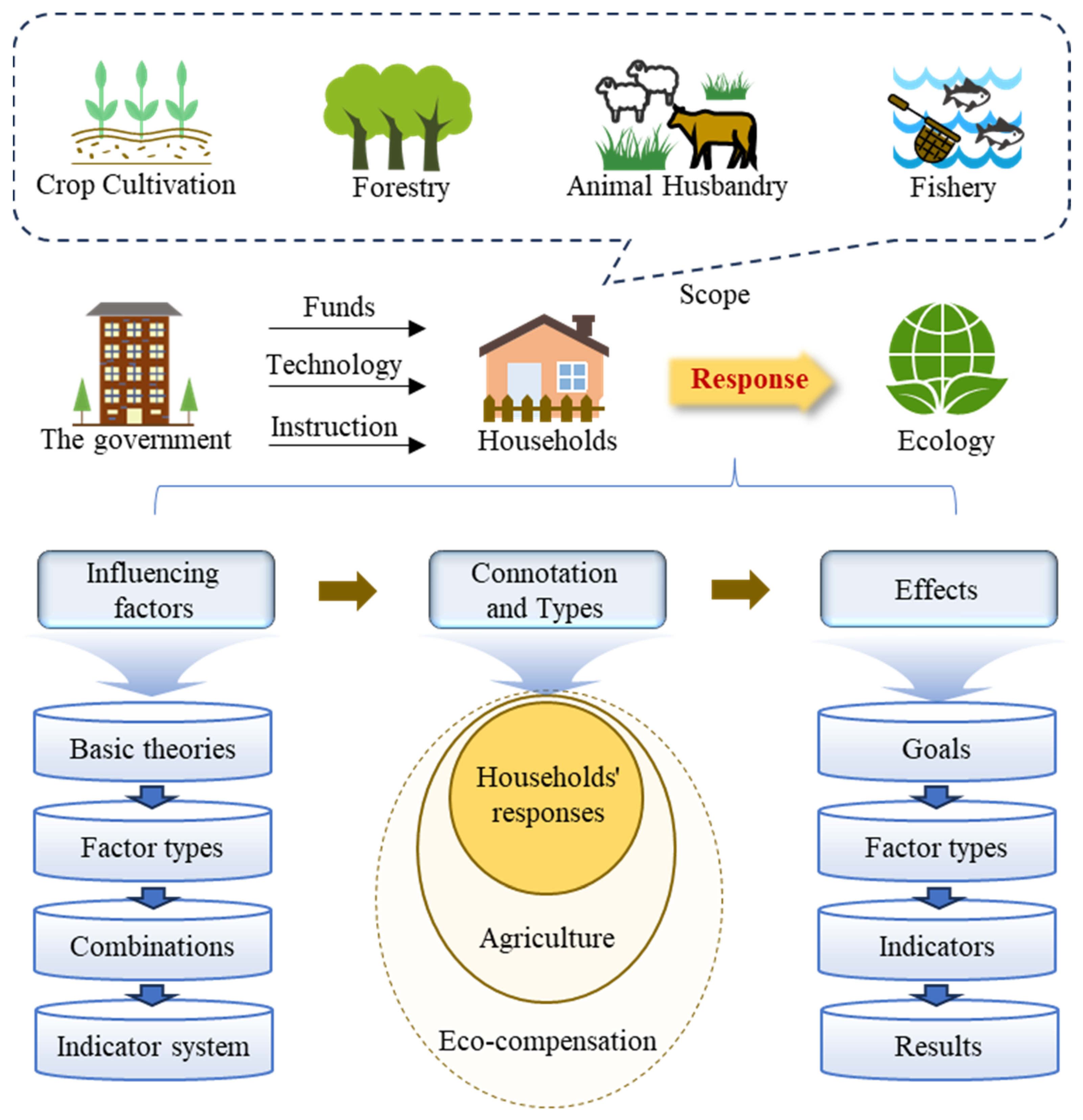
2. Research Framework on Agricultural Households’ Response to Eco-Compensation in China
2.1. Research Scope
2.2. Core Contents
3. The Connotation and Types of Agricultural Households’ Response to Eco-Compensation in China

| Types | Protecting Objects | Specific Changes | References |
|---|---|---|---|
| Reducing production intensity | Farmlands | Fallow | Xie et al., 2022 [17] |
| Grasslands | Reduce grazing | Li et al., 2022 [19] | |
| Forests | Stop farming | Lu et al., 2025 [52] | |
| Aquatic biological resources | Reduce fishing | He and Chen, 2022 [53] | |
| Optimizing production methods | Farmlands | Reducing chemical inputs | Liu et al., 2020 [54] |
| Appling organic fertilizer | Yi et al., 2021 [55] | ||
| Planting green manure | Ntakirutimana et al., 2019 [56] | ||
| Crop rotation | Zhang et al., 2025 [57] | ||
| comprehensive utilization of crop straw | Jiang et al., 2025 [58] | ||
| Grasslands | Manual grass-cutting | Li and Liu., 2023 [21] | |
| Breed improvement | |||
| Cross-regional grazing | |||
| Barn feeding | |||
| Forests | Agroforestry | Zhu and Wang, 2015 [59] | |
| Cultivating economic forests | Liu et al., 2025 [60] | ||
| Watersheds | Paddy land to dry land | Hong et al., 2020 [61] | |
| Changing livelihood types | Multi-field | Non-farm livelihood | Wen et al., 2022 [62] |
| Xu and Feng, 2025 [63] |
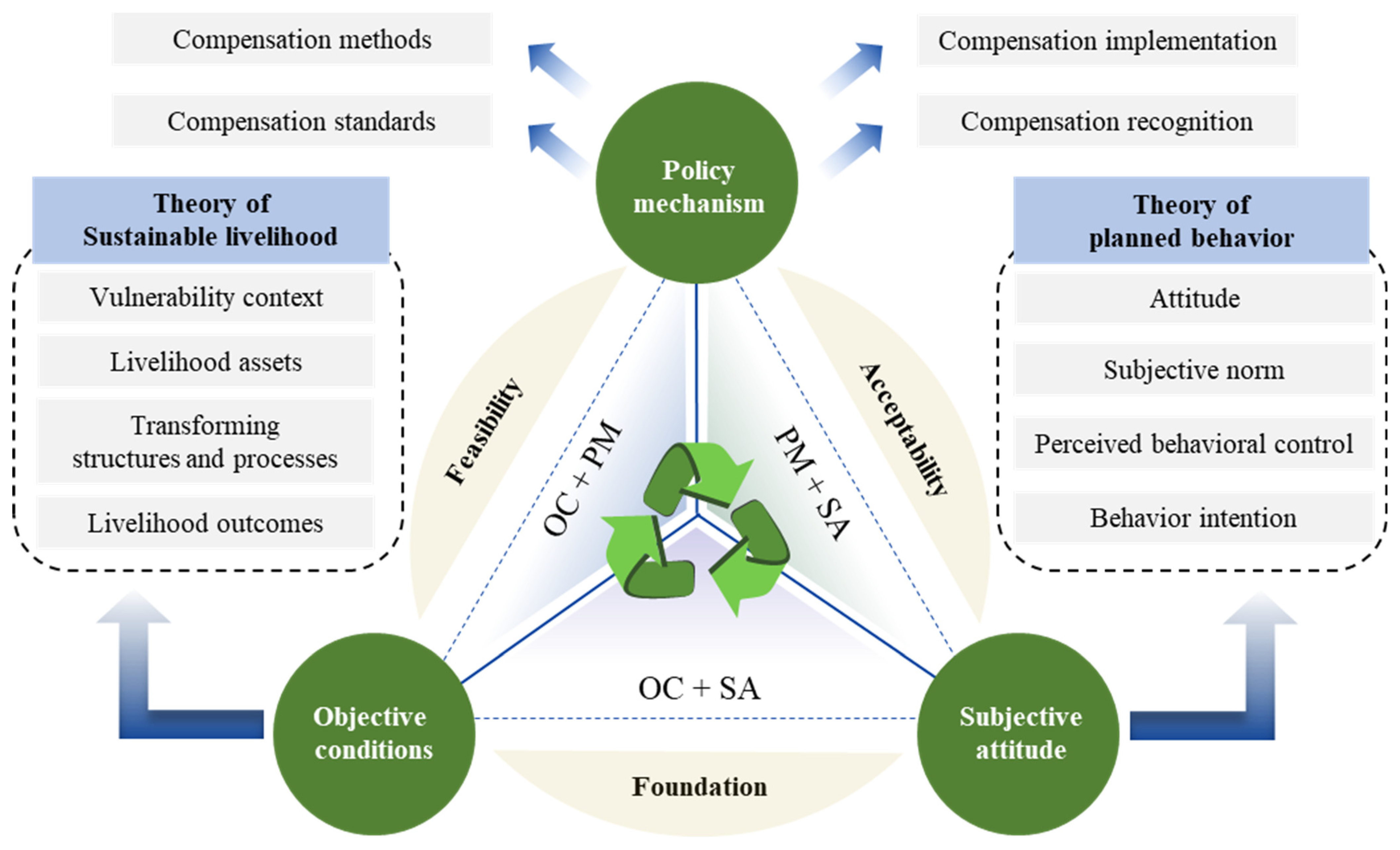
4. The Influencing Factors of Agricultural Households’ Response to Eco-Compensation in China
| Factor Types | Subclasses | Specific Indicators or Factor Descriptions | References |
|---|---|---|---|
| Compensation policy and mechanism | Compensation methods | Fund compensation Technology compensation | Yang and Zheng, 2021 [65] |
| Compensation standards | Subsidy amounts | Qiu et al., 2022 [69] | |
| Compensation implementation | Supervision intensity Contract duration | Pang and Jin, 2021 [70] Giefer et al., 2021 [71] | |
| Compensation recognition | Satisfaction Level of trust in policy | Li and Liu., 2023 [21] Xie et al., 2017 [22] | |
| Theory of sustainable livelihood | Vulnerability contexts | Location characteristic Road infrastructure Industrial structure Economic growth | Démurger and Pelletier, 2015 [73] Liu et al., 2024 [74] |
| Livelihood assets | Household size or number of agricultural workers Education level Farmland size Farmland quality Household income Feasibility of loan Possession of houses Possession of livestock Possession of agricultural machines Possession of durable consumer goods Social network Energy structure | Giefer et al., 2021 [71] Sheng et al., 2019 [75] Wei et al., 2021 [76] Liu et al., 2018 [77] Shen et al., 2025 [78] | |
| Transforming structures and processes | In addition to eco-compensation, it also includes related supporting systems such as social security and employment assistance. | Chen, 2023 [79] | |
| Livelihood outcomes | Income change Food safety change Disaster resilience change | Li and Liu., 2023 [21] | |
| Theory of planned behavior | Attitudes toward the behavior | Positive/negative attitudes towards protecting/destroying the ecology Perception of ecological and economic benefits of compensation policies | Deng et al., 2016 [85] Peng et al., 2022 [64] |
| Subjective norms | Pressure from neighbors Trust in the government and people around | Shi et al., 2019 [86] Dai et al., 2025 [84] | |
| Perceived behavioral control | Capacity Policy perception | Shi et al., 2019 [86] Jin et al., 2020 [72] | |
| Behavioral intention | The willingness of households to respond | Pang et al., 2021 [87] |
5. The Effects of Agricultural Households’ Response to Eco-Compensation in China
6. Discussion
7. Conclusions
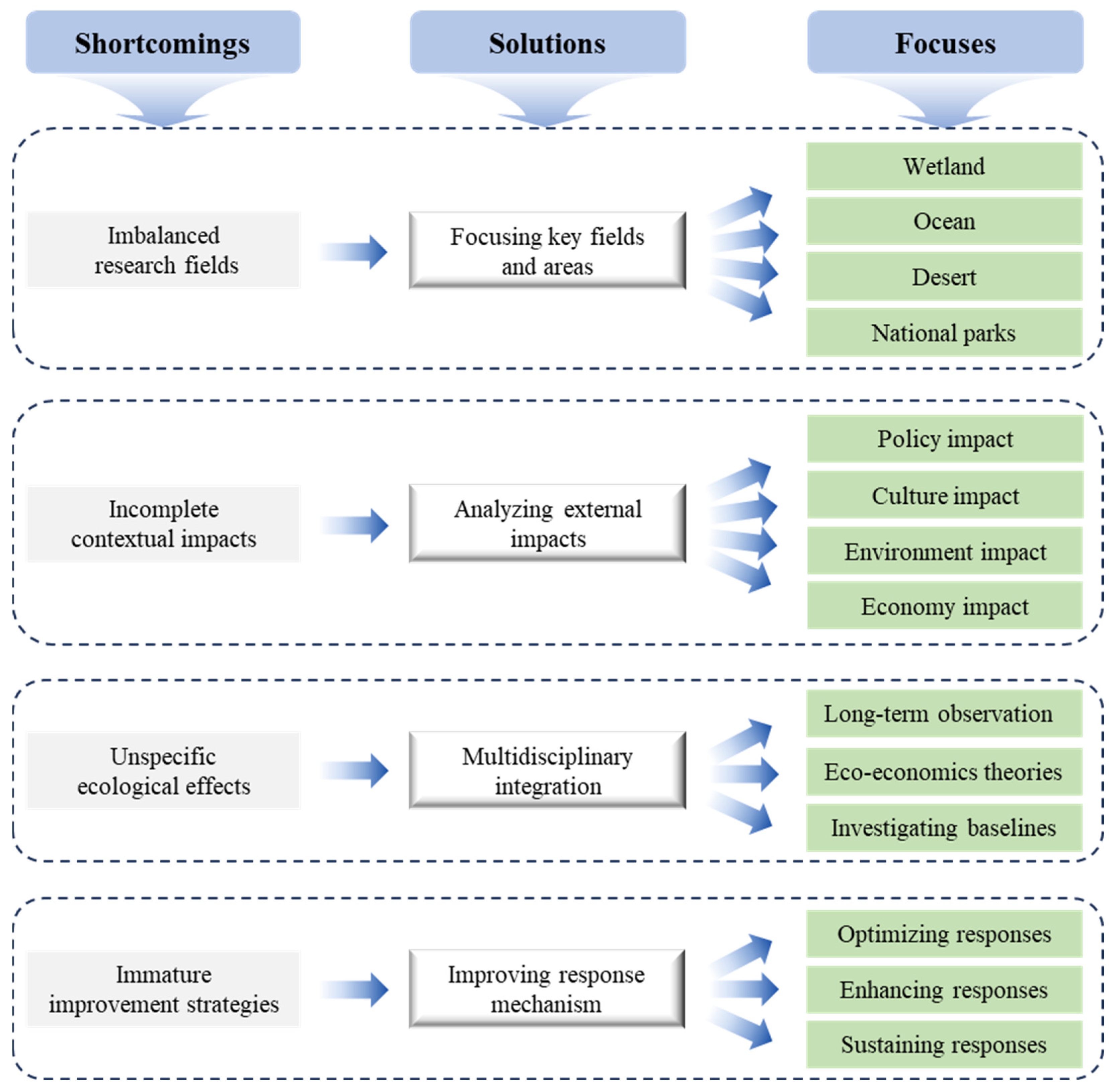
8. Future Directions
- Strengthening research in key areas and protected areas
- 2.
- Focusing on the correlation between contexts and agricultural households’ responses
- 3.
- Multidisciplinary integration for precise evaluation of ecological effects
- 4.
- Studying the improvement mechanism of agricultural households’ responses
Author Contributions
Funding
Institutional Review Board Statement
Data Availability Statement
Conflicts of Interest
References
- Bryan, B.A.; Gao, L.; Ye, Y.; Sun, X.; Connor, J.D.; Crossman, N.D.; Stafford-Smith, M.; Wu, J.; He, C.; Yu, D.; et al. China’s response to a national land-system sustainability emergency. Nature 2018, 559, 193–204. [Google Scholar] [CrossRef] [PubMed]
- Zhang, W.; Wei, C.; Li, J.; Zhou, Q.; Ma, J.; Li, Y.; He, Y.; Zou, Y.; Luo, Y.; Yao, Y. Stabilization of acidification in China’s cropland soils. Nat. Geosci. 2025, 18, 1125–1132. [Google Scholar] [CrossRef]
- Wu, Z.; Zhou, Z.; Liang, H.; Wu, H.; Liu, Z.; Xie, Z.; Zhu, J.; Zheng, B.; Wan, W. Application of a comprehensive framework to estimate the risk of agricultural non-point source pollution in China since 2000. J. Clean. Prod. 2025, 509, 145581. [Google Scholar] [CrossRef]
- Li, H.; Jin, X.; Zhao, R.; Han, B.; Liang, X.; Sun, R. Decoding the spatiotemporal dynamics of cropland carbon emission drivers in China: A machine learning-based analysis. J. Clean. Prod. 2025, 526, 146675. [Google Scholar] [CrossRef]
- Zabel, F.; Delzeit, R.; Schneider, J.M.; Seppelt, R.; Mauser, W.; Václavík, T. Global impacts of future cropland expansion and intensification on agricultural markets and biodiversity. Nat. Commun. 2019, 10, 2844. [Google Scholar] [CrossRef]
- Shang, W.; Gong, Y.; Wang, Z.; Stewardson, M.J. Eco-compensation in China: Theory, practices and suggestions for the future. J. Environ. Manag. 2018, 210, 162–170. [Google Scholar] [CrossRef]
- Mayr, S.; Pokorny, B.; Montero-de-Oliveira, F.-E.; Reinecke, S. Scaling agroforestry through payments for ecosystem services: A scoping review. Clim. Policy 2025, 1–20. [Google Scholar] [CrossRef]
- Diswandi, D.; Fadliyanti, L.; Afifi, M.; Busaini, B.; Dakwah, M.M. Harmonizing tourism and conservation through payment for ecosystem services: A case study of Gili Matra, Indonesia. Environ. Dev. 2025, 55, 101184. [Google Scholar] [CrossRef]
- Hayes, T.; Murtinho, F.; Wolff, H.; López-Sandoval, M.F.; Salazar, J. Effectiveness of payment for ecosystem services after loss and uncertainty of compensation. Nat. Sustain. 2021, 5, 81–88. [Google Scholar] [CrossRef]
- Qiu, L.; Kant, S.; Zeng, W. Modeling willingness to continue participation in payments for ecosystem services programs: A case of China’s second phase of the grain for green program in indigenous communities. For. Policy Econ. 2025, 174, 103489. [Google Scholar] [CrossRef]
- Li, Q.; Zander, P. Resilience building of rural livelihoods in PES programmes: A case study in China’s Loess Hills. Ambio 2019, 49, 962–985. [Google Scholar] [CrossRef] [PubMed]
- Liang, Y.; Li, S.; Feldman, M.W.; Daily, G.C. Does household composition matter? The impact of the Grain for Green Program on rural livelihoods in China. Ecol. Econ. 2012, 75, 152–160. [Google Scholar] [CrossRef]
- Behrendt, K.; Brown, C.; Qiao, G.; Zhang, B. Assessing the opportunity costs of Chinese herder compliance with a payment for environmental services scheme. Ecol. Econ. 2022, 193, 107313. [Google Scholar] [CrossRef]
- Jiang, Z.; Gao, Y.; Jin, L. Herdsmen’ s satisfaction and support to grassland eco-compensation policy: A SEM test based on CSI logic model. Acta Ecol. Sin. 2024, 44, 196–208. [Google Scholar] [CrossRef]
- Sheng, J.; Cheng, Q.; Wu, Y. Payment for watershed services and the coordination of interests in transboundary rivers: China’s Xin’an River Basin Eco-compensation pilot. J. Environ. Manag. 2023, 328, 116670. [Google Scholar] [CrossRef]
- Ren, Y.; Lin, F.; Fu, L.; Ren, D. The impact of ecological compensation in the Xin’an river basin on rural residents’ livelihood strategies—The moderating role of livelihood capital. J. Anhui Norm. Univ. (Hum. Soc. Sci.) 2025, 53, 101–112. [Google Scholar] [CrossRef]
- Xie, X.; Cui, Y.; Yao, L.; Ni, Q.; Khan, S.U.; Zhao, M. Does fallow policy affect rural household income in poor areas? A quasi-experimental evidence from fallow pilot area in Northwest China. Land Use Policy 2022, 120, 106220. [Google Scholar] [CrossRef]
- Campbell, B.M.; Beare, D.J.; Bennett, E.M.; Hall-Spencer, J.M.; Ingram, J.S.I.; Jaramillo, F.; Ortiz, R.; Ramankutty, N.; Sayer, J.A.; Shindell, D. Agriculture production as a major driver of the Earth system exceeding planetary boundaries. Ecol. Soc. 2017, 22, 8. [Google Scholar] [CrossRef]
- Li, Z.; Su, B.; Liu, M. Research Progress on the Theory and Practice of Grassland Eco-Compensation in China. Agriculture 2022, 12, 721. [Google Scholar] [CrossRef]
- Pan, X.; Xu, L.; Yang, Z.; Yu, B. Payments for ecosystem services in China: Policy, practice, and progress. J. Clean. Prod. 2017, 158, 200–208. [Google Scholar] [CrossRef]
- Li, Z.; Liu, M. Herder households’ livelihood strategies as a response to payments for grassland ecosystem services in China. Land Degrad. Dev. 2023, 34, 1375–1389. [Google Scholar] [CrossRef]
- Xie, H.; Cheng, L.; Lv, T. Factors Influencing Farmer Willingness to Fallow Winter Wheat and Ecological Compensation Standards in a Groundwater Funnel Area in Hengshui, Hebei Province, China. Sustainability 2017, 9, 839. [Google Scholar] [CrossRef]
- Xue, R.; Faye, B.; Zhang, R.; Gong, X.; Du, G. Farmers’ Willingness to Engage in Ecological Compensation for Crop Rotation in China’s Black Soil Regions. Agriculture 2024, 14, 1320. [Google Scholar] [CrossRef]
- Lin, J. An Empirical Research on Eco-Compensation Strategy for Handling Non-Point Source Pollution of Water Bodies. Appl. Ecol. Environ. Res. 2019, 17, 4823–4838. [Google Scholar] [CrossRef]
- Ti, J.; Yang, Y.; Pu, L.; Wen, X.; Yin, X.; Chen, F. Ecological compensation for winter wheat fallow and impact assessment of winter fallow on water sustainability and food security on the North China Plain. J. Clean. Prod. 2021, 328, 129431. [Google Scholar] [CrossRef]
- Zhang, Y.; Ma, Y. Areal research and development compensation efficiency and influencing factors in grain core area. Areal Res. Dev. 2022, 41, 153–158. [Google Scholar]
- Han, F.; Zhang, X.; Zhou, R. A review and prospect of grassland ecological compensation and its impact on herders’ behavior. Resour. Sci. 2024, 46, 1447–1459. [Google Scholar]
- Li, J.; Li, M.; Ji, H. Relationship among eco-compensation policy, income impact and life quality of herdsmen: Case of Qinghai province. J. Arid Land Resour. Environ. 2022, 36, 63–71. [Google Scholar] [CrossRef]
- Chen, J.; Chen, Y. Intrinsic logic and implementation path of grassland ecological compensation. Grassl. Prataculture 2024, 36, 58–62. [Google Scholar]
- Yang, Q.; Wang, W.; Zhou, L.; Li, Y.; Lu, J. Progress and prospects of research on compensation for arable land protection. J. Southwest Univ. (Nat. Sci. Ed.) 2024, 46, 2–14. [Google Scholar] [CrossRef]
- Sun, X.; Wang, B.; Dong, Z. Watershed Ecological Compensation: Theoretical Basis and Model Innovation. Reform 2021, 145–155. [Google Scholar]
- Chen, J.; Hong, Y.; Huang, G.; Yang, X.; Lin, X.; Liu, Y. Research progress on the effect of forest ecological compensation policy and its influencing factors. Issues For. Econ. 2022, 42, 477–489. [Google Scholar]
- Ren, L.; Li, J.; Li, S.; Li, C.; Daily, G.C. Does China’s major Payment for Ecosystem Services program meet the “gold criteria”? Targeting strategies of different decision-makers. J. Clean. Prod. 2020, 275, 122667. [Google Scholar] [CrossRef]
- Deng, X.; Yan, S.; Song, X.; Li, Z.; Mao, J. Spatial targets and payment modes of win–win payments for ecosystem services and poverty reduction. Ecol. Indic. 2022, 136, 108612. [Google Scholar] [CrossRef]
- Tian, T.; Zhu, S.-Y.; Zhang, J.; Zhao, X.-Z.; Zhao, L.; Ullah, F.; Li, M.-Y.; Zhao, Z.-Y.; Xiong, Y.-C. Livelihood-environment trade-off under the payment for ecosystem services (PES) at decadal scale in northwest China. Ecol. Front. 2025, 45, 98–107. [Google Scholar] [CrossRef]
- Diendéré, A.A.; Kaboré, D. Preferences for a payment for ecosystem services program to control forest fires in Burkina Faso: A choice experiment. For. Policy Econ. 2023, 151, 102973. [Google Scholar] [CrossRef]
- Vorlaufer, T.; Engel, S.; de Laat, J.; Vollan, B. Payments for ecosystem services did not crowd out pro-environmental behavior: Long-term experimental evidence from Uganda. Proc. Natl. Acad. Sci. USA 2023, 120, e2215465120. [Google Scholar] [CrossRef]
- Waruingi, E.; Mbeche, R.; Ateka, J. Determinants of forest dependent household’s participation in payment for ecosystem services: Evidence from Plantation Establishment Livelihood Improvement Scheme (PELIS) in Kenya. Glob. Ecol. Conserv. 2021, 26, e01514. [Google Scholar] [CrossRef]
- Wunder, S.; Fraccaroli, C.; Varela, E.; Bruzzese, S.; Termansen, M. Examining innovative designs of agri-environmental schemes in Europe: A case comparison of impact pathways. Ecosyst. Serv. 2025, 73, 101728. [Google Scholar] [CrossRef]
- Pérez-Sánchez, C.; Pierri-Daunt, A.B.; Villamayor-Tomas, S. Unraveling spatial agglomeration patterns in agri-environmental schemes: Evidence from the improvement of steppe habitats in the Natura 2000 network in Catalonia (Spain). Land Use Policy 2024, 142, 107145. [Google Scholar] [CrossRef]
- Wittstock, F.; Paulus, A.; Beckmann, M.; Hagemann, N.; Baaken, M.C. Understanding farmers’ decision-making on agri-environmental schemes: A case study from Saxony, Germany. Land Use Policy 2022, 122, 106371. [Google Scholar] [CrossRef]
- Li, W.; Liu, M. Serveral Strategic Thoughts on China’s Eco-compensation Mechanism. Resour. Sci. 2010, 32, 791–796. [Google Scholar]
- Moioli, C.; Shrestha, A.; Roeser, D.; Wang, G.; Sunderland, T.; Zerriffi, H. Reforestation, livelihoods and income equality: Lessons learned from China’s Conversion of Cropland to Forest Program. Land Degrad. Dev. 2023, 34, 2838–2848. [Google Scholar] [CrossRef]
- Blanco, E.; Moros, L.; Pfaff, A.; Steimanis, I.; Velez, M.A.; Vollan, B. No crowding out among those terminated from an ongoing PES program in Colombia. J. Environ. Econ. Manag. 2023, 120, 102826. [Google Scholar] [CrossRef]
- Moros, L.; Vélez, M.A.; Quintero, D.; Tobin, D.; Pfaff, A. Temporary PES do not crowd out and may crowd in lab-in-the-field forest conservation in Colombia. Ecol. Econ. 2023, 204, 107652. [Google Scholar] [CrossRef]
- Tanaka, K.; Hanley, N.; Kuhfuss, L. Farmers’ preferences toward an outcome-based payment for ecosystem service scheme in Japan. J. Agric. Econ. 2022, 73, 720–738. [Google Scholar] [CrossRef]
- Hu, Y.; Kuhn, L.; Zeng, W.; Glauben, T. Who benefits from payments for ecosystem services? Policy lessons from a forest carbon sink program in China. Ecol. Econ. 2023, 214, 107976. [Google Scholar] [CrossRef]
- Howell, A. Socio-economic impacts of scaling back a massive payments for ecosystem services programme in China. Nat. Hum. Behav. 2022, 6, 1218–1225. [Google Scholar] [CrossRef]
- Zhang, H.; An, L.; Bilsborrow, R.; Chun, Y.; Yang, S.; Dai, J. Neighborhood impacts on household participation in payments for ecosystem services programs in a Chinese nature reserve: A methodological exploration. J. Geogr. Sci. 2021, 31, 899–922. [Google Scholar] [CrossRef]
- Li, Z.; Rao, D.; Liu, M. The Impact of China’s Grassland Ecological Compensation Policy on the Income Gap between Herder Households? A Case Study from a Typical Pilot Area. Land 2021, 10, 1405. [Google Scholar] [CrossRef]
- Chen, S.; Wu, J.; Zhang, X. Sustainable livelihood of retired fishing households in China’s Yangtze River during the 10-year fishing ban. Chin. J. Agric. Resour. Reg. Plan. 2025, 46, 131–143. [Google Scholar]
- Lu, Y.; Kong, F.; Xu, C. The impact of China’s grain for green program on farmer’s income: A systematic review and meta-analysis. Ecol. Front. 2025, 45, 1165–1178. [Google Scholar] [CrossRef]
- He, Y.; Chen, T. Does the 10-Year Fishing Ban Compensation Policy in the Yangtze River Basin Improve the Livelihoods of Fishing Households? Evidence from Ma’anshan City, China. Agriculture 2022, 12, 2088. [Google Scholar] [CrossRef]
- Liu, M.; Chen, C.; Yang, L.; Min, Q.; Xiong, Y. Agricultural eco-compensation may not necessarily reduce chemical inputs. Sci. Total Environ. 2020, 741, 139847. [Google Scholar] [CrossRef]
- Yi, X.; Yu, L.; Chang, S.-H.-E.; Yin, C.; Wang, H.; Zhang, Z. The effects of China’s Organic-Substitute-Chemical-Fertilizer (OSCF) policy on greenhouse vegetable farmers. J. Clean. Prod. 2021, 297, 126677. [Google Scholar] [CrossRef]
- Ntakirutimana, L.; Li, F.; Huang, X.; Wang, S.; Yin, C. Green Manure Planting Incentive Measures of Local Authorities and Farmers’ Perceptions of the Utilization of Rotation Fallow for Sustainable Agriculture in Guangxi, China. Sustainability 2019, 11, 2723. [Google Scholar] [CrossRef]
- Zhang, R.; Du, G.; Faye, B.; Liu, H. Analysis of Farmers’ Crop Rotation Intention and Behavior Using Structural Equation Modeling: Evidence from Heilongjiang Province, China. Land 2025, 14, 158. [Google Scholar] [CrossRef]
- Jiang, Z.; Li, W.; Gao, Y. Eco-compensation policy to promote households’ behavior for comprehensive utilization of crop straw: Do the positive effects last? Sustain. Futures 2025, 9, 100505. [Google Scholar] [CrossRef]
- Zhu, C.; Wang, S. The conversion of cropland to forest, cropland constraint and farmer household economic behaviors. Econ. Probl. 2015, 86–90. [Google Scholar] [CrossRef]
- Liu, H.; Su, X.; Guan, J.; Zhang, H. Implementation effects of China’s forest ecological compensation policy——Literature analysis from CNKI and other databases. China For. Econ. 2025, 21–30. [Google Scholar] [CrossRef]
- Hong, J.; Zhang, Q.; Wu, F.; Yang, Y.; Dong, C. Assessment on environmental benefit of agro-ecological compensation under “Paddy Land to Dry Land” policy. J. Arid Land Resour. Environ. 2020, 34, 103–108. [Google Scholar] [CrossRef]
- Wen, Q.; Fang, J.; Li, X.; Su, F. Impact of Ecological Compensation on Farmers’ Livelihood Strategies in Energy Development Regions in China: A Case Study of Yulin City. Land 2022, 11, 965. [Google Scholar] [CrossRef]
- Xu, X.; Feng, X. Does Grassland Ecological Compensation Policy Really Promote Herders’ Collective Action in Community-Based Grassland Conservation? Evidence from Northern China. Land Degrad. Dev. 2025, 36, 6455–6468. [Google Scholar] [CrossRef]
- Peng, J.; Lü, H.; Qiao, R.; Yu, S.; Xu, Z.; Wu, J. Farm households’ willingness to participate in China’s Grain-for-Green Program under different compensation scenarios. Ecol. Indic. 2022, 139, 108890. [Google Scholar] [CrossRef]
- Yang, F.; Zheng, X. Impact of ecological compensation methods on farmers’green production behaviors from the perspective of value perception. China Popul. Resour. Environ. 2021, 31, 164–171. [Google Scholar]
- Liu, M.; Bai, Y.; Ma, N.; Rao, D.; Yang, L.; Min, Q. Blood transfusion or hematopoiesis? how to select between the subsidy mode and the long-term mode of eco-compensation. Environ. Res. Lett. 2020, 15, 094059. [Google Scholar] [CrossRef]
- Liu, M.; Rao, D.; Yang, L.; Min, Q. Subsidy, training or material supply? The impact path of eco-compensation method on farmers’ livelihood assets. J. Environ. Manag. 2021, 287, 112339. [Google Scholar] [CrossRef]
- Li, W. Research on Wetland Protection Behavior Decision Simulation and Optimization Strategy of Coastal Farmers—Based on CE and ABM model. Master’s Thesis, Guangxi University, Nanning, China, 2024. [Google Scholar]
- Qiu, H.; Su, L.; Tang, J. Effects of environmental regulation on rural livelihood diversification: Evidence from pastoral China. J. Rural Stud. 2022, 95, 26–39. [Google Scholar] [CrossRef]
- Pang, J.; Jin, L. Wetland ecological compensation mechanism: A case study of the Poyang Lake. J. Ecol. Rural Environ. 2021, 37, 456–464. [Google Scholar] [CrossRef]
- Giefer, M.M.; An, L.; Chen, X. Normative, livelihood, and demographic influences on enrollment in a payment for ecosystem services program. Land Use Policy 2021, 108, 105525. [Google Scholar] [CrossRef]
- Jin, L.; Xu, K.; Pang, J. Impact of ecological cognition on farmers’willingness and behavior of participating sloping land conversion program: Based on survey data from two poverty-stricken counties in yunnan province. J. Agro-For. Econ. Manag. 2020, 19, 716–725. [Google Scholar] [CrossRef]
- Démurger, S.; Pelletier, A. Volunteer and satisfied? Rural households’ participation in a payments for environmental services programme in Inner Mongolia. Ecol. Econ. 2015, 116, 25–33. [Google Scholar] [CrossRef]
- Liu, G.; Zhou, Y.; Ge, Y. The impact of diversified ecological compensation on rural households’ livelihood strategy choices: A case study of rural households in ecological protection redline zones. Rural Econ. 2024, 120–131. [Google Scholar]
- Sheng, J.; Qiu, H.; Zhang, S. Opportunity cost, income structure, and energy structure for landholders participating in payments for ecosystem services: Evidence from Wolong National Nature Reserve, China. World Dev. 2019, 117, 230–238. [Google Scholar] [CrossRef]
- Wei, X.; Khachatryan, H.; Zhu, H. Poyang lake wetlands restoration in China: An analysis of farmers’ perceptions and willingness to participate. J. Clean. Prod. 2021, 284, 125001. [Google Scholar] [CrossRef]
- Liu, M.; Yang, L.; Bai, Y.; Min, Q. The impacts of farmers’ livelihood endowments on their participation in eco-compensation policies: Globally important agricultural heritage systems case studies from China. Land Use Policy 2018, 77, 231–239. [Google Scholar] [CrossRef]
- Shen, X.; Dong, J.; Grilli, G.; Pagliacci, F.; Gatto, P. Should I stay or should I go? Farmers’ choices to remain in a PES program when policy design changes. J. Environ. Manag. 2025, 384, 125552. [Google Scholar] [CrossRef]
- Chen, H. Research on the Mechanism of the Impact of Fishing Ban Compensation Policy in the Yangtze River Basin on the Livelihood of Fishermen. Master’s Thesis, Shanghai Ocean University, Shanghai, China, 2023. [Google Scholar]
- Liu, Y.; Zhou, J.; Cheng, H.; Li, Y.; Shen, Y.; Wan, L.; Yang, S.; Liu, G.; Su, X. The role of livelihood assets in livelihood strategy choice from the perspective of macrofungal conservation in nature reserves on the Qinghai-Tibetan Plateau. Glob. Ecol. Conserv. 2023, 44, e02478. [Google Scholar] [CrossRef]
- Tora, T.T.; Degaga, D.T.; Utallo, A.U. Impacts of livelihood assets on livelihood security in drought-prone Gamo lowlands of southwest Ethiopia. Geogr. Sustain. 2022, 3, 58–67. [Google Scholar] [CrossRef]
- Yang, L.; Liu, M.; Lun, F.; Min, Q.; Zhang, C.; Li, H. Livelihood Assets and Strategies among Rural Households: Comparative Analysis of Rice and Dryland Terrace Systems in China. Sustainability 2018, 10, 2525. [Google Scholar] [CrossRef]
- Ajzen, I. The theory of planned behavior. Organ. Behav. Hum. Decis. Process. 1991, 50, 179–211. [Google Scholar] [CrossRef]
- Dai, Q.; Zhou, Y.; Hu, J.; Xu, W. Impact of ecological compensation modes on the ecological protection behavior of farmers. Econ. Geogr. 2025, 45, 139–149. [Google Scholar] [CrossRef]
- Deng, J.; Sun, P.; Zhao, F.; Han, X.; Yang, G.; Feng, Y. Analysis of the ecological conservation behavior of farmers in payment for ecosystem service programs in eco-environmentally fragile areas using social psychology models. Sci. Total Environ. 2016, 550, 382–390. [Google Scholar] [CrossRef] [PubMed]
- Shi, H.; Wang, Z.; Yan, L. The influence of ecological cognition on farmers’ grain for green behavior: Based on TPB and multi-group SEM. China Land Sci. 2019, 33, 42–49. [Google Scholar] [CrossRef]
- Pang, J.; Qiu, S.; Jin, L. Effect of Eco-compensation Policy on Farmers’ Willing and Behavior of Wetlands Ecological Protection: Based on Poyang Lake. Resour. Environ. Yangtze Basin 2021, 30, 2982–2991. [Google Scholar]
- Sheng, J.; Wang, H. Participation, income growth and poverty alleviation in payments for ecosystem services: The case of China’s Wolong Nature Reserve. Ecol. Econ. 2022, 196, 107433. [Google Scholar] [CrossRef]
- Li, H.; Cai, Y.; Zhang, Y.; Liu, Y.; Zhang, K.; Yang, X. Impact of a cross-jurisdictional Payment for Ecosystem Services program on the participants’ welfare in North China. J. Clean. Prod. 2018, 189, 454–463. [Google Scholar] [CrossRef]
- Li, J.; Feldman, M.W.; Li, S.; Daily, G.C. Rural household income and inequality under the Sloping Land Conversion Program in western China. Proc. Natl. Acad. Sci. USA 2011, 108, 7721–7726. [Google Scholar] [CrossRef] [PubMed]
- Zheng, H.; Robinson, B.E.; Liang, Y.-C.; Polasky, S.; Ma, D.-C.; Wang, F.-C.; Ruckelshaus, M.; Ouyang, Z.-Y.; Daily, G.C. Benefits, costs, and livelihood implications of a regional payment for ecosystem service program. Proc. Natl. Acad. Sci. USA 2013, 110, 16681–16686. [Google Scholar] [CrossRef]
- He, Y.; Chen, T.; Liu, Z.; Li, Q. Impact of fishing ban compensation policy on retired fishing households’ livelihoods in Yangtze River. Resour. Environ. Yangtze Basin 2023, 32, 311–323. [Google Scholar]
- Wang, Y.; Niu, J.; Wang, Y.; Zhang, Y.; Zhang, J.; Chen, X. Pathways from payments for ecosystem services to household energy transition. Ecol. Front. 2025, 45, 950–958. [Google Scholar] [CrossRef]
- Hou, L.; Xia, F.; Chen, Q.; Huang, J.; He, Y.; Rose, N.; Rozelle, S. Grassland ecological compensation policy in China improves grassland quality and increases herders’ income. Nat. Commun. 2021, 12, 4683. [Google Scholar] [CrossRef]
- Zhang, Q.; Wang, Y.; Tao, S.; Bilsborrow, R.E.; Qiu, T.; Liu, C.; Sannigrahi, S.; Li, Q.; Song, C. Divergent socioeconomic-ecological outcomes of China’s conversion of cropland to forest program in the subtropical mountainous area and the semi-arid Loess Plateau. Ecosyst. Serv. 2020, 45, 101167. [Google Scholar] [CrossRef]
- Zhao, Q.; Shen, R.; Teng, Y.; Li, X. Pilot progress and countermeasures on farmland rotation and fallow system in the groundwater funnel area of China. Soils 2018, 50, 1–6. [Google Scholar] [CrossRef]
- Li, Z.; Liu, M.; Xu, L.; Teng, W.; Fang, J. Construction of Eco-Compensation Policy Framework for Natural Rubber with Production and Ecological Win–Win. Land 2025, 14, 368. [Google Scholar] [CrossRef]
- Gao, Y.; Bi, Y.; Yu, L. Understanding the impacts of ecological compensation policy on rural livelihoods: Insights from forest communities of China. J. Environ. Manag. 2025, 374, 123921. [Google Scholar] [CrossRef] [PubMed]
- Simpson, K.; Armsworth, P.R.; Dallimer, M.; Nthambi, M.; de Vries, F.P.; Hanley, N. Improving the ecological and economic performance of agri-environment schemes: Payment by modelled results versus payment for actions. Land Use Policy 2023, 130, 106688. [Google Scholar] [CrossRef]
- Jayachandran, S. The inherent trade-off between the environmental and anti-poverty goals of payments for ecosystem services. Environ. Res. Lett. 2023, 18, 025003. [Google Scholar] [CrossRef]
- Lapierre, M.; Le Velly, G.; Bougherara, D.; Préget, R.; Sauquet, A. Designing agri-environmental schemes to cope with uncertainty. Ecol. Econ. 2023, 203, 107610. [Google Scholar] [CrossRef]
- Bartkowski, B.; Beckmann, M.; Bednář, M.; Biffi, S.; Domingo-Marimon, C.; Mesaroš, M.; Schüßler, C.; Šarapatka, B.; Tarčak, S.; Václavík, T.; et al. Adoption and potential of agri-environmental schemes in Europe: Cross-regional evidence from interviews with farmers. People Nat. 2023, 5, 1610–1621. [Google Scholar] [CrossRef]
- Wąs, A.; Malak-Rawlikowska, A.; Zavalloni, M.; Viaggi, D.; Kobus, P.; Sulewski, P. In search of factors determining the participation of farmers in agri-environmental schemes—Does only money matter in Poland? Land Use Policy 2021, 101, 105190. [Google Scholar] [CrossRef]
- Sander, A.; Ghazoul, J.; Finger, R.; Schaub, S. Participation in individual and collective agri-environmental schemes: A synthesis using the Theory of Planned Behaviour. J. Rural Stud. 2024, 107, 103255. [Google Scholar] [CrossRef]
- Huang, W.; Yang, B. Ecological compensation policy of Xin’an River Basin on efficiency of green water resources utilization. Resour. Environ. Yangtze Basin 2024, 33, 1969–1981. [Google Scholar]
- Lv, W.; Fan, P.; Wang, W. Semi market-oriented environmental incentives and ecological restoration: Evidence from horizontal ecological compensation in the Xin’an River Basin. Financ. Trade Econ. 2025, 46, 23–37. [Google Scholar]
- Chen, X.; Ma, L.; Zhuang, D.; Zhang, L. The impacts and transmission mechnisms of “forest eco-bank” on rural households’ livelihoods—An analysis based on micro-survey data of farmers in Shunchang County. Issues For. Econ. 2025, 45, 203–215. [Google Scholar]
- Xu, X.; Li, L.; Zhang, F. Configurations of Market-Oriented Tourism Ecological Compensation: A csQCA Approach. J. China Tour. Res. 2023, 20, 356–377. [Google Scholar] [CrossRef]
- Wang, B.; Lin, Y.; Ren, L.; Sun, G.; Gao, J. The impact of ecological compensation policies for public welfare forests on the livelihood strategies and income of forest farmers. Issues For. Econ. 2023, 43, 200–208. [Google Scholar]
- Pang, J.; Xu, K.; Jin, L. Research on the impact of wetland eco-compensation on farmers’ livelihood strategies and income: An empirical analysis of Poyang Lake. China Land Sci. 2021, 35, 72–80+108. [Google Scholar]
- Benjamin, E.O.; Ola, O.; Buchenrieder, G. Does an agroforestry scheme with payment for ecosystem services (PES) economically empower women in sub-Saharan Africa? Ecosyst. Serv. 2018, 31, 1–11. [Google Scholar] [CrossRef]


| Effect Types | Study Areas | Evaluation Objects | Key Conclusions | References |
|---|---|---|---|---|
| Economy | Wolong nature reserve in Sichuan | Income growth | Increased PES participation can promote income growth. And PES participation was more beneficial to small and medium farmers than large farmers. | Sheng and Wang, 2022 [88] |
| Miyun reservoir in Beijing and Hebei | Total household income | The paddy land-to-dry land program had a positive but somewhat limited effect on total household income (increase of 2171 CNY/person). | Li et al., 2018 [89] | |
| Nationwide (meta-analysis) | Income with different sources | The Grain for Green Program had a significant positive impact on total income (including subsidies) and off-farm income. | Lu et al., 2025 [52] | |
| Zhouzhi county, in Shaanxi | Income inequality | Overall, income inequality was less among households participating in the Sloping Land Conversion Program than among those that did not after 7 y of the PES program. | Li et al., 2011 [90] | |
| Miyun reservoir in Beijing and Hebei | Benefit–cost ratio | The paddy land-to-dry land program has an overall benefit–cost ratio of 1.5, and both downstream beneficiaries and upstream providers gain from the program. | Zheng et al., 2013 [91] | |
| The middle and lower reaches of the Yangtze River | Livelihood assets | The total index of livelihood assets of retired fishery households has significantly increased, and the coupling coordination degree index of livelihood assets of retired fishery households has significantly increased. | He et al., 2023 [92] | |
| Black river basin in Shaanxi | Energy transition | The Grain-to-Green Program promoted energy transition both directly and indirectly by increasing non-farm income. | Wang et al., 2025 [93] | |
| Ecology | Nationwide | Grassland ecology | NDVI increased by 1.2% in grassland eco-compensation regions from the pre-program period (2006–2010) to the program period (2011–2015). | Hou et al., 2021 [94] |
| Checheng and Jichang in Shanxi | Forest ecology | During 2002–2014, the proportion of the study area in forest cover increased from 57.9% to 63.2%. | Zhang et al.,2020 [95] | |
| Heilonggang low plain area in Hebei | Farmand ecology | In the past two years since the implementation of the crop rotation and fallow system, the soil organic matter in the demonstration zone has increased by 8.6%, and the average content of total nitrogen, available phosphorus, and available potassium in the soil has increased by 15.8%. | Zhao et al., 2018 [96] | |
| Miyun reservoir in Beijing and Hebei | Watershed ecology | The paddy land-to-dry land program increased water yield by 1.82 × 10⁷ m3 per y and reduced total nitrogen and total phosphorus by 10.36 and 4.34 tons per y, respectively. And the increase in water yield is 5% of the average runoff in Miyun Reservoir between 2000 and 2009. | Zheng et al., 2013 [91] |
Disclaimer/Publisher’s Note: The statements, opinions and data contained in all publications are solely those of the individual author(s) and contributor(s) and not of MDPI and/or the editor(s). MDPI and/or the editor(s) disclaim responsibility for any injury to people or property resulting from any ideas, methods, instructions or products referred to in the content. |
© 2025 by the authors. Licensee MDPI, Basel, Switzerland. This article is an open access article distributed under the terms and conditions of the Creative Commons Attribution (CC BY) license.
Share and Cite
Li, Z.; Xu, L.; Teng, W.; Teng, Y.; Liu, M.; Zeng, X. A Review of Research on the Responses of Agricultural Households to Eco-Compensation in China. Agriculture 2026, 16, 108. https://doi.org/10.3390/agriculture16010108
Li Z, Xu L, Teng W, Teng Y, Liu M, Zeng X. A Review of Research on the Responses of Agricultural Households to Eco-Compensation in China. Agriculture. 2026; 16(1):108. https://doi.org/10.3390/agriculture16010108
Chicago/Turabian StyleLi, Zhidong, Lidan Xu, Wangtengfei Teng, Yuwei Teng, Moucheng Liu, and Xiaohong Zeng. 2026. "A Review of Research on the Responses of Agricultural Households to Eco-Compensation in China" Agriculture 16, no. 1: 108. https://doi.org/10.3390/agriculture16010108
APA StyleLi, Z., Xu, L., Teng, W., Teng, Y., Liu, M., & Zeng, X. (2026). A Review of Research on the Responses of Agricultural Households to Eco-Compensation in China. Agriculture, 16(1), 108. https://doi.org/10.3390/agriculture16010108