


Abstract
The simulation accuracy of crop models is highly dependent on the proper calibration of key parameters. To enhance the applicability of the Next-Generation agricultural production systems sIMulator (APSIM NG) in dryland wheat production within the Loess Hilly Region, this study proposes a crop model parameter calibration framework that deeply integrates Morris and DREAM-zs methodologies. Morris was employed to conduct a global sensitivity analysis on parameters related to the APSIM NG dryland wheat grain and leaf growth sub-models. The DREAM-zs algorithm was then utilized for multi-objective collaborative optimization of key parameters. Results indicate that Morris excels at capturing nonlinear and coupled relationships among model parameters. Optimized key parameters include maximum grain size (0.055 g), radiation use efficiency (1.540 g·MJ−1), and extinction coefficient (0.443). Post-optimization, the root mean square error (RMSE) and mean absolute error (MAE) for wheat yield decreased by 24.1% and 23.2%, respectively, while those for LAI decreased by 16.9% and 19.2%. This framework conserves computational resources and accelerates convergence when handling nonlinear internal model parameters and complex coupling relationships, providing technical support for the localized application of APSIM NG in the Loess Hilly Region of Northwest China.
1. Introduction
In arid and semiarid regions, the frequent occurrence of extreme weather events and sustained population growth have intensified pressures on the food supply [1]. As one of the primary staple crops, wheat plays a vital role in ensuring global food security. The wheat growth process is relatively complex, requiring a balance of interactions among factors such as genotype, environment, and management practices. Mechanistic crop growth models can dynamically simulate the physical growth and development of crops [2]. The APSIM model stands as one of the leading mechanistic models, widely adopted for agricultural ecosystem simulation and management strategy optimization due to its modular structure, high flexibility, and systematic approach [3,4]. The APSIM model comprises a classic version and a Next-Generation iteration (APSIM NG). The classic version suffers from issues such as code redundancy, whereas APSIM NG enables plant model construction through component libraries, allowing users to assemble organs and physiological processes without programming [5,6]. The accuracy of crop model simulations depends on efficient and precise parameter calibration. However, APSIM NG parameters have not undergone localized calibration, making it difficult to accurately reflect regional environmental characteristics and, thus, limiting the model’s effectiveness in China’s Northwestern Loess Hilly Region. Well-adapted models provide reliable data sources. Therefore, enhancing the localized adaptability of APSIM NG holds significant implications for intelligent decision making in dryland wheat production across China’s Northwestern Loess Hills.
Traditional model calibration often focuses on single objectives, such as yield or leaf area index (LAI) alone. However, 90–95% of wheat’s biological yield originates from crop photosynthetic products [7]. LAI is a key indicator of collective photosynthetic capacity, where higher LAI signifies greater photosynthetic area [8]. However, excessively high LAI can cause shading, which, conversely, reduces yield [9]. The nonlinear trade-off between LAI and yield makes it challenging to simultaneously improve the simulation accuracy of both indicators through single-objective calibration. In contrast, multi-objective cooperative optimization seeks balance among different objectives [10], continuously refines crop models to more accurately reflect their performance under real-world field conditions, and better guides future intelligent agricultural production. Scholars have applied multi-objective optimization to agriculture and crop models. For instance, Tatsumi combined the MOCOM-UA algorithm with the Erosion–Productivity Impact Calculator (EPIC) model, effectively improving maize yield simulations [11]. Additionally, multi-objective optimization algorithms include the improved multi-objective particle swarm optimization (CMOPSO), non-dominated sorting genetic algorithm II (NSGA-II), and genetic algorithm (GA) [12,13,14]. These algorithms demand substantial computational resources for multi-objective optimization problems, exhibit slow convergence rates, and are susceptible to parameter coupling effects, rendering them less suitable for the structurally complex APSIM NG model. In contrast, the DREAM algorithm, proposed by Vrugt et al. (2009) [15], integrates multi-chain parallel Markov chain Monte Carlo with adaptive differential evolution strategies. It exhibits strong global exploration capabilities and rapid convergence, enabling robust sampling in highly nonlinear, strongly coupled, high-dimensional parameter spaces [15]. Cui et al. (2023) demonstrated in yield simulation optimization studies that the DREAM-zs algorithm converges more rapidly [16]. However, its application in multi-objective parameter calibration remains limited and warrants further validation.
Multi-objective optimization involves numerous parameters, and direct calibration increases complexity and uncertainty [17]. Therefore, this study introduces sensitivity analysis prior to optimization to identify key parameters significantly influencing the model. Sensitivity analysis serves as the foundation for evaluating how changes in input factors affect model outputs [18]. By quantifying the relative influences of various parameters on simulation outputs, it identifies key parameters contributing significantly to output variations and reveals potential interactions arising from different parameter combinations [19,20]. Sensitivity analysis is categorized into local and global sensitivity analysis. Local sensitivity analysis is computationally simple and cost-effective, but ignores parameter interactions, making it applicable only to linear or additive models [21]. Global sensitivity analysis explores the entire parameter space by simultaneously varying all parameter values and typically accounts for parameter interactions [22]. Common global sensitivity analysis methods include Morris, Sobol, and EFAST. Morris performs global sensitivity analysis based on differential basic effects with low computational cost; the Sobol method employs variance-based global sensitivity analysis; EFAST combines the advantages of FAST and Sobol methods, yielding more robust results [23,24,25]. Although Morris and EFAST have been widely applied in crop model calibration, studies applying these methods to the APSIM NG model remain scarce.
Therefore, to enhance the effective application of the APSIM NG model in dryland wheat production within China’s Northwestern Loess Hilly Region, this study employs a strategy integrating global sensitivity analysis with multi-objective optimization to conduct multi-objective synergistic optimization of dryland wheat yield and LAI. Key parameters significantly influencing wheat yield and LAI were identified in the grain and leaf growth sub-models through Morris and EFAST screening, ensuring optimization focused on parameters likely to yield substantial changes. The DREAM-zs algorithm was then employed for multi-objective parameter optimization.
2. Materials and Methods
2.1. Overview of the Study Area
This study takes dryland wheat in the Anding District, Dingxi City, Gansu Province, Northwest China, as a case example. Located in the hilly gully region of the Western Loess Plateau, the district has geographical coordinates of 104°38′ E, 35°35′ N and features a temperate semiarid climate. The annual accumulated temperature ≥0 °C is 2933.5 °C, the annual accumulated temperature ≥10 °C is 2239.1 °C, and the frost-free period lasts 140 days. Annual sunshine hours exceed 2400 h, with an average annual temperature of 7.23 °C, average annual precipitation of 455.71 mm, and annual evaporation of 1531 mm. As a typical inland hinterland, Anding District relies primarily on precipitation for river runoff, with limited rainfall during spring and winter. The regional soil is predominantly loess, characterized by a fine particle size, compact structure, relatively low porosity, a pH value of 8.3, organic matter content of 12.01 g·kg−1, and total phosphorus content of 1.77 g·kg−1. Detailed physicochemical properties are presented in Table 1.
Table 1.
Physicochemical properties of the soil in the study area 1.
2.2. Experimental Design
To increase the generalizability of the model parameters and the robustness of the simulation results, this study employed multisite, multiphase field experiments to account for climatic variability across different years. The first phase was conducted from 2002 to 2005 in Mazichuan village, Lijiabao town, Anding District, whereas the second phase took place from 2015 to 2017 in Anjiagou village, Fengxiang town, Anding District. The two sites are approximately 30 km apart in terms of straight-line distance, and both are located in the core representative areas of typical rain-fed agriculture in the Loess Hills. They share similar climate types and employ uniform management practices and tillage methods.
The experimental crop was the single-season “Dingxi Spring Wheat No. 35,” cultivated via the locally customary traditional farming method of three plowings and two harrows. The three plowings were conducted as follows: the first plowing after the previous crop harvest before August, the second plowing at the end of August, and the third plowing in September, with plowing depths of 200 mm, 100 mm, and 50 mm, respectively. The two harrows were conducted as follows: one harrowing after the third tillage in September, and another before soil freezing in October. Crops were sown according to the normal planting schedule. Due to interannual variations in meteorological conditions, sowing and harvesting dates were slightly adjusted in different years (generally mid-March sowing and late July harvesting annually).
Each experimental plot measured 6 m × 4 m, with plots randomly assigned within blocks and replicated three times. The seeding rate was 187.5 kg·hm−2, using no-till machine seeding with a seeding depth of 0.07 m and a row spacing of 0.25 m. The experimental plots received 105 kg·hm−2 of pure nitrogen fertilizer and 105 kg·hm−2 of P2O5 fertilizer, both applied as basal fertilizer at the time of seeding.
2.3. Data Collection
During the wheat growth stages of emergence–tillering, tillering–jointing, jointing–ear formation, ear formation–heading, heading–flowering, flowering–grain filling, and grain filling–maturity, ten well-developed wheat plants were selected. The LAI was calculated via the length–width ratio method [27]. Each plant was measured three times, with four replicates per growth stage. The average value served as the measured leaf area index for that stage. Wheat yield data were obtained from the statistical bulletins of Anding District in Dingxi City, Gansu Province, as recorded in the Dingxi City Statistical Yearbook from 1971 to 2021.
where Larea denotes leaf area; Llength denotes leaf length, referring to the distance from the leaf base to the leaf tip; Lwidth denotes leaf width, referring to the width at the broadest part of the leaf; Ltarea denotes total leaf area; and Sarea denotes land area.
Soil physicochemical property data for the experimental area (Table 1) represent actual measurements taken during the trial period. Soil moisture measurements were conducted every 15 days, concurrently determining field capacity and the lower limit of available water. The following nine measurement layers were established: 0–50 mm, 50–100 mm, 100–300 mm, 300–500 mm, 500–800 mm, 800–1100 mm, 1100–1400 mm, 1400–1700 mm, and 1700–2000 mm. The 0–100 mm layer was determined using the air-drying method. Soil samples were air-dried, sieved through a 1 mm mesh, and stored in bags. Layers below 100 mm were measured using a neutron moisture analyzer.
Meteorological data were provided by the Gansu Meteorological Bureau, covering daily records from 1971 to 2021 for Dingxi City in Anding District. These variables included daily maximum temperature (°C), daily minimum temperature (°C), daily solar radiation (MJ·m−2), and daily precipitation (mm). The daily solar radiation was calculated via the sunshine duration conversion method [26]. The basic attribute parameters of crop varieties in the study area are as follows: the leaf appearance rate is 35 °C·d, the minimum leaf number is 7 leaves, the sensitivity to photoperiod is 3, the sensitivity to vernalization is 5, and the grain water content is 0.2%.
In this study, long-term district-level annual yield data (1971 to 2021) primarily served as background input for model operation, characterizing the interannual variability of the study area under different climatic years, rather than being directly used to construct the parameter optimization objective function. Model parameter calibration and performance evaluation were conducted using contemporaneous district-level yearbook yield and LAI measurements from the periods of 2002 to 2005 and 2015 to 2017, ensuring temporal consistency between the two optimization objectives.
2.4. Next-Generation APSIM
The APSIM model uses meteorological, soil, and crop growth data to assess the potential impacts of climate change on crop growth and yield [28], allowing users to customize and integrate various crop and soil modules [29]. The APSIM NG model incorporates the strengths of the APSIM 7.X framework and runs on Linux, Windows, and OSX. Its structure revolves around plant, soil, and management modules. The soil module includes management controls for water balance, nitrogen and phosphorus transformations, soil pH, etc. The management module specifies the desired management rules on the basis of real-world scenarios [30]. The model’s original data originate from experimental sites in Western Australia, whose soil physicochemical properties differ from those in Northwest China. This study optimized key parameters affecting the yield and leaf area index within the wheat grain and leaf growth sub-models on the basis of prior research findings and multiyear field measurement data. The APSIM NG-Wheat model was subsequently evaluated and calibrated. The APSIM NG version used in this research is APSIM2023.7.7270.0.
2.5. Global Sensitivity Analysis Method
Sensitivity analysis is a method for evaluating how model outputs respond to changes in input parameters, quantifying the importance of input parameters and exploring model structure [31]. Global sensitivity analysis methods can simultaneously explore the entire multidimensional parameter space [32]. For specific output variables, it can quantify the influences of individual parameters and interactions between parameters, featuring low computational cost and ease of implementation.
In conducting sensitivity analysis for this study, the yield data and LAI from the model simulations were first subjected to min-max normalization to prevent dimensional differences from affecting the sensitivity analysis results. The min-max normalization formula is as follows:
where X represents the raw simulation data output by the model, while min(X) and max(X) denote the minimum and maximum values of the raw simulation data, respectively.
2.5.1. Morris
The Morris method is highly operational, requires a small sample size for sampling, and exhibits randomness in variable values, significantly influencing the objective function in the model [33]. The influences of the model parameters are assessed by calculating the mean μ and standard deviation σ of the sensitivity index. A higher μ value indicates a greater average impact of a parameter on the model outputs. The σ value reflects the degree of output fluctuation caused by changes in the input parameters, revealing nonlinear effects and interaction effects of parameter variations.
where and represent the model’s output after increasing and decreasing the input parameter by one small step, respectively; N denotes the number of trials; and is the average of all model outputs.
2.5.2. Extended Fourier Amplitude Testing Method
EFAST combines the strengths of the FAST and Sobol methods [31], representing a global sensitivity analysis approach based on model variance analysis.
This variance-based global sensitivity analysis method decomposes the variance of the integrable model output (P) into the variance attributable to each input parameter (, … ) and the variance arising from their interactions [34]. Applying this theory to the APSIM obtains the following:
where denotes the variance allocated to the i-th parameter ; and denotes the variance allocated to the interaction between and . The impact of parameter on the model output P is quantified by the ratio of the variance caused by to the total variance V(P), i.e., the first-order sensitivity, represented by the indicator , the formula for which is as follows:
where denotes the conditional expectation of output P given parameter . If altering the value of significantly affects , then is sensitive to the output P; conversely, if the effect is minor, is insensitive. The global sensitivity index is represented by the metric , which incorporates the first-order sensitivity of parameter and its interactions with other parameters, as expressed by the following formula:
where denotes the term without the parameter .
In this study, the sensitivity parameter criteria for the Morris method are as follows: < ; for the EFAST method, the sensitivity parameter criteria are as follows: > 0.05 and > 0.10.
2.6. Sensitivity Analysis Parameter Selection
This study primarily conducts a sensitivity analysis on relevant parameters of the APSIM NG-Wheat dryland wheat grain and leaf growth sub-models. Owing to structural and functional differences between the APSIM Classic and APSIM NG versions, parameters that are optimizable in the Classic version cannot be optimized in the APSIM NG. Therefore, this study selected optimizable parameters from the grain and leaf growth sub-models by referencing the research of Cui et al. (2023) [35], Wei and Nie (2023) [34], Zhao et al. (2014) [36], and the wheat model documentation on the APSIM official website. The upper and lower bounds of each parameter were set to ±50% of the default value, with each parameter following a uniform distribution (Table 2 and Table 3). A sensitivity analysis was conducted on the parameters in Table 2 and Table 3 via the Morris and EFAST methods in SimLab 2.2 sensitivity analysis software. In the Morris, the model is executed r × (k + 1) times. Here, r represents the number of trajectories, typically ranging from 4 to 10; in this study, it was set to 10. k denotes the number of model input factors, with a total of 120 groups sampled. The EFAST method employs 2123 samples (the EFAST method defines “number of samples ≥ total number of parameters × 65” as the criterion for valid sensitivity analysis).
Table 2.
Range of values for sensitivity analysis of 7 parameters for the APSIM NG-Wheat dryland wheat grain growth sub-model.
Table 3.
Range of values for sensitivity analysis of 4 parameters for the APSIM NG-Wheat dryland wheat leaf growth sub-model.
2.7. Multi-Objective Optimization Algorithm
DREAM-zs is an updated version of the DREAM algorithm, designed to address complex, high-dimensional, and multimodal problems [37]. This algorithm uses historical sample sets to adjust the generation of current candidate samples [38]. The candidate samples for each chain are generated via a differential evolution strategy, which is formulated as follows:
where k denotes the parameter dimension; represents the t−1th candidate sample on the i-th chain; and denote -dimensional vectors sampled from the multivariate normal distribution (0, 10−12) and the multivariate uniform distribution (−0.05, 0.05), respectively; and denote two nonrepeating samples randomly drawn from the historical sample set; and represents the step size, defined by the following formula:
After the candidate samples are generated, their acceptance probabilities are calculated. On the basis of the acceptance probability, we decide whether to retain the current candidate sample. The acceptance probability is calculated via the following formula:
where f denotes the posterior distribution, and q denotes the proposal distribution. Finally, the Gelman–Rubin criterion is used to assess whether the chain has converged [39], with the following formula:
where G denotes the number of samples per Markov chain, N represents the number of Markov chains, W signifies the intrachain variance, and B indicates the interchain variance. Convergence occurs when R ≤ 1.2 [39].
In this study, the DREAM-zs algorithm was employed to achieve synergistic optimization by simultaneously minimizing simulation errors in both yield and LAI. Consequently, the objective function was formulated as follows:
where x denotes the parameter vector of the calibration model, and k represents the number of parameters in the vector; N denotes the number of samples; YS(xi), YO(xi), LS(xi), and LO(xi) represent the simulated wheat yield, observed wheat yield, simulated LAI, and observed LAI for the i-th sample corresponding to parameter vector x, respectively; and and denote the minimum and maximum values of parameter x.
2.8. Parameter Optimization
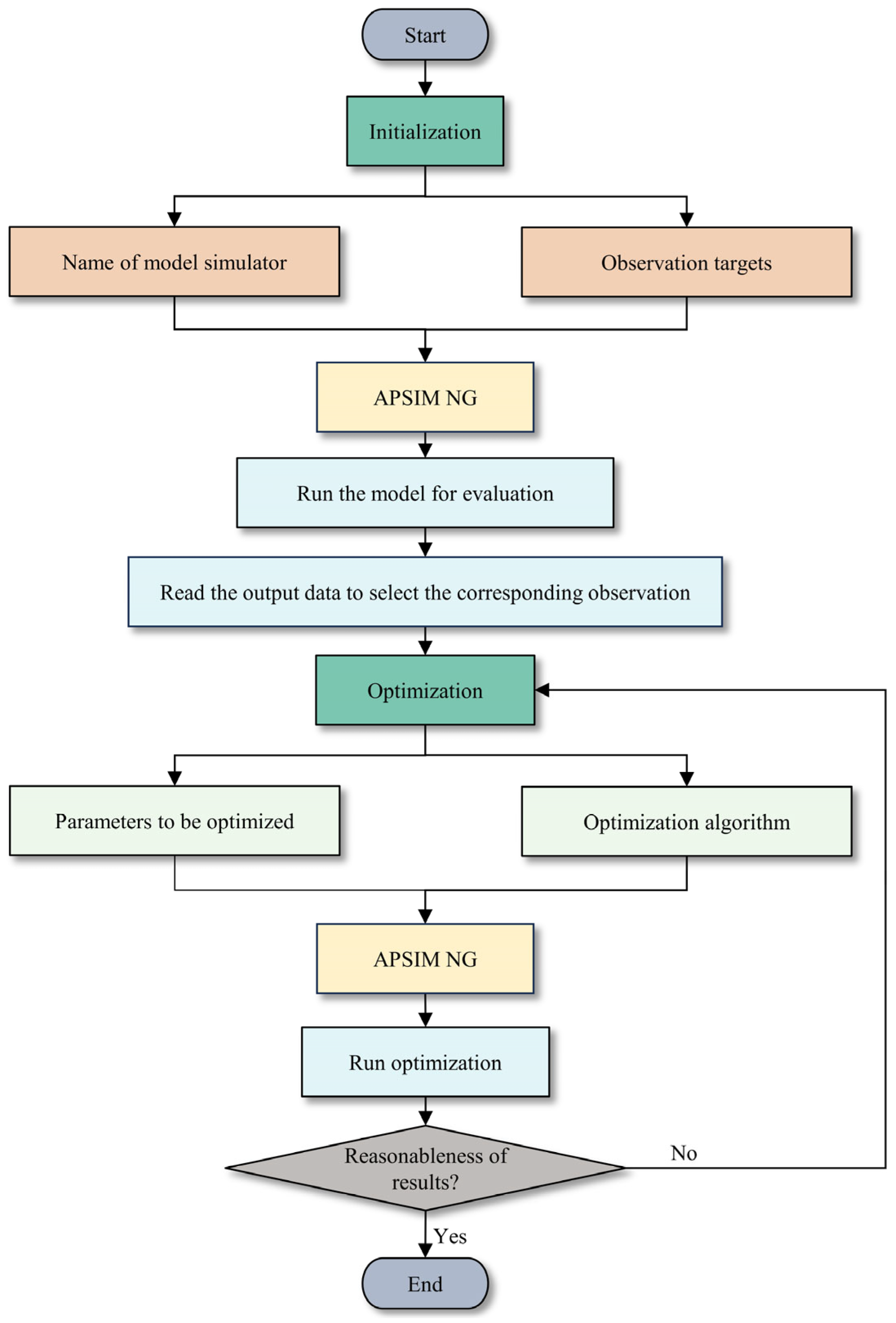
The simulations were conducted via the APSIM NG platform. An optimization program was developed in R (version 4.2.3) using RStudio software. The DREAM-zs algorithm was invoked via the CroptimizR package to drive the APSIM NG-Wheat model for parameter optimization. The crop variety optimized was Dingxi Spring Wheat No. 35. The parameter optimization steps are illustrated in Figure 1. The specific steps are as follows:
Step 1: The model was initialized. The packages required for the optimization program were downloaded and loaded, including CroptimizR, CroPlotR, ApsimOnR, dplyr, ggplot2, gridExtra, and tidyr.
Step 2: The simulator and observation targets were set. The observation targets in this study were yield and LAI.
Step 2: The model was run to evaluate initial results. The simulator name and observed target values were extracted from the output data.
Step 3: The optimization range for target parameters was defined. The parameters to be optimized in this study were those identified through sensitivity analysis as having significant synergistic effects on yield and LAI.
Step 4: Optimization algorithm parameters were configured. The CroptimizR package was used to invoke the DREAM-zs algorithm for optimization. The iteration count for the DREAM-zs algorithm was empirically set to 500 and run multiple times to ensure stability. The number of Markov chain members was set to 3 based on Vrugt et al. (2009) [15]. The random seed was set to 1234.
Step 5: The model was driven to run iteratively and evaluate the output results for plausibility until the optimization termination criteria were met.
Figure 1.
Optimization steps for the APSIM NG-Wheat dryland wheat parameters.
2.9. Model Validation
When addressing quantitative data prediction problems, selecting an appropriate error metric is crucial. The root mean square error (RMSE) and mean absolute error (MAE) are commonly used error metrics in model validation [40,41].
The RMSE measures the deviation between model simulations and observed data. It calculates the magnitude of the error by averaging the squares of the prediction errors and then taking the square root. The RMSE is intuitive and easy to interpret, effectively reflecting the stability of model predictions. A higher model prediction accuracy corresponds to lower RMSE values. The MAE serves as a statistical measure of the average difference between the simulated and observed values. It exhibits greater stability when handling outliers and better reflects the overall trend of the data.
where represents the observed value, and represents the simulated value.
3. Results
3.1. Sensitivity Analysis Results
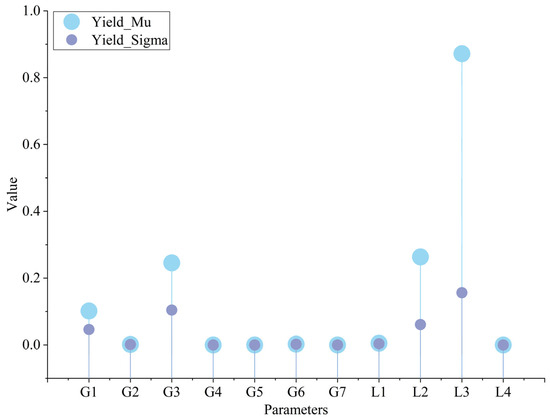
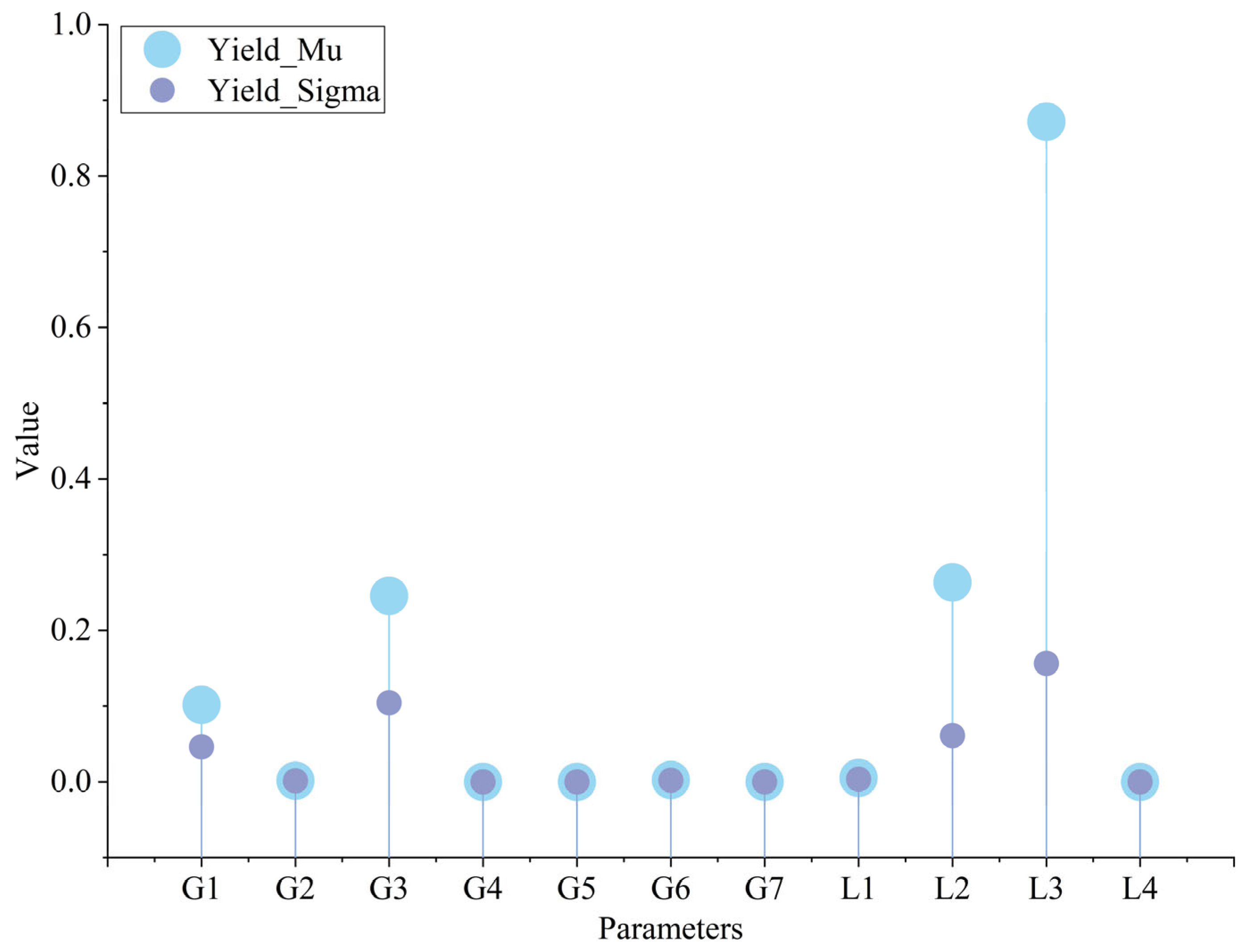
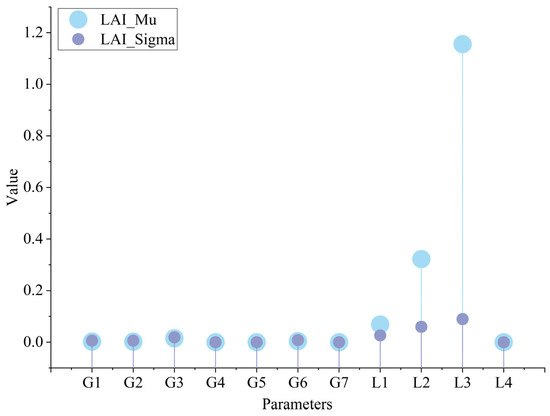
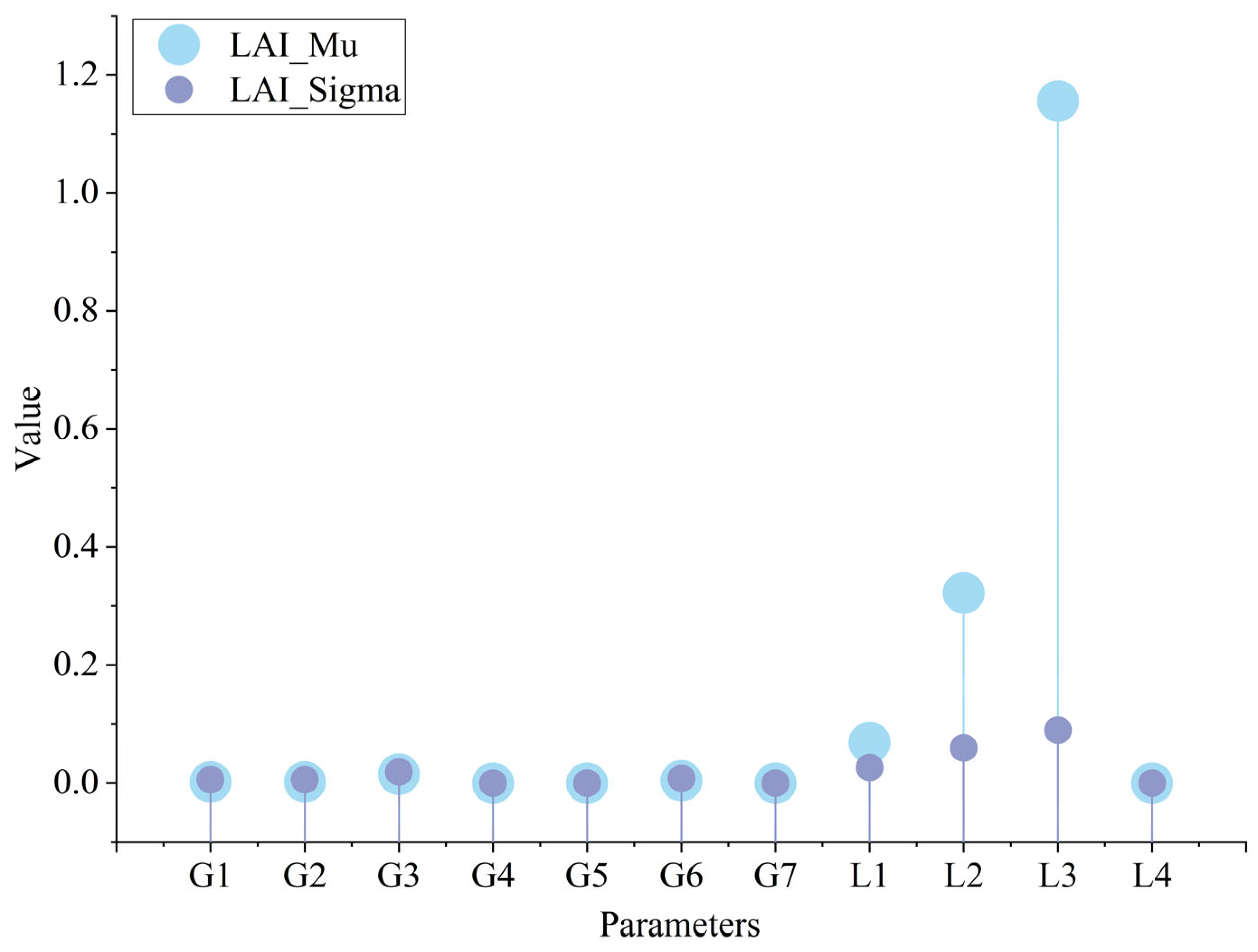
The results of the parameter sensitivity analysis based on the Morris method are shown in Figure 2 and Figure 3. According to the sensitivity parameter criteria, the parameters sensitive to yield and LAI are maximum grain size (G3), radiation use efficiency (L2), and extinction coefficient (L3). Regarding yield (Figure 2), parameter L3 exhibits the highest mean sensitivity and largest standard deviation, indicating its dominant role in yield formation, alongside significant parameter interactions. This parameter primarily influences yield formation by regulating the canopy’s radiation interception efficiency, thereby affecting the fundamental supply of photosynthetic products. Parameters G3 and L2 exhibited medium-level sensitivity means with relatively pronounced standard deviations, indicating that they exert stable yet relatively minor influences on yield. In contrast, parameters G1, G2, G4, G5, G6, G7, L1, and L4 cluster near the origin with low mean sensitivity and standard deviation, suggesting limited direct contribution to yield and stable parameter responses. For LAI (Figure 3), the overall sensitivity ranking resembles that for yield, though relative importance shifts. L3 remains the most sensitive parameter, underscoring its pivotal role in regulating canopy growth structure. L2 maintains moderate sensitivity, while L1 and G3 exhibit heightened sensitivity to LAI compared to yield, reflecting their close association with leaf expansion and leaf area formation processes. The remaining parameters demonstrate weaker sensitivity.
Figure 2.
The Morris sensitivity analysis results (yield).
Figure 3.
The Morris sensitivity analysis results (LAI).
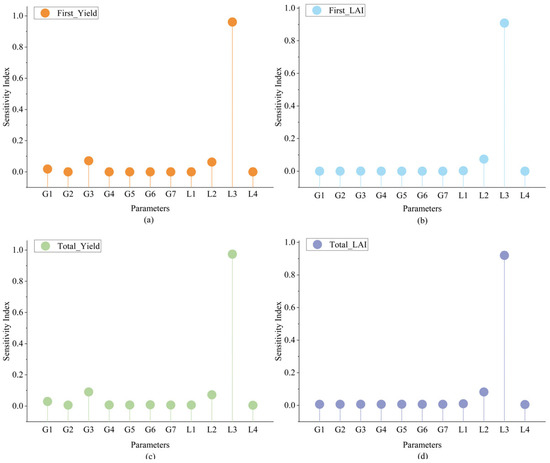
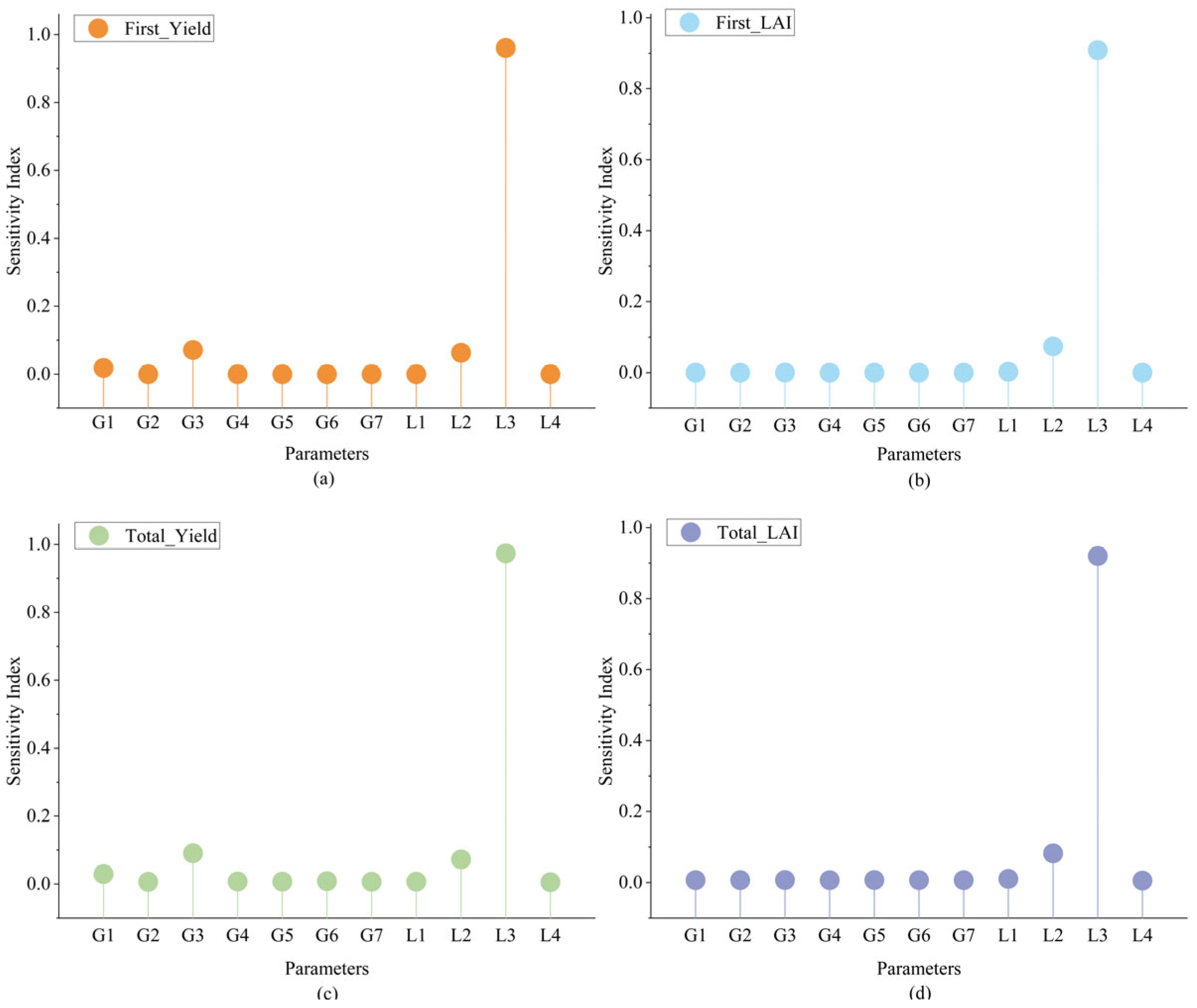
The results of the parameter sensitivity analysis obtained using the EFAST method are shown in Figure 4. Figure 4a,b represent the first-order sensitivity indices for yield and LAI, respectively, while Figure 4c,d show the corresponding full-order sensitivity indices. According to the sensitivity parameter criteria, only parameter L3 exhibited significant sensitivity for both yield and LAI objectives, while the remaining parameters failed to meet the sensitivity thresholds. In the first-order sensitivity analysis (Figure 4a,b), parameter L3 demonstrated significantly higher first-order sensitivity indices for both yield and LAI compared to other parameters, indicating the strongest response characteristics of model outputs to variations in this parameter. Parameters G3 and L2 exhibit relatively higher first-order sensitivity indices among the non-sensitive parameters, with slightly greater direct influences on yield and LAI than others, though their overall sensitivity remains markedly lower than L3. The full-order sensitivity analysis results (Figure 4c,d) further confirm that parameter L3 maintains the highest full-order sensitivity index, highly consistent with the first-order findings. This indicates that the interaction effects between this parameter and others contribute relatively little to model outputs. Sensitivity indices for other parameters in the full-order analysis remain low, indicating their limited combined contribution to yield and LAI.
Figure 4.
The EFAST sensitivity analysis results. (a) Results of first-order sensitivity analysis of parameters on wheat yield; (b) results of first-order sensitivity analysis of parameters on LAI; (c) results of global sensitivity analysis of wheat yield; (d) results of global sensitivity analysis of parameters on LAI.
Overall, only a few parameters exhibit high sensitivity toward both yield and LAI simultaneously, and their response characteristics display certain nonlinearity and uncertainty. The sensitivity results for yield and LAI show both overlaps and differences, reflecting potential trade-offs among different physiological processes during multi-objective synergistic calibration.
3.2. Parameter Optimization Results
On the basis of the sensitivity analysis results, and in accordance with the official documentation of the APSIM NG-Wheat model, the parameters to be optimized were selected (Table 4). The optimization range for maximum grain size (G3), referencing Cui et al. (2023) [16], was set between 0.040 g and 0.060 g. The optimization ranges for radiation use efficiency (L2) and extinction coefficient (L3) were referenced from Wei and Nie (2023) [34] and set at default values of ±10% and 0.300 to 0.700, respectively.
Table 4.
Initial and optimized values of parameters associated with the APSIM NG-Wheat dryland wheat grain and leaf growth sub-models.
The DREAM-zs algorithm was employed to optimize the parameters. The key parameter combinations for the Morris method screening were optimized. The optimization program converged after 140 iterations and reached a stable state, with a total runtime of 2887.5 s. The key parameters for the EFAST screening were optimized. The optimization program converged after 135 iterations and reached a stable state, with a total runtime of 1654.8 s. The optimization results indicate that the optimized value for G3 is greater than the default value, suggesting that moderately increasing the grain storage capacity can increase the yield potential. Similarly, the optimized value for L2 is higher than the default value, indicating that there is still room for improvement in light energy utilization efficiency within the current model. The optimized value for L3 is lower than the default value; reducing this parameter enhances the canopy’s ability to capture light energy, thereby promoting dry matter accumulation and yield formation.
3.3. Model Testing Results
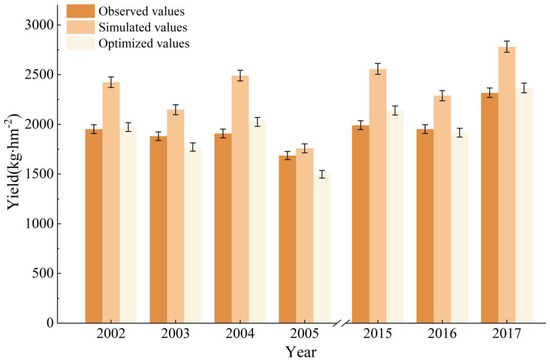
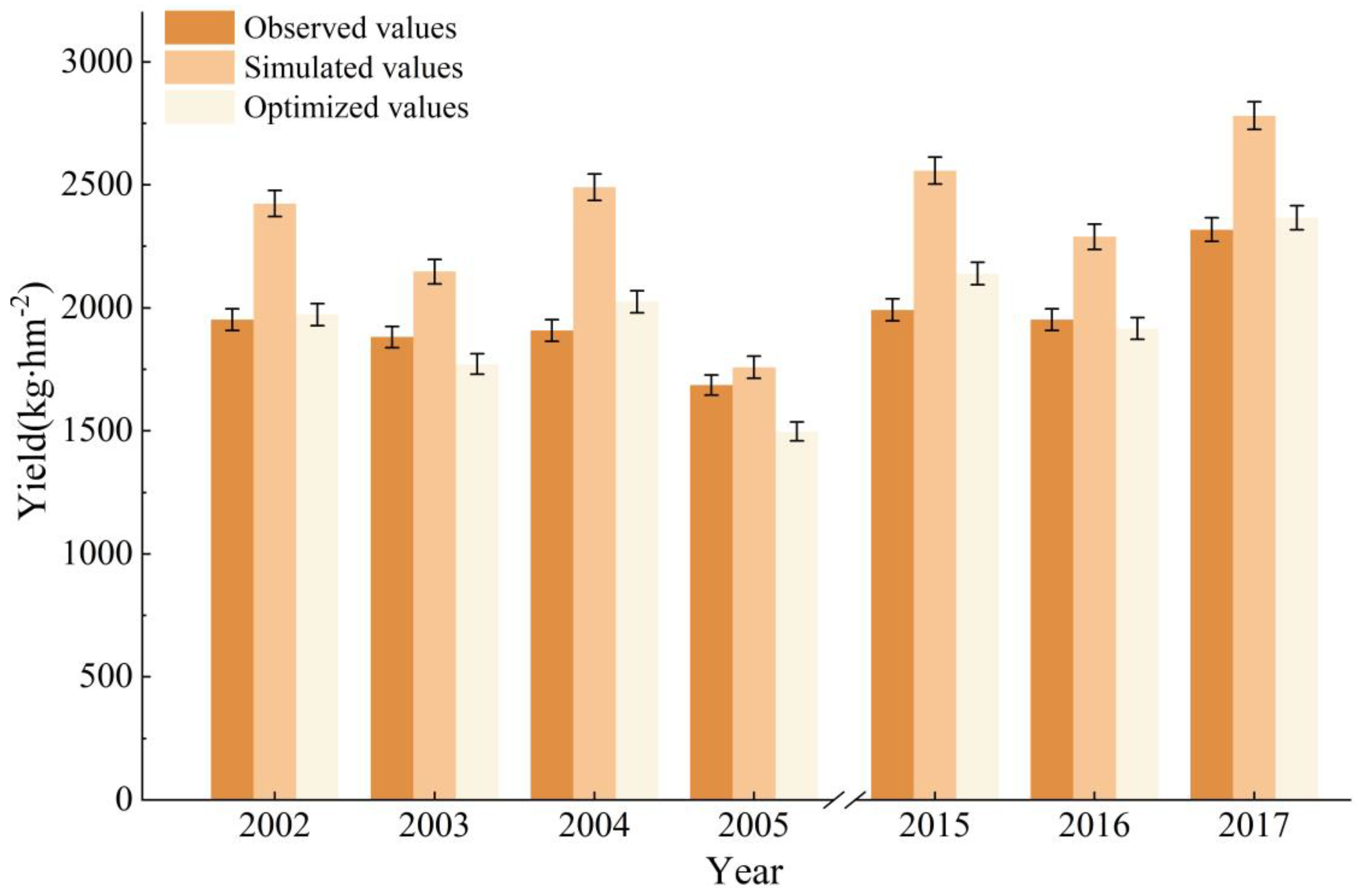
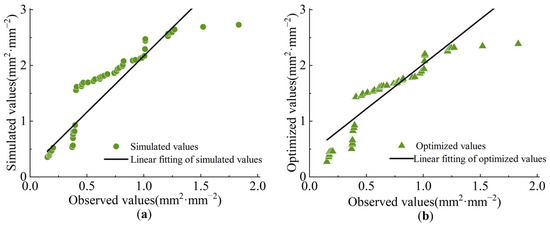
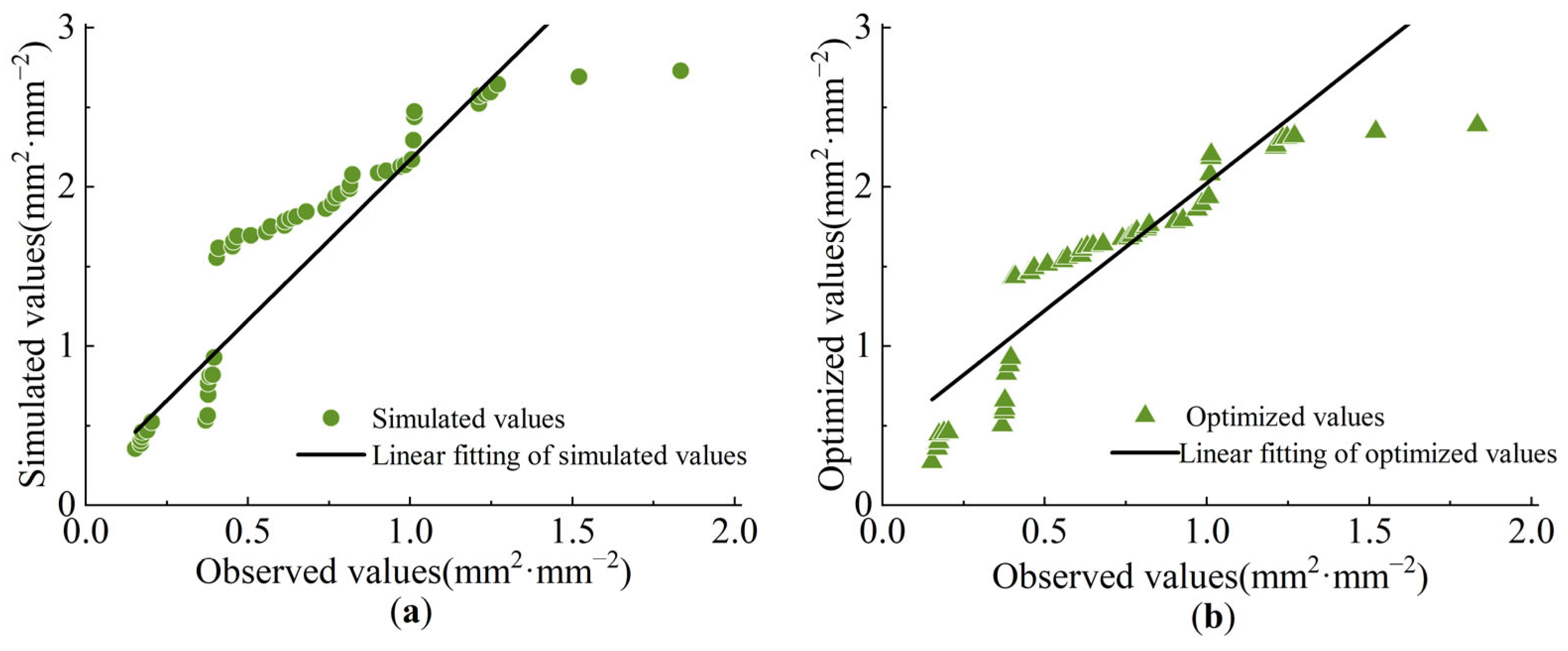
Optimization results indicate that parameter calibration enhances model simulation performance compared to the default parameters of the APSIM NG-Wheat model (Table 5 and Table 6), with both RMSE and MAE for wheat yield and LAI significantly reduced. Further comparison of different sensitivity analysis methods reveals that the parameter set selected using the Morris method demonstrates superior simulation performance after optimization compared to the EFAST method: the simulated wheat yields more closely matched the observed values (Figure 5), and simulated LAI values showed improved agreement with the measurements (Figure 6). In summary, multi-objective co-optimization of parameters in the APSIM NG-Wheat dryland wheat grain and leaf growth sub-models via the DREAM-zs algorithm effectively enhances the model’s simulation accuracy.
Table 5.
Results of simulation tests for yield and LAI of wheat in dryland areas of APSIM NG-Wheat (Morris).
Table 6.
Results of simulation tests for yield and LAI of wheat in dryland areas of APSIM NG-Wheat (EFAST).
Figure 5.
Comparison of simulated and measured values before and after optimization of yield in wheat.
Figure 6.
Comparison of simulated and observed values of wheat LAI before and after parameter optimization. (a) Comparison of simulated LAI values with observed values prior to parameter optimization; (b) comparison of optimized LAI values with observed values after parameter optimization.
4. Discussion
This study employs the APSIM NG to perform multi-objective co-optimization of parameters related to the grain and leaf growth sub-models for dryland wheat. The model features numerous complex internal parameters and relatively computationally intensive operations. To enhance calibration efficiency, sensitivity analysis methods, such as Morris and EFAST, were employed to screen critical model parameters. Under the two global sensitivity analysis methods described above, the key parameters influencing wheat yield and LAI were not entirely consistent between the grain and leaf growth sub-models. The Morris method identified sensitive parameters, including maximum grain size, radiation use efficiency, and extinction coefficient, while the EFAST method selected the extinction coefficient as the sensitive parameter. The discrepancy primarily stems from differing emphases in process analysis between the two methods. Both methods effectively capture overall trends in parameter influences on model outputs and exhibit high sensitivity to nonlinear effects and parameter interactions [23]. The Morris method, with its heightened sensitivity to nonlinear effects and parameter interactions [23], can, thus, identify parameters like maximum grain size and radiation use efficiency that exhibit stage-dependent or scenario-dependent effects. The EFAST method characterizes total effect indices, while also focusing on the stable contributions of individual parameters to the overall variance in model outputs [25]. In this study, EFAST analysis revealed that the extinction coefficient exerts a dominant influence on yield and LAI across the entire parameter space, mitigating the impact of the interaction between maximum grain size and radiation use efficiency. The Morris method’s advantage in multi-objective parameter screening lies in its ability to uncover potentially critical parameter sets and their interactions, thereby providing more comprehensive parameter space information for subsequent optimization. The sensitivity analysis results of this study are consistent with those of Li et al. (2011) [42], Wei and Nie (2023) [34], and Zhao et al. (2014) [36], indicating reasonable findings.
Based on the sensitivity analysis results, the parameters to be optimized were determined to be maximum grain size, radiation use efficiency, and extinction coefficient. Their optimization ranges were referenced from previous studies and align with the growth and development patterns of wheat in loess hilly dryland areas. Optimization results indicate that the maximum grain size and radiation use efficiency increased compared to default values, while the extinction coefficient showed a decreasing trend. Within the APSIM NG-Wheat model module, grain size directly influenced yield calculations [16], and grain size was determined by the degree of grain filling from flowering to grain filling stage [43], concurrently with the continuous accumulation of dry matter through photosynthesis and other processes. Fischer (2011) [44] and Wang et al. (2023) [45] noted that water stress directly impacts agronomic traits like photosynthesis and dry matter accumulation. Under water deficiency, wheat yield formation relies more on grain filling capacity than on grain number per spike [44,45]. Dryland wheat often exhibits grain number limitation compensated by enhanced grain weight [46]. Therefore, increasing maximum grain size enhances the potential for dry matter accumulation per grain during the grain filling stage, partially offsetting the adverse yield effects of reduced grain number. Photosynthesis is a primary driver of dry matter accumulation, and leaf area directly influences the photosynthetic capacity of wheat populations [47]. LAI is closely correlated with the extinction coefficient [48]. The extinction coefficient indicates light transmittance within the crop canopy [34], influencing light energy distribution and use efficiency. Under rain-fed conditions, water and high-temperature stress induce leaf stomatal closure and reduced photosynthetic rates, leading to decreased extinction coefficients [49]. This physiological response aligns with the optimization trend of extinction coefficient parameters observed in this study. Radiation use efficiency reflects a crop’s ability to convert available light energy into biomass through photosynthesis and is highly sensitive to environmental conditions. Under water stress, dryland wheat often maintains population productivity by enhancing the conversion efficiency of dry matter per unit of intercepted light energy [50]. Thus, the increase in radiation use efficiency parameters observed in this study demonstrates the model’s adaptive regulation of light energy utilization efficiency under dryland conditions.
Optimizing crop model parameters is fundamentally a complex problem of finding global optimal solutions within a high-dimensional, nonlinear parameter space. When the optimization objective expands from a single goal to multiple goals, such as the synergistic optimization of yield and LAI, the uncertainty and complexity of model parameters increase accordingly [51]. The modular design of the APSIM NG model and its complex system simulation requirements demand precise parameterization to ensure simulation reliability. The DREAM-zs algorithm employed in this study features straightforward parameter configuration. By running multiple Markov chains in parallel and utilizing adaptive sampling strategies, it achieves higher efficiency and stability when addressing multi-objective optimization problems. In contrast, GA and PSO typically rely on iterative adjustments of empirical parameters, such as crossover probability, mutation rate, or inertia weight in practical applications. When parameter dimensions are high, or strong nonlinear couplings exist, their optimization performance becomes highly sensitive to hyperparameters, often leading to reduced search efficiency or premature convergence [12,14]. Although the NSGA-II algorithm excels in constructing Pareto frontiers, its function evaluation count is typically the product of population size and iteration count [13], often consuming substantial computational resources in computationally intensive applications like crop modeling. In this study, the DREAM-zs algorithm was set to 500 iterations, with a maximum total runtime of 2887.5 s. This demonstrates that, while balancing multi-objective optimization accuracy and computational resources, DREAM-zs can provide a computationally efficient and stable parameter optimization solution for complex crop models like APSIM NG.
Model performance was evaluated via the RMSE and MAE, with the optimized model demonstrating improved adaptability. Since this study employed dual objectives of minimizing simulation errors for both yield and LAI with equal weighting (weight coefficient of 1), yield optimization achieved relatively more significant improvements despite the substantial difference in dimensionality between the two objectives, whereas LAI showed smaller improvements. This finding indicates that differences in the magnitudes of different indicators may lead to uneven responses of optimization objectives during collaborative search.
Although this study optimized the results of model simulations, certain limitations remain. First, measurement errors in input data, such as meteorological and soil parameters, may affect simulation accuracy. Under complex terrain conditions, accurately obtaining spatial distribution information of wheat is crucial for yield estimation and model spatial scale validation [52]. In the future, the quality of model input data can be further enhanced through multi-source data fusion, such as multi-temporal remote sensing data. Additionally, while this study treated growth stage parameters as fundamental crop variety attributes, subsequent research could incorporate growth stage phase parameters to analyze their influences.
5. Conclusions
This study established a calibration framework for crop model parameters by deeply integrating Morris global sensitivity analysis with DREAM-zs multi-objective optimization. The key parameters identified for the APSIM NG-based dryland wheat grain and leaf growth sub-models are maximum grain size, radiation use efficiency, and extinction coefficient. Post-optimization, the RMSE and MAE for yield decreased by 24.1% and 23.2%, respectively, while those for LAI decreased by 16.9% and 19.2%. This framework achieves synergistic optimization of dryland wheat yield and LAI, enhancing the localized adaptability of the APSIM NG model in China’s Northwestern Loess Hilly Region.
Author Contributions
Conceptualization, H.Z. and Z.N.; methodology, H.Z. and Z.N.; software, H.Z.; validation, H.Z., Z.N. and G.L.; formal analysis, G.L.; investigation, H.Z.; resources, Z.N. and G.L.; data curation, Z.N.; writing—original draft preparation, H.Z.; writing—review and editing, H.Z. and Z.N.; visualization, H.Z.; supervision, Z.N.; project administration, G.L.; funding acquisition, Z.N. All authors have read and agreed to the published version of the manuscript.
Funding
This research was funded by the National Natural Science Foundation of China, grant number 32160416; the Gansu Provincial Leading Talent Project, grant number GSBJLJ-2023-09; the Gansu Provincial Youth Science and Technology Fund, grant number 25JRRA370; and the Gansu Provincial Key R&D Program, grant number 25YFGG001.
Data Availability Statement
Data will be made available on request.
Acknowledgments
We extend our sincere gratitude to all personnel involved in the foundational data experiments for this research.
Conflicts of Interest
The authors declare no conflicts of interest.
References
- Huang, X.; Shang, S.; Mao, X.; Li, J.; Bo, L.; Zhao, Y. Mapping and assessing maize water-efficiency dynamics using data assimilation and the SWAP model in Northwest China. Field Crop. Res. 2026, 336, 110198. [Google Scholar] [CrossRef] [Scilit]
- Chenu, K.; Porter, J.R.; Martre, P.; Basso, B.; Chapman, S.C.; Ewert, F.; Bindi, M.; Asseng, S. Contribution of Crop Models to Adaptation in Wheat. Trends Plant Sci. 2017, 22, 472–490. [Google Scholar] [CrossRef] [Scilit]
- Li, G.; Qin, X.; Zhang, C.; Huo, Z. A multi-objective parameter optimization framework for process-based crop models in data-sparse regions exemplified by AquaCrop-OSPy. Eur. J. Agron. 2026, 172, 127866. [Google Scholar] [CrossRef] [Scilit]
- Brown, H.; Huth, N.; Holzworth, D. Crop model improvement in APSIM: Using wheat as a case study. Eur. J. Agron. 2018, 100, 141–150. [Google Scholar] [CrossRef] [Scilit]
- AYadav, B.; Krishnan, P.; Parihar, C.M.; Banerjee, K. Modeling crop growth and soil hydrothermal regimes under conservation agriculture using APSIM-wheat. Sci. Rep. 2025, 15, 36362. [Google Scholar] [CrossRef] [Scilit] [PubMed]
- Lagerquist, E.; Vogeler, I.; Kumar, U.; Bergkvist, G.; Lana, M.; Watson, C.; Parsons, D. Assessing the Effect of Intercropped Leguminous Service Crops on Main Crops and Soil Processes Using Apsim Ng. Agric. Syst. 2023, 216, 103884. [Google Scholar] [CrossRef] [Scilit]
- Chen, T.X.; Wang, Y.J.; Zhang, Y.; Chang, X.H.; Tao, Z.Q.; Wang, D.M.; Yang, Y.S.; Zhu, Y.J.; Liu, A.K.; Shi, S.B.; et al. Effects of different nitrogen rates on photosynthetic and physiological indices and yield of winter wheat. Crops 2020, 36, 88–96. [Google Scholar] [CrossRef]
- Zhang, Y.B.; Tang, Q.Y. Progress in the study of light radiation use efficiency in crops. Crop Res. 2006, 5, 557–561. [Google Scholar] [CrossRef]
- Yuan, L.X.; Zhang, B.J. Morphological Characterization of the Ideal Plant Shape of Cereals. Crops 2000, 2, 23–24. [Google Scholar] [CrossRef]
- Li, G.; Zhang, C.; Huo, Z. Reconciling crop production and ecological conservation under uncertainty: A fuzzy credibility-based multi-objective simulation-optimization model. Sci. Total Environ. 2023, 873, 162340. [Google Scholar] [CrossRef] [Scilit]
- Tatsumi, K. Effects of automatic multi-objective optimization of crop models on corn yield reproducibility in the U.S.A. Ecol. Model. 2016, 322, 124–137. [Google Scholar] [CrossRef] [Scilit]
- Cheng, H.; Zhang, X.; Yang, P.; Ding, B.; Sun, Z. Scheduling Optimization of a Regionally Integrated Energy System Based on an Improved Multi-Objective Particle Swarm Algorithm. Energy Rep. 2025, 14, 3888–3904. [Google Scholar] [CrossRef] [Scilit]
- Li, Y.; Liu, X.; Li, G.; Pan, X.; Li, P.; He, C.; Jiao, Y. Multi-Objective Optimization of the Combustion Characteristics of Moisture and Soil Containing Wheat Stubble by RSM and NSGA-II. Results Eng. 2025, 28, 108419. [Google Scholar] [CrossRef] [Scilit]
- Zhu, Z.H.; Xia, W.J.; Su, S.B.; Chen, Q.L.; He, C.; Zhang, B.J. Energy, Exergy, Environment, and Economic (4E) Analysis and Multi-Objective Genetic Algorithm Optimization of an Energy-Saving and Carbon-Reducing Electrification Ethylene Glycol Multiple-Effect Distillation Process. Energy 2025, 341, 139475. [Google Scholar] [CrossRef] [Scilit]
- Vrugt, J.; Braak, C.; Diks, C.; Robinson, B.; Hyman, J.; Higdon, D. Accelerating Markov Chain Monte Carlo Simulation by Differential Evolution with Self-Adaptive Randomized Subspace Sampling. Int. J. Nonlin. Sci. Num. 2009, 10, 273–290. [Google Scholar] [CrossRef] [Scilit]
- Cui, W.; Nie, Z.; Li, G.; Yuan, J. Optimization of Parameters Related to Grain Growth of Spring Wheat in Dryland Based on the Next-Generation APSIM. Agronomy 2023, 13, 1915. [Google Scholar] [CrossRef] [Scilit]
- Vazquez-Cruz, M.A.; Guzman-Cruz, R.; Lopez-Cruz, I.L.; Cornejo-Perez, O.; Torres-Pacheco, I.; Guevara-Gonzalez, R.G. Global sensitivity analysis by means of EFAST and Sobol’ methods and calibration of reduced state-variable TOMGRO model using genetic algorithms. Comput. Electron. Agric. 2014, 100, 1–12. [Google Scholar] [CrossRef] [Scilit]
- Tsai, W.P.; Feng, D.; Pan, M.; Beck, H.; Lawson, K.; Yang, Y.; Liu, J.; Shen, C. From calibration to parameter learning: Harnessing the scaling effects of big data in geoscientific modeling. Nat. Commun. 2021, 12, 5988. [Google Scholar] [CrossRef] [Scilit]
- Yang, J. Convergence and uncertainty analyses in Monte-Carlo based sensitivity analysis. Environ. Model. Softw. 2011, 26, 444–457. [Google Scholar] [CrossRef] [Scilit]
- Wang, A.; Solomatine, D.P. Practical Experience of Sensitivity Analysis: Comparing Six Methods, on Three Hydrological Models, with Three Performance Criteria. Water 2019, 11, 1062. [Google Scholar] [CrossRef] [Scilit]
- Wallach, D.; Buis, S.; Seserman, D.M.; Palosuo, T.; Thorburn, P.J.; Mielenz, H.; Justes, E.; Kersebaum, K.C.; Dumont, B.; Launay, M.; et al. A calibration protocol for soil-crop models. Environ. Model. Softw. 2024, 180, 106147. [Google Scholar] [CrossRef] [Scilit]
- Douglas-Smith, D.; Iwanaga, T.; Croke, B.F.W.; Jakeman, A.J. Certain trends in uncertainty and sensitivity analysis: An overview of software tools and techniques. Environ. Model. Softw. 2020, 124, 104588. [Google Scholar] [CrossRef] [Scilit]
- Mutua, S.; Chawanda, C.J.; Waswa, G.; Huysmans, M. Improving groundwater recharge estimation in the Kano Plains Aquifer, Western Kenya through global sensitivity analysis and Wetspass-M model validation using groundwater level fluctuations. J. Hydrol. Reg. Stud. 2025, 62, 102823. [Google Scholar] [CrossRef] [Scilit]
- Liu, J.; Liu, Z.; Zhu, A.; Shen, F.; Lei, Q.; Duan, Z. Global sensitivity analysis of the APSIM-Oryza rice growth model under different environmental conditions. Sci. Total Environ. 2019, 651, 953–968. [Google Scholar] [CrossRef] [Scilit]
- Lu, Y.; Chibarabada, T.P.; McCabe, M.F.; De Lannoy, G.J.M.; Sheffield, J. Global sensitivity analysis of crop yield and transpiration from the FAO-AquaCrop model for dryland environments. Field Crop. Res. 2021, 269, 108182. [Google Scholar] [CrossRef] [Scilit]
- Li, G.; Huang, G.B.; Bellotti, W.; Chen, W. Adaptation research of APSIM model under different tillage systems in the loess hill-gullied region. Acta Ecol. Sin. 2009, 29, 2655–2663. [Google Scholar] [CrossRef]
- Nie, Z.G.; Li, G.; Wang, J.; Ma, W.W.; Luo, C.P.; Dong, L.X.; Lu, Y.L. Parameter optimization for the simulation of leaf area index of dryland wheat with the APSIM model. Sci. Agric. Sin. 2019, 52, 2056–2068. [Google Scholar] [CrossRef]
- Zhao, Z.; Li, Z.; Li, Y.; Yu, L.; Gu, X.; Cai, H. Optimization of water and nitrogen measures for maize-soybean intercropping under climate change conditions based on the APSIM model in the Guanzhong plain, China. Agric. Syst. 2025, 224, 104236. [Google Scholar] [CrossRef] [Scilit]
- Holzworth, D.P.; Huth, N.I.; DeVoil, P.G.; Zurcher, E.J.; Herrmann, N.I.; McLean, G.; Chenu, K.; Van Oosterom, E.J.; Snow, V.; Murphy, C.; et al. APSIM—Evolution toward a new generation of agricultural systems simulation. Environ. Model. Softw. 2014, 62, 327–350. [Google Scholar] [CrossRef] [Scilit]
- Holzworth, D.; Huth, N.I.; Fainges, J.; Brown, H.; Zurcher, E.; Cichota, R.; Verrall, S.; Herrmann, N.I.; Zheng, B.; Snow, V. APSIM Next Generation: Overcoming challenges in modernizing a farming systems model. Environ. Model. Softw. 2018, 103, 43–51. [Google Scholar] [CrossRef] [Scilit]
- Yang, X.; Zhang, X.; Zhao, Z.; Ma, N.; Tian, J.; Xu, Z.; Zhang, J.; Zhang, Y. Rainfall and Maximum Temperature are Dominant Climatic Factors Influencing Apsim-Maize Cultivar Parameters Sensitivity in Semiarid Regions. Eur. J. Agron. 2024, 164, 127494. [Google Scholar] [CrossRef] [Scilit]
- Li, Z.; Jin, X.; Liu, H.; Xu, X.; Wang, J. Global sensitivity analysis of wheat grain yield and quality and the related process variables from the DSSAT-CERES model based on the extended Fourier Amplitude Sensitivity Test method. J. Integr. Agric. 2019, 18, 1547–1561. [Google Scholar] [CrossRef] [Scilit]
- DeJonge, K.C.; Ascough, J.C.; Ahmadi, M.; Andales, A.A.; Arabi, M. Global sensitivity and uncertainty analysis of a dynamic agroecosystem model under different irrigation treatments. Ecol. Model. 2012, 231, 113–125. [Google Scholar] [CrossRef] [Scilit]
- Wei, X.H.; Nie, Z.G. Sensitivity analysis and optimization of parameters related to leaf area index in dryland wheat based on the APSIM model. Chin. J. Eco-Agric. 2023, 32, 119–129. [Google Scholar] [CrossRef]
- Cui, W.; Nie, Z.; Li, G.; Yuan, J.; Zhu, H. Multi-Objective Optimization of Phenology and Grain Growth Parameters in Spring Wheat Using Apsim Next Generation and Algorithm. College of Information Science and Technology, Gansu Agricultural University, Lanzhou, China, 2023. to be submitted. [Google Scholar] [CrossRef] [Scilit]
- Zhao, G.; Bryan, B.A.; Song, X. Sensitivity and uncertainty analysis of the APSIM-wheat model: Interactions between cultivar, environmental, and management parameters. Ecol. Model. 2014, 279, 1–11. [Google Scholar] [CrossRef] [Scilit]
- Afshar, A.; Hassanzadeh, Y.; Farrokhi, A. Study uncertainty of parameters of hydrological model (SWAT) by Differential Evolution Adaptive Metropolis algorithm (DREAM-ZS). J. Water Soil Conserv. 2020, 27, 25–45. [Google Scholar] [CrossRef] [Scilit]
- Xia, Y.; Li, N. High-Resolution Estimation of Soil Saturated Hydraulic Conductivity via Upscaling and Karhunen–Loève Expansion within DREAM(ZS). Appl. Sci. 2024, 14, 4521. [Google Scholar] [CrossRef] [Scilit]
- Gelman, A.; Rubin, D.B. Inference from Iterative Simulation Using Multiple Sequences. Stat. Sci. 1992, 7, 457–472. [Google Scholar] [CrossRef] [Scilit]
- Chai, T.; Draxler, R.R. Root mean square error (RMSE) or mean absolute error (MAE)?—Arguments against avoiding RMSE in the literature. Geosci. Model Dev. 2014, 7, 1247–1250. [Google Scholar] [CrossRef] [Scilit]
- Mentaschi, L.; Besio, G.; Cassola, F.; Mazzino, A. Problems in RMSE-based wave model validations. Ocean Model. 2013, 72, 53–58. [Google Scholar] [CrossRef] [Scilit]
- Li, D.Q.; Tang, Q.Y.; Qin, J.Q.; Zhang, Y.B.; Yang, S.H.; Chen, L.J.; Li, X.Y. Relationship between light energy radiation use efficiency and yield in rice. J. Hunan Agric. Univ. 2011, 37, 1–6. [Google Scholar]
- Marshall, D.; Ellison, F.; Mares, D. Effects of grain shape and size on milling yields in wheat. I. Theoretical analysis based on simple geometric models. Aust. J. Agric. Res. 1984, 35, 619–630. [Google Scholar] [CrossRef] [Scilit]
- Fischer, R.A. Wheat Physiology: A Review of Recent Developments. Crop Pasture Sci. 2011, 62, 95–114. [Google Scholar] [CrossRef] [Scilit]
- Wang, Y.; Yu, T.; Wang, C.; Wei, J.; Zhang, S.; Liu, Y.; Xu, Z. Heat shock protein TaHSP17.4, a TaHOP interactor in wheat, improves plant stress tolerance. Int. J. Biol. Macromol. 2023, 246, 125694. [Google Scholar] [CrossRef] [Scilit]
- Sadras, V.O.; Slafer, G.A. Environmental Modulation of Yield Components in Cereals: Heritabilities Reveal a Hierarchy of Phenotypic Plasticities. Field Crop. Res. 2012, 127, 215–224. [Google Scholar] [CrossRef] [Scilit]
- Nguyen, T.H.; Cappelli, G.A.; Emberson, L.; Ignacio, G.F.; Irimescu, A.; Francesco, S.; Fabrizio, G.; Booth, N.; Boldeanu, G.; Bermejo, V.; et al. Assessing the Spatio-Temporal Tropospheric Ozone and Drought Impacts on Leaf Growth and Grain Yield of Wheat across Europe through Crop Modeling and Remote Sensing Data. Eur. J. Agron. 2024, 153, 127052. [Google Scholar] [CrossRef] [Scilit]
- Wang, L.; Liu, S.; Lu, S.; Lv, T.; Ma, D.; Kang, G.; Xie, Y.; Sun, J.; Wang, C. Irrigation and Nitrogen Fertilizer Increase Wheat Productivity by Improving Root-Shoot Population Coordination. Agric. Water Manag. 2025, 316, 109589. [Google Scholar] [CrossRef] [Scilit]
- Ding, D.; Wang, N.; Zhang, X.; Zou, Y.; Zhao, Y.; Xu, Z.; Chu, X.; Liu, J.; Bai, Y.; Feng, S.; et al. Quantifying the Interaction of Water and Radiation Use Efficiency under Plastic Film Mulch in Winter Wheat. Sci. Total Environ. 2021, 794, 148704. [Google Scholar] [CrossRef] [Scilit] [PubMed]
- Sinclair, T.R.; Muchow, R.C. Radiation Use Efficiency. Adv. Agron. 1999, 65, 215–265. [Google Scholar] [CrossRef] [Scilit]
- Chapagain, R.; Huth, N.; Remenyi, T.A.; Mohammed, C.L.; Ojeda, J.J. Assessing the effect of using different APSIM model configurations on model outputs. Ecol. Model. 2023, 483, 110451. [Google Scholar] [CrossRef] [Scilit]
- Wang, N.; Wu, Q.; Gui, Y.; Hu, Q.; Li, W. Cross-Modal Segmentation Network for Winter Wheat Mapping in Complex Terrain Using Remote-Sensing Multi-Temporal Images and DEM Data. Remote Sens. 2024, 16, 1775. [Google Scholar] [CrossRef] [Scilit]

Disclaimer/Publisher’s Note: The statements, opinions and data contained in all publications are solely those of the individual author(s) and contributor(s) and not of MDPI and/or the editor(s). MDPI and/or the editor(s) disclaim responsibility for any injury to people or property resulting from any ideas, methods, instructions or products referred to in the content. |
© 2025 by the authors. Licensee MDPI, Basel, Switzerland. This article is an open access article distributed under the terms and conditions of the Creative Commons Attribution (CC BY) license.