Article

Dual Role of Copper in the Micropropagation of Olive: Morphological, Physiological, and Biochemical Responses from Beneficial Growth to Lethal Stress

1
IBE/Institute of BioEconomy, National Research Council (CNR), 50019 Sesto Fiorentino, Italy
2
Department of Pomology, Faculty of Agriculture, Assiut University, Assiut 71526, Egypt
3
CNR-IBBR Institute of Bioscience and Bioresources, 50019 Sesto Fiorentino, Italy
4
CREA—Research Centre for Plant Protection and Certification, 90128 Palermo, Italy
5
Department of Soil, Plant and Food Sciences, University of Bari Aldo Moro, 70125 Bari, Italy
*
Author to whom correspondence should be addressed.
Agriculture 2025, 15(24), 2544; https://doi.org/10.3390/agriculture15242544
Submission received: 25 October 2025 / Revised: 3 December 2025 / Accepted: 5 December 2025 / Published: 9 December 2025

Abstract

In olive micropropagation, Copper (Cu) promotes metabolic activity at optimal levels but exerts toxic effects and induces stress and cellular damage when present at excessive concentrations. The present study examined in vitro olive (cv. Moraiolo) shoot cultures under varying Cu concentrations to evaluate the impact of Cu-induced stress on shoot growth and development, as well as the associated physiological and biochemical tolerance mechanisms. Olive shoots were cultured on OM medium (as a control) supplemented with 50, 100, 200, or 300 µM CuSO4·5H2O. Morphological and biochemical analyses showed that up to 50 µM Cu did not cause visible stress symptoms or impair growth, while higher concentrations (100–300 µM) significantly suppressed or inhibited vegetative growth, and caused a marked reduction in photosynthetic pigments. The contents of oxidative stress markers, hydrogen peroxide and malondialdehyde, increased with rising Cu concentrations, serving as reliable indicators of severe stress conditions. Non-enzymatic antioxidants, glutathione, ascorbic acid and proline, increased with higher Cu concentrations, playing a protective role against oxidative damage. These findings provide insight into the tolerance mechanisms of olive shoots under Cu stress, offering useful information for optimizing in vitro micropropagation and understanding Cu toxicity in plant tissue culture.

1. Introduction

Olive (Olea europaea L.) is one of the oldest cultivated fruit species in the Mediterranean region, along with the fig and date palm [1]. Native to the eastern Mediterranean, it belongs to the Oleaceae family and is widely grown across nearly 10 million hectares globally, with over 800 million trees [2]. While the primary use is for oil production, with less than 10% consumed as table olives, olive also holds cultural, ecological, and economic significance.
In Italy, olive is grown on 1,080,060 hectares, with an average yield of 2220 kg/ha, producing 2,397,880 tons of olive fruits. The country produced around 155,000 tons of olive oil in the 2022–2023 season. Italy continues to rank as one of the top olive oil-producing countries in the world, with olive growing deeply rooted in its agricultural history and Mediterranean culture [3]. This large production makes Italy a major player in the world olive industry, fueling its agricultural economy and picturesque Mediterranean culture. The tree is well adapted to drought and poor soils, commonly found in traditional Mediterranean landscapes, and its durable, attractive wood serves as an additional source of income, especially in regions such as Southern Italy [4,5]. Olive oil, extracted from the fruit, is a monounsaturated fat rich in oleic acid and a valuable source of vitamin E. This traditional Mediterranean oil has gained global attention due to its associated health benefits, including reduced risks of coronary heart disease and certain cancers such as breast and colon cancer [6]. These health-promoting properties have further elevated the significance of olive cultivation, reinforcing its role not only as an agricultural staple but also as a contributor to human well-being. Globally, Spain is the leading olive-producing country, contributing more than 40% of world olive oil production, followed by Italy, which remains one of the top global producers and an essential contributor to the Mediterranean olive sector [3].
Heavy-metal contamination has become a significant global environmental issue, primarily driven by human activities such as mining, industrial emissions, wastewater irrigation, and the excessive use of products containing heavy metals [7]. Climate change, through altered precipitation patterns, temperature fluctuations, and extreme weather events, can exacerbate the accumulation and mobility of heavy metals such as copper in agricultural soils, potentially increasing their bioavailability and risk to crops and food safety [8]. Global food production will need to increase by approximately 60% by 2050 to meet the demands of a growing population, especially under the constraints imposed by climate change and increasing soil contamination by heavy metals such as Cu [9]. Even at trace concentrations, heavy metals can adversely affect ecosystems and living organisms. Among these, copper (Cu) is of particular interest due to its dual role as an essential micronutrient required for plant growth and enzymatic function, yet it becomes toxic when present in excess. Similarly, other metals, such as iron (Fe), manganese (Mn), and zinc (Zn), are recognized as essential micronutrients for plants, needed in small quantities due to their role as enzyme cofactors, potentially toxic at elevated levels [10]. Heavy metals such as Cu, cadmium (Cd), chromium (Cr), arsenic (As), lead (Pb), and nickel (Ni) have been detected in olive oil at levels exceeding permissible limits, leading to serious ecological consequences [11]. At elevated concentrations, these metals are highly toxic to both plants and animals, and several, including As, Cd, and Pb, are classified as potential carcinogens linked to cancer in humans [6]. Given the essential role of olive oil in both human health and Mediterranean agriculture, and the increasing concern over heavy metal contamination, the presence of heavy metals in olive oil, whether derived from soil, agricultural practices, industrial activities, or contamination during processing and storage, is a critical quality concern. These metals not only accelerate oxidative deterioration, compromising oil stability and shelf life, but also pose risks to human health, highlighting the importance of their continuous monitoring in olive oil production [12,13].
Cu serves as a vital cofactor for several enzymes involved in key physiological and biochemical processes, especially under stress conditions. These enzymes include polyphenol oxidase, laccase, cytochrome c oxidase, copper/zinc-superoxide dismutase (Cu/Zn-SOD), phycocyanin, and amino oxidase [14]. Cu also has a critical role in electron transport and redox reactions occurring in plant mitochondria, chloroplasts, cytoplasm, and cell walls [15]. In spite of its importance, excessive Cu concentrations can disrupt regular cellular function, leading to inhibited photosynthesis, altered plasma membrane permeability, and a range of metabolic disturbances [16]. These effects have been documented both in field-grown plants and in vitro cultures [17,18]. Al-Habahbeh et al. [19] demonstrate that olive trees accumulate heavy metals; therefore, care is warranted for the long-term usage of treated wastewater, and periodic evaluations of potential dangers, particularly concerning fruit and oil quality, are necessary.
In vitro culture systems reduce environmental variability due to defined nutrient media, controlled conditions, and uniform stress application. The simplicity of manipulation also allows investigation of a large number of plants and stress treatments in a limited space and time [20].
In vitro studies on Cu toxicity have been conducted in several plant species, Nicotiana tabacum [21], tomato [22], Citrus reticulata [23], Ailanthus altissima [24], and date palm [25]. However, to date, no studies have specifically examined the impact of Cu toxicity on olive under controlled in vitro conditions. Understanding how crops respond to heavy metal stress, including excess Cu, is essential for developing sustainable agricultural practices and ensuring long-term global food security [26]. Therefore, the objective of the present study is to evaluate the response of in vitro olive shoot cultures under varying Cu concentrations, to better understand their tolerance mechanisms and growth performance under Cu-induced stress, considering the relatively high concentrations of this metal detected in olive oil [27]. The study has been conducted on the cv. Moraiolo, one of the most widely cultivated varieties for oil production, particularly in central Italy. In addition to morphological observations, the study assessed key physiological and biochemical parameters, including photosynthetic pigments, hydrogen peroxide (H2O2), malondialdehyde (MDA), soluble sugars (SGH), ascorbic acid (AsA), and proline, to elucidate the oxidative and metabolic responses associated with copper-induced stress.

2. Materials and Methods

2.1. Introduction and Stabilization In Vitro of cv. Moraiolo Shoot Culture

Three-year-old potted mother plants of the Moraiolo cultivar, originally produced through cutting propagation and sourced from a greenhouse germplasm collection, were maintained under controlled greenhouse conditions with temperatures ranging from 25 to 28 °C and approximately 80% relative humidity. They were sprayed twice with a fungicide (Captan) at 5% concentration during the week preceding the explant collection. Shoots, 50–70 cm long, were then collected in spring, brought into the laboratory, used to prepare 1–2 cm micro cuttings, and introduced in vitro following the procedure of Lambardi et al. [28], partially modified. In short, for decontamination, the explants were washed under running tap water overnight, and dipped in 70% ethanol for 30 s, followed by a washing with tap water. The explants were then transferred under the laminar flow hood, where they were treated with 0.1% (w/v) mercuric chloride solution with 3 drops of Tween 20 for 2 min, after which the explants were rinsed with sterilized distilled water three times, each time for 5 min.
‘Moraiolo’ nodal segments were cultured in vitro on OM medium [29], supplemented with 30 g L−1 mannitol, 100 mg L−1 FE-EDDHA, 1.18 g L−1 L-Glutamine, and 4 mg L−1 zeatin. Before adding agar, the pH of the medium was adjusted to 5.8, and it was autoclaved for 20 min at 121 °C. Incubated in a growth chamber at 25 ± 2 °C with a 16/8 light/dark photoperiod, the cultures were exposed to cool-white fluorescent lights with a light intensity of 45 μmol m−2s−1. The shoots were subcultured every six weeks by microcutting (2 nodes) segmentation.

2.2. Cu Experiment

At the 4th subculture, the shoots were transferred to the same OM medium supplemented with concentrations of 50, 100, 150, 200, 250, and 300 µM Cu (as CuSO4·5H2O); the control was the standard OM medium containing 1 µM of Cu (No additional Cu added). Every shoot contained 2 nodes and 4 leaves (average weight, 0.25 g; length, about 2 cm). Each treatment consisted of 15 jars, and every jar contained 4 shoots. Each jar had a total volume of 150 mL and was filled with 30 mL of culture medium. Cultures were incubated as mentioned above. After 6 weeks, the following morphological growth parameters were measured: (i) survival (%), (ii) plantlet height (cm), (iii) number of leaves, (iv) fresh and dry weight (g), and (v) relative water content (%), which has been calculated by the formula:
(FW − DW)/DW × 100
After taking 5 jars per treatment for morphological measurements, the remaining jars were divided into 5 groups. Leaves from all shoots within each group were collected and immediately frozen in liquid nitrogen. Each group was ground to a fine powder, and five aliquots were taken for the chemical analyses described in Section 2.3 and Section 2.4. This procedure ensured representative sampling from all remaining shoots while allowing replication for each biochemical parameter.

2.3. Pigment Determination

Fresh leaves were homogenized with 80% acetone; then, the sample mixture was centrifuged at 12,000 rpm for 20 min at 4 °C. The supernatants were used to determine the chlorophyll and carotenoid contents. The chlorophyll and carotenoid contents were estimated by measuring the absorbance at 470, 645, and 663 nm. Thus, chlorophyll-a, chlorophyll-b, total chlorophylls, and carotenoids were further calculated according to the formula described by Bhushan et al. [30]. All spectrophotometric analyses were performed using a microplate reader (Tecan–Spark).

2.4. Hydrogen Peroxide, Malondialdehyde, Antioxidants, and Proline Quantifications

2.4.1. Hydrogen Peroxide (H2O2)

H2O2 was measured spectrophotometrically after the reaction with potassium iodide (KI), based on the method proposed by Alexieva et al. [31]. The reaction was developed in trichloroacetic acid (TCA), and absorbance was measured at 390 nm. The amount for H2O2 was calculated using a standard curve prepared with known concentrations of H2O2. The results were expressed as µg g−1 leaf fresh weight (FW).

2.4.2. The Malondialdehyde (MDA)

MDA concentration was measured by the thiobarbituric acid (TBA) method [32], and expressed in µmol g−1 and calculated by the following formula:
C (µmol L−1) = 6.45(A532 − A600) − 0.56A450

2.4.3. The Ascorbic Acid (AsA)

AsA concentration was determined according to the method proposed by Okamura [33] and modified by Law et al. [34]. The assay was based on the reduction of Fe3+ to Fe2+ by ascorbate (As) in acidic solution. The absorbance at 525 nm was recorded. A standard curve of AsA was used for calibration. Results were expressed as µg g−1 FW.

2.4.4. Glutathione (GSH)

GSH was determined using a modification of the Sedlak and Lindsay [35] method. The determination was obtained through the extraction in TCA and by reaction with Ellman’s reagent; the absorbance was read at 412 nm. The standard curve of GSH was used for calibration. The results were expressed as µg g−1 FW.

2.4.5. Proline

Proline extraction and quantification were performed according to Bates et al. [36] with slight modifications. Samples were homogenized in liquid nitrogen and extracted with 70% ethanol (v/v). Extracts were held for 20 min at 95 °C, with ninhydrin reagent [1% ninhydrin (w/v) in glacial acetic acid 60% (v/v), ethanol 20% (v/v)]. Proline content was measured spectrophotometrically at 520 nm; proline was used as an external standard, and data were expressed in µg g−1 leaf FW. All spectrophotometric analyses were performed using a microplate reader (Tecan–Spark).

2.5. Statistical Analysis

Descriptive statistics (means and standard errors) were performed for all measured parameters using SigmaPlot 15.0 (SPSS Inc., Chicago, IL, USA) scientific data analysis and graphing software. One-way ANOVA was applied to test the different Cu concentrations on olive shoots. A Fisher-LSD multiple comparison was applied to assess significant differences among treatments (p ≤ 0.05 level). Multivariate analysis (MANOVA) was performed by Primer v7.0 (Primer-E Ltd., Plymouth Marine Laboratory, Plymouth, UK) on Euclidean matrices of distance calculated on normalized biometrical traits to evaluate the significance of observed segregations between treatments and biometrical traits.

3. Results and Discussion

Our results demonstrated a clear Cu concentration-dependent response in the in vitro growth of olive shoots, with Cu availability influencing a broad range of morphological and physiological traits. This outcome aligns with the known roles of Cu-dependent enzymes in supporting plant development, photosynthesis, lignification, and stress tolerance [37], as well as evidence that Cu deficiency can limit growth, reproduction, and wood production. Moreover, excessive Cu resulting from pollution, nutrient imbalance, or root damage is reported to negatively affect plant physiology and photosynthesis [38,39,40,41,42].

3.1. General Effects of Cu on Growth of In Vitro Olive Shoots

Figure 1 shows olive shoots cultured on media containing increasing Cu concentrations. The explants exhibited a 100% survival rate when cultured in OM medium containing 1 µM Cu, which represents the control concentration for olive micropropagation under our experimental conditions. Survival remained high at 50 µM Cu, but mortality increased markedly at higher Cu concentrations. Leaf chlorosis and visible toxicity symptoms were progressively observed as Cu levels increased. The morphology significantly affected the survival rate, yet the 50 µM Cu concentration showed no difference from the control. However, the highest concentration (300 µM) reduced the survival rate by 72% compared with the control. The inhibition of survival and growth could be a result of antioxidant enzyme activation, as these enzymes are taking part in the degradation of endogenous indole-3-acetic acid [43] and in the processes of lignification and cell wall cross-linking [44]. Hence, our results showed the inhibition of growth in olive shoots accompanied by the accumulation of elevated Cu concentrations.

3.2. Morphological Traits of In Vitro Olive Shoots Under Different Cu Concentrations

The findings revealed that Cu had a negative influence on all biometrical traits considered: ANOVA highlighted highly significant differences (p ≤ 0.001) for shoot height (H), dry weight (DW), and relative water content (RWC), while a lower significance (p ≤ 0.05) was observed for the leaf number (#L) (Table 1).
Cu treatments significantly reduced shoot height and leaf number of in vitro olive shoots, with reductions of 46.3% and 44.9% already evident at the lowest concentration (50 µM). At the highest Cu levels, both traits were severely inhibited, as plantlets neither elongated nor produced new leaves compared to control plantlets (1 µM Cu) (Table 1).
In addition, all evaluated concentrations of Cu significantly reduced both FW and DW in olive shoots. Cu toxicity also strongly impacted the in vitro growth of olive shoots by causing a sharp decline in RWC with increasing Cu concentration. Moreover, the RWC of the tissues resulted in significant effects in the medium containing higher concentrations of Cu (200 and 300 µM), respect to the control and 50 µM of CuSO4·5H2O (Table 1). The shoots cultured in Cu-enriched medium showed a significant reduction in water content compared to those grown in the control medium by 21.1% and 22.2% in 200 and 300 µM Cu medium, respectively.
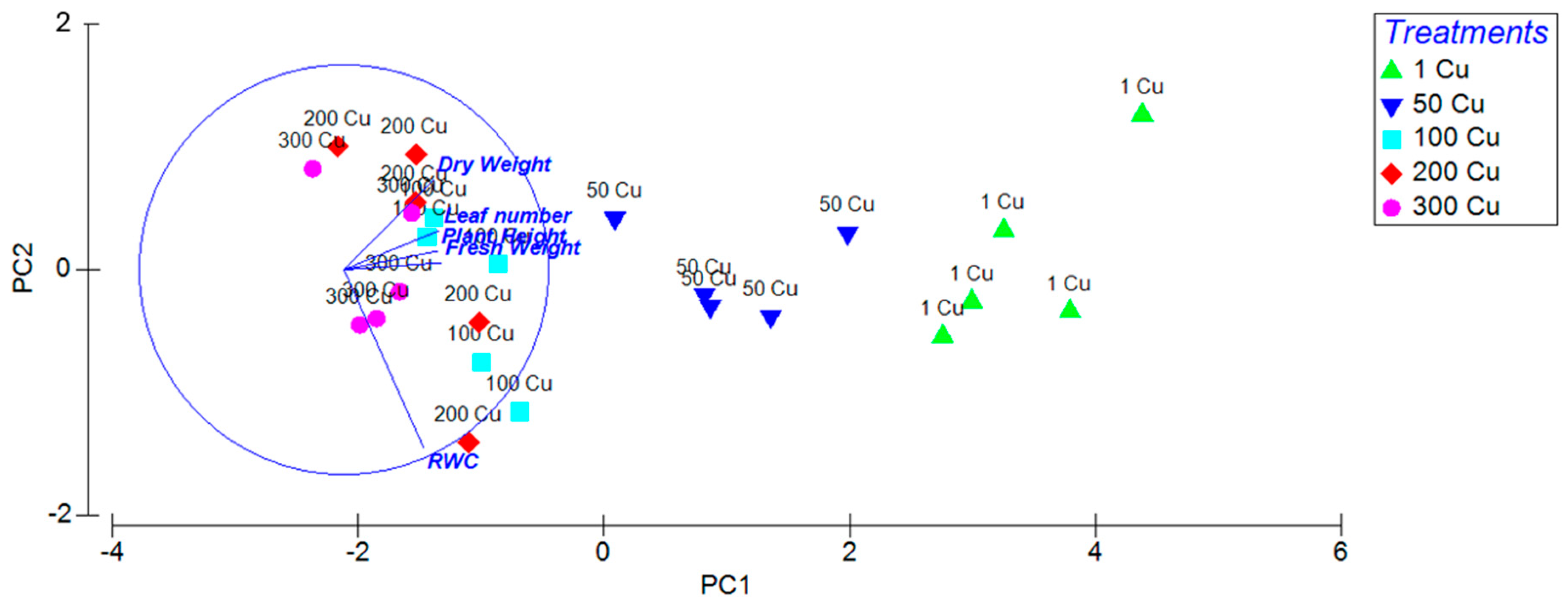
The Principal Component Analyses (PCA), performed on biometrical traits (H, L, FW, DW, and RWC; Figure 2), explained 98.2% of the total variance (86.5, 8.7, and 3.0%, respectively). Figure 2 explains how shoots exposed to different Cu concentrations cluster along the principal components, allowing visualization of the overall effect of Cu stress on multiple growth behaviors concurrently. The eigenvectors related to PC1 showed negative correlation with the following values: −0.457, −0.467, −0.476, −0.441, and −0.390 for H, L, FW, DW, and RWC, respectively. Regarding PC2, only RWC recorded a negative correlation (−0.872), while the other parameters considered—H (0.090), L (0.191), FW (0.034), and DW (0.440)—evidenced positive correlations. The MANOVA was performed to examine the separation between different Cu concentrations supplied. The first principal coordinate axis showed that different Cu concentrations affect the biometrical traits considered; furthermore, lower Cu concentrations (1 and 50 µM) were spread mostly along PC1, while higher Cu concentrations were separated along PC2 (Figure 2). This analysis highlights patterns across multiple traits simultaneously, showing that PCA can reveal overall responses to copper stress that are not evident from individual measurements alone. Negative correlations along PC1 indicate that increases in Cu concentration are associated with decreases in shoot height, leaf number, fresh weight, dry weight, and relative water content, whereas positive correlations along PC2 indicate traits that increase independently or are less affected by Cu stress.
To our knowledge, the toxicity of copper on olive growth and development has not been previously studied. But the toxic effects of Cu have been demonstrated in vitro across several plant species. For example, concentrations above 100 μM inhibited callus growth and shoot regeneration in Nicotiana tabacum [21], while 100 μM reduced growth and regeneration in tomato explants and suppressed some enzymatic bands [22]. Similarly, high Cu concentrations inhibited root growth more than shoot growth and reduced fresh and dry weights in Citrus reticulata [23], limited shoot growth in Ailanthus altissima [24], and, even at 8 μM, impaired multiple morphological and physiological traits in date palm [25]. Conversely, some studies have shown that moderate Cu levels can enhance plant growth. For instance, Tinospora cordifolia showed better growth at 25–125 μM CuSO4 compared to controls with 0.1 μM Cu [45]. Similarly, bean plants exhibited improved shoot and root formation with increased Cu in the medium, although higher concentrations were ineffective [46]. Based on these findings, the present study indicates that elevated Cu levels can inhibit the normal growth and development of in vitro olive cv. Moraiolo shoots.

3.3. Effect of Cu Toxicity on Photosynthetic Pigments

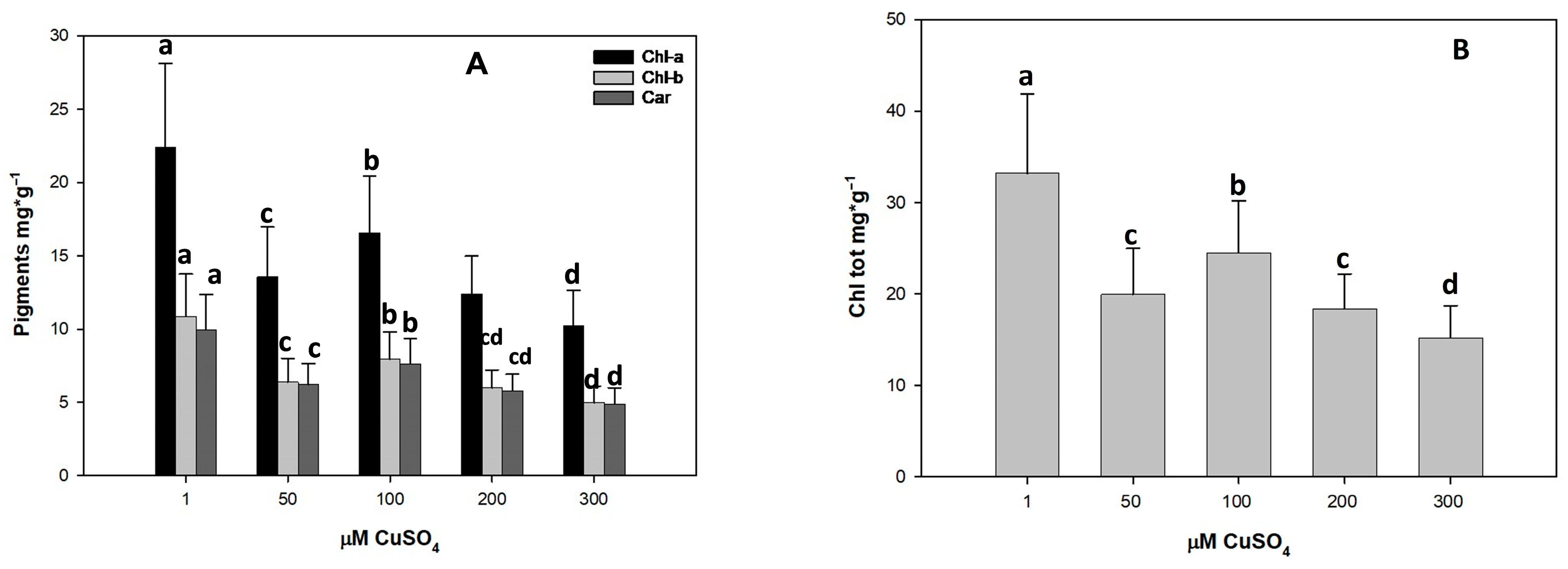
The content of photosynthesis-related pigments (i.e., chlorophyll-a (chl-a), chlorophyll-b (chl-b), and carotenoid) was detected in in vitro olive leaves under different Cu levels, plus the control. Exposure to different Cu concentrations resulted in different statistically significant concentrations of photosynthetic pigments in leaves of olive shoots (Figure 3). The ANOVA shows that a significant interaction between treatments is found for chl-a (p = 0.014) and total chlorophyll (Chltot) (p = 0.018). As attended, higher chl-a, -b, and carotenoids values are found in the control treatment, while lower are recorded in the highest Cu treatment (300 µM) (Figure 3A). Interestingly, among all Cu levels, the concentration of 100 µM gave the highest content of chl-a, chl-b, and carotenoids and, subsequently, the total chlorophyll (Figure 3B). This finding corresponds with Gori et al. [21] in Cu-tolerant tobacco plants cultured at 100 μM, where chlorophyll-a and -b contents were also comparable to controls, with only the chl-a/b ratio being altered.
Our results are in line with many studies about the effect of heavy metals, and especially Cu, on in vitro shoots. Deo and Nayak [18] confirmed that the reduction in chlorophyll in Musa acuminata, cv. Bantala in vitro shoots may be due to the Cu effect on photosystem II (PS II), which has been associated with the destruction of the inner structure of chloroplasts and modifications of the lipoprotein composition of thylakoid membranes. These findings have also been reported by Panou-Filotheou et al. [47]. Moreover, Cu inhibition of the enzymatic reaction in the photosynthetic carbon reduction cycle could potentially be the cause [48].
In the same vein, González-Mendoza et al. [41] tested two concentrations of CuSO4 (0.062 and 0.33 M) on Avicennia germinans plants. They found that the stomatal conductance decreased by 28% and 18%, respectively, while the total photosynthesis was completely inhibited. They observed a reduction in chlorophyll fluorescence as well, suggesting that Cu2+ toxicity negatively affects A. germinans’ photosynthetic apparatus (gas exchange and chl fluorescence).

3.4. Effect of Cu Toxicity on Oxidative Stress Markers

3.4.1. Hydrogen Peroxide (H2O2)

H2O2 takes part in several important functions in plant cells, such as cell wall lignification, protein cross-linking, signal transduction [43], and photosynthesis [49]. Plants possess a plethora of antioxidant defense mechanisms to modulate their production, yielding advantageous effects under biotic stresses, such as pathogen infection, nematodes, and herbivory, and abiotic stresses (i.e., heavy metals, salinity, drought, heat, cold, and flooding) [50]. During these circumstances, hydrogen peroxide (H2O2) emerges as a principal reactive oxygen species (ROS), serving both as a deleterious oxidant and a signaling molecule, with antioxidant enzymes and metabolites meticulously regulating its concentrations to equilibrate stress signaling and cellular protection. Thus, H2O2 concentration could be used as a reliable indicator of the severity of environmental stress [51].
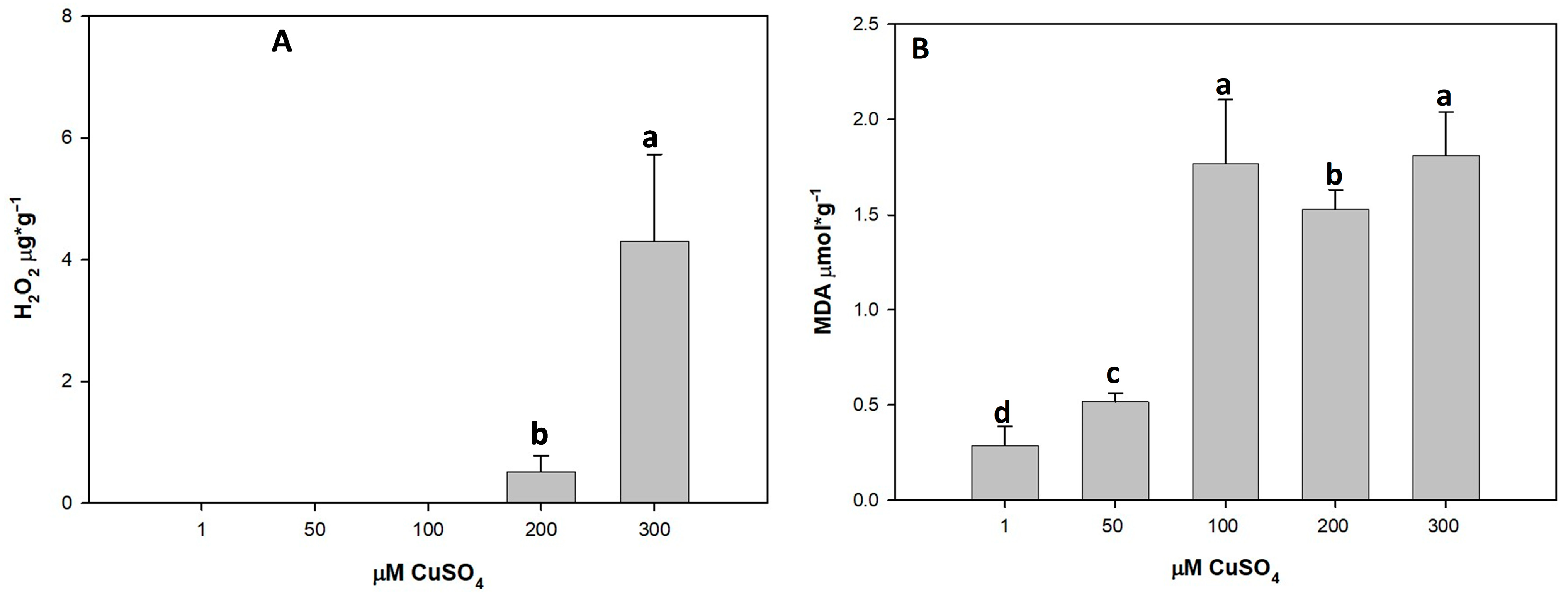
In this study, the in vitro olive shoots cultivated with 300 µM of CuSO4·5H2O exhibited H2O2 levels 430.1% higher than those of control shoots and even surpassed the levels found in lower doses of Cu at 50 and 100 µM. H2O2 levels measured in the olive leaves (Figure 4A) indicate that extra Cu significantly increases H2O2 in the treated plants. Consistent with our results, earlier research indicated that during abiotic stress, the production of H2O2 radicals is a typical action of oxidative stress [52]. The released H2O2 can function as a localized signal, inducing cellular apoptosis. It can similarly permeate the cells, resulting in alterations to the redox state of cellular membranes and their polarity; this would activate the antioxidant defense systems. Moreover, Bouazizi et al. [53] found that excessive exposure to Cu markedly elevates H2O2 levels in bean roots, signifying increased oxidative stress.

3.4.2. Impact of Cu on MDA Levels

Copper toxicity was formerly thought to primarily result from the disruption of membrane integrity and the release of free radicals [54], resulting in oxidative damage shown by elevated levels of H2O2 and MDA in plant tissues.
In the ANOVA analyses carried out at the foliar level, a significant interaction has been found for MDA (p ≤ 0.001). Noteworthy, a similar H2O2 tendency was observed in MDA, the final product of lipid peroxidation, which varied significantly between control and Cu-exposed shoots (Figure 4A). The Cu-treated olive shoots showed a remarkable increase, especially at 100 and 300 µM Cu, reaching approximately 516 and 530%, respectively, in MDA over the control; the only exception was the 50 µM concentration, where MDA increased slightly compared to the control. Li et al. [55] found that the treatment with 50 μM CuCl2 in barley for three days significantly increased the levels of MDA. The same result has been confirmed by Gautam et al. [56] on safflower seedlings, and Hossain et al. [42] in lentil plants under excessive Cu stress. Similarly, Sanchez-Pardo et al. [57] stated that MDA content increased in root nodules of white lupin and soybean when exposed to a high level of Cu (192 μM), as compared to control shoots. All these observations are in line with the findings of our study.

3.5. Effect of Cu Toxicity on Non-Enzymatic Antioxidants

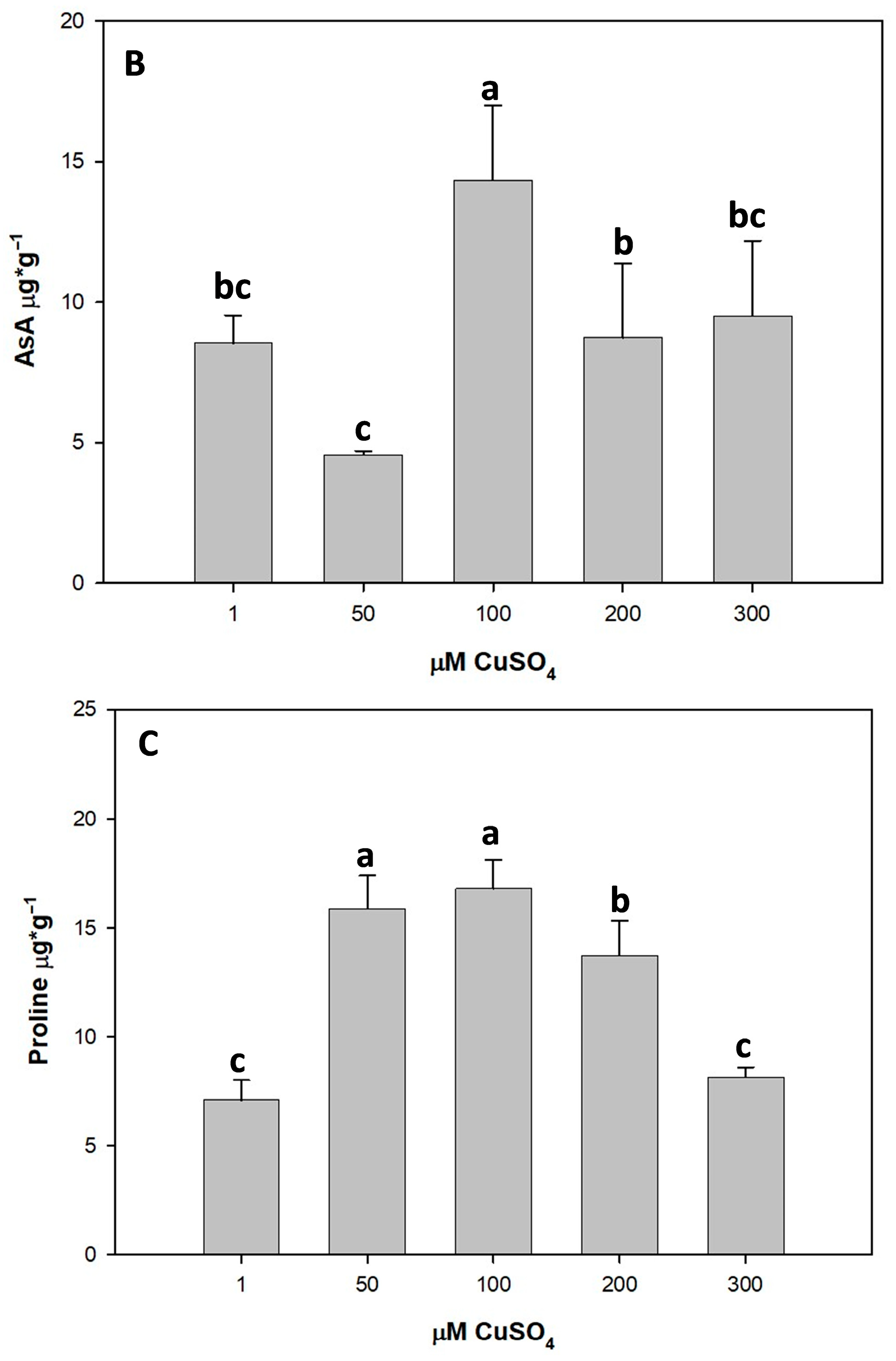
GSH and AsA play essential roles in mitigating oxidative stress in plants by interacting directly with ROS and promoting the AsA–GSH cycle [58]. Cu augmented GSH S-transferase and GSH peroxidase, and, within the same investigation, Nagalakshmi and Prasad [59] determined that excessive Cu disrupted the equilibrium between the production and consumption of GSH. In response to abiotic stressors, such as heavy metals, plants have developed a defense strategy by activating a range of antioxidant enzymes and non-enzymatic antioxidants, including GSH and AsA. Tie et al. [60] reported elevated concentrations of AsA and GSH in maize when exposed to Cu (2 mM).

3.5.1. Impact of Cu on GSH Content

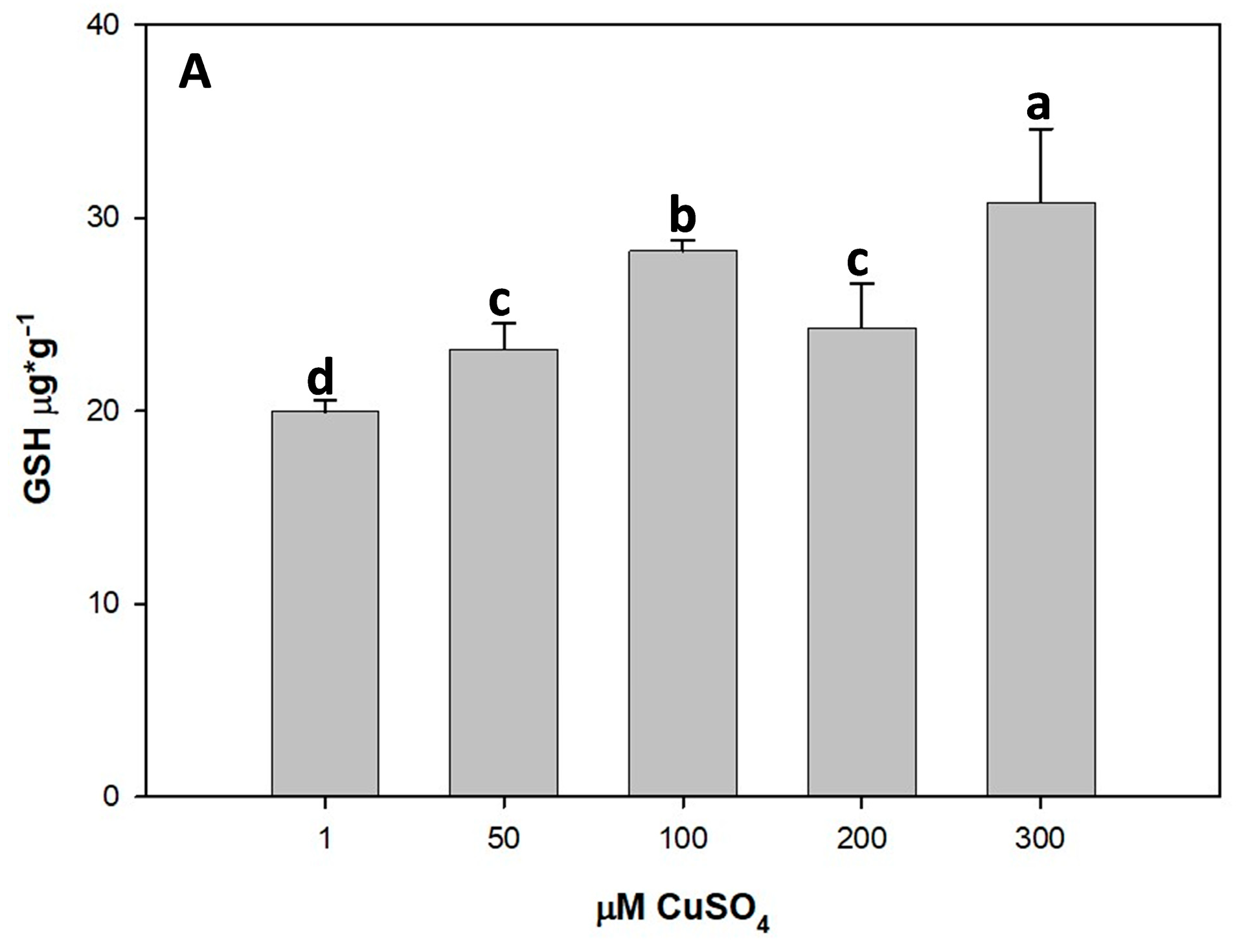
The exposure of explants to the heavy metal induces many stressors, including a significant increase in ROS within the culture environment, resulting in different abnormalities that disrupt the metabolic functions of the plant, even at the molecular level [61]. GSH levels of in vitro olive shoots are shown in Figure 5A; results from ANOVA showed they were statistically significant, with p = 0.032. The content of GSH was increased by treatment with Cu. At optimal or low concentrations of Cu, such as 50 µM, plantlets could sustain or marginally elevate GSH levels to improve antioxidant defense. The increase of Cu concentrations in the media stimulates the accumulation of GSH as a part of the antioxidant defense response. At the highest concentration of Cu (300 µM), GSH increased by 54.3% compared to the control shoots (Figure 5A). GSH is a low molecular weight tripeptide compound that contains a sulfhydryl group and is an important metal chelator and antioxidant [62], which facilitates the regulation of the cell cycle, cell detoxification, and subsequently antioxidant defenses. Through the AsA, GSH cycle (AsA–GSH), GSH improves the tolerance to Cu. Other studies have confirmed that with the increase in Cu concentration, the content of protein thiol in the cells of green algae Scenedesmus increased, while the content of GSH, in contrast, significantly decreased [63]. In addition, Thounaojam et al. [64] found that the content of GSH increased under Cu stress, and the tolerance of rice to Cu improved.
Reflecting the trends we observed in this study, the exposure of in vitro olive shoots to Cu excess significantly affected their GSH homeostasis. Moderate Cu stress may enhance GSH accumulation as a defense response, while prolonged or high Cu levels typically deplete GSH due to its consumption in ROS detoxification and phytochelatin synthesis.

3.5.2. Ascorbic Acid (AsA)

The findings of the AsA content are presented in Figure 5B. Despite not being statistically significant, in reaction to Cu stress, shoots exhibited elevated AsA production, particularly at 100 µM of CuSO4·5H2O (68.0%), in comparison to the controls. Among all treatments, 50 µM Cu resulted in the lowest ascorbic acid concentration, where the AsA levels declined with a decrease of 46.5% under Cu stress. These observations are in line with the findings of Younis et al. [65] in bean, where they all confirmed that AsA content in leaves increased in response to Cu exposure, suggesting its involvement in ROS scavenging.

3.5.3. Effect of Cu Stress on Proline Content

It is well known that proline accumulation in high amounts is useful to prevent cell damage as a reaction to the biotic [66] and abiotic stresses [67]. It is a multifunctional amino acid that plays a vital role in regulating cellular osmolarity, protein stability, inhibition of lipid peroxidation, and ROS generation.
From one-way ANOVA, a significant influence of copper concentration on proline content was observed (p ≤ 0.001), highlighting that different Cu concentrations affect proline production at the foliar level. In our results, the variations in proline concentration in olive leaves subjected to Cu treatment are evident in Cu-stressed shoots (Figure 5C) that demonstrated a steady increase in proline content beginning at 50 µM, peaking at 100 µM concentration of CuSO4·5H2O where the value of proline increased by approximately 2.3-fold compared to the control, followed by a fall at elevated Cu concentrations (200 and 300 µM). Still, proline levels remained greater than those in the control shoots. A decrease in proline levels at higher Cu concentrations may indicate impaired stress tolerance, possibly reflecting metabolic disruption or reduced antioxidant capacity under excessive ROS accumulation.
These results reflect those reported by Vinod et al. [68] in wheat (Triticum aestivum L.) in response to Cu, which demonstrated a buildup of proline with rising copper levels. Similarly, Gautam et al. [56] suggest that proline content accumulates in higher concentrations as Cu treatment intensifies.

4. Conclusions

In conclusion, this study clearly demonstrated the effects of copper on the growth and development of the in vitro shoots of olive (Olea europea L.) cv. Moraiolo. High Cu concentrations (100–300 µM CuSO4·5H2O) significantly reduced survival rate, leaf number, and both fresh and dry weight, with complete inhibition of vegetative growth. Photosynthetic pigment content was also markedly decreased under high Cu stress. In response to oxidative damage caused by elevated Cu concentrations, levels of non-enzymatic antioxidants, including glutathione, ascorbic acid, and proline, were increased. Additionally, oxidative stress markers such as hydrogen peroxide (H2O2) and malondialdehyde (MDA) showed significantly elevated levels in plant tissues, reflecting the abiotic stress induced by Cu. These biochemical changes suggest that non-enzymatic antioxidants play a protective role against oxidative damage, while H2O2 and MDA serve as indicators of stress severity. Overall, these findings offer clear insight into the physiological and biochemical mechanisms by which olive shoots tolerate Cu stress in vitro. This information may also have important implications for the suitability of cultivating olive trees in orchards on soils with a high Cu content, although confirmation of these observations on plants grown in pots or directly in the soil is certainly necessary.
Since this is the first study investigating Cu effects on olive under in vitro conditions, the initial concentration of 50 µM was chosen based on previous studies in other species that reported physiological responses within this range. Morphological and physiological analyses in the present work confirmed that 50 µM Cu was not markedly harmful to olive shoots. Future experiments will explore lower Cu concentrations to better identify the range associated with beneficial rather than stress-inducing effects on olive cultures.

Author Contributions

Conceptualization, D.E., S.P. and M.L.; methodology, D.E. and S.P.; formal analysis, S.P.; investigation, D.E., M.L. and S.P.; resources, M.L.; data curation, M.L. and S.P.; validation, M.L., D.E., S.P., C.R. and G.F.; writing—original draft preparation, D.E.; writing—review and editing, D.E., M.L., S.P., C.R. and G.F.; visualization, M.L., D.E. and S.P.; supervision, M.L. and G.F.; funding acquisition, G.F. All authors have read and agreed to the published version of the manuscript.

Funding

This research received no external funding.

Institutional Review Board Statement

Not applicable.

Data Availability Statement

The data that support the findings of this study are available from the corresponding author upon reasonable request.

Conflicts of Interest

The authors declare no conflicts of interest.

References

  1. Zohary, D.; Spiegel-Roy, P. Beginnings of fruit growing in the Old World. Science 1975, 187, 319–327. [Google Scholar] [CrossRef] [PubMed]
  2. Avramidou, E.V.; Boutsios, S.; Korakaki, E.; Malliarou, E.; Solomou, A.; Petrakis, P.V.; Koubouris, G. Olive, a monumental tree; multidimensional perspective from origin to sustainability. In Economically Important Trees: Origin, Evolution, Genetic Diversity and Ecology. Sustainable Development and Biodiversity; Uthup, T.K., Karumamkandathil, R., Eds.; Springer: Singapore, 2024; Volume 37. [Google Scholar]
  3. FAOSTAT: Food and Agriculture Organization of the United Nations. Datasets FAO Olive and Olive Oil Production. 2023. Available online: http://faostat.fao.org (accessed on 3 September 2025).
  4. Lambardi, M.; Rugini, E. Micropropagation of olive (Olea europaea L.). In Microprop-Agation of Woody Trees and Fruits, Forestry Sciences; Jain, S.M., Ishii, K., Eds.; Springer: Dordrecht, The Netherlands, 2003; Volume 75. [Google Scholar] [CrossRef]
  5. Regni, L.; Brunori, A.; Mairech, H.; Testi, L.; Proietti, P. Multifunctionality of olive groves. In The Olive Botany and Production; Fabbri, A., Baldoni, L., Caruso, T., Famiani, F., Eds.; CAB International: Wellingford, UK, 2023; pp. 633–639. [Google Scholar] [CrossRef]
  6. Nunes, L.S.; Barbosa, J.T.P.; Fernandes, A.P.; Lemos, V.A.; dos Santos, W.N.L.; Korn, M.G.A.; Teixeira, L.S.G. Multi-element determination of Cu, Fe, Ni and Zn content in vegetable oils samples by high-resolution continuum source atomic absorption spectrometry and microemulsion sample preparation. Food Chem. 2011, 127, 780–783. [Google Scholar] [CrossRef]
  7. Yruela, I. Copper in plants. Braz. J. Plant Physiol. 2005, 17, 145–156. [Google Scholar] [CrossRef]
  8. Raza, A.; Razzaq, A.; Mehmood, S.S.; Zou, X.; Zhang, X.; Lv, Y.; Xu, J. Impact of Climate Change on Crops Adaptation and Strategies to Tackle Its Outcome: A Review. Plants 2019, 8, 34. [Google Scholar] [CrossRef]
  9. Franco-Navarro, J.D.; Díaz-Espejo, A.; Barragán, V.; Luque-Cobija, M.; Ruiz, L.; Rodríguez, P.; Hernández, M.J.; Navarro, M.; Muñoz, M.; Shabala, S.; et al. Advancements in Water-Saving Strategies and Crop Adaptation to Drought: A Comprehensive Review. Plants 2025, 14, 122. [Google Scholar] [CrossRef]
  10. Elazab, D.; Lambardi, M.; Capuana, M. In Vitro Culture Studies for the Mitigation of Heavy Metal Stress in Plants. Plants 2023, 12, 3387. [Google Scholar] [CrossRef]
  11. Luka, M.F.; Akun, E. Investigation of trace metals in different varieties of olive oils from northern Cyprus and their variation in accumulation using ICP-MS and multivariate techniques. Environ. Earth Sci. 2019, 78, 578. [Google Scholar] [CrossRef]
  12. Dilek, B.; Yasemin, B.K.; Selcuk, Y. Comparison of extraction induced by emulsion breaking, ultrasonic extraction and wet digestion procedures for determination of metals in edible oil samples in Turkey using ICP-OES. Food Chem. 2013, 138, 770–775. [Google Scholar] [CrossRef]
  13. Sabier, T.; Luis, D.M.; Pablo, H.P. Determination of arsenic species distribution in extra virgin olive oils from arsenic-endemic areas by dimensional chromatography and atomic spectroscopy. J. Food Compos. Anal. 2018, 66, 121–126. [Google Scholar] [CrossRef]
  14. Nazir, F.; Hussain, A.; Fariduddin, Q. Hydrogen peroxide modulate photosynthesis and antioxidant systems in tomato (Solanum lycopersicum L.) plants under copper stress. Chemosphere 2019, 230, 544–558. [Google Scholar] [CrossRef] [PubMed]
  15. Verkleij, J.A.C.; Lolkema, P.C.; De Neeling, A.L.; Harmens, H. Heavy metal resistance in higher plants: Biochemical and genetic aspects. In Ecological Responses to Environmental Stresses; Rozema, J., Verkleij, J.A.C., Eds.; Tasks for Vegetation Science; Springer: Dordrecht, The Netherlands, 1991; Volume 22. [Google Scholar] [CrossRef]
  16. Gong, Q.; Li, Z.H.; Wang, L.; Zhou, J.Y.; Kang, Q.; Niu, D.D. Gibberellic acid application on biomass, oxidative stress response, and photosynthesis in spinach (Spinacia oleracea L.) seedlings under copper stress. Environ. Sci. Pollut. Res. Int. 2021, 28, 53594–53604. [Google Scholar] [CrossRef]
  17. Romeu–Moreno, A.; Mas, A. Effect of copper exposure in tissue cultured Vitis vinifera. J. Agric. Food Chem. 1999, 47, 2519–2522. [Google Scholar] [CrossRef]
  18. Deo, B.; Nayak, P.K. Study of copper phytotoxicity on in vitro culture of Musa acuminata cv Bantala. J. Agric. Biotech. Sustain. Dev. 2011, 3, 136–140. [Google Scholar]
  19. Al-Habahbeh, K.A.; Al-Nawaiseh, M.B.; Al-Sayaydeh, R.S.; Al-Hawadi, J.S.; Albdaiwi, R.N.; Al-Debei, H.S.; Ayad, J.Y. Long-term irrigation with treated municipal wastewater from the Wadi Musa region: Soil heavy metal accumulation, uptake and partitioning in olive trees. Horticulturae 2021, 7, 152. [Google Scholar] [CrossRef]
  20. Abouzaid, E.; El-Sayed, E.S.N.; Mohamed, E.S.A.; Youssef, M. Molecular Analysis of Drought Tolerance in Guava Based on In Vitro PEG Evaluation. Trop. Plant Biol. 2016, 9, 73–81. [Google Scholar] [CrossRef]
  21. Gori, P.; Schiff, S.; Santandrea, G.; Bennici, A. Response of in vitro cultures of Nicotiana tabacum L. to copper stress and selection of plants from Cu-tolerant callus. Plant Cell Tissue Organ Cult. (PCTOC) 1998, 53, 161–169. [Google Scholar] [CrossRef]
  22. El-Aref, H.M.; Hamada, A.M. Genotypic differences and alterations of protein patterns of tomato explants under copper stress. Biol. Plant. 1998, 41, 555–564. [Google Scholar] [CrossRef]
  23. Chakravarty, B.; Goswami, B.C. Effect of zinc and copper on growth and regenerating cultures of Citrus reticulata Blanco. Indian J. Plant Physiol. 2000, 5, 52–58. [Google Scholar]
  24. Gatti, E. Micropropagation of Ailanthus altissima and in vitro heavy metal tolerance. Biol. Plant. 2008, 52, 146–148. [Google Scholar] [CrossRef]
  25. Al-Mayahi, A.M.W. Effect of copper sulphate and cobalt chloride on growth of the in vitro culture tissues for date palm (Phoenix dactylifera L.) cv. Ashgar. Am. J. Agric. Biol. Sci. 2014, 9, 6–18. [Google Scholar] [CrossRef]
  26. FAO. The Future of Food and Agriculture: Trends and Challenges; FAO: Rome, Italy, 2017. [Google Scholar]
  27. González-Torres, P.; Puentes, J.G.; Moya, A.J.; La Rubia, M.D. Comparative study of the presence of heavy metals in edible vegetable oils. Appl. Sci. 2023, 13, 3020. [Google Scholar] [CrossRef]
  28. Lambardi, M.; Ozudogru, E.A.; Roncasaglia, R. In vitro propagation of olive (Olea europaea L.) by nodal segmentation of elongated shoots. Methods Mol. Biol. 2013, 11013, 33–44. [Google Scholar] [CrossRef]
  29. Rugini, E. In vitro propagation of some olive (Olea europaea sativa L.) cultivars with different root-ability, and medium development using analytical data from developing shoots and embryos. Sci. Hortic. 1984, 24, 123–134. [Google Scholar] [CrossRef]
  30. Bhushan, D.; Pandey, A.; Choudhary, M.K.; Datta, A.; Chakraborty, S.; Chakraborty, N. Comparative proteomics analysis of differentially expressed proteins in chickpea extracellular matrix during dehydration stress. Mol. Cell. Proteom. 2007, 6, 1868–1884. [Google Scholar] [CrossRef]
  31. Alexieva, V.; Sergiev, I.; Mapelli, S.; Karanov, E. The effect of drought and ultraviolet radiation on growth and stress markers in pea and wheat. Plant Cell Environ. 2001, 24, 1337–1344. [Google Scholar] [CrossRef]
  32. Heath, R.L.; Packer, L. Photoperoxidation in isolated chloroplasts: I. Kinetics and stoichiometry of fatty acid peroxidation. Arch. Biochem. Biophys. 1968, 125, 189–198. [Google Scholar] [CrossRef] [PubMed]
  33. Okamura, M. An improved method for determination of L-ascorbic acid and L-dehydroascorbic acid in blood plasma. Clin. Chim. Acta 1980, 103, 259–268. [Google Scholar] [CrossRef]
  34. Law, M.Y.; Charles, S.A.; Halliwell, B. Glutathione and ascorbic acid in spinach (Spinacea oleracea) chloroplasts: The effect of hydrogen peroxide and of paraquat. Biochem. J. 1983, 210, 899–903. [Google Scholar] [CrossRef] [PubMed]
  35. Sedlak, J.; Lindsay, R.H. Estimation of total, protein-bound and non-protein sulfhydryl groups in tissue with Ellman’s reagent. Anal. Biochem. 1968, 25, 192–205. [Google Scholar] [CrossRef] [PubMed]
  36. Bates, L.E.; Waldren, R.P.; Teare, I.D. Rapid determination of free proline for water stress studies. Plant Soil 1973, 39, 205–220. [Google Scholar] [CrossRef]
  37. Burkhead, J.L.; Gogolin Reynolds, K.A.; Abdel-Ghany, S.E.; Cohu, C.M.; Pilon, M. Copper homeostasis. New Phytol. 2009, 182, 799–816. [Google Scholar] [CrossRef] [PubMed]
  38. Adrees, M.; Ali, S.; Rizwan, M.; Ibrahim, M.; Abbas, F.; Farid, M.; Zia-Ur-Rehman, M.; Irshad, M.K.; Bharwana, S.A. The effect of excess copper on growth and physiology of important food crops: A review. Environ. Sci. Pollut. Res. Int. 2015, 22, 8148–8162. [Google Scholar] [CrossRef]
  39. Pisam, W.M.; Abdel Aal, A.H.; Khodair, O.A. Muhammad Youssef In vitro performance of two banana cultivars under copper stress Assiut. J. Agric. Sci. 2020, 51, 143–153. [Google Scholar]
  40. Marques, D.M.; da Silva, A.B.; Mantovani, J.R.; Magalhães, P.C.; de Souza, T.C. Root morphology and leaf gas exchange in Peltophorum dubium (Spreng.) Taub. (Caesalpinioideae) exposed to copper-induced toxicity. S. Afr. J. Bot. 2019, 121, 186–192. [Google Scholar] [CrossRef]
  41. González-Mendoza, D.; Gil, F.E.; Escoboza-Garcia, F.; Santamaría, J.M.; Zapata-Perez, O. Copper stress on photosynthesis of black mangle (Avicennia germinans). An. Acad. Bras. Cienc. 2013, 85, 665–670. [Google Scholar] [CrossRef]
  42. Hossain, M.S.; Abdelrahman, M.; Tran, C.D.; Nguyen, K.H.; Chu, H.D.; Watanabe, Y.; Hasanuzzaman, M.; Mohsin, S.M.; Fujita, M.; Tran, L.S.P. Insights into acetate-mediated copper homeostasis and antioxidant defense in lentil under excessive copper stress. Environ. Pollut. 2020, 258, 113544. [Google Scholar] [CrossRef]
  43. Gill, S.S.; Tuteja, N. Reactive oxygen species and antioxidant machinery in abiotic stress tolerance in crop plants. Plant Physiol. Biochem. 2010, 48, 909–930. [Google Scholar] [CrossRef]
  44. Chen, E.L.; Chen, Y.A.; Chen, L.M.; Liu, Z.H. Effect of copper on peroxidase activity and lignin content in Raphanus sativus. Plant Physiol. Biochem. 2002, 40, 439–444. [Google Scholar] [CrossRef]
  45. Kumar, S.; Narula, A.; Sharma, M.; Srivastava, P.S. Effect of copper and zinc on growth, secondary metabolite content and micropropagation of Tinospora cordifolia: A medicinal plant. Phytomorphology 2003, 53, 79–91. [Google Scholar]
  46. Yurekli, F.; Porgali, Z.B. The effects of excessive exposure to copper in bean plants. Acta Biol. Cracoviensia Ser. Bot. 2006, 48, 7–13. [Google Scholar]
  47. Panou-Filotheou, H.; Bosabalidis, A.M.; Karataglis, S. Effects of copper toxicity on leaves of oregano (Origanum vulgare subsp. hirtum). Ann. Bot. 2001, 88, 207–214. [Google Scholar] [CrossRef]
  48. Porgali, Z.B.; Yurekli, F. Salt stress-induced alterations in proline accumulation, relative water content and superoxide dismutase (SOD) activity in salt sensitive Lycopersicon esculentum and L. pennellii. Acta Bot. Hung. 2005, 47, 173–182. [Google Scholar] [CrossRef]
  49. Khan, T.A.; Yusuf, M.; Fariduddin, Q. Seed treatment with H2O2 modifies net photosynthetic rate and antioxidant system in mung bean (Vigna radiata L. Wilczek) plants. Isr. J. Plant Sci. 2015, 62, 167–175. [Google Scholar] [CrossRef]
  50. Hossain, M.A.; Bhattacharjee, S.; Armin, S.M.; Qian, P.; Xin, W.; Li, H.Y.; Burritt, D.J.; Fujita, M.; Tran, L.S.P. Hydrogen peroxide priming modulates abiotic oxidative stress tolerance: Insights from ROS detoxification and scavenging. Front Plant Sci. 2015, 6, 420. [Google Scholar] [CrossRef]
  51. Asaeda, T.; Rahman, M.; Liping, X.; Schoelynck, J. Hydrogen peroxide variation patterns as abiotic stress responses of Egeria densa. Front. Plant Sci. 2022, 13, 855477. [Google Scholar] [CrossRef]
  52. Velikova, V.; Yordanov, I.; Edreva, Q. Oxidative and some antioxidant systems in acid rain–treated bean plants: Protective role of exogenous polyamines. Plant Sci. 2000, 151, 59–66. [Google Scholar] [CrossRef]
  53. Bouazizi, H.; Jouili, H.; Geitmann, A.; El Ferjani, E. Effect of copper excess on H2O2 accumulation and peroxidase activities in bean roots. Acta Biol. Hung. 2008, 59, 233–245. [Google Scholar] [CrossRef] [PubMed]
  54. Wang, H.; Shan, X.; Wen, B.; Zhang, S.; Wang, Z. Responses of antioxidative enzymes to accumulation of copper in a copper hyperaccumulator Commelina communis. Arch. Environ. Contam. Toxicol. 2004, 47, 185–192. [Google Scholar] [CrossRef]
  55. Li, Y.H.; Yu, L.L.; Li, C.Y.; Zhang, M.M.; Zhang, X.Q.; Fang, Y.X.; Xue, D.W. Genome-wide identification of barley NRAMP and gene expression analysis under heavy metal stress. Biotechnol. Bull. 2022, 38, 103–111. [Google Scholar] [CrossRef]
  56. Gautam, S.; Anjani, K.; Srivastava, N. In vitro evaluation of excess copper affecting seedlings and their biochemical characteristics in Carthamus tinctorius L. (variety PBNS-12). Physiol. Mol. Biol. Plants 2016, 22, 121–129. [Google Scholar] [CrossRef]
  57. Sánchez-Pardo, B.; Fernández-Pascual, M.; Zornoza, P. Copper microlocalisation and changes in leaf morphology, chloroplast ultrastructure and antioxidative response in white lupin and soybean grown in copper excess. J. Plant Res. 2014, 127, 119–129. [Google Scholar] [CrossRef]
  58. Hasanuzzaman, M.; Bhuyan, M.H.M.; Anee, T.I.; Parvin, K.; Nahar, K.; Mahmud, J.A.; Fujita, M. Regulation of ascorbate-glutathione pathway in mitigating oxidative damage in plants under abiotic stress. Antioxidants 2019, 8, 384. [Google Scholar] [CrossRef] [PubMed]
  59. Nagalakshmi, N.; Prasad, M.N.V. Responses of glutathione cycle enzymes and glutathione metabolism to copper stress in Scenedesmus bijugatus. Plant Sci. 2001, 160, 291–299. [Google Scholar] [CrossRef] [PubMed]
  60. Tie, S.G.; Tang, Z.J.; Zhao, Y.M.; Li, W. Oxidative damage and antioxidant response caused by excess copper in leaves of maize. Afr. J. Biotechnol. 2012, 11, 4378–4384. [Google Scholar] [CrossRef]
  61. Ahmad, P.; Sarwat, M.; Sharma, S. Reactive oxygen species, antioxidants and signaling in plants. J. Plant Biol. 2008, 51, 167–173. [Google Scholar] [CrossRef]
  62. Noctor, G.; Mhamdi, A.; Chaouch, S.; Han, Y.I.; Neukermans, J.; Marquez-Garcia, B.; Queval, G.; Foyer, C.H. Glutathione in plants: An integrated overview. Plant Cell Environ. 2012, 35, 454–484. [Google Scholar] [CrossRef]
  63. Conte, S.S.; Chu, H.H.; Chan-Rodriguez, D.; Punshon, T.; Vasques, K.A.; Salt, D.E.; Walker, E.L. Arabidopsis thaliana Yellow Stripe1-Like4 and Yellow Stripe1-Like6 localize to internal cellular membranes and are involved in metal ion homeostasis. Front. Plant Sci. 2013, 4, 283. [Google Scholar] [CrossRef]
  64. Thounaojam, T.C.; Panda, P.; Mazumdar, P.; Kumar, D.; Sharma, G.D.; Sahoo, L.; Sanjib, P. Excess copper induced oxidative stress and response of antioxidants in rice. Plant Physiol. Biochem. 2012, 53, 33–39. [Google Scholar] [CrossRef]
  65. Younis, M.E.; Tourky, S.M.N.; Elsharkawy, S.E.A. Symptomatic parameters of oxidative stress and antioxidant defense system in Phaseolus vulgaris L. in response to copper or cadmium stress. S. Afr. J. Bot. 2018, 117, 207–214. [Google Scholar] [CrossRef]
  66. Elazab, D.S.; Ahmed, M.A.I.; El-Mahdy, M.T.; Ahmed, A. Citrus leafminer management: Jasmonic acid versus efficient pesticides. J. Plant Growth Regul. 2020, 40, 824–830. [Google Scholar] [CrossRef]
  67. Azooz, M.M.; Abou-Elhamd, M.F.; Al-Fredan, M.A. Biphasic effect of copper on growth, proline, lipid peroxidation and antioxidant enzyme activities of wheat (Triticum aestivum cv. Hasaawi) at early growing stage. Am. J. Crop Sci. 2012, 6, 688–694. [Google Scholar]
  68. Vinod, K.; Awasthi, G.; Chauhan, P.K. Cu and Zn tolerance and responses of the biochemical and physiochemical system of wheat. J. Stress Physiol. Biochem. 2012, 8, 203–213. [Google Scholar]
Figure 1. Effect of different concentrations of Cu (µM) on vegetative growth and mortality of in vitro olive shoots. Survival rates (%) for each treatment were Control 1 (100%), 50 (92%), 100 (72%), 200 (56%), and 300 (28%).
Agriculture 15 02544 g001
Figure 2. Principal component analyses by MANOVA, carried out on biometrical data. PCA performed on biometrical traits (Shoot height, Leaf number, FW, DW, and RWC) of shoots exposed to different Cu treatments. MANOVA was used to assess separation between treatments, and the PCA showed clustering of shoots according to Cu concentration, highlighting how Cu stress affects multiple growth traits simultaneously.
Agriculture 15 02544 g002
Figure 3. Pigment (A) and total chlorophyll concentration (B) of in vitro olive leaves exposed to different Cu concentrations. The values are expressed as mean ± standard error (SE, n = 15). One-way ANOVA was applied to determine significant differences between treatments. Different letters represent statistical differences between treatments for each compound (Fisher-LSD multiple comparison at p ≤ 0.05).
Agriculture 15 02544 g003
Figure 4. Reactive oxygen species production in in vitro olive leaves exposed to different Cu concentrations. Measured levels of (A) hydrogen peroxide (H2O2) and (B) malondialdehyde (MDA). Data are expressed as mean ± SE (n = 15). One-way ANOVA was applied to determine significant differences between treatments. Different letters represent statistical differences between treatments for each tested chemical (Fisher-LSD multiple comparison at p ≤ 0.01).
Agriculture 15 02544 g004
Figure 5. Antioxidants and proline production in in vitro olive leaves exposed to different Cu concentrations. Measured levels of glutathione (GSH), ascorbic acid (AsA), and proline are reported, respectively, in (AC). Data are expressed as mean ± SE (n = 15). One-way ANOVA was applied to determine significant differences between treatments. Different letters represent statistical differences between treatments for each tested chemical (Fisher-LSD multiple comparison at p ≤ 0.01).
Agriculture 15 02544 g005aAgriculture 15 02544 g005b
Table 1. Biometrical parameters obtained on in vitro olive shoots exposed to different Cu concentrations. Shoot height (H, cm), leaf number (#L), fresh weight (FW, g), dry weight (DW, g), and relative water content (RWC %) are reported as mean values ± Standard Error (SE; n = 15). One-way ANOVA was applied to determine significant differences between treatments (* p ≤ 0.05; *** p ≤ 0.001; n.s. not significant).
Treatment (µM)H (cm)#LFW (g)DW (g)RWC (%)
Mean±SEMean±SEMean±SEMean±SEMean±SE
1 CuSO48.64±0.0921.4±2.130.512±0.0300.068±0.01886.676±1.45
50 CuSO44.64±0.0911.8±1.680.298±0.0390.056±0.00580.547±1.92
100 CuSO43.36±0.164.4±0.510.100±0.0070.026±0.00173.269±3.07
200 CuSO43.06±0.193.6±0.400.080±0.0090.024±0.00268.403±4.77
300 CuSO42.18±0.233.4±0.400.055±0.0060.018±0.00267.404±2.53
p-level****n.s.******
Disclaimer/Publisher’s Note: The statements, opinions and data contained in all publications are solely those of the individual author(s) and contributor(s) and not of MDPI and/or the editor(s). MDPI and/or the editor(s) disclaim responsibility for any injury to people or property resulting from any ideas, methods, instructions or products referred to in the content.