The Resilience Trilemma in Grain Supply Chain: Unpacking Spatiotemporal Trade-Offs Across Production–Consumption Zones from the Case of China

Abstract
1. Introduction
1.1. Theoretical Evolution of Grain Supply Chain Resilience
1.2. Multidimensional Deconstruction of Resilience Mechanisms
1.3. Practical Paths to Enhancing Resilience
1.4. Critical Research Evaluation
2. Materials and Methods
2.1. Index System Development
2.2. Data Sources
2.3. Methodology
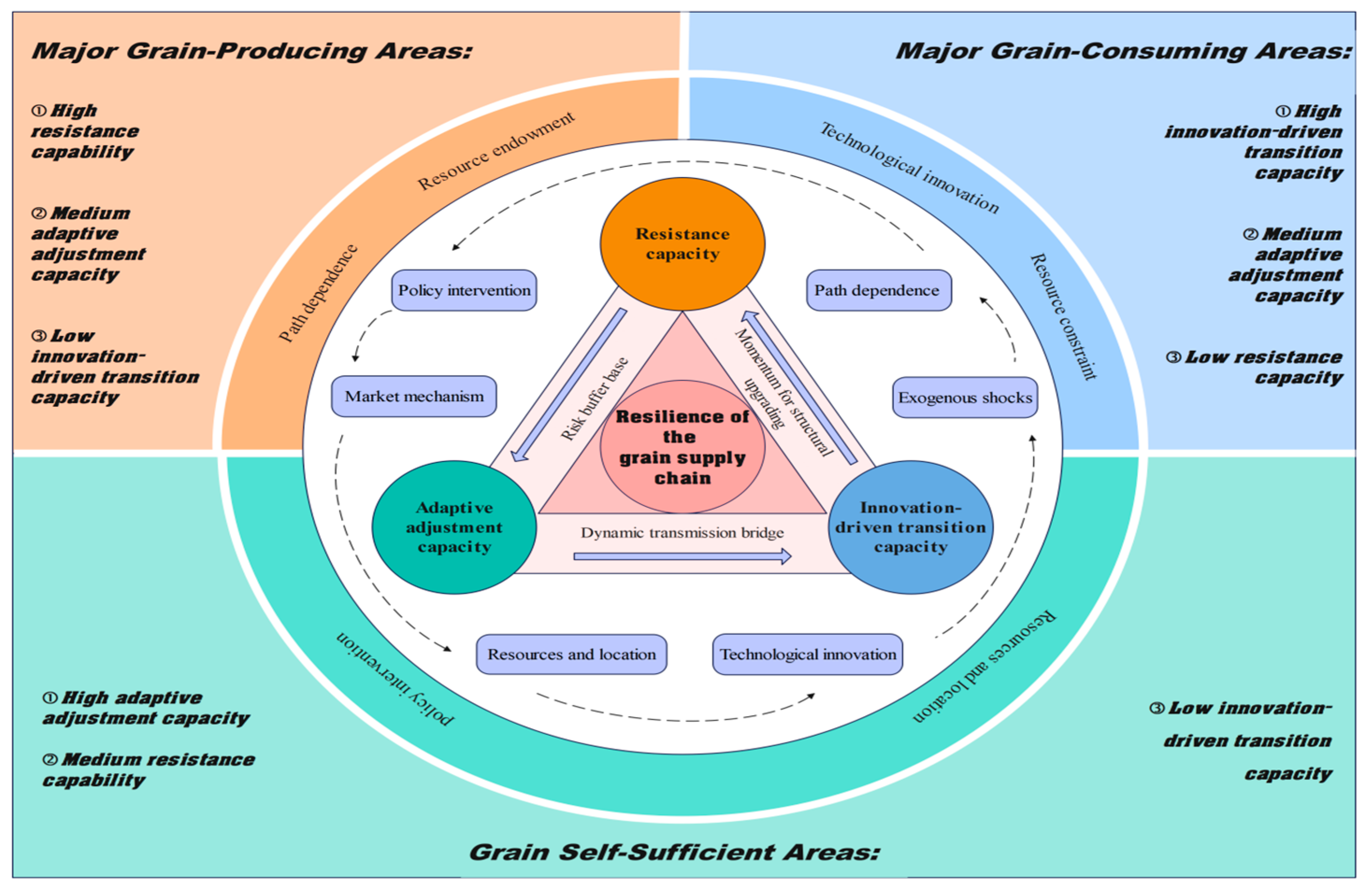
Conceptualizing the Resilience Trilemma: A Constrained Optimization Perspective
2.4. Entropy Weight Method
2.5. Kernel Density Estimation
2.6. Coefficient of Variation
2.7. Theil Index
2.8. σ-Convergence
2.9. β Convergence
3. Results
3.1. Variation Characteristics of China’s Grain Supply Chain Resilience Composite Index
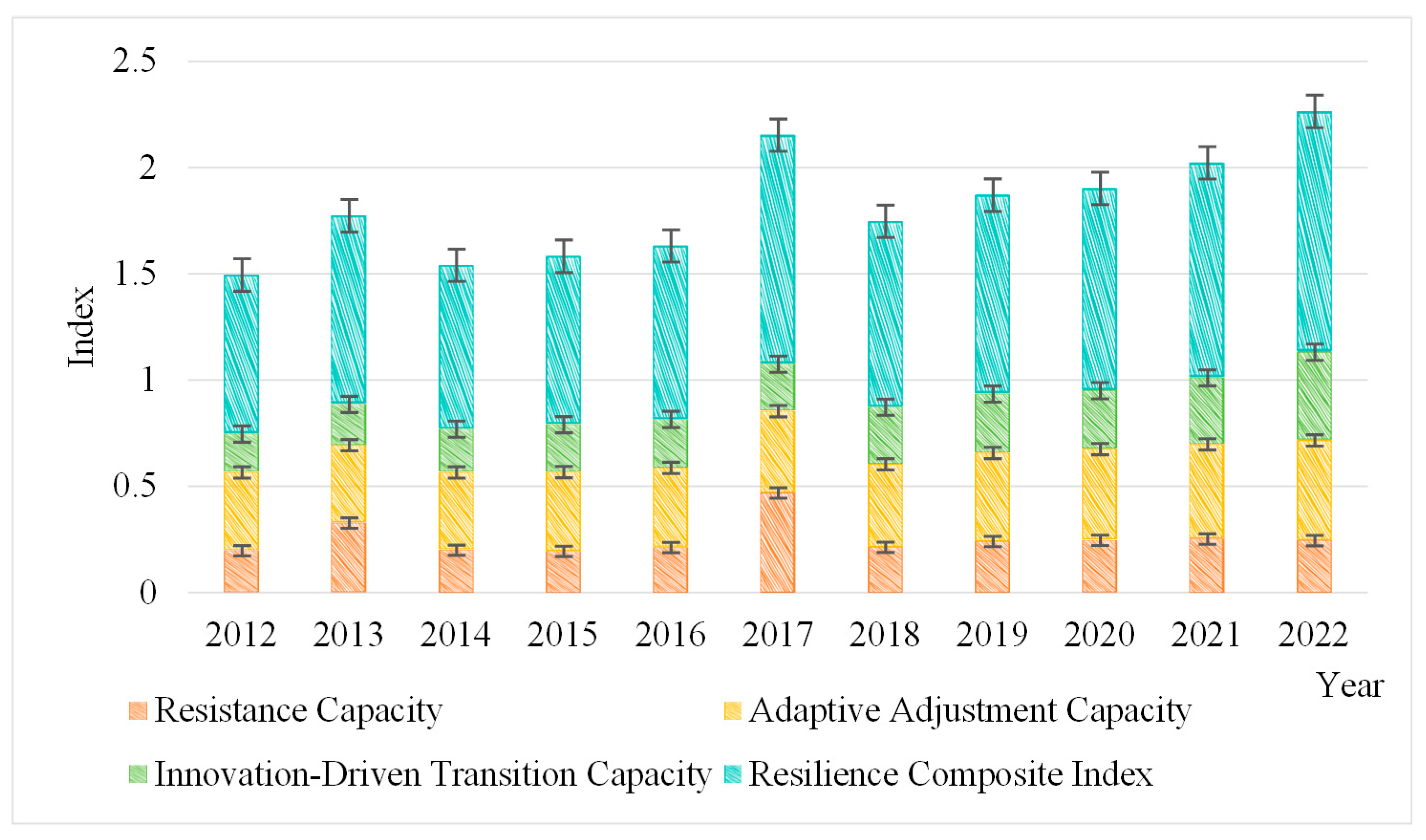
3.1.1. Temporal Features of the Composite Index
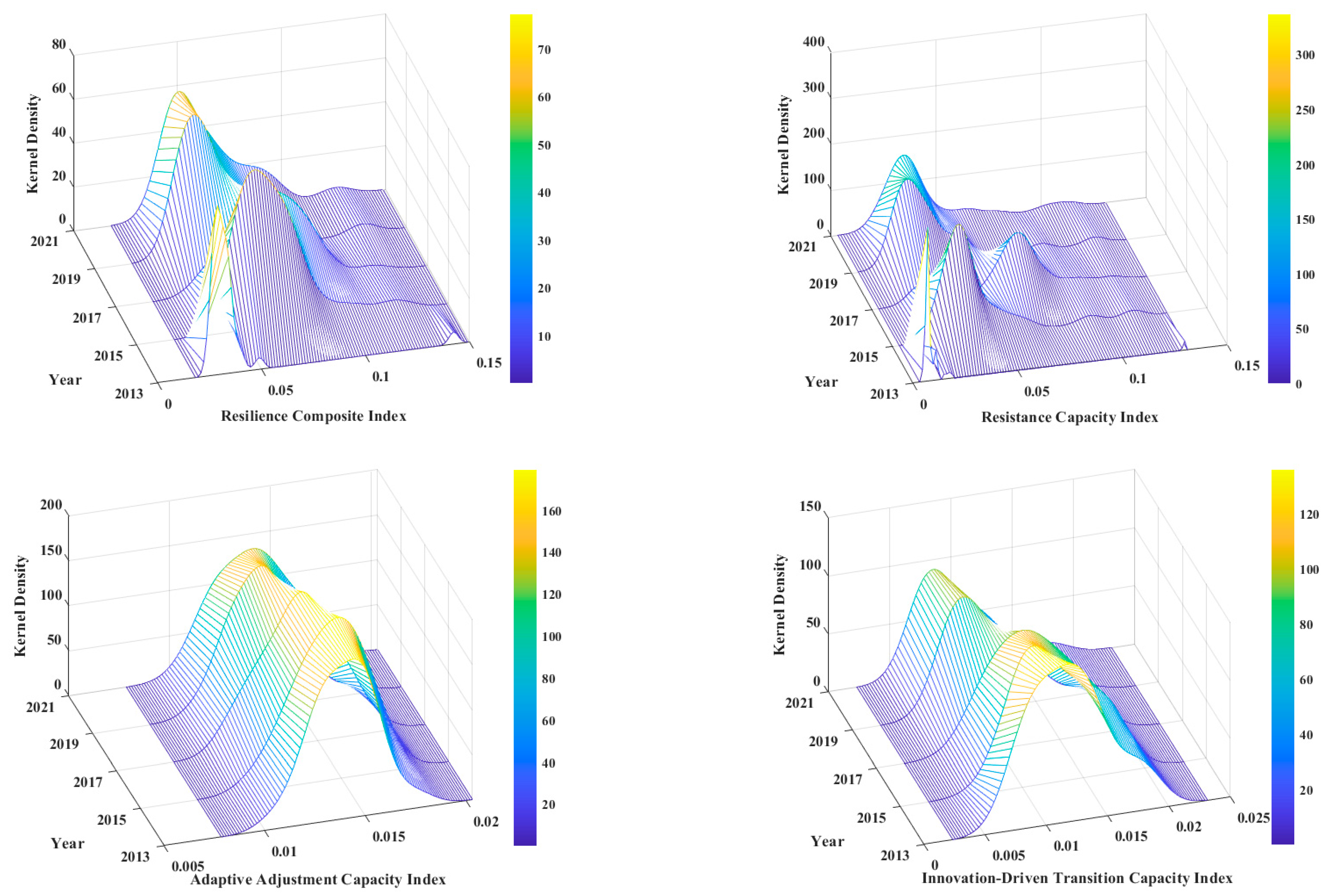
3.1.2. Evolution of Kernel Density in Grain Supply Chain Resilience Composite Index
Dynamic Evolution of Subsystem Indices in China’s Grain Supply Chain Resilience Weight Structure of the Subsystem Indices
3.1.3. Temporal Characteristics of Subsystem Indices in Grain Supply Chain Resilience
3.1.4. Kernel Density Evolution of Subsystem Indices in Grain Supply Chain Resilience
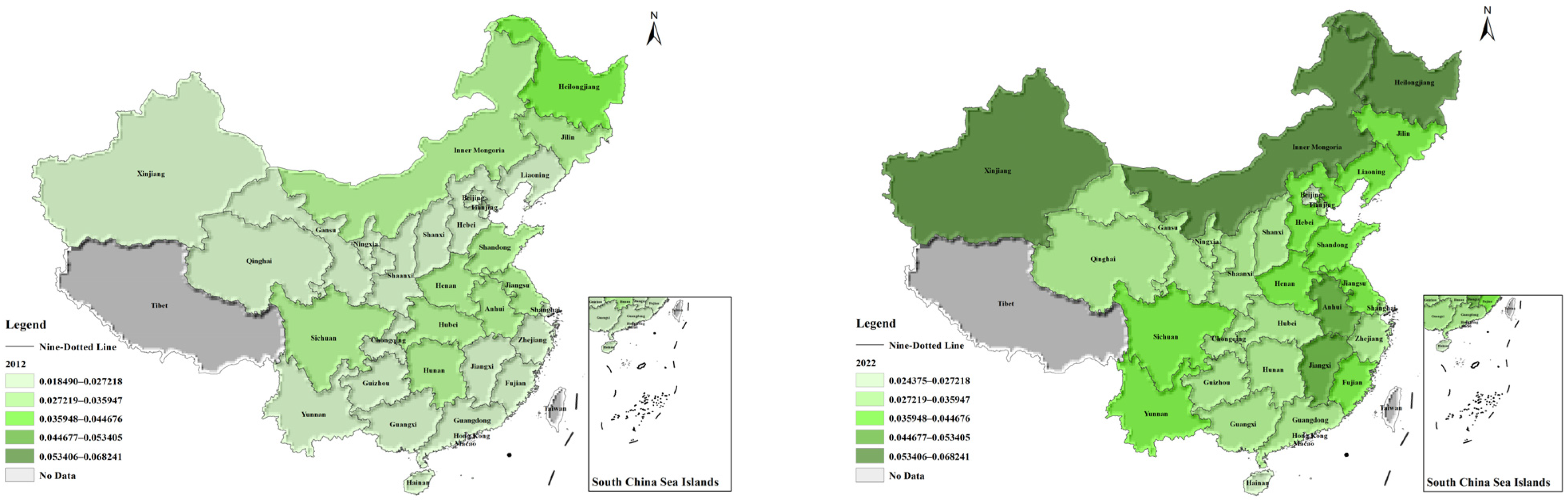
3.1.5. Regional Disparities in China’s Grain Supply Chain Resilience
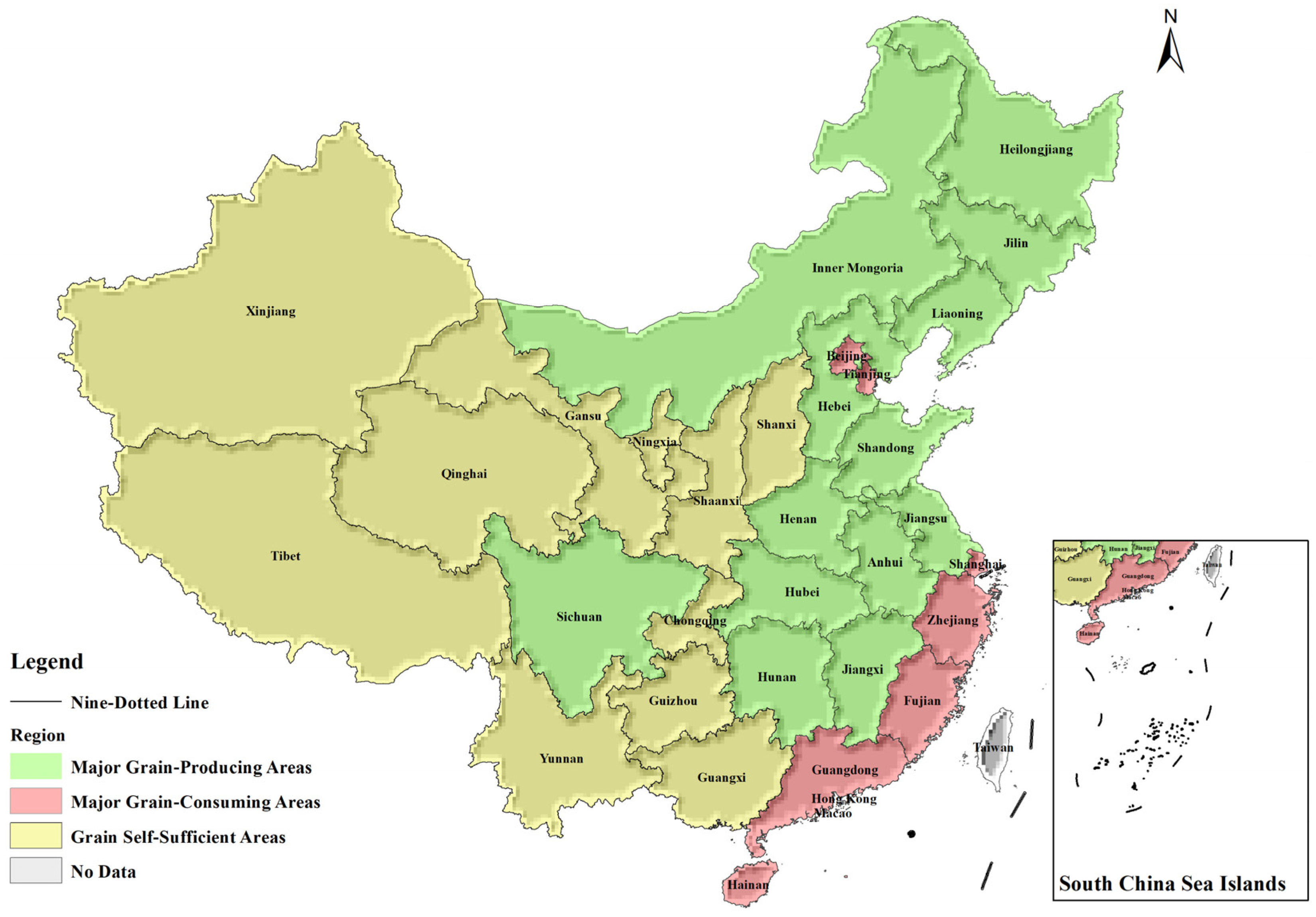
Resilience Differentiation Features Based on Spatial Patterns of Grain Production–Consumption
3.1.6. Decomposition Analysis of Regional Disparities in China’s Grain Supply Chain Resilience
3.2. Convergence Analysis
3.2.1. α-Convergence Analysis
3.2.2. β-Convergence Analysis
4. Conclusions
Author Contributions
Funding
Institutional Review Board Statement
Informed Consent Statement
Data Availability Statement
Conflicts of Interest
References
- Wen, H.; Zeng, Z. Impact of non-agricultural employment on food security in China’s old revolutionary Base Areas. Agriculture 2024, 14, 868. [Google Scholar] [CrossRef]
- World Bank. Logistics Performance Index 2023; World Bank Publications: NW Washinton, DC, USA, 2022; Available online: https://lpi.worldbank.org/international/global (accessed on 28 November 2025).
- Tendall, D.; Joerin, J.; Kopainsky, B.; Edwards, P.; Shreck, A.; Le, Q.; Kruetli, P.; Grant, M.; Six, J. Food system resilience: Defining the concept. Glob. Food Secur. 2015, 6, 17–23. [Google Scholar] [CrossRef]
- Béné, C. Resilience of local food systems and links to food security—A review of some important concepts in the context of COVID-19 and other shocks. Food Secur. 2020, 12, 805–822. [Google Scholar] [CrossRef] [PubMed]
- Cottrell, R.S.; Nash, K.L.; Halpern, B.S.; Remenyi, T.A.; Corney, S.P.; Fleming, A.; Blanchard, J.L. Food production shocks across land and sea. Nat. Sustain. 2019, 2, 130–137. [Google Scholar] [CrossRef]
- Ponomarov, S.Y.; Holcomb, M.C. Understanding the concept of supply chain resilience. Int. J. Logist. Manag. 2009, 20, 124–143. [Google Scholar] [CrossRef]
- Christopher, M.; Peck, H. Building the resilient supply chain. Int. J. Logist. Manag. 2004, 15, 1–14. [Google Scholar] [CrossRef]
- Béné, C.; Al-Hassan, R.M.; Amarasinghe, O.; Fong, P.; Ocran, J.; Onumah, E.; Ratuniata, R.; Van Tuyen, T.; McGregor, J.A.; Mills, D.J. Is resilience socially constructed? Empirical evidence from Fiji, Ghana, Sri Lanka, and Vietnam. Glob. Environ. Change 2016, 38, 153–170. [Google Scholar] [CrossRef]
- Hollnagel, E. Resilience engineering and the built environment. Build. Res. Inf. 2014, 42, 221–228. [Google Scholar] [CrossRef]
- Jüttner, U.; Maklan, S. Supply chain resilience in the global financial crisis: An empirical study. Supply Chain Manag. Int. J. 2011, 16, 246–259. [Google Scholar] [CrossRef]
- Wang, L.; Xue, X.; Zhou, X. A new approach for measuring the resilience of transport infrastructure networks. Complexity 2020, 2020, 7952309. [Google Scholar] [CrossRef]
- Hosseini, S.; Barker, K. A Bayesian network model for resilience-based supplier selection. Int. J. Prod. Econ. 2016, 180, 68–87. [Google Scholar] [CrossRef]
- Intergovernmental Panel on Climate Change (IPCC). Climate Change 2021: The Physical Science Basis (AR6 Working Group I Report); Cambridge University Press: Cambridge, UK, 2021; Available online: https://www.ipcc.ch/assessment-report/ar6/ (accessed on 28 November 2025).
- World Health Organization. The State of Food Security and Nutrition in the World 2023: Urbanization, Agrifood Systems Transformation and Healthy Diets Across the Rural–Urban Continuum; Food & Agriculture Org: Rome, Italy, 2023; Volume 2023, Available online: https://openknowledge.fao.org/items/445c9d27-b396-4126-96c9-50b335364d01 (accessed on 28 November 2025).
- Sunday, N.; Kahunde, R.; Atwine, B.; Adelaja, A.; George, J. How specific resilience pillars mitigate the impact of drought on food security: Evidence from Uganda. Food Secur. 2023, 15, 111–131. [Google Scholar] [CrossRef]
- Headey, D.; Heidkamp, R.; Osendarp, S.; Ruel, M.; Scott, N.; Black, R.; Shekar, M.; Bouis, H.; Flory, A.; Haddad, L.; et al. Impacts of COVID-19 on childhood malnutrition and nutrition-related mortality. Lancet 2020, 396, 519–521. [Google Scholar] [CrossRef]
- Laber, M.; Klimek, P.; Bruckner, M.; Yang, L.; Thurner, S. Shock propagation from the Russia–Ukraine conflict on international multilayer food production network determines global food availability. Nat. Food 2023, 4, 508–517. [Google Scholar] [CrossRef] [PubMed]
- Hobbs, J.E. Food supply chains during the COVID-19 pandemic. Can. J. Agric. Econ. Rev. Can. d’Agroecon. 2020, 68, 171–176. [Google Scholar] [CrossRef]
- Zhou, X.Y.; Lu, G.; Xu, Z.; Yan, X.; Khu, S.T.; Yang, J.; Zhao, J. Influence of Russia-Ukraine war on the global energy and food security. Resour. Conserv. Recycl. 2023, 188, 106657. [Google Scholar] [CrossRef]
- De França Marques, S.; Pitombo, C.S. Local modeling as a solution to the lack of stop-level ridership data. J. Transp. Geogr. 2023, 112, 103682. [Google Scholar] [CrossRef]
- Klerkx, L.; Rose, D.C. Dealing with the game-changing technologies of Agriculture 4.0: How do we manage diversity and responsibility in food system transition pathways? Glob. Food Secur. 2020, 24, 100347. [Google Scholar] [CrossRef]
- Treiblmaier, H. The impact of the blockchain on the supply chain: A theory-based research framework and a call for action. Supply Chain Manag. Int. J. 2018, 23, 545–559. [Google Scholar] [CrossRef]
- Vern, P.; Panghal, A.; Mor, R.S.; Kamble, S.S. Blockchain technology in the agri-food supply chain: A systematic literature review of opportunities and challenges. Manag. Rev. Q. 2025, 75, 643–675. [Google Scholar] [CrossRef]
- Ivanov, D.; Dolgui, A.; Das, A.; Sokolov, B. Digital supply chain twins: Managing the ripple effect, resilience, and disruption risks by data-driven optimization, simulation, and visibility. In Handbook of Ripple Effects in the Supply Chain; Springer International Publishing: Cham, Switzerland, 2019; pp. 309–332. [Google Scholar] [CrossRef]
- Wang, J.; Ran, B. Sustainable collaborative governance in supply chain. Sustainability 2018, 10, 171. [Google Scholar] [CrossRef]
- Duong, L.N.K.; Chong, J. Supply chain collaboration in the presence of disruptions: A literature review. Int. J. Prod. Res. 2020, 58, 3488–3507. [Google Scholar] [CrossRef]
- Tarei, P.K.; Thakkar, J.J.; Nag, B. Development of a decision support system for assessing the supply chain risk mitigation strategies: An application in Indian petroleum supply chain. J. Manuf. Technol. Manag. 2021, 32, 506–535. [Google Scholar] [CrossRef]
- Smyth, S.J.; Webb, S.R.; Phillips, P.W. The role of public-private partnerships in improving global food security. Glob. Food Secur. 2021, 31, 100588. [Google Scholar] [CrossRef]
- Wu, L.; Chen, Z. Study on the Influences of Inter-Governmental Information Flow and Interdepartmental Collaborative Supervision on Pork Quality: A Case Study in China. Foods 2024, 13, 2387. [Google Scholar] [CrossRef]
- Assa, H.; Sharifi, H.; Lyons, A. An examination of the role of price insurance products in stimulating investment in agriculture supply chains for sustained productivity. Eur. J. Oper. Res. 2021, 288, 918–934. [Google Scholar] [CrossRef]
- Shi, Y.; Wang, F. Revenue and risk sharing mechanism design in agriculture supply chains considering the participation of agricultural cooperatives. Systems 2023, 11, 423. [Google Scholar] [CrossRef]
- Kirli, D.; Couraud, B.; Robu, V.; Salgado-Bravo, M.; Norbu, S.; Andoni, M.; Antonopoulos, I.; Negrete-Pincetic, M.; Flynn, D.; Kiprakis, A. Smart contracts in energy systems: A systematic review of fundamental approaches and implementations. Renew. Sustain. Energy Rev. 2022, 158, 112013. [Google Scholar] [CrossRef]
- Wu, X.; Yang, M.; Wu, C.; Liang, L. How to avoid source disruption of emergency supplies in emergency supply chains: A subsidy perspective. Int. J. Disaster Risk Reduct. 2024, 102, 104303. [Google Scholar] [CrossRef]
- Stone, J.; Rahimifard, S. Resilience in agri-food supply chains: A critical analysis of the literature and synthesis of a novel framework. Supply Chain Manag. Int. J. 2018, 23, 207–238. [Google Scholar] [CrossRef]
- Ortega-Beltran, A.; Bandyopadhyay, R. Contributions of integrated aflatoxin management strategies to achieve the sustainable development goals in various African countries. Glob. Food Secur. 2021, 30, 100559. [Google Scholar] [CrossRef]
- He, C.; Zhou, C.; Wen, H. Improving the consumer welfare of rural residents through public support policies: A study on old revolutionary areas in China. Socio-Economic Plan. Sci. 2024, 91, 101767. [Google Scholar] [CrossRef]
- El Bilali, H.; Allahyari, M.S. Transition towards sustainability in agriculture and food systems: Role of information and communication technologies. Inf. Process. Agric. 2018, 5, 456–464. [Google Scholar] [CrossRef]
- Darnhofer, I. Resilience or how do we enable agricultural systems to ride the waves of unexpected change? Agric. Syst. 2021, 187, 102997. [Google Scholar] [CrossRef]
- Ericksen, P.J. Conceptualizing food systems for global environmental change research. Glob. Environ. Change 2008, 18, 234–245. [Google Scholar] [CrossRef]
- Fan, S.; Teng, P.; Chew, P.; Smith, G.; Copeland, L. Food system resilience and COVID-19—Lessons from the Asian experience. Glob. Food Secur. 2021, 28, 100501. [Google Scholar] [CrossRef]
- Seekell, D.A.; Carr, J.A.; Dell’Angelo, J.; D’Odorico, P.; Fader, M.; Gephart, J.A.; Rinaldo, A. Resilience in the global food system. Environ. Res. Lett. 2017, 12, 025010. [Google Scholar] [CrossRef] [PubMed]
- Wästfelt, A.; Zhang, Q. Reclaiming localisation for revitalising agriculture: A case study of peri-urban agricultural change in Gothenburg, Sweden. J. Rural Stud. 2016, 47, 172–185. [Google Scholar] [CrossRef]
- Duan, W.; Madasi, J.D.; Khurshid, A.; Ma, D. Industrial structure conditions economic resilience. Technol. Forecast. Soc. Change 2022, 183, 121944. [Google Scholar] [CrossRef]



| First-Order Dimension | Second-Level Dimension | Specific Indicators | Attribute | Weight |
|---|---|---|---|---|
| Resistance Capacity | The grain supply chain stability ability | Grain production per capita (tons/capita) | + | 0.04659 |
| Arable land per capita (ha/capita) | + | 0.04614 | ||
| Agricultural production price index | + | 0.04995 | ||
| The grain supply chain coordination ability | Rural labor force level | + | 0.00122 | |
| Grain yield per unit area (kg/ha) | + | 0.02793 | ||
| Foreign trade dependence (%) | − | 0.05031 | ||
| Rural road access rate | + | 0.04812 | ||
| Adaptive Adjustment Capacity | The grain supply chain disaster resilience ability | Crop damage rate | − | 0.05017 |
| Strength of agricultural plastic film | − | 0.05024 | ||
| Fertilizer intensity | − | 0.05022 | ||
| Pesticide application intensity | − | 0.05009 | ||
| Agricultural diesel fuel intensity (tons/ha) | − | 0.05009 | ||
| The grain supply chain adjustment ability | Value added of primary industry in GDP (%) | + | 0.04878 | |
| Agricultural Insurance (Premium) Payout (million yuan) | + | 0.04671 | ||
| The multiple crop index | + | 0.04915 | ||
| Grain yield fluctuation rate | − | 0.05018 | ||
| Innovation-Driven Transition Capacity | The grain supply chain innovation ability | Planting construction of the crops | + | 0.04945 |
| Number of organic food certificates (PCS) | + | 0.04643 | ||
| The grain supply chain transformation ability | Per capita disposable income of rural residents | + | 0.04863 | |
| Output value of grain | + | 0.04696 | ||
| Number of grain industry enterprises (PCS) | + | 0.04691 | ||
| Profit of grain industry enterprises (100 million yuan) | + | 0.04575 |
| Region | Composite Index Mean | Resistance Capacity Mean | Adaptive Adjustment Capacity Mean | Innovation-Driven Transition Capacity Mean |
|---|---|---|---|---|
| Major Grain-Producing Areas | 0.0412 | 0.0128 | 0.0156 | 0.0128 |
| Major Grain-Consuming Areas | 0.0327 | 0.0072 | 0.0131 | 0.0124 |
| Grain Self-Sufficient Areas | 0.0285 | 0.0089 | 0.0139 | 0.0057 |
| Year | T (Total) | T (Intergroup) | Intergroup Contribution Rate (%) | CV | CR of Resistance Capacity (%) | CR of Adaptive Adjustment Capacity (%) | CR of Innovation-Driven Transition Capacity (%) |
|---|---|---|---|---|---|---|---|
| 2012 | 0.112 | 0.068 | 60.7 | 0.43 | 28.5 | 33.9 | 37.6 |
| 2013 | 0.118 | 0.071 | 60.2 | 0.45 | 27.8 | 34.2 | 38.0 |
| 2014 | 0.125 | 0.074 | 59.2 | 0.47 | 26.9 | 35.1 | 38.0 |
| 2015 | 0.131 | 0.076 | 58.0 | 0.49 | 25.4 | 36.7 | 37.9 |
| 2016 | 0.134 | 0.078 | 58.2 | 0.50 | 24.8 | 37.0 | 38.2 |
| 2017 | 0.142 | 0.083 | 58.5 | 0.53 | 32.1 | 35.3 | 32.6 |
| 2018 | 0.148 | 0.087 | 58.8 | 0.55 | 29.7 | 36.8 | 33.5 |
| 2019 | 0.153 | 0.090 | 58.8 | 0.57 | 28.3 | 37.5 | 34.2 |
| 2020 | 0.159 | 0.094 | 59.1 | 0.60 | 27.6 | 38.1 | 34.3 |
| 2021 | 0.165 | 0.098 | 59.4 | 0.62 | 26.9 | 38.7 | 34.4 |
| 2022 | 0.170 | 0.101 | 59.4 | 0.64 | 26.5 | 39.2 | 34.3 |
| Region Type | β-Coefficient | t Value | Convergence Rate (%) | Convergence Trend |
|---|---|---|---|---|
| Nationwide | −0.126 * | −2.37 | 1.8 | Weak convergence |
| Major Grain-Producing Areas | −0.214 ** | −3.05 | 3.2 | Significant convergence |
| Major Grain-Consuming Areas | 0.082 | 1.12 | — | Divergency |
| Grain Self-Sufficient Areas | −0.153 * | −2.16 | 2.1 | Weak convergence |
| Region Type | Absolute β-Convergence | Conditional β-Convergence | |||
|---|---|---|---|---|---|
| Coefficient | Rate of Convergence | Coefficient | Rate of Convergence | Control Variable Contribution | |
| Nationwide | −0.122 *** (0.037) | 1.5% per year | −0.087 ** (0.043) | 1.1% per year | Innovation-Driven Transition Capacity |
| Major Grain-Producing Areas | −0.179 *** (0.041) | 2.1% per year | −0.154 *** (0.049) | 1.8% per year | Adaptive Adjustment Capacity |
| Major Grain-Consuming Areas | 0.038 (0.055) | — | 0.261 * (0.142) | 0.7% per year | Resistance Capacity (Cold chain coverage) |
| Grain Self-Sufficient Areas | −0.065 * (0.038) | 0.8% per year | −0.049 (0.041) | — | Resistance Capacity (Transport accessibility) |
Disclaimer/Publisher’s Note: The statements, opinions and data contained in all publications are solely those of the individual author(s) and contributor(s) and not of MDPI and/or the editor(s). MDPI and/or the editor(s) disclaim responsibility for any injury to people or property resulting from any ideas, methods, instructions or products referred to in the content. |
© 2025 by the authors. Licensee MDPI, Basel, Switzerland. This article is an open access article distributed under the terms and conditions of the Creative Commons Attribution (CC BY) license (https://creativecommons.org/licenses/by/4.0/).
Share and Cite
He, C.; Yu, L.; Su, X. The Resilience Trilemma in Grain Supply Chain: Unpacking Spatiotemporal Trade-Offs Across Production–Consumption Zones from the Case of China. Agriculture 2025, 15, 2531. https://doi.org/10.3390/agriculture15242531
He C, Yu L, Su X. The Resilience Trilemma in Grain Supply Chain: Unpacking Spatiotemporal Trade-Offs Across Production–Consumption Zones from the Case of China. Agriculture. 2025; 15(24):2531. https://doi.org/10.3390/agriculture15242531
Chicago/Turabian StyleHe, Congxian, Lulu Yu, and Xiang Su. 2025. "The Resilience Trilemma in Grain Supply Chain: Unpacking Spatiotemporal Trade-Offs Across Production–Consumption Zones from the Case of China" Agriculture 15, no. 24: 2531. https://doi.org/10.3390/agriculture15242531
APA StyleHe, C., Yu, L., & Su, X. (2025). The Resilience Trilemma in Grain Supply Chain: Unpacking Spatiotemporal Trade-Offs Across Production–Consumption Zones from the Case of China. Agriculture, 15(24), 2531. https://doi.org/10.3390/agriculture15242531