Article

The Energy Potential of Woody Vine Shoots Depending on the Training System, Cultivar, and Colour of the Fruit


1
Department of Viticulture and Enology, Faculty of Horticulture, Mendel University in Brno, Valtická 337, 69144 Lednice, Czech Republic
2
Institute of Horticulture Production, University of Life Sciences in Lublin, Głęboka 28, 20-612 Lublin, Poland
3
Department of Applied Mathematics and Computer Science, University of Life Sciences in Lublin, Głęboka 28, 20-612 Lublin, Poland
4
Department of Power Engineering and Transportation, University of Life Sciences in Lublin, Głęboka 28, 20-612 Lublin, Poland
*
Author to whom correspondence should be addressed.
Agriculture 2025, 15(24), 2524; https://doi.org/10.3390/agriculture15242524
Submission received: 25 September 2025 / Revised: 1 December 2025 / Accepted: 3 December 2025 / Published: 5 December 2025

Abstract

The aim of this study was to assess the energy potential of woody grapevine (Vitis vinifera L.) shoots depending on the cultivation system, cultivar, and fruit colour. Field studies were conducted in 2024 at the Mendel University Vineyard in Lednice (Czech Republic) on Chardonnay, Merlot, Riesling, and Zweigelt cultivars, cultivated using the Guyot and Cordon systems. The cultivar analysis covered both the amount of biomass produced during pruning and its energy and emission properties. Laboratory tests of the energy potential of the biomass obtained were carried out at the University of Life Sciences in Lublin. The results showed that the varietal factor significantly influenced the biomass parameters—Chardonnay was characterised by the highest total plant weight (773.57 g), while Zweigelt (8.60 pcs.) had the highest number of shoots with the lowest unit weight (74.82 g). The Cordon system generated significantly higher biomass yields and more favourable combustion properties compared to Guyot. Differences in fruit colour indicate that, among the studied cultivars, white-berried varieties produce heavier shoots, whereas red varieties produce a greater number of shoots. The analysis of gas emissions showed a significant influence of the cultivar and training system, with the highest CO, CO2, and NOx emissions recorded for the Zweigelt cultivar. The results emphasise that an integrated approach, taking into account both genotypic factors, training systems and phenotypic characteristics of the vines, is crucial for optimising the use of wine biomass as an energy source in the context of a circular economy.

1. Introduction

Wine production represents one of the oldest and most economically significant branches of agriculture, generating millions of tons of by-products each year that pose serious environmental challenges. Globally, around 75 million tons of grapes are produced annually, with approximately 80% used for winemaking, resulting in substantial quantities of residual biomass such as leaves, shoots, pomace, and stalks. Among these, grape pomace, composed of skins, seeds, and pulp, has been widely investigated for its potential in the energy, pharmaceutical, and cosmetic industries [1,2,3,4]. Wine production is not only a long-standing tradition but also a significant source of economic value. The global wine market was worth approximately USD 302 billion in 2017, and was projected to grow to USD 423 billion by 2023 [5]. At the same time, winemaking generates enormous amounts of waste: 10–13 million tons of grape pomace [6] and approximately 2.7–3 million tons of wine lees [5] are produced annually. This waste constitutes a significant percentage of the grape mass (approximately 20–40%), and if improperly managed, it can generate serious environmental problems [7]. Grape pomace, including skins, seeds, and pulp residues, is relatively well known and widely researched for its use in the energy, pharmaceutical, and cosmetics sectors. However, other vineyard residues—particularly lignified pruning wood—remain largely underutilised despite their high energy potential and abundant availability [1,8].
The wine industry, like many other agro-industrial sectors, is struggling with the problem of increasing waste. Grape production and processing generate not only organic waste, but also wastewater, greenhouse gas emissions, and significant burdens associated with the transport and use of plant protection products. In the context of increasing pressure to implement sustainable development principles, the wine sector is faced with the need to not only reduce emissions and pollution, but also to find cost-effective and efficient ways to use by-products. Recent studies highlight that grapevine pruning residues can reach calorific values between 17 and 19 MJ·kg−1, comparable to other woody biomasses used for bioenergy production. In this regard, biomass from vines is not a problem, but a resource with high energy potential [9,10].
Given the increasing emphasis on circular bioeconomy models in viticulture, the valorisation of pruning wood offers a sustainable strategy for reducing waste, closing nutrient cycles, and enhancing the energy efficiency of winegrowing systems. The dynamic development of the energy sector and growing pressure to decarbonise make the search for new renewable energy sources a priority. Currently, the energy sector accounts for nearly 40% of global greenhouse gas emissions, making it a key area for action to mitigate climate change. In this context, bioenergy appears to be a strategic element of the energy transition [11,12,13,14,15].
Agricultural biomass, including by-products from the wine industry, has great potential as an energy source. Across Europe, agricultural residues represent an estimated annual potential of about 950 million tons, forming an important foundation for renewable energy strategies. Utilising these resources helps to reduce dependence on fossil fuels and supports the achievement of the Sustainable Development Goals, particularly SDG 7, which emphasises access to clean and affordable energy. Incorporating vineyard residues into the energy chain can therefore improve local energy security, decrease greenhouse gas emissions, and provide additional income streams for grape growers and wineries [16,17,18].
In the context of climate change and the simultaneous increase in energy demand, the use of renewable energy sources, including biomass, is becoming indispensable [19,20,21]. The use of such raw materials for energy production has a significant positive impact on the improvement of agricultural management and should therefore be an important element of agricultural policy [22]. Biomass from agriculture and horticulture, e.g., crop residues, straw, leaves, or pruned shoots, is an important source of renewable energy [23]. Its use in combustion, anaerobic fermentation, or biofuel production processes reduces dependence on fossil fuels and greenhouse gas emissions [11]. The management of this type of waste also promotes a circular economy, increasing local energy security and bringing economic benefits to farmers and producers [24,25,26].
The energy characteristics of vine biomass are determined by several interacting factors, including cultivar, training system, climatic conditions, and even the colour of the grape berries. These parameters influence the physicochemical composition of the wood—especially ash content, moisture, elemental composition, and calorific value—which in turn affect both energy efficiency and emission profiles during thermochemical conversion processes. Notably, the contrasting phenolic and anthocyanin content of white and red cultivars may alter their combustion behaviour and environmental footprint. Despite the growing emphasis on sustainable vineyard management, comprehensive evaluations of how grapevine cultivar, training system, and berry colour jointly influence the energy and emission potential of lignified residues remain scarce. This knowledge gap is particularly evident in Central European viticultural conditions, where climatic, varietal, and management diversity significantly shape biomass quality [27,28]. Therefore, the present study aims to provide an integrated analysis of these factors, assessing the elemental composition and emission behaviour of grapevine pruning residues. The findings are expected to contribute to the sustainable management of vineyard biomass in the Czech Republic and offer practical implications for improving energy recovery efficiency while supporting the national economy [29,30,31,32,33,34].
In the Czech Republic, viticulture plays a vital role in horticultural and regional agricultural production. The country’s vineyard area covers approximately 18,000 hectares, producing around 60,000 tonnes of grapes annually, of which over 95% are used for winemaking [35,36]. Modern Czech viticulture has undergone a major transformation in recent decades, introducing advanced cultivars and clones such as Chardonnay, Ryzlink rýnský (Riesling), Veltlínské zelené (Grüner Veltliner), Frankovka (Blaufränkisch), and Zweigeltrebe [37,38,39]. These varieties are valued not only for their oenological potential but also for their significant economic and cultural importance, contributing to the growth of wine tourism and the sustainability of rural regions, in response to the rapid climate changes in recent decades [40]. Nevertheless, the intensification of vineyard management and the increasing use of high-yielding systems have also resulted in larger volumes of annual pruning residues, which are usually burned or mulched without energetic recovery [41,42,43].
The aim of this study is to conduct a comprehensive analysis, taking into account the impact of cultivar, cultivation system, and fruit colour, which is necessary for a full understanding of the bioenergy potential of wine biomass.

2. Materials and Methods

2.1. Cultivation Methodology

This study assessed the potential of woody vine shoots in relation to training system, cultivar, and fruit colour. A two-factor experiment was conducted, comparing Guyot and Cordon pruning in four varieties with different vigour and growth habits. The focus was on quantitatively determining biomass production and assessing its suitability for energy use, while also examining the impact of structural differences on annual wood formation and the amount of waste generated during pruning.
The field experiment was conducted in 2024 at the Mendel University Vineyard in Lednice (Moravia, Czech Republic), cultivated in a warm temperate climate zone. Vitis vinifera L. grapevine varieties Chardonnay, Merlot, Riesling, and Zweigelt were grown using two systems: Guyot and Cordon. The experiment was arranged in a randomised block design. It comprised eight combinations (four varieties * two training systems) and ten replicates. The replicates were plots with five plants each. The plants were planted with a spacing of 2 × 1 m. The experimental vineyard was established between 2004 and 2006. Over the following years, the vineyard underwent gradual transformation under three successive management regimes, during which the original “classic” cane-trained system was replaced by Guyot and Cordon formations. The current training systems were consistently applied and structurally stabilised for approximately 12 years prior to the 2024 data collection, ensuring full comparability between treatments.
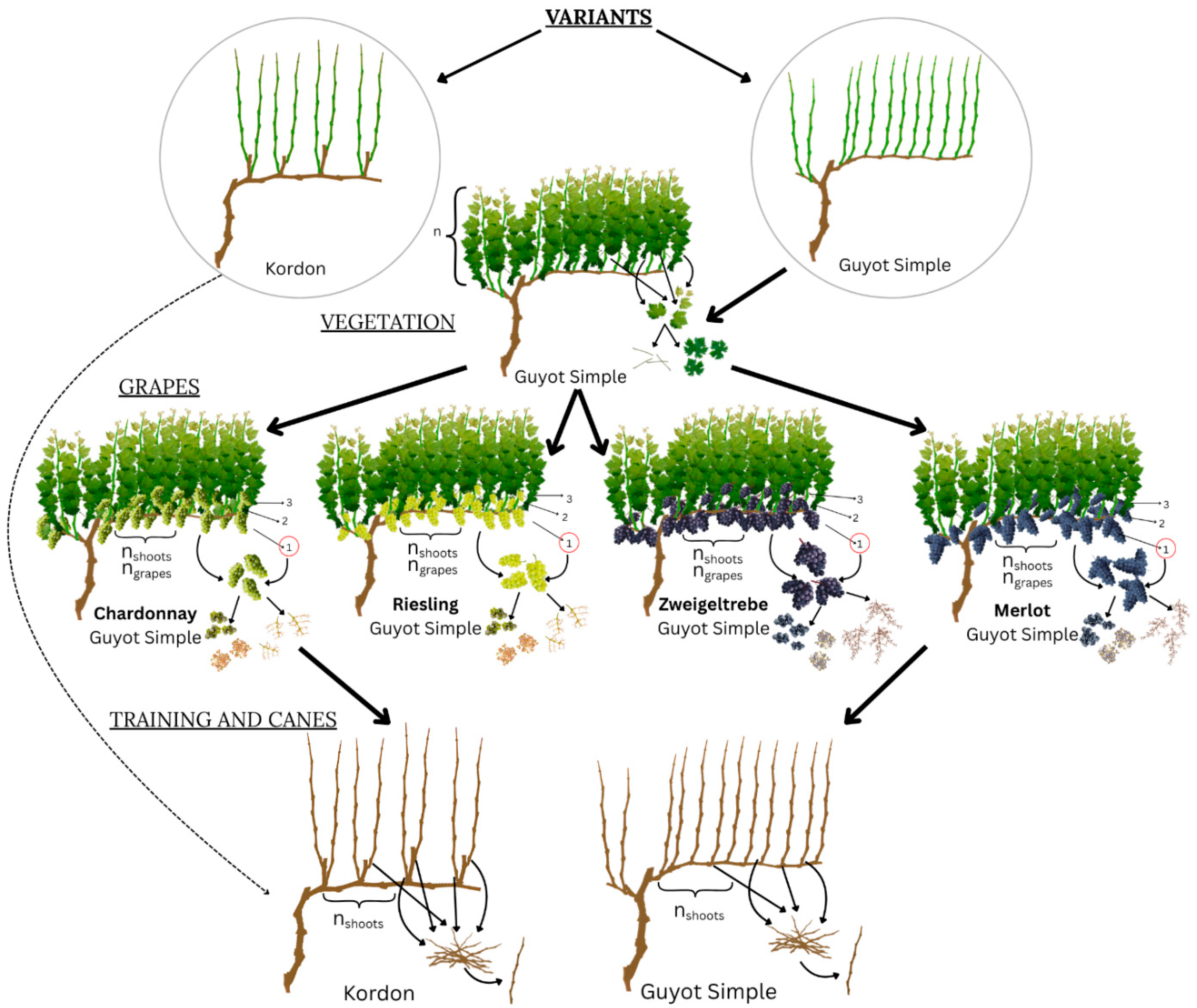
Vines grown using the single Guyot system had an 80 cm high trunk, a single two-year-old shoot of approximately 1.0 m long, and a single two-bud spur. Vines trained using the Cordon system had an 80 cm high trunk and a perennial frame of approximately 1.0 m long with four branching nodes on which two-bud spurs/knots were left, from which two fruiting shoots were obtained (Figure 1). Summer thinning of shoots, formative pruning of tops, and winter pruning were carried out in accordance with the appropriate training type. No excessive crown or yield load treatments were applied for experimental purposes; the vine load was maintained within the standard range of 9–11 fruit buds per cane (lignified).
The fruiting shoots were harvested (annual pruned shoots) after lignification and defoliation during dormancy (induced by low temperatures and internal physiological changes) and just before winter pruning on 17 December 2024. The total annual number of lignified shoots of wood on each vine was counted. Shoots were collected from 10 representative vines (random selection with uniform load). The shoots were cut at the base of the spur and weighed in fresh condition (accuracy ± 0.1 g).

2.2. Methodology for Fuel Characterisation

The detailed methodology for measuring energy parameters is discussed in Table 1, Table 2 and Table 3. Prior to laboratory testing, the material was placed in a room with constant temperature and humidity, where it was dried naturally in air-dry conditions at 20 °C and 55% to 60% humidity for two weeks in order to standardise the assessment conditions. The laboratory tests were carried out at the Laboratory of the Department of Energy and Transport at the University of Life Sciences in Lublin. The material for analysis was first ground (to a thickness of 0.5 mm) using a Retsch SM 100 mill (Retsch GmbH, Haan, Germany, 2022) with a power of 1.5 kW. For the purposes of this study, 100 g of material was obtained in 2 min, which consumed 0.045 kWh. Our results present values in an analytical condition; additionally, in the case of HHV, the analytical condition was converted to a dry condition without ash.

2.3. Statistical Analysis

After the experiment was completed, the results were statistically analysed using three-factor analysis of variance (ANOVA), comparisons between varieties, regardless of plant material and vine colour, and comparisons between training systems and fruit colour. Statistical inference was performed at a significance level of α = 0.05. Multivariate data analysis techniques were used, including cluster analysis and principal component analysis. The results of the cluster analysis were presented using a dendrogram to show the yield and quality of wine waste and the caloric value of stems and pomace. The relationships between the components of the biomass of productive vines, independent of plant material, were determined separately for each cultivar. All analyses were performed using STATISTICA 13 software (StatSoft, Inc.; TIBCO Software; Palo Alto, CA, USA; 2015).

3. Results

The field and laboratory results obtained were analysed in the context of three factors: cultivar, training system, and fruit colour.

3.1. Effect of Cultivar (Factor A)

Factor A—cultivar: This factor has a very significant effect on all parameters (p = 0.0001). This interaction shows a unique growth pattern for the cultivar: it produces a small number of shoots (6.15 ± 1.42), but these shoots are exceptionally strong (132.86 ± 31.30 g) (Table 4). This combination results in the highest total plant mass (773.57 ± 158.76 g) of all varieties. Zweigelt produces a large number of shoots (8.60 ± 0.99), but the individual shoots are the lightest (74.82 ± 11.21 g), resulting in the lowest total plant weight (521.17 ± 124.23 g). This highlights an interesting compromise between the number of shoots and the weight of individual shoots.

3.2. Effect of Training Systems (Factor B)

Factor B—Training system: This factor is highly significant for all parameters (p = 0.0001). The Cordon training system ensures higher biomass yield, which is a significant advantage for potential energy production.
Under the conditions studied, the Cordon system produces significantly heavier individual shoots and a greater total plant weight than the Guyot system, indicating that it is more effective in maximising biomass yield. Cordon training is significantly better in terms of biomass yield. It provides heavier individual shoots (122.90 ± 33.95 g) and, consequently, a significantly higher total plant weight (759.86 ± 121.79 g) compared to the Guyot system (510.24 ± 105.59 g) (Table 4).
The Cordon system produced significantly heavier single shoots (122.90 ± 33.95 g) and greater total plant weight (759.86 ± 121.79 g) compared to the Guyot system (84.22 ± 17.48 g; 510.24 ± 105.59 g).

3.3. Effect of Colour (Factor C)

Factor C—Colour: The effect of grape colour is statistically significant (p = 0.0001). The selected cultivars—Chardonnay, Riesling, Merlot, and Zweigelt—were intentionally chosen as representatives of Central European viticulture, differing in vigour, wood density, and canopy behaviour. This design ensured practical and comparative relevance to typical vineyard management scenarios rather than broad extrapolation. Based on the numerical values, the data suggest that white varieties have a higher shoot weight and total plant weight, while red varieties have a higher number of shoots. The data probably indicate that the biomass of white grapes has a higher weight per shoot (125.60 ± 31.33 g) and a higher total plant weight (694.62 ± 187.77 g) compared to the biomass of red grapes [56].
The colour of the grapes also has a significant impact, although its role is indirect. White grape varieties in our dataset (Chardonnay, Riesling) show a higher average shoot weight (125.60 ± 31.33 g) and total plant weight (694.62 ± 187.77 g) but produce fewer shoots (7.02 ± 1.46). Blue-berried varieties (Merlot, Zweigelt) have more shoots (8.57 ± 1.11) but with a lower weight (81.52 ± 15.74 g).

3.4. Interactions (A*B, A*C, B*C, A*B*C)

All interactions between factors (A*B, A*C, B*C, and A*B*C) are highly statistically significant (p = 0.0001). Highly significant p-values for all interaction effects (A*B, A*C, etc.) in all three tables confirm that the training system and biomass characteristics are not independent. The yield of a particular cultivar and the original combination of physical characteristics (clone, rootstock, density, age, etc.) are greatly influenced by the training system and the physical characteristics of the woody shoots. This highlights the need for a holistic approach to biomass assessment. This is the most important finding of this chapter, as it shows that the impact of a single factor, such as cultivar, is not constant but depends on its combination with the training system and colour.
The statistical significance of all interactions (p < 0.0001) confirms the synergistic complexity of biomass production.
A*B: Variation: Training—Highly significant interactions (p < 0.0001) indicate that the effect of one factor is dependent on the others—a characteristic feature of the complexity of the viticulture system [57].

3.5. Analysis of the Energy Potential of the Tested Waste Biomass

The results of this study clearly show that three main factors—cultivar, training system, and grape colour—have a significant and interdependent influence on the physical properties of woody vine shoots. Consistent p-values (<0.0001) for all measured parameters emphasise the robustness of these effects. From a sustainability perspective, incorporating pruning residues into vineyard management has the potential to reduce on-site burning by reducing greenhouse gas emissions, supporting a circular economy model. However, the choice of grape cultivar and training system combination must remain tailored to specific conditions: in the production of high-quality white or red wine, where fruit composition is crucial, the potential yield or quality compromises resulting from pruning must be carefully weighed against the energy benefits derived from biomass.
Table 5 shows the effect of grapevine cultivar, training system, and berry colour of four varieties of Vitis vinifera L. on the technical analysis of combustion parameters obtained from shoots. The analysed technical combustion parameters differed significantly between varieties. The HHV level showed significant differences between the tested varieties, with the lowest level observed in Riesling (15.97) and no significant differences in the other varieties, while the highest level was obtained in Chardonnay and Zweigelt (16.43). Identical relationships were observed among dry HHV, LHV, and MC (27.37, 14.89, and 37.75, respectively), where shoots obtained from the Chardonnay cultivar were characterised by a significantly higher level among the studied varieties, while Zweigelt (24.02, 14.71, and 29.37) had the lowest by a significant degree.
The training system had a significant impact on the level of the assessed technical parameters of combustion. It was shown that HHV, dry HHV, LHV, MC, and A obtained from shoots trained using the Cordon system were significantly higher than those obtained from shoots trained using the Guyot system. The opposite significant relationship was demonstrated for the V parameter, which, in the case of FC, demonstrated no significant effect of the training system on the level of the assessed parameter.
The statistical analysis carried out on most of the technical parameters analysed did not show a significant influence of berry colour on the parameters assessed. An exception was found in the case of MC, where it was shown that varieties with light-coloured fruit had a significantly higher level of the assessed parameter compared to red-coloured fruit. Conversely, a significant correlation was found in the case of the FC parameter.
The double interaction between varieties and training system, and between training system and berry colour, showed significant correlations between the analysed technical combustion parameters, with the exception of the FC parameter. The same correlation occurs in the case of the triple interaction between cultivar, training system, and fruit colour. In the case of the interaction between the cultivar and the colour of the fruit, significant correlations were found for all the parameters assessed.
Table 6 presents the results of the elementary analysis, which showed a significant impact of cultivar and cultivation method on most of the evaluated elements. Analysis of the fruit content of the evaluated grapevine varieties did not show a significant impact on any evaluated parameters except oxygen. After burning, the shoots of white grapevine varieties were characterised by a significantly higher oxygen level than red ones.
No significant differences between the analysed varieties of Vitis vinifera L. were found in the case of sulphur (S) and N/C; a similar relationship between the parameters of the elemental analysis was also observed in the case of the form of vine training. Ash from Zweigelt shoots was characterised by significantly higher levels of carbon (C) and nitrogen (N) (34.27; 0.77, respectively). The lowest levels of the above-mentioned parameters of the elemental analysis were recorded for carbon (C) in the Chardonnay cultivar and for nitrogen in the Chardonnay and Merlot varieties, which did not differ from each other. The Chardonnay cultivar was characterised by significantly higher levels of hydrogen (H), oxygen (O), H/C, and O/C (8.97; 57.91; 2.98; and 1.44, respectively), while the Zweigelt cultivar showed significantly lower levels of these elements.
Interactions between A*B, A*C, B*C, and A*B*C showed a significant relationship between the examined characteristics and the parameters of elemental analysis, i.e., carbon (C), sulphur (S), H/C, and O/C. Considering the influence of fruit colour, no significant effect on the elemental analysis was observed in most cases, while in combination with the cultivar and form of cultivation under consideration, significant interactions were observed among all the elemental analysis parameters assessed. Identical interaction relationships were found for the evaluated elements, i.e., hydrogen (H), nitrogen (N), oxygen (O), and N/C, with a significant relationship between the tested cultivar and cultivation method, as well as between the cultivar, cultivation method, and fruit colouring. No significant interaction was found among the other interaction combinations.
Table 7 presents the emission parameters, which showed significant differences between the tested varieties and the forms of vine training, while the colour of the fruit had no significant effect on the differences in the assessed parameters. The CO and CO2 levels were significantly higher in the Zweigelt cultivar and significantly lower in Chardonnay. The significantly highest NOx level was recorded in the Zweigelt cultivar, which differed significantly from Merlot and Chardonnay. The highest level of SO2 was found in Zweigelt and differed significantly from Chardonnay and Riesling, which had the lowest levels of this gas. In the case of the above-mentioned parameters, it was observed that the Zweigelt cultivar had the highest level, while Chardonnay had the lowest. After combustion, Merlot shoots had the highest ash content of all the varieties assessed. The method of training used in the Vitis vinifera L. vines had a significant impact on their emission levels. Vines trained using the Guyot method generated significantly higher levels of CO and CO2 than those trained using the Cordon method. The opposite significant relationship was observed in the case of NOx, SO2, and dust. The interaction between the cultivar and the training system, the cultivar and the colour of the fruit, the training system and the colour of the fruit, and all three characteristics studied simultaneously had a significant effect on the emission parameters, i.e., CO, CO2, and dust, while in the case of SO2, only the triple relationship was not demonstrated. Furthermore, no triple interaction was demonstrated for NOx, which did not confirm a significant relationship between cultivar and training system.
Table 8 presents a description of the parameters of the exhaust gas composition, which showed significant differences between the tested varieties and the form of vine training. The colour of the fruit did not have a significant impact on the differences in the assessed parameters, with the exception of the VoH2O parameter, which was significantly higher in white varieties than in red ones. The differences between the varieties in the parameters tested are confirmed by the exhaust gas analysis presented. Most of the exhaust gas parameters assessed showed significantly higher levels in the Zweigelt cultivar and significantly lower levels in Chardonnay. The exception was the Vo(H2O) parameter, for which a significantly inverse relationship was observed.
In most combustion parameters, the type of training system used for the four grapevine varieties studied had a significant impact, with the exception of VoH2O, VN2, VOg, and Vogu. Guyot training had significantly higher combustion parameters, i.e., VoO2, VOa, VCO2 and VSO2, than shoots trained using the Cordon method.
The interaction between fruit colour, training system, and cultivar showed a significant effect on all combustion parameters studied. Furthermore, the triple interaction showed a significant relationship only in the parameters VCO2 and VOH2O; the same relationship was observed in the interaction between cultivar and cultivation method.
Table 9 presents correlations between all examined biomass combustion parameters, the weight of one shoot, and the weight of shoots per plant, as well as the number of all shoots, taking into account the training system. No correlations were found in Cordon-trained shrubs between the weight of one shoot, the weight of shoots per plant, and energy parameters. In the case of Guyot-trained shrubs, no relationship was found between the energy parameters studied and the number of shoots per plant. Cordon-trained vines showed strong relationships between the number of shoots per plant and biomass combustion parameters, i.e., HHV dry without ash, C, H, MC, O, V, H/C, O/C, CO2, VOO2, VOa, VCO2, V’H2O, V’’H2O, VN2, VOga, and VOgu. Identical correlations were observed between the weight of one shoot and the weight of shoots per plant in Guyot-trained shrubs and the energy parameters listed above.
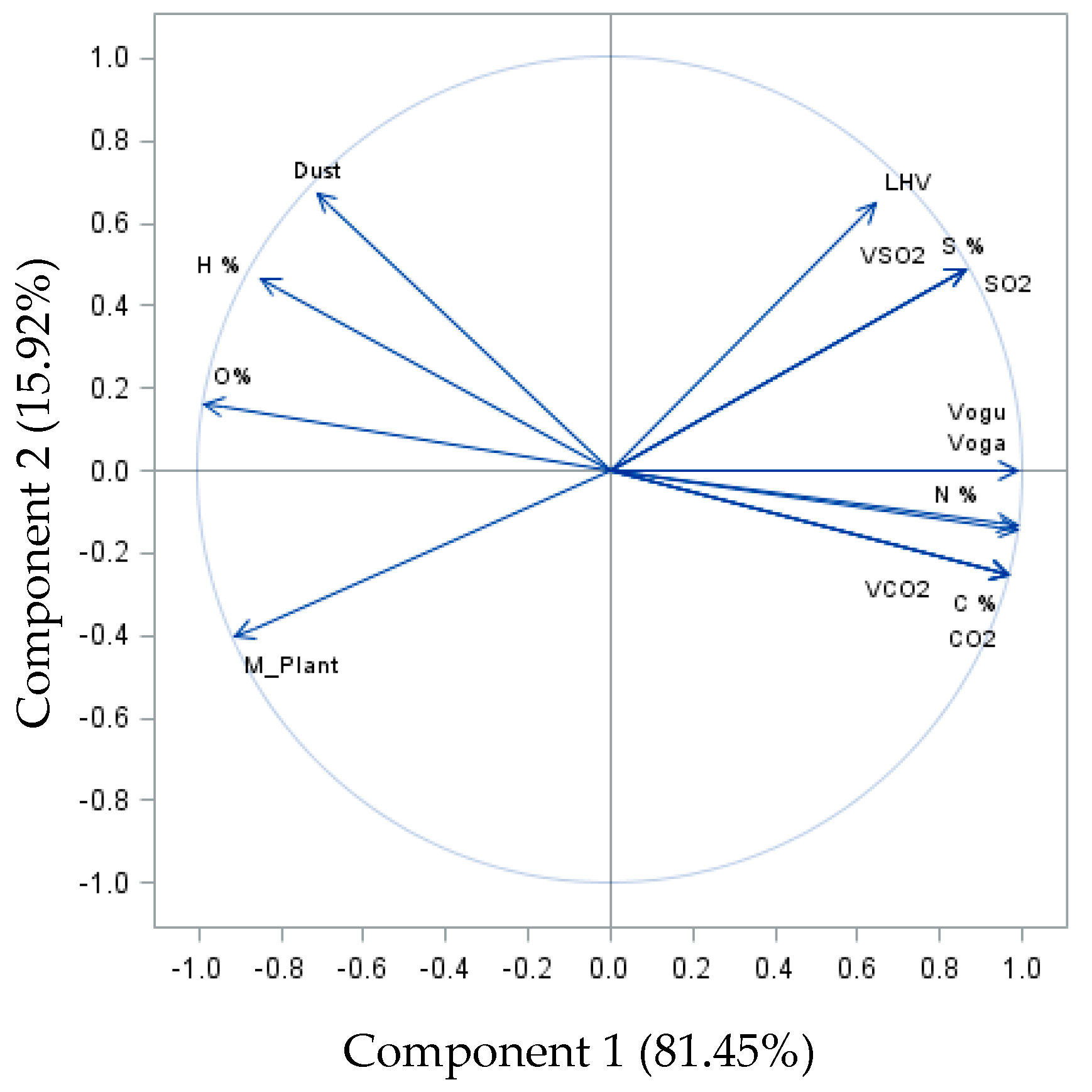
The principal component analysis (Figure 2) presents an analysis of the composition of selected energy parameters of the tested material in relation to four grape varieties grown using the Cordon method. The sum of PC (PC1 and PC2) of the total variable characteristics for Chardonnay, Merlot, Riesling, and Zweigelt grape varieties was 97.37% (84.45% for PC1 and 15.92% for PC2). Four independent clusters were observed, the first of which shows the relationships between Dust, H, and O. The second cluster shows a very strong relationship between LHV, S, SO2, and VSO2, while the third largest cluster represents the relationship between Vogu, Voga, N, C, CO2, and VCO2. It was observed that biomass parameters do not affect the assessed energy parameters, as shown by cluster number four.
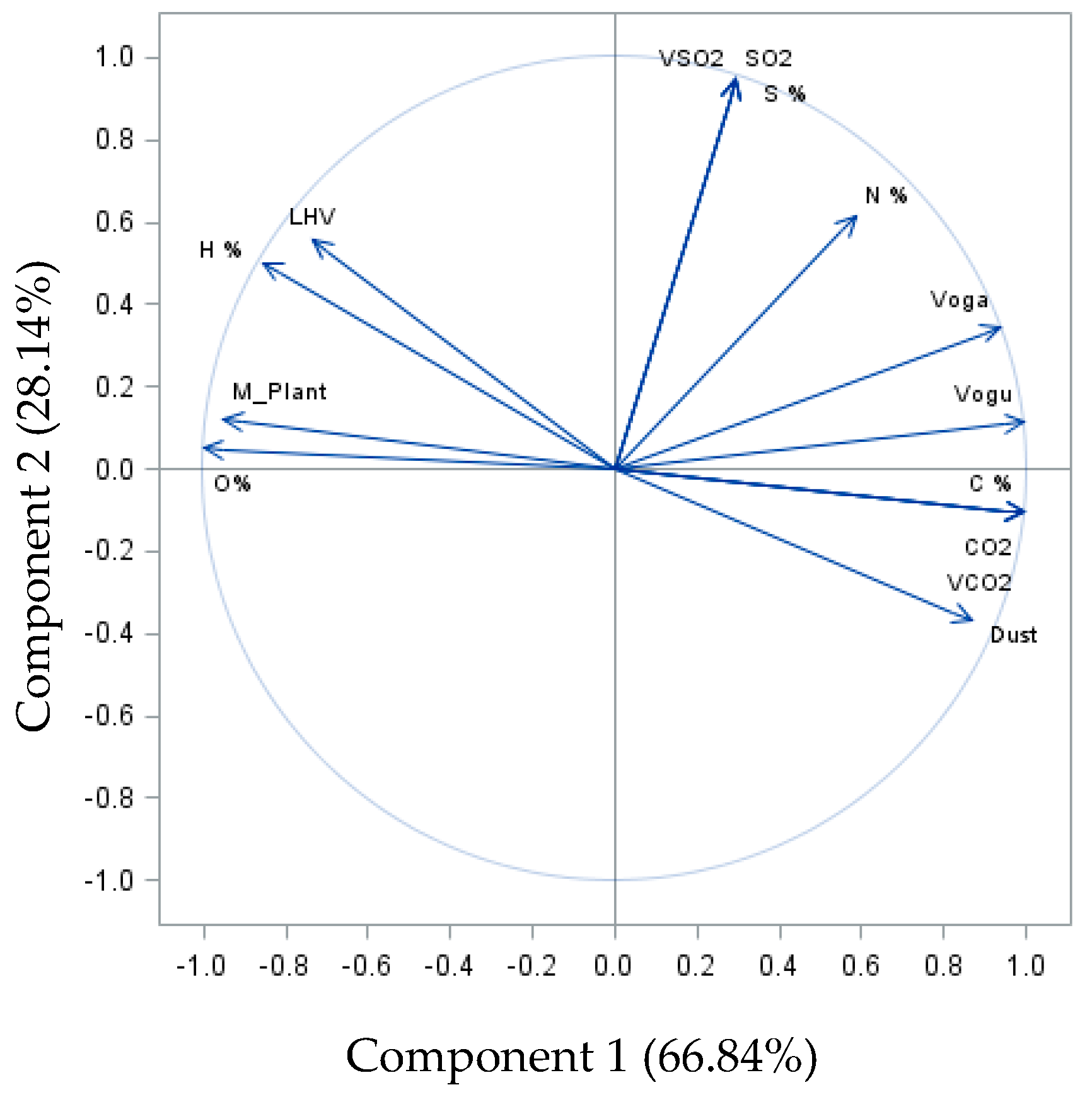
Figure 3 presents the PCA analysis of grapevine shoots grown in the Guyot form. The sum of PC (PC1 and PC2) of the total variable characteristics for grapevine pomace was 94.98% (66.84% for PC1 and 28.14% for PC2, respectively). Three independent clusters were observed, where the first represents the relationship between the amount of waste biomass and O, H, and LHV. The second cluster shows a very strong relationship between S, SO2, and VSO2, N, Vogu, and Voga, while the last one shows relationships between C, CO2, VCO2, and Dust.
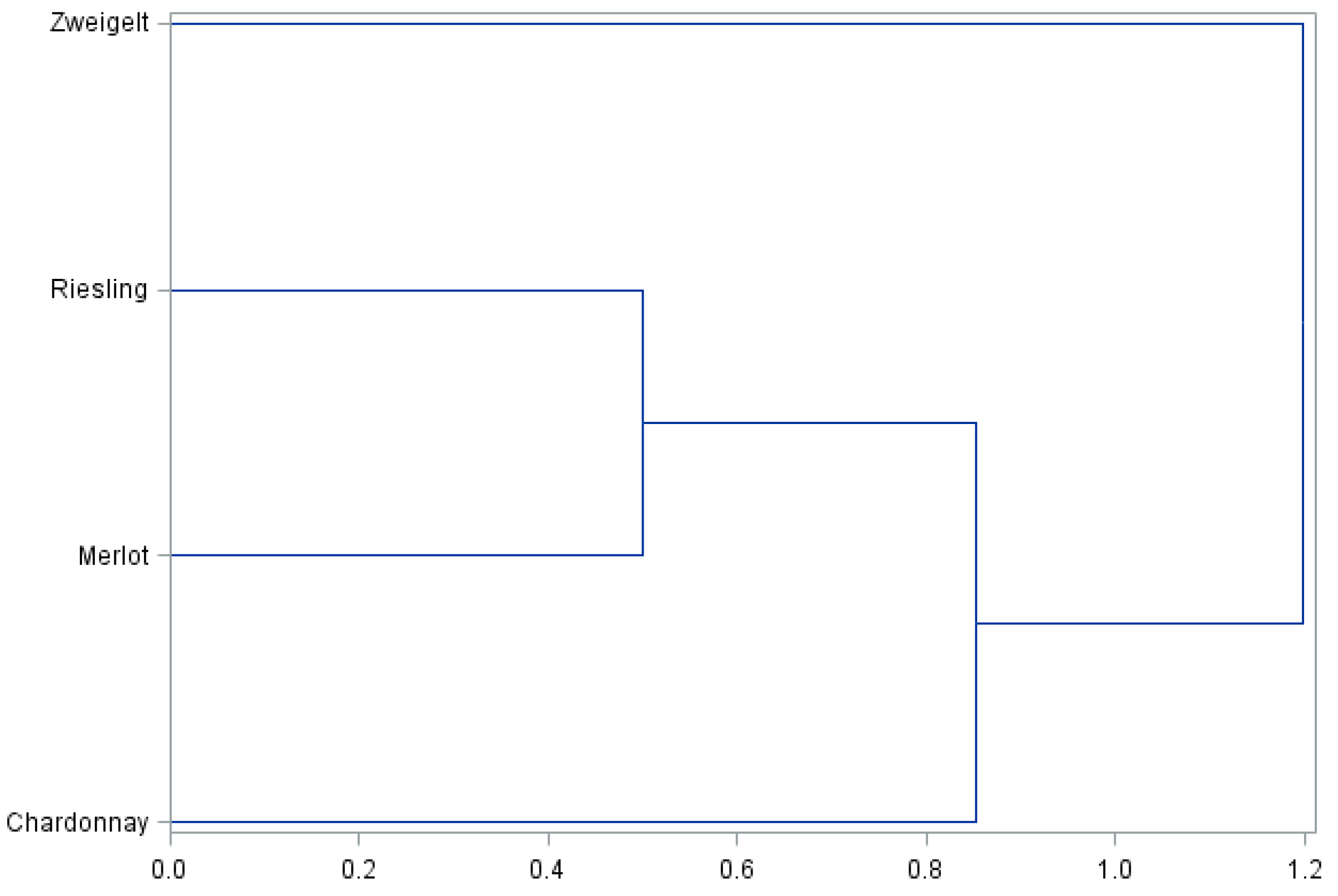
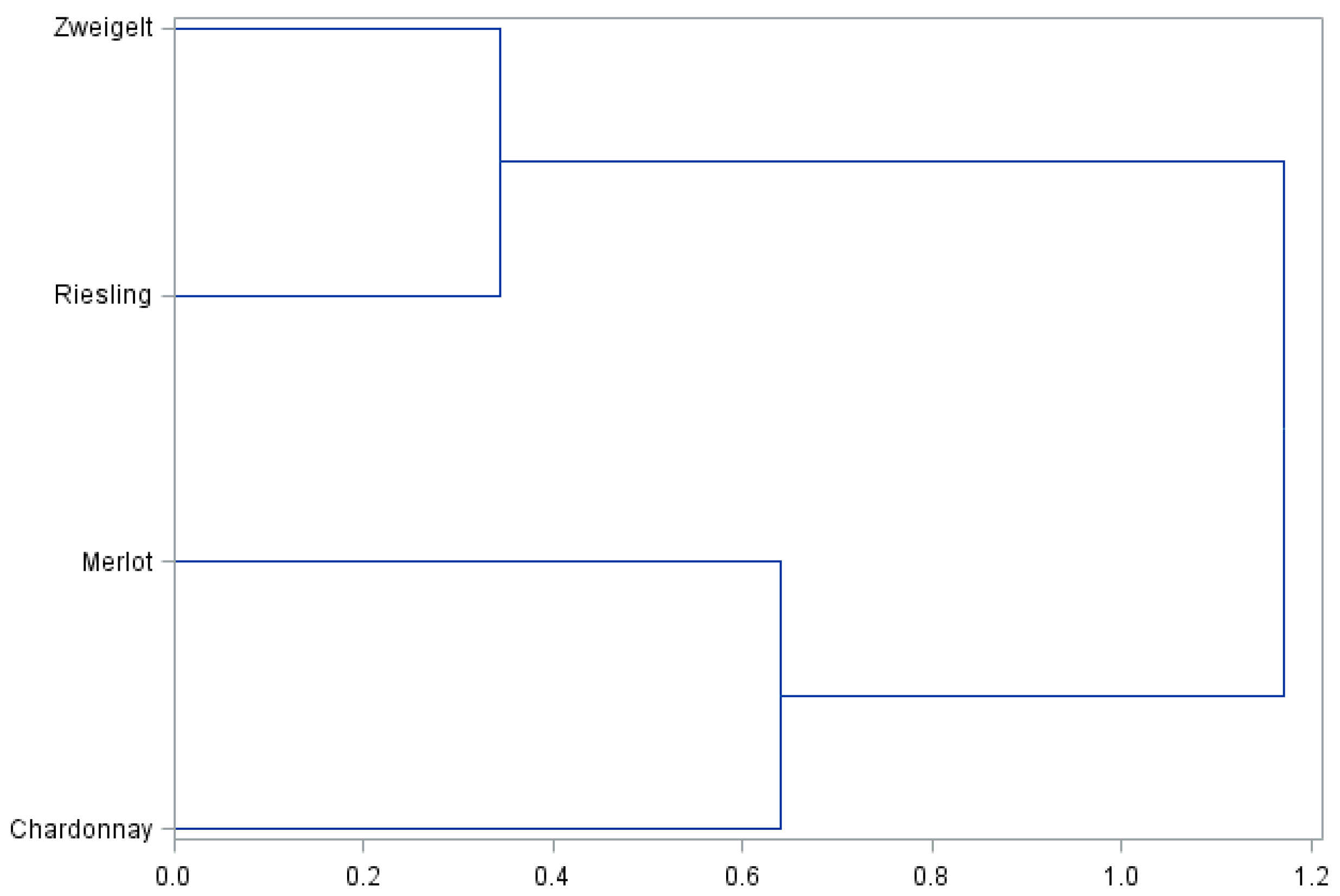
Figure 4 presents an analysis of Cordon-trained shrubs, the aim of which is to determine the similarity between the amount of biomass obtained and the energy assessment. It was found that Riesling and Merlot shrubs show a strong similarity between all the combustion and biomass parameters assessed. The Zweigelt cultivar differs significantly from the other varieties assessed.
An analysis of grapevine clusters formed using the Guyot method revealed two clusters, showing a high degree of similarity between individual varieties. The first cluster included the Zweigelt and Riesling varieties, while the second included Merlot and Chardonnay. The distribution of varieties in the same cluster indicates a high degree of similarity in biomass production and energy potential (Figure 5).

4. Discussion

4.1. Effect of Cultivar (Factor A)

Chardonnay achieved the highest biomass per plant despite having fewer shoots, reflecting its moderate vigour and high basal bud fertility, characteristics that maximise the yield of spurs to fully express their production potential in the Cordon system. Research by Torres et al. [56] on canopy architecture confirms that varietal composition—basal bud fertility and shoot thickness—strongly influences the chosen training system, affecting biomass, grape yield, and seasonal reliability.
Merlot responded strongly to Cordon training, increasing shoot circumference, which is consistent with its high vegetative vigour and sensitivity to basal node behaviour. Merlot improved under Cordon training in terms of stem thickness and wood mass. Research on canopy management practices in warm environments emphasises that vigorous varieties such as Tempranillo or Merlot benefit structurally from dense architecture pruned to pin shoots, showing increased wood density in such systems, Torres et al. [56].
Riesling maintained balanced biomass production in both systems, which is consistent with its well-documented adaptability and moderate vigour. This was reflected in a balanced number of shoots and their thickness in both the Guyot and Cordon systems. Research conducted by Maniero [57] suggests that varieties such as Riesling, with moderate vigour, maintain crown balance and high wood quality in different training systems, mainly by avoiding excessive shading in the case of spur pruning.
Zweigelt produced the most shoots, but with the lowest stem weight, indicating the cultivar’s predisposition to greater shoot initiation than secondary thickening—a trait less favourable for energy recovery. The production of many thinner shoots, in line with the growth strategy of the cultivar, which favours quantity over thickness, indicates rapid internode elongation and the allocation of resources to reproduction [58].
Zweigelt, on the other hand, is characterised by high bud fertility and a large number of shoots, as the distribution of resources favours crown growth at the expense of the lignification of individual shoots. Research by Lisek [59] should confirm these observations, as it has been shown that Zweigel and Riesling tend to have a high fertility rate for all types of fertile buds (secondary, primary, and even latent). On the other hand, Chardonnay showed significantly lower secondary and even primary fertility. However, varieties such as Merlot and Chardonnay did not produce fertile latent buds. These differences are crucial because bud fertility is a precursor to shoot thinning, and the ratio of shoots to mass affects wood maturation and total pruning waste.
The varietal patterns observed here are consistent with the hypothesis that internal vigour, internode morphology, and canopy density—shaped by genetic background—directly influence pruning residue yields [60]. The number of shoots has a direct impact on dry biomass. In biomass-oriented vine cultivation, the transparency of the Cordon structure translates into more predictable annual yields.
The cultivar factor was confirmed as the main determinant of shoot characteristics, which is consistent with recent findings that genotypic differences have a strong influence on vegetative growth patterns and wood allocation [26,61].
This structural profile suggests a growth habit conducive to fewer but more vigorous shoots—an architecture conducive to increased lignification per unit length, as observed in other moderately vigorous varieties [62]. In contrast, Anderson et al. [63] obtained the same Dijon 76 Chardonnay clone, trained it to 12 shoots, and achieved a shoot weight of 70 g and a total pruning weight of 1.8 kg. This increases the shoot load factor in the context of clone-training interactions [63]. Our results confirm that genotype-determined architecture should be considered, in addition to interactions with the root system, as a dominant factor determining the volume of pruned biomass [64,65]. The clear differences between Chardonnay and Zweigelt reflect the cultivar-specific balance between source and sink and shoot growth allocation strategies.

4.2. Effect of Training Systems (Factor B)

Contrasting shoot development strategies—producing a few thick shoots versus numerous thin ones—illustrate a biological trade-off between allocating resources to stem thickening (lignification) and maximising reproductive efficiency. From an energy recovery perspective, thicker stems generally exhibit higher density, lower ash content, and more favourable combustion characteristics, as confirmed by previous studies on the fuel potential of vine prunings [59,65]. Differences in biomass accumulation per plant between Cordon and Guyot training systems may therefore substantially affect the potential energy yield per hectare, if this parameter is of interest. Research on the recovery of residual biomass in viticulture confirms that vine wood exhibits relatively stable fuel properties, supporting its potential as a renewable energy source [59,65]. Thus, the approximately 50% more biomass in Cordon systems can translate into a significant increase in energy [66]. However, the choice of training system must remain independent. Although Cordon systems offer advantages such as grape quality, biomass impact, and shoot regeneration, they are still overrated in cool climate regions where there is a risk of spring frosts [67,68].
The higher weight of individual shoots and total biomass of vines grown using the Cordon method are consistent with recent findings linking pin pruning to improved vascular connectivity, stronger carbohydrate allocation to basal nodes, and increased secondary thickening. In biomass energy applications, the thicker and denser wood from Cordon-trained vines is more advantageous because it typically has a higher volumetric density and lower moisture content, which improves combustion efficiency [69]. Guyot-trained vines, based on shoot pruning, produce more shoots from distal buds, but with smaller diameters and lower lignin content due to increased competition between shoots and reduced carbohydrate reserves in distal nodes [70].
These results are consistent with studies indicating that short-pruned Cordon systems promote stable basal bud fertility and thicker, well-lignified shoots due to consistent shoot spacing and perennial Cordon wood [71,72]. Guyot systems, on the other hand, allow for greater flexibility in shoot length but may result in greater variability in shoot diameter and weight [73,74]. This relationship was also suggested by Liu et al. [62]. Pruning shoots has the advantage of preserving the most fruitful nodes on the shoots, and when combined with apical dominance, can lead to the M effect and uneven budding. Reserves, mainly carbohydrates, may also potentially change after the removal of retained wood older than 2 years [60]. In this context, Cordon training appears to increase the uniformity of shoot ripening, which is beneficial for maximising total lignified biomass per vine, especially in varieties predisposed to strong basal shoot growth [53]. O’Brien et al. [72] made an interesting observation about permanent trellises [72,74,75,76]: the optimal behaviour of pin shoots is 2–3 nodes located along a permanent structure in one-year-old wood and recent branches. The advantage of the trellis system in producing heavier shoots is due to its architectural stability. Perennial Cordon arms maintain a fixed position of the spurs, leading to uniform budding and more homogeneous shoot ripening. This contrasts with the Guyot system, where the annual replacement of fruiting shoots increases the variability in shoot diameter, as seen in our lower average shoot weight values [77]. In healthy vines, most of the accumulated wood should be removed. In addition to the cost of pruning, this system has the advantage of providing greater reserve storage capacity and often leads to more balanced shoot growth. However, even Reynolds et al. [78] observed that the age of planting Cordons has no effect on crown density or shoot composition, but it was found to have a significant effect on the sensory analysis of wine.

4.3. Effect of Colour (Factor C)

This result is consistent with observations from recent studies on grapevine physiology, in which morphological (vigour) and morphological–anatomical (leaves, habit) characteristics often co-occur with berry colour, which is due to breeding effects rather than pigmentation, indicating internal genealogical differences related to berry colour [56,79,80,81,82]. Testing only two varieties in each colour group does not provide sufficient evidence to support generalisations or draw firm conclusions based on colour-related differences. According to Song et al. [83], significant correlations between colour and agronomic traits should be observed, but most associations are weak or ambiguous. Red and white varieties respond differently to the same support systems in terms of growth characteristics, including stem length and position, highlighting inherent differences in structural characteristics associated with pigmentation groups. Several grape groups are grouped based on common agronomic characteristics such as ripening time, bunch weight, berry weight, and anthocyanin content based on bunch analysis, but correlations are often due to the influence of specific combinations of varieties and colours. It is necessary to maintain an appropriate source-to-sink ratio in line with production, agronomic, and vegetative objectives over time to balance and exploit the potential of the vine. When assessing the vegetative and production strategy of red and white varieties, very different quality objectives can be observed. The use of long pruned shoots is often a very versatile form of vine cultivation and supports a well-developed source-to-receiver ratio, resulting in better aromatic composition and yield for white varieties. However, short pruning and shoot pruning give better results for the Ravaz index and red varieties [83]. These differences may reflect the history of cultivation method selection: many white varieties in Central Europe are cultivated for moderate vigour and denser shoot arrangement, while some red varieties prefer crown expansion over shoot mass accumulation. Almanza-Merchán et al. [84], assessing the impact of production and vegetative balance in Cabernet Sauvignon (red) and Sauvignon Blanc (white) grape varieties in Sutamarchan-Boyaca according to pruning type, showed that vines pruned long showed the best behaviour and the most balanced source-to-sump ratio, while Sauvignon Blanc showed better yield. Vines pruned short and mixed showed better Ravaza index values, indicating their balanced development throughout the grape production cycle.

4.4. Interactions (A*B, A*C, B*C, A*B*C)

Koblet et al. [85] observed that different combinations of training system, cultivar, and rootstock lead to a specific source–sink ratio, as demonstrated by the amount of pruning waste. For example, Chardonnay grown using the Cordon method produced the highest total plant mass in the entire study, exploiting both the vigour pattern of the genotype and the stability of the Cordon architecture. Meanwhile, Zweigelt grown using the Guyot system produced one of the lowest yields, combining a genotype with a high number of shoots with a system that disperses resource allocation per shoot. This confirms that cultivar-specific growth habits can be enhanced or weakened by the choice of training system [86,87]. Similarly, the A × C interaction suggests that differences between colour groups are not uniform within varieties; for example, Merlot (blue) showed greater weight gain in Cordon training compared to Zweigelt, indicating varying adaptability to pruning within the same colour group. As noted by Colugnati et al. [88], the genealogy of a cultivar influences its interaction with the support. This is reflected in the interaction pathways between varieties and colours. For example, red varieties may thrive with claw pruning, but the Zweigelt origin alters claw interactions. Each cultivar, depending on berry colour and wine style, requires specific agronomic practices. For red varieties, the use of a vertical trellising system and spur pruning helps to modify yield and the ratio of leaf area to fruit on the vine, which also accelerates grape ripening [29,89,90].
The B*C and A*B*C interactions further emphasise the independence of these factors: optimal biomass yield only occurs when the genotype of the cultivar, the structural training system, and the colour group are considered together, with the colour group serving as a proxy indicator. Pérez-Lamela et al. [91] suggest that the combination of cultivar colour, formation, and pruning even influences the phenolic composition of wine and oenological processes. Ignoring these synergies can lead to suboptimal availability of pruning residues and, consequently, to a reduction in their potential for further use. According to studies by Reta et al. [92] and Yang et al. [93], the combination of sustainable pruning, comprehensive canopy management, and the selection of an appropriate training system is an important step towards achieving high yields in grapevine varieties and indicates that all these factors must be considered together in order to maximise biomass production.

4.5. Analysis of the Energy Potential of the Tested Waste Biomass

Conversely, a significant relationship was found for the V and FC parameters. The above relationships confirm earlier studies by Maj et al. [29], carried out on PIWI grapevine varieties grown in Poland, which also showed a significant influence of the cultivar on the technical and elemental analysis of fuel obtained from the combustion of woody shoots. A significant influence of the Vitis vinifera L. cultivar on the technical analysis of combustion parameters obtained from grape stems and pomace was demonstrated by Kapłan et al. (2025) [30]. In turn, the studies by Klimek et al. [31] found a significant impact of rootstock type on the HHV and MC, V, A, and FC coefficients during the combustion of woody shoots. Similar relationships were demonstrated in the studies by Kapłan et al. [26] assessing the energy potential of Regent grapevine leaves grafted onto different types of rootstocks. In the study by Enes et al. [34], the HHV coefficient determined for biomass from vine shoots collected from two different locations in Portugal did not differ significantly and ranged from 17.3 to 17.4 MJ·kg−1.
The levels of oxygen (O), H/C, and O/C differed significantly between all the varieties assessed, and the varieties ranked in the same order for the elements in question: Chardonnay, Merlot, Riesling, and Zweigelt. Previous studies by Maj et al. [29], which aimed to assess the energy potential of biomass in the form of shoots from PIWI grapevine varieties grown in Poland, showed a significant influence of the cultivar on the results of the elemental analysis in the case of carbon (C), sulphur (S), and O/C, while in the case of the other parameters, i.e., H, N, O, H/C, N/C, and O/C, this influence was insignificant.
Elemental analysis of biomass from vine shoots grown in Portugal in two different locations showed that the place of cultivation had a significant effect on the content of C, H, O, S, and ash [34].
The above results confirm that the grapevine cultivar significantly modifies emission parameters. Maj et al. [29] also demonstrated this relationship when evaluating PIWI varieties, with the exception of NOx, whose level did not differ significantly. Kapłan et al. [30] demonstrated in their research that the grapevine cultivar significantly affects the combustion parameters of biomass obtained from grape stems and pomace.
A significant and unambiguous influence of the cultivar on the parameters of exhaust gas composition was demonstrated by Kapłan et al. [30] when assessing biomass obtained from grape stems and pomace. In the study by Maj et al. [29], a significant influence of the cultivar on the composition of exhaust gases was demonstrated only in the case of the parameters VoO2 I VSO2, while the other components did not differ significantly from each other. Klimek et al. [31] showed that the type of rootstock in Regent grapevines had a significant impact on the composition of exhaust gases produced by the combustion of woody shoots of this species.

5. Conclusions

The grape cultivar is the main factor determining the properties of biomass and its behaviour during combustion. Zweigelt had the best energy parameters (high calorific value, low moisture content), but at the same time generates the highest gas emissions (CO, NOx, SO2). Chardonnay has the lowest exhaust emissions and the highest hydrogen and oxygen content, but has higher moisture content, which can reduce combustion efficiency. Riesling performs the worst in terms of calorific value and moisture content.
The form of vine training (Guyot vs. Cordon) has a significant impact on combustion and emission parameters. The Guyot system generates higher carbon, CO, and CO2 content, but produces lower emissions of dust, SO2, and NOx. The Cordon system generates more dust, nitrogen, and sulphur oxides, but less CO and CO2. The choice of training system should be tailored to the objectives, e.g., greater energy efficiency (Guyot) or lower pollutant emissions (Cordon).
The colour of the fruit (white vs. red) is of marginal importance. It primarily affects the moisture and water vapour content in the exhaust gases—white varieties have higher moisture and more water vapour. No significant differences in gas emissions or calorific values were found.
The results of the study confirm that vine pruning residues are a valuable energy resource, and their effective management can support the transition to a circular economy and a reduction in greenhouse gas emissions.
This study highlights how the proper selection of cultivar and training system can optimise both vineyard management and renewable energy output from pruning residues. These insights are directly applicable to Czech grape growers or vintners from Central European (cool climate) conditions, such as in Austria, Slovakia, or Poland. Results may help to improve sustainability metrics, reduce waste management costs, and align viticultural practices with international climate commitments.
In warmer or subtropical viticultural regions, such as Brazil, Chile, or California, where biomass accumulation and moisture content dynamics differ, the present results may guide the adaptation of pruning strategies for improved combustion efficiency and emission control. Understanding cultivar-specific carbon and nitrogen profiles provides a foundation for selecting grape cultivars and training systems well-suited to bioenergy production under diverse environmental conditions.

Author Contributions

Conceptualisation, R.D., M.K., K.E.K. and G.M.; methodology, R.D., M.K. and G.M.; software, K.E.K.; validation, M.K., K.E.K. and G.M.; formal analysis, R.D., M.K., K.E.K. and G.M.; investigation, M.K. and G.M.; resources, R.S. and M.B.; data curation, R.D., M.K., K.E.K. and G.M.; writing—original draft preparation, R.D., M.K., K.E.K. and G.M.; writing—review and editing, R.D., M.K. and K.E.K.; visualisation, K.E.K.; supervision, R.S. and M.B.; project administration, R.D., M.K., K.E.K. and G.M.; funding acquisition, M.K., K.E.K. and G.M. All authors have read and agreed to the published version of the manuscript.

Funding

QK21010189—Implementation of ecosystem services with a focus on water balance in viticultural practice.

Data Availability Statement

The raw data supporting the conclusions of this article will be made available by the authors on request.

Conflicts of Interest

The authors declare no conflicts of interest.

References

  1. Kokkinomagoulos, E.; Kandylis, P. Grape Pomace, an Undervalued by-Product: Industrial Reutilization within a Circular Economy Vision. Rev. Environ. Sci. Biotechnol. 2023, 22, 739–773. [Google Scholar] [CrossRef]
  2. Siller-Sánchez, A.; Luna-Sánchez, K.A.; Bautista-Hernández, I.; Chávez-González, M.L. Use of Grape Pomace from the Wine Industry for the Extraction of Valuable Compounds with Potential Use in the Food Industry. Curr. Food Sci. Technol. Rep. 2024, 2, 7–16. [Google Scholar] [CrossRef]
  3. Ferrer, J.R.; García-Cortijo, M.C.; Pinilla, V.; Castillo-Valero, J.S. The Business Model and Sustainability in the Spanish Wine Sector. J. Clean. Prod. 2022, 330, 129810. [Google Scholar] [CrossRef]
  4. Tsiapali, O.I.; Ayfantopoulou, E.; Tzourouni, A.; Ofrydopoulou, A.; Letsiou, S.; Tsoupras, A. Unveiling the Utilization of Grape and Winery By-Products in Cosmetics with Health Promoting Properties. Appl. Sci. 2025, 15, 1007. [Google Scholar] [CrossRef]
  5. Kokkinomagoulos, E.; Kandylis, P. Sustainable Exploitation of By-Products of Vitivinicultural Origin in Winemaking. Proceedings 2020, 67, 5. [Google Scholar] [CrossRef]
  6. Transforming Wine By-Products into Energy: Evaluating Grape Pomace and Distillation Stillage for Biomass Pellet Production. Available online: https://agris.fao.org/search/en/providers/122436/records/6759ad650ce2cede71ca3d8e?utm_source=chatgpt.com (accessed on 17 November 2025).
  7. Wine Industry Waste as a Source of Bioactive Compounds for Drug Use. Available online: https://www.mdpi.com/1422-0067/26/22/10820?utm_source=chatgpt.com (accessed on 17 November 2025).
  8. Rosen, D.L.; Miculan Bradley, D. Wine Tourism, the Business of Wine, and the Impact of the Environöment and Sustainability. In Wine Tourism and Sustainability; Martínez-Falcó, J., Marco-Lajara, B., Sánchez-García, E., Millán-Tudela, L.A., Eds.; Springer Nature: Cham, Switzerland, 2024; pp. 123–146. ISBN 978-3-031-48936-5. [Google Scholar]
  9. Dogan, E.; Luni, T.; Majeed, M.T.; Tzeremes, P. The Nexus between Global Carbon and Renewable Energy Sources: A Step towards Sustainability. J. Clean. Prod. 2023, 416, 137927. [Google Scholar] [CrossRef]
  10. Parrado-Hernando, G.; Pfeifer, A.; Frechoso, F.; Miguel González, L.J.; Duić, N. A Novel Approach to Represent the Energy System in Integrated Assessment Models. Energy 2022, 258, 124743. [Google Scholar] [CrossRef]
  11. Salcedo-Puerto, O.; Mendoza-Martinez, C.; Vakkilainen, E. Solid Residues from Cocoa Production Chain: Assessment of Thermochemical Valorization Routes. Renew. Sustain. Energy Rev. 2025, 208, 115048. [Google Scholar] [CrossRef]
  12. Agrawal, A.; Bakshi, B.R.; Kodamana, H.; Ramteke, M. Multi-Objective Optimization of Food-Energy-Water Nexus via Crops Land Allocation. Comput. Chem. Eng. 2024, 183, 108610. [Google Scholar] [CrossRef]
  13. Guzović, Z.; Duić, N.; Piacentino, A.; Markovska, N.; Mathiesen, B.V.; Lund, H. Paving the Way for the Paris Agreement: Contributions of SDEWES Science. Energy 2023, 263, 125617. [Google Scholar] [CrossRef]
  14. Polak, R.; Dziki, D.; Krzykowski, A.; Rudy, S.; Biernacka, B. RenewGeo: An Innovative Geothermal Technology Augmented by Solar Energy. Agric. Eng. 2025, 29, 49–62. [Google Scholar] [CrossRef]
  15. Shi, Z.; Marinello, F.; Ai, P.; Pezzuolo, A. Assessment of Bioenergy Plant Locations Using a GIS-MCDA Approach Based on Spatio-Temporal Stability Maps of Agricultural and Livestock Byproducts: A Case Study. Sci. Total Environ. 2024, 947, 174665. [Google Scholar] [CrossRef]
  16. Kumar Sharma, A.; Kumar Ghodke, P.; Goyal, N.; Nethaji, S.; Chen, W.-H. Machine Learning Technology in Biohydrogen Production from Agriculture Waste: Recent Advances and Future Perspectives. Bioresour. Technol. 2022, 364, 128076. [Google Scholar] [CrossRef]
  17. Duque-Acevedo, M.; Ulloa-Murillo, L.M.; Belmonte-Ureña, L.J.; Camacho-Ferre, F.; Mercl, F.; Tlustoš, P. Sustainable and Circular Agro-Environmental Practices: A Review of the Management of Agricultural Waste Biomass in Spain and the Czech Republic. Waste Manag. Res. 2023, 41, 955–969. [Google Scholar] [CrossRef]
  18. Sommer, S.G.; Hamelin, L.; Olesen, J.E.; Montes, F.; Jia, W.; Chen, Q.; Triolo, J.M. Agricultural Waste Biomass. In Supply Chain Management for Sustainable Food Networks; Iakovou, E., Bochtis, D., Vlachos, D., Aidonis, D., Eds.; Wiley: Hoboken, NJ, USA, 2015; pp. 67–106. ISBN 978-1-118-93075-5. [Google Scholar]
  19. Yaashikaa, P.R.; Senthil Kumar, P.; Varjani, S. Valorization of Agro-Industrial Wastes for Biorefinery Process and Circular Bioeconomy: A Critical Review. Bioresour. Technol. 2022, 343, 126126. [Google Scholar] [CrossRef]
  20. Martínez-Jaramillo, J.E.; Van Ackere, A.; Larsen, E. Long Term Impacts of Climate Change on the Transition towards Renewables in Switzerland. Energy 2023, 263, 126089. [Google Scholar] [CrossRef]
  21. Paschalidou, A.; Tsatiris, M.; Kitikidou, K.; Papadopoulou, C. Bioenergy–Biomass–Energy Crops. In Using Energy Crops for Biofuels or Food: The Choice; Green Energy and Technology; Springer International Publishing: Cham, Switzerland, 2018; pp. 11–24. ISBN 978-3-319-63942-0. [Google Scholar]
  22. Licata, M.; Farruggia, D.; Sgroi, F.; Salamone, F.; Leto, C.; Di Miceli, G. A Comparative Study to Assess the Production of Two Oilseed Crops (Brassica carinata A. Braun and Carthamus tinctorius L.) and the Energy Potential of Their Agricultural Biomass Residues. Heliyon 2024, 10, E38654. [Google Scholar] [CrossRef] [PubMed]
  23. Adnane, I.; Taoumi, H.; Elouahabi, K.; Lahrech, K.; Oulmekki, A. Valorization of Crop Residues and Animal Wastes: Anaerobic Co-Digestion Technology. Heliyon 2024, 10, E26440. [Google Scholar] [CrossRef]
  24. Generowicz, N.; Kowalski, Z. Cascade Use of Post-Production Waste from the Wood Industry. Polityka Energetyczna 2020, 23, 87–102. [Google Scholar] [CrossRef]
  25. Gołos, P.; Kaliszewski, A. Wybrane Aspekty Wykorzystania Biomasy Drzewnej do Celów energetycznych. Leśne Pr. Badaw. 2015, 76, 78–87. [Google Scholar] [CrossRef]
  26. Klimek, K.E.; Kapłan, M.; Maj, G. The Evaluation of Energy from Grapevine Shoots Used as Biomass Depending on the Cultivar. J. Water Land Dev. 2023, 58, 120–128. [Google Scholar] [CrossRef]
  27. Danko, R.; Pavloušek, P.; Kapłan, M.; Klimek, K.E. Conception, Consequences and Design of Cool Climate Viticulture Training Systems. Agriculture 2024, 14, 1966. [Google Scholar] [CrossRef]
  28. Bača, P.; Mašán, V.; Vanýsek, P.; Burg, P.; Binar, T.; Burgová, J.; Abrham, Z. Assessing the Carbon Footprint of Viticultural Production in Central European Conditions. Sustainability 2024, 16, 6561. [Google Scholar] [CrossRef]
  29. Maj, G.; Klimek, K.; Kapłan, M.; Wrzesińska-Jędrusiak, E. Using Wood-Based Waste from Grapevine Cultivation for Energy Purposes. Energies 2022, 15, 890. [Google Scholar] [CrossRef]
  30. Kapłan, M.; Maj, G.; Klimek, K.E.; Buczyński, K.; Borkowska, A.; Sotolář, R.; Danko, R.; Baroň, M. Characterization of Post-Production Waste from Winemaking of Selected Vitis vinifera L. Varieties Grown in Temperate Climates and Their Energy Valorization. Energies 2025, 18, 663. [Google Scholar] [CrossRef]
  31. Klimek, K.E.; Kapłan, M.; Borkowska, A.; Maj, G.; Słowik, T. Effect of ‘Regent’ Grapevine Rootstock Type on Energy Potential Parameters. J. Water Land Dev. 2024, 50–56. [Google Scholar] [CrossRef]
  32. Czekała, W.; Pulka, J.; Jasiński, T.; Szewczyk, P.; Bojarski, W.; Jasiński, J. Waste as substrates for agricultural biogas plants: A case study from Poland. J. Water Land Dev. 2023, 45–50. [Google Scholar] [CrossRef]
  33. Torreiro, Y.; Pérez, L.; Piñeiro, G.; Pedras, F.; Rodríguez-Abalde, A. The Role of Energy Valuation of Agroforestry 607 Biomass on the Circular Economy. Energies 2020, 13, 2516. [Google Scholar] [CrossRef]
  34. Enes, T.; Aranha, J.; Fonseca, T.; Matos, C.; Barros, A.; Lousada, J. Residual Agroforestry Biomass–Thermochemi-605 Cal Properties. Forests 2019, 10, 1072. [Google Scholar] [CrossRef]
  35. Svobodová, I.; Věžník, A.; Král, M. Viticulture in The Czech Republic: Some Spatio-Temporal Trends. Morav. Geogr. Rep. 2014, 22, 2–14. [Google Scholar] [CrossRef]
  36. Bublíková, L.; Štěpánek, M. Situation and Outlook Report: Grapevine and Wine 2025. In Situační a Výhledová Zpráva Réva Vinná a Víno, 1st ed.; Ministry of Agriculture: Prague, Czech Republic, 2025; Volume 2025, ISBN 978-80-7434-810-5. [Google Scholar]
  37. Hicl, Z. Evaluation of Viniculture and Viticulture in the Czech Republic from the Perspective of Industry and Prediction of Development until 2020 According to Selected Variables. Acta Univ. Agric. Silvic. Mendel. Brun. 2013, 60, 89–100. [Google Scholar] [CrossRef]
  38. Sedlo, J.; Tomšík, P. Strategic Development of Varietal Vineyards in the Czech Republic. Acta Univ. Agric. Silvic. Mendel. Brun. 2013, 60, 325–334. [Google Scholar] [CrossRef]
  39. Vesela, K.; Krizek, D.; Severova, L. Structure and Development of Czech Wine Market and Foreign Trade. Wine Econ. Policy 2023, 12, 37–49. [Google Scholar] [CrossRef]
  40. Machar, I.; Vlckova, V.; Bucek, A.; Vrublova, K.; Filippovova, J.; Brus, J. Environmental Modelling of Climate Change Impact on Grapevines: Case Study from the Czech Republic. Pol. J. Environ. Stud. 2017, 26, 1927–1934. [Google Scholar] [CrossRef]
  41. Verter, N.; Hasíková, L. The Performance of Grape Production in the Czech Republic. Acta Univ. Agric. Silvic. Mendel. Brun. 2019, 67, 333–342. [Google Scholar] [CrossRef]
  42. Navrátilová, M.; Beranová, M.; Severová, L.; Šrédl, K.; Svoboda, R.; Abrhám, J. The Impact of Climate Change on the Sugar Content of Grapes and the Sustainability of Their Production in the Czech Republic. Sustainability 2020, 13, 222. [Google Scholar] [CrossRef]
  43. Průša, D.; Šrédl, K.; Prášilová, M.; Žovincová, A.; Kopecká, L.; Severová, L.; Svoboda, R.; Drozdová, D.; Naveriani, L.; Němec, O.; et al. Wine Tourism and Its Role in the Transformation of Wine Production and Consumption in Czechia: A Case Study. Agriculture 2025, 15, 1882. [Google Scholar] [CrossRef]
  44. EN-ISO 1928:2020; Coal and Coke—Determination of Gross Calorific Value. International Organization for Standardization: Geneva, Switzerland, 2020. Available online: https://www.iso.org/standard/75883.html (accessed on 28 August 2024).
  45. EN-ISO 18122:2022; Solid Biofuels—Determination of Ash Content. International Organization for Standardization: Geneva, Switzerland, 2022. Available online: https://www.iso.org/standard/83190.html (accessed on 28 August 2024).
  46. EN-ISO 18123:2016-01; Solid Fuels—Determination of Volatile Content by Gravimetric Method. International Organization for Standardization: Geneva, Switzerland, 2016. Available online: https://www.iso.org/obp/ui/#iso:Std:Iso:18123:Ed-2:V1:En (accessed on 28 August 2024).
  47. EN-ISO 18134-1:2022; Solid Biofuels—Determination of Moisture Content—Oven Dry Method Part 1: Reference Method. International Organization for Standardization: Geneva, Switzerland, 2015. Available online: https://www.iso.org/standard/83191.html (accessed on 28 August 2024).
  48. Lago-Vanzela, E.S.; Rebello, L.P.G.; Ramos, A.M.; Stringheta, P.C.; Da-Silva, R.; García-Romero, E.; Gómez-Alonso, S.; Hermosín-Gutiérrez, I. Chromatic Characteristics and Color-Related Phenolic Composition of Brazilian Young Red Wines Made from the Hybrid Grape Cultivar BRS Violeta (“BRS Rúbea” × “IAC 1398-21”). Food Res. Int. 2013, 54, 33–43. [Google Scholar] [CrossRef]
  49. EN-ISO 16948:2015-07; Solid Biofuels—Determination of Total Content of Carbon, Hydrogen and Nitrogen. International Organization for Standardization: Geneva, Switzerland, 2015. Available online: https://www.iso.org/standard/58004.html (accessed on 28 August 2024).
  50. EN-ISO 16994:2016; Solid Biofuels—Determination of Total Content of Sulphur and Chlorine. ISO: Geneva, Switzerland, 2016. Available online: https://www.iso.org/standard/70097.html (accessed on 28 August 2024).
  51. Alves, J.L.F.; Da Silva, J.C.G.; Mumbach, G.D.; Domenico, M.D.; Da Silva Filho, V.F.; de Sena, R.F.; Machado, R.A.F.; Ma-Rangoni, C. Insights into the Bioenergy Potential of Jackfruit Wastes Considering Their Physicochemical Properties, Bioenergy Indi-Cators, Combustion Behaviors, and Emission Characteristics. Renew. Energy 2020, 155, 1328–1338. [Google Scholar] [CrossRef]
  52. Maj, G. Emission Factors and Energy Properties of Agro and Forest Biomass in Aspect of Sustainability of Energy Sector. Energies 2018, 11, 1516. [Google Scholar] [CrossRef]
  53. Borycka, B. Commodity Study on Food and Energy Utilization of Rich-Food Waste of the Fruit and Vegetables Industry. Monography; Radom University of Technology: Radom, Poland, 2008. [Google Scholar]
  54. Kovacs, H.; Szemmelveisz, K.; Koós, T. Theoretical and Experimental Metals Flow Calculations during Biomass Combustion. Fuel 2016, 185, 524–531. [Google Scholar] [CrossRef]
  55. Paraschiv, L.S.; Serban, A.; Paraschiv, S. Calculation of Combustion Air Required for Burning Solid Fuels (Coal/Biomass/Solid Waste) and Analysis of Flue Gas Composition. Energy Rep. 2020, 6, 36–45. [Google Scholar] [CrossRef]
  56. Torres, N.; Santesteban, L.G.; Villa-Llop, A.; Oneka, O.; Juanena, N.; Palacios, J.; Vergnes, D.; Janoueix, A.; Dewasme, C.; Roby, J.P. Vine Response to Spur and Cane Pruning Criteria Differing in the Respect to the Sap Flow Paths Is Affected by Plant Material and Growth Conditions. Acta Hortic. 2024, 1390, 77–80. [Google Scholar] [CrossRef]
  57. Maniero, C.R.; Tecchio, M.A.; Monteiro, H.S.A.; Sánchez, C.A.P.C.; Pereira, G.E.; de Oliveira, J.B.; Brito, S.d.N.S.; Domingues Neto, F.J.; Leonel, S.; Silva, M.d.S.; et al. Phenological Performance, Thermal Demand, and Qualitative Potential of Wine Grape Cultivars Under Double Pruning. Agriculture 2025, 15, 1241. [Google Scholar] [CrossRef]
  58. Lebon, E.; Pellegrino, A.; Tardieu, F.; Lecoeur, J. Shoot Development in Grapevine (Vitis vinifera) Is Affected by the Modular Branching Pattern of the Stem and Intra- and Inter-Shoot Trophic Competition. Ann. Bot. 2004, 93, 263–274. [Google Scholar] [CrossRef]
  59. Lisek, J. Primary Assessment of Grapevine Cultivars’ Bud Fertility with Diverse Ancestry Following Spring Frost Under Central Poland Environmental Conditions. Agriculture 2025, 15, 108. [Google Scholar] [CrossRef]
  60. Monteiro, A.I.; Malheiro, A.C.; Bacelar, E.A. Morphology, Physiology and Analysis Techniques of Grapevine Bud Fruitfulness: A Review. Agriculture 2021, 11, 127. [Google Scholar] [CrossRef]
  61. Florindo, T.; Ferraz, A.I.; Rodrigues, A.C.; Nunes, L.J.R. Residual Biomass Recovery in the Wine Sector: Creation of Value Chains for Vine Pruning. Agriculture 2022, 12, 670. [Google Scholar] [CrossRef]
  62. Liu, M.-Y.; Chi, M.; Tang, Y.-H.; Song, C.-Z.; Xi, Z.-M.; Zhang, Z.-W. Effect of Three Training Systems on Grapes in a Wet Region of China: Yield, Incidence of Disease and Anthocyanin Compositions of Vitis vinifera cv. Cabernet Sauvignon. Molecules 2015, 20, 18967–18987. [Google Scholar] [CrossRef]
  63. Anderson, M.M.; Smith, R.J.; Williams, M.A.; Wolpert, J.A. Viticultural Evaluation of French and California Chardonnay Clones Grown for Production of Sparkling Wine. Am. J. Enol. Vitic. 2008, 59, 73–77. [Google Scholar] [CrossRef]
  64. Tomasi, D.; Gaiotti, F.; Petoumenou, D.; Lovat, L.; Belfiore, N.; Boscaro, D.; Mian, G. Winter Pruning: Effect on Root Density, Root Distribution and Root/Canopy Ratio in Vitis vinifera cv. Pinot Gris. Agronomy 2020, 10, 1509. [Google Scholar] [CrossRef]
  65. Galar-Martínez, M.; Torres, N.; Sebastián, B.; Palacios, J.; Arzoz, I.; Juanena, N.; Villa-Llop, A.; Loidi, M.; Dewasme, C.; Roby, J.P.; et al. Respectful Pruning Improves Grapevine Development: A Case Study in Young Vineyards. Aust. J. Grape Wine Res. 2024, 2024, 8448405. [Google Scholar] [CrossRef]
  66. Theocharis, S.; Gkrimpizis, T.; Karadimou, C.; Nikolaou, K.-E.; Koundouras, S.; Taskos, D. Exploring the Interplay of Bud Load and Pruning Type in Shaping ‘Xinomavro’ (Vitis vinifera L.) Vine Growth, Yield, and Berry Composition. Horticulturae 2024, 10, 1111. [Google Scholar] [CrossRef]
  67. Jesus, M.; Romaní, A.; Mata, F.; Domingues, L. Current Options in the Valorisation of Vine Pruning Residue for the Production of Biofuels, Biopolymers, Antioxidants, and Bio-Composites Following the Concept of Biorefinery: A Review. Polymers 2022, 14, 1640. [Google Scholar] [CrossRef]
  68. Yu, R.; Torres, N.; Tanner, J.D.; Kacur, S.M.; Marigliano, L.E.; Zumkeller, M.; Gilmer, J.C.; Gambetta, G.A.; Kurtural, S.K. Adapting Wine Grape Production to Climate Change through Canopy Architecture Manipulation and Irrigation in Warm Climates. Front. Plant Sci. 2022, 13, 1015574. [Google Scholar] [CrossRef]
  69. Walker, H.V.; Swarts, N.D.; Jones, J.E.; Kerslake, F. Nitrogen Use Efficiency, Partitioning, and Storage in Cool Climate Potted Pinot Noir Vines. Sci. Hortic. 2022, 291, 110603. [Google Scholar] [CrossRef]
  70. Guadagna, P.; Fernandes, M.; Chen, F.; Santamaria, A.; Teng, T.; Frioni, T.; Caldwell, D.G.; Poni, S.; Semini, C.; Gatti, M. Using Deep Learning for Pruning Region Detection and Plant Organ Segmentation in Dormant Spur-Pruned Grapevines. Precis. Agric. 2023, 24, 1547–1569. [Google Scholar] [CrossRef]
  71. de Toda, F.M.; de Toda, F.M.; Garcia, J.; Balda, P. Preliminary Results on Forcing Vine Regrowth to Delay Ripening to a Cooler Period. Vitis 2019, 58, 17–22. [Google Scholar] [CrossRef]
  72. O’Brien, P.; De Bei, R.; Sosnowski, M.; Collins, C. A Review of Factors to Consider for Permanent Cordon Establishment and Maintenance. Agronomy 2021, 11, 1811. [Google Scholar] [CrossRef]
  73. Torregrosa, L.; Carbonneau, A.; Kelner, J.-J. The Shoot System Architecture of Vitis vinifera ssp. Sativa. Sci. Hortic. 2021, 288, 110404. [Google Scholar] [CrossRef]
  74. Keller, M.; Mills, L.; Harbertson, J. Rootstock Effects on Deficit-Irrigated Winegrapes in a Dry Climate: Vigor, Yield Formation, and Fruit Ripening. Am. J. Enol. Vitic. 2012, 63, 29–39. [Google Scholar] [CrossRef]
  75. Del Zozzo, F.; Poni, S. Climate Change Affects Choice and Management of Training Systems in the Grapevine. Aust. J. Grape Wine Res. 2024, 2024, 7834357. [Google Scholar] [CrossRef]
  76. Guisard, Y.; Blackman, J.; Clark, A.; Holzapfel, B.; Rawson, A.; Rogiers, S.; Schmidtke, L.; Smith, J.; Steel, C. Viticulture and Wine Science. In Horticulture: Plants for People and Places, Volume 1: Production Horticulture; Dixon, G.R., Aldous, D.E., Eds.; Springer: Dordrecht, The Netherlands, 2014; pp. 197–261. ISBN 978-94-017-8578-5. [Google Scholar]
  77. O’Brien, P.; Collins, C.; Bei, R.D. Wrapping Permanent Cordon Arms Tightly around the Cordon Wire Negatively Impacts Vine Performance: Original Language of the Article: English. IVES Tech. Rev. Vine Wine 2025. [Google Scholar] [CrossRef]
  78. Reynolds, A.G.; Wardle, D.A.; Dever, M. Shoot Density Effects on Riesling Grapevines: Interactions with Cordon Age. Am. J. Enol. Vitic. 1994, 45, 435–443. [Google Scholar] [CrossRef]
  79. Fredes, C.; Moreno, Y.; Ortega, S.; von Bennewitz, E. Vine Balance: A Study Case in Carménère Grapevines Claudio Fredes. Cienc. Investig. Agrar. 2010, 37, 143–150. [Google Scholar]
  80. Teixeira, G.; Monteiro, A.; Santos, C.; Lopes, C.M. Leaf Morphoanatomy Traits in White Grapevine Cultivars with Distinct Geographical Origin. Ciênc. Téc. Vitivinícola 2018, 33, 90–101. [Google Scholar] [CrossRef]
  81. Reynard, J.-S.; Brodard, J.; Roquis, D.; Droz, E.; Avia, K.; Verdenal, T.; Zufferey, V.; Lacombe, T.; Croll, D.; Spring, J.-L. A Divergent Haplotype with a Large Deletion at the Berry Color Locus Causes a White-Skinned Phenotype in Grapevine. Hortic. Res. 2025, 12, uhaf069. [Google Scholar] [CrossRef]
  82. Massonnet, M.; Fasoli, M.; Tornielli, G.B.; Altieri, M.; Sandri, M.; Zuccolotto, P.; Paci, P.; Gardiman, M.; Zenoni, S.; Pezzotti, M. Ripening Transcriptomic Program in Red and White Grapevine Varieties Correlates with Berry Skin Anthocyanin Accumulation. Plant Physiol. 2017, 174, 2376–2396. [Google Scholar] [CrossRef]
  83. Song, S.; del Mar Hernández, M.; Provedo, I.; Menéndez, C.M. Segregation and Associations of Enological and Agronomic Traits in Graciano × Tempranillo Wine Grape Progeny (Vitis vinifera L.). Euphytica 2014, 195, 259–277. [Google Scholar] [CrossRef]
  84. Almanza-Merchán, P.J.; Serrano-Cely, P.A.; Forero-Ulloa, F.E.; Arango, J.; Puerto, Á.M. Pruning Affects the Vegetative Balance of the Wine Grape (Vitis vinifera L.). Agron. Colomb. 2014, 32, 180–187. [Google Scholar] [CrossRef]
  85. Koblet, W.; Carmo Candolfi-Vasconcelos, M.; Keller, M. Effects of Training System, Canopy Management Practices, Crop Load and Rootstocks on Grapevine Photosynthesis. Acta Hortic. 1996, 427, 133–140. [Google Scholar] [CrossRef]
  86. Martínez, M.-C.; Mantilla, J.L.G. Comparative Study of Juvenility Resulting from in Vitro Propagated Vitis vinifera L., cv. Albariño Vines When Subjected to Different Pruning Systems. J. Int. Sci. Vigne Vin 1994, 28, 111. [Google Scholar] [CrossRef]
  87. Sanchez-Rodriguez, L.A.; Spósito, M.B. Influence of the Trellis/Training System on the Physiology and Production of Vitis labrusca cv. Niagara Rosada in Brazil. Sci. Hortic. 2020, 261, 109043. [Google Scholar] [CrossRef]
  88. Colugnati, G.; Bregant, F.; Battistutta, F.; Celotti, E.; Zironi, R. Preliminary Observations about Genotype–Training System Interaction on cv. Sauvignon Blanc: Evolution of Phenolic and Aromatic Fractions during Maturation. Acta Hortic. 1996, 427, 339–346. [Google Scholar] [CrossRef]
  89. VanderWeide, J.; Nasrollahiazar, E.; Schultze, S.; Sabbatini, P.; Castellarin, S.D. Impact of Cluster Thinning on Wine Grape Yield and Fruit Composition: A Review and Meta-Analysis. Aust. J. Grape Wine Res. 2024, 2024, 2504396. [Google Scholar] [CrossRef]
  90. Kar, S.; Clark, R.W.; Ivey, I.T.; DeShields, J.B.; Cusimano, J.; Levin, A.D. Post-Frost Pruning Does Not Impact Vine Yield and Berry Composition in Young Grapevines. Horticulturae 2024, 10, 505. [Google Scholar] [CrossRef]
  91. Pérez-Lamela, C.; García-Falcón, M.S.; Simal-Gándara, J.; Orriols-Fernández, I. Influence of Grape Variety, Vine System and Enological Treatments on the Colour Stability of Young Red Wines. Food Chem. 2007, 101, 601–606. [Google Scholar] [CrossRef]
  92. Reta, K.; Netzer, Y.; Lazarovitch, N.; Fait, A. Canopy Management Practices in Warm Environment Vineyards to Improve Grape Yield and Quality in a Changing Climate. A Review A Vademecum to Vine Canopy Management under the Challenge of Global Warming. Sci. Hortic. 2025, 341, 113998. [Google Scholar] [CrossRef]
  93. Yang, C.; Menz, C.; Fraga, H.; Reis, S.; Machado, N.; Malheiro, A.C.; Santos, J.A. Simultaneous Calibration of Grapevine Phenology and Yield with a Soil–Plant–Atmosphere System Model Using the Frequentist Method. Agronomy 2021, 11, 1659. [Google Scholar] [CrossRef]
Figure 1. Comprehensive visualisation of the experimental process, including important vegetation phases, treatment variants, and sampling stages.
Agriculture 15 02524 g001
Figure 2. PCA analysis showing the relationship between selected energy parameters obtained from grapevine shoots grown in the Cordon form (M_Plamt- Shoot mass).
Agriculture 15 02524 g002
Figure 3. PCA analysis showing the relationship between selected energy parameters obtained from grapevine shoots grown in the guyot form.
Agriculture 15 02524 g003
Figure 4. Comparative analysis of the values of tested biomass and energy obtained from grapevine shoots of selected Vitis vinifera L. varieties grown in the Cordon form.
Agriculture 15 02524 g004
Figure 5. Comparative analysis of the values of tested biomass and energy obtained from grapevine shoots of selected Vitis vinifera L. varieties grown in the guyot form.
Agriculture 15 02524 g005
Table 1. Fuel characterisation analysis.
ParameterMethodEquipment
Energetic properties
Higher Heating Value
(HHV; MJ·kg−1)
EN-ISO 1928:2020 [44]isoperibolic calorimeter
LECO AC 600
(LECO Corporation, Saint Joseph, MI, USA, 2012)
Lower Heating Value
(LHV; MJ·kg−1)
Proximate Analysis
Ash (A; %)EN-ISO 18122:2022 [45]thermogravimetric analyser
LECO TGA 701
(LECO Corporation, Saint Joseph, MI, USA, 2013)
Volatile matter (V; %)EN-ISO 18123:2023 [46]
Moisture (MC; %)EN-ISO 18134:2023 [47]
Fixed carbon (FC; %)FC = 100 − V − A − M [48]
Ultimate Analysis
Carbon (C; %)EN-ISO 16948:2015 [49]elemental analyser
LECO CHNS 628
(LECO Corporation, Saint Joseph, MI, USA, 2012)
Hydrogen (H; %)
Nitrogen (N; %)
Sulphur (S; %)EN-ISO 16994:2016 [50]
Oxygen (O; %)O = 100 − A − H − C − S − N [51]
Table 2. Emission factors (emission factors calculated according to studies [52,53]).
ParameterMethod and Equipment
Carbon monoxide Emission factor (Ec) of chemically pure coal (CO; kg·Mg−1) C O = 28 12 · E c · ( C / CO ) ,
CO—carbon monoxide emission factor (kg·kg−1), 28 12 —molar mass ratio of carbon monoxide and carbon, EC—emission factor of chemically pure coal (kg·kg−1), C/CO—part of the carbon emitted as CO (for biomass 0.06).
Carbon dioxide emission factor (CO2; kg·Mg−1) C O 2 = 44 12 · E c   12 28 · C O   12 16 · E C H 4   26.4 31.4 · E N M V O C ,
CO2—carbon dioxide emission factor (kg·kg−1), 44 12 —molar mass ratio of carbon dioxide and pure coal, 12 28 —molar mass ratio of carbon dioxide and carbon monoxide, 12 16 —molar mass ratio of carbon and methane, ECH4—methane emission factor, ENMVOC—emission index of non-methane VOCs (for biomass 0.009).
Sulphur dioxide emission factor (SO2; kg·Mg−1) S O 2 = 2 S 100 · 1 r ,
SO2—sulphur dioxide emission factor (kg·kg−1), 2—molar mass ratio of SO2 and sulphur, S—sulphur content in fuel (%), r—coefficient determining the part of total sulphur retained in the ash.
The emission factor was
calculated from
(NOx; kg·Mg−1)
N O x = 46 14 · E c · N / C · N N O x / N ,
NOx—NOx emission factor (kg·kg−1), 46 14 —molar mass ratio of nitrogen dioxide to nitrogen. The molar mass of nitrogen dioxide is considered due to the fact that nitrogen oxide in the air oxidises very quickly to nitrogen dioxide, N/C—nitrogen to carbon ratio in biomass, NNOx/N—part of nitrogen emitted as NOx (for biomass 0.122).
Table 3. Exhaust gas composition (exhaust gas composition was calculated according to [54,55]).
ParameterMethod and Equipment
Theoretical oxygen demand (VO2; Nm3·kg−1) V O 2 = 22.41 100 · C 12 + H 4 + S O 32 ,
C—biomass carbon content (%), H—biomass hydrogen content (%),
S—biomass sulphur content (%), O—biomass oxygen content (%).
The stoichiometric volume of dry air required to burn
1 kg of biomass
(Voa; Nm3·kg−1)
V O a = V O 2 0.21 ,
Since the oxygen content in the air is 21%, which participates in the combustion process in the boiler, the stoichiometric volume of dry air required to burn 1 kg of biomass
Carbon dioxide content of the combustion products (VCO2; Nm3·kg−1) V C O 2 = 22.41 12 C 100 ,
Content of sulphur dioxide (VSO2; Nm3·kg−1) V S O 2 = 22.41 32 · S 100 ,
Water vapour content of the exhaust gas (VH2O; Nm3·kg−1) V H 2 O H = 22.41 100 · H 2 + M 18 ,
is the component of water vapour volume from the hydrogen combustion process
( V H 2 O H ; Nm3H2O·kg−1 fuel) V H 2 O a = 1.61 · x · V o a ,
and the volume of moisture contained in the combustion air
( V H 2 O a ; Nm3H2O·kg−1 fuel) V H 2 O = V H 2 O H V H 2 O a ;
M-fuel moisture content (%), x-air absolute humidity
(kg H2O·kg−1 dry air).
The theoretical nitrogen content in the exhaust gas ( V N 2 ; Nm3·kg−1) V N 2 = 22.41 28 · N 100 + 0.79 · V o a ,
Considering that the nitrogen in the exhaust comes from the fuel composition and the combustion air, and the nitrogen content in the air is 79%.
The total stoichiometric volume of dry exhaust gas ( V g u ; Nm3·kg−1) V g u = V C O 2 + V S O 2 + V N 2
The total volume of exhaust gases ( V g a ; Nm3 kg−1) V g a = V g u + V H 2 O
Assuming that biomass combustion is carried out under stoichiometric conditions, i.e., using the minimum amount of air required for combustion (λ = 1), a minimum exhaust gas volume will be obtained.
Table 4. Vine crown characteristics based on woody residues (pruning wood), depending on cultivar and training system.
Number of Shoots (pcs.)Mass of 1 Shoot (g)Shoot Mass (g)
Cultivar (A)Chardonnay6.15 ± 1.42 b132.86 ± 31.30 a773.57 ± 158.76 a
Merlot8.55 ± 1.23 a88.22 ± 16.99 c629.79 ± 99.83 b
Riesling7.90 ± 0.85 a118.33 ± 30.40 b615.66 ± 184.49 b
Zweigelt8.60 ± 0.99 a74.82 ± 11.21 d521.17 ± 124.23 c
p-value0.00010.00010.0001
Form of conduct (B)Guyot8.05 ± 1.17 a84.22 ± 17.48 b510.24 ± 105.59 b
Cordon7.55 ± 1.76 b122.90 ± 33.95 a759.86 ± 121.79 a
p-value0.00010.00010.0001
Colour (C)White125.60 ± 31.33 a694.62 ± 187.77 a7.02 ± 1.46 b
Red81.52 ± 15.74 b575.48 ± 124.09 b8.57 ± 1.11 a
p-value0.00010.00010.0001
A*Bp-value0.00010.00010.0001
A*Cp-value0.00010.00010.0001
B*Cp-value0.00010.00010.0001
A*B*Cp-value0.00010.00010.0001
Significant difference means that different letters in the column indicate significant differences at α = 0.05.
Table 5. Technical and elemental analysis of grape varieties (A), cultivation form (B), colour, and the combination of interactions of the given factors (dry matter).
Technical Analysis Parameters
HHV (MJ·kg−1)HHV Dry Ash-Free (MJ·kg−1)LHV (MJ·kg−1)MC (%)A (%)V (%)FC (%)
Cultivar (A)Chardonnay16.43 ± 0.44 a27.37 ± 0.84 a14.89 ± 0.38 a37.75 ± 0.57 a2.22 ± 0.24 b48.23 ± 0.35 c11.80 ± 0.24 c
Merlot16.41 ± 0.45 a26.74 ± 1.25 b14.68 ± 0.34 b36.24 ± 1.21 b2.34 ± 0.27 a48.60 ± 1.03 c12.83 ± 0.43 b
Riesling15.97 ± 0.11 b24.82 ± 0.67 c14.37 ± 0.04 c33.41 ± 1.27 c2.22 ± 0.15 b51.90 ± 1.21 b12.47 ± 0.54 b
Zweigelt16.43 ± 0.73 a24.02 ± 1.06 d14.71 ± 0.47 d29.37 ± 0.11 d2.24 ± 0.04 b54.39 ± 0.26 a14.00 ± 0.28 a
p-value0.00010.00010.00010.00010.00010.00010.0001
Form of conduct (B)Guyot16.13 ± 0.44 b25.25 ± 1.97 b14.56 ± 0.41 b33.79 ± 3.44 b2.11 ± 0.10 b51.21 ± 2.71 a12.89 ± 0.82 a
Cordon16.49 ± 0.50 a26.22 ± 1.19 a14.76 ± 0.32 a34.59 ± 3.41 a2.39 ± 0.15 a50.35 ± 2.72 b12.66 ± 0.98 a
p-value0.00010.00010.00010.00010.00010.00010.1504
Colour (C)White16.20 ± 0.39 a26.10 ± 1.52 a14.63 ± 0.38 a35.58 ± 2.46 a2.22 ± 0.19 a50.06 ± 2.10 a12.13 ± 0.53 b
Red16.42 ± 0.58 a25.38 ± 1.80 a14.69 ± 0.39 a32.80 ± 3.68 b2.29 ± 0.19 a51.49 ± 3.11 a13.42 ± 0.70 a
p-value0.28830.30150.70680.04060.38070.20030.0001
A*Bp-value0.00010.00010.00010.00010.00010.00010.3627
A*Cp-value0.00010.00010.00010.00010.02120.00010.0001
B*Cp-value0.00010.00010.00010.00510.00010.00010.3423
A*B*Cp-value0.00010.00010.00010.00010.00010.00010.2133
Explanations: HHV—higher heating value, LHV—lower heating value, MC—moisture, A—ash, V—volatile matter, FC—fixed carbon. Significant difference means that different letters in the column indicate significant differences at α = 0.05.
Table 6. Elemental analysis of vine shoots depending on cultivar, cultivation method, colour, and the combination of interactions between factors.
Ultimate Analysis%
CHNSOH/CN/CO/C
Cultivar (A)Chardonnay30.15 ± 0.62 d8.97 ± 0.05 a0.71 ± 0.01 b0.04 ± 0.00 a57.91 ± 0.45 a2.98 ± 0.07 a0.02 ± 0.00 a1.44 ± 0.04 a
Merlot30.89 ± 0.88 c8.81 ± 0.19 ab0.70 ± 0.04 b0.04 ± 0.00 a57.22 ± 0.45 b2.85 ± 0.14 b0.02 ± 0.00 a1.39 ± 0.05 b
Riesling32.39 ± 0.72 b8.60 ± 0.33 bc0.73 ± 0.04 ab0.04 ± 0.00 a56.02 ± 0.77 c2.65 ± 0.09 c0.02 ± 0.00 a1.30 ± 0.05 c
Zweigelt34.27 ± 0.23 a8.37 ± 0.11 c0.77 ± 0.07 a0.04 ± 0.00 a54.31 ± 0.31 d2.44 ± 0.03 d0.02 ± 0.00 a1.19 ± 0.01 d
p-value0.00010.00010.00010.34580.00010.00010.26070.0001
Form of conduct (B)Guyot32.42 ± 1.49 a8.67 ± 0.22 a0.70 ± 0.03 b0.04 ± 0.00 a56.06 ± 1.39 b2.68 ± 0.19 b0.02 ± 0.00 a1.30 ± 0.09 b
Cordon31.43 ± 1.85 b8.70 ± 0.37 a0.76 ± 0.05 a0.04 ± 0.00 a56.68 ± 1.55 a2.78 ± 0.26 a0.02 ± 0.00 a1.36 ± 0.11 a
p-value0.00010.75410.00010.35480.00010.00010.45890.0001
Colour (C)White31.27 ± 1.33 a8.78 ± 0.30 a0.72 ± 0.03 a0.04 ± 0.00 a56.97 ± 1.16 a2.81 ± 0.19 a0.02 ± 0.00 a1.37 ± 0.09 a
Red32.58 ± 1.86 a8.59 ± 0.27 a0.74 ± 0.06 a0.04 ± 0.00 a55.76 ± 1.56 b2.65 ± 0.24 a0.02 ± 0.00 a1.29 ± 0.11 a
p-value0.06060.11340.39360.18520.04270.06780.55200.0598
A*Bp-value0.00010.14870.11050.00010.23440.01950.21810.0392
A*Cp-value0.00010.00040.00410.00870.00010.00010.00370.0001
B*Cp-value0.00010.00270.00090.00010.00300.00390.00010.0001
A*B*Cp-value0.00380.18870.19410.00360.24530.01190.29510.0251
Explanations: C—carbon content, H—hydrogen content, N—nitrogen content, S—sulphur content, O—oxygen content, H/C—ratio of hydrogen to carbon, N/C—ratio nitrogen to carbon, O/C—ratio oxygen to carbon. Significant difference means that different letters in the column indicate significant differences at α = 0.05.
Table 7. Emission parameters for vine shoots depending on the cultivar, form of training, and fruit colour.
Emission Factor (kg·Mg−1)
CONOxCO2SO2Dust
Cultivar (A)Chardonnay37.15 ± 0.76 d2.50 ± 0.03 b909.62 ± 18.71 d0.08 ± 0.00 b2.80 ± 0.30 b
Merlot38.06 ± 1.08 c2.48 ± 0.14 b931.98 ± 26.41 c0.08 ± 0.01 ab2.96 ± 0.34 a
Riesling39.90 ± 0.88 b2.57 ± 0.15 ab977.17 ± 21.62 b0.08 ± 0.00 b2.80 ± 0.19 b
Zweigelt42.22 ± 0.28 a2.72 ± 0.23 a1033.78 ± 6.82 a0.09 ± 0.01 a2.83 ± 0.05 b
p-value0.00010.00010.00010.00010.0001
Form of conduct (B)Guyot39.94 ± 1.84 a2.47 ± 0.10 b977.98 ± 45.05 a0.08 ± 0.00 b2.67 ± 0.13 b
Cordon38.73 ± 2.28 b2.66 ± 0.18 a948.29 ± 55.86 b0.09 ± 0.01 a3.02 ± 0.18 a
p-value0.00010.00010.00010.00010.0001
Colour (C)White38.53 ± 1.64 a2.54 ± 0.11 a943.40 ± 40.20 a0.08 ± 0.00 a2.80 ± 0.24 a
Red40.14 ± 2.30 a2.60 ± 0.22 a982.88 ± 56.26 a0.08 ± 0.01 a2.89 ± 0.24 a
p-value0.06060.39360.06060.18520.3807
A*Bp-value0.00010.11050.00760.00010.0001
A*Cp-value0.00010.00410.00010.00870.0212
B*Cp-value0.00010.00090.00010.00010.0001
A*B*Cp-value0.00380.19410.00380.24360.0001
Explanation: CO—carbon monoxide, CO2—carbon dioxide, SO2—sulphur dioxide, NOx—nitrogen oxides. Significant difference means that different letters in the column indicate significant differences at α = 0.05.
Table 8. Composition for vine shoots depending on the cultivar, form of training, and fruit colour cultivar.
Exhaust Gas Parameters (Nm3·kg−1)
VoO2VoaVCO2VSO2VoH2OVN2 VogaVogu
Cultivar (A)Chardonnay0.66 ± 0.01 c3.14 ± 0.06 c0.56 ± 0.01 d0.00 ± 0.00 b1.47 ± 0.01 a3.05 ± 0.05 c 5.60 ± 0.07 b3.61 ± 0.06 c
Merlot0.67 ± 0.01 bc3.19 ± 0.05 bc0.58 ± 0.02 c0.00 ± 0.00 ab1.44 ± 0.03 b3.08 ± 0.04 c 5.61 ± 0.05 b3.66 ± 0.05 c
Riesling0.69 ± 0.03 b3.31 ± 0.16 b0.60 ± 0.01 b0.00 ± 0.00 ab1.38 ± 0.03 c3.20 ± 0.11 b 5.71 ± 0.17 ab3.80 ± 0.12 b
Zweigelt0.73 ± 0.01 a3.47 ± 0.05 a0.64 ± 0.00 a0.00 ± 0.00 a1.30 ± 0.01 d3.36 ± 0.07 a 5.86 ± 0.09 a4.00 ± 0.07 a
p-value0.00010.00010.00010.00010.00010.0001 0.00010.0001
Form of conduct (B)Guyot0.70 ± 0.03 a3.33 ± 0.13 a0.61 ± 0.03 a0.00 ± 0.00 b1.39 ± 0.07 a3.19 ± 0.11 a 5.72 ± 0.10 a3.80 ± 0.14 a
Cordon0.68 ± 0.03 b3.23 ± 0.17 b0.59 ± 0.03 b0.00 ± 0.00 a1.41 ± 0.08 a3.15 ± 0.17 a 5.67 ± 0.18 a3.74 ± 0.2 a
p-value0.00010.00010.00010.00010.11700.1898 0.16410.0671
Colour (C)White0.68 ± 0.03 a3.23 ± 0.14 a0.58 ± 0.02 a0.00 ± 0.00 a1.43 ± 0.06 a3.12 ± 0.11 a 5.65 ± 0.14 a3.71 ± 0.13 a
Red0.70 ± 0.03 a3.33 ± 0.15 a0.61 ± 0.03 a0.00 ± 0.00 a1.37 ± 0.07 b3.22± 0.15 a 5.74 ± 0.15 a3.83 ± 0.19 a
p-value0.09710.09710.06060.18520.04770.0882 0.17030.0777
A*Bp-value0.22710.22710.00010.00760.00760.1178 0.58940.1488
A*Cp-value0.00010.00010.00010.00870.00010.0001 0.00080.0001
B*Cp-value0.00570.00570.00010.00010.14060.0067 0.00150.0345
A*B*Cp-value0.38510.38510.00380.24360.00880.6068 0.84070.4646
Explanations: VoO2—the theoretical oxygen demand, Voa—stoichiometric volume of dry air required to burn 1 kg of biomass, VCO2—the carbon dioxide content, VSO2—the content of sulphur dioxide, VoH2O—the water vapour content of the exhaust gas, VN2—the theoretical nitrogen content in the exhaust gas, Vogu—the total stoichiometric volume of dry exhaust gas, Voga—the total volume of exhaust gases. Significant difference means that different letters in the column indicate significant differences at α = 0.05.
Table 9. Analysis of the correlation between energy parameters and vine shoot waste biomass.
CordonGuyot
Weight of 1 Shoot (g)Weight of Shoots Per Plant (g)Number of Shoots (pcs.)Weight of 1 Shoot (g)Weight of Shoots Per Plant (g)Number of Shoots s (pcs.)
HHV(MJ·kg−1)0.060.26−0.270.260.08−0.36
HHV dry without ash0.350.52−0.650.550.67−0.19
LHV0.210.37−0.430.440.47−0.39
C(%)−0.40−0.500.66−0.57−0.760.08
H0.280.38−0.55 0.550.60−0.26
N−0.25−0.220.24−0.28−0.31−0.09
S−0.21−0.070.17−0.17−0.31−0.15
MC0.350.46−0.610.590.76−0.01
O0.390.48−0.640.600.76−0.01
A0.270.29−0.200.150.12−0.22
V−0.40−0.510.65−0.55−0.750.05
FC−0.16−0.240.37−0.32−0.63−0.07
CO−0.40−0.500.66−0.52−0.760.08
H/C0.410.51−0.680.550.75−0.18
N/C0.100.19−0.290.140.30−0.14
O/C0.430.52−0.680.540.77−0.07
NOx(kg·Mg−1)−0.25−0.220.24−0.28−0.31−0.09
CO2 −0.40−0.500.66−0.52−0.760.08
SO2−0.21−0.070.17−0.17−0.31−0.15
Dust0.270.29−0.200.150.12−0.22
VoO2(Nm3·kg−1)−0.38−0.450.58−0.55−0.68−0.06
Voa−0.38−0.450.58−0.55−0.68−0.06
VCO2−0.40−0.500.66−0.56−0.760.08
VSO2−0.21−0.070.17−0.17−0.31−0.15
V’H2O0.340.45−0.620.560.73−0.13
V”H2O−0.38−0.450.58−0.55−0.68−0.06
VN2−0.40−0.460.57−0.57−0.69−0.07
Voga−0.37−0.410.55−0.59−0.60−0.12
Vogu −0.41−0.470.60−0.58−0.71−0.05
Disclaimer/Publisher’s Note: The statements, opinions and data contained in all publications are solely those of the individual author(s) and contributor(s) and not of MDPI and/or the editor(s). MDPI and/or the editor(s) disclaim responsibility for any injury to people or property resulting from any ideas, methods, instructions or products referred to in the content.