Review

A Review on the Chassis Configurations and Key Technologies of Agricultural Robots

1
Automotive Engineering Research Institute, Jiangsu University, Zhenjiang 212013, China
2
Faculty of Agricultural Engineering, Jiangsu University, Zhenjiang 212013, China
3
School of Automotive and Traffic Engineering, Jiangsu University, Zhenjiang 212013, China
*
Author to whom correspondence should be addressed.
Agriculture 2025, 15(22), 2379; https://doi.org/10.3390/agriculture15222379
Submission received: 26 September 2025 / Revised: 6 November 2025 / Accepted: 17 November 2025 / Published: 18 November 2025
(This article belongs to the Section Agricultural Technology)

Abstract

The chassis configuration serves as the mobility foundation of agricultural robots, directly determining their trafficability, stability, and intelligent operation in complex fields. Existing research lacks a systematic analysis of the evolution and adaptation principles of mainstream chassis technologies. This review addresses this gap by proposing a dual-dimensional framework—“structural design principles and dynamic adaptive control”—to evaluate wheeled, tracked, and wheel-legged hybrid chassis. Our analysis reveals that (1) wheeled chassis achieve refinement through efficiency-driven operation in structured environments but are limited by rigid wheel–ground contact; (2) tracked chassis enhance performance on soft or sloped terrain via technologies like contour-adaptive tracks, albeit with increased energy consumption; and (3) wheel-legged hybrid chassis represent a shift towards active terrain overcoming, offering superior adaptability at the cost of high control complexity. Finally, we synthesize persistent challenges and identify future breakthroughs in terrain–vehicle coupled modeling and multi-modal control, which will drive the evolution towards intelligent, mechatronic–hydraulic integrated platforms.

1. Introduction

1.1. Research Background and Significance

As a core national strategy driving the digitalization and intelligent transformation of agricultural production systems, smart agriculture is profoundly reshaping traditional agricultural practices [1,2,3]. Faced with dual pressures stemming from limited arable land resources—28% of which consist of hilly and mountainous regions—and growing demands for food security, intelligent mobile equipment has emerged as a critical technological enabler for improving land use efficiency [4,5,6]. As the mobility foundation of agricultural robotic systems, the chassis configuration directly determines trafficability and operational stability in unstructured terrains (e.g., slopes ≤ 20° and ridge height variations ≤ 15 cm) [7,8], while also influencing overall system intelligence through the integrated motion–perception–control coupling mechanism.
Current research confronts three major technical challenges [9,10,11]. At the structural design level, conventional rigid chassis exhibit significant limitations in mechanical response on soft or muddy surfaces (ground contact pressure > 15 kPa) and sloped terrain (critical rollover angle < 25°). This indicates a dynamic mismatch between established contact interface force transmission models and actual field conditions. At the dynamic response level, the progressive reduction in crop canopy gaps during the growth cycle—which can be up to 50%—requires a chassis with active reconfigurability. However, current solutions, constrained by fixed-parameter designs, lack this essential dynamic adaptability. At the engineering application level, a pronounced trade-off between mass redundancy and energy efficiency in multi-modal configurations highlights the theoretical shortcomings of conventional design methodologies in achieving optimal system integration and performance balance. Consequently, innovative chassis configuration design has become a pivotal technological frontier for advancing intelligent agricultural machinery toward enhanced performance and environmental adaptability [12,13].

1.2. Classification Framework for Chassis Configurations

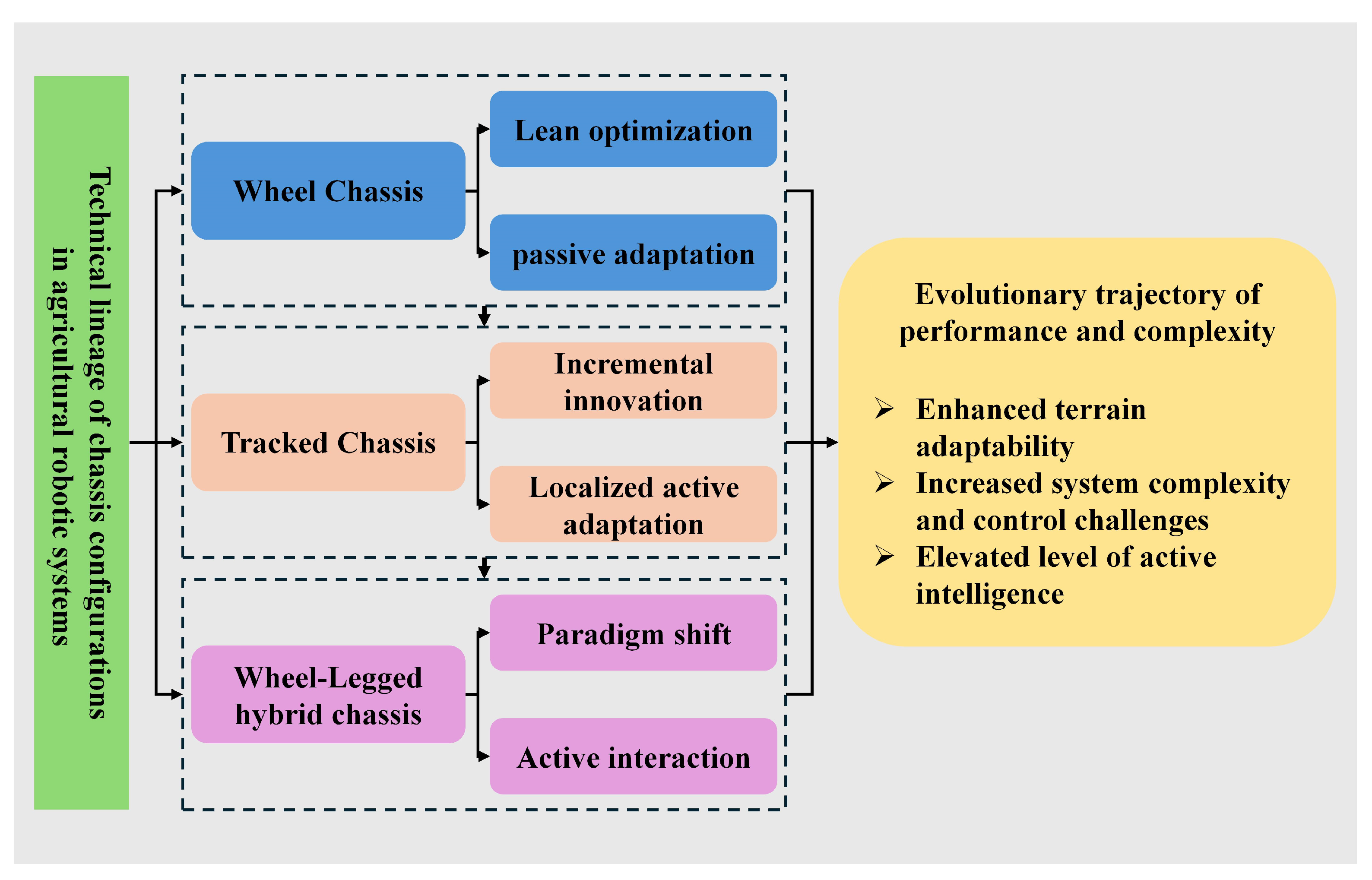
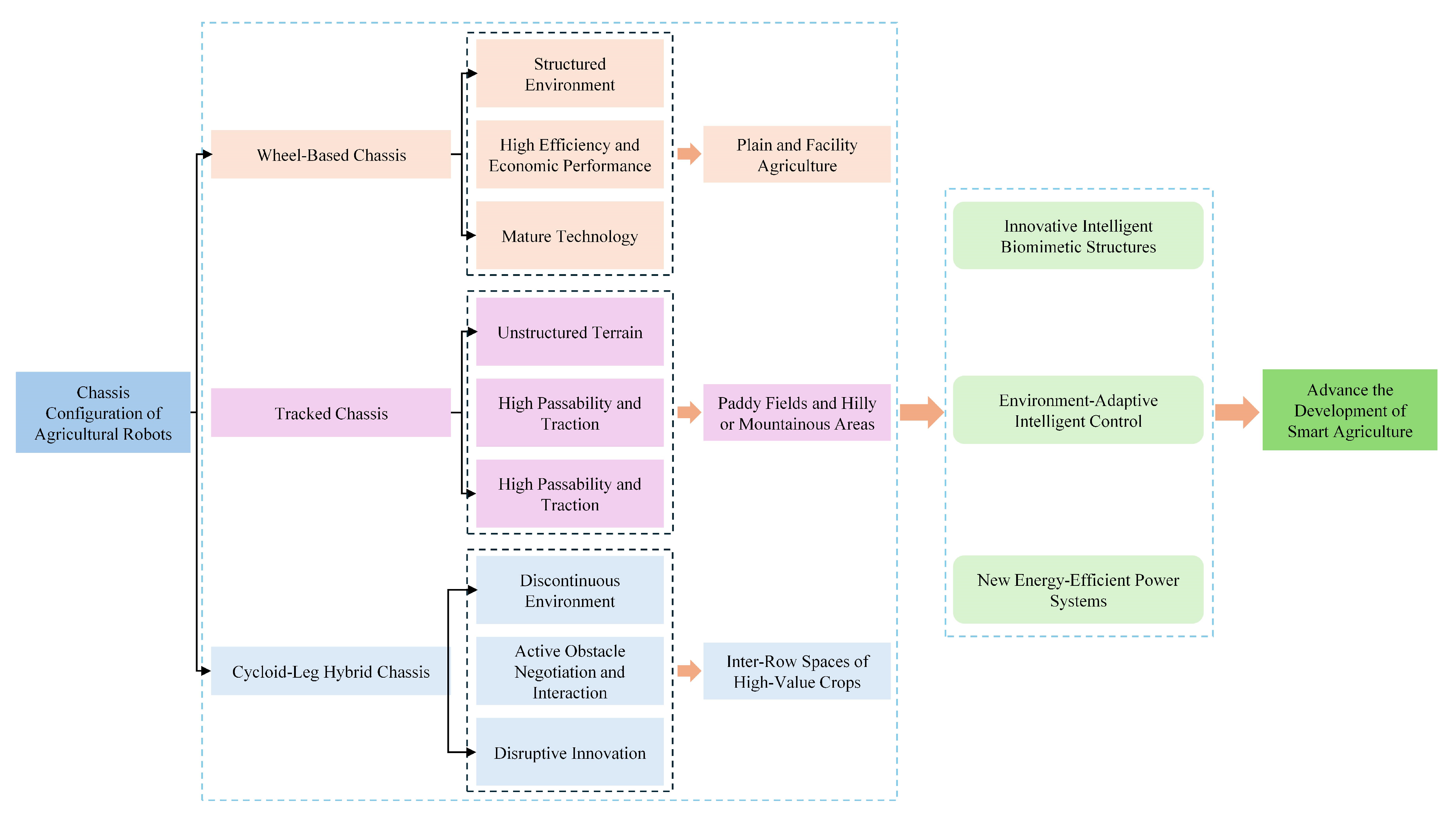
Mainstream field robot chassis configurations are primarily categorized into three types: wheeled, tracked, and wheel-legged hybrid [14,15,16]. Through distinct structural designs and scenario-specific adaptation mechanisms, these configurations form a complementary technological ecosystem. The corresponding technological spectrum is illustrated in Figure 1, while a techno-economic comparison is presented in Table 1.
The wheeled chassis, based on kinematic simplification and characterized by high operational efficiency, is predominant in structured environments such as flat drylands and greenhouses [17,18]. Its limitations in unstructured terrain are determined by nonholonomic constraints and ground contact mechanics. The tracked chassis overcomes the limitations of wheeled systems by virtue of continuous ground contact and contour-following dynamics, thereby enabling effective load distribution on wet, soft, and sloped terrains [19,20,21]. Its performance depends critically on accurate soil-track shear stress modeling and robust stability control mechanisms [22,23,24]. The wheel-legged hybrid chassis combines rolling efficiency with active obstacle-crossing capability. By leveraging parallel mechanism theory and biomimetic control strategies, it facilitates dynamic interaction within dense plant canopies, representing an advancement from passive adaptation to active environmental engagement [25,26,27].
This review will systematically analyze these three configurations in the following sections.

1.3. Review Objectives and Structure

While recent advances in field robot chassis research have demonstrated progress within specific configurations, significant gaps persist at the level of systematic theoretical understanding. Current studies largely concentrate on performance optimization of individual designs, with limited attention to the overarching evolutionary logic and technology shift patterns across the three principal technical pathways. Moreover, conventional analytical approaches tend to examine structural design and dynamic control in isolation, thereby failing to establish an integrated framework that captures the intrinsic coupling among “mechanical configuration, environmental interaction, and intelligent control.”
To address these limitations, this review proposes and employs a dual-dimensional analytical framework—“structural design principles and dynamic adaptive control”—to conduct a systematic evaluation and forward-looking analysis of the three mainstream chassis configurations. This study aims to clarify the underlying technical principles and innovation trajectories of each configuration, while also revealing their paradigmatic evolution from “passive adaptation” to “active terrain overcoming.”
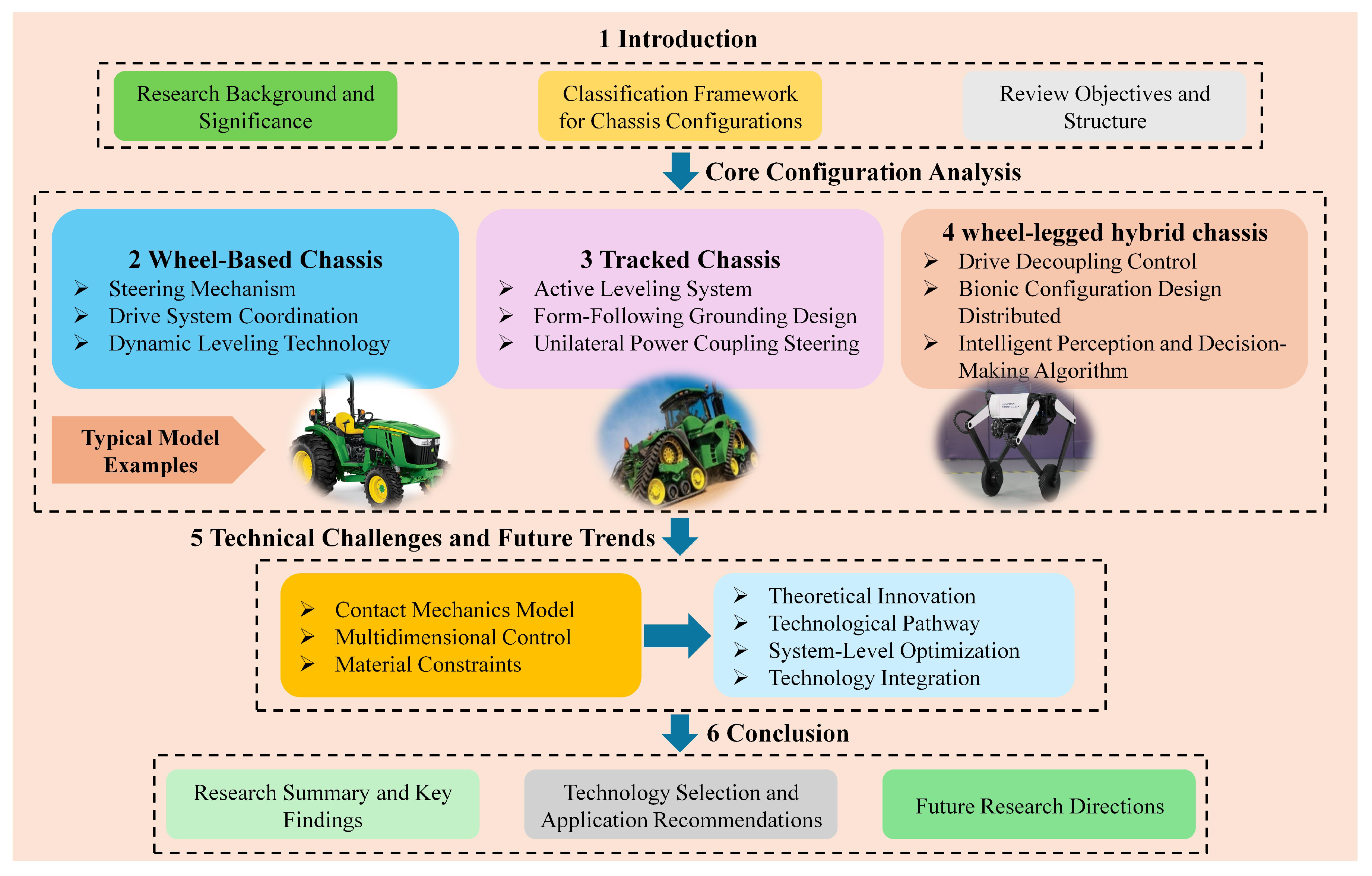
The review follows a structured progression: Section 2, Section 3 and Section 4 present a systematic analysis of the three chassis types; Section 5 synthesizes prevailing challenges and emerging trends; and Section 6 delivers a holistic summary and proposes evidence-based technical selection guidelines. The overall logical structure of the paper is illustrated in Figure 2.

2. Wheeled Chassis: Foundation for High-Efficiency Operation

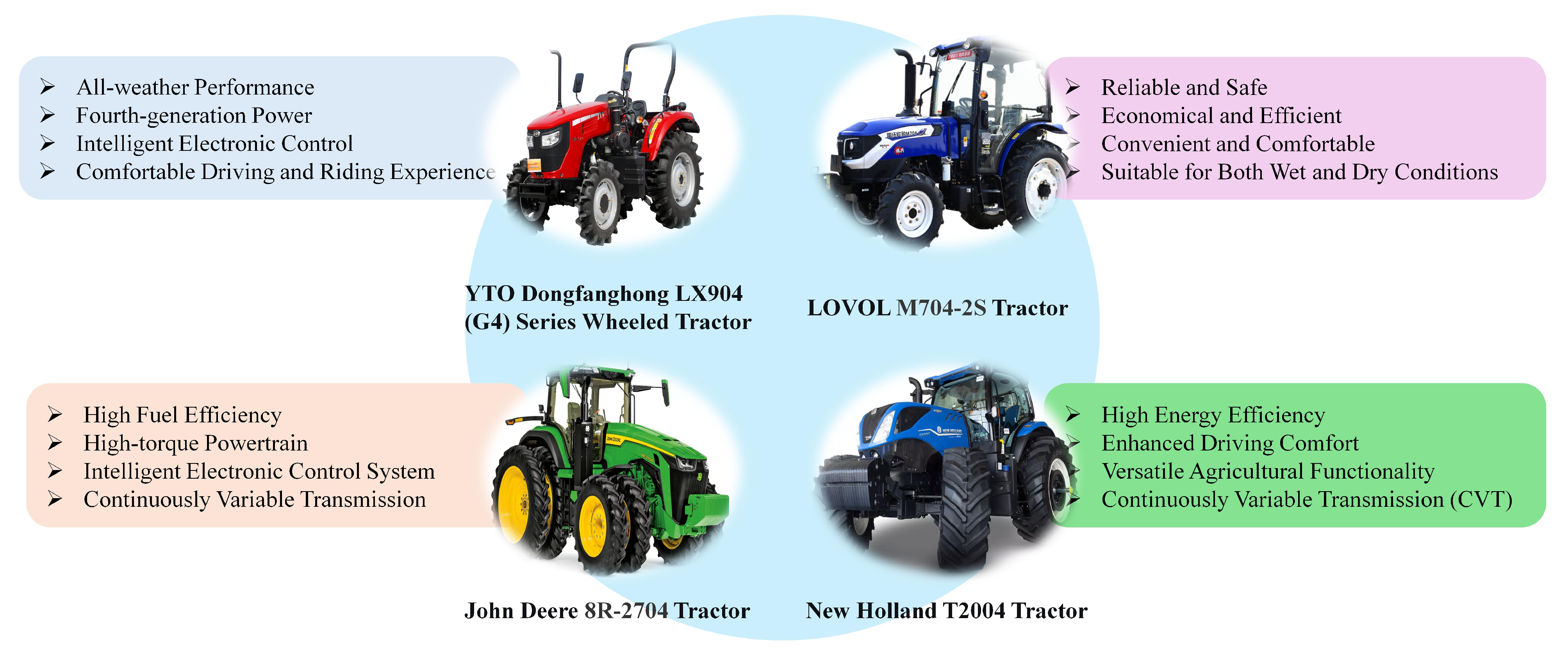
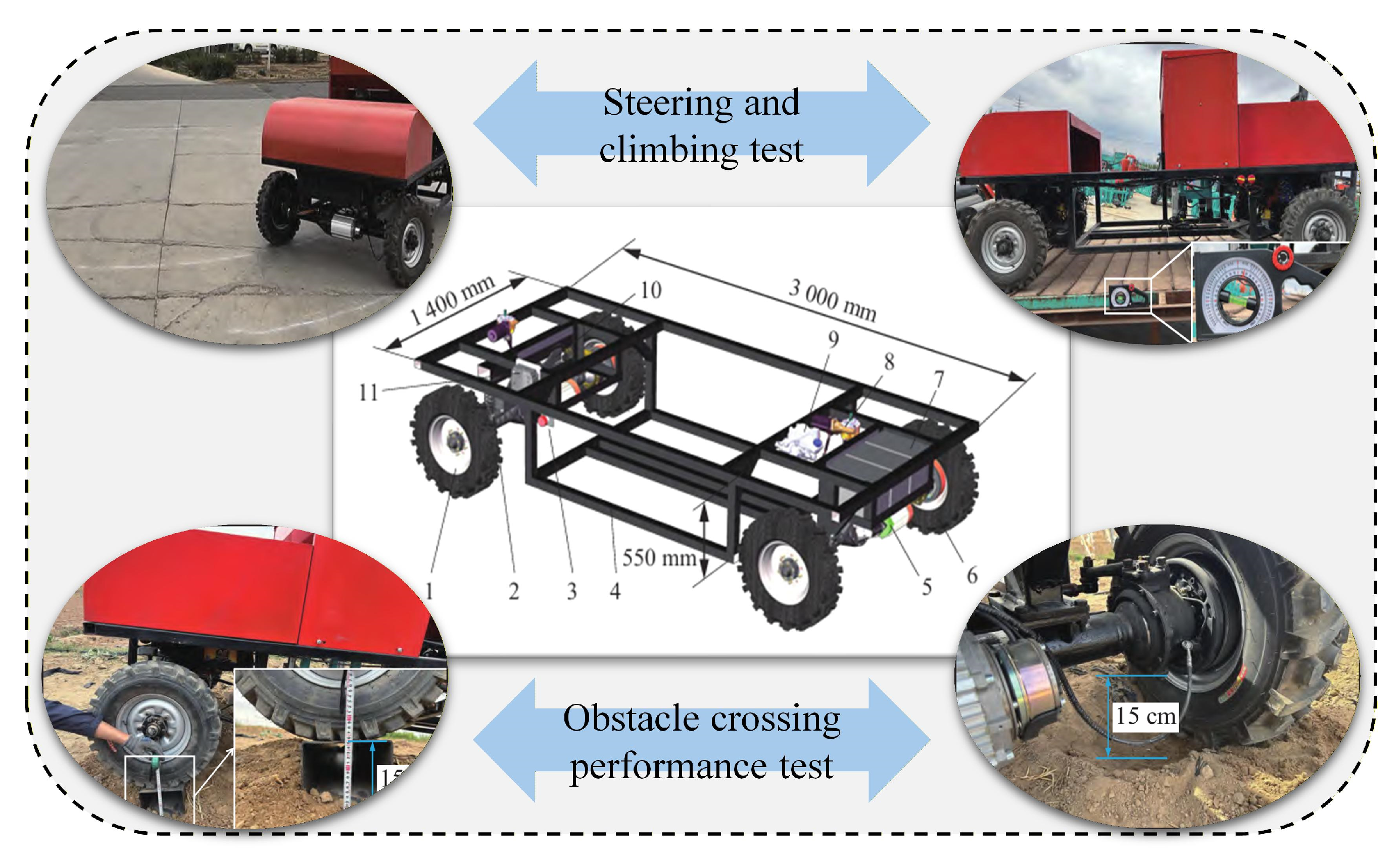
The wheeled chassis, as the most prevalent configuration paradigm in agricultural mechanization, fundamentally represents an engineering integration of kinematic simplification and optimal energy efficiency [28,29,30]. Within field robot systems, it serves as the core mobility platform. Through modeling and control of efficient wheel–ground contact mechanics, it ensures reliability, cost-effectiveness, and operational precision in structured working environments [31,32,33]. A representative wheeled chassis prototype is illustrated in Figure 3.

2.1. Technical Principles and Structural Characteristics

As the core mobility platform for agricultural robots, the coordinated design of steering mechanisms and drive modes in wheeled chassis represents a key technological approach to addressing challenges in unstructured field environments [34,35,36]. To enable precise and coordinated transmission of forces and torques under complex terrain conditions, an optimal balance must be achieved among mobility, trafficability, efficiency, and stability. From the perspective of vehicle dynamics, it is essential to systematically elucidate the transmission pathways and efficiency characteristics of force and torque, clarify the critical role of slip ratio control in enhancing system stability, and explain how sensor feedback enables accurate trajectory tracking and dynamic stabilization through advanced control algorithms. At the same time, the inherent complexity of the wheel–ground interaction model must be fully accounted for, thereby providing a theoretical foundation and evaluation benchmark for structural optimization and control strategy refinement.

2.1.1. Comparative Analysis of Steering Mechanisms and Terrain Adaptability

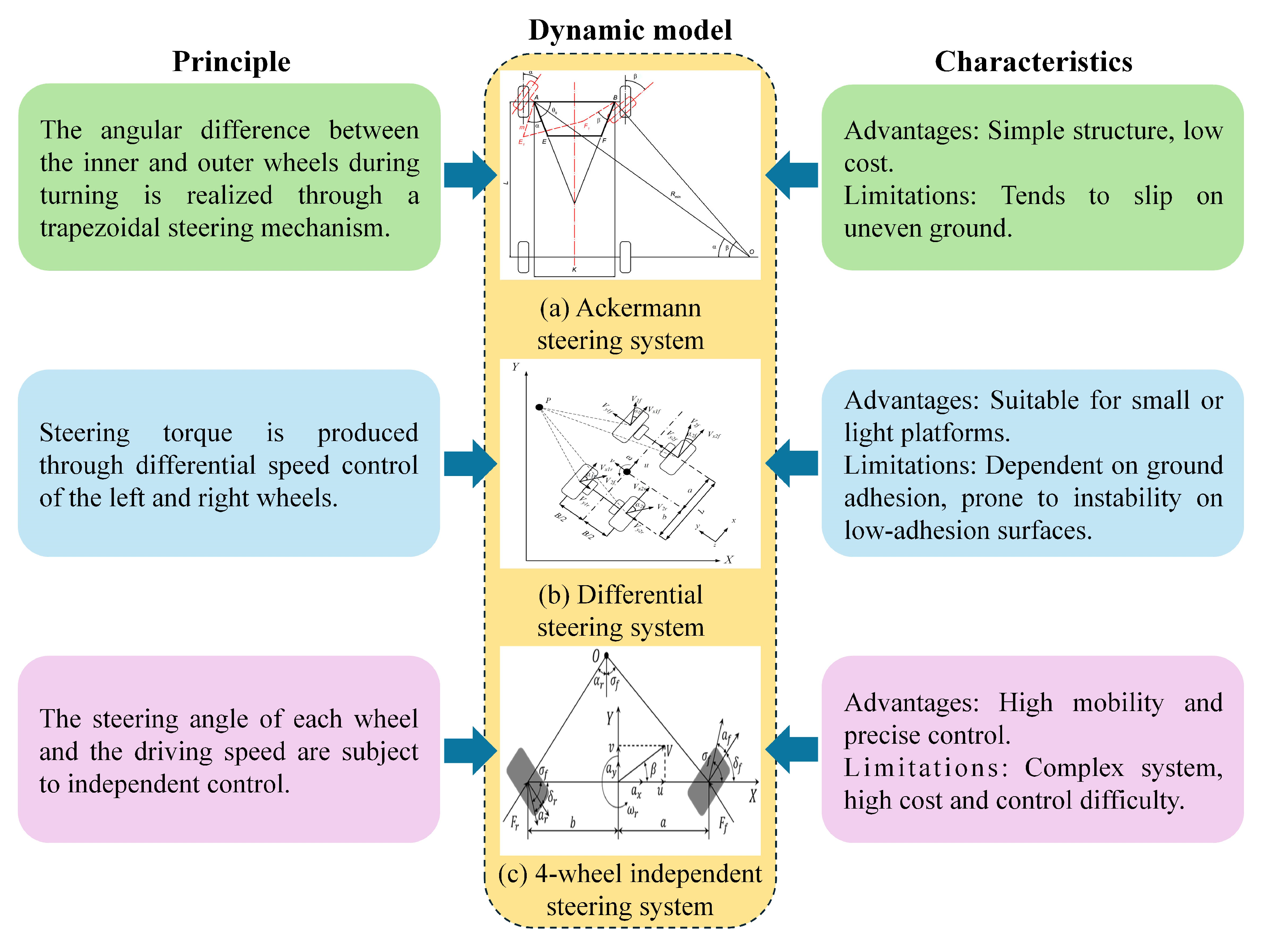
Common steering mechanisms are primarily categorized into three types: Ackermann steering, differential steering, and four-wheel independent steering.
Ackermann steering utilizes a trapezoidal linkage to assign different steering angles to the inner and outer wheels. This ensures that the rotational axes of all wheels intersect at a single instantaneous center, enabling pure rolling motion during steering. To optimize the steering trapezoid in agricultural tractors, Li et al. [37] developed a nonlinear dynamic model that incorporates tire pure rolling conditions and inertial moments. They introduced a weighting function ω ( α ) to capture dynamic behavior across varying steering angle ranges and employed a Hybrid Genetic Algorithm (HGA), integrating Powell’s method with genetic algorithms, for collaborative optimization. To further improve the dynamic performance and robustness of the steering system, research has evolved from purely mechanical optimization to encompass integrated electro-mechanical and hydraulic control strategies. An et al. [38] designed an Electric Automatic Steering System (EASS) based on fuzzy control logic. By constructing a fuzzy inference model with convergence time and resistance torque as inputs and dynamic PID parameters as outputs, they achieved seamless coordination between the steering motor and hydraulic assistance system. For the problem of synchronized trajectory tracking in tractor-trailer wheeled robots (TTWR) at low speeds, Zhou and Chuang [39] proposed a control strategy based on passive steering angles and adaptive tracking targets. By incorporating a passive steering mechanism into the trailer and establishing a kinematic model that accounts for this constraint, they reduced the system’s control complexity and energy consumption.
Differential steering is a widely adopted steering method for agricultural robot chassis. Its fundamental principle involves generating a steering torque by controlling the speed differential between the left and right drive wheels, relying on ground-provided lateral friction to achieve directional control. This approach features a mechanically simple structure and eliminates the need for complex steering actuators. However, its performance is highly sensitive to variations in ground adhesion conditions, and steering efficiency may significantly degrade or even fail on low-friction surfaces. To improve the robustness and control accuracy of differential steering systems, various advanced control strategies have been proposed in the literature. An et al. [40] developed a hierarchical control architecture that integrates sliding mode control with load ratio optimization for a four-wheel independently driven electric tractor. By establishing a dedicated dynamic model, they effectively enhanced vehicle stability during differential steering maneuvers. Liu et al. [41] addressed the issue of path deviation in differentially steered automated guided vehicles (AGV) under large lateral errors. They proposed a dual-variable limited PID control algorithm, which improved the system’s adaptability to complex terrains and strengthened the robustness of path tracking.
Four-wheel independent steering enables complex motion modes, such as in-place turning and crabwise locomotion, by independently controlling the steering angle of each wheel. This multi-degree-of-freedom capability significantly enhances vehicle maneuverability in confined or unstructured environments. Zhu et al. [42] addressed the fundamental challenge of balancing steering stability and agility for tractors operating on sloped terrain. They proposed a four-wheel steering control strategy incorporating slope dynamics, thereby extending the classical Ackermann geometric constraints to enable adaptive steering on inclines. To address the autonomous navigation challenges faced by four-wheel steering mobile robots in GPS-denied orchard environments, Raikwar et al. [43] developed a cost-effective navigation architecture based on model-driven design. By deeply integrating Ackermann steering principles and leveraging kinematic constraints to actively suppress lateral slip, they established a GNSS-independent “encoder-model” closed-loop navigation framework, enabling reliable localization for low-cost orchard robots. For agricultural robots operating in complex, unstructured fields, Zhang et al. [44] tackled the issues of wheel slip disturbances and internal system uncertainties. They proposed a composite sliding mode control method based on an extended disturbance observer, which employs adaptive control gains to compensate for abrupt changes in wheel–ground friction induced by variations in soil compliance. This approach significantly improves the robustness of the four-wheel independent steering system and enhances the stability of wheel–ground interaction, effectively overcoming the limitations of conventional control methods in heterogeneous field conditions.
To systematically evaluate the inherent characteristics and performance boundaries of different steering architectures, Table 2 presents a comparative analysis of their key performance metrics across three dimensions—kinematics, dynamics, and systems engineering—based on existing research.
This comparison reveals an evolutionary trajectory from mechanical decoupling toward electronic coordination. Ackermann steering remains the most cost-effective solution for structured environments due to its deterministic design. Differential steering utilizes drivetrain electrification to achieve exceptional maneuverability, yet it is highly sensitive to ground conditions. Four-wheel independent steering provides the highest level of control authority and path-tracking accuracy, positioning it as a forward-looking solution for high-value, precision agriculture, albeit with increased complexity and cost.
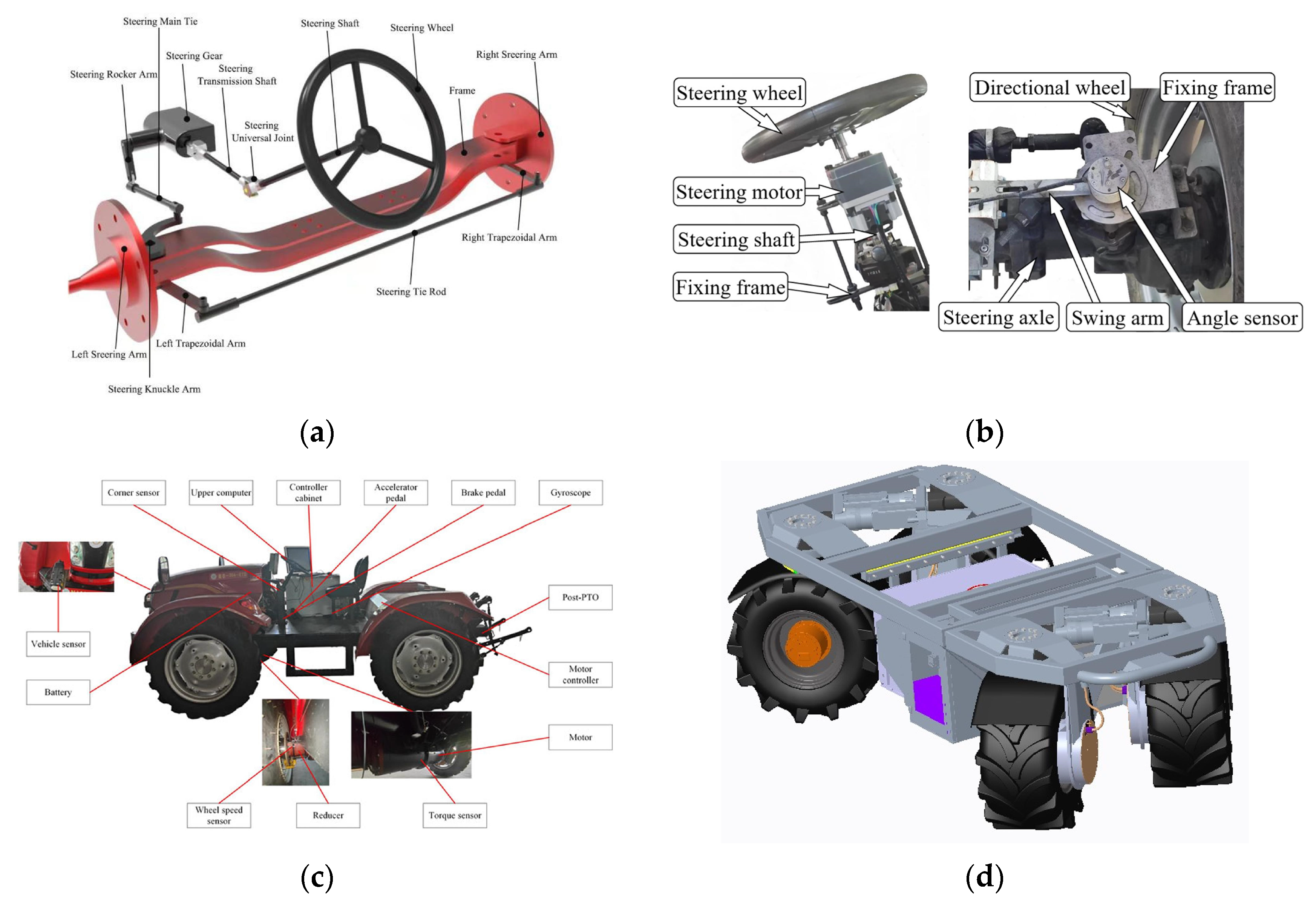
Figure 4 presents a comparative illustration of the different steering mechanisms. Figure 5 displays the structural configurations and physical prototypes of the aforementioned steering systems.
Figure 4a illustrates the Ackermann steering mechanism [37], α is the outer tire deflection angle (°); β is the inner tire deflection angle (°); K is the track (m); β is the angle at which the right steering arm rotates during turning (°); m is the trapezoidal arm length (m); θ 0 is the included angle between the steering wheel return timing trapezoidal arm and front axle (°). Figure 4b illustrates the wheel speed analysis of the differential steering mechanism [40]. It is assumed that, when the electric tractor turns left, the left side is inside, while the right side is the outside. The subscripts 1 and 2, respectively, represent the left and right sides; the subscripts x and y , respectively, represent the longitudinal and transverse of the tire; and the subscripts f and r , respectively, represent the front and rear wheels. B is the wheelbase (m); ω is the yaw angle speed of the electric tractor (rad/s); a is the distance from the center of gravity of the electric tractor to the front axle (m); b is the distance from the center of gravity of the electric tractor to the rear axle (m); u is the longitudinal speed at the center of mass of the electric tractor (m/s); and v is the transverse speed at the center of mass of the electric tractor (m/s). Figure 4c illustrates a simplified linear two-degree-of-freedom model of the four-wheel steering system [42], O is the steering center; X and Y are the longitudinal and lateral axes of the tractor’s movement; V is the tractor’s velocity; u and v are the tractor’s velocity components on the X and Y axes; a x and a y are acceleration on the X and Y axes; ω r is the yaw rate; β is the center-of-mass sideslip angle; F f and r are the sum of the lateral forces from the ground on the front and rear axle tires; σ f and σ r are the auxiliary angles of the front and rear axles; α f and α r are the sideslip angles of the front and rear tires; δ f and δ r are the steering angles of the front and rear tires.
In summary, although optimization research on Ackermann, differential, and four-wheel independent steering mechanisms has significantly improved the motion flexibility and path-tracking accuracy of wheeled chassis through various approaches—each exhibiting distinct scenario adaptability—their performance limits remain evident under extreme operating conditions. Dynamic operations on combined lateral slopes and uneven terrain continue to pose instability risks, and tire force saturation coupled with load transfer during steering maneuvers can readily lead to rollover incidents. Qin et al. [45] developed a coupled nonlinear dynamic model encompassing both straight-line and steering phases, and proposed an energy-based stability index to assess rollover risk on stochastic road surfaces. He et al. [46] enhanced the lateral stability metric by incorporating the concept of the Rollover Critical Position (RCP), enabling real-time quantification of rollover susceptibility. In the domain of active control, Song et al. [47] designed a sliding mode control (SMC)-based active steering system capable of rapidly restoring vehicle posture following disturbances. Furthermore, Qin et al. [48] proposed a flywheel-active steering coordinated control system that mitigates severe rollover tendencies from an energy dissipation perspective. Collectively, these studies constitute the theoretical and technical foundation for active safety systems in intelligent agricultural machinery. Future research should further investigate the coupled dynamic behaviors of different steering mechanisms under extreme operational conditions and establish a comprehensive theoretical framework for multi-system cooperative control, ultimately achieving an integrated balance between adaptability and safety in agricultural vehicle steering systems.

2.1.2. Trade-Off Between Traction Characteristics and Field Performance of Drive Configurations

The mainstream drive configurations currently include front-wheel drive (FWD), rear-wheel drive (RWD), and all-wheel drive (AWD), each exhibiting distinct trade-offs in traction performance and operational effectiveness in agricultural environments (Table 3). FWD provides responsive steering control and improved anti-skid performance on low-adhesion surfaces; however, the driven front wheels are prone to slippage under heavy-load conditions, and research on this configuration in agricultural applications remains relatively limited. RWD offers high drivetrain efficiency and strong load-carrying capacity, but it is susceptible to immobilization in soft or saturated soils and may exhibit understeer characteristics during dynamic maneuvers. AWD delivers superior terrain adaptability and higher tractive effort, albeit at the expense of increased drivetrain complexity and reduced baseline transmission efficiency due to the extended power transmission path.
To further enhance the traction efficiency and terrain adaptability of rear-wheel drive (RWD) systems, research efforts have primarily focused on torque distribution, anti-slip control, and energy consumption optimization. Luo et al. [49] addressed the yaw stability challenges of electric tractors during plowing operations. They proposed a learning-based dual-layer control framework for rear-wheel independently driven electric tractors, achieving high-precision yaw moment regulation. Zhang et al. [50] investigated the issue of reduced traction energy efficiency in wheeled tractors caused by excessive unilateral wheel slip during plowing. They introduced a coordinated speed-slip control strategy based on active torque distribution, which effectively minimized ineffective power dissipation. Luo et al. [51] focused on the challenge of simultaneously optimizing energy consumption and operational stability in electric tractors. They developed an energy-saving drive control strategy incorporating real-time terrain parameter identification. By establishing longitudinal dynamics and load transfer models, and integrating sliding mode observer-based longitudinal wheel force estimation with particle filter-based terrain parameter inversion, their approach dynamically computes the optimal slip ratio and regulates drive motor torque accordingly. Ashok Kumar et al. [52] developed a microcontroller-based embedded system for real-time measurement and display of dynamic axle torque and traction power in agricultural tractors. This system overcomes signal transmission challenges associated with rotating components, providing a reliable platform for research on tractor traction dynamics and energy efficiency improvement.
Research on all-wheel drive (AWD) systems predominantly focuses on torque coordination, kinematic compatibility, and stability control. Li et al. [53] aimed to improve the traction efficiency of a four-wheel-drive fuel cell electric tractor. They proposed a cooperative control strategy based on a hierarchical progressive architecture. By estimating tire force conditions in real time and dynamically distributing torque across all four wheels toward achieving the optimal slip ratio, they significantly reduced overall slip. Qiu et al. [54] studied an all-wheel-drive agricultural mobile platform equipped with front and rear servo steering. They proposed a coordinated motion control strategy that extends the Ackermann steering principle, resulting in reduced total motor energy consumption and improved accuracy in circular path tracking. For efficiency optimization in AWD systems, power matching between front and rear axles in mechanical front-wheel-drive (MFWD) tractors remains a critical challenge. Janulevičius et al. [55,56] established a quantitative control chain linking tire deformation, inflation pressure, kinematic parameters, and fuel consumption. Using the kinematic mismatch coefficient as the optimization objective, they minimized parasitic power losses in the driveline by suppressing the power circulation induced by deformation differences between front and rear tires. Shafaei et al. [57] developed a drawbar pull prediction model for MFWD tractors using an intelligent fuzzy inference system. Through optimization of membership functions, defuzzification methods, and training iterations, they constructed a high-precision computational model, confirming that the four-wheel-drive configuration substantially enhances traction performance.
In summary, research on agricultural machinery drive systems is transitioning from traditional mechanical transmission toward electric drive and intelligent control. Studies on rear-wheel drive (RWD) systems, particularly in the context of electric tractors, employ advanced intelligent algorithms to improve operational stability and energy efficiency. Research on all-wheel drive (AWD) systems focuses on enhancing traction performance through torque coordination and kinematic compatibility. Collectively, these advancements are driving the evolution of agricultural drive systems toward intelligent operation characterized by high precision, high efficiency, and enhanced adaptability.

2.2. Breakthroughs in Innovative Design

In the study of wheeled chassis for agricultural machinery, optimization of steering mechanisms and innovation in drive modes constitute the core foundation of technological advancement. However, traditional wheeled configurations continue to face significant challenges when operating in complex environments and fulfilling diverse task requirements, including insufficient ground clearance, limited track width adaptability, and inadequate dynamic stability. Therefore, evolving chassis configurations to overcome scenario-specific limitations and developing new operational platforms with extreme spatial mobility, millimeter-level operational precision, and full-terrain adaptability have become critical bottlenecks in advancing agricultural mechanization into high-value crop sectors. To improve terrain adaptability and operational stability of wheeled chassis, current research is primarily focused on innovations in structural design, coordinated drive and steering control, and dynamic leveling technologies.
With regard to structural innovation, recent studies emphasize optimizing the mechanical body to enhance terrain trafficability and system stability. Gao et al. [58] developed a chassis featuring variable track width and adjustable ground clearance based on a balanced rocker-arm suspension system, enabling adaptation to varying agronomic conditions and complex terrains. Adaptive leveling is achieved through a hydraulic actuation system. In addition to achieving adaptive regulation of the macroscopic configuration, topology optimization and lightweight design of key load-bearing components represent critical strategies for enhancing chassis performance. Lu et al. [59] designed an omnidirectional mobile chassis with electrically adjustable track width and wheelbase (as shown in Figure 6), effectively resolving issues of poor universality and seedling damage arising from inconsistent crop row spacings. By employing swing-arm motors for real-time track width adjustment, this design significantly improved the chassis’s adaptability to diverse row configurations and enhanced field trafficability. Su et al. [60,61] tackled the problems of seedling crushing and limited environmental adaptability in phenotyping robots caused by fixed track widths. They proposed a continuously variable and precisely controllable track width adjustment system based on an electric actuator and sliding column linkage mechanism, enabling online fine-tuning within the 1400–1600 mm range. This solution effectively accommodates different crop row spacings and reduces rolling-induced crop damage.
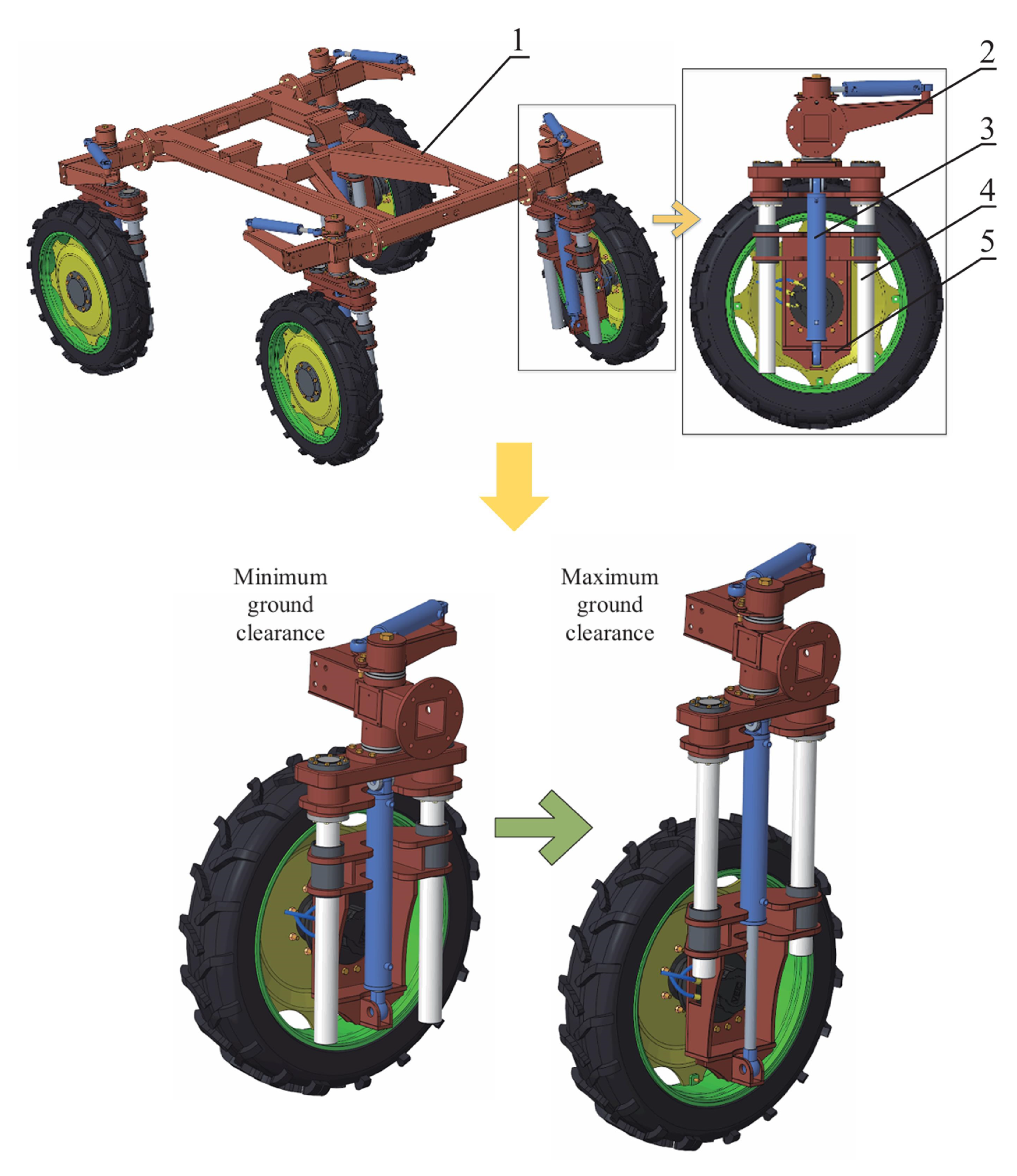
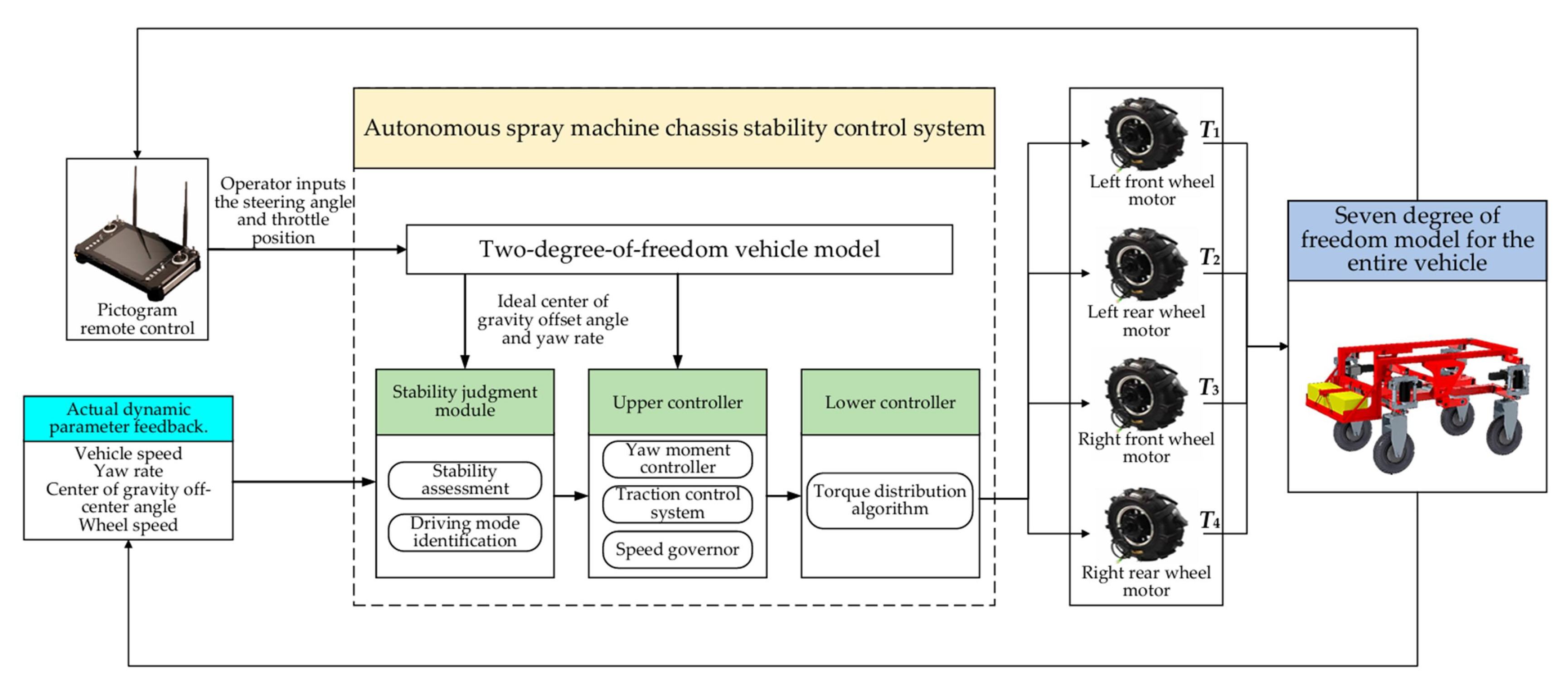
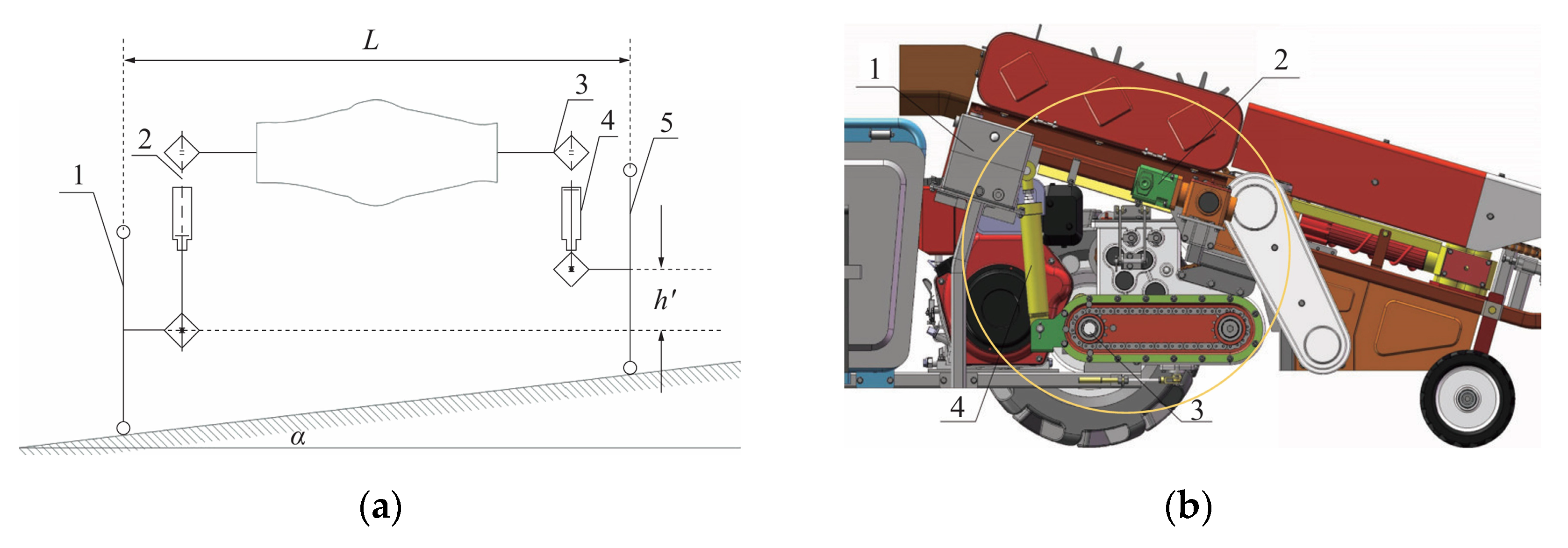
In the domain of drive and steering control, research primarily focuses on addressing challenges related to multi-wheel coordination and precise maneuvering. Yang et al. [62] investigated the issues of severe vibration, poor maneuverability, and significant ground compaction encountered by large high-clearance self-propelled boom sprayers during complex field operations. They proposed an optimization design method for the hydraulic suspension system based on an improved multi-objective particle swarm optimization algorithm. By integrating intelligent parameter tuning with structural design and time-varying fusion strategies, the comprehensive performance of the suspension system was significantly enhanced. Figure 7 illustrates the schematic diagram of ground clearance adjustment. Zhou et al. [63] addressed the issue of inadequate driving stability in high-clearance self-propelled sprayers under challenging operational conditions. Leveraging the independently controllable torque of each wheel in electric-drive sprayers, they developed a hierarchical control architecture consisting of instability detection, upper-level motion planning, and lower-level torque distribution (as shown in Figure 8), which substantially improved vehicle driving stability. Massarotti et al. [64] introduced a dual-steering system combining front-wheel steering and articulated steering for compact tractors. This approach successfully reconciled the trade-off between high maneuverability in confined spaces and directional stability at high speeds. Bayano-Tejero et al. [65] developed a ROS-based diesel-hydraulic dual-steering axle system to enhance the applicability of autonomous tractors in demanding orchard environments. They proposed a novel Hybrid Steering (HS) mode that improves upon the limitations of conventional Front Steering (FS) and Front-Rear Inverse Steering (FRIS), effectively addressing maneuverability and stability requirements in narrow-row orchards. Wang et al. [66] designed a front-and-rear dual-drive dual-steering corn seeding robot chassis (shown in Figure 9) to overcome the large turning radius and low field utilization efficiency associated with traditional tractor-seeder units. By implementing synchronous reverse steering control based on the Ackermann principle, they achieved effective coordination between operational maneuverability and seeding precision.
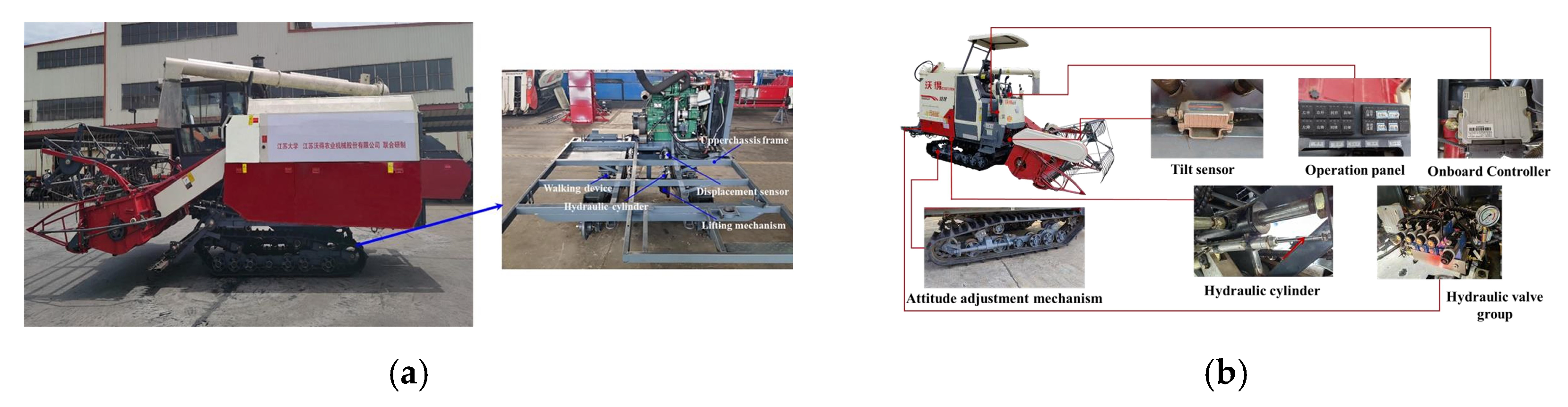
In the field of dynamic leveling technology, research aims to actively maintain vehicle body levelness to ensure operational quality and safety. Chen et al. [67] developed a compact maize harvester equipped with attitude adjustment capability to address the challenges of mechanical harvesting in hilly and mountainous regions, thereby significantly improving operational safety and terrain adaptability. The underlying leveling principle is illustrated in Figure 10. Zhao et al. [68] proposed a stepwise leveling method based on active suspension to address the insufficient chassis level stability of three-wheeled agricultural robots operating on complex terrain, effectively enhancing leveling efficiency as well as operational stability and safety on uneven ground. Chen et al. [69] designed an electrically controlled air suspension height adjustment system incorporating single-neuron adaptive PID control to mitigate cargo and component damage caused by unstable vehicle height during agricultural vehicle operation, thereby improving ride comfort and system reliability. Peng et al. [70] developed an automatic leveling system based on a sliding mode variable structure control algorithm to meet the requirements of autonomous body leveling for tractors under complex operating conditions, providing an effective solution for tractor stabilization in hilly and mountainous environments.
In summary, through the three principal pathways of structural innovation, intelligent control, and active leveling, these studies have collectively established a highly adaptive wheeled chassis technology framework specifically designed to meet complex agronomic requirements. Substantial progress has been achieved in enhancing spatial mobility, maneuvering stability, and operational precision.

2.3. Application Scenarios and Limitations

As the core locomotion mechanism of modern agricultural equipment, the performance of wheeled chassis is highly dependent on the terrain characteristics and agronomic requirements of the operating environment. While demonstrating significant advantages in structured operational scenarios, they continue to face multiple technical challenges under unstructured or complex topographic conditions.
On soft terrain, the high ground contact pressure of wheeled chassis often exceeds the soil’s yield strength, leading to increased sinkage, slippage, and reduced traction. This not only diminishes operational efficiency but also adversely affects soil health through compaction and shear failure. Even specialized wide-section, low-pressure tires are unable to fundamentally mitigate these challenges under extremely wet and soft conditions. During slope operations, rigid axles limit terrain contour-following capability, undermining operational stability and consistency. Active leveling systems frequently exhibit insufficient adaptability to dynamic terrain variations due to inherent response delays, while high centers of gravity and narrow track widths elevate the risk of rollover. Moreover, heavy-duty operations contribute significantly to subsoil compaction, degrading soil structure and negatively impacting crop growth. Although modifications to tire configurations or operational parameters can partially mitigate these issues, system-level optimization is necessary to achieve a balanced trade-off between operational efficiency and long-term sustainability.
In summary, wheeled chassis offer distinct efficiency advantages in flat terrains and controlled-environment agriculture; however, their application in complex field conditions requires further advancement through technological innovation. Future research should focus on developing reconfigurable mobility systems, intelligent power distribution strategies, high-precision attitude control mechanisms, and advanced ground contact designs aimed at minimizing soil compaction. These developments will progressively advance wheeled chassis toward enhanced all-terrain adaptability, intelligent operation, and ecological sustainability.

2.4. Review of Technological Paradigms

The development of wheeled chassis reflects a sustained pursuit of operational efficiency within structured environments. Its technical foundation is rooted in vehicle dynamics, with evolutionary progress marked by enhanced control precision and parametric adaptability of mechanical structures. This represents continuous innovation within the established “rigid wheel–ground contact” technical mode.
The success of this technical mode arises from the alignment between its technical simplicity—which ensures high reliability, low maintenance, and superior manufacturability—and the requirements of mainstream agricultural operations. However, this very success reinforces inherent limitations. The rigid wheel–ground contact fundamentally restricts environmental adaptability in unstructured terrains. Consequently, while indispensable in specific applications, the advancement of wheeled chassis is characterized by incremental improvements rather than transformative change, thereby providing the rationale for the emergence of tracked and wheel-legged hybrid technologies.

3. Tracked Chassis: A Solution for Unstructured Terrains

Tracked chassis represent a key technological approach for addressing operational challenges in unstructured terrain. By leveraging their unique ground contact mechanics and multi-terrain adaptation capabilities, they effectively mitigate the functional limitations of wheeled chassis in soft, steep, and high-moisture operating environments [71,72,73]. With the increasing demands of precision agriculture and comprehensive agricultural mechanization, track systems have evolved from traditional rigid configurations into intelligent mobility platforms that integrate power coupling, dynamic ground contact regulation, and active terrain contour adaptation. A representative tracked chassis prototype is illustrated in Figure 11.

3.1. Technical Evolution Path

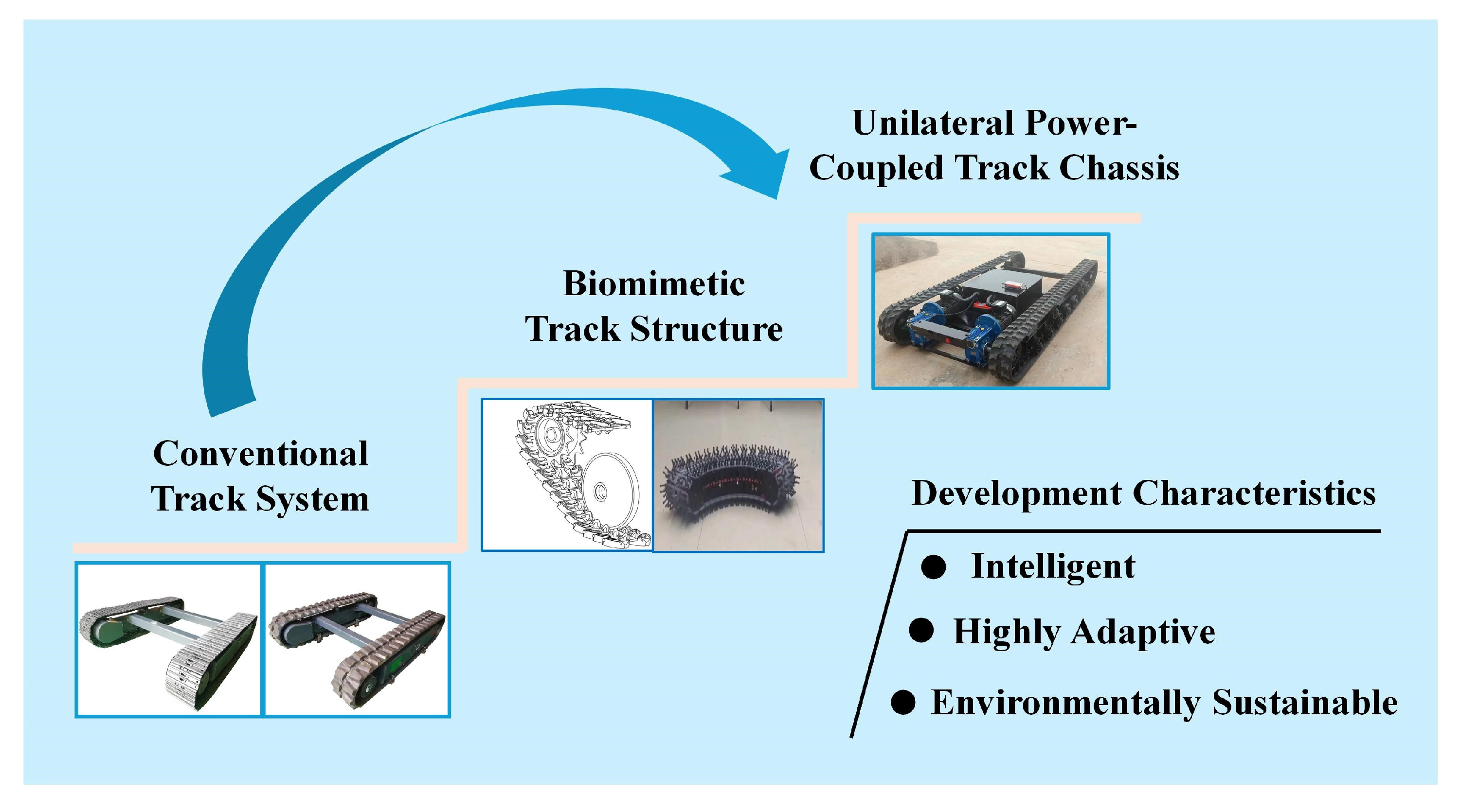
The technological evolution of tracked chassis has been driven by the core objectives of enhancing terrain trafficability, improving traction efficiency, and ensuring operational stability. This evolution reflects a continuous process of system optimization through multidisciplinary integration, rather than a simple linear replacement, as illustrated in Figure 12.
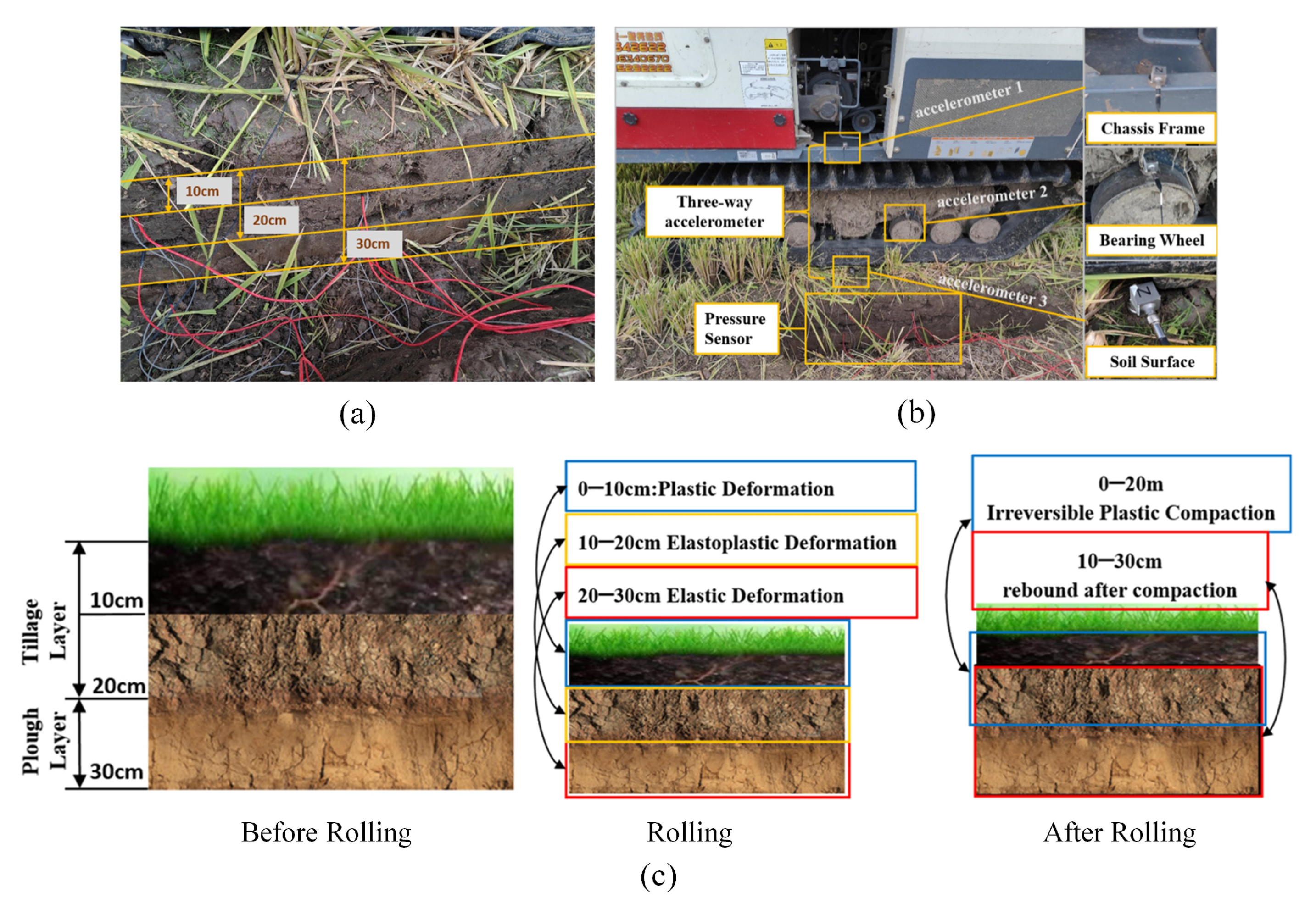
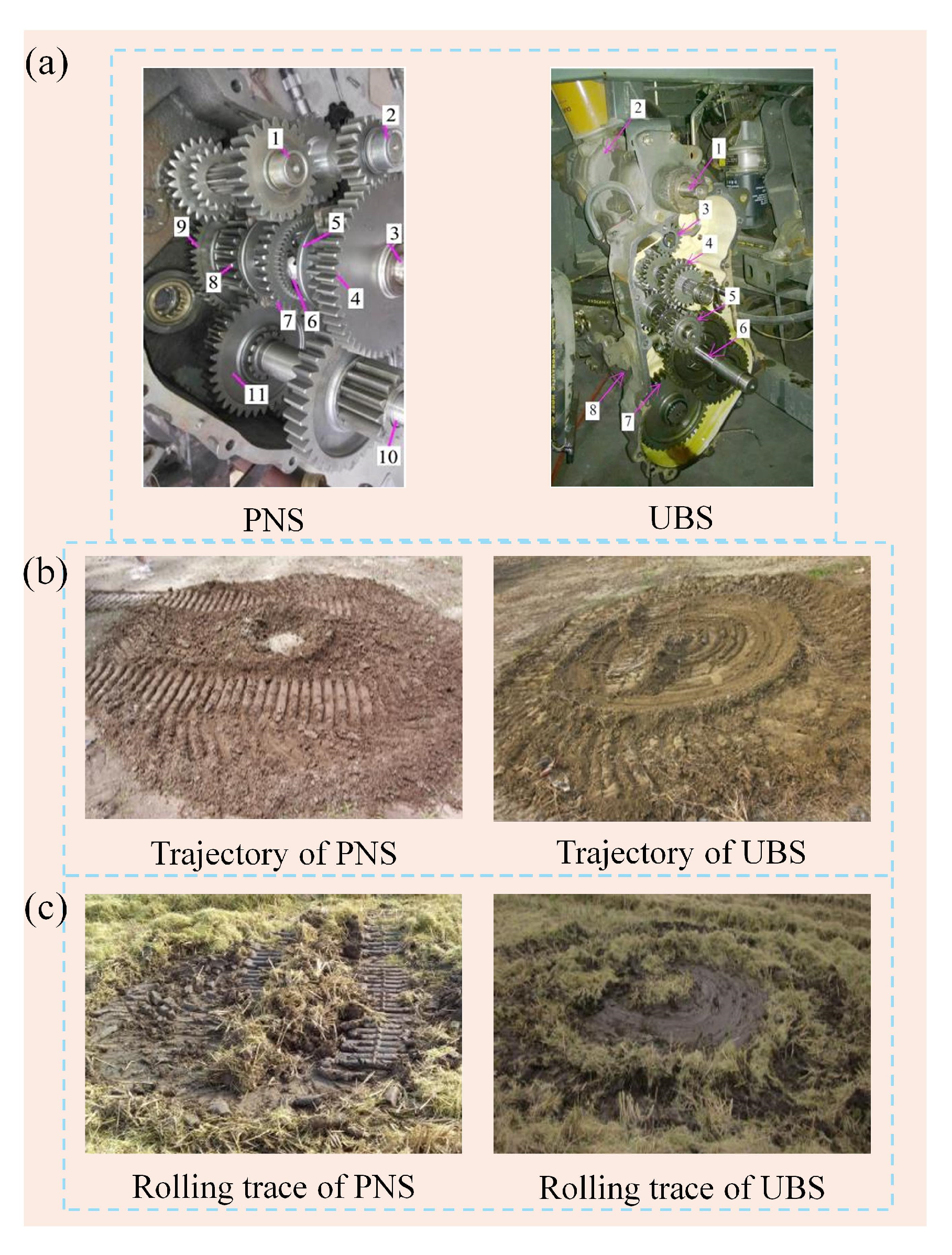
Traditional track systems utilize a combination of metal or rubber track plates and multiple supporting wheel assemblies. This configuration provides fundamental terrain trafficability and reduces average ground contact pressure, offering an effective solution to issues such as soil sinkage and wheel slip. Extensive research on structural optimization, ground pressure distribution, and steering dynamics has established a robust theoretical foundation for conventional tracked systems. Kormanek et al. [74] examined variations in ground contact pressure under different loading conditions to evaluate the soil compaction risk of tracked vehicles in forested environments, revealing the complex influence of dynamic loads and track tension on soil during actual operations. Jing et al. [75] performed rolling tests at varying speeds using a tracked combine harvester to analyze the underlying mechanisms of soil compaction in paddy fields. Their study demonstrated that the “soil bouncing phenomenon,” induced by mechanical self-excited vibrations, further aggravates damage to subsoil structure, with results presented in Figure 13. Liu et al. [76] investigated the soil compaction mechanism of rubber-tracked chassis operating in wet and soft terrains, finding that increased travel speed can mitigate compaction risk. Wang et al. [77] addressed ambiguities in steering mechanisms and inadequate driving stability by analyzing the steering mechanics and field performance of tracked chassis in hilly areas with heavy clay soils, evaluating key parameters including turning radius, sinkage, soil resistance, and slip ratio. Tang et al. [78] employed the finite element method to analyze the load-bearing characteristics of the chassis frame of a rice combine harvester, tackling issues of poor driving stability and operator discomfort under high-load conditions, thereby providing a theoretical basis for the design of high-capacity tracked harvester systems.
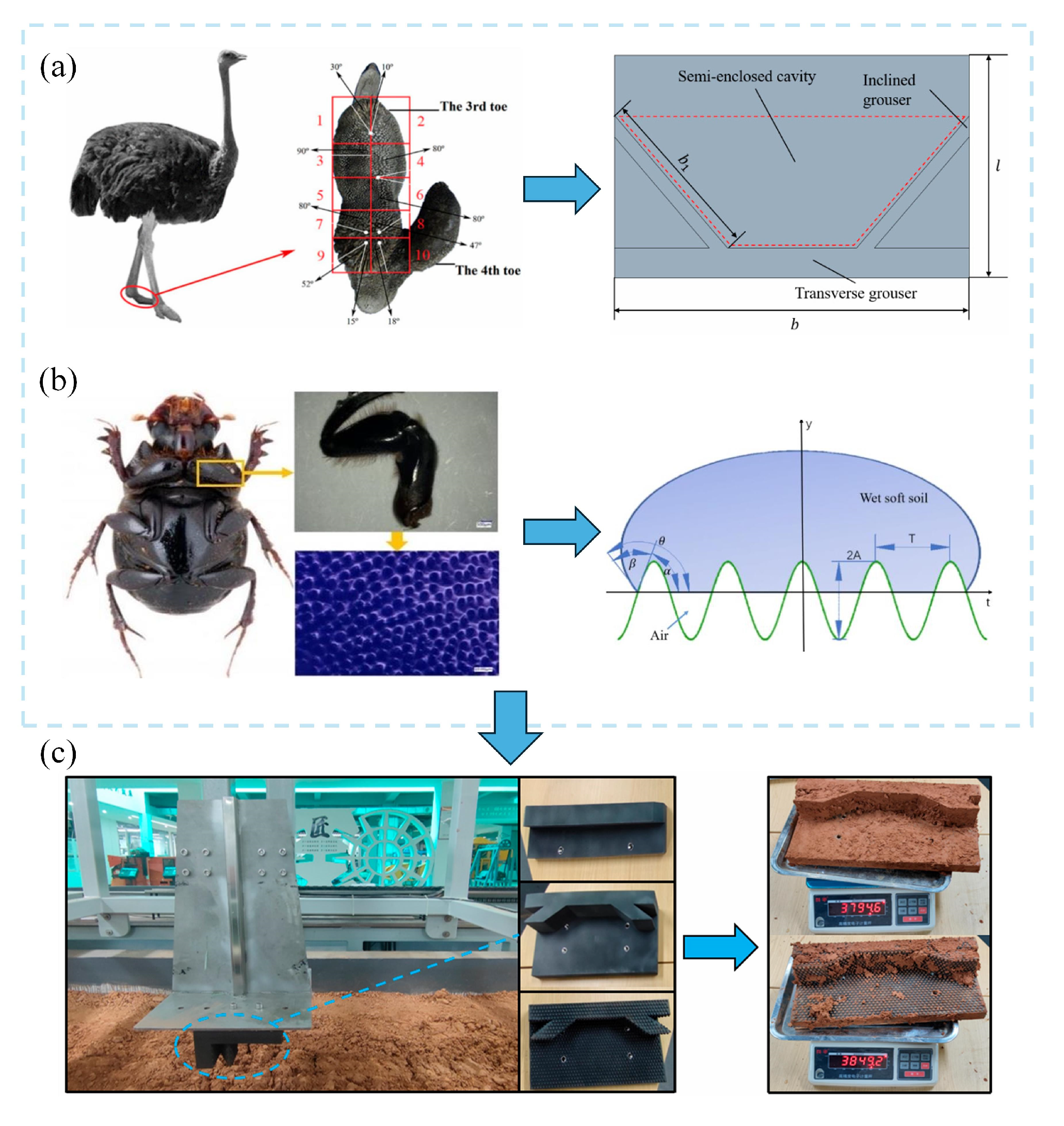
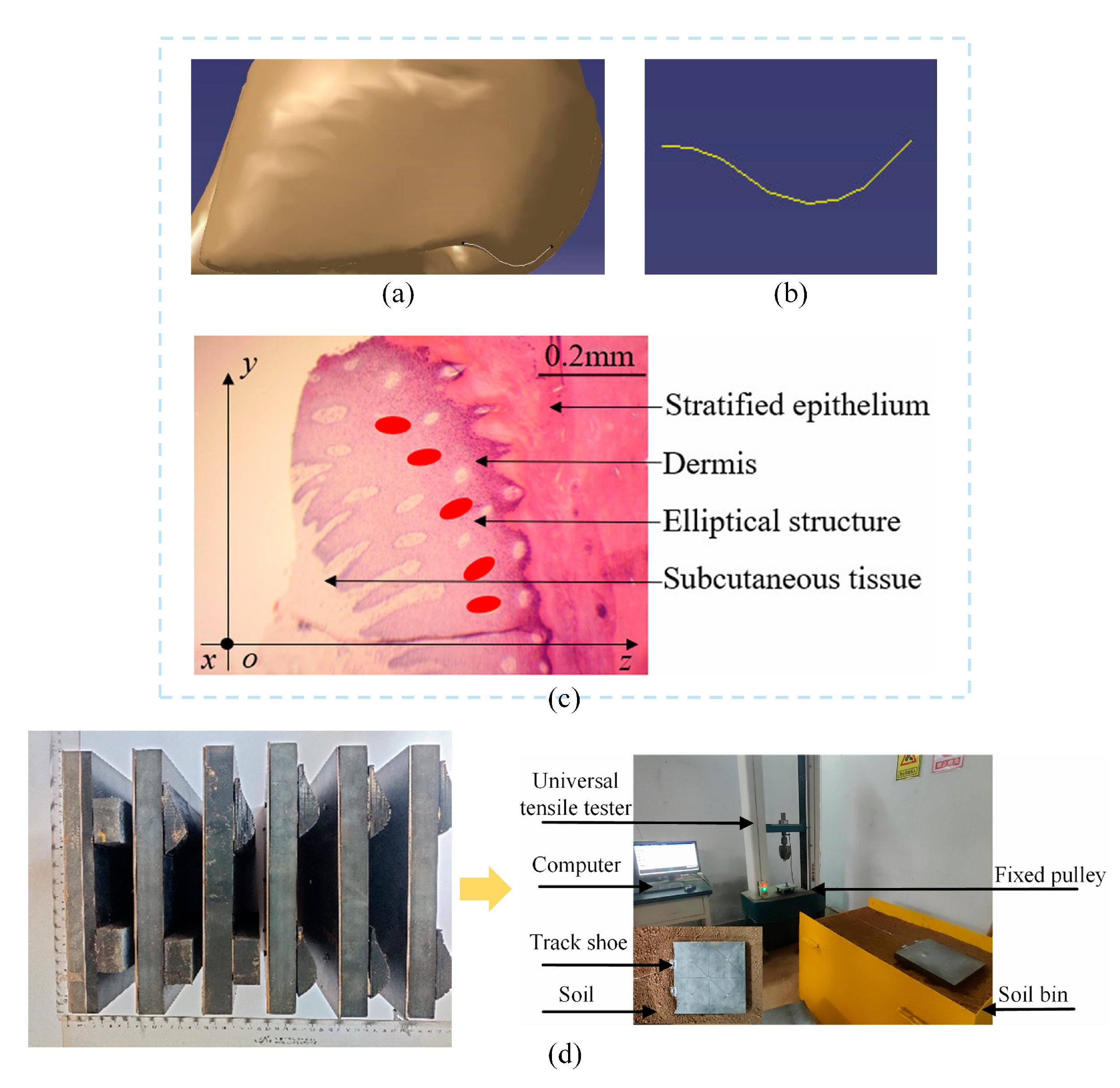
However, under extreme operating conditions such as wet and steep slopes, traditional track systems often experience severe slippage due to non-uniform ground contact pressure distribution and insufficient adhesion. To address this challenge, contour-adaptive track technology enhances ground contact area and improves pressure distribution uniformity by dynamically adjusting track configuration and ground interface morphology. This significantly improves traction performance and operational stability in complex environments such as wet and soft fields, steep slopes, and rugged terrain. He et al. [79] investigated the influence of grouser geometry on soil interaction mechanisms, revealing that lateral shear displacement induces vertical “sliding sinkage,” with sinkage magnitude positively correlated with grouser width and height, and negatively correlated with thickness and spacing. Qing et al. [80] further analyzed the cutting behavior of various biomimetic grousers at different speeds to mitigate the slippage tendency of tracked vehicles. They established a strong correlation between maximum traction force and key grouser parameters and identified the optimal parameter combination. Yuan et al. [81] adopted a bionic design approach, inspired by the ostrich foot structure and surface microstructures of dung beetles, to optimize the configuration and surface patterning of track grousers. This approach substantially enhanced traction performance, reduced soil adhesion, and improved both terrain trafficability and operational efficiency under wet and soft conditions. The underlying principles and performance characteristics are illustrated in Figure 14. To address the slippage issues of tracked vehicles in mountainous agricultural operations, Zhang et al. [82] designed a biomimetic track shoe pattern based on the macroscopic contour and microstructure of goat hooves (shown in Figure 15), achieving a 9.1% increase in adhesion compared to conventional track shoes. Fu et al. [83] developed multiple biomimetic track segment structures inspired by the spatial curvature of the goat spine, resulting in significantly improved ground adhesion performance.
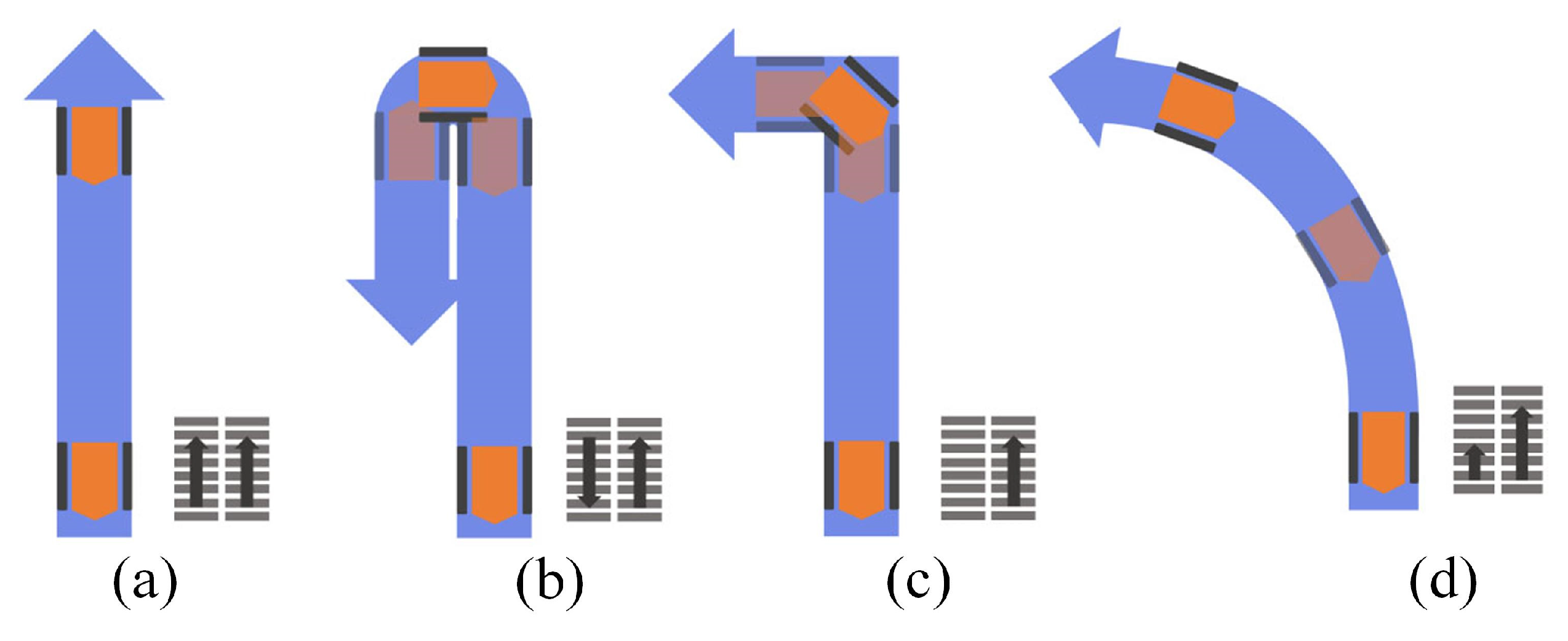
To address issues such as significant power loss, low operational efficiency, and poor maneuverability during steering in traditional tracked vehicles, unilateral power coupling technology has emerged. This approach reconfigures the drive system from both energy flow and information flow perspectives, effectively overcoming the inherent limitations of conventional mechanical steering systems. The operating principle is illustrated in Figure 16. At the theoretical level, Wang et al. [84] analyzed the differential steering mechanism enabled by unilateral power coupling using a harvester as a case study, aiming to resolve the challenges of large turning radius and low transmission efficiency in traditional hydrostatically driven tracked chassis. They experimentally validated an improved model for steering parameters and slip ratio. Building upon this technical framework, Han et al. [85] further developed a dedicated chassis for cotton topping operations. By integrating dual-motor independent drive with a fuzzy PID control algorithm, they achieved substantial improvements in operational stability and row-following accuracy. Chen et al. [86] proposed a hierarchical control strategy to address instability and trajectory deviation during straight-line travel in dual-motor tracked vehicles. The upper-layer controller regulates vehicle speed to ensure longitudinal stability, while the lower-layer controller maintains synchronization of bilateral motor speeds, thereby significantly enhancing the chassis’s maneuverability and terrain trafficability. Furthermore, Gao et al. [87] designed a fully tracked modular unmanned agricultural power chassis to tackle the challenges of low mechanization levels and operational difficulties in hilly and mountainous regions with complex terrain. A key innovation was the implementation of motor-compensated unilateral power coupling differential steering technology, which enables flexible steering and stable motion. This advancement improves the chassis’s terrain adaptability and multi-scenario applicability, providing essential technical support for the development of intelligent agricultural machinery.
In summary, the technological evolution of tracked chassis has advanced from addressing basic terrain trafficability to exploring material interface interactions and powertrain system architectures, marking a transition from conventional track systems to modern adaptive mobility platforms. The integration of key technologies such as bio-inspired anti-adhesion designs and unilateral power coupling has provided effective solutions to insufficient adhesion and low steering efficiency in wet and soft ground conditions. However, the full realization of these advanced technologies relies on complementary advancements in systemic performance, particularly in active ground contact pressure regulation, energy management within hybrid power systems, and adaptive capabilities of contour-following suspension structures.

3.2. Key Performance Breakthroughs

To overcome the inherent limitations in static pressure distribution and energy efficiency, recent research on tracked chassis has focused on three core domains: active ground contact pressure control, efficient energy management in hybrid power systems, and adaptive suspension technology. These advancements collectively address the primary challenges of soil sinkage, high energy consumption, and vehicle instability.
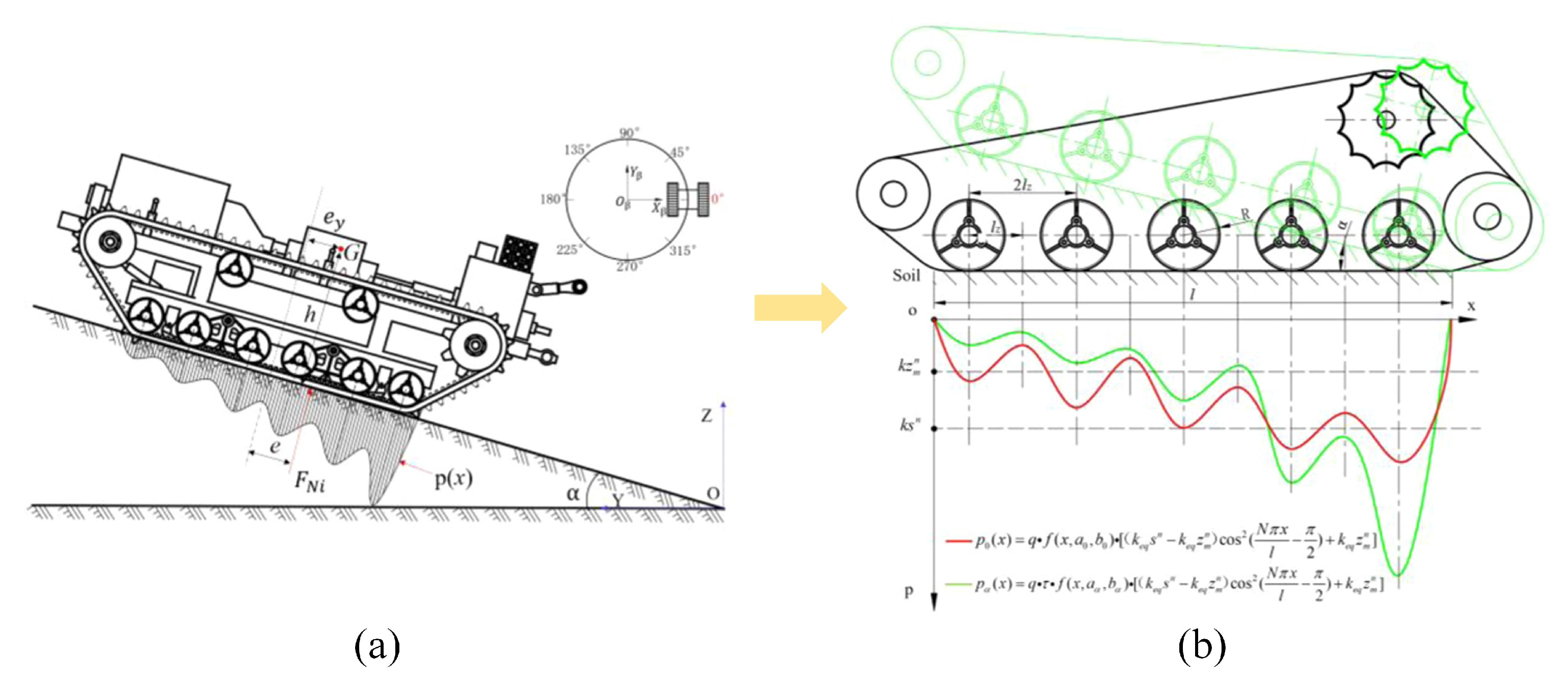
Advances in ground mechanics and adhesion performance constitute the foundation for efficient chassis operation. Zhao et al. [88] established a static model for ground contact pressure distribution in rubber-tracked wheels, providing a reliable theoretical framework for rubber track design. The longitudinal distribution of ground pressure is described by a piecewise function incorporating a quadratic cosine function: p y = 2 α σ m y l r + α σ m ,   l r 2 y 0 m n cos N 1 π y l 2 + n ,   0 < y l 2 α σ m y l r + 2 α σ m l + l r 2 l r ,   l < y l + l r 2 , where y is the coordinate along the track contact length; σ m denotes the peak pressure of the intermediate roadwheel ( k P a ); l r represents the contact length of the leading (or trailing) roadwheel ( m m ); l is the wheelbase between the leading and trailing roadwheels ( m m ); α satisfies σ 1 = α σ m ; m and n characterize the quadratic function linking pressure peaks and valleys, with n y = β m ( y ) , where β is a ground hardness parameter; and N indicates the number of roadwheels. The transverse distribution is defined by a linear piecewise function: p x = 2 1 γ ω p y x + p y ,   ω 2 x 0 2 γ 1 ω p y x + p y ,   0 < x ω 2 , where γ is the transverse load distribution coefficient of the roadwheel; x is the transverse coordinate across the track width ( m m ); and ω denotes the track contact width ( m m ). Keller et al. [89] developed a vertical stress prediction model based on track parameters that can effectively assess soil compaction risk. With regard to adhesion mechanisms, Fu et al. [90] conducted triaxial shear, traction, and direct shear tests to derive a modified equation for soil shear strength that incorporates the effects of moisture content, shear rate, and normal load. They further developed normal and tangential adhesion models for track shoes, offering theoretical support for the design of anti-adhesion track configurations. Building upon accurate ground pressure prediction, Tang et al. [91] proposed a positive–negative steering transmission model (shown in Figure 17) to minimize soil compaction and reduce soil accumulation caused by tracked chassis. Yang et al. [92] introduced a slope-adaptive ground contact pressure prediction model, significantly improving the accuracy of traction performance estimation for tracked vehicles operating on inclined terrain. The prediction model integrates the tractor parameters, soil parameters, slope soil pressure model, slope angle and phase angle, slope track ground pressure prediction model curve P α ( x ) , and ground pressure model P 0 ( x ) under 0° conditions, as shown in Figure 18. In terms of structural optimization, Zeng et al. [93] addressed the issue of rice stubble damage caused by track compaction during ratoon rice harvesting through the design of a narrow triangular tracked chassis. By optimizing the ground contact layout to actively reduce ground pressure, this configuration achieved lower soil compaction while maintaining high ground clearance. Hu et al. [94] and Wu et al. [95], through high-precision multi-body dynamics modeling and geometric parameter optimization of track systems, respectively, systematically improved the terrain trafficability and operational stability of triangular tracked chassis in complex environments.
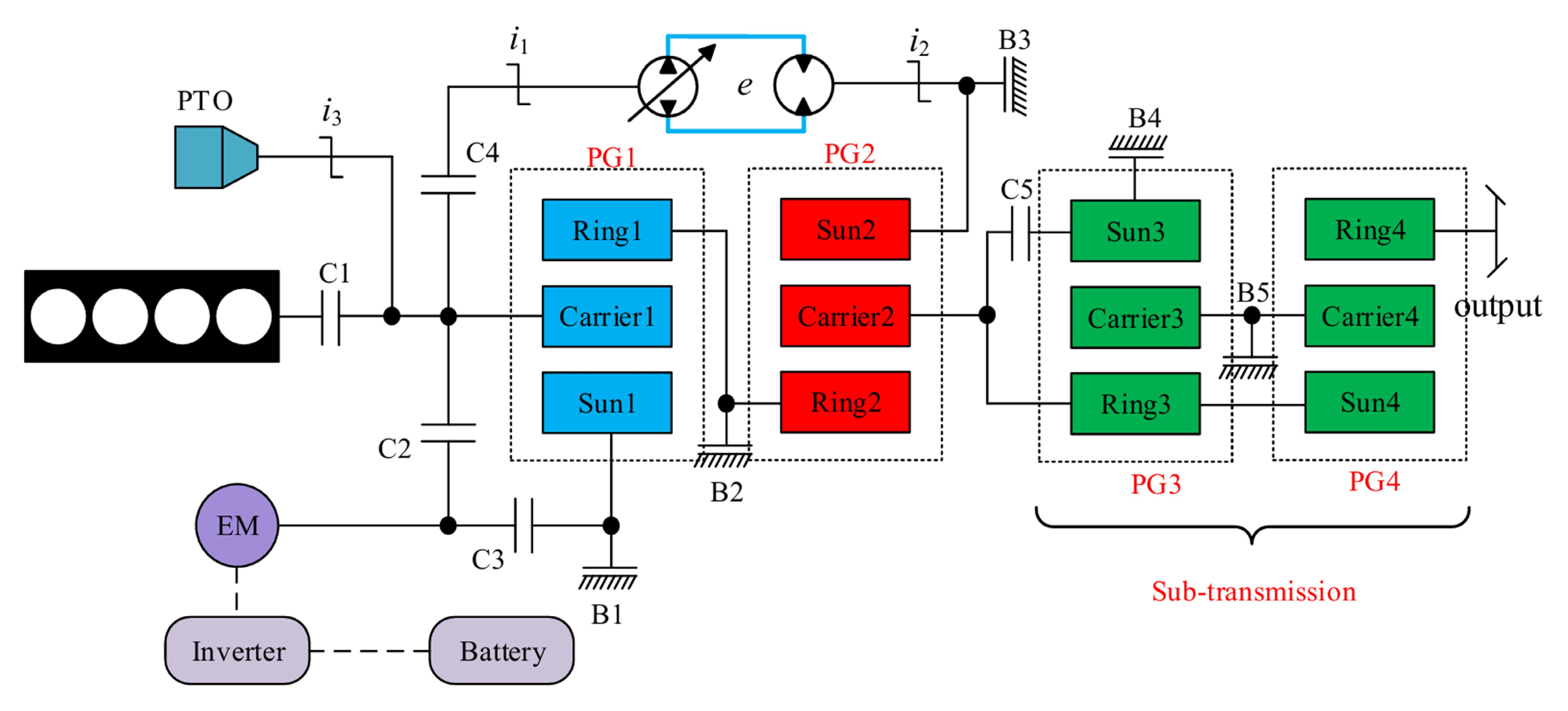
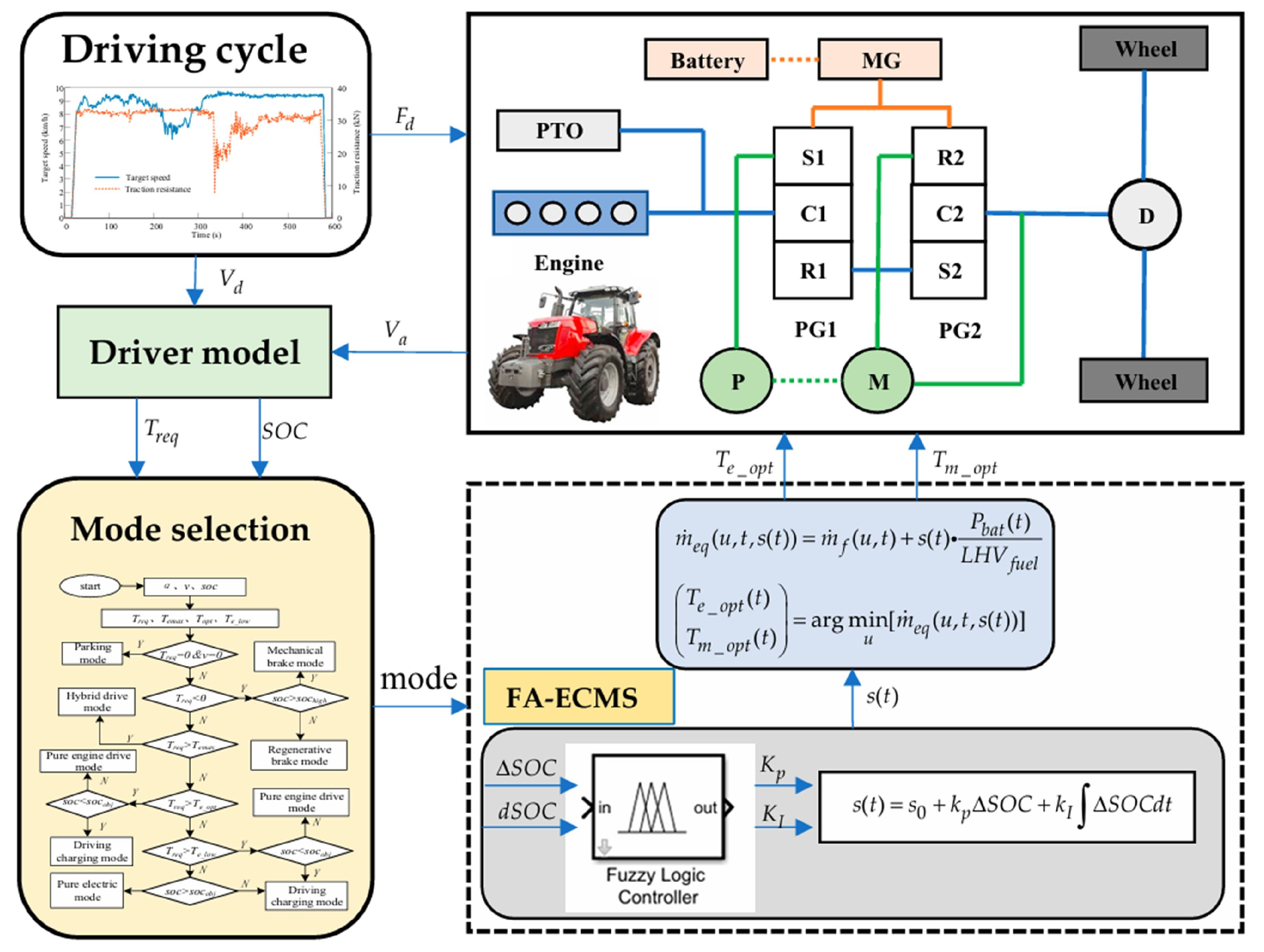
Advancements in power transmission and energy management aim to improve the economic efficiency and operational endurance of tracked chassis. Li et al. [96] developed a fully hydraulic remote-controlled tracked chassis with variable track width. By integrating a closed-circuit hydraulic system and optimized engine matching, the system achieves efficient power transmission and stable energy management. Liu et al. [97] designed a hydrostatic transmission (HST) drive system for mountainous terrain tracked tractors to address limitations such as narrow operational speed range, complex control requirements, and inadequate slope safety. They completed parameter matching and system integration of the engine, HST pump/motor, and drive axle. In the domain of hybrid power systems, Zhu et al. [98] proposed a mechanical–electrical–hydraulic hybrid power system (as shown in Figure 19). Integrated with a multi-mode drive architecture and a rule-based energy management strategy, the system enables the engine operating point to shift toward high-efficiency regions. Zhu et al. [99] further introduced a fuzzy adaptive equivalent fuel consumption minimization strategy (shown in Figure 20), which dynamically adjusts the power distribution between fuel and electric sources based on battery state-of-charge (SOC) feedback, significantly enhancing fuel economy. Du et al. [100] designed a dual-pump four-motor independent drive system for a camellia fruit harvester. By employing synchronization valves to ensure motor speed consistency on each side, the system guarantees precise differential steering and balanced torque distribution. Wang et al. [101] developed a core drive and control system based on hydrostatic transmission to meet the demands of infinite variability in speed, precise motion control, and high traction force for power chassis operating in hilly and mountainous orchards. Through component selection, parameter matching, and system simulation-based optimization, accurate hydraulic control for travel and steering functions was achieved. Wang et al. [102] developed a range-extended electric tracked tractor. The incorporation of a range extender enables extended operational endurance, effectively addressing the limited range issue faced by low-power electric tracked tractors in greenhouse environments.
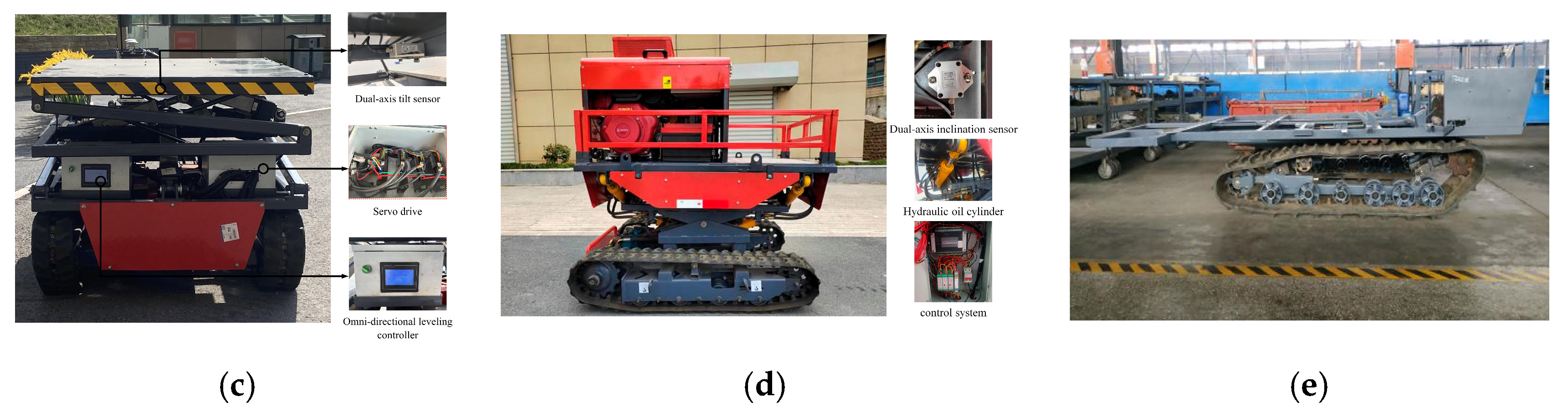
Advancements in intelligent control and attitude stability are essential for improving operational quality and safety. He et al. [103] addressed the path tracking challenge for crawler combine harvesters in paddy fields by proposing a control strategy based on online trajectory error prediction and feedforward compensation. Integrated with real-time turning radius estimation using an attitude vector method, this approach significantly enhances tracking accuracy and system robustness. Regarding chassis leveling, Wang et al. [104] developed an omnidirectional leveling system featuring a “three-layer articulated frame” structure. The system achieves high-precision attitude control under pitch, roll, and compound inclination conditions, while employing sliding mode synchronous control based on a disturbance observer to suppress synchronization errors in hydraulic cylinders. Sun et al. [105] addressed the instability of combine harvesters operating on complex terrain through an omnidirectional leveling method utilizing a hydraulically actuated four-point lifting chassis. Multi-body dynamics simulations confirmed the effectiveness of the four-cylinder coordination strategy in mitigating rollover risks. Jiang et al. [106] developed a QBP-PID composite control algorithm capable of online self-tuning of controller parameters and real-time optimization of neural network weights. This method substantially improves the response speed and control precision of the leveling system. A prototype of the leveled chassis for tracked agricultural machinery is shown in Figure 21.
In summary, tracked chassis technology has evolved from passive structural adaptation to a systematically integrated approach involving active regulation of ground contact mechanics, efficient power transmission, and intelligent control. By optimizing ground contact pressure distribution to enhance terrain trafficability, advancing hybrid power energy management strategies to reduce energy consumption, and developing intelligent leveling algorithms to ensure operational stability, these studies have systematically addressed the core limitations encountered in operations on hilly and specialized terrains. Currently, these advancements are progressing toward deeper mechatronic–hydraulic integration and intelligent system coordination, with the ultimate goal of realizing a next-generation intelligent agricultural platform capable of full-condition adaptability.

3.3. Application Scenarios and Limitations

Tracked chassis have emerged as a core mobility solution for modern agricultural machinery in complex terrains and specialized agronomic applications, owing to their superior ground contact performance, obstacle-crossing capability, and traction characteristics. Their application scope has expanded beyond traditional field operations to include hilly and mountainous regions, paddy fields and wetlands, facility agriculture, and specialty crop production environments. They demonstrate exceptional performance in four representative scenarios: mitigating sinkage on wet and soft soils, adapting to sloped and fragmented terrain in mountainous landscapes, delivering high traction efficiency with relatively low instantaneous ground pressure in large-scale farming operations, and enabling low-impact, modular operations in controlled-environment agriculture.
Despite these advantages, the technology faces several technical and operational limitations. In terms of soil interaction, although the low average ground pressure offers improved resistance to sinkage compared to wheeled systems, the continuous shear action of tracks and significant slippage during steering can induce substantial soil structural degradation. Recent studies further indicate that the “bouncing phenomenon” observed during combine harvester operation transmits dynamic vibrations to deeper soil layers, leading to vibration-induced compaction. This implies that the impact on soil health extends beyond surface-level shear failure to include subsoil compaction. From a mechanical standpoint, tracked systems are characterized by structural complexity, high manufacturing and maintenance costs, limited travel speed, considerable steering power loss, poor maneuverability, and elevated energy consumption—challenges that constrain electrification efforts due to current limitations in battery capacity and operational range. Furthermore, intelligent control technologies—such as adaptive ground pressure regulation and real-time energy management—remain underdeveloped, resulting in limited reliability and robustness in practical engineering deployments.
Overall, while tracked chassis exhibit strong off-road capabilities, significant advancements are required in cost reduction, energy efficiency, and intelligent control integration. Future progress will depend on cross-disciplinary innovations in lightweight materials, bio-inspired and adaptive algorithms for optimizing ground pressure distribution and minimizing slippage, and integrated mechatronic–hydraulic systems. These developments will enable tracked platforms to evolve synergistically with wheeled and legged configurations, contributing to the realization of more efficient, cost-effective, and environmentally sustainable agricultural mobility solutions.

3.4. Review of Technological Paradigms

The evolution of tracked chassis is a direct response to the environmental limitations of wheeled systems. Its core approach has shifted from passive reliance on contact area to localized, active intervention in ground contact morphology and power transmission—exemplified by contour-adaptive tracks and unilateral power coupling. This constitutes a “performance-enhancing innovation” that extends operational boundaries through the deliberate introduction of “controlled complexity.”
This “controlled complexity” defines the application domains of tracked chassis. In specific conditions where wheeled systems fail, the enhanced stability and traction of tracked configurations provide irreplaceable value. However, outside these targeted scenarios, their performance advantages cannot compensate for drawbacks in energy consumption and operational complexity. Thus, the success of tracked chassis lies in establishing a distinct comparative advantage within a well-defined application niche.

4. Wheel-Legged Hybrid Chassis: Integration of Mobility and Obstacle-Crossing Capability

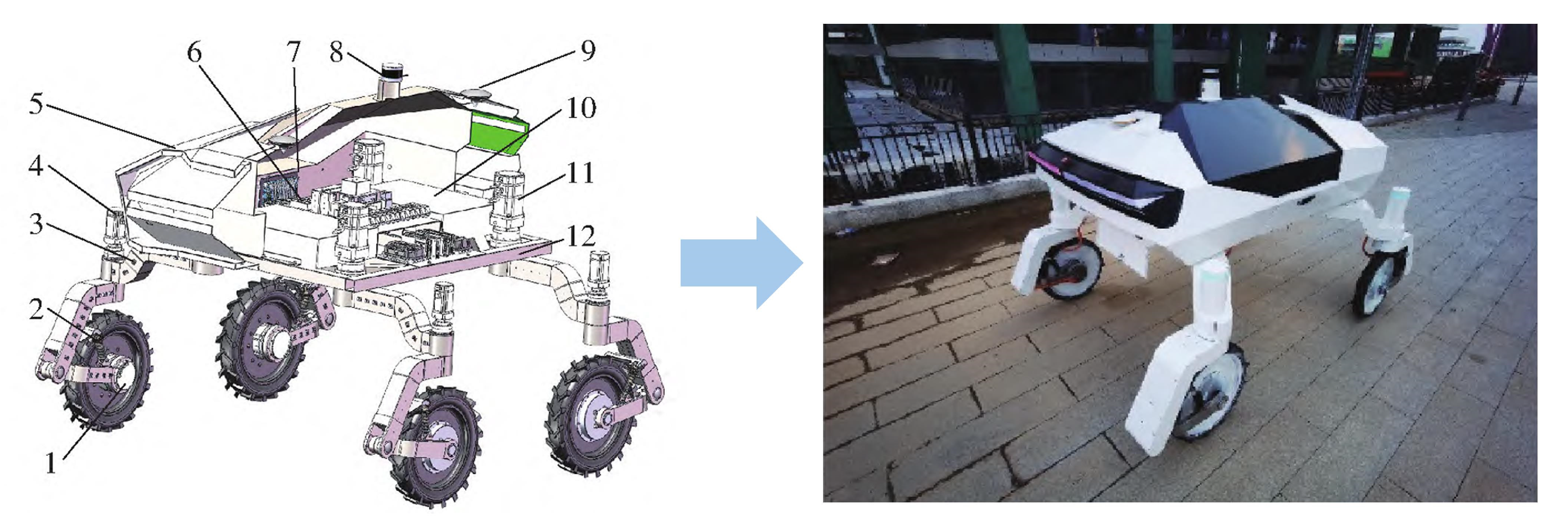
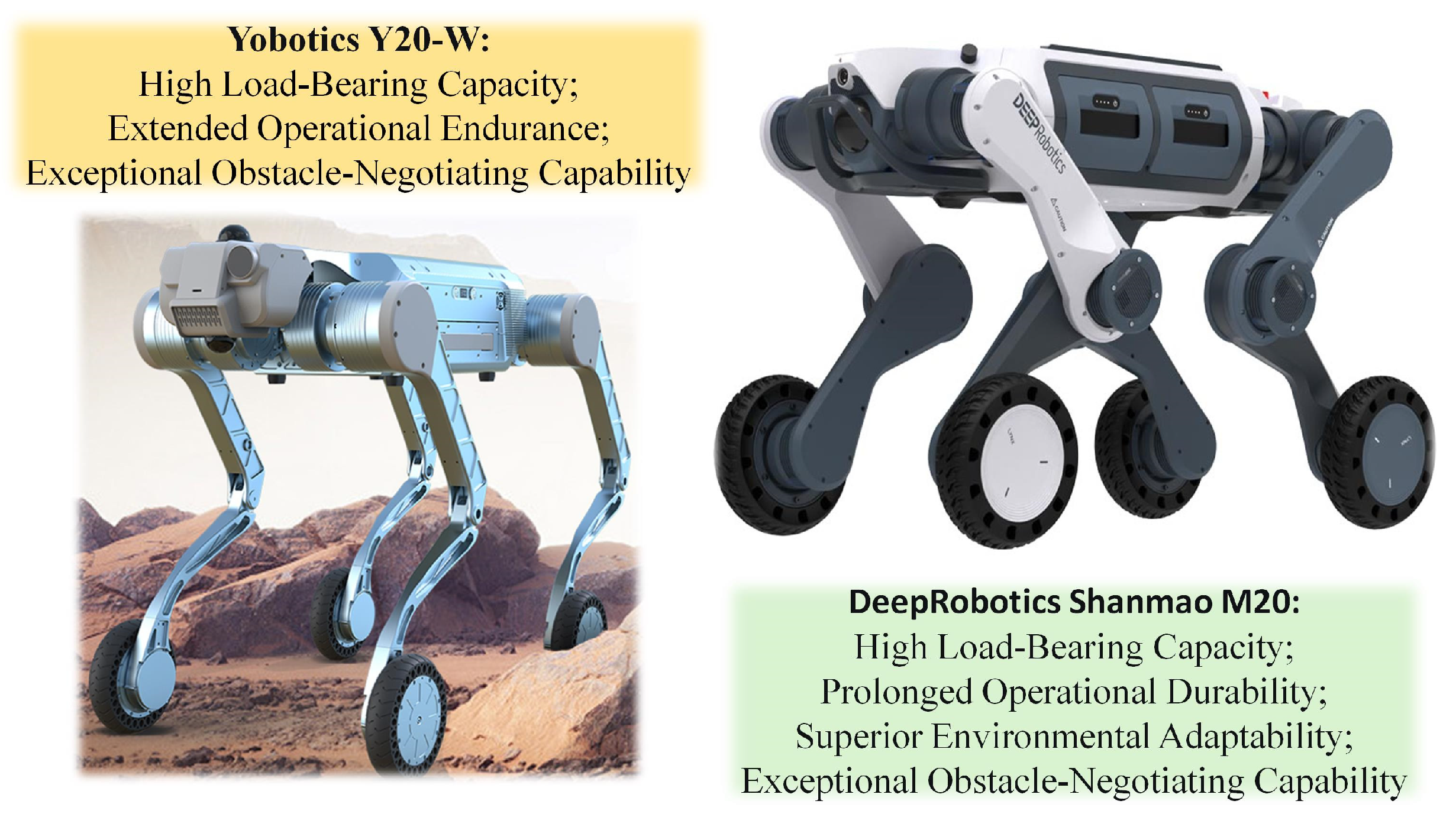
While tracked chassis enhance terrain trafficability in complex environments, their paradigm of passive ground contact adaptation still presents inherent limitations—such as high rates of crop damage and root system injury during steering—when operating in discontinuous biological environments, including high-density inter-row spaces and ridge-tillage systems. Consequently, the wheel-legged hybrid chassis has emerged as an innovative solution that integrates the efficient mobility of wheeled systems with the active obstacle-crossing capability of legged mechanisms, and has gradually become a focal point in advanced agricultural robotics research [107,108,109]. Figure 22 illustrates state-of-the-art wheel-legged hybrid robotic platforms. Although these designs are not exclusively developed for agricultural applications, the novel mechanical configurations they employ offer valuable technical insights for addressing the challenges of efficient traversal and non-damaging obstacle negotiation in discontinuous terrains—such as furrows and seedbeds—encountered by agricultural robots.

4.1. Bionic Configuration Design and Motion Generation

Realizing the transition from “terrain adaptation” to “active crossing” necessitates innovations in bio-inspired structural design and motion generation. Research focuses on two fundamental enablers: achieving structural lightweighting through topological optimization of wheel-leg joints, and developing control systems for omnidirectional mobility and multi-modal reconfiguration.
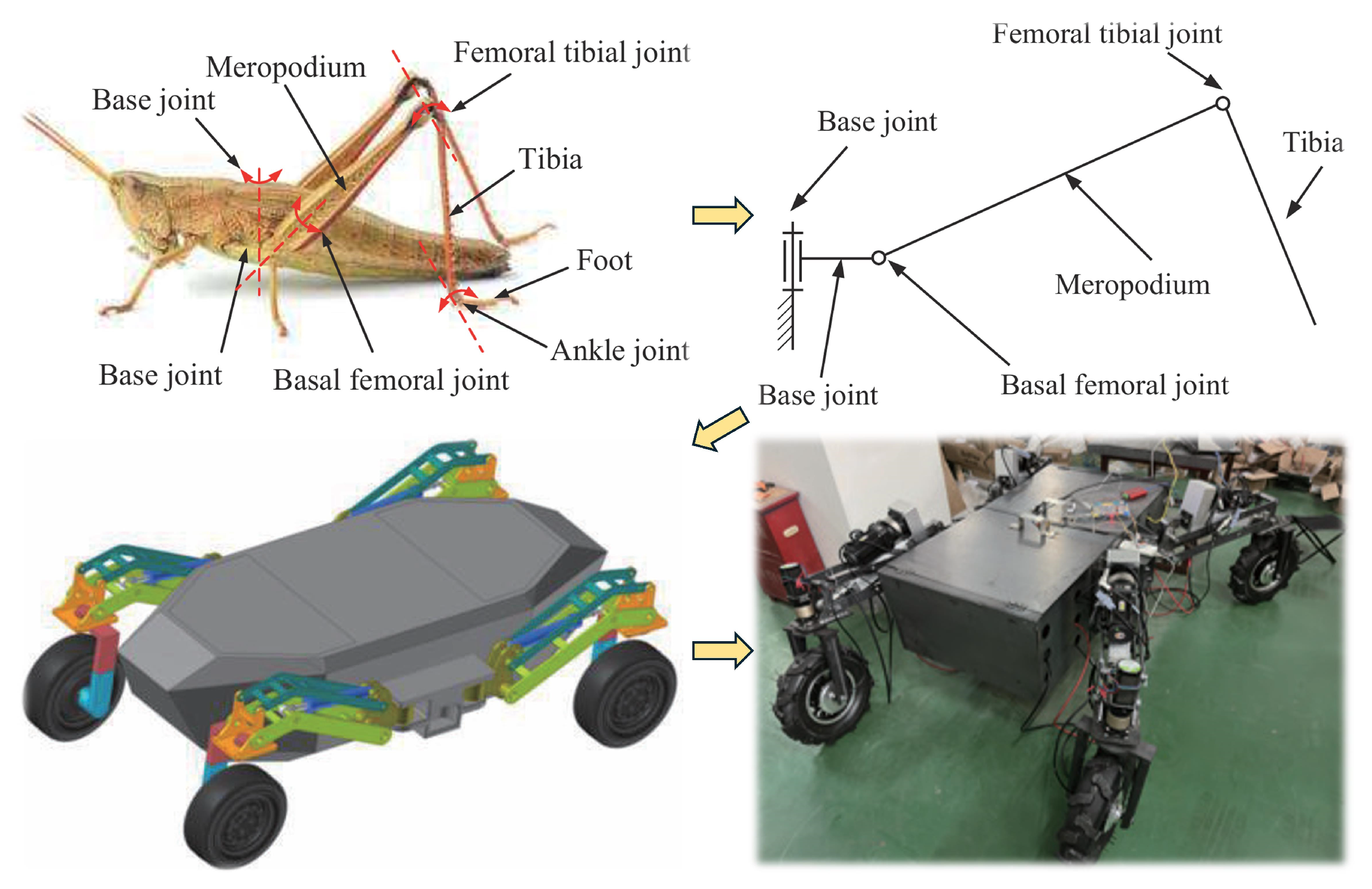
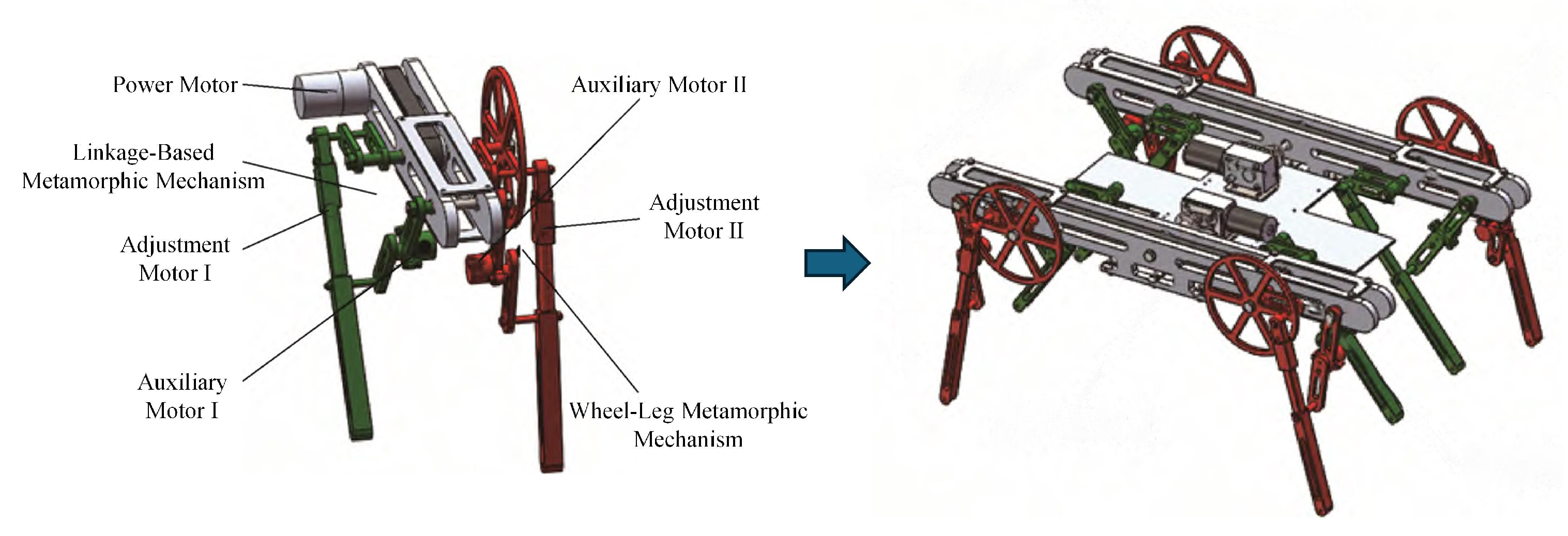
Wheel-leg joint configuration and topological optimization constitute the physical cornerstone for high-performance chassis motion. The primary goal is to overcome the limitations of conventional designs by achieving an optimal balance among load-bearing capacity, motion flexibility, and structural lightweighting through innovative engineering solutions. Research in this domain demonstrates a clear progression from theoretical methodological advances to deeper application-oriented development. At the level of configuration synthesis theory, Pan and Li [110] proposed a synthesis method for a reconfigurable, kinematically decoupled hybrid serial–parallel wheel-leg mechanism based on screw theory. This approach addresses the issues of high energy consumption and control complexity associated with joint locking during mode transitions. In this context, intelligent configuration design and performance optimization have emerged as critical research frontiers. The ANYmal robot [111] developed by ETH Zurich (Swiss Federal Institute of Technology, Zürich, Switzerland) employs a multi-modal neural network architecture to achieve autonomous, “parkour”-like locomotion in complex, obstacle-rich environments. Its demonstrated capabilities in dynamic motion planning and rapid decision-making provide theoretical validation and valuable technical inspiration for wheel-legged hybrid chassis systems seeking to realize agile traversal and active environmental adaptation in highly unstructured agricultural terrains. To improve the terrain adaptability of traditional chassis, Pan et al. [112] conducted a bio-inspired configuration design and topological optimization of a wheel-leg joint inspired by the kinematic principles of a locust’s hind leg (as shown in Figure 23), establishing an innovative mechanical design framework for actively adaptive locomotion platforms. Furthermore, to meet the demanding requirements of complex operational environments such as forestry and agriculture, researchers have developed a series of high-performance, task-specific configurations. Sun et al. [113] addressed the challenge of balancing mobility and stability for forestry vehicles operating on rugged terrain. They performed parametric optimization on a series hybrid configuration integrating an active four-bar linkage suspension with a passive V-shaped rocker steering mechanism, achieving an optimal trade-off among leveling height adjustment, ground contact area, and anti-wheel slip performance. To enhance obstacle-crossing smoothness and ride comfort, Zhu et al. [114] proposed a hybrid configuration combining a 3-degree-of-freedom (3-DOF) articulated body with pitch-adjustable wheel-legs. Optimization ensured coordinated center-of-gravity displacement between front and rear vehicle frames during obstacle traversal, thereby improving travel smoothness. Liu et al. [115] aimed to resolve the fundamental trade-off between mobility/obstacle-crossing capability and control complexity. Based on a hybrid design employing a single-loop closed-chain 2RPSR metamorphic mechanism, they achieved efficient dynamic switching between wheeled and legged modes using a single actuation source (as shown in Figure 24). Moreover, bio-inspired optimization can be applied not only to drive configuration innovation but also to enhance the performance of existing structures. Inspired by reptilian spinal movement, Liu et al. [116] integrated a gear-driven leg adjustment module into a spherical robot, enabling it to simulate lizard-like torso twisting. This modification resulted in a 27% increase in stride length and a significant reduction in turning radius in quadruped locomotion mode. To address the conflict between efficient flat-ground mobility and high obstacle-crossing capability on rough terrain, Mertyüz et al. [117] proposed a novel deformable wheel-leg configuration based on a four-bar linkage. Through optimized topological design, a single wheel can dynamically transform into a six-legged star-shaped structure, offering a mechanically viable solution for future agricultural chassis to achieve both efficient travel and non-damaging obstacle negotiation in discretized environments such as furrows and seedbeds. Meanwhile, the application of bionics and advanced materials has opened new avenues for chassis configuration innovation. Yoo et al. [118] innovatively integrated bio-inspired, foldable soft legs into a wheeled chassis. By leveraging the passive large deformation of soft structures to facilitate obstacle traversal, their design demonstrates exceptional terrain adaptability and energy efficiency, establishing a novel paradigm for wheel-leg integration that transcends conventional rigid mechanisms.
Building upon advanced mechanical configurations, the generation of complex motion patterns through coordinated control constitutes another critical component in achieving “active terrain overcoming.” Research on omnidirectional motion generation based on wheel-leg coordination is evolving from enhancing individual motion capabilities toward the development of sophisticated multi-modal adaptive motion planning. This transition reflects a fundamental shift in research focus from “static mechanical design” to “dynamic motion generation.” The former emphasizes configuration, topology, and parametric optimization to establish inherent motion potential, whereas the latter involves real-time planning and intelligent control to translate that potential into terrain-adaptive behaviors. This paradigm shift is clearly illustrated in recent research. The OmniQuad robot proposed by Iotti et al. [119] exemplifies the former approach. By integrating Mecanum wheels with 2-DOF leg mechanisms and developing advanced wheel-leg coordinated motion algorithms, it translates a fixed mechanical architecture into dynamic functionalities such as omnidirectional mobility, obstacle traversal, and adjustable body height. In contrast, the work by Li et al. [120] represents the latter direction—intelligent motion strategy generation for complex terrains. Moving beyond conventional fixed-chassis paradigms, they introduced a wheel-legged hybrid robot architecture with active morphological adaptability. Its core innovation lies in dynamically generating three distinct locomotion modes—synchronized crawling, rolling, and curling-extension—through coordinated actuation of wheel-leg units and shape modulation of a five-link articulated body, enabling precise terrain adaptation and robust traversal across heterogeneous environments, including flat ground, soft soil, steep slopes, and obstacles.
These examples collectively demonstrate that the evolution from “static” mechanism design to “dynamic” motion mode generation and control represents an inevitable trajectory for wheel-legged hybrid chassis aiming to achieve autonomous and intelligent operation in unstructured or discontinuous environments. The feasibility of this pathway is being validated by rapidly advancing engineered platforms. The new-generation wheel-legged hybrid robot developed by Cloud Deep Technology (affiliated with Tsinghua University) serves as a representative case, with its key achievement being the autonomous recognition of environmental conditions and seamless transition between multiple motion modes—such as wheeled high-speed locomotion and legged precise obstacle negotiation—demonstrating exceptional system-level reliability in complex inspection tasks. Conversely, the emergence of modular robotic systems such as the Benmo Technology D1 embodies the concept of “dynamic reconfiguration” at the architectural level. By enabling on-demand reconfiguration of wheel-leg modules to directly generate task-optimized motion patterns, it presents a highly forward-looking technical framework for future agricultural robots operating in variable and unpredictable field scenarios.

4.2. Drive Control, Perception, and Decision-Making Technologies

The performance of wheel-legged hybrid chassis, enabled by advanced mechanical designs, critically depends on high-performance drive systems and intelligent perception–decision-making technologies. Distributed independent drive ensures stable actuation, while environmental perception enhances situational awareness, collectively improving reliability and accuracy in agricultural applications.
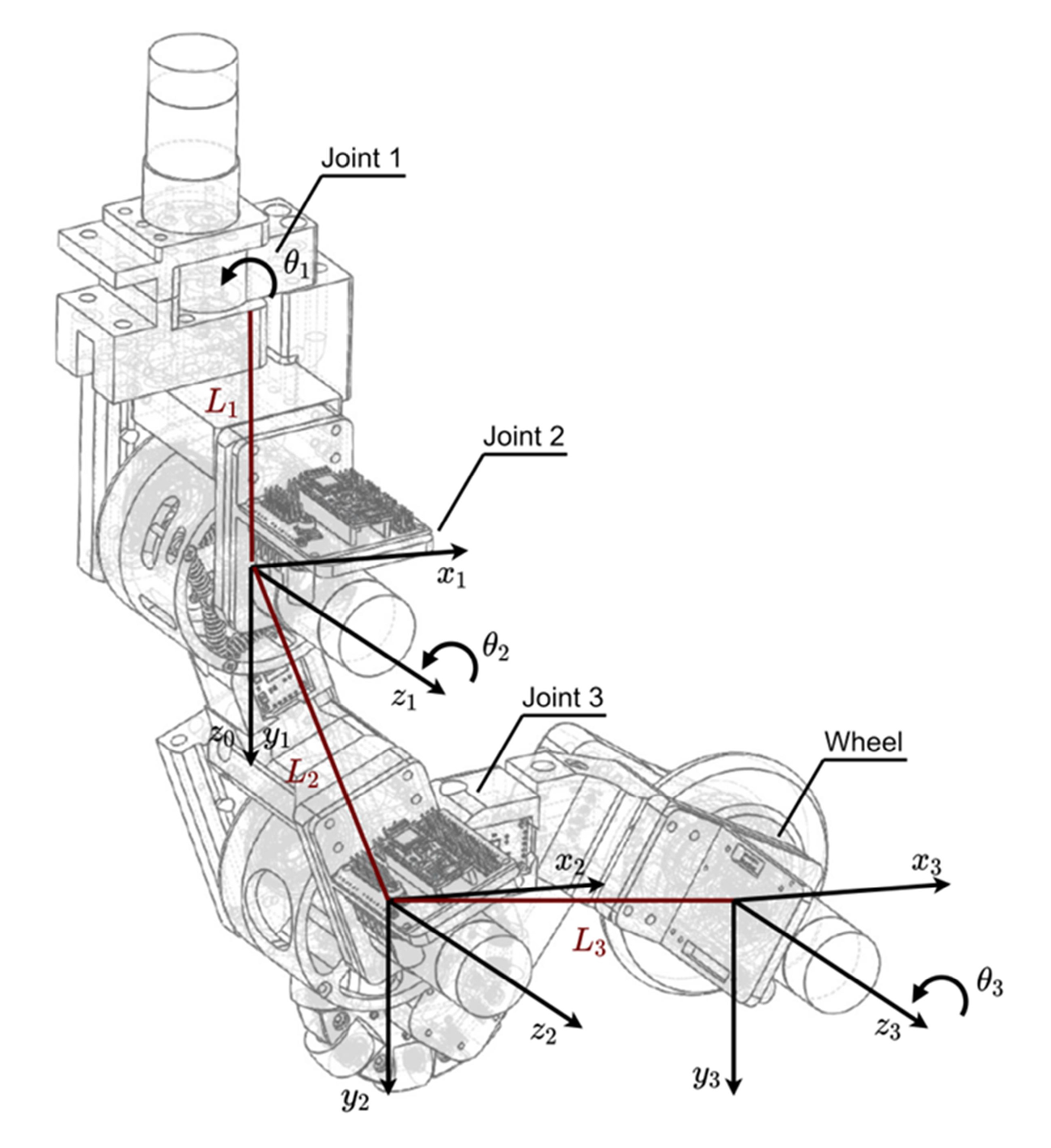
Research on distributed independent drive and decoupling control aims to enhance the stability, operational efficiency, and dynamic responsiveness of wheel-legged systems during multi-mode operation through innovative control architectures and propulsion system designs, thereby enabling high-performance execution in challenging agricultural environments. Chen et al. [121] addressed drive instability in wheel-legged platforms caused by active leg swinging during body leveling in hilly orchard terrain. They proposed a hierarchical torque decoupling and distribution control strategy: an upper-level controller computes the total required torque and yaw moment, while a lower-level controller optimizes real-time torque allocation to each wheel-leg unit based on its posture and vertical load, significantly improving steering and slope-driving stability. Building upon this work, Pan et al. [122] investigated the limited agility of knee-wheeled robots in legged locomotion mode due to high leg inertia. They developed a wheel-leg coordinated control strategy by analyzing the dynamic characteristics of hydraulic actuators and hub-mounted permanent magnet synchronous motors, and designed a delay-compensated nonlinear model predictive controller to achieve effective coordination and decoupling of multiple actuators. In pursuit of improved energy efficiency, Du et al. [123] focused on overcoming low efficiency and limited endurance in wheel-legged hybrid robots under heavy-load conditions. They proposed a four-quadrant electro-hydrostatic actuator capable of integrated driving and energy recovery. The system’s force-velocity characteristics were modeled and experimentally validated, achieving 87% drive efficiency and 88% energy recovery efficiency. Further advancing system integration and engineering applicability, Pinto et al. [124] designed a 3-degree-of-freedom single-leg module incorporating non-rigid joints (as shown in Figure 25). By implementing a state-space control algorithm, they achieved precise decoupling control between rigid and compliant joint components, establishing a low-power, high-stability technical pathway for constructing highly adaptable mobile platforms and enabling reliable deployment of agricultural robots in discrete and discontinuous terrains.
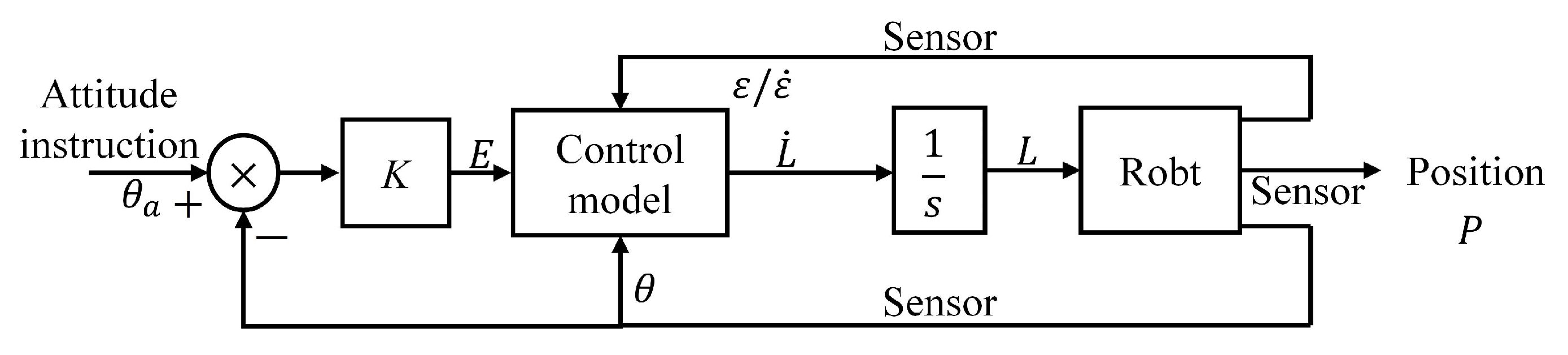
Building on stable drive actuation, environmental perception and adaptive control algorithms are critical for enhancing the intelligence and terrain adaptability of wheel-legged systems. Zhang et al. [125] developed a low-cost flexible joint sensor based on a PR (prismatic-revolute) structure to address the instability of quadruped-wheeled robots caused by “weak legs” on uneven terrain. This sensor accurately measures wheel–ground contact forces and, when integrated with gyroscope data and a PID control loop, enables dynamic self-balancing of the vehicle body. Facing more complex motion stability challenges, Chen et al. [126] investigated the problem of maintaining body stability while maximizing leg workspace in heavy-duty wheel-legged hybrid robots operating on unstructured terrain. They proposed a whole-body stability control strategy that integrates posture control based on the primary support triangle, horizontal center-of-gravity regulation through foot-end force distribution, and vertical height control—significantly improving the robot’s stability and obstacle-crossing performance. Zhu and Kan [127] examined lateral instability and rollover risks for articulated forestry chassis traversing rugged terrain. By establishing a lateral stability model grounded in tire contact force analysis and evaluating the influence of actively adjustable pitchable wheel-legs on system stability, they provided algorithmic and theoretical foundations for adaptive stability control in such platforms. To address dynamic stability and working height maintenance challenges in unstructured environments, Fernandes and Garcia [128] proposed an integrated control strategy combining the Zero Moment Point (ZMP) method with fuzzy logic. Using a fuzzy controller to directly process ZMP and height errors while independently regulating each wheel-leg actuator, the approach effectively attenuates body vibrations across various uneven surfaces. Zhang et al. [129] developed a biomimetic wheel-legged hybrid robot to mitigate rollover susceptibility and poor stability in agricultural machinery operating in hilly and mountainous regions. By constructing a spatial kinematic model linking body posture to wheel-leg extension and retraction, and designing an adaptive posture control system based on the NSGA-II multi-objective optimization algorithm, they significantly enhanced the robot’s terrain trafficability, operational stability, and safety in complex environments. Ma et al. [130] focused on mitigating the decline in operational accuracy caused by body pitching and center-of-mass shifts during ridge traversal and other uneven surface crossings. They proposed a closed-loop pitch attitude control algorithm based on active suspension (as shown in Figure 26). Through precise kinematic modeling and a posture-actuator decoupling strategy, accurate pitch angle regulation was achieved while maintaining a fixed center of mass. At the level of intelligent adaptive algorithms, Liu et al. [131] addressed the challenge of dynamic balance control under model uncertainties and external disturbances in unstructured terrain. They proposed a fusion algorithm integrating Adaptive Dynamic Programming (ADP) and Virtual Model Control (VMC). The algorithm learns optimal feedback gains through online policy iteration, enabling real-time adaptation of the robot’s posture and locomotion modes. Lu et al. [132] aimed to enhance robust balance control performance under parameter uncertainties and external disturbances. They developed a nonlinear control strategy based on Sliding Mode Control (SMC) combined with a disturbance observer. By transforming system states to reformulate complex dynamics into a cascaded structure and designing sliding surfaces along with an observer for disturbance estimation and compensation, the method achieves asymptotic stability and effective chatter suppression.
In summary, advancements in drive control and perception–decision-making technologies have significantly enhanced the dynamic performance and terrain adaptability of wheel-legged hybrid chassis. To elucidate the characteristics of various control methods, Table 4 provides a comparative analysis of the primary control strategies.
This comparison clearly demonstrates that no single “universal” control strategy is applicable across all scenarios. For agricultural applications, selection requires careful trade-offs among control performance, system complexity, energy efficiency, engineering reliability, and operational robustness. In the future, hybrid hierarchical architectures that integrate the strengths of multiple control paradigms may represent a viable pathway for addressing the high levels of uncertainty inherent in agricultural field environments.

4.3. Scene Applicability Analysis

Leveraging its active mobility and high-precision control capabilities, the wheel-legged hybrid chassis demonstrates significant advantages across various agricultural applications, particularly in high-value crop cultivation environments. However, it also faces challenges including relatively low power transmission efficiency and substantial system mass.
This chassis performs effectively in the following representative scenarios:
(1)
Greenhouse Operations: Within densely planted greenhouses, it enables non-damaging traversal through active obstacle-crossing capability and precise pose control, thereby preventing damage to seedlings and foliage.
(2)
Open-Field Ridge Tillage: It ensures accurate and continuous operations such as pesticide application and harvesting by maintaining stable furrow crossing via real-time body attitude adjustment.
(3)
Hilly Orchards: On sloped terrain, it maintains operational stability through multi-legged support and optimized power distribution, effectively navigating obstacles such as weeds and fallen branches.
(4)
Seedbed Nursery Management: It can retract its wheel-legs to navigate narrow passages and extend them to enhance ground support, enabling efficient execution of nursery management tasks.
Despite these notable advantages, wheel-legged hybrid chassis still face critical technical bottlenecks. The multi-joint transmission architecture incurs significant energy losses and limits operational endurance, while frequent posture adjustments further exacerbate energy consumption. Moreover, the integration of multiple actuators and high-strength structural components to meet mechanical requirements results in considerable system mass. This not only increases energy demands but may also induce severe soil compaction during static or low-speed operations, where localized ground pressure can become exceptionally high—thereby partially undermining the environmental benefits achieved through their active obstacle avoidance capabilities.

4.4. Review of Technological Paradigms

The wheel-legged hybrid chassis represents a fundamental shift in technical approach—a transition from “terrain adaptation” to “active terrain overcoming.” Its core innovation lies in the decoupling and reintegration of mobility, support, and obstacle traversal functions through bio-inspired principles and multi-degree-of-freedom mechanisms.
However, this shift entails an exponential increase in system complexity, energy consumption, and control difficulty. The exceptional mobility relies on multiple actuators, high-precision sensing, and strongly coupled control algorithms, resulting in costs and maintenance demands that currently exceed thresholds for conventional agriculture. Ensuring long-term robustness under harsh field conditions remains a critical challenge.
Consequently, the current stage of development underscores a central proposition: the widespread adoption of such advanced concepts depends not only on theoretical feasibility but, more critically, on achieving an application-driven balance among performance, complexity, and reliability through effective engineering.

5. Technical Challenges and Future Trends

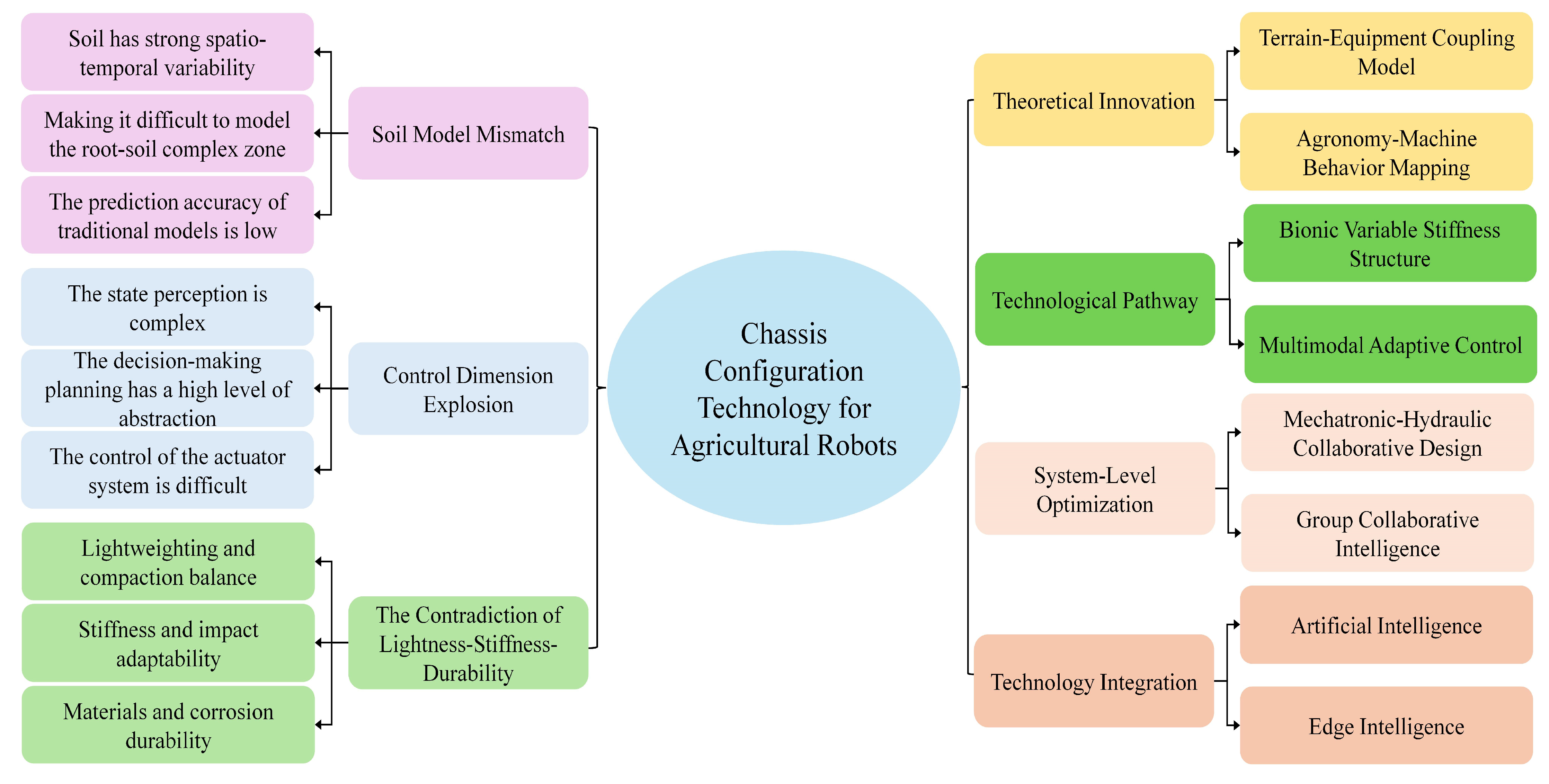
Although significant progress has been achieved in chassis configuration technologies for field robots, persistent technical bottlenecks remain when addressing the high complexity of agricultural environments, diverse operational requirements, and pressing demands for sustainable development. These bottlenecks are deeply interconnected and mutually constraining, necessitating coordinated innovation across three key dimensions—theoretical modeling, technical methodologies, and system integration—to advance field robot chassis technology to a higher level of performance and applicability. The specific challenges and corresponding breakthrough directions are illustrated in Figure 27.

5.1. Current Limitations

5.1.1. Mismatch Between Contact Mechanics Models and Soil Rheological Properties

Soil is a multiphase medium with high spatiotemporal variability. Its mechanical behavior is dynamic, changing with factors such as moisture content and compaction. Conventional models based on fixed empirical parameters—such as cohesion (c) and internal friction angle (φ)—are insufficient for accurately predicting real-world soil-structure interaction processes. This limitation is especially significant in the root-soil composite zone, where root-induced anisotropy introduces additional complexity into modeling efforts, thereby constraining both traction performance optimization and the effectiveness of soil conservation measures.

5.1.2. The “Dimensionality Explosion” Problem in Real-Time Control of Multi-DOF Mechanisms

Active chassis configurations—such as wheel-legged hybrids and variable geometry designs—enhance terrain adaptability but concurrently give rise to a “dimensionality explosion” in control systems. This necessitates the synchronized processing of multi-source sensor data, millisecond-level motion planning, and coordinated actuation across multiple joints, all while maintaining both control precision and energy efficiency. Traditional control approaches often fall short of these stringent real-time requirements, while learning-based methods face challenges such as limited training data and poor generalization across diverse operating conditions.

5.1.3. Constraints Among Lightweighting, Stiffness, and Durability

Chassis design faces a so-called “impossible trinity” trade-off: lightweight construction is essential for minimizing soil compaction and extending the operational range of electric drive systems, yet high structural stiffness is required to withstand heavy loads and dynamic terrain impacts. Additionally, environmental stressors such as field-induced corrosion and mechanical vibration demand exceptional durability. Consequently, designers are often forced to make performance compromises, such as accepting the excessive weight of steel or the limited long-term reliability of advanced composites, which hinders holistic performance advancement.

5.2. Breakthrough Directions and Development Trends

Faced with the aforementioned multifaceted challenges, the future development of field robot chassis technology must move beyond conventional single-dimensional optimization approaches and embrace a systematic innovation paradigm. This transformation will be driven by deep multi-disciplinary integration and synergistic hardware-software co-design, necessitating coordinated advancement across three interconnected domains: theoretical frameworks, technical methodologies, and system-level integration.

5.2.1. Fundamental Theoretical Breakthroughs

A pressing need exists for cross-scale “terrain-equipment” coupled dynamic models that integrate principles from soil mechanics, multibody dynamics, and machine learning. By leveraging multi-source sensor data for real-time parameter adaptation, such models can enable a transition from static representations to dynamic digital twins capable of reflecting evolving operational conditions. Concurrently, “agronomy-machine behavior” mapping models should be established to correlate crop growth patterns with chassis motion constraints, thereby aligning robotic operations more closely with agronomic requirements and enhancing task relevance.

5.2.2. Technological Pathway Innovation

To overcome existing bottlenecks, optimizing individual technologies is no longer sufficient to address the complexity of agricultural operating environments, necessitating the development of cross-domain, innovative technical pathways. At the control algorithm level, multi-modal adaptive control systems based on intelligent methodologies like deep reinforcement learning are urgently needed. These systems would enable autonomous mode switching and stable operation across diverse terrains and tasks. In the domain of structural design and materials, the development of bio-inspired variable-stiffness suspensions and smart materials is essential to simultaneously optimize the conflicting requirements of lightweight construction, structural rigidity, and long-term durability at the physical level.
With respect to energy and powertrain systems, the key lies in advancing integrated “energy-chassis” co-design. The energy system represents a fundamental constraint that defines the operational endurance and power delivery capacity of the chassis—rather than functioning as an independent auxiliary component—and exhibits distinct adaptation patterns relative to chassis configurations: highly dynamic wheeled and wheel-legged platforms demonstrate inherent compatibility with pure electric drive systems due to their high efficiency and precise controllability, whereas tracked systems with high traction demands require integration with hybrid powertrains to satisfy combined requirements for high power output and extended operational range. Future technological breakthroughs will critically depend on treating energy modality as a top-level design parameter to enable synergistic system optimization.

5.2.3. System-Level Optimization

At the system level, the deep integration of innovative technologies is essential for unlocking performance potential. This requires a holistic improvement in system energy efficiency, thermal management, and vibration characteristics through multidisciplinary optimization approaches. Further research into multi-robot cooperative operations should focus on swarm-level perception, dynamic task allocation, and decentralized cooperative control, enabling efficient and autonomous operation across large-scale agricultural fields.
Mechatronic–hydraulic co-design represents the quintessential embodiment of this system-level optimization paradigm. Its objective is to achieve integrated system performance that cannot be attained by any single-domain technology, through the seamless integration of heterogeneous functional subsystems—mechanical, electrical, and hydraulic. The Electro-Hydrostatic Actuator (EHA) exemplifies this approach. Rather than simply combining a motor, pump, and cylinder, it integrates these components into a compact “intelligent joint,” eliminating the bulky fluid lines and throttling losses inherent in conventional valve-controlled hydraulic systems. As a result, it simultaneously delivers high energy efficiency, high power density, and precise motion control at the system level, offering an optimal solution to reconcile the inherent trade-off between high traction force and fine operational precision in agricultural machinery.

5.2.4. Technology Fusion

The integration of information technologies must be deepened, with a central focus on empowering mechanical systems through Artificial Intelligence (AI) and Edge Intelligence. AI-driven cognitive capabilities will advance chassis functionality from pre-programmed automation toward autonomous decision-making and environmental understanding. Edge Intelligence, enabled by distributed computing architectures, will equip chassis platforms with robust local real-time processing and decision-making capabilities, significantly reducing response latency and improving adaptability in complex, unstructured environments.

6. Conclusions

This review has systematically analyzed the technical bottlenecks and evolutionary trajectories of field robot chassis through a dual-dimensional framework integrating structural design and dynamic adaptive control. It demonstrates that wheeled, tracked, and wheel-legged hybrid configurations represent complementary paradigms, with development pathways progressing from mechanical execution toward integrated “perception-decision–execution” systems. The key characteristics are summarized in Figure 28.

6.1. Research Summary and Key Findings

The study delineates three distinct technological pathways:
Wheeled chassis follow a refinement-driven optimization trajectory. Grounded in vehicle dynamics, their evolution focuses on enhancing steering control and parametric structural adaptability within the “rigid wheel–ground contact” technical mode. This enables high efficiency in structured environments but imposes inherent limitations in unstructured terrains.
Tracked chassis represent an improvement-oriented innovation. They overcome the limitations of wheeled chassis by actively modulating ground contact morphology and power transmission (e.g., contour-adaptive tracks, unilateral power coupling). This extends operational capability to wet, soft, and sloped terrains, albeit at the cost of increased system complexity and energy consumption.
Wheel-legged hybrid chassis embody a technology shift from “terrain adaptation” to “active terrain overcoming.” By leveraging bio-inspired, multi-degree-of-freedom mechanisms, they decouple and subsequently reintegrate mobility and obstacle negotiation functions. While outlining a future direction toward active intelligence, their practical deployment remains constrained by challenges in control complexity and energy management.
In essence, these configurations span a spectrum from “universal application” (wheeled) to “targeted enhancement” (tracked) and “prospective exploration” (wheel-legged). Future development must prioritize balanced optimization across technological performance, engineering feasibility, and economic viability.

6.2. Technology Selection and Application Recommendations

Chassis selection is a multi-objective optimization problem governed by core constraints:
Inter-Row Operations: This scenario presents a trade-off between configuration flexibility and system complexity. Wheeled chassis rely on real-time adjustments of track width and ground clearance, whereas wheel-legged hybrids offer superior pose adaptability, contingent upon the maturation of robust control algorithms for reliable field deployment.
Sloped and Soft Terrain: The decision centers on ground contact optimization. Tracked chassis represent the established solution, with the choice between rigid and contour-adaptive tracks involving a balance between cost and stability. Wheel-legged hybrids present an alternative through active stability control yet face prohibitive energy consumption and cost barriers.
Endurance-Driven Scenarios: Energy economy is the determining factor. Wheeled chassis set the benchmark for operational efficiency. For tracked and wheel-legged systems, the priority should be to minimize parasitic losses through hybrid powertrains and predictive energy management, rather than to match the efficiency of wheeled configurations.

6.3. Future Research Directions

Based on the in-depth analysis of the technical bottlenecks inherent in various chassis configurations presented earlier, this paper synthesizes five critical and unresolved research directions to provide targeted guidance for the next-generation development of field robot chassis:
Online Terrain–Vehicle Modeling: Developing real-time algorithms for soil parameter identification and adaptive dynamic modeling using proprioceptive sensing.
Computation-Aware Control for High-Dimensional Systems: Designing real-time control architectures that enforce dynamic safety constraints in complex systems such as wheel-legged hybrids.
Bio-Inspired Variable-Stiffness Design: Transitioning from homogeneous structures to integrated function–structure–material systems to achieve breakthroughs in mass efficiency and adaptability.
Task-Terrain-Powertrain Co-Design: Establishing a collaborative framework for global energy optimization through coordinated mission planning, terrain assessment, and multi-source powertrain dynamics.
Decentralized Swarm Coordination: Enabling robust and emergent collaboration in heterogeneous robot swarms under realistic communication constraints.
In conclusion, the field is transitioning from single-function platforms to holistically optimized, intelligent systems. Future breakthroughs will hinge on deep mechatronic–hydraulic integration and cross-disciplinary convergence, ultimately enabling chassis that not only adapt to but also interpret and actively engage with complex environments.

Author Contributions

Conceptualization, X.Q. and R.D.; Literature Search, X.Q. and X.M.; Data Curation, R.D., X.C., and L.Z.; writing—original draft preparation, X.Q.; writing—review and editing, R.D., Y.M., A.L., and Q.Y. All authors have read and agreed to the published version of the manuscript.

Funding

This work was supported by the National Natural Science Foundation Project of China [Project 52472410, 52502526], and Natural Science Foundation of Jiangsu Province [Project BK20250841].

Data Availability Statement

No new data were created or analyzed in this study. Data sharing is not applicable to this article.

Conflicts of Interest

The authors declare no conflicts of interest.

References

  1. Ding, R.; Qi, X.; Chen, X.; Mei, Y.; Li, A. The Current Development Status of Agricultural Machinery Chassis in Hilly and Mountainous Regions. Appl. Sci. 2025, 15, 7505. [Google Scholar] [CrossRef]
  2. Jiang, Y.; Wang, R.; Ding, R.; Sun, Z.; Jiang, Y.; Liu, W. Research Review of Agricultural Machinery Power Chassis in Hilly and Mountainous Areas. Agriculture 2025, 15, 1158. [Google Scholar] [CrossRef]
  3. Jiang, L.; Xu, B.; Husnain, N.; Wang, Q. Overview of Agricultural Machinery Automation Technology for Sustainable Agriculture. Agronomy 2025, 15, 1471. [Google Scholar] [CrossRef]
  4. Jin, Y.; Liu, J.; Xu, Z.; Yuan, S.; Li, P.; Wang, J. Development Status and Trend of Agricultural Robot Technology. Int. J. Agric. Biol. Eng. 2021, 14, 1–19. [Google Scholar] [CrossRef]
  5. Liu, W.; Zhou, J.; Zhang, T.; Zhang, P.; Yao, M.; Li, J.; Sun, Z.; Ma, G.; Chen, X.; Hu, J. Key Technologies in Intelligent Seeding Machinery for Cereals: Recent Advances and Future Perspectives. Agriculture 2025, 15, 8. [Google Scholar] [CrossRef]
  6. Zhu, S.; Wang, B.; Pan, S.; Ye, Y.; Wang, E.; Mao, H. Task Allocation of Multi-Machine Collaborative Operation for Agricultural Machinery Based on the Improved Fireworks Algorithm. Agronomy 2024, 14, 710. [Google Scholar] [CrossRef]
  7. Li, H.; Chen, L.; Zhang, Z. A Study on the Utilization Rate and Influencing Factors of Small Agricultural Machinery: Evidence from 10 Hilly and Mountainous Provinces in China. Agriculture 2023, 13, 51. [Google Scholar] [CrossRef]
  8. Wang, B.; Du, X.; Wang, Y.; Mao, H. Multi-Machine Collaboration Realization Conditions and Precise and Efficient Production Mode of Intelligent Agricultural Machinery. Int. J. Agric. Biol. Eng. 2024, 17, 27–36. [Google Scholar] [CrossRef]
  9. Sun, J.; Liu, Z.; Yang, F.; Sun, Q.; Liu, Q.; Luo, P. Research Review of Agricultural Equipment and Slope Operation Key Technologies in Hilly and Mountains Region. Nongye Jixie Xuebao/Trans. Chin. Soc. Agric. Mach. 2023, 54, 1–18. [Google Scholar] [CrossRef]
  10. Wang, W.; Chen, L.; Yang, Y.; Liu, L. Development and Prospect of Agricultural Machinery Chassis Technology. Trans. Chin. Soc. Agric. Mach. 2021, 52, 1–15. [Google Scholar] [CrossRef]
  11. Wang, B.; Zhu, J.; Chai, X.; Liu, B.; Zhang, G.; Yao, W. Research Status and Development Trend of Key Technology of Agricultural Machinery Chassis in Hilly and Mountainous Areas. Comput. Electron. Agric. 2024, 226, 109447. [Google Scholar] [CrossRef]
  12. Cui, B.; Cui, X.; Wei, X.; Zhu, Y.; Ma, Z.; Zhao, Y.; Liu, Y. Design and Testing of a Tractor Automatic Navigation System Based on Dynamic Path Search and a Fuzzy Stanley Model. Agriculture 2024, 14, 2136. [Google Scholar] [CrossRef]
  13. Yang, S.; Zhai, C.; Gao, Y.; Dou, H.; Zhao, X.; He, Y.; Wang, X. Planting Uniformity Performance of Motor-Driven Maize Precision Seeding Systems. Int. J. Agric. Biol. Eng. 2022, 15, 101–108. [Google Scholar] [CrossRef]
  14. Han, L.; Mao, H.; Hu, J.; Kumi, F. Development of a Riding-Type Fully Automatic Transplanter for Vegetable Plug Seedlings. Span. J. Agric. Res. 2019, 17, e0205. [Google Scholar] [CrossRef]
  15. Yu, Y.; Wang, G.; Tang, Z.; Cao, Y.; Zhao, Y. Structural Form and Field Operation Effect of Crawler Type Broccoli Harvester. Eng. Agric. 2023, 43, e20230132. [Google Scholar] [CrossRef]
  16. Ren, X.; Liu, H.; Qin, Y.; Han, L.; Nie, S.; Xie, J. Trajectory Optimization and Stability Control for a Novel Unmanned Intelligent Wheel-Legged Vehicles on Unstructured Terrains. Robot. Auton. Syst. 2024, 182, 104818. [Google Scholar] [CrossRef]
  17. Liu, J.; Xia, C.; Jiang, D.; Sun, Y. Development and Testing of the Power Transmission System of a Crawler Electric Tractor for Greenhouses. Appl. Eng. Agric. 2020, 36, 797–805. [Google Scholar] [CrossRef]
  18. Tang, Z.; Wang, H.; Liu, S.; Lu, D.; Tang, Y. Development of Structure and Control System of Self-Propelled Small Green Vegetables Combine Harvester. J. Agric. Sci. Technol. 2023, 25, 1045–1058. [Google Scholar] [CrossRef]
  19. Guan, Z.; Li, H.; Jiang, T.; Xing, L.; Zhang, M.; Jiang, D.; Jin, M. Effect of Rubber-Tracked Chassis Roller on Soil Surface Vertical Stress Distribution Based on Finite Element Method. J. Terramech. 2025, 120, 101080. [Google Scholar] [CrossRef]
  20. Chen, S.; Zhou, Y.; Tang, Z.; Lu, S. Modal Vibration Response of Rice Combine Harvester Frame under Multi-Source Excitation. Biosyst. Eng. 2020, 194, 177–195. [Google Scholar] [CrossRef]
  21. Chen, J.; Ning, X.; Li, Y.; Yang, G.; Wu, P.; Chen, S. A Fuzzy Control Strategy for the Forward Speed of a Combine Harvester Based on Kdd. Appl. Eng. Agric. 2017, 33, 15–22. [Google Scholar] [CrossRef]
  22. Tang, Z.; Li, Y.; Zhou, Y.; Zhang, H. Inertial Vibration Characteristics of Track Chassis Caused by Reciprocating Motion of Crank Slider. Shock Vib. 2019, 2019, 4378138. [Google Scholar] [CrossRef]
  23. Li, Y.; Liu, Y.; Ji, K.; Zhu, R. A Fault Diagnosis Method for a Differential Inverse Gearbox of a Crawler Combine Harvester Based on Order Analysis. Agriculture 2022, 12, 1300. [Google Scholar] [CrossRef]
  24. Hu, J.; Pan, J.; Dai, B.; Chai, X.; Sun, Y.; Xu, L. Development of an Attitude Adjustment Crawler Chassis for Combine Harvester and Experiment of Adaptive Leveling System. Agronomy 2022, 12, 717. [Google Scholar] [CrossRef]
  25. Zhang, R.; Pang, H.; Ji, Q.; Li, G.; Dong, W.; Wen, L.; Li, J. Structure Design and Traction Trafficability Analysis of Multi-Posture Wheel-Legs Bionic Walking Wheels for Sand Terrain. J. Terramech. 2020, 91, 31–43. [Google Scholar] [CrossRef]
  26. Xu, K.; Lu, Y.; Shi, L.; Li, J.; Wang, S.; Lei, T. Whole-Body Stability Control with High Contact Redundancy for Wheel-Legged Hexapod Robot Driving over Rough Terrain. Mech. Mach. Theory 2023, 181, 105199. [Google Scholar] [CrossRef]
  27. Wang, K.; Hou, J.; Zhou, S.; Wei, D.; Xu, W.; Wang, Y.; Chai, H.; Chen, L.; Zhu, Q.; Gao, L.; et al. Wheeled-Legged Robots for Multi-Terrain Locomotion in Plateau Environments. Biomim. Intell. Robot. 2025, 5, 100256. [Google Scholar] [CrossRef]
  28. Zheng, S.; Zhao, X.; Fu, H.; Tan, H.; Zhai, C.; Chen, L. Design and Experimental Evaluation of a Smart Intra-Row Weed Control System for Open-Field Cabbage. Agronomy 2025, 15, 112. [Google Scholar] [CrossRef]
  29. Yang, H.; Sun, Y.; Xia, C.; Zhang, H. Research on Energy Management Strategy of Fuel Cell Electric Tractor Based on Multi-Algorithm Fusion and Optimization. Energies 2022, 15, 6389. [Google Scholar] [CrossRef]
  30. Zhu, Z.; Chai, X.; Xu, L.; Quan, L.; Yuan, C.; Tian, S. Design and Performance of a Distributed Electric Drive System for a Series Hybrid Electric Combine Harvester. Biosyst. Eng. 2023, 236, 160–174. [Google Scholar] [CrossRef]
  31. Wang, L.; Zhu, J.; Liu, F.; He, Z.; Lai, Q.; Zhu, Z.; Song, Z.; Li, Z. Algorithm and Scale Experiment of Gyro-Based Tractor Rollover Control towards Hilly Farmland Application. Comput. Electron. Agric. 2024, 220, 108925. [Google Scholar] [CrossRef]
  32. Sun, J.; Wang, Z.; Ding, S.; Xia, J.; Xing, G. Adaptive Disturbance Observer-Based Fixed Time Nonsingular Terminal Sliding Mode Control for Path-Tracking of Unmanned Agricultural Tractors. Biosyst. Eng. 2024, 246, 96–109. [Google Scholar] [CrossRef]
  33. Wang, L.; Liu, F.; Song, Z.; Ni, Y.; He, Z.; Zhai, Z.; Zhu, Z.; Zhou, Q.; Song, Z.; Li, Z. Advances in Tractor Rollover and Stability Control: Implications for off-Road Driving Safety. Comput. Electron. Agric. 2024, 226, 109483. [Google Scholar] [CrossRef]
  34. Yu, Y.; Hao, S.; Guo, S.; Tang, Z.; Chen, S. Motor Torque Distribution Strategy for Different Tillage Modes of Agricultural Electric Tractors. Agriculture 2022, 12, 1373. [Google Scholar] [CrossRef]
  35. Han, J.; Wang, F. Design and Testing of a Small Orchard Tractor Driven by a Power Battery. Eng. Agric. 2023, 43, e20220195. [Google Scholar] [CrossRef]
  36. Liu, H.; Yan, S.; Shen, Y.; Li, C.; Zhang, Y.; Hussain, F. Model Predictive Control System Based on Direct Yaw Moment Control for 4WID Self-Steering Agriculture Vehicle. Int. J. Agric. Biol. Eng. 2021, 14, 175–181. [Google Scholar] [CrossRef]
  37. Li, B.; Zhu, H.; Fang, L.; Zhu, Y.; Fang, S.; Li, F.; Xia, C. Optimum Design of a Tractor Steering Trapezoid Based on a Hybrid Genetic Algorithm. IEEE Access 2024, 12, 87767–87775. [Google Scholar] [CrossRef]
  38. An, G.; Zhong, Z.; Yang, S.; Yang, L.; Jin, C.; Du, J.; Yin, X. EASS: An Automatic Steering System for Agricultural Wheeled Vehicles Using Fuzzy Control. Comput. Electron. Agric. 2024, 217, 108544. [Google Scholar] [CrossRef]
  39. Zhou, Y.; Chung, K. Path Tracking Control of a Tractor-Trailer Wheeled Robot Kinematics with a Passive Steering Angle. Appl. Math. Model. 2022, 109, 341–357. [Google Scholar] [CrossRef]
  40. An, Y.; Wang, L.; Deng, X.; Chen, H.; Lu, Z.; Wang, T. Research on Differential Steering Dynamics Control of Four-Wheel Independent Drive Electric Tractor. Agriculture 2023, 13, 1758. [Google Scholar] [CrossRef]
  41. Liu, Z.; Chen, Y.; Xu, Z.; Li, X.; Zhou, Z. Four-wheel differential steering AGV navigation control system based on double variable limiters PID algorithm. Trans. Chin. Soc. Agric. Eng. 2025, 41, 27–37. [Google Scholar] [CrossRef]
  42. Zhu, J.; Feng, T.; Kang, S.; Chen, D.; Ni, X.; Wang, L. Design and Simulation of Steering Control Strategy for Four-Wheel Steering Hillside Tractor. Agriculture 2024, 14, 2238. [Google Scholar] [CrossRef]
  43. Raikwar, S.; Fehrmann, J.; Herlitzius, T. Navigation and Control Development for a Four-Wheel-Steered Mobile Orchard Robot Using Model-Based Design. Comput. Electron. Agric. 2022, 202, 107410. [Google Scholar] [CrossRef]
  44. Zhang, Y.; Shen, Y.; Liu, H.; He, S.; Khan, Z. A Composite Sliding Mode Controller with Extended Disturbance Observer for 4WSS Agricultural Robots in Unstructured Farmlands. Comput. Electron. Agric. 2025, 232, 110069. [Google Scholar] [CrossRef]
  45. Qin, J.; Zhu, Z.; Ji, H.; Zhu, Z.; Li, Z.; Du, Y.; Song, Z.; Mao, E. Simulation of Active Steering Control for the Prevention of Tractor Dynamic Rollover on Random Road Surfaces. Biosyst. Eng. 2019, 185, 135–149. [Google Scholar] [CrossRef]
  46. He, Z.; Song, Z.; Wang, L.; Zhou, X.; Gao, J.; Wang, K.; Yang, M.; Li, Z. Fasting the Stabilization Response for Prevention of Tractor Rollover Using Active Steering: Controller Parameter Optimization and Real-Vehicle Dynamic Tests. Comput. Electron. Agric. 2023, 204, 107525. [Google Scholar] [CrossRef]
  47. Song, Z.; Wang, L.; Liu, Y.; Wang, K.; He, Z.; Zhu, Z.; Qin, J.; Li, Z. Actively Steering a Wheeled Tractor against Potential Rollover Using a Sliding-Mode Control Algorithm: Scaled Physical Test. Biosyst. Eng. 2022, 213, 13–29. [Google Scholar] [CrossRef]
  48. Qin, J.; Wu, A.; Song, Z.; He, Z.; Suh, C.S.; Zhu, Z.; Li, Z. Recovering Tractor Stability from an Intensive Rollover with a Momentum Flywheel and Active Steering: System Formulation and Scale-Model Verification. Comput. Electron. Agric. 2021, 190, 106458. [Google Scholar] [CrossRef]
  49. Luo, Z.; Xie, B.; Chen, Z.; Zhang, S.; Zhao, Z.; Zheng, B.; Wen, C.; Song, Z. Learning-Based Double Layer Control Method of Yaw Stability Simulation Research for Rear Wheel Independent Drive Electric Tractor Plowing Operation. Comput. Electron. Agric. 2024, 221, 108985. [Google Scholar] [CrossRef]
  50. Zhang, S.; Wen, C.; Ren, W.; Luo, Z.; Xie, B.; Zhu, Z.; Chen, Z. A Joint Control Method Considering Travel Speed and Slip for Reducing Energy Consumption of Rear Wheel Independent Drive Electric Tractor in Ploughing. Energy 2023, 263, 126008. [Google Scholar] [CrossRef]
  51. Luo, Z.; Xie, B.; Tong, Y.; Zhao, Z.; Zheng, B.; Chen, Z.; Wen, C. Energy-Saving Drive Control Strategy for Electric Tractors Based on Terrain Parameter Identification. Appl. Energy 2024, 376, 124230. [Google Scholar] [CrossRef]
  52. Ashok Kumar, A.; Tewari, V.K.; Nare, B.; Chetan, C.R.; Srivastava, P.; Prakash Kumar, S. Embedded Digital Drive Wheel Torque Indicator for Agricultural 2WD Tractors. Comput. Electron. Agric. 2017, 139, 91–102. [Google Scholar] [CrossRef]
  53. Li, X.; Xu, L.; Liu, M.; Yan, X.; Zhang, M. Research on Torque Cooperative Control of Distributed Drive System for Fuel Cell Electric Tractor. Comput. Electron. Agric. 2024, 219, 108811. [Google Scholar] [CrossRef]
  54. Qiu, Q.; Fan, Z.; Meng, Z.; Zhang, Q.; Cong, Y.; Li, B.; Wang, N.; Zhao, C. Extended Ackerman Steering Principle for the Coordinated Movement Control of a Four Wheel Drive Agricultural Mobile Robot. Comput. Electron. Agric. 2018, 152, 40–50. [Google Scholar] [CrossRef]
  55. Janulevičius, A.; Damanauskas, V. How to Select Air Pressures in the Tires of MFWD (Mechanical Front-Wheel Drive) Tractor to Minimize Fuel Consumption for the Case of Reasonable Wheel Slip. Energy 2015, 90, 691–700. [Google Scholar] [CrossRef]
  56. Janulevičius, A.; Damanauskas, V.; Pupinis, G. Effect of Variations in Front Wheels Driving Lead on Performance of a Farm Tractor with Mechanical Front-Wheel-Drive. J. Terramech. 2018, 77, 23–30. [Google Scholar] [CrossRef]
  57. Shafaei, S.M.; Loghavi, M.; Kamgar, S. Benchmark of an Intelligent Fuzzy Calculator for Admissible Estimation of Drawbar Pull Supplied by Mechanical Front Wheel Drive Tractor. Artif. Intell. Agric. 2020, 4, 209–218. [Google Scholar] [CrossRef]
  58. Gao, Q.; Gao, F.; Tian, L.; Li, L.; Ding, N.; Xu, G.; Jiang, D. Design and Development of a Variable Ground Clearance, Variable Wheel Track Self-Leveling Hillside Vehicle Power Chassis (V2-HVPC). J. Terramech. 2014, 56, 77–90. [Google Scholar] [CrossRef]
  59. Lu, K.; Han, Z.; Zhu, L.; Feng, X.; Chen, X.; Wang, R. Design and Experiment of Robot Chassis for Information Acquisition with Variable Wheelbase Omnidirectional Movement. Trans. Chin. Soc. Agric. Mach. 2025, 56, 27–38. [Google Scholar] [CrossRef]
  60. Su, M.; Zhou, D.; Yun, Y.; Ding, B.; Xia, P.; Yao, X.; Ni, J.; Zhu, Y.; Cao, W. Design and Implementation of a High-Throughput Field Phenotyping Robot for Acquiring Multisensor Data in Wheat. Plant Phenomics 2025, 7, 100014. [Google Scholar] [CrossRef]
  61. Su, M.; Yun, Y.; Yao, X.; Zhu, Y.; Cao, W.; Zhou, D. Design and Experiment of Wheel-crawler Switching Chassis for Crop Phenotyping Information Perception Robot. Trans. Chin. Soc. Agric. Mach. 2025, 56, 39–48. [Google Scholar] [CrossRef]
  62. Yang, F.; Du, Y.; Wen, C.; Li, Z.; Mao, E.; Zhu, Z. Optimization Design of the Hydro-Pneumatic Suspension System for High clearance Self-Propelled Sprayer Using Improved MOPSO Algorithm. Int. J. Agric. Biol. Eng. 2024, 17, 109–122. [Google Scholar] [CrossRef]
  63. Zhou, L.; Hu, C.; Chen, Y.; Guo, P.; Liu, J.; Chen, Y.; Cao, J. Research on a Chassis Stability Control Method for High-Ground-Clearance Self-Propelled Electric Sprayers. Appl. Sci. 2024, 14, 7734. [Google Scholar] [CrossRef]
  64. Massarotti, G.P.; Filippini, G.; Alviach, G.R.; Gamez-Montero, P.J.; Macia, E.C. A New Dual Steering System in a Compact Tractor. Actuators 2025, 14, 35. [Google Scholar] [CrossRef]
  65. Bayano-Tejero, S.; Sarri, D.; Sola-Guirado, R.R. Design and Field Validation of a Dual-Axle Steering System for Autonomous Tractors. Comput. Electron. Agric. 2025, 231, 110000. [Google Scholar] [CrossRef]
  66. Wang, Q.; He, J.; Lu, C.; Wang, C.; Yang, H.; Li, H.; Tan, L. Design and experiment of the maize sowing robot chassis with front and rear dual drive and dual steering. Trans. Chin. Soc. Agric. Eng. 2025, 41, 10–20. [Google Scholar] [CrossRef]
  67. Chen, M.; Xu, G.; Wei, Y.; Zhang, Y.; Diao, P.; Pang, H. Design and Experiment Analysis of the Small Maize Harvester with Attitude Adjustment in the Hilly and Mountainous Areas of China. Int. J. Agric. Biol. Eng. 2024, 17, 118–127. [Google Scholar] [CrossRef]
  68. Zhao, X.; Yang, J.; Zhong, Y.; Zhang, C.; Gao, Y. Study on Chassis Leveling Control of a Three-Wheeled Agricultural Robot. Agronomy 2024, 14, 1765. [Google Scholar] [CrossRef]
  69. Chen, Y.; Chen, L.; Wang, R.; Xu, X.; Shen, Y.; Liu, Y. Modeling and Test on Height Adjustment System of Electrically-Controlled Air Suspension for Agricultural Vehicles. Int. J. Agric. Biol. Eng. 2016, 9, 40–47. [Google Scholar] [CrossRef]
  70. Peng, H.; Ma, W.; Wang, Z.; Yuan, Z. Leveling Control of Hillside Tractor Body Based on Fuzzy Sliding Mode Variable Structure. Appl. Sci. 2023, 13, 6066. [Google Scholar] [CrossRef]
  71. Lu, E.; Ma, Z.; Li, Y.; Xu, L.; Tang, Z. Adaptive Backstepping Control of Tracked Robot Running Trajectory Based on Real-Time Slip Parameter Estimation. Int. J. Agric. Biol. Eng. 2020, 13, 178–187. [Google Scholar] [CrossRef]
  72. Ding, R.; Qi, X.; Chen, X.; Mei, Y.; Li, A.; Wang, R.; Guo, Z. Research on the Design of an Omnidirectional Leveling System and Adaptive Sliding Mode Control for Tracked Agricultural Chassis in Hilly and Mountainous Terrain. Agriculture 2025, 15, 1920. [Google Scholar] [CrossRef]
  73. Chai, X.; Hu, J.; Ma, T.; Liu, P.; Shi, M.; Zhu, L.; Zhang, M.; Xu, L. Construction and Characteristic Analysis of Dynamic Stress Coupling Simulation Models for the Attitude-Adjustable Chassis of a Combine Harvester. Agronomy 2024, 14, 1874. [Google Scholar] [CrossRef]
  74. Kormanek, M.; Dvorak, J. Ground Pressure Changes Caused by MHT 8002HV Crawler Harvester Chassis. Croat. J. For. Eng. 2021, 42, 201–211. [Google Scholar] [CrossRef]
  75. Jing, T.; Tang, Z.; Ding, Z.; Liang, Y.; Fang, M.; Wang, T. Paddy Soil Compaction Effect Undergoing Multi-Dimensional Dynamic Load of Combine Harvester Crawler. Agriculture 2024, 14, 202. [Google Scholar] [CrossRef]
  76. Liu, S.; Tang, Z.; Shen, C.; Wang, T.; Liang, Y. Effect of Rice Stubble on Soil Compaction Properties of a Crawler Undergoing Combine Harvester Harvesting. Eng. Agric. 2023, 43, e20230057. [Google Scholar] [CrossRef]
  77. Wang, F.; Feng, Y.; Wang, D.; Zhang, Z.; Yin, G.; Shen, C.; Liang, J.; Lu, Y.; Jiang, S.; Li, Z.; et al. Turning Mechanism and Performance Testing of Crawler Chassis for Panax notoginseng Harvester. Trans. Chin. Soc. Agric. Mach. 2025, 56, 692–703. [Google Scholar] [CrossRef]
  78. Tang, Z.; Ren, H.; Li, X.; Liu, X.; Zhang, B. Structure Design and Bearing Capacity Analysis for Crawler Chassis of Rice Combine Harvester. Complexity 2020, 2020, 7610767. [Google Scholar] [CrossRef]
  79. He, J.; Wu, D.; Ma, J.; Wang, H.; Yang, Y. The Influence Law of Grouser Shape on Soil Slide Sinkage When Tracked Vehicle Travels on Soft Road. Proc. Inst. Mech. Eng. Part K J. Multi-Body Dyn. 2020, 234, 225–237. [Google Scholar] [CrossRef]
  80. Qing, C.; Wenbo, M.; Qiuhua, R.; Ganxian, L. Optimization Design of Bionic Grousers for the Crawled Mineral Collector Based on the Deep-Sea Sediment. Mar. Georesour. Geotechnol. 2020, 38, 48–56. [Google Scholar] [CrossRef]
  81. Yuan, L.; Tang, Z.; Liu, S.; Wang, T.; Ding, Z. Design for Copying Grouser and Bionic Convex Hull Patterns on Track Surfaces of Crawler Combine Harvesters. Agriculture 2024, 14, 1079. [Google Scholar] [CrossRef]
  82. Zhang, F.; Zhang, C.; Teng, S.; Cui, X.; Ali, S.; Wang, X. Research on the Adhesive Performance of a Biomimetic Goat Hoof Track Shoe Pattern. Biomimetics 2022, 7, 80. [Google Scholar] [CrossRef]
  83. Fu, S.; Cui, X.; Yang, L.; Wang, X.; Guo, Z.; Zhang, F. Research on Adhesion Performance of Track Monomer with Bionic Structure. Biomimetics 2025, 10, 250. [Google Scholar] [CrossRef] [PubMed]
  84. Wang, Y.; Jin, C.; Yang, T.; Wang, T.; Ni, Y. Analysis and Experimental Investigation of Steering Kinematics of Driven Steering Crawler Harvester Chassis. Agriculture 2023, 14, 65. [Google Scholar] [CrossRef]
  85. Han, C.; Li, C.; Xu, Y.; Qiu, S.; Luo, Y.; You, J.; Mao, H. Design and Experiment of Crawler Walking System of Cotton Topping Machine. Trans. Chin. Soc. Agric. Mach. 2025, 56, 121–129, 267. [Google Scholar] [CrossRef]
  86. Chen, B.; Ma, K.; Liu, Y.; Ren, J.; Zhang, C.; Zhao, T. Straight driving stability hierarchical control for dual-motor driving electric tracked vehicle. J. Jilin Univ. (Eng. Technol. Ed.) 2023, 53, 2752–2760. [Google Scholar] [CrossRef]
  87. Gao, Q.; Pan, D.; Zhang, X.; Deng, F.; Huang, D.; Wang, L. Design and Simulation of Entire Track Modular Unmanned Agricultural Power Chassis. Trans. Chin. Soc. Agric. Mach. 2020, 51 (Suppl. 2), 561–570. [Google Scholar] [CrossRef]
  88. Zhao, Z.; Mu, X.; Guo, H.; Lv, K.; Du, F. Test and modeling on static ground pressure of rubber track conversion system. Trans. Chin. Soc. Agric. Eng. 2018, 34, 72–79. [Google Scholar] [CrossRef]
  89. Keller, T.; Arvidsson, J. A Model for Prediction of Vertical Stress Distribution near the Soil Surface below Rubber-Tracked Undercarriage Systems Fitted on Agricultural Vehicles. Soil Tillage Res. 2016, 155, 116–123. [Google Scholar] [CrossRef]
  90. Fu, J.; Li, J.; Fu, Q.; Qiao, Y. Development and Verification of Adhesion Models for Track Shoes Operating on Clay Soils. Biosyst. Eng. 2023, 235, 69–82. [Google Scholar] [CrossRef]
  91. Tang, Z.; Zhang, H.; Li, H.; Li, Y.; Ding, Z.; Chen, J. Developments of Crawler Steering Gearbox for Combine Harvester Straight Forward and Steering in Situ. Int. J. Agric. Biol. Eng. 2020, 13, 120–126. [Google Scholar] [CrossRef]
  92. Yang, F.; Liu, Q.; Ji, Y.; Chu, H.; Duan, L.; Lin, Z.; Shou, Y.; Liu, Z. Development and Validation of Sloped Ground Pressure Prediction Model for a Tracked Tractor in Hilly and Mountainous Environments. Soil Tillage Res. 2024, 241, 106135. [Google Scholar] [CrossRef]
  93. Zeng, S.; Huang, D.; Yang, W.; Liu, W.; Wen, Z.; Zeng, L. Design and test of the chassis of triangular crawler reclaiming rice harvester. J. Jilin Univ. (Eng. Technol. Ed.) 2022, 52, 1943–1950. [Google Scholar] [CrossRef]
  94. Hu, K.; Zhang, W.; Li, K.; Liu, H.; Qi, B. Multi-body Dynamics Modeling and Experiment of Triangular Tracked Chassis with High Ground Clearance. Trans. Chin. Soc. Agric. Mach. 2021, 52, 386–394. [Google Scholar] [CrossRef]
  95. Wu, Z.; Chen, L.; Wang, Y.; Luo, K.; Lai, X.; Zang, X.; Cao, C. Design and Experiment on Traversibility of Traveling Chassis of Crawler Self-propelled Tea Picker. Trans. Chin. Soc. Agric. Mach. 2025, 56, 474–483. [Google Scholar] [CrossRef]
  96. Li, S.; Chen, H.; Peng, J.; Meng, L.; Zhang, X.; Li, M. Design and Test of Hydraulic Remote Control Crawler Power Chassis for Hilly and Mountainous Orchards. Trans. Chin. Soc. Agric. Mach. 2024, 55, 119–127. [Google Scholar] [CrossRef]
  97. Liu, J.; Xia, C.; Jiang, D.; Shang, G.; Han, J.; Sun, Y. Determination and Application of Maximum Efficiency Curve of Crawler Electric Tractor Motors. Math. Probl. Eng. 2021, 2021, 1310926. [Google Scholar] [CrossRef]
  98. Zhu, Z.; Yang, Y.; Wang, D.; Cai, Y.; Lai, L. Energy Saving Performance of Agricultural Tractor Equipped with Mechanic-Electronic-Hydraulic Powertrain System. Agriculture 2022, 12, 436. [Google Scholar] [CrossRef]
  99. Zhu, Z.; Zeng, L.; Chen, L.; Zou, R.; Cai, Y. Fuzzy Adaptive Energy Management Strategy for a Hybrid Agricultural Tractor Equipped with HMCVT. Agriculture 2022, 12, 1986. [Google Scholar] [CrossRef]
  100. Du, X.; Ning, C.; Yang, Z.; Ma, Z.; He, L.; Han, X. Design and Experiment of Hydraulic System for Crawler Chassis of Straddle Type Camellia oleifera Fruit Harvester. Trans. Chin. Soc. Agric. Mach. 2023, 54, 139–147. [Google Scholar] [CrossRef]
  101. Wang, P.; Yi, J.; Zhu, J.; Zhang, Y.; Yang, X. Design and Test of Hydraulic System of Power Chassis for Hilly and Mountainous Orchards. Trans. Chin. Soc. Agric. Mach. 2025, 56, 702–711, 722. [Google Scholar] [CrossRef]
  102. Wang, B.; Qiao, M.; Chu, X.; Shang, S.; Wang, D. Design and Experiment on Extended-range Electric Caterpillar Tractor. Trans. Chin. Soc. Agric. Mach. 2023, 54, 431–439. [Google Scholar] [CrossRef]
  103. He, Y.; Zhou, J.; Sun, J.; Jia, H.; Gemechu, T.T. Traveling Control Method Adapted to Different Paddy Ground Conditions with Feedforward Compensation for Crawler Combine Harvester Based on Online Tracking Error Prediction. Comput. Electron. Agric. 2024, 220, 108853. [Google Scholar] [CrossRef]
  104. Wang, R.; Zhang, K.; Ding, R.; Jiang, Y.; Jiang, Y. A Novel Hydraulic Interconnection Design and Sliding Mode Synchronization Control of Leveling System for Crawler Work Machine. Agriculture 2025, 15, 137. [Google Scholar] [CrossRef]
  105. Sun, Y.; Xu, L.; Jing, B.; Chai, X.; Li, Y. Development of a Four-Point Adjustable Lifting Crawler Chassis and Experiments in a Combine Harvester. Comput. Electron. Agric. 2020, 173, 105416. [Google Scholar] [CrossRef]
  106. Jiang, Y.; Sun, Z.; Wang, R.; Ding, R.; Ye, Q. Design and Control of a New Omnidirectional Levelling System for Hilly Crawler Work Machines. Comput. Electron. Agric. 2024, 218, 108661. [Google Scholar] [CrossRef]
  107. Chen, H.-Y.; Wang, T.-H.; Ho, K.-C.; Ko, C.-Y.; Lin, P.-C.; Lin, P.-C. Development of a Novel Leg-Wheel Module with Fast Transformation and Leaping Capability. Mech. Mach. Theory 2021, 163, 104348. [Google Scholar] [CrossRef]
  108. Takahashi, N.; Shibata, N.; Nonaka, K. Optimal Configuration Control of Planar Leg/Wheel Mobile Robots for Flexible Obstacle Avoidance. Control Eng. Pract. 2020, 101, 104503. [Google Scholar] [CrossRef]
  109. Zhu, Q.; Guan, X.; Yu, B.; Zhang, J.; Ba, K.; Li, X.; Xu, M.; Kong, X. Overview of Structure and Drive for Wheel-Legged Robots. Robot. Auton. Syst. 2024, 181, 104777. [Google Scholar] [CrossRef]
  110. Pan, W.; Li, R. A Configuration Synthesis Method of Reconfigurable and Decoupled Wheel-legged Mechanical Leg. Acta Armamentarii 2024, 45, 2658–2666. [Google Scholar] [CrossRef]
  111. Hoeller, D.; Rudin, N.; Sako, D.; Hutter, M. ANYmal Parkour: Learning Agile Navigation for Quadrupedal Robots. Sci. Robot. 2024, 9, eadi7566. [Google Scholar] [CrossRef]
  112. Pan, K.; Zhang, Q.; Wang, Z.; Wang, S.; Zhou, A.; You, Y.; Wang, D. Method for the Posture Control of Bionic Mechanical Wheel-Legged Vehicles in Hilly and Mountainous Areas. Int. J. Agric. Biol. Eng. 2024, 17, 151–162. [Google Scholar] [CrossRef]
  113. Sun, Z.; Zhang, D.; Li, Z.; Shi, Y.; Wang, N. Optimum Design and Trafficability Analysis for an Articulated Wheel-Legged Forestry Chassis. J. Mech. Des. 2022, 144, 013301. [Google Scholar] [CrossRef]
  114. Zhu, Y.; Kan, J.; Li, W.; Kang, F. A Novel Forestry Chassis with an Articulated Body with 3 Degreesof Freedom and Installed Luffingwheel-Legs. Adv. Mech. Eng. 2018, 10, 1687814017747101. [Google Scholar] [CrossRef]
  115. Liu, C.; Tan, X.; Yao, Y.; Fu, Z. Design and Analysis of a Novel Deformable Wheel-legged Robot. J. Mech. Eng. 2022, 58, 65–74. [Google Scholar] [CrossRef]
  116. Liu, L.; Ke, Y.; Huang, Y.; Cao, J.; Lou, J.; Ye, L. Design and Analysis of a Spherical Wheel-Legged Hybrid Robot with Leg Adjustment Modules for Enhanced Locomotion Performance. Appl. Math. Model. 2026, 150, 116424. [Google Scholar] [CrossRef]
  117. Mertyüz, İ.; Tanyıldızı, A.K.; Taşar, B.; Tatar, A.B.; Yakut, O. FUHAR: A Transformable Wheel-Legged Hybrid Mobile Robot. Robot. Auton. Syst. 2020, 133, 103627. [Google Scholar] [CrossRef]
  118. Yoo, S.; Kim, S.; Kang, J.; Park, H.; Lee, S.; Cha, Y. Foldable Soft Leg-Assisted Wheel Robot. Adv. Sci. 2025, e12435. [Google Scholar] [CrossRef]
  119. Iotti, F.; Ranjan, A.; Angelini, F.; Garabini, M. OmniQuad: A Wheeled-Legged Hybrid Robot with Omnidirectional Wheels. Mech. Mach. Theory 2025, 214, 106125. [Google Scholar] [CrossRef]
  120. Li, J.; Liu, Y.; Yu, Z.; Guan, Y.; Zhao, Y.; Zhuang, Z.; Sun, T. Design, Analysis, and Experiment of a Wheel-Legged Mobile Robot. Appl. Sci. 2023, 13, 9936. [Google Scholar] [CrossRef]
  121. Chen, P.; Liu, S.; Xu, J.; Liu, M. Stability Control of a Wheel-Legged Mobile Platform Used in Hilly Orchards. Biosyst. Eng. 2025, 256, 104195. [Google Scholar] [CrossRef]
  122. Pan, Z.; Liu, S.; Zhou, S.; Li, B.; Niu, Z.; Wang, R. Collaborative Control of the Knee-Wheeled Wheel-Legged Robot: Considering Actuators Characteristics. Proc. Inst. Mech. Eng. Part I J. Syst. Control Eng. 2025, 239, 272–289. [Google Scholar] [CrossRef]
  123. Du, S.; Zhou, J.; Zhao, H.P.; Ma, S. Research on the Energy Transfer and Efficiency Performance of an Electro-Hydrostatic Actuator for Wheel-Legged Robot Joint. Energy 2024, 291, 130417. [Google Scholar] [CrossRef]
  124. Pinto, V.H.; Gonçalves, J.; Costa, P. Design, Modeling, and Control of a Single Leg for a Legged-Wheeled Locomotion System with Non-Rigid Joint. Actuators 2021, 10, 29. [Google Scholar] [CrossRef]
  125. Zhang, Y.; Song, Y.; Lu, F.; Zhang, D.; Yang, L.; Cui, T.; He, X.; Zhang, K. Design and Experiment of Greenhouse Self-Balancing Mobile Robot Based on PR Joint Sensor. Agriculture 2023, 13, 2040. [Google Scholar] [CrossRef]
  126. Chen, Z.; Huang, J.; Wang, S.; Wang, J.; Xu, Y. Whole-Body Stability Control of Foot Walking for Wheel-Legged Robot on Unstructured Terrain. Robot. Intell. Autom. 2025, 45, 292–303. [Google Scholar] [CrossRef]
  127. Zhu, Y.; Kan, J. Prediction of the Lateral Stability of a Forestry Chassis with an Articulated Body and Fitted with Luffing Wheel-Legs. Biosyst. Eng. 2022, 224, 143–160. [Google Scholar] [CrossRef]
  128. Fernandes, H.R.; Garcia, A.P. Design and Control of an Active Suspension System for Unmanned Agricultural Vehicles for Field Operations. Biosyst. Eng. 2018, 174, 107–114. [Google Scholar] [CrossRef]
  129. Zhang, Q.; Pan, K.; Wang, Z.; Huang, S.; You, Y.; Wang, D. Pose Control of Biomimetic Wheel-legged Robots in Complex Terrain. Trans. Chin. Soc. Agric. Mach. 2024, 55, 380–391, 403. [Google Scholar] [CrossRef]
  130. Ma, F.; Ni, L.; Wu, L.; Nie, J. Pitching attitude closed loop control of wheel-legged all terrain mobile robot with active suspension. Trans. Chin. Soc. Agric. Eng. 2018, 34, 20–27. [Google Scholar] [CrossRef]
  131. Liu, X.; Sun, Y.; Han, Q.; Cao, K.; Shen, H.; Xu, J.; Li, Y.; Ji, A. A Novel Adaptive Dynamic Optimal Balance Control Method for Wheel-Legged Robot. Appl. Math. Model. 2025, 137, 115737. [Google Scholar] [CrossRef]
  132. Lu, B.; Cao, H.; Fang, Y.; Zhang, J.; Hao, Y. Robust Motion Control for an Underactuated Wheeled Bipedal Robot Utilizing Sliding Mode Strategy. Control Eng. Pract. 2024, 153, 106108. [Google Scholar] [CrossRef]
Figure 1. Technical Lineage of Chassis Configurations.
Agriculture 15 02379 g001
Figure 2. Structural Framework Diagram.
Agriculture 15 02379 g002
Figure 3. Wheeled Chassis Prototype.
Agriculture 15 02379 g003
Figure 4. Comparison of Different Steering Mechanisms.
Agriculture 15 02379 g004
Figure 5. Examples of Different Steering Mechanisms: (a) Traditional Ackermann Steering Mechanism [37]; (b) EASS Automatic Steering Mechanism [38]; (c) Differential Steering Electric Tractor [40]; (d) Negative Four-Wheel Steering Chassis [43].
Agriculture 15 02379 g005
Figure 6. Mobile Chassis with Adjustable Track Width [59]: 1. Hub Motor 2. Suspension System with Shock Absorber 3. Control Arm 4. Steering Motor 5. Vehicle Body Panel 6. Lower-Level Controller 7. Upper-Level Controller 8. Multi-Line Laser Scanner 9. Real-Time Kinematic (RTK) Module 10. Power Battery 11. Control Arm Actuation Motor 12. Vehicle Chassis.
Agriculture 15 02379 g006
Figure 7. Chassis with Adjustable Ground Clearance [62]: 1. Frame 2. Steering System 3. Hydraulic Cylinder 4. Guiding Mechanism 5. Hydro. pneumatic Suspension Fixing Mechanism Tires and Motors.
Agriculture 15 02379 g007
Figure 8. The overall structure of chassis stability control strategy [63].
Agriculture 15 02379 g008
Figure 9. Dual-Drive and Dual-Steering Corn Planting Robot Chassis with Front and Rear Propulsion System [66]: 1. Front axle 2. Damping spring 3. Switch 4. Frame 5. Drive motor 6. Rear axle 7. Battery pack 8. Electric steering actuator 9. Electronic brake actuator 10. Arch leveling mechanism 11. Vehicle controller.
Agriculture 15 02379 g009
Figure 10. Leveling Principle and Structural Design [67]: Figure (a) is attitude adjustment principle, 1. Low tire 2. Left swing mechanism 3. Traveling gearbox 4. Hydraulic cylinder 5. High tire. Figure (b) is structure diagram of attitude adjustment device, 1. Hydraulic oil tank 2. Hydraulic oil pump 3. Right swing mechanism 4. Hydraulic cylinder.
Agriculture 15 02379 g010
Figure 11. Typical Prototype.
Agriculture 15 02379 g011
Figure 12. Technical Evolution Path.
Agriculture 15 02379 g012
Figure 13. Soil Compaction Mechanism of a Tracked Combine Harvester [75]: (a) Buried Position of Pressure Sensor (b) Vibration Compaction Test Sensor Arrangement (c) Schematic Diagram of Soil Rolling Process at Different Depths.
Agriculture 15 02379 g013
Figure 14. Structural Principle and Performance Analysis of Biomimetic Track Teeth [81]: (a) Biomimetic Principle of Ostrich Foot Structure (b) Principle of Convex Protrusion Morphology on the Body Surface of Dung Beetles for Release Function (c) Comparative Analysis of Performance Optimization in Bionic Track Systems.
Agriculture 15 02379 g014
Figure 15. Biomimetic Track Plate Mimicking the Hooves of Goats [82]: (a) Model of A Goat Hoof (b) Bionic Curve (c) Observation of The Tissue Structure of The Goat Hoof Ball (d) Traction Resistance Testing.
Agriculture 15 02379 g015
Figure 16. Hematic Diagram of Linear and Steering Motions of Track Chassis [84]: (a)Straight-Line Driving; (b) Differential Direction Reversal; (c) Unilateral Braking Steering; (d) Differential Steering. The arrow in the lower right corner indicates the speed and direction of both sides of the tracked chassis.
Agriculture 15 02379 g016
Figure 17. A Comparative Analysis of the Performance Characteristics of PNS and Traditional UBS Transmissions [91]: (a) Transmission Structure: 1. Shift gear with three stalls 2. Idler shaft 3. PNS shaft 4. Power input shaft of steering gears 5. Cone gear I for change rotation direction 6. Cone gear II for change rotation direction 7. Brake gear 8. Power output shaft of steering gears 9. Power input shaft of steering gears 10. Brake shaft of steering gears 11. Drive shaft gear. (b) Crawler Rolling Tracks and Trajectory of Two Types of Steering Transmissions on Dry Soil: 1. Power input shaft 2. HST 3. HST output gear 4. Shift gear 5. Idler shaft 6. Clutch gear shaft 7. Drive shaft gear. 8. Crawler drive shaft. (c) Destruction Form of Rice Field Soil.
Agriculture 15 02379 g017
Figure 18. Ground Pressure Distribution on Slopes [92]: (a) Analysis of The Pressure System (b) Predicted Function Model.
Agriculture 15 02379 g018
Figure 19. Configuration Scheme [98]: Where C1~C5 are clutches, B1~B5 are brakes, PG1~PG4 are planetary gears, i 1 ~ i 3 are the transmission ratios of gear pairs, and e is the displacement ratio of the hydraulic system.
Agriculture 15 02379 g019
Figure 20. Energy management control strategy framework of the hybrid tractor [99].
Agriculture 15 02379 g020
Figure 21. Prototype Illustration of a Tracked Agricultural Machine Featuring a Leveling Chassis: (a) Track Chassis System for Posture Adjustment of a Combined Harvester [24] (b) 4LZ-4.0 Tracked Combine Harvester Attitude-Adjustment System [73] (c) Fully Adjustable Leveling Crawler Chassis for Agricultural Applications [72] (d) Three-Tier Frame Leveling Chassis [104] (e) Four-Point Adjustable Elevating Crawler Chassis [105].
Agriculture 15 02379 g021aAgriculture 15 02379 g021b
Figure 22. Wheel-Legged Hybrid Robot.
Agriculture 15 02379 g022
Figure 23. A Bionic Mechanical Wheel-Legged Hybrid Chassis Inspired by the Hind Legs of Locusts [112].
Agriculture 15 02379 g023
Figure 24. A Novel Deformable Wheel-Leg Robotic System [115].
Agriculture 15 02379 g024
Figure 25. Three-Degree-of-Freedom Wheel-Leg Mechanism [124].
Agriculture 15 02379 g025
Figure 26. Position and posture control block diagram of wheel-legged hybrid robot [130]: E represents pitching deviation (°); K represents gain; θ represents pitching angle measured by sensor (°); θ a represents target pitching angle (°); P represents position matrix; L represents actuator elongation ( m m ); L ˙ is actuator elongation velocity (mm ∙ s−1); ε / ε represents suspension rotation angle.
Agriculture 15 02379 g026
Figure 27. Bottlenecks and Breakthrough Directions in Agricultural Robot Chassis Technology.
Agriculture 15 02379 g027
Figure 28. Overview of the Development of Agricultural Robot Chassis Technology.
Agriculture 15 02379 g028
Table 1. Comprehensive Techno-Economic Comparative Analysis of Field Robot Chassis Configurations.
Comparison MetricWheeled ChassisTracked ChassisWheel-Legged Hybrid Chassis
Terrain TrafficabilityLow: High ground contact pressure, prone to sinkage; limited obstacle-crossing capability.High: Low ground contact pressure, strong adhesion; suitable for wet, soft, and sloped terrain.Very High: Active posture adjustment; capable of handling discontinuous obstacles.
Payload CapacityHigh: Compact structure, high transmission efficiency.Medium-High: Load-bearing structure has significant self-weight.Low: High proportion of self-weight from joints and actuators.
Motion ManeuverabilityHigh: Mature steering models; high speed on roads and in fields.Medium-Low: High steering resistance, low speed; poor maneuverability on hard pavement.Very High: Omnidirectional movement and in-place turning; complex gait planning capability.
Energy EfficiencyHigh: Short transmission chain, low rolling resistance.Medium: High internal losses from track wrapping and steering.Low: High energy consumption for multi-DOF drive and posture maintenance.
Soil DisturbanceHigh: High risk of compaction and shear failure.Medium: Low average compaction, but vibration risk exists.Variable: Can be optimized via active control of ground pressure.
Complexity and CostLow: Mature technology, controllable cost.Medium: Complex mechanical structure, moderate maintenance.Very High: Multiple actuators and strongly coupled control algorithms.
Representative ModelsAgriculture 15 02379 i001
John Deere 8R-2304 Tractor
Agriculture 15 02379 i002
AgBot 5.115T2 Agricultural Robot
Agriculture 15 02379 i003
DEEP Robotics Shanmao
Table 2. Performance Comparison and Analysis of Steering Mechanisms for Wheeled Chassis.
Performance MetricAckermann SteeringDifferential SteeringFour-Wheel Independent Steering
Steering ManeuverabilityLarge turning radiusZero-radius steeringZero-radius steering, crabwise locomotion
Path Tracking AccuracyMedium: Limited by mechanism error and tire sideslipMedium-High: Dependent on wheel speed control precisionHigh: Requires multi-sensor fusion and coordinated control
Steering Resistance TorqueRelatively Low: Pure rolling condition, minimal sideslip energy lossRelatively High: Relies on tire slip, involves slip lossControllable: Can be reduced via steering angle optimization
Mechanical ComplexityLow: Rigid linkage mechanismMedium: Requires independent drives or decoupling mechanismsHigh: Independent steering actuator required for each wheel
Control ComplexityLow: SISO system, simple controlMedium: Requires coordination of dual-wheel speeds and slip compensationHigh: MIMO strongly coupled system, needs advanced control algorithms
CostLowMediumHigh
Key ChallengesApproximate error of steering trapezoid, sideslip at low speedsUncertainty of tire-ground adhesion characteristics, slip ratio controlActuator dynamic response consistency, system parameter perturbations, real-time optimization computational load
Table 3. Comparison of Different Drive Configurations.
Performance MetricFront-Wheel Drive (FWD)Rear-Wheel Drive (RWD)All-Wheel Drive (AWD)
Core FeaturesSteering and drive functions integrated at the front axleDrive and load-bearing functions integrated at the rear axleTorque distributable on demand to all wheels
Primary AdvantagesSuperior steering stability on wet/slippery surfacesHigh traction efficiency during acceleration and under heavy loadsOptimal all-terrain trafficability and traction performance
Agricultural LimitationsProne to insufficient front-wheel traction under heavy loadsSusceptible to immobilization on soft terrain, with understeer tendencyComplex system with high manufacturing cost and baseline energy consumption
Tractive Efficiency in FieldLowMediumHigh
Transmission EfficiencyRelatively HighHighRelatively Low
Table 4. Comparative Analysis of Primary Control Strategies for Wheel-Legged Hybrid Chassis in Agricultural Applications.
Technical CategoryCore MechanismAdvantagesLimitations
Hierarchical Optimization ControlOptimizes joint torque distribution based on dynamic models.Utilizes drive redundancy for high energy efficiency and trafficability.Relies on precise models; high computational load.
Force-Sensing ControlRapidly adjusts body posture using feedback from torque sensors.Quick response to local unknown disturbances.High sensor cost; reactive local control nature.
Whole-Body Coordination ControlCoordinates all joints to stabilize the overall center of mass.Excellent terrain adaptability and posture stability.Complex algorithms; poor real-time performance; high energy consumption.
Data-Driven ControlAdapts to unknown environmental disturbances through online learning.Low model dependency; strong environmental robustness.Limited generalization capability; poor decision interpretability.
Robust ControlEnsures system stability against bounded disturbances.Theoretical completeness; insensitive to defined perturbations.Conservative control strategy; potential chattering.
Disclaimer/Publisher’s Note: The statements, opinions and data contained in all publications are solely those of the individual author(s) and contributor(s) and not of MDPI and/or the editor(s). MDPI and/or the editor(s) disclaim responsibility for any injury to people or property resulting from any ideas, methods, instructions or products referred to in the content.