1. Introduction
The attention of the European mass media is currently concentrated mostly on the political and economic events taking place on the European continent. When we read/hear about the Americas (mainly North America) or Asia, the news is often connected to their reaction (or its absence) towards events in Europe. The African continent is therefore less frequently spoken about, appearing in the news when the next emigration wave from the continent hits Europe. But Africa has an abundance of opportunities which are scarcely spoken about. Africa, the second largest continent (after Asia) in both size and land area, covers about one-fifth of the total land surface of Earth [
1]. In addition, Africa is home to some 30% of the world’s mineral reserves, 40% of the world’s gold, around 90% of its chromium and platinum, 65% of the world’s arable land and 10% of the planet’s internal renewable fresh water source [
2]. In addition, Africa’s population is equivalent to approximately 19% of the total world population [
3]. More than that, in Africa, the annual growth rate of the population is about 2.32% and is forecasted to experience significant growth in the coming years, closing the gap significantly with Asia by 2100 [
4]. Everything stated above makes Africa an attractive subject for the big and powerful to strengthen their influence on.
One of the world’s “giants”, China, has a long history of looking for opportunities in Africa, becoming the largest trade partner and creditor for the continent. According to the International Monetary Fund (IMF), around 20% of sub-Saharan Africa’s exports now go to China and about 16% of Africa’s imports come from China [
5]. As Africa is important in their policy as it represents an opportunity to strengthen their influence in the global economic and political arenas, China’s officials keep their fingers on the pulse of what is going on on the continent. An indicator of Africa being important for China is the fact that China’s Foreign Minister, Wang Yi, undertook a set of visits to African countries during 5–11 January 2025, marking his 57th visit to Africa since 2013 [
6]. Another proof of China’s great interest in Africa is the acquisition of a 20% stake in the Standard Bank of South Africa, made by the Industrial and Commercial Bank of China (ICBC) in 2008 [
7]. Though China’s FDI in Africa reached USD 3.96 billion in 2023, up from USD 75 million two decades earlier, the U.S. FDI flows to Africa in the same year amounted for USD 7.79 billion, exceeding those of China [
7]. That, in turn, shows that China is not the only big global player investing in the African continent. Though China’s presence on the African continent is continuously growing, the country is not the biggest investor compared to Europe and the USA, whose investment amounts are still larger. Since 2022, the Export-Import Bank of the United States (EXIM) has strengthened partnerships across Africa, approving approximately USD 4 billion in authorizations for sub-Saharan Africa, with the U.S. International Development Finance Corporation (DFC) having investments of over USD 13 billion in more than 300 projects across 36 countries in Africa [
8]. Following the deeply embedded historical economic ties between the European and African continents, the EU member states and the UK continue to hold strong influence in Africa, with growing investments in the continent as well [
9]. Europe in general and the European Union in particular realize the growing geopolitical importance of Africa, though some experts argue that the main reason for Europe’s growing interest in Africa lies primarily in the attempts of the EU to maintain its global influence. Africa, on the other hand, began exploring alternative opportunities for political and economic collaboration besides the EU, due to the changes in the global layout of actors and forces. Nevertheless, thanks to the geographical proximity as well as deep historical ties and common global challenges, the trade relations between the two regions are too important to be underestimated. All in all, the European Union’s (EU’s) trade relationships with Africa are a complex tapestry of surpluses and deficits, revealing a narrative of interdependence, competition, and the ever-changing nature of international commerce [
10].
Agricultural production and trade play a vitally important role in the functioning of both subjectsunder research, being critically important either for food security, employment rate, or GDP growth. Due to different climatic conditions and, therefore, distinct agricultural specialization, the agricultural products trade between the EU and Africa holds a great potential for expansion. Despite the obvious advantages of the bilateral agro trade expansion perspectives, many challenges—such as climate change, competition from other trade partners, shifts in the global political landscape—cast doubt on the optimism surrounding these trade relationships. Therefore, the significance of the topic under research cannot be overstated. Accordingly, the main aim of the presented research is to analyze the trends and prospects of agri-food trade between the EU27 and Africa, with a focus on imports, exports and external influences. Consequently, the research question to be addressed can be formulated as follows: How has the agri-food trade between the EU27 and Africa evolved and how will it continue to evolve in the context of the current global challenges? The stated goals aimed to confirm or reject the hypothesis, that either the agro product exports or imports between the analyzed subjectsare supposed to increase, taking into account all the challenges the EU27 is trying to overcome nowadays.
2. Literature Review
Among the scholars researching various aspects of the EU–Africa trade relations, one should mention, among others, O.I. Kareem, who investigated Africa’s commodity and export impacts on the EU trade policies [
11] and researched whether the technical regulations in the European Union necessarily or sufficiently constitute a trade impediment for Africa [
12]. Incorporating the SDGs into their research, El Nour and their co-authors evaluated the relationship between agricultural trade policies and progress towards several SDGs, placing particular emphasis on the analysis of the impact of agricultural trade policies between the European Union (EU) and North Africa, with a focus on Egypt and Tunisia [
13]. Focusing on the theme of competitiveness, J. F. Bell with a group of their colleagues conducted research to assess the risks, reciprocal measures and policies being implemented to ensure sustainability and competitiveness in two of South Africa’s highest-exported products to the EU: citrus and wine [
14], while I. Zdráhal, N. Verter and F. Lategan investigated trade performance and competitiveness in food items between South Africa (SA) and the EU28 [
15]. Incorporating the political dimension into the research, H. Asche reviewed the political impasse between the EU and Africa, following the highly contested initiation of the bi-regional trade agreements [
16]. Focusing on trade-related developments, M. Cameron reviewed recent structural changes of trade between South Africa and the EU, identifying “realistic export opportunities” for South Africa in individual EU markets [
17]. Taking into account the EU’s practices, M. van der Merwe, I. Zdráhal and F. Lategan investigated the potential negative impact of the European Union’s (EU) agri-food import practices on the competitiveness of South Africa’s agricultural sector [
18]. Taking into consideration the institutional dimension of public administration, H. Engemann, Y. Jafari and T. Heckelei investigated the role of exporters’ institutional quality (IQ) and its similarity with importers’ IQ in shaping the stability of trade relationships, focusing on the trade links of agri-food products exported from sub-Saharan African (SSA) countries to the European Union (EU-28) [
19]. Highlighting the importance of exports, S. Woolfrey and P. Karkare analyzed developments and trends affecting Africa’s exports to the EU, focusing on African exports as a broader category of developing country exports [
20], and W. Sihlobo and T. Kapuya analyzed South Africa’s agricultural exports to the European Union (EU) and within the African continent [
21]. Recognizing the significance of SPSs, J. E. Assoua, E. L. Molua and R. Nkendah investigated the impact of changes in sanitary and phytosanitary measures in importing countries on coffee exports from Cameroon [
22]. In a related study, F.O. Kareem, B. Brümmer and I. Martinez-Zarzoso analyzed the influence of the EU pesticide standards on African exports, alongside a complementary non-tariff measure in the form of a minimum entry price regulation [
23]. Acknowledging the interconnected nature of the world trade market subjects, a group of co-authors, led by Wei Hu, developed a framework for analyzing the food trade network from a comparative perspective. They compared and analyzed the evolution of food trade networks in China, the United States, Russia, the European Union, and African countries [
24]. Recognizing the demands of the global economy, N. Lekhanya investigated the use of digital technology in promoting the use of agribusiness development in Lesotho. This aligns with the goals of AfCFTA and the EU to accelerate agribusiness growth through better coordination with existing initiatives to boost agribusiness, that is, the Economic Partnership Agreements with South African Development Countries member states [
25]. Analyzing Africa as a collection of individual countries, I. Fusacchia and their co-authors analyzed the effects of regional trade liberalization within AfCFTA on production fragmentation and networks. Their research focused on the integration of member countries into agricultural and food regional and global value chains [
26]. So, what both concerned and motivated the authors is the noticeable scarcity of research works on the EU–Africa agricultural product trade. While some studies can be found online, they tend to focus either on the EU trade relations with some definite parts/countries of Africa or some specific products. This narrow scope creates a scientific gap, which will be filled in with the research presented in the given article comprehensively.
3. Materials and Methods
Relative data along with appropriate methods and tools form the foundation of profound and effective research. The data analyzed in the article were taken from the official publications of the Eurostat (ESTAT). Specifically, the analyzed data were taken from the dataset called International trade of EU, the euro area and the Member States by SITC product group. The time frame under analysis spans 23 time periods—from 2002 to 2024 inclusive. The mentioned time frame was chosen because 2002 marks the earliest year for which the data are available, while 2024 represents the most recent ones. The data are reported annually and expressed in millions of EUR. The SITC is used to denote Standard International Trade Classification—a product classification of the United Nations (UN) used for external trade statistics (export and import values and volumes of goods), allowing for international comparisons of commodities and manufactured goods [
27]. The analyzed data are of the SITC product group “Food, Drinks and Tobacco”, which includes Section 0 (food and live animals), Section 1 (beverages and tobacco), Section 4 (animal and vegetable oils and fats) and Division 22 (oil seeds, oil nuts, and oil kernels) [
28].
Such methods and tools of scientific research as textual and tabular methods, empirical, statistical and comparative analyses, as well as the logical reasoning—both deductive and inductive—were applied during the research. Additionally, time series analysis, modelling and forecasting, time series data decomposition techniques, etc., were also used while conducting the research presented in the given article. To enhance the effectiveness of the research and improve the presentation of its results, different visualization tools like vertical bar charts, linear and combined graphs, histograms with density curves, time series plots, “check-for-residuals” combined graphs, etc., were used in the paper.
The additive decomposition, which was applied to the analyzed data to separate and analyze their underlying components, was carried out using R software (version 4.4.0) based on the following formula:
where ‘
’ is the data, ‘
’ is the seasonal component, ‘
’ is the trend-cycle component, and ‘
’ is the remainder component, all at period
t [
29].
The general outlook for an ARIMA model—a powerful tool for time series data analysis, based on their historical values and patterns—is:
where ‘
p’ is the number of autoregressive terms, ‘
d’ is the number of nonseasonal differences needed for stationarity, and ‘
q’ is the number of lagged forecast errors in the prediction equation [
30]. The exact formulae for every chosen ARIMA model, depending on their
p,
d and
q values, can be found in any specification publication on the topic, of which there are many (for example, here [
31]).
ETS stands for “Error-Trend-Seasonality” and describes how these components interact with each other [
32]. Each component mentioned above is represented by one of the following parameters: additive (A) or multiplicative (M) or none (N). The ETS framework includes approximately 30 models, each of which has its own formula. The detailed information about them can be found, for example, here [
33]. By default, R software uses the AICc for the selection of the most appropriate ETS model.
According to the naïve forecasting method, known for its simplicity and ease of use, the one-step-ahead forecast is equal to the most recent actual value:
where ‘^
y_
t’ is the forecast for the next period ‘
t’, and ‘
y_{
t − 1}’ is the observed value of the time series at the previous period ‘
t − 1’ [
32].
Random Walk with Drift (RWD) model, generally known for its ability to incorporate a deterministic trend into the unforeseeable movements of the analyzed time series, is generally calculated using the formula given below:
where ‘
y_t’ is the value at time ‘
t’, ‘
\delta’ is called the drift, ‘
y_{
t − 1}’ is the value at the previous time step and ‘
w_t’ is a white noise (random) term with a mean of zero [
34].
The commonly accepted formula for residual calculation—the difference between the observed data values and their forecasted counterparts—is:
where ‘
ri’ is the residual value, ‘
y’—actual value and ‘
ŷ’—predicted value [
35].
Skewness, a distribution asymmetry measure, is commonly calculated according to the following formula:
where ‘
x’ is a vector of observations with length
n, ‘
’ is its mean, ‘
’—its empirical standard deviation [
36].
The formula for calculating kurtosis, which measures the “tailedness” of a distribution, is:
where
is second central moment, and
is the fourth central moment [
37].
All the calculations and data visualizations were performed using STATA (Release 19) and R statistical software. The full software citations, including relevant links, are provided in the Reference section of this article.
4. Results
The global political and economic scenes are constantly evolving, with the new unions emerging in response to the rising challenges and in an attempt to overcome obstacles with minimal loss. Through the Africa–EU partnership, both analyzed subjects work together to strengthen economic cooperation and promote sustainable development, with agriculture playing a key role in the future expansion of the partnership [
38]. The food systems of Africa and the European Union (EU) are deeply interconnected, creating a range of both positive and negative impacts across both subjects [
39].
The trade relations between the EU and Africa are governed by a set of agreements, including Economic Partnership Agreements (EPAs) with different African regions and countries, such as the EU-West Africa EPA (EU—ECOWAS and EU—WAEMU) and the EU-SADC EPA, Preferential Trade Schemes like the Everything but Arms (EBA) regime for Least Developed Countries, the new Sustainable Investment Facilitation Agreements (SIFAs) with such partners as Angola, etc. [
40]. Although the African Continental Free Trade Area (AfCFTA) primarily aims to promote intra-African trade, it is supposed to impact the continent’s international trade too. The EU views the AfCFTA as a step towards its long-term ambition of a continent-to-continent free trade agreement [
41]. A new legal framework for the EU’s relations with OACPS members for the next 20 years entered into provisional application on 1 January 2024 in the form of the OACPS-EU Partnership Agreement, also known as the Samoa Agreement, which includes a common foundation and three regional protocols: one each for Africa, the Caribbean, and the Pacific [
42]. This ongoing series of efforts to keep the EU–Africa trade relations afloat is caused, among other factors, bya deep understanding that trade contributes significantly to the development of the subjects involved. Benefits include jobs creation, financial inflows, access to new goods and services that may not be locally available, etc. Through the agricultural products trade with Africa, the EU consumers gain access to a wealth of tropical products, out-of-season products, and competitively priced goods, including cocoa, coffee and tea, tropical fruits, spices, etc. [
43]. At the same time, the consumers in the African countries benefit from the access to such final products as cereals, spirits and liqueurs, dairy products, etc. [
43].
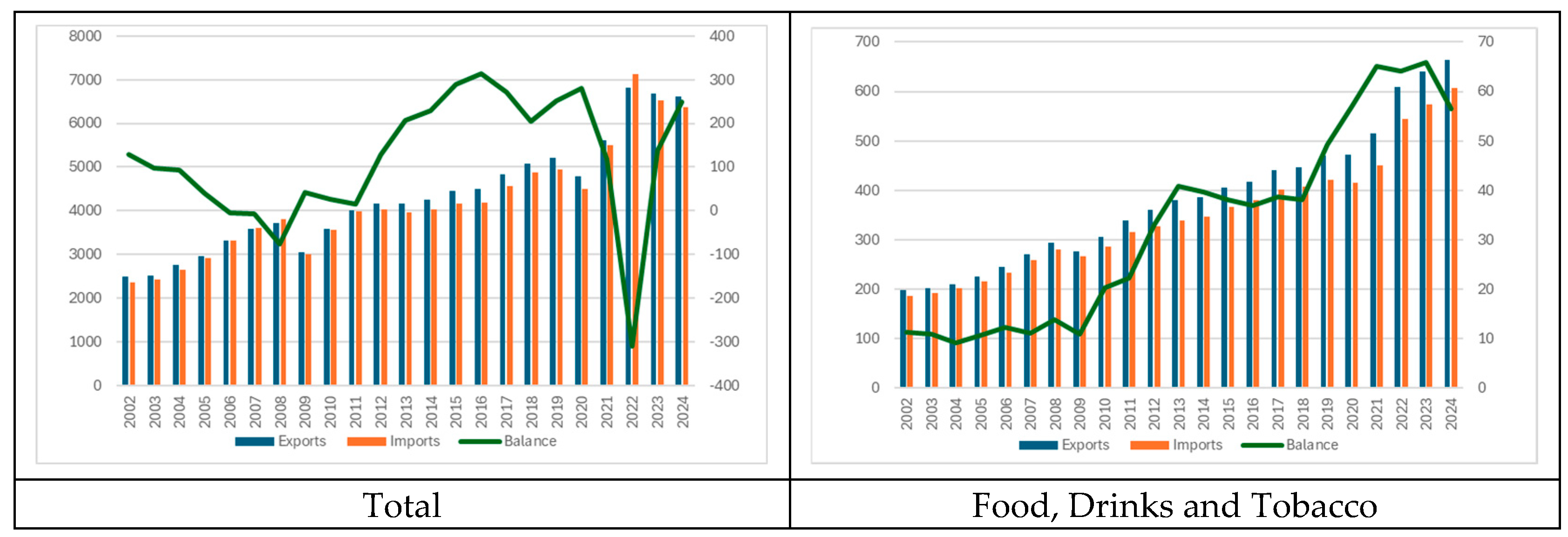
Due to the strong interdependence between economics and politics, the current fluctuations in both global and local political landscapes influence the economic relations in general—and trade relations in particular—between the involved subjects. In order to achieve the research objectives and thoroughly analyze the agricultural product trade between the EU27 and Africa, the international trade component dynamics of the EU27, either total or agricultural ones, are visualized in
Figure 1.
The dynamics of the total exports from the EU27 reflect the global challenges the Union had to overcome. The exports showed an upward trend until the year 2009, in which we observe the first export decrease—attributable to the consequences of the global financial crisis. After recovering, the EU27 exports dynamics continued to grow until 2020, when the second decrease was observed, likely due to the COVID-19 pandemic. What stands out is the two-year decrease for the said exports in 2023 and 2024. It is rather difficult to give one single explanation for the mentioned decrease just right now. In time, it may become easier to define the most influential factor behind the decrease in EU27 exports. However, currently, it appears to be the result of a combination of such factors as climate change, “silent tariff wars”, and the change of the agro exports routes from Ukraine. As for the EU27 total imports, their dynamics differ from the exports in only one year, that is 2013, when a decrease in the total imports coincides with an increase in the related exports. One of the possible explanations of the mentioned decrease in imports could be the general slowdown of the EU economic development at that time, which suppressed the union’s import demand. The balance of the EU27 total international trade increased in the years 2009, 2012–2016 inclusive, 2019, 2020, 2023 and 2024. In the remaining years a decline in the mentioned balance was observed.
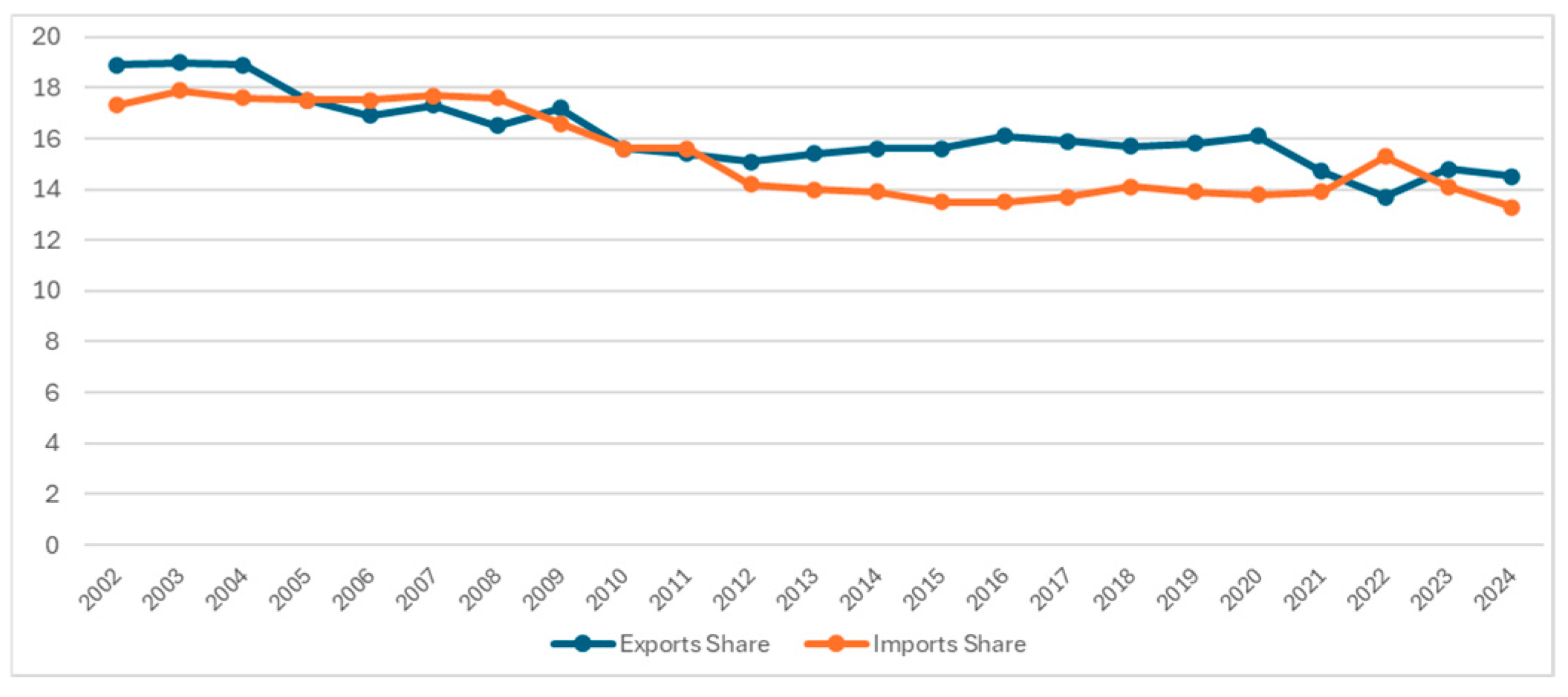
A totally different situation can be observed in the EU27 agro exports dynamics—it is upward through the whole time frame under analysis, with the sole exception in 2009—a decline that can be explained by the consequences of the global financial crisis. The dynamics of the EU27 agro imports do not differ a lot from that of the exports, with only one difference in 2020, when a decrease in the said imports, with the increase in the relative exports, can be observed. The EU27 agro trade balance decreased in 2003, 2004, 2007, 2009, 2014–2016 inclusive, 2018, 2022 and 2024, indicating a narrowing gap between agricultural exports and imports. In the remaining years the said balance increased. The shares for the EU27 total exports and imports as compared to those of the world can be observed in
Figure 2.
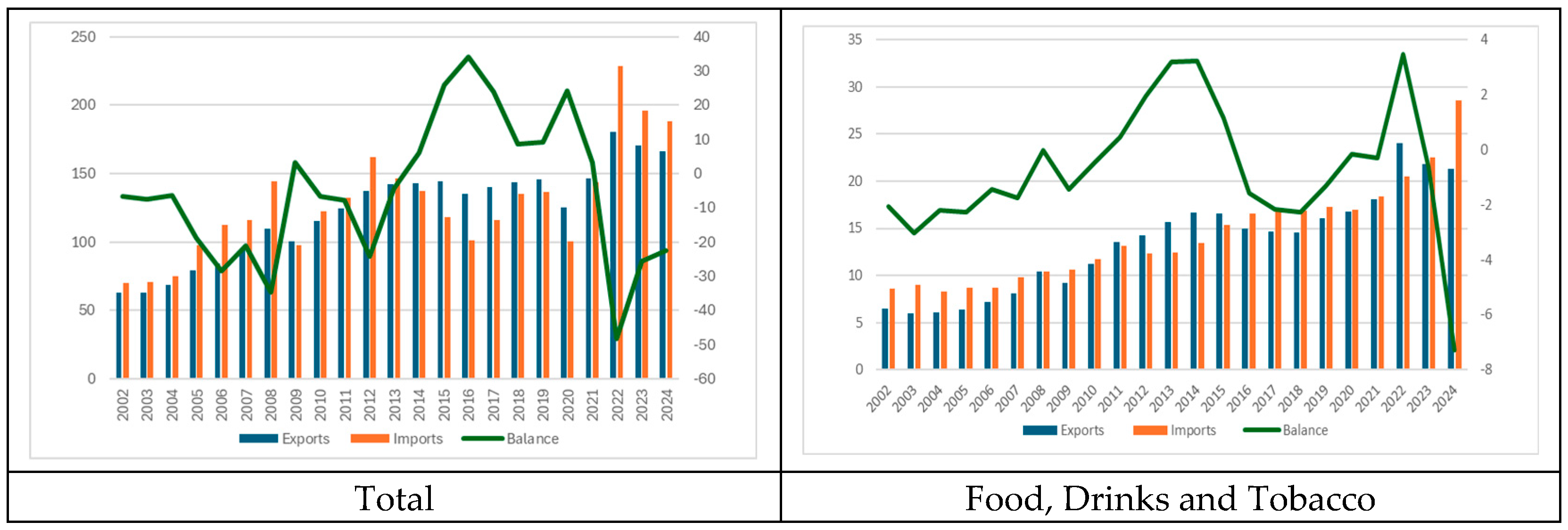
Even without a detailed analysis, a clear downward trend in the EU27 shares of either the world’s exports or imports can be observed. More specifically, the EU27 share in the global exports decreased from almost 19 to around 15%, while its share in the global imports decreased from around 17 to 13%. Analyzing precisely, we observe a decrease in the EU27 export share in the years 2004–2006, 2008, 2010–2012, 2017, 2018, 2021, 2022 and 2024. In the remaining years an increase in the export shares was recorded. As for the EU27 imports, their share in the world one decreased in 2004, 2005, 2008–2010, 2012–2015, 2019, 2020, 2023 and 2024. During the remaining years, an increase in the import shares can be observed. Of course, it is a matter of common knowledge that the decrease in the share does not automatically mean a decrease in the absolute amount, value or volume. Therefore, it would be premature to make any statements about the EU’s losing its trade importance on the world market. Nevertheless, the presented analysis results should give the decision makers a lot to think about so they can take the appropriate actions to strengthen the EU’s position on the global trade market. Moving towards the core research topic, the international trade component dynamics of the EU27 with Africa can be observed in
Figure 3.
The dynamics of the total international trade between the EU27 and Africa almost fully coincides with that of the EU27’s overall international trade, particularly on the export side. The only difference is the year 2016, in which we observe the decrease in the total exports from the EU27 to Africa with the simultaneous increase in the EU27’s total exports. The rest of the export dynamics appear largely consistent. The pattern of the EU27 imports from Africa differs more significantly from the overall EU27 import dynamics, particularly in a period of three years, 2014–2016. During this time the EU27 imports from Africa decreased, while the total EU27 imports increased. The rest of the import dynamics have the same patterns in terms of differences. Regarding the trade balance for the total trade between the EU27 and Africa, a decrease was recorded in 2003, 2005, 2006, 2008, 2010–2012, 2017, 2018, 2021 and 2022. In the remaining years the trade balance increased, showing the expanding difference between the exports and imports.
The EU27 reduced its Food, Drinks and Tobacco exports to Africa in 2003, 2009, 2015–2018, 2023 and 2024. Notably, this overlaps with the years 2009, 2016, 2023 and 2024, in which a decrease in the total EU27 exports to Africa was noted. The EU27 decreased its agro import value from Africa in 2004, 2006, 2012 and 2020. Among these only 2020 overlaps with the decrease in the total imports of the EU27 from Africa. The generally accepted explanation of the mentioned fact is the influence of the COVID-19 pandemic, which had a negative impact on the whole of global trade in general and on that between the EU and Africa in particular. The differences between the EU27 exports and imports of Food, Drinks and Tobacco to and from Africa decreased in 2003, 2005, 2007, 2009 (suggesting possible cyclicality), 2015–2018, 2021, 2023 and 2024. The years corresponding to the relative decrease in the exports and imports between the EU27 and Africa are 2003, 2005, 2017, 2018 and 2021. While often considered to offer a relatively small amount of useful information, descriptive statistics are very useful both in the data distribution analysis and in the comparative analysis of two or more datasets (
Table 1).
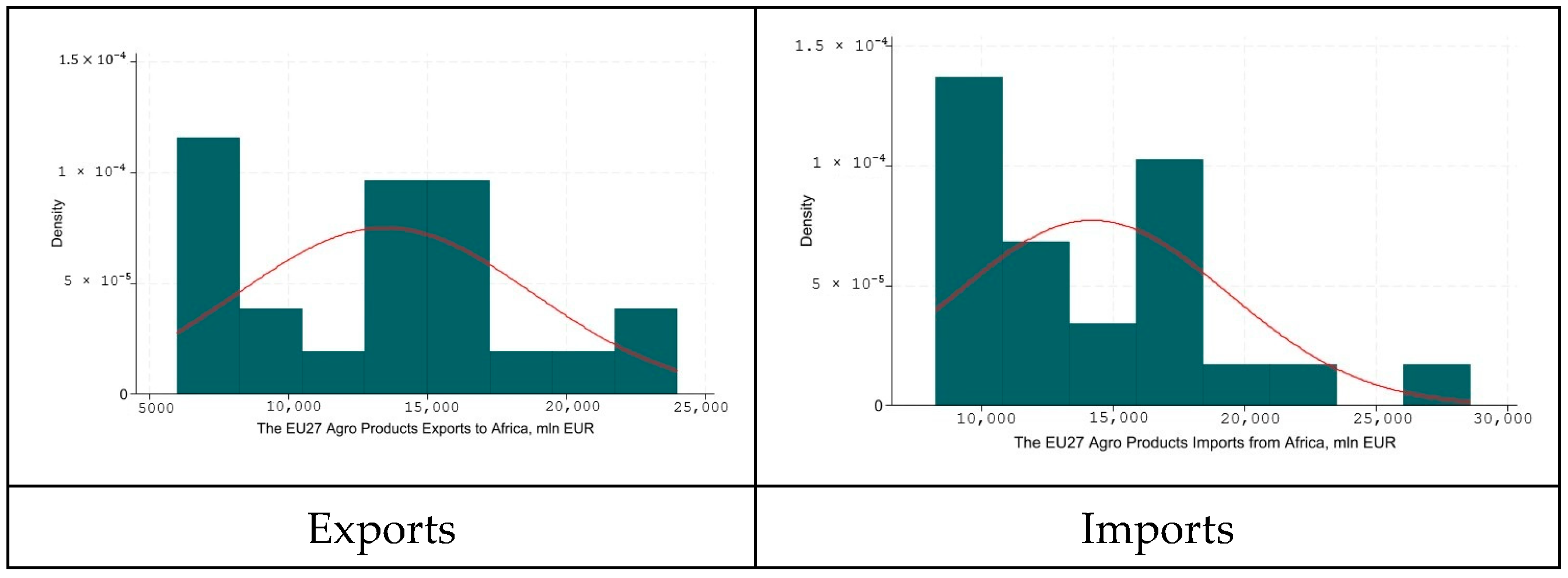
The comparative analysis of the EU27 agri exports to and imports from Africa leads to the following conclusions—the mean value of exports is smaller than that of the imports, with the opposite situation in the case of the data sets’ medians. The export data has a smaller minimum value than that of the imports. However, the maximum value of the export data is also smaller than that of the imports. The standard deviation indicates that the exports data are more spread out than the imports ones. The variance values of the analyzed datasets provide further support for the expressed conclusions. In addition, both datasets appeared to be skewed to the right, with the imports data showing a longer tail. The kurtosis values of both datasets do not differ a lot from that of a normally distributed dataset; the imports dataset is slightly leptokurtic, while the export dataset is slightly platykurtic. To double-check the normality distribution of the datasets, the histograms with overlaid density curves for both datasets under analysis are displayed in
Figure 4.
The visual presentation of the datasets under research provides a clear overview of their distribution. According to the presented histograms, none of the datasets seem to be normally distributed, with the import dataset displaying an outlier. The density curves prove the right skewness of both datasets, but they appear relatively platykurtic despite the numeric values of the datasets’ kurtoses. The time series graphs for the datasets under research are presented in
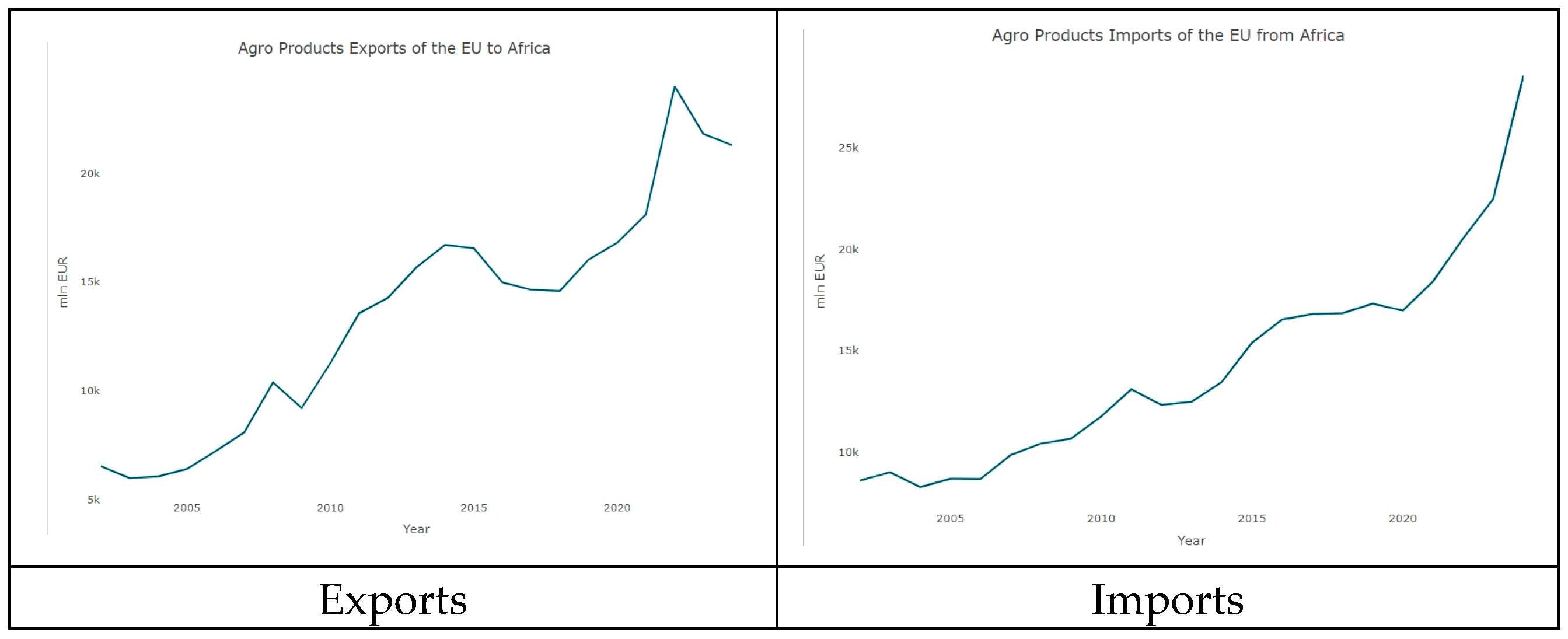
Figure 5.
Even without the application of any analytical tools, it is obvious that both time series data exhibit a strong upward trend. Though no clear cyclicality was observed in either dataset, in order to ensure the selection of the best-fitting model for the time series analysis, modelling and forecasting, both presented datasets were decomposed with frequencies 2, 3 and 4. The decomposition results indicated a clear trend component along with the presence of slight seasonality (in this case cyclicality). That is why, in order to prepare the datasets for modelling and forecasting, both datasets were transformed into
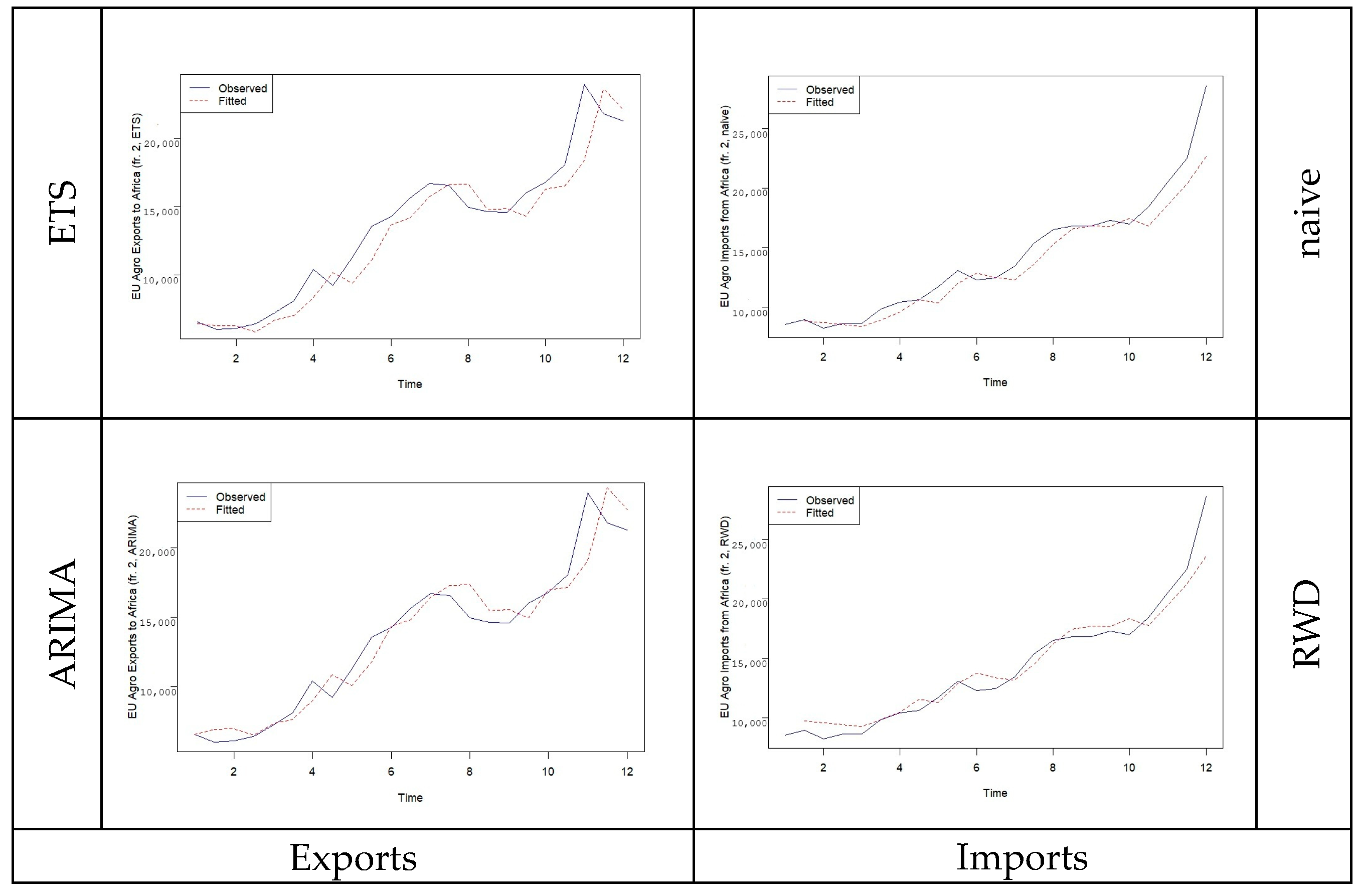
stl objects for analysis. The visual presentation of the best-fitting models based on their observed vs. fitted values is given in
Figure 6.
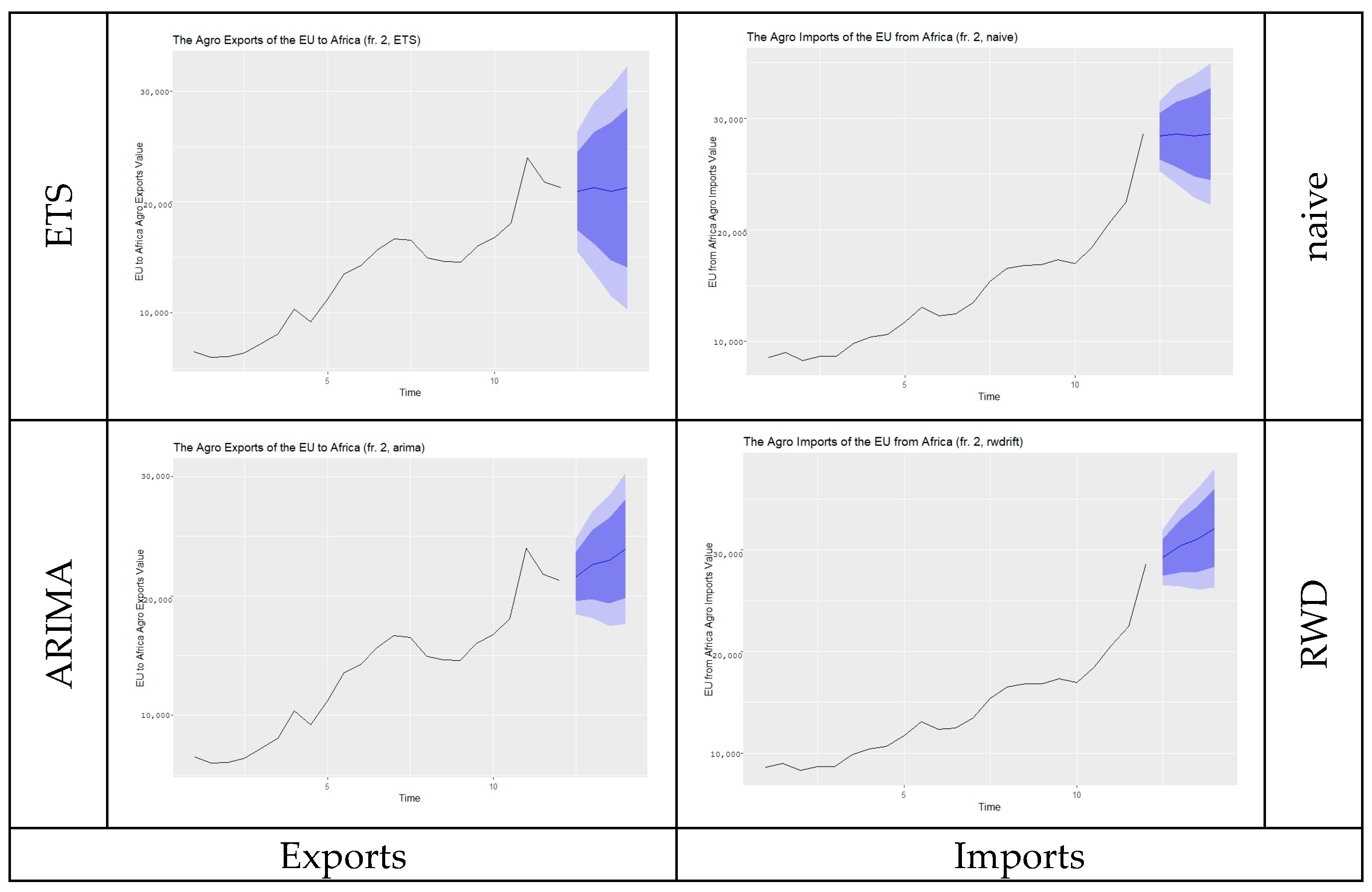
The models that best fit the observed exports data are ARIMA (0, 1, 0) and ETS (M, N, N), while for the imports data they are “naive” and RWD. Using the mentioned models, forecasts were generated for the next four time periods. The graphs displaying either the observed or forecasted data values with their confidence limits are presented in
Figure 7.
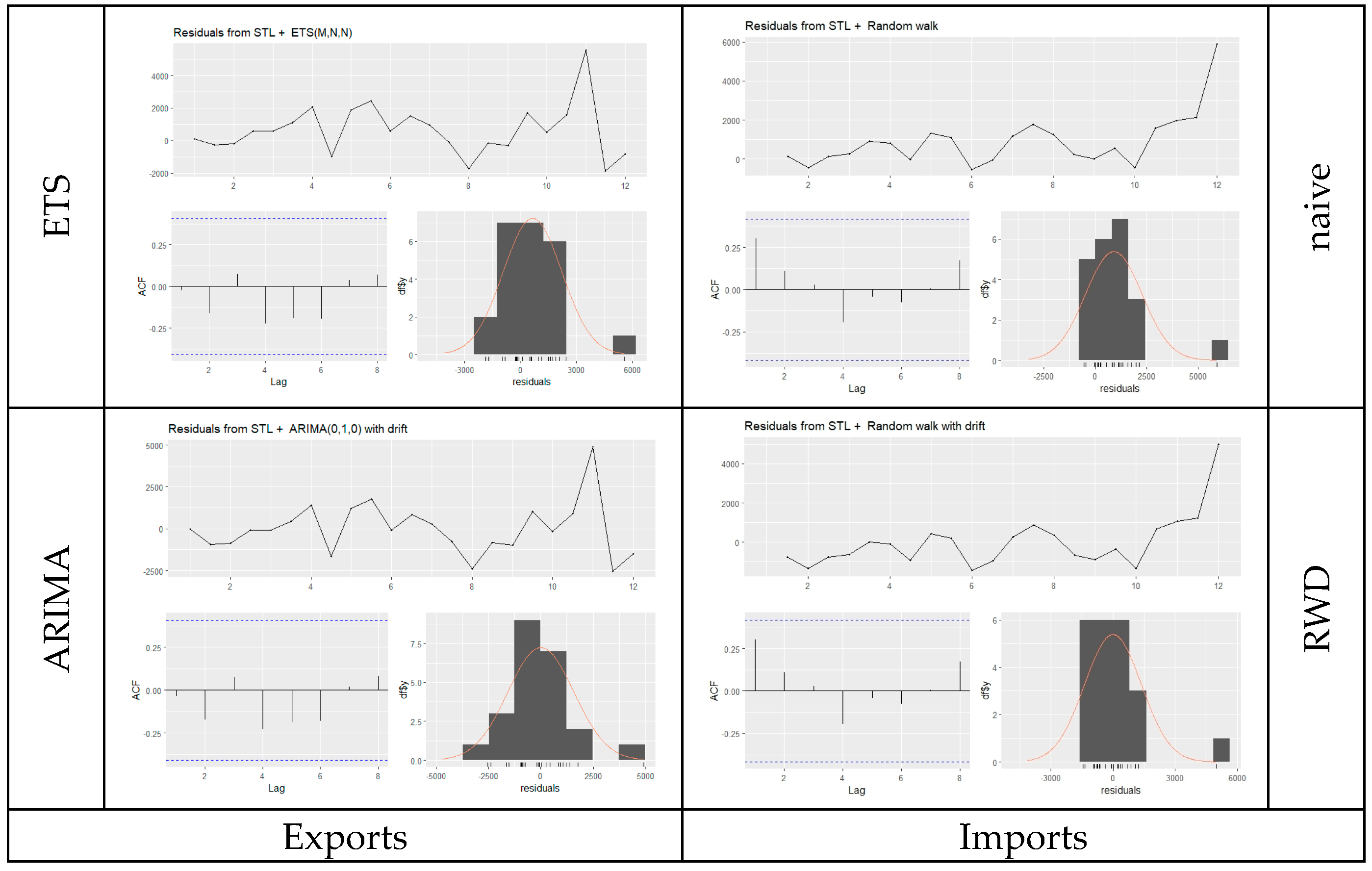
It should be explained here that both analyzed datasets consist of 23 observations. To enable their decomposition, the researched data were transformed into time series objects with frequencies of 2, 3 and 4. The resulting time series data with the frequency of 2 appeared to best fit the model results. The mentioned decomposition resulted in twelve data observations pairs, with the first observation of the twelfth pair corresponding to the last observed data value. Therefore, the forecasting was initiated from the twelfth observation pair, that is, from the 25th observation. To preserve the integrity of the original data as well as to ensure the most robust results, the analyzed datasets were not manipulated for the creation of the 24th observation value. According to the ETS model applied to the exports data, their forecasted values are supposed to be approximately around the last observed data value, with minor fluctuations. The application of the ARIMA model produces forecasted values that exhibit a clear upward trend, with smoother fluctuations compared to those generated by the ETS model. After the application of the “naive” method, the forecasted values for the imports data are supposed to be around the last observed value, as expected from the “naive” method. The RWD imports values forecasts have an obvious upward direction. In order to determine which model provides the most robust results, the “check-for-residuals” option was employed, and the results are depicted in
Figure 8.
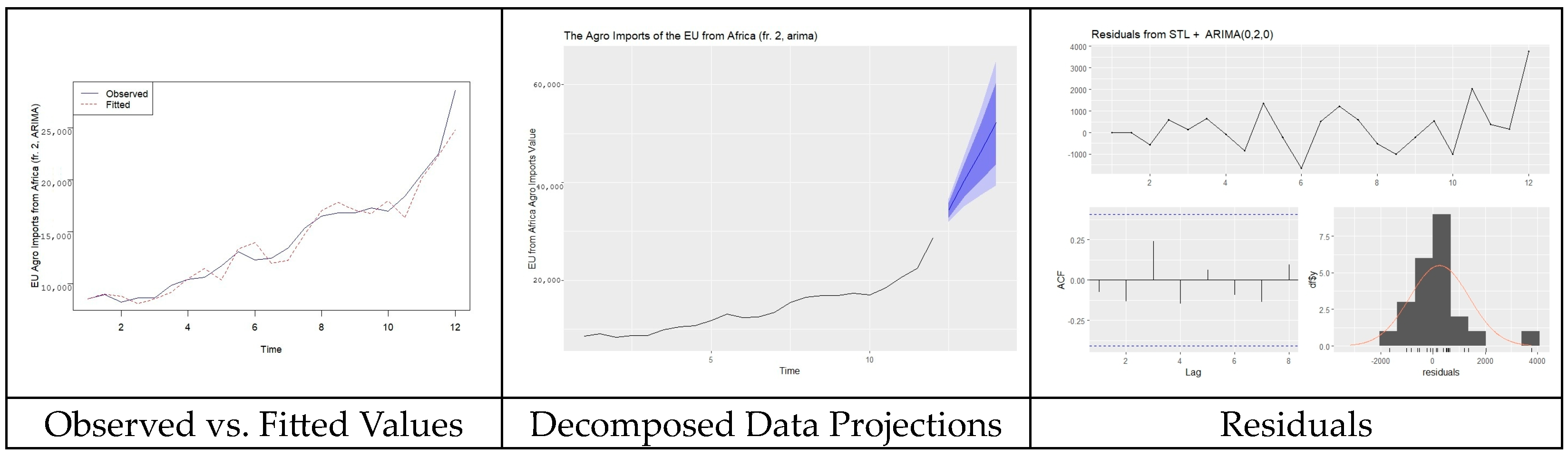
In the case of the exports data, the “check-for-residuals” results clearly indicated that ARIMA is the best-fitting model, as evidenced by the presented graph. However, the visualization of the said results for the imports data made the problem even harder to solve. As shown in the “check-for-residuals” results presented above, none of the chosen models appear to be suitable for application. Based on the “check-for-residuals” results for the imports data, the ARIMA model appeared to be the most appropriate choice. The graphs displaying the effects of the application of the ARIMA model to the imports data are presented in
Figure 9.
As shown in the first plot presented in the figure above, the ARIMA model tries to capture all the peculiarities of the real observations, resulting in a plot with more fluctuations than that of the real observations. On the contrary, “naive” and RWD models applied to the imports data fitted the real data observations more smoothly, which makes them better models/methods for application. However, upon examining the plots using the results of “check-for-residuals”, it becomes obvious which model performs best. In order to double-check the appropriateness of the chosen models, the Ljung–Box Test was applied to the residuals. According to the test results, none of the Q-test statistics exceeded the critical value from the chi-squared distribution, with all the p-values exceeding the default significance level. Consequently, that suggests that the residuals do not exhibit significant autocorrelation, proving the adequacy of the chosen models.
6. Conclusions
Africa has always been among the top geopolitical priorities for the EU due to the continent’s close geographical proximity and long-standing economic ties. The celebration of 25 years of successful partnership between the African Union and European Union is additional proof of that [
47]. Successfully functioning trade relations are essential in the current globalized world, especially due to the ever-changing global trade order. The EU and Africa have all the prerequisites to strengthen the trade of their agricultural and food products due to both the strategic importance for both subjects and the different supply and demand palette, shaped by different climatic conditions and production specialization.
Upon fulfilling the research objectives, it was indicated that the total exports dynamics of the EU27 mostly show an upward trend, with downward changes in 2009 and 2020. The EU27’s total imports have a similar trend, added by a negative change in 2013. However, a common and rather unexpected development is the decrease in both exports and imports for the EU27 in the years 2023 and 2024. That trend should be an alarm bell for the EU decision makers, as it may indicate a potential slow-down in the union’s economic and trade dynamics. The agricultural product trade (Food, Drinks and Tobacco) dynamics look more optimistic, showing an upward trend through the whole analyzed time frame, with a decrease in exports only in 2009 and decreases in imports in 2009 and 2020. Those years could have been experiencing the consequences of the global financial crisis and the COVID-19 pandemic, respectively. The mentioned positive dynamics are supposed to have a positive impact on both analyzed subjects, driven by differences in agricultural specialization and the demand of local markets. The total exports dynamics from the EU27 to Africa mostly show an upward trend, with negative changes in 2009, 2016 and 2020. At the same time its imports decreased in 2009, 2013–2016 and 2020. Another common feature is the decrease in both overall exports and imports between the EU27 and Africa in 2023 and 2024, which could be explained by the consequences of the war in Ukraine. The dynamics of the exports of agro products (Food, Drinks and Tobacco) from the EU27 to Africa present a different pattern from those described before. In addition to a decrease in 2009, it also changed negatively in 2003, 2015–2018 and, again, in 2023 and 2024. At the same time, the agro imports of the EU27 from Africa decreased in 2004, 2006, 2012 and 2020, while they increased in both 2023 and 2024. The mentioned changes are expected to have a positive impact on African countries—but not only them—as the differences mentioned above mean increased demand for African agro products in the EU market. At the same time, they reflect the increased ability of the market subjects to buy the imported products. Although the war in Ukraine may seem distant from Africa, it has influenced the continent’s economic and trade flows, either directly or indirectly. In the analyzed case this influence occurred through Africa’s economic relations with the EU, which shares a common border with Ukraine. At the same time, the increase in the EU27–Africa agro product trade would have a positive impact not only on African countries, by improving their currency inflows, but on the EU as well, and not solely in economic terms. The increased trade amounts between the analyzed subjects foster closer political relations, which are becoming more important for both parties. These strengthened ties enhance their collective influence, compared to the other big global players.
The results for the time series analysis, modelling and forecasting suggest that the projections for the next four time periods for the EU27-to-Africa agro exports will remain around their last observed value, slightly fluctuating (as indicated by the ETS model) or increasing with a delicate slope (according to the ARIMA model). The projections of the EU27-from-Africa agro imports for the next four time periods indicate an increase with a rather sharp slope (as suggested by the ARIMA model). The Ljung–Box Test results indicated the absence of significant autocorrelation and a good fit of all the applied models, indicating that the model residuals resemble white noise. Consequently, the research hypotheses were confirmed, showing a light fluctuation or sharp increase in both Food, Drinks and Tobacco exports and imports between the EU27 and Africa.
The research results give decision makers a lot to think about regarding all the subjects involved, presenting an alternative scenario—one that is rather interesting and even weird—to prepare for. If the decrease in the agro and food products exports from the EU27 to Africa in 2023 and 2024 can be explained by the reduced re-exports of the Ukrainian agro and food products—due to the revival of the Black Sea routes—then the increase in the EU27 agro-food product imports from Africa in 2023 and 2024 and their rather sharp increase projections warrant deeper investigation. Of course, such factors as unfavourable climatic and weather conditions affecting agro product harvests, the improved adjustment of the African agro and food products to the EU27 requirements, and the strategic goal of aligning with Africa—a territorially and demographically significant representative of the Global South—should be taken into consideration while expanding the presented research. That is, economics and politics are so interrelated nowadays that efforts made to improve one will certainly contribute to the improvement of the other. That is why the geo-political profits from the improvement of the EU27–Africa trade relations cannot be overestimated. The research and its results can be of great help for a wide range of stakeholders. Public administrators of all levels may use them for either a general overview or detailed economic and trade information on the subjects under research. For decision makers it is a valuable source of information to make the best decisions possible under the changing global, regional and local circumstances. Representatives of the academic community can include the research results in their curriculum, while statisticians and data analytics may find the research noteworthy as an example of the analysis, modelling and forecasting of datasets containing a rather small number of observations. Additionally, other subjects may find the research interesting depending on their specific focus within the topic under research.