Adaptive Genetic Algorithm Integrated with Ant Colony Optimization for Multi-Task Agricultural Machinery Scheduling


Abstract
1. Introduction
- Dual-Objective Scheduling Model: A VRP-based model incorporating time window constraints and machinery heterogeneity is established, targeting both minimal total scheduling cost and shortest operational duration. This model addresses the multi-machine, multi-task scheduling problem in modern agriculture and ensures operational efficiency.
- Hybrid Optimization Algorithm: An adaptive crossover probability adjustment strategy and dynamic pheromone update mechanism are designed to synergize GA’s global search capabilities with ACO’s local path optimization. Comparative experiments demonstrate AGA-ACO’s superior convergence speed, solution accuracy, and resistance to local optima over standalone GA and ACO.
2. Materials and Methods
2.1. Problem Description
2.2. Model Building
2.2.1. Model Assumptions
- All farmland parameters (area, location, required tasks, time windows) and machinery specifications (type, quantity, efficiency, speed) are known and constant.
- Each machine can only execute tasks matching its type and operates on one task at a time, with total deployment not exceeding available inventory.
- For computational tractability, farmland geometries are approximated as regular polygons to enable efficient area calculation and distance estimation in the scheduling model.
- 4.
- Tasks within each farmland must be executed sequentially according to the order specified in the task list . For example, if 1,2], task type 1 must be completed before task type 2 can begin.
- 5.
- Dynamic environmental factors (e.g., weather variations, soil moisture fluctuations) are excluded from operational efficiency calculations.
- 6.
- A soft time window constraint is implemented for each farmland, where all required tasks must be completed within the specified time window. Deviations incur quantified penalty costs.
2.2.2. Objective Function
2.2.3. Constraints
2.2.4. Variable Description
2.3. AGA-ACO Algorithm
- (1)
- Autonomous adaptation mechanism: Dynamically adjusts crossover and mutation probabilities based on real-time population fitness, eliminating manual parameter setting.
- (2)
- Elite preservation with diversity maintenance: A fitness-proportional (roulette-wheel) selection scheme guarantees the retention of high-quality solutions, while explicitly enforcing diversity thresholds to prevent genetic stagnation.
- (3)
- Pheromone-guided local intensification: Borrowing from ant colony optimization (ACO), pheromone trails focus local search on promising task–machine assignments under tight time-window constraints, thus refining solution quality without sacrificing convergence speed.
2.3.1. Algorithm Framework
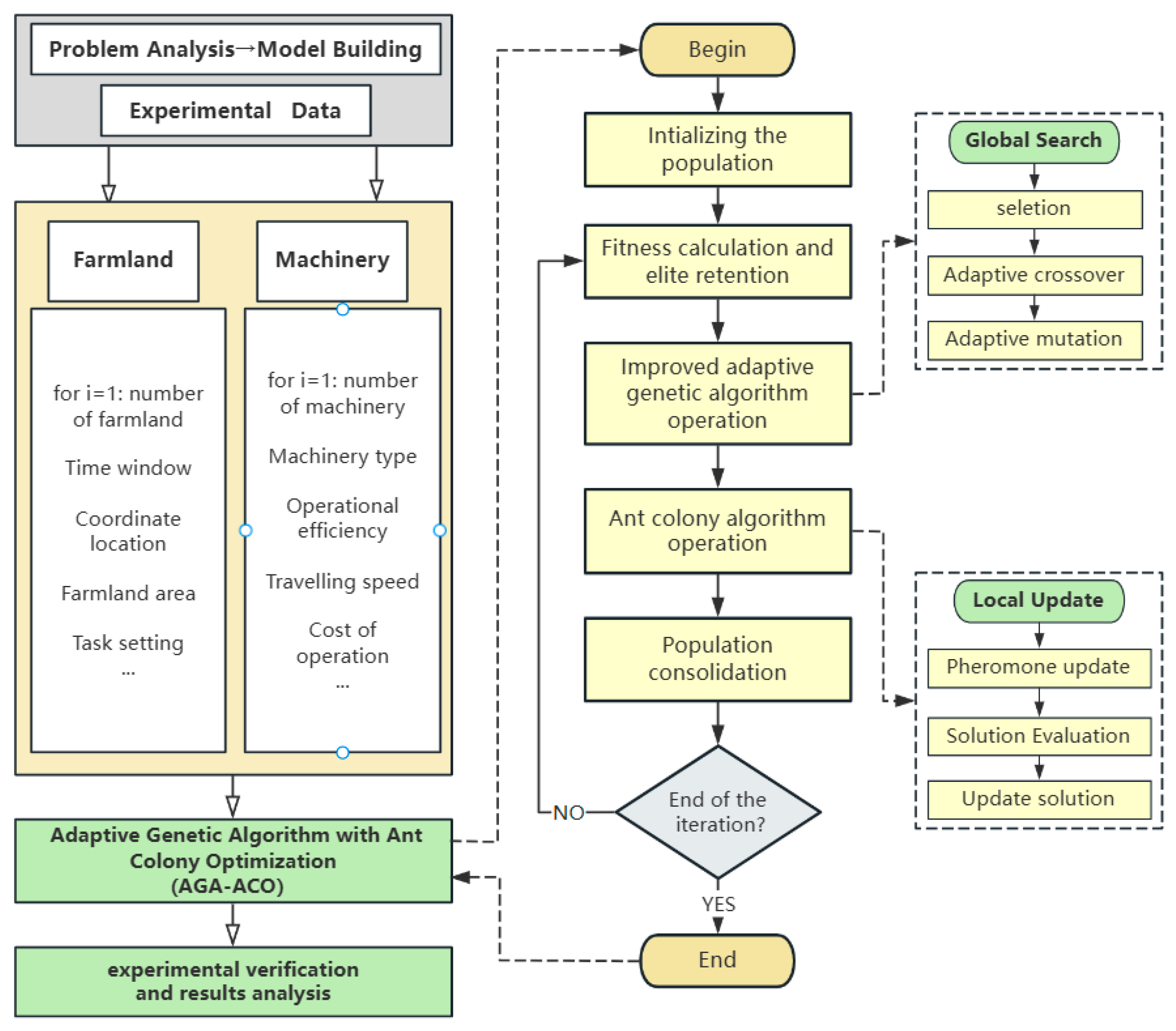
2.3.2. Algorithm Steps
- (1)
- Parameter Initialization. The algorithm begins by loading all necessary input parameters, which include the operational parameters of agricultural machinery, geospatial attributes of farmlands, and task specifications. Subsequently, core algorithmic parameters are configured to initialize the optimization process.
- (2)
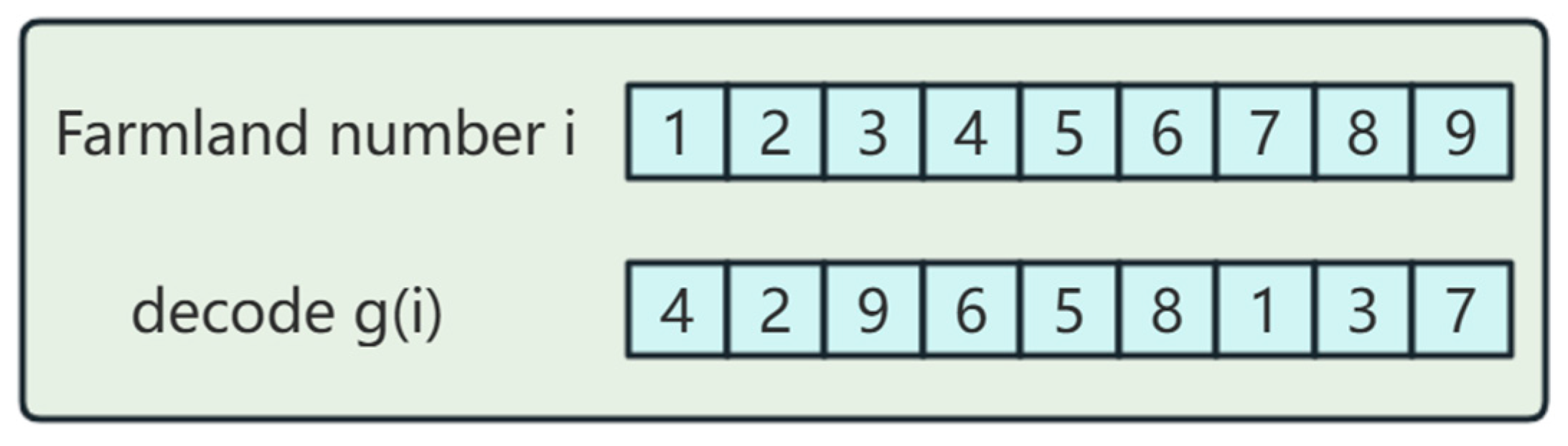
- Encoding and Decoding Scheme. The algorithm employs a priority-based integer encoding strategy for solution representation. Each chromosome consists of n genes corresponding to n farmlands, where the gene value g(i) represents the operational priority of farmland i. Lower values of g(i) indicate higher priority for task execution. The initial population is generated through a randomized priority assignment process. During decoding, farmlands are sorted according to their priority values, and agricultural machinery is then assigned to execute tasks following this prioritized sequence. The assignment considers both spatial proximity between machinery and farmlands, as well as temporal constraints.
- (3)
- Fitness. The fitness function evaluates individual quality during evolution. To minimize total scheduling costs, the fitness is defined as the reciprocal of the cost function:where is the cost scaled between the minimum and maximum values within the population using min-max normalization:
- (4)
- Selection. High-quality individuals are selected without duplication to ensure population diversity and improve convergence efficiency and algorithm accuracy for effectively preserving high-quality solutions. In the selection phase, both roulette wheel selection and elitist selection are used to ensure that individuals with higher fitness have a greater probability of survival, while outstanding individuals are preserved and passed on to the next generation [42]. The selection probability for individual i is:where n is the population size, and fi is the fitness of individual i. This strategy biases selection toward high-fitness solutions while preserving diversity.
- (5)
- Adaptive crossover. In traditional genetic algorithms, the crossover and mutation probabilities remain fixed throughout the evolutionary process, which often leads to premature convergence or inefficient exploration. Although these parameters are critical factors affecting algorithm performance, determining their optimal values remains challenging. Extensive research has demonstrated that adaptive control of these parameters can significantly improve algorithm efficiency [20,43].
- (6)
- Adaptive mutation. While crossover exploits existing genetic information, mutation serves as a critical diversification operator that introduces novel genetic variations to escape local optima. To complement the adaptive crossover strategy and further enhance the algorithm’s search capability, we propose a self-adaptive mutation mechanism with similar fitness-based adjustment principles. The mutation probability is dynamically adjusted based on individual fitness:where and represent the maximum and minimum mutation probabilities, respectively; is the individual’s fitness value; [0.5, 1] regulates mutation intensity. The parameters for adaptive crossover and mutation were determined through a series of preliminary experiments. The values were chosen from a range of candidate values and the selected ones provided a good balance between exploration and exploitation.
- (7)
- ACO-Enhanced Optimization Mechanism. The hybrid algorithm integrates an ant colony optimization (ACO) mechanism, a probabilistic algorithm designed for optimal path finding [44], to refine task-machine assignments by leveraging pheromone-guided local search and heuristic-driven exploration. The pheromone matrix , initialized as , quantifies the desirability of assigning machine m to task j at farmland i. The heuristic factor balances temporal feasibility and cost efficiency, defined as:where is the execution time of machine m for task j, denotes the latest service time of farmland i, and aggregates transfer, operational, and labor costs. The selection probability for ant k to choose machine m follows a pheromone-heuristic balance rule:
- (8)
- Conflict Detection and Resolution. To ensure operational feasibility and prevent scheduling conflicts during solution construction, the algorithm implements a farmland occupation tracking mechanism. This mechanism maintains a dynamic registry of scheduled operations for each farmland and validates each new task assignment to prevent temporal overlaps.
- Calculate completion time: Determine when the proposed operation would finish based on its start time and duration.
- Check for conflicts: Compare the proposed operation time interval with all existing operations at the same farmland. Two operations overlap if one starts before the other finishes.
- Resolve conflicts: If overlap is detected, adjust the start time to begin after all conflicting operations complete.
- Validate time window: Verify that the adjusted assignment satisfies the farmland time window constraint. If the completion time exceeds the deadline, reject the assignment.
- Update registry: Upon successful validation, add the new operation interval to the registry for future conflict checks.
- (9)
- Preservation of Elite Solutions. A crucial aspect of the algorithm involves safeguarding the best-performing individuals to mitigate population degeneration. This is achieved through a strict elitism mechanism where the optimal solution in each generation is preserved unchanged. One copy of this elite individual is exempt from crossover and mutation operations and is automatically carried forward to the next generation, thereby ensuring that the solution quality does not deteriorate throughout the evolutionary process.
- (10)
- Iterative Procedure. The optimization process is conducted iteratively. The algorithm proceeds cycle-by-cycle through the steps of selection, crossover, mutation, and local refinement. It halts when the stopping criterion is met, which is typically either a sufficiently high solution quality (fitness) has been attained or a computational budget has been exhausted. The final solution is then retrieved by decoding the best individual in the population.
3. Results
3.1. Experimental Setup
3.1.1. Dataset Description
3.1.2. Algorithm Parameter Configuration
3.2. Simulation Results and Analysis
3.2.1. Performance Evaluation
3.2.2. Scalability Analysis
3.2.3. Convergence Behavior Analysis
- (1)
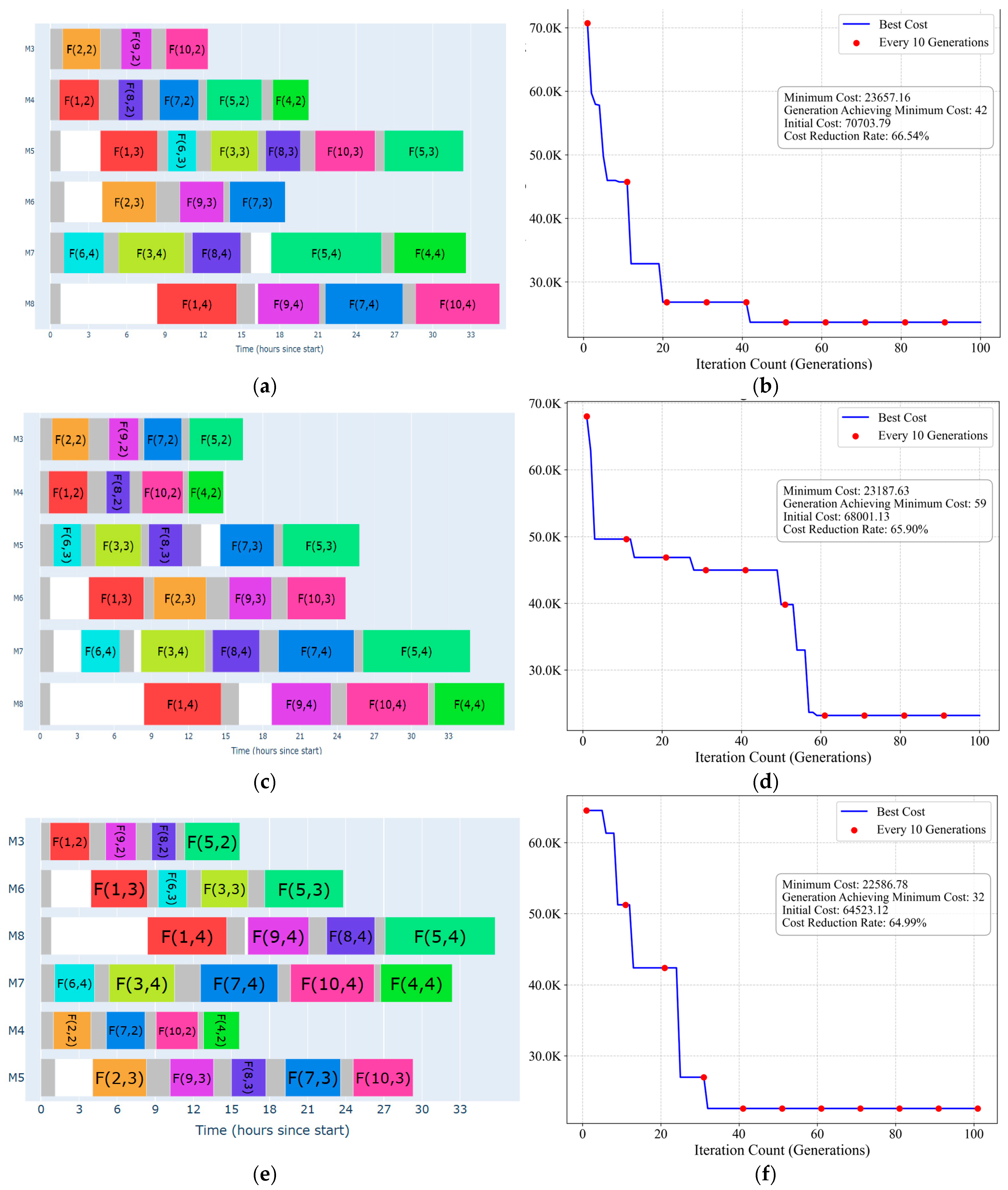
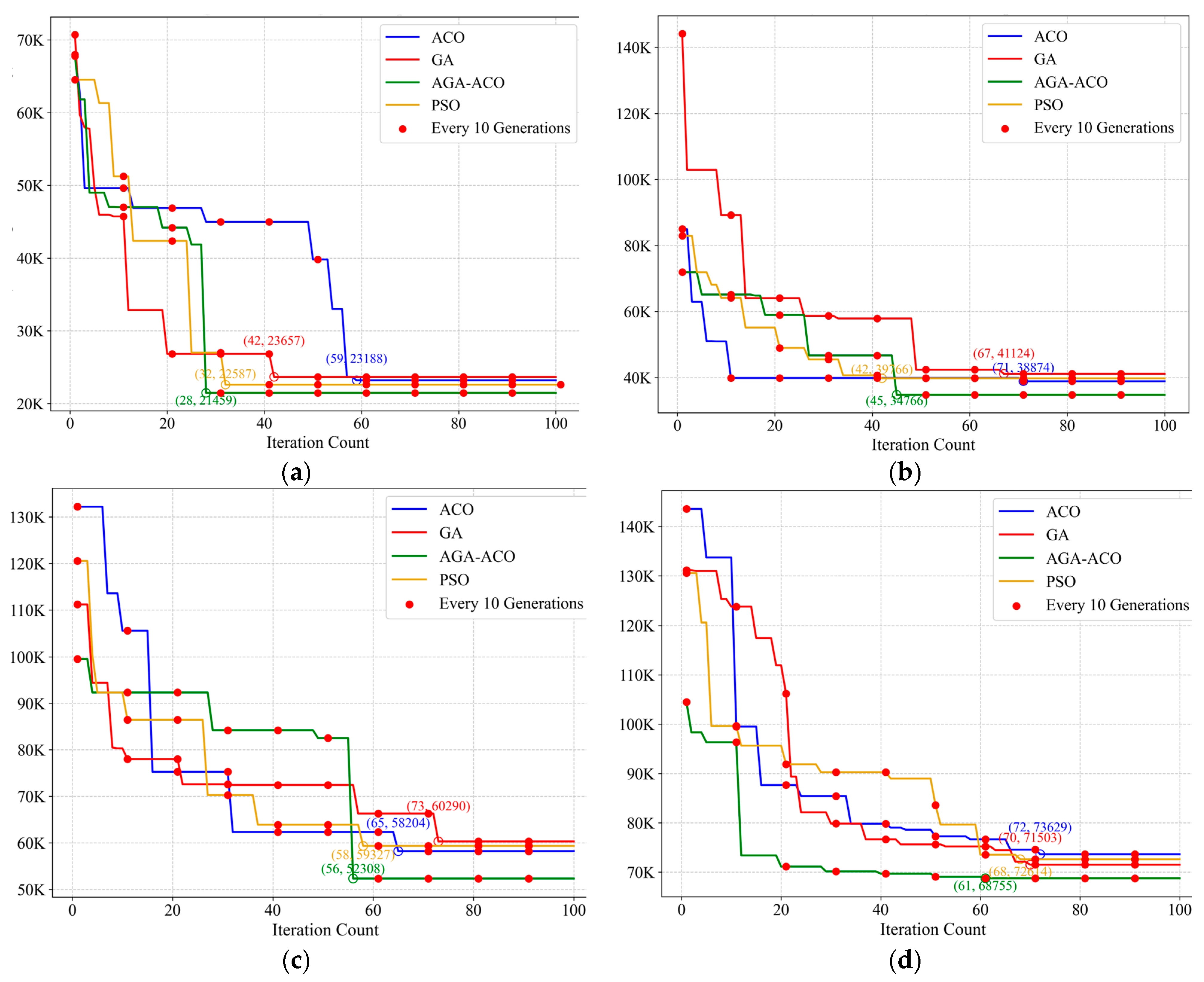
- Superior Optimization Trajectory: AGA-ACO demonstrates consistently better performance throughout the entire optimization process. It generates superior initial solutions with costs 15–20% lower than standard algorithms due to adaptive initialization, then maintains effective exploration-exploitation balance through adaptive operators and pheromone-guided diversification. This dual mechanism prevents the premature convergence observed in standalone GA and ACO, where both algorithms progressively lose optimization momentum and stagnate at suboptimal solutions, particularly evident in Figure 5c,d.
- (2)
- Convergence Efficiency: The hybrid approach achieves optimal solutions with significantly fewer iterations across all problem scales. Most notably in the 30-farmland scenario (Figure 5d), AGA-ACO achieves convergence significantly faster than GA, ACO, and PSO while maintaining superior solution quality. This efficiency gain stems from the synergistic two-phase optimization strategy—genetic algorithm for rapid global exploration followed by ant colony optimization for targeted local refinement—enabling the algorithm to identify and exploit high-quality solution regions more effectively than either component algorithm alone.
3.2.4. Algorithm-Component Comparison
- The AGA configuration removes roughly three-quarters of the excess cost observed in GA-Base and shortens convergence time by 10–15%. Dynamically self-tuned crossover and mutation probabilities help maintain population diversity and protect high-fitness routes from premature loss. This continuous adaptation supplies a steady stream of promising task–machine combinations, yielding near-optimal solutions without additional computational overhead from local search.
- Introducing ACO refinement into a fixed-parameter GA (GA-ACO) reduces the total cost by another 2–3%, demonstrating the effectiveness of pheromone-guided task reassignment in enhancing local solution quality. However, because crossover and mutation remain static, the algorithm still risks premature convergence once the population becomes overly homogeneous—limiting the ACO’s ability to further explore new high-quality routes. As a result, GA-ACO’s performance remains slightly inferior to that of the adaptive GA.
- The full hybrid model achieves the best balance between exploration and exploitation. Its marginal improvement over AGA decreases from 3.1% to 3.6% and finally to 2.2% as the number of farmlands increases, indicating that with larger problem sizes, opportunities for route sharing diminish and constraint saturation increases. Nonetheless, the ACO refinement continues to provide meaningful improvements in both convergence smoothness and final solution quality.
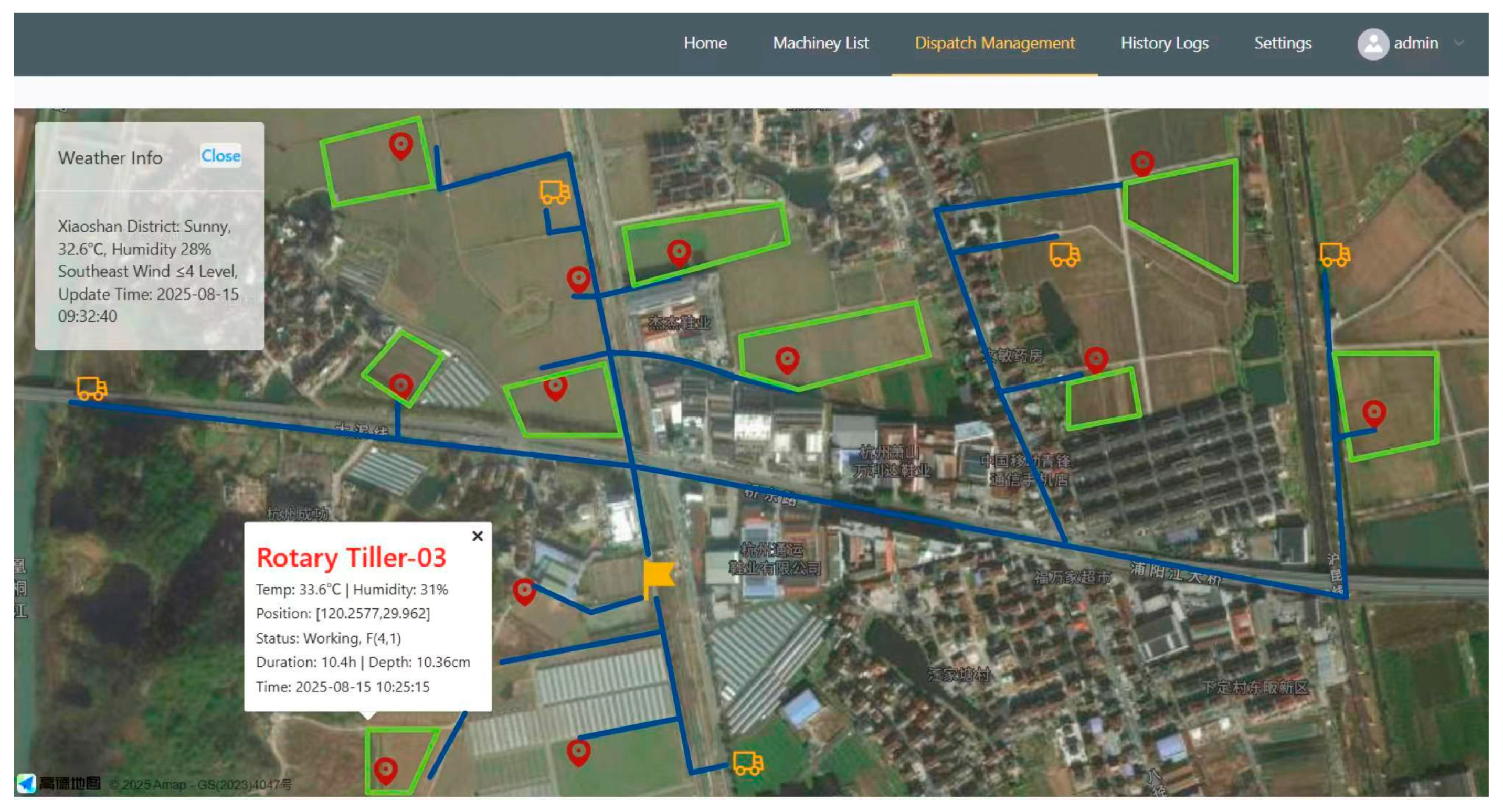
3.3. System Development
4. Discussion
5. Conclusions
Author Contributions
Funding
Institutional Review Board Statement
Data Availability Statement
Acknowledgments
Conflicts of Interest
References
- Bochtis, D.D.; Sørensen, C.G.; Busato, P. Advances in agricultural machinery management: A review. Biosyst. Eng. 2014, 126, 69–81. [Google Scholar] [CrossRef]
- Li, H.; Chen, L.; Zhang, Z. A study on the utilization rate and influencing factors of small agricultural machinery: Evidence from 10 hilly and mountainous provinces in China. Agriculture 2022, 13, 51. [Google Scholar] [CrossRef]
- Sethanan, K.; Neungmatcha, W. Multi-objective particle swarm optimization for mechanical harvester route planning of sugarcane field operations. Eur. J. Oper. Res. 2016, 252, 969–984. [Google Scholar] [CrossRef]
- Liu, Y.; Zang, Y.; Yang, Y. China’s rural revitalization and development: Theory, technology and management. J. Geogr. Sci. 2020, 30, 1923–1942. [Google Scholar] [CrossRef]
- Liu, D.; You, J.; Wang, R.; Deng, H. Agricultural production optimization and marginal product response to climate change. Agriculture 2022, 12, 1403. [Google Scholar] [CrossRef]
- Liu, X.; Zhu, X.; Hao, K. Dynamic immune cooperative scheduling of agricultural machineries. Complex Intell. Syst. 2021, 7, 2871–2884. [Google Scholar] [CrossRef]
- Zhou, Z.; Zina, A.; Qu, L.; Cao, Z.; Zhang, Y.; Zhao, D. Enhancing agricultural production and environmental benefits through full mechanization: Experimental evidence from China. Habitat Int. 2025, 157, 103332. [Google Scholar] [CrossRef]
- Xue, X.; Han, Y. Research review on agriculture machinery operation services. J. China Agric. Univ. 2021, 10, 185–197. [Google Scholar]
- Tabatabaei, A.; Torabi, F.; Paitoon, T. Simultaneous scheduling of machines and automated guided vehicles utilizing heuristic search algorithm. In Proceedings of the 2018 IEEE 8th Annual Computing and Communication Workshop and Conference (CCWC), Las Vegas, NV, USA, 8–10 January 2018; IEEE: New York, NY, USA, 2018; pp. 54–59. [Google Scholar]
- Cortés, C.E.; Sáez, D.; Núñez, A.; Muñoz-Carpintero, D. Hybrid adaptive predictive control for a dynamic pickup and delivery problem. Transp. Sci. 2009, 43, 27–42. [Google Scholar] [CrossRef]
- Dupanloup, I.; Schneider, S.; Excoffier, L. A simulated annealing approach to define the genetic structure of populations. Mol. Ecol. 2002, 11, 2571–2581. [Google Scholar] [CrossRef]
- Qiu, M.; Fu, Z.; Eglese, R.; Tang, Q. A tabu search algorithm for the vehicle routing problem with discrete split deliveries and pickups. Comput. Oper. Res. 2018, 100, 102–116. [Google Scholar] [CrossRef]
- Vincent, F.Y.; Jodiawan, P.; Gunawan, A. An adaptive large neighborhood search for the green mixed fleet vehicle routing problem with realistic energy consumption and partial recharges. Appl. Soft Comput. 2021, 105, 107251. [Google Scholar] [CrossRef]
- Chen, S.; Chen, R.; Wang, G.-G.; Gao, J.; Sangaiah, A.K. An adaptive large neighborhood search heuristic for dynamic vehicle routing problems. Comput. Electr. Eng. 2018, 67, 596–607. [Google Scholar] [CrossRef]
- Chávez, J.J.; Escobar, J.W.; Echeverri, M.G. A multi-objective Pareto ant colony algorithm for the Multi-Depot Vehicle Routing problem with Backhauls. Int. J. Ind. Eng. Comput. 2016, 7, 35. [Google Scholar] [CrossRef]
- Montemanni, R.; Gambardella, L.M.; Rizzoli, A.E.; Donati, A.V. Ant colony system for a dynamic vehicle routing problem. J. Comb. Optim. 2005, 10, 327–343. [Google Scholar] [CrossRef]
- Hanshar, F.T.; Ombuki-Berman, B.M. Dynamic vehicle routing using genetic algorithms. Appl. Intell. 2007, 27, 89–99. [Google Scholar] [CrossRef]
- He, P.; Li, J.; Qin, H.; He, Y.; Cao, G. Using hybrid algorithm to reduce non-working distance in intra-and inter-field logistics simultaneously for heterogeneous harvesters. Comput. Electron. Agric. 2019, 167, 105065. [Google Scholar] [CrossRef]
- Feng, T.; Li, J.; Jiang, H.; Yang, S.X.; Wang, P.; Teng, Y.; Chen, S.; Fu, Q.; Luo, B. The optimal global path planning of mobile robot based on improved hybrid adaptive genetic algorithm in different tasks and complex road environments. IEEE Access 2024, 12, 18400–18415. [Google Scholar] [CrossRef]
- Srinivas, M.; Patnaik, L.M. Adaptive probabilities of crossover and mutation in genetic algorithms. IEEE Trans. Syst. Man. Cybern. 2002, 24, 656–667. [Google Scholar] [CrossRef]
- Jafar-Zanjani, S.; Inampudi, S.; Mosallaei, H. Adaptive genetic algorithm for optical metasurfaces design. Sci. Rep. 2018, 8, 11040. [Google Scholar] [CrossRef]
- Chen, R.; Liang, C.-Y.; Hong, W.-C.; Gu, D.-X. Forecasting holiday daily tourist flow based on seasonal support vector regression with adaptive genetic algorithm. Appl. Soft Comput. 2015, 26, 435–443. [Google Scholar] [CrossRef]
- Lu, H.; Wen, X.; Lan, L.; An, Y.; Li, X. A self-adaptive genetic algorithm to estimate JA model parameters considering minor loops. J. Magn. Magn. Mater. 2015, 374, 502–507. [Google Scholar] [CrossRef]
- Wang, W.Q. Research on Models and Algorithms for Agricultural Machinery Scheduling Problem with Time Window. Ph.D. Thesis, Zhejiang University, Hangzhou, China, 2019. [Google Scholar]
- Guan, S.; Nakamura, M.; Shikanai, T.; Okazaki, T. Resource assignment and scheduling based on a two-phase metaheuristic for cropping system. Comput. Electron. Agric. 2009, 66, 181–190. [Google Scholar] [CrossRef]
- Orfanou, A.; Busato, P.; Bochtis, D.D.; Edwards, G.; Pavlou, D.; Sørensen, C.G.; Berruto, R. Scheduling for machinery fleets in biomass multiple-field operations. Comput. Electron. Agric. 2013, 94, 12–19. [Google Scholar] [CrossRef]
- Chen, J.; Han, P.; Zhang, Y.; You, T.; Zheng, P. Scheduling energy consumption-constrained workflows in heterogeneous multi-processor embedded systems. J. Syst. Archit. 2023, 142, 102938. [Google Scholar] [CrossRef]
- Cao, R.; Li, S.; Ji, Y.; Zhang, Z.; Xu, H.; Zhang, M.; Li, M.; Li, H. Task assignment of multiple agricultural machinery cooperation based on improved ant colony algorithm. Comput. Electron. Agric. 2021, 182, 105993. [Google Scholar] [CrossRef]
- Wang, Y.-J.; Huang, G.Q. A two-step framework for dispatching shared agricultural machinery with time windows. Comput. Electron. Agric. 2022, 192, 106607. [Google Scholar] [CrossRef]
- He, P.; Li, J.; Wang, X. Wheat harvest schedule model for agricultural machinery cooperatives considering fragmental farmlands. Comput. Electron. Agric. 2018, 145, 226–234. [Google Scholar] [CrossRef]
- Dantzig, G.B.; Ramser, J.H. The Truck Dispatching Problem. Manag. Sci. 1959, 6, 80–91. [Google Scholar] [CrossRef]
- Zhang, F.; Luo, X.; Zhang, Z.; He, J.; Zhang, W. Agricultural machinery scheduling optimization method based on improved multi-parents genetic algorithm. Trans. CSAE 2021, 37, 192–198. [Google Scholar]
- Lin, T.; Liao, W.-T.; Rodríguez, L.F.; Shastri, Y.N.; Ouyang, Y.; Tumbleson, M.E.; Ting, K.C. Optimization modeling analysis for grain harvesting management. Trans. ASABE 2019, 62, 1489–1508. [Google Scholar] [CrossRef]
- Basnet, C.B.; Foulds, L.R.; Wilson, J.M. Scheduling contractors’ farm-to-farm crop harvesting operations. Int. Trans. Oper. Res. 2006, 13, 1–15. [Google Scholar] [CrossRef]
- Vazquez, D.A.Z.; Fan, N.; Teegerstrom, T.; Seavert, C.; Summers, H.M.; Sproul, E.; Quinn, J.C. Optimal production planning and machinery scheduling for semi-arid farms. Comput. Electron. Agric. 2021, 187, 106288. [Google Scholar] [CrossRef]
- Cong, C.; Jianping, H.; Qingkai, Z.; Meng, Z.; Yibai, L.; Feng, N.; Guangqiao, C. Research on the Scheduling of Tractors in the Major Epidemic to Ensure Spring Ploughing. Math. Probl. Eng. 2021, 2021, 3534210. [Google Scholar] [CrossRef]
- Seyyedhasani, H.; Dvorak, J.S. Reducing field work time using fleet routing optimization. Biosyst. Eng. 2018, 169, 1–10. [Google Scholar] [CrossRef]
- Cerdeira-Pena, A.; Carpente, L.; Amiama, C. Optimised forage harvester routes as solutions to a traveling salesman problem with clusters and time windows. Biosyst. Eng. 2017, 164, 110–123. [Google Scholar] [CrossRef]
- Wang, Y.; Wang, L.; Chen, G.; Cai, Z.; Zhou, Y.; Xing, L. An improved ant colony optimization algorithm to the periodic vehicle routing problem with time window and service choice. Swarm Evol. Comput. 2020, 55, 100675. [Google Scholar] [CrossRef]
- Luo, Y.; Chen, Z.Y. Path optimization of logistics distribution based on improved genetic algorithm. Syst. Eng. 2012, 30, 118–122. [Google Scholar]
- Huang, H.; Cuan, X.; Chen, Z.; Zhang, L.; Chen, H. A multiregional agricultural machinery scheduling method based on hybrid particle swarm optimization algorithm. Agriculture 2023, 13, 1042. [Google Scholar] [CrossRef]
- Qu, H.; Xing, K.; Alexander, T. An improved genetic algorithm with co-evolutionary strategy for global path planning of multiple mobile robots. Neurocomputing 2013, 120, 509–517. [Google Scholar] [CrossRef]
- Hao, K.; Zhao, J.; Li, Z.; Liu, Y.; Zhao, L. Dynamic path planning of a three-dimensional underwater AUV based on an adaptive genetic algorithm. Ocean Eng. 2022, 263, 112421. [Google Scholar] [CrossRef]
- Colorni, A.; Dorigo, M.; Maniezzo, V. Distributed optimization by ant colonies. In Proceedings of the First European Conference on Artificial Life, Paris, France, 11–13 December 1991; Volume 142, pp. 134–142. [Google Scholar]



| Symbol | Description |
|---|---|
| Set of farmlands | |
| Set of agricultural machinery | |
| The i-th farmland | |
| , hm2 | |
| The j-th agricultural machinery | |
| can perform | |
| , hm2 | |
| during transfer, km/h | |
| , hm2/h | |
| from location i to p, h | |
| , h | |
| , h | |
| , h | |
| , h | |
| , h | |
| , h | |
| (CNY/h) | |
| (CNY/h) | |
| , 0 otherwise | |
| travels from location i to p, 0 otherwise | |
| , 0 otherwise | |
| to p, km | |
| , h | |
| , CNY |
| Farmland ID | Operation Area (hm2) | Coordinate X (km) | Coordinate Y (km) | Operation Task | Time Window (h) |
|---|---|---|---|---|---|
| 1 | 33.2 | 31 | 78 | 2, 3, 4 | [3, 20] |
| 2 | 28.7 | 11 | 79 | 2, 3 | [6, 18] |
| 3 | 25.8 | 79 | 44 | 3, 4 | [5, 21] |
| 4 | 29.2 | 32 | 65 | 2, 4 | [15, 35] |
| 5 | 43.3 | 33 | 41 | 2, 3, 4 | [13, 35] |
| 6 | 16.7 | 52 | 56 | 2, 3, 4 | [3, 18] |
| 7 | 31.5 | 43 | 44 | 3, 4 | [10, 30] |
| 8 | 19.2 | 66 | 35 | 2, 3, 4 | [8, 30] |
| 9 | 24.0 | 27 | 31 | 2, 3, 4 | [6, 45] |
| 10 | 28.2 | 45 | 62 | 2, 3, 4 | [12, 40] |
| ID | Type | Efficiency (hm2/h) | Speed (km/h) | Relocation Cost (¥/h) | Operational Cost (¥/h) |
|---|---|---|---|---|---|
| 1 | Rotary Tiller | 6.1 | 13 | 65 | 105 |
| 2 | Rotary Tiller | 6.5 | 15 | 71 | 112 |
| 3 | Rice Transplanter | 9.3 | 16 | 59 | 119 |
| 4 | Rice Transplanter | 10.2 | 17 | 66 | 125 |
| 5 | Weeder | 6.5 | 14 | 70 | 108 |
| 6 | Weeder | 7.3 | 16 | 73 | 112 |
| 7 | Sprayer | 5.1 | 12 | 66 | 169 |
| 8 | Sprayer | 5.8 | 13 | 73 | 160 |
| 9 | Transport Vehicle | 8.9 | 18 | 55 | 102 |
| 10 | Transport Vehicle | 8.1 | 19 | 64 | 109 |
| Machinery ID | Scheduling Time (h) | Scheduling Cost (¥) | Operation Route 1 |
|---|---|---|---|
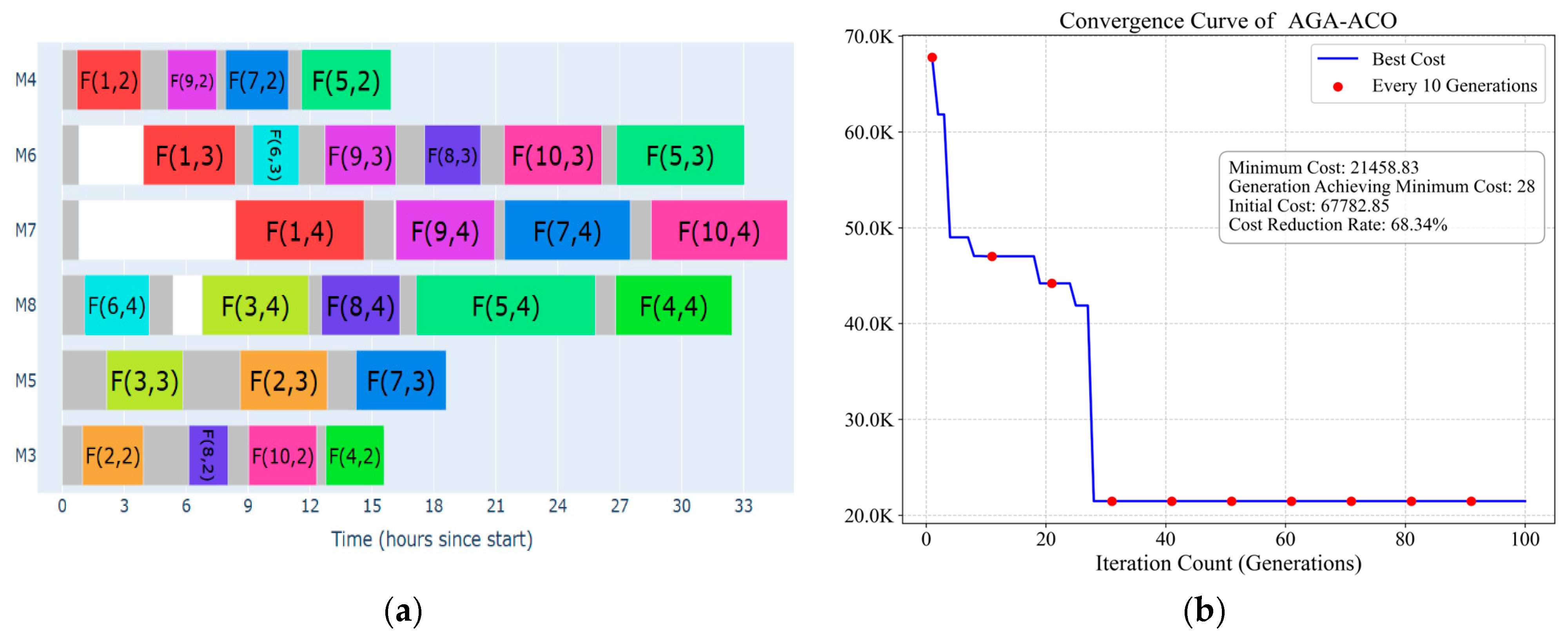
| 3 | 15.88 | 2326.64 | 2→8→10→4 |
| 4 | 16.46 | 2302.05 | 1→9→7→5 |
| 5 | 18.91 | 2068.89 | 3→2→7 |
| 6 | 33.30 | 3948.08 | 1→6→9→8→10→5 |
| 7 | 35.23 | 5138.18 | 1→9→7→10 |
| 8 | 32.72 | 5674.00 | 6→3→8→5→4 |
| Total | 152.49 | 21,458.83 |
| Algorithm | Farmland Plots | Tasks | Time (h) | Cost (¥) | Iterations |
|---|---|---|---|---|---|
| AGA-ACO | 15 | 38 | 216.24 | 35,766.41 ± 1326 | 47 ± 1.86 |
| 20 | 50 | 284.47 | 52,214.63 ± 1845 | 53 ± 2.35 | |
| 30 | 68 | 412.18 | 68,694.24 ± 2146 | 61 ± 2.88 | |
| GA | 15 | 38 | 235.41 | 40,125.67 ± 2318 | 66 ± 2.56 |
| 20 | 50 | 288.49 | 56,654.32 ± 2672 | 70 ± 3.56 | |
| 30 | 68 | 432.25 | 73,024.63 ± 2634 | 65 ± 3.77 | |
| ACO | 15 | 38 | 223.59 | 38,764.37 ± 1885 | 67 ± 2.47 |
| 20 | 50 | 296.47 | 55,234.73 ± 2418 | 66 ± 3.12 | |
| 30 | 68 | 421.24 | 74,325.61 ± 2872 | 68 ± 3.21 | |
| PSO | 15 | 38 | 226.36 | 39,524.26 ± 1617 | 41 ± 3.18 |
| 20 | 50 | 297.34 | 57,256.32 ± 2623 | 52 ± 3.58 | |
| 30 | 68 | 433.56 | 73,265.36 ± 3012 | 64 ± 3.49 |
| Algorithm | 15 Farmlands | 20 Farmlands | 30 Farmlands | ||||||
|---|---|---|---|---|---|---|---|---|---|
| Cost | Iter | Gap (%) 1 | Cost | Iter | Gap (%) | Cost | Iter | Gap (%) | |
| GA-Base | 40,126 ± 2318 | 66 | +12.2 | 56,654 ± 2672 | 70 | +8.5 | 73,025 ± 2634 | 65 | +6.3 |
| AGA | 36,890 ± 1520 | 52 | +3.1 | 53,850 ± 1923 | 59 | +3.1 | 71,187 ± 2566 | 58 | +3.6 |
| GA-ACO | 37,315 ± 1950 | 58 | +4.3 | 54,180 ± 2341 | 62 | +3.8 | 70,220 ± 2879 | 67 | +2.2 |
| AGA-ACO | 35,766 ± 1326 | 47 | 0.0 | 52,215 ± 1845 | 53 | 0.0 | 68,694 ± 2146 | 61 | 0.0 |
Disclaimer/Publisher’s Note: The statements, opinions and data contained in all publications are solely those of the individual author(s) and contributor(s) and not of MDPI and/or the editor(s). MDPI and/or the editor(s) disclaim responsibility for any injury to people or property resulting from any ideas, methods, instructions or products referred to in the content. |
© 2025 by the authors. Licensee MDPI, Basel, Switzerland. This article is an open access article distributed under the terms and conditions of the Creative Commons Attribution (CC BY) license (https://creativecommons.org/licenses/by/4.0/).
Share and Cite
Dai, L.; Jin, Z.; Zhao, X.; Du, X.; Ma, Z. Adaptive Genetic Algorithm Integrated with Ant Colony Optimization for Multi-Task Agricultural Machinery Scheduling. Agriculture 2025, 15, 2319. https://doi.org/10.3390/agriculture15222319
Dai L, Jin Z, Zhao X, Du X, Ma Z. Adaptive Genetic Algorithm Integrated with Ant Colony Optimization for Multi-Task Agricultural Machinery Scheduling. Agriculture. 2025; 15(22):2319. https://doi.org/10.3390/agriculture15222319
Chicago/Turabian StyleDai, Li, Zhikai Jin, Xiong Zhao, Xiaoqiang Du, and Zenghong Ma. 2025. "Adaptive Genetic Algorithm Integrated with Ant Colony Optimization for Multi-Task Agricultural Machinery Scheduling" Agriculture 15, no. 22: 2319. https://doi.org/10.3390/agriculture15222319
APA StyleDai, L., Jin, Z., Zhao, X., Du, X., & Ma, Z. (2025). Adaptive Genetic Algorithm Integrated with Ant Colony Optimization for Multi-Task Agricultural Machinery Scheduling. Agriculture, 15(22), 2319. https://doi.org/10.3390/agriculture15222319