Assessing the Presence of a Monoculture: From Definition to Quantification


Abstract
1. Introduction—Definition of Monoculture
2. Monoculture Indexes
- Herfindahl–Hirschman concentration index:
- Ogive concentration index:
- Gini concentration index, whose calculation requires an ascending sorting of single-crop areas yi (i = 1…N). The Gini index assessment can be performed in different ways, which give the same results:where ci is the cumulative relative frequency of pi.
- Shannon diversification index:
3. The Constraints of Limiting the Area
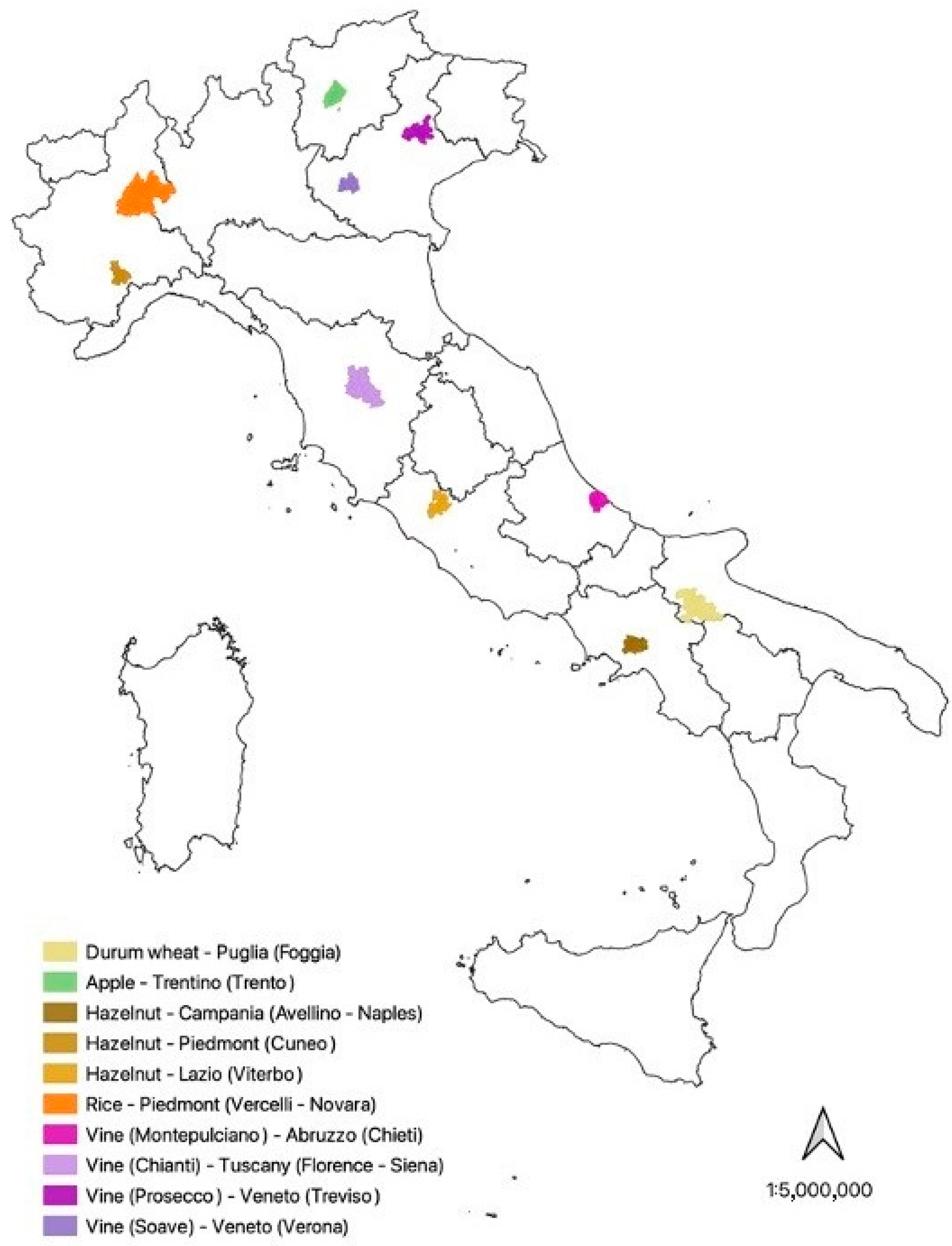
4. Examples of Possible Monocultures in Italy
- Vine (Prosecco)—region: Veneto (Province: Treviso);
- Vine (Soave)—region: Veneto (Province: Verona);
- Vine (Chianti)—region: Tuscany (Provinces: Florence–Siena);
- Vine (Montepulciano)—region: Abruzzo (Province: Chieti);
- Apple—region: Trentino Alto-Adige (Province: Trento);
- Hazelnut—region: Piedmont (Province: Cuneo);
- Hazelnut—region: Lazio (Province: Viterbo);
- Hazelnut—region: Campania (Provinces: Avellino–Napoli);
- Durum wheat—region: Puglia (Province: Foggia);
- Rice—region: Piedmont (Provinces: Vercelli–Novara).
5. Conclusions
Author Contributions
Funding
Institutional Review Board Statement
Informed Consent Statement
Data Availability Statement
Conflicts of Interest
References
- Cook, R.J.; Weller, D.M. In defense of crop monoculture. In ‘Proceedings 4th International Crop Science Congress’; The Regional Institute Ltd.: Gosford, NSW, Australia, 2004. [Google Scholar]
- Connor, D.J.; Loomis, R.S.; Cassman, K.G. Crop Ecology. In Productivity and Management in Agricultural Systems; Cambridge University Press: Cambridge, UK, 2011. [Google Scholar]
- Sethuraman, G.; Mohd Zain, N.A.; Yusoff, S.; Ng, Y.M.; Baisakh, N.; Cheng, A. Revamping Ecosystem Services through Agroecology—The Case of Cereals. Agriculture 2021, 11, 204. [Google Scholar] [CrossRef] [Scilit]
- Sharma, G.; Shrestha, S.; Kunwar, S.; Tseng, T.-M. Crop Diversification for Improved Weed Management: A Review. Agriculture 2021, 11, 461. [Google Scholar] [CrossRef] [Scilit]
- Miller, G.T.; Spoolman, S.E. Living in the Environment: Principles, Connections, and Solutions; Cengage Learning Inc.: Boston, MA, USA, 2009. [Google Scholar]
- Baruah, U.D.; Mili, N.; Basumatary, M.; Saikia, A. Assessment of Spatial Pattern and Distribution of Major Crops in Assam, India. Space Cult. 2020, 7, 92–108. [Google Scholar] [CrossRef] [Scilit]
- Pal, S.; Kar, S. Implications of the methods of agricultural diversification in reference with Malda district: Drawback and rationale. Int. J. Food Agric. Vet. Sci. 2012, 2, 97–105. [Google Scholar]
- Ang, F.; Mortimer, S.M.; Areal, F.J.; Tiffin, R. On the Opportunity Cost of Crop Diversification. J. Agric. Econ. 2018, 69, 794–814. [Google Scholar] [CrossRef] [Scilit]
- Ochoa, W.S.M.; Härtlb, F.H.; Paul, C.; Knoke, T. Cropping systems are homogenized by farm income – Empirical evidence from small-scale farming systems in dry forests of southern Ecuador. Land Use Policy 2019, 82, 204–219, (Cited 2 times). [Google Scholar] [CrossRef] [Scilit]
- Li, H.; Wu, J. Use and misuse of landscape indices. Landsc. Ecol. 2004, 19, 389–399. [Google Scholar] [CrossRef] [Scilit]
- Weitzman, M.L. Economic profitability versus ecological entropy. Q. J. Econ. 2000, 115, 237–263. [Google Scholar] [CrossRef] [Scilit]
- Di Falco, S.; Chavas, J.-P. Rainfall shocks, resilience, and the effects of crop biodiversity on agroecosystem productivity. Land Econ. 2008, 84, 83–96. [Google Scholar] [CrossRef] [Scilit]
- Abson, D.J.; Fraser, E.D.G.; Benton, T.G. Landscape diversity and the resilience of agricultural returns: A portfolio analysis of land-use patterns and economic returns from lowland agriculture. Agric. Food Secur. 2013, 2, 1–15. [Google Scholar] [CrossRef] [Scilit]
- Sipiläinen, T.; Huhtala, A. Opportunity costs of providing crop diversity in organic and conventional farming: Would targeted environmental policies make economic sense? Eur. Rev. Agric. Econ. 2013, 40, 441–462. [Google Scholar] [CrossRef] [Scilit]
- Smith, E.G.; Young, D.L.; Zentner, R.P. Prairie Crop Diversification, Current Agriculture. Food Resour. Issues 2001, 2, 37–47. [Google Scholar]
- Visentini, F.; Vallerani, F. A countryside to sip: Venice inland and the Prosecco’s uneasy relationship with wine tourism and rural exploitation. Sustainability 2018, 10, 2195. [Google Scholar] [CrossRef] [Scilit]
- Basso, M. From daily land-use practice to global phenomenon. On the origin and recent evolution of prosecco’s wine landscape (Italy). Misc. Geogr. 2018, 22, 109–115. [Google Scholar] [CrossRef] [Scilit]
- Basso, M.; Fregolent, L. Fighting Against Monocultures: Wine-Growing and Tourism in the Veneto Region. In Social Movements and Public Policies in Southern European Cities; Fregolent, L., Nello, O., Eds.; Springer Nature: Berlin/Heidelberg, Germany, 2020; pp. 151–165. [Google Scholar]
- Marinia, L.; Quaranta, M.; Fontana, P.; Biesmeijer, J.C.; Bommarco, R. Landscape context and elevation affect pollinator communities in intensive apple orchards. Basic Appl. Ecol. 2012, 13, 681–689. [Google Scholar] [CrossRef] [Scilit]
- Marongiu, S.; Cesaro, L. Cooperation as a factor of territorial competitiveness: The local system of apple production in Trentino. In Proceedings of the 1st Congress of Bioeconomy and Sustainable Development of Agriculture, Georgian Association of Bioeconomy, Tblisi, Georgia, 11–12 October 2013. [Google Scholar]
- Franco, S.; Marongiu, S. A district for the hazelnut sector: Rural or agro-food system? Analysis of national and regional laws for the governance of Monti Cimini territory. Acta Hort. (ISHS) 2009, 845, 775–782. [Google Scholar] [CrossRef] [Scilit]
- Franco, S.; Pancino, B.; Cristofori, V. Hazelnut production and local development in Italy. Acta Hort. (ISHS) 2014, 1052, 347–352. [Google Scholar] [CrossRef] [Scilit]
- Coppola, G.; Costantini, M.; Orsi, L.; Facchinetti, D.; Santoro, F.; Pessina, D.; Bacenetti, J. A Comparative Cost-Benefit Analysis of Conventional and Organic Hazelnuts Production Systems in Center Italy. Agriculture 2020, 10, 409. [Google Scholar] [CrossRef] [Scilit]
- Nera, E.; Paas, W.; Reidsma, P.; Paolini, G.; Antonioli, F.; Severini, S. Assessing the Resilience and Sustainability of a Hazelnut Farming System in Central Italy with a Participatory Approach. Sustainability 2020, 12, 343. [Google Scholar] [CrossRef] [Scilit]
- Bernardoni, E.; Acutis, M.; Ventrella, D. Long-term durum wheat monoculture: Modelling and future projection. Ital. J. Agron. 2012, 7, 86–92. [Google Scholar] [CrossRef] [Scilit]
- Ventrella, D.; Stellacci, A.M.; Castrignano, A.; Charfeddine, M.; Castellini, M. Effects of crop residue management on winter durum wheat productivity in a long term experiment in Southern Italy. Eur. J. Agron. 2016, 77, 188–198. [Google Scholar] [CrossRef] [Scilit]
- Ben Hassen, M.; Monaco, F.; Facchi, A.; Romani, M.; Valè, G.; Sali, G. Economic Performance of Traditional and Modern Rice Varieties under Different Water Management Systems. Sustainability 2017, 9, 347. [Google Scholar] [CrossRef] [Scilit]
- Mascanzoni, E.; Perego, A.; Marchi, N.; Scarabel, L.; Panozzo, S.; Ferrero, A.; Acutis, M.; Sattin, M. Epidemiology and agronomic predictors of herbicide resistance in rice at a large scale. Agron. Sustain. Dev. 2018, 38, 1–10. [Google Scholar] [CrossRef] [Scilit]



| Region | Area (ha) | Agricultural Area (ha) | Crop Area (ha) | Crop Area/ Agricultural Area | Crop Area/ Total Crop | Shannon Index |
|---|---|---|---|---|---|---|
| Small | 10,000 | 8000 | 6000 | 75% | 48% | 0.60 |
| Medium | 20,000 | 15,000 | 9000 | 60% | 72% | 0.45 |
| Large | 40,000 | 30,000 | 12,000 | 40% | 96% | 0.25 |
| Region | Total Area (ha) | Agricultural Area (ha) | Crop Area (ha) | Crop Area/ Agricultural |
|---|---|---|---|---|
| Vine—Prosecco (Veneto) | 45,903 | 16,921 | 8131 | 48.1% |
| Vine—Soave (Veneto) | 30,327 | 18,635 | 12,326 | 66.1% |
| Vine—Chianti (Tuscany) | 95,702 | 31,909 | 11,778 | 36.9% |
| Vine—Montepulciano (Abruzzo) | 28,377 | 17,649 | 12,340 | 69.9% |
| Apple (Trentino) | 37,351 | 10,067 | 6320 | 62.8% |
| Hazelnut (Piedmont) | 29,458 | 11,197 | 4741 | 42.3% |
| Hazelnut (Lazio) | 37,978 | 21,266 | 14,008 | 65.9% |
| Hazelnut (Campania) | 35,244 | 11,480 | 7546 | 65.7% |
| Durum wheat (Puglia) | 93,014 | 68,483 | 50,874 | 74.3% |
| Rice (Piedmont) | 160,813 | 124,226 | 104,585 | 84.2% |
| Shannon Index | Gini Index | Herfindahl Index | Ogive Index | |
|---|---|---|---|---|
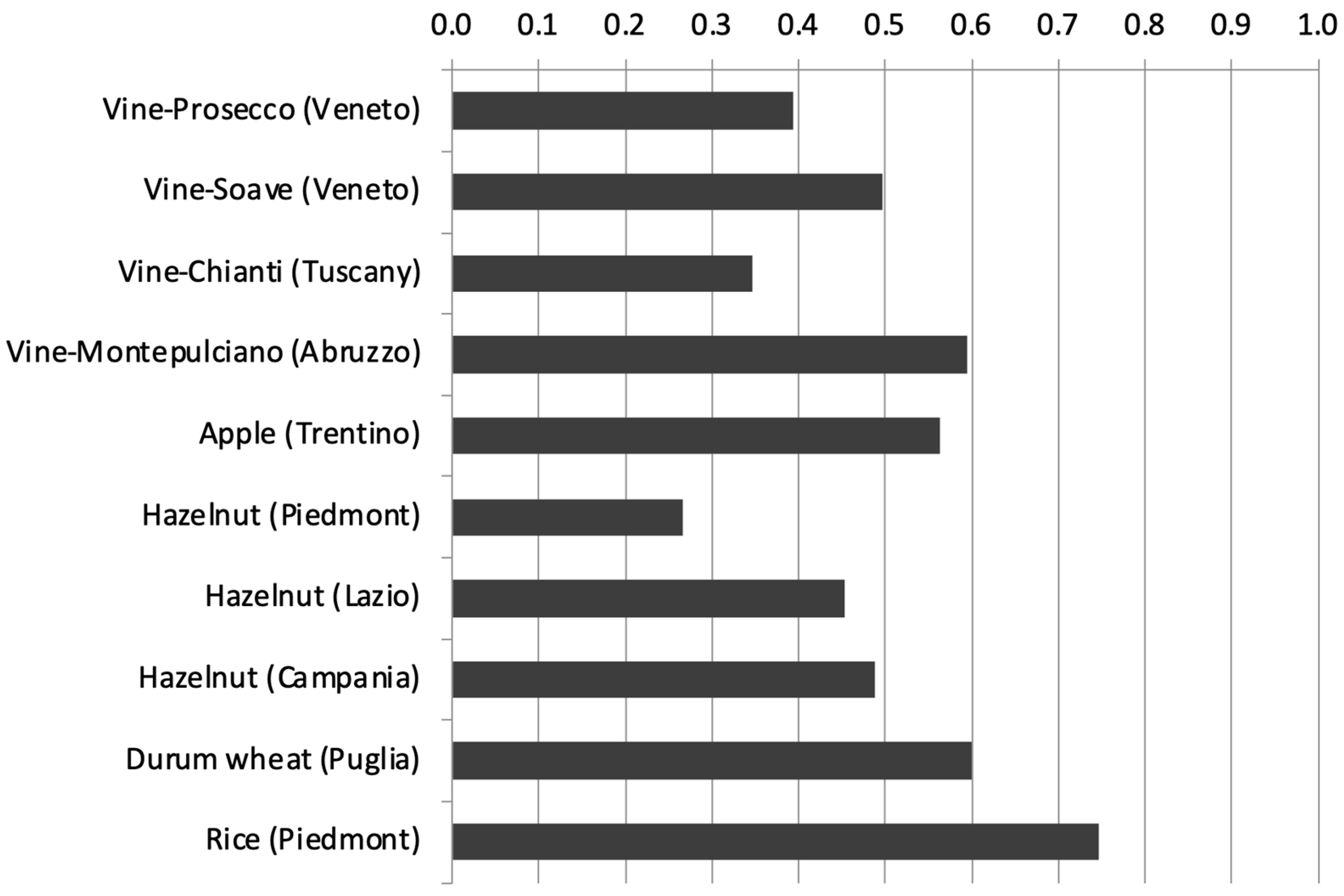
| Vine—Prosecco (Veneto) | 0.394 | 0.780 | 0.300 | 0.247 |
| Vine—Soave (Veneto) | 0.497 | 0.809 | 0.452 | 0.420 |
| Vine—Chianti (Tuscany) | 0.346 | 0.758 | 0.227 | 0.176 |
| Vine—Montepulciano (Abruzzo) | 0.595 | 0.878 | 0.521 | 0.487 |
| Apple (Trentino) | 0.563 | 0.833 | 0.514 | 0.417 |
| Hazelnut (Piedmont) | 0.267 | 0.647 | 0.233 | 0.174 |
| Hazelnut (Lazio) | 0.454 | 0.778 | 0.453 | 0.399 |
| Hazelnut (Campania) | 0.488 | 0.820 | 0.457 | 0.407 |
| Durum wheat (Puglia) | 0.600 | 0.866 | 0.560 | 0.537 |
| Rice (Piedmont) | 0.747 | 0.941 | 0.717 | 0.698 |
| Mean | 0.495 | 0.811 | 0.443 | 0.396 |
| Standard deviation | 0.140 | 0.079 | 0.153 | 0.163 |
| Variation coefficient | 28.2% | 9.8% | 34.6% | 41.3% |
| Shannon | GINI | Herfindal | Ogive | |
|---|---|---|---|---|
| Shannon | 1.000 | |||
| GINI | 0.967 | 1.000 | ||
| Herfindahl | 0.976 | 0.903 | 1.000 | |
| Ogive | 0.973 | 0.909 | 0.992 | 1.000 |
| Monoculture | Crop Area 2010–2020 |
|---|---|
| Vine—Prosecco (Veneto) | 36.2% |
| Vine—Soave (Veneto) | 0.9% |
| Vine—Chianti (Tuscany) | −2.2% |
| Vine—Montepulciano (Abruzzo) | −1.0% |
| Apple (Trentino) | −5.4% |
| Hazelnut (Piedmont) | 41.1% |
| Hazelnut (Lazio) | 27.2% |
| Hazelnut (Campania) | 24.4% |
| Durum wheat (Puglia) | 3.9% |
| Rice (Piedmont) | −7.8% |
Publisher’s Note: MDPI stays neutral with regard to jurisdictional claims in published maps and institutional affiliations. |
© 2022 by the authors. Licensee MDPI, Basel, Switzerland. This article is an open access article distributed under the terms and conditions of the Creative Commons Attribution (CC BY) license (https://creativecommons.org/licenses/by/4.0/).
Share and Cite
Franco, S.; Pancino, B.; Martella, A.; De Gregorio, T. Assessing the Presence of a Monoculture: From Definition to Quantification. Agriculture 2022, 12, 1506. https://doi.org/10.3390/agriculture12091506
Franco S, Pancino B, Martella A, De Gregorio T. Assessing the Presence of a Monoculture: From Definition to Quantification. Agriculture. 2022; 12(9):1506. https://doi.org/10.3390/agriculture12091506
Chicago/Turabian StyleFranco, Silvio, Barbara Pancino, Angelo Martella, and Tommaso De Gregorio. 2022. "Assessing the Presence of a Monoculture: From Definition to Quantification" Agriculture 12, no. 9: 1506. https://doi.org/10.3390/agriculture12091506
APA StyleFranco, S., Pancino, B., Martella, A., & De Gregorio, T. (2022). Assessing the Presence of a Monoculture: From Definition to Quantification. Agriculture, 12(9), 1506. https://doi.org/10.3390/agriculture12091506