Improving Rural Livelihood through the Cultivation of Indigenous Fruits and Vegetables: Evidence from Ondo State, Nigeria

 ,
, 
Abstract
:1. Introduction
2. Materials and Methods
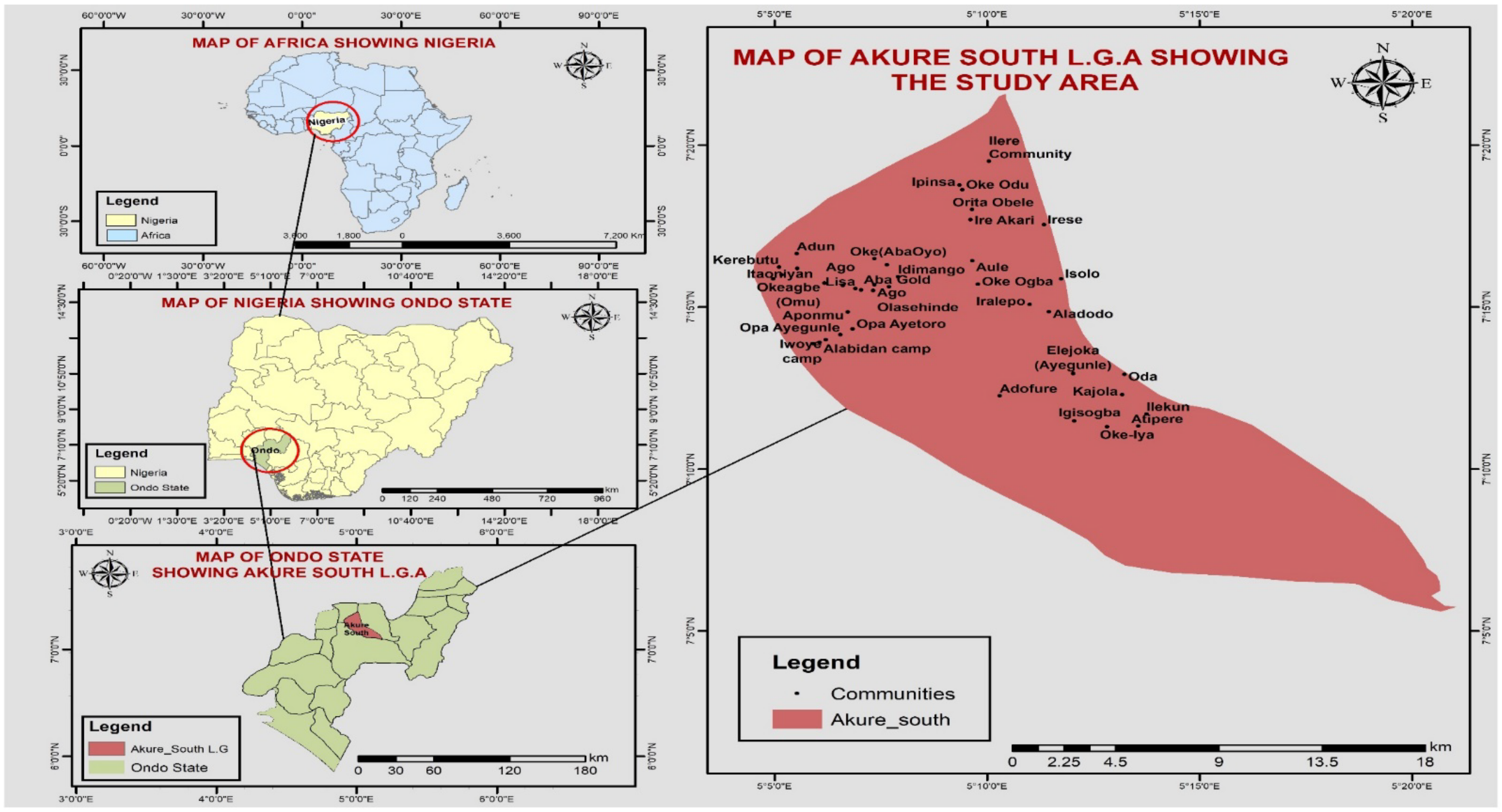
2.1. Study Area
2.2. Data Sampling Methods and Sample Size
2.3. Research Instrument, Validity, and Reliability
2.4. Econometric Model Specification
2.4.1. Probit Regression Analysis of Factors Influencing the Decisions of Participants to Utilize Their Lands for Cultivating Indigenous Fruits and Vegetables
2.4.2. Principal Component Analysis of the Livelihood Asset Index Generation
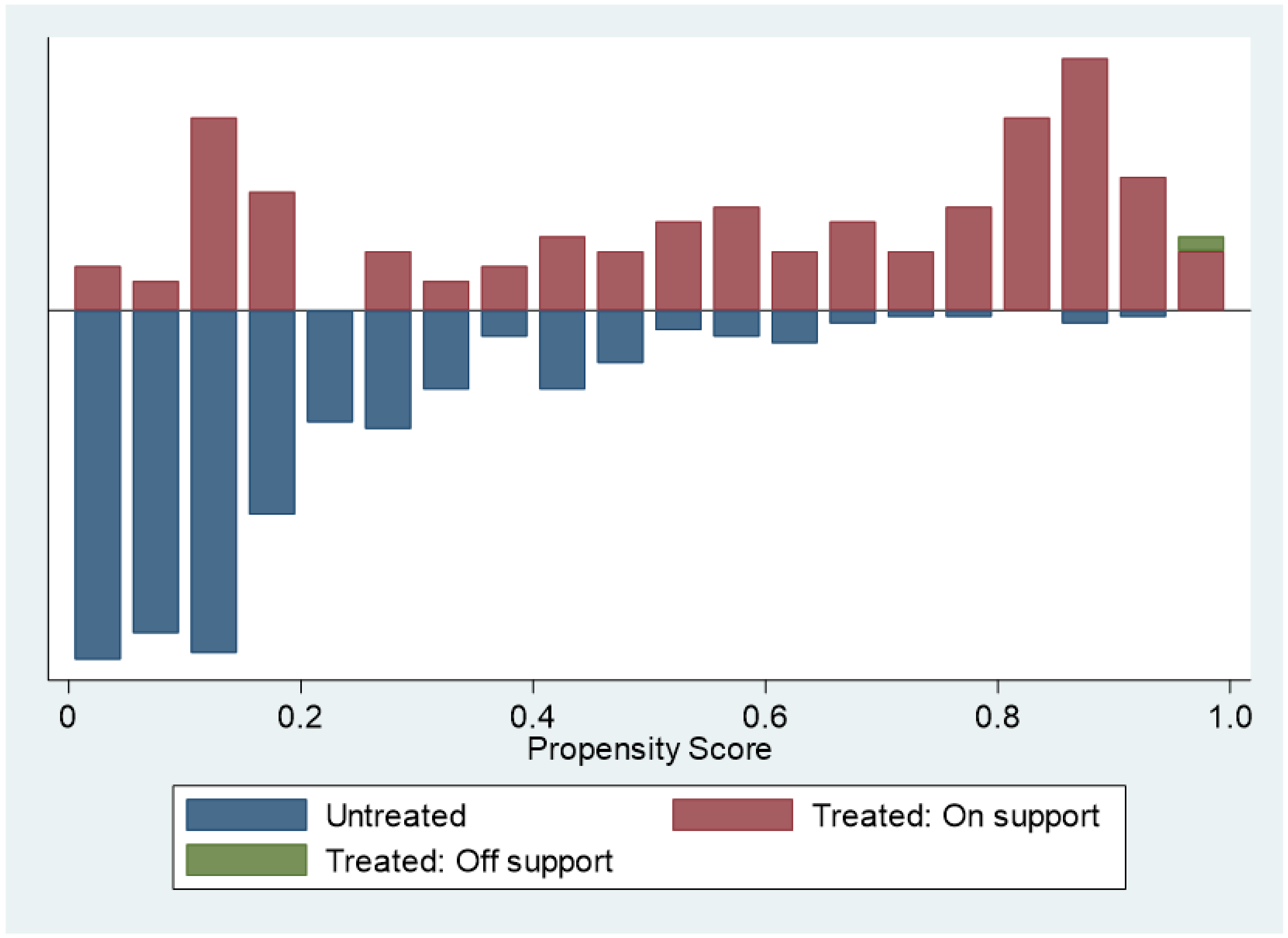
2.4.3. Impact of Cultivating Indigenous Fruits and Vegetables on their Livelihoods Using Propensity Score Matching
2.4.4. Estimating the Impact (Average Treatment Effect on the Treated)
2.5. Ethical Approval
3. Results and Discussion
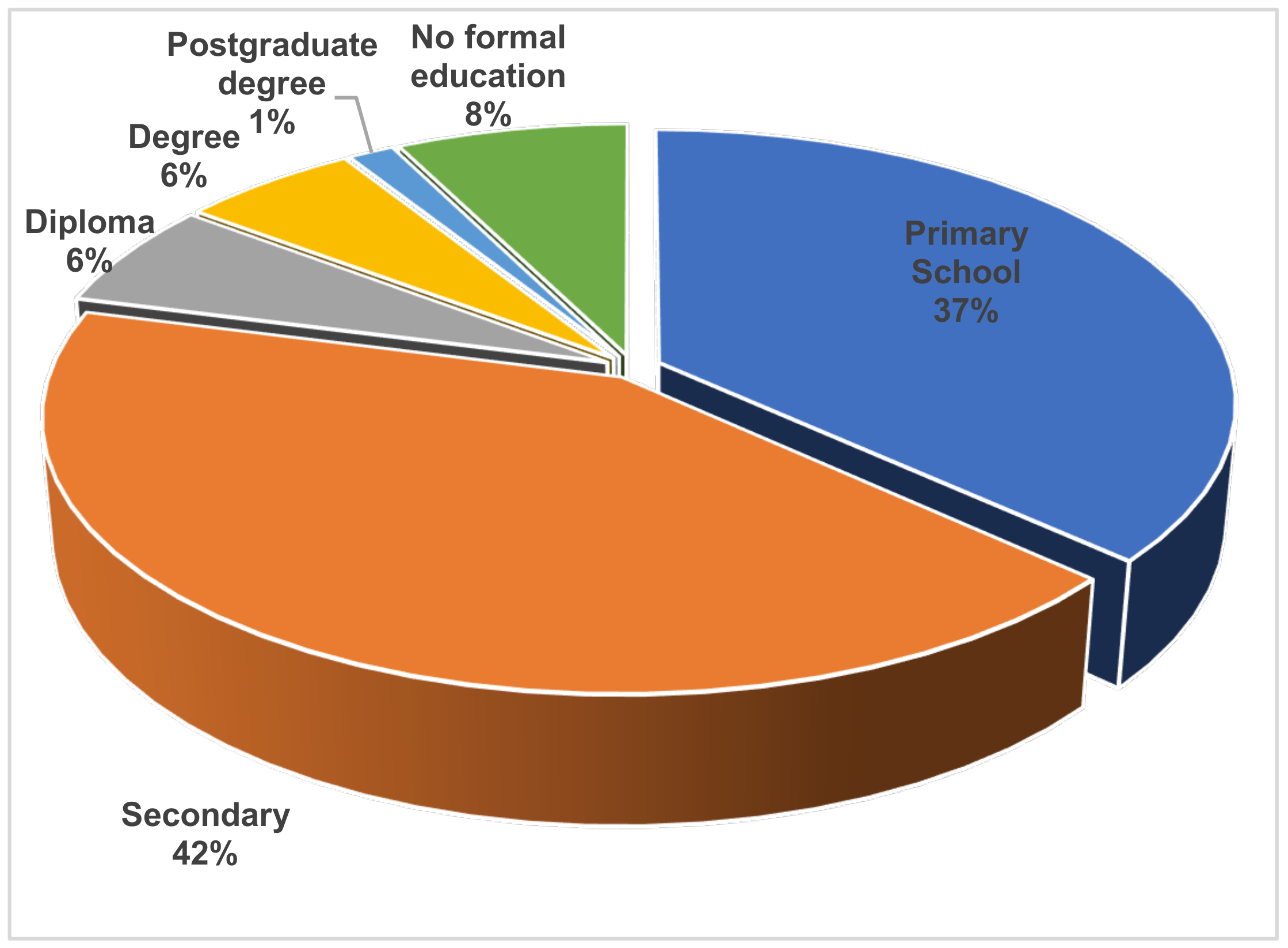
3.1. Socioeconomic Characteristics versus Land Utilization Status of the Participants
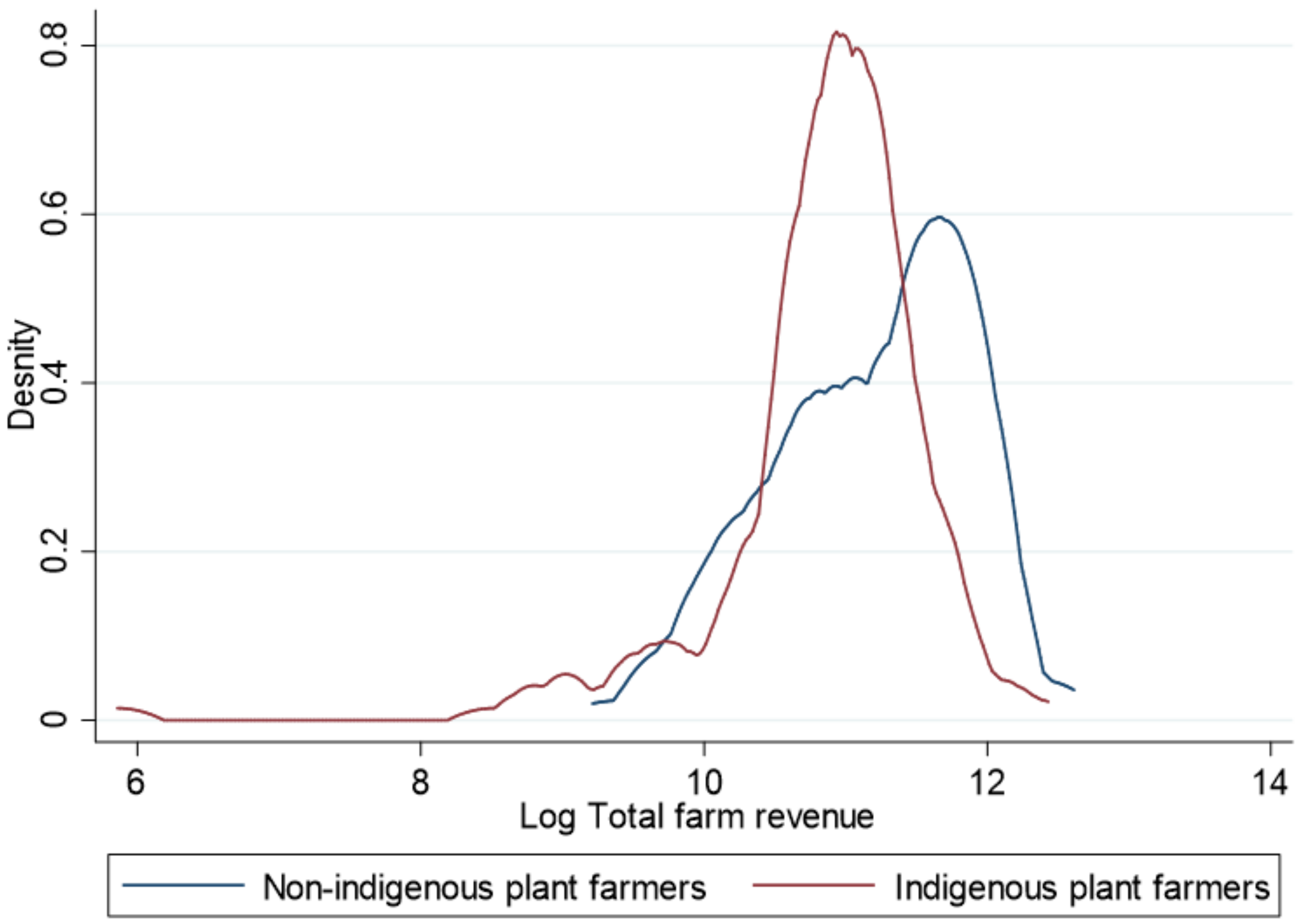
3.2. Land Utilization and Total Farm Revenue
3.3. Gross Margin Analysis Result
3.4. Factors Influencing Their Decision to Utilize Lands to Cultivate Indigenous Fruits and Vegetables
3.5. Impact of Cultivating Indigenous Fruits and Vegetables on Livelihood Outcome of Farmers’
4. The Study Limitations
5. Conclusions and Recommendations
Author Contributions
Funding
Institutional Review Board Statement
Informed Consent Statement
Data Availability Statement
Acknowledgments
Conflicts of Interest
References
- Knickel, K.; Redman, M.; Darnhofer, I.; Ashkenazy, A.; Chebach, T.C.; Šūmane, S.; Tisenkopfs, T.; Zemeckis, R.; Atkociuniene, V.; Rivera, M. Between aspirations and reality: Making farming, food systems and rural areas more resilient, sustainable and equitable. J. Rural Stud. 2018, 59, 197–210. [Google Scholar] [CrossRef] [Green Version]
- Dengerink, J.; Dirks, F.; Likoko, E.; Guijt, J. One size doesn’t fit all: Regional differences in priorities for food system transformation. Food Secur. 2021, 13, 1455–1466. [Google Scholar] [CrossRef]
- Mustafa, M.A.; Mabhaudhi, T.; Avvari, M.V.; Massawe, F. Transition toward sustainable food systems: A holistic pathway toward sustainable development. In Food Security and Nutrition; Elsevier: Amsterdam, The Netherlands, 2021; pp. 33–56. [Google Scholar]
- Bouazza, A.B. Small and medium enterprises as an effective sector for economic development and employment creation in Algeria. Int. J. Econ. Commer. Manag. 2015, 3, 1–16. [Google Scholar]
- Garbero, A.; Resce, G.; Carneiro, B. Spatial dynamics across food systems transformation in IFAD investments: A machine learning approach. Food Secur. 2021, 13, 1125–1143. [Google Scholar] [CrossRef]
- Bongaarts, J.; FAO; IFAD; UNICEF; WFP; WHO. The State of Food Security and Nutrition in the World 2020. Transforming Food Systems for Affordable Healthy Diets; FAO: Rome, Italy, 2020; p. 320. [Google Scholar]
- Ruben, R.; Cavatassi, R.; Lipper, L.; Smaling, E.; Winters, P. Towards food systems transformation—Five paradigm shifts for healthy, inclusive and sustainable food systems. Food Secur. 2021, 13, 1423–1430. [Google Scholar] [CrossRef]
- Ribeiro, H.; Jaime, P.C.; Ventura, D. Alimentação e sustentabilidade. Estud. Avançados 2017, 31, 185–198. [Google Scholar] [CrossRef] [Green Version]
- Gonçalves, C.D.B.Q.; Schlindwein, M.M.; Martinelli, G.D.C. Agroforestry systems: A systematic review focusing on traditional indigenous practices, food and nutrition security, economic viability, and the role of women. Sustainability 2021, 13, 11397. [Google Scholar] [CrossRef]
- Imathiu, S. Neglected and underutilized cultivated crops with respect to indigenous African leafy vegetables for food and nutrition security. J. Food Secur. 2021, 9, 115–125. [Google Scholar] [CrossRef]
- Awodoyin, R.O.; Olubode, O.S.; Ogbu, J.U.; Balogun, R.B.; Nwawuisi, J.U.; Orji, K.O. Indigenous fruit trees of tropical Africa: Status, opportunity for development and biodiversity management. Agric. Sci. 2015, 6, 31. [Google Scholar] [CrossRef] [Green Version]
- Omotayo, A.O.; Aremu, A.O. Underutilized African indigenous fruit trees and food–nutrition security: Opportunities, challenges, and prospects. Food Energy Secur. 2020, 9, e220. [Google Scholar] [CrossRef]
- Omotayo, A.O.; Ndhlovu, P.T.; Tshwene, S.C.; Aremu, A.O. Utilization pattern of indigenous and naturalized plants among some selected rural households of North West Province, South Africa. Plants 2020, 9, 953. [Google Scholar] [CrossRef]
- Adebooye, O.; Ogbe, F.; Bamidele, J. Ethnobotany of indigenous leaf vegetables of Southwest Nigeria. Delpinoa 2003, 45, 295–299. [Google Scholar]
- Maroyi, A. Traditional homegardens and rural livelihoods in Nhema, Zimbabwe: A sustainable agroforestry system. Int. J. Sustain. Dev. World Ecol. 2009, 16, 1–8. [Google Scholar] [CrossRef] [Green Version]
- Kehlenbeck, K.; Asaah, E.; Jamnadass, R. Diversity of indigenous fruit trees and their contribution to nutrition and livelihoods in sub-Saharan Africa: Examples from Kenya and Cameroon. In Diversifying Food and Diets: Using Agricultural Biodiversity to Improve Nutrition and Health; FAO: Rome, Italy, 2013; pp. 257–269. [Google Scholar]
- Shumsky, S.A.; Hickey, G.M.; Pelletier, B.; Johns, T. Understanding the contribution of wild edible plants to rural social-ecological resilience in semi-arid Kenya. Ecol. Soc. 2014, 19, 1–21. [Google Scholar] [CrossRef] [Green Version]
- Nnadi, F.; Chikaire, J.; Ezudike, K. Assessment of indigenous knowledge practices for sustainable agriculture and food security in Idemili South Local Government Area of Anambra State, Nigeria. J. Resour. Dev. Manag. 2013, 1, 1–8. [Google Scholar]
- Wood, A.P.; Dixon, A.; McCartney, M.P. Wetland Management and Sustainable Livelihoods in Africa; Routledge/Earthscan from Routledge: Oxford, UK, 2013. [Google Scholar]
- Leakey, R.R.; Tchoundjeu, Z.; Schreckenberg, K.; Shackleton, S.E.; Shackleton, C.M. Agroforestry tree products (AFTPs): Targeting poverty reduction and enhanced livelihoods. Int. J. Agric. Sustain. 2005, 3, 1–23. [Google Scholar] [CrossRef]
- Cunningham, A.B. Applied Ethnobotany: People, Wild Plant Use and Conservation; Routledge: Oxford, UK, 2014. [Google Scholar]
- Awoyemi, O.; Abdulkarim, I.; Ewa, E.; Aduloju, A. Ethnobotanical assessment of herbal plants in South-Western Nigeria. Acad. Res. Int. 2012, 2, 50. [Google Scholar]
- Bassey, C.; Ikpi, L. Perception of utilitarian values of agrobiodiversity by rural farmers in Akwa Ibom State, Nigeria. Afr. J. Agric. Res. 2011, 6, 6622–6634. [Google Scholar]
- Afolabi, O.J.; Akinneye, J.O.; Igiekhume, A.M. Identification, abundance, and diversity of mosquitoes in Akure South Local Government Area, Ondo State, Nigeria. J. Basic Appl. Zool. 2019, 80, 1–7. [Google Scholar] [CrossRef]
- Daniel, O.A. Urban extreme weather: A challenge for a healthy Living environment in Akure, Ondo State, Nigeria. Climate 2015, 3, 775–791. [Google Scholar] [CrossRef] [Green Version]
- Guest, G. Sampling and selecting participants in field research. Handb. Methods Cult. Anthropol. 2014, 2, 215–249. [Google Scholar]
- Omotayo, A.O.; Oladejo, A.J. Profitability of cassava-based production systems. J. Hum. Ecol. 2016, 56, 196–203. [Google Scholar] [CrossRef]
- Omotayo, A.O.; Aremu, A.O. Evaluation of factors influencing the inclusion of indigenous plants for food security among rural households in the North West Province of South Africa. Sustainability 2020, 12, 9562. [Google Scholar] [CrossRef]
- Olagunju, K.O.; Ogunniyi, A.I.; Oyetunde-Usman, Z.; Omotayo, A.O.; Awotide, B.A. Does agricultural cooperative membership impact technical efficiency of maize production in Nigeria: An analysis correcting for biases from observed and unobserved attributes. PLoS ONE 2021, 16, e0245426. [Google Scholar] [CrossRef]
- Ogunniyi, A.I.; Omotoso, S.O.; Salman, K.K.; Omotayo, A.O.; Olagunju, K.O.; Aremu, A.O. Socio-economic drivers of food security among rural households in Nigeria: Evidence from smallholder maize farmers. Soc. Indic. Res. 2021, 155, 583–599. [Google Scholar] [CrossRef]
- Ogunniyi, A.; Omonona, B.; Abioye, O.; Olagunju, K. Impact of irrigation technology use on crop yield, crop income and household food security in Nigeria: A treatment effect approach. Am. Inst. Math. Sci. 2018, 3, 154–171. [Google Scholar]
- Kaza, S.; Yao, L.; Bhada-Tata, P.; Van Woerden, F. What a Waste 2.0: A Global Snapshot of Solid Waste Management to 2050; World Bank Publications: Washington, DC, USA, 2018. [Google Scholar]
- Omotayo, A.O.; Omotoso, A.B.; Daud, A.S.; Ogunniyi, A.I.; Olagunju, K.O. What drives households’ payment for waste disposal and recycling behaviours? Empirical evidence from South Africa’s general household survey. Int. J. Environ. Res. Public Health 2020, 17, 7188. [Google Scholar] [CrossRef]
- Rada, E.C.; Ragazzi, M.; Ionescu, G.; Merler, G.; Moedinger, F.; Raboni, M.; Torretta, V. Municipal solid waste treatment by integrated solutions: Energy and environmental balances. Energy Procedia 2014, 50, 1037–1044. [Google Scholar] [CrossRef] [Green Version]
- Rosenbaum, P.R.; Rubin, D.B. The central role of the propensity score in observational studies for causal effects. Biometrika 1983, 70, 41–55. [Google Scholar] [CrossRef]
- Rufai, A.M.; Ogunniyi, A.I.; Salman, K.K.; Salawu, M.B.; Omotayo, A.O. Rural transformation and labor market outcomes among rural youths in Nigeria. Sustainability 2021, 13, 13794. [Google Scholar] [CrossRef]
- Imbens, G.; Hirano, K. The propensity score with continuous treatments. Appl. Bayesian Model. Causal Inference Incomplete Data Perspect. 2004, 226164, 73–84. [Google Scholar]
- Lechner, M. Earnings and employment effects of continuous gff-the-job training in east Germany after unification. J. Bus. Econ. Stat. 1999, 17, 74–90. [Google Scholar] [CrossRef]
- Lechner, M. Identification and estimation of causal effects of multiple treatments under the conditional independence assumption. In Econometric Evaluation of Labour Market Policies; Springer: New York, NY, USA, 2001; pp. 43–58. [Google Scholar]
- Dadjo, C.; Nyende, A.B.; Salako, K.V.; Hounkpevi, A.; Assogbadjo, A.E. Socio–economic factors determining conservation and cultivation of Garcinia kola Heckel—A medicinal plant extinct in the wild in Benin. Econ. Bot. 2020, 74, 115–125. [Google Scholar] [CrossRef]
- Nkonki-Mandleni, B.; Omotayo, A.O. Exploring the living conditions at Ezakheleni informal settlement, Durban Metropolis of KwaZulu-Natal, South Africa with an upscaling motive. Int. J. 2020, 76, 11. [Google Scholar]
- Omotayo, A.O. Farming households’ environment, nutrition and health interplay in Southwest, Nigeria. Int. J. Sci. Res. Agric. Sci. 2016, 3, 84–98. [Google Scholar] [CrossRef]
- Zakaria, H. The drivers of women farmers’ participation in cash crop production: The case of women smallholder farmers in Northern Ghana. J. Agric. Educ. Ext. 2017, 23, 141–158. [Google Scholar] [CrossRef]
- Wu, C.C. Education in farm production: The case of Taiwan. Am. J. Agric. Econ. 1977, 59, 699–709. [Google Scholar] [CrossRef]
- Daud, A.S.; Awoyemi, T.; Omotoso, A.B.; Omotayo, A.O. Human capital and income diversification among crop farmers in rural Oyo State, Nigeria. J. Agribus. Rural Dev. 2018, 49, 251–260. [Google Scholar] [CrossRef]
- Cox, N.J. Speaking stata: Graphing distributions. Stata J. 2004, 4, 66–88. [Google Scholar] [CrossRef] [Green Version]
- Ojiewo, C.; Tenkouano, A.; Hughes, J.; Keatinge, J. Diversifying diets: Using indigenous vegetables to improve profitability, nutrition and health in Africa. In Diversifying Food and Diets: Using Agricultural Biodiversity to Improve Nutrition and Health’, Earthscan; Routledge: Oxford, UK, 2013; pp. 291–302. [Google Scholar]
- Mvungi, H.; Laizer, A.; Lukumay, P.J.; Ochieng, J.; Ngoteya, G.; Dinssa, F.; Simon, J.E.; Govindasamy, R.; Ndinya, C.; Odendo, M. Profitability analysis of traditional African vegetable seeds production in Kenya. J. Med. Act. Plants 2020, 9, 281–288. [Google Scholar]
- Halli, S.B.; Swamy, K.; Sankanur, M.; Yewale, A. Fruit-based agroforestry systems for food security and higher profitability. Int. J. Farm Sci. 2016, 6, 302–311. [Google Scholar]
- Burkhart, E.P.; Jacobson, M.G. Transitioning from wild collection to forest cultivation of indigenous medicinal forest plants in eastern North America is constrained by lack of profitability. Agrofor. Syst. 2009, 76, 437–453. [Google Scholar] [CrossRef]
- Grenz, J.H.; Sauerborn, J. The potential of organic agriculture to contribute to sustainable crop production and food security in Sub-Saharan Africa. J. Agric. Rural Dev. Trop. Subtrop. 2007, 89, 50–84. [Google Scholar]
- Saxena, K.; Sharma, D.; Vales, M. Development and commercialization of CMS pigeonpea hybrids. Plant Breed. Rev. 2018, 41, 103–167. [Google Scholar]
- Greene, W.H. Econometric Analysis; Pearson Education India: Delhi, India, 2003. [Google Scholar]
- Schreinemachers, P.; Wu, M.-H.; Uddin, M.N.; Ahmad, S.; Hanson, P. Farmer training in off-season vegetables: Effects on income and pesticide use in Bangladesh. Food Policy 2016, 61, 132–140. [Google Scholar] [CrossRef] [Green Version]
- Aubert, B.A.; Schroeder, A.; Grimaudo, J. IT as enabler of sustainable farming: An empirical analysis of farmers’ adoption decision of precision agriculture technology. Decis. Support Syst. 2012, 54, 510–520. [Google Scholar] [CrossRef] [Green Version]
- Doss, C.R. Analyzing technology adoption using microstudies: Limitations, challenges, and opportunities for improvement. Agric. Econ. 2006, 34, 207–219. [Google Scholar] [CrossRef]
- Paudel Khatiwada, S.; Deng, W.; Paudel, B.; Khatiwada, J.R.; Zhang, J.; Su, Y. Household livelihood strategies and implication for poverty reduction in rural areas of central Nepal. Sustainability 2017, 9, 612. [Google Scholar] [CrossRef] [Green Version]
- Fox, L.; Sohnesen, T.P. Household enterprises in Sub-Saharan Africa: Why they matter for growth, jobs, and livelihoods. World Bank Policy Res. Work. Pap. 2012, 6184, 1–55. [Google Scholar]
- Kuivanen, K.; Alvarez, S.; Michalscheck, M.; Adjei-Nsiah, S.; Descheemaeker, K.; Mellon-Bedi, S.; Groot, J.C. Characterising the diversity of smallholder farming systems and their constraints and opportunities for innovation: A case study from the Northern Region, Ghana. NJAS Wagening. J. Life Sci. 2016, 78, 153–166. [Google Scholar] [CrossRef]
- Shukla, M.; Jharkharia, S. Agri-fresh produce supply chain management: A state-of-the-art literature review. Int. J. Oper. Prod. Manag. 2013, 33, 114–158. [Google Scholar] [CrossRef]
- Gardas, B.B.; Raut, R.D.; Cheikhrouhou, N.; Narkhede, B.E. A hybrid decision support system for analyzing challenges of the agricultural supply chain. Sustain. Prod. Consum. 2019, 18, 19–32. [Google Scholar] [CrossRef]
- Muimba-Kankolongo, A. Food Crop Production by Smallholder Farmers in Southern Africa: Challenges and Opportunities for Improvement; Academic Press: Cambridge, MA, USA, 2018. [Google Scholar]
- Tanimonure, V.A.; Naziri, D.; Codjoe, S.N.A.; Ayanwale, A.B. Underutilised indigenous vegetables for household dietary diversity in Southwest Nigeria. Agriculture 2021, 11, 1064. [Google Scholar] [CrossRef]
- Muhanji, G.; Roothaert, R.L.; Webo, C.; Stanley, M. African indigenous vegetable enterprises and market access for small-scale farmers in East Africa. Int. J. Agric. Sustain. 2011, 9, 194–202. [Google Scholar] [CrossRef] [Green Version]



| S/N | Botanical Name | Family | * Vernacular Name | Commonly Utilized Plant Parts |
|---|---|---|---|---|
| 16 Selected Indigenous Fruit | ||||
| 1. | Artocarpus communis (Parkinson ex F.A.Zorn) Fosberg | Moraceae | Breadfruit (E), Berefuutu (Y) | Fruit, leaves, stem, seeds, roots |
| 2. | Blighia sapida K.D.Koenig | Sapindaceae | Ackee (E), Ishin (Y) | Fruit, bark, seeds, roots |
| 3. | Citrus aurantifolia L. | Rutaceae | Lime (E), Oronbo were (Y) | Fruit |
| 4. | Citrus aurantium L. | Rutaceae | Orange (E), Ganinganin (Y) | Fruit, bark, and seeds |
| 5. | Cocos nucifera L. | Arecaceae | Coconut (E), Agbon (Y) | Fruit and seeds |
| 6. | Chrysophyllum albidum G.Don | Sapotaceae | Africa star apple (E), Agbalumo (Y) | Fruit, bark, and roots |
| 7. | Dialium guineense Willd. | Leguminosae | Black velvet tamarind (E), Awin (Y) | Fruit |
| 8. | Elaeis guineensis Jacq | Asteraceae | Palm oil (E), Eyin (Y) | Fruit, seeds, and oil |
| 9. | Irvingia gabonensis (Aubry-Lecomte ex O’Rorke) Baill. | Irvingiaceae | Bush mango (E), Oro (Y) | Fruit, bark, seeds, and roots |
| 10 | Irvingia wombolu Vermoesen | Irvingiaceae | Bitter bush mango (E), Oro (Y) | Fruit and bark |
| 11 | Parkia biglobosa (Jacq.) G.Don | Leguminosae | Locust beans (E), Iru (Y) | Fruit and seeds |
| 12 | Plukenetia conophora Müll. Arg. | Euphorbiaceae | Walnut (E), Awusa (Y) | Fruit, seeds, and roots |
| 13. | Solanum indicum L. | Solanaceae | African eggplant (E), Ajegun Were (Y) | Fruit |
| 14. | Solanum aethiopicum Jacq. | Solanaceae | Garden egg (E), Igba (Y) | Fruit |
| 15. | Spondias mombin L. | Anacardiaceae | Hog plum (E), Iyeye (Y) | Fruit |
| 16. | Theobroma cacao L. | Malvaceae | Cocoa (E), Koko (Y) | Fruit, bark, seeds |
| 30 Selected Indigenous Vegetables | ||||
| 1. | Ageratum conyzoides Hieron. | Asteraceae | Billy goat weed (E), Imiesu (Y) | Fruit, leaves, seeds, roots |
| 2. | Amaranthus hybridus Vell | Amaranthaceae | Africa spinach (E), Tete (Y) | Leaves and stem |
| 3. | Amaranthus spinosus L | Amaranthaceae | Spiny amaranthus (E), Teteelegun (Y) | Fruit, leaves, and stem |
| 4. | Amaranthus viridis All | Amaranthaceae | Green amaranth (E), Teteabalaye (Y) | Leaves and stem |
| 5. | Andrographis paniculata (Burm.f.) Nees | Acanthaceae | King of bitter (E), Mejemeje (Y) | Leaves, stem, and roots |
| 6. | Basella alba L. | Basellaceae | Malabar spinach (E), Amunututu (Y) | Leaves and stem |
| 7. | Boerhavia diffusa L. | Nyctaginaceae | Hog weed (E), Eemo/Olowojeja (Y) | Leaves and stem |
| 8. | Bryophyllum pinnatum (Lam.) Oken | Crassulaceae | Miracle leave (E), Abamoda (Y) | Leaves and roots |
| 9. | Ceiba pentandra (L.) Gaertn. | Malvaceae | Baobao (E), Eegungun (Y) | Leaves and seeds |
| 10. | Chromolaena odorata L. | Asteraceae | Siam weed (E), Akintola (Y) | Leaves and roots |
| 11. | Cnidoscolus aconitifolius (Mill.) I.M.Johnst. | Euphorbiaceae | Chaya (E), Iyanapaja (Y) | Leaves and stem |
| 12. | Crassocephalum rubens (Juss. ex Jacq.) S.Moore | Asteraceae | Coriander (E), Ebolo (Y) | Leaves, stem, and seeds |
| 13. | Celosia argentea L. | Amaranthaceae | Lagos spinach (E), Shokoyokoto (Y) | Leaves and stem |
| 14. | Clerodendrum volubile P.Beauv. | Lamiaceae | White butterfly (E), Dagba (ewe ata) (Y) | Leaves and roots |
| 15. | Corchorus olitorius f. grandifolius De Wild. | Malvaceae | Jute leaves (E), Ewedu (Y) | Leaves and roots |
| 16. | Eclipta prostrata Lour. | Asteraceae | False daisy (E), Abikole (Y) | Leaves and stem |
| 17. | Gossypium barbadense L. | Malvaceae | Cotton seed (E), Owu (Y) | Fruit and seeds |
| 18. | Hibiscus asper Hook. f. | Malvaceae | Hibiscus (E), Isapa (Y) | Leaves, seeds, and flowers |
| 19. | Launaea taraxacifolia (Willd.) Amin ex C. Jeffrey | Asteraceae | Wild lettuce (E), Yanrin (Y) | Leaves and stem |
| 20. | Manihot utilissima Pohl | Euphorbiaceae | Cassava leaves (E), Ege (Y) | Leaves |
| 21. | Mucuna pruriens (L.) DC. | Leguminosae | Mucuna leaves (E), Esisi/Iwerepe (Y) | Leaves and roots |
| 22. | Ocimum gratissimum L. | Lamiaceae | Scent leaves (E), Efirin (Y) | Leaves, seeds, and roots |
| 23. | Sida acuta Burm. F. | Malvaceae | Wire weed (E), Iseketu (Y) | Leaves, stem, and roots |
| 24. | Solanum erianthum D. Don | Solanaceae | Big eggplant (E), EwuroIjebu (Y) | Leaves, stem, and roots |
| 25. | Solanum macrocarpon Pav. ex Dunal | Solanaceae | Africa eggplant (E), Igbagba (Y) | Leaves, stem, bark, and roots |
| 26. | Solanum nigrum Acerbi ex Dunal | Solanaceae | Black nightshade (E), Efo odu (Y) | Leaves, stem, and whole plant |
| 27. | Senecio biafrae Oliv. and Hiern | Asteraceae | Bologi (E), Woorowo (Y) | Leaves and stem |
| 28. | Talinum triangulare (Jacq.) Willd. | Talinaceae | Waterleaf (E), Gbure (Y) | Leaves and stem |
| 29. | Vernonia adoensis var. Adoensis | Asteraceae | Bitter leaf (E), Ewuro odo (Y) | Leaves, stem, and whole plant |
| 30. | Vernonia amygdalina Del. | Asteraceae | Bitter leaf (E), Ewuro (Y) | Leaves and stem |
| Variables | Description and Measurement Units |
|---|---|
| Age | Age of the participant (in completed years) |
| Marital status | Marital status of the participant? (1 = married, 0 = otherwise) |
| Educational status | Years of formal schooling? (in completed years) |
| Other occupation | Other occupation of the participant apart from farming? (1 = yes, 0 = no) |
| Ethnicity | Ethnic group of the participant? (1 = Yoruba, 0 = otherwise) |
| Household size | Number of household members? (head count) |
| Years of experience | Experience in farming? (number of years) |
| Storage technique | Storage method of the product? (1 = basket, 0 = otherwise) |
| Nutritional benefit | Nutritional advantage of indigenous plants? (1 = yes, 0 = no) |
| Drought-resistant benefit | Drought-resistant advantage of indigenous plants? (1 = yes, 0 = no) |
| Low input requirement benefits | Low input advantage of indigenous plants? (1 = yes, 0 = no) |
| Pest and disease benefits | Pest- and disease-resistant advantage of indigenous plants? (1 = yes, 0 = no) |
| Financial return | Total value of revenue from indigenous plant production in Naira (continuous) |
| Membership of cooperative society | Participant’s cooperative membership? (1 = yes, 0 = no) |
| Customer access to farm | Can potential buyers have access to the farm? (1 = yes, 0 = no) |
| State of infrastructure | Does the farmland have necessary infrastructure? (1 = yes, 0 = no) |
| Financial gain | Is indigenous plant cultivation profitable? (1 = yes, 0 = no) |
| Transportation cost | Total value of transportation during production in Naira (continuous) |
| Labour cost | Total labour production in Naira (continuous) |
| Established market | Is there market for the indigenous plants produced? (1 = yes, 0 = no) |
| Road availability | Is there accessible road leading to the farm? (1 = yes, 0 = no) |
| Access to government subsidies | Do you have access to government subsidies? (1 = yes, 0 = no) |
| Livelihood Assets of Households | Description | Mean |
|---|---|---|
| Human Capital | ||
| Do you have vocational training in indigenous fruits and vegetables? | Dummy | 0.73 |
| Technical training on how to cultivate indigenous fruits and vegetables? | Dummy | 0.55 |
| Marketing skill on indigenous fruits and vegetables? | Dummy | 0.535 |
| Do you have innovative product(s) from indigenous fruits and vegetables? | Dummy | 0.441 |
| Do you have access to a government agent for on-the-job training or follow-ups? | Dummy | 0.303 |
| Natural Capital | ||
| Do you have access to land? | Dummy | 0.317 |
| Do you utilize the land for indigenous fruits and vegetables? | Dummy | 0.308 |
| Do you have access to water? | Dummy | 0.358 |
| Do you have or own livestock? | Dummy | 0.421 |
| Social Capital | ||
| Networking with another indigenous fruit and vegetable sellers? | Dummy | 0.458 |
| Networking with relevant government ministry? | Dummy | 0.754 |
| Do you network with international organizations or another farmer cooperative? | Dummy | 0.510 |
| Do you network with professional memberships and organizations such as the National Fadama Development Project (NFDP), Agricultural Development Programme (ADP)? | Dummy | 0.487 |
| Are you part of any trade unions? | Dummy | 0.352 |
| Do you network with village or community committees? | Dummy | 0.234 |
| Financial Capital | ||
| Access to banks and cooperatives? | Dummy | 0.425 |
| Personal savings? | Dummy | 0.225 |
| Access to government subsidies or grants? | Dummy | 0.692 |
| Access to money from relatives? | Dummy | 0.525 |
| Networking with financial institutions? | Dummy | 0.340 |
| Physical Capital | ||
| Is there an established market for indigenous fruits and vegetables? | Dummy | 0.448 |
| Are roads accessible? | Dummy | 0.795 |
| Telephone infrastructure? | Dummy | 0.817 |
| Access to private vehicle or other means of transportation? | Dummy | 0.320 |
| Ease of access to customers? | Dummy | 0.317 |
| Variable | Pooled (n = 400) | Indigenous Plant Farmers (n = 277) | Non-Indigenous Plant Farmers (n = 123) | |||
|---|---|---|---|---|---|---|
| Outcome Variable | Mean | SD | Mean | SD | Mean | SD |
| Total farm revenue | 64,117.3 | 50,130.93 | 72,345.53 | 58,743.86 | 55,888.99 | 41,201.2 |
| Livelihood index | 3.42 × 10⁻⁹ | 2.107 | −0.84990 | 1.42101 | 1.9018 | 2.1541 |
| Socioeconomic Variables | ||||||
| Gender | 0.395 | 0.4894 | 0.3935 | 0.48941 | 0.39837 | 0.49156 |
| Age | 50.25 | 9.582 | 50.1264 | 9.0835 | 50.528 | 10.655 |
| Marital status | 1.07 | 0.513 | 1.0974 | 0.51908 | 1.016 | 0.49561 |
| Educational status | 1.15 | 1.405 | 1.0722 | 1.41748 | 1.3414 | 1.366 |
| Other occupation | 1.65 | 3.35 | 1.8014 | 3.7783 | 1.333 | 2.075 |
| Ethnicity | 0.175 | 0.55 | 0.18050 | 0.53492 | 0.1626 | 0.5919 |
| Household size | 6.075 | 2.258 | 5.9097 | 2.1099 | 6.447 | 2.532 |
| Years of experience | 19.16 | 10.619 | 18.144 | 10.106 | 21.447 | 11.4076 |
| Storage techniques | 0.36 | 0.481 | 0.36101 | 0.48116 | 0.3577 | 0.48129 |
| Nutritional benefit | 3.278 | 0.698 | 3.3357 | 0.64767 | 3.1463 | 0.78597 |
| Drought-resistant benefit | 2.71 | 1.046 | 2.7039 | 1.0763 | 2.7235 | 0.97762 |
| Low input requirement benefit | 2.669 | 1.148 | 2.9205 | 0.9673 | 2.0983 | 1.3136 |
| Pest and disease benefits | 2.817 | 0.949 | 2.78339 | 0.94217 | 2.8943 | 0.96507 |
| Financial return | 0.105 | 0.307 | 0.06859 | 0.25321 | 0.18699 | 0.3914 |
| Membership of cooperative society | 0.305 | 0.461 | 0.27797 | 0.44881 | 0.36585 | 0.4836 |
| Customer access to farm | 0.163 | 0.369 | 0.10507 | 0.30720 | 0.29268 | 0.45685 |
| State of infrastructure | 1.492 | 0.592 | 1.4693 | 0.58665 | 1.5447 | 0.60397 |
| Financial gain | 0.237 | 0.443 | 0.2346 | 0.44942 | 0.2439 | 0.43119 |
| Transportation cost | 1628.82 | 2881.0 | 1437.688 | 2256.516 | 2057.7 | 3915.8 |
| Labour cost | 1021 | 9049.40 | 10,476.53 | 9236.447 | 9632.52 | 8621.375 |
| Established market | 0.34 | 0.4743 | 0.20577 | 0.40499 | 0.64227 | 0.48129 |
| Road availability | 0.52 | 0.5002 | 0.45126 | 0.49851 | 0.67479 | 0.47036 |
| Access to government subsidies | 0.692 | 0.462 | 0.649819 | 0.47788 | 0.78861 | 0.78861 |
| Variable | Coefficient | Robust Std. Error | t | p > |t| | Tolerance | Marginal Effect | Robust Std. Error |
|---|---|---|---|---|---|---|---|
| Age | −0.0048 | 0.0115 | −0.42 | 0.676 | 0.4679 | −0.00152 | 0.0036 |
| Marital status | −0.3690 | 0.1891 | −1.95 | 0.051 * | 0.8802 | −0.1173 | 0.0596 |
| Educational status | 0.1165 | 0.0577 | 2.02 | 0.044 ** | 0.9051 | 0.03704 | 0.0184 |
| Other occupation | −0.0687 | 0.0227 | −3.03 | 0.002 *** | 0.9236 | −0.0218 | 0.0072 |
| Ethnicity | −0.2022 | 0.1576 | −1.28 | 0.200 | 0.8152 | −0.0643 | 0.0502 |
| Household size | −0.0463 | 0.0455 | −1.02 | 0.310 | 0.6707 | −0.0147 | 0.0144 |
| Years of experience | 0.0152 | 0.0114 | 1.34 | 0.182 | 0.4234 | 0.0048 | 0.0036 |
| Storage technique | 0.2004 | 0.1971 | 1.02 | 0.309 | 0.7193 | 0.06487 | 0.0648 |
| Nutritional benefit | 0.2833 | 0.1388 | −2.04 | 0.041 ** | 0.7912 | −0.09009 | 0.0439 |
| Drought-resistant benefit | 0.1346 | 0.0974 | 1.38 | 0.167 | 0.5699 | 0.0428 | 0.0310 |
| Low input requirement benefit | 0.3619 | 0.0818 | 4.43 | 0.000 *** | 0.6575 | 0.1150 | 0.0257 |
| Reduced pest and disease benefits | 0.2236 | 0.1192 | 1.88 | 0.061 * | 0.6035 | 0.0711 | 0.0372 |
| Financial return | 0.7789 | 0.2575 | 3.02 | 0.002 *** | 0.7878 | 0.2843 | 0.0996 |
| Membership of cooperative society | −0.0970 | 0.2009 | −0.48 | 0.629 | 0.6561 | −0.0304 | 0.0623 |
| Customer access to farm | 1.0724 | 0.2457 | 4.36 | 0.000 *** | 0.6524 | 0.3910 | 0.091 |
| State of infrastructure | 0.3652 | 0.1519 | 2.40 | 0.016 ** | 0.7749 | 0.1161 | 0.0476 |
| Financial gain | 0.4319 | 0.2426 | 1.78 | 0.075 * | 0.6971 | 0.1373 | 0.0768 |
| Transportation cost | 0.0000 | 0.0000 | 2.05 | 0.041 ** | 0.6304 | 0.0000 | 0.0000 |
| Labour cost | −0.0000 | 0.0000 | −2.07 | 0.038 ** | 0.6178 | −7.15 × 10⁻⁶ | 0.0000 |
| Established market | 0.8331 | 0.1743 | 4.78 | 0.000 *** | 0.7326 | 0.2811 | 0.0593 |
| Road availability | 0.2654 | 0.1798 | 1.48 | 0.140 | 0.7248 | 0.08395 | 0.0562 |
| Access to government subsidies | 0.3235 | 0.1885 | 1.72 | 0.086 * | 0.7946 | 0.0983 | 0.0539 |
| Constant | −0.4081 | 0.8100 | −0.50 | 0.614 | |||
| Number of observations | 400 | ||||||
| Wald chi2 (22) | 136.91 | ||||||
| Prob > chi2 | 0.0000 | ||||||
| Pseudo R2 | 0.3301 | ||||||
| Log pseudolikelihood | −164.064 | ||||||
| Mean Variance Inflation Factor (VIF) | 1.47 |
| Outcome Variables | Sample | Treated | Controls | Difference | T-Stat |
|---|---|---|---|---|---|
| Livelihood | Unmatched | 1.89110243 | −0.849916718 | 2.74101915 | 14.87 |
| ATT | 1.87670221 | −0.388338309 | 2.26504052 | 6.12 | |
| Average farm revenue | Unmatched | 72,717.2131 | 35,931.8182 | 36,785.3949 | 7.14 |
| ATT | 72,574.3802 | 54,969.527 | 17,604.8531 | 1.68 |
Publisher’s Note: MDPI stays neutral with regard to jurisdictional claims in published maps and institutional affiliations. |
© 2022 by the authors. Licensee MDPI, Basel, Switzerland. This article is an open access article distributed under the terms and conditions of the Creative Commons Attribution (CC BY) license (https://creativecommons.org/licenses/by/4.0/).
Share and Cite
Olowo, S.F.; Omotayo, A.O.; Lawal, I.O.; Aremu, A.O. Improving Rural Livelihood through the Cultivation of Indigenous Fruits and Vegetables: Evidence from Ondo State, Nigeria. Agriculture 2022, 12, 372. https://doi.org/10.3390/agriculture12030372
Olowo SF, Omotayo AO, Lawal IO, Aremu AO. Improving Rural Livelihood through the Cultivation of Indigenous Fruits and Vegetables: Evidence from Ondo State, Nigeria. Agriculture. 2022; 12(3):372. https://doi.org/10.3390/agriculture12030372
Chicago/Turabian StyleOlowo, Similoluwa Felicia, Abiodun Olusola Omotayo, Ibraheem Oduola Lawal, and Adeyemi Oladapo Aremu. 2022. "Improving Rural Livelihood through the Cultivation of Indigenous Fruits and Vegetables: Evidence from Ondo State, Nigeria" Agriculture 12, no. 3: 372. https://doi.org/10.3390/agriculture12030372
APA StyleOlowo, S. F., Omotayo, A. O., Lawal, I. O., & Aremu, A. O. (2022). Improving Rural Livelihood through the Cultivation of Indigenous Fruits and Vegetables: Evidence from Ondo State, Nigeria. Agriculture, 12(3), 372. https://doi.org/10.3390/agriculture12030372