Review

Cerebellar Astrocytes: Much More Than Passive Bystanders In Ataxia Pathophysiology


by
Valentina Cerrato
1,2
1
Department of Neuroscience Rita Levi-Montalcini, University of Turin, I-10126 Turin, Italy
2
Neuroscience Institute Cavalieri Ottolenghi, Orbassano, I-10043 Turin, Italy
J. Clin. Med. 2020, 9(3), 757; https://doi.org/10.3390/jcm9030757
Submission received: 24 February 2020 / Revised: 6 March 2020 / Accepted: 9 March 2020 / Published: 11 March 2020
(This article belongs to the Special Issue Glial Cells in Central Nervous System (CNS) Pathology and Repair)

Abstract

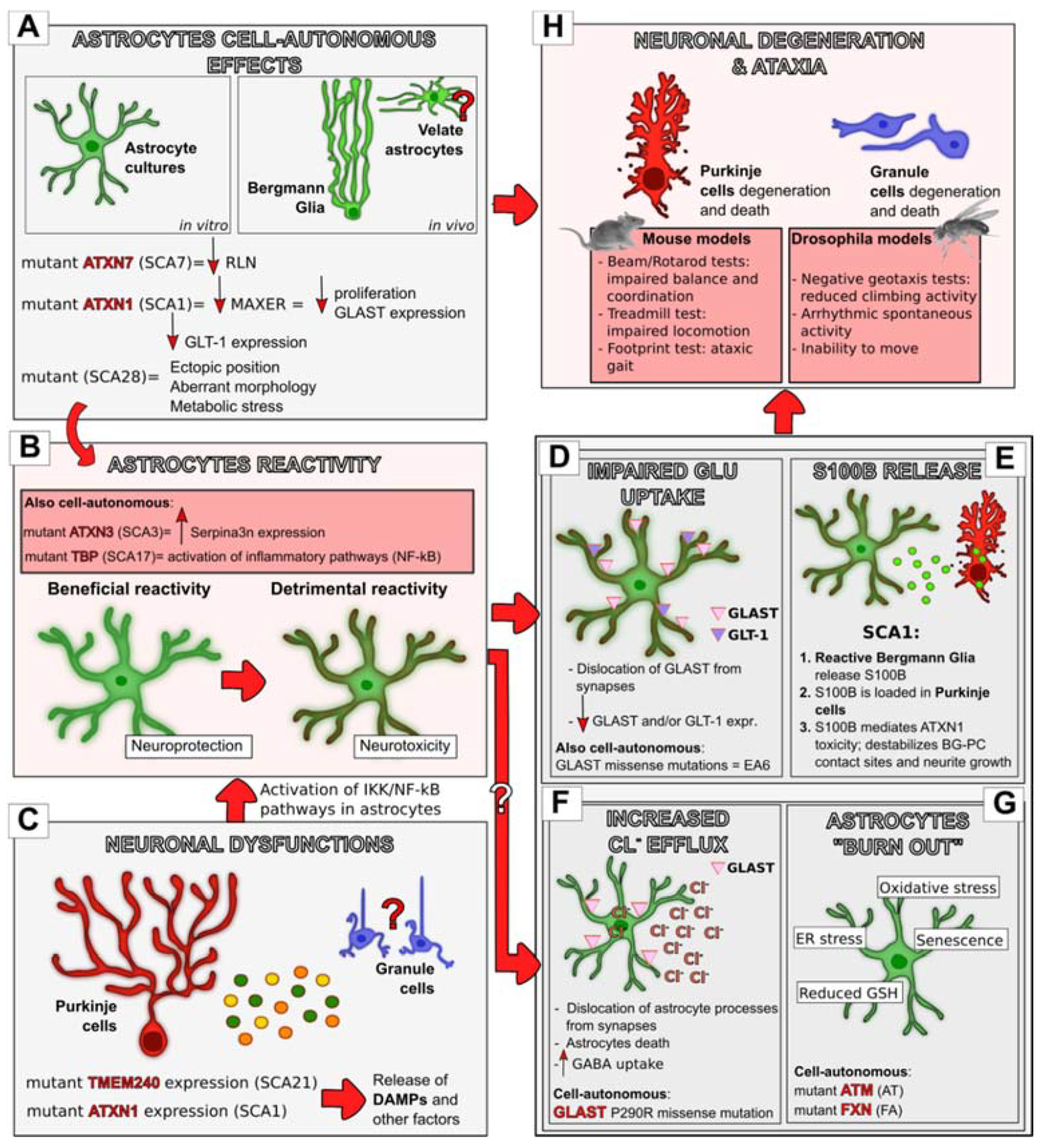
Ataxia is a neurodegenerative syndrome, which can emerge as a major element of a disease or represent a symptom of more complex multisystemic disorders. It comprises several forms with a highly variegated etiology, mainly united by motor, balance, and speech impairments and, at the tissue level, by cerebellar atrophy and Purkinje cells degeneration. For this reason, the contribution of astrocytes to this disease has been largely overlooked in the past. Nevertheless, in the last few decades, growing evidences are pointing to cerebellar astrocytes as crucial players not only in the progression but also in the onset of distinct forms of ataxia. Although the current knowledge on this topic is very fragmentary and ataxia type-specific, the present review will attempt to provide a comprehensive view of astrocytes’ involvement across the distinct forms of this pathology. Here, it will be highlighted how, through consecutive stage-specific mechanisms, astrocytes can lead to non-cell autonomous neurodegeneration and, consequently, to the behavioral impairments typical of this disease. In light of that, treating astrocytes to heal neurons will be discussed as a potential complementary therapeutic approach for ataxic patients, a crucial point provided the absence of conclusive treatments for this disease.
Keywords: cerebellum; ataxia; astrocytes; neurodegeneration; glia cerebellum; ataxia; astrocytes; neurodegeneration; glia