Sex- and Diabetes-Dependent Perioperative Model for End-Stage Liver Disease Trajectories Identify Distinct Hepatorenal Stress Phenotypes After Surgical Coronary Revascularization

 ,
,  , , , , , , , , , , , , ,
Abstract
1. Introduction
2. Materials and Methods
2.1. Design and the Study Setting
2.2. Data Collection and Clinical Definitions
2.3. MELD Assessment and Perioperative Time Points
2.4. Derived MELD Dynamics and Phenotype Definition
2.5. Exposure Variables and Covariates
2.6. Statistical Analysis
2.7. GenAI Statement
3. Results
3.1. Baseline Characteristics of the Study Cohort
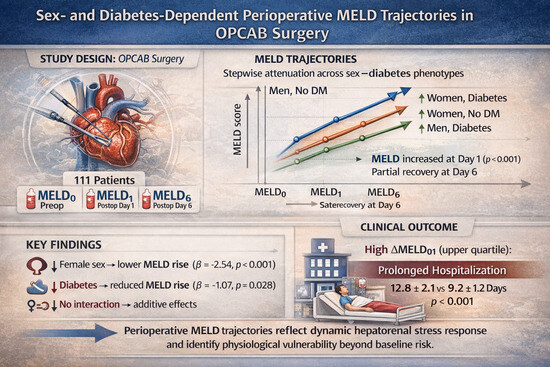
3.2. Perioperative MELD Dynamics Across Sex–Diabetes Phenotypes
3.3. Multivariable and Longitudinal Determinants of Perioperative MELD Response
3.4. Clinical Correlates of the High-Surge MELD Phenotype
4. Discussion
5. Conclusions
Author Contributions
Funding
Institutional Review Board Statement
Informed Consent Statement
Data Availability Statement
Acknowledgments
Conflicts of Interest
Abbreviations
| ALT | alanine aminotransferase |
| AST | aspartate aminotransferase |
| BMI | body mass index |
| CABG | coronary artery bypass grafting |
| Cx | circumflex artery |
| DM | diabetes mellitus |
| GEE | generalized estimating equations |
| ICU | intensive care unit |
| INR | international normalized ratio |
| IVS | interventricular septal thickness |
| LAD | left anterior descending artery |
| LDL | low-density lipoprotein |
| LMCA | left main coronary artery |
| LVED | left ventricular end-diastolic diameter |
| LVEF | left ventricular ejection fraction |
| MELD | Model for End-Stage Liver Disease |
| OPCAB | off-pump coronary artery bypass grafting |
| PAD | peripheral artery disease |
| POD | postoperative day |
| Q | quartile |
| RCA | right coronary artery |
| RVD | right ventricular end-diastolic diameter |
| SD | standard deviation |
| SGLT2 | sodium-glucose cotransporter 2 |
| WBC | white blood cell count |
References
- Ruf, A.; Dirchwolf, M.; Freeman, R.B. From Child-Pugh to MELD score and beyond: Taking a walk down memory lane. Ann. Hepatol. 2022, 27, 100535. [Google Scholar] [CrossRef]
- Pathare, P.; Elbayoumi, M.; Weyand, M.; Griesbach, C.; Haig, F. MELD-score for risk stratification in cardiac surgery. Heart Vessel. 2023, 38, 1156–1163. [Google Scholar] [CrossRef] [PubMed]
- Yu, X.; Zhou, R.; Tan, W.; Wang, X.; Zheng, X.; Huang, Y.; Chen, J.; Li, B.; Liu, X.; Li, Z.; et al. Evidence-based incorporation of key parameters into MELD score for acute-on-chronic liver failure. eGastroenterology 2024, 2, e100101. [Google Scholar] [CrossRef] [PubMed]
- Urbanowicz, T.K.; Olasińska-Wiśniewska, A.; Michalak, A.; Gąsecka, A.; Rodzki, M.; Perek, B.; Jemielity, M. Cardioprotective effect of low level of LDL cholesterol on perioperative myocardial injury in off-pump coronary artery bypass grafting. Medicina 2021, 57, 875. [Google Scholar] [CrossRef]
- Błażejowska, E.; Urbanowicz, T.; Gąsecka, A.; Olasińska-Wiśniewska, A.; Jaguszewski, M.J.; Targoński, R.; Szarpak, Ł.; Filipiak, K.J.; Perek, B.; Jemielity, M. Diagnostic and prognostic value of miRNAs after coronary artery bypass grafting: A review. Biology 2021, 10, 1350. [Google Scholar] [CrossRef]
- Urbanowicz, T.; Michalak, M.; Al-Imam, A.; Olasińska-Wiśniewska, A.; Rodzki, M.; Witkowska, A.; Haneya, A.; Buczkowski, P.; Perek, B.; Jemielity, M. The significance of systemic immune-inflammation index for mortality prediction in diabetic patients treated with off-pump coronary artery bypass surgery. Diagnostics 2022, 12, 634. [Google Scholar] [CrossRef]
- Urbanowicz, T.; Michalak, M.; Gąsecka, A.; Perek, B.; Rodzki, M.; Bociański, M.; Straburzyńska-Migaj, E.; Jemielity, M. Postoperative neutrophil to lymphocyte ratio as an overall mortality midterm prognostic factor following OPCAB. Clin. Pract. 2021, 11, 587–597. [Google Scholar] [CrossRef]
- Gourier, S.; Léon, K.; Vermeersch, V.; Bouras, M.; Langeron, O.; Caillard, A. Sex-based differences in anesthesia approaches and outcomes: A narrative review. Anaesth. Crit. Care Pain Med. 2025, 44, 101723. [Google Scholar] [CrossRef] [PubMed]
- Walters, S.M.; Richter, E.W.; Lutzker, T.; Patel, S.; Vincent, A.N.; Kleiman, A.M. Perioperative considerations regarding sex in solid organ transplantation. Anesthesiol. Clin. 2020, 38, 297–310. [Google Scholar] [CrossRef] [PubMed]
- Nerenberg, K.A.; Roeters van Lennep, J.E. Advancing sex and gender considerations in perioperative cardiovascular-risk assessment. Can. J. Cardiol. 2021, 37, 1912–1914. [Google Scholar] [CrossRef]
- Zheng, Q.; Zhou, J.; Zhang, Y.; Wang, T.; Wu, D.; Pu, Q.; Mei, J.; Liao, H.; Liu, L. Insights into sex differences in perioperative outcomes of non-small cell lung cancer patients. Transl. Lung Cancer Res. 2024, 13, 2549–2560. [Google Scholar] [CrossRef] [PubMed]
- Di Florio, D.N.; Sin, J.; Coronado, M.J.; Atwal, P.S.; Fairweather, D. Sex differences in inflammation, redox biology, mitochondria and autoimmunity. Redox Biol. 2020, 31, 101482. [Google Scholar] [CrossRef]
- Kirkman, D.L.; Robinson, A.T.; Rossman, M.J.; Seals, D.R.; Edwards, D.G. Mitochondrial contributions to vascular endothelial dysfunction, arterial stiffness, and cardiovascular diseases. Am. J. Physiol. Heart Circ. Physiol. 2021, 320, H2080–H2100. [Google Scholar] [CrossRef]
- Szyguła-Jurkiewicz, B.; Szczurek-Wasilewicz, W.; Gąsior, M.; Copik, I.; Małyszek-Tumidajewicz, J.; Skrzypek, M.; Romuk, E.; Zembala, M.; Zembala, M.; Przybyłowski, P. Oxidative stress markers and modified model for end-stage liver disease are associated with outcomes in patients with advanced heart failure receiving bridge therapy with continuous-flow left ventricular assist devices. Antioxidants 2021, 15, 1813. [Google Scholar] [CrossRef]
- Kozluca, V.; Akbulut, I.M.; Tan, T.S.; Gulyigit, H.; Ozerdem, M.E.; Sayin, T. Diuretic response prediction with MELD score in heart failure. Clin. Cardiol. 2025, 48, e70245. [Google Scholar] [CrossRef]
- Kelecy, M.W.; Shutt, T.; Rostas, J.; Martin, R.C.G., 2nd. Clinical effect of enoxaparin on international normalized ratio following hepato-pancreatico-biliary and gastroesophageal resection. J. Surg. Oncol. 2018, 118, 15–20. [Google Scholar] [CrossRef] [PubMed]
- Allen, A.M.; Heimbach, J.K.; Larson, J.J.; Mara, K.C.; Kim, W.R.; Kamath, P.S.; Therneau, T.M. Reduced access to liver transplantation in women: Role of height, MELD exception scores, and renal function underestimation. Transplantation 2018, 102, 1710–1716. [Google Scholar] [CrossRef]
- Bittermann, T.; Mahmud, N.; Weinberg, E.M.; Reddy, K.R. MELD 3.0 leads to heterogeneous prioritization of men and women on the liver transplant waiting list. Liver Transpl. 2023, 29, 655–657. [Google Scholar] [CrossRef]
- Urbanowicz, T.; Michalak, M.; Olasińska-Wiśniewska, A.; Haneya, A.; Straburzyńska-Migaj, E.; Bociański, M.; Jemielity, M. Gender differences in coronary artery diameters and survival results after off-pump coronary artery bypass (OPCAB) procedures. J. Thorac. Dis. 2021, 13, 2867–2873. [Google Scholar] [CrossRef]
- Urbanowicz, T.K.; Michalak, M.; Olasińska-Wiśniewska, A.; Żukowski, M.; Koczorowski, K.; Łasowski, B.; Woźnicki, M.; Filipiak, K.J.; Tykarski, A.; Jemielity, M. Left main coronary artery disease treated with beating heart surgery: 10-year single center results. Postepy Kardiol. Interwencyjnej 2024, 20, 157–163. [Google Scholar] [CrossRef] [PubMed]
- Greaney, J.L.; Saunders, E.F.H.; Santhanam, L.; Alexander, L.M. Oxidative stress contributes to microvascular endothelial dysfunction in men and women with major depressive disorder. Circ. Res. 2019, 125, 564–574. [Google Scholar] [CrossRef] [PubMed]
- Fonkoue, I.T.; Michopoulos, V.; Park, J. Sex differences in post-traumatic stress disorder risk: Autonomic control and inflammation. Clin. Auton. Res. 2020, 30, 409–421. [Google Scholar] [CrossRef]
- Tower, J.; Pomatto, L.C.D.; Davies, K.J.A. Sex differences in the response to oxidative and proteolytic stress. Redox Biol. 2020, 31, 101488. [Google Scholar] [CrossRef]
- Wang-Heaton, H.; Wingard, M.C.; Dalal, S.; Shook, P.L.; Connelly, B.A.; Johnson, P.; Nichols, P.L.; Singh, M.; Singh, K. ATM deficiency differentially affects expression of proteins related to fatty acid oxidation and oxidative stress in a sex-specific manner in response to Western-type diet prior to and following myocardial infarction. Life Sci. 2024, 342, 122541. [Google Scholar] [CrossRef]
- Cristallo, M.; Furci, F.; Cascario, M.; Gangemi, S.; Nettis, E. Sex differences in oxidative stress concerning allergic diseases. Biomolecules 2025, 15, 1461. [Google Scholar] [CrossRef]
- Ciutac, A.M.; Pana, T.; Dawson, D.; Myint, P.K. Sex-related differences in heart failure patients: Physiological mechanisms of cardiovascular ageing and evidence-based sex-specific medical therapies. Ther. Adv. Cardiovasc. Dis. 2025, 19, 17539447241309673. [Google Scholar] [CrossRef]
- Lüscher, T.; Flammer, A.; Kuster, G. Sex and Cardiovascular Disease. Cardiovasc. Med. 2023, 26, 67. [Google Scholar] [CrossRef]
- Alamat, L.; Rana, A.; Lopez Candales, A.; Sawalha, K.; Shaw-Devine, A. True Impact of Sex Differences in Diagnosis and Management of Cardiovascular Disease. Cureus 2025, 17, e99237–e99246. [Google Scholar] [CrossRef] [PubMed]
- Gupta, A.; Gupta, A.K. Small vessels, big impact: Understanding women’s microvascular heart disease. Curr. Opin. Physiol. 2026, 47, 100903–100911. [Google Scholar] [CrossRef]
- Ivanova, M.M.; Dao, J.; Friedman, A.; Kasaci, N.; Goker-Alpan, O. Sex Differences in Circulating Inflammatory, Immune, and Tissue Growth Markers Associated with Fabry Disease-Related Cardiomyopathy. Cells 2025, 14, 322. [Google Scholar] [CrossRef] [PubMed]
- SenthilKumar, G.; Katunaric, B.; Bordas-Murphy, H.; Sarvaideo, J.; Freed, J.K. Estrogen and the Vascular Endothelium: The Unanswered Questions. Endocrinology 2023, 164, bqad079. [Google Scholar] [CrossRef]
- Xiang, D.; Liu, Y.; Zhou, S.; Zhou, E.; Wang, Y. Protective Effects of Estrogen on Cardiovascular Disease Mediated by Oxidative Stress. Oxid Med. Cell Longev. 2021, 2021, 5523516–5523531. [Google Scholar] [CrossRef] [PubMed]
- Squiccimarro, E.; Lorusso, R.; Margari, V.; Labriola, C.; Whitlock, R.; Paparella, D. Sex-related differences in systemic inflammatory response and outcomes after cardiac surgery and cardiopulmonary bypass. Interdiscip Cardiovasc. Thorac. Surg. 2025, 40, ivaf066–ivaf074. [Google Scholar] [CrossRef]
- Chong-Nguyen, C.; Fuentes-Artiles, R.; Pilgrim, T.; Yilmaz, B.; Döring, Y. The gut-heart axis in coronary artery disease: A scoping and narrative review of sex-based microbial and metabolic disparities. Biol. Sex Differ. 2026, 17, 24–46. [Google Scholar] [CrossRef] [PubMed]
- Kuhn, L.; Schupp, T.; Steinke, P.; Weidner, K.; Bertsch, T.; Rusnak, J.; Jannesari, M.; Siegel, F.; Duerschmied, D.; Behnes, M.; et al. Sex-Based Differences and Outcomes in Unselected Patients Undergoing Coronary Angiography. J. Clin. Med. 2025, 14, 224. [Google Scholar] [CrossRef]
- Balcerowska, M.; Kwaśnik, P. The multifaceted impact of stress on immune function. Mol. Biol. Rep. 2025, 52, 1008–2020. [Google Scholar] [CrossRef]
- Hamaguchi, Y.; Kaido, T.; Okumura, S.; Kobayashi, A.; Shirai, H.; Yao, S.; Yagi, S.; Kamo, N.; Uemoto, S. Including body composition in MELD scores improves mortality prediction among patients awaiting liver transplantation. Clin. Nutr. 2020, 39, 1885–1892. [Google Scholar] [CrossRef]
- Kim, Y.K.; Shin, W.J.; Song, J.G.; Jun, I.G.; Kim, H.Y.; Seong, S.H.; Sang, B.H.; Hwang, G.S. Factors associated with changes in coagulation profiles after living donor hepatectomy. Transpl. Proc. 2010, 42, 2430–2435. [Google Scholar] [CrossRef]
- McChord, J.; Ong, P. Bridging the Gender Gap in Cardiovascular Medicine: Addressing Drug Intolerances and Personalized Care for Women with Angina/Ischemia with Non-Obstructive Coronary Artery Disease. J. Cardiovasc. Dev. Dis. 2024, 11, 381. [Google Scholar] [CrossRef] [PubMed]
- Varga, S.; Juhász, L.; Gál, P.; Bogáts, G.; Boros, M.; Palásthy, Z.; Szabó, A.; Kaszaki, J. Neuronal nitric oxide mediates the anti-inflammatory effects of intestinal ischemic preconditioning. J. Surg. Res. 2019, 244, 241–250. [Google Scholar] [CrossRef]
- Raevens, S.; Boert, M.; Fallon, M.B. Hepatopulmonary syndrome. JHEP Rep. 2022, 4, 100527. [Google Scholar] [CrossRef] [PubMed]
- Wahlström, K.L.; Hansen, H.F.; Kvist, M.; Burchardt, J.; Lykkesfeldt, J.; Gögenur, I.; Ekeloef, S. Effect of remote ischemic preconditioning on perioperative endothelial dysfunction in non-cardiac surgery: A randomised clinical trial. Cells 2023, 12, 911. [Google Scholar] [CrossRef] [PubMed]
- Jaffer, A.; Yang, K.; Ebrahim, A.; Brown, A.N.; El-Andari, R.; Dokollari, A.; Gregory, A.J.; Adams, C.; Kent, W.D.T.; Fatehi Hassanabad, A. Optimizing recovery in cardiac surgery: A narrative review of enhanced recovery after surgery protocols and clinical outcomes. Med. Sci. 2025, 14, 128. [Google Scholar] [CrossRef]
- Azari, A.; Baradaran Rahimi, V.; Moravvej, Z.; Rahsepar, A.A.; Ghayour-Mobarhan, M.; Salehi, M.; Bigdelu, L. Antioxidant activity in off and on-pump coronary artery bypass grafting and valve replacement surgery. J. Basic Clin. Physiol. Pharmacol. 2023, 34, 365–370. [Google Scholar] [CrossRef] [PubMed]



| Parameter | Whole Group n = 111 | Females (F) n = 24 | Men (M) n = 87 | p (M vs. F) | No Diabetes n = 64 | Diabetes Mellitus n = 47 | p (no vs. DM) |
|---|---|---|---|---|---|---|---|
| Demographic characteristics | |||||||
| Age, years, median (Q1–Q3) | 68 (63–72) | 72 (67–74) | 68 (62–72) | 0.037 | 69 (63–73) | 67 (64–72) | 0.919 |
| Male sex, n (%) | 87 (78.4) | 0 (0) | 87 (100.0) | <0.001 | 49 (76.6) | 38 (80.9) | 0.592 |
| BMI, kg/m2, median (Q1–Q3) | 29 (25–32) | 27 (24–29) | 30 (27–32) | 0.016 | 29 (24–31) | 29 (27–32) | 0.263 |
| BMI > 30 kg/m2, n (%) | 28 (25.2) | 10 (41.7) | 14 (16.1) | 0.055 | 14 (21.9) | 14 (29.8) | 0.355 |
| Comorbidities | |||||||
| Arterial hypertension, n (%) | 104 (93.7) | 21 (87.5) | 83 (95.4) | 0.163 | 59 (92.2) | 45 (95.7) | 0.452 |
| Diabetes mellitus, n (%) | 47 (42.3) | 9 (37.5) | 38 (43.7) | 0.592 | 0 (0) | 47 (100) | <0.001 |
| Dyslipidemia, n (%) | 57 (51.4) | 8 (33.3) | 47 (54.0) | 0.048 | 34 (53.1) | 23 (48.9) | 0.667 |
| PAD, n (%) | 22 (19.8) | 11 (45.8) | 11 (12.6) | <0.001 | 11 (17.2) | 11 (23.4) | 0.421 |
| Prior stroke, n (%) | 7 (6.3) | 2 (8.3) | 5 (5.7) | 0.652 | 6 (9.4) | 1 (2.1) | 0.124 |
| Active smoking, n (%) | 24 (21.6) | 8 (33.3) | 16 (18.4) | 0.118 | 14 (21.9) | 10 (21.3) | 0.943 |
| Coronary artery disease | |||||||
| Number of involved arteries, mean (SD) | 1.9 (1.2) | 1.5 (1.3) | 2.0 (1.2) | 0.484 | 2.0 (1.2) | 2.0 (1.2) | 0.690 |
| Left main disease, n (%) | 46 (41.4) | 11 (45.8) | 35 (40.2) | 0.488 | 28 (43.8) | 18 (38.3) | 0.808 |
| LAD disease, n (%) | 90 (81.1) | 18 (75.0) | 72 (82.8) | 0.395 | 49 (76.6) | 41 (87.2) | 0.159 |
| Cx disease, n (%) | 60 (54.1) | 14 (58.3) | 46 (52.9) | 0.639 | 36 (56.3) | 24 (51.1) | 0.592 |
| RCA disease, n (%) | 67 (60.4) | 14 (58.3) | 53 (60.9) | 0.823 | 40 (62.5) | 27 (57.4) | 0.595 |
| Preoperative echocardiography | |||||||
| LVD, mm, median (Q1–Q3) | 46 (41–51) | 42 (40–49) | 46 (42–51) | 0.143 | 46 (42–49) | 47 (41–52) | 0.875 |
| RVD, mm, median (Q1–Q3) | 28 (26–31) | 25 (21–27) | 29 (27–32) | <0.001 | 28 (27–31) | 28 (26–32) | 0.897 |
| IVS, mm, median (Q1–Q3) | 13 (11–15) | 11 (10–14) | 13 (11–15) | 0.013 | 13 (11–14) | 12 (11–14) | 0.293 |
| EF, %, median (Q1–Q3) | 55 (50–60) | 55 (50–60) | 59 (50–63) | 0.509 | 55 (50–60) | 60 (50–60) | 0.696 |
| Postoperative echocardiography | |||||||
| LVED, cm, median (Q1–Q3) | 46 (41–49) | 42 (38–48) | 46 (42–50) | 0.086 | 45 (41–49) | 47 (42–52) | 0.131 |
| RVD, cm, median (Q1–Q3) | 28 (25–30) | 24 (21–26) | 29 (26–31) | <0.001 | 28 (25–31) | 28 (24–30) | 0.666 |
| IVS, cm, median (Q1–Q3) | 12 (11–14) | 11 (9–13) | 13 (11–15) | 0.006 | 13 (11–15) | 12 (11–13) | 0.080 |
| LVEF, %, median (Q1–Q3) | 60 (50–60) | 55 (50–60) | 60 (50–60) | 0.624 | 59 (50–60) | 60 (55–60) | 0.388 |
| Parameter | Men Without Diabetes (1) n = 49 | Men with Diabetes (2) n = 38 | Women Without Diabetes (3) n = 15 | Women with Diabetes (4) n = 9 | p 1 vs. 2 | p 1 vs. 3 | p 1 vs. 4 | p 2 vs. 3 | p 2 vs. 4 | p 2 vs. 3 |
|---|---|---|---|---|---|---|---|---|---|---|
| Preoperative | ||||||||||
| WBC, 10 × 9/L, median (Q1–Q3) | 6.8 (5.9–8.6) | 7.5 (6.4–9.4) | 7.4 (6.9–9.2) | 9.8 (6.6–10.1) | 0.181 | 0.103 | 0.071 | 0.694 | 0.306 | 0.721 |
| Hemoglobin, mmol/L, median (Q1–Q3) | 9.0 (8.3–9.4) | 8.8 (8.0–9.3) | 8.7 (8.1–9.0) | 8.3 (8.1–9.0) | 0.613 | 0.088 | 0.060 | 0.229 | 0.217 | 0.858 |
| Platelets, 10 × 9/L, median (Q1–Q3) | 206 (171–250) | 214 (174–247) | 249 (217–306) | 236 (184–273) | 0.824 | 0.016 | 0.308 | 0.012 | 0.234 | 0.438 |
| ALT, IU/L, median (Q1–Q3) | 29 (23–40) | 35 (27–57) | 28 (19–31) | 25 (21–32) | 0.115 | 0.093 | 0.237 | 0.012 | 0.096 | 1.000 |
| AST, IU/L, median (Q1–Q3) | 25 (20–33) | 28 (24–35) | 23 (20–26) | 22 (16–36) | 0.276 | 0.227 | 0.382 | 0.030 | 0.223 | 0.698 |
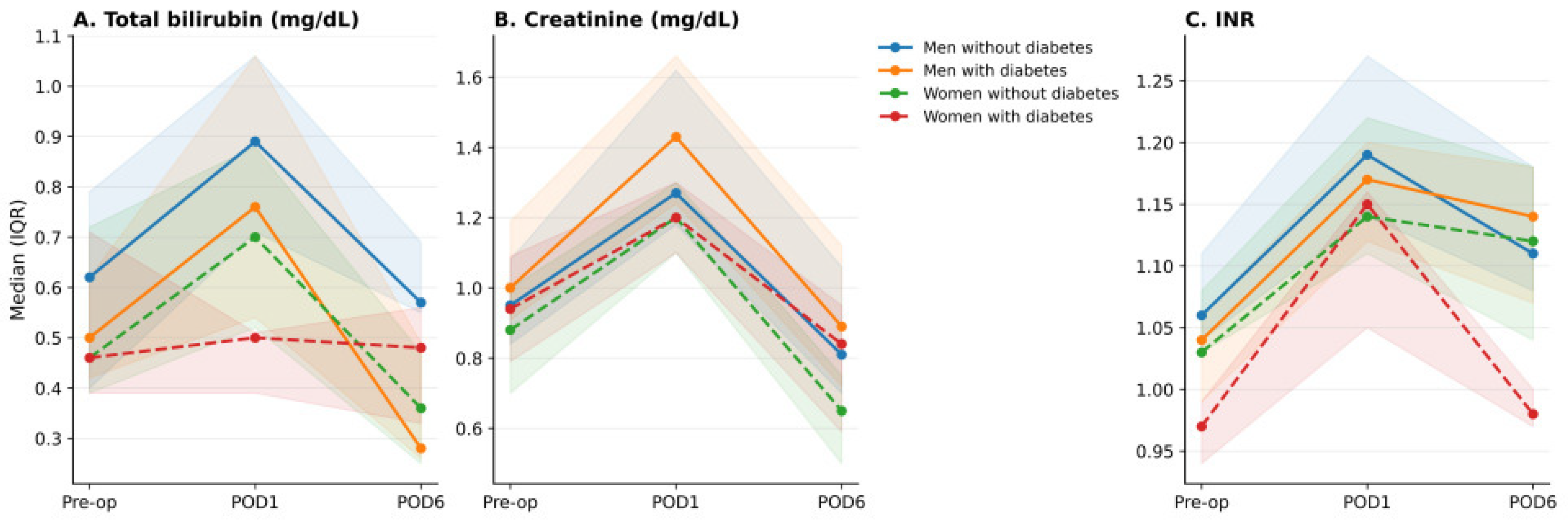
| Bibilirubin total, mg/dL, median (Q1–Q3) | 0.62 (0.40–0.79) | 0.50 (0.42–0.62) | 0.46 (0.39–0.72) | 0.46 (0.39–0.71) | 0.187 | 0.541 | 0.465 | 0.968 | 0.808 | 1.000 |
| Total Cholesterol, mmol/L, median (Q1–Q3) | 3.46 (3.00–4.04) | 3.68 (2.80–4.77) | 3.72 (3.27–4.81) | 3.56 (3.17–4.18) | 0.397 | 0.192 | 0.632 | 0.694 | 0.903 | 0.548 |
| Serum Creatinine, mg/dL, median (Q1–Q3) | 0.95 (0.84–1.08) | 1.00 (0.91–1.19) | 0.88 (0.70–1.00) | 0.94 (0.79–1.09) | 0.130 | 0.094 | 0.813 | 0.012 | 0.285 | 0.200 |
| INR, median (Q1–Q3) | 1.06 (1.04–1.11) | 1.04 (0.99–1.06) | 1.03 (1.03–1.08) | 0.97 (0.94–0.99) | 0.018 | 0.305 | <0.001 | 0.416 | 0.017 | 0.004 |
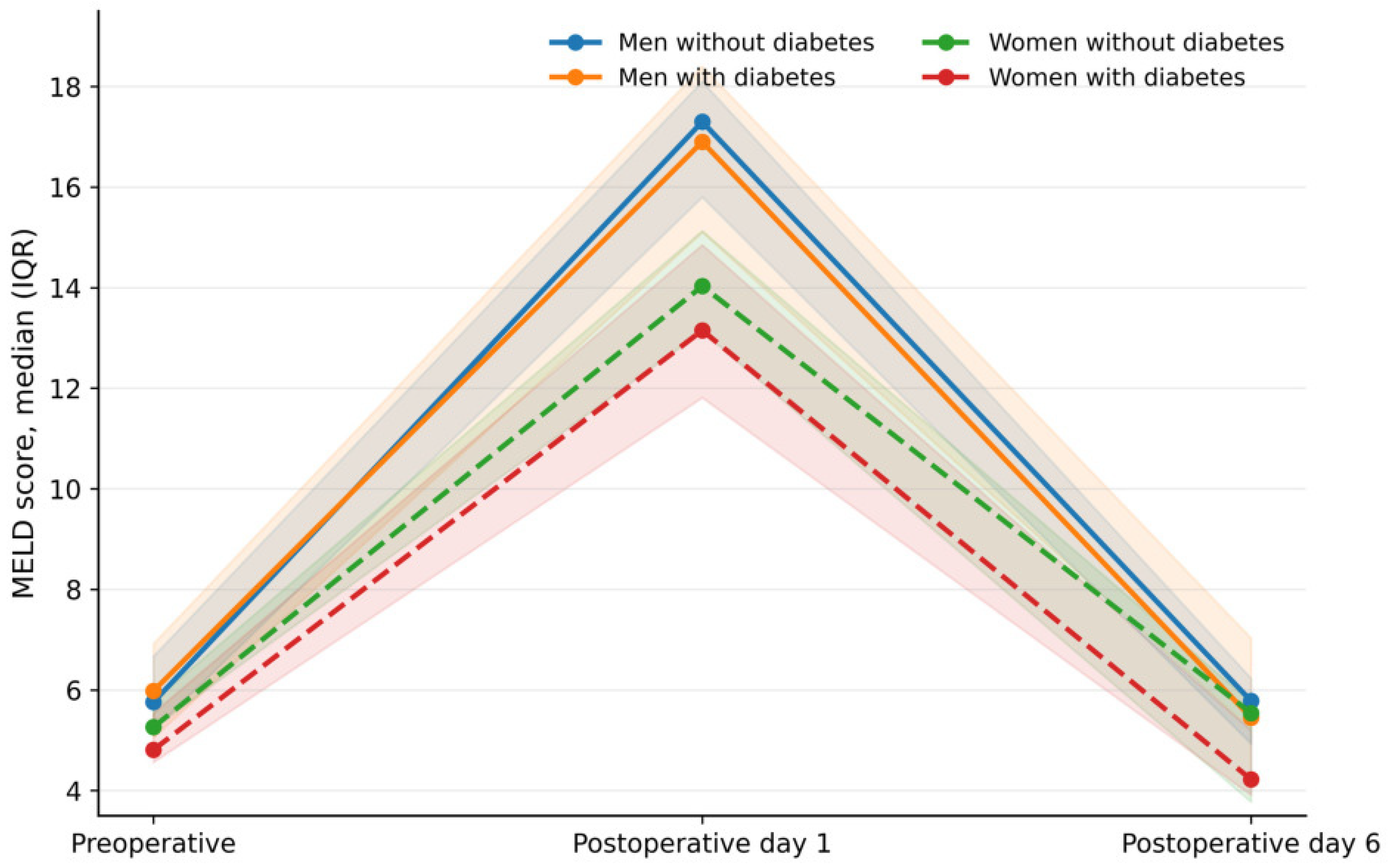
| MELD-0, median (Q1–Q3) | 5.76 (5.20–6.67) | 5.98 (5.05–6.92) | 5.26 (5.25–5.78) | 4.81 (4.56–5.54) | 0.786 | 0.369 | 0.033 | 0.356 | 0.033 | 0.098 |
| Troponin—I, ng/L, median (Q1–Q3) | 0.01 (0.02–0.04) | 0.01 (0.01–0.03) | 0.01 (0.00–0.02) | 0.01 (0.00–0.03) | 0.274 | 0.047 | 0.393 | 0.218 | 0.701 | 0.875 |
| 1st postoperative day | ||||||||||
| WBC-1, 10 × 9/L, median (Q1–Q3) | 11.7 (9.3–14.0) | 10.7 (9.9–13.3) | 12.5 (10.6–14.9) | 12.8 (10.6–13.9) | 0.650 | 0.296 | 0.660 | 0.130 | 0.332 | 0.766 |
| Hemoglobin-1, mmol/L, median (Q1–Q3) | 7.3 (6.9–7.8) | 7.4 (6.7–7.7) | 7.2 (6.9–7.5) | 7.0 (6.4–7.2) | 0.844 | 0.441 | 0.091 | 0.537 | 0.141 | 0.295 |
| ALT-1, IU/L, median (Q1–Q3) | 28 (19–41) | 32 (23–44) | 23 (16–34) | 24 (20–27) | 0.489 | 0.195 | 0.178 | 0.080 | 0.045 | 0.682 |
| AST-1, IU/L, median (Q1–Q3) | 34 (26–44) | 34 (29–46) | 27 (23–35) | 32 (28–39) | 0.960 | 0.136 | 0.806 | 0.095 | 0.648 | 0.308 |
| Bibilirubin total-1, mg/dL, median (Q1–Q3) | 0.89 (0.71–1.06) | 0.76 (0.54–1.06) | 0.70 (0.52–0.88) | 0.50 (0.39–0.51) | 0.080 | 0.023 | <0.001 | 0.465 | 0.025 | 0.161 |
| Creatinine-1, mg/dL, median (Q1–Q3) | 1.27 (1.18–1.62) | 1.43 (1.24–1.66) | 1.2 (1.1–1.3) | 1.2 (1.1–1.3) | 0.061 | 0.196 | 0.221 | 0.004 | 0.014 | 1.000 |
| INR-1, median (Q1–Q3) | 1.19 (1.14–1.27) | 1.17 (1.12–1.20) | 1.14 (1.11–1.22) | 1.15 (1.05–1.16) | 0.037 | 0.060 | 0.005 | 0.514 | 0.074 | 0.256 |
| MELD-1, median (Q1–Q3) | 17.3 (15.8–18.1) | 16.9 (15.1–18.4) | 14.03 (13.13–15.13) | 13.15 (11.81–14.85) | 0.353 | 0.024 | 0.020 | 0.002 | 0.003 | 0.512 |
| Troponin—I, ng/L, median (Q1–Q3) | 1.27 (0.55–2.30) | 1.01 (0.56–1.62) | 0.56 (0.34–0.92) | 0.40 (0.27–1.98) | 0.246 | 0.017 | 0.229 | 0.079 | 0.740 | 1.000 |
| 6th postoperative day | ||||||||||
| WBC-6, 10 × 9/L, median (Q1–Q3) | 6.8 (5.3–8.0) | 6.9 (5.9–8.4) | 8.0 (6.3–8.9) | 7.7 (6.1–8.0) | 0.653 | 0.103 | 0.606 | 0.289 | 0.761 | 0.438 |
| Hemoglobin-6, mmol/L, median (Q1–Q3) | 6.6 (6.4–7.0) | 6.6 (6.2–6.9) | 6.8 (6.7–7.5) | 7.3 (6.8–7.3) | 0.131 | 0.098 | 0.016 | 0.016 | 0.003 | 0.471 |
| ALT-6, IU/L, median (Q1–Q3) | 15 (11–23) | 14 (9–19) | 18 (11–30) | 15 (12–19) | 0.681 | 0.711 | 1.000 | 0.422 | 1.000 | 1.000 |
| AST-6, IU/L, median (Q1–Q3) | 23 (20–32) | 20 (15–37) | 40 (25–58) | 37 (31–41) | 0.328 | 0.114 | 0.417 | 0.070 | 0.596 | 1.000 |
| Bibilirubin total-6, mg/dL, median (Q1–Q3) | 0.57 (0.055–0.69) | 0.28 (0.26–0.49) | 0.36 (0.25–0.47) | 0.48 (0.33–0.56) | 0.008 | 0.151 | 0.400 | 0.350 | 1.000 | 1.000 |
| Creatinine-6, mg/dL, median (Q1–Q3) | 0.81 (0.70–1.06) | 0.89 (0.72–1.12) | 0.65 (0.50–0.75) | 0.84 (0.59–0.95) | 0.291 | 0.003 | 0.373 | <0.001 | 0.142 | 0.196 |
| INR-6, median (Q1–Q3) | 1.11 (1.08–1.18) | 1.14 (1.07–1.18) | 1.12 (1.04–1.18) | 0.98 (0.97–1.00) | 0.827 | 0.794 | 0.007 | 0.823 | 0.067 | 0.183 |
| MELD-6, median (Q1–Q3) | 5.78 (4.93–6.23) | 5.45 (5.21–7.03) | 5.54 (3.77–5.76) | 4.22 (3.91–5.19) | 0.508 | 0.926 | 0.131 | 0.518 | 0.200 | 0.333 |
| Troponin—I-6, ng/L, median (Q1–Q3) | 0.21 (0.08–1.30) | 0.38 (0.22–0.56) | 0.19 (0.06–1.45) | 0.23 (0.09–1.44) | 0.942 | 0.945 | 1.000 | 0.966 | 0.927 | 0.889 |
| Variable | High MELD Surge (n = 28) | Low MELD Surge (n = 83) | p-Value |
|---|---|---|---|
| Demographic characteristics | |||
| Age, y, (median (Q1–Q3)) | 68.0 (63.0–72.0) | 68.0 (63.0–72.0) | 0.991 |
| Male sex, n (%) | 22 (78.6) | 65 (78.3) | 1.000 |
| BMI, kg/m2 | 29.1 (25.6–32.5) | 28.9 (25.1–31.8) | 0.842 |
| BMI > 30 kg/m2, n (%) | 7 (25.0) | 21 (25.3) | 1.000 |
| Comorbidities | |||
| Hypertension, n (%) | 26 (92.9) | 78 (94.0) | 1.000 |
| Diabetes mellitus, n (%) | 11 (39.3) | 36 (43.4) | 0.826 |
| Dyslipidemia, n (%) | 14 (50.0) | 43 (51.8) | 1.000 |
| PAD, n (%) | 6 (21.4) | 16 (19.3) | 0.794 |
| Prior stroke, n (%) | 2 (7.1) | 5 (6.0) | 1.000 |
| Active smoking, n (%) | 6 (21.4) | 18 (21.7) | 1.000 |
| Coronary artery disease | |||
| LMCA disease, n (%) | 11 (39.3) | 35 (42.2) | 0.826 |
| LAD disease, n (%) | 23 (82.1) | 67 (80.7) | 1.000 |
| Cx disease, n (%) | 15 (53.6) | 45 (54.2) | 1.000 |
| RCA disease, n (%) | 17 (60.7) | 50 (60.2) | 1.000 |
| MELD parameters median (Q1–Q3) | |||
| MELD0 | 5.8 (5.2–6.7) | 5.8 (5.2–6.7) | 0.964 |
| MELD1 | 17.8 (16.9–19.2) | 15.9 (14.8–17.2) | <0.001 |
| MELD6 | 5.9 (4.8–6.4) | 5.6 (4.7–6.2) | 0.412 |
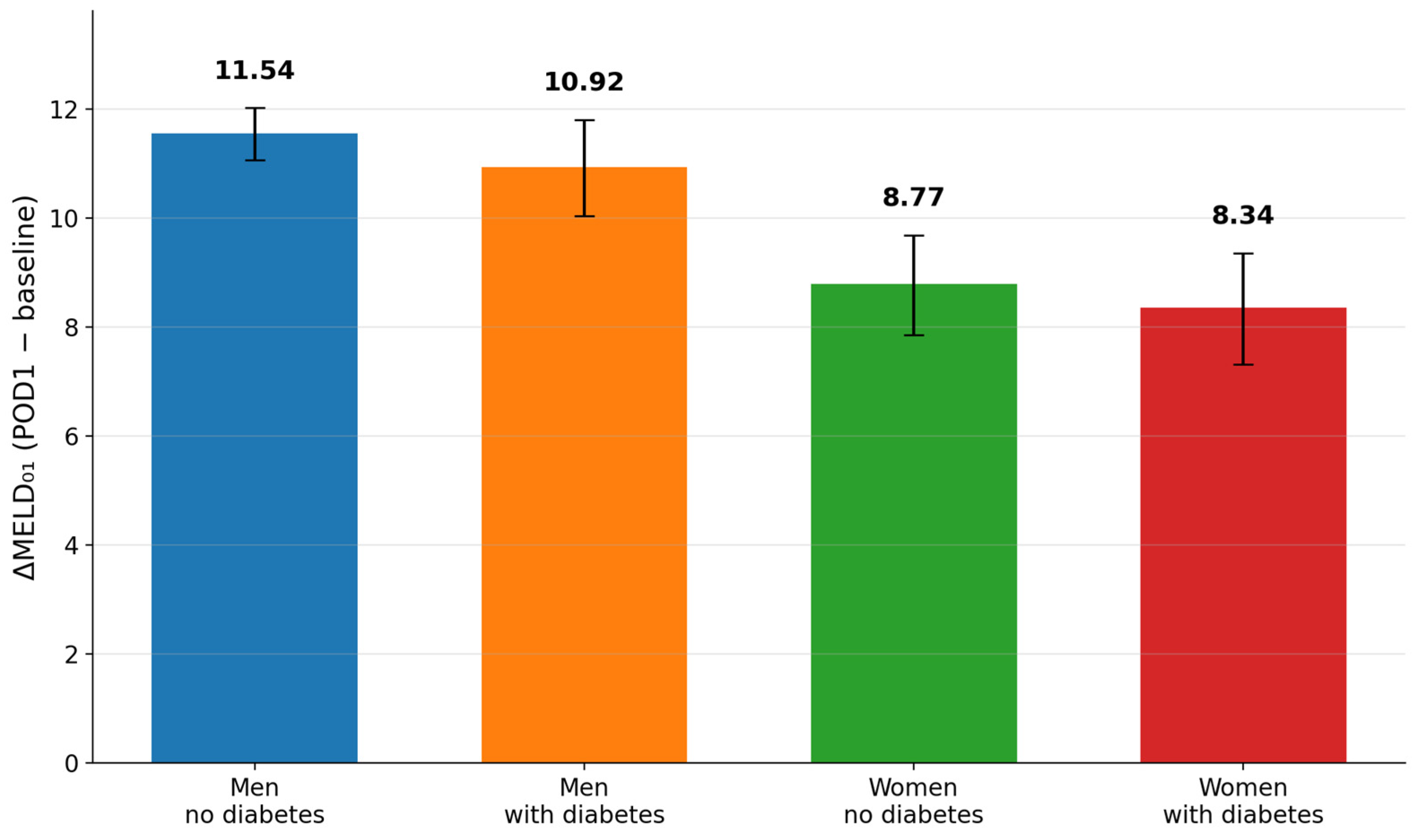
| ΔMELD01 | 12.1 (11.3–13.9) | 8.9 (7.8–10.1) | <0.001 |
| ΔMELD06 | 0.3 (−0.9–1.6) | 0.2 (−1.0–1.3) | 0.721 |
| Clinical outcomes | |||
| Overall hospitalization, days, mean (SD) | 12.8 ± 2.1 | 9.2 ± 1.2 | <0.001 |
| Intensive care unit stay, h | 28 (5) | 24 (4) | 0.285 |
| Postoperative hospitalization, days, mean (SD) | 9.7 ± 2.0 | 6.5 ± 1.0 | <0.001 |
Disclaimer/Publisher’s Note: The statements, opinions and data contained in all publications are solely those of the individual author(s) and contributor(s) and not of MDPI and/or the editor(s). MDPI and/or the editor(s) disclaim responsibility for any injury to people or property resulting from any ideas, methods, instructions or products referred to in the content. |
© 2026 by the authors. Licensee MDPI, Basel, Switzerland. This article is an open access article distributed under the terms and conditions of the Creative Commons Attribution (CC BY) license.
Share and Cite
Urbanowicz, T.; Bajsert, M.; Grywalska, E.; Filipiak, K.J.; Krasińska, B.; Mertowska, P.; Kowalczyk, M.; Mertowski, S.; Marcinkowska, Z.; Rahnama, M.; et al. Sex- and Diabetes-Dependent Perioperative Model for End-Stage Liver Disease Trajectories Identify Distinct Hepatorenal Stress Phenotypes After Surgical Coronary Revascularization. J. Clin. Med. 2026, 15, 2906. https://doi.org/10.3390/jcm15082906
Urbanowicz T, Bajsert M, Grywalska E, Filipiak KJ, Krasińska B, Mertowska P, Kowalczyk M, Mertowski S, Marcinkowska Z, Rahnama M, et al. Sex- and Diabetes-Dependent Perioperative Model for End-Stage Liver Disease Trajectories Identify Distinct Hepatorenal Stress Phenotypes After Surgical Coronary Revascularization. Journal of Clinical Medicine. 2026; 15(8):2906. https://doi.org/10.3390/jcm15082906
Chicago/Turabian StyleUrbanowicz, Tomasz, Monika Bajsert, Ewelina Grywalska, Krzysztof J. Filipiak, Beata Krasińska, Paulina Mertowska, Monika Kowalczyk, Sebastian Mertowski, Zuzanna Marcinkowska, Mansur Rahnama, and et al. 2026. "Sex- and Diabetes-Dependent Perioperative Model for End-Stage Liver Disease Trajectories Identify Distinct Hepatorenal Stress Phenotypes After Surgical Coronary Revascularization" Journal of Clinical Medicine 15, no. 8: 2906. https://doi.org/10.3390/jcm15082906
APA StyleUrbanowicz, T., Bajsert, M., Grywalska, E., Filipiak, K. J., Krasińska, B., Mertowska, P., Kowalczyk, M., Mertowski, S., Marcinkowska, Z., Rahnama, M., Wiśniewska, O., Gierszewska, J., Olasińska-Wiśniewska, A., Swora-Cwynar, E., Bartuś, K., Krasiński, Z., Haneya, A., & Jemielity, M. (2026). Sex- and Diabetes-Dependent Perioperative Model for End-Stage Liver Disease Trajectories Identify Distinct Hepatorenal Stress Phenotypes After Surgical Coronary Revascularization. Journal of Clinical Medicine, 15(8), 2906. https://doi.org/10.3390/jcm15082906