Prevalence, Clinical Characteristics, and Therapeutic Underachievement in Familial Hypercholesterolemia: Results from the GRegistry-FH Population-Based Study in Greece

 , , , , , , , , , , , ,
  and
and
Abstract
1. Introduction
2. Methods
2.1. Study Design and Population
2.2. Data Collection and Variables
- Demographics: age, sex, height, weight, and body mass index (BMI).
- Medical History: personal and family history of premature ASCVD and cardiovascular risk factors.
- Clinical Data: blood pressure readings and laboratory values for glucose and lipid parameters.
- Lifestyle: smoking status (current, ex-smoker, or non-smoker), dietary habits, and physical activity.
2.3. Diagnostic Criteria for HeFH
2.4. Simon Broome Register Criteria
- Definite FH: LDL-C > 4.9 mmol/L (190 mg/dL) PLUS the presence of tendon xanthomas (in the patient or a relative) OR evidence of a causative genetic mutation (LDLR, APOB, or PCSK9).
- Possible FH: LDL-C > 4.9 mmol/L (190 mg/dL) PLUS a family history of premature MI or elevated total cholesterol (>7.5 mmol/L).
2.5. Dutch Lipid Clinic Network (DLCN) Criteria
- Definite FH: >8 points;
- Probable FH: 6–8 points;
- Possible FH: 3–5 points;
- Unlikely FH: 0–2 points.
2.6. Statistical Analysis
3. Results
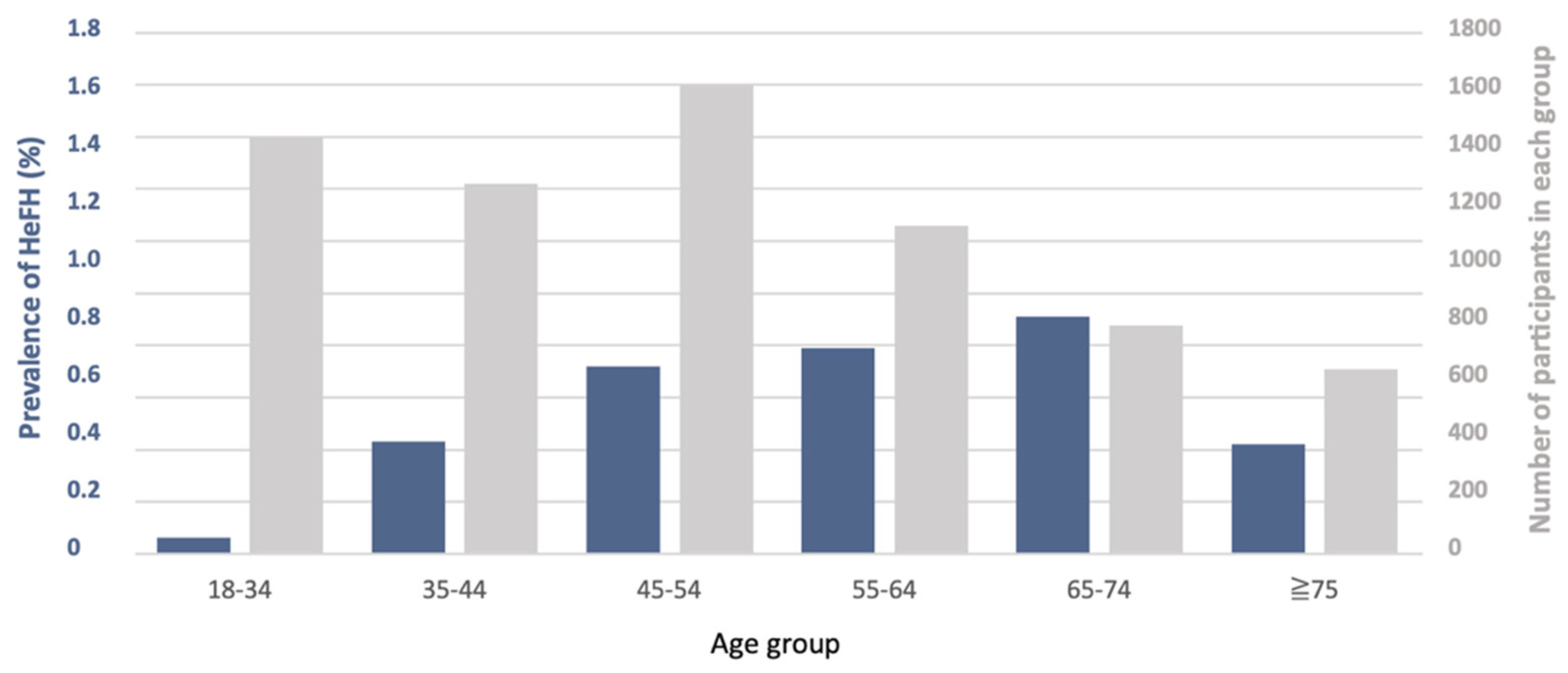
3.1. Prevalence of HeFH in the Greek Population
3.2. Clinical and Risk Factor Profile
- Mean Age of ASCVD: 55 ± 14 years for HeFH vs. 67 ± 12 years for the general population (p < 0.001).
- Premature Manifestation: 82.4% (14 out of 17) of individuals with the HeFH phenotype with ASCVD experienced premature onset.
- Myocardial Infarction: The mean age for MI in the HeFH group was 52 ± 12 years compared to 66 ± 13 years in others (p < 0.001), with 90% of these events classified as premature.
3.3. Lipid-Lowering Therapy (LLT) and Target Attainment
4. Discussion
Strengths and Limitations
5. Conclusions
Author Contributions
Funding
Institutional Review Board Statement
Informed Consent Statement
Data Availability Statement
Conflicts of Interest
References
- Defesche, J.C.; Gidding, S.S.; Harada-Shiba, M.; Hegele, R.A.; Santos, R.D.; Wierzbicki, A.S. Familial hypercholesterolaemia. Nat. Rev. Dis. Prim. 2017, 3, 17093. [Google Scholar] [CrossRef] [PubMed]
- Cuchel, M.; Raal, F.J.; Hegele, R.A.; Al-Rasadi, K.; Arca, M.; Averna, M.; Bruckert, E.; Freiberger, T.; Gaudet, D.; Harada-Shiba, M.; et al. 2023 Update on European Atherosclerosis Society Consensus Statement on Homozygous Familial Hypercholesterolaemia: New treatments and clinical guidance. Eur. Heart J. 2023, 44, 2277–2291. [Google Scholar] [CrossRef] [PubMed]
- Watts, G.F.; Gidding, S.S.; Hegele, R.A.; Raal, F.J.; Sturm, A.C.; Jones, L.K.; Sarkies, M.N.; Al-Rasadi, K.; Blom, D.J.; Daccord, M.; et al. International Atherosclerosis Society guidance for implementing best practice in the care of familial hypercholesterolaemia. Nat. Rev. Cardiol. 2023, 20, 845–869. [Google Scholar] [CrossRef] [PubMed]
- Watts, G.F.; Jones, L.K.; Sarkies, M.N.; Pang, J.; Gidding, S.S.; Libby, P.; Santos, R.D. International Atherosclerosis Society Roadmap for Familial Hypercholesterolaemia. Glob. Heart 2024, 19, 12. [Google Scholar] [CrossRef] [PubMed]
- Grzymski, J.J.; Elhanan, G.; Morales Rosado, J.A.; Smith, E.; Schlauch, K.A.; Read, R.; Rowan, C.; Slotnick, N.; Dabe, S.; Metcalf, W.J.; et al. Population genetic screening efficiently identifies carriers of autosomal dominant diseases. Nat. Med. 2020, 26, 1235–1239. [Google Scholar] [CrossRef] [PubMed]
- Nordestgaard, B.G.; Chapman, M.J.; Humphries, S.E.; Ginsberg, H.N.; Masana, L.; Descamps, O.S.; Wiklund, O.; Hegele, R.A.; Raal, F.J.; Defesche, J.C.; et al. Familial hypercholesterolaemia is underdiagnosed and undertreated in the general population: Guidance for clinicians to prevent coronary heart disease: Consensus statement of the European Atherosclerosis Society. Eur. Heart J. 2013, 34, 3478–3490. [Google Scholar] [CrossRef] [PubMed]
- Benn, M.; Watts, G.F.; Tybjærg-Hansen, A.; Nordestgaard, B.G. Mutations causative of familial hypercholesterolaemia: Screening of 98 098 individuals from the Copenhagen General Population Study estimated a prevalence of 1 in 217. Eur. Heart J. 2016, 37, 1384–1394. [Google Scholar] [CrossRef] [PubMed]
- de Ferranti, S.D.; Rodday, A.M.; Mendelson, M.M.; Wong, J.B.; Leslie, L.K.; Sheldrick, R.C. Prevalence of Familial Hypercholesterolemia in the 1999 to 2012 United States National Health and Nutrition Examination Surveys (NHANES). Circulation 2016, 133, 1067–1072. [Google Scholar] [CrossRef] [PubMed]
- Besseling, J.; Kindt, I.; Hof, M.; Kastelein, J.J.P.; Hutten, B.A.; Hovingh, G.K. Severe heterozygous familial hypercholesterolemia and risk for cardiovascular disease: A study of a cohort of 14,000 mutation carriers. Atherosclerosis 2014, 233, 219–223. [Google Scholar] [CrossRef] [PubMed]
- Sjouke, B.; Kusters, D.M.; Kindt, I.; Besseling, J.; Defesche, J.C.; Sijbrands, E.J.; Roeters van Lennep, J.E.; Stalenhoef, A.F.; Wiegman, A.; de Graaf, J.; et al. Homozygous autosomal dominant hypercholesterolaemia in the Netherlands: Prevalence, genotype-phenotype relationship, and clinical outcome. Eur. Heart J. 2015, 36, 560–565. [Google Scholar] [PubMed]
- Henderson, R.; O’Kane, M.; McGilligan, V.; Watterson, S. The genetics and screening of familial hypercholesterolaemia. J. Biomed. Sci. 2016, 23, 39. [Google Scholar] [CrossRef] [PubMed]
- Tromp, T.R.; Hartgers, M.L.; Hovingh, G.K.; Vallejo-Vaz, A.J.; Ray, K.K.; Soran, H.; Freiberger, T.; Bertolini, S.; Harada-Shiba, M.; Blom, D.J.; et al. Worldwide experience of homozygous familial hypercholesterolaemia: Retrospective cohort study. Lancet 2022, 399, 719–728. [Google Scholar] [CrossRef] [PubMed]
- Talmud, P.J.; Shah, S.; Whittall, R.; Futema, M.; Howard, P.; Cooper, J.A.; Harrison, S.C.; Li, K.; Drenos, F.; Karpe, F.; et al. Use of low-density lipoprotein cholesterol gene score to distinguish patients with polygenic and monogenic familial hypercholesterolaemia: A case-control study. Lancet 2013, 381, 1293–1301. [Google Scholar] [PubMed]
- Taylor, A.; Bayly, G.; Patel, K.; Yarram, L.; Williams, M.; Hamilton-Shield, J.; Humphries, S.E.; Norbury, G. A double heterozygote for familial hypercholesterolaemia and familial defective apolipoprotein B-100. Ann. Clin. Biochem. 2010, 47, 487–490. [Google Scholar] [CrossRef] [PubMed]
- Masana, L.; Zamora, A.; Plana, N.; Comas-Cufí, M.; Garcia-Gil, M.; Martí-Lluch, R.; Ponjoan, A.; Alves-Cabratosa, L.; Elosua, R.; Marrugat, J.; et al. Incidence of Cardiovascular Disease in Patients with Familial Hypercholesterolemia Phenotype: Analysis of 5 Years Follow-Up of Real-World Data from More than 1.5 Million Patients. J. Clin. Med. 2019, 8, 1080. [Google Scholar] [CrossRef] [PubMed]
- Qureshi, N.; Woods, B.; Neves de Faria, R.; Saramago Goncalves, P.; Cox, E.; Leonardi Bee, J.; Condon, L.; Weng, S.; Akyea, R.K.; Iyen, B.; et al. Alternative cascade-testing protocols for identifying and managing patients with familial hypercholesterolaemia: Systematic reviews, qualitative study and cost-effectiveness analysis. Health Technol. Assess. 2023, 27, 1–140. [Google Scholar] [PubMed]
- Zamora, A.; Masana, L.; Civeira, F.; Ibarretxe, D.; Fanlo-Maresma, M.; Vila, A.; Suárez Tembra, M.; Marco-Benedí, V.; Alvarez-Sala-Walther, L.A.; Camacho-Ruiz, M. Prognostic stratification of familial hypercholesterolaemia patients using AI algorithms: A gender-specific approach. Eur. Heart J. Digit. Health 2025, 6, 1113–1123. [Google Scholar] [CrossRef] [PubMed]
- Representatives of the Global Familial Hypercholesterolemia Community; Wilemon, K.A.; Patel, J.; Aguilar-Salinas, C.; Ahmed, C.D.; Alkhnifsawi, M.; Almahmeed, W.; Alonso, R.; Al-Rasadi, K.; Badimon, L. Reducing the Clinical and Public Health Burden of Familial Hypercholesterolemia: A Global Call to Action. JAMA Cardiol. 2020, 5, 217–229. [Google Scholar] [PubMed]
- Balkrishna, A.; Agarwal, U.; Saxena, S.; Sharma, G.; Arya, V. Toward an Integrated Therapeutic Approach for Familial Hypercholesterolemia. Curr. Med. Sci. 2026, 46, 65–78. [Google Scholar] [CrossRef] [PubMed]
- Faria, R.; Saramago, P.; Cox, E.; Weng, S.; Iyen, B.; Akyea, R.K.; Humphries, S.E.; Qureshi, N.; Woods, B. How does cholesterol burden change the case for investing in familial hypercholesterolaemia? A cost-effectiveness analysis. Atherosclerosis 2023, 367, 40–47. [Google Scholar] [PubMed]
- Kolovou, G.; Marvaki, C.; Makrygiannis, S.; Kadda, O.; Giannakopoulou, V.; Kalogeropoulos, P.; Anagnostopoulou, K.; Goumas, G.; Kazianis, G.; Limberi, S.; et al. Rationale and design of the Greek registry for familial hypercholesterolemia (GRegistry-FH) of the hellenic college of treatment of atherosclerosis (HCTA). Hell. J. Cardiol. 2020, 61, 284–287. [Google Scholar] [CrossRef]
- Kolovou, G.; Makrygiannis, S.; Marvaki, C.; Pavlatou, N.; Anagnostopoulou, K.; Giannakopoulou, V.; Goumas, G.; Kalogeropoulos, P.; Kolovou, V.; Limberi, S.; et al. Prevalence and Risk Factors for Atherosclerotic Cardiovascular Disease in 7704 Individuals: An Analysis from the Greek Registry for the Prevalence of Familial Hypercholesterolemia (GRegistry-FH). J. Cardiovasc. Dev. Dis. 2024, 11, 411. [Google Scholar] [CrossRef] [PubMed]
- Abdul-Razak, S.; Rahmat, R.; Mohd Kasim, A.; Rahman, T.A.; Muid, S.; Nasir, N.M.; Ibrahim, Z.; Kasim, S.; Ismail, Z.; Abdul Ghani, R.; et al. Diagnostic performance of various familial hypercholesterolaemia diagnostic criteria compared to Dutch lipid clinic criteria in an Asian population. BMC Cardiovasc. Disord. 2017, 17, 264. [Google Scholar] [CrossRef] [PubMed]
- Neil, H.; Betteridge, D.; Broome, K.; Durrington, P.; Hawkins, M.; Humphries, S.E.; Mann, J.; Miller, J.; Thompson, G.; Thorogood, M.; et al. Mortality in treated heterozygous familial hypercholesterolaemia: Implications for Clinical Management. Scientific Steering Committee on behalf of the Simon Broome Register Group. Atherosclerosis 1999, 142, 105–112. [Google Scholar]
- Mach, F.; Baigent, C.; Catapano, A.L.; Koskinas, K.C.; Casula, M.; Badimon, L.; Chapman, M.J.; De Backer, G.G.; Delgado, V.; Ference, B.A.; et al. 2019 ESC/EAS Guidelines for the management of dyslipidaemias: Lipid modification to reduce cardiovascular risk. Eur. Heart J. 2020, 41, 111–188. [Google Scholar] [PubMed]
- Zamora, A.; Masana, L.; Comas-Cufí, M.; Vila, À.; Plana, N.; García-Gil, M.; Alves-Cabratosa, L.; Marrugat, J.; Roman, I.; Ramos, R.; et al. Familial hypercholesterolemia in a European Mediterranean population-Prevalence and clinical data from 2.5 million primary care patients. J. Clin. Lipidol. 2017, 11, 1013–1022. [Google Scholar] [PubMed]
- Moorjani, S.; Roy, M.; Gagne, C.; Davignon, J.; Brun, D.; Toussaint, M.; Lambert, M.; Campeau, L.; Blaichman, S.; Lupien, P. Homozygous familial hypercholesterolemia among French Canadians in Quebec province. Arteriosclerosis 1989, 9, 211–216. [Google Scholar] [CrossRef] [PubMed]
- Steyn, K.; Goldberg, Y.P.; Kotze, M.J.; Steyn, M.; Swanepoel, A.S.; Fourie, J.M.; Coetzee, G.A.; Van der Westhuyzen, D.R. Estimation of the prevalence of familial hypercholesterolaemia in a rural Afrikaner community by direct screening for three Afrikaner founder low density lipoprotein receptor gene mutations. Hum. Genet. 1996, 98, 479–484. [Google Scholar] [CrossRef] [PubMed]
- Seftel, H.C.; Baker, S.G.; Jenkins, T.; Mendelsohn, D. Prevalence of familial hypercholesterolemia in Johannesburg jews. Am. J. Med. Genet. 1989, 34, 545–547. [Google Scholar] [CrossRef] [PubMed]
- Fahed, A.C.; Safa, R.M.; Haddad, F.F.; Bitar, F.F.; Andary, R.R.; Arabi, M.T.; Azar, S.T.; Nemer, G. Homozygous familial hypercholesterolemia in Lebanon: A genotype/phenotype correlation. Mol. Genet. Metab. 2011, 102, 181–188. [Google Scholar] [CrossRef] [PubMed]
- Benn, M.; Watts, G.F.; Tybjaerg-Hansen, A.; Nordestgaard, B.G. Familial hypercholesterolemia in the Danish general population: Prevalence, coronary artery disease, and cholesterol-lowering medication. J. Clin. Endocrinol. Metab. 2012, 97, 3956–3964. [Google Scholar] [CrossRef] [PubMed]
- Cannon, C.P.; Blazing, M.A.; Giugliano, R.P.; McCagg, A.; White, J.A.; Théroux, P.; Darius, H.; Lewis, B.S.; Ophuis, T.O.; Jukema, J.W.; et al. Ezetimibe added to statin therapy after acute coronary syndromes. N. Engl. J. Med. 2015, 372, 2387–2397. [Google Scholar] [CrossRef] [PubMed]
- Vallejo-Vaz, A.J.; Ginsberg, H.N.; Davidson, M.H.; Eckel, R.H.; Cannon, C.P.; Lee, L.V.; Bessac, L.; Pordy, R.; Letierce, A.; Ray, K.K. Lower On-Treatment Low-Density Lipoprotein Cholesterol and Major Adverse Cardiovascular Events in Women and Men: Pooled Analysis of 10 ODYSSEY Phase 3 Alirocumab Trials. J. Am. Heart Assoc. 2018, 7, e009221. [Google Scholar] [PubMed]
- Antza, C.; Rizos, C.V.; Kotsis, V.; Liamis, G.; Skoumas, I.; Rallidis, L.; Garoufi, A.; Sfikas, G.; Kolovou, G.; Penopoulos, A.; et al. Beyond lipid levels: Unraveling the hypertensive factor in familial hypercholesterolemia. The HELLAS-FH registry. J. Hum. Hypertens. 2025, 39, 619–625. [Google Scholar] [CrossRef] [PubMed]
- Besseling, J.; Kastelein, J.J.; Defesche, J.C.; Hutten, B.A.; Hovingh, G.K. Association between familial hypercholesterolemia and prevalence of type 2 diabetes mellitus. JAMA 2015, 313, 1029–1036. [Google Scholar] [CrossRef] [PubMed]
- Goldstein, J.L.; Schrott, H.G.; Hazzard, W.R.; Bierman, E.L.; Motulsky, A.G. Hyperlipidemia in coronary heart disease. II. Genetic analysis of lipid levels in 176 families and delineation of a new inherited disorder, combined hyperlipidemia. J. Clin. Investig. 1973, 52, 1544–1568. [Google Scholar] [CrossRef] [PubMed]
- Datta, B.N.; McDowell, I.F.; Rees, A. Integrating provision of specialist lipid services with cascade testing for familial hypercholesterolaemia. Curr. Opin. Lipidol. 2010, 21, 366–371. [Google Scholar] [CrossRef] [PubMed]
- Willeit, P.; Yeang, C.; Moriarty, P.M.; Tschiderer, L.; Varvel, S.A.; McConnell, J.P.; Tsimikas, S. Low-Density Lipoprotein Cholesterol Corrected for Lipoprotein(a) Cholesterol, Risk Thresholds, and Cardiovascular Events. J. Am. Heart Assoc. 2020, 9, e016318. [Google Scholar] [PubMed]


| General Population | HeFH Phenotype | p | |
|---|---|---|---|
| n | 7663 | 41 | |
| Men, n (%) | 3238 (42.3) | 23 (56.1) | 0.074 (ns) |
| Women, n (%) | 4425 (57.7) | 18 (43.9) | |
| Age, years mean (SD) | 49.6 (17.1) | 55.7 (12.6) | 0.004 |
| ΒΜΙ, kg/m2 mean (SD) | 26.5 (6.7) | 26.4 (3.8) | 0.9 (ns) |
| Current smoking, n (%) | 2212 (28.9) | 17 (41.5) | 0.07 (ns) |
| Hypertension, n (%) | 1830 (23.9) | 20 (48.8) | <0.001 |
| Diabetes mellitus, n (%) | 810 (10.6) | 7 (17.1) | 0.18 (ns) |
| Pre-diabetes mellitus *, n (%) | 1419 (25.4) | 5 (16.1) | 0.23 (ns) |
| Personal history of MI, n (%) | 238 (3.1) | 10 (24.4) | <0.001 |
| Personal history of CHD, n (%) | 445 (5.8) | 17 (41.5) | <0.001 |
| Personal history of stroke, n (%) | 357 (4.7) | 8 (19.5) | <0.001 |
| Relatives with hypercholesterolemia, mean (SD) | 1 (1) | 3 (1) | <0.001 |
| Family history of CHD, n (%) | 2452 (32.0) | 27 (65.9) | <0.001 |
| Family history of stroke, n (%) | 2158 (28.2) | 16 (39.0) | 0.12 (ns) |
| General Population | HeFH Phenotype | p | |
|---|---|---|---|
| Blood glucose, mg/dL mean (SD) | 99 (30) | 113 (36) | 0.49 (ns) |
| Systolic blood pressure, mmHg mean (SD) | 123 (17) | 136 (18) | <0.001 |
| Diastolic blood pressure, mmHg mean (SD) | 75 (11) | 79 (12) | 0.075 (ns) |
| Baseline total cholesterol, mean (SD) | 201 (39) | 296 (35) | <0.001 |
| Baseline triglycerides, mean (SD) | 136 (65) | 128 (43) | 0.45 (ns) |
| Baseline HDL cholesterol, mean (SD) | 52 (13) | 51 (15) | 0.71 (ns) |
| Baseline LDL cholesterol, mean (SD) | 126 (29) | 224 (42) | <0.001 |
| Receiving lipid-lowering treatment, n (%) | 1514 (19.8) | 33 (80.5) | <0.001 |
| Treated total cholesterol, mean (SD) | 185 (36) | 202 (34 | 0.007 |
| Treated triglycerides, mean (SD) | 136 (64) | 105 (35) | 0.011 |
| Treated HDL cholesterol, mean (SD) | 52 (13) | 60 (14) | 0.002 |
| Treated LDL cholesterol, mean (SD) | 108 (33) | 130 (53) | 0.048 |
Disclaimer/Publisher’s Note: The statements, opinions and data contained in all publications are solely those of the individual author(s) and contributor(s) and not of MDPI and/or the editor(s). MDPI and/or the editor(s) disclaim responsibility for any injury to people or property resulting from any ideas, methods, instructions or products referred to in the content. |
© 2026 by the authors. Licensee MDPI, Basel, Switzerland. This article is an open access article distributed under the terms and conditions of the Creative Commons Attribution (CC BY) license.
Share and Cite
Kolovou, G.; Makrygiannis, S.; Pavlatou, N.; Marvaki, C.; Kadda, O.; Marvaki, A.; Kalogeropoulos, P.; Kolovou, V.; Tzenalis, A.; Emre, Z.; et al. Prevalence, Clinical Characteristics, and Therapeutic Underachievement in Familial Hypercholesterolemia: Results from the GRegistry-FH Population-Based Study in Greece. J. Clin. Med. 2026, 15, 5127. https://doi.org/10.3390/jcm15135127
Kolovou G, Makrygiannis S, Pavlatou N, Marvaki C, Kadda O, Marvaki A, Kalogeropoulos P, Kolovou V, Tzenalis A, Emre Z, et al. Prevalence, Clinical Characteristics, and Therapeutic Underachievement in Familial Hypercholesterolemia: Results from the GRegistry-FH Population-Based Study in Greece. Journal of Clinical Medicine. 2026; 15(13):5127. https://doi.org/10.3390/jcm15135127
Chicago/Turabian StyleKolovou, Genovefa, Stamatis Makrygiannis, Niki Pavlatou, Christina Marvaki, Olga Kadda, Aikaterini Marvaki, Petros Kalogeropoulos, Vana Kolovou, Anastasios Tzenalis, Zeimpek Emre, and et al. 2026. "Prevalence, Clinical Characteristics, and Therapeutic Underachievement in Familial Hypercholesterolemia: Results from the GRegistry-FH Population-Based Study in Greece" Journal of Clinical Medicine 15, no. 13: 5127. https://doi.org/10.3390/jcm15135127
APA StyleKolovou, G., Makrygiannis, S., Pavlatou, N., Marvaki, C., Kadda, O., Marvaki, A., Kalogeropoulos, P., Kolovou, V., Tzenalis, A., Emre, Z., Jahaj, E., Kasiara, Z., Giannakoulis, I., Tsolakoglou, I., Tsaloukidis, N., Koulaxidou, R., Anagnostopoulou, K., Giannakopoulou, V., Goumas, G., ... Bilianou, H. (2026). Prevalence, Clinical Characteristics, and Therapeutic Underachievement in Familial Hypercholesterolemia: Results from the GRegistry-FH Population-Based Study in Greece. Journal of Clinical Medicine, 15(13), 5127. https://doi.org/10.3390/jcm15135127