


Round Spermatid Injection (ROSI) as a Last Resort in High-Risk Azoospermia: Chain of Outcome Metrics and Real-World Safety Signals

 , , , , , and
Abstract
1. Introduction
2. Materials and Methods
2.1. Study Design and Reporting Framework
2.2. Participants and Clinical Context
2.3. Embryologic Assessment and Spermatid Search Procedure
2.4. Outcome Definitions and Chain of Outcome Metrics
2.5. Sample Size Rationale and Precision
2.6. Statistical Analysis
2.7. Ethical Approval
3. Results
3.1. Baseline Characteristics
3.2. Chain of Outcome Metrics and Attrition Pattern
3.3. Pregnancy Follow-Up and Delivery Outcomes
3.4. Subgroup Descriptive Patterns
3.5. Safety Signal and Uncertainty
4. Discussion
5. Conclusions
Supplementary Materials
Author Contributions
Funding
Institutional Review Board Statement
Informed Consent Statement
Data Availability Statement
Conflicts of Interest
References
- Edwards, R.G.; Tarin, J.J.; Dean, N.; Hirsch, A.; Tan, S.L. Are spermatid injections into human oocytes now mandatory? Hum. Reprod. 1994, 9, 2217–2219. [Google Scholar] [CrossRef]
- Tesarik, J.; Mendoza, C.; Testart, J. Viable embryos from injection of round spermatids into oocytes. N. Engl. J. Med. 1995, 333, 525. [Google Scholar] [CrossRef] [PubMed]
- Tesarik, J.; Mendoza, C. Spermatid injection into human oocytes. I. Laboratory techniques and special features of zygote development. Hum. Reprod. 1996, 11, 772–779. [Google Scholar] [CrossRef] [PubMed]
- Tesarik, J.; Rolet, F.; Brami, C.; Sedbon, E.; Thorel, J.; Tibi, C.; Thébault, A. Spermatid injection into human oocytes. II. Clinical application in the treatment of infertility due to non-obstructive azoospermia. Hum. Reprod. 1996, 11, 780–783. [Google Scholar] [CrossRef] [PubMed]
- Barak, Y.; Kogosowski, A.; Goldman, S.; Soffer, Y.; Gonen, Y.; Tesarik, J. Pregnancy and birth after transfer of embryos that developed from single-nucleated zygotes obtained by injection of round spermatids into oocytes. Fertil. Steril. 1998, 70, 67–70. [Google Scholar] [CrossRef]
- Khalili, M.A.; Aflatoonian, A.; Zavos, P.M. Intracytoplasmic injection using spermatids and subsequent pregnancies: Round versus elongated spermatids. J. Assist. Reprod. Genet. 2002, 19, 84–86. [Google Scholar] [CrossRef]
- Hanson, B.M.; Kohn, T.P.; Pastuszak, A.W.; Scott, R.T.; Cheng, P.J.; Hotaling, J.M. Round spermatid injection into human oocytes: A systematic review and meta-analysis. Asian J. Androl. 2021, 23, 363–369. [Google Scholar] [CrossRef]
- Tao, Y. Oocyte activation during round spermatid injection: State of the art. Reprod. Biomed. Online 2022, 45, 211–218. [Google Scholar] [CrossRef]
- Angelopoulos, T.; Krey, L.; McCullough, A.; Adler, A.; Grifo, J.A. A simple and objective approach to identifying human round spermatids. Hum. Reprod. 1997, 12, 2208–2216. [Google Scholar] [CrossRef][Green Version]
- Tanaka, A.; Nagayoshi, M.; Takemoto, Y.; Tanaka, I.; Kusunoki, H.; Watanabe, S.; Yanagimachi, R. Fourteen babies born after round spermatid injection into human oocytes. Proc. Natl. Acad. Sci. USA 2015, 112, 14629–14634. [Google Scholar] [CrossRef]
- Tanaka, A.; Watanabe, S. How to improve the clinical outcome of round spermatid injection (ROSI) into the oocyte: Correction of epigenetic abnormalities. Reprod. Med. Biol. 2023, 22, e12503. [Google Scholar] [CrossRef] [PubMed]
- Practice Committee of the American Society for Reproductive Medicine; Practice Committee of the Society for Assisted Reproductive Technology. Round spermatid nucleus injection (ROSNI). Fertil. Steril. 2006, 86, S184–S186. [Google Scholar] [CrossRef] [PubMed]
- Practice Committee of the American Society for Reproductive Medicine; Practice Committee of the Society for Assisted Reproductive Technology. Round spermatid nucleus injection (ROSNI). Fertil. Steril. 2008, 90, S199–S201. [Google Scholar] [CrossRef] [PubMed]
- Lundin, K.; Bentzen, J.G.; Bozdag, G.; Ebner, T.; Harper, J.; Le Clef, N.; Moffett, A.; Norcross, S.; Polyzos, N.P.; Rautakallio-Hokkanen, S.; et al. Good practice recommendations on add-ons in reproductive medicine. Hum. Reprod. 2023, 38, 2062–2104. [Google Scholar] [CrossRef]
- Ethics Committee of the American Society for Reproductive Medicine. Informed consent in assisted reproduction: An Ethics Committee opinion. Fertil. Steril. 2023, 119, 948–953. [Google Scholar] [CrossRef]
- Brannigan, R.E.; Hermanson, L.; Kaczmarek, J.; Kim, S.K.; Kirkby, E.; Tanrikut, C. Updates to Male Infertility: AUA/ASRM Guideline (2024). J. Urol. 2024, 212, 789–799. [Google Scholar] [CrossRef]
- Tekayev, M.; Vuruskan, A.K. Clinical values and advances in round spermatid injection (ROSI). Reprod. Biol. 2021, 21, 100530. [Google Scholar] [CrossRef]
- Cheng, N.-M.; Huang, W.J.; Huang, C.-Y.; Chen, Y.-J.; Ho, C.-H. Clinical outcomes of round spermatid injection vs. intracytoplasmic sperm injection: The role of hormonal pretreatment for nonobstructive azoospermia. J. Chin. Med. Assoc. 2025, 88, 52–57. [Google Scholar] [CrossRef]
- Shan, Y.; Zhao, H.; Zhao, D.; Wang, J.; Cui, Y.; Bao, H. Assisted oocyte activation with calcium ionophore improves pregnancy outcomes and offspring safety in infertile patients: A systematic review and meta-analysis. Front. Physiol. 2022, 12, 751905. [Google Scholar] [CrossRef]
- Kamath, M.S.; Vogiatzi, P.; Sunkara, S.K.; Woodward, B. Oocyte activation for women following intracytoplasmic sperm injection (ICSI). Cochrane Database Syst. Rev. 2024, 12, CD014040. [Google Scholar]
- Fawzy, M.; Elsuity, M.A.; Magdi, Y.; Rashwan, M.M.; Gad, M.A.; Adel, N.; Emad, M.; Ibrahem, D.; El-Gezeiry, S.; Etman, A.; et al. Evaluating the Effectiveness of Assisted Oocyte Activation in ICSI: Pairwise Meta-Analyses and Systematic Evidence Evaluation. BJOG Int. J. Obstet. Gynaecol. 2025, 132, 724–741. [Google Scholar] [CrossRef] [PubMed]
- Zhang, J.; Sui, Y.; Xiao, M.; Sun, X.; Fu, J. Assessing the impact of calcium ionophore on pregnancy outcomes in artificial oocyte activation cycles: A 10-year update of systematic review and meta-analysis. J. Assist. Reprod. Genet. 2025, 42, 165–183. [Google Scholar] [CrossRef] [PubMed]
- Hanley, J.A.; Lippman-Hand, A. If nothing goes wrong, is everything all right? Interpreting zero numerators. JAMA 1983, 249, 1743–1745. [Google Scholar] [CrossRef] [PubMed]
- Clopper, C.J.; Pearson, E.S. The use of confidence or fiducial limits illustrated in the case of the binomial. Biometrika 1934, 26, 404–413. [Google Scholar] [CrossRef]
- Davies, M.J.; Moore, V.M.; Willson, K.J.; Van Essen, P.; Priest, K.; Scott, H.; Chan, A. Reproductive technologies and the risk of birth defects. N. Engl. J. Med. 2012, 366, 1803–1813. [Google Scholar] [CrossRef]
- Hansen, M.; Kurinczuk, J.J.; Milne, E.; De Klerk, N.; Bower, C. Assisted reproductive technology and birth defects: A systematic review and meta-analysis. Hum. Reprod. Update 2013, 19, 330–353. [Google Scholar] [CrossRef]
- Pinborg, A.; Wennerholm, U.-B.; Bergh, C. Long-term outcomes for children conceived by assisted reproductive technology. Fertil. Steril. 2023, 120, 449–456. [Google Scholar] [CrossRef]
- Graham, M.E.; Jelin, A.; Hoon, A.H., Jr.; Wilms Floet, A.M.; Levey, E.; Graham, E.M. Assisted reproductive technology: Short- and long-term outcomes. Dev. Med. Child Neurol. 2023, 65, 38–49. [Google Scholar] [CrossRef]
- Wang, W.; Meng, Q.; Hu, L.; Du, J.; Xu, B.; Han, X.; Liu, X.; Zhou, K.; Ke, K.; Gan, M.; et al. Assisted reproductive technology and neurodevelopment in children at 1 year of age: A longitudinal birth cohort study. Am. J. Obstet. Gynecol. 2024, 231, 532.e1–532.e21. [Google Scholar] [CrossRef]
- Lucifero, D.; Chaillet, J.R.; Trasler, J.M. Potential significance of genomic imprinting defects for reproduction and assisted reproductive technology. Hum. Reprod. Update 2004, 10, 3–18. [Google Scholar] [CrossRef]
- Horsthemke, B.; Ludwig, M. Assisted reproduction: The epigenetic perspective. Hum. Reprod. Update 2005, 11, 473–482. [Google Scholar] [CrossRef] [PubMed]
- Ye, M.; Reyes Palomares, A.; Iwarsson, E.; Oberg, A.S.; Rodriguez-Wallberg, K.A. Imprinting disorders in children conceived with assisted reproductive technology in Sweden. Fertil. Steril. 2024, 122, 706–714. [Google Scholar] [CrossRef] [PubMed]
- Kagami, M.; Hara-Isono, K.; Sasaki, A.; Amita, M. Association between imprinting disorders and assisted reproductive technologies. Epigenomics 2025, 17, 397–410. [Google Scholar] [CrossRef] [PubMed]
- Tanaka, A.; Suzuki, K.; Nagayoshi, M.; Tanaka, A.; Takemoto, Y.; Watanabe, S.; Yanagimachi, R. Ninety babies born after round spermatid injection into oocytes: Survey of their development from fertilization to 2 years of age. Fertil. Steril. 2018, 110, 443–451. [Google Scholar] [CrossRef]
- Urman, B.; Alatas, C.; Aksoy, S.; Mercan, R.; Nuhoglu, A.; Mumcu, A.; Balaban, B. Transfer at the blastocyst stage of embryos derived from testicular round spermatid injection. Hum. Reprod. 2002, 17, 741–743. [Google Scholar] [CrossRef]
- Balaban, B.; Urman, B.; Isiklar, A.; Alatas, C.; Aksoy, S.; Mercan, R.; Nuhoglu, A. Progression to the blastocyst stage of embryos derived from testicular round spermatids. Hum. Reprod. 2000, 15, 1377–1382. [Google Scholar] [CrossRef]
- Vicdan, K.; Isik, A.Z.; Delilbaşi, L. Development of blastocyst-stage embryos after round spermatid injection in patients with complete spermiogenesis failure. J. Assist. Reprod. Genet. 2001, 18, 78–86. [Google Scholar] [CrossRef]



| Characteristic | Value |
|---|---|
| Female age (years), mean (SD) | 30.8 (6.4) |
| Female age (years), median (IQR) | 29 (26–35) |
| MII oocytes, median (IQR) | 7 (2–10) |
| Azoospermia type: cryptozoospermia, n (%) | 76 (34.4) |
| Azoospermia type: non-obstructive azoospermia, n (%) | 76 (34.4) |
| Azoospermia type: obstructive azoospermia, n (%) | 69 (31.2) |
| Sperm source: ejaculate, n (%) | 76 (34.4) |
| Sperm source: TESE, n (%) | 72 (32.6) |
| Sperm source: micro TESE, n (%) | 73 (33.0) |
| Genetic status: not recorded, n (%) | 78 (35.3) |
| Genetic status: 47,XXY, n (%) | 74 (33.5) |
| Genetic status: AZF, n (%) | 69 (31.2) |
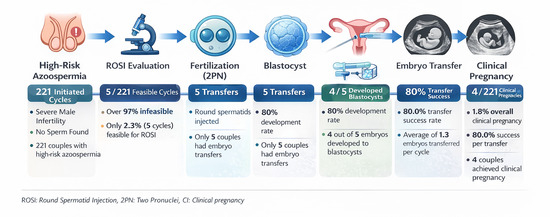
| Stage-Specific Metric | n/N | Estimate (%) | Exact 95% CI |
|---|---|---|---|
| Feasibility (cycle level; ≥1 injected oocyte) | 5/221 | 2.3 | 0.7–5.2 |
| Two pronuclei per injected oocyte | 23/40 | 57.5 | 40.9–73.0 |
| Blastocyst per two pronuclei | 15/23 | 65.2 | 42.7–83.6 |
| Transfer procedure per cycle with ≥1 blastocyst | 5/5 | 100.0 | 47.8–100.0 |
| Clinical pregnancy per transfer procedure | 4/5 | 80.0 | 28.4–99.5 |
| Clinical pregnancy per initiated cycle | 4/221 | 1.8 | 0.5–4.6 |
| Fetal anomaly among clinical pregnancies | 0/4 | 0.0 | 0.0–60.2 |
| Subgroup Domain | Level | Feasibility (n/N) | Feasibility % (95% CI) | Clinical Pregnancy per Initiated Cycle (n/N) | Clinical Pregnancy % (95% CI) |
|---|---|---|---|---|---|
| Azoospermia type | Cryptozoospermia | 2/76 | 2.6 (0.3–9.2) | 2/76 | 2.6 (0.3–9.2) |
| Azoospermia type | Non-obstructive azoospermia | 3/76 | 3.9 (0.8–11.1) | 2/76 | 2.6 (0.3–9.2) |
| Azoospermia type | Obstructive azoospermia | 0/69 | 0.0 (0.0–5.2) | 0/69 | 0.0 (0.0–5.2) |
| Genetic status | Not recorded | 4/78 | 5.1 (1.4–12.6) | 3/78 | 3.8 (0.8–10.8) |
| Genetic status | 47,XXY | 0/74 | 0.0 (0.0–4.9) | 0/74 | 0.0 (0.0–4.9) |
| Genetic status | AZF | 1/69 | 1.4 (0.0–7.8) | 1/69 | 1.4 (0.0–7.8) |
| Sperm source | Ejaculate | 1/76 | 1.3 (0.0–7.1) | 0/76 | 0.0 (0.0–4.8) |
| Sperm source | TESE | 2/72 | 2.8 (0.3–9.7) | 2/72 | 2.8 (0.3–9.7) |
| Sperm source | micro TESE | 2/73 | 2.7 (0.3–9.5) | 2/73 | 2.7 (0.3–9.5) |
Disclaimer/Publisher’s Note: The statements, opinions and data contained in all publications are solely those of the individual author(s) and contributor(s) and not of MDPI and/or the editor(s). MDPI and/or the editor(s) disclaim responsibility for any injury to people or property resulting from any ideas, methods, instructions or products referred to in the content. |
© 2026 by the authors. Licensee MDPI, Basel, Switzerland. This article is an open access article distributed under the terms and conditions of the Creative Commons Attribution (CC BY) license.
Share and Cite
Karabulut Doğan, Ü.; Cömert, E.H.; Baykara, T.; Taş, M.; Gençten, Y.; Doğruel, T.; Doğan, O. Round Spermatid Injection (ROSI) as a Last Resort in High-Risk Azoospermia: Chain of Outcome Metrics and Real-World Safety Signals. J. Clin. Med. 2026, 15, 2771. https://doi.org/10.3390/jcm15072771
Karabulut Doğan Ü, Cömert EH, Baykara T, Taş M, Gençten Y, Doğruel T, Doğan O. Round Spermatid Injection (ROSI) as a Last Resort in High-Risk Azoospermia: Chain of Outcome Metrics and Real-World Safety Signals. Journal of Clinical Medicine. 2026; 15(7):2771. https://doi.org/10.3390/jcm15072771
Chicago/Turabian StyleKarabulut Doğan, Ümran, Erhan Hüseyin Cömert, Tuğçe Baykara, Mustafa Taş, Yusuf Gençten, Telal Doğruel, and Ozan Doğan. 2026. "Round Spermatid Injection (ROSI) as a Last Resort in High-Risk Azoospermia: Chain of Outcome Metrics and Real-World Safety Signals" Journal of Clinical Medicine 15, no. 7: 2771. https://doi.org/10.3390/jcm15072771
APA StyleKarabulut Doğan, Ü., Cömert, E. H., Baykara, T., Taş, M., Gençten, Y., Doğruel, T., & Doğan, O. (2026). Round Spermatid Injection (ROSI) as a Last Resort in High-Risk Azoospermia: Chain of Outcome Metrics and Real-World Safety Signals. Journal of Clinical Medicine, 15(7), 2771. https://doi.org/10.3390/jcm15072771



