Versatile Three-Dimensional Head and Neck Reconstruction Using a Thoracodorsal Artery-Based Chimeric Flap: A Bi-Institutional Experience



Abstract
1. Introduction
2. Methods
2.1. Study Design and Patient Selection
2.2. Preoperative Evaluation
2.3. Surgical Technique
2.3.1. Flap Design and Harvest
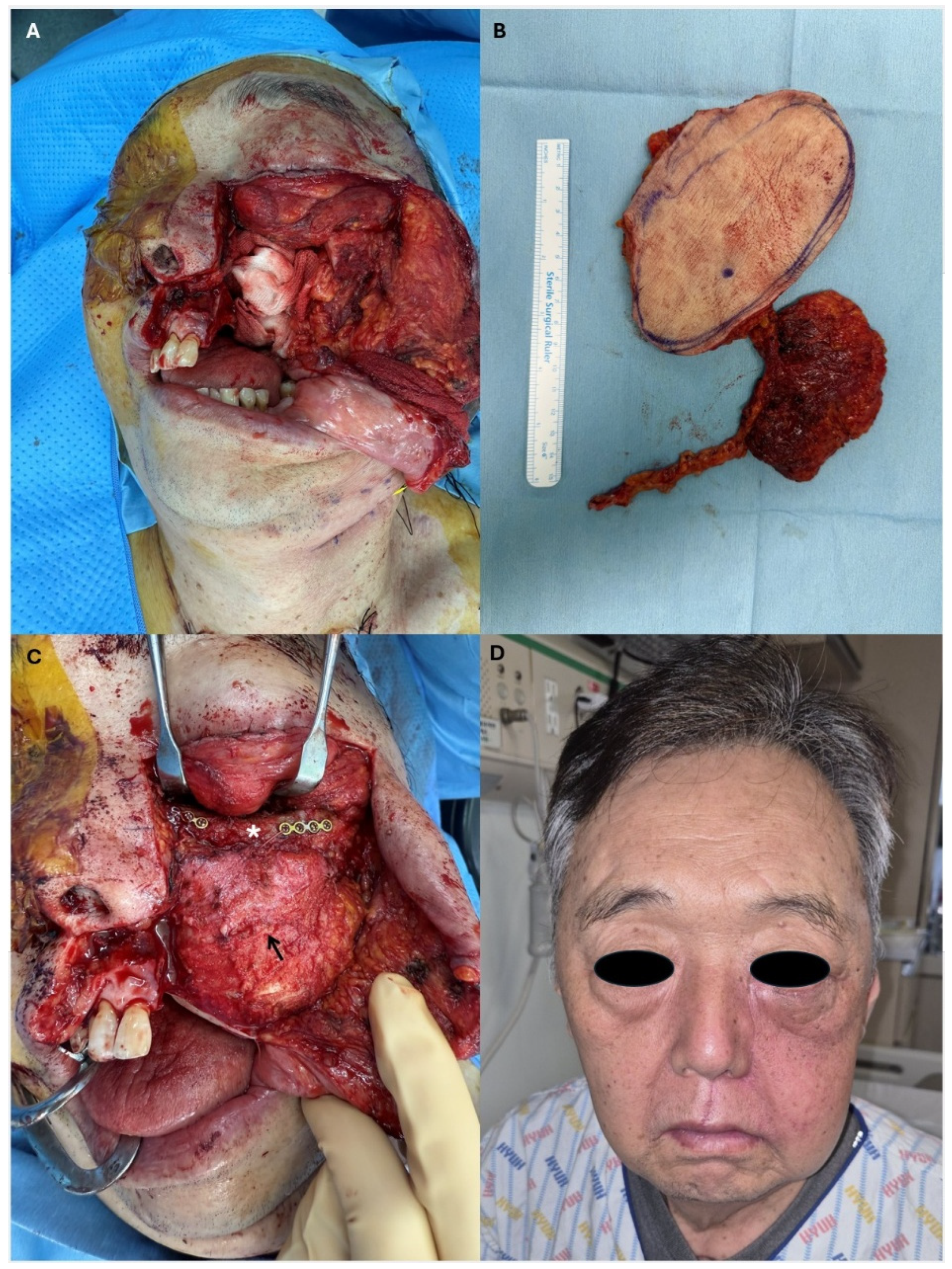
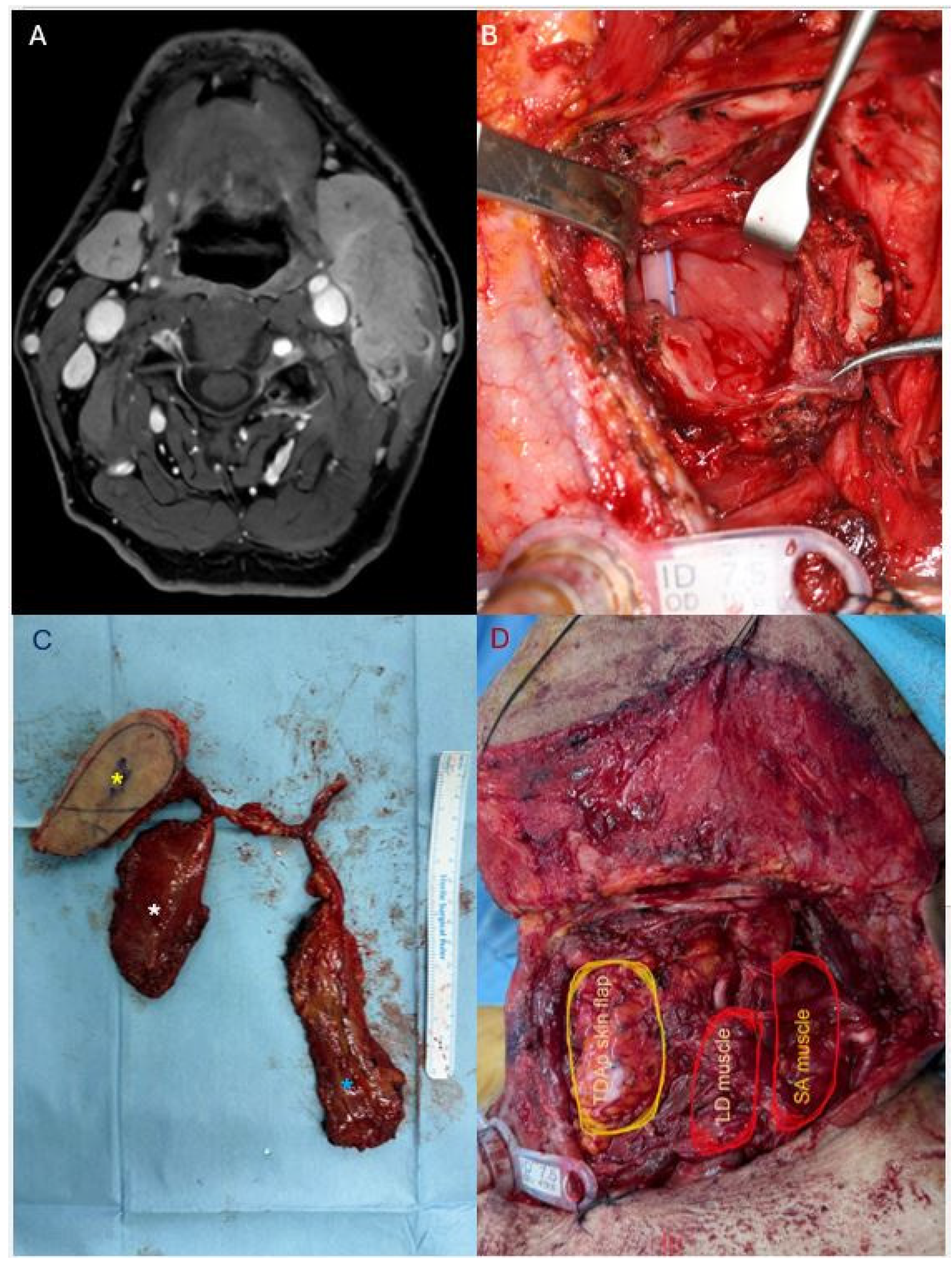
- TDAP skin paddle: A fasciocutaneous component based on perforators from the descending or transverse branch of the thoracodorsal artery, used for mucosal lining or external skin coverage.
- Latissimus dorsi muscle: A partial segment for dead space obliteration, volume replacement, or reinforcement of mucosal lining sutures.
- Serratus anterior muscle: Used for supplementary volume augmentation, reinforcement of the mucosal lining, or protection of exposed vessels following neck dissection and tumor ablation.
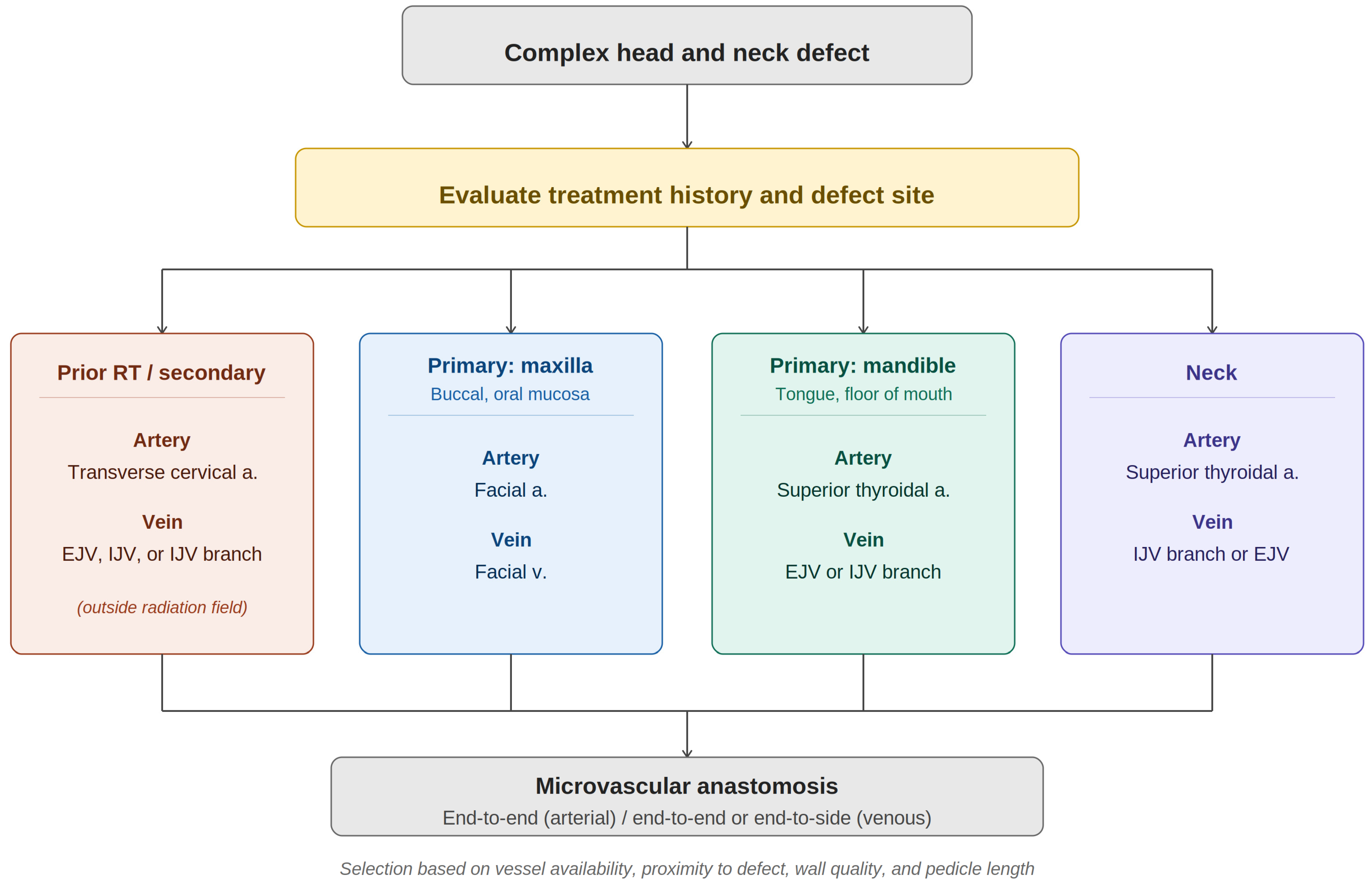
2.3.2. Recipient Vessel Selection and Microvascular Anastomosis
2.3.3. Flap Inset and Layered Closure
2.4. Postoperative Management
2.5. Data Collection and Outcome Measures
3. Results
3.1. Patient Characteristics and Follow-Up
3.2. Reconstructive Details and Flap Anatomy
3.3. Surgical and Functional Outcomes
3.4. Mortality and Disease Progression
4. Discussion
4.1. Rationale for the Thoracodorsal Chimeric System
4.2. Technical Considerations
4.2.1. The Supine Approach and Surgical Efficiency
4.2.2. Practical Considerations for Chimeric Flap Harvest
4.2.3. The Three-Paddle Configuration
4.3. Clinical Versatility and Reconstructive Potential
4.3.1. Multifunctional Role of Muscle Components
4.3.2. Intraoperative Adaptability and Three-Dimensional Freedom
4.4. Outcomes, Complications, and Limitations
5. Conclusions
Author Contributions
Funding
Institutional Review Board Statement
Informed Consent Statement
Data Availability Statement
Acknowledgments
Conflicts of Interest
Abbreviations
| TDAP | Thoracodorsal artery perforator |
| LD | Latissimus dorsi |
| SA | Serratus anterior |
| ALT | Anterolateral thigh |
| SCM | Sternocleidomastoid |
References
- Koshima, I.; Yamamoto, H.; Hosoda, M.; Moriguchi, T.; Orita, Y.; Nagayama, H. Free combined composite flaps using the lateral circumflex femoral system for repair of massive defects of the head and neck regions: An introduction to the chimeric flap principle. Plast. Reconstr. Surg. 1993, 92, 411–420. [Google Scholar] [CrossRef]
- Bittermann, G.; Thönissen, P.; Poxleitner, P.; Zimmerer, R.; Vach, K.; Metzger, M.C. Microvascular transplants in head and neck reconstruction: 3D evaluation of volume loss. J. Cranio-Maxillofac. Surg. 2015, 43, 1319–1324. [Google Scholar] [CrossRef]
- Wong, C.H.; Wei, F.C. Microsurgical free flap in head and neck reconstruction. Head Neck 2010, 32, 1236–1245. [Google Scholar] [CrossRef]
- Tan, B.K.; Por, Y.C.; Chen, H.C. Complications of head and neck reconstruction and their treatment. Semin. Plast. Surg. 2010, 24, 288–298. [Google Scholar] [CrossRef] [PubMed]
- Borggreven, P.A.; Aaronson, N.K.; Verdonck-de Leeuw, I.M.; Muller, M.J.; Heiligers, M.L.; de Bree, R.; Langendijk, J.A.; Leemans, C.R. Quality of life after surgical treatment for oral and oropharyngeal cancer: A prospective longitudinal assessment of patients reconstructed by a microvascular flap. Oral Oncol. 2007, 43, 1034–1042. [Google Scholar] [CrossRef] [PubMed]
- Raghuram, A.C.; Manfro, G.; Teixeira, G.V.; Cernea, C.R.; Dias, F.L.; Marco, M.D.; Polo, R.; Abu-Ghname, A.; Maricevich, M. Use of Single Chimeric Free Flaps or Double Free Flaps for Complex Head and Neck Reconstruction. J. Reconstr. Microsurg. 2021, 37, 791–798. [Google Scholar] [CrossRef] [PubMed]
- Hallock, G.G. The Chimeric Propeller Flap. Semin. Plast. Surg. 2020, 34, 207–209. [Google Scholar] [CrossRef]
- Chen, C.M.; Chen, C.H.; Lai, C.S.; Lin, S.D.; Huang, I.Y.; Shieh, T.Y. Anterolateral thigh flaps for reconstruction of head and neck defects. J. Oral Maxillofac. Surg. 2005, 63, 948–952. [Google Scholar] [CrossRef]
- Gholami, M.; Shaban, B.; Hejazi, A.; Sazegar, G.; Soufizadeh, R. Anatomical Variations of Anterolateral Thigh Flap: A Fresh Cadaver Dissection Study. World J. Plast. Surg. 2021, 10, 18–24. [Google Scholar] [CrossRef]
- Lee, Y.C.; Chen, W.C.; Chou, T.M.; Shieh, S.J. Anatomical variability of the anterolateral thigh flap perforators: Vascular anatomy and its clinical implications. Plast. Reconstr. Surg. 2015, 135, 1097–1107. [Google Scholar] [CrossRef]
- Jiang, C.; Guo, F.; Li, N.; Liu, W.; Su, T.; Chen, X.; Zheng, L.; Jian, X. Multipaddled anterolateral thigh chimeric flap for reconstruction of complex defects in head and neck. PLoS ONE 2014, 9, e106326. [Google Scholar] [CrossRef] [PubMed]
- Lesser, E.R.; Samrid, R.; Pujol, J.; Bishop, J.; Rosbrugh, J.; Bubb, K.C.; Raeburn, K.T.; Barton, B.M.; Iwanaga, J.; Tubbs, R.S. Anatomical Study of the Angular Branch of the Thoracodorsal Artery and the Lateral Border of the Scapula with Application to Reconstructive Surgery. Cureus 2026, 18, e101559. [Google Scholar] [CrossRef]
- Seitz, A.; Papp, S.; Papp, C.; Maurer, H. The anatomy of the angular branch of the thoracodorsal artery. Cells Tissues Organs 1999, 164, 227–236. [Google Scholar] [CrossRef]
- Kim, S.W.; Youn, D.G.; Kim, J.T.; Kim, Y.H. A thoracodorsal artery perforator chimeric free flap for prevention of microvascular pedicle compression in lower extremity reconstruction. Microsurgery 2018, 38, 46–50. [Google Scholar] [CrossRef]
- Jaffar, S.; Jaiswal, D.; Shankhdhar, V.K.; Bindu, A.; Mathews, S.; Mantri, M.; Kumar, V.; Yadav, P.S. Free Thoracodorsal Artery Perforator Flap for Head and Neck Reconstruction: An Indian Experience. Indian J. Plast. Surg. 2023, 56, 499–506. [Google Scholar] [CrossRef]
- Hanasono, M.M. Reconstructive Surgery for Head and Neck Cancer Patients. Adv. Med. 2014, 2014, 795483. [Google Scholar] [CrossRef]
- Tharakan, T.; Marfowaa, G.; Akakpo, K.; Jackson, R.; Zenga, J.; Puram, S.V.; Pipkorn, P. Multiple simultaneous free flaps for head and neck reconstruction: A multi-institutional cohort. Oral Oncol. 2023, 136, 106269. [Google Scholar] [CrossRef]
- Chen, C.L.; Zenga, J.; Roland, L.T.; Pipkorn, P. Complications of double free flap and free flap combined with locoregional flap in head and neck reconstruction: A systematic review. Head Neck 2018, 40, 632–646. [Google Scholar] [CrossRef] [PubMed]
- Cho, B.; Choi, K.; Yang, J.; Kang, B.; Cho, H.; Ryu, J.; Lee, J.; Park, H.; Lee, J.; Chung, H. Anatomical View of Thoracodorsal Artery Variants Using Computed Tomography Angiography. J. Reconstr. Microsurg. 2023, 39, 640–647. [Google Scholar] [CrossRef] [PubMed]
- Chen, H.H.; Lin, M.S.; Chou, E.K.; Chang, S.C.; Chen, H.C.; Xu, E.; Wu, C.I. Anterolateral thigh perforator flap: Varying perforator anatomy. Ann. Plast. Surg. 2009, 63, 153–155. [Google Scholar] [CrossRef]
- Suh, J.M.; Chung, C.H.; Chang, Y.J. Head and neck reconstruction using free flaps: A 30-year medical record review. Arch. Craniofacial Surg. 2021, 22, 38. [Google Scholar] [CrossRef]
- Maricevich, M.; Lin, L.O.; Liu, J.; Chang, E.I.; Hanasono, M.M. Interposition Vein Grafting in Head and Neck Free Flap Reconstruction. Plast. Reconstr. Surg. 2018, 142, 1025–1034. [Google Scholar] [CrossRef] [PubMed]
- Bohannon, I.A.; Carroll, W.R.; Magnuson, J.S.; Rosenthal, E.L. Closure of post-laryngectomy pharyngocutaneous fistulae. Head Neck Oncol. 2011, 3, 29. [Google Scholar] [CrossRef]
- Antonsen, B.T.; Weum, S.; de Weerd, L. Challenging the Dogma of Dead Space Obliteration with Muscle Flaps in Deep Spinal Surgical Site Infections. Plast. Reconstr. Surg. Glob. Open 2025, 13, e6732. [Google Scholar] [CrossRef] [PubMed]
- Thariat, J.; Carsuzaa, F.; Beddok, A.; Deneuve, S.; Marcy, P.-Y.; Merlotti, A.; Dejean, C.; Devauchelle, B. Reconstructive flap surgery in head and neck cancer patients: An interdisciplinary view of the challenges encountered by radiation oncologists in postoperative radiotherapy. Front. Oncol. 2024, 14, 1379861. [Google Scholar] [CrossRef] [PubMed]
- Liu, M.; Liu, W.; Yang, X.; Guo, H.; Peng, H. Pectoralis Major Myocutaneous Flap for Head and Neck Defects in the Era of Free Flaps: Harvesting Technique and Indications. Sci. Rep. 2017, 7, 46256. [Google Scholar] [CrossRef]
- Wettstein, R.; Largo, R.D.; Raffoul, W.; Schumacher, R.; Schaefer, D.J.; Kalbermatten, D.F. Laser scanning evaluation of atrophy after autologous free muscle transfer. Ann. Plast. Surg. 2014, 72, 680–684. [Google Scholar] [CrossRef]
- Saki, N.; Nikakhlagh, S.; Kazemi, M. Pharyngocutaneous fistula after laryngectomy: Incidence, predisposing factors, and outcome. Arch. Iran. Med. 2008, 11, 314–317. [Google Scholar] [PubMed]
- Ragbir, M.; Brown, J.S.; Mehanna, H. Reconstructive considerations in head and neck surgical oncology: United Kingdom National Multidisciplinary Guidelines. J. Laryngol. Otol. 2016, 130, S191–S197. [Google Scholar] [CrossRef]
- Chim, H.; Salgado, C.J.; Seselgyte, R.; Wei, F.-C.; Mardini, S. Principles of head and neck reconstruction: An algorithm to guide flap selection. In Proceedings of the Seminars in Plastic Surgery; Thieme Medical Publishers: Stuttgart, Germany, 2010; pp. 148–154. [Google Scholar]
- Soutar, D.; Scheker, L.; Tanner, N.; McGregor, I. The radial forearm flap: A versatile method for intra-oral reconstruction. Br. J. Plast. Surg. 1983, 36, 1–8. [Google Scholar] [CrossRef]
- Hidalgo, D.A. Fibula free flap: A new method of mandible reconstruction. Plast. Reconstr. Surg. 1989, 84, 71–79. [Google Scholar] [CrossRef] [PubMed]
- Paydarfar, J.A.; Birkmeyer, N.J. Complications in head and neck surgery: A meta-analysis of postlaryngectomy pharyngocutaneous fistula. Arch. Otolaryngol. Head Neck Surg. 2006, 132, 67–72. [Google Scholar] [CrossRef] [PubMed]
- Akduman, D.; Naiboğlu, B.; Uslu, C.; Oysu, C.; Tek, A.; Sürmeli, M.; Kiliçarslan, Y.; Yanilmaz, M. Pharyngocutaneous fistula after total laryngectomy: Incidence, predisposing factors, and treatment. Kulak Burun Bogaz Ihtis. Derg. KBB J. Ear Nose Throat 2008, 18, 349–354. [Google Scholar] [PubMed]



| Variable | Value |
|---|---|
| Age (years), mean ± SD | 63.2 ± 11.2 |
| Sex (Male:Female) | 14:5 |
| Primary site | |
| Hypopharynx | 8 (42.1%) |
| Oral cavity | 7 (36.8%) |
| Others (larynx, maxilla, parotid) | 4 (21.1%) |
| Flap configuration | |
| TDAP + LDm | 11 (57.9%) |
| LDms + SAm | 4 (21.1%) |
| TDAP + SAm | 2 (10.5%) |
| LDmc + SAm | 1 (5.3%) |
| TDAP + LDm + SAm | 1 (5.3%) |
| Additional procedures | |
| Non-vascularized bone graft | 3 (15.8%) |
| Supercharging | 1 (5.3%) |
| Mean follow-up (months) | 9.8 ± 8.3 |
| Overall flap survival | 19/19 (100%) |
| Overall mortality | 5 (26.3%) |
| Reconstruction-related complications † | 9 (47.4%) |
| Pharyngocutaneous fistula/Leakage | 6 |
| Wound dehiscence | 2 |
| Seroma/Hematoma | 2 |
| Wound infection | 1 |
| Case | Age/Sex | Diagnosis | Flap Configuration | Bone Graft | Complication | Outcome |
|---|---|---|---|---|---|---|
| 1 | 60/M | Recurrent glottic SCC | TDAP + LDm | — | Fistula | Expired |
| 2 | 54/M | Hypopharyngeal SCC | TDAP + LDm | — | — | Survived |
| 3 | 60/M | Hypopharyngeal SCC | TDAP + LDm | — | Infection | Survived |
| 4 | 57/M | Hypopharyngeal SCC | TDAP + LDm | — | — | Survived |
| 5 | 58/M | Hypopharyngeal SCC | TDAP + LDm | — | Fistula | Expired |
| 6 | 55/M | Hypopharyngeal SCC | TDAP + LDm | — | Fistula | Expired |
| 7 | 78/M | Tongue base SCC | TDAP + LDm | — | — | Survived |
| 8 | 42/M | Parotid carcinoma | TDAP + SAm | — | — | Expired |
| 9 | 54/F | Buccal SCC | LDms + SAm | — | Fistula | Survived |
| 10 | 50/M | Tongue base SCC | TDAP + LDm | — | Hematoma | Survived |
| 11 | 75/F | Oral cavity SCC | LDms + SAm | — | Dehiscence, Fistula | Survived |
| 12 | 72/F | Gingivobuccal SCC | LDmc + SAm | NV fibula | — | Expired |
| 13 | 69/M | Hypopharyngeal SCC | LDms + SAm | — | — | Survived |
| 14 | 65/M | Maxillary sinus MEC | TDAP + LDm | NV iliac bone | — | Survived |
| 15 | 80/F | Tongue base SCC | TDAP + LDm | — | Seroma | Survived |
| 16 | 82/F | Alveolar SCC | LDms + SAm | NV fibula | — | Survived |
| 17 | 69/M | Glottic SCC | TDAP + LDm | — | — | Survived |
| 18 | 51/M | Hypopharyngeal SCC | TDAP + SAm | — | Dehiscence, Leakage | Survived |
| 19 | 69/M | Hypopharyngeal SCC | TDAP + LDm + SAm | — | — | Survived |
| Flap Type | Tissue Components | Pedicle Length | 3D Versatility | Key Advantages | Key Limitations |
|---|---|---|---|---|---|
| ALT [8] | Skin, fascia, (±vastus lateralis muscle) | 8–12 cm | Moderate | Long pedicle; low donor morbidity; large skin paddle | Highly variable perforator anatomy; limited to single-layer reconstruction without additional flap |
| Radial forearm [31] | Skin, fascia | Up to 20 cm | Low | Thin, pliable tissue; long pedicle; reliable anatomy | Single tissue type; sacrifices major forearm artery; limited bulk |
| Fibula [32] | Bone, skin paddle | 4–6 cm | Moderate | Vascularized bone for mandibular reconstruction; allows dental rehabilitation | Soft tissue component often insufficient for mucosal and skin coverage; short pedicle |
| Pectoralis major (pedicled) [26] | Skin, muscle | N/A | Low | No microsurgery required; reliable blood supply; rapid harvest | Bulky; limited reach; poor tissue match for mucosal lining; aesthetic donor-site deformity |
| Double free flap [6,17,18] | Variable | Variable | High | Optimal flap selection for each subunit; flexible positioning; independent vascular supply | Prolonged operative time; two sets of anastomoses; consumes multiple recipient vessels; increased physiological burden |
| TDA chimeric (present study) | TDAP skin paddle, LD muscle, SA muscle, (±non-vascularized bone) | 7–8 cm | High | Multiple independently positionable components; consistent vascular anatomy; single pedicle; true 3D reconstruction | Donor-site morbidity (shoulder weakness, scar); potentially excessive bulk; prior axillary surgery may preclude harvest |
Disclaimer/Publisher’s Note: The statements, opinions and data contained in all publications are solely those of the individual author(s) and contributor(s) and not of MDPI and/or the editor(s). MDPI and/or the editor(s) disclaim responsibility for any injury to people or property resulting from any ideas, methods, instructions or products referred to in the content. |
© 2026 by the authors. Licensee MDPI, Basel, Switzerland. This article is an open access article distributed under the terms and conditions of the Creative Commons Attribution (CC BY) license.
Share and Cite
Kim, Y.H.; Hong, S.E.; Kang, D. Versatile Three-Dimensional Head and Neck Reconstruction Using a Thoracodorsal Artery-Based Chimeric Flap: A Bi-Institutional Experience. J. Clin. Med. 2026, 15, 2398. https://doi.org/10.3390/jcm15062398
Kim YH, Hong SE, Kang D. Versatile Three-Dimensional Head and Neck Reconstruction Using a Thoracodorsal Artery-Based Chimeric Flap: A Bi-Institutional Experience. Journal of Clinical Medicine. 2026; 15(6):2398. https://doi.org/10.3390/jcm15062398
Chicago/Turabian StyleKim, Youn Hwan, Seung Eun Hong, and Daihun Kang. 2026. "Versatile Three-Dimensional Head and Neck Reconstruction Using a Thoracodorsal Artery-Based Chimeric Flap: A Bi-Institutional Experience" Journal of Clinical Medicine 15, no. 6: 2398. https://doi.org/10.3390/jcm15062398
APA StyleKim, Y. H., Hong, S. E., & Kang, D. (2026). Versatile Three-Dimensional Head and Neck Reconstruction Using a Thoracodorsal Artery-Based Chimeric Flap: A Bi-Institutional Experience. Journal of Clinical Medicine, 15(6), 2398. https://doi.org/10.3390/jcm15062398