Real-World Effectiveness and Safety of Eliglustat in Adult Patients with Gaucher Disease Type 1: A Multicenter Retrospective Study in China

Abstract
1. Introduction
2. Materials and Methods
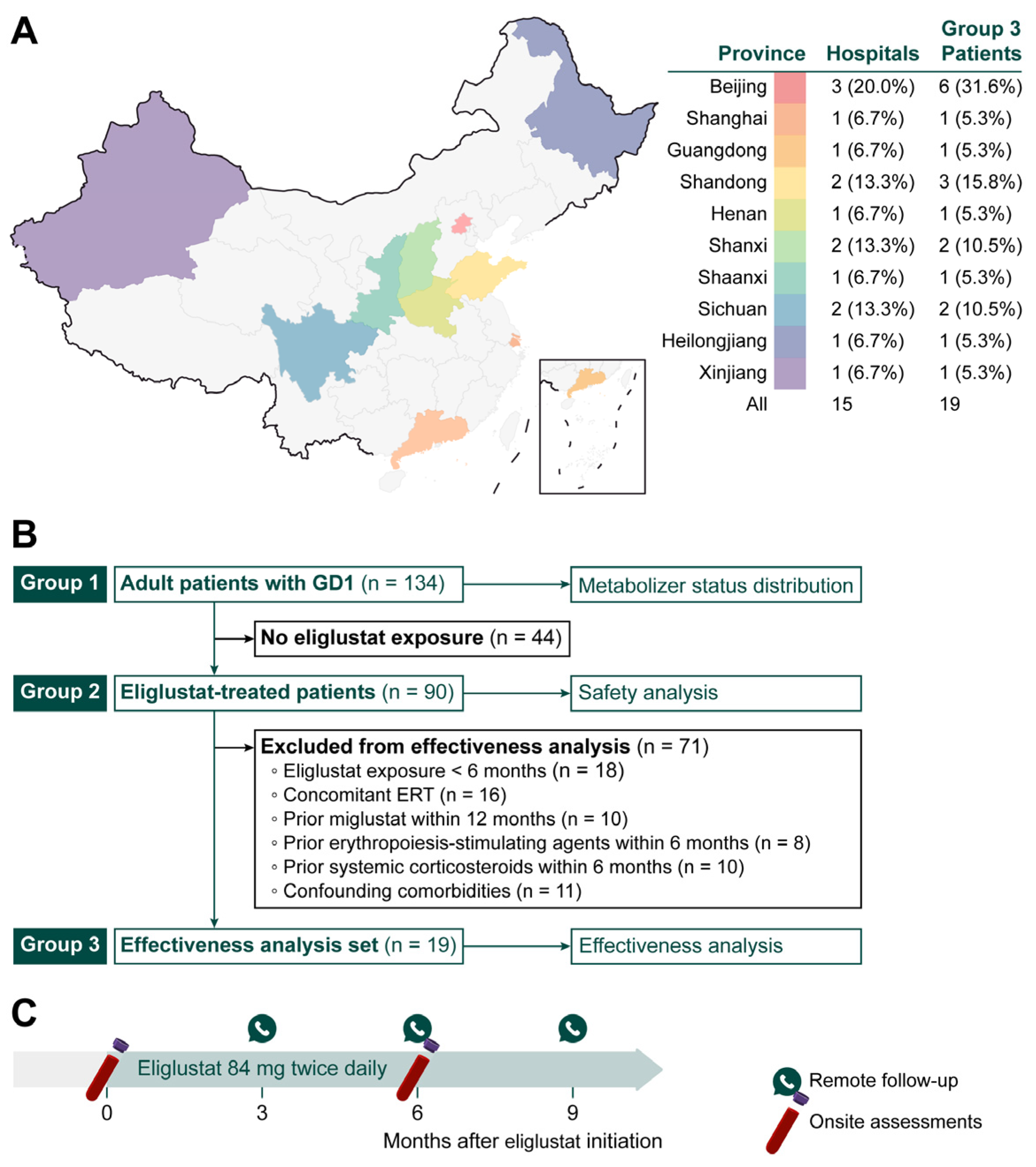
2.1. Study Design and Patients
2.2. Study Treatment
2.3. Effectiveness and Safety Assessments
2.4. Statistical Analysis
3. Results
3.1. Baseline Characteristics
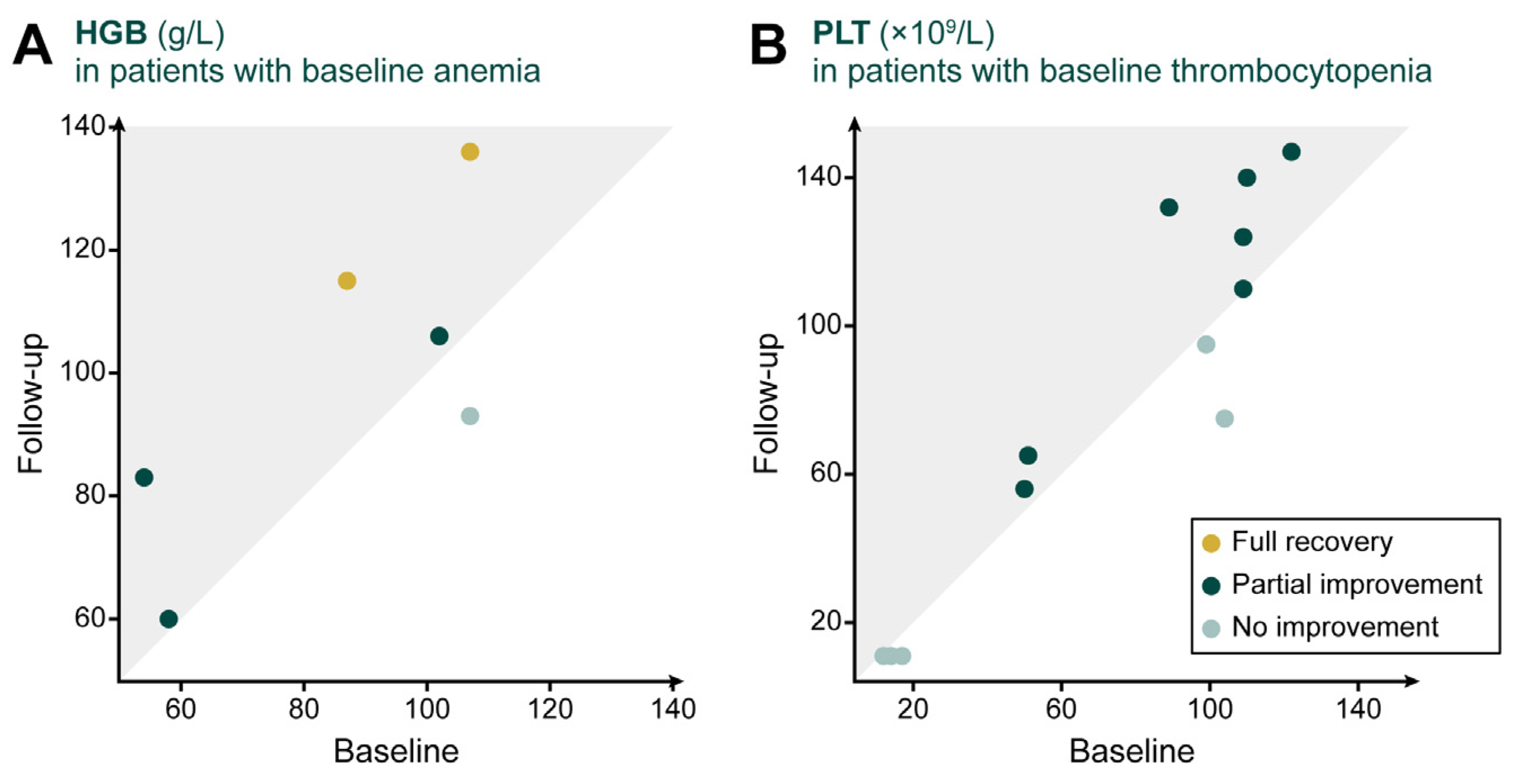
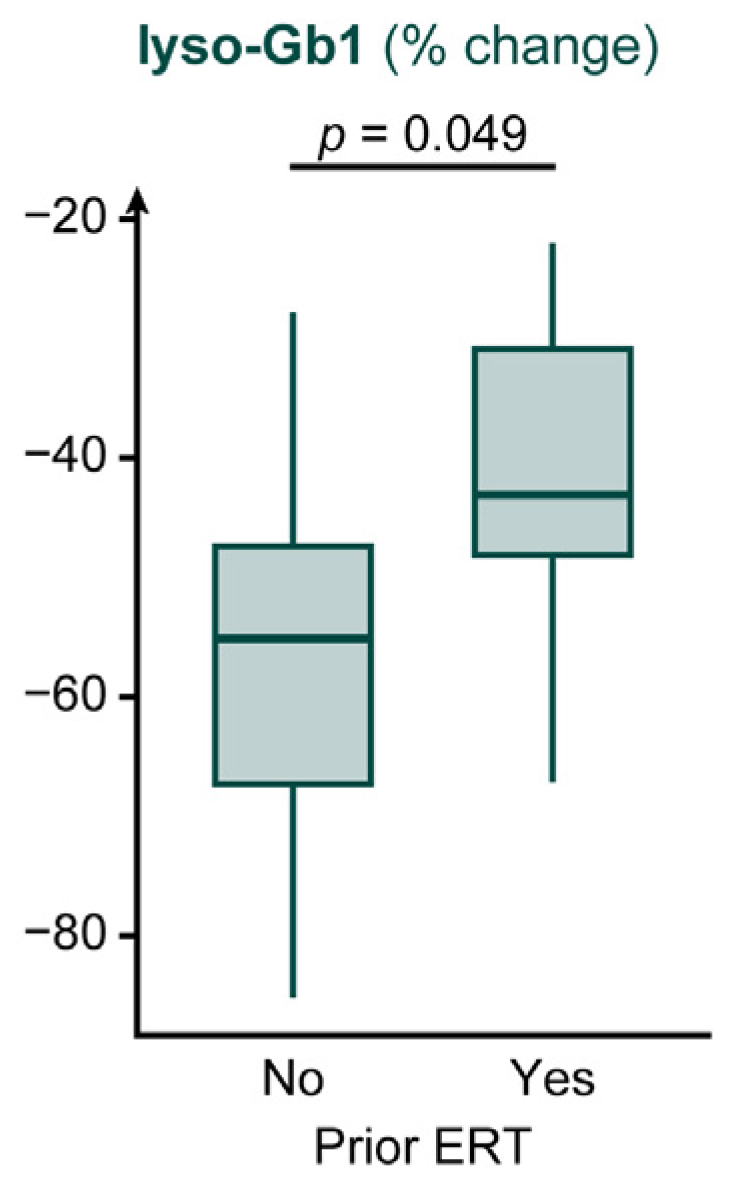
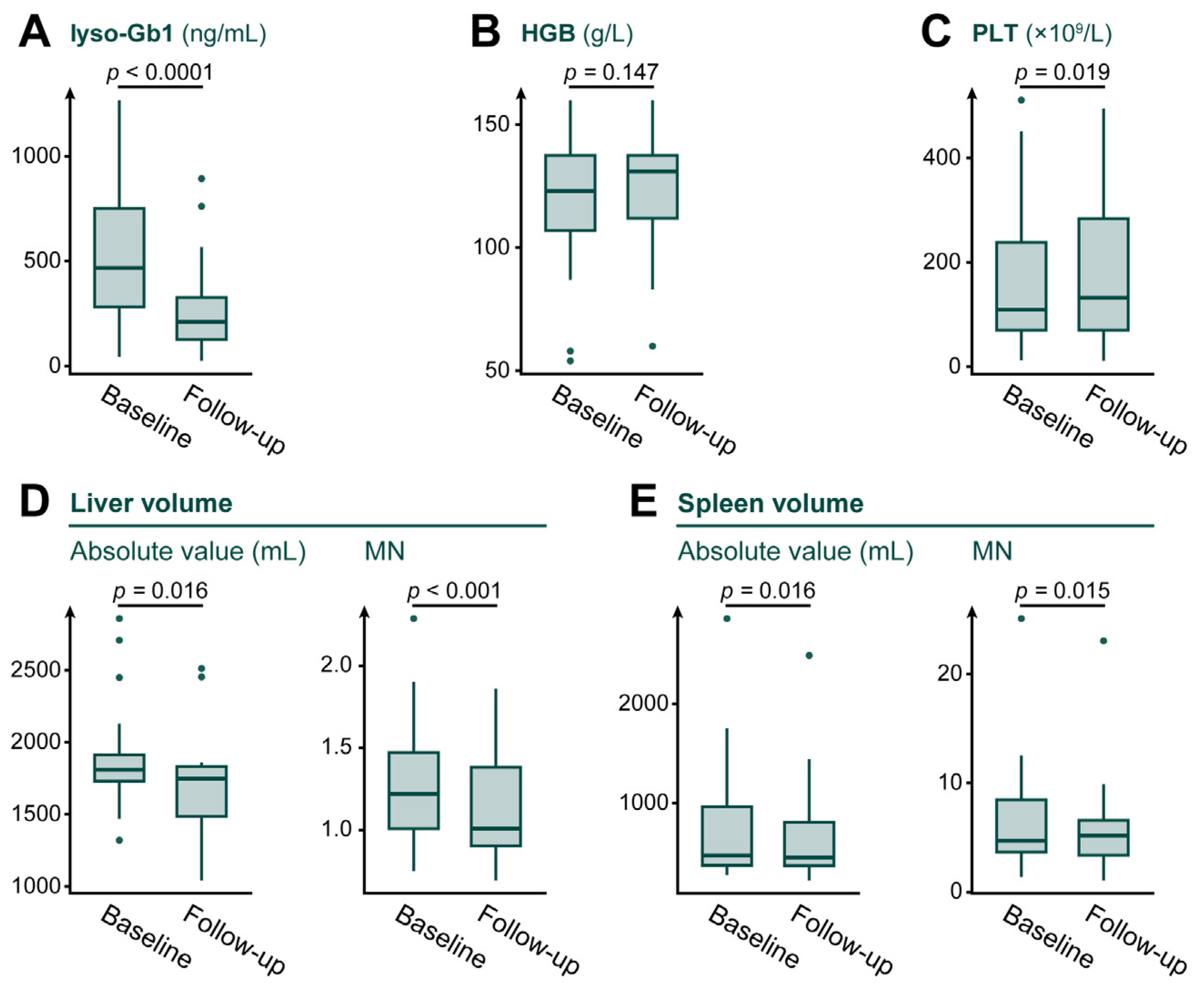
3.2. Effectiveness Analysis
3.3. Safety Analysis
4. Discussion
5. Conclusions
Author Contributions
Funding
Institutional Review Board Statement
Informed Consent Statement
Data Availability Statement
Conflicts of Interest
Abbreviations
| AE | Adverse event |
| CI | Confidence interval |
| CTCAE | Common Terminology Criteria for Adverse Events |
| CYP2D6 | Cytochrome P450 2D6 |
| CYP3A | Cytochrome P450 3A |
| EM | Extensive metabolizer |
| ERT | Enzyme replacement therapy |
| GBA1 | Glucosylceramidase beta 1 |
| GCase | β-glucocerebrosidase |
| GCS | Glucosylceramide synthase |
| GD | Gaucher disease |
| GD1 | Gaucher disease type 1 |
| GluCer | Glucosylceramide |
| HGB | Hemoglobin |
| IM | Intermediate metabolizer |
| IQR | Interquartile range |
| lyso-Gb1 | Glucosylsphingosine |
| MN | Multiples of normal |
| MRI | Magnetic resonance imaging |
| PLT | Platelet count |
| PM | Poor metabolizer |
| SAE | Serious adverse event |
| SRT | Substrate reduction therapy |
| URM | Ultrarapid metabolizer |
Appendix A

| Subgroup | lyso-Gb1 | HGB | PLT |
|---|---|---|---|
| All patients | −50.3% (−85.2% to −22.0%) | 3.4% (−15.2% to 53.7%) | 9.8% (−35.3% to 48.3%) |
| Age (years) | 0.38 (−0.54, 1.28) a; 0.417 | 0.19 (−0.02, 0.61) b; 0.447 | −0.07 (−0.97, 0.83) a; 0.873 |
| >36 (n = 9) | −46.5% (−67.6% to −27.8%) | 6.5% (−6.6% to 53.7%) | 3.3% (−21.4% to 27.5%) |
| ≤36 (n = 10) | −53.8% (−85.2% to −22.0%) | 1.9% (−15.2% to 32.2%) | 10.9% (−35.3% to 48.3%) |
| Sex | −0.30 (−1.20, 0.61) a; 0.525 | −0.21 (−1.11, 0.70) a; 0.648 | 0.20 (−0.70, 1.11) a; 0.648 |
| Male (n = 9) | −52.5% (−85.2% to −27.8%) | 0.72% (−6.6% to 27.1%) | 12.0% (−21.4% to 37.9%) |
| Female (n = 10) | −47.7% (−82.6% to −22.0%) | 5.2% (−15.2% to 53.7%) | 6.5% (−35.3% to 48.3%) |
| Disease duration (years) | 0.57 (−0.47, 1.60) a; 0.290 | −0.84 (−1.87, 0.24) a; 0.131 | 0.19 (−0.83, 1.20) a; 0.713 |
| >6 (n = 9) | −46.5% (−82.6% to −28.4%) | 0.0% (−13.1% to 12.4%) | 12.0% (−27.9% to 20.5%) |
| ≤6 (n = 10) | −60.1% (−85.2% to −31.6%) | 5.4% (−15.2% to 53.7%) | 9.2% (−35.3% to 37.9%) |
| Prior ERT exposure | 0.96 (−0.02, 1.91) a; 0.049 | −0.80 (−1.70, 0.12) a; 0.088 | 0.36 (−0.56, 1.27) a; 0.453 |
| Yes (n = 8) | −43.1% (−67.1% to −22.0%) | 1.7% (−13.1% to 7.2%) | 11.0% (−27.9% to 48.3%) |
| No (n = 11) | −55.1% (−85.2% to −27.8%) | 6.8% (−15.2% to 53.7%) | 8.6% (−35.3% to 37.9%) |
| Splenectomy status | −0.34 (−1.26, 0.58) a; 0.476 | −0.78 (−1.68, 0.13) a; 0.094 | 0.39 (−0.54, 1.30) a; 0.377 |
| Yes (n = 8) | −56.6% (−82.8% to −27.8%) | 1.83% (−15.2% to 8.8%) | 11.0% (−5.3% to 37.9%) |
| No (n = 11) | −45.0% (−85.2% to −22.0%) | 6.8% (−13.1% to 53.7%) | 8.6% (−35.3% to 48.3%) |
References
- Castillon, G.; Chang, S.C.; Moride, Y. Global Incidence and Prevalence of Gaucher Disease: A Targeted Literature Review. J. Clin. Med. 2022, 12, 85. [Google Scholar] [CrossRef]
- Wang, M.; Li, F.; Zhang, J.; Lu, C.; Kong, W. Global Epidemiology of Gaucher Disease: An Updated Systematic Review and Meta-analysis. J. Pediatr. Hematol. Oncol. 2023, 45, 181–188. [Google Scholar] [CrossRef]
- Lu, Y.; Gao, Q.; Ren, X.; Li, J.; Yang, D.; Zhang, Z.; Han, J. Incidence and prevalence of 121 rare diseases in China: Current status and challenges: 2022 revision. Intractable Rare Dis. Res. 2022, 11, 96–104. [Google Scholar] [CrossRef]
- Rossi, M.; Schaake, S.; Usnich, T.; Boehm, J.; Steffen, N.; Schell, N.; Krüger, C.; Gül-Demirkale, T.; Bahr, N.; Kleinz, T.; et al. Classification and Genotype-Phenotype Relationships of GBA1 Variants: MDSGene Systematic Review. Mov. Disord. 2025, 40, 605–618. [Google Scholar] [CrossRef] [PubMed]
- Camou, F.; Berger, M.G. Gaucher disease, state of the art and perspectives. J. Intern. Med. 2025, 298, 155–172. [Google Scholar] [CrossRef]
- Zhang, Z.; Yue, P.; Lu, T.; Wang, Y.; Wei, Y.; Wei, X. Role of lysosomes in physiological activities, diseases, and therapy. J. Hematol. Oncol. 2021, 14, 79. [Google Scholar] [CrossRef] [PubMed]
- Pandey, M.K.; Burrow, T.A.; Rani, R.; Martin, L.J.; Witte, D.; Setchell, K.D.; McKay, M.A.; Magnusen, A.F.; Zhang, W.; Liou, B.; et al. Complement drives glucosylceramide accumulation and tissue inflammation in Gaucher disease. Nature 2017, 543, 108–112. [Google Scholar] [CrossRef]
- Grabowski, G.A. Phenotype, diagnosis, and treatment of Gaucher’s disease. Lancet 2008, 372, 1263–1271. [Google Scholar] [CrossRef] [PubMed]
- Giuffrida, G.; Markovic, U.; Condorelli, A.; Calafiore, V.; Nicolosi, D.; Calagna, M.; Grasso, S.; Ragusa, M.T.V.; Gentile, J.; Napolitano, M. Glucosylsphingosine (Lyso-Gb1) as a reliable biomarker in Gaucher disease: A narrative review. Orphanet J. Rare Dis. 2023, 18, 27. [Google Scholar] [CrossRef]
- Carubbi, F.; Linari, S.; Spada, M. Glucosylsphingosine (Lyso-Gb1): An Update on Its Use as a Biomarker in Gaucher Disease. Int. J. Mol. Sci. 2026, 27, 1705. [Google Scholar] [CrossRef]
- Barton, N.W.; Brady, R.O.; Dambrosia, J.M.; Di Bisceglie, A.M.; Doppelt, S.H.; Hill, S.C.; Mankin, H.J.; Murray, G.J.; Parker, R.I.; Argoff, C.E.; et al. Replacement therapy for inherited enzyme deficiency--macrophage-targeted glucocerebrosidase for Gaucher’s disease. N. Engl. J. Med. 1991, 324, 1464–1470. [Google Scholar] [CrossRef]
- Feng, J.; Gao, Z.; Shi, Z.; Wang, Y.; Li, S. Patient-reported outcomes in Gaucher’s disease: A systematic review. Orphanet J. Rare Dis. 2023, 18, 244. [Google Scholar] [CrossRef]
- Qi, X.; Xu, J.; Shan, L.; Li, Y.; Cui, Y.; Liu, H.; Wang, K.; Gao, L.; Kang, Z.; Wu, Q. Economic burden and health related quality of life of ultra-rare Gaucher disease in China. Orphanet J. Rare Dis. 2021, 16, 358. [Google Scholar] [CrossRef] [PubMed]
- Weinreb, N.J.; Barranger, J.A.; Charrow, J.; Grabowski, G.A.; Mankin, H.J.; Mistry, P. Guidance on the use of miglustat for treating patients with type 1 Gaucher disease. Am. J. Hematol. 2005, 80, 223–229. [Google Scholar] [CrossRef]
- McEachern, K.A.; Fung, J.; Komarnitsky, S.; Siegel, C.S.; Chuang, W.L.; Hutto, E.; Shayman, J.A.; Grabowski, G.A.; Aerts, J.M.; Cheng, S.H.; et al. A specific and potent inhibitor of glucosylceramide synthase for substrate inhibition therapy of Gaucher disease. Mol. Genet. Metab. 2007, 91, 259–267. [Google Scholar] [CrossRef] [PubMed]
- Belmatoug, N.; Di Rocco, M.; Fraga, C.; Giraldo, P.; Hughes, D.; Lukina, E.; Maison-Blanche, P.; Merkel, M.; Niederau, C.; Plöckinger, U.; et al. Management and monitoring recommendations for the use of eliglustat in adults with type 1 Gaucher disease in Europe. Eur. J. Intern. Med. 2017, 37, 25–32. [Google Scholar] [CrossRef] [PubMed]
- Revel-Vilk, S.; Szer, J.; Mehta, A.; Zimran, A. How we manage Gaucher Disease in the era of choices. Br. J. Haematol. 2018, 182, 467–480. [Google Scholar] [CrossRef] [PubMed]
- Mistry, P.K.; Lukina, E.; Ben Turkia, H.; Shankar, S.P.; Baris Feldman, H.; Ghosn, M.; Mehta, A.; Packman, S.; Lau, H.; Petakov, M.; et al. Clinical outcomes after 4.5 years of eliglustat therapy for Gaucher disease type 1: Phase 3 ENGAGE trial final results. Am. J. Hematol. 2021, 96, 1156–1165. [Google Scholar] [CrossRef] [PubMed]
- Cox, T.M.; Drelichman, G.; Cravo, R.; Balwani, M.; Burrow, T.A.; Martins, A.M.; Lukina, E.; Rosenbloom, B.; Ross, L.; Angell, J.; et al. Eliglustat compared with imiglucerase in patients with Gaucher’s disease type 1 stabilised on enzyme replacement therapy: A phase 3, randomised, open-label, non-inferiority trial. Lancet 2015, 385, 2355–2362. [Google Scholar] [CrossRef]
- Mistry, P.K.; Balwani, M.; Charrow, J.; Kishnani, P.; Niederau, C.; Underhill, L.H.; McClain, M.R. Real-world effectiveness of eliglustat in treatment-naïve and switch patients enrolled in the International Collaborative Gaucher Group Gaucher Registry. Am. J. Hematol. 2020, 95, 1038–1046. [Google Scholar] [CrossRef] [PubMed]
- Lukina, E.; Watman, N.; Dragosky, M.; Lau, H.; Avila Arreguin, E.; Rosenbaum, H.; Zimran, A.; Foster, M.C.; Gaemers, S.J.M.; Peterschmitt, M.J. Outcomes after 8 years of eliglustat therapy for Gaucher disease type 1: Final results from the Phase 2 trial. Am. J. Hematol. 2019, 94, 29–38. [Google Scholar] [CrossRef]
- Torralba-Cabeza, M.; Morado-Arias, M.; Pijierro-Amador, A.; Fernández-Canal, M.C.; Villarrubia-Espinosa, J. Recommendations for oral treatment for adult patients with type 1 Gaucher disease. Rev. Clin. Esp. 2022, 222, 529–542. [Google Scholar] [CrossRef]
- Dardis, A.; Michelakakis, H.; Rozenfeld, P.; Fumic, K.; Wagner, J.; Pavan, E.; Fuller, M.; Revel-Vilk, S.; Hughes, D.; Cox, T.; et al. Patient centered guidelines for the laboratory diagnosis of Gaucher disease type 1. Orphanet J. Rare Dis. 2022, 17, 442. [Google Scholar] [CrossRef]
- Bennett, L.L.; Turcotte, K. Eliglustat tartrate for the treatment of adults with type 1 Gaucher disease. Drug Des. Dev. Ther. 2015, 9, 4639–4647. [Google Scholar] [CrossRef]
- Bracoud, L.; Ahmad, H.; Brill-Almon, E.; Chertkoff, R. Improving the accuracy of MRI spleen and liver volume measurements: A phase III Gaucher disease clinical trial setting as a model. Blood Cells Mol. Dis. 2011, 46, 47–52. [Google Scholar] [CrossRef]
- Pastores, G.M.; Weinreb, N.J.; Aerts, H.; Andria, G.; Cox, T.M.; Giralt, M.; Grabowski, G.A.; Mistry, P.K.; Tylki-Szymańska, A. Therapeutic goals in the treatment of Gaucher disease. Semin. Hematol. 2004, 41, 4–14. [Google Scholar] [CrossRef]
- Liao, M.J.; Zhang, L.S. Standardized diagnosis and treatment of iron deficiency and iron-deficiency anemia. Zhonghua Nei Ke Za Zhi 2023, 62, 722–727. [Google Scholar] [CrossRef] [PubMed]
- Wang, J.X.; Zhang, F.C.; Liu, X.Q.; Tang, C.W.; Chen, L.A.; Han, Y. Expert consensus for diagnosis and treatment of thrombocytopenia in China. Zhonghua Nei Ke Za Zhi 2020, 59, 498–510. [Google Scholar] [CrossRef] [PubMed]
- Platt, F.M.; d’Azzo, A.; Davidson, B.L.; Neufeld, E.F.; Tifft, C.J. Lysosomal storage diseases. Nat. Rev. Dis. Primers 2018, 4, 27. [Google Scholar] [CrossRef] [PubMed]
- Mistry, P.K.; Lukina, E.; Ben Turkia, H.; Shankar, S.P.; Baris, H.; Ghosn, M.; Mehta, A.; Packman, S.; Pastores, G.; Petakov, M.; et al. Outcomes after 18 months of eliglustat therapy in treatment-naïve adults with Gaucher disease type 1: The phase 3 ENGAGE trial. Am. J. Hematol. 2017, 92, 1170–1176. [Google Scholar] [CrossRef]
- Murugesan, V.; Chuang, W.L.; Liu, J.; Lischuk, A.; Kacena, K.; Lin, H.; Pastores, G.M.; Yang, R.; Keutzer, J.; Zhang, K.; et al. Glucosylsphingosine is a key biomarker of Gaucher disease. Am. J. Hematol. 2016, 91, 1082–1089. [Google Scholar] [CrossRef] [PubMed]
- Elstein, D.; Mellgard, B.; Dinh, Q.; Lan, L.; Qiu, Y.; Cozma, C.; Eichler, S.; Böttcher, T.; Zimran, A. Reductions in glucosylsphingosine (lyso-Gb1) in treatment-naïve and previously treated patients receiving velaglucerase alfa for type 1 Gaucher disease: Data from phase 3 clinical trials. Mol. Genet. Metab. 2017, 122, 113–120. [Google Scholar] [CrossRef]
- Mistry, P.K.; Lukina, E.; Ben Turkia, H.; Amato, D.; Baris, H.; Dasouki, M.; Ghosn, M.; Mehta, A.; Packman, S.; Pastores, G.; et al. Effect of oral eliglustat on splenomegaly in patients with Gaucher disease type 1: The ENGAGE randomized clinical trial. JAMA 2015, 313, 695–706. [Google Scholar] [CrossRef]
- Cox, T.; Lachmann, R.; Hollak, C.; Aerts, J.; van Weely, S.; Hrebícek, M.; Platt, F.; Butters, T.; Dwek, R.; Moyses, C.; et al. Novel oral treatment of Gaucher’s disease with N-butyldeoxynojirimycin (OGT 918) to decrease substrate biosynthesis. Lancet 2000, 355, 1481–1485. [Google Scholar] [CrossRef]
- Weinreb, N.J.; Goldblatt, J.; Villalobos, J.; Charrow, J.; Cole, J.A.; Kerstenetzky, M.; vom Dahl, S.; Hollak, C. Long-term clinical outcomes in type 1 Gaucher disease following 10 years of imiglucerase treatment. J. Inherit. Metab. Dis. 2013, 36, 543–553. [Google Scholar] [CrossRef]
- Grabowski, G.A.; Barton, N.W.; Pastores, G.; Dambrosia, J.M.; Banerjee, T.K.; McKee, M.A.; Parker, C.; Schiffmann, R.; Hill, S.C.; Brady, R.O. Enzyme therapy in type 1 Gaucher disease: Comparative efficacy of mannose-terminated glucocerebrosidase from natural and recombinant sources. Ann. Intern. Med. 1995, 122, 33–39. [Google Scholar] [CrossRef]
- Schaison, G.; Caubel, I.; Belmatoug, N.; Billette de Villemeur, T.; Saudubray, J.M. French results of enzyme replacement therapy in Gaucher’s disease. Bull. Acad. Natl. Med. 2002, 186, 851–861; discussion 861–863. [Google Scholar] [PubMed]
- Starzyk, K.; Richards, S.; Yee, J.; Smith, S.E.; Kingma, W. The long-term international safety experience of imiglucerase therapy for Gaucher disease. Mol. Genet. Metab. 2007, 90, 157–163. [Google Scholar] [CrossRef] [PubMed]



| Characteristics | Value |
|---|---|
| Sex | |
| Male | 9 (47.4%) |
| Female | 10 (52.6%) |
| Age (years) | 36 (18 to 55) |
| Body weight (kg) | 60 (42 to 102) |
| Disease duration (years) | 6 (2 to 36) |
| Metabolizer status | |
| EM | 16 (84.2%) |
| IM | 3 (15.8%) |
| Prior ERT exposure | 8 (42.1%) |
| Duration (months) | 10 (1 to 15) |
| Splenectomy status | 8 (42.1%) |
| Partial splenectomy | 2 (10.5%) |
| Total splenectomy | 6 (31.6%) |
| lyso-Gb1 (ng/mL) | 468 (44 to 1268) |
| HGB (g/L) | 123 (54 to 160) |
| PLT (×109/L) | 109 (12 to 511) |
| Liver volume | |
| Absolute value (mL) | 1808 (1321 to 2861) |
| MN | 1.22 (0.75 to 2.29) |
| Spleen volume | |
| Absolute value (mL) | 473 (280 to 2861) |
| MN | 4.69 (1.37 to 25.10) |
| Parameter | Baseline | Follow-up | % Change | Effect Size (95% CI) | p Value |
|---|---|---|---|---|---|
| lyso-Gb1 (ng/mL) | 468 (44 to 1268) | 210 (24 to 893) | −50.3% (−85.2% to −22.0%) | −0.88 (−0.88, −0.88) b | <0.0001 |
| HGB (g/L) | 123 (54 to 160) | 131 (60 to 160) | 3.4% (−15.2% to 53.7%) | 0.35 (−0.12, 0.81) a | 0.147 |
| PLT (×109/L) | 109 (12 to 511) | 132 (11 to 495) | 9.8% (−35.3% to 48.3%) | 0.59 (0.10, 1.07) a | 0.019 |
| Liver volume | |||||
| Absolute value (mL) | 1808 (1321 to 2861) | 1747 (1044 to 2513) | −2.9% (−63.5% to 0.2%) | −0.55 (−0.79, −0.16) b | 0.016 |
| MN | 1.22 (0.75 to 2.29) | 1.01 (0.70 to 1.86) | −4.7% (−61.2% to 5.0%) | −0.78 (−0.88, −0.55) b | <0.001 |
| Spleen volume | |||||
| Absolute value (mL) | 473 (280 to 2861) | 452 (225 to 2488) | −15.9% (−19.8% to 12.0%) | −0.87 (−1.56, −0.16) a | 0.016 |
| MN | 4.69 (1.37 to 25.10) | 5.17 (1.07 to 23.04) | −11.0% (−22.7% to 12.1%) | −0.88 (−1.57, −0.16) a | 0.015 |
Disclaimer/Publisher’s Note: The statements, opinions and data contained in all publications are solely those of the individual author(s) and contributor(s) and not of MDPI and/or the editor(s). MDPI and/or the editor(s) disclaim responsibility for any injury to people or property resulting from any ideas, methods, instructions or products referred to in the content. |
© 2026 by the authors. Licensee MDPI, Basel, Switzerland. This article is an open access article distributed under the terms and conditions of the Creative Commons Attribution (CC BY) license.
Share and Cite
Zhou, Y.; Hao, Z.; Zhuang, Q.; Han, B. Real-World Effectiveness and Safety of Eliglustat in Adult Patients with Gaucher Disease Type 1: A Multicenter Retrospective Study in China. J. Clin. Med. 2026, 15, 2323. https://doi.org/10.3390/jcm15062323
Zhou Y, Hao Z, Zhuang Q, Han B. Real-World Effectiveness and Safety of Eliglustat in Adult Patients with Gaucher Disease Type 1: A Multicenter Retrospective Study in China. Journal of Clinical Medicine. 2026; 15(6):2323. https://doi.org/10.3390/jcm15062323
Chicago/Turabian StyleZhou, Yongxin, Zijian Hao, Qilin Zhuang, and Bing Han. 2026. "Real-World Effectiveness and Safety of Eliglustat in Adult Patients with Gaucher Disease Type 1: A Multicenter Retrospective Study in China" Journal of Clinical Medicine 15, no. 6: 2323. https://doi.org/10.3390/jcm15062323
APA StyleZhou, Y., Hao, Z., Zhuang, Q., & Han, B. (2026). Real-World Effectiveness and Safety of Eliglustat in Adult Patients with Gaucher Disease Type 1: A Multicenter Retrospective Study in China. Journal of Clinical Medicine, 15(6), 2323. https://doi.org/10.3390/jcm15062323