1. Introduction
Colorectal cancer is a major cause of mortality and morbidity worldwide. In clinical oncology practice, risk assessment and survival assessment are quantified by tumor extension, tumor location, histological grade, and patient performance status. These criteria are the basis for personalized systemic treatment [
1]. In the case of patients with metastatic disease, which is stage IV of the disease, tumor heterogeneity does not always conform to the traditional parameters, and the complexity of cases has interactions between the tumor and the host, with a significant impact on survival [
2].
Neoplasia induces systemic inflammation, known as a key mechanism, with implications in tumor progression, angiogenesis, invasion and metastasis, with a particular response to treatment. In this regard, blood count indices and routine biochemical analysis can be considered as potential prognostic biomarkers, having a low cost, accessibility and reproducibility [
3]. Among them, the neutrophil/lymphocyte index and its derived variants, including the neutrophil (leukocyte—neutrophil) ratio (dNLR), reflect the balance between immune-inflammatory activation and antitumor immune competence. Assessment of the inflammatory state at the time of diagnosis provides additional information on mortality risk and treatment response [
4].
Also, the evaluation of treatment efficacy and safety is a central element of modern clinical practice, in which therapeutic decisions must be based not only on the demonstration of clinical benefit but also on a structured analysis of the risks associated with treatment. This approach is all the more relevant in the oncological context, where therapeutic decisions are directly related to survival, patient’s quality of life and management of adverse effects. In colorectal cancer, patient survival depends significantly on the stage of the disease at diagnosis, and for patients with stage IV disease, the goals of treatment include prolonging survival, maintaining quality of life, and reducing symptoms, in a context in which complete cure remains, in most cases, unattainable [
5]. Standard treatment for metastatic disease includes combinations of chemotherapy based on 5-fluorouracil (5-FU), oxaliplatin (OX), and irinotecan (IRI), frequently associated with targeted therapies with monoclonal antibodies, such as bevacizumab (BEV) or panitumumab (PA) [
6]. The results of these regimens are variable and depend on the biological characteristics of the tumor, the evolutionary stage of the disease, and the individual patient’s tolerability to treatment.
In addition to conventional therapeutic approaches, in recent years the emergence of integrated and personalized therapeutic strategies in the management of metastatic colorectal cancer has revolutionized oncology [
7]. The median overall survival has improved significantly thanks to combined chemotherapy regimens and targeted therapies, including anti–vascular endothelial growth factor (anti-VEGF) and anti-epidermal growth factor receptor (anti-EGFR) monoclonal antibodies, which can be selected based on the molecular profile of the tumor [
8]. For example, therapeutic response and survival can be influenced by specific genetic markers or molecular variants, which increasingly justify the use of biomarkers to personalize treatment and optimize clinical outcomes [
9]. Such approaches not only increase efficacy but also reduce toxicities that are irrelevant to certain subgroups of patients, contributing to a more precise and focused management of the individual characteristics of the disease [
10]. In addition, recent literature highlights the need for dynamic, multidimensional evaluations of treatment that incorporate both traditional clinical parameters and advanced biological markers and prediction algorithms. By correlating clinical data with these new tools, the quality of therapeutic decisions can be significantly improved and patients who would truly benefit from specific interventions can be identified, thus maximizing the benefit-to-risk ratio [
11].
Careful monitoring of biological parameters during oncological treatment is fundamental for assessing both the efficacy and safety of therapy, enabling early identification of toxicities that may limit continuation of the therapeutic regimen. Hematological abnormalities (e.g., anemia and thrombocytopenia) or biochemical imbalances (such as increased total bilirubin, transaminases, and serum creatinine) may compromise patient tolerance and may lead to interruption or adjustment of therapy [
12,
13]. Such toxicities should be integrated into the benefit–risk assessment for each individual patient.
It is essential to highlight the importance of dynamic assessment of biological markers for optimizing personalized treatment in oncology. By precisely adjusting therapeutic regimens based on biomarker changes, therapeutic efficacy can be maintained while reducing the risk of severe adverse events. Correlating these parameters with overall survival and disease progression provides valuable prognostic information and supports the development of therapeutic strategies better tailored to the individual needs of patients with advanced colorectal cancer [
14].
In this complex context, the present article aims to review the methodology and applicability of the main tools used in assessing the efficacy and safety of treatment, discussing how evidence from clinical trials and real-world data-based practices can be integrated to inform patient-centered and evidence-based therapeutic decisions. Based on these considerations, the present study also aims to explore the relationship between laboratory inflammatory markers determined at diagnosis and overall survival in patients with stage IV colorectal adenocarcinoma, in active oncological treatment. In a retrospective cohort setting, clinicopathological data and baseline hematological and biochemical parameters, with a focus on dNLR, were analyzed in order to identify associations with disease characteristics and their prognostic potential on survival.
2. Materials and Methods
This study was approved by the Ethics Committee of the OncoHelp Oncology Center, Timișoara, Romania (No. 434/7 March 2025), and by the Ethics Committee of Lucian Blaga University of Sibiu, Romania (No. 3960/11 July 2025).
2.1. Study Design and Patient Selection
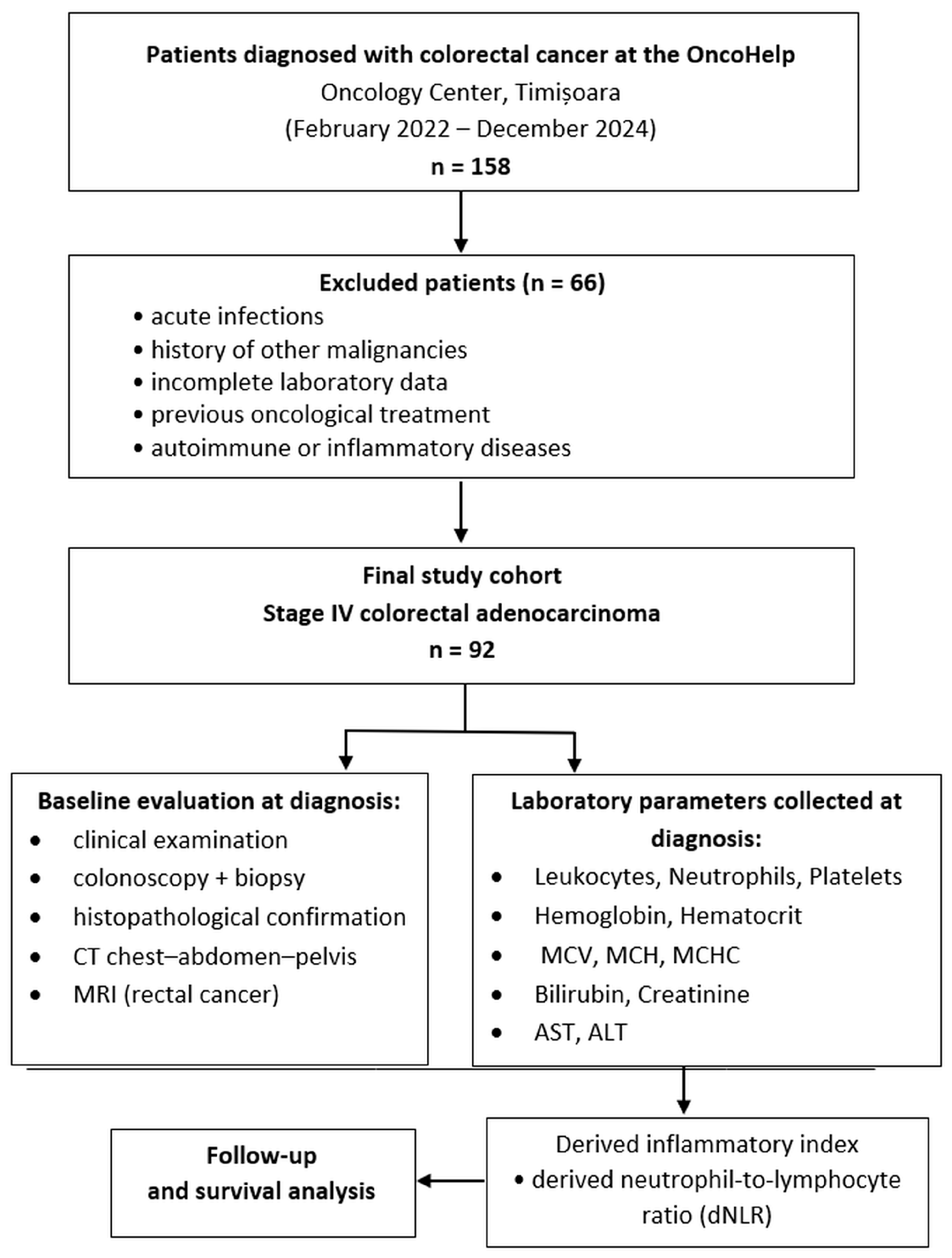
This retrospective cohort study included patients with stage IV colorectal adenocarcinoma diagnosed at the OncoHelp Oncology Center, Timisoara, Romania, between February 2022 and December 2024. Initially, 158 patients were screened for eligibility. After the application of predefined inclusion and exclusion criteria, 92 patients were included in the final analysis (
Figure 1). Patients were enrolled at the time of their first presentation to the oncology outpatient clinic.
At diagnosis, all patients underwent a comprehensive clinical evaluation, including physical examination, routine laboratory testing, colonoscopy with biopsy followed by histopathological confirmation, and radiological assessment for disease staging. Imaging evaluation included contrast-enhanced computed tomography (CT) of the chest, abdomen, and pelvis. Magnetic resonance imaging (MRI) was additionally performed in patients with rectal cancer when clinically indicated.
The inclusion criteria were as follows: (i) newly diagnosed colorectal adenocarcinoma, (ii) stage IV disease at diagnosis, (iii) availability of complete baseline laboratory data obtained at diagnosis, and (iv) absence of prior oncological treatment.
The exclusion criteria included: acute infections at diagnosis, autoimmune or inflammatory diseases potentially affecting laboratory parameters, chronic systemic corticosteroid therapy, prior chemotherapy or biological treatment, and a personal history of other malignancies.
Baseline laboratory parameters were obtained at the time of diagnosis using standard automated hematology and biochemistry analyzers. Reference ranges for all laboratory variables were defined according to institutional laboratory standards and are reported in the
Supplementary Materials (Table S1). The laboratory parameters analyzed included hematocrit (HCT), hemoglobin (HGB), mean corpuscular volume (MCV), mean corpuscular hemoglobin (MCH), mean corpuscular hemoglobin concentration (MCHC), platelet count (PLT), white blood cell count (WBC), absolute neutrophil count (ANC), aspartate aminotransferase (AST), alanine aminotransferase (ALT), total bilirubin, and serum creatinine.
The derived neutrophil-to-lymphocyte ratio (dNLR) was calculated as ANC/(WBC − ANC) and subsequently analyzed as an inflammation-based prognostic marker.
2.2. Performance Status Assessment (ECOG)
Performance status was assessed at baseline using the Eastern Cooperative Oncology Group (ECOG) performance status scale, a widely used clinical tool for evaluating patients’ functional status and ability to perform daily activities. The ECOG scale ranges from 0 to 5, where 0 indicates fully active patients without functional limitations, and higher scores reflect increasing levels of disability, with 5 corresponding to death.
ECOG performance status was determined by the treating physician at the time of diagnosis, based on clinical evaluation and patient-reported functional capacity. For analytical purposes, ECOG performance status was evaluated as a categorical variable.
2.3. Statistical Analysis
Statistical analysis was performed to evaluate the association between baseline laboratory inflammatory markers and clinicopathological characteristics, as well as their prognostic impact on overall survival in patients with colorectal cancer. The analyzed clinicopathological variables included age, sex, primary tumor location, TNM stage (T, N, and M1), pathological tumor grade, performance status, and survival status.
Data management, statistical analyses, and graphical representations were conducted using Microsoft Excel 2021 (Microsoft Corp., Redmond, WA, USA) and IBM SPSS Statistics version 26 (IBM Corp., Armonk, NY, USA). Continuous variables were tested for normality using the Shapiro–Wilk test. Normally distributed data were expressed as mean ± standard deviation, while non-normally distributed data were reported as median and interquartile range (IQR).
Comparisons between two independent groups were performed using the independent samples Student’s t-test for normally distributed variables or the Mann–Whitney U test for non-normally distributed variables. For comparisons among more than two groups, one-way analysis of variance (ANOVA) followed by Tukey’s post hoc test was applied for normally distributed data, while the Kruskal–Wallis test followed by Dunn’s post hoc test was used for non-normally distributed data.
Overall survival (OS) was defined as the time from diagnosis to death from any cause or last follow-up. Survival curves were estimated using the Kaplan–Meier method and compared using the log-rank test. Univariable Cox proportional hazards regression was performed to assess associations with OS. Variables of clinical relevance were subsequently entered into a multivariable Cox model adjusted for age, sex, ECOG performance status, primary tumor sidedness, liver metastases, primary tumor resection, first-line treatment class, anemia, AST, and dNLR. Hazard ratios (HRs) with 95% confidence intervals (CIs) were reported, and a two-sided p-value < 0.05 was considered statistically significant.
All statistical tests were two-sided, and a p-value < 0.05 was considered statistically significant.
3. Results
The study cohort comprised eligible patients with stage IV colorectal adenocarcinoma. Most patients were younger than 70 years (66.37%), while 33.63% were aged 70 years or older. The study population was predominantly male, with men accounting for 62% of cases and women for 38%. Regarding tumor location, left-sided colorectal tumors were more frequent, representing 76.1% of cases, whereas right-sided tumors accounted for 23.9%. Tumor staging was performed according to the Tumor–Node–Metastasis (TNM) classification system, which evaluates the extent of the primary tumor (T), regional lymph node involvement (N), and the presence of distant metastases (M1). According to tumor extent, patients were almost equally distributed between T3 (59.8%) and T4 (40.2%) stages (
Table 1).
Lymph node involvement was common, with the majority of patients presenting nodal metastases (N1–N2, 80.4%), while 19.6% had no lymph node involvement (N0). As expected for a stage IV cohort, distant metastases were present in all included patients (M1, 100%). Regarding pathological differentiation, moderately differentiated tumors (G2) were the most prevalent (52.20%), followed by poorly differentiated tumors (G3, 22.83%) and well-differentiated tumors (G1, 25.07%). Performance status assessment showed that most patients had a good functional status, with ECOG (
Tables S2 and S3) performance index scores of 0 or 1 in 94.6% of cases, while only 5.4% had a performance status of 2.
The median follow-up, calculated using the reverse Kaplan–Meier method, was 687 days (95% CI: 647–727). No patients were lost to follow-up. Survival status was ascertained through the institutional oncology registry. Initial systemic treatment consisted mainly of combination chemotherapy regimens associated with targeted agents. First-line systemic treatment was most commonly oxaliplatin-based (46.7%), followed by irinotecan-based regimens (29.3%) and fluoropyrimidine-based therapies (23.9%).
3.1. Association of Baseline Laboratory Parameters and Derived Inflammatory Indices with Clinicopathological Characteristics and Outcomes
3.1.1. Association of Inflammatory Markers with TNM Stage
When laboratory parameters were compared according to primary tumor extent, no statistically significant differences were observed between T3 and T4 tumors for most hematological and biochemical variables (
Table 2). Hemoglobin-related parameters, leukocyte counts, liver enzymes, renal function markers, and the derived inflammatory index (dNLR) showed comparable values between the two groups. These findings suggest that, within an advanced disease setting, local tumor extension alone does not substantially influence systemic inflammatory or biochemical parameters measured at diagnosis.
Across lymph node categories, hematological and biochemical parameters remained largely stable (
Table 3). No significant differences were observed in hemoglobin levels, erythrocyte indices, renal or hepatic markers. The dNLR ratio also showed no significant variation across N stages. Platelet count differed significantly across lymph node stages (overall
p-value = 0.011), with higher values in N1 and N2 compared to N0. Dunn’s post hoc analysis showed significant differences for N0 vs. N1 (
p-value = 0.045) and N0 vs. N2 (
p-value = 0.043), but not for N1 vs. N2 (
p-value = 0.125). This finding suggests a potential association between thrombocytosis and lymphatic tumor spread. White blood cell and neutrophil counts remained relatively stable across N stages, indicating that nodal disease burden alone may not substantially influence systemic inflammatory activation at diagnosis.
The hematological and biochemical characteristics of the M1 cohort (n = 92) are presented in
Table 4.
3.1.2. Association of Inflammatory Markers with Tumor Pathological Grade
Baseline laboratory parameters were compared according to histological grade (G1–G3). No statistically significant differences were observed in most hematological and biochemical markers across tumor grades. Hemoglobin, hematocrit, erythrocyte indices (MCH, MCHC, MCV), platelet count, total bilirubin, serum creatinine, ANC, AST, ALT, and dNLR showed comparable distributions between G1, G2, and G3 tumors (all p > 0.05). Although a trend toward higher leukocyte counts was observed in patients with G3 tumors, this did not reach statistical significance (p = 0.056). Similarly, dNLR values were not significantly different across histological grades (p = 0.860), suggesting that systemic inflammatory status at baseline was not directly associated with tumor differentiation grade in this cohort.
Overall, these findings indicate that baseline inflammatory and routine laboratory parameters were largely independent of histological grading in metastatic colorectal cancer (
Table 5).
3.1.3. Association of Laboratory Parameters with Performance Status
Performance status was significantly associated with hematological and inflammatory parameters (
Table 6). Hematocrit levels showed a decreasing trend across performance index categories, although this did not reach statistical significance (
p = 0.128). Total leukocyte count, absolute neutrophil count, and dNLR differed significantly according to performance index (WBC:
p = 0.008; ANC:
p = 0.003; dNLR:
p = 0.001). Post hoc pairwise comparisons using Dunn’s test demonstrated significantly higher values in P1 and P2 compared with P0 (WBC: P1 vs. P0, adjusted
p-value = 0.018; P2 vs. P0, adjusted
p-value = 0.023; ANC: P1 vs. P0, adjusted
p-value = 0.010; P2 vs. P0, adjusted
p-value = 0.036; dNLR: P1 vs. P0, adjusted
p-value = 0.010; P2 vs. P0, adjusted
p-value = 0.011), whereas no significant differences were observed between P1 and P2 (all adjusted
p-value > 0.10). ALT levels showed a non-significant trend across performance categories (
p = 0.064). Other hematological and biochemical variables did not show statistically significant differences.
3.1.4. Association of Inflammatory Markers with Demographic Characteristics and Primary Tumor Location
Clinicopathological characteristics, including age, sex, and primary tumor location were evaluated in relation to baseline inflammatory and laboratory parameters (
Table 7).
When stratified by age, several laboratory parameters differed between patients younger than 70 years and those aged 70 years or older. Serum creatinine levels were significantly higher in older patients (p-value = 0.031), while the derived neutrophil-to-lymphocyte ratio was also increased in this age group (p-value = 0.035). Other hematological parameters, including hemoglobin, leukocyte counts, absolute neutrophil counts, platelet counts, and liver enzymes, showed comparable values between age categories. These findings suggest that age-related differences were mainly reflected in renal function and inflammatory balance rather than in global hematological profiles.
According to sex, significant differences were observed in several inflammation related parameters. White blood cell counts were significantly higher in men compared to women (p-value = 0.038), accompanied by increased absolute neutrophil counts (p-value = 0.034). In addition, serum creatinine levels were significantly higher in male patients (p-value < 0.001). Total bilirubin levels were higher in women (p-value = 0.046), while the derived neutrophil-to-lymphocyte ratio did not differ significantly between sexes. Other haematological and biochemical parameters showed no statistically significant differences.
When patients were stratified according to primary tumor location, most laboratory parameters showed similar distributions between left- and right-sided colorectal tumors. Mean corpuscular volume was significantly higher in patients with left-sided tumors (p-value = 0.048). Absolute neutrophil counts and derived neutrophil-to-lymphocyte ratio tended to be higher in right-sided tumors; however, these differences did not reach statis-tical significance. No significant differences were observed for platelet counts, leukocyte counts, liver enzymes, renal function markers, or total bilirubin according to tumor loca-tion.
Overall, demographic factors such as age and sex were associated with selective al-terations in inflammatory and biochemical parameters, while primary tumor location showed a limited influence on baseline systemic inflammatory profiles in this cohort.
3.2. Kaplan–Meier Analysis of Overall Survival According to Inflammatory Marker Levels
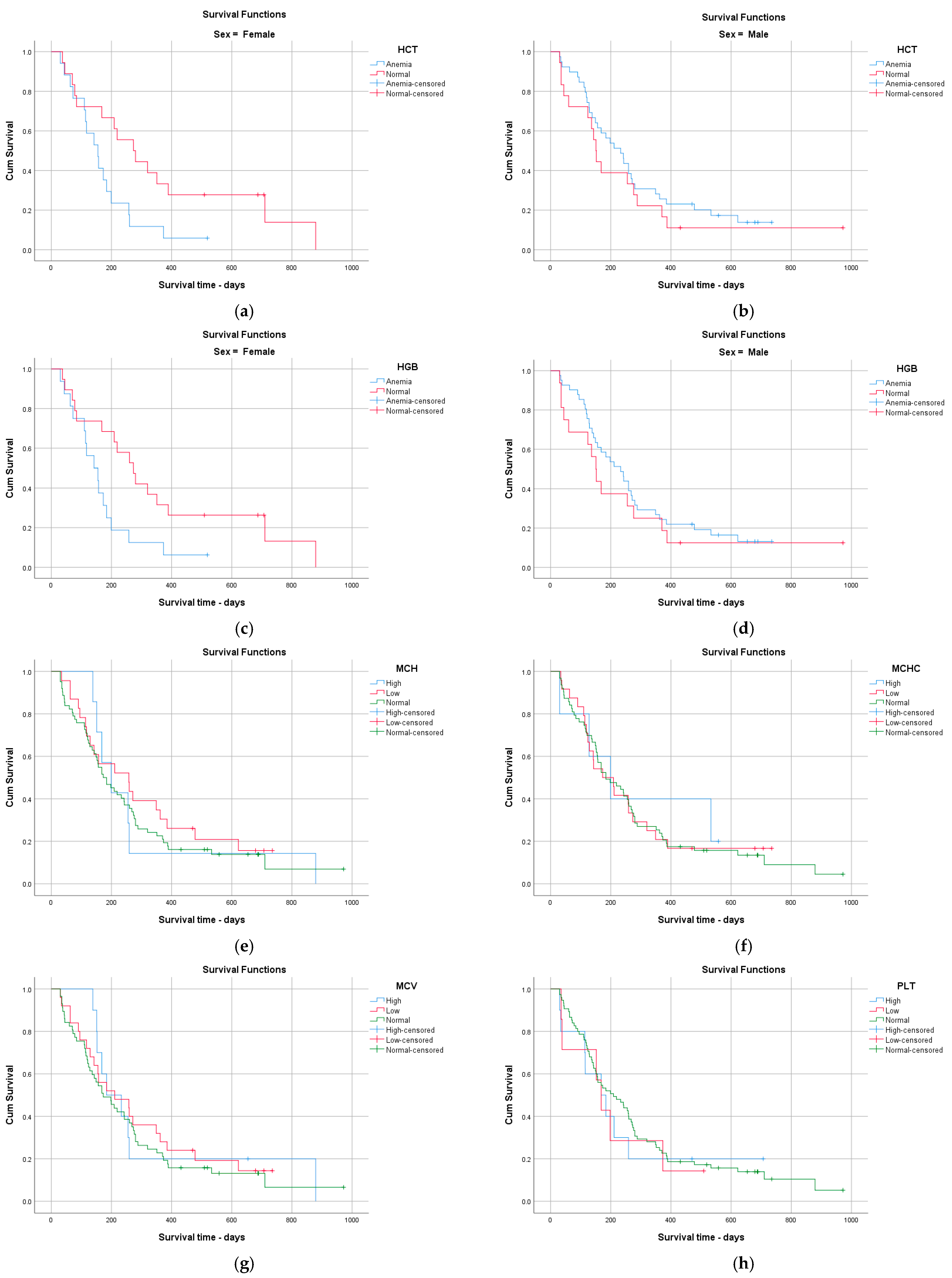
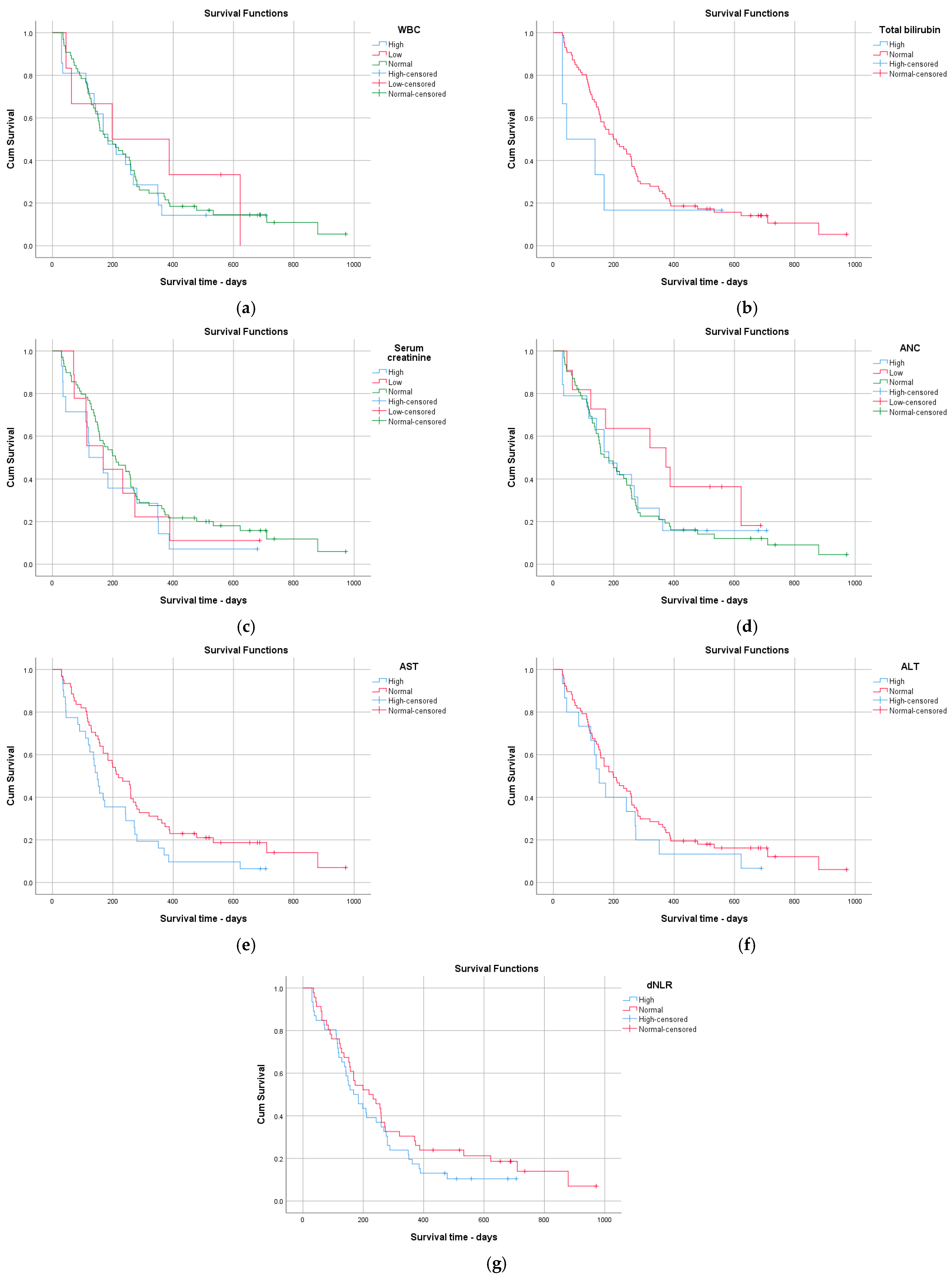
In Kaplan–Meier analysis, only AST elevation was significantly associated with shorter overall survival. Other routine hematological and biochemical parameters, including hemoglobin, hematocrit, platelet count, leukocyte count, bilirubin, creatinine, and dNLR (median-based cut-off), were not significantly associated with survival. Although some markers showed numerical differences in median OS, these did not reach statistical significance, likely reflecting limited subgroup sizes and clinical heterogeneity (
Figure 2 and
Figure 3,
Table 8).
3.3. Cox Regression Mode
In univariable Cox regression analysis, primary tumor resection and irinotecan-based first-line therapy were significantly associated with overall survival. Patients who underwent primary tumor resection had improved survival (HR 0.609, 95% CI 0.373–0.995, p = 0.048). In contrast, irinotecan-based regimens were associated with increased mortality risk compared with fluoropyrimidine-only therapy (HR 1.810, 95% CI 1.036–3.165, p = 0.037). Elevated AST showed borderline statistical significance (HR 1.588, 95% CI 1.001–2.519, p = 0.050). Continuous dNLR was not significantly associated with survival; however, patients in the second tertile (T2) had significantly worse survival compared with T1 (HR 1.983, 95% CI 1.152–3.413, p = 0.014). No significant associations were observed for age, sex, ECOG performance status, tumor sidedness, liver metastases, anemia, or oxaliplatin-based therapy.
After adjustment for clinically relevant confounders, only irinotecan-based first-line therapy remained independently associated with overall survival (HR 2.103, 95% CI 1.162–3.808, p = 0.022). The associations observed in univariable analysis for primary tumor resection, AST, and dNLR did not persist in the multivariable model. Specifically, AST elevation (HR 1.234, 95% CI 0.947–1.608, p = 0.119), anemia (HR 1.420, 95% CI 0.865–2.306, p = 0.165), and continuous dNLR (HR 1.117, 95% CI 0.849–1.470, p = 0.429) were not independently associated with survival.
In this cohort of metastatic colorectal cancer patients, irinotecan-based therapy was the only independent predictor of overall survival. The prognostic associations observed for AST and dNLR in unadjusted analyses were attenuated after adjustment for clinicopathological and treatment-related factors (
Table 9).
4. Discussion
In this retrospective cohort of patients with metastatic colorectal adenocarcinoma, we investigated the prognostic impact of baseline clinicopathological characteristics and routine laboratory parameters on overall survival. Although several variables were associated with survival in univariable analyses, only irinotecan-based first-line therapy remained independently associated with overall survival after adjustment for major clinical confounders.
Systemic inflammation has been extensively studied in metastatic colorectal cancer. In our cohort, dNLR was associated with performance status and certain pathological features, and patients in the intermediate tertile demonstrated worse survival in univariable analysis. However, continuous dNLR did not retain independent significance in the multivariable model. These findings suggest that systemic inflammatory indices may partially reflect disease burden and host condition rather than acting as fully independent prognostic determinants. Large prospective trials, including COIN and TRIBE, have reported independent associations between elevated NLR/dNLR and inferior survival in mCRC [
15,
16,
17]. Our results support the biological relevance of inflammation but underscore the importance of comprehensive adjustment for metastatic pattern, functional status, and treatment allocation when evaluating inflammatory biomarkers [
18,
19,
20].
Similarly, elevated AST was associated with shorter survival in unadjusted analyses and Kaplan–Meier comparisons. However, this effect was attenuated after multivariable adjustment. In metastatic colorectal cancer, AST elevation may reflect hepatic metastatic involvement, systemic inflammatory activation, metabolic stress, or muscle catabolism rather than isolated hepatocellular injury [
21,
22,
23]. The loss of independent significance indicates that AST likely functions as a surrogate marker of disease extent rather than an autonomous prognostic factor.
Anemia, defined according to sex-specific WHO criteria, was also associated with survival in univariable analysis but did not remain significant in the adjusted model. Cancer-related anemia is multifactorial and frequently driven by chronic inflammation, iron dysregulation, nutritional impairment, and bone marrow suppression [
24,
25,
26]. Its attenuation after adjustment suggests that hemoglobin levels may represent overall disease severity and physiological reserve rather than exerting an independent prognostic effect.
Notably, irinotecan-based first-line therapy remained independently associated with shorter survival. This finding should be interpreted cautiously, as treatment selection in metastatic colorectal cancer is not randomized and may reflect confounding by indication. Patients receiving irinotecan-based regimens may have had more aggressive disease biology or clinical features influencing therapeutic decisions. Similar considerations have been described in observational studies evaluating treatment patterns in mCRC [
27,
28]. Therefore, the observed association likely reflects underlying disease complexity rather than a direct detrimental effect of irinotecan itself.
Across histological grade, T stage, nodal status, and performance categories, laboratory parameters showed heterogeneous but generally modest differences. Although inflammatory markers tended to increase with worsening performance status, these variations did not translate into independent survival effects once clinical and treatment-related confounders were considered. Other routine laboratory parameters—including platelet count, leukocyte count, bilirubin, creatinine, and ALT—were not independently associated with survival, in line with prior evidence suggesting that composite inflammatory indices may outperform isolated biomarkers [
28,
29,
30].
Overall, our findings highlight the complexity of prognostic modeling in metastatic colorectal cancer. While inflammation-based markers such as dNLR and AST demonstrate associations with survival in unadjusted analyses, their independent prognostic contribution appears limited after accounting for key clinical and treatment variables. These results emphasize the necessity of rigorous multivariable modeling in biomarker evaluation.
Several limitations merit consideration. The retrospective character implies the use of existing data in observation sheets, which can lead to incomplete information, variability in the documentation of clinical parameters and potential recording errors. The single-center design and relatively small sample size may limit statistical power and increase susceptibility to residual confounding. Moreover, only baseline laboratory parameters were analyzed; dynamic changes during treatment could provide additional prognostic insight [
31]. Consequently, the results should be interpreted with caution and validated by multicenter, prospective studies in larger batches of patients. Nevertheless, the internal consistency of our findings and their alignment with contemporary literature support the role of systemic inflammatory and metabolic markers as reflections of disease burden in metastatic colorectal cancer.
5. Conclusions
In this cohort of patients with metastatic colorectal adenocarcinoma, several inflammation-related and routine laboratory parameters were associated with overall survival in unadjusted analyses. However, after adjustment for clinicopathological and treatment-related confounders, only irinotecan-based first-line therapy remained independently associated with survival. Although markers such as dNLR and AST demonstrated prognostic signals in univariable analyses, their effects were attenuated in multivariable modeling, suggesting that these biomarkers may primarily reflect disease burden and host condition rather than acting as autonomous prognostic determinants.
These findings underscore the importance of comprehensive multivariable adjustment when evaluating inflammation-based biomarkers in metastatic colorectal cancer. Further prospective studies with larger cohorts and dynamic longitudinal assessment of inflammatory indices are warranted to clarify their independent prognostic value.




 ,
,