Usability Evaluation of a Central Monitoring System with AI-Based Cardiac Arrest Prediction in the ICU


Abstract
1. Introduction
2. Materials and Methods
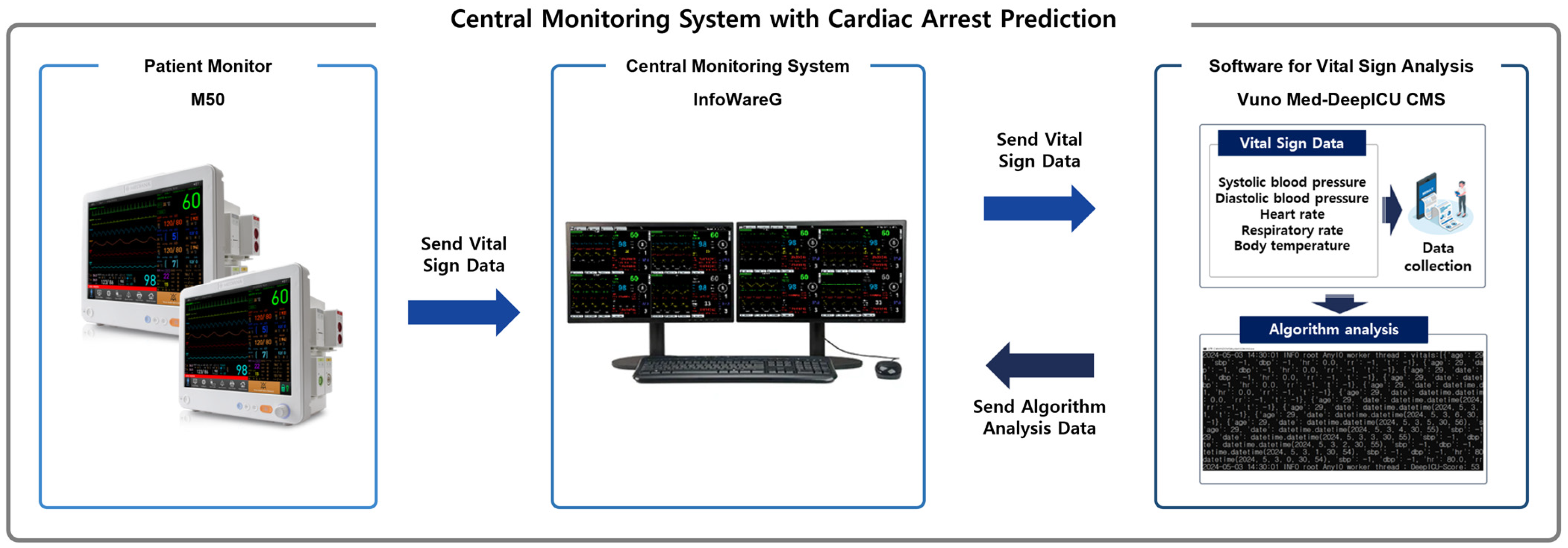
2.1. Central Monitoring System with AI-Based Cardiac Arrest Prediction
2.1.1. Configuration
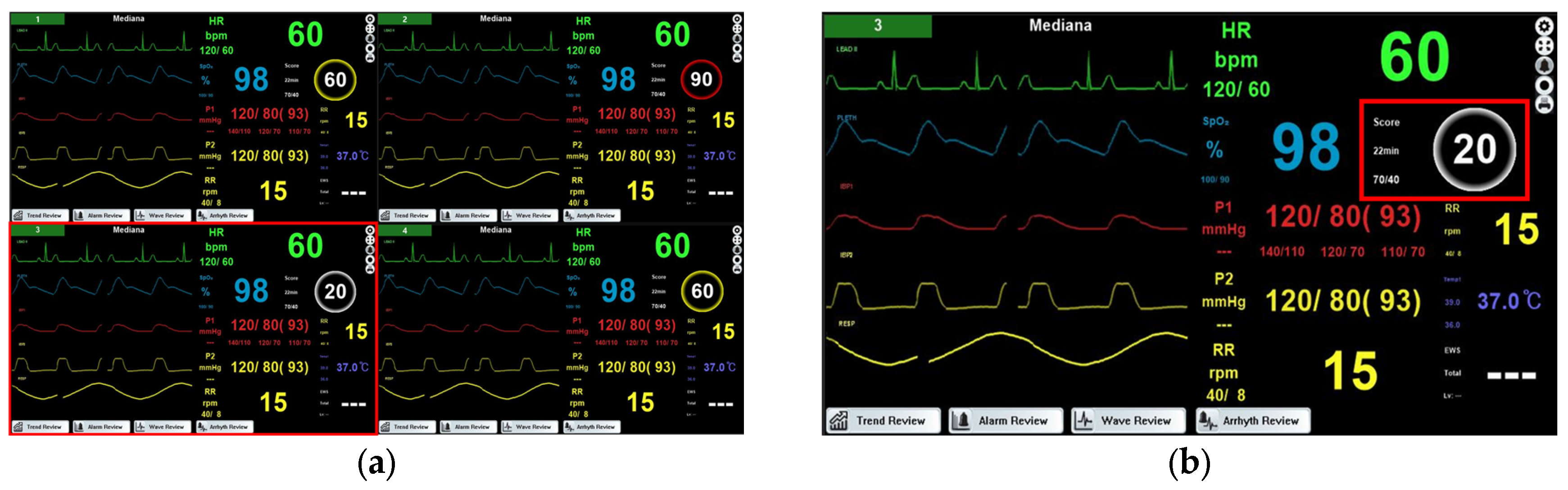
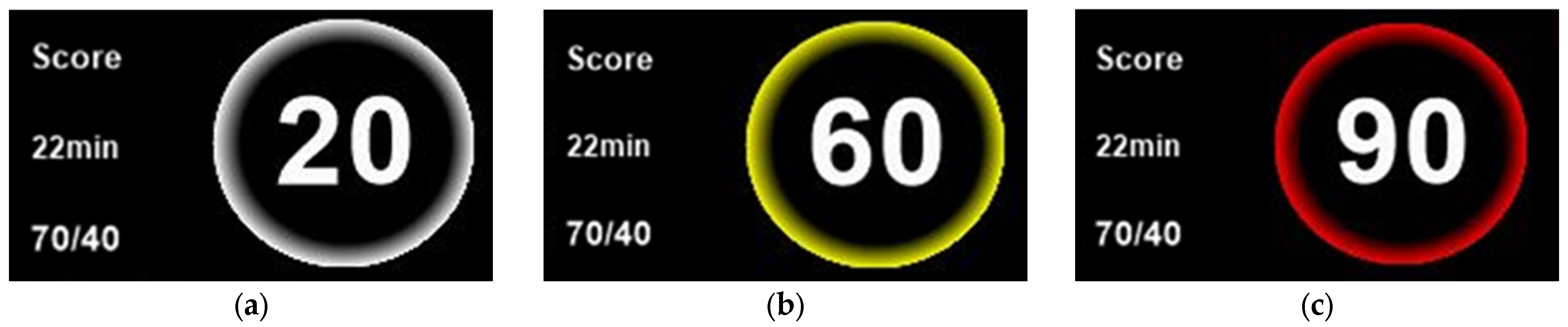
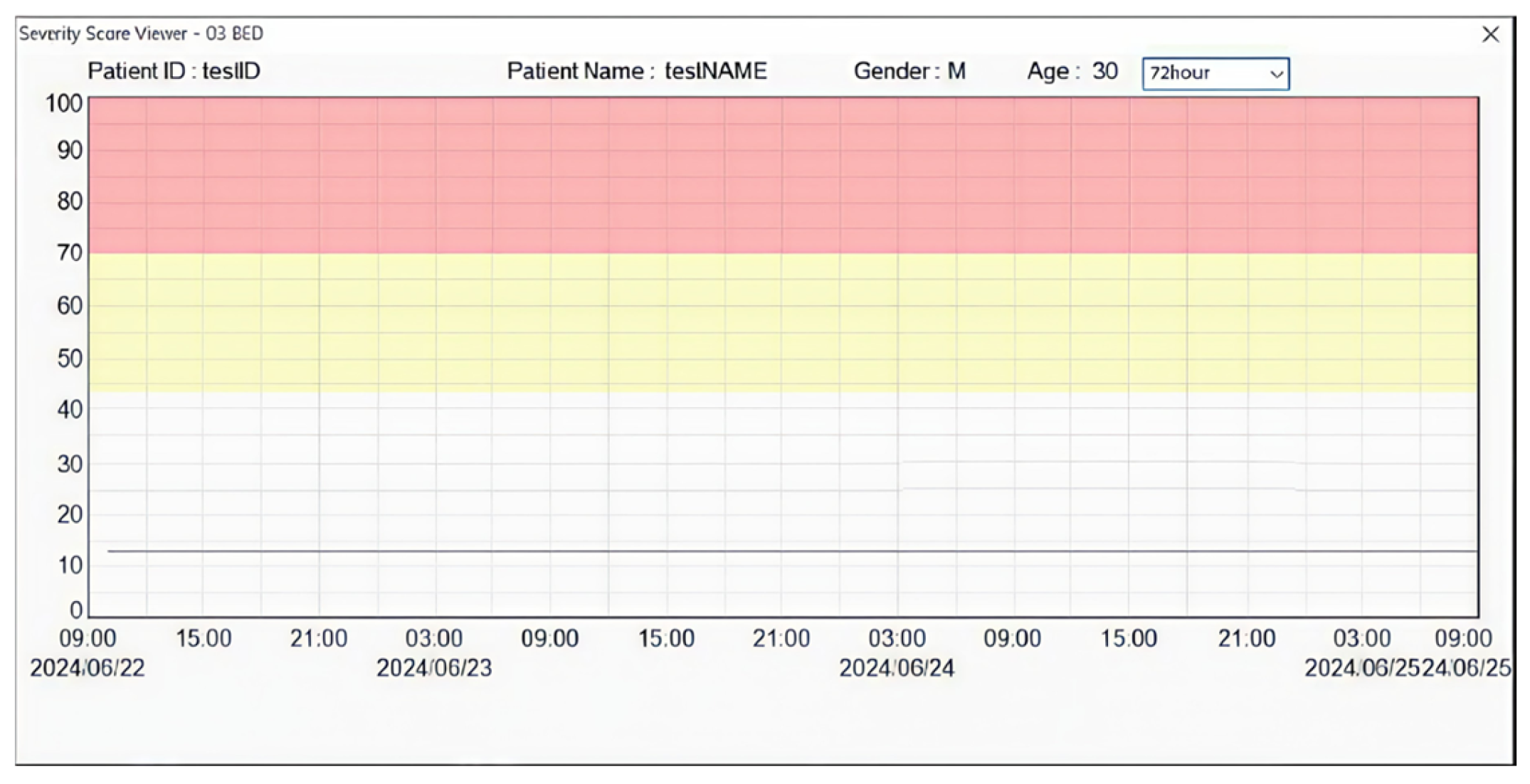
2.1.2. GUI (Graphical User Interface)
2.2. Study Design
2.3. Study Procedure
2.4. Analysis
2.4.1. Usability Test
2.4.2. SUS (System Usability Scale) Survey
2.4.3. Satisfaction Survey
3. Results
3.1. Demographic Characteristics
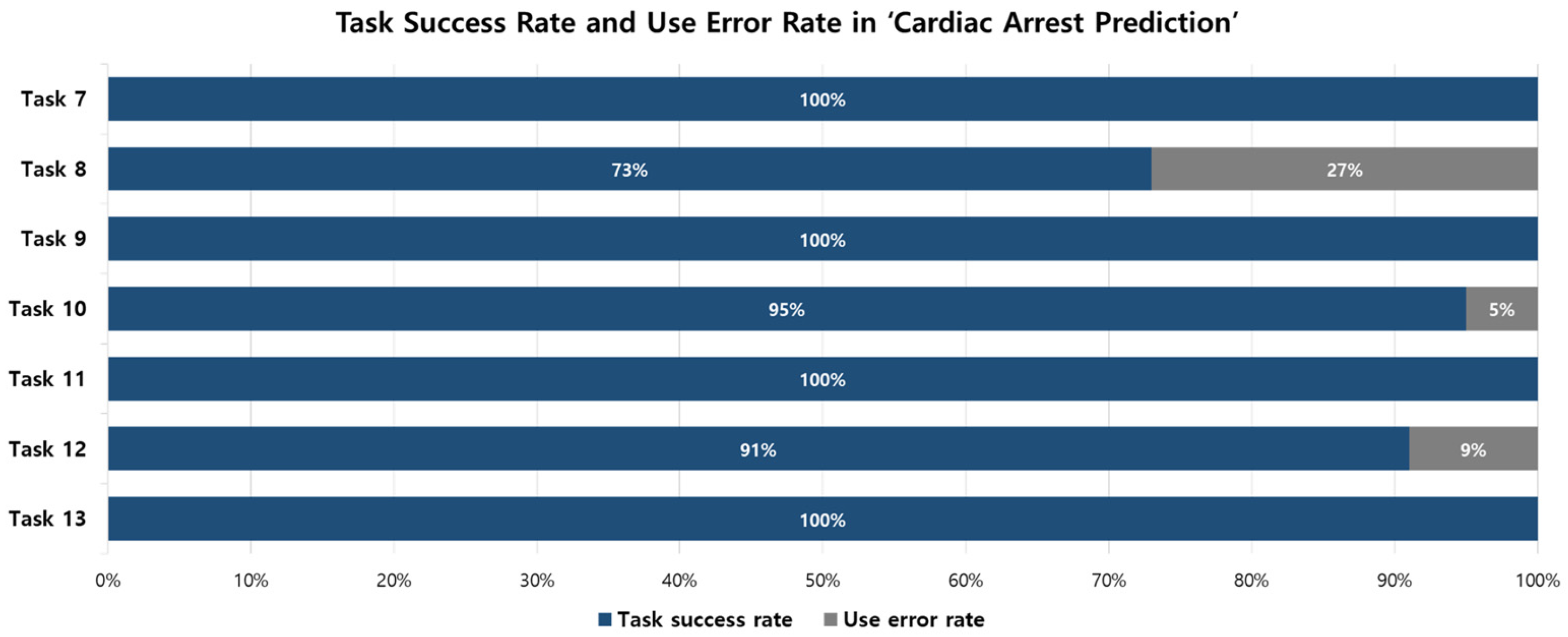
3.2. Usability Test
3.3. SUS (System Usability Scale) Survey
3.4. Satisfaction Survey
4. Discussion
5. Conclusions
Author Contributions
Funding
Institutional Review Board Statement
Informed Consent Statement
Data Availability Statement
Acknowledgments
Conflicts of Interest
Abbreviations
| ICU | intensive care unit |
| CMS | Central Monitoring System |
| ECG | electrocardiogram |
| CO2 | carbon dioxide |
| SpO2 | transcutaneous oxygen saturation |
| HR | heart rate |
| NIBP | non-invasive blood pressure |
| PR | pulse rate |
| RR | respiration rate |
| IRB | Institutional Review Board |
| SUS | System Usability Scale |
References
- Lee, H.; Yang, H.L.; Ryu, H.G.; Jung, C.W.; Cho, Y.J.; Yoon, S.B.; Yoon, H.K.; Lee, H.C. Real-Time Machine Learning Model to Predict in-Hospital Cardiac Arrest Using Heart Rate Variability in ICU. npj Digit. Med. 2023, 6, 215. [Google Scholar] [CrossRef] [PubMed]
- Armstrong, R.A.; Kane, C.; Oglesby, F.; Barnard, K.; Soar, J.; Thomas, M. The Incidence of Cardiac Arrest in the Intensive Care Unit: A Systematic Review and Meta-Analysis. J. Intensive Care Soc. 2019, 20, 144–154. [Google Scholar] [CrossRef] [PubMed]
- Kwon, J.M.; Kim, K.H.; Jeon, K.H.; Lee, S.Y.; Park, J.; Oh, B.H. Artificial Intelligence Algorithm for Predicting Cardiac Arrest Using Electrocardiography. Scand. J. Trauma Resusc. Emerg. Med. 2020, 28, 98. [Google Scholar] [CrossRef]
- Hillman, K.M.; Bristow, P.J.; Chey, T.; Daffurn, K.; Jacques, T.; Norman, S.L.; Bishop, G.F.; Simmons, G. Duration of Life-Threatening Antecedents Prior to Intensive Care Admission. Intensive Care Med. 2002, 28, 1629–1634. [Google Scholar] [CrossRef] [PubMed]
- Elvekjaer, M.; Aasvang, E.K.; Olsen, R.M.; Sørensen, H.B.D.; Porsbjerg, C.M.; Jensen, J.U.; Haahr-Raunkjær, C.; Meyhoff, C.S. Physiological Abnormalities in Patients Admitted with Acute Exacerbation of COPD: An Observational Study with Continuous Monitoring. J. Clin. Monit. Comput. 2020, 34, 1051–1060. [Google Scholar] [CrossRef]
- Lee, A.; Bishop, G.; Hillman, K.M.; Daffurn, K. The Medical Emergency Team. Anaesth. Intensive Care 1995, 23, 183–186. [Google Scholar] [CrossRef]
- Smith, G.B.; Osgood, V.M.; Crane, S. ALERT—A Multiprofessional Training Course in the Care of the Acutely Ill Adult Patient. Resuscitation 2002, 52, 281–286. [Google Scholar] [CrossRef]
- Shin, Y.; Cho, K.-j.; Chang, M.; Youk, H.; Kim, Y.J.; Park, J.Y.; Yoo, D. The Development and Validation of a Novel Deep-Learning Algorithm to Predict in-Hospital Cardiac Arrest in ED-ICU (Emergency Department-Based Intensive Care Units): A Single Center Retrospective Cohort Study. Signa Vitae 2024, 20, 83–98. [Google Scholar] [CrossRef]
- Kim, Y.K.; Seo, W.D.; Lee, S.J.; Koo, J.H.; Kim, G.C.; Song, H.S.; Lee, M. Early Prediction of Cardiac Arrest in the Intensive Care Unit Using Explainable Machine Learning: Retrospective Study. J. Med. Internet Res. 2024, 26, e62890. [Google Scholar] [CrossRef]
- Li, Y.; Ye, W.; Yang, K.; Zhang, S.; He, X.; Jin, X.; Wang, C.; Sun, Z.; Liu, M. Prediction of Cardiac Arrest in Critically Ill Patients Based on Bedside Vital Signs Monitoring. Comput. Methods Programs Biomed. 2022, 214, 106568. [Google Scholar] [CrossRef]
- Giebel, G.D.; Raszke, P.; Nowak, H.; Palmowski, L.; Adamzik, M.; Heinz, P.; Tokic, M.; Timmesfeld, N.; Brunkhorst, F.M.; Wasem, J.; et al. Improving AI-Based Clinical Decision Support Systems and Their Integration into Care from the Perspective of Experts: Interview Study Among Different Stakeholders. JMIR Med. Inform. 2025, 13, e69688. [Google Scholar] [CrossRef]
- Nasirizad Moghadam, K.; Chehrzad, M.M.; Reza Masouleh, S.; Maleki, M.; Mardani, A.; Atharyan, S.; Harding, C. Nursing Physical Workload and Mental Workload in Intensive Care Units: Are They Related? Nurs. Open 2021, 8, 1625–1633. [Google Scholar] [CrossRef]
- Choi, H.; Kim, Y.; Jang, W. Enhancing the Usability of Patient Monitoring Devices in Intensive Care Units: Usability Engineering Processes for Early Warning System (EWS) Evaluation and Design. J. Clin. Med. 2025, 14, 3218. [Google Scholar] [CrossRef] [PubMed]
- Andrade, E.; Quinlan, L.; Harte, R.; Byrne, D.; Fallon, E.; Kelly, M.; Casey, S.; Kirrane, F.; O’Connor, P.; O’Hora, D.; et al. Novel Interface Designs for Patient Monitoring Applications in Critical Care Medicine: Human Factors Review. JMIR Hum. Factors 2020, 7, e15052. [Google Scholar] [CrossRef]
- Kim, Y.; Son, J.; Jang, W. Usability Study on Patient Monitoring Systems: An Evaluation of a User Interface Based on User Experience and Preference. Med. Sci. Monit. 2023, 29, e938570. [Google Scholar] [CrossRef] [PubMed]
- Mohammadi, M.; Mazloumi, A.; Kazemi, Z.; Zeraati, H. Evaluation of Mental Workload among ICU Ward’s Nurses. Health Promot. Perspect. 2015, 5, 280–287. [Google Scholar] [CrossRef]
- Dee, S.A.; Tucciarone, J.; Plotkin, G.; Mallilo, C. Determining the Impact of an Alarm Management Program on Alarm Fatigue among ICU and Telemetry RNs: An Evidence Based Research Project. SAGE Open Nurs. 2022, 8, 23779608221098713. [Google Scholar] [CrossRef]
- Daniels, J.; Fels, S.; Kushniruk, A.; Lim, J.; Ansermino, J.M. A Framework for Evaluating Usability of Clinical Monitoring Technology. J. Clin. Monit. Comput. 2007, 21, 323–330. [Google Scholar] [CrossRef] [PubMed]
- Choi, H.; Jang, W. User Experience Study of the Patient Monitoring Systems Based on Usability Testing and Eye Tracking. Healthcare 2024, 12, 2573. [Google Scholar] [CrossRef]
- Privitera, M.B. Applied Human Factors in Medical Device Design; Academic Press: Cambridge, MA, USA, 2019. [Google Scholar]
- ANSI/AAMI HE75:2009 (R2018); Human Factors Engineering-Design of Medical Devices. Association for the Advancement of Medical Instrumentation: Arlington, VA, USA, 2013.
- ISO 14971; Medical Devices—Application of Risk Management to Medical Devices. International Organization for Standardization: Geneva, Switzerland, 2019.
- Sevilla-Gonzalez, M.D.R.; Moreno Loaeza, L.; Lazaro-Carrera, L.S.; Bourguet Ramirez, B.; Vázquez Rodríguez, A.; Peralta-Pedrero, M.L.; Almeda-Valdes, P. Spanish Version of the System Usability Scale for the Assessment of Electronic Tools: Development and Validation. JMIR Hum. Factors 2020, 7, e21161. [Google Scholar] [CrossRef] [PubMed]
- Mohamad Marzuki, M.F.; Yaacob, N.A.; Yaacob, N.M. Translation, Cross-Cultural Adaptation, and Validation of the Malay Version of the System Usability Scale Questionnaire for the Assessment of Mobile Apps. JMIR Hum. Factors 2018, 5, e10308. [Google Scholar] [CrossRef] [PubMed]
- Østervang, C.; Jensen, C.M.; Coyne, E.; Dieperink, K.B.; Lassen, A. Usability and Evaluation of a Health Information System in the Emergency Department: Mixed Methods Study. JMIR Hum. Factors 2024, 11, e48445. [Google Scholar] [CrossRef]
- Deshmukh, A.M.; Chalmeta, R. Validation of System Usability Scale as a Usability Metric to Evaluate Voice User Interfaces. PeerJ Comput. Sci. 2024, 10, e1918. [Google Scholar] [CrossRef] [PubMed]
- Bangor, A.; Kortum, P.; Miller, J. Determining What Individual SUS Scores Mean: Adding an Adjective Rating Scale. J. Usability Stud. 2009, 4, 114–123. [Google Scholar]



| Task Number | Task Description | Critical Task |
|---|---|---|
| Basic Settings | ||
| Task 1 | Enter information for predicting the patient’s critical condition and confirm its application to the PM. | |
| Task 2 | Change the NIBP automatic measurement interval to 60 min and measure NIBP. | |
| Task 3 | Change the HR Alarm Limit to 80/60 and confirm its application to the PM. | |
| Task 4 | Set the primary alarm threshold to 40 and the secondary alarm threshold to 70 for cardiac arrest alarms. | |
| Task 5 | Temporarily silence the alarm for 2 min. | |
| Task 6 | Set the HR Alarm Limit to 100/80 to prevent unnecessary alarms after the temporary silence period ends. | |
| Cardiac Arrest Prediction | ||
| Task 7 | Check the patient’s cardiac arrest prediction score. | |
| Task 8 | Check the severity of the alarm that occurred and the patient’s RR. | ✔ |
| Task 9 | After confirming the alarm status, temporarily silence the alarm. | ✔ |
| Task 10 | Change the monitoring screen to a 6-bed view for enhanced patient monitoring. | |
| Task 11 | Change the monitoring screen to a 4-bed view to focus on patients with higher cardiac arrest prediction scores. | |
| Task 12 | Check the severity of the occurred alarm and the patient’s HR. | ✔ |
| Task 13 | Check the patient’s cardiac arrest prediction score. | |
| Patient Review | ||
| Task 14 | Open the patient’s ECG waveform review window to check the history of ECG-related alarms. | |
| Task 15 | Zoom in on the waveform in the area where the Asystole alarm occurred. | |
| Task 16 | Set the HR to be displayed. | |
| Task 17 | Review the trend data of the patient’s cardiac arrest prediction score. | |
| Patient Discharge | ||
| Task 18 | Discharge the patient from Bed 1. | |
| No | System Usability Scale (SUS) Items |
|---|---|
| 1 | I think that I would like to use this system frequently. |
| 2 | I found the system unnecessarily complex. |
| 3 | I thought the system was easy to use. |
| 4 | I think that I would need the support of a technical person to be able to use this system. |
| 5 | I found the various functions in this system were well integrated. |
| 6 | I thought there was too much inconsistency in this system. |
| 7 | I would imagine that most people would learn to use this system very quickly. |
| 8 | I found the system very cumbersome to use. |
| 9 | I felt very confident using the system. |
| 10 | I needed to learn a lot of things before I could get going with this system. |
| No | Satisfaction Survey Items |
|---|---|
| 1 | Do you think the function of remotely changing the information entered into the PM through CMS is useful? |
| 2 | Do you think the function of remotely changing and measuring the NIBP auto-measurement interval of PM is useful? |
| 3 | Do you think the function of predicting cardiac arrest and displaying the score based on artificial intelligence is useful? |
| 4 | Do you think the function of monitoring multiple patients simultaneously is useful? |
| 5 | Do you think the function of changing the alarm limits is useful? |
| 6 | Do you think the function of pausing the alarm when it occurs is useful? |
| 7 | Do you think the function of categorizing alarms by severity (High, Medium, Low) is useful? |
| 8 | Do you think the function of zooming on the area where ECG-related alarms occur for confirmation is useful? |
| 9 | Do you think the function of checking the trend of the cardiac arrest prediction score is useful? |
| Variable | Users | |
|---|---|---|
| Gender | Male | 3 |
| Female | 19 | |
| Age | 20–29 years | 6 |
| 30–39 years | 5 | |
| 40–49 years | 10 | |
| 50–59 years | 1 | |
| Department of participant variable | Intensive Care Unit (ICU) | 22 |
| Work experience | Less than 3 years | 2 |
| More than 3 years, less than 5 years | 3 | |
| More than 5 years, less than 10 years | 6 | |
| More than 10 years | 11 | |
| User experience with similar devices | Less than 3 years | 2 |
| More than 3 years, less than 5 years | 3 | |
| More than 5 years, less than 10 years | 6 | |
| More than 10 years | 11 | |
| Use Scenario | Task Success Rate | Use Error Rate |
|---|---|---|
| Basic Settings | 89% | 11% |
| Cardiac Arrest Prediction | 94% | 6% |
| Patient Review | 81% | 19% |
| Patient Discharge | 100% | 0% |
| No | System Usability Scale (SUS) Items | Mean | SD |
|---|---|---|---|
| 1 | I think that I would like to use this system frequently. | 4.2 | 0.6 |
| 2 | I found the system unnecessarily complex. | 2.9 | 1.0 |
| 3 | I thought the system was easy to use. | 3.8 | 0.7 |
| 4 | I think that I would need the support of a technical person to be able to use this system. | 3.0 | 1.0 |
| 5 | I found the various functions in this system were well integrated. | 4.0 | 0.7 |
| 6 | I thought there was too much inconsistency in this system. | 2.2 | 1.0 |
| 7 | I would imagine that most people would learn to use this system very quickly. | 4.0 | 0.6 |
| 8 | I found the system very cumbersome to use. | 2.3 | 0.7 |
| 9 | I felt very confident using the system. | 3.8 | 0.8 |
| 10 | I needed to learn a lot of things before I could get going with this system. | 2.5 | 0.9 |
| System Usability Scale (SUS) Score | 67.3 | 11.2 | |
| No | Satisfaction Survey Items | Mean | SD |
|---|---|---|---|
| 1 | Do you think the function of remotely changing the information entered into the PM through CMS is useful? | 4.5 | 0.6 |
| 2 | Do you think the function of remotely changing and measuring the NIBP auto-measurement interval of PM is useful? | 4.6 | 0.6 |
| 3 | Do you think the function of predicting cardiac arrest and displaying the score based on artificial intelligence is useful? | 4.2 | 0.8 |
| 4 | Do you think the function of monitoring multiple patients simultaneously is useful? | 4.7 | 0.5 |
| 5 | Do you think the function of changing the alarm limits is useful? | 4.7 | 0.5 |
| 6 | Do you think the function of pausing the alarm when it occurs is useful? | 4.6 | 0.5 |
| 7 | Do you think the function of categorizing alarms by severity (High, Medium, Low) is useful? | 4.1 | 1.0 |
| 8 | Do you think the function of zooming on the area where ECG-related alarms occur for confirmation is useful? | 4.4 | 0.7 |
| 9 | Do you think the function of checking the trend of the cardiac arrest prediction score is useful? | 4.3 | 0.7 |
Disclaimer/Publisher’s Note: The statements, opinions and data contained in all publications are solely those of the individual author(s) and contributor(s) and not of MDPI and/or the editor(s). MDPI and/or the editor(s) disclaim responsibility for any injury to people or property resulting from any ideas, methods, instructions or products referred to in the content. |
© 2026 by the authors. Licensee MDPI, Basel, Switzerland. This article is an open access article distributed under the terms and conditions of the Creative Commons Attribution (CC BY) license.
Share and Cite
Oh, J.; Kim, Y.; Jang, W. Usability Evaluation of a Central Monitoring System with AI-Based Cardiac Arrest Prediction in the ICU. J. Clin. Med. 2026, 15, 2261. https://doi.org/10.3390/jcm15062261
Oh J, Kim Y, Jang W. Usability Evaluation of a Central Monitoring System with AI-Based Cardiac Arrest Prediction in the ICU. Journal of Clinical Medicine. 2026; 15(6):2261. https://doi.org/10.3390/jcm15062261
Chicago/Turabian StyleOh, Jiyoon, Yourim Kim, and Wonseuk Jang. 2026. "Usability Evaluation of a Central Monitoring System with AI-Based Cardiac Arrest Prediction in the ICU" Journal of Clinical Medicine 15, no. 6: 2261. https://doi.org/10.3390/jcm15062261
APA StyleOh, J., Kim, Y., & Jang, W. (2026). Usability Evaluation of a Central Monitoring System with AI-Based Cardiac Arrest Prediction in the ICU. Journal of Clinical Medicine, 15(6), 2261. https://doi.org/10.3390/jcm15062261