1. Introduction
Athletes, similarly to the general population, may experience paroxysmal arrhythmias (PA) [
1,
2]. In some individuals, these arrhythmias are triggered by physical exertion and occur only under specific circumstances, such as competition, high-intensity interval training, or prolonged endurance exercise. Their onset is often unpredictable, yet they may significantly impair performance, disrupt training plans, or necessitate termination of exercise.
Some paroxysmal arrhythmias are associated with pronounced symptoms, including palpitations, loss of power, dizziness, or presyncope, whereas others primarily affect athletic performance without causing overt haemodynamic compromise. Even when self-terminating, these episodes frequently generate anxiety related to the possibility of life-threatening cardiac events [
1,
2].
By their nature, paroxysmal arrhythmias often cease before they can be documented by medical personnel. The majority are supraventricular and occur in the absence of structural heart disease [
1,
2]. Consequently, establishing a definitive diagnosis may be challenging. Many athletes undergo repeated ambulatory ECG monitoring, exercise testing, or prolonged monitoring using patches or external/implantable loop recorders, frequently without success. In selected cases, invasive electrophysiological study (EPS) is required to confirm the diagnosis [
3,
4]. Even then due to the parasympathetic predominance, it is generally difficult to observe or trigger arrhythmias in baseline conditions as conduction through the atrioventricular junction is “slowed.” After administration of a beta-agonist, conduction improves, which improves the induction of the arrhythmia.
Accurate identification of the arrhythmia is essential for appropriate risk stratification and management. In athletes without structural or inherited heart disease, recurrent symptomatic supraventricular arrhythmias are commonly an indication for catheter ablation, which may provide definitive cure and enable safe return to sport [
3,
4].
Recent years have seen the rapid development of wearable heart rate and ECG monitoring technologies, including chest straps and smartwatches [
5,
6,
7]. These devices offer continuous monitoring during training and competition and may facilitate documentation of otherwise elusive arrhythmias. In this case series, we present ten athletes of different ages and sporting disciplines whose paroxysmal arrhythmias were initially detected using wearable devices and who were referred for treatment mainly based solely on this form of arrhythmia documentation.
2. Case Series
All presented consecutive athletes were evaluated in the private practice of an experienced sports cardiologist between 2021 and 2025. Each athlete sought consultation because of palpitations occurring during exercise, characterized by an abrupt increase in heart rate disproportionate to exercise intensity and loss of power, dizziness or presyncope. During these episodes, most athletes were forced to interrupt training or continue at markedly reduced intensity. In all cases, the arrhythmia terminated spontaneously either during or shortly after exercise.
The frequency of episodes ranged from weekly to once every several months, and onset was consistently unpredictable. Arrythmia was present for months to up to 2 years, with some athletes already seeking medical advice without success. All athletes were either professional or semi-professional and represented various sporting disciplines. Importantly, they were highly familiar with their physiological heart rate responses to exercise.
All patients underwent resting 12-lead ECG, transthoracic echocardiography, maximal exercise testing, and between one and several 24 to 72 h ambulatory ECG recordings. At baseline, all athletes were free of known heart disease, otherwise asymptomatic, and in excellent physical condition.
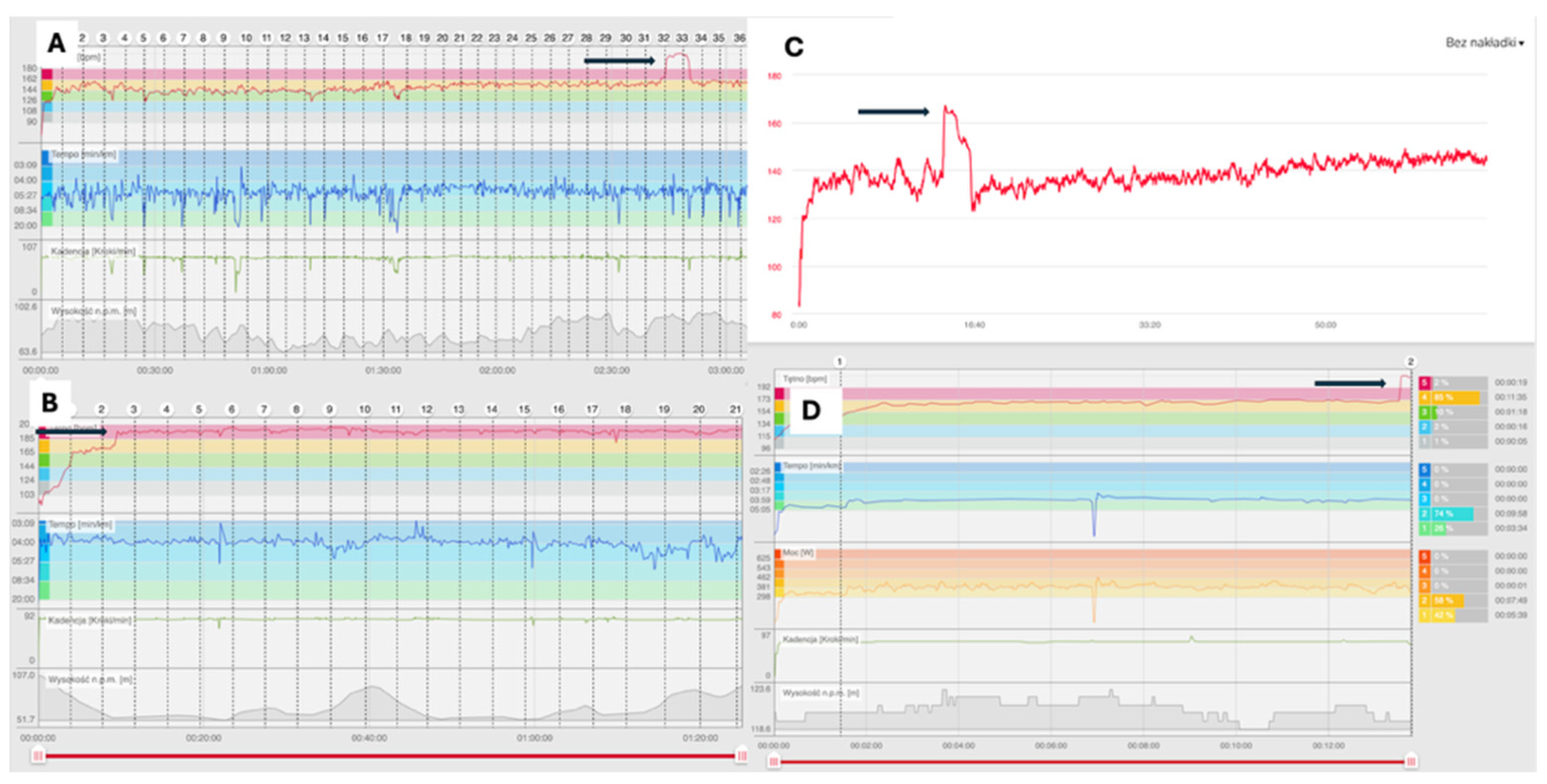
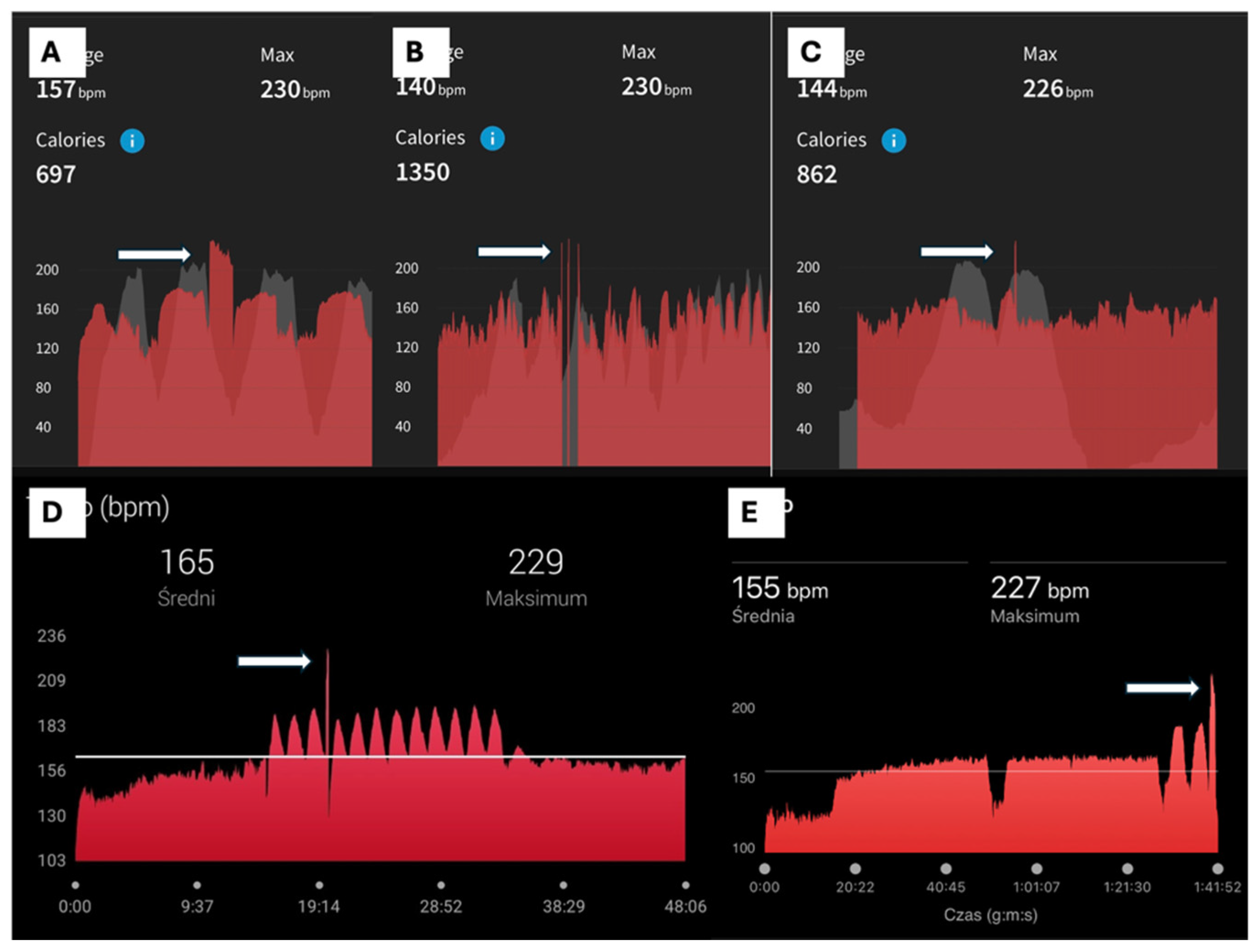
In each case, the athletes identified a characteristic, abrupt, and reproducible heart rate pattern on their wearable devices that coincided with symptoms and differed clearly from motion artefacts (
Figure 1 and
Figure 2).
Patient characteristics are summarized in
Table 1.
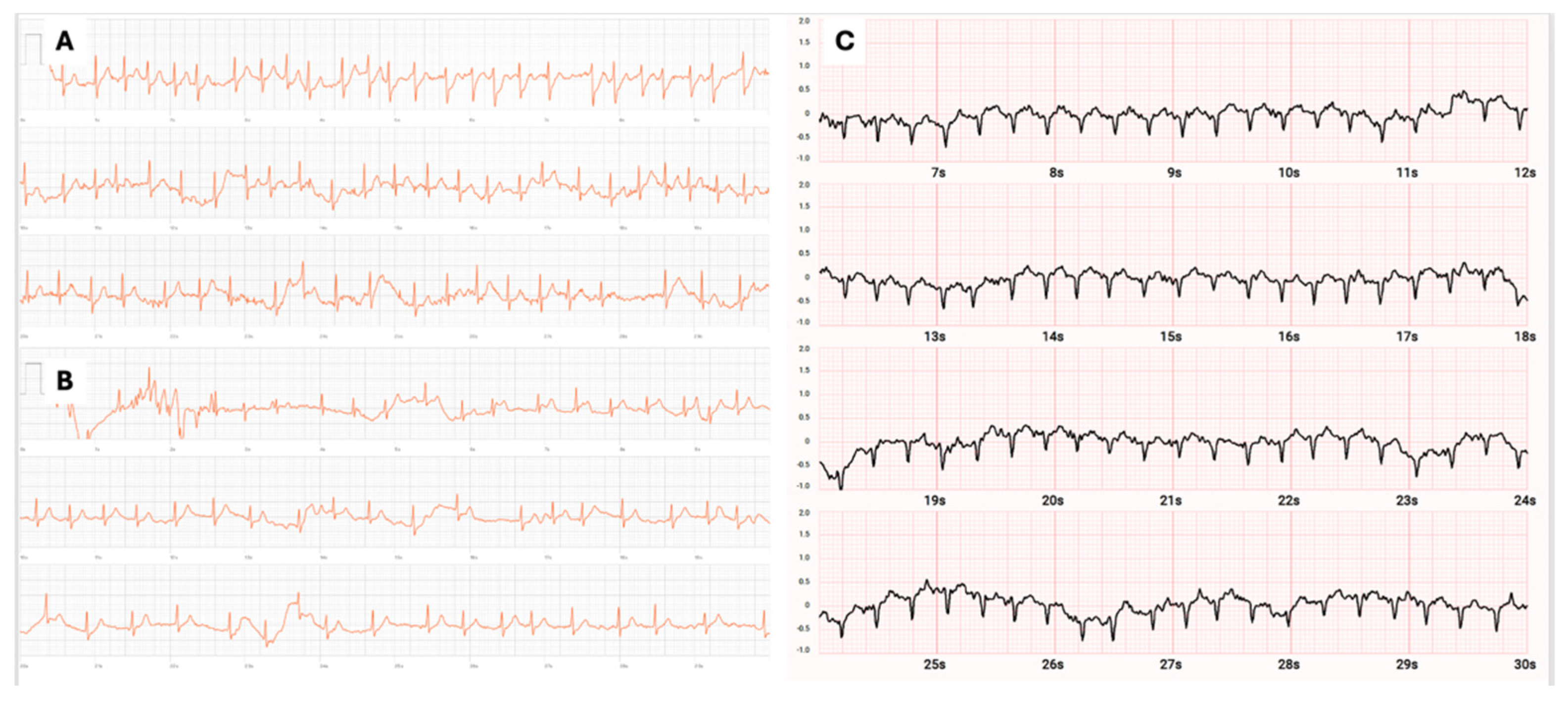
Maximal heart rate during arrhythmic episodes ranged from 205 to 240 bpm, clearly exceeding age-predicted maximal heart rates. Most arrhythmias were detected exclusively using chest-strap heart rate (HR) monitors. In one case, wrist-based photoplethysmography (PPG) was used, and in two cases the heart rate increase was supported by single-lead ECG recordings from smartwatches (
Figure 3).
Only four athletes (40%) had arrhythmias documented using standard diagnostic methods such as ambulatory ECG or exercise testing. In one individual, several ambulatory ECG recordings combined with a prolonged, near-maximal exercise protocol were required to capture the arrhythmia.
Structural heart disease was excluded in all but one athlete, a 48-year-old cyclist with a bicuspid aortic valve and moderate aortic stenosis. This athlete declined EPS and remains under close echocardiographic surveillance.
In our group, all athletes with justified presence of the symptomatic isolated supraventricular arrythmia based on arrythmia analysis from a wearable device and willing to undergo ablation to eliminate the arrhythmia background were referred for EPS. Time from wearable detection to EPS was between 6 months and 2.5 years. In all cases, EPS successfully induced supraventricular arrhythmias, including atrial fibrillation (n = 4), atrioventricular nodal re-entrant tachycardia (AVNRT; n = 3), and atrioventricular re-entrant tachycardia due to accessory pathway (AVRT; n = 2). All patients underwent catheter ablation during the same procedure. One athlete with AVRT required a repeat ablation due to the presence of a second accessory pathway.
All athletes gradually returned to training and competition and remained free from symptoms during follow-up ranging from 1 to 4 years. Additionally, 24 h ambulatory ECG recordings with exercise after 3–6 months from ablation did not disclose the presence of arrythmia.
3. Discussion
Current Heart Rhythm Society and European Heart Rhythm Association recommendations acknowledge the role of wearable digital devices in athletes who experience infrequent or difficult-to-document palpitations [
2,
5]. Commercially available devices, including fitness trackers, smartwatches, handheld electrodes, and chest-strap ECG monitors, allow rhythm data to be stored and shared with healthcare professionals. Despite these recommendations, published data demonstrating their use remain limited and show variable accuracy [
8].
In this case series, we demonstrate the clinical utility of wearable devices in a cohort of advanced endurance athletes of both sexes, including both young and master athletes. In all but one individual, a definitive diagnosis confirmed by EPS was prompted by data obtained from wearable devices. In several cases, these data constituted the only objective evidence of arrhythmia yet were considered sufficient to justify invasive evaluation, which ultimately led to curative ablation.
The use of wearable devices substantially shortened the diagnostic pathway, reduced healthcare utilization, and alleviated anxiety among athletes. In well-trained individuals who can distinguish artefacts from true arrhythmic events, these devices appear particularly valuable. Chest-strap heart rate monitors proved especially useful for detecting mid-exercise arrhythmias, which were often missed by smartwatch-based PPG or ECG recordings [
8,
9].
Smartwatch PPG is known to be less reliable during intense exercise, whereas smartwatch ECG requires a stable position and a minimum recording duration, conditions that are often incompatible with high-intensity physical activity [
5]. Consequently, some arrhythmic episodes were too brief or occurred under conditions unsuitable for ECG recording [
8].
Recordings obtained during exercise are particularly prone to motion artefacts, signal noise, and algorithm misclassification, especially in the setting of rapid sinus tachycardia. Therefore rhythm assessment based on heart rate-only tracings without systematic ECG validation during exercise should be interpreted with caution. Characteristic features of paroxysmal arrhythmias detected using heart rate monitoring, which may help in decision-making towards EPS referral, included
Sudden and atypical heart rate increase exceeding expected maximal values;
Concomitant symptoms such as palpitations, loss of power, dizziness, or presyncope;
Reproducibility across different training sessions;
Varied duration, ranging from seconds to over an hour;
Termination with cessation of exercise.
While ECG documentation remains essential for precise arrhythmia classification, single-lead ECG is not always sufficient. When non-invasive methods fail, invasive EPS with provocation remains the definitive diagnostic tool and allows immediate treatment [
2,
3,
4].
Consistent with previous reports, younger athletes in our series were more likely to present with AVNRT or AVRT, whereas atrial fibrillation (AF) predominated among master athletes, a pattern that may aid differential diagnosis in clinical practice [
10,
11]. Importantly, AF in athletes is often vagally mediated. In these circumstances, AF typically occurs under conditions of pronounced vagal predominance, most commonly during nighttime or rest. Nevertheless, AF can also be adrenergic (exercise-induced) and may start during exercise and terminate shortly after cessation [
1].
4. Conclusions
This case series supports the use of wearable digital devices, particularly chest-strap heart rate monitors, in the detection of exercise-induced paroxysmal arrhythmias in athletes. When characteristic features are present, data obtained from these devices may support referral for an invasive electrophysiological evaluation, even in the absence of arrhythmia documentation using standard methods. Our findings contribute to the growing body of evidence supporting broader integration of wearable technologies into the diagnostic pathways of sports cardiology.
Author Contributions
Conceptualization, M.K. and Ł.M.; methodology, M.K. and Ł.M.; software, M.K.; validation, P.D.; investigation, M.K., Ł.M., and P.D.; data curation, Ł.M.; writing—original draft preparation, M.K.; writing—review and editing, Ł.M. and P.D.; visualization, Ł.M.; supervision, Ł.M. All authors have read and agreed to the published version of the manuscript.
Funding
This research received no external funding.
Institutional Review Board Statement
The study was conducted in accordance with the Declaration of Helsinki. Ethical review and approval were waived for this study due to the retrospective character of the presented data.
Informed Consent Statement
Informed consent was obtained from all subjects involved in the study.
Data Availability Statement
Data are available from the authors.
Conflicts of Interest
The authors declare no conflicts of interest.
Abbreviations
The following abbreviations are used in this manuscript:
| ACC | American College of Cardiology |
| AF | Atrial fibrillation |
| AHA | American Heart Association |
| AVNRT | Atrioventricular nodal re-entrant tachycardia |
| AVRT | Atrioventricular re-entrant tachycardia |
| bpm | Beats per minute |
| EAPC | European Association of Preventive Cardiology |
| ECG | Electrocardiogram |
| EHRA | European Heart Rhythm Association |
| ESC | European Society of Cardiology |
| EPS | Electrophysiological study |
| HR | Heart rate |
| HRS | Heart Rhythm Society |
| MTB | Mountain bike |
| PA | Paroxysmal arrhythmia |
| PB | Personal best |
| PPG | Photoplethysmography |
References
- Heidbuchel, H.; Adami, P.E.; Antz, M.; Braunschweig, F.; Delise, P.; Scherr, D.; Solberg, E.E.; Wilhelm, M.; Pelliccia, A. Recommendations for participation in leisure-time physical activity and competitive sports in patients with arrhythmias and potentially arrhythmogenic conditions: Part 1: Supraventricular arrhythmias. A position statement of the Section of Sports Cardiology and Exercise from the European Association of Preventive Cardiology (EAPC) and the European Heart Rhythm Association (EHRA), both associations of the European Society of Cardiology. Eur. J. Prev. Cardiol. 2021, 28, 1539–1551. [Google Scholar] [PubMed]
- Lampert, R.; Chung, E.H.; Ackerman, M.J.; Arroyo, A.R.; Darden, D.; Deo, R.; Dolan, J.; Etheridge, S.P.; Gray, B.R.; Harmon, K.G.; et al. 2024 HRS expert consensus statement on arrhythmias in the athlete: Evaluation, treatment, and return to play. Heart Rhythm 2024, 21, e151–e252. [Google Scholar] [CrossRef] [PubMed]
- Pelliccia, A.; Sharma, S.; Gati, S.; Bäck, M.; Börjesson, M.; Caselli, S.; Collet, J.-P.; Corrado, D.; Drezner, J.A.; Halle, M.; et al. 2020 ESC Guidelines on sports cardiology and exercise in patients with cardiovascular disease. Eur. Heart J. 2021, 42, 17–96. [Google Scholar] [CrossRef] [PubMed]
- Kim, J.H.; Baggish, A.L.; Levine, B.D.; Ackerman, M.J.; Day, S.M.; Dineen, E.H.; Guseh, J.S.; La Gerche, A.; Lampert, R.; Martinez, M.W.; et al. Clinical considerations for competitive sports participation for athletes with cardiovascular abnormalities: A scientific statement from the American Heart Association and American College of Cardiology. Circulation 2025, 151, e716–e761. [Google Scholar] [PubMed]
- Svennberg, E.; Tjong, F.; Goette, A.; Akoum, N.; Di Biase, L.; Bordachar, P.; Boriani, G.; Burri, H.; Conte, G.; Deharo, J.C.; et al. How to use digital devices to detect and manage arrhythmias: An EHRA practical guide. Europace 2022, 24, 979–1005. [Google Scholar] [CrossRef] [PubMed]
- Singh, B.; Chastin, S.; Miatke, A.; Curtis, R.; Dumuid, D.; Brinsley, J.; Ferguson, T.; Szeto, K.; Simpson, C.; Eglitis, E.; et al. Real-world accuracy of wearable activity trackers for detecting medical conditions: Systematic review and meta-analysis. JMIR mHealth uHealth 2024, 12, e56972. [Google Scholar] [CrossRef] [PubMed]
- Sridhar, A.R.; Cheung, J.W.; Lampert, R.; Silva, J.N.A.; Gopinathannair, R.; Sotomonte, J.C.; Tarakji, K.; Fellman, M.; Chrispin, J.; Varma, N.; et al. State of the art of mobile health technologies use in clinical arrhythmia care. Commun. Med. 2024, 4, 218. [Google Scholar] [CrossRef] [PubMed]
- Sequeira, N.; D’Souza, D.; Angaran, P.; Aves, T.; Dorian, P. Common wearable devices demonstrate variable accuracy in measuring heart rate during supraventricular tachycardia. Heart Rhythm 2020, 17, 854–859. [Google Scholar] [CrossRef] [PubMed]
- Saggu, D.K.; Udigala, M.N.; Sarkar, S.; Sathiyamoorthy, A.; Dash, S.; Mohan, P.V.R.; Rajan, V.; Calambur, N. Feasibility of using chest strap and dry electrode system for longer term cardiac arrhythmia monitoring: Results from a pilot observational study. Indian Pacing Electrophysiol. J. 2024, 24, 282–290. [Google Scholar] [CrossRef] [PubMed]
- Boraita, A.; Heras, M.E.; Valenzuela, P.L.; Diaz-Gonzalez, L.; Morales-Acuna, F.; Alcocer-Ayuga, M.; Bartolomé-Mateos, S.; Santos-Lozano, A.; Lucia, A. Holter-determined arrhythmias in young elite athletes with suspected risk: Insights from a 20-year experience. Front. Cardiovasc. Med. 2022, 9, 896148. [Google Scholar] [CrossRef] [PubMed]
- Svedberg, N.; Sundström, J.; James, S.; Hållmarker, U.; Hambraeus, K.; Andersen, K. Long-term incidence of atrial fibrillation and stroke among cross-country skiers. Circulation 2019, 140, 910–920. [Google Scholar] [CrossRef] [PubMed]
| Disclaimer/Publisher’s Note: The statements, opinions and data contained in all publications are solely those of the individual author(s) and contributor(s) and not of MDPI and/or the editor(s). MDPI and/or the editor(s) disclaim responsibility for any injury to people or property resulting from any ideas, methods, instructions or products referred to in the content. |