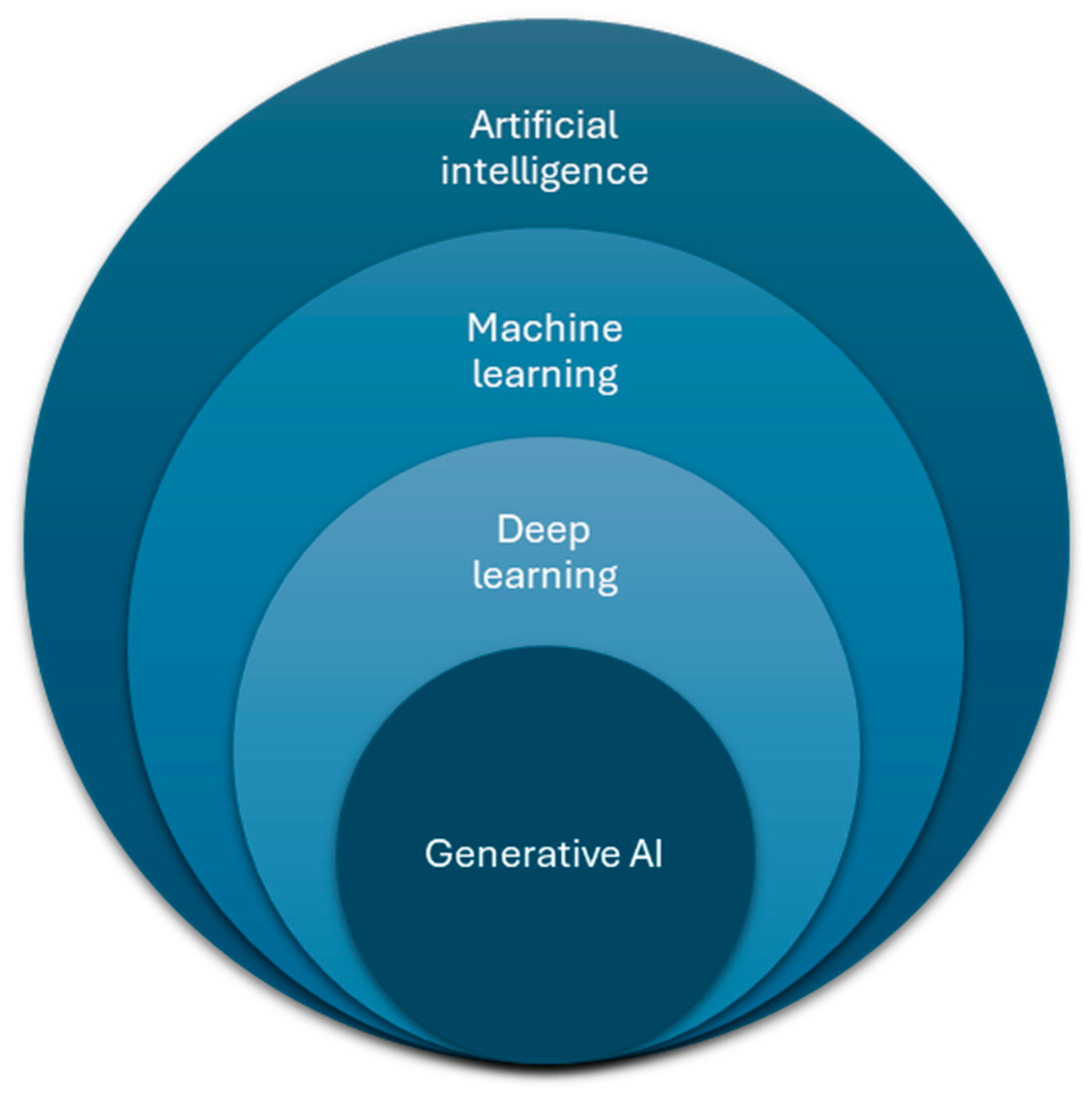
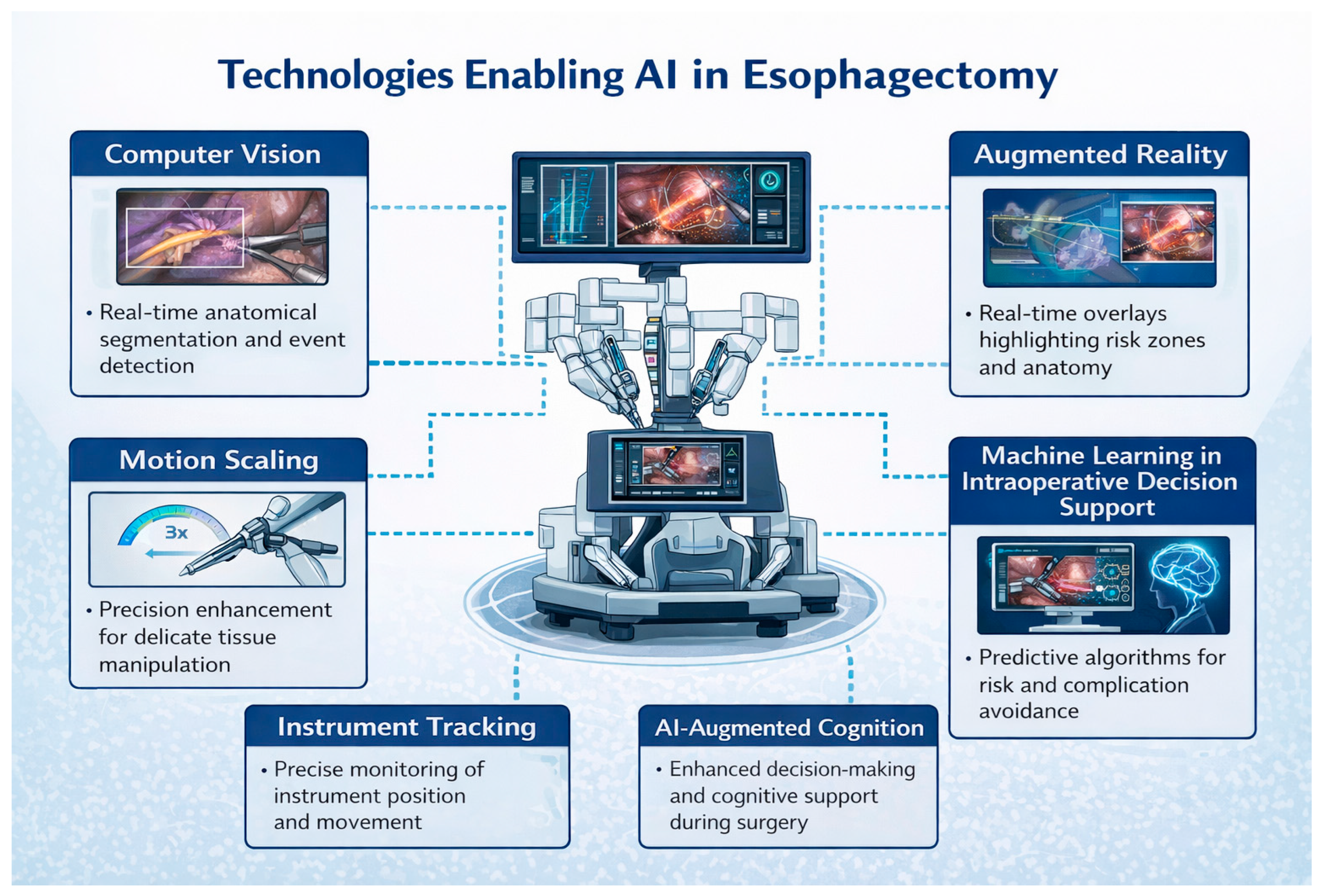
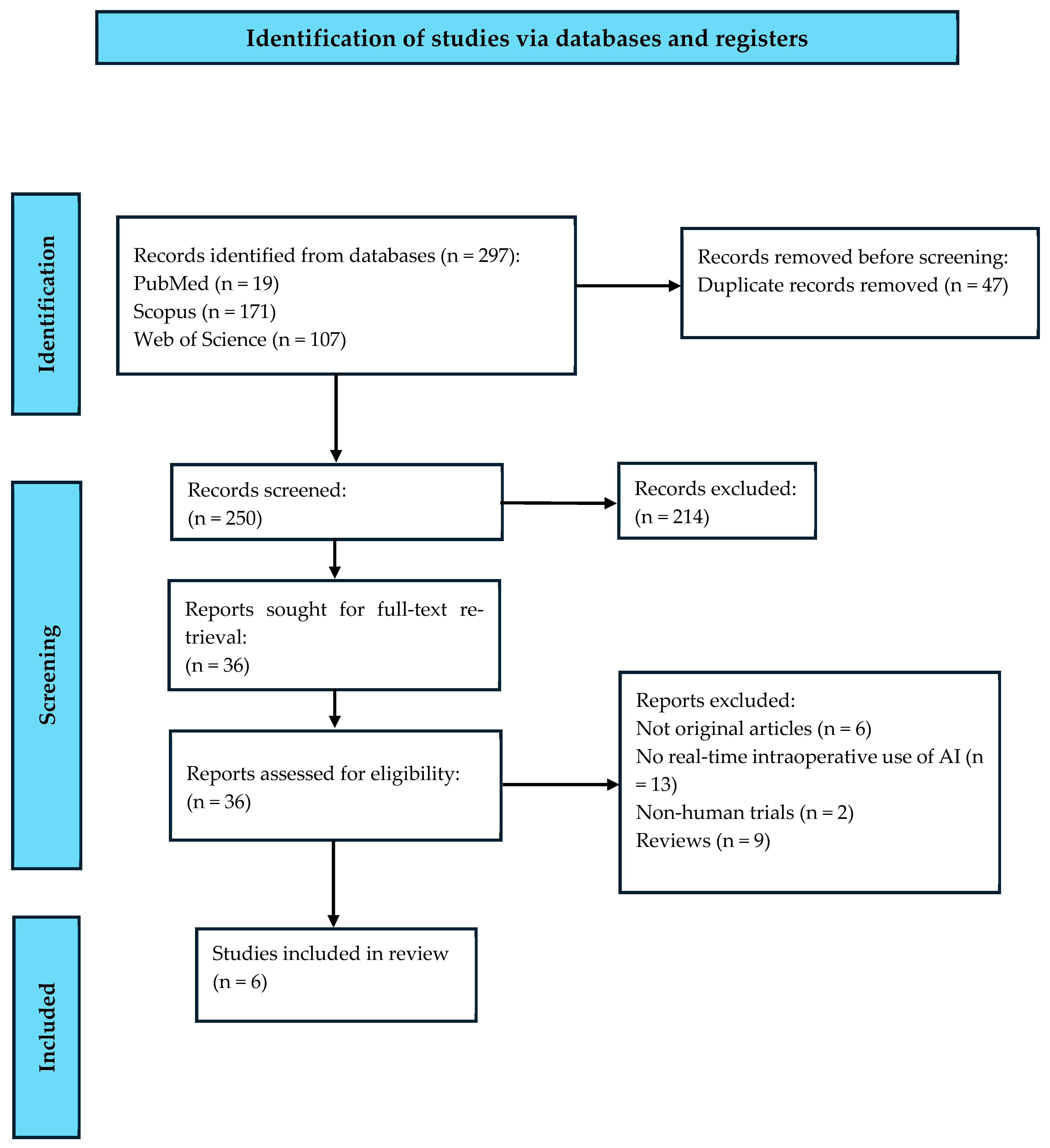
Artificial Intelligence in Esophagectomy: A Systematic Review
 ,
,  , ,
, ,
Abstract
1. Introduction
Objective of the Study
2. Materials and Methods
2.1. Study Design and Reporting Standards
2.2. Review Question and PICO Framework
2.3. Literature Search Strategy
2.4. Eligibility Criteria
- Original studies reporting the intraoperative use of artificial intelligence;
- Procedures involving esophagectomy;
- Human studies;
- Any surgical approach, including open, minimally invasive, or robotic surgery;
- Reporting technical performance metrics and/or clinical outcomes.
- Artificial intelligence used exclusively in the preoperative setting (e.g., imaging, staging, prediction of response to neoadjuvant therapy) or postoperative setting (e.g., prediction of complications);
- Simulation, phantom, cadaveric, or animal studies;
- Conference abstracts without available full text;
- Reviews, editorials, commentaries, or letters;
- Studies not involving esophageal surgery or focusing on other malignancies such as gastric cancer.
2.5. Study Selection
2.6. Data Extraction
2.7. Risk of Bias Assessment
2.8. Use of Artificial Intelligence in Figure Creation and Language Editing and Correction
3. Results
4. Discussion
5. Limitations
6. Conclusions
Supplementary Materials
Author Contributions
Funding
Data Availability Statement
Acknowledgments
Conflicts of Interest
Abbreviations
| AI | Artificial intelligence |
| MIE | Minimally invasive esophagectomy |
| RAMIE | Robot-assisted minimally invasive esophagectomy |
| ET | Excessive traction |
| RLN | Recurrent laryngeal nerve |
| NIM | Nerve integrity monitor |
| CNN | Convolutional neural network |
| RNN | Recurrent neural network |
| LSTM | Long short-term memory |
| ML | Machine learning |
| AUC | Area under the curve |
| IoU | Intersection over Union |
References
- Teng, Y.; Xia, C.; Cao, M.; Yang, F.; Yan, X.; He, S.; Cao, M.; Zhang, S.; Li, Q.; Tan, N.; et al. Esophageal cancer global burden profiles, trends, and contributors. Cancer Biol. Med. 2024, 21, 656–666. [Google Scholar] [CrossRef] [PubMed] [PubMed Central]
- Lu, S.; Li, K.; Wang, K.; Liu, G.; Han, Y.; Peng, L.; Chen, L.; Leng, X. Global trends of esophageal cancer among individuals over 60 years: An epidemiological analysis from 1990 to 2050 based on the global burden of disease study 1990–2021. Oncol. Rev. 2025, 19, 1616080. [Google Scholar] [CrossRef] [PubMed] [PubMed Central]
- Then, E.O.; Lopez, M.; Saleem, S.; Gayam, V.; Sunkara, T.; Culliford, A.; Gaduputi, V. Esophageal Cancer: An Updated Surveillance Epidemiology and End Results Database Analysis. World J. Oncol. 2020, 11, 55–64. [Google Scholar] [CrossRef] [PubMed] [PubMed Central]
- van Heijl, M.; van Lanschot, J.J.; Koppert, L.B.; van Berge Henegouwen, M.I.; Muller, K.; Steyerberg, E.W.; van Dekken, H.; Wijnhoven, B.P.; Tilanus, H.W.; Richel, D.J.; et al. Neoadjuvant chemoradiation followed by surgery versus surgery alone for patients with adenocarcinoma or squamous cell carcinoma of the esophagus (CROSS). BMC Surg. 2008, 8, 21. [Google Scholar] [CrossRef] [PubMed] [PubMed Central]
- Achim, F.; Otsuka, K.; Yamashita, T.; Asagoe, Y.; Kurita, D.; Constantin, A.; Constantinoiu, S.; Mohssen, A.; Rosianu, C.; Rotariu, A.; et al. Advances in Minimally Invasive Esophagectomy-An Overview of Recent Developments and a Novel Classification of Innovations in Treatment of Thoracic Esophageal Cancer. Medicina 2025, 61, 2176. [Google Scholar] [CrossRef] [PubMed] [PubMed Central]
- Edmondson, J.; Hunter, J.; Bakis, G.; O’Connor, A.; Wood, S.; Qureshi, A.P. Understanding Post-Esophagectomy Complications and Their Management: The Early Complications. J. Clin. Med. 2023, 12, 7622. [Google Scholar] [CrossRef] [PubMed] [PubMed Central]
- Kingma, B.F.; de Maat, M.F.G.; van der Horst, S.; van der Sluis, P.C.; Ruurda, J.P.; van Hillegersberg, R. Robot-assisted minimally invasive esophagectomy (RAMIE) improves perioperative outcomes: A review. J. Thorac. Dis. 2019, 11, S735–S742. [Google Scholar] [CrossRef] [PubMed] [PubMed Central]
- Chowdappa, R.; Dharanikota, A.; Arjunan, R.; Althaf, S.; Premalata, C.S.; Ranganath, N. Operative Outcomes of Minimally Invasive Esophagectomy versus Open Esophagectomy for Resectable Esophageal Cancer. South Asian J. Cancer 2021, 10, 230–235. [Google Scholar] [CrossRef] [PubMed] [PubMed Central]
- Rabbani, S.A.; El-Tanani, M.; Sharma, S.; Rabbani, S.S.; El-Tanani, Y.; Kumar, R.; Saini, M. Generative Artificial Intelligence in Healthcare: Applications, Implementation Challenges, and Future Directions. BioMedInformatics 2025, 5, 37. [Google Scholar] [CrossRef]
- Kenig, N.; Monton Echeverria, J.; Muntaner Vives, A. Artificial Intelligence in Surgery: A Systematic Review of Use and Validation. J. Clin. Med. 2024, 13, 7108. [Google Scholar] [CrossRef] [PubMed] [PubMed Central]
- Page, M.J.; McKenzie, J.E.; Bossuyt, P.M.; Boutron, I.; Hoffmann, T.C.; Mulrow, C.D.; Shamseer, L.; Tetzlaff, J.M.; Akl, E.A.; Brennan, S.E.; et al. The PRISMA 2020 statement: An updated guideline for reporting systematic reviews. BMJ 2021, 372, n71. [Google Scholar] [CrossRef]
- Furube, T.; Takeuchi, M.; Kawakubo, H.; Noma, K.; Maeda, N.; Daiko, H.; Ishiyama, K.; Otsuka, K.; Kishimoto, Y.; Koyanagi, K.; et al. Impact of Artificial Intelligence on the Timing of Recurrent Laryngeal Nerve Recognition during Robot-Assisted Minimally Invasive Esophagectomy. Ann. Surg. Oncol. 2025, 32, 6366–6373. [Google Scholar] [CrossRef] [PubMed]
- Furube, T.; Takeuchi, M.; Kawakubo, H.; Noma, K.; Maeda, N.; Daiko, H.; Ishiyama, K.; Otsuka, K.; Sato, Y.; Koyanagi, K.; et al. Usefulness of an Artificial Intelligence Model in Recognizing Recurrent Laryngeal Nerves During Robot-Assisted Minimally Invasive Esophagectomy. Ann. Surg. Oncol. 2024, 31, 9344–9351. [Google Scholar] [CrossRef] [PubMed]
- Brandenburg, J.M.; Schulze, A.; Jenke, A.C.; Bhasker, N.; Bleser, N.; Junger, D.; Stern, A.; Rivoir, D.; Naderi, H.; Fritz-Kebede, F.; et al. Surgical workflow analysis for Surgomics and context-aware assistance in robot-assisted minimally invasive esophagectomy (RAMIE): A retrospective, single-arm, multicenter annotation and machine learning study. Eur. J. Surg. Oncol. 2026, 52, 111174. [Google Scholar] [CrossRef] [PubMed]
- den Boer, R.B.; Jaspers, T.J.M.; de Jongh, C.; Pluim, J.P.W.; van der Sommen, F.; Boers, T.; van Hillegersberg, R.; Van Eijnatten, M.A.J.M.; Ruurda, J.P. Deep learning-based recognition of key anatomical structures during robot-assisted minimally invasive esophagectomy. Surg. Endosc. 2023, 37, 5164–5175. [Google Scholar] [CrossRef] [PubMed] [PubMed Central]
- Sato, K.; Fujita, T.; Matsuzaki, H.; Takeshita, N.; Fujiwara, H.; Mitsunaga, S.; Kojima, T.; Mori, K.; Daiko, H. Real-time detection of the recurrent laryngeal nerve in thoracoscopic esophagectomy using artificial intelligence. Surg. Endosc. 2022, 36, 5531–5539, Erratum in Surg. Endosc. 2022, 36, 9483. https://doi.org/10.1007/s00464-022-09705-w. [Google Scholar] [CrossRef] [PubMed]
- Takeuchi, M.; Kawakubo, H.; Saito, K.; Maeda, Y.; Matsuda, S.; Fukuda, K.; Nakamura, R.; Kitagawa, Y. Automated Surgical-Phase Recognition for Robot-Assisted Minimally Invasive Esophagectomy Using Artificial Intelligence. Ann. Surg. Oncol. 2022, 29, 6847–6855. [Google Scholar] [CrossRef] [PubMed]
- Mela, E.; Tsapralis, D.; Papaconstantinou, D.; Sakarellos, P.; Vergadis, C.; Klontzas, M.E.; Rouvelas, I.; Tzortzakakis, A.; Schizas, D. Current Role of Artificial Intelligence in the Management of Esophageal Cancer. J. Clin. Med. 2025, 14, 1845. [Google Scholar] [CrossRef] [PubMed]
- Lopes, S.; Mascarenhas, M.; Fonseca, J.; Fernandes, M.G.O.; Leite-Moreira, A.F. Unveiling the Algorithm: The Role of Explainable Artificial Intelligence in Modern Surgery. Healthcare 2025, 13, 3208. [Google Scholar] [CrossRef]
- Hong, Y.; Wang, H.; Zhang, Q.; Zhang, P.; Cheng, K.; Cao, G.; Zhang, R.; Chen, B. Machine Learning and Deep Learning Hybrid Approach Based on Muscle Imaging Features for Diagnosis of Esophageal Cancer. Diagnostics 2025, 15, 1730. [Google Scholar] [CrossRef]
- Leivaditis, V.; Maniatopoulos, A.A.; Lausberg, H.; Mulita, F.; Papatriantafyllou, A.; Liolis, E.; Beltsios, E.; Adamou, A.; Kontodimopoulos, N.; Dahm, M. Artificial Intelligence in Thoracic Surgery: A Review Bridging Innovation and Clinical Practice for the Next Generation of Surgical Care. J. Clin. Med. 2025, 14, 2729. [Google Scholar] [CrossRef] [PubMed] [PubMed Central]



| Title | Furube et al. (2025) [12] | Furube et al. (2024) [13] | Brandenburg et al. (2023) [14] | den Boer et al. (2023) [15] | Sato et al. (2022) [16] | Takeuchi et al. (2022) [17] |
|---|---|---|---|---|---|---|
| Bias due to confounding | serious | moderate | moderate | moderate | moderate | moderate |
| Bias in selection of participants | moderate | moderate | moderate | moderate | moderate | moderate |
| Bias in classification of intervention | moderate | low | low | low | low | low |
| Bias due to deviations from intended intervention | low | low | low | low | low | low |
| Bias due to missing data | moderate | moderate | moderate | moderate | moderate | low |
| Bias in measurement of outcomes | serious | serious | serious | serious | moderate | moderate |
| Overall risk of bias | serious | serious | moderate | moderate | moderate | moderate |
| STARD 2015 Checklist Assessment | 63% (17/27) | 59% (16/27) | 67% (18/27) | 60% (18/30) | 70% (19/27) | 68% (17/25) |
| Study (Year) | AI Task | Key Performance Metrics | Model Architecture/Framework |
|---|---|---|---|
| Furube et al. (2025) [12] | Real-time detection of excessive traction on RLN | Correct detection of unintended nerve traction: 84.4%; Excessive traction risk (ETR) score correlated with traction degree; AI detected ET earlier than NIM signal in representative case (pre-injury potential) | Deep learning-based convolutional neural network (CNN) built upon previously developed anatomical recognition framework; frame-level binary classification model for excessive traction detection with real-time risk score generation |
| Furube et al. (2024) [13] | RLN segmentation and recognition metrics | AUC: 0.92 (left), 0.88 (right); Dice: 0.72; Sensitivity: 0.86; Specificity: 0.89; IoU: 0.40 ± 0.26 (right), 0.34 ± 0.27 (left); surgeon assistance improved RLN recognition rates and IoU with AI assistance | CNN-based semantic segmentation model for RLN recognition (deep learning segmentation framework; supervised training on annotated RAMIE frames) |
| Brandenburg et al. (2023) [14] | Surgomic feature recognition (Active Learning) | Mean F1-score: 0.75 ± 0.16 (all features); instrument detection F1: 0.80 ± 0.17; inter-rater agreement κ > 0.82; AL improved rare instrument sample selection and performance vs. EQS | Bayesian ResNet18 backbone combined with Active Learning (AL) framework for surgomic feature classification |
| den Boer et al. (2023) [15] | Anatomical structure segmentation (Bayesian NN) | Median Dice: 0.79 (azygos/vena cava), 0.74 (aorta), 0.89 (lung); algorithm comparable to expert annotations; inference time ~0.026 s/frame (39 Hz) | Bayesian convolutional neural network for semantic segmentation (uncertainty-aware deep learning architecture) |
| Sato et al. (2022) [16] | Recurrent laryngeal nerve (RLN) segmentation | Dice coefficient: 0.58 (AI) vs. 0.62 (expert) vs. 0.47 (general surgeons); AI performance superior to general surgeons (p = 0.019) | U-Net-based deep learning semantic segmentation model for RLN detection |
| Takeuchi et al. (2022) [17] | Surgical phase recognition | Overall accuracy: 84%; precision: ~0.84; per-phase recall: 58–93% | CNN-based model combined with temporal sequence modeling (CNN + LSTM) for surgical phase recognition |
| AI Application Domain | Primary Function | Representative Intraoperative Use | Typical AI Methods |
|---|---|---|---|
| Anatomy detection and recognition | Identification and delineation of critical structures | Real-time recognition of RLN, aorta, azygos vein, lung during dissection | CNN-based deep learning, semantic segmentation, transfer learning |
| Surgical phase recognition | Temporal classification of procedural steps | Automated identification of operative phases to provide contextual awareness | Deep learning with CNNs and temporal models (e.g., RNN/LSTM) |
| Pattern and event detection | Detection of predefined intraoperative risk patterns | Identification of excessive traction, bleeding, smoke, or unsafe tissue handling | Deep learning classification models, CNNs, active learning |
| Instrument detection and tracking | Recognition and localization of surgical tools | Real-time tracking of instruments to infer surgical intent and motion | Computer vision, CNN-based object detection |
| Intraoperative guidance and decision support | Augmented cognition and risk mitigation | Visual overlays, alerts for nerve traction, anatomy highlighting | AI-augmented computer vision, augmented reality, ML-based risk models |
Disclaimer/Publisher’s Note: The statements, opinions and data contained in all publications are solely those of the individual author(s) and contributor(s) and not of MDPI and/or the editor(s). MDPI and/or the editor(s) disclaim responsibility for any injury to people or property resulting from any ideas, methods, instructions or products referred to in the content. |
© 2026 by the authors. Licensee MDPI, Basel, Switzerland. This article is an open access article distributed under the terms and conditions of the Creative Commons Attribution (CC BY) license.
Share and Cite
Aleksiev, V.; Markov, D.; Bechev, K.; Stanchev, D.; Shterev, F.; Markov, G. Artificial Intelligence in Esophagectomy: A Systematic Review. J. Clin. Med. 2026, 15, 2169. https://doi.org/10.3390/jcm15062169
Aleksiev V, Markov D, Bechev K, Stanchev D, Shterev F, Markov G. Artificial Intelligence in Esophagectomy: A Systematic Review. Journal of Clinical Medicine. 2026; 15(6):2169. https://doi.org/10.3390/jcm15062169
Chicago/Turabian StyleAleksiev, Vladimir, Daniel Markov, Kristian Bechev, Desislav Stanchev, Filip Shterev, and Galabin Markov. 2026. "Artificial Intelligence in Esophagectomy: A Systematic Review" Journal of Clinical Medicine 15, no. 6: 2169. https://doi.org/10.3390/jcm15062169
APA StyleAleksiev, V., Markov, D., Bechev, K., Stanchev, D., Shterev, F., & Markov, G. (2026). Artificial Intelligence in Esophagectomy: A Systematic Review. Journal of Clinical Medicine, 15(6), 2169. https://doi.org/10.3390/jcm15062169