Real-Time EEG-Derived Amygdala Neurofeedback for Post-Traumatic Stress Disorder: A Clinical Case Series



Abstract
1. Introduction
2. Methods
2.1. Study Design and Ethics
2.2. Participants
2.3. Prism Neurofeedback Intervention
2.4. Outcome Measures
2.5. Statistical Analysis
3. Results
3.1. Treatment Implementation
3.2. Primary Outcome: PTSD Symptom Changes
3.3. Treatment Follow-Up
3.4. Subgroup Analyses
3.5. Exploratory Self-Regulation Strategy Analysis
3.6. Individual Patient Outcomes
4. Discussion
4.1. Principal Findings
4.2. Adjunctive Use and Bridge Utility
4.3. Treatment Mechanisms
4.4. Limitations
5. Conclusions
Supplementary Materials
Author Contributions
Funding
Institutional Review Board Statement
Informed Consent Statement
Data Availability Statement
Conflicts of Interest
References
- Bradley, R.; Greene, J.; Russ, E.; Dutra, L.; Westen, D. A multidimensional meta-analysis of psychotherapy for PTSD. Am. J. Psychiatry 2005, 162, 214–227. [Google Scholar] [CrossRef] [PubMed]
- Steenkamp, M.M.; Litz, B.T.; Hoge, C.W.; Marmar, C.R. Psychotherapy for military-related PTSD: A review of randomized clinical trials. JAMA 2015, 314, 489–500. [Google Scholar] [CrossRef] [PubMed]
- Goldway, N.; Jalon, I.; Keynan, J.N.; Hellrung, L.; Horstmann, A.; Paret, C.; Hendler, T. Feasibility and utility of amygdala neurofeedback. Neurosci. Biobehav. Rev. 2022, 138, 104694. [Google Scholar] [CrossRef] [PubMed]
- Meir-Hasson, Y.; Kinreich, S.; Podlipsky, I.; Hendler, T.; Intrator, N. An EEG finger-print of fMRI deep regional activation. NeuroImage 2014, 102, 128–141. [Google Scholar] [CrossRef] [PubMed]
- Lubianiker, N.; Goldway, N.; Fruchtman-Steinbok, T.; Paret, C.; Keynan, J.N.; Singer, N.; Cohen, A.; Kadosh, K.C.; Linden, D.E.J.; Hendler, T. Process-based framework for precise neuromodulation. Nat. Hum. Behav. 2019, 3, 436–445. [Google Scholar] [CrossRef] [PubMed]
- Keynan, J.N.; Cohen, A.; Jackont, G.; Green, N.; Goldway, N.; Davidov, A.; Meir-Hasson, Y.; Raz, G.; Intrator, N.; Fruchter, E.; et al. Electrical fingerprint of the amygdala guides neurofeedback training for stress resilience. Nat. Hum. Behav. 2019, 3, 63–73. [Google Scholar] [CrossRef] [PubMed]
- Fruchter, E.; Goldenthal, N.; Adler, L.A.; Gross, R.; Harel, E.V.; Deutsch, L.; Nacasch, N.; Grinapol, S.; Amital, D.; Voigt, J.D.; et al. Amygdala-derived-EEG-fMRI-pattern neurofeedback for the treatment of chronic post-traumatic stress disorder: A prospective, multicenter, multinational study evaluating clinical efficacy. Psychiatry Res. 2024, 333, 115711. [Google Scholar] [CrossRef] [PubMed]
- Goldental, N.; Gross, R.; Amital, D.; Harel, E.V.; Hendler, T.; Tendler, A.; Levi, L.; Lavro, D.; Harmelech, T.; Grinapol, S.; et al. Amygdala EFP neurofeedback effects on PTSD symptom clusters and emotional regulation processes. J. Clin. Med. 2025, 14, 2421. [Google Scholar] [CrossRef] [PubMed]
- Fine, N.B.; Helpman, L.; Bardin Armon, D.; Gurevitch, G.; Sheppes, G.; Seligman, Z.; Hendler, T.; Bloch, M. Amygdala-related electroencephalogram neuro-feedback as an add-on therapy for treatment-resistant childhood sexual abuse posttraumatic stress disorder: Feasibility study. Psychiatry Clin. Neurosci. 2024, 78, 19–28. [Google Scholar] [CrossRef]
- Voigt, J.D.; Mosier, M.; Tendler, A. Systematic review and meta-analysis of neurofeedback and its effect on posttraumatic stress disorder. Front. Psychiatry 2024, 15, 1323485. [Google Scholar] [CrossRef] [PubMed]
- Blevins, C.A.; Weathers, F.W.; Davis, M.T.; Witte, T.K.; Domino, J.L. The posttraumatic stress disorder checklist for DSM-5 (PCL-5): Development and initial psychometric evaluation. J. Trauma. Stress 2015, 28, 489–498. [Google Scholar] [CrossRef]
- Monson, C.M.; Gradus, J.L.; Young-Xu, Y.; Schnurr, P.P.; Price, J.L.; Schumm, J.A. Change in posttraumatic stress disorder symptoms: Do clinicians and patients agree? Psychol. Assess. 2008, 20, 131–138. [Google Scholar] [CrossRef] [PubMed]
- Cohen, J. Statistical Power Analysis for the Behavioral Sciences, 2nd ed.; Lawrence Erlbaum Associates: Mahwah, NJ, USA, 1988. [Google Scholar]
- Wilson, E.B. Probable inference, the law of succession, and statistical inference. J. Am. Stat. Assoc. 1927, 22, 209–212. [Google Scholar] [CrossRef]
- Guideline Development Panel for the Treatment of PTSD in Adults. Summary of the clinical practice guideline for the treatment of posttraumatic stress disorder (PTSD) in adults. Am. Psychol. 2019, 74, 596–607. [CrossRef] [PubMed]



| Characteristic | Value |
|---|---|
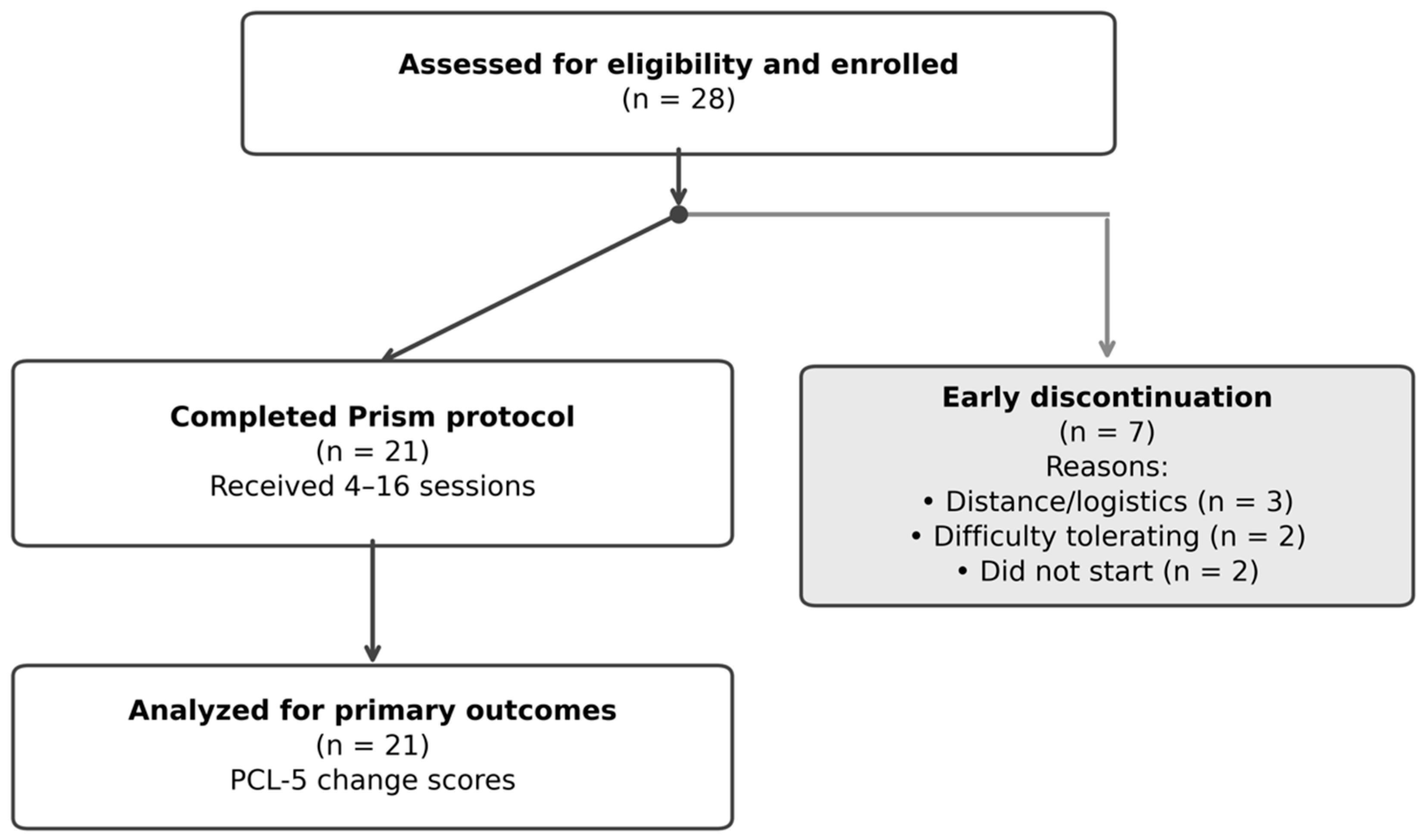
| Total Enrolled | 28 patients |
| Treatment Completers | 21 (75.0%) |
| Early Discontinuation | 7 (25.0%) |
| Sessions Completed (mean ± SD) | 13.0 ± 3.8 |
| Session Range | 4–16 sessions |
| Treatment Duration | 3–10 weeks |
| Adverse Events | None documented |
| Measure | Value | 95% Confidence Interval |
|---|---|---|
| Baseline PCL-5 | 56.9 ± 14.1 | 50.4–63.3 |
| Endpoint PCL-5 | 19.8 ± 17.8 | 11.7–27.9 |
| Mean Change | −37.0 ± 18.2 | 28.7–45.4 |
| Percent Improvement | 65.2% | - |
| Effect Size (Cohen’s d) | 2.03 | - |
| p-value | <0.001 | - |
| Response Threshold | Responders | Response Rate | 95% CI |
|---|---|---|---|
| Any improvement (>0 points) | 21/21 | 100% | 84.5–100% |
| Clinically significant (≥10 points) | 19/21 | 90.5% | 71.1–97.3% |
| Conservative threshold (≥15 points) | 18/21 | 85.7% | 65.4–95.0% |
| Large improvement (≥30 points) | 15/21 | 71.4% | 50.0–86.2% |
| Excellent response (≥50 points) | 5/21 | 23.8% | 9.6–45.1% |
| Characteristic | Severe PTSD (≥60) | Moderate PTSD (<60) |
|---|---|---|
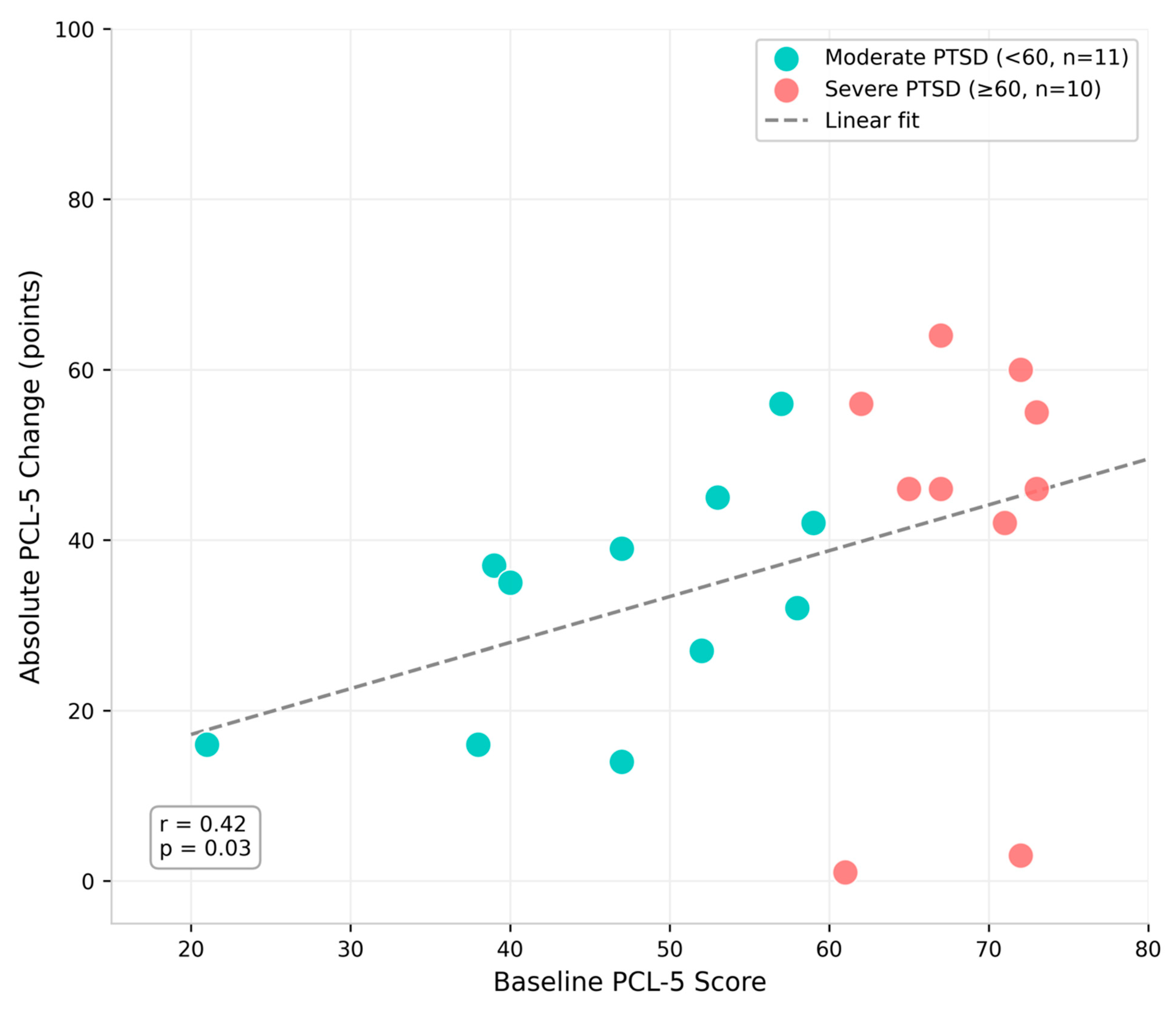
| n | 10 | 11 |
| Baseline PCL-5 | 68.3 ± 4.5 | 46.5 ± 11.4 |
| Endpoint PCL-5 | 26.4 ± 21.8 | 13.8 ± 11.2 |
| Mean Change | −41.9 ± 22.2 | −32.6 ± 13.4 |
| Sessions Completed | 14.2 ± 2.2 | 11.9 ± 4.7 |
| Any improvement | 10 (100%) | 11 (100%) |
| Clinically significant | 8 (80%) | 11 (100%) |
| Conservative threshold | 8 (80%) | 10 (90.9%) |
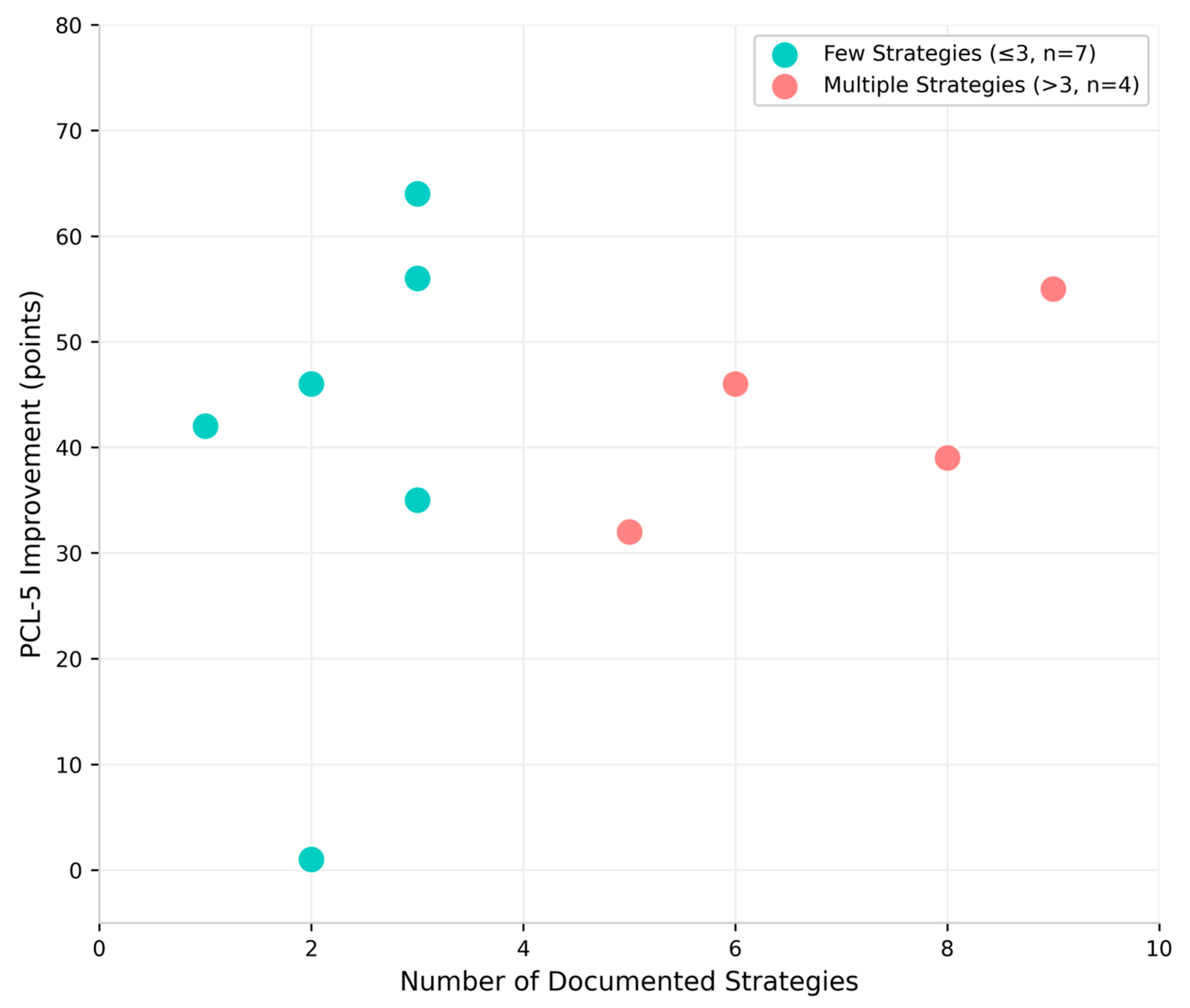
| Strategy Category | Count | Percentage | Representative Examples |
|---|---|---|---|
| Abstract/Emotional | 10 | 25.0% | “360 Acceptance”, “sense of freedom”, “promise of life” |
| Sensory/Physical | 9 | 22.5% | “touching pants and focusing on feet”, “breathing”, “mindful touch” |
| Visualization/Imagery | 5 | 12.5% | “creative tension”, “seed zone”, “spaced out into Mars” |
| Nature/Environmental | 5 | 12.5% | “sound of wind and birds”, “safety when in nature”, “bird song” |
| Auditory/Musical | 5 | 12.5% | “humming a song”, “music”, “songs” |
| Animal/Riding | 3 | 7.5% | “riding her pony”, “riding her big horse”, “riding shorty” |
| Memory-Based | 3 | 7.5% | Christmas memories”, “wifey and catch”, “family/England/age 5” |
| Patient | Baseline PCL-5 | Endpoint PCL-5 | Change | % Change | Sessions | Response Category |
|---|---|---|---|---|---|---|
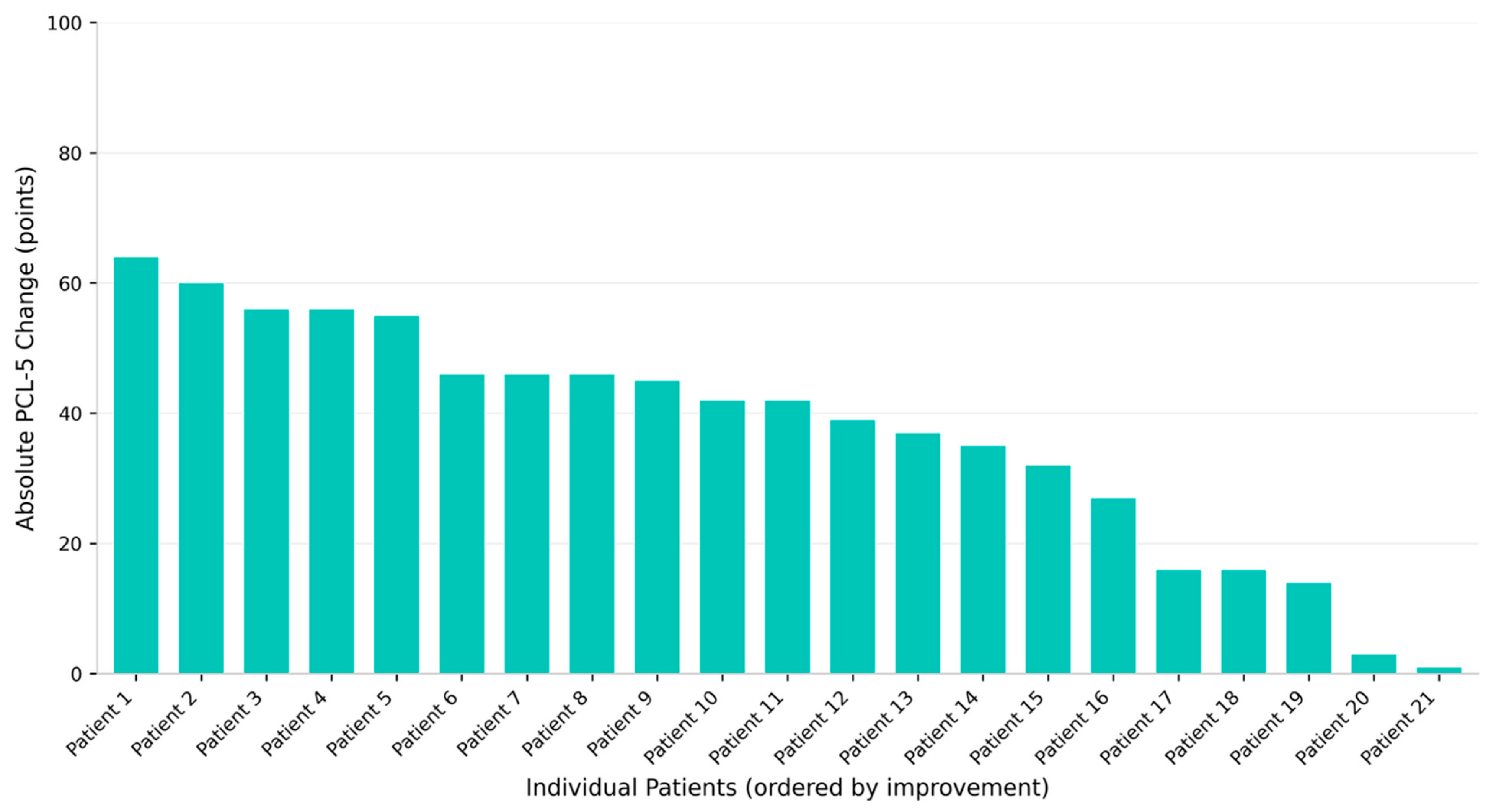
| 1 | 67 | 3 | −64 | −96% | 15 | Excellent (≥50-point) |
| 2 | 72 | 12 | −60 | −83% | 14 | Excellent (≥50-point) |
| 3 | 57 | 1 | −56 | −98% | 9 | Excellent (≥50-point) |
| 4 | 62 | 6 | −56 | −90% | 15 | Excellent (≥50-point) |
| 5 | 73 | 18 | −55 | −75% | 15 | Excellent (≥50-point) |
| 6 | 67 | 21 | −46 | −69% | 15 | Good (30–49-point) |
| 7 | 73 | 27 | −46 | −63% | 15 | Good (30–49-point) |
| 8 | 65 | 19 | −46 | −71% | 8 | Good (30–49-point) |
| 9 | 53 | 8 | −45 | −85% | 15 | Good (30–49-point) |
| 10 | 59 | 17 | −42 | −71% | 16 | Good (30–49-point) |
| 11 | 71 | 29 | −42 | −59% | 15 | Good (30–49-point) |
| 12 | 47 | 8 | −39 | −83% | 15 | Good (30–49-point) |
| 13 | 39 | 2 | −37 | −95% | 7 | Good (30–49-point) |
| 14 | 40 | 5 | −35 | −88% | 15 | Good (30–49-point) |
| 15 | 58 | 26 | −32 | −55% | 15 | Good (30–49-point) |
| 16 | 52 | 25 | −27 | −52% | 15 | Moderate (10–29-point) |
| 17 | 21 | 5 | −16 | −76% | 5 | Moderate (10–29-point) |
| 18 | 38 | 22 | −16 | −42% | 15 | Moderate (10–29-point) |
| 19 | 47 | 33 | −14 | −30% | 4 | Moderate (10–29-point) |
| 20 | 72 | 69 | −3 | −4% | 15 | Minimal (<10-point) |
| 21 | 61 | 60 | −1 | −2% | 15 | Minimal (<10-point) |
Disclaimer/Publisher’s Note: The statements, opinions and data contained in all publications are solely those of the individual author(s) and contributor(s) and not of MDPI and/or the editor(s). MDPI and/or the editor(s) disclaim responsibility for any injury to people or property resulting from any ideas, methods, instructions or products referred to in the content. |
© 2026 by the authors. Licensee MDPI, Basel, Switzerland. This article is an open access article distributed under the terms and conditions of the Creative Commons Attribution (CC BY) license.
Share and Cite
Ghelber, D.; Harmelech, T.; Tendler, A. Real-Time EEG-Derived Amygdala Neurofeedback for Post-Traumatic Stress Disorder: A Clinical Case Series. J. Clin. Med. 2026, 15, 2122. https://doi.org/10.3390/jcm15062122
Ghelber D, Harmelech T, Tendler A. Real-Time EEG-Derived Amygdala Neurofeedback for Post-Traumatic Stress Disorder: A Clinical Case Series. Journal of Clinical Medicine. 2026; 15(6):2122. https://doi.org/10.3390/jcm15062122
Chicago/Turabian StyleGhelber, Diana, Tal Harmelech, and Aron Tendler. 2026. "Real-Time EEG-Derived Amygdala Neurofeedback for Post-Traumatic Stress Disorder: A Clinical Case Series" Journal of Clinical Medicine 15, no. 6: 2122. https://doi.org/10.3390/jcm15062122
APA StyleGhelber, D., Harmelech, T., & Tendler, A. (2026). Real-Time EEG-Derived Amygdala Neurofeedback for Post-Traumatic Stress Disorder: A Clinical Case Series. Journal of Clinical Medicine, 15(6), 2122. https://doi.org/10.3390/jcm15062122