Immediate and Long-Term Effectiveness of a Therapeutic Exercise Protocol in Patients with Dementia

 ,
,  , , and
Abstract
1. Introduction
Objectives
2. Materials and Methods
2.1. Design
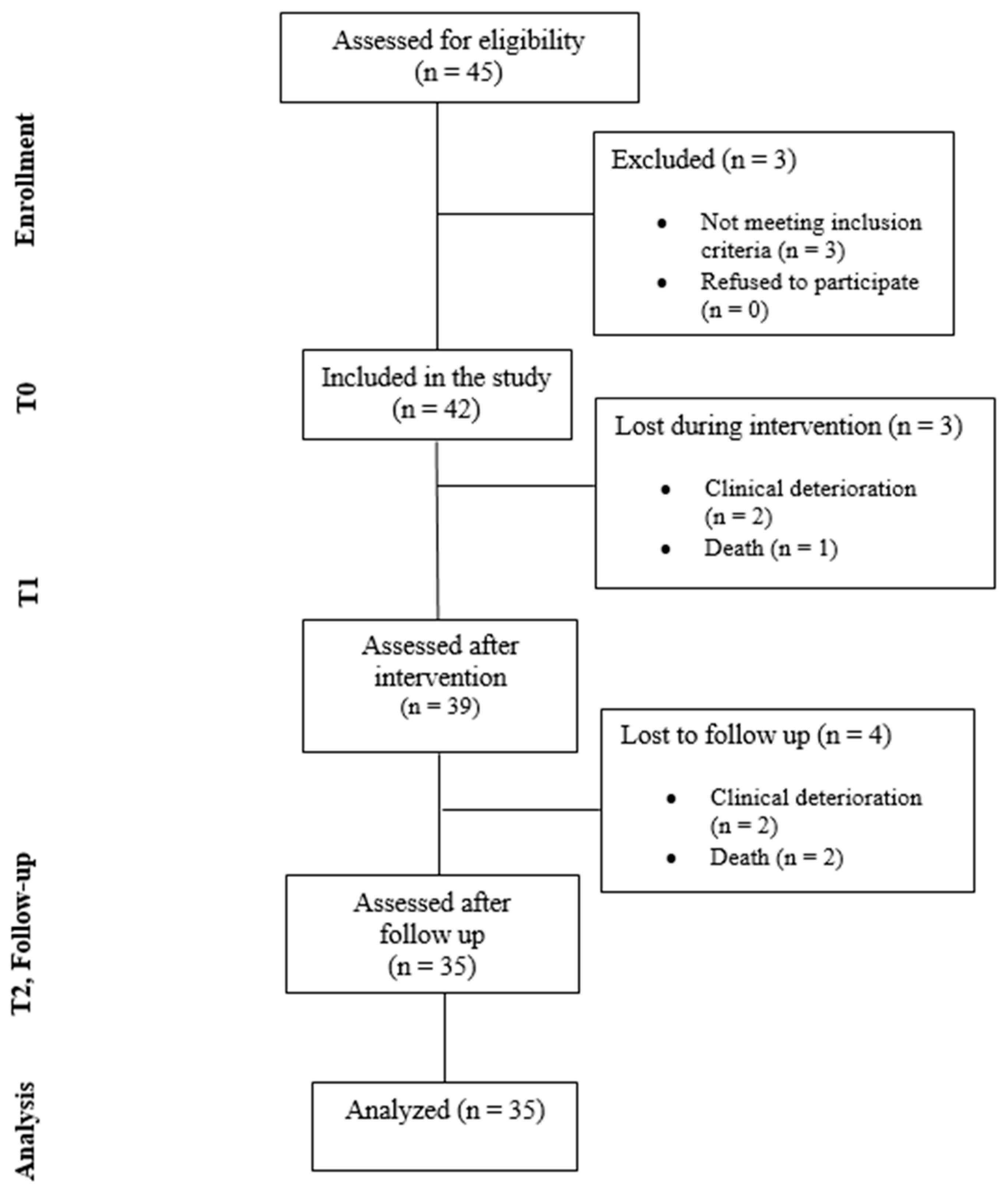
2.2. Participants
- (a)
- Medical diagnosis of mild-to-moderate cognitive impairment, which was verified through the medical reports of the neurology department responsible for the diagnosis;
- (b)
- Mini-Mental State Examination (MMSE) scores between 10 and 23 (mild–moderate stage). The questionnaire was administered by the neuropsychologist at the social health center;
- (c)
- No regular engagement in physical exercise during the previous 6 months, according to the recommendations set out in the World Health Organization Guidelines on Physical Activity and Sedentary Behavior [41]. This means not having engaged in regular physical activity, not having achieved 150 min of moderate physical activity or 75 min of vigorous physical activity per week, or not having performed muscle-strengthening activities two or more days a week, aerobic exercise for 150 min per week, or multi-component functional balance exercises three or more days a week.
- (a)
- Musculoskeletal or cardiovascular comorbidities that limited or contraindicated participation in the exercise protocol, including acute musculoskeletal pathology, non-consolidated fractures, or cardiovascular pathology diagnosed as unstable angina, uncontrolled atrial or ventricular arrhythmias, uncontrolled sinus tachycardia, recent embolism, thrombophlebitis, etc. [42].
- (b)
- Cardiorespiratory sequelae resulting from a SARS-CoV-2 infection or Long COVID, including clinical manifestations such as fatigue, “brain fog” (cognitive impairment), dyspnea, persistent cough, chest pain and muscle aches [43].
- (c)
- Inability to ambulate 10 m independently, requiring assistance from another person or technical aids such as crutches or walkers.
2.3. Setting
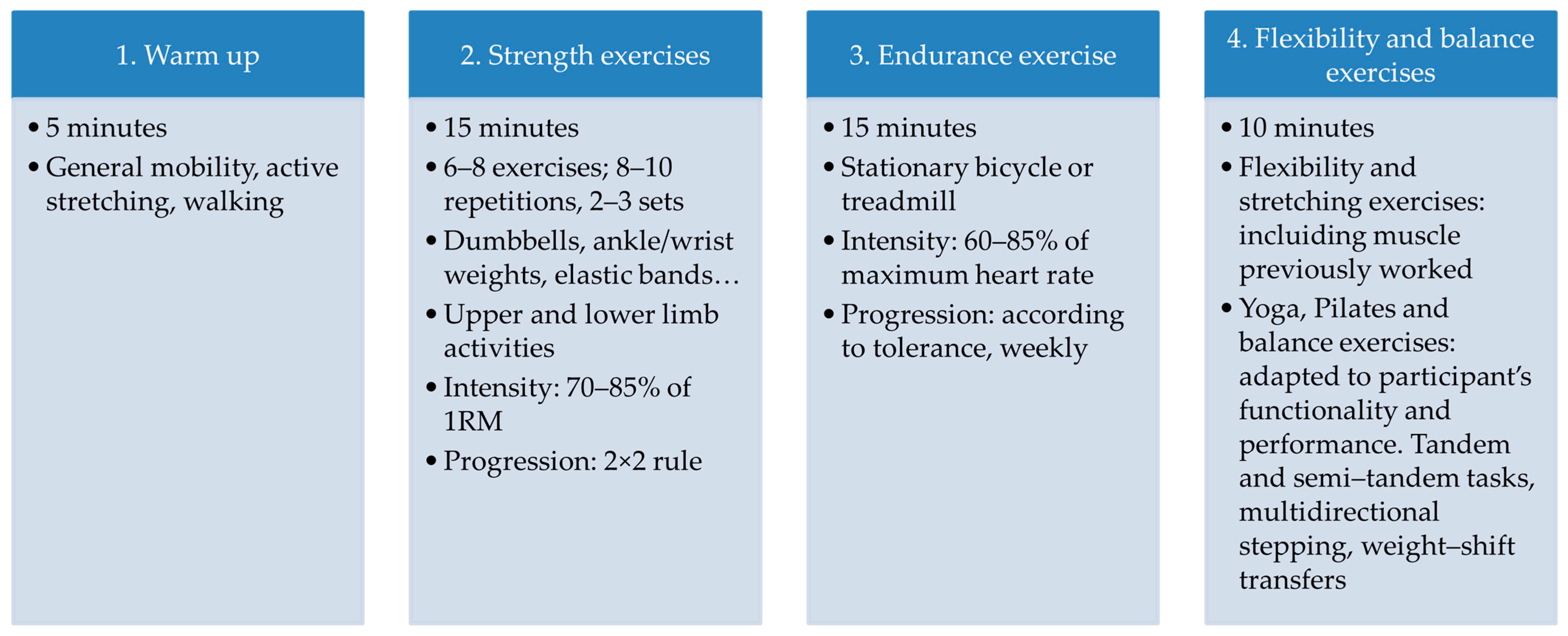
2.4. Intervention
2.5. Outcome Measures
2.6. Data Analysis
3. Results
3.1. Global Longitudinal Comparisons
3.2. Post Hoc Pairwise Comparisons Between Time Points
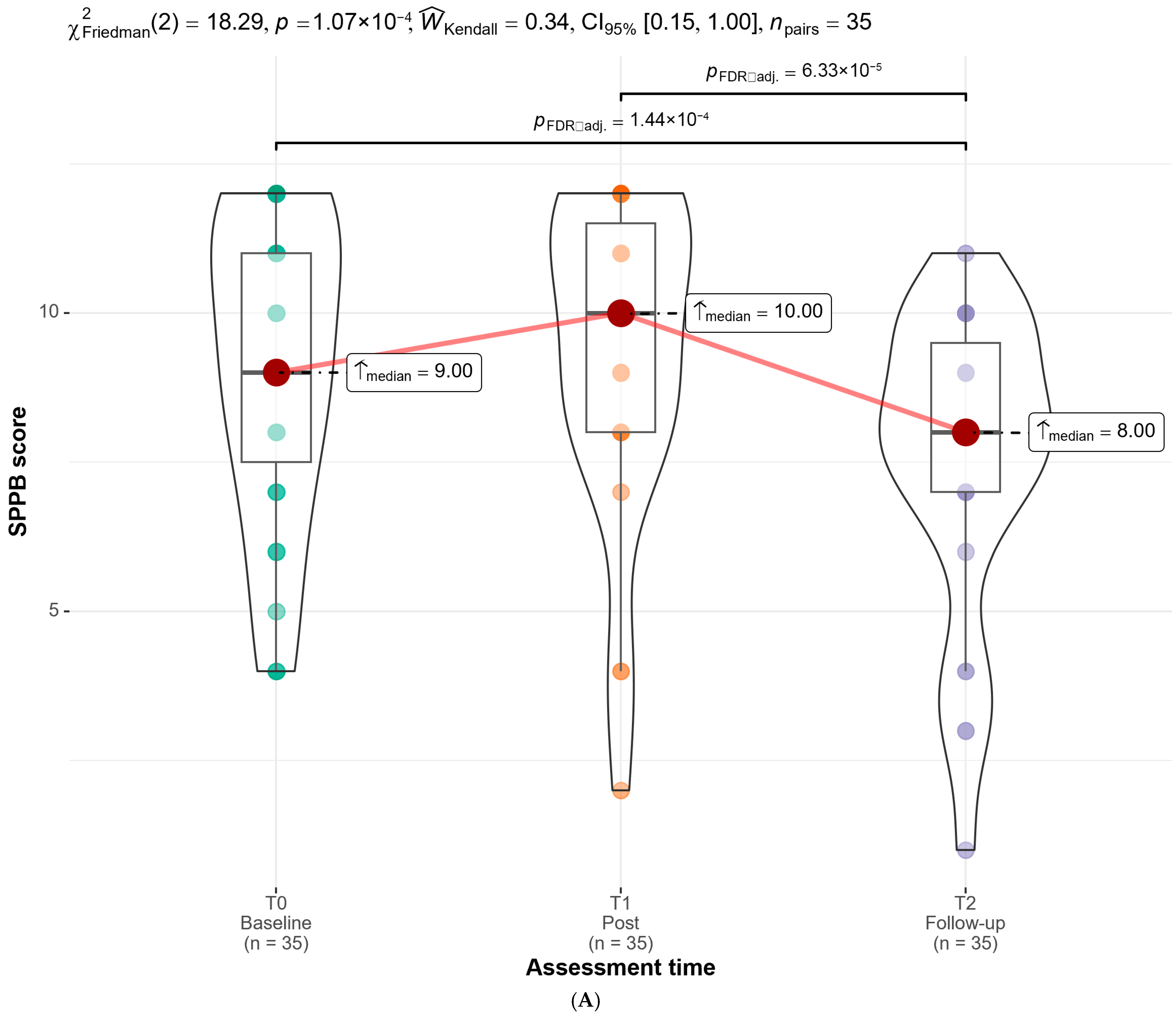
3.2.1. General Motor Function (SPPB)
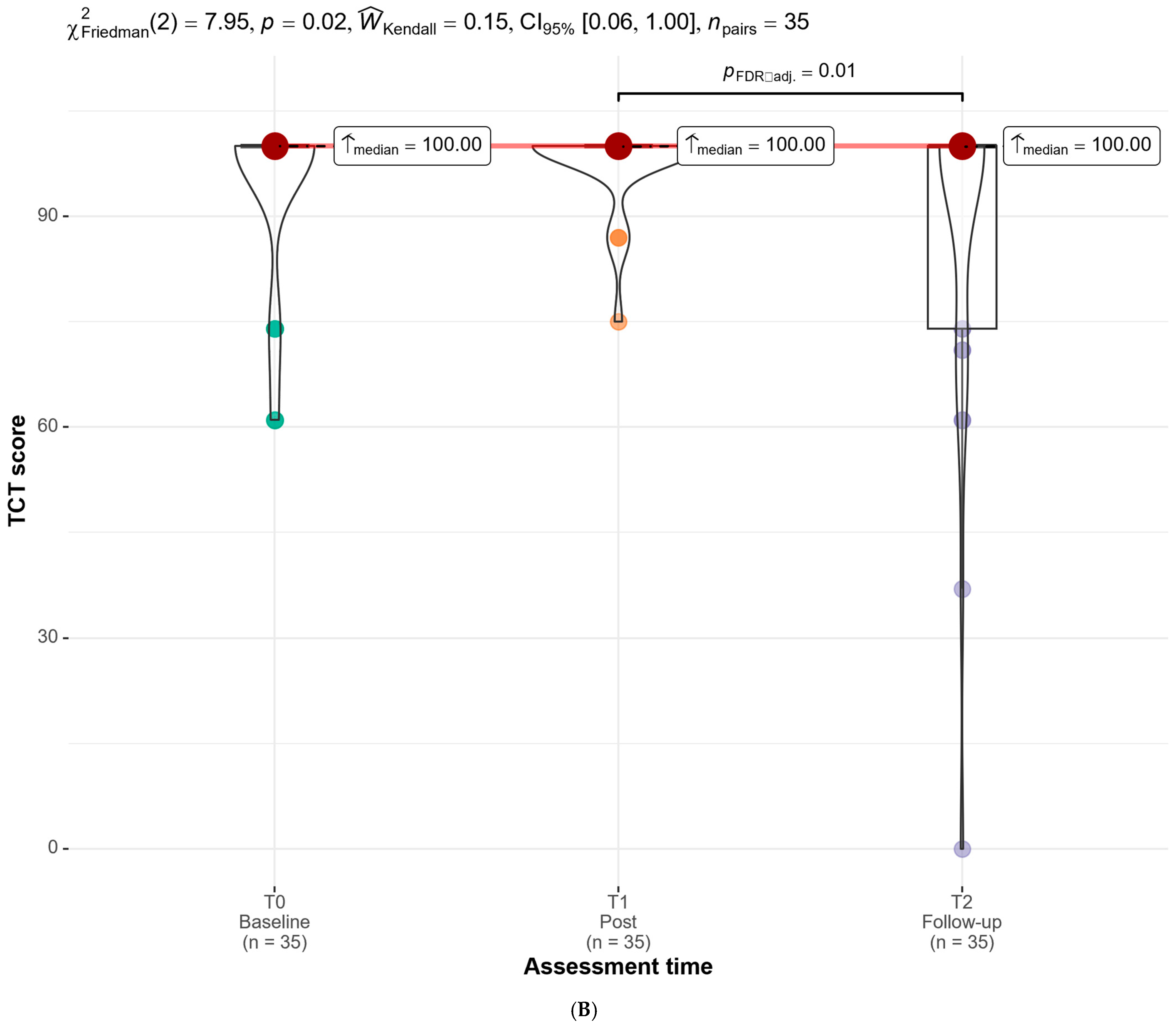
3.2.2. Trunk Control (TCT)
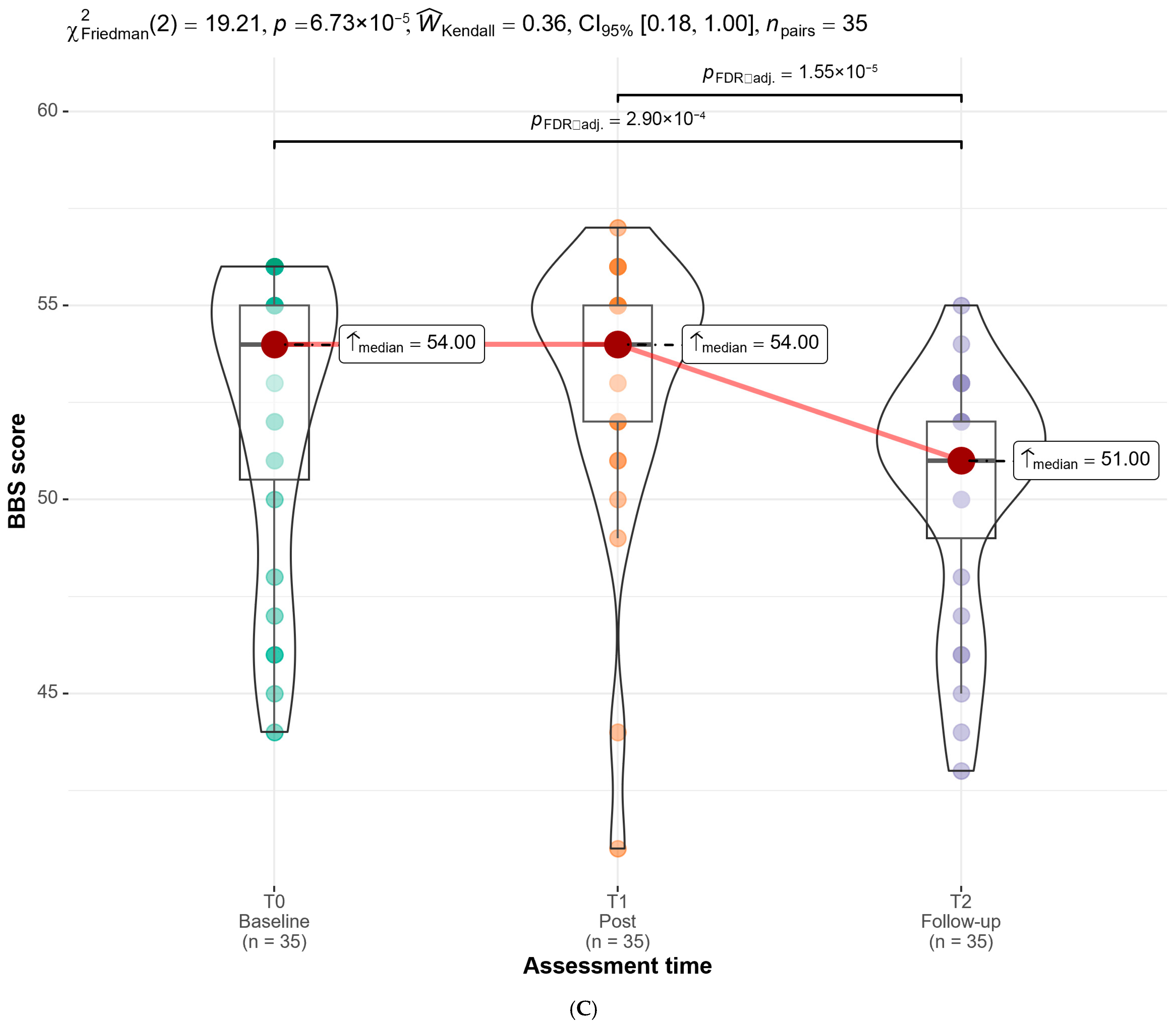
3.2.3. Balance (BBS)
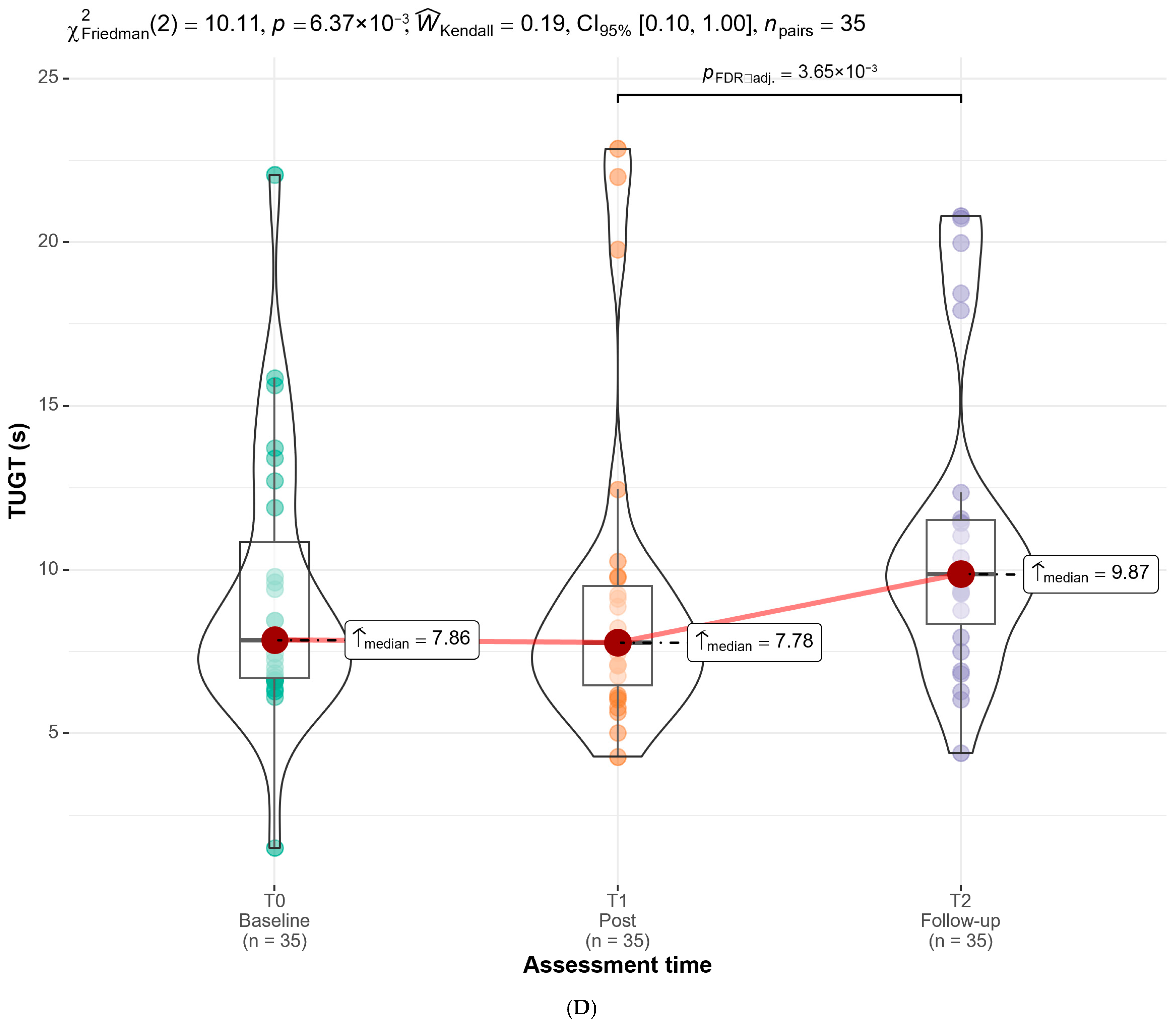
3.2.4. Mobility and Gait (TUGT)
3.3. Analysis of Results According to the Minimally Clinically Important Difference (MCID)
4. Discussion
Limitations
5. Conclusions
Author Contributions
Funding
Institutional Review Board Statement
Informed Consent Statement
Data Availability Statement
Acknowledgments
Conflicts of Interest
Abbreviations
| AD | Alzheimer’s Disease |
| ADLs | Activities of Daily Living |
| BBS | Berg Balance Scale |
| BI | Barthel Index |
| MCI | Mild Cognitive Impairment |
| MCID | Minimally Clinically Important Difference |
| MMSE | Mini-Mental State Examination |
| SPPB | Short Physical Performance Battery |
| TCT | Trunk Control Test |
| TE | Therapeutic Exercise |
| TUGT | Timed Up and Go Test |
References
- Villarejo Galende, A.; Eimil Ortiz, M.; Llamas Velasco, S.; Llanero Luque, M.; López de Silanes de Miguel, C.; Prieto Jurczynska, C. Informe de la Fundación del Cerebro. Impacto social de la enfermedad de Alzheimer y otras demencias. Neurol. Publ. Soc. Española Neurol. 2021, 36, 39–49. [Google Scholar] [CrossRef]
- World Health Organization. Demencia. Available online: https://www.who.int/es/news-room/fact-sheets/detail/dementia (accessed on 12 December 2025).
- Okonkwo, O.C.; Schultz, S.A.; Oh, J.M.; Larson, J.; Edwards, D.; Cook, D.; Koscik, R.; Gallagher, C.L.; Dowling, N.M.; Carlsson, C.M.; et al. Physical Activity Attenuates Age-Related Biomarker Alterations in Preclinical AD. Neurology 2014, 83, 1753–1760. [Google Scholar] [CrossRef]
- Reuben, D.B.; Kremen, S.; Maust, D.T. Dementia Prevention and Treatment. JAMA Intern. Med. 2024, 184, 563–572. [Google Scholar] [CrossRef]
- Aranda, M.P.; Kremer, I.N.; Hinton, L.; Zissimopoulos, J.; Whitmer, R.A.; Hummel, C.H.; Trejo, L.; Fabius, C. Impact of Dementia: Health Disparities, Population Trends, Care Interventions, and Economic Costs. J. Am. Geriatr. Soc. 2021, 69, 1774–1783. [Google Scholar] [CrossRef] [PubMed]
- Kalochristianaki, S.; Vlotinou, P.; Bablekos, G.; Katsouri, I.G.; Tsiakiri, A.; Georgousopoulou, V.; Tsakni, G. Cost Estimation Analysis of Dementia: A Scope Review. Cureus 2025, 17, e84547. [Google Scholar] [CrossRef] [PubMed]
- Forbes, D.; Forbes, S.C.; Blake, C.M.; Thiessen, E.J.; Forbes, S. Exercise Programs for People with Dementia. Cochrane Database Syst. Rev. 2015, 2015, CD006489. [Google Scholar] [CrossRef]
- Yu, J.-T.; Xu, W.; Tan, C.-C.; Andrieu, S.; Suckling, J.; Evangelou, E.; Pan, A.; Zhang, C.; Jia, J.; Feng, L.; et al. Evidence-Based Prevention of Alzheimer’s Disease: Systematic Review and Meta-Analysis of 243 Observational Prospective Studies and 153 Randomised Controlled Trials. J. Neurol. Neurosurg. Psychiatry 2020, 91, 1201–1209. [Google Scholar] [CrossRef]
- Abraha, I.; Rimland, J.M.; Trotta, F.M.; Dell’Aquila, G.; Cruz-Jentoft, A.; Petrovic, M.; Gudmundsson, A.; Soiza, R.; O’Mahony, D.; Guaita, A.; et al. Systematic Review of Systematic Reviews of Non-Pharmacological Interventions to Treat Behavioural Disturbances in Older Patients with Dementia. The SENATOR-OnTop Series. BMJ Open 2017, 7, e012759. [Google Scholar] [CrossRef] [PubMed]
- Lam, F.M.; Huang, M.-Z.; Liao, L.-R.; Chung, R.C.; Kwok, T.C.; Pang, M.Y. Physical Exercise Improves Strength, Balance, Mobility, and Endurance in People with Cognitive Impairment and Dementia: A Systematic Review. J. Physiother. 2018, 64, 4–15. [Google Scholar] [CrossRef]
- López-Ortiz, S.; Pinto-Fraga, J.; Valenzuela, P.L.; Martín-Hernández, J.; Seisdedos, M.M.; García-López, O.; Toschi, N.; Di Giuliano, F.; Garaci, F.; Mercuri, N.B.; et al. Physical Exercise and Alzheimer’s Disease: Effects on Pathophysiological Molecular Pathways of the Disease. Int. J. Mol. Sci. 2021, 22, 2897. [Google Scholar] [CrossRef]
- Tari, A.R.; Walker, T.L.; Huuha, A.M.; Sando, S.B.; Wisloff, U. Neuroprotective Mechanisms of Exercise and the Importance of Fitness for Healthy Brain Ageing. Lancet 2025, 405, 1093–1118. [Google Scholar] [CrossRef]
- Brisendine, M.H.; Drake, J.C. Early-Stage Alzheimer’s Disease: Are Skeletal Muscle and Exercise the Key? J. Appl. Physiol. 2023, 134, 515–520. [Google Scholar] [CrossRef]
- Roy, E.R.; Wang, B.; Wan, Y.-W.; Chiu, G.; Cole, A.; Yin, Z.; Propson, N.E.; Xu, Y.; Jankowsky, J.L.; Liu, Z.; et al. Type I Interferon Response Drives Neuroinflammation and Synapse Loss in Alzheimer Disease. J. Clin. Investig. 2020, 130, 1912–1930. [Google Scholar] [CrossRef]
- De la Rosa, A.; Olaso-Gonzalez, G.; Arc-Chagnaud, C.; Millan, F.; Salvador-Pascual, A.; García-Lucerga, C.; Blasco-Lafarga, C.; Garcia-Dominguez, E.; Carretero, A.; Correas, A.G.; et al. Physical Exercise in the Prevention and Treatment of Alzheimer’s Disease. J. Sport. Health Sci. 2020, 9, 394–404. [Google Scholar] [CrossRef]
- Demurtas, J.; Schoene, D.; Torbahn, G.; Marengoni, A.; Grande, G.; Zou, L.; Petrovic, M.; Maggi, S.; Cesari, M.; Lamb, S.; et al. Physical Activity and Exercise in Mild Cognitive Impairment and Dementia: An Umbrella Review of Intervention and Observational Studies. J. Am. Med. Dir. Assoc. 2020, 21, 1415–1422.e6. [Google Scholar] [CrossRef]
- Hunt, S.J.; Navalta, J.W. Nitric Oxide and the Biological Cascades Underlying Increased Neurogenesis, Enhanced Learning Ability, and Academic Ability as an Effect of Increased Bouts of Physical Activity. Int. J. Exerc. Sci. 2012, 5, 245–275. [Google Scholar] [CrossRef]
- Valenzuela, P.L.; Castillo-García, A.; Morales, J.S.; de la Villa, P.; Hampel, H.; Emanuele, E.; Lista, S.; Lucia, A. Exercise Benefits on Alzheimer’s Disease: State-of-the-Science. Ageing Res. Rev. 2020, 62, 101108. [Google Scholar] [CrossRef]
- Wang, R.; Holsinger, R.M.D. Exercise-Induced Brain-Derived Neurotrophic Factor Expression: Therapeutic Implications for Alzheimer’s Dementia. Ageing Res. Rev. 2018, 48, 109–121. [Google Scholar] [CrossRef]
- Liang, J.; Wang, H.; Zeng, Y.; Qu, Y.; Liu, Q.; Zhao, F.; Duan, J.; Jiang, Y.; Li, S.; Ying, J.; et al. Physical Exercise Promotes Brain Remodeling by Regulating Epigenetics, Neuroplasticity and Neurotrophins. Rev. Neurosci. 2021, 32, 615–629. [Google Scholar] [CrossRef]
- Cutuli, D.; Decandia, D.; Giacovazzo, G.; Coccurello, R. Physical Exercise as Disease-Modifying Alternative against Alzheimer’s Disease: A Gut-Muscle-Brain Partnership. Int. J. Mol. Sci. 2023, 24, 14686. [Google Scholar] [CrossRef]
- Dominguez, L.J.; Veronese, N.; Vernuccio, L.; Catanese, G.; Inzerillo, F.; Salemi, G.; Barbagallo, M. Nutrition, Physical Activity, and Other Lifestyle Factors in the Prevention of Cognitive Decline and Dementia. Nutrients 2021, 13, 4080. [Google Scholar] [CrossRef]
- Alty, J.; Farrow, M.; Lawler, K. Exercise and Dementia Prevention. Pract. Neurol. 2020, 20, 234–240. [Google Scholar] [CrossRef]
- Pinho, R.A.; Muller, A.P.; Marqueze, L.F.; Radak, Z.; Arida, R.M. Physical Exercise-Mediated Neuroprotective Mechanisms in Parkinson’s Disease, Alzheimer’s Disease, and Epilepsy. Braz. J. Med. Biol. Res. 2024, 57, e14094. [Google Scholar] [CrossRef]
- Beckett, M.W.; Ardern, C.I.; Rotondi, M.A. A Meta-Analysis of Prospective Studies on the Role of Physical Activity and the Prevention of Alzheimer’s Disease in Older Adults. BMC Geriatr. 2015, 15, 9. [Google Scholar] [CrossRef]
- Sepúlveda-Lara, A.; Sepúlveda, P.; Marzuca-Nassr, G.N. Resistance Exercise Training as a New Trend in Alzheimer’s Disease Research: From Molecular Mechanisms to Prevention. Int. J. Mol. Sci. 2024, 25, 7084. [Google Scholar] [CrossRef]
- Boa Sorte Silva, N.C.; Barha, C.K.; Erickson, K.I.; Kramer, A.F.; Liu-Ambrose, T. Physical Exercise, Cognition, and Brain Health in Aging. Trends Neurosci. 2024, 47, 402–417. [Google Scholar] [CrossRef]
- Laver, K.; Dyer, S.; Whitehead, C.; Clemson, L.; Crotty, M. Interventions to Delay Functional Decline in People with Dementia: A Systematic Review of Systematic Reviews. BMJ Open 2016, 6, e010767. [Google Scholar] [CrossRef]
- Pitkälä, K.H.; Pöysti, M.M.; Laakkonen, M.-L.; Tilvis, R.S.; Savikko, N.; Kautiainen, H.; Strandberg, T.E. Effects of the Finnish Alzheimer Disease Exercise Trial (FINALEX): A Randomized Controlled Trial. JAMA Intern. Med. 2013, 173, 894–901. [Google Scholar] [CrossRef]
- Holthoff, V.A.; Marschner, K.; Scharf, M.; Steding, J.; Meyer, S.; Koch, R.; Donix, M. Effects of Physical Activity Training in Patients with Alzheimer’s Dementia: Results of a Pilot RCT Study. PLoS ONE 2015, 10, e0121478. [Google Scholar] [CrossRef]
- Zhou, S.; Chen, S.; Liu, X.; Zhang, Y.; Zhao, M.; Li, W. Physical Activity Improves Cognition and Activities of Daily Living in Adults with Alzheimer’s Disease: A Systematic Review and Meta-Analysis of Randomized Controlled Trials. Int. J. Environ. Res. Public Health 2022, 19, 1216. [Google Scholar] [CrossRef]
- Zhu, X.-C.; Yu, Y.; Wang, H.-F.; Jiang, T.; Cao, L.; Wang, C.; Wang, J.; Tan, C.-C.; Meng, X.-F.; Tan, L.; et al. Physiotherapy Intervention in Alzheimer’s Disease: Systematic Review and Meta-Analysis. J. Alzheimers Dis. 2015, 44, 163–174. [Google Scholar] [CrossRef]
- Adderley, J.; Ciccarelli, S.; Ferraro, F.V. Do Exercise Interventions Improve Functional Mobility and Balance in Alzheimer’s Patients? A Systematic Review. J. Sports Med. Phys. Fit. 2025, 65, 1235–1244. [Google Scholar] [CrossRef]
- Öhman, H.; Savikko, N.; Strandberg, T.E.; Pitkälä, K.H. Effect of Physical Exercise on Cognitive Performance in Older Adults with Mild Cognitive Impairment or Dementia: A Systematic Review. Dement. Geriatr. Cogn. Disord. 2014, 38, 347–365. [Google Scholar] [CrossRef]
- Varma, V.R.; Chuang, Y.-F.; Harris, G.C.; Tan, E.J.; Carlson, M.C. Low-Intensity Daily Walking Activity Is Associated with Hippocampal Volume in Older Adults. Hippocampus 2015, 25, 605–615. [Google Scholar] [CrossRef]
- Stephen, R.; Hongisto, K.; Solomon, A.; Lönnroos, E. Physical Activity and Alzheimer’s Disease: A Systematic Review. J. Gerontol. A Biol. Sci. Med. Sci. 2017, 72, 733–739. [Google Scholar] [CrossRef]
- Mackin, R.S.; Areán, P.A. Incidence and Documentation of Cognitive Impairment among Older Adults with Severe Mental Illness in a Community Mental Health Setting. Am. J. Geriatr. Psychiatry 2009, 17, 75–82. [Google Scholar] [CrossRef]
- Di Lorito, C.; Bosco, A.; Booth, V.; Goldberg, S.; Harwood, R.H.; Van der Wardt, V. Adherence to Exercise Interventions in Older People with Mild Cognitive Impairment and Dementia: A Systematic Review and Meta-Analysis. Prev. Med. Rep. 2020, 19, 101139. [Google Scholar] [CrossRef]
- Olsen, C.F.; Bergland, A. Reliability of the Norwegian Version of the Short Physical Performance Battery in Older People with and without Dementia. BMC Geriatr. 2017, 17, 124. [Google Scholar] [CrossRef]
- Halaweh, H.; Willén, C.; Grimby-Ekman, A.; Svantesson, U. Physical Functioning and Fall-Related Efficacy among Community-Dwelling Elderly People. Eur. J. Physiother. 2015, 18, 11–17. [Google Scholar] [CrossRef][Green Version]
- World Health Organization. Guidelines on Physical Activity and Sedentary Behavior. 2021. Available online: https://www.who.int/publications/i/item/9789240015128 (accessed on 22 December 2025).
- Wenger, N. Cardiac Rehabilitation: Guide to Procedures for the Twenty-First Century; CRC Press: Boca Raton, FL, USA, 1999; ISBN 978-1-135-56708-8. [Google Scholar]
- Zheng, C.; Chen, X.-K.; Sit, C.H.-P.; Liang, X.; Li, M.-H.; Ma, A.C.-H.; Wong, S.H.-S. Effect of Physical Exercise-Based Rehabilitation on Long COVID: A Systematic Review and Meta-Analysis. Med. Sci. Sports Exerc. 2024, 56, 143–154. [Google Scholar] [CrossRef]
- Liu, I.-T.; Lee, W.-J.; Lin, S.-Y.; Chang, S.-T.; Kao, C.-L.; Cheng, Y.-Y. Therapeutic Effects of Exercise Training on Elderly Patients with Dementia: A Randomized Controlled Trial. Arch. Phys. Med. Rehabil. 2020, 101, 762–769. [Google Scholar] [CrossRef]
- Thomas, S.; Mackintosh, S.; Halbert, J. Does the “Otago Exercise Programme” Reduce Mortality and Falls in Older Adults?: A Systematic Review and Meta-Analysis. Age Ageing 2010, 39, 681–687. [Google Scholar] [CrossRef]
- Wollesen, B.; Schulz, S.; Seydell, L.; Delbaere, K. Does Dual Task Training Improve Walking Performance of Older Adults with Concern of Falling? BMC Geriatr. 2017, 17, 213. [Google Scholar] [CrossRef]
- Cordes, T.; Bischoff, L.L.; Schoene, D.; Schott, N.; Voelcker-Rehage, C.; Meixner, C.; Appelles, L.-M.; Bebenek, M.; Berwinkel, A.; Hildebrand, C.; et al. A Multicomponent Exercise Intervention to Improve Physical Functioning, Cognition and Psychosocial Well-Being in Elderly Nursing Home Residents: A Study Protocol of a Randomized Controlled Trial in the PROCARE (Prevention and Occupational Health in Long-Term Care) Project. BMC Geriatr. 2019, 19, 369. [Google Scholar] [CrossRef]
- Rodrigues, F.; Domingos, C.; Monteiro, D.; Morouço, P. A Review on Aging, Sarcopenia, Falls, and Resistance Training in Community-Dwelling Older Adults. Int. J. Environ. Res. Public Health 2022, 19, 874. [Google Scholar] [CrossRef]
- O’Bryan, S.J.; Giuliano, C.; Woessner, M.N.; Vogrin, S.; Smith, C.; Duque, G.; Levinger, I. Progressive Resistance Training for Concomitant Increases in Muscle Strength and Bone Mineral Density in Older Adults: A Systematic Review and Meta-Analysis. Sports Med. 2022, 52, 1939–1960. [Google Scholar] [CrossRef]
- Sociedad Española de Geriatría y Gerontología. Guía de Ejercicio Físico Para Mayores. “Tu Salud En Marcha”; Solidaridad: Madrid, Spain, 2012; ISBN 978-84-939656-3-1. [Google Scholar]
- Kameniar, K.; Mackintosh, S.; Van Kessel, G.; Kumar, S. The Psychometric Properties of the Short Physical Performance Battery to Assess Physical Performance in Older Adults: A Systematic Review. J. Geriatr. Phys. Ther. 2024, 47, 43–54. [Google Scholar] [CrossRef]
- Eusepi, D.; Pellicciari, L.; Ugolini, A.; Graziani, L.; Coppari, A.; Carlizza, A.; Caselli, S.; La Porta, F.; Paci, M.; Di Bari, M.; et al. Reliability of the Short Physical Performance Battery (SPPB): A Systematic Review with Meta-Analysis. Eur. Geriatr. Med. 2025, 16, 1993–2008. [Google Scholar] [CrossRef]
- Santamaría-Peláez, M.; González-Bernal, J.J.; Da Silva-González, Á.; Medina-Pascual, E.; Gentil-Gutiérrez, A.; Fernández-Solana, J.; Mielgo-Ayuso, J.; González-Santos, J. Validity and Reliability of the Short Physical Performance Battery Tool in Institutionalized Spanish Older Adults. Nurs. Rep. 2023, 13, 1354–1367. [Google Scholar] [CrossRef]
- Farriols, C.; Bajo, L.; Muniesa, J.M.; Escalada, F.; Miralles, R. Functional Decline after Prolonged Bed Rest Following Acute Illness in Elderly Patients: Is Trunk Control Test (TCT) a Predictor of Recovering Ambulation? Arch. Gerontol. Geriatr. 2009, 49, 409–412. [Google Scholar] [CrossRef]
- Muir-Hunter, S.W.; Graham, L.; Montero Odasso, M. Reliability of the Berg Balance Scale as a Clinical Measure of Balance in Community-Dwelling Older Adults with Mild to Moderate Alzheimer Disease: A Pilot Study. Physiother. Can. 2015, 67, 255–262. [Google Scholar] [CrossRef]
- Telenius, E.W.; Engedal, K.; Bergland, A. Inter-Rater Reliability of the Berg Balance Scale, 30 s Chair Stand Test and 6 m Walking Test, and Construct Validity of the Berg Balance Scale in Nursing Home Residents with Mild-to-Moderate Dementia. BMJ Open 2015, 5, e008321. [Google Scholar] [CrossRef]
- Miranda, N.; Tiu, T.K. Berg Balance Testing. In StatPearls; StatPearls Publishing: Treasure Island, FL, USA, 2025. [Google Scholar]
- Ries, J.D.; Echternach, J.L.; Nof, L.; Gagnon Blodgett, M. Test-Retest Reliability and Minimal Detectable Change Scores for the Timed “up & Go” Test, the Six-Minute Walk Test, and Gait Speed in People with Alzheimer Disease. Phys. Ther. 2009, 89, 569–579. [Google Scholar] [CrossRef]
- Seifallahi, M.; Mehraban, A.H.; Galvin, J.E.; Ghoraani, B. Alzheimer’s Disease Detection Using Comprehensive Analysis of Timed Up and Go Test via Kinect V.2 Camera and Machine Learning. IEEE Trans. Neural Syst. Rehabil. Eng. 2022, 30, 1589–1600. [Google Scholar] [CrossRef]
- Serna Orozco, M.F.; Reinosa Rivera, H.; Jaramillo-Losada, J.; Payan-Salcedo, H.A.; Escudero, M.M. Association of the Timed Up and Go Test with Alzheimer’s Disease: Systematic Review and Meta-Analysis. J. Appl. Gerontol. 2025, 7334648251394486. [Google Scholar] [CrossRef] [PubMed]
- Cabañero-Martínez, M.J.; Cabrero-García, J.; Richart-Martínez, M.; Muñoz-Mendoza, C.L. The Spanish Versions of the Barthel Index (BI) and the Katz Index (KI) of Activities of Daily Living (ADL): A Structured Review. Arch. Gerontol. Geriatr. 2009, 49, e77–e84. [Google Scholar] [CrossRef]
- González, N.; Bilbao, A.; Forjaz, M.J.; Ayala, A.; Orive, M.; Garcia-Gutierrez, S.; Hayas, C.L.; Quintana, J.M. OFF (Older Falls Fracture)-IRYSS group Psychometric Characteristics of the Spanish Version of the Barthel Index. Aging Clin. Exp. Res. 2018, 30, 489–497. [Google Scholar] [CrossRef]
- Patil, I. Visualizations with Statistical Details: The “ggstatsplot” Approach. J. Open Source Softw. 2021, 6, 3167. [Google Scholar] [CrossRef]
- Sedaghat, A.R. Understanding the Minimal Clinically Important Difference (MCID) of Patient-Reported Outcome Measures. Otolaryngol. Head Neck Surg. 2019, 161, 551–560. [Google Scholar] [CrossRef]
- Kool, N.; Kool, J.; Bachmann, S. Duration of Rehabilitation Therapy to Achieve a Minimal Clinically Important Difference in Mobility, Walking Endurance and Patient-Reported Physical Health: An Observational Study. J. Rehabil. Med. 2023, 55, jrm12322. [Google Scholar] [CrossRef]
- Castiglia, S.F.; Galeoto, G.; Lauta, A.; Palumbo, A.; Tirinelli, F.; Viselli, F.; Santilli, V.; Sacchetti, M.L. The Culturally Adapted Italian Version of the Barthel Index (IcaBI): Assessment of Structural Validity, Inter-Rater Reliability and Responsiveness to Clinically Relevant Improvements in Patients Admitted to Inpatient Rehabilitation Centers. Funct. Neurol. 2017, 22, 221–228. [Google Scholar] [CrossRef]
- Nozoe, M.; Miyata, K.; Kubo, H.; Ishida, M.; Yamamoto, K. Establishing Minimal Clinically Important Differences and Cut-off Values for the Lower Limb Motricity Index and Trunk Control Test in Older Patients with Acute Stroke: A Prospective Cohort Study. Top. Stroke Rehabil. 2025, 32, 238–247. [Google Scholar] [CrossRef]
- Perera, S.; Mody, S.H.; Woodman, R.C.; Studenski, S.A. Meaningful Change and Responsiveness in Common Physical Performance Measures in Older Adults. J. Am. Geriatr. Soc. 2006, 54, 743–749. [Google Scholar] [CrossRef]
- Taghavi Azar Sharabiani, P.; Mehdizadeh, M.; Goudarzi, S.; Jamali, S.; Mazhar, F.N.; Heidari, M.; Haji Alizadeh, N.; Mohammadi, F.; Foomani, A.S.S.; Taghizadeh, G. Minimal Important Difference of Berg Balance Scale, Performance-Oriented Mobility Assessment and Dynamic Gait Index in Chronic Stroke Survivors. J. Stroke Cerebrovasc. Dis. 2024, 33, 107930. [Google Scholar] [CrossRef]
- Gervasoni, E.; Jonsdottir, J.; Montesano, A.; Cattaneo, D. Minimal Clinically Important Difference of Berg Balance Scale in People with Multiple Sclerosis. Arch. Phys. Med. Rehabil. 2017, 98, 337–340.e2. [Google Scholar] [CrossRef] [PubMed]
- Hayashi, S.; Miyata, K.; Takeda, R.; Iizuka, T.; Igarashi, T.; Usuda, S. Minimal Clinically Important Difference of the Berg Balance Scale and Comfortable Walking Speed in Patients with Acute Stroke: A Multicenter, Prospective, Longitudinal Study. Clin. Rehabil. 2022, 36, 1512–1523. [Google Scholar] [CrossRef] [PubMed]
- Tamura, S.; Miyata, K.; Kobayashi, S.; Takeda, R.; Iwamoto, H. Minimal Clinically Important Difference of the Berg Balance Scale Score in Older Adults with Hip Fractures. Disabil. Rehabil. 2022, 44, 6432–6437. [Google Scholar] [CrossRef]
- Taghizadeh, G.; Eissazade, N.; Fereshtehnejad, S.-M.; Taghavi Azar Sharabiani, P.; Shati, M.; Mortazavi, S.S.; Habibi, S.A.H.; SalemiJuybari, M.; Mehdizadeh, M. Minimal Clinically Important Difference and Substantial Clinical Benefits for Single- and Dual-Task Timed up and Go Test Following Motor-Cognitive Training in Parkinson’s Disease. Age Ageing 2025, 54, afaf241. [Google Scholar] [CrossRef]
- Mostafaee, N.; Pirayeh, N.; Fakoor, M. Responsiveness and Minimal Clinically Important Changes of Common Patient-Reported and Performance-Based Outcome Measures of Physical Function in Patients with Knee Osteoarthritis. Physiother. Theory Pr. 2024, 40, 2661–2669. [Google Scholar] [CrossRef]
- Nuzum, H.; Stickel, A.; Corona, M.; Zeller, M.; Melrose, R.J.; Wilkins, S.S. Potential Benefits of Physical Activity in MCI and Dementia. Behav. Neurol. 2020, 2020, 7807856. [Google Scholar] [CrossRef]
- Skillbäck, T.; Blennow, K.; Zetterberg, H.; Skoog, J.; Rydén, L.; Wetterberg, H.; Guo, X.; Sacuiu, S.; Mielke, M.M.; Zettergren, A.; et al. Slowing Gait Speed Precedes Cognitive Decline by Several Years. Alzheimers Dement. 2022, 18, 1667–1676. [Google Scholar] [CrossRef]
- Ng, T.P.; Lee, T.S.; Lim, W.S.; Chong, M.S.; Yap, P.; Cheong, C.Y.; Rawtaer, I.; Liew, T.M.; Gwee, X.; Gao, Q.; et al. Functional Mobility Decline and Incident Mild Cognitive Impairment and Early Dementia in Community-Dwelling Older Adults: The Singapore Longitudinal Ageing Study. Age Ageing 2022, 51, afac182. [Google Scholar] [CrossRef]
- Morris, R.; Lord, S.; Lawson, R.A.; Coleman, S.; Galna, B.; Duncan, G.W.; Khoo, T.K.; Yarnall, A.J.; Burn, D.J.; Rochester, L. Gait Rather Than Cognition Predicts Decline in Specific Cognitive Domains in Early Parkinson’s Disease. J. Gerontol. Biol. Sci. Med. Sci. 2017, 72, 1656–1662. [Google Scholar] [CrossRef]
- Feng, L.; Wang, Y.; Zeng, D.; Wang, M.; Duan, X. Predictors of Cognitive Decline in Older Individuals without Dementia: An Updated Meta-Analysis. Ann. Clin. Transl. Neurol. 2023, 10, 497–506. [Google Scholar] [CrossRef] [PubMed]
- An, R.; Gao, Y.; Huang, X.; Yang, Y.; Yang, C.; Wan, Q. Predictors of Progression from Subjective Cognitive Decline to Objective Cognitive Impairment: A Systematic Review and Meta-Analysis of Longitudinal Studies. Int. J. Nurs. Stud. 2024, 149, 104629. [Google Scholar] [CrossRef] [PubMed]
- Cezar, N.O.d.C.; Ansai, J.H.; de Oliveira, M.P.B.; da Silva, D.C.P.; Gomes, W.d.L.; Barreiros, B.A.; Langelli, T.d.C.O.; de Andrade, L.P. Feasibility of Improving Strength and Functioning and Decreasing the Risk of Falls in Older Adults with Alzheimer’s Dementia: A Randomized Controlled Home-Based Exercise Trial. Arch. Gerontol. Geriatr. 2021, 96, 104476. [Google Scholar] [CrossRef]
- Law, C.-K.; Lam, F.M.; Chung, R.C.; Pang, M.Y. Physical Exercise Attenuates Cognitive Decline and Reduces Behavioural Problems in People with Mild Cognitive Impairment and Dementia: A Systematic Review. J. Physiother. 2020, 66, 9–18. [Google Scholar] [CrossRef]
- Wang, Z.; Xu, X.; Yang, X.; Wang, S.S.; Zhou, Y.; Li, Y. Effects of Multicomponent Exercise on Cognitive Function in Persons with Mild Cognitive Impairment: A Systematic Review and Meta-Analysis. Int. J. Nurs. Stud. 2024, 158, 104843. [Google Scholar] [CrossRef] [PubMed]
- Toots, A.; Wiklund, R.; Littbrand, H.; Nordin, E.; Nordström, P.; Lundin-Olsson, L.; Gustafson, Y.; Rosendahl, E. The Effects of Exercise on Falls in Older People with Dementia Living in Nursing Homes: A Randomized Controlled Trial. J. Am. Med. Dir. Assoc. 2019, 20, 835–842.e1. [Google Scholar] [CrossRef]
- Trautwein, S.; Barisch-Fritz, B.; Scharpf, A.; Ringhof, S.; Stein, T.; Krell-Roesch, J.; Woll, A. Effects of a 16-Week Multimodal Exercise Program on Gait Performance in Individuals with Dementia: A Multicenter Randomized Controlled Trial. BMC Geriatr. 2020, 20, 245. [Google Scholar] [CrossRef]
- Perrochon, A.; Tchalla, A.E.; Bonis, J.; Perucaud, F.; Mandigout, S. Effects of a Multicomponent Exercise Program on Spatiotemporal Gait Parameters, Risk of Falling and Physical Activity in Dementia Patients. Dement. Geriatr. Cogn. Dis. Extra 2015, 5, 350–360. [Google Scholar] [CrossRef]
- Sanders, L.M.J.; Hortobágyi, T.; Karssemeijer, E.G.A.; Van der Zee, E.A.; Scherder, E.J.A.; van Heuvelen, M.J.G. Effects of Low- and High-Intensity Physical Exercise on Physical and Cognitive Function in Older Persons with Dementia: A Randomized Controlled Trial. Alzheimers Res. Ther. 2020, 12, 28. [Google Scholar] [CrossRef] [PubMed]
- Bürge, E.; Berchtold, A.; Maupetit, C.; Bourquin, N.M.-P.; von Gunten, A.; Ducraux, D.; Zumbach, S.; Peeters, A.; Kuhne, N. Does Physical Exercise Improve ADL Capacities in People over 65 Years with Moderate or Severe Dementia Hospitalized in an Acute Psychiatric Setting? A Multisite Randomized Clinical Trial. Int. Psychogeriatr. 2017, 29, 323–332. [Google Scholar] [CrossRef]
- Lamb, S.E.; Mistry, D.; Alleyne, S.; Atherton, N.; Brown, D.; Copsey, B.; Dosanjh, S.; Finnegan, S.; Fordham, B.; Griffiths, F.; et al. Aerobic and Strength Training Exercise Programme for Cognitive Impairment in People with Mild to Moderate Dementia: The DAPA RCT. Health Technol. Assess. 2018, 22, 1. [Google Scholar] [CrossRef]
- Rist, P.M.; Marden, J.R.; Capistrant, B.D.; Wu, Q.; Glymour, M.M. Do Physical Activity, Smoking, Drinking, or Depression Modify Transitions from Cognitive Impairment to Functional Disability? J. Alzheimers Dis. 2015, 44, 1171–1180. [Google Scholar] [CrossRef] [PubMed]
- Rist, P.M.; Capistrant, B.D.; Wu, Q.; Marden, J.R.; Glymour, M.M. Dementia and Dependence: Do Modifiable Risk Factors Delay Disability? Neurology 2014, 82, 1543–1550. [Google Scholar] [CrossRef] [PubMed]
- Yu, F.; Vock, D.M.; Zhang, L.; Salisbury, D.; Nelson, N.W.; Chow, L.S.; Smith, G.; Barclay, T.R.; Dysken, M.; Wyman, J.F. Cognitive Effects of Aerobic Exercise in Alzheimer’s Disease: A Pilot Randomized Controlled Trial. J. Alzheimers Dis. 2021, 80, 233–244. [Google Scholar] [CrossRef]
- de Assis, G.G.; de Almondes, K.M. Exercise-Dependent BDNF as a Modulatory Factor for the Executive Processing of Individuals in Course of Cognitive Decline. A Systematic Review. Front. Psychol. 2017, 8, 584. [Google Scholar] [CrossRef]
- Cefis, M.; Chaney, R.; Wirtz, J.; Méloux, A.; Quirié, A.; Leger, C.; Prigent-Tessier, A.; Garnier, P. Molecular Mechanisms Underlying Physical Exercise-Induced Brain BDNF Overproduction. Front. Mol. Neurosci. 2023, 16, 1275924. [Google Scholar] [CrossRef]
- Agüera Sánchez, M.Á.; Barbancho Ma, M.Á.; García-Casares, N. Efecto Del Ejercicio Físico En La Enfermedad de Alzheimer. Una Revisión Sistemática. Aten. Primaria 2020, 52, 307–318. [Google Scholar] [CrossRef]
- Erickson, K.I.; Voss, M.W.; Prakash, R.S.; Basak, C.; Szabo, A.; Chaddock, L.; Kim, J.S.; Heo, S.; Alves, H.; White, S.M.; et al. Exercise Training Increases Size of Hippocampus and Improves Memory. Proc. Natl. Acad. Sci. USA 2011, 108, 3017–3022. [Google Scholar] [CrossRef]
- Venegas-Sanabria, L.C.; Cavero-Redondo, I.; Martínez-Vizcaino, V.; Cano-Gutierrez, C.A.; Álvarez-Bueno, C. Effect of Multicomponent Exercise in Cognitive Impairment: A Systematic Review and Meta-Analysis. BMC Geriatr. 2022, 22, 617. [Google Scholar] [CrossRef]
- Jia, M.; Hu, F.; Hui, Y.; Peng, J.; Wang, W.; Zhang, J. Effects of Exercise on Older Adults with Mild Cognitive Impairment: A Systematic Review and Network Meta-Analysis. J. Alzheimers Dis. 2025, 104, 980–994. [Google Scholar] [CrossRef]
- Yang, D.; Hou, N.; Jia, M. Multicomponent Exercise Interventions for Older Adults with Alzheimer’s Disease: A Systematic Review and Meta-Analytical Perspective. J. Alzheimers Dis. 2025, 106, 876–889. [Google Scholar] [CrossRef] [PubMed]
- Lv, S.; Wang, Q.; Liu, W.; Zhang, X.; Cui, M.; Li, X.; Xu, Y. Comparison of Various Exercise Interventions on Cognitive Function in Alzheimer’s Patients: A Network Meta-Analysis. Arch. Gerontol. Geriatr. 2023, 115, 105113. [Google Scholar] [CrossRef]
- Deng, T.; Yu, W.; Lü, Y. Different Physical Exercise in the Treatment of Alzheimer’s Disease. Psychogeriatrics 2025, 25, e13207. [Google Scholar] [CrossRef] [PubMed]
- Borges-Machado, F.; Teixeira, L.; Carvalho, J.; Ribeiro, O. Does Multicomponent Physical Exercise Training Work for Dementia? Exploring the Effects on Cognition, Neuropsychiatric Symptoms, and Quality of Life. J. Geriatr. Psychiatry Neurol. 2023, 36, 376–385. [Google Scholar] [CrossRef] [PubMed]
- Sun, G.; Ding, X.; Zheng, Z.; Ma, H. Effects of Exercise Interventions on Cognitive Function in Patients with Cognitive Dysfunction: An Umbrella Review of Meta-Analyses. Front. Aging Neurosci. 2025, 17, 1553868. [Google Scholar] [CrossRef]
- López-Ortiz, S.; Valenzuela, P.L.; Seisdedos, M.M.; Morales, J.S.; Vega, T.; Castillo-García, A.; Nisticò, R.; Mercuri, N.B.; Lista, S.; Lucia, A.; et al. Exercise Interventions in Alzheimer’s Disease: A Systematic Review and Meta-Analysis of Randomized Controlled Trials. Ageing Res. Rev. 2021, 72, 101479. [Google Scholar] [CrossRef]
- Zhang, S.; Zhen, K.; Su, Q.; Chen, Y.; Lv, Y.; Yu, L. The Effect of Aerobic Exercise on Cognitive Function in People with Alzheimer’s Disease: A Systematic Review and Meta-Analysis of Randomized Controlled Trials. Int. J. Environ. Res. Public Health 2022, 19, 15700. [Google Scholar] [CrossRef]
- Toots, A.; Littbrand, H.; Lindelöf, N.; Wiklund, R.; Holmberg, H.; Nordström, P.; Lundin-Olsson, L.; Gustafson, Y.; Rosendahl, E. Effects of a High-Intensity Functional Exercise Program on Dependence in Activities of Daily Living and Balance in Older Adults with Dementia. J. Am. Geriatr. Soc. 2016, 64, 55–64. [Google Scholar] [CrossRef]
- Plotkin, D.; Coleman, M.; Van Every, D.; Maldonado, J.; Oberlin, D.; Israetel, M.; Feather, J.; Alto, A.; Vigotsky, A.D.; Schoenfeld, B.J. Progressive Overload without Progressing Load? The Effects of Load or Repetition Progression on Muscular Adaptations. PeerJ 2022, 10, e14142. [Google Scholar] [CrossRef] [PubMed]
- Franco-O’Byrne, D.; Santamaría-García, H.; Migeot, J.; Ibáñez, A. Emerging Theories of Allostatic-Interoceptive Overload in Neurodegeneration. In Perceptual Dysregulation in Psychiatric Nosology; Springer: Cham, Switzerland, 2025; Volume 74, pp. 191–216. [Google Scholar] [CrossRef]
- Salisbury, D.L.; Li, D.; Todd, M.; Ng, T.K.S.; Yu, F. Aerobic Exercise, Training Dose, and Cardiorespiratory Fitness: Effects and Relationships with Resting Plasma Neurotrophic Factors in Alzheimer’s Dementia. J. Vasc. Dis. 2023, 2, 351–366. [Google Scholar] [CrossRef] [PubMed]
- Yuan, Y.; Yang, Y.; Hu, X.; Zhang, L.; Xiong, Z.; Bai, Y.; Zeng, J.; Xu, F. Effective Dosage and Mode of Exercise for Enhancing Cognitive Function in Alzheimer’s Disease and Dementia: A Systematic Review and Bayesian Model-Based Network Meta-Analysis of RCTs. BMC Geriatr. 2024, 24, 480. [Google Scholar] [CrossRef] [PubMed]
- Sui, S.; Wang, M. Optimizing Exercise Dosage for Executive Function in Alzheimer’s Disease: A Bayesian Dose-Response Meta-Analysis of Randomized Trials. Arch. Gerontol. Geriatr. 2025, 139, 106001. [Google Scholar] [CrossRef]
- Martínez-López, S.; Tabone, M.; Clemente-Velasco, S.; González-Soltero, M.D.R.; Bailén, M.; de Lucas, B.; Bressa, C.; Domínguez-Balmaseda, D.; Marín-Muñoz, J.; Antúnez, C.; et al. A Systematic Review of Lifestyle-Based Interventions for Managing Alzheimer’s Disease: Insights from Randomized Controlled Trials. J. Alzheimers Dis. 2024, 102, 943–966. [Google Scholar] [CrossRef]



| Outcome | Mean ± SD | Median (IQR) | 5th–95th Range | Normality Shapiro | |
|---|---|---|---|---|---|
| General motor function (SPPB) | T0 | 9.07 ± 2.54 | 9.00 (3.50) | 4.30–12.00 | 0.91 (0.024) |
| T1 | 9.33 ± 2.70 | 10.00 (3.50) | 4.00–12.00 | 0.86 (0.002) | |
| T2 | 7.52 ± 2.55 | 8.00 (2.50) | 3.00–10.00 | 0.89 (0.007) | |
| Trunk control (TCT) | T0 | 94.22 ± 12.66 | 100.00 (0.00) | 64.90–100.00 | 0.50 (<0.001) |
| T1 | 97.63 ± 6.14 | 100.00 (0.00) | 87.00–100.00 | 0.44 (<0.001) | |
| T2 | 87.00 ± 24.40 | 100.00 (26.00) | 44.20–100.00 | 0.61 (<0.001) | |
| Balance (BBS) | T0 | 52.26 ± 3.84 | 54.00 (4.50) | 45.30–56.00 | 0.85 (0.001) |
| T1 | 52.96 ± 3.64 | 54.00 (3.00) | 45.50–56.00 | 0.79 (<0.001) | |
| T2 | 50.22 ± 3.14 | 51.00 (3.00) | 44.30–53.70 | 0.90 (0.012) | |
| Mobility and gait (TUGT) | T0 | 9.26 ± 4.13 | 7.86 (4.16) | 6.16–15.78 | 0.87 (0.003) |
| T1 | 9.19 ± 4.80 | 7.78 (3.03) | 5.21–21.33 | 0.72 (<0.001) | |
| T2 | 11.02 ± 4.58 | 9.87 (3.15) | 6.12–20.50 | 0.85 (0.001) | |
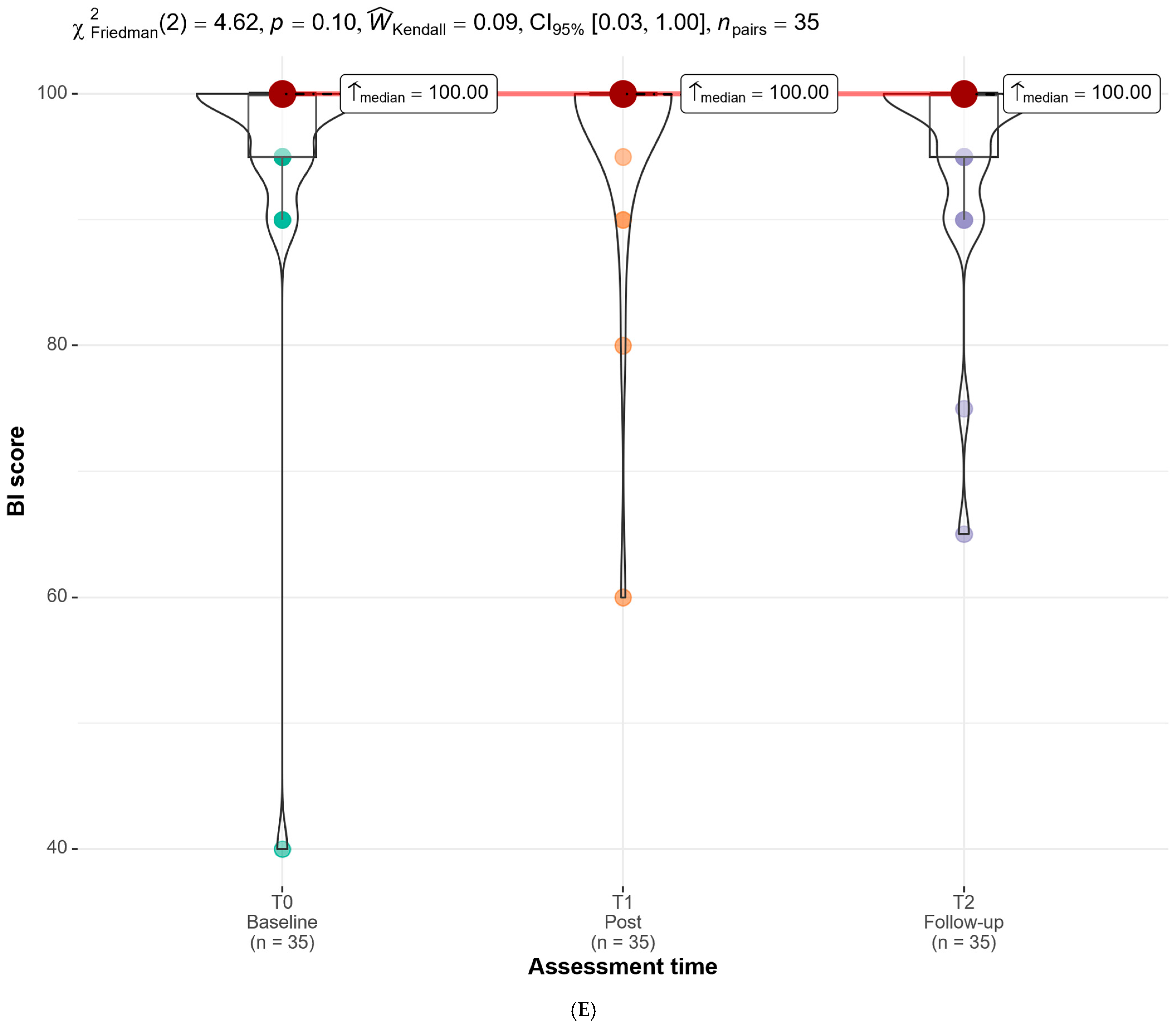
| Independence in ADL (BI) | T0 | 95.56 ± 11.63 | 100.00 (5.00) | 90.00–100.00 | 0.40 (<0.001) |
| T1 | 96.85 ± 8.68 | 100.00 (0.00) | 83.00–100.00 | 0.43 (<0.001) | |
| T2 | 95.37 ± 8.31 | 100.00 (5.00) | 79.50–100.00 | 0.62 (<0.001) |
| Outcome | Friedman χ2 (p-Value) | Kendall’s W (Effect Size) |
|---|---|---|
| General motor function (SPPB) | 18.29 *** (<0.001) | 0.339 (moderate) |
| Trunk control (TCT) | 7.95 * (0.019) | 0.147 (small) |
| Balance (BBS) | 19.21 *** (<0.001) | 0.356 (moderate) |
| Mobility and gait (TUGT) | 10.11 ** (0.006) | 0.187 (small) |
| Independence in ADL (BI) | 4.62 (0.099) | 0.086 (trivial) |
| Outcome | Comparison | |Z| | p-Value | Holm-Adjusted p-Value | |r| (Effect Size) |
|---|---|---|---|---|---|
| General motor function (SPPB) | T0 vs. T1 | 3.22 | 0.312 | 0.312 | 0.620 (large) |
| T0 vs. T2 | 0.97 | 0.005 | 0.010 | 0.187 (small) | |
| T1 vs. T2 | 2.19 | <0.001 | <0.001 | 0.421 (moderate) | |
| Trunk control (TCT) | T0 vs. T1 | 4.45 | 0.105 | 0.210 | 0.855 (large) |
| T0 vs. T2 | 3.40 | 0.211 | 0.211 | 0.654 (large) | |
| T1 vs. T2 | 3.68 | 0.013 | 0.039 | 0.707 (large) | |
| Balance (BBS) | T0 vs. T1 | 3.00 | 0.217 | 0.217 | 0.578 (large) |
| T0 vs. T2 | 0.63 | 0.004 | 0.008 | 0.120 (small) | |
| T1 vs. T2 | 3.30 | <0.001 | <0.001 | 0.636 (large) | |
| Mobility and gait (TUGT) | T0 vs. T1 | 1.42 | 0.160 | 0.160 | 0.273 (small) |
| T0 vs. T2 | 2.28 | 0.023 | 0.046 | 0.439 (moderate) | |
| T1 vs. T2 | 2.93 | 0.006 | 0.018 | 0.564 (large) |
Disclaimer/Publisher’s Note: The statements, opinions and data contained in all publications are solely those of the individual author(s) and contributor(s) and not of MDPI and/or the editor(s). MDPI and/or the editor(s) disclaim responsibility for any injury to people or property resulting from any ideas, methods, instructions or products referred to in the content. |
© 2026 by the authors. Licensee MDPI, Basel, Switzerland. This article is an open access article distributed under the terms and conditions of the Creative Commons Attribution (CC BY) license.
Share and Cite
María del Rosario, F.-S.; Celia, G.-M.; Jorge, A.-J.; Ana, M.J.; Sonia, G.-S.; Nieves, D.B.; Elena, S.-J. Immediate and Long-Term Effectiveness of a Therapeutic Exercise Protocol in Patients with Dementia. J. Clin. Med. 2026, 15, 1482. https://doi.org/10.3390/jcm15041482
María del Rosario F-S, Celia G-M, Jorge A-J, Ana MJ, Sonia G-S, Nieves DB, Elena S-J. Immediate and Long-Term Effectiveness of a Therapeutic Exercise Protocol in Patients with Dementia. Journal of Clinical Medicine. 2026; 15(4):1482. https://doi.org/10.3390/jcm15041482
Chicago/Turabian StyleMaría del Rosario, Ferreira-Sánchez, García-Macías Celia, Alarcón-Jiménez Jorge, Martín Jiménez Ana, Gómez-Sánchez Sonia, De Bernardo Nieves, and Sánchez-Jiménez Elena. 2026. "Immediate and Long-Term Effectiveness of a Therapeutic Exercise Protocol in Patients with Dementia" Journal of Clinical Medicine 15, no. 4: 1482. https://doi.org/10.3390/jcm15041482
APA StyleMaría del Rosario, F.-S., Celia, G.-M., Jorge, A.-J., Ana, M. J., Sonia, G.-S., Nieves, D. B., & Elena, S.-J. (2026). Immediate and Long-Term Effectiveness of a Therapeutic Exercise Protocol in Patients with Dementia. Journal of Clinical Medicine, 15(4), 1482. https://doi.org/10.3390/jcm15041482