Therapeutic Drug Monitoring of the Subcutaneous Formulations of Infliximab and Vedolizumab—Current Knowledge and Future Directions


Abstract
1. Introduction
2. Background and Rationale for TDM with SC Biologics
2.1. Therapeutic Drug Monitoring in IBD: Current and Evolving Practice
2.2. Why Subcutaneous Formulations Have Changed the Landscape
3. Subcutaneous Infliximab (CT-P13 SC)
3.1. Pharmacokinetics and Clinical Evidence
3.2. Immunogenicity and Monotherapy vs. Combination
3.3. Therapeutic Drug Monitoring in SC Infliximab
4. Subcutaneous Vedolizumab
4.1. Pharmacokinetics and Clinical Evidence
4.2. Exposure–Response Relationship, Including for Endoscopic Healing
4.3. Role of TDM in SC Vedolizumab
5. Practical and Logistical Considerations with SC TDM of Infliximab and Vedolizumab
Assay Availability and Validation
- SC infliximab (CT-P13): Median steady-state troughs are consistently higher than IV, with pivotal data showing Week 22 geometric mean troughs of ~21 µg/mL (SC) vs. ~3 µg/mL (IV) [5]. Real-world data from the REMSWITCH study further suggest that maintaining troughs >14 µg/mL may protect against relapse [20].
- SC vedolizumab: Population PK modelling and post hoc exposure–response analyses from the GEMINI and VISIBLE cohorts indicate that Week 52 clinical remission and endoscopic healing are maximised with troughs in the 25–35 µg/mL range, with median SC steady-state troughs reported around 31.5 μg/mL (IQR 23.2–42.0) [13,25,27].
6. Evidence Gaps and Future Directions
6.1. Absence of SC-Specific Trough Targets
6.2. Limited Prospective TDM Studies
6.3. Immunogenicity and the Role of Combination Therapy
6.4. Point-of-Care and At-Home Monitoring
7. Conclusions and Clinical Recommendations
Author Contributions
Funding
Institutional Review Board Statement
Informed Consent Statement
Data Availability Statement
Conflicts of Interest
References
- Sethi, S.; Dias, S.; Kumar, A.; Blackwell, J.; Brookes, M.J.; Segal, J.P. Meta-analysis: The efficacy of therapeutic drug monitoring of anti_TNF therapy in inflammatory bowel disease. Aliment. Pharmacol. Ther. 2023, 57, 1362–1374. [Google Scholar] [CrossRef] [PubMed]
- Mitrev, N.; Vande Casteele, N.; Seow, C.H.; Andrews, J.M.; Connor, S.J.; Moore, G.T.; Barclay, M.; Begun, J.; Bryant, R.; Chan, W.; et al. Review article: Consensus statements on therapeutic drug monitoring of anti-tumour necrosis factor therapy in inflammatory bowel disease. Aliment. Pharmacol. Ther. 2017, 46, 1037–1053. [Google Scholar] [CrossRef] [PubMed]
- Singh, S.; Dulai, P.S.; Casteele, N.V.; Battat, R.; Fumery, M.; Boland, B.S.; Sandborn, W.J. Systematic review with meta-analysis: Association between vedolizumab trough concentration and clinical outcomes in patients with inflammatory bowel disease. Aliment. Pharmacol. Ther. 2019, 50, 848–857. [Google Scholar] [CrossRef] [PubMed]
- Papamichael, K.; Cheifetz, A.S.; Melmed, G.Y.; Irving, P.M.; Vande Casteele, N.; Kozuch, P.L.; Raffals, L.E.; Baidoo, L.; Bressler, B.; Devlin, S.M.; et al. Appropriate therapeutic drug monitoring of biologic agents for patients with inflammatory bowel diseases. Clin. Gastroenterol. Hepatol. 2019, 17, 1655–1668. [Google Scholar] [CrossRef]
- Schreiber, S.; Ben-Horin, S.; Leszczyszyn, J.; Dudkowiak, R.; Lahat, A.; Gawdis-Wojnarska, B.; Pukitis, A.; Horynski, M.; Farkas, K.; Kierkus, J.; et al. Randomized Controlled Trial: Subcutaneous vs. Intravenous Infliximab CT-P13 Maintenance in Inflammatory Bowel Disease. Gastroenterology 2021, 160, 2340–2353. [Google Scholar] [CrossRef]
- D’hAens, G.; Rosario, M.; Polhamus, D.; Dirks, N.L.; Chen, C.; Kisfalvi, K.; Agboton, C.; Vermeire, S.; Feagan, B.G.; Sandborn, W.J. Exposure-efficacy relationship of vedolizumab subcutaneous and intravenous formulations in Crohn’s disease and ulcerative colitis. Expert Rev. Clin. Pharmacol. 2024, 17, 403–412. [Google Scholar] [CrossRef]
- Dhar, A.; Ritchie, S.; Bone, J.; Rand, V.; Wake, S. O50 Monitoring adherence to subcutaneous biologics for IBD care using digital technology—A NHSX proof-of-concept study following COVID-19. Gut 2023, 72, A28–A29. [Google Scholar]
- Elford, A.T.; Heldt, R.; Kamal, S.; Christensen, B.; Segal, J.P. Systematic review with meta-analysis of the effectiveness of subcutaneous biologics versus intravenous biologics in inflammatory bowel diseases. Eur. J. Gastroenterol. Hepatol. 2025, 37, 47–54. [Google Scholar] [CrossRef]
- Roblin, X.; Little, R.D.; Mathieu, N.; Paul, S.; Nancey, S.; Barrau, M.; Sparrow, M.P. Therapeutic drug monitoring in inflammatory bowel disease: Recent developments. Expert Rev. Gastroenterol. Hepatol. 2024, 18, 575–586. [Google Scholar] [CrossRef]
- Steenholdt, C.; Lorentsen, R.D.; Petersen, P.N.; Widigson, E.S.; Kloft, C.; Klaasen, R.A.; Brynskov, J. Therapeutic drug monitoring of vedolizumab therapy in inflammatory bowel disease. J. Gastroenterol. Hepatol. 2024, 39, 1088–1098. [Google Scholar] [CrossRef]
- Dreesen, E.; Bossuyt, P.; Mulleman, D.; Gils, A.; Pascual-Salcedo, D. Practical recommendations for the use of therapeutic drug monitoring of biopharmaceuticals in inflammatory diseases. Clin. Pharmacol. Ther. 2017, 9, 101–111. [Google Scholar] [CrossRef] [PubMed]
- Loftus, E.V., Jr.; Paul, S.; Roblin, X. Therapeutic drug monitoring for subcutaneous infliximab? Too early to conclude. Clin. Gastroenterol. Hepatol. 2023, 21, 2193–2194. [Google Scholar] [CrossRef] [PubMed]
- Wang, Z.; Verstockt, B.; Sabino, J.; Ferrante, M.; Vermeire, S.; Dreesen, E. Therapeutic drug monitoring can guide the intravenous-to-subcutaneous switch of infliximab and vedolizumab: A simulation study. Clin. Gastroenterol. Hepatol. 2023, 21, 3188–3190. [Google Scholar] [CrossRef] [PubMed]
- Wiken, T.H.; Høivik, M.L.; Buer, L.; Warren, D.J.; Bolstad, N.; Moum, B.A.; Anisdahl, K.; Småstuen, M.C.; Medhus, A.W. Switching from intravenous to subcutaneous vedolizumab maintenance treatment in patients with inflammatory bowel disease followed by therapeutic drug monitoring. Scand. J. Gastroenterol. 2023, 58, 863–873. [Google Scholar] [CrossRef]
- Hanauer, S.B.; Sands, B.E.; Schreiber, S.; Danese, S.; Kłopocka, M.; Kierkuś, J.; Kulynych, R.; Gonciarz, M.; Sołtysiak, A.; Smoliński, P. Subcutaneous Infliximab (CT-P13 SC) as Maintenance Therapy for Inflammatory Bowel Disease: Two Randomized Phase 3 Trials (LIBERTY). Gastroenterology 2024, 167, 919–933. [Google Scholar] [CrossRef]
- Schreiber, S.; Colombel, J.F.; Hanauer, S.B.; Sandborn, W.J.; Danese, S.; Lee, S.J.; Kim, S.H.; Bae, Y.J.; Lee, S.H.; Lee, S.G.; et al. Comparing Outcomes With Subcutaneous Infliximab (CT-P13 SC) by Baseline Immunosuppressant Use: A Post Hoc Analysis of the LIBERTY-CD and LIBERTY-UC Studies. Inflamm. Bowel Dis. 2025, 31, 2714–2724. [Google Scholar] [CrossRef]
- D’Haens, G.; Reinisch, W.; Schreiber, S.; Cummings, F.; Irving, P.M.; Ye, B.D.; Kim, D.H.; Yoon, S.; Ben-Horin, S. Subcutaneous Infliximab Monotherapy Versus Combination Therapy with Immunosuppressants in Inflammatory Bowel Disease: A Post Hoc Analysis of a Randomised Clinical Trial. Clin. Drug Investig. 2023, 43, 277–288. [Google Scholar] [CrossRef]
- Little, R.D.; Ward, M.G.; Wright, E.; Jois, A.J.; Boussioutas, A.; Hold, G.L.; Gibson, P.R.; Sparrow, M.P. Therapeutic drug monitoring of subcutaneous infliximab in inflammatory bowel disease—Understanding pharmacokinetics and exposure–response relationships in a new era of subcutaneous biologics. J. Clin. Med. 2022, 11, 6173. [Google Scholar] [CrossRef]
- D’AMico, F.; Massimino, L.; Palmieri, G.; Buono, A.D.; Gabbiadini, R.; Caron, B.; Moreira, P.; Silva, I.; Bosca-Watts, M.; Innocenti, T.; et al. An international multicentre study of switching from intravenous to subcutaneous infliximab and vedolizumab in IBD: The TIME study. Eur. J. Clin. Investig. 2024, 54, e14283. [Google Scholar] [CrossRef]
- Buisson, A.; Nachury, M.; Bazoge, M.; Yzet, C.; Wils, P.; Dodel, M.; Coban, D.; Pereira, B.; Fumery, M. Long-term effectiveness and acceptability of switching from intravenous to subcutaneous infliximab in patients with inflammatory bowel disease treated with intensified doses: The REMSWITCH-LT study. Aliment. Pharmacol. Ther. 2024, 59, 526–534. [Google Scholar] [CrossRef]
- Smith, P.J.; Critchley, L.; Storey, D.; Gregg, B.; Stenson, J.; Kneebone, A.; Rimmer, T.; Burke, S.; Hussain, S.; Teoh, W.Y.; et al. Efficacy and safety of elective switching from intravenous to subcutaneous infliximab (CT-P13): A multicentre cohort study. J. Crohn’s Colitis 2022, 16, 1436–1446. [Google Scholar] [CrossRef] [PubMed]
- Hanzel, J.; Bukkems, L.H.; Gecse, K.B.; D’haens, G.R.; Mathôt, R.A.A. Population pharmacokinetics of subcutaneous infliximab CT-P13 in Crohn’s disease and ulcerative colitis. Aliment. Pharmacol. Ther. 2021, 54, 1309–1319. [Google Scholar] [CrossRef] [PubMed]
- Roblin, X.; Veyrard, P.; Bastide, L.; Berger, A.E.; Barrau, M.; Paucelle, A.; Waeckel, L.; Kwiatek, S.; Flourie, B.; Nancey, S.; et al. Subcutaneous injection of infliximab CT-P13 results in stable drug levels within 14-day treatment cycle in Crohn’s disease. Aliment. Pharmacol. Ther. 2022, 56, 77–83. [Google Scholar] [CrossRef] [PubMed]
- Sandborn, W.J.; Baert, F.; Danese, S.; Krznarić, Ž.; Kobayashi, T.; Yao, X.; Chen, J.; Rosario, M.; Bhatia, S.; Kisfalvi, K.; et al. Efficacy and safety of vedolizumab subcutaneous formulation in a randomized trial of patients with ulcerative colitis. Gastroenterology 2020, 158, 562–572. [Google Scholar] [CrossRef]
- Vermeire, S.; D’haens, G.; Baert, F.; Danese, S.; Kobayashi, T.; Loftus, E.V.; Bhatia, S.; Agboton, C.; Rosario, M.; Chen, C.; et al. Efficacy and safety of subcutaneous vedolizumab in patients with moderately to severely active Crohn’s disease: Results from the VISIBLE 2 randomised trial. J. Crohn’s Colitis 2022, 16, 27–38. [Google Scholar] [CrossRef]
- Sandborn, W.J.; Chen, J.; Kisfalvi, K.; Loftus, E.V., Jr.; D’Haens, G.; Candela, N.; Lasch, K.; Wolf, D.C.; Uddin, S.M.; Danese, S. Practical primer addressing real-world use scenarios of subcutaneous vedolizumab in ulcerative colitis and Crohn’s disease: Post hoc analyses of VISIBLE studies. Crohn’s Colitis 360 2023, 5, otad034. [Google Scholar] [CrossRef]
- Vermeire, S.; Jones, S.; Velazco, N.; Agboton, C.; Wojtowicz, A.M.; Young, L.; Phillips, R.; Loftus, E.V., Jr.; Danese, S.; D’hAens, G. Long-term safety of subcutaneous vedolizumab in ulcerative colitis and Crohn’s disease: Findings from the VISIBLE OLE study. J. Crohn’s Colitis 2025, 19, i1455–i1456. [Google Scholar] [CrossRef]
- Rosario, M.; Polhamus, D.; Dirks, N.; Lock, R.; Yao, X.; Chen, J.; Chen, C.; Sun, W.; Feagan, B.; Sandborn, W.; et al. P529 Exposure–response relationship of vedolizumab subcutaneous treatment in patients with ulcerative colitis: VISIBLE 1. J. Crohn’s Colitis 2019, 13, S377–S378. [Google Scholar] [CrossRef]
- Lim, S.H.; Gros, B.; Sharma, E.; Lehmann, A.; Lindsay, J.O.; Caulfield, L.; Gaya, D.R.; Taylor, J.; Limdi, J.; Kwok, J.; et al. Safety, Effectiveness, and Treatment Persistence of Subcutaneous Vedolizumab in IBD: A Multicenter Study From the United Kingdom. Inflamm. Bowel Dis. 2024, 30, 1284–1294. [Google Scholar] [CrossRef]
- Frič, V.O.; Borzan, V.; Šahinović, I.; Borzan, A.; Kurbel, S. Real-World Study on Vedolizumab Serum Concentration, Efficacy, and Safety after the Transition from Intravenous to Subcutaneous Vedolizumab in Inflammatory Bowel Disease Patients: Single-Center Experience. Pharmaceuticals 2023, 16, 239. [Google Scholar]
- Tursi, A.; Mocci, G.; Elisei, W.; Savarino, E.; Maconi, G.; Scaldaferri, F.; Papa, A.; Italian Group for Switch of Biologics. Switching rate from intravenous to subcutaneous vedolizumab in managing inflammatory bowel diseases is lower than expected. Minerva Gastroenterol. 2025, 71, 15–21. [Google Scholar] [CrossRef]
- Little, R.D.; McKenzie, J.; Srinivasan, A.; Hilley, P.; Gilmore, R.B.; Chee, D.; Sandhu, M.; Saitta, D.; Chow, E.; Thin, L.; et al. Switching from dose-intensified intravenous to subcutaneous infliximab in inflammatory bowel disease (DISCUS-IBD): Protocol for a multicentre randomised controlled trial. BMJ Open 2024, 14, e081787. [Google Scholar] [CrossRef]
- Leong, R.; Contacos, C.; Chapman, N.; TAIDI, G.; Chester, C. ACTRN12621001498886; Switching Patients from Intravenous to Subcutaneous Infliximab in Inflammatory Bowel Disease (SISS); ANZCTR: Sydney, NSW, Australia, 2021. [Google Scholar]
- Chee, D.; Nice, R.; Hamilton, B.; Jones, E.; Hawkins, S.; Redstone, C.; Cairnes, V.; Pohl, K.; Chanchlani, N.; Lin, S.; et al. Patient-led remote intracapillary pharmacokinetic sampling (fingerPRICKS) for therapeutic drug monitoring in patients with inflammatory bowel disease. J. Crohn’s Colitis 2022, 16, 190–198. [Google Scholar] [CrossRef]
- Papamichael, K.; Afif, W.; Drobne, D.; Dubinsky, M.C.; Ferrante, M.; Irving, P.M.; Kamperidis, N.; Kobayashi, T.; Kotze, P.G.; Lambert, J.; et al. Therapeutic drug monitoring of biologics in inflammatory bowel disease: Unmet needs and future perspectives. Lancet Gastroenterol. Hepatol. 2022, 7, 171–185. [Google Scholar] [CrossRef]


| Drug (Formulation) | Reported Steady-State Troughs | Exposure-Response Observations | Suggested Provisional Maintenance Range |
|---|---|---|---|
| Infliximab (SC, CT-P13) | ~21 µg/mL (W22, Schreiber et al.), REMSWITCH median 14–16 µg/mL | Relapse risk higher if trough <14 µg/mL | >14 µg/mL |
| Vedolizumab (SC) | Median 31.5 mg/L (IQR 23–42, Wang et al.);VISIBLE quartile analysis | Higher remission and healing with >25–30 µg/mL | 25–35 µg/mL |
| Scenario | TDM Recommendation | Comments |
|---|---|---|
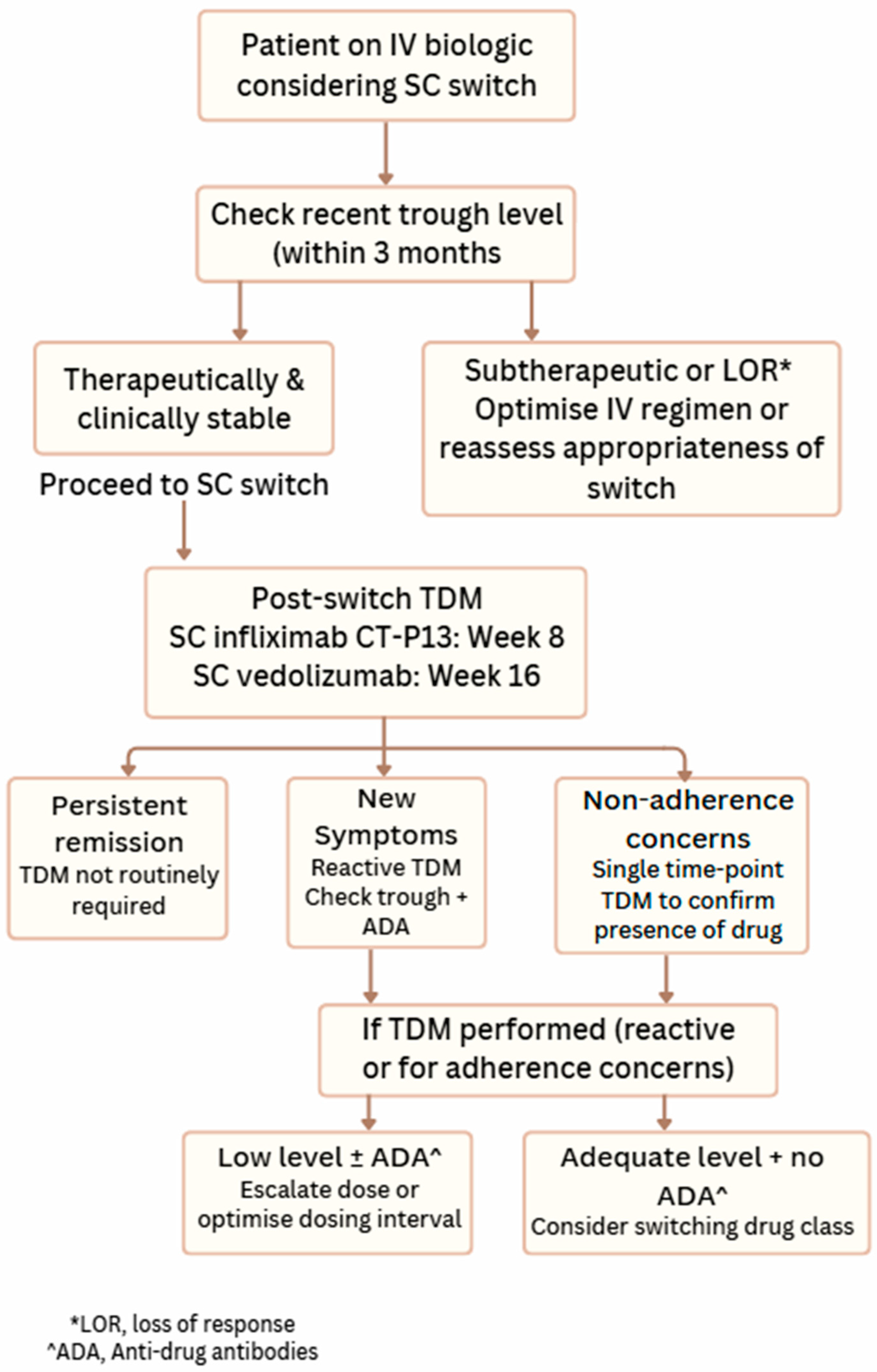
| Switching from IV to SC infliximab or vedolizumab | ✔ Consider baseline TDM to confirm adequate exposure | Helps establish pre-switch pharmacokinetic status |
| Patient with suspected loss of response on SC | ✔ Perform TDM to assess for low levels or ADAs | May support switch back to IV or dose escalation |
| Clinically stable patient on SC | ✖ Routine TDM currently not recommended | No defined proactive thresholds yet available |
| Non-adherence concerns | ✔ TDM can help assess drug presence or absence | Especially useful in self-administered SC setting |
Disclaimer/Publisher’s Note: The statements, opinions and data contained in all publications are solely those of the individual author(s) and contributor(s) and not of MDPI and/or the editor(s). MDPI and/or the editor(s) disclaim responsibility for any injury to people or property resulting from any ideas, methods, instructions or products referred to in the content. |
© 2026 by the authors. Licensee MDPI, Basel, Switzerland. This article is an open access article distributed under the terms and conditions of the Creative Commons Attribution (CC BY) license.
Share and Cite
Massouridis, B.; Sparrow, M.P. Therapeutic Drug Monitoring of the Subcutaneous Formulations of Infliximab and Vedolizumab—Current Knowledge and Future Directions. J. Clin. Med. 2026, 15, 972. https://doi.org/10.3390/jcm15030972
Massouridis B, Sparrow MP. Therapeutic Drug Monitoring of the Subcutaneous Formulations of Infliximab and Vedolizumab—Current Knowledge and Future Directions. Journal of Clinical Medicine. 2026; 15(3):972. https://doi.org/10.3390/jcm15030972
Chicago/Turabian StyleMassouridis, Ben, and Miles P. Sparrow. 2026. "Therapeutic Drug Monitoring of the Subcutaneous Formulations of Infliximab and Vedolizumab—Current Knowledge and Future Directions" Journal of Clinical Medicine 15, no. 3: 972. https://doi.org/10.3390/jcm15030972
APA StyleMassouridis, B., & Sparrow, M. P. (2026). Therapeutic Drug Monitoring of the Subcutaneous Formulations of Infliximab and Vedolizumab—Current Knowledge and Future Directions. Journal of Clinical Medicine, 15(3), 972. https://doi.org/10.3390/jcm15030972