Preserved Ejection, Lost Rhythm: A Narrative Review of the Pathophysiology and Management of Heart Failure with Preserved Ejection Fraction and Concomitant Atrial Fibrillation

 ,
,  , , , and
Abstract
1. Introduction
2. Epidemiology
3. Definitions
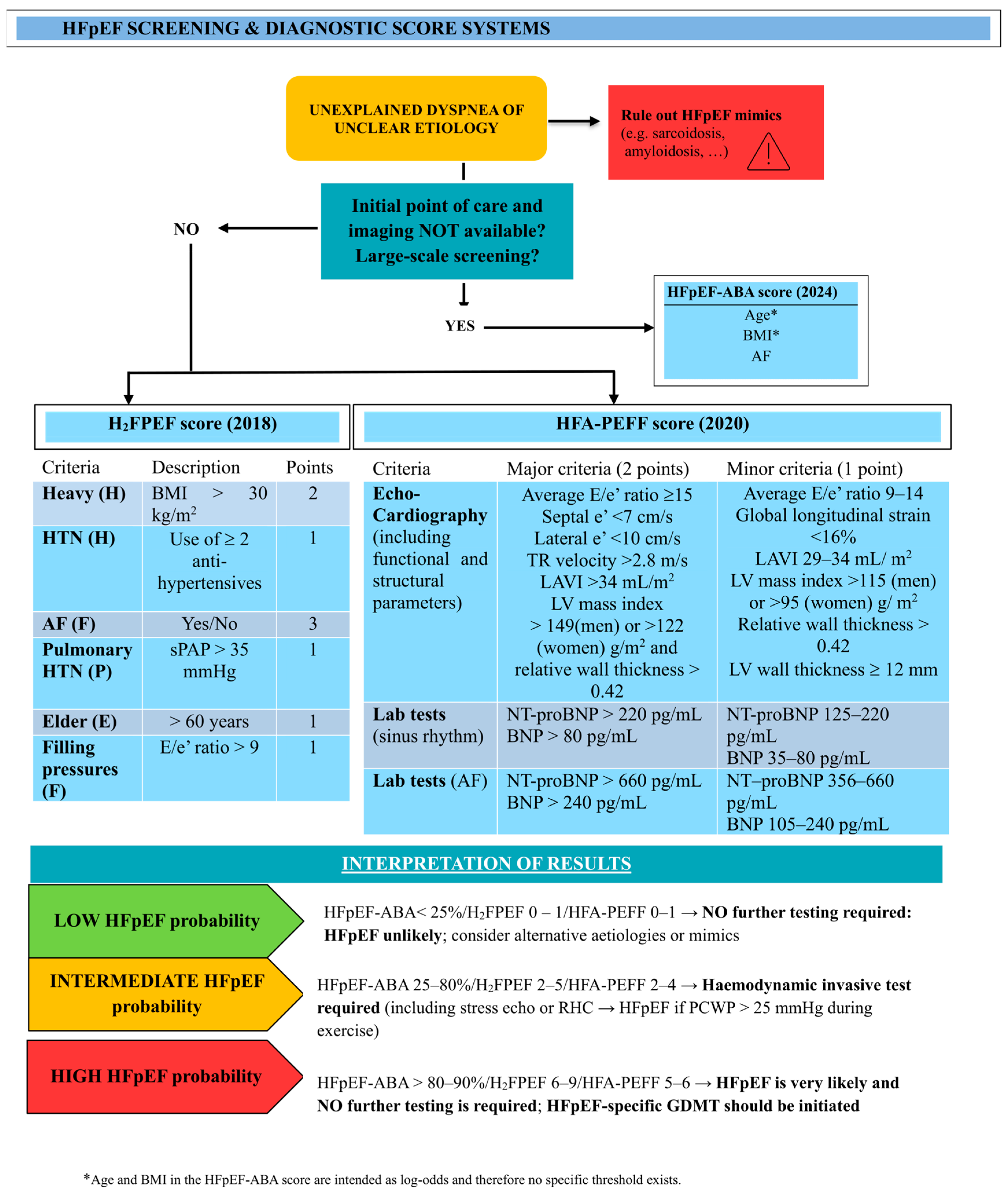
4. Diagnostic Criteria

5. Pathophysiology of HFpEF
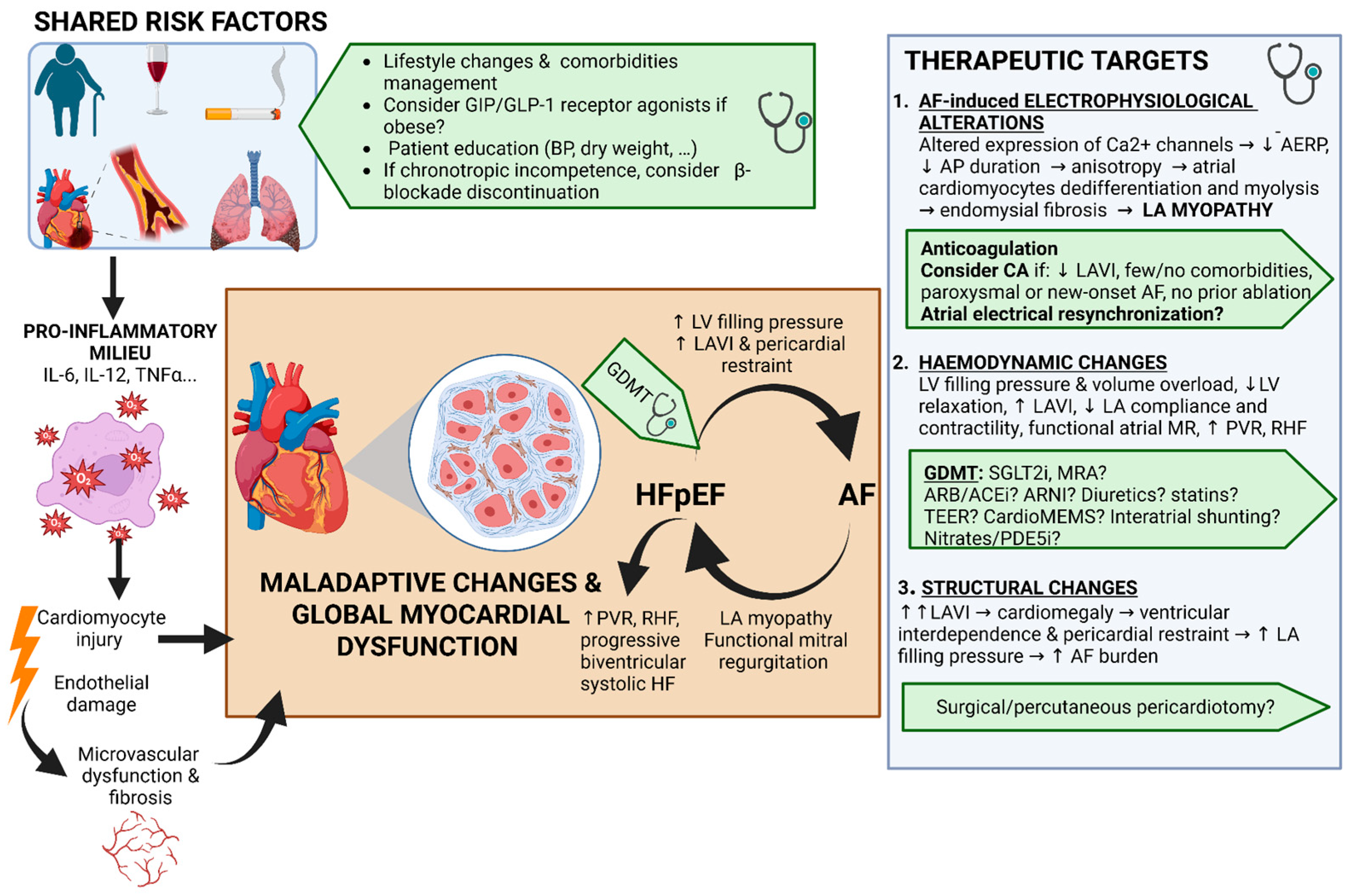
6. AF, LA Myopathy and HFpEF Interplay
7. Impact of AF on HFpEF Morbidity and Mortality
8. HFpEF-AF Management
8.1. Addressing Comorbidities and Risk Factors
8.2. Medical Treatment of HFpEF
8.2.1. SGLT2 Inhibitors
8.2.2. GIP/GLP-1 Receptor Agonists
8.2.3. MRAs
8.2.4. ACE Inhibitors, ARBs, and ARNIs
8.2.5. Statins
8.2.6. Diuretics
8.3. Medical Treatment of AF
8.3.1. Rate vs. Rhythm Control
8.3.2. Catheter Ablation in HFpEF
8.3.3. Selecting Patients for Ablation
8.4. New Experimental Strategies
9. Conclusions
Author Contributions
Funding
Institutional Review Board Statement
Informed Consent Statement
Data Availability Statement
Acknowledgments
Conflicts of Interest
References
- Heeringa, J.; van der Kuip, D.A.M.; Hofman, A.; Kors, J.A.; van Herpen, G.; Stricker, B.H.C.; Stijnen, T.; Lip, G.Y.H.; Witteman, J.C.M. Prevalence, Incidence and Lifetime Risk of Atrial Fibrillation: The Rotterdam Study. Eur. Heart J. 2006, 27, 949–953. [Google Scholar] [CrossRef] [PubMed]
- Teramoto, K.; Teng, T.-H.K.; Chandramouli, C.; Tromp, J.; Sakata, Y.; Lam, C.S. Epidemiology and Clinical Features of Heart Failure with Preserved Ejection Fraction. Card. Fail. Rev. 2022, 8, e27. [Google Scholar] [CrossRef]
- Santhanakrishnan, R.; Wang, N.; Larson, M.G.; Magnani, J.W.; McManus, D.D.; Lubitz, S.A.; Ellinor, P.T.; Cheng, S.; Vasan, R.S.; Lee, D.S.; et al. Atrial Fibrillation Begets Heart Failure and Vice Versa. Circulation 2016, 133, 484–492. [Google Scholar] [CrossRef]
- Obokata, M.; Olson, T.P.; Reddy, Y.N.V.; Melenovsky, V.; Kane, G.C.; Borlaug, B.A. Haemodynamics, Dyspnoea, and Pulmonary Reserve in Heart Failure with Preserved Ejection Fraction. Eur. Heart J. 2018, 39, 2810–2821. [Google Scholar] [CrossRef]
- Borlaug, B.A.; Sharma, K.; Shah, S.J.; Ho, J.E. Heart Failure with Preserved Ejection Fraction. J. Am. Coll. Cardiol. 2023, 81, 1810–1834. [Google Scholar] [CrossRef]
- Tan, S.C.W.; Tang, M.-L.; Chu, H.; Zhao, Y.-T.; Weng, C. Trends in Global Burden and Socioeconomic Profiles of Atrial Fibrillation and Atrial Flutter: Insights from the Global Burden of Disease Study 2021. CJC Open 2024, 7, 247–258. [Google Scholar] [CrossRef]
- Pandey, A.; Omar, W.; Ayers, C.; LaMonte, M.; Klein, L.; Allen, N.B.; Kuller, L.H.; Greenland, P.; Eaton, C.B.; Gottdiener, J.S.; et al. Sex and Race Differences in Lifetime Risk of Heart Failure with Preserved Ejection Fraction and Heart Failure with Reduced Ejection Fraction. Circulation 2018, 137, 1814–1823. [Google Scholar] [CrossRef]
- van Riet, E.E.S.; Hoes, A.W.; Wagenaar, K.P.; Limburg, A.; Landman, M.A.J.; Rutten, F.H. Epidemiology of Heart Failure: The Prevalence of Heart Failure and Ventricular Dysfunction in Older Adults over Time. A Systematic Review. Eur. J. Heart Fail. 2016, 18, 242–252. [Google Scholar] [CrossRef] [PubMed]
- Shah, K.S.; Xu, H.; Matsouaka, R.A.; Bhatt, D.L.; Heidenreich, P.A.; Hernandez, A.F.; Devore, A.D.; Yancy, C.W.; Fonarow, G.C. Heart Failure with Preserved, Borderline, and Reduced Ejection Fraction. J. Am. Coll. Cardiol. 2017, 70, 2476–2486. [Google Scholar] [CrossRef] [PubMed]
- Colilla, S.; Crow, A.; Petkun, W.; Singer, D.E.; Simon, T.; Liu, X. Estimates of Current and Future Incidence and Prevalence of Atrial Fibrillation in the U.S. Adult Population. Am. J. Cardiol. 2013, 112, 1142–1147. [Google Scholar] [CrossRef]
- Clark, K.A.A.; Reinhardt, S.W.; Chouairi, F.; Miller, P.E.; Kay, B.; Fuery, M.; Guha, A.; Ahmad, T.; Desai, N.R. Trends in Heart Failure Hospitalizations in the US from 2008 to 2018. J. Card. Fail. 2022, 28, 171–180. [Google Scholar] [CrossRef]
- Bozkurt, B.; Coats, A.J.S.; Tsutsui, H.; Abdelhamid, C.M.; Adamopoulos, S.; Albert, N.; Anker, S.D.; Atherton, J.; Böhm, M.; Butler, J.; et al. Universal Definition and Classification of Heart Failure: A Report of the Heart Failure Society of America, Heart Failure Association of the European Society of Cardiology, Japanese Heart Failure Society and Writing Committee of the Universal Definition of Heart Failure: Endorsed by the Canadian Heart Failure Society, Heart Failure Association of India, Cardiac Society of Australia and New Zealand, and Chinese Heart Failure Association. Eur. J. Heart Fail. 2021, 23, 352–380. [Google Scholar] [CrossRef] [PubMed]
- Obokata, M.; Reddy, Y.N.V.; Melenovsky, V.; Sorimachi, H.; Jarolim, P.; Borlaug, B.A. Uncoupling between Intravascular and Distending Pressures Leads to Underestimation of Circulatory Congestion in Obesity. Eur. J. Heart Fail. 2022, 24, 353–361. [Google Scholar] [CrossRef]
- Larson, K.; Omar, M.; Sorimachi, H.; Omote, K.; Alogna, A.; Popovic, D.; Tada, A.; Doi, S.; Naser, J.; Reddy, Y.N.V.; et al. Clinical Phenogroup Diversity and Multiplicity: Impact on Mechanisms of Exercise Intolerance in Heart Failure with Preserved Ejection Fraction. Eur. J. Heart Fail. 2024, 26, 564–577. [Google Scholar] [CrossRef]
- Bonelli, A.; Degiovanni, A.; Beretta, D.; Cersosimo, A.; Spinoni, E.G.; Bosco, M.; Dell’Era, G.; Chiara, B.C.D.; Gigli, L.; Salghetti, F.; et al. H2FPEF and HFA-PEFF Scores Performance and the Additional Value of Cardiac Structure and Function in Patients with Atrial Fibrillation. Int. J. Cardiol. 2024, 413, 132385. [Google Scholar] [CrossRef]
- Baba, M.; Yoshida, K.; Ieda, M. Clinical Applications of Natriuretic Peptides in Heart Failure and Atrial Fibrillation. Int. J. Mol. Sci. 2019, 20, 2824. [Google Scholar] [CrossRef] [PubMed]
- Ariyaratnam, J.P.; Mishima, R.S.; Kadhim, K.; Emami, M.; Fitzgerald, J.L.; Thiyagarajah, A.; Dziano, J.K.; Howie, J.O.; Middeldorp, M.E.; Sanders, P.; et al. Utility and Validity of the HFA-PEFF and H2FPEF Scores in Patients with Symptomatic Atrial Fibrillation. JACC Heart Fail. 2024, 12, 1015–1025. [Google Scholar] [CrossRef] [PubMed]
- Nagueh, S.F.; Sanborn, D.Y.; Oh, J.K.; Anderson, B.; Billick, K.; Derumeaux, G.; Klein, A.; Koulogiannis, K.; Mitchell, C.; Shah, A.; et al. Recommendations for the Evaluation of Left Ventricular Diastolic Function by Echocardiography and for Heart Failure with Preserved Ejection Fraction Diagnosis: An Update from the American Society of Echocardiography. J. Am. Soc. Echocardiogr. 2025, 38, 537–569. [Google Scholar] [CrossRef]
- Reddy, Y.N.V.; Carter, R.E.; Sundaram, V.; Kaye, D.M.; Handoko, M.L.; Tedford, R.J.; Andersen, M.J.; Sharma, K.; Obokata, M.; Verbrugge, F.H.; et al. An Evidence-Based Screening Tool for Heart Failure with Preserved Ejection Fraction: The HFpEF-ABA Score. Nat. Med. 2024, 30, 2258–2264. [Google Scholar] [CrossRef]
- Reddy, Y.N.V.; Carter, R.E.; Obokata, M.; Redfield, M.M.; Borlaug, B.A. A Simple, Evidence-Based Approach to Help Guide Diagnosis of Heart Failure with Preserved Ejection Fraction. Circulation 2018, 138, 861–870. [Google Scholar] [CrossRef]
- Pieske, B.; Tschöpe, C.; De Boer, R.A.; Fraser, A.G.; Anker, S.D.; Donal, E.; Edelmann, F.; Fu, M.; Guazzi, M.; Lam, C.S.P.; et al. How to Diagnose Heart Failure with Preserved Ejection Fraction: The HFA–PEFF Diagnostic Algorithm: A Consensus Recommendation from the Heart Failure Association (HFA) of the European Society of Cardiology (ESC). Eur. J. Heart Fail. 2020, 22, 391–412. [Google Scholar] [CrossRef]
- Ariyaratnam, J.P.; Lau, D.H.; Sanders, P.; Kalman, J.M. Atrial Fibrillation and Heart Failure: Epidemiology, Pathophysiology, Prognosis, and Management. Card. Electrophysiol. Clin. 2021, 13, 47–62. [Google Scholar] [CrossRef]
- Ling, L.-H.; Kistler, P.M.; Kalman, J.M.; Schilling, R.J.; Hunter, R.J. Comorbidity of Atrial Fibrillation and Heart Failure. Nat. Rev. Cardiol. 2016, 13, 131–147. [Google Scholar] [CrossRef] [PubMed]
- Paulus, W.J.; Tschöpe, C. A Novel Paradigm for Heart Failure with Preserved Ejection Fraction. J. Am. Coll. Cardiol. 2013, 62, 263–271. [Google Scholar] [CrossRef]
- Obokata, M.; Reddy, Y.N.V.; Pislaru, S.V.; Melenovsky, V.; Borlaug, B.A. Evidence Supporting the Existence of a Distinct Obese Phenotype of Heart Failure with Preserved Ejection Fraction. Circulation 2017, 136, 6–19. [Google Scholar] [CrossRef] [PubMed]
- Borlaug, B.A.; Reddy, Y.N. The Role of the Pericardium in Heart Failure: Implications for Pathophysiology and Treatment. JACC Heart Fail. 2019, 7, 574–585. [Google Scholar] [CrossRef]
- Packer, M.; Lam, C.S.P.; Lund, L.H.; Redfield, M.M. Interdependence of Atrial Fibrillation and Heart Failure with a Preserved Ejection Fraction Reflects a Common Underlying Atrial and Ventricular Myopathy. Circulation 2020, 141, 4–6. [Google Scholar] [CrossRef]
- Sorimachi, H.; Verbrugge, F.H.; Omote, K.; Omar, M.; Obokata, M.; Reddy, Y.N.V.; Ye, Z.; Michelena, H.I.; Borlaug, B.A. Longitudinal Evolution of Cardiac Dysfunction in Heart Failure and Preserved Ejection Fraction with Normal Natriuretic Peptide Levels. Circulation 2022, 146, 500–502. [Google Scholar] [CrossRef] [PubMed]
- Obokata, M.; Reddy, Y.N.V.; Melenovsky, V.; Pislaru, S.; Borlaug, B.A. Deterioration in Right Ventricular Structure and Function over Time in Patients with Heart Failure and Preserved Ejection Fraction. Eur. Heart J. 2019, 40, 689–697. [Google Scholar] [CrossRef]
- Wijffels, M.C.; Kirchhof, C.J.; Dorland, R.; Allessie, M.A. Atrial Fibrillation Begets Atrial Fibrillation. A Study in Awake Chronically Instrumented Goats. Circulation 1995, 92, 1954–1968. [Google Scholar] [CrossRef]
- Allessie, M.; Ausma, J.; Schotten, U. Electrical, Contractile and Structural Remodeling during Atrial Fibrillation. Cardiovasc. Res. 2002, 54, 230–246. [Google Scholar] [CrossRef]
- Schotten, U.; Duytschaever, M.; Ausma, J.; Eijsbouts, S.; Neuberger, H.-R.; Allessie, M. Electrical and Contractile Remodeling during the First Days of Atrial Fibrillation Go Hand in Hand. Circulation 2003, 107, 1433–1439. [Google Scholar] [CrossRef]
- Schoonderwoerd, B.A.; Van Gelder, I.C.; Van Veldhuisen, D.J.; Van den Berg, M.P.; Crijns, H.J.G.M. Electrical and Structural Remodeling: Role in the Genesis and Maintenance of Atrial Fibrillation. Prog. Cardiovasc. Dis. 2005, 48, 153–168. [Google Scholar] [CrossRef]
- Ausma, J.; van der Velden, H.M.W.; Lenders, M.-H.; van Ankeren, E.P.; Jongsma, H.J.; Ramaekers, F.C.S.; Borgers, M.; Allessie, M.A. Reverse Structural and Gap-Junctional Remodeling after Prolonged Atrial Fibrillation in the Goat. Circulation 2003, 107, 2051–2058. [Google Scholar] [CrossRef]
- Li, Y.; Jian, Z.; Yang, Z.Y.; Chen, L.; Wang, X.F.; Ma, R.Y.; Xiao, Y.B. Increased Expression of Connective Tissue Growth Factor and Transforming Growth Factor-Beta-1 in Atrial Myocardium of Patients with Chronic Atrial Fibrillation. Cardiology 2013, 124, 233–240. [Google Scholar] [CrossRef]
- Kohl, P.; Camelliti, P.; Burton, F.L.; Smith, G.L. Electrical Coupling of Fibroblasts and Myocytes: Relevance for Cardiac Propagation. J. Electrocardiol. 2005, 38, 45–50. [Google Scholar] [CrossRef] [PubMed]
- Johner, N.; Namdar, M.; Shah, D.C. Safety, Efficacy and Prognostic Benefit of Atrial Fibrillation Ablation in Heart Failure with Preserved Ejection Fraction. Arrhythm. Electrophysiol. Rev. 2022, 11, e18. [Google Scholar] [CrossRef] [PubMed]
- Zakeri, R.; Moulay, G.; Chai, Q.; Ogut, O.; Hussain, S.; Takahama, H.; Lu, T.; Wang, X.-L.; Linke, W.A.; Lee, H.-C.; et al. Left Atrial Remodeling and Atrioventricular Coupling in a Canine Model of Early Heart Failure with Preserved Ejection Fraction. Circ. Heart Fail. 2016, 9, e003238. [Google Scholar] [CrossRef] [PubMed]
- Hendrick, D.A.; Smith, A.C.; Kratz, J.M.; Crawford, F.A.; Spinale, F.G. The Pig as a Model of Tachycardia and Dilated Cardiomyopathy. Lab. Anim. Sci. 1990, 40, 495–501. [Google Scholar]
- Hartupee, J.; Mann, D.L. Neurohormonal Activation in Heart Failure with Reduced Ejection Fraction. Nat. Rev. Cardiol. 2017, 14, 30–38. [Google Scholar] [CrossRef]
- Stiles, M.K.; John, B.; Wong, C.X.; Kuklik, P.; Brooks, A.G.; Lau, D.H.; Dimitri, H.; Roberts-Thomson, K.C.; Wilson, L.; De Sciscio, P.; et al. Paroxysmal Lone Atrial Fibrillation Is Associated with an Abnormal Atrial Substrate: Characterizing the “Second Factor”. J. Am. Coll. Cardiol. 2009, 53, 1182–1191. [Google Scholar] [CrossRef]
- Deferm, S.; Bertrand, P.B.; Verbrugge, F.H.; Verhaert, D.; Rega, F.; Thomas, J.D.; Vandervoort, P.M. Atrial Functional Mitral Regurgitation: JACC Review Topic of the Week. J. Am. Coll. Cardiol. 2019, 73, 2465–2476. [Google Scholar] [CrossRef] [PubMed]
- Chen, P.-S.; Chen, L.S.; Fishbein, M.C.; Lin, S.-F.; Nattel, S. Role of the Autonomic Nervous System in Atrial Fibrillation: Pathophysiology and Therapy. Circ. Res. 2014, 114, 1500–1515. [Google Scholar] [CrossRef]
- Patel, R.B.; Lam, C.S.P.; Svedlund, S.; Saraste, A.; Hage, C.; Tan, R.-S.; Beussink-Nelson, L.; Tromp, J.; Sanchez, C.; Njoroge, J.; et al. Disproportionate Left Atrial Myopathy in Heart Failure with Preserved Ejection Fraction among Participants of the PROMIS-HFpEF Study. Sci. Rep. 2021, 11, 4885. [Google Scholar] [CrossRef]
- Litwin, S.E.; Komtebedde, J.; Hu, M.; Burkhoff, D.; Hasenfuß, G.; Borlaug, B.A.; Solomon, S.D.; Zile, M.R.; Mohan, R.C.; Kahwash, R.; et al. Exercise-Induced Left Atrial Hypertension in Heart Failure with Preserved Ejection Fraction. JACC Heart Fail. 2023, 11, 1103–1117. [Google Scholar] [CrossRef] [PubMed]
- Backhaus, S.J.; Nasopoulou, A.; Lange, T.; Schulz, A.; Evertz, R.; Kowallick, J.T.; Hasenfuß, G.; Lamata, P.; Schuster, A. Left Atrial Roof Enlargement Is a Distinct Feature of Heart Failure with Preserved Ejection Fraction. Circ. Cardiovasc. Imaging 2024, 17, e016424. [Google Scholar] [CrossRef]
- Carlisle, M.A.; Fudim, M.; DeVore, A.D.; Piccini, J.P. Heart Failure and Atrial Fibrillation, Like Fire and Fury. JACC Heart Fail. 2019, 7, 447–456. [Google Scholar] [CrossRef] [PubMed]
- Kittleson, M.M.; Panjrath, G.S.; Amancherla, K.; Davis, L.L.; Deswal, A.; Dixon, D.L.; Januzzi, J.L.; Yancy, C.W. 2023 ACC Expert Consensus Decision Pathway on Management of Heart Failure with Preserved Ejection Fraction. J. Am. Coll. Cardiol. 2023, 81, 1835–1878. [Google Scholar] [CrossRef]
- Sugumar, H.; Nanayakkara, S.; Vizi, D.; Wright, L.; Chieng, D.; Leet, A.; Mariani, J.A.; Voskoboinik, A.; Prabhu, S.; Taylor, A.J.; et al. A Prospective STudy Using invAsive Haemodynamic Measurements foLLowing Catheter Ablation for AF and Early HFpEF: STALL AF-HFpEF. Eur. J. Heart Fail. 2021, 23, 785–796. [Google Scholar] [CrossRef]
- Zakeri, R.; Chamberlain, A.M.; Roger, V.L.; Redfield, M.M. Temporal Relationship and Prognostic Significance of Atrial Fibrillation in Heart Failure Patients with Preserved Ejection Fraction: A Community-Based Study. Circulation 2013, 128, 1085–1093. [Google Scholar] [CrossRef]
- Brouwers, F.P.; de Boer, R.A.; van der Harst, P.; Voors, A.A.; Gansevoort, R.T.; Bakker, S.J.; Hillege, H.L.; van Veldhuisen, D.J.; van Gilst, W.H. Incidence and Epidemiology of New Onset Heart Failure with Preserved vs. Reduced Ejection Fraction in a Community-Based Cohort: 11-Year Follow-up of PREVEND. Eur. Heart J. 2013, 34, 1424–1431. [Google Scholar] [CrossRef]
- Zakeri, R. Is There a Role for Catheter Ablation of Atrial Fibrillation in the Treatment of Patients with Heart Failure and Preserved Ejection Fraction? Circ. Heart Fail. 2022, 15, e009835. [Google Scholar] [CrossRef]
- Zakeri, R.; Borlaug, B.A.; McNulty, S.E.; Mohammed, S.F.; Lewis, G.D.; Semigran, M.J.; Deswal, A.; LeWinter, M.; Hernandez, A.F.; Braunwald, E.; et al. Impact of Atrial Fibrillation on Exercise Capacity in Heart Failure with Preserved Ejection Fraction: A RELAX Trial Ancillary Study. Circ. Heart Fail. 2014, 7, 123–130. [Google Scholar] [CrossRef]
- Melenovsky, V.; Hwang, S.-J.; Redfield, M.M.; Zakeri, R.; Lin, G.; Borlaug, B.A. Left Atrial Remodeling and Function in Advanced Heart Failure with Preserved or Reduced Ejection Fraction. Circ. Heart Fail. 2015, 8, 295–303. [Google Scholar] [CrossRef] [PubMed]
- Fauchier, L.; Bisson, A.; Bodin, A. Heart Failure with Preserved Ejection Fraction and Atrial Fibrillation: Recent Advances and Open Questions. BMC Med. 2023, 21, 54. [Google Scholar] [CrossRef] [PubMed]
- Reddy, Y.N.V.; Obokata, M.; Verbrugge, F.H.; Lin, G.; Borlaug, B.A. Atrial Dysfunction in Patients with Heart Failure with Preserved Ejection Fraction and Atrial Fibrillation. J. Am. Coll. Cardiol. 2020, 76, 1051–1064. [Google Scholar] [CrossRef]
- Liu, G.; Long, M.; Hu, X.; Hu, C.-H.; Du, Z.-M. Meta-Analysis of Atrial Fibrillation and Outcomes in Patients with Heart Failure and Preserved Ejection Fraction. Heart Lung Circ. 2021, 30, 698–706. [Google Scholar] [CrossRef]
- Cikes, M.; Planinc, I.; Claggett, B.; Cunningham, J.; Milicic, D.; Sweitzer, N.; Senni, M.; Gori, M.; Linssen, G.; Shah, S.J.; et al. Atrial Fibrillation in Heart Failure with Preserved Ejection Fraction. JACC Heart Fail. 2022, 10, 336–346. [Google Scholar] [CrossRef]
- Saksena, S.; Slee, A.; Natale, A.; Lakkireddy, D.R.; Shah, D.; Di Biase, L.; Lewalter, T.; Nagarakanti, R.; Santangeli, P. Atrial Fibrillation Can Adversely Impact Heart Failure with Preserved Ejection Fraction by Its Association with Heart Failure Progression and Mortality: A Post-Hoc Propensity Score-Matched Analysis of the TOPCAT Americas Trial. Europace 2023, 25, euad095. [Google Scholar] [CrossRef] [PubMed]
- Saksena, S.; Slee, A.; Nagarakanti, R.; Prakash, A. Atrial Fibrillation (AF) and Heart Failure with Preserved Ejection Fraction (HFpEF): Advances and Challenges. Cardiovasc. Electrophysiol. 2025, 36, 2720–2745. [Google Scholar] [CrossRef]
- Uhm, J.-S.; Kim, J.; Yu, H.T.; Kim, T.-H.; Lee, S.-R.; Cha, M.-J.; Choi, E.-K.; Lee, J.M.; Kim, J.-B.; Park, J.; et al. Stroke and Systemic Embolism in Patients with Atrial Fibrillation and Heart Failure According to Heart Failure Type. ESC Heart Fail. 2021, 8, 1582–1589. [Google Scholar] [CrossRef]
- Ather, S.; Chan, W.; Bozkurt, B.; Aguilar, D.; Ramasubbu, K.; Zachariah, A.A.; Wehrens, X.H.; Deswal, A. Impact of Non-Cardiac Comorbidities on Morbidity and Mortality in a Predominantly Male Population with Heart Failure and Preserved versus Reduced Ejection Fraction. J. Am. Coll. Cardiol. 2012, 59, 998–1005. [Google Scholar] [CrossRef] [PubMed]
- Rienstra, M.; Hobbelt, A.H.; Alings, M.; Tijssen, J.G.P.; Smit, M.D.; Brügemann, J.; Geelhoed, B.; Tieleman, R.G.; Hillege, H.L.; Tukkie, R.; et al. Targeted Therapy of Underlying Conditions Improves Sinus Rhythm Maintenance in Patients with Persistent Atrial Fibrillation: Results of the RACE 3 Trial. Eur. Heart J. 2018, 39, 2987–2996. [Google Scholar] [CrossRef]
- Selvaraj, S.; Claggett, B.; Shah, S.J.; Anand, I.; Rouleau, J.L.; Desai, A.S.; Lewis, E.F.; Pitt, B.; Sweitzer, N.K.; Pfeffer, M.A.; et al. Systolic Blood Pressure and Cardiovascular Outcomes in Heart Failure with Preserved Ejection Fraction: An Analysis of the TOPCAT Trial. Eur. J. Heart Fail. 2018, 20, 483–490. [Google Scholar] [CrossRef] [PubMed]
- Pathak, R.K.; Middeldorp, M.E.; Meredith, M.; Mehta, A.B.; Mahajan, R.; Wong, C.X.; Twomey, D.; Elliott, A.D.; Kalman, J.M.; Abhayaratna, W.P.; et al. Long-Term Effect of Goal-Directed Weight Management in an Atrial Fibrillation Cohort: A Long-Term Follow-Up Study (LEGACY). J. Am. Coll. Cardiol. 2015, 65, 2159–2169. [Google Scholar] [CrossRef]
- Abed, H.S.; Wittert, G.A.; Leong, D.P.; Shirazi, M.G.; Bahrami, B.; Middeldorp, M.E.; Lorimer, M.F.; Lau, D.H.; Antic, N.A.; Brooks, A.G.; et al. Effect of Weight Reduction and Cardiometabolic Risk Factor Management on Symptom Burden and Severity in Patients with Atrial Fibrillation: A Randomized Clinical Trial. JAMA 2013, 310, 2050–2060. [Google Scholar] [CrossRef] [PubMed]
- Zhu, W.; Liang, W.; Ye, Z.; Wu, Y.; He, X.; Xue, R.; Wu, Z.; Zhou, Y.; Zhao, J.; Dong, Y.; et al. Association of Physical Activity and Risk of Atrial Fibrillation in Heart Failure with Preserved Ejection Fraction. Nutr. Metab. Cardiovasc. Dis. 2021, 31, 247–253. [Google Scholar] [CrossRef]
- Linz, D.; McEvoy, R.D.; Cowie, M.R.; Somers, V.K.; Nattel, S.; Lévy, P.; Kalman, J.M.; Sanders, P. Associations of Obstructive Sleep Apnea with Atrial Fibrillation and Continuous Positive Airway Pressure Treatment: A Review. JAMA Cardiol. 2018, 3, 532–540. [Google Scholar] [CrossRef]
- Bitter, T.; Faber, L.; Hering, D.; Langer, C.; Horstkotte, D.; Oldenburg, O. Sleep-Disordered Breathing in Heart Failure with Normal Left Ventricular Ejection Fraction. Eur. J. Heart Fail. 2009, 11, 602–608. [Google Scholar] [CrossRef]
- Holmqvist, F.; Guan, N.; Zhu, Z.; Kowey, P.R.; Allen, L.A.; Fonarow, G.C.; Hylek, E.M.; Mahaffey, K.W.; Freeman, J.V.; Chang, P.; et al. Impact of Obstructive Sleep Apnea and Continuous Positive Airway Pressure Therapy on Outcomes in Patients with Atrial Fibrillation-Results from the Outcomes Registry for Better Informed Treatment of Atrial Fibrillation (ORBIT-AF). Am. Heart J. 2015, 169, 647–654.e2. [Google Scholar] [CrossRef]
- Tu, S.J.; Hanna-Rivero, N.; Elliott, A.D.; Clarke, N.; Huang, S.; Pitman, B.M.; Gallagher, C.; Linz, D.; Mahajan, R.; Lau, D.H.; et al. Associations of Anemia with Stroke, Bleeding, and Mortality in Atrial Fibrillation: A Systematic Review and Meta-Analysis. J. Cardiovasc. Electrophysiol. 2021, 32, 686–694. [Google Scholar] [CrossRef]
- Kim, M.; Hong, M.; Kim, J.-Y.; Kim, I.-S.; Yu, H.T.; Kim, T.-H.; Uhm, J.-S.; Joung, B.; Lee, M.-H.; Pak, H.-N. Clinical Relationship between Anemia and Atrial Fibrillation Recurrence after Catheter Ablation without Genetic Background. IJC Heart Vasc. 2020, 27, 100507. [Google Scholar] [CrossRef]
- Lawson, C.A.; Seidu, S.; Zaccardi, F.; McCann, G.; Kadam, U.T.; Davies, M.J.; Lam, C.S.; Heerspink, H.L.; Khunti, K. Outcome Trends in People with Heart Failure, Type 2 Diabetes Mellitus and Chronic Kidney Disease in the UK over Twenty Years. EClinicalMedicine 2021, 32, 100739. [Google Scholar] [CrossRef] [PubMed]
- Khan, Y.H.; Sarriff, A.; Adnan, A.S.; Khan, A.H.; Mallhi, T.H. Chronic Kidney Disease, Fluid Overload and Diuretics: A Complicated Triangle. PLoS ONE 2016, 11, e0159335. [Google Scholar] [CrossRef]
- Castagno, D.; Baird-Gunning, J.; Jhund, P.S.; Biondi-Zoccai, G.; MacDonald, M.R.; Petrie, M.C.; Gaita, F.; McMurray, J.J.V. Intensive Glycemic Control Has No Impact on the Risk of Heart Failure in Type 2 Diabetic Patients: Evidence from a 37,229 Patient Meta-Analysis. Am. Heart J. 2011, 162, 938–948.e2. [Google Scholar] [CrossRef] [PubMed]
- Scirica, B.M.; Braunwald, E.; Raz, I.; Cavender, M.A.; Morrow, D.A.; Jarolim, P.; Udell, J.A.; Mosenzon, O.; Im, K.; Umez-Eronini, A.A.; et al. Heart Failure, Saxagliptin, and Diabetes Mellitus: Observations from the SAVOR-TIMI 53 Randomized Trial. Circulation 2014, 130, 1579–1588. [Google Scholar] [CrossRef] [PubMed]
- Lipscombe, L.L.; Gomes, T.; Lévesque, L.E.; Hux, J.E.; Juurlink, D.N.; Alter, D.A. Thiazolidinediones and Cardiovascular Outcomes in Older Patients with Diabetes. JAMA 2007, 298, 2634–2643. [Google Scholar] [CrossRef]
- Takahashi, Y.; Nitta, J.; Kobori, A.; Sakamoto, Y.; Nagata, Y.; Tanimoto, K.; Matsuo, S.; Yamane, T.; Morita, N.; Satomi, K.; et al. Alcohol Consumption Reduction and Clinical Outcomes of Catheter Ablation for Atrial Fibrillation. Circ. Arrhythmia Electrophysiol. 2021, 14, e009770. [Google Scholar] [CrossRef]
- Hoek, A.G.; Mukamal, K.J.; Van Oort, S.; Gottdiener, J.S.; Kizer, J.R.; Defilippi, C.R.; Psaty, B.; Gardin, J.M.; Shah, S.J.; Elders, P.J.; et al. The Association between Alcohol Consumption and Heart Failure with Reduced and Preserved Ejection Fraction: The Cardiovascular Health Study. Eur. Heart J. 2023, 44, ehad655.950. [Google Scholar] [CrossRef]
- Anker, S.D.; Butler, J.; Filippatos, G.; Ferreira, J.P.; Bocchi, E.; Böhm, M.; Brunner–La Rocca, H.-P.; Choi, D.-J.; Chopra, V.; Chuquiure-Valenzuela, E.; et al. Empagliflozin in Heart Failure with a Preserved Ejection Fraction. N. Engl. J. Med. 2021, 385, 1451–1461. [Google Scholar] [CrossRef]
- Solomon, S.D.; McMurray, J.J.V.; Claggett, B.; De Boer, R.A.; DeMets, D.; Hernandez, A.F.; Inzucchi, S.E.; Kosiborod, M.N.; Lam, C.S.P.; Martinez, F.; et al. Dapagliflozin in Heart Failure with Mildly Reduced or Preserved Ejection Fraction. N. Engl. J. Med. 2022, 387, 1089–1098. [Google Scholar] [CrossRef]
- Nassif, M.E.; Windsor, S.L.; Borlaug, B.A.; Kitzman, D.W.; Shah, S.J.; Tang, F.; Khariton, Y.; Malik, A.O.; Khumri, T.; Umpierrez, G.; et al. The SGLT2 Inhibitor Dapagliflozin in Heart Failure with Preserved Ejection Fraction: A Multicenter Randomized Trial. Nat. Med. 2021, 27, 1954–1960. [Google Scholar] [CrossRef] [PubMed]
- Butt, J.H.; Docherty, K.F.; Jhund, P.S.; de Boer, R.A.; Böhm, M.; Desai, A.S.; Howlett, J.G.; Inzucchi, S.E.; Kosiborod, M.N.; Martinez, F.A.; et al. Dapagliflozin and Atrial Fibrillation in Heart Failure with Reduced Ejection Fraction: Insights from DAPA-HF. Eur. J. Heart Fail. 2022, 24, 513–525. [Google Scholar] [CrossRef]
- Sato, T.; Aizawa, Y.; Yuasa, S.; Kishi, S.; Fuse, K.; Fujita, S.; Ikeda, Y.; Kitazawa, H.; Takahashi, M.; Sato, M.; et al. The Effect of Dapagliflozin Treatment on Epicardial Adipose Tissue Volume. Cardiovasc. Diabetol. 2018, 17, 6. [Google Scholar] [CrossRef]
- Borlaug, B.A.; Reddy, Y.N.V.; Braun, A.; Sorimachi, H.; Omar, M.; Popovic, D.; Alogna, A.; Jensen, M.D.; Carter, R. Cardiac and Metabolic Effects of Dapagliflozin in Heart Failure with Preserved Ejection Fraction: The CAMEO-DAPA Trial. Circulation 2023, 148, 834–844. [Google Scholar] [CrossRef]
- Tada, A.; Burkhoff, D.; Naser, J.A.; Harada, T.; Pourmussa, B.; Reddy, Y.N.V.; Jensen, M.D.; Carter, R.E.; Demmer, R.T.; Testani, J.M.; et al. Dapagliflozin Enhances Arterial and Venous Compliance During Exercise in Heart Failure with Preserved Ejection Fraction: Insights from the CAMEO-DAPA Trial. Circulation 2024, 150, 997–1009. [Google Scholar] [CrossRef]
- Paasche, A.; Wiedmann, F.; Kraft, M.; Seibertz, F.; Herlt, V.; Blochberger, P.L.; Jávorszky, N.; Beck, M.; Weirauch, L.; Seeger, T.; et al. Acute Antiarrhythmic Effects of SGLT2 Inhibitors–Dapagliflozin Lowers the Excitability of Atrial Cardiomyocytes. Basic. Res. Cardiol. 2024, 119, 93–112. [Google Scholar] [CrossRef]
- Zelniker, T.A.; Bonaca, M.P.; Furtado, R.H.M.; Mosenzon, O.; Kuder, J.F.; Murphy, S.A.; Bhatt, D.L.; Leiter, L.A.; McGuire, D.K.; Wilding, J.P.H.; et al. Effect of Dapagliflozin on Atrial Fibrillation in Patients with Type 2 Diabetes Mellitus: Insights from the DECLARE-TIMI 58 Trial. Circulation 2020, 141, 1227–1234. [Google Scholar] [CrossRef] [PubMed]
- Aziri, B.; Begic, E.; Jankovic, S.; Mladenovic, Z.; Stanetic, B.; Kovacevic-Preradovic, T.; Iglica, A.; Mujakovic, A. Systematic Review of Sodium-Glucose Cotransporter 2 Inhibitors: A Hopeful Prospect in Tackling Heart Failure-Related Events. ESC Heart Fail. 2023, 10, 1499–1530. [Google Scholar] [CrossRef] [PubMed]
- Packer, M.; Zile, M.R.; Kramer, C.M.; Baum, S.J.; Litwin, S.E.; Menon, V.; Ge, J.; Weerakkody, G.J.; Ou, Y.; Bunck, M.C.; et al. Tirzepatide for Heart Failure with Preserved Ejection Fraction and Obesity. N. Engl. J. Med. 2025, 392, 427–437. [Google Scholar] [CrossRef]
- Borlaug, B.A.; Zile, M.R.; Kramer, C.M.; Baum, S.J.; Hurt, K.; Litwin, S.E.; Murakami, M.; Ou, Y.; Upadhyay, N.; Packer, M. Effects of Tirzepatide on Circulatory Overload and End-Organ Damage in Heart Failure with Preserved Ejection Fraction and Obesity: A Secondary Analysis of the SUMMIT Trial. Nat. Med. 2025, 31, 544–551. [Google Scholar] [CrossRef]
- Nreu, B.; Dicembrini, I.; Tinti, F.; Sesti, G.; Mannucci, E.; Monami, M. Major Cardiovascular Events, Heart Failure, and Atrial Fibrillation in Patients Treated with Glucagon-like Peptide-1 Receptor Agonists: An Updated Meta-Analysis of Randomized Controlled Trials. Nutr. Metab. Cardiovasc. Dis. 2020, 30, 1106–1114. [Google Scholar] [CrossRef] [PubMed]
- Saglietto, A.; Falasconi, G.; Penela, D.; Francia, P.; Sau, A.; Ng, F.S.; Dusi, V.; Castagno, D.; Gaita, F.; Berruezo, A.; et al. Glucagon-like Peptide-1 Receptor Agonist Semaglutide Reduces Atrial Fibrillation Incidence: A Systematic Review and Meta-Analysis. Eur. J. Clin. Investig. 2024, 54, e14292. [Google Scholar] [CrossRef]
- Pitt, B.; Pfeffer, M.A.; Assmann, S.F.; Boineau, R.; Anand, I.S.; Claggett, B.; Clausell, N.; Desai, A.S.; Diaz, R.; Fleg, J.L.; et al. Spironolactone for Heart Failure with Preserved Ejection Fraction. N. Engl. J. Med. 2014, 370, 1383–1392. [Google Scholar] [CrossRef] [PubMed]
- Pfeffer, M.A.; Claggett, B.; Assmann, S.F.; Boineau, R.; Anand, I.S.; Clausell, N.; Desai, A.S.; Diaz, R.; Fleg, J.L.; Gordeev, I.; et al. Regional Variation in Patients and Outcomes in the Treatment of Preserved Cardiac Function Heart Failure with an Aldosterone Antagonist (TOPCAT) Trial. Circulation 2015, 131, 34–42. [Google Scholar] [CrossRef]
- Kurgansky, K.E.; Parker, R.; Djousse, L.; Gagnon, D.R.; Joseph, J. Spironolactone Reduces the Risk of Death in Veterans with Heart Failure with Preserved Ejection Fraction. J. Am. Heart Assoc. 2024, 13, e032231. [Google Scholar] [CrossRef] [PubMed]
- Shantsila, E.; Shahid, F.; Sun, Y.; Deeks, J.; Calvert, M.; Fisher, J.P.; Kirchhof, P.; Gill, P.S.; Lip, G.Y.H. Spironolactone in Atrial Fibrillation with Preserved Cardiac Fraction: The IMPRESS-AF Trial. J. Am. Heart Assoc. 2020, 9, e016239. [Google Scholar] [CrossRef]
- Guo, C.; Ricchiuti, V.; Lian, B.Q.; Yao, T.M.; Coutinho, P.; Romero, J.R.; Li, J.; Williams, G.H.; Adler, G.K. Mineralocorticoid Receptor Blockade Reverses Obesity-Related Changes in Expression of Adiponectin, Peroxisome Proliferator-Activated Receptor-Gamma, and Proinflammatory Adipokines. Circulation 2008, 117, 2253–2261. [Google Scholar] [CrossRef]
- Khan, M.S.; Fonarow, G.C.; Khan, H.; Greene, S.J.; Anker, S.D.; Gheorghiade, M.; Butler, J. Renin-Angiotensin Blockade in Heart Failure with Preserved Ejection Fraction: A Systematic Review and Meta-Analysis. ESC Heart Fail. 2017, 4, 402–408. [Google Scholar] [CrossRef]
- Yusuf, S.; Pfeffer, M.A.; Swedberg, K.; Granger, C.B.; Held, P.; McMurray, J.J.V.; Michelson, E.L.; Olofsson, B.; Ostergren, J.; CHARM Investigators and Committees. Effects of Candesartan in Patients with Chronic Heart Failure and Preserved Left-Ventricular Ejection Fraction: The CHARM-Preserved Trial. Lancet 2003, 362, 777–781. [Google Scholar] [CrossRef]
- Massie, B.M.; Carson, P.E.; McMurray, J.J.; Komajda, M.; McKelvie, R.; Zile, M.R.; Anderson, S.; Donovan, M.; Iverson, E.; Staiger, C.; et al. Irbesartan in Patients with Heart Failure and Preserved Ejection Fraction. N. Engl. J. Med. 2008, 359, 2456–2467. [Google Scholar] [CrossRef]
- Solomon, S.D.; Zile, M.; Pieske, B.; Voors, A.; Shah, A.; Kraigher-Krainer, E.; Shi, V.; Bransford, T.; Takeuchi, M.; Gong, J.; et al. The Angiotensin Receptor Neprilysin Inhibitor LCZ696 in Heart Failure with Preserved Ejection Fraction: A Phase 2 Double-Blind Randomised Controlled Trial. Lancet 2012, 380, 1387–1395. [Google Scholar] [CrossRef]
- Solomon, S.D.; McMurray, J.J.V.; Anand, I.S.; Ge, J.; Lam, C.S.P.; Maggioni, A.P.; Martinez, F.; Packer, M.; Pfeffer, M.A.; Pieske, B.; et al. Angiotensin-Neprilysin Inhibition in Heart Failure with Preserved Ejection Fraction. N. Engl. J. Med. 2019, 381, 1609–1620. [Google Scholar] [CrossRef]
- Alehagen, U.; Benson, L.; Edner, M.; Dahlström, U.; Lund, L.H. Association Between Use of Statins and Mortality in Patients with Heart Failure and Ejection Fraction of ≥50. Circ. Heart Fail. 2015, 8, 862–870. [Google Scholar] [CrossRef]
- Antoniades, C.; Bakogiannis, C.; Leeson, P.; Guzik, T.J.; Zhang, M.-H.; Tousoulis, D.; Antonopoulos, A.S.; Demosthenous, M.; Marinou, K.; Hale, A.; et al. Rapid, Direct Effects of Statin Treatment on Arterial Redox State and Nitric Oxide Bioavailability in Human Atherosclerosis via Tetrahydrobiopterin-Mediated Endothelial Nitric Oxide Synthase Coupling. Circulation 2011, 124, 335–345. [Google Scholar] [CrossRef]
- Ramasubbu, K.; Estep, J.; White, D.L.; Deswal, A.; Mann, D.L. Experimental and Clinical Basis for the Use of Statins in Patients with Ischemic and Nonischemic Cardiomyopathy. J. Am. Coll. Cardiol. 2008, 51, 415–426. [Google Scholar] [CrossRef] [PubMed]
- Borlaug, B.A.; Jensen, M.D.; Kitzman, D.W.; Lam, C.S.P.; Obokata, M.; Rider, O.J. Obesity and Heart Failure with Preserved Ejection Fraction: New Insights and Pathophysiological Targets. Cardiovasc. Res. 2023, 118, 3434–3450. [Google Scholar] [CrossRef] [PubMed]
- Verhaert, D.V.M.; Brunner-La Rocca, H.-P.; van Veldhuisen, D.J.; Vernooy, K. The Bidirectional Interaction between Atrial Fibrillation and Heart Failure: Consequences for the Management of Both Diseases. Europace 2021, 23, ii40–ii45. [Google Scholar] [CrossRef] [PubMed]
- Kirchhof, P.; Camm, A.J.; Goette, A.; Brandes, A.; Eckardt, L.; Elvan, A.; Fetsch, T.; van Gelder, I.C.; Haase, D.; Haegeli, L.M.; et al. Early Rhythm-Control Therapy in Patients with Atrial Fibrillation. N. Engl. J. Med. 2020, 383, 1305–1316. [Google Scholar] [CrossRef]
- Metzner, A.; Suling, A.; Brandes, A.; Breithardt, G.; Camm, A.J.; Crijns, H.J.G.M.; Eckardt, L.; Elvan, A.; Goette, A.; Haegeli, L.M.; et al. Anticoagulation, Therapy of Concomitant Conditions, and Early Rhythm Control Therapy: A Detailed Analysis of Treatment Patterns in the EAST-AFNET 4 Trial. Europace 2021, 24, 552–564. [Google Scholar] [CrossRef]
- Dulai, R.; Sulke, N.; Freemantle, N.; Lambiase, P.D.; Farwell, D.; Srinivasan, N.T.; Tan, S.; Patel, N.; Graham, A.; Veasey, R.A. Pulmonary Vein Isolation vs Sham Intervention in Symptomatic Atrial Fibrillation: The SHAM-PVI Randomized Clinical Trial. JAMA 2024, 332, 1165–1173. [Google Scholar] [CrossRef]
- Andrade, J.G.; Turgeon, R.D.; Macle, L.; Deyell, M.W. Cryoablation or Drug Therapy for Initial Treatment of Atrial Fibrillation. Eur. Cardiol. 2022, 17, e10. [Google Scholar] [CrossRef] [PubMed]
- Andrade, J.G.; Deyell, M.W.; Macle, L.; Wells, G.A.; Bennett, M.; Essebag, V.; Champagne, J.; Roux, J.F.; Yung, D.; Skanes, A.; et al. Progression of Atrial Fibrillation after Cryoablation or Drug Therapy. N. Engl. J. Med. 2023, 388, 105–116. [Google Scholar] [CrossRef]
- Marrouche, N.F.; Brachmann, J.; Andresen, D.; Siebels, J.; Boersma, L.; Jordaens, L.; Merkely, B.; Pokushalov, E.; Sanders, P.; Proff, J.; et al. Catheter Ablation for Atrial Fibrillation with Heart Failure. N. Engl. J. Med. 2018, 378, 417–427. [Google Scholar] [CrossRef] [PubMed]
- Sohns, C.; Fox, H.; Marrouche, N.F.; Crijns, H.J.G.M.; Costard-Jaeckle, A.; Bergau, L.; Hindricks, G.; Dagres, N.; Sossalla, S.; Schramm, R.; et al. Catheter Ablation in End-Stage Heart Failure with Atrial Fibrillation. N. Engl. J. Med. 2023, 389, 1380–1389. [Google Scholar] [CrossRef] [PubMed]
- Rodríguez Muñoz, D.; Crespo-Leiro, M.G.; Fernández Lozano, I.; Zamorano Gómez, J.L.; Peinado Peinado, R.; Manzano Espinosa, L.; de Juan Bagudá, J.; Marco Del Castillo, Á.; Arribas Ynsaurriaga, F.; Salguero Bodes, R. Conduction System Pacing and Atrioventricular Node Ablation in Heart Failure: The PACE-FIB Study Design. ESC Heart Fail. 2023, 10, 3700–3709. [Google Scholar] [CrossRef]
- Martens, P.; Augusto, S.N.; Erzeel, J.; Pison, L.; Mullens, W.; Tang, W.H.W. Effects of Atrial Fibrillation Ablation for Heart Failure with Preserved Ejection Fraction: Insights from CABANA. JACC Heart Fail. 2025, 13, 785–794. [Google Scholar] [CrossRef]
- Vlachakis, P.K.; Apostolos, A.; Theofilis, P.; Karakasis, P.; Koniari, I.; Kordalis, A.; Leventopoulos, G.; Drakopoulou, M.; Leontsinis, I.; Tousoulis, D.; et al. Atrial Fibrillation Recurrence After Catheter Ablation: The Puzzle We Have and the Pieces We Need. Pacing Clin. Electrophysiol. 2025, 48, 985–998. [Google Scholar] [CrossRef]
- Packer, D.L.; Piccini, J.P.; Monahan, K.H.; Al-Khalidi, H.R.; Silverstein, A.P.; Noseworthy, P.A.; Poole, J.E.; Bahnson, T.D.; Lee, K.L.; Mark, D.B.; et al. Ablation Versus Drug Therapy for Atrial Fibrillation in Heart Failure: Results from the CABANA Trial. Circulation 2021, 143, 1377–1390. [Google Scholar] [CrossRef]
- Nielsen, J.C.; Johannessen, A.; Raatikainen, P.; Hindricks, G.; Walfridsson, H.; Pehrson, S.M.; Englund, A.; Hartikainen, J.; Mortensen, L.S.; Hansen, P.S.; et al. Long-Term Efficacy of Catheter Ablation as First-Line Therapy for Paroxysmal Atrial Fibrillation: 5-Year Outcome in a Randomised Clinical Trial. Heart 2017, 103, 368–376. [Google Scholar] [CrossRef]
- Kuck, K.-H.; Lebedev, D.S.; Mikhaylov, E.N.; Romanov, A.; Gellér, L.; Kalējs, O.; Neumann, T.; Davtyan, K.; On, Y.K.; Popov, S.; et al. Catheter Ablation or Medical Therapy to Delay Progression of Atrial Fibrillation: The Randomized Controlled Atrial Fibrillation Progression Trial (ATTEST). Europace 2021, 23, 362–369a. [Google Scholar] [CrossRef]
- Chieng, D.; Sugumar, H.; Segan, L.; Tan, C.; Vizi, D.; Nanayakkara, S.; Al-Kaisey, A.; Hawson, J.; Prabhu, S.; Voskoboinik, A.; et al. Atrial Fibrillation Ablation for Heart Failure with Preserved Ejection Fraction: A Randomized Controlled Trial. JACC Heart Fail. 2023, 11, 646–658. [Google Scholar] [CrossRef]
- DeLuca, M.R.; Ali, B.; Tarabichi, Y.; Verma, B.R.; Karim, S. Catheter Ablation vs Antiarrhythmic Therapy for Atrial Fibrillation in Heart Failure with Preserved Ejection Fraction. Heart Rhythm. 2024, 22, 2218–2223. [Google Scholar] [CrossRef]
- Bulhões, E.; Antunes, V.L.J.; Mazetto, R.; Defante, M.L.R.; Garcia, A.C.; Guida, C. Catheter Ablation versus Medical Therapy for Atrial Fibrillation in Patients with Heart Failure with Preserved Ejection Fraction: A Systematic Review and Meta-Analysis. Heart Rhythm. 2024, 21, 1595–1603. [Google Scholar] [CrossRef] [PubMed]
- Rattka, M.; Kühberger, A.; Pott, A.; Stephan, T.; Weinmann, K.; Baumhardt, M.; Aktolga, D.; Teumer, Y.; Bothner, C.; Scharnbeck, D.; et al. Catheter Ablation for Atrial Fibrillation in HFpEF Patients—A Propensity-score-matched Analysis. Cardiovasc. Electrophysiol. 2021, 32, 2357–2367. [Google Scholar] [CrossRef] [PubMed]
- Yamauchi, R.; Morishima, I.; Okumura, K.; Kanzaki, Y.; Morita, Y.; Takagi, K.; Nagai, H.; Watanabe, N.; Furui, K.; Yoshioka, N.; et al. Catheter Ablation for Non-Paroxysmal Atrial Fibrillation Accompanied by Heart Failure with Preserved Ejection Fraction: Feasibility and Benefits in Functions and B-Type Natriuretic Peptide. EP Eur. 2021, 23, 1252–1261. [Google Scholar] [CrossRef]
- Nagai, T.; Arakawa, J.; Hamabe, A.; Tabata, H. Improvement of Left Ventricular Function after Successful Radiofrequency Catheter Ablation in Persistent Atrial Fibrillation with Preserved Left Ventricular Ejection Fraction: A Comprehensive Echocardiographic Assessment Using Two-Dimensional Speckle Tracking Analysis. J. Echocardiogr. 2019, 17, 95–103. [Google Scholar] [CrossRef] [PubMed]
- Long, S.; Sun, Y.; Dai, S.; Xiao, X.; Wang, Z.; Sun, W.; Gao, L.; Xia, Y.; Yin, X. Safety and Efficacy of Catheter Ablation in Atrial Fibrillation Patients with Heart Failure with Preserved Ejection Fraction. BMC Cardiovasc. Disord. 2025, 25, 47. [Google Scholar] [CrossRef]
- Turagam, M.K.; Neuzil, P.; Schmidt, B.; Reichlin, T.; Neven, K.; Metzner, A.; Hansen, J.; Blaauw, Y.; Maury, P.; Arentz, T.; et al. Safety and Effectiveness of Pulsed Field Ablation for Atrial Fibrillation in Patients with Heart Failure. JACC Clin. Electrophysiol. 2024, 10, 1675–1686. [Google Scholar] [CrossRef]
- Xie, Z.; Qi, B.; Wang, Z.; Li, F.; Chen, C.; Li, C.; Yuan, S.; Yao, S.; Zhou, J.; Ge, J. Ablation for Atrial Fibrillation Improves the Outcomes in Patients with Heart Failure with Preserved Ejection Fraction. Europace 2023, 26, euad363. [Google Scholar] [CrossRef]
- Liu, Q.; Zhang, Y.; Zhao, Y.; You, L.; Wu, J.; Yin, H.; Xie, R. Long-Term Outcome of Left Heart Function after Catheter Ablation in Patients with Persistent Atrial Fibrillation Combined with Preserved Ejection Fraction Heart Failure. J. Interv. Cardiol. 2024, 2024, 8332948. [Google Scholar] [CrossRef]
- Machino-Ohtsuka, T.; Seo, Y.; Ishizu, T.; Sugano, A.; Atsumi, A.; Yamamoto, M.; Kawamura, R.; Machino, T.; Kuroki, K.; Yamasaki, H.; et al. Efficacy, Safety, and Outcomes of Catheter Ablation of Atrial Fibrillation in Patients with Heart Failure with Preserved Ejection Fraction. J. Am. Coll. Cardiol. 2013, 62, 1857–1865. [Google Scholar] [CrossRef]
- Oraii, A.; McIntyre, W.F.; Parkash, R.; Kowalik, K.; Razeghi, G.; Benz, A.P.; Belley-Côté, E.P.; Conen, D.; Connolly, S.J.; Tang, A.S.L.; et al. Atrial Fibrillation Ablation in Heart Failure with Reduced vs Preserved Ejection Fraction: A Systematic Review and Meta-Analysis. JAMA Cardiol. 2024, 9, 545–555. [Google Scholar] [CrossRef] [PubMed]
- Zylla, M.M.; Leiner, J.; Rahm, A.-K.; Hoffmann, T.; Lugenbiel, P.; Schweizer, P.; Scholz, E.; Mereles, D.; Kronsteiner, D.; Kieser, M.; et al. Catheter Ablation of Atrial Fibrillation in Patients with Heart Failure and Preserved Ejection Fraction. Circ Heart Fail. 2022, 15, 860–872. [Google Scholar] [CrossRef] [PubMed]
- Pal, N.; Sivaswamy, N.; Mahmod, M.; Yavari, A.; Rudd, A.; Singh, S.; Dawson, D.K.; Francis, J.M.; Dwight, J.S.; Watkins, H.; et al. Effect of Selective Heart Rate Slowing in Heart Failure with Preserved Ejection Fraction. Circulation 2015, 132, 1719–1725. [Google Scholar] [CrossRef]
- Palau, P.; Seller, J.; Domínguez, E.; Sastre, C.; Ramón, J.M.; de La Espriella, R.; Santas, E.; Miñana, G.; Bodí, V.; Sanchis, J.; et al. Effect of β-Blocker Withdrawal on Functional Capacity in Heart Failure and Preserved Ejection Fraction. J. Am. Coll. Cardiol. 2021, 78, 2042–2056. [Google Scholar] [CrossRef] [PubMed]
- Tsigkas, G.; Apostolos, A.; Despotopoulos, S.; Vasilagkos, G.; Papageorgiou, A.; Kallergis, E.; Leventopoulos, G.; Mplani, V.; Koniari, I.; Velissaris, D.; et al. Anticoagulation for Atrial Fibrillation in Heart Failure Patients: Balancing between Scylla and Charybdis. J. Geriatr. Cardiol. 2021, 18, 352–361. [Google Scholar] [CrossRef]
- Shah, S.J.; Borlaug, B.A.; Chung, E.S.; Cutlip, D.E.; Debonnaire, P.; Fail, P.S.; Gao, Q.; Hasenfuss, G.; Kahwash, R.; Kaye, D.M.; et al. Atrial Shunt Device for Heart Failure with Preserved and Mildly Reduced Ejection Fraction (REDUCE LAP-HF II): A Randomised, Multicentre, Blinded, Sham-Controlled Trial. Lancet 2022, 399, 1130–1140. [Google Scholar] [CrossRef]
- Adamson, P.B.; Abraham, W.T.; Bourge, R.C.; Costanzo, M.R.; Hasan, A.; Yadav, C.; Henderson, J.; Cowart, P.; Stevenson, L.W. Wireless Pulmonary Artery Pressure Monitoring Guides Management to Reduce Decompensation in Heart Failure with Preserved Ejection Fraction. Circ Heart Fail. 2014, 7, 935–944. [Google Scholar] [CrossRef]


| HFpEF Phenogroup and Estimated Prevalence | Main Features |
|---|---|
| Cardiometabolic (72%) | Patients with diabetes and/or with a BMI > 30 kg/m2 |
| Stiff vascular (57%) | Patients with a pulse pressure at rest > 90 mmHg or TACI < 0.5 mL/m2 |
| LA myopathy (53%) | Patients with LAVI > 34 mL/m2 or with AF |
| Pulmonary vascular disease (40%) | Patients with resting mPAP > 20 mmHg and resting PVR > 2 WU |
| No phenogroup (5.7%) |
| Paper | Level of Evidence | Sample Size | Outcomes (QoL, Imaging, HFpEF Defining Criteria) | Impact on HHF and Mortality |
|---|---|---|---|---|
| 2a. Overview of studies investigating the effects of CA on AF in HFpEF-AF patients (positive results). | ||||
| Chieng et al. (2023) [122] | RCT | 31 total (16 ablation, 15 medical therapy) | Improved peak exercise PCWP (~30.4 → ~25.4 mm Hg). Increase in peak VO2 (≈20.2 → 23.1 mL/kg/min). Lower NT-proBNP levels (from ~794 → ~141 ng/L). Improved QoL: MLHF score improved significantly. 50% of the ablation group no longer fulfilling criteria for HFpEF (based on invasive RHC) vs. 7% medical therapy arm at 6 months. | Not clearly powered for long-term readmission/mortality; 6-month follow-up focused on hemodynamics, symptoms, and biomarkers. |
| Xie et al. (2023) [130] | Observational(propensity matched) | 1034 HFpEF-AF patients; 392 first-time ablation, 642 medical therapy | Reduced AF/AT recurrence (~33% lower risk in ablation group).QoL/symptoms: implied via reduced hospitalizations and maintaining sinus rhythm. | Composite endpoint (HF hospitalization, death) significantly lower in the CA group: aHR 0.55 (95% CI 0.37–0.82), p = 0.003, mostly hospitalizations. |
| Liu et al. (2024) [131] | Retrospective observational | 116 HFpEF patients | Significant decrease in LA size at 1 year post-ablation Increased LVEF in the HFpEF group. Improvements in LA strain and LA storage and pump function; NO change in left atrial conduit function. (E/e′) did NOT improve significantly (E/e′ baseline ≈14.11 vs. 14.30 at 1 year; p = 0.85). | N/A |
| Martens et al. (2025) [117] | Post hoc analysis of CABANA (RCT) | CABANA: 1763 patients (H2FPEF score: ≥6) | Greater treatment effect of ablation in reducing AF recurrence in the high HFpEF probability group vs. the lower score group; interaction p = 0.035. Improvement in NYHA class greater in those with a high probability of HFpEF after AF ablation. | Composite endpoint (HF hospitalization, death) significantly lower in the CA group: (HR 0.82; p = 0.025), mostly hospitalizations. |
| Yamauchi et al. (2021) [126] | Prospective observational | 1173 patients with NON-paroxysmal AF; 293 HFpEF patients | AF recurrence at 1 year: in HFpEF, 48/293 (≈16.4%) recurrence; sinus rhythm maintained in ~94.8% at 1 year. Significant improvement in LA diameter in the HFpEF group. NYHA functional class improved. BNP levels significantly decreased from baseline to 1 year. | N/A |
| Rattka et al. (2021) [125] | Observational propensity matched | 127 (43 ablation vs. 43 AAD after matching) | Improved echocardiographic parameters and improved diastolic function; 35% of the CA group no longer met HFpEF diagnostic criteria vs. 9% in the medical therapy group. Reduced AF recurrence. | Composite endpoint (HF hospitalization, death) significantly lower in the CA group: HR 0.30 (95% CI 0.13–0.67), mostly hospitalizations. |
| 2b. Overview of studies investigating the effects of CA on AF in HFpEF-AF patients (negative/mixed results). | ||||
| Nagai et al. (2019) [127] | Observational before-and-after | 30 patients (persistent AF, no recurrence after RFCA) |
| N/A |
| Long et al. (2025) [128] | Retrospective Observational | 570 patients: 187 HFpEF + CA, 187 HFpEF + AAD, 196 without HFpEF + ablation |
| Mortality: 7.5% with CA vs. 12.8% with AAD (p = 0.49). HF hospitalizations: 0.38 per patient in the CA arm vs. 1.28 in the AAD arm (p < 0.001). |
| Machino-Ohtsuka et al. (2013) [132] | Prospective observational | 40 patients |
| N/A |
| Oraii et al. (2023) [133] | Systematic review and meta-analysis | 3 RCTs with 2465 participants (1552 HFrEF, 913 HFpEF) | No significant difference in HF events between ablation and conventional therapies in HFpEF (RR 0.93; 95% CI 0.65–1.32). | No significant difference in cardiovascular death between ablation and conventional therapies in HFpEF (RR 0.91; 95% CI 0.46–1.79). No significant difference in all-cause mortality between ablation and conventional therapies in HFpEF (RR 0.95; 95% CI 0.39–2.30). |
| Zylla et al. (2022) [134] | Prospective observational | 102 AF patients (24 with HFpEF) | HF symptoms and elevated NT-proBNP persisted, even in patients with successful rhythm control at follow-up. Echocardiographic follow-up showed progression of adverse left atrial remodelling and no relevant improvement in diastolic function in HFpEF. QoL improved in patients without HFpEF, whereas patients with HFpEF still exhibited a lower physical component summary score (median, 41.5 versus 53.4; p < 0.004). | N/A |
| Nagai et al. (2019) [127] | Observational before-and-after | 30 patients (persistent AF, no recurrence after RFCA) |
| N/A |
Disclaimer/Publisher’s Note: The statements, opinions and data contained in all publications are solely those of the individual author(s) and contributor(s) and not of MDPI and/or the editor(s). MDPI and/or the editor(s) disclaim responsibility for any injury to people or property resulting from any ideas, methods, instructions or products referred to in the content. |
© 2026 by the authors. Licensee MDPI, Basel, Switzerland. This article is an open access article distributed under the terms and conditions of the Creative Commons Attribution (CC BY) license.
Share and Cite
Ballatore, A.; Poggio, A.; Sullivan, A.P.; Saglietto, A.; De Ferrari, G.M.; Anselmino, M. Preserved Ejection, Lost Rhythm: A Narrative Review of the Pathophysiology and Management of Heart Failure with Preserved Ejection Fraction and Concomitant Atrial Fibrillation. J. Clin. Med. 2026, 15, 969. https://doi.org/10.3390/jcm15030969
Ballatore A, Poggio A, Sullivan AP, Saglietto A, De Ferrari GM, Anselmino M. Preserved Ejection, Lost Rhythm: A Narrative Review of the Pathophysiology and Management of Heart Failure with Preserved Ejection Fraction and Concomitant Atrial Fibrillation. Journal of Clinical Medicine. 2026; 15(3):969. https://doi.org/10.3390/jcm15030969
Chicago/Turabian StyleBallatore, Andrea, Alan Poggio, Andrew P. Sullivan, Andrea Saglietto, Gaetano Maria De Ferrari, and Matteo Anselmino. 2026. "Preserved Ejection, Lost Rhythm: A Narrative Review of the Pathophysiology and Management of Heart Failure with Preserved Ejection Fraction and Concomitant Atrial Fibrillation" Journal of Clinical Medicine 15, no. 3: 969. https://doi.org/10.3390/jcm15030969
APA StyleBallatore, A., Poggio, A., Sullivan, A. P., Saglietto, A., De Ferrari, G. M., & Anselmino, M. (2026). Preserved Ejection, Lost Rhythm: A Narrative Review of the Pathophysiology and Management of Heart Failure with Preserved Ejection Fraction and Concomitant Atrial Fibrillation. Journal of Clinical Medicine, 15(3), 969. https://doi.org/10.3390/jcm15030969