The Left Atrial Appendage in Sinus Rhythm and Atrial Fibrillation: From Functional Structure to Potential Thromboembolic Reservoir, Rationale for Medical or Radical Exclusion

 , , , and
Abstract
1. Introduction
2. Embryology and Physiology of the Adult Left Atrial Appendage
3. From Physiologic Function to Potential Thrombus Formation
3.1. Left Atrial Appendage: Morphology and Clinical Relevance
- -
- Chicken Wing (lowest risk): Characterized by a sharp bend or fold in the dominant lobe, often with a “hooked” appearance. This morphology is associated with reduced stasis and lower thromboembolic risk.
- -
- Windsock (intermediate risk): A single dominant lobe of variable length with minimal branching. Blood flow dynamics are moderately favorable, conferring intermediate risk.
- -
- Cactus (higher risk): Multiple lobes extending from a central body, resembling a cactus. The branching architecture promotes regions of slow flow and higher thrombus risk.
- -
- Cauliflower (highest risk): A short, complex structure without a clear dominant lobe. Its irregular anatomy and low flow velocity predispose to marked blood stasis, higher prevalence of spontaneous echo contrast (“smoke”), and the greatest risk of thromboembolic events [7].
3.2. CHA2DS2-VASc: Stroke Risk Assessment in Atrial Fibrillation
4. Anticoagulation Therapy
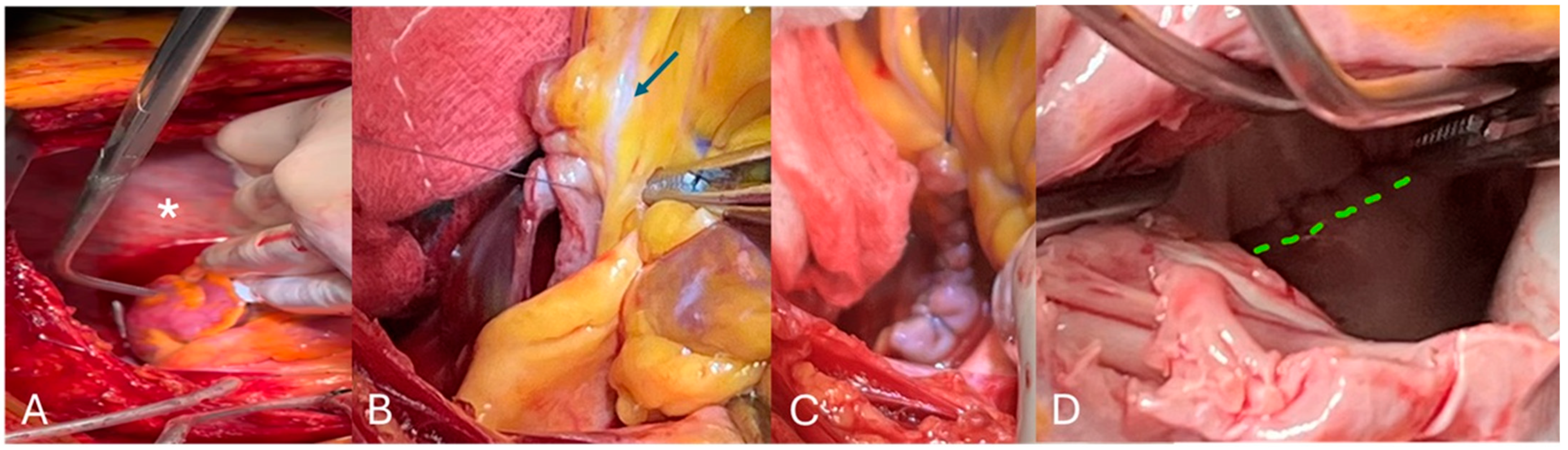
5. Surgical and Percutaneous Left Atrial Appendage Exclusion
5.1. Surgical Left Atrial Appendage Closure
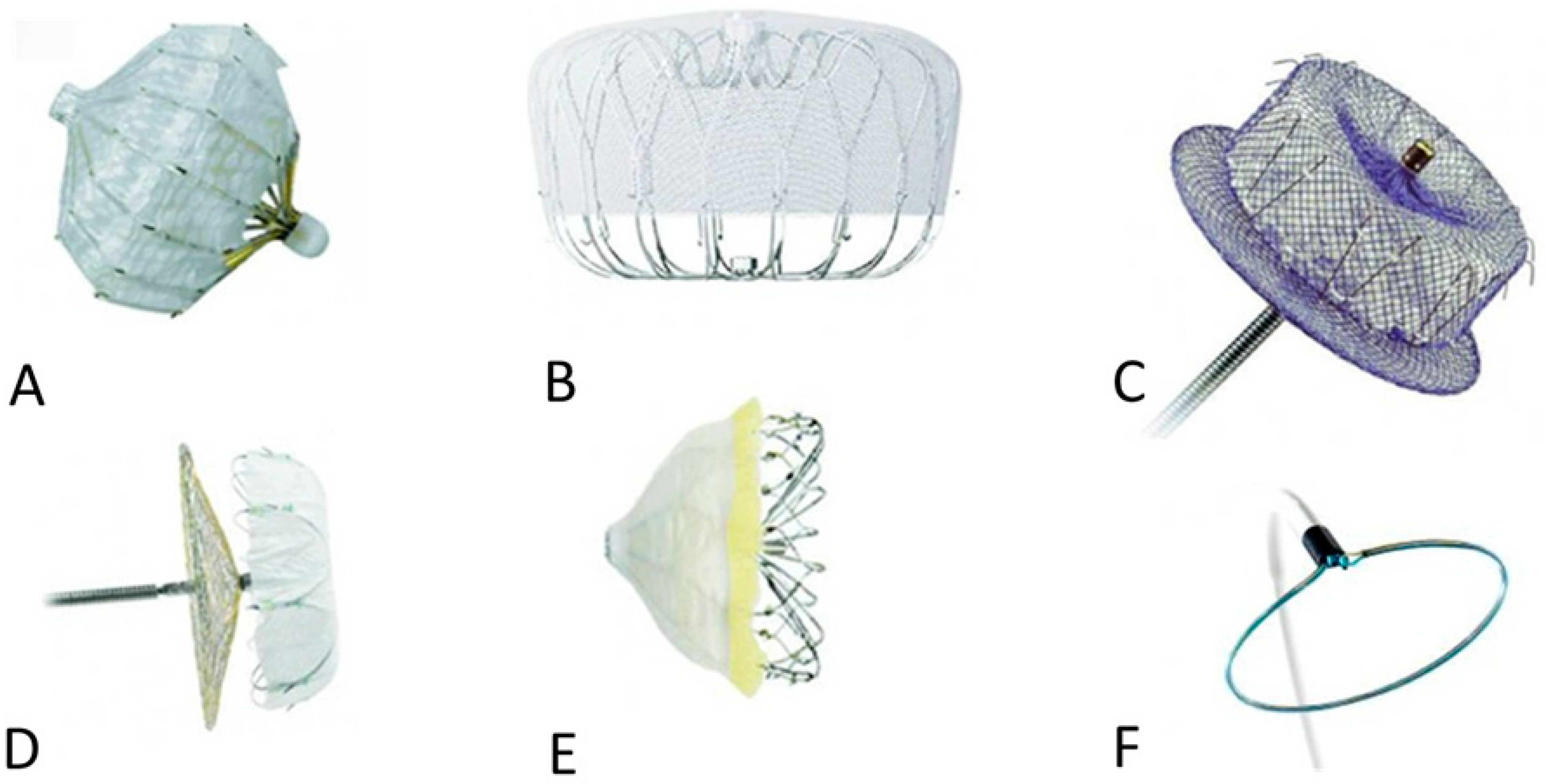
5.2. Transcatheter Left Atrial Appendage Occlusion
5.3. Anticoagulation After Percutaneous and Surgical Left Atrial Appendage Closure
5.4. Device-Related Complications
6. Discussion
7. Conclusions
Author Contributions
Funding
Data Availability Statement
Conflicts of Interest
References
- Beigel, R.; Wunderlich, N.C.; Ho, S.Y.; Arsanjani, R.; Siegel, R.J. The left atrial appendage: Anatomy, function, and noninvasive evaluation. JACC Cardiovasc. Imaging 2014, 7, 1251–1265. [Google Scholar] [CrossRef]
- Tabata, T.; Oki, T.; Yamada, H.; Abe, M.; Onose, Y.; Thomas, J.D. Relationship between left atrial appendage function and plasma concentration of atrial natriuretic peptide. Eur. J. Echocardiogr. 2000, 1, 130. [Google Scholar] [CrossRef]
- Goetze, J.P.; Bruneau, B.G.; Ramos, H.R.; Ogawa, T.; de Bold, M.K.; de Bold, A.J. Cardiac natriuretic peptides. Nat. Rev. Cardiol. 2020, 17, 698–717. [Google Scholar] [CrossRef]
- van Brakel, T.J.; van der Krieken, T.; Westra, S.W.; van der Laak, J.A.; Smeets, J.L.; van Swieten, H.A. Fibrosis and electrophysiological characteristics of the atrial appendage in patients with atrial fibrillation and structural heart disease. J. Interv. Card. Electrophysiol. 2013, 38, 85–93. [Google Scholar] [CrossRef] [PubMed]
- Yung, C.K.; Halim, N.D.S.; Choy, A.M.J. Aging-related changes in atrial compliance and fibrosis: Implications for atrial function. Heart Fail. Rev. 2020, 25, 1027–1035. [Google Scholar]
- Xingpeng, W.; Xiang, X.; Wenting, W.; Haiyun, H.; Feng, L.; Chen, W.; Qing, Y.; Huakang, L.; Zhihui, Z.; Zhiyuan, S. Risk factors associated with left atrial appendage thrombosis in patients with non-valvular atrial fibrillation by transesophageal echocardiography. Int. J. Cardiovasc. Imaging 2023, 39, 1263–1273. [Google Scholar] [CrossRef]
- Di Biase, L.; Santangeli, P.; Anselmino, M.; Mohanty, P.; Salvetti, I.; Gili, S.; Horton, R.; Sanchez, J.E.; Bai, R.; Mohanty, S.; et al. Does the left atrial appendage morphology correlate with the risk of stroke in patients with atrial fibrillation? Results from a multicenter study. J. Am. Coll. Cardiol. 2012, 60, 531–538. [Google Scholar] [CrossRef]
- Paliwal, N.; Park, H.-C.; Mao, Y.; Hong, S.J.; Lee, Y.; Spragg, D.D.; Calkins, H.; Trayanova, N.A. Slow blood-flow in the left atrial appendage is associated with stroke in atrial fibrillation patients. Heliyon 2024, 10, e26858. [Google Scholar] [CrossRef]
- Siddiqi, T.J.; Usman, M.S.; Shahid, I.; Ahmed, J.; Khan, S.U.; Ya’qoub, L.; Rihal, C.S.; Alkhouli, M. Utility of the CHA2DS2-VASc score for predicting ischaemic stroke in patients with or without atrial fibrillation: A systematic review and meta-analysis. Eur. J. Prev. Cardiol. 2022, 29, 625–631. [Google Scholar] [CrossRef] [PubMed]
- Zhu, W.-G.; Xiong, Q.-M.; Hong, K. Meta-analysis of CHADS2 versus CHA2DS2-VASc for predicting stroke and thromboembolism in atrial fibrillation patients independent of anticoagulation. Tex. Heart Inst. J. 2015, 42, 6–15. [Google Scholar] [CrossRef] [PubMed]
- Joglar, J.A.; Chung, M.K.; Armbruster, A.L.; Badhwar, V.; Bailey, S.R.; Blomstrom-Lundqvist, C.; Cannon, B.C.; Cheung, J.W.; Chugh, S.S.; Fuster, V.; et al. 2023 ACC/AHA/ACCP/HRS guideline for the diagnosis and management of atrial fibrillation: A report of the American College of Cardiology/American Heart Association Joint Committee on Clinical Practice Guidelines. Circulation 2024, 149, e1–e156. [Google Scholar] [CrossRef] [PubMed]
- Turagam, M.K.; Velagapudi, P.; Kar, S.; Holmes, D.; Reddy, V.Y.; Refaat, M.M.; Di Biase, L.; Al-Ahmed, A.; Chung, M.K.; Lewalter, T.; et al. Cardiovascular therapies targeting left atrial appendage. J. Am. Coll. Cardiol. 2018, 72, 448–463. [Google Scholar] [CrossRef] [PubMed]
- Sievert, H.; Lesh, M.D.; Trepels, T.; Omran, H.; Bartorelli, A.; Della Bella, P.; Nakai, T.; Reisman, M.; DiMario, C.; Block, P.; et al. Percutaneous left atrial appendage transcatheter occlusion to prevent stroke in high-risk patients with atrial fibrillation: Early clinical experience. Circulation 2002, 105, 1887–1889. [Google Scholar] [CrossRef]
- Burton, S.; Ahmed, R.; King, N.; Reynolds, A.; Modi, A.; Asopa, S. Clinical impact of surgical left atrial appendage occlusion during cardiac surgery in patients in sinus rhythm: A meta-analysis. Heart Rhythm. 2025, 22, 2595–2602. [Google Scholar] [CrossRef]
- Zeitani, J.; Nazzaro, M.S. Left Atrial Appendage Closure in Non-AF Patients: Balancing Immediate Risks and Long-Term Benefits. Ann. Thorac. Surg. 2025, 7. [Google Scholar] [CrossRef]
- Bilge, M.; Eryonucu, B.; Güler, N.; Erkoç, R. Right atrial appendage function in patients with chronic nonvalvular atrial fibrillation. Jpn. Heart J. 2000, 41, 451–462. [Google Scholar] [CrossRef][Green Version]
- Connolly, S.J.; Ezekowitz, M.D.; Yusuf, S.; Reilly, P.A. Dabigatran versus warfarin in patients with atrial fibrillation. N. Engl. J. Med. 2009, 361, 1139–1151. [Google Scholar] [CrossRef] [PubMed]
- Abou, R.; Leung, M.; Tonsbeek, A.M.; Podlesnikar, T.; Maan, A.C.; Schalij, M.J.; Marsan, N.A.; Delgado, V.; Bax, J.J. Effect of Aging on Left Atrial Compliance and Electromechanical Properties in Subjects Without Structural Heart Disease. Am. J. Cardiol. 2017, 120, 140–147. [Google Scholar] [CrossRef]
- Yasue, H.; Yoshimura, M.; Sumida, H.; Kikuta, K.; Kugiyama, K.; Jougasaki, M.; Ogawa, H.; Okumura, K.; Mukoyama, M.; Nakao, K. Localization and mechanism of secretion of B-type natriuretic peptide in comparison with those of A-type natriuretic peptide in normal subjects and patients with heart failure. Circulation 1994, 90, 195–203. [Google Scholar] [CrossRef]
- Shinoda, K.; Hayashi, S.; Fukuoka, D.; Torii, R.; Watanabe, T.; Nakano, T. Structural comparison between the right and left atrial appendages using multidetector computed tomography. Biomed. Res. Int. 2016, 2016, 6492183. [Google Scholar] [CrossRef]
- Okubo, A.; Doi, T.; Morii, K.; Nishizawa, Y.; Yamashita, K.; Shigemoto, K.; Mizuiri, S.; Usui, K.; Arita, M.; Naito, T.; et al. Utility of CHA2DS2-VASc score to predict mid-term clinical outcomes in hemodialysis patients. Am. J. Nephrol. 2022, 53, 169–175. [Google Scholar] [CrossRef]
- Ruff, C.T.; Giugliano, R.P.; Braunwald, E.; Hoffman, E.B.; Deenadayalu, N.; Ezekowitz, M.D.; Camm, A.J.; Weitz, J.I.; Lewis, B.S.; Parkhomenko, A.; et al. Comparison of the efficacy and safety of new oral anticoagulants with warfarin in patients with atrial fibrillation: A meta-analysis of randomized trials. Lancet 2014, 383, 955–962. [Google Scholar] [CrossRef]
- Fleg, J.L.; Strait, J. Age-associated changes in cardiovascular structure and function: A fertile milieu for future disease. Heart Fail. Rev. 2012, 17, 545–554. [Google Scholar] [CrossRef] [PubMed]
- Patel, M.R.; Mahaffey, K.W.; Garg, J.; Pan, G.; Singer, D.E.; Hacke, W.; Breithardt, G.; Halperin, J.L.; Hankey, G.J.; Piccini, J.P.; et al. Rivaroxaban versus warfarin in nonvalvular atrial fibrillation. N. Engl. J. Med. 2011, 365, 883–891. [Google Scholar] [CrossRef] [PubMed]
- Granger, C.B.; Alexander, J.H.; McMurray, J.J.V.; Lopes, R.D.; Hylek, E.M.; Hanna, M.; Al-Khalidi, H.R.; Ansell, J.; Atar, D.; Avezum, A.; et al. Apixaban versus warfarin in patients with atrial fibrillation. N. Engl. J. Med. 2011, 365, 981–992. [Google Scholar] [CrossRef]
- Giugliano, R.P.; Ruff, C.T.; Braunwald, E.; Murphy, S.A.; Wiviott, S.D.; Halperin, J.L.; Waldo, A.L.; Ezekowitz, M.D.; Weitz, J.I.; Flaker, G.C.; et al. Edoxaban versus warfarin in patients with atrial fibrillation. N. Engl. J. Med. 2013, 369, 2093–2104. [Google Scholar] [CrossRef]
- Tan, C.S.S.; Lee, S.W.H. Warfarin and food, herbal or dietary supplement interactions: A systematic review. Br. J. Clin. Pharmacol. 2021, 87, 352–374. [Google Scholar] [CrossRef] [PubMed]
- Holbrook, A.M.; Pereira, J.A.; Labiris, R.; McDonald, H.; Douketis, J.D.; Crowther, M.; Wells, P.S. Systematic overview of warfarin and its drug and food interactions. Arch. Intern. Med. 2005, 165, 1095–1106. [Google Scholar] [CrossRef]
- Ferri, N.; Colombo, E.; Tenconi, M.; Baldessin, L.; Corsini, A. Drug–drug interactions of direct oral anticoagulants (DOACs): From pharmacological to clinical practice. Pharmaceutics 2022, 14, 1120. [Google Scholar] [CrossRef]
- Bitar, Y.S.L.; Duraes, A.R.; Roever, L.; Gomes Neto, M.; Lins-Kusterer, L.; Bocchi, E.A. Comparison of the direct oral anticoagulants and warfarin in patients with atrial fibrillation and valvular heart disease: Updated systematic review and meta-analysis of randomized controlled trials. Front. Cardiovasc. Med. 2021, 8, 712585. [Google Scholar] [CrossRef]
- Acanfora, D.; Ciccone, M.M.; Scicchitano, P.; Ricci, G.; Acanfora, C.; Uguccioni, M.; Casucci, G. Efficacy and safety of direct oral anticoagulants in patients with atrial fibrillation and high thromboembolic risk: A systematic review. Front. Pharmacol. 2019, 10, 1048. [Google Scholar] [CrossRef]
- Paré, G.; Eriksson, N.; Lehr, T.; Connolly, S.; Eikelboom, J.; Ezekowitz, M.D.; Axelsson, T.; Haertter, S.; Oldgren, J.; Reilly, P.; et al. Genetic determinants of dabigatran plasma levels and their relation to bleeding. Circulation 2013, 127, 1404–1412. [Google Scholar] [CrossRef] [PubMed]
- Ji, Q.; Zhang, C.; Xu, Q.; Wang, Z.; Li, X.; Lv, Q. The impact of ABCB1 and CES1 polymorphisms on dabigatran pharmacokinetics and pharmacodynamics in patients with atrial fibrillation. Br. J. Clin. Pharmacol. 2021, 87, 2247–2255. [Google Scholar] [CrossRef] [PubMed]
- Boriani, G.; Savelieva, I.; Dan, G.A.; Deharo, J.C.; Ferro, C.; Israel, C.W.; Lane, D.A.; La Manna, G.; Mor-ton, J.; Mitjans, A.M.; et al. Chronic kidney disease in patients with car-diac rhythm disturbances or implantable electrical devices: Clinical significance and implications for decision making. Position paper of the European Heart Rhythm Association endorsed by the Heart Rhythm Society and the Asia Pacific Heart Rhythm Society. Europace 2015, 17, 1169–1196. [Google Scholar]
- Lee, S.R.; Kwon, S.; Choi, E.K.; Jung, J.H.; Han, K.D.; Oh, S.; Lip, G.Y.H. Proton pump inhibitor co-therapy in patients with atrial fibrillation treated with oral anticoagulants and a prior history of upper gastrointestinal tract bleeding. Cardiovasc. Drugs Ther. 2022, 36, 679–689. [Google Scholar] [CrossRef]
- Pastori, D.; Marang, A.; Bisson, A.; Herbert, J.; Lip, G.Y.H.; Fauchier, L. Performance of the HAS-BLED, ORBIT, and ATRIA bleeding risk scores on a cohort of 399,344 hospitalized patients with atrial fibrillation and cancer: Data from the French National Hospital Discharge Database. J. Am. Heart Assoc. 2022, 11, e026388. [Google Scholar] [CrossRef]
- Friberg, L.; Skeppholm, M.; Terent, A. Benefit of anticoagulation unlikely in patients with atrial fibrillation and a CHA2DS2-VASc score of 1. J. Am. Coll. Cardiol. 2015, 65, 225–232. [Google Scholar] [CrossRef] [PubMed]
- Larsen, T.B.; Lip, G.Y. Warfarin or novel oral anticoagulants for atrial fibrillation? Lancet 2014, 383, 931–933. [Google Scholar] [CrossRef]
- Yao, X.; Abraham, N.S.; Alexander, G.C.; Crown, W.; Montori, V.M.; Sangaralingham, L.R.; Gersh, B.J.; Shah, N.D.; Noseworthy, P.A. Effect of adherence to oral anticoagulants on risk of stroke and major bleeding among patients with atrial fibrillation. J. Am. Heart Assoc. 2016, 5, e003074. [Google Scholar] [CrossRef]
- O’Brien, E.C.; Holmes, D.N.; Ansell, J.E.; Allen, L.A.; Hylek, E.; Kowey, P.R.; Gersh, B.J.; Fonarow, G.C.; Koller, C.R.; Ezekowitz, M.D.; et al. Physician practices regarding contraindications to oral anticoagulation in atrial fibrillation: Findings from the ORBIT-AF registry. Am. Heart J. 2014, 167, 601–609.e1. [Google Scholar] [CrossRef]
- Lip, G.Y.H.; Banerjee, A.; Boriani, G.; Chiang, C.E.; Fargo, R.; Freedman, B.; Lane, D.A.; Ruff, C.T.; Turakhia, M.; Werring, D.; et al. Antithrombotic Therapy for Atrial Fibrillation: CHEST Guideline and Expert Panel Report. Chest 2018, 154, 1121–1201. [Google Scholar] [CrossRef] [PubMed]
- Flaker, G.C.; Gruber, M.; Connolly, S.J.; Goldman, S.; Chaparro, S.; Vahanian, A.; Halinen, M.O.; Horrow, J.; Halperin, J.L.; SPORTIF Investigators. Risks and benefits of combining aspirin with anticoagulant therapy in patients with atrial fibrillation: An exploratory analysis of SPORTIF trials. Am. Heart J. 2006, 152, 967–973. [Google Scholar] [CrossRef] [PubMed]
- Madden, J.L. Resection of the left auricular appendix; a prophylaxis for recurrent arterial emboli. J. Am. Med. Assoc. 1949, 140, 769–772. [Google Scholar] [CrossRef]
- Yao, X.; Gersh, B.J.; Holmes, D.R., Jr.; Melduni, R.M.; Johnsrud, D.O.; Sangaralingham, L.R.; Shah, N.D.; Noseworthy, P.A. Association of Surgical Left Atrial Appendage Occlusion with Subsequent Stroke and Mortality Among Patients Undergoing Cardiac Surgery. JAMA 2018, 319, 2116–2126. [Google Scholar] [CrossRef] [PubMed]
- D’Abramo, M.; Romiti, S.; Saltarocchi, S.; Saade, W.; Spunticchia, F.; Bruno, N.; Peruzzi, M.; Miraldi, F.; Frati, G.; Greco, E.; et al. Different techniques of surgical left atrial appendage closure and their efficacy: A systematic review. Rev. Cardiovasc. Med. 2023, 24, 184. [Google Scholar] [CrossRef]
- Apostolakis, E.; Papakonstantinou, N.A.; Baikoussis, N.G.; Koniari, I.; Papadopoulos, G. Surgical strategies and devices for surgical exclusion of the left atrial appendage: A word of caution. J. Card. Surg. 2013, 28, 199–206. [Google Scholar] [CrossRef]
- Katz, E.S.; Tsiamtsiouris, T.; Applebaum, R.M.; Schwartzbard, A.; Tunick, P.A.; Kronzon, I. Surgical left atrial appendage ligation is frequently incomplete: A transesophageal echocardiographic study. J. Am. Coll. Cardiol. 2000, 36, 468–471. [Google Scholar] [CrossRef]
- Bakhtiary, F.; Kleine, P.; Martens, S.; Dzemali, O.; Dogan, S.; Keller, H.; Schmitz, C.; Müller, T.; Weber, M.; Hoffmann, J.; et al. Simplified technique for surgical ligation of the left atrial appendage in high-risk patients. J. Thorac. Cardiovasc. Surg. 2008, 135, 430–431. [Google Scholar] [CrossRef]
- Whitlock, R.; Healey, J.; Vincent, J.; Brady, K.; Teoh, K.; Royse, A.; Shah, P.; Guo, Y.; Alings, M.; Folkeringa, R.J.; et al. Rationale and design of the Left Atrial Appendage Occlusion Study (LAAOS) III. Ann. Cardiothorac. Surg. 2014, 3, 45–54. [Google Scholar]
- Cartledge, R.; Suwalski, G.; Witkowska, A.; Gottlieb, G.; Cioci, A.; Chidiac, G.; Nowak, A.; Müller, P.; Schmidt, L.; Becker, T.; et al. Standalone epicardial left atrial appendage exclusion for thromboembolism prevention in atrial fibrillation. Interact. Cardiovasc. Thorac. Surg. 2022, 34, 548–555. [Google Scholar] [CrossRef]
- Alkhouli, M.; Ellis, C.R.; Daniels, M.; Coylewright, M.; Nielsen-Kudsk, J.E.; Holmes, D.R. Left Atrial Appendage Occlusion: Current Advances and Remaining Challenges. ACC Adv. 2022, 1, 100136. [Google Scholar]
- Bayard, Y.-L.; Omran, H.; Neuzil, P.; Meier, B.; Della Bella, P.; Trepels, T.; Block, P.; Kramer, P.; Fleschenberg, D.; Krumsdorf, U.; et al. European PLAATO Study Investigators. PLAATO for prevention of cardioembolic stroke in non-anticoagulation-eligible atrial fibrillation patients. EuroIntervention 2010, 6, 220–226. [Google Scholar] [CrossRef] [PubMed]
- Reddy, V.Y.; Holmes, D.R.; Doshi, S.K.; Kar, S.; Valdevit, L.; Buchbinder, M.; Neuzil, P.; Huber, K.; Schmidt, B.; O’Neill, W.W.; et al. Percutaneous left atrial appendage closure for stroke prophylaxis in patients with nonvalvular atrial fibrillation: 2.3-year follow-up of the PROTECT AF trial. J. Am. Coll. Cardiol. 2013, 61, 470–476. [Google Scholar]
- Boersma, L.V.; Schmidt, B.; Betts, T.R.; Sievert, H.; Tamburino, C.; Teiger, E.; Meier, B.; Reddy, V.Y.; Holmes, D.R.; Nakai, T.; et al. Implant success and safety of left atrial appendage closure with the WATCHMAN device: Peri-procedural outcomes from the EWOLUTION registry. Eur. Heart J. 2016, 37, 2465–2474. [Google Scholar] [CrossRef]
- Piccini, J.P.; Sievert, H.; Patel, M.R. Left atrial appendage occlusion: Rationale, evidence, devices, and patient selection. Eur. Heart J. 2017, 38, 869–876. [Google Scholar] [CrossRef]
- Lllli, O.; Doshi, S.; Kar, S.; Holmes, D.R.; Valdevit, L.; Buchbinder, M.; Neuzil, P.; Huber, K.; Schmidt, B.; O’Neill, W.W.; et al. Quality of life assessment in the randomized PROTECT AF trial of patients at risk for stroke with nonvalvular atrial fibrillation. J. Am. Coll. Cardiol. 2013, 61, 1790–1798. [Google Scholar]
- Holmes, D.R., Jr.; Kar, S.; Price, M.J.; Whisenant, B.; Sievert, H.; Doshi, S.K.; Valdevit, L.; Neuzil, P.; Huber, K.; Schmidt, B.; et al. Prospective randomized evaluation of the Watchman Left Atrial Appendage Closure device in patients with atrial fibrillation versus long-term warfarin therapy: The PREVAIL trial. J. Am. Coll. Cardiol. 2014, 64, 1–12. [Google Scholar] [CrossRef]
- Landmesser, U.; Holmes, D.R., Jr. Left atrial appendage closure: A percutaneous transcatheter approach for stroke prevention in atrial fibrillation. Eur. Heart J. 2012, 33, 698–704. [Google Scholar] [CrossRef] [PubMed]
- Reddy, V.Y.; Mobius-Winkler, S.; Miller, M.A.; Neuzil, P.; Schuler, G.; Hildick-Smith, D.; Huber, K.; Kuck, K.-H.; Mansour, M.; Schmidt, B.; et al. Left atrial appendage closure with the Watchman device in patients with a contraindication for oral anticoagulation: The ASAP study. J. Am. Coll. Cardiol. 2013, 61, 2551–2556. [Google Scholar] [CrossRef]
- Tzikas, A.; De Martino, K.; Marwan, M.; Hausleiter, J.; Gafoor, S.; Shakir, S.; Rück, A.; Schömig, A.; Sievert, H.; Meier, B.; et al. Left atrial appendage occlusion with Amplatzer Cardiac Plug/Amplatzer Amulet devices: Early and mid-term results from a large multicentre registry. EuroIntervention 2017, 13, 867–876. [Google Scholar]
- Tichelbäcker, T.; Scherner, L.; Puls, M.; Wöhrle, J.; Blessing, E.; Schmidt, T.; Thielmann, M.; Kuck, K.H.; Lempereur, M.; Al-Attar, N.; et al. Mid-term outcomes of left atrial appendage occlusion with the Amplatzer Cardiac Plug and Amplatzer Amulet devices in a high-risk cohort. Sci. Rep. 2020, 10, 16323. [Google Scholar] [CrossRef]
- Lakkireddy, D.; Thaler, D.; Ellis, C.R.; Holmes, D.R.; Reddy, V.Y.; Kar, S.; Salih, M.; Schneider, P.A.; Huber, K.; Hildick-Smith, D.; et al. Three-year outcomes from the Amplatzer Amulet left atrial appender occluder randomized controlled trial (Amulet IDE). J. Am. Coll. Cardiol. Intv 2023, 16, 1902–1913. [Google Scholar] [CrossRef]
- Rashid, H.N.; Layland, J. Association between device-related thrombus and the neo-appendage with left-atrial appendage occlusion devices. Eur. Heart J. 2021, 42, 1047–1048. [Google Scholar] [CrossRef]
- Park, J.W.; Sievert, H.; Kleinecke, C.; Vaskelyte, L.; Schnupp, S.; Abu-Zeitone, A.; Hildick-Smith, D.; Tzikas, A.; De Maria, E.; Kowalski, M.; et al. Left atrial appendage occlusion with LAmbre in atrial fibrillation: Initial European experience. Int. J. Cardiol. 2018, 265, 97–102. [Google Scholar] [CrossRef]
- Huang, H.; Liu, Y.; Xu, Y.; Zhang, Y.; Li, Y.; Wang, C.; Chen, J.; Zhao, X.; Liang, D.; Zhou, Q.; et al. Percutaneous left atrial appendage closure with the LAmbre device for stroke prevention in atrial fibrillation: A prospective, multicenter clinical study. J. Am. Coll. Cardiol. Intv 2017, 10, 2188–2194. [Google Scholar] [CrossRef] [PubMed]
- Asmarats, L.; Rodés-Cabau, J. Percutaneous Left Atrial Appendage Closure: Current Devices and Clinical Outcomes. Circ. Cardiovasc. Interv. 2017, 10, e005441. [Google Scholar] [CrossRef] [PubMed]
- Sanchez, J.M.; Lee, A.; Bartus, K.; Lee, R.J. Percutaneous epicardial approach for LAA ligation. J. Interv. Card. Electrophysiol. 2021, 62, 293–297. [Google Scholar] [CrossRef]
- Mesnier, J.; Cepas-Guillén, P.; Freixa, X.; Flores-Umanzor, E.; Trinh, K.H.; O’Hara, G.; Rodés-Cabau, J. Antithrombotic Management After Left Atrial Appendage Closure: Current Evidence and Future Perspectives. Circ. Cardiovasc. Interv. 2023, 16, e012812. [Google Scholar] [CrossRef]
- Søndergaard, L.; Wong, Y.H.; Reddy, V.Y.; Boersma, L.V.A.; Bergmann, M.W.; Doshi, S.; Kar, S.; Sievert, H.; Wehrenberg, S.; Stein, K.; et al. Propensity-Matched Comparison of Oral Anticoagulation Versus Antiplatelet Therapy After Left Atrial Appendage Closure with WATCHMAN. JACC Cardiovasc. Interv. 2019, 12, 1055–1063. [Google Scholar] [CrossRef]
- Procopio, A.; Radico, F.; Gragnano, F.; Ghiglieno, C.; Fassini, G.; Filtz, A.; Barbarossa, A.; Sacchetta, D.; Faustino, M.; Ricci, F.; et al. A real-world multicenter study on left atrial appendage occlusion: The Italian multi-device experience. Int. J. Cardiol. Heart Vasc. 2024, 51, 101391. [Google Scholar] [CrossRef] [PubMed]
- Lip, G.Y.H.; Collet, J.P.; Haude, M.; Byrne, R.; Chung, E.H.; Fauchier, L.; Halvorsen, S.; Lau, D.; Lopez-Cabanillas, N.; Lettino, M.; et al. 2018 Joint European consensus document on the management of antithrombotic therapy in atrial fibrillation patients presenting with acute coronary syndrome and/or undergoing percutaneous cardiovascular interventions. Europace 2019, 21, 192–193. [Google Scholar] [CrossRef]
- Paitazoglou, C.; Bergmann, M.W.; Ince, H.; Kische, S.; Romanov, A.; Schmitz, T.; Schmidt, B.; Gori, T.; Meincke, F.; Protopopov, A.V.; et al. True Efficacy of LAA Closure: Patient Outcomes on Long-term Single-Antiplatelet or No Therapy: Insights from the EWOLUTION Registry. J. Invasive Cardiol. 2022, 34, E348–E355. [Google Scholar] [CrossRef]
- Osman, M.; Busu, T.; Osman, K.; Khan, S.U.; Daniels, M.; Holmes, D.R.; Reddy, V.Y.; Boersma, L.V.; Tzikas, A.; Kar, S.; et al. Short-term antiplatelet versus anticoagulant therapy after left atrial appendage occlusion: A systematic review and meta-analysis. JACC Clin. Electrophysiol. 2020, 6, 494–506. [Google Scholar] [CrossRef]
- Rotta Detto Loria, J.; Desch, S.; Pöss, J.; Kirsch, K.; Thiele, H.; Sandri, M. Percutaneous Left Atrial Appendage Occlusion—Current Evidence and Future Directions. J. Clin. Med. 2023, 12, 7292. [Google Scholar] [CrossRef] [PubMed]
- Wang, Y.; Di Biase, L.; Horton, R.P.; Nguyen, T.; Morhanty, P.; Natale, A. Left Atrial Appendage Studied by Computed Tomography to Help Planning for Appendage Closure Device Placement. J. Cardiovasc. Electrophysiol. 2010, 21, 973–982. [Google Scholar] [CrossRef]
- Piayda, K.; Sievert, K.; Della Rocca, D.G.; Tzikas, A.; Omran, H.; Neuzil, P.; Meier, B.; Nickenig, G.; Kirchhof, P.; Hammerstingl, C.; et al. Safety and feasibility of peri-device leakage closure after LAAO: An international, multicentre collaborative study. EuroIntervention 2021, 17, e1033–e1040. [Google Scholar] [CrossRef] [PubMed]
- Samaras, A.; Papazoglou, A.S.; Balomenakis, C.; Pappa, E.; Koutsogiannis, N.; Deftereos, S.; Tousoulis, D.; Vassilikos, V.; Tzeis, S.; Nanas, J.; et al. Residual leaks following percutaneous left atrial appendage occlusion and outcomes: A meta-analysis. Eur. Heart J. 2024, 45, 885–898. [Google Scholar] [CrossRef] [PubMed]
- Sularz, A.; Chavez Ponce, A.; Al-Abcha, A.; Simard, T.; Killu, A.M.; Doshi, S.K.; Alkhouli, M. Safety and Feasibility of 3D Intracardiac Echocardiography in Guiding Left Atrial Appendage Occlusion with WATCHMAN FLX. JACC Adv. 2025, 4, 101570. [Google Scholar] [CrossRef]
- Sandhu, A.; Varosy, P.D.; Du, C.; Aleong, R.G.; Tumolo, A.Z.; West, J.J.; Freeman, J.V.; Curtis, J.P.; Friedman, D.J.; Hess, P.L.; et al. Device-Sizing and Associated Complications with Left Atrial Appendage Occlusion: Findings from the NCDR LAAO Registry. Circ. Cardiovasc. Interv. 2022, 15, e012183. [Google Scholar] [CrossRef]
- Namrouti, A.; Elias, E.; Quesada, R.; Patel, N. Percutaneous Retrieval of Free-Floating Amulet Device from Left Atrium. JACC Case Rep. 2025, 30, 8. [Google Scholar] [CrossRef]
- Lempereur, M.; Aminian, A.; Saw, J. Rebuttal with regards to “Device-associated thrombus formation after left atrial appendage occlusion: A systematic review of events reported with the Watchman, the Amplatzer Cardiac Plug and the Amulet”. Catheter Cardiovasc. Interv. 2018, 92, E216–E217. [Google Scholar] [CrossRef]
- Fauchier, L.; Cinaud, A.; Brigadeau, F.; Lepillier, A.; Pierre, B.; Abbey, S.; Fatemi, M.; Franceschi, F.; Guedeney, P.; Jacon, P.; et al. Device-related thrombosis after percutaneous left atrial appendage occlusion for atrial fibrillation. J. Am. Coll. Cardiol. 2018, 71, 1528–1536. [Google Scholar] [CrossRef]
- Hildick-Smith, D.; Landmesser, U.; Camm, A.J.; Diener, H.C.; Paul, V.; Schmidt, B.; Settergren, M.; Teiger, E.; Nielsen-Kudsk, J.E.; Tondo, C. Left atrial appendage occlusion with the Amplatzer™ Amulet™ device: Full results of the prospective global observational study. Eur. Heart J. 2020, 41, 2894–2901. [Google Scholar] [CrossRef]
- Cochet, H.; Iriart, X.; Sridi, S.; Camaioni, C.; Corneloup, O.; Montaudon, M.; Laurent, F.; Selmi, W.; Renou, P.; Jalal, Z.; et al. Left atrial appendage patency and device-related thrombus after percutaneous left atrial appendage occlusion: A computed tomography study. Eur. Heart J. Cardiovasc. Imaging 2018, 19, 1351–1361. [Google Scholar] [CrossRef]
- Sedaghat, A.; Vij, V.; Al-Kassou, B.; Gloekler, S.; Galea, R.; Fürholz, M.; Meier, B.; Valgimigli, M.; O’Hara, G.; Arzamendi, D.; et al. Device-related thrombus after left atrial appendage closure: Data on thrombus characteristics, treatment strategies, and clinical outcomes from the EUROC-DRT registry. Circ. Cardiovasc. Interv. 2021, 14, e010195. [Google Scholar] [CrossRef] [PubMed]
- Dukkipati, S.R.; Kar, S.; Holmes, D.R.; Doshi, S.K.; Swarup, V.; Gibson, D.N.; Maini, B.; Gordon, N.T.; Main, M.L.; Reddy, V.Y. Device-Related Thrombus After Left Atrial Appendage Closure: Incidence, Predictors, and Outcomes. Circulation 2018, 138, 874–885. [Google Scholar] [CrossRef] [PubMed]
- Holmes, D.R., Jr.; Reddy, V.Y.; Gordon, N.T.; Delurgio, D.; Doshi, S.K.; Desai, A.J. Left atrial appendage closure: Lessons learned from randomized trials and real-world experience. J. Am. Coll. Cardiol. 2020, 75, 3180–3191. [Google Scholar]
- Hylek, E.M.; Held, C.; Alexander, J.H.; Lopes, R.D.; De Caterina, R.; Wojdyla, D.M.; Huber, K.; Jansky, P.; Steg, P.G.; Hanna, M.; et al. Major bleeding in patients with atrial fibrillation receiving apixaban or warfarin: The ARISTOTLE Trial. J. Am. Coll. Cardiol. 2014, 63, 2141–2147. [Google Scholar] [CrossRef]
- Goodman, S.G.; Wojdyla, D.M.; Piccini, J.P.; White, H.D.; Paolini, J.F.; Nessel, C.C.; Berkowitz, S.D.; Mahaffey, K.W.; Patel, M.R.; Sherwood, M.W.; et al. Factors associated with major bleeding events: Insights from the ROCKET AF trial. J. Am. Coll. Cardiol. 2014, 63, 891–900. [Google Scholar] [CrossRef]



| LAA Morphology | Thromboembolic Risk | Flow/Function | Preferred Intervention | Post-Procedural Antithrombotic Strategy |
|---|---|---|---|---|
| Chicken Wing | Low | Good emptying | OAC or Watchman | Standard OAC/DAPT |
| Windsock | Intermediate | Moderate flow | OAC or Watchman/Amulet | OAC 4–6 wks → DAPT 3–6 mo |
| Cactus | High | Slower emptying | Amulet/Epicardial LAAO | DAPT 3–6 mo or tailored SAPT |
| Cauliflower | Very High | Severe stasis | Amulet/Epicardial LAAO/Surgical excision | Individualized; high bleeding risk → SAPT |
Disclaimer/Publisher’s Note: The statements, opinions and data contained in all publications are solely those of the individual author(s) and contributor(s) and not of MDPI and/or the editor(s). MDPI and/or the editor(s) disclaim responsibility for any injury to people or property resulting from any ideas, methods, instructions or products referred to in the content. |
© 2025 by the authors. Licensee MDPI, Basel, Switzerland. This article is an open access article distributed under the terms and conditions of the Creative Commons Attribution (CC BY) license.
Share and Cite
Zeitani, J.; Likaj, E.; Nazzaro, M.S.; Dibra, A.; Sievert, K.; Sievert, H. The Left Atrial Appendage in Sinus Rhythm and Atrial Fibrillation: From Functional Structure to Potential Thromboembolic Reservoir, Rationale for Medical or Radical Exclusion. J. Clin. Med. 2026, 15, 284. https://doi.org/10.3390/jcm15010284
Zeitani J, Likaj E, Nazzaro MS, Dibra A, Sievert K, Sievert H. The Left Atrial Appendage in Sinus Rhythm and Atrial Fibrillation: From Functional Structure to Potential Thromboembolic Reservoir, Rationale for Medical or Radical Exclusion. Journal of Clinical Medicine. 2026; 15(1):284. https://doi.org/10.3390/jcm15010284
Chicago/Turabian StyleZeitani, Jacob, Ermal Likaj, Marco Stefano Nazzaro, Alban Dibra, Kolja Sievert, and Horst Sievert. 2026. "The Left Atrial Appendage in Sinus Rhythm and Atrial Fibrillation: From Functional Structure to Potential Thromboembolic Reservoir, Rationale for Medical or Radical Exclusion" Journal of Clinical Medicine 15, no. 1: 284. https://doi.org/10.3390/jcm15010284
APA StyleZeitani, J., Likaj, E., Nazzaro, M. S., Dibra, A., Sievert, K., & Sievert, H. (2026). The Left Atrial Appendage in Sinus Rhythm and Atrial Fibrillation: From Functional Structure to Potential Thromboembolic Reservoir, Rationale for Medical or Radical Exclusion. Journal of Clinical Medicine, 15(1), 284. https://doi.org/10.3390/jcm15010284