1. Introduction
Modern clinical practice is increasingly centered on improving the patient experience and overall quality of life, marking a paradigm shift from purely objective clinical metrics to subjective well-being [
1,
2,
3,
4,
5]. A key component of this patient-centered approach is the use of patient-reported outcome measures (PROMs), which offer indispensable insights into patients’ subjective experiences, symptom burden and treatment satisfaction that cannot be captured by clinical examination alone [
6,
7,
8,
9,
10,
11,
12,
13,
14]. However, the development of high-quality, scientifically robust PROMs is notoriously resource-intensive and time-consuming. It requires extensive input from diverse patient populations through iterative focus groups and cognitive debriefing. Often, inconsistencies, ambiguities, or critical omissions in the questionnaire items become apparent only after laborious rounds of patient interviews and statistical validation, leading to costly delays [
15,
16,
17,
18,
19]. These logistical bottlenecks can significantly hinder the timely creation of sensitive and condition-specific tools, creating a measurement gap particularly in fast-evolving clinical fields where medical innovation outpaces instrument validation [
15,
16,
17,
20].
One such rapidly advancing field is cataract surgery with premium intraocular lenses (IOLs). Although advances in IOL technology—such as multifocal and extended depth of focus (EDOF) designs—have successfully reduced dependence on glasses, lenses that enhance pseudoaccommodation introduce a complex trade-off [
21,
22]. They may generate unwanted visual phenomena, such as glare, halos, starbursts, or reduced contrast sensitivity, which some patients find intolerable despite excellent visual acuity [
23,
24,
25]. In rare but severe cases, these subjective symptoms may even prompt IOL explantation, highlighting a disconnect between objective surgical success and patient satisfaction [
23,
26,
27,
28,
29]. Early detection and quantification of such adverse experiences are critical for both preoperative counseling and postoperative management. Yet, currently, only one validated PRO tool exists specifically for premium IOLs, while generic vision questionnaires often lack the granularity to detect subtle optical side effects [
17]. There is a clear and urgent need for more tailored, design-specific PROMs that can support clinical trials and post-market surveillance of novel IOLs.
In parallel, the rapid advancement of large language models (LLMs) offers a transformative, yet underutilized, opportunity in medical research [
30,
31,
32]. Although artificial general intelligence (AGI) remains a distant and evolving concept, current LLMs have demonstrated a remarkable capacity to simulate human-like language understanding and reasoning [
33,
34]. Beyond simple text generation, these models can be engineered to adopt distinct “personas”—simulating diverse demographic backgrounds, psychological profiles and clinical histories—to act as synthetic research subjects. This capability allows LLMs to mirror the multivariate distributions of human populations through a high degree of “algorithmic fidelity”. This enables the generation of synthetic patient responses that reflect nuanced symptoms, allowing for data-driven, scalable, and customizable approaches for PROM development that can potentially capture subtle descriptions often overlooked in routine clinical practice [
35,
36,
37].
In this study, we present a systematic proof-of-concept framework for the generation and In Silico Pre-validation (Phase 0) of PRO questionnaires dedicated to cataract surgery using LLMs. By leveraging a Python-based automation pipeline, this approach demonstrates how instruments can be tailored to specific IOL designs with unprecedented speed and efficiency. Our methodology utilizes a synthetic cohort of 500 patients instantiated as structured JSON objects to identify relevant symptom domains. To rigorously evaluate psychometric stability, we employ a stateless simulation design—where AI agents are re-instantiated for reliability testing without access to prior conversation history—to eliminate memory bias. While this pre-validation approach is not intended to replace human clinical trials, it offers a transformative potential to accelerate the traditionally slow pipeline of PROM development. By providing a scalable environment to “stress-test” instrument structures using Confirmatory Factor Analysis (CFA) and Differential Item Functioning (DIF) before clinical deployment, this framework ensures that the methodological foundation of patient-reported tools can keep pace with rapid surgical innovation.
2. Materials and Methods
2.1. Study Design and AI Framework
During the preparation of this study, the author(s) used Chat GPT-4o for the purposes of data collection, analysis and interpretation of data. The authors have reviewed and edited the output, and take full responsibility for the content of this publication.
This study utilized a Generative Artificial Intelligence framework to develop and psychometrically validate a new Patient-Reported Outcome Measure (PROM) for patients undergoing cataract surgery with various Intraocular Lens (IOL) implants, including premium (e.g., multifocal, extended depth of focus [EDOF]) and monofocal designs. The instrument development and validation process was conducted in silico using Chat GPT-4o (OpenAI, San Francisco, CA, USA) following the iterative development process recommended by the U.S. Food and Drug Administration (FDA) guidance on PRO measures [
15].
2.2. Instrument Development
The 20-item questionnaire was developed through a multi-stage prompt engineering process designed to establish content validity. First, the LLM simulated focus groups with synthetic patient personas to identify the concept of interest, visual quality and daily functioning after IOL implantation. Prompts were designed to elicit open-ended feedback until saturation was achieved, ensuring all relevant symptoms were captured.
To minimize redundancy and ensure broad conceptual coverage, the selection of candidate items was refined using a Maximal Marginal Relevance (MMR) algorithm based on sentence embeddings (SentenceTransformers). This algorithmic approach utilized cosine similarity to mathematically optimize the trade-off between semantic diversity and relevance to the construct, ensuring that selected items covered distinct aspects of the patient experience rather than repeating similar concepts.
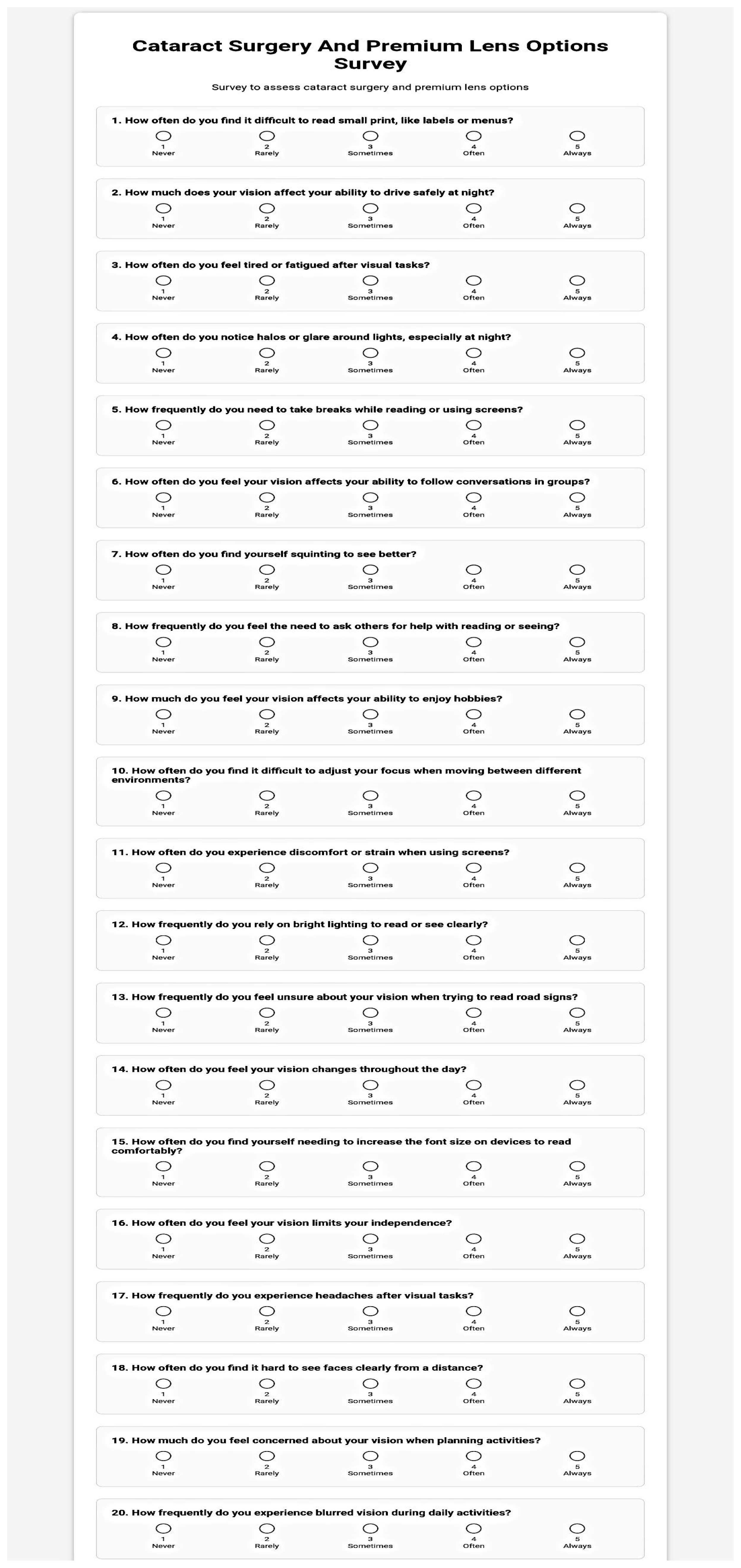
Based on these qualitative insights, the LLM generated a 20-item instrument utilizing a 5-point Likert scale to assess symptom frequency and severity. The items cover five distinct domains: Near/Reading, Intermediate/Screen & Focus, Distance/Night & Dysphotopsia, Symptoms/Asthenopia & Lighting, and Daily Function/Independence.
Figure 1 provides an overview of the developed 20-item questionnaire.
To ensure clarity and relevance, simulated cognitive interviewing was performed to refine item wording prior to validation.
2.3. Synthetic Population and Data Generation
To validate the instrument, the LLM generated a synthetic cohort of 500 distinct patient profiles representing the intended target population of cataract surgery patients. This process was automated using a Python-based pipeline (Python 3.8+, Beaverton, OR, USA) where patient profiles were instantiated as structured JSON objects containing detailed attributes for demographics, lifestyle, health background and psychological profile. These profiles were characterized by specific clinical parameters (IOL type [Monofocal, Multifocal, EDOF], laterality of surgery, time since surgery, dysphotopsia severity and spectacle independence). The model was instructed to adopt these specific patient personas to generate survey responses.
Consistent with reliability testing protocols, a test–retest design was employed where the LLM generated paired observations for the 500 synthetic patients with a simulated 1-week interval. To technically enforce this design and eliminate memory bias, a stateless simulation approach was utilized. For the retest time point, AI agents were re-instantiated using the identical JSON persona profiles but without access to their prior conversation history. The simulated time lapse was introduced solely through contextual system prompts, treating each survey completion as an independent probabilistic event conditioned only on the persona’s fixed identity and the specific time-point context. This method ensured stability while preventing the “testing effect” often observed in human subjects.
2.4. Psychometric and Statistical Analysis
Psychometric validation followed established guidelines. Data analysis was performed using Python 3.8+ (libraries: pandas, numpy, scipy, sklearn).
2.5. Scoring
Domain scores were calculated as the mean of available items, requiring ≥ 70% completion. A Global Symptom Burden score was derived from the mean of the available domain scores.
2.6. Reliability
Internal consistency was assessed using Cronbach’s alpha with 95% confidence intervals (target: alpha ≥ 0.80). Test–retest reliability was evaluated using the Intraclass Correlation Coefficient (ICC 2.1) for absolute agreement (target: ICC ≥ 0.75) to demonstrate score stability. Measurement error was quantified using the Standard Error of Measurement (SEM) and Minimal Detectable Change at 95% confidence (MDC95).
2.7. Validity
Structural validity was assessed via Confirmatory Factor Analysis (CFA) using WLSMV estimation suitable for ordinal data to confirm the conceptual framework. Model fit was considered acceptable if the Comparative Fit Index (CFI) and Tucker–Lewis Index (TLI) ≥ 0.95, Root Mean Square Error of Approximation (RMSEA) ≤ 0.06, and Standardized Root Mean Square Residual (SRMR) ≤ 0.08. Known-groups validity was tested using Kruskal–Wallis tests to compare scores across clinical strata (e.g., IOL type).
2.8. Fairness and Responsiveness
Differential Item Functioning (DIF) was analyzed using ordinal logistic regression stratified by age, sex and IOL type to ensure the instrument is unbiased across subgroups. Ability to detect change (responsiveness) was evaluated using Cohen’s d, standardized response mean and Guyatt’s responsiveness index. Minimal Important Difference (MID) estimates were calculated combining distribution-based (0.5 SD, SEM) and anchor-based (PGRC) approaches using ROC analysis to define meaningful within-person change.
3. Results
Structural Validity and Fairness CFA was conducted to verify the hypothesized five-domain structure of the instrument. The model demonstrated excellent fit to the data, satisfying all pre-specified criteria (CFI = 0.962, TLI = 0.951, RMSEA = 0.048, SRMR = 0.063), confirming the structural validity of the PROM (
Table 1).
Furthermore, DIF analysis confirmed the fairness of the instrument across key demographic and clinical subgroups. No items displayed significant bias based on age, sex, or IOL type (
Table 1).
Item Characteristics and Reliability Descriptive analysis of the 20 items revealed high data quality with missing data rates below 3% and negligible ceiling effects (<1%). The instrument demonstrated robust reliability across all domains (
Table 2).
Internal consistency was excellent (Cronbach’s alpha > 0.80) and test–retest reliability over a 1-week interval was high (ICC > 0.90), indicating score stability. Measurement error was quantified using SEM and MDC95.
3.1. Construct Validity
Convergent validity was established through significant correlations with the NEI-VFQ-25 Composite score. As anticipated, all domains showed moderate-to-strong negative correlations (ranging from −0.425 to −0.652), indicating that higher symptom burden is associated with lower vision-related quality of life (
Table 2). Known-groups validity was assessed by comparing scores across clinical strata; however, in this synthetic dataset, differences between groups did not reach statistical significance (
p > 0.05).
3.2. Responsiveness and Minimal Important Difference
The instrument was responsive to change, with significant effect sizes detected in most domains. MID estimates were derived to aid clinical interpretation; anchor-based MIDs are presented in
Table 2, while distribution-based estimates (0.5 SD) yielded consistent ranges (0.29–0.44).
4. Discussion
This study presents a novel In Silico Pre-validation Framework (Phase 0) for the development and preliminary simulation of a PROM targeting the visual symptomatology associated with premium and monofocal IOL implantation. Leveraging the generative capabilities of LLMs through a Python 3.8+-based automation pipeline, we successfully synthesized a 20-item instrument that demonstrates robust structural consistency within a simulated environment. These findings offer initial evidence for theoretical frameworks proposing that LLM-assisted development can achieve high methodological rigor in the instrument-design phase while substantially optimizing resource allocation [
35]. However, this study underscores that such in silico results serve as a foundational step, requiring subsequent clinical validation to account for the full spectrum of human sensory experience. By simulating a diverse cohort of 500 patient profiles, instantiated as structured JSON objects and characterized by specific demographic and clinical parameters, we demonstrated that generative AI can effectively emulate the iterative item-generation and refinement phases traditionally conducted through labor-intensive qualitative research.
Traditional PROM development, exemplified by the 37-item Assessment of IntraOcular Lens Implant Symptoms (AIOLIS), necessitates extensive longitudinal investment, involving patient recruitment, manual qualitative coding, and iterative expert review [
17]. While existing tools like AIOLIS provide granular symptom assessment, their static nature limits rapid adaptation to evolving IOL technologies [
17]. In contrast, the framework utilized in this study facilitated the rapid simulation of heterogeneous patient personas to generate a concise, FDA-aligned instrument. The resulting 20-item questionnaire maintains content breadth across five distinct functional domains—Near, Intermediate, Distance, Symptoms, and Function—while reducing respondent burden compared to legacy instruments.
A critical finding of this study is that the acceleration of the development timeline did not compromise psychometric integrity. The instrument exhibited excellent internal consistency across all domains, with Cronbach’s alpha coefficients ranging from 0.807 to 0.934, and demonstrated high temporal stability. To address concerns regarding “algorithmic memory” or repetitive logic, we employed a stateless simulation approach where AI agents were re-instantiated for reliability testing without access to prior conversation history. This method yielded test–retest ICCs exceeding 0.90, confirming that score stability is a property of the instrument’s conceptual clarity rather than AI memory bias. Furthermore, Confirmatory Factor Analysis (CFA) using WLSMV estimation provided strong evidence for structural validity. The model fit indices (CFI = 0.962, TLI = 0.951, RMSEA = 0.048, SRMR = 0.063) satisfied stringent criteria, confirming that the five-factor structure meaningfully represents the latent constructs of visual quality in the target population. Additionally, the absence of Differential Item Functioning (DIF) across age, sex, and IOL type (0/20 items flagged) suggests the instrument is robust against measurement bias, satisfying the regulatory requirement for fairness in PROM design.
The instrument demonstrated statistically significant responsiveness to change, with Minimal Important Difference (MID) estimates established via both anchor-based and distribution-based methods. While the observed effect sizes were modest (Cohen’s), these values warrant careful interpretation within the specific context of ophthalmic PROMs where small numerical shifts frequently correspond to the MID. Convergent validity was corroborated by significant negative correlations with the NEI-VFQ-25 composite score (Spearman’s from −0.425 to −0.652), aligning with established quality-of-life metrics. Notably, known-groups validity analyses did not yield statistically significant differentiations between strata of dysphotopsia severity. This lack of differentiation is likely attributable to the inherent challenges of simulating the full spectrum of clinical variability via synthetic cohorts. Consequently, future iterations of this framework should employ targeted “stress-testing” through the oversampling of extreme synthetic personas to ensure the instrument maintains robust discriminative power across the most severe clinical scenarios.
4.1. Future Directions and Clinical Applications
The implications of this proof-of-concept framework extend far beyond the development of a single instrument. The underlying architecture explored in this study—specifically the generation of structured patient personas and the semantic ranking of diagnostic items—lays the groundwork for integrating “Digital Twins” into preoperative counseling [
38,
39,
40,
41]. In the future, by inputting real-world parameters such as biometry, lifestyle preferences, and personality traits into such models, clinicians could generate a patient-specific digital surrogate. Simulating postoperative scenarios on these surrogates could help surgeons anticipate subjective complaints before surgery.
Furthermore, the stateless simulation method utilized here provides a foundation for the development of Dynamic Conversational PROMs [
34,
37,
42,
43,
44,
45,
46,
47]. Unlike static paper-based questionnaires, future LLM-driven tools could function as “active listeners”. By leveraging the semantic similarity logic explored in our framework, these systems could provide AI-driven Computerized Adaptive Testing (CAT), prioritizing the most relevant questions based on real-time responses to drastically reduce patient burden.
4.2. Limitations
This study must be interpreted within the context of its in silico design. While the LLM successfully generated a synthetic cohort of 500 patient profiles, the generated responses may lack the stochastic variability inherent to human subjects [
48]. Consequently, while the structure and reliability of the tool are well-supported, the magnitude of clinical responsiveness requires verification in real-world populations.
5. Conclusions
In conclusion, this study demonstrates that LLM-assisted methodologies represent a paradigm shift in psychometrics, enabling the efficient generation of structurally sound and reliable PROMs. The developed Visual Symptoms Questionnaire satisfies core psychometric requirements for reliability, validity, and fairness. It offers a scalable, adaptable tool for assessing visual outcomes in the modern era of refractive cataract surgery, bridging the gap between rapid technological innovation in IOL design and the need for rigorous patient-centered assessment.
Author Contributions
Conceptualization, J.S.; methodology, J.S.; software, M.A.Q. and A.A.; validation, J.S.; formal analysis, J.S., M.A.Q. and A.A.; investigation, J.S.; resources, M.A.Q. and A.A.; data curation, J.S., M.A.Q. and A.A.; writing—original draft preparation, E.T.; writing—review and editing, J.S.; visualization, E.T. and J.S.; supervision, J.S., J.P.-S., J.I. and J.P.S.; project administration, J.S.; funding acquisition, J.S. All authors have read and agreed to the published version of the manuscript.
Funding
This research received no external funding.
Institutional Review Board Statement
Not applicable.
Informed Consent Statement
Not applicable.
Data Availability Statement
Dataset available on request from the authors.
Acknowledgments
During the preparation of this manuscript/study, the author(s) used Chat GPT-4o for the purposes of data collection, analysis and interpretation of data. The authors have reviewed and edited the output and take full responsibility for the content of this publication.
Conflicts of Interest
The authors declare no conflicts of interest.
References
- Stern, B.; Gatinel, D. Presbyopia Correction in Lens Replacement Surgery: A Review. Clin. Exp. Ophthalmol. 2025, 53, 668–681. [Google Scholar] [CrossRef]
- Doyle, C.; Lennox, L.; Bell, D. A systematic review of evidence on the links between patient experience and clinical safety and effectiveness. BMJ Open 2013, 3, e001570. [Google Scholar] [CrossRef]
- Schattner, A. Patients’ experience of care as key to improving quality of care. Postgrad. Med. J. 2023, qgad112. [Google Scholar] [CrossRef]
- Kandel, H.; Stapleton, F.A.O.; Downie, L.E.; Chidi-Egboka, N.C.; MIngo-Botin, D.; Arnalich-Montiel, F.; Rauz, S.; Recchioni, A.; Sitaula, S.; Markoulli, M.; et al. The impact of dry eye disease on patient-reported quality of life: A Save Sight Dry Eye Registry study. Ocul. Surf. 2025, 37, 11–23. [Google Scholar] [CrossRef] [PubMed]
- Squitieri, L.; Bozic, K.J.; Pusic, A.L. The Role of Patient-Reported Outcome Measures in Value-Based Payment Reform. Value Health 2017, 20, 834–836. [Google Scholar] [CrossRef] [PubMed]
- Churruca, K.; Pomare, C.; Ellis, L.A.; Long, J.C.; Henderson, S.B.; Murphy, L.E.D.; Leahy, C.J.; Braithwaite, J. Patient-reported outcome measures (PROMs): A review of generic and condition-specific measures and a discussion of trends and issues. Health Expect. 2021, 24, 1015–1024. [Google Scholar] [CrossRef] [PubMed]
- Snyder, C.F.; Aaronson, N.K. Use of patient-reported outcomes in clinical practice. Lancet 2009, 374, 369–370. [Google Scholar] [CrossRef]
- Calvert, M.; Blazeby, J.; Altman, D.G.; Revicki, D.A.; Moher, D.; Brundage, M.D.; CONSORT PRO Group. Reporting of patient-reported outcomes in randomized trials: The CONSORT PRO extension. JAMA 2013, 309, 814–822. [Google Scholar] [CrossRef]
- Weldring, T.; Smith, S.M. Patient-Reported Outcomes (PROs) and Patient-Reported Outcome Measures (PROMs). Health Serv. Insights 2013, 6, 61–68. [Google Scholar] [CrossRef]
- Lu, S.C.; Porter, I.; Valderas, J.M.; Harrison, C.J.; Sidey-Gibbons, C. Effectiveness of routine provision of feedback from patient-reported outcome measurements for cancer care improvement: A systematic review and meta-analysis. J. Patient Rep. Outcomes 2023, 7, 54. [Google Scholar] [CrossRef]
- Denniston, A.K.; Kyte, D.; Calvert, M.; Burr, J.M. An introduction to patient-reported outcome measures in ophthalmic research. Eye 2014, 28, 637–645. [Google Scholar] [CrossRef]
- Frosch, D.L. Patient-Reported Outcomes as a Measure of Healthcare Quality. J. Gen. Intern. Med. 2015, 30, 1383–1384. [Google Scholar] [CrossRef]
- Hyland, C.J.; Pusic, A.L.; Liu, J.B. Patient-Reported Outcomes and Surgical Quality. Clin. Colon. Rectal Surg. 2023, 36, 259–264. [Google Scholar] [CrossRef]
- Hughes, S.; Aiyegbusi, O.L.; Lasserson, D.; Collis, P.; Glasby, J.; Calvert, M. Patient-reported outcome measurement: A bridge between health and social care? J. R. Soc. Med. 2021, 114, 381–388. [Google Scholar] [CrossRef]
- U.S. Food and Drug Administration (FDA). Guidance for Industry: Patient-Reported Outcome Measures: Use in Medical Product Development to Support Labeling Claims. 2009. Available online: https://www.fda.gov/regulatory-information/search-fda-guidance-documents/patient-reported-outcome-measures-use-medical-product-development-support-labeling-claims (accessed on 16 October 2025).
- U.S. Food and Drug Administration (FDA). Principles for Selecting, Developing, Modifying, and Adapting Patient-Reported Outcome Instruments for Use in Medical Device Evaluation. 2020. Available online: https://www.fda.gov/regulatory-information/search-fda-guidance-documents/principles-selecting-developing-modifying-and-adapting-patient-reported-outcome-instruments-use (accessed on 16 October 2025).
- Hays, R.D.; MacRae, S.; Holladay, J.; Tarver, M.E.; Lum, F.; Stark, W.; Weidmer, B.; Kumar, N.; Lau, G.; Nguyen, T.; et al. Development of a Patient-Reported Outcome Measure to Assess Symptoms Associated with Cataract Surgery and Intraocular Lens Implants. Ophthalmology 2023, 130, 715–725. [Google Scholar] [CrossRef] [PubMed]
- Ranganathan, P.; Musoro, J.Z.; Pramesh, C.S. Measuring quality of life in clinical research—Part 1. Perspect. Clin. Res. 2025, 16, 162–165. [Google Scholar] [CrossRef] [PubMed]
- Roborel de Climens, A.; Findley, A.; Bury, D.P.; Brady, K.J.S.; Reaney, M.; Gater, A. Development and Content Validation of the Patient’s Qualitative Assessment of Treatment—Real-World (PQAT-RW): An Instrument to Evaluate Benefits and Disadvantages of Treatments in Real-World Settings. Patient Relat. Outcome Meas. 2024, 15, 255–269. [Google Scholar] [CrossRef]
- Sharma, S.; Jensen, M.P. Cross-cultural adaptations of patient-reported outcome measures can be very useful. Ann. Phys. Rehabil. Med. 2021, 64, 101325. [Google Scholar] [CrossRef]
- O’Connor, D.P.; Brinker, M.R. Challenges in outcome measurement: Clinical research perspective. Clin. Orthop. Relat. Res. 2013, 471, 3496–3503. [Google Scholar] [CrossRef] [PubMed]
- Guo, Y.; Wang, Y.; Hao, R.; Jiang, X.; Liu, Z.; Li, X. Comparison of Patient Outcomes following Implantation of Trifocal and Extended Depth of Focus Intraocular Lenses: A Systematic Review and Meta-Analysis. J. Ophthalmol. 2021, 2021, 1115076. [Google Scholar] [CrossRef]
- Masket, S.; Lum, F.; MacRae, S.; Hays, R.D.; Tarver, M.E.; Holladay, J.; Yoon, G.; Nguyen, T.; Stark, W.; Kumar, N.; et al. Symptoms and Satisfaction Levels Associated with Intraocular Lens Implants in the Monofocal and Premium IOL Patient-Reported Outcome Measure Study. Ophthalmology 2023, 130, 726–734. [Google Scholar] [CrossRef]
- McNeely, R.N.; Moutari, S.; Stewart, S.; Moore, J.E. Visual outcomes and patient satisfaction 1 and 12 months after combined implantation of extended depth of focus and trifocal intraocular lenses. Int. Ophthalmol. 2021, 41, 3985–3998. [Google Scholar] [CrossRef]
- Pusnik, A.; Petrovski, G.; Lumi, X. Dysphotopsias or Unwanted Visual Phenomena after Cataract Surgery. Life 2022, 13, 53. [Google Scholar] [CrossRef] [PubMed]
- Zvorničanin, J.; Zvorničanin, E. Premium intraocular lenses: The past, present and future. J. Curr. Ophthalmol. 2018, 30, 287–296. [Google Scholar] [CrossRef]
- Alió, F.; Barraquer, R.; Cantó-Cerdán, M.; Alió, J.L. Causes of intraocular pseudophakic lens explantation in Spain. Eur. J. Ophthalmol. 2023, 34, 432–439. [Google Scholar] [CrossRef]
- Fernández, J.; Ribeiro, F.; Dick, H.B.; Rocha-de-Lossada, C.; Rodríguez-Vallejo, M. Navigating the Lens Labyrinth: A Practical Approach to Intraocular Lens Classification and Selection. Ophthalmol. Ther. 2025, 14, 2313–2322. [Google Scholar] [CrossRef]
- Marcos, S.; Artal, P.; Lundström, L.; Yoon, G. Visual simulation of intraocular lenses: Technologies and applications [Invited]. Biomed. Opt. Express 2025, 16, 1025–1042. [Google Scholar] [CrossRef] [PubMed]
- Shool, S.; Adimi, S.; Saboori Amleshi, R.; Bitaraf, E.; Golpira, R.; Tara, M. A systematic review of large language model (LLM) evaluations in clinical medicine. BMC Med. Inf. Decis. Mak. 2025, 25, 117. [Google Scholar] [CrossRef]
- den Hamer, D.M.; Schoor, P.; Polak, T.B.; Kapitan, D. Improving patient pre-screening for clinical trials: Assisting physicians with large language models. arXiv 2023, arXiv:2304.07396. [Google Scholar] [CrossRef]
- Kim, Y.; Xu, X.; McDuff, D.; Breazeal, C.; Park, H.W. Health-LLM: Large Language Models for Health Prediction via Wearable Sensor Data. arXiv 2024, arXiv:2401.06866. [Google Scholar] [CrossRef]
- Hua, Y.; Liu, F.; Yang, K.; Li, Z.; Na, H.; Sheu, Y.; Zhou, P.; Moran, L.V.; Ananiadou, S.; Clifton, D.A.; et al. Large Language Models in Mental Health Care: A Scoping Review. arXiv 2024, arXiv:2401.02984. [Google Scholar] [CrossRef]
- Pielka, M.; Schneider, T.; Terheyden, J.; Sifa, R. PRObot: Enhancing patient-reported outcome measures for diabetic retinopathy using chatbots and generative AI. arXiv 2024, arXiv:2411.02973. [Google Scholar] [CrossRef]
- Terheyden, J.H.; Pielka, M.; Schneider, T.; Holz, F.G.; Sifa, R. A new generation of patient-reported outcome measures with large language models. J. Patient Rep. Outcomes 2025, 9, 34. [Google Scholar] [CrossRef]
- Ilaty, A.; Shirazi, H.; Homayouni, H. SynLLM: A Comparative Analysis of Large Language Models for Medical Tabular Synthetic Data Generation via Prompt Engineering. arXiv 2025, arXiv:2508.08529. [Google Scholar] [CrossRef]
- Maity, S.; Saikia, M.J. Large Language Models in Healthcare and Medical Applications: A Review. Bioengineering 2025, 12, 631. [Google Scholar] [CrossRef]
- Chilaka, C.F.; Riaz, H.; Kashif, M.; Ejaz, M.; Riaz, M.S. Digital twins: Pioneering personalized precision in modern surgery. Ann. Med. Surg. 2025, 87, 7761–7762. [Google Scholar] [CrossRef]
- Kibibi, M.L. The Role of Digital Twins in Personalizing Patient Treatment Plans in Healthcare. Res. Invent. J. Biol. Appl. Sci. 2025, 5, 67–70. [Google Scholar] [CrossRef]
- Pammi, M.; Shah, P.S.; Yang, L.K.; Hagan, J.; Aghaeepour, N.; Neu, J. Digital twins, synthetic patient data, and in-silico trials: Can they empower paediatric clinical trials? Lancet Digit Health 2025, 7, 100851. [Google Scholar] [CrossRef]
- Ahmed, U.; Iqbal, K.; Aoun, M.; Khan, G. Natural Language Processing for Clinical Decision Support Systems: A Review of Recent Advances in Healthcare. J. Intell. Connect Emerg. Technol. 2023, 8, 1–17. [Google Scholar]
- Geoghegan, L.; Scarborough, A.; Wormald, J.C.R.; Harrison, C.J.; Collins, D.; Gardiner, M.; Bruce, J.; Rodrigues, J.N. Automated conversational agents for post-intervention follow-up: A systematic review. BJS Open 2021, 5, zrab070. [Google Scholar] [CrossRef] [PubMed]
- de Ligt, K.M.; Hommes, S.; Vromans, R.D.; Boomstra, E.; van de Poll, L.V.; Krahmer, E.J. Improving the Implementation of Patient-Reported Outcome Measure in Clinical Practice: Tackling Current Challenges With Innovative Digital Communication Technologies. J. Med. Internet Res. 2025, 27, e60777. [Google Scholar] [CrossRef]
- Lin, A.; Wang, Z.; Jiang, A.; Chen, L.; Qi, C.; Zhu, L.; Mou, W.; Gan, W.; Zeng, D.; Xiao, M.; et al. Large language models in clinical trials: Applications, technical advances, and future directions. BMC Med. 2025, 23, 563. [Google Scholar] [CrossRef] [PubMed]
- Slumbers, O.; Leibo, J.Z.; Janssen, M.A. Using Large Language Models to Simulate Human Behavioural Experiments: Port of Mars. arXiv 2025, arXiv:2506.05555. [Google Scholar] [CrossRef]
- Brügge, E.; Ricchizzi, S.; Arenbeck, M.; Keller, M.N.; Schur, L.; Stummer, W.; Holling, M.; Lu, M.H.; Darici, D. Large language models improve clinical decision making of medical students through patient simulation and structured feedback: A randomized controlled trial. BMC Med. Educ. 2024, 24, 1391. [Google Scholar] [CrossRef] [PubMed]
- Maaz, S.; Obeidat, S.; Mosher, C.; Palaganas, J.; Alshowaier, N.; Almashal, M.; Abu Alsaud, K.; Kumar, A.; Al-Wabil, A. Prompt design and comparing large language models for healthcare simulation case scenarios. J. Healthc. Simul. 2025, 1–15. [Google Scholar] [CrossRef]
- Seth, I.; Bulloch, G.; Thornell, E.; Lundström, M.; Agarwal, S. Catquest-9SF questionnaire shows greater visual functioning in bilateral cataract populations: A prospective study. Indian J. Ophthalmol. 2022, 70, 3820–3826. [Google Scholar] [CrossRef]
| Disclaimer/Publisher’s Note: The statements, opinions and data contained in all publications are solely those of the individual author(s) and contributor(s) and not of MDPI and/or the editor(s). MDPI and/or the editor(s) disclaim responsibility for any injury to people or property resulting from any ideas, methods, instructions or products referred to in the content. |



 ,
,