


Reframing Ankle Sprain Management: The Role of Thermography in Ligament Injury Monitoring

 , and
, and 
Abstract
1. Introduction
1.1. Ankle Sprains in Elite Sport
1.2. The Role of Physiological Monitoring in Return-to-Sport Decisions
1.3. Rationale for Applying IRT in Ankle Sprain Management
1.4. Aim of the Study
2. Materials and Methods
2.1. Study Design and Dataset
2.2. Image Acquisition Protocol
2.3. Data Processing and Quality Control
2.4. Inclusion and Exclusion Criteria
- Unilateral ankle injury related to sports activity.
- Athlete evaluated in a sporting environment by a professional.
- At least three thermographic assessments post-injury, with the first within 20 days.
- Bilateral injuries.
- Absence of follow-up thermographic assessments.
- Inadequate image segmentation or missing clinical metadata.
2.5. Limitations of Data Collection Context
2.6. Statistical Analysis
3. Results
3.1. Hyperthermic Response in the Acute Phase of Injury
3.2. Progress of Skin Temperature in the AnkleROI During Rehabilitation
4. Discussion
4.1. Control of the Acute Response to the Injury
4.2. Monitoring Ankle Sprain RTP with Objective Data
5. Conclusions
Author Contributions
Funding
Institutional Review Board Statement
Informed Consent Statement
Data Availability Statement
Conflicts of Interest
Abbreviations
| RTP | Return-to-play |
| CK | Creatin kinase |
| IRT | Infrared Thermography |
| ACL | Anterior cruciate ligament |
| ROI | Region of interest |
| AnkleROI | Region of interest of the ankle |
Appendix A

| Subjects | Type of Injury | Side | Preinjury (Day)/(°C) | Post Injury (Day)/(°C) | |||||||||||||||||||||||||||
|---|---|---|---|---|---|---|---|---|---|---|---|---|---|---|---|---|---|---|---|---|---|---|---|---|---|---|---|---|---|---|---|
| Athlete 1 | AJXX Grade II | right | (−3)/(0.51) | (1)/ (0.83) | (2)/ (1.68) | (22)/ (−0.41) | (31)/ (0.52) | (32)/ (−0.02) | (41)/ (−0.2) | (49)/ (0.69) | |||||||||||||||||||||
| Athlete 2 | AJDX Grade II | left | (−12)/(0.12) | (2)/ (−0.01) | (8)/ (−0.46) | (16)/ (−0.37) | |||||||||||||||||||||||||
| Athlete 3 | AJXX Grade I | right | (−12)/(0.36) | (1)/ (−0.33) | (7)/ (−0.08) | (15)/ (−0.05) | (22)/ (0.01) | (28)/ (0.18) | (56)/ (0.19) | ||||||||||||||||||||||
| Athlete 4 | AJXX Grade II | right | (−1)/(0.05) | (8)/ (0.86) | (15)/ (0.77) | (36)/ (2.46) | |||||||||||||||||||||||||
| Athlete 5 | AJXX Grade II | right | (−48)/(0.43) | (2)/ (2,9) | (4)/ (1.11) | (6)/ (0.34) | (7)/ (1.02) | (8)/ (0.43) | (9)/ (0.47) | (11)/ (0.98) | (12)/ (0.63) | (15)/ (0.31) | (17)/ (0.36) | ||||||||||||||||||
| Athlete 6 | AJXX Grade I | right | (−16)/(0.65) | (15)/ (0.37) | (20)/ (0.35) | (36)/ (0.14) | (43)/ (0.33) | (50)/ (0.18) | |||||||||||||||||||||||
| Athlete 7 | AJDX Grade II | left | (−2)/(−0.04) | (10)/ (0.16) | (13)/ (0.13) | (14)/ (−0.18) | (15)/ (0.09) | (17)/ (−0.09) | (18)/ (0.09) | (22)/ (0.08) | (23)/ (−0.05) | (25)/ (−0.57) | (26)/ (0.08) | (28)/ (−0.24) | (33)/ (−0.02) | (34)/ (−0.01) | (46)/ (0.45) | (47)/ (0.31) | (50)/ (0.11) | (51)/ (0.32) | (53)/ (0.29) | (54)/ (0.3) | (55)/ (0.06) | (58)/ (0.45) | (60)/ (0.31) | (61)/ (0.3) | (63)/ (0.51) | (64)/ (−0.02) | (66)/ (−0.02) | (67)/ (−0.12) | (70)/ (−0.1) |
| Athlete 8 | AJSX Grade II | left | (−6)/(0.6) | (7)/ (0.05) | (24)/ (−0.16) | (26)/ (0.36) | (27)/ (0.61) | (28)/ (0.24) | (36)/ (0.37) | (42)/ (0.25) | (43)/ (0.06) | (46)/ (0.13) | (47)/ (−0.09) | (49)/ (0.09) | (50)/ (−0.14) | (51)/ (1.01) | (54)/ (0.02) | (57)/ (1.01) | (59)/ (0.2) | (60)/ (0.28) | (62)/ (0.03) | (63)/ (0.21) | (66)/ (−0.06) | ||||||||
| Athlete 9 | AJDX Grade III | left | (−61)/(0.6) | (4)/ (−0.24) | (5)/ (−0.4) | (11)/ (−0.12) | (15)/ (−0.45) | (16)/ (−0.23) | (18)/ (−0.41) | (19)/ (0.04) | (23)/ (−0.19) | (29)/ (−0.05) | (30)/ (0.04) | (36)/ (0.06) | (38)/ (0.19) | (44)/ (0.08) | (47)/ (−0.25) | (48)/ (0.01) | (61)/ (0.67) | (64)/ (0.7) | (65)/ (0.37) | (68)/ (0.56) | (70)/ (0.44) | (71)/ (1.05) | |||||||
| Athlete 10 | AJLX Grade II | right | (−1)/(−0.37) | (1)/ (−0.02) | (6)/ (0.29) | (10)/ (0.18) | (13)/ (0.56) | (14)/ (0.6) | (18)/ (0.3) | (24)/ (0.19) | (25)/ (0.2) | (31)/ (0.23) | (33)/ (−0.11) | (39)/ (0.44) | (42)/ (0.58) | (43)/ (0.19) | (56)/ (0.21) | (59)/ (0.14) | (60)/ (0.47) | (63)/ (0.2) | (65)/ (0.04) | (66)/ (0.26) | (70) (0.29) | ||||||||
| Athlete 11 | AJXX Grade II | left | (−1)/(0.16) | (2)/ (−2.93) | (3)/ (−0.35) | (4)/ (−0.75) | (5)/ (0.11) | (6)/ (−0.61) | |||||||||||||||||||||||
| Athlete 12 | AJLA Grade II | right | (−1)/(−0.15) | (4)/ (1.99) | (32)/ (1.52) | (37)/ (0.51) | (39)/ (−0.02) | (50)/ (1.2) | (51)/ (0.66) | (53)/ (−0.41) | (54)/ (−0.17) | (58)/ (−1.02) | (60)/ (−0.13) | (67)/ (−0.29) | (71)/ (−0.37) | ||||||||||||||||
| Athlete 13 | AJDX Grade II | right | (−8)/(0.17) | (2)/ (0.85) | (18)/ (0.28) | (23)/ (0.05) | (25)/ (0.25) | (30)/ (0.32) | (32)/ (0.16) | (39)/ (0.21) | (44)/ (0.18) | (47)/ (0.04) | (53)/ (−0.13) | (57)/ (0.47) | (65)/ (−0.23) | (67)/ (−0.56) | |||||||||||||||
| Athlete 14 | AJXX Grade II | left | (−17)/ (−0.31) | (15)/ (−0.18) | (43)/ (−0.1) | (50)/ (−0.11) | |||||||||||||||||||||||||
| Athlete 15 | AJXX Grade II | left | (−1)/(−0.61) | (1)/ (−3.7) | (2)/ (−1.96) | (5)/ (−1.55) | (15)/ (−2.87) | (20)/ (−2.65) | (21)/ (−1.64) | (23)/ (−0.94) | (30)/ (−1.34) | (37)/ (−0.9) | |||||||||||||||||||
| Athlete 16 | AJXX Grade II | right | (−46)/(0.31) | (9)/ (0.85) | (29)/ (1.03) | (29)/ (0.49) | (45)/ (0.63) | ||||||||||||||||||||||||
| Athlete 17 | AJXX Grade III | right | (−21)/(0.29) | (1)/ (1.45) | (41)/ (2.76) | (70)/ (1.11) | |||||||||||||||||||||||||
| Athlete 18 | AJXX Grade II | right | (−7)/(0.91) | (7)/ (1.46) | (13)/ (2.16) | (29)/ (1.1) | (33)/ (1.35) | (43)/ (1.16) | (48)/ (0.94) | (55)/ (1.71) | (62)/ (1.22) | (71)/ (1.67) | |||||||||||||||||||
| Athlete 19 | AJLX Grade II | left | (−1)/(0.31) | (1)/ (−0.47) | (5)/ (−0.63) | (8)/ (−0.79) | (15)/ (−0.45) | (19)/ (−0.37) | (23)/ (0.45) | ||||||||||||||||||||||
| Athlete 20 | AJLX Grade II | right | (−4)/(−0.67) | (1)/ (−0.32) | (16)/ (−0.19) | (20)/ (−0.82) | (23)/ (−0.2) | (30)/ (−0.86) | |||||||||||||||||||||||
| Athlete 21 | AJXX Grade II | right | (−3)/(0.4) | (4)/ (1.46) | (8)/ (1.63) | (9)/ (0.64) | |||||||||||||||||||||||||
| Athlete 22 | AJMX Grade II | right | (−9)/(0.24) | (4)/ (0.44) | (17)/ (0.01) | (21)/ (0.69) | (28)/ (0.45) | (32)/ (−0.21) | (36)/ (0.52) | (38)/ (0.22) | |||||||||||||||||||||
| Athlete 23 | AJLX Grade II | left | (−14)/(0.01) | (6)/ (−0.35) | (7)/ (−0.68) | (12)/ (0.19) | (13)/ (0.45) | (15)/ (−0.52) | (16)/ (−0.48) | (19)/ (−0.26) | (20)/ (−0.65) | (23)/ (0.24) | (24)/ (0.11) | (26)/ (−0.18) | (28)/ (−0.37) | (29)/ (−0.5) | (35)/ (−0.96) | (39)/ (−1.11) | (41)/ (−0.33) | ||||||||||||
| Athlete 24 | AJLA Grade II | left | (−2)/(0.1) | (9)/ (−1.07) | (11)/ (−0.56) | (16)/ (0.1) | (24)/ (0.07) | (29)/ (−0.05) | |||||||||||||||||||||||
| Athlete 25 | AJXX grade II | left | (−4)/(−0.5) | (4)/ (−0.73) | (9)/ (−0.66) | (11)/ (−0.3) | (16)/ (−0.4) | (18)/ (−0.41) | (23)/ (0.11) | (25)/ (−0.17) | (30)/ (−0.42) | (34)/ (−0.42) | (39)/ (−0.53) | (44)/ (−0.15) | (46)/ (−0.29) | (51)/ (−0.48) | (58)/ (−0.49) | (60)/ (−0.49) | |||||||||||||
| Athlete 26 | AJLX Grade II | right | (−3)/(0.67) | (1)/ (3.58) | (5)/ (2.38) | (8)/ (2.59) | (12)/ (2.45) | (15)/ (1.8) | (19)/ (1.44) | (23)/ (1.94) | (27)/ (1.93) | ||||||||||||||||||||
References
- Flore, Z.; Hambly, K.; De Coninck, K.; Welsch, G. Time-loss and recurrence rate of lateral ankle sprains in male professional football players depending on the severity grade: Do we trivialise LAS? BMJ Open Sport Exerc. Med. 2025, 11, e002271. [Google Scholar] [CrossRef] [Scilit] [PubMed]
- Xu, D.; Zhou, H.; Jie, T.; Zhou, Z.; Yuan, Y.; Jemni, M.; Quan, W.; Gao, Z.; Xiang, L.; Gusztav, F.; et al. Data-Driven Deep Learning for Predicting Ligament Fatigue Failure Risk Mechanisms. Int. J. Mech. Sci. 2025, 301, 110519. [Google Scholar] [CrossRef] [Scilit]
- Wagemans, J.; Bleakley, C.; Taeymans, J.; Schurz, A.P.; Kuppens, K.; Baur, H.; Vissers, D. Exercise-based rehabilitation reduces reinjury following acute lateral ankle sprain: A systematic review update with meta-analysis. PLoS ONE 2022, 17, e0262023. [Google Scholar] [CrossRef] [Scilit] [PubMed]
- D’Hooghe, P.; Cruz, F.; Alkhelaifi, K. Return to Play After a Lateral Ligament Ankle Sprain. Curr. Rev. Musculoskelet. Med. 2020, 13, 281–288. [Google Scholar] [CrossRef] [Scilit]
- Tassignon, B.; Verschueren, J.; Delahunt, E.; Smith, M.; Vicenzino, B.; Verhagen, E.; Meeusen, R. Criteria-Based Return to Sport Decision-Making Following Lateral Ankle Sprain Injury: A Systematic Review and Narrative Synthesis. Sports Med. 2019, 49, 601–619. [Google Scholar] [CrossRef] [Scilit]
- Martin, R.L.; Davenport, T.E.; Paulseth, S.; Wukich, D.K.; Godges, J.J.; Orthopaedic Section American Physical Therapy Association. Ankle stability and movement coordination impairments: Ankle ligament sprains. J. Orthop. Sports Phys. Ther. 2013, 43, A1–A40. [Google Scholar] [CrossRef] [Scilit]
- Wilczyński, B.; Cabaj, P.; Biały, M.; Zorena, K. Impact of lateral ankle sprains on physical function, range of motion, isometric strength and balance in professional soccer players. BMJ Open Sport Exerc. Med. 2024, 10, e002293. [Google Scholar] [CrossRef] [Scilit]
- Bsoul, N.; Ning, L.; Cai, L.; Mazmanyan, D.; Porter, D. Evidence-based clinical practice guidelines for the management of acute ankle injuries according to: A PRISMA systematic review and quality appraisal with AGREE II. BMC Musculoskelet. Disord. 2024, 25, 523. [Google Scholar] [CrossRef] [Scilit]
- Wangensteen, A.; Almusa, E.; Boukarroum, S.; Farooq, A.; Hamilton, B.; Whiteley, R.; Bahr, R.; Tol, J.L. MRI does not add value over and above patient history and clinical examination in predicting time to return to sport after acute hamstring injuries: A prospective cohort of 180 male athletes. Br. J. Sports Med. 2015, 49, 1579–1587. [Google Scholar] [CrossRef] [Scilit]
- Reurink, G.; Goudswaard, G.J.; Tol, J.L.; Almusa, E.; Moen, M.H.; Weir, A.; Verhaar, J.A.; Hamilton, B.; Maas, M. MRI observations at return to play of clinically recovered hamstring injuries. Br. J. Sports Med. 2014, 48, 1370–1376. [Google Scholar] [CrossRef] [Scilit]
- Brancaccio, P.; Limongelli, F.M.; Maffulli, N. Monitoring of serum enzymes in sport. Br. J. Sports Med. 2006, 40, 96–97. [Google Scholar] [CrossRef] [Scilit] [PubMed]
- Sillero-Quintana, M.; Fernández-Jaén, T.; Fernández-Cuevas, I.; Gómez-Carmona, P.M.; Arnaiz-Lastras, J.; Pérez, M.; Guillén, P. Infrared thermography as a support tool for screening and early diagnosis in emergencies. J. Med. Imaging Health Inform. 2015, 5, 1223–1228. [Google Scholar] [CrossRef] [Scilit]
- Gómez-Carmona, P.; Fernández-Cuevas, I.; Sillero-Quintana, M.; Arnaiz-Lastras, J.; Navandar, A. Infrared Thermography Protocol on Reducing the Incidence of Soccer Injuries. J. Sport. Rehabil. 2020, 29, 1222–1227. [Google Scholar] [CrossRef] [Scilit] [PubMed]
- Escamilla-Galindo, V.; Felipe, J.L.; Alonso-Callejo, A.; Van-der-Horst, R.; de la Torre-Combarros, A.; Minafra, P.; Fernández-Muñoz, D.; Fernández-Cuevas, I. Return-to-play criteria based on infrared thermography during anterior cruciate ligament rehabilitation in football players. Biol. Sport 2025, 42, 161–167. [Google Scholar] [CrossRef] [Scilit]
- Piñonosa, S.; Sillero-Quintana, M.; Milanović, L.; Coterón, J.; Sampedro, J. Thermal evolution of lower limbs during a rehabilitation process after anterior cruciate ligament surgerya. Kinesiology 2013, 45, 121–129. [Google Scholar]
- Moreira, D.G.; Costello, J.T.; Brito, C.J.; Adamczyk, J.G.; Ammer, K.; Bach, A.J.; Costa, C.M.; Eglin, C.; Fernandes, A.A.; Fernández-Cuevas, I. Thermographic imaging in sports and exercise medicine: A Delphi study and consensus statement on the measurement of human skin temperature. J. Therm. Biol. 2017, 69, 155–162. [Google Scholar] [CrossRef] [Scilit]
- Vardasca, R.; Ring, E.; Plassmann, P.; Jones, C.D. Thermal symmetry of the upper and lower extremities in healthy subjects. Thermol. Int. 2012, 22, 53–60. [Google Scholar]
- Zhang, H.Y.; Son, S.; Yoo, B.R.; Youk, T. Reference Standard for Digital Infrared Thermography of the Surface temperature of the Lower limbs. Bioengineering 2023, 10, 283. [Google Scholar] [CrossRef] [Scilit]
- Hauser, R.A.; Dolan, E.E.; Phillips, H.J.; Newlin, A.C.; Moore, R.E.; Woldin, B.A. Ligament injury and healing: A review of current clinical diagnostics and therapeutics. Open Rehabil. J. 2013, 6, 1–20. [Google Scholar] [CrossRef] [Scilit]
- Iba, T.; Kondo, Y.; Maier, C.L.; Helms, J.; Ferrer, R.; Levy, J.H. Impact of hyper-and hypothermia on cellular and whole-body physiology. J. Intensive Care 2025, 13, 4. [Google Scholar] [CrossRef] [Scilit]
- Heuer, G.J.; Conway, H. Regional And General Temperature Response Following Experimentally Induced Acute Inflammation And Infection. Arch. Surg. 1940, 40, 917–928. [Google Scholar] [CrossRef] [Scilit]
- Oliveira, J.; Vardasca, R.; Pimenta, M.; Gabriel, J.; Torres, J. Use of infrared thermography for the diagnosis and grading of sprained ankle injuries. Infrared Phys. Technol. 2016, 76, 530–541. [Google Scholar] [CrossRef] [Scilit]
- Kumar, P.; Gaurav, A.; Rajnish, R.K.; Sharma, S.; Kumar, V.; Aggarwal, S.; Patel, S. Applications of thermal imaging with infrared thermography in Orthopaedics. J. Clin. Orthop. Trauma 2022, 24, 101722. [Google Scholar] [CrossRef] [Scilit]
- Ioannou, S. Functional infrared thermal imaging: A contemporary tool in soft tissue screening. Sci. Rep. 2020, 10, 9303. [Google Scholar] [CrossRef] [Scilit] [PubMed]
- Cwajda-Białasik, J.; Filipska-Blejder, K.; Moscicka, P. Medical thermography in the diagnosis of pressure ulcers: A narrative review. J. Wound Manag. 2025, 26, 100–110. [Google Scholar]
- Perpetuini, D.; Formenti, D.; Cardone, D.; Filippini, C.; Merla, A. Regions of interest selection and thermal imaging data analysis in sports and exercise science: A narrative review. Physiol. Meas. 2021, 42, 08TR01. [Google Scholar] [CrossRef] [Scilit]
- Flore, Z.; Hambly, K.; De Coninck, K.; Welsch, G. A Rehabilitation Algorithm After Lateral Ankle Sprains in Professional Football (Soccer): An Approach Based on Clinical Practice Guidelines. Int. J. Sports Phys. Ther. 2024, 19, 910–922. [Google Scholar] [CrossRef] [Scilit]
- Calder, J.D.; Bamford, R.; Petrie, A.; McCollum, G.A. Stable versus unstable grade II high ankle sprains: A prospective study predicting the need for surgical stabilization and time to return to sports. Arthrosc. J. Arthrosc. Relat. Surg. 2016, 32, 634–642. [Google Scholar] [CrossRef] [Scilit]
- Salameh, M.; Hantouly, A.T.; Rayyan, A.; Dabbas, J.; Toubasi, A.A.; Hartnett, D.A.; Blankenhorn, B. Return to play after isolated syndesmotic ligamentous injury in athletes: A systematic review and meta-analysis. Foot Ankle Orthop. 2022, 7, 24730114221096482. [Google Scholar] [CrossRef] [Scilit]
- Benani, A.; Pottie, P.; Fauchet, M.; Gossard, C.; Netter, P.; Gillet, P.; Guingamp, C. How a daily and moderate exercise improves ligament healing. IRBM 2008, 29, 267–271. [Google Scholar] [CrossRef] [Scilit]
- Chamberlain, C.S.; Crowley, E.; Vanderby, R. The spatio-temporal dynamics of ligament healing. Wound Repair Regen. 2009, 17, 206–215. [Google Scholar] [CrossRef] [Scilit]
- Taberner, M.; Allen, T.; Cohen, D.D. Progressing rehabilitation after injury: Consider the ‘control-chaos continuum’. Br. J. Sports Med. 2019, 53, 1132–1136. [Google Scholar] [CrossRef] [Scilit]
- Lee, J.Y.; Walton, D.M.; Tremblay, P.; May, C.; Millard, W.; Elliott, J.M.; MacDermid, J.C. Defining pain and interference recovery trajectories after acute non-catastrophic musculoskeletal trauma through growth mixture modeling. BMC Musculoskelet. Disord. 2020, 21, 615. [Google Scholar] [CrossRef] [Scilit]
- Uematsu, S. Thermographic imaging of cutaneous sensory segment in patients with peripheral nerve injury: Skin-temperature stability between sides of the body. J. Neurosurg. 1985, 62, 716–720. [Google Scholar] [CrossRef] [Scilit]
- Švantner, M.; Lang, V.; Skála, J.; Kohlschütter, T.; Honner, M.; Muzika, L.; Kosová, E. Statistical study on human temperature measurement by infrared thermography. Sensors 2022, 22, 8395. [Google Scholar] [CrossRef] [Scilit]
- Koerner, S.; Adams, D.; Harper, S.L.; Black, J.M.; Langemo, D.K. Use of Thermal Imaging to Identify Deep-Tissue Pressure Injury on Admission Reduces Clinical and Financial Burdens of Hospital-Acquired Pressure Injuries. Adv. Ski. Wound Care 2019, 32, 312–320. [Google Scholar] [CrossRef] [Scilit]
- Côrte, A.C.; Pedrinelli, A.; Marttos, A.; Souza, I.F.G.; Grava, J.; Hernandez, A.J. Infrared thermography study as a complementary method of screening and prevention of muscle injuries: Pilot study. BMJ Open Sport Exerc. Med. 2019, 5, e000431. [Google Scholar] [CrossRef] [Scilit] [PubMed]
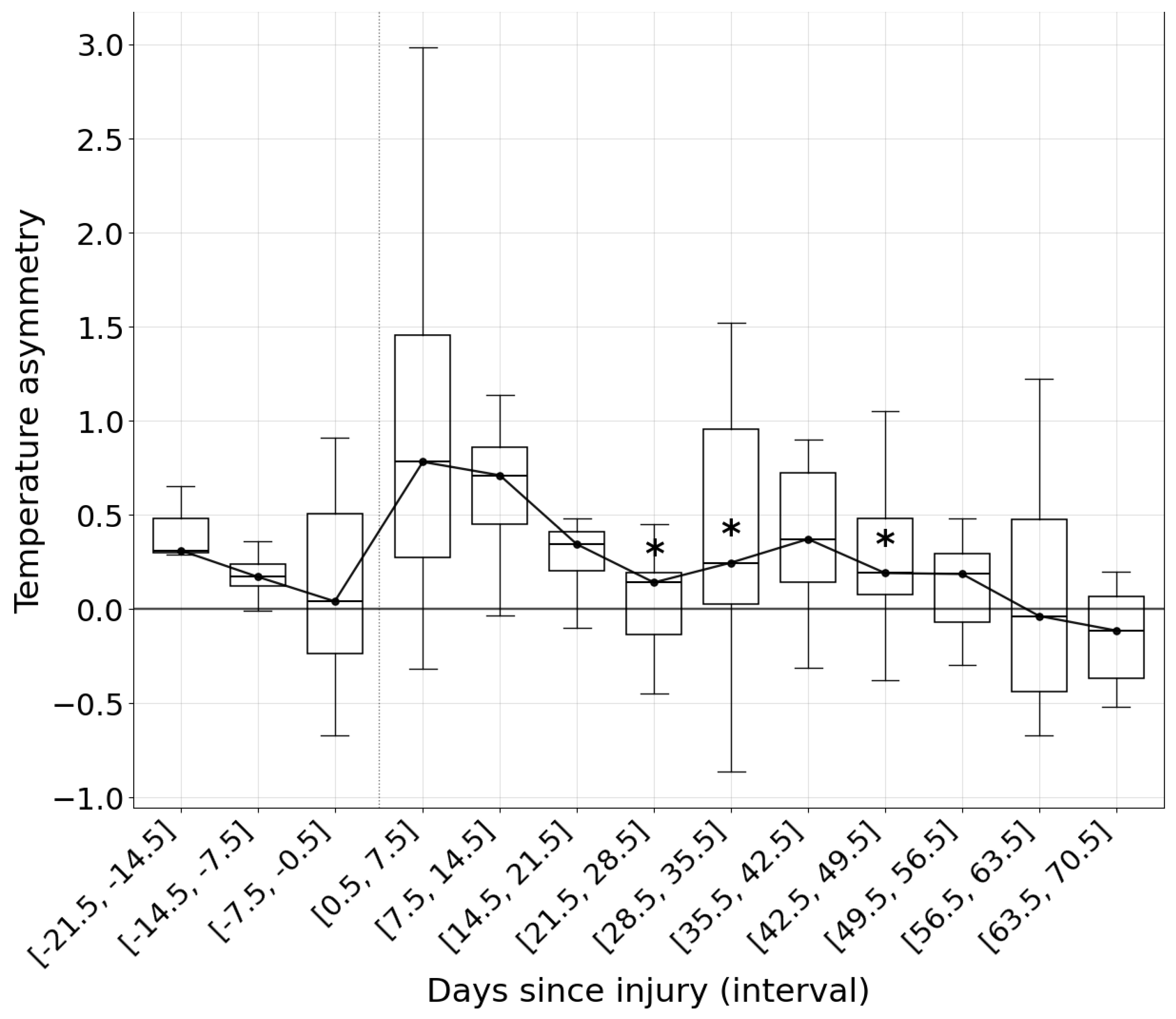
| Time Window (Days) | n | Mean Δ | P (t-test) | 95% CI |
|---|---|---|---|---|
| 7.5–14.5 | 10 | −0.063 | 0.336 | [−0.391, 0.264] |
| 14.5–21.5 | 13 | −0.210 | 0.080 | [−0.517, 0.096] |
| 21.5–28.5 | 13 | −0.488 * | 0.004 | [−0.835, −0.142] |
| 28.5–35.5 | 11 | −0.421 * | 0.001 | [−0.647, −0.196] |
| 35.5–42.5 | 11 | −0.364 | 0.097 | [−0.947, 0.219] |
| 42.5–49.5 | 7 | −0.287 * | 0.019 | [−0.552, −0.022] |
| 49.5–56.5 | 7 | −0.347 | 0.129 | [−1.028, 0.335] |
| 56.5–63.5 | 7 | −0.654 | 0.052 | [−1.492, 0.185] |
| 63.5–70.5 | 5 | −0.838 | 0.066 | [−2.073, 0.396] |
Disclaimer/Publisher’s Note: The statements, opinions and data contained in all publications are solely those of the individual author(s) and contributor(s) and not of MDPI and/or the editor(s). MDPI and/or the editor(s) disclaim responsibility for any injury to people or property resulting from any ideas, methods, instructions or products referred to in the content. |
© 2025 by the authors. Licensee MDPI, Basel, Switzerland. This article is an open access article distributed under the terms and conditions of the Creative Commons Attribution (CC BY) license.
Share and Cite
Escamilla-Galindo, V.-L.; Fernández-Muñoz, D.; Fernández-Carmona, J.; Ceniza-Villacastín, J.A.; Fernández-Cuevas, I. Reframing Ankle Sprain Management: The Role of Thermography in Ligament Injury Monitoring. J. Clin. Med. 2026, 15, 134. https://doi.org/10.3390/jcm15010134
Escamilla-Galindo V-L, Fernández-Muñoz D, Fernández-Carmona J, Ceniza-Villacastín JA, Fernández-Cuevas I. Reframing Ankle Sprain Management: The Role of Thermography in Ligament Injury Monitoring. Journal of Clinical Medicine. 2026; 15(1):134. https://doi.org/10.3390/jcm15010134
Chicago/Turabian StyleEscamilla-Galindo, Victor-Luis, Daniel Fernández-Muñoz, Javier Fernández-Carmona, Julio A. Ceniza-Villacastín, and Ismael Fernández-Cuevas. 2026. "Reframing Ankle Sprain Management: The Role of Thermography in Ligament Injury Monitoring" Journal of Clinical Medicine 15, no. 1: 134. https://doi.org/10.3390/jcm15010134
APA StyleEscamilla-Galindo, V.-L., Fernández-Muñoz, D., Fernández-Carmona, J., Ceniza-Villacastín, J. A., & Fernández-Cuevas, I. (2026). Reframing Ankle Sprain Management: The Role of Thermography in Ligament Injury Monitoring. Journal of Clinical Medicine, 15(1), 134. https://doi.org/10.3390/jcm15010134

