Article

Haptic Visual and Superimposed Digital Imaging Analysis Improves the Interrater Reliability of J-Sign Assessment in Patients with Patellofemoral Instability: A Prospective Diagnostic Study


1
Klinik Ludwigshafen, Department for Orthopaedics and Trauma Surgery at Heidelberg University, Ludwig-Guttmann-Str. 13, 67071 Ludwigshafen, Germany
2
Arcus Sportklinik, 75179 Pforzheim, Germany
3
Department of Trauma, Hand and Reconstructive Surgery, Departments and Institutes of Surgery, Saarland University, 66421 Homburg, Germany
*
Author to whom correspondence should be addressed.
J. Clin. Med. 2025, 14(23), 8559; https://doi.org/10.3390/jcm14238559 (registering DOI)
Submission received: 5 November 2025 / Revised: 29 November 2025 / Accepted: 1 December 2025 / Published: 2 December 2025
(This article belongs to the Section Orthopedics)

Abstract

Background: J-sign assessment is increasingly important for decision-making in patients with patellar instability. However, the low interrater reliability of the J-sign evaluation has raised concerns. The aim of this study was to investigate whether haptic visual assessment or superimposed digital imaging analysis might improve interrater reliability. Methods: In 51 patients with ≥ 1 patellar dislocation, J-sign grading was assessed by two experienced observers via three different methods: (i) plain visual evaluation; (ii) combined haptic visual assessment, including palpation of the medial and lateral patellar facets with the thumb and index finger during active knee joint motion; and (iii) a digital photo application tool using superimposed digital imaging analysis obtained at 90° of flexion–knee joint flexion and full extension. Results: For the visual assessment of the J-sign, the interrater reliability was fair, with κ = 0.39 ± 0.11 [0.18–0.6]. The interrater reliability of the haptic visual assessment and the photo application reached a good level of agreement, with κ = 0.89 ± 0.05 [0.8–0.98] and κ = 0.85 ± 0.05 [0.74–0.95], respectively. Conclusions: Plain visual evaluation of the J-sign revealed fair interrater reliability. The haptic visual assessment of the J-sign and the digital photo application tool yielded good interrater reliability. The results indicate that haptic visual assessment of J-sign should be implemented in daily clinical practice and used to communicate findings between and among physicians and studies.

1. Introduction

Lateral patellar instability (LPI) is one of the most common knee joint injuries in adolescents and young adults [1,2]. Reconstruction of the medial patellofemoral ligament (MPFL-R), which is injured in more than 90% of patients after first-time patellar dislocation [3], has been established as a cornerstone of surgical therapy for patients with recurrent LPI [4,5,6,7]. However, there is still no clear consensus regarding the indications and need for concomitant bony correction (e.g., correction of trochlear dysplasia, patellar height, etc.) in addition to MPFL-R [8,9]. The preoperative assessment of patellofemoral maltracking is relevant in this context. Imaging modalities such as 3D- or 4D-computed tomography scans [10,11] or dynamic magnetic resonance imaging [12] may be helpful in this regard. However, these techniques are associated with substantial costs, and dynamic MRI in particular is not widely available [12]. In this context, evaluation of the J-sign, which is a clinical sign of patellar maltracking during active knee joint motion, has been considered as a helpful parameter for decision-making [13,14,15,16,17]. In addition, the J-sign was identified as a prognostic risk factor for postoperative failure of isolated MPFL-R [16,18,19]. Accordingly, the preoperative assessment of the J-sign is becoming increasingly important in patients with recurrent patellar instability.
Classically, J-sign assessment is performed via plain visual evaluation, which involves observing the patient’s knee moving from flexion to full extension and grading the lateral displacement of the patella in full extension. However, the intra- and interrater reliability of this plain visual evaluation of the J-Sign is low [20,21,22,23,24]. Therefore, the aim of this study was to investigate whether palpation, in addition to plain visual assessment, and the use of superimposed digital imaging improved the previously reported low interrater reliability of J-sign assessment. The hypothesis was that both methods improve the previously reported low interrater reliability of plain visual J-sign assessment.

2. Materials and Methods

This study obtained approval from the local ethics committee of Rheinland-Pfalz and Baden-Württemberg (Reference no. 2023-16952-andere Forschung erstvotierend and B-F-2023-076) in accordance with the Declaration of Helsinki. Between October 2023 and January 2024, 51 consecutive patients with LPIs (≥1 patellar dislocation) were prospectively assessed by two raters (two consultant surgeons) at a sports medicine center and a level-one trauma center. The patients included in this study were those who presented to the outpatient clinic seeking further evaluation and management for recurrent patellar dislocations.

2.1. Inclusion Criteria

To be included, patients had to have an age ≥ 14 years and a history of LPI. The demographics of all patients were recorded via an internal clinic database. Moreover, in all patients, the J-sign was assessed using the modified quadrant method according to Zhang et al. [16,17]. The grading was as follows: grade 0: <1 quadrant of lateral patellar tracking; grade 1: ≥1 and <2 quadrants of lateral patellar tracking; grade 2: ≥2 and <3 quadrants of lateral patellar tracking; and grade 3: > 3 quadrants of lateral patellar tracking or complete patellar dislocation.

2.2. Exclusion Citeria

Patients aged <14 years and all patients without a history of LPI were excluded. Patients who had undergone previous surgery on the affected knee joint were also ruled out.

2.3. J-Sign Evaluation Methods

The J-sign was assessed consecutively by both raters during the patient’s outpatient visit. While one rater performed the assessment, the other was outside the examination room. Both raters evaluated the J-sign using the following three methods and recorded the determined J-sign grade in an Excel spreadsheet after each assessment, without informing the other rater.
The J-sign evaluation started with plain visual assessment, which was independently performed by the two raters as previously described [20,21,22,23,24]. For this purpose, patients were seated on the edge of an examination couch with their legs hanging over the side at 90° of knee joint flexion. Patients were then asked to slowly extend their knees from flexion to full extension, and the degree of patellar lateralization was recorded as described above.
This was followed by haptic visual assessment, including palpation of the medial and lateral patellar facets with the thumb and index finger during active knee joint extension (Figure 1).
Finally, J-sign assessment was performed with a newly developed digital photo application tool (“J-sign App”, mbits imaging GmbH, Heidelberg, Germany) using a superimposed picture. The digital photo application is a custom-developed, non-publicly available tool. For its development, the patellae of 20 knees from clinical staff members were marked on the skin in 90° flexion and full extension. Subsequently, photographs were taken in both positions from a perspective approximately 30 cm directly above the knee. These images were used to develop and calibrate the digital photo application.
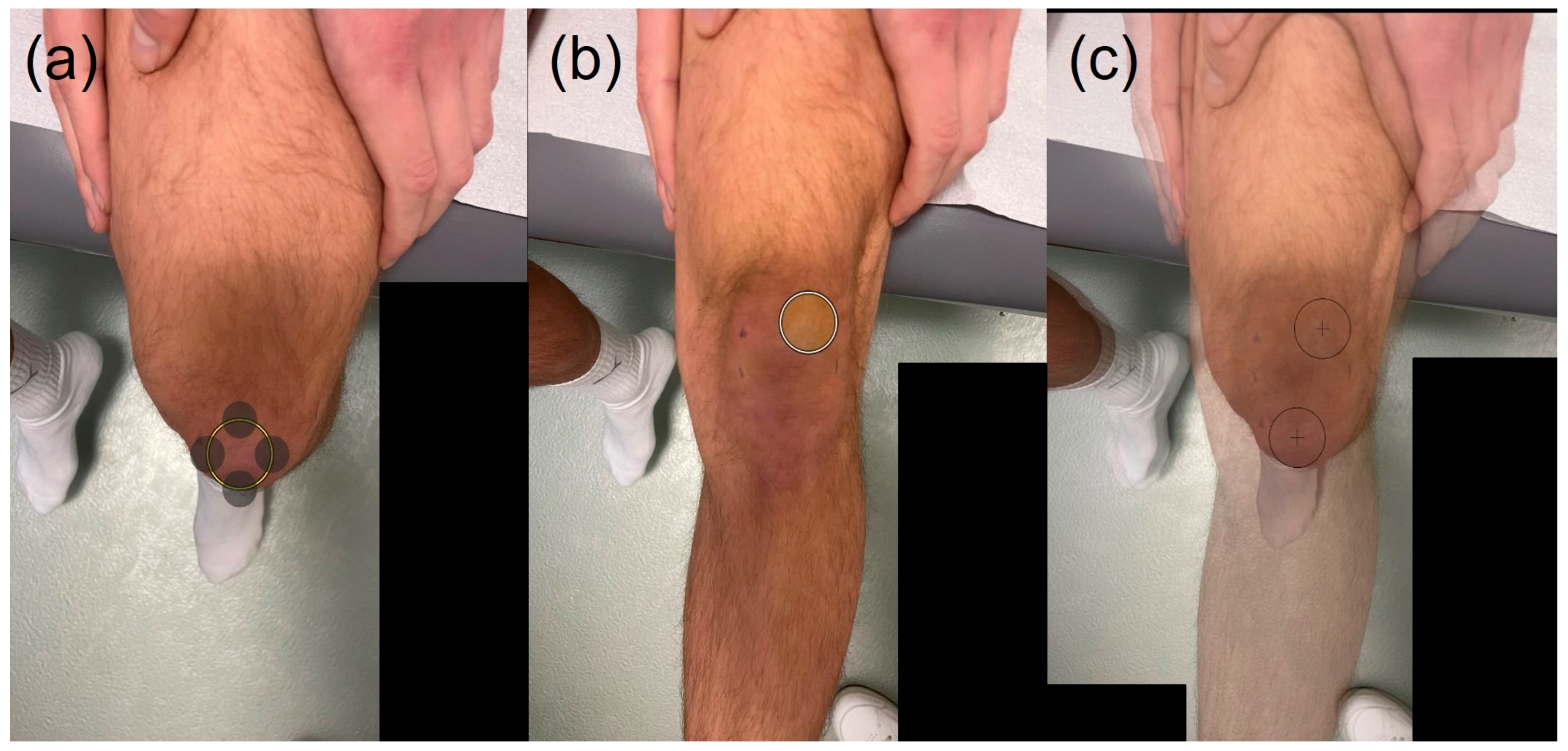
For the assessment of the J-sign in patients using the digital photo application tool, a photograph of the knee joint from a perspective of approximately 30 cm in a well-lit examination room was taken at 90° of flexion using a clinic-owned mobile device equipped with the digital photo application tool (Figure 2a). Within the application, the patella was then marked with a circular template. Subsequently, a second photograph from a perspective approximately 30 cm was taken with the knee in full extension, and the patella was again marked with a circle of the same diameter (Figure 2b). The digital photo application tool subsequently calculated the J-sign grade by automatically determining the displacement between the two circles based on the quadrant method described by Zhang et al. [17] (Figure 2c).

2.4. Statistical Analysis

Data are presented as the mean values ± standard deviations (ranges) for numerical variables with lower and upper 95% confidence intervals in brackets. Weighted Cohen’s kappa (κ) was used to calculate the interrater reliability. All analyses were performed via GraphPad Prism (version 9; GraphPad Software, San Diego, CA, USA) and DATAtab Team (2023) (DATAtab: Online Statistics Calculator. DATAtab e.U. Graz, Austria). The level of agreement was determined according to Landis JR and Koch GG [25]. A priori power analysis was performed with G*Power (version 3.1.9.4). Using the 3 × 3 table of Bujang MA and Baharum N. [26] and the Cohen’s kappa of Hiemstra et al. [24] at the minimum level of κ = 0.31a minimum of 49 participants were calculated to achieve a power of 80% (0.8) with a given alpha error of 0.05.

3. Results

The study group comprised 51 patients (male/female 19/32; age 25.1 ± 10 years) with an average body mass index of 24.5 ± 5.8 (18.1–40.1) kg/m2 who presented for orthopedic surgical consultation for recurrent lateral patellofemoral instability.
In Table 1 the absolute and relative distributions of the J-sign grades of both raters and the three different methods used to assess the J-sign are shown
The results of the interrater reliability and the percent of agreement of the three different methods of J-sign evaluation are presented in Table 2. For the visual assessment of the J-sign, the interrater reliability was fair, with κ = 0.39 ± 0.11 [0.18–0.6]. In contrast, the interrater reliability of the haptic visual assessment and the photo application reached a good level of agreement, with κ = 0.89 ± 0.05 [0.8–0.98] and κ = 0.85 ± 0.05 [0.74–0.95], respectively.

4. Discussion

The most important finding of the present study was that plain visual evaluation of the J-sign showed low interrater reliability, similar to previous studies. In contrast, both the haptic visual assessment of the J-sign and the photo application yielded high interrater reliability.
In the current literature, the J-sign has been increasingly considered as important with respect to treatment decisions in patients with recurrent patellar instability. In this context, patient-reported outcome measures after isolated MPFL-R were reduced in the presence of a preoperative high-grade J-sign [16,18,19]. These findings have led to the recommendation for the correction of anatomical risk factors in addition to MPFL-R in the presence of a preoperative high-grade J-sign [13].
Traditionally, the J-sign is assessed visually, with the examiner following and assessing the extended lateral movement of the patella exclusively with their eyes. However, multiple studies have demonstrated that visual assessment alone yields limited interrater reliability [20,21,22,23,24]. Hiemstra et al. reported fair-to-moderate agreement when two raters evaluated the J-sign in patients with recurrent patellofemoral instability, whether using a binary (positive/negative) scale or a 5-point Likert scale (κ = 0.31–0.41) [24], while intrarater reliability was acceptable (κ = 0.72–0.79) in a larger cohort of clinicians using the quadrant and Donell classifications [21]. Similarly, Klimenko et al. used a quadrant-based grading system in 87 knees and found fair interobserver (κ = 0.31) and moderate intraobserver reliability (κ = 0.58) [22]. Smith et al. also reported only moderate interrater (κ = 0.53) and fair intrarater agreement (κ = 0.28) when assessing a visually defined J-sign in patients with bilateral recurrent patellar instability [23]. Using web-based assessments of standardized video recordings, Best et al. found comparable results, with moderate interrater (κ = 0.45) and intrarater reliability (κ = 0.48), and concluded that visual evaluation alone is insufficient for reliably identifying or grading patellar maltracking [20].
In contrast, Walla et al. reported substantially higher interrater and intrarater reliability (κ = 0.76 and κ = 0.75) when J-sign severity was categorized using simplified grouping systems in video assessments. Their findings suggest that methodological differences—particularly the number of grading categories—may substantially influence the reliability of visual J-sign evaluation [27].
This study aimed to overcome previous drawbacks in J-sign grading by incorporating palpation and imaging-based evaluation. The results indicate that the haptic visual assessment of the J-sign is superior to plain visual assessment in terms of interrater reliability. This multimodal perception might be associated with an improved assessment strength of lateral patellar movement. This finding is consistent with the current results on motor learning strategies. Sigrist et al. reported that multimodal feedback is more efficient than unimodal feedback [28]. Furthermore, Doyle and Snowden reported that multimodal stimuli are typically perceived more precisely and faster than unimodal stimuli are [29]. Feygin et al. showed that for learning 3D hand movements, haptic visual training of the target trajectory was more effective than unimodal training only [30]. Patrizio et al. recently published a randomized controlled trial with 32 first-year medical students who completed an educational module for cardiac auscultation. While the control group utilized traditional education methods, the interventional group incorporated multisensory stimuli with simulated cardiac cycles of 3D cross-sectioned hearts and haptic synchronization. In a post-assessment exam, the diagnostic accuracy was significantly greater in the multisensory group than in the control group. The authors concluded that the incorporation of multisensory stimuli significantly improved cardiac auscultation competency and may address the worldwide deterioration in cardiac auscultation skills [31]. These observations may explain the superiority of the haptic visual method for assessing the J-sign in terms of interrater reliability. According to the results of this study, it can be assumed that the haptic visual assessment is more reliable for communication between orthopedic surgeons and is easy to implement in daily clinical practice. The visual assessment of the J-sign can easily be adapted to the haptic visual method. In contrast to using 3D or 4D computed tomography scans and dynamic magnetic resonance imaging, it is an inexpensive and readily available option for evaluating patellar maltracking. However, the results of this study must be interpreted in light of several limitations: first, the calculation of the degree of the J-sign with the help of the photo application used in our study was based on the relative lateral displacement of the patella in two superimposed photos. However, this calculation is based on the fact that the patella must be precisely recognized on both photos and marked accordingly. This is probably the greatest weakness of this type of determination, because the exact size of the patella can often be determined only to a limited extent on the photos because of the soft tissue mantle. The reliance on manual identification of patellar landmarks inside soft tissue in the photo application introduces subjectivity that is not measured nor validated. Furthermore, the digital photo application was not calibrated during development using a more objective reference method, such as dynamic MRI imaging. Second, two raters performed the three methods for assessing the J-sign consecutively, starting with the visual method, followed by the haptic visual method and the photo application method. As a result, some bias may have been evident from the minimal washout period between the first, second and third investigations, whereby the results of the photo-application-based determination should have been the least affected. In future studies on this, the need for randomization or the use of a washout period is recommended. Third, only two raters evaluated the three methods of J-sign assessment. Moreover, the two raters were experienced in the haptic visual method. Accordingly, this could have led to the good results of this method. In contrast, both raters were unexperienced with the photo application but achieved comparable results with this method. This may lead to the conclusion that photo application may be suitable for unexperienced examiners. The influence of clinical experience on the examination is certainly not negligible. Accordingly, further studies with a larger and more diverse group of raters are necessary. Fourth, only the interrater reliability, but not the intrarater reliability, was determined for the different methods of J-sign assessment in our study. This should be performed as part of a future study. Fifth, no more objective measurements with robust reference standards, such as dynamic MRI, were available to assess the lateral displacement of the patella during knee joint movement. Finally, external validity is limited by the single center setting and the use of only two raters.

5. Conclusions

Plain visual evaluation of the J-sign revealed fair interrater reliability. The haptic visual assessment of the J-sign and the digital photo application tool yielded good interrater reliability. The results indicate that haptic visual assessment of J-sign should be implemented in daily clinical practice and used to communicate findings between and among physicians and studies.

Author Contributions

Conceptualization, F.Z., S.Y.V. and P.B.; methodology, F.Z., S.Y.V. and P.B.; software, F.Z., S.Y.V., E.M., J.G., P.A.G. and P.B.; validation, F.Z., S.Y.V., E.M., J.G., P.A.G. and P.B.; formal analysis, F.Z., S.Y.V., E.M., J.G., P.A.G. and P.B.; investigation, F.Z. and P.B.; resources, F.Z., S.Y.V. and P.B.; data curation, F.Z., S.Y.V., E.M., J.G., P.A.G. and P.B.; writing—original draft preparation, F.Z. and P.B.; writing—review and editing, F.Z., S.Y.V., E.M., J.G., P.A.G. and P.B.; visualization, F.Z.; supervision, F.Z. and P.B.; project administration, F.Z., S.Y.V. and P.B. All authors have read and agreed to the published version of the manuscript.

Funding

This research received no external funding.

Institutional Review Board Statement

The study was conducted in accordance with the Declaration of Helsinki, and approved by the local ethics committee of Rhineland-Pfalz and Baden-Württemberg (Reference no. 2023-16952-andere Forschung erstvotierend and B-F-2023-076, date of approval: 29 August 2023).

Informed Consent Statement

Informed consent was obtained from all subjects or their parent or legal guardian in the case of the children under 16 involved in the study.

Data Availability Statement

The datasets used and analyzed during the current study are available from the corresponding author on reasonable request.

Conflicts of Interest

The authors declare no conflicts of interest.

References

  1. Fithian, D.C.; Paxton, E.W.; Stone, M.L.; Silva, P.; Davis, D.K.; Elias, D.A.; White, L.M. Epidemiology and natural history of acute patellar dislocation. Am. J. Sports Med. 2004, 32, 1114–1121. [Google Scholar] [CrossRef]
  2. Sanders, T.L.; Pareek, A.; Hewett, T.E.; Stuart, M.J.; Dahm, D.L.; Krych, A.J. Incidence of First-Time Lateral Patellar Dislocation: A 21-Year Population-Based Study. Sports Health 2018, 10, 146–151. [Google Scholar] [CrossRef]
  3. Migliorini, F.; Pilone, M.; Eschweiler, J.; Marsilio, E.; Hildebrand, F.; Maffulli, N. High Rates of Damage to the Medial Patellofemoral Ligament, Lateral Trochlea, and Patellar Crest After Acute Patellar Dislocation: Magnetic Resonance Imaging Analysis. Arthroscopy 2022, 38, 2472–2479. [Google Scholar] [CrossRef]
  4. Kita, K.; Tanaka, Y.; Toritsuka, Y.; Amano, H.; Uchida, R.; Takao, R.; Horibe, S. Factors Affecting the Outcomes of Double-Bundle Medial Patellofemoral Ligament Reconstruction for Recurrent Patellar Dislocations Evaluated by Multivariate Analysis. Am. J. Sports Med. 2015, 43, 2988–2996. [Google Scholar] [CrossRef] [PubMed]
  5. Parikh, S.N.; Nathan, S.T.; Wall, E.J.; Eismann, E.A. Complications of medial patellofemoral ligament reconstruction in young patients. Am. J. Sports Med. 2013, 41, 1030–1038. [Google Scholar] [CrossRef] [PubMed]
  6. Schneider, D.K.; Grawe, B.; Magnussen, R.A.; Ceasar, A.; Parikh, S.N.; Wall, E.J.; Colosimo, A.J.; Kaeding, C.C.; Myer, G.D. Outcomes After Isolated Medial Patellofemoral Ligament Reconstruction for the Treatment of Recurrent Lateral Patellar Dislocations: A Systematic Review and Meta-analysis. Am. J. Sports Med. 2016, 44, 2993–3005. [Google Scholar] [CrossRef]
  7. Mackay, N.D.; Smith, N.A.; Parsons, N.; Spalding, T.; Thompson, P.; Sprowson, A.P. Medial Patellofemoral Ligament Reconstruction for Patellar Dislocation: A Systematic Review. Orthop. J. Sports Med. 2014, 2, 2325967114544021. [Google Scholar] [CrossRef]
  8. Migliorini, F.; Marsilio, E.; Oliva, F.; Eschweiler, J.; Hildebrand, F.; Maffulli, N. Chondral injuries in patients with recurrent patellar dislocation: A systematic review. J. Orthop. Surg. Res. 2022, 17, 63. [Google Scholar] [CrossRef]
  9. Cregar, W.M.; Huddleston, H.P.; Wong, S.E.; Farr, J.; Yanke, A.B. Inconsistencies in Reporting Risk Factors for Medial Patellofemoral Ligament Reconstruction Failure: A Systematic Review. Am. J. Sports Med. 2022, 50, 867–877. [Google Scholar] [CrossRef] [PubMed]
  10. Matthieu, L.; Pedro Augusto, G.T.; Gabriela, H.; Romain, G.; Nicolas, D.; Alain, B.; Andrea, F. Four-dimensional CT analysis of patellofemoral instability: A prospective cohorte study. Eur. J. Radiol. 2025, 194, 112450. [Google Scholar] [CrossRef]
  11. Moldovan, F.; Gligor, A.; Bataga, T. Structured Integration and Alignment Algorithm: A Tool for Personalized Surgical Treatment of Tibial Plateau Fractures. J. Pers. Med. 2021, 11, 190. [Google Scholar] [CrossRef]
  12. Frings, J.; Dust, T.; Krause, M.; Ohlmeier, M.; Frosch, K.-H.; Adam, G.; Warncke, M.; Maas, K.-J.; Henes, F.O. Objective assessment of patellar maltracking with 3 T dynamic magnetic resonance imaging: Feasibility of a robust and reliable measuring technique. Sci. Rep. 2020, 10, 16770. [Google Scholar] [CrossRef] [PubMed]
  13. Zimmermann, F.; Milinkovic, D.D.; Zimmerer, A.; Balcarek, P. When Should Bony Correction Be Considered in Addition to Medial Patellofemoral Ligament Reconstruction? Results of a Clinically Derived 2-Group Classification of Lateral Patellar Instability Based on 122 Patients at 2- to 5-Year Follow-up. Orthop. J. Sports Med. 2023, 11, 23259671221147572. [Google Scholar] [CrossRef]
  14. Milinkovic, D.D.; Jovandic, I.; Zimmermann, F.; Balcarek, P. The J-sign and the body mass index determine the disease-specific quality of life in patients with lateral patellar instability. Knee Surg. Sports Traumatol. Arthrosc. 2022, 30, 1672–1678. [Google Scholar] [CrossRef]
  15. Hiemstra, L.A.; Kerslake, S.A.; Lafave, M.R. Influence of Risky Pathoanatomy and Demographic Factors on Clinical Outcomes After Isolated Medial Patellofemoral Ligament Reconstruction: A Regression Analysis. Am. J. Sports Med. 2019, 47, 2904–2909. [Google Scholar] [CrossRef] [PubMed]
  16. Zhang, Z.; Zhang, H.; Song, G.; Zheng, T.; Feng, H. A pre-operative grade 3 J-sign adversely affects short-term clinical outcome and is more likely to yield MPFL residual graft laxity in recurrent patellar dislocation. Knee Surg. Sports Traumatol. Arthrosc. 2020, 28, 2147–2156. [Google Scholar] [CrossRef]
  17. Zhang, Z.; Zhang, H.; Song, G.; Wang, X.; Zhang, J.; Zheng, T.; Ni, Q.; Feng, H. A High-Grade J Sign Is More Likely to Yield Higher Postoperative Patellar Laxity and Residual Maltracking in Patients with Recurrent Patellar Dislocation Treated with Derotational Distal Femoral Osteotomy. Am. J. Sports Med. 2020, 48, 117–127. [Google Scholar] [CrossRef] [PubMed]
  18. Zhang, Z.-J.; Dimeng, L.-Q.; Cao, Y.-W.; Zheng, T.; Song, G.-Y.; Li, Y.; Zhang, H. Predictors of Graft Failure After Primary Medial Patellofemoral Ligament Reconstruction. Orthop. J. Sports Med. 2022, 10, 23259671221138854. [Google Scholar] [CrossRef]
  19. Zhao, Z.; Wang, Y.; Li, J.; Wang, H.; Bai, X.; Wang, Q.; Li, Z. Clinical Outcomes and Prognostic Factors in Patients with Recurrent Patellar Lateral Dislocation Treated with Isolated Medial Patellofemoral Ligament Reconstruction: A Retrospective Single-Center Analysis. Orthop. J. Sports Med. 2021, 9, 2325967121995803. [Google Scholar] [CrossRef]
  20. Best, M.J.; Tanaka, M.J.; Demehri, S.; Cosgarea, A.J. Accuracy and Reliability of the Visual Assessment of Patellar Tracking. Am. J. Sports Med. 2020, 48, 370–375. [Google Scholar] [CrossRef]
  21. Hiemstra, L.A.; Sheehan, B.; Sasyniuk, T.M.; Kerslake, S. Inter-rater Reliability of the Classification of the J-Sign Is Inadequate Among Experts. Clin. J. Sport Med. 2022, 32, 480–485. [Google Scholar] [CrossRef]
  22. Klimenko, O.; Sousa, T.C.; Baker, R.; Carl, J.; Mader, S.; Holden, K.; McMulkin, M.L. How Reliable is a J-sign Severity Scale When Assessing Lateral Patellar Instability? J. Pediatr. Orthop. Soc. N. Am. 2023, 5, 630. [Google Scholar] [CrossRef] [PubMed]
  23. Smith, T.O.; Clark, A.; Neda, S.; Arendt, E.A.; Post, W.R.; Grelsamer, R.P.; Dejour, D.; Almqvist, K.F.; Donell, S.T. The intra- and inter-observer reliability of the physical examination methods used to assess patients with patellofemoral joint instability. Knee 2012, 19, 404–410. [Google Scholar] [CrossRef]
  24. Hiemstra, L.A.; O’Brien, C.L.; Lafave, M.R.; Kerslake, S. Common Physical Examination Tests for Patellofemoral Instability Demonstrate Weak Inter-Rater Reliability. Arthrosc. Sports Med. Rehabil. 2021, 3, e673–e677. [Google Scholar] [CrossRef]
  25. Landis, J.R.; Koch, G.G. The measurement of observer agreement for categorical data. Biometrics 1977, 33, 159–174. [Google Scholar] [CrossRef] [PubMed]
  26. Bujang, M.A.; Baharum, N. Guidelines of the minimum sample size requirements for Kappa agreement test. Epidemiol. Biostat. Public Health 2022, 14. [Google Scholar] [CrossRef]
  27. Walla, N.; Moore, T.; Harangody, S.; Fitzpatrick, S.; Flanigan, D.C.; Duerr, R.A.; Siston, R.; Magnussen, R.A. Qualitative visual assessment of the J-sign demonstrates high inter-rater reliability. J. ISAKOS 2023, 8, 420–424. [Google Scholar] [CrossRef]
  28. Sigrist, R.; Rauter, G.; Riener, R.; Wolf, P. Augmented visual, auditory, haptic, and multimodal feedback in motor learning: A review. Psychon. Bull. Rev. 2013, 20, 21–53. [Google Scholar] [CrossRef]
  29. Doyle, M.C.; Snowden, R.J. Identification of visual stimuli is improved by accompanying auditory stimuli: The role of eye movements and sound location. Perception 2001, 30, 795–810. [Google Scholar] [CrossRef]
  30. Feygin, D.; Keehner, M.; Tendick, R. Haptic guidance: Experimental evaluation of a haptic training method for a perceptual motor skill. In Proceedings of the 10th Symposium on Haptic Interfaces for Virtual Environment and Teleoperator Systems. HAPTICS 2002, Orlando, FL, USA, 24–25 March 2002; IEEE: New York City, NY, USA, 2002. [Google Scholar]
  31. Patrizio, H.A.; Phyu, R.; Kim, B.; Brolis, N.V. Improved cardiac auscultation competency interweaving visual, auditory, and tactile stimuli: A preliminary study. Int. J. Med. Educ. 2024, 15, 37–43. [Google Scholar] [CrossRef] [PubMed]
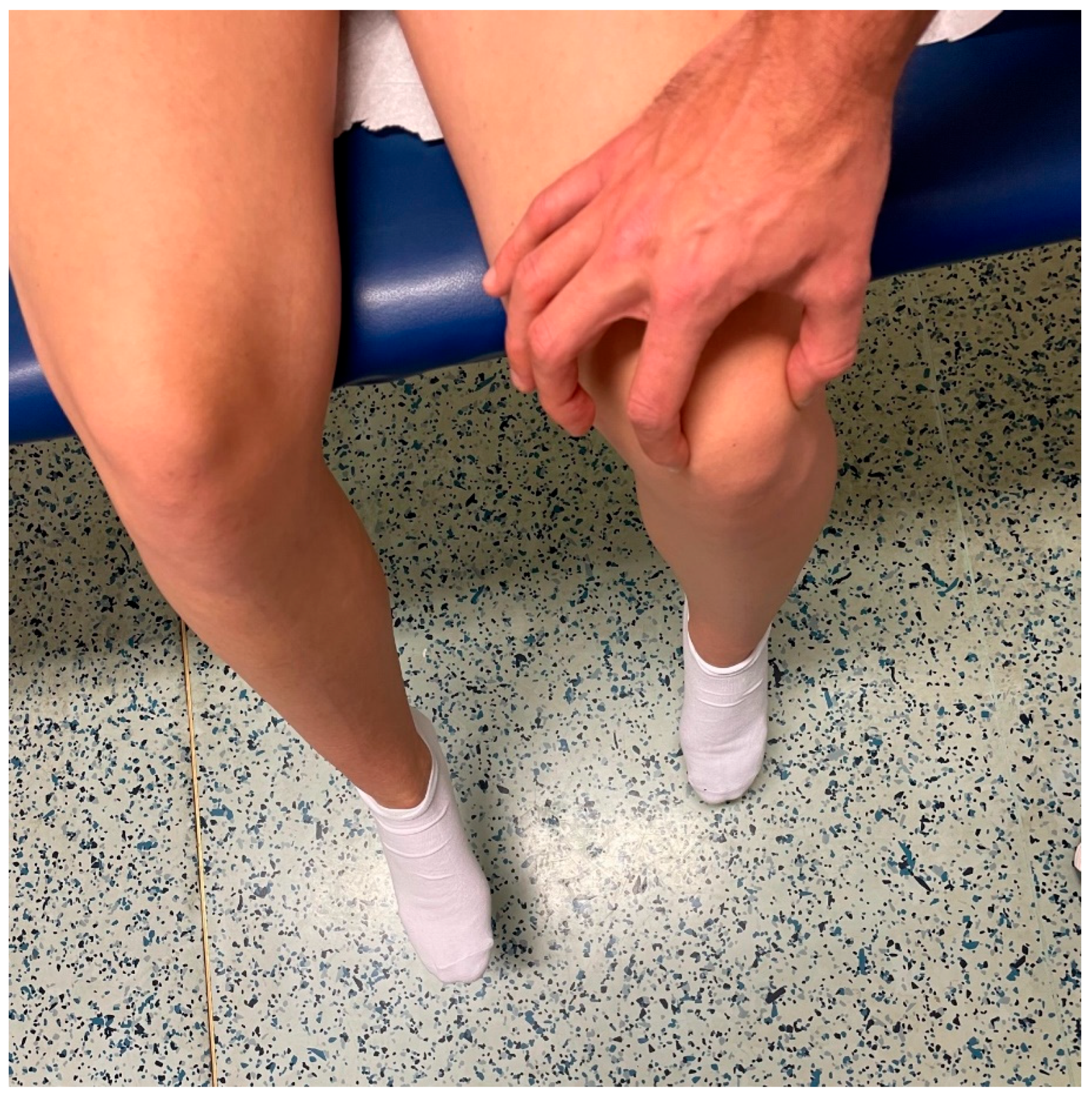
Figure 1. Assessment of J-sign with the haptic visual method. With the patient seated and the knee flexed at 90°, the lateral and medial patellar poles were palpated using the thumb and index finger. The patient then actively extended the knee, and patellar tracking was assessed through palpation.
Jcm 14 08559 g001
Figure 2. (ac): Assessment of J-sign using the digital photo application tool. The knee was photographed at 90° flexion and full extension using a mobile app, with the patella marked by a circular template in both positions (a,b). The app calculated the J-sign grade based on the displacement between the circles using quadrant method (c).
Jcm 14 08559 g002
Table 1. Absolute and relative distributions of J-sign grades.
Grade 0Grade 1Grade 2Grade 3
Visual
(Rater 1)
20 (39%)19 (37%)11 (22%)1 (2%)
Visual
(Rater 2)
32 (63%)16 (31%)2 (4%)1 (2%)
Haptic visual
(Rater 1)
17 (33%)18 (35%)15 (29%)1 (2%)
Haptic visual
(Rater 2)
18 (35%)20 (39%)11 (22%)2 (4%)
Photo application
(Rater 1)
21 (41%)13 (25%)15 (29%)2 (4%)
Photo application (Rater 2)21 (41%)17 (33%)13 (25%)-
The absolute and relative distributions of the J-sign grades of both raters and the three different methods for assessing the J-sign according to the modified quadrant method of Zhang et al. [10,11] are shown. Grade 0: <1 quadrant of lateral patellar tracking; Grade 1: ≥1 and <2 quadrants; Grade 2: ≥2 and <3 quadrants; Grade 3: >3 quadrants or complete patellar dislocation.
Table 2. Interrater reliability of the three methods of J-sign evaluation.
Weighted Cohen’s Kappa (κ)Standard DeviationLower 95%
Confidence Interval
Upper 95%
Confidence Interval
Level of
Agreement
Percent of Agreement
Visual0.390.110.180.6Fair54.9%
Haptic
visual
0.890.050.80.98Almost perfect90.2%
Photo
Application
0.850.050.740.95Almost perfect84.3%
The values of weighted Cohen’s kappa (κ) with their standard deviations, confidence intervals and levels of agreement, as well as the percent of agreement, are shown.
Disclaimer/Publisher’s Note: The statements, opinions and data contained in all publications are solely those of the individual author(s) and contributor(s) and not of MDPI and/or the editor(s). MDPI and/or the editor(s) disclaim responsibility for any injury to people or property resulting from any ideas, methods, instructions or products referred to in the content.