Review

Salivary Gland Transplantation as a Promising Approach for Tear Film Restoration in Severe Dry Eye Disease

by
Jiayi Chen
1,2,†,
Tianyi Bai
1,2,†,
Jiazeng Su
2,
Xin Cong
3,
Lan Lv
4,
Louis Tong
5,6,7,8,
Haozhe Yu
1,
Yun Feng
1,* and
Guangyan Yu
2,*
1
Beijing Key Laboratory of Damaged Ocular Nerve, Department of Ophthalmology, Peking University Third Hospital, Beijing 100191, China
2
National Engineering Laboratory for Digital and Material Technology of Stomatology, Beijing Key Laboratory of Digital Stomatology, Department of Oral and Maxillofacial Surgery, Peking University School and Hospital of Stomatology, Beijing 100081, China
3
Key Laboratory of Molecular Cardiovascular Sciences, Beijing Key Laboratory of Cardiovascular Receptors Research, Department of Physiology and Pathophysiology, Peking University School of Basic Medical Sciences, Ministry of Education, Beijing 100191, China
4
Department of Ophthalmology, Beijing Tong Ren Hospital, Capital University of Medical Science, Beijing 100730, China
5
Cornea and External Eye Disease Service, Singapore National Eye Center, Singapore 168751, Singapore
6
Ocular Surface Research Group, Singapore Eye Research Institute, Singapore 169856, Singapore
7
Eye-Academic Clinical Program, Duke-National University of Singapore, Singapore 169857, Singapore
8
Department of Ophthalmology, Yong Loo Lin School of Medicine, National University of Singapore, Singapore 119228, Singapore
*
Authors to whom correspondence should be addressed.
These authors contributed equally to this work.
J. Clin. Med. 2024, 13(2), 521; https://doi.org/10.3390/jcm13020521
Submission received: 14 November 2023 / Revised: 12 December 2023 / Accepted: 8 January 2024 / Published: 17 January 2024

Abstract

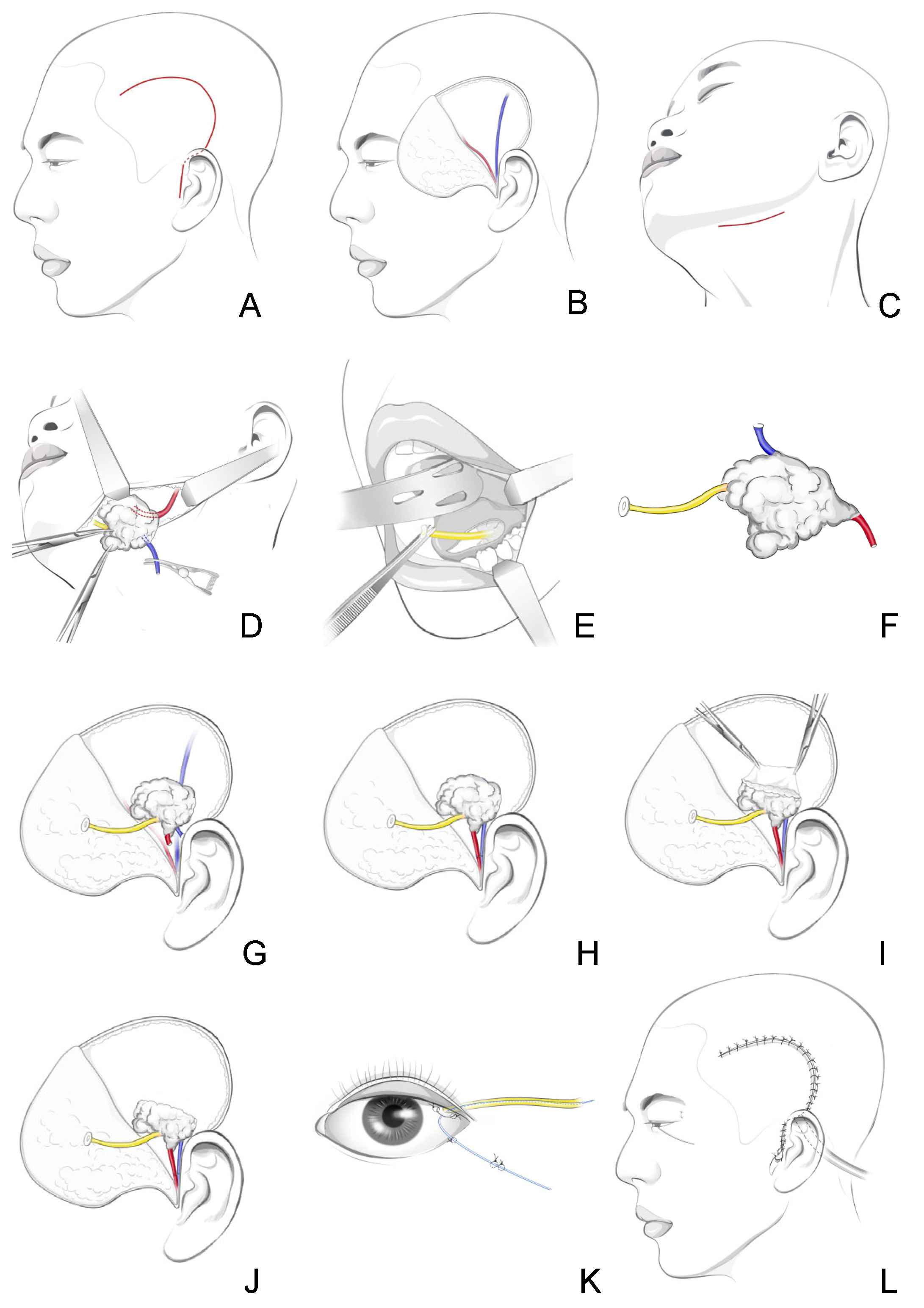
With increased awareness of dry eye disease (DED), a multitude of therapeutic options have become available. Nevertheless, the treatment of severe DED remains difficult. In a patient whose DED is related to the loss of lacrimal function without severe destruction of the salivary glands, autologous transplantation of the latter as functioning exocrine tissue to rebuild a stable tear film is an attractive idea. All three major and minor salivary glands have been used for such transplantation. Due to the complications associated with and unfavorable prognosis of parotid duct and sublingual gland transplantation, surgeons now prefer to use the submandibular gland (SMG) for such procedures. The transplantation of the SMG not only has a high survival rate, but also improves dry eye symptoms and signs for more than 20 years post-surgery. The regulation of the secretion of the transplanted SMG is critical because the denervated SMG changes its mechanism of secretion. Innovative procedures have been developed to stimulate secretion in order to prevent the obstruction of the Wharton’s duct and to decrease secretion when postoperative “epiphora” occurs. Among the minor salivary glands, the transplantation of the labial salivary glands is the most successful in the long-term. The measurement of the flow rates of minor salivary glands and donor-site selection are critical steps before surgery.
Keywords: dry eye disease; transplantation; salivary gland; surgical technique dry eye disease; transplantation; salivary gland; surgical technique