Article

Sex-Specific Analysis of Mid-Term Outcomes of Atherectomy-Assisted Endovascular Treatment in Severe Peripheral Arterial Disease


by
Konstantinos Avranas
,
Apostolos G. Pitoulias
*,†,
Gergana T. Taneva
,
Efthymios Beropoulis
and
Konstantinos P. Donas
Rhein Main Vascular Center, Department of Vascular and Endovascular Surgery, Asklepios Clinics Langen, Paulinen Wiesbaden, 63225 Langen, Germany
*
Author to whom correspondence should be addressed.
These authors contributed equally to this work.
J. Clin. Med. 2024, 13(11), 3235; https://doi.org/10.3390/jcm13113235
Submission received: 16 April 2024 / Revised: 20 May 2024 / Accepted: 27 May 2024 / Published: 30 May 2024

Abstract

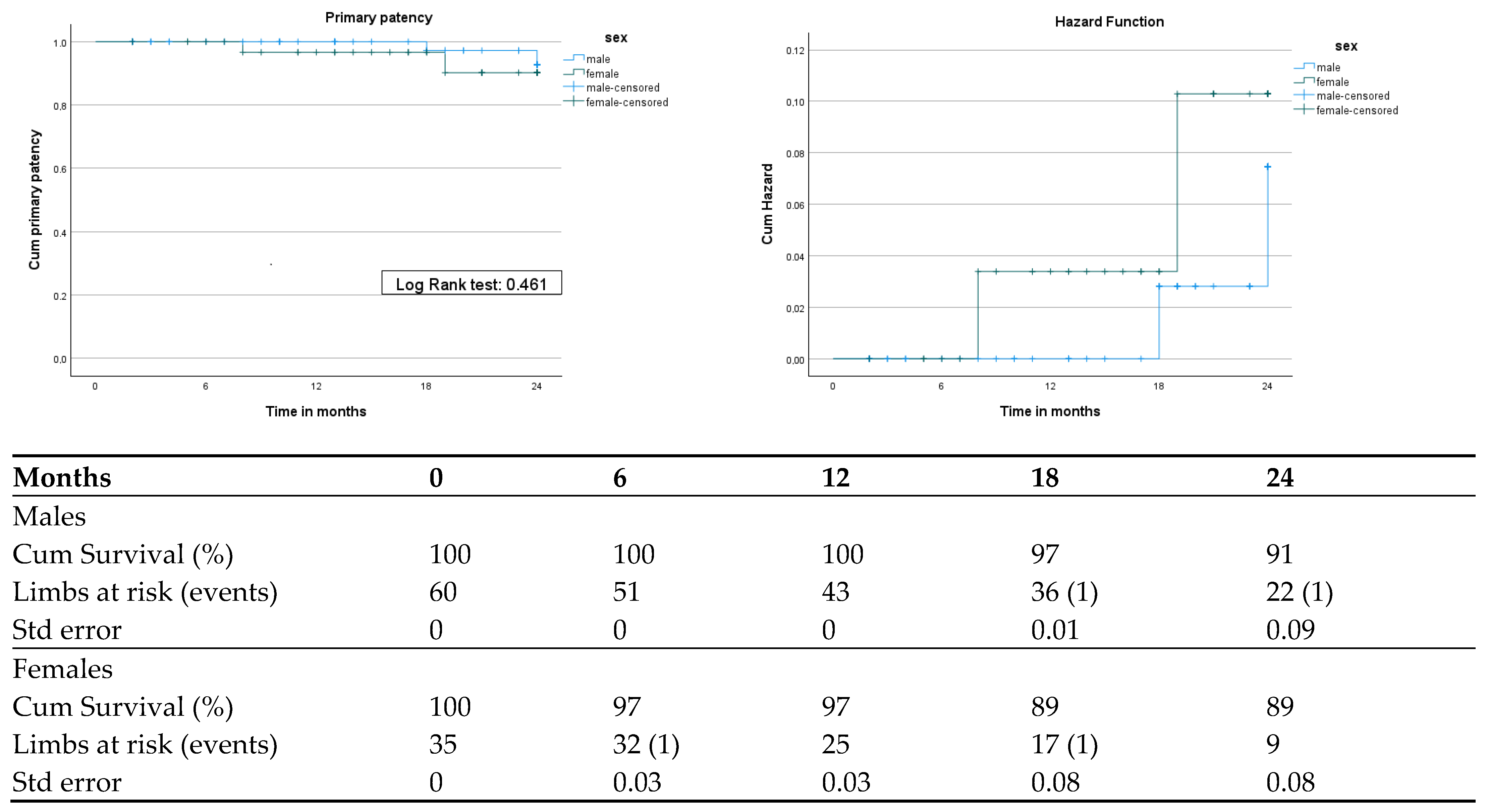
Background: Endovascular treatment of lower-extremity peripheral disease (PAD) is associated with higher complication rates and suboptimal outcomes in women. Atherectomy has shown favourable outcomes in calcified lesions, minimising the incidence of stent placement caused by recoil or flow-limiting dissection. To date, there are no published mid-term outcomes evaluating the performance of atherectomy differentiated by sex. This study aims to evaluate sex-specific outcomes and prognostic factors affecting the results of atherectomy-assisted endovascular treatment in severe PAD. Methods: A retrospective analysis was conducted at a single centre in Germany, initiated by physicians and not sponsored by industry, on patients presenting with Rutherford categories ranging from III to V and featuring de novo occlusive or stenotic lesions of the superficial femoral (SFA) and/or popliteal arteries. The intervention involved rotational atherectomy-assisted angioplasty utilising the Jetstream (Boston, US®) device. The point of interest of this study was postinterventional clinical improvement as well as mid-term outcomes, including primary patency, over a targeted 2-year follow-up period. Statistical analysis utilised Cox regression (survival analysis) to calculate hazard ratios according to sex category. Comparative survival analysis was performed using the log-rank test and visually represented through Kaplan–Meier curves. Risk factors associated with absence of clinical improvement were examined across both sex groups utilising the chi-square or Fisher exact test, as appropriate. Results: A total of 98 patients (103 limbs) were initially included, with >75% having moderate-to-severe lesion calcification (>50%). A total of 84 patients (97 limbs, 62 male and 35 female) proceeded to a 2-year follow-up (mean 16.4 months for males and 16.1 for females) after a successful index procedure. Age distribution, Rutherford class, diabetes, chronic kidney disease (CKD), target vessel, lesion type, and length were balanced among both groups. Similar primary patency rates, of 89% among female and 91% among male limbs, were observed (p = 0.471). Female patients exhibited a lower rate of clinical improvement based on the Rutherford scale in comparison to males (80.6% vs. 94.5%, p = 0.048). CDK was the only significant prognostic factor across pooled data (odds ratio for CKD: 15.15, p < 0.001). Conclusions: Rotational atherectomy showed comparably high rates of mid-term primary patency, with low rates of bailout stent placement. These findings highlight the beneficial use of atherectomy in female patients who are per se at risk for higher rates of complications during and after endovascular interventions.
Keywords: rotational atherectomy; atherectomy-assisted drug-eluting angioplasty; femoropopliteal lesions; peripheral artery disease; sex-specific outcomes rotational atherectomy; atherectomy-assisted drug-eluting angioplasty; femoropopliteal lesions; peripheral artery disease; sex-specific outcomes