Article

Validity of the Maximal Heart Rate Prediction Models among Runners and Cyclists

1
3rd Department of Internal Medicine and Cardiology, Medical University of Warsaw, 04-749 Warsaw, Poland
2
Department of Physical Education and Health, Faculty in Biala Podlaska, Jozef Pilsudski University of Physical Education in Warsaw, 21-500 Biala Podlaska, Poland
3
Department of Medical Physiology, Child Development & Exercise Center, Wilhelmina Children’s Hospital, UMC Utrecht, 3584 EA Utrecht, The Netherlands
4
Department of Pharmacology and Clinical Pharmacology Collegium Medicum, Cardinal Stefan Wyszyński University in Warsaw, 01-938 Warsaw, Poland
5
Department of Internal Medicine and Cardiac Rehabilitation, Medical University of Lodz, 90-549 Łódź, Poland
*
Author to whom correspondence should be addressed.
J. Clin. Med. 2023, 12(8), 2884; https://doi.org/10.3390/jcm12082884
Submission received: 17 March 2023 / Revised: 8 April 2023 / Accepted: 12 April 2023 / Published: 14 April 2023
(This article belongs to the Special Issue Exercise and Sports Cardiology)

Abstract

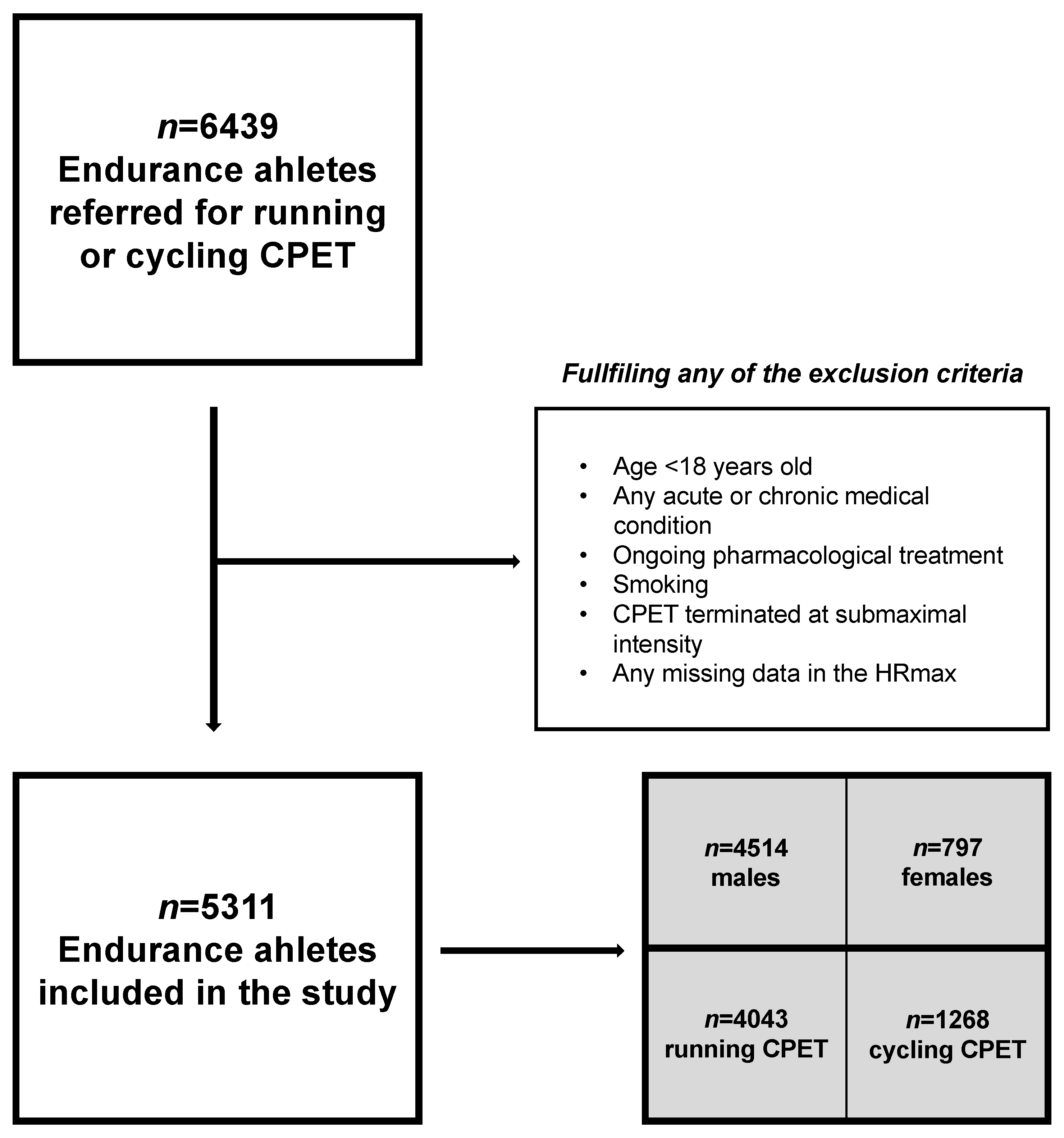
Maximal heart rate (HRmax) is a widely used measure of cardiorespiratory fitness. Prediction of HRmax is an alternative to cardiopulmonary exercise testing (CPET), but its accuracy among endurance athletes (EA) requires evaluation. This study aimed to externally validate HRmax prediction models in the EA independently for running and cycling CPET. A total of 4043 runners (age = 33.6 (8.1) years; 83.5% males; BMI = 23.7 (2.5) kg·m−2) and 1026 cyclists (age = 36.9 (9.0) years; 89.7% males; BMI = 24.0 (2.7) kg·m−2) underwent maximum CPET. Student t-test, mean absolute percentage error (MAPE), and root mean square error (RMSE) were applied to validate eight running and five cycling HRmax equations externally. HRmax was 184.6 (9.8) beats·min−1 and 182.7 (10.3) beats·min−1, respectively, for running and cycling, p = 0.001. Measured and predicted HRmax differed significantly (p = 0.001) for 9 of 13 (69.2%) models. HRmax was overestimated by eight (61.5%) and underestimated by five (38.5%) formulae. Overestimated HRmax amounted to 4.9 beats·min−1 and underestimated HRmax was in the range up to 4.9 beats·min−1. RMSE was 9.1–10.5. MAPE ranged to 4.7%. Prediction models allow for limited precision of HRmax estimation and present inaccuracies. HRmax was more often underestimated than overestimated. Predicted HRmax can be implemented for EA as a supplemental method, but CPET is the preferable method.
Keywords: maximal heart rate; endurance athletes; cardiopulmonary exercise test; exercise physiology; prediction models; endurance performance maximal heart rate; endurance athletes; cardiopulmonary exercise test; exercise physiology; prediction models; endurance performance