


Effectiveness of Percutaneous Flexor Tenotomies for the Prevention and Management of Toe-Related Diabetic Foot Ulcers: A Systematic Review

 ,
,  , ,
, ,  and
and 
Abstract
1. Introduction
2. Materials and Methods
2.1. Literature Search
2.2. Selection Requirements
2.2.1. Inclusion Criteria
2.2.2. Exclusion Criteria
2.3. Literature Screening and Data Extraction
2.4. Quality Evaluation of Included Studies (STROBE Guidelines)
2.5. Statistical Analyses
3. Results
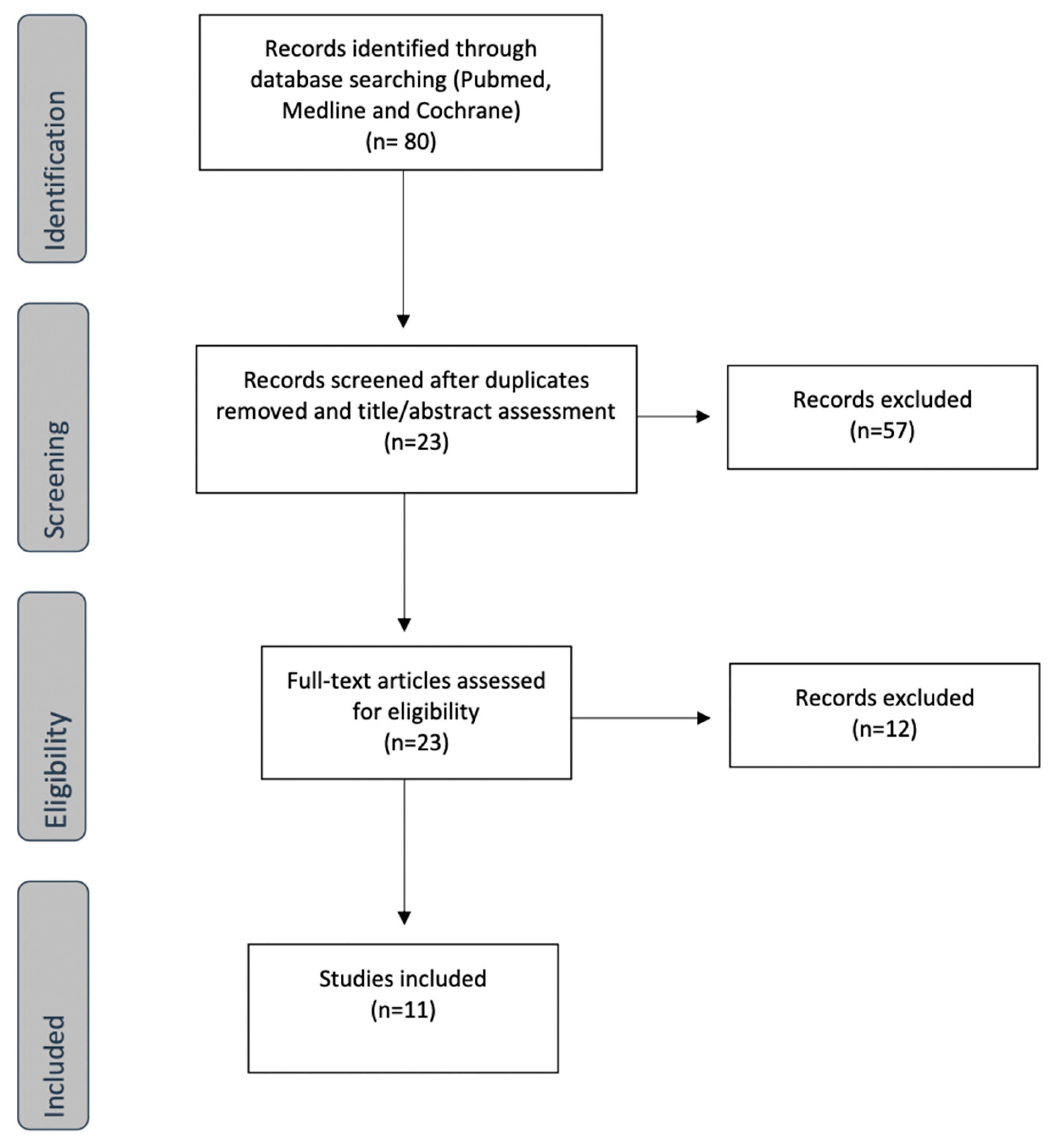
3.1. Literature Retrieval
3.2. Characteristics of the Included Studies
3.3. Quality of the Reporting
3.4. Screened Outcomes
3.4.1. Healing Rates and Mean Healing Times
3.4.2. Ulceration and Recurrence Rates
3.4.3. Complications Arising from the Surgical Procedure
3.4.4. Adverse Events
4. Discussion
5. Conclusions
Author Contributions
Funding
Institutional Review Board Statement
Informed Consent Statement
Data Availability Statement
Conflicts of Interest
References
- Armstrong, D.G.; Boulton, A.J.M.; Bus, S.A. Diabetic Foot Ulcers and Their Recurrence. N. Engl. J. Med. 2017, 376, 2367–2375. [Google Scholar] [CrossRef] [PubMed]
- Hawkins, G.C.; Bennett, M.H.; Smart, D.R. Australian Diabetes Foot Network: Management of diabetes-related foot ulceration—A clinical update. Med. J. Aust. 2013, 198, 259–260. [Google Scholar] [CrossRef] [PubMed]
- Cowley, M.S.; Boyko, E.; Shofer, J.B.; Ahroni, J.H.; Ledoux, W.R. Foot ulcer risk and location in relation to prospective clinical assessment of foot shape and mobility among persons with diabetes. Diabetes Res. Clin. Pract. 2008, 82, 226–232. [Google Scholar] [CrossRef]
- Pickwell, K.M.; Siersma, V.D.; Kars, M.; Holstein, P.E.; Schaper, N.C.; on behalf of the Eurodiale consortium. Diabetic foot disease: Impact of ulcer location on ulcer healing. Diabetes Metab. Res. Rev. 2013, 29, 377–383. [Google Scholar] [CrossRef] [PubMed]
- Bus, S.A.; Maas, M.; Michels, R.P.; Levi, M. Role of Intrinsic Muscle Atrophy in the Etiology of Claw Toe Deformity in Diabetic Neuropathy May Not Be as Straightforward as Widely Believed. Diabetes Care 2009, 32, 1063–1067. [Google Scholar] [CrossRef]
- Malhotra, K.; Davda, K.; Singh, D. The pathology and management of lesser toe deformities. EFORT Open Rev. 2016, 1, 409–419. [Google Scholar] [CrossRef]
- Schrier, J.C.M.; Verheyen, C.C.P.M.; Louwerens, J.W. Definitions of Hammer Toe and Claw Toe. J. Am. Podiatr. Med. Assoc. 2009, 99, 194–197. [Google Scholar] [CrossRef]
- Lázaro-Martínez, J.L.; Aragón-Sánchez, J.; Afonso, F.J.A.; García-Morales, E.; García-Álvarez, Y.; Molines-Barroso, R.J. The Best Way to Reduce Reulcerations. Int. J. Low. Extrem. Wounds 2014, 13, 294–319. [Google Scholar] [CrossRef]
- La Fontaine, J.; Lavery, L.A.; Hunt, N.A.; Murdoch, D.P. The Role of Surgical Off-Loading to Prevent Recurrent Ulcerations. Int. J. Low. Extrem. Wounds 2014, 13, 320–334. [Google Scholar] [CrossRef]
- Bus, S.A.; Valk, G.D.; van Deursen, R.W.; Armstrong, D.G.; Caravaggi, C.; Hlaváček, P.; Bakker, K.; Cavanagh, P.R. The effectiveness of footwear and offloading interventions to prevent and heal foot ulcers and reduce plantar pressure in diabetes: A systematic review. Diabetes Metab. Res. Rev. 2008, 24, S162–S180. [Google Scholar] [CrossRef]
- Finestone, A.S.; Tamir, E.; Ron, G.; Wiser, I.; Agar, G. Surgical offloading procedures for diabetic foot ulcers compared to best non-surgical treatment: A study protocol for a randomized controlled trial. J. Foot Ankle Res. 2018, 11, 6. [Google Scholar] [CrossRef] [PubMed]
- Bus, S.A.; Lavery, L.A.; Monteiro-Soares, M.; Rasmussen, A.; Raspovic, A.; Sacco, I.C.; van Netten, J.J.; on behalf of the International Working Group on the Diabetic Foot. Guidelines on the prevention of foot ulcers in persons with diabetes (IWGDF 2019 update). Diabetes Metab. Res. Rev. 2020, 36, e3269. [Google Scholar] [CrossRef] [PubMed]
- Scott, J.E.; Hendry, G.J.; Locke, J. Effectiveness of percutaneous flexor tenotomies for the management and prevention of recurrence of diabetic toe ulcers: A systematic review. J. Foot Ankle Res. 2016, 9, 25. [Google Scholar] [CrossRef] [PubMed]
- Bonanno, D.R.; Gillies, E.J. Flexor Tenotomy Improves Healing and Prevention of Diabetes-Related Toe Ulcers: A Systematic Review. J. Foot Ankle Surg. 2017, 56, 600–604. [Google Scholar] [CrossRef]
- Tricco, A.C.; Lillie, E.; Zarin, W.; O’Brien, K.K.; Colquhoun, H.; Levac, D.; Moher, D.; Peters, M.D.J.; Horsley, T.; Weeks, L.; et al. PRISMA Extension for Scoping Reviews (PRISMA-ScR): Checklist and Explanation. Ann. Intern. Med. 2018, 169, 467–473. [Google Scholar] [CrossRef]
- Cuschieri, S. The STROBE guidelines. Saudi J. Anaesth. 2019, 13 (Suppl. S1), S31–S34. [Google Scholar] [CrossRef]
- Schepers, T.; Berendsen, H.A.; Oei, I.H.; Koning, J. Functional Outcome and Patient Satisfaction after Flexor Tenotomy for Plantar Ulcers of the Toes. J. Foot Ankle Surg. 2010, 49, 119–122. [Google Scholar] [CrossRef]
- Kearney, T.P.; Hunt, N.A.; Lavery, L. Safety and effectiveness of flexor tenotomies to heal toe ulcers in persons with diabetes. Diabetes Res. Clin. Pract. 2010, 89, 224–226. [Google Scholar] [CrossRef]
- Van Netten, J.J.; Bril, A.; Van Baal, J.G. The effect of flexor tenotomy on healing and prevention of neuropathic diabetic foot ulcers on the distal end of the toe. J. Foot Ankle Res. 2013, 6, 3–5. [Google Scholar] [CrossRef]
- Rasmussen, A.; Bjerre-Christensen, U.; Almdal, T.P.; Holstein, P. Percutaneous flexor tenotomy for preventing and treating toe ulcers in people with diabetes mellitus. J. Tissue Viability 2013, 22, 68–73. [Google Scholar] [CrossRef]
- Tamir, E.; Vigler, M.; Avisar, E.; Finestone, A.S. Percutaneous Tenotomy for the Treatment of Diabetic Toe Ulcers. Foot Ankle Int. 2013, 35, 38–43. [Google Scholar] [CrossRef] [PubMed]
- Schmitz, P.; Scheffer, R.; de Gier, S.; Krol, R.M.; van der Veen, D.; Smeets, L. The Effect of Percutaneous Flexor Tenotomy on Healing and Prevention of Foot Ulcers in Patients with Claw Deformity of the Toe. J. Foot Ankle Surg. 2019, 58, 1134–1137. [Google Scholar] [CrossRef]
- Andersen, J.H.; Rasmussen, A.; Møller, M.F.; Rossing, P.; Kirketerp-Møller, K.; Engberg, S. The effect of needle tenotomy on hammer, mallet and claw toe deformities in patients with diabetes, a retrospective study. J. Clin. Transl. Endocrinol. 2019, 18, 100208. [Google Scholar] [CrossRef]
- Smith, S.E.; Miller, J. The Safety and Effectiveness of the Percutaneous Flexor Tenotomy in Healing Neuropathic Apical Toe Ulcers in the Outpatient Setting. Foot Ankle Spéc. 2019, 13, 123–131. [Google Scholar] [CrossRef] [PubMed]
- Mens, M.A.; van Netten, J.J.; Busch-Westbroek, T.E.; Bus, S.A.; Streekstra, G.J.; Wellenberg, R.H.H.; Maas, M.; Nieuwdorp, M.; Stufkens, S.A.S. Biomechanical and musculoskeletal changes after flexor tenotomy to reduce the risk of diabetic neuropathic toe ulcer recurrence. Diabet. Med. 2021, 39, e14761. [Google Scholar] [CrossRef]
- López-Moral, M.; Molines-Barroso, R.J.; García-Álvarez, Y.; Sanz-Corbalán, I.; Tardáguila-García, A.; Lázaro-Martínez, J.L. Safety and Efficacy of Several Versus Isolated Prophylactic Flexor Tenotomies in Diabetes Patients: A 1-Year Prospective Study. J. Clin. Med. 2022, 11, 4093. [Google Scholar] [CrossRef]
- Andersen, J.A.; Rasmussen, A.; Engberg, S.; Bencke, J.; Frimodt-Møller, M.; Kirketerp-Møller, K.; Rossing, P. Flexor Tendon Tenotomy Treatment of the Diabetic Foot: A Multicenter Randomized Controlled Trial. Diabetes Care 2022, 45, 2492–2500. [Google Scholar] [CrossRef]

| First Author Year | Study Design | Objectives | Sample | Lesion Characteristics | Surgical Intervention | Follow-Up |
|---|---|---|---|---|---|---|
| Schepers T. 2010, [17] | retrospective | To assess the results of using flexor tenotomies to treat ulcers in flexible claw toes. | 23 patients
17 PULs |
|
| 11 months |
| Kearney TP. 2010, [18] | retrospective | To evaluate the effectiveness and safety of percutaneous tenotomy of the flexor digitorum longus for healing neuropathic ulcers in the tip of the toes. | 48 patients with diabetes
|
|
| 28 months |
| Van Netten JJ. 2013, [19] | retrospective | To report healing rates and healing times and to investigate the influence of preoperative treatment, time of ulcer evolution before tenotomy, and location or presence of infection on healing and healing time. They also wanted to describe the advantages of using this technique as a prophylactic intervention in diabetic patients with claw or hammertoes. | 33 patients with diabetes
|
|
| 23 ± 11 months |
| Rasmussen A. 2013, [20] | retrospective | To examine the effectiveness of a modified flexor tenotomy technique to prevent and heal neuropathic and neuroischemic ulcers located on the tip of the toe in the presence of claw or hammertoe deformity in diabetic patients. | 38 patients
|
|
| 6 months |
| Tamir E. 2014, [21] | retrospective | To report on the performance of percutaneous flexor and extensor tenotomies for treating neuropathic ulcers. | 55 patients with diabetes * Patients with critical ischemia were excluded |
|
| 22 months |
| Schmitz P. 2019, [22] | retrospective | To assess whether percutaneous flexor tenotomy is an effective intervention to treat and prevent toe ulcers and whether prophylactic percutaneous tenotomy is a safe and effective way to prevent ulceration. | 101 feet included 77 with DFS
|
|
| 13.4 months |
| Hedegaard Andersen J. 2019, [23] | retrospective | To show the outcome of percutaneous needle tenotomies and the benefit of flexor tenotomies as a treatment for claw, hammer, and mallet toes in people with diabetes. | 81 patients with diabetes
|
|
| 97 weeks |
| Smith SE. 2020, [24] | prospective | To show the effectiveness and usefulness of percutaneous flexor tenotomies for the healing of neuropathic ulcers at the distal end of the toes performed in an outpatient setting and to show the effectiveness of percutaneous flexor tenotomies for the prevention of progression of preulcerative toe lesions to diabetic foot ulcers. | 23 patients with diabetes
41 PULs |
|
| 6 months |
| Mens MA. 2022, [25] | prospective | To evaluate the effect of percutaneous flexor tenotomy in diabetic patients on plantar pressure, toe angulation, and ulcer recurrence. | 14 patients with diabetes
50 toes |
|
| 14.4 months |
| López-Moral M. 2022, [26] | prospective | To evaluate the long-term clinical outcomes of patients who underwent isolated percutaneous flexor tenotomies versus multiple tenotomies to treat previous toe deformities and diabetic foot ulcers. | 23 patients with diabetes
|
|
11 with isolated tenotomies
| 1 year |
| Andersen J. 2022, [27] | RCT | To examine the ability of tenotomies to prevent and treat hammertoe-associated ulcers in diabetic patients. | 96 patients with diabetes 16 ulcers 79 PULs |
|
PUL with SOC PUL with tenotomies + SOC DFU with SOC DFU with tenotomies + SOC | 1 year |
| Item Number–STROBE Guidelines | |||||||||||||||||||||||
|---|---|---|---|---|---|---|---|---|---|---|---|---|---|---|---|---|---|---|---|---|---|---|---|
| 1(a) | 1(b) | 2 | 3 | 4 | 5 | 6 | 7 | 8 | 9 | 10 | 11 | 12 | 13 | 14 | 15 | 16 | 17 | 18 | 19 | 20 | 21 | 22 | |
| Schepers T. 2010, [17] | No | Yes | Yes | No | Yes | Yes | No | Yes | Yes | No | No | No | No | Yes | Yes | Yes | Yes | No | Yes | No | Yes | No | No |
| Kearney TP. 2010, [18] | Yes | Yes | Yes | Yes | Yes | Yes | Yes | Yes | No | No | No | No | No | Yes | Yes | Yes | Yes | Yes | Yes | Yes | Yes | Yes | Yes |
| Van Netten JJ. 2013, [19] | Yes | Yes | Yes | Yes | Yes | Yes | Yes | Yes | Yes | No | Yes | No | Yes | Yes | Yes | Yes | Yes | No | Yes | No | Yes | Yes | Yes |
| Rasmussen A. 2013, [20] | Yes | Yes | Yes | Yes | Yes | Yes | Yes | Yes | Yes | No | No | Yes | Yes | Yes | Yes | Yes | Yes | Yes | Yes | No | Yes | No | No |
| Tamir E. 2014, [21] | Yes | Yes | No | Yes | Yes | No | Yes | No | No | No | No | No | Yes | Yes | Yes | Yes | Yes | Yes | Yes | No | Yes | No | Yes |
| Schmitz P. 2019, [22] | Yes | Yes | Yes | Yes | Yes | Yes | No | Yes | No | No | Yes | Yes | No | Yes | Yes | Yes | Yes | Yes | Yes | Yes | Yes | No | Yes |
| Hedegaard Andersen J. 2019, [23] | Yes | Yes | Yes | Yes | Yes | Yes | No | Yes | Yes | No | No | No | No | Yes | Yes | Yes | Yes | Yes | Yes | Yes | Yes | No | Yes |
| Smith SE. 2020, [24] | Yes | Yes | Yes | Yes | Yes | Yes | Yes | Yes | Yes | Yes | No | Yes | Yes | Yes | Yes | Yes | Yes | Yes | Yes | No | Yes | No | Yes |
| Mens MA. 2022, [25] | No | Yes | Yes | Yes | Yes | No | Yes | Yes | No | No | No | Yes | Yes | Yes | Yes | Yes | Yes | Yes | Yes | Yes | Yes | Yes | No |
| López-Moral M. 2022, [26] | Yes | Yes | Yes | Yes | Yes | Yes | Yes | Yes | Yes | Yes | Yes | No | Yes | Yes | Yes | Yes | Yes | No | Yes | No | Yes | Yes | Yes |
| Andersen J. 2022, [27] | Yes | Yes | Yes | Yes | Yes | Yes | Yes | Yes | Yes | Yes | Yes | Yes | Yes | Yes | Yes | Yes | Yes | Yes | Yes | Yes | Yes | Yes | Yes |
| Researchers | Healing Rate (%) | Mean Healing Time | Adverse Events | Surgical Complications |
|---|---|---|---|---|
| Schepers T et al. (2010), [17] | 100% | 3.6 weeks |
|
|
| Kearney TP et al. (2010), [18] | 98.3% | 40–52 days |
|
|
| Van Netten JJ et al. (2013), [19] | 92% | 22 ± 26 days |
|
|
| Rasmussen A et al. (2013), [20] | 93% | 21 days |
|
|
| Tamir E et al. (2014), [21] | 98% | 4 weeks |
|
|
| Schmitz P et al. (2019), [22] | 93.8% | 22 days |
|
|
| Hedegaard Andersen J et al. (2019), [23] | 94% | 28 days | Curative group:
4 amputations (3 minor and 1 major) |
|
| Smith SE et al. (2020), [24] | 100% | 10.2 ± 4.3 days |
|
|
| Mens MA et al. (2022), [25] | NA Recurrence 0% | NA |
|
|
| López-Moral M et al. (2022), [26] | NA Recurrence 0% | NA | Insolated tenotomies:
|
|
| Andersen J et al. (2022), [27] | 100% Recurrence 0% | Days (7–26) |
|
|
Disclaimer/Publisher’s Note: The statements, opinions and data contained in all publications are solely those of the individual author(s) and contributor(s) and not of MDPI and/or the editor(s). MDPI and/or the editor(s) disclaim responsibility for any injury to people or property resulting from any ideas, methods, instructions or products referred to in the content. |
© 2023 by the authors. Licensee MDPI, Basel, Switzerland. This article is an open access article distributed under the terms and conditions of the Creative Commons Attribution (CC BY) license (https://creativecommons.org/licenses/by/4.0/).
Share and Cite
Calvo-Wright, M.M.; López-Moral, M.; García-Álvarez, Y.; García-Madrid, M.; Álvaro-Afonso, F.J.; Lázaro-Martínez, J.L. Effectiveness of Percutaneous Flexor Tenotomies for the Prevention and Management of Toe-Related Diabetic Foot Ulcers: A Systematic Review. J. Clin. Med. 2023, 12, 2835. https://doi.org/10.3390/jcm12082835
Calvo-Wright MM, López-Moral M, García-Álvarez Y, García-Madrid M, Álvaro-Afonso FJ, Lázaro-Martínez JL. Effectiveness of Percutaneous Flexor Tenotomies for the Prevention and Management of Toe-Related Diabetic Foot Ulcers: A Systematic Review. Journal of Clinical Medicine. 2023; 12(8):2835. https://doi.org/10.3390/jcm12082835
Chicago/Turabian StyleCalvo-Wright, María M., Mateo López-Moral, Yolanda García-Álvarez, Marta García-Madrid, Francisco J. Álvaro-Afonso, and José Luis Lázaro-Martínez. 2023. "Effectiveness of Percutaneous Flexor Tenotomies for the Prevention and Management of Toe-Related Diabetic Foot Ulcers: A Systematic Review" Journal of Clinical Medicine 12, no. 8: 2835. https://doi.org/10.3390/jcm12082835
APA StyleCalvo-Wright, M. M., López-Moral, M., García-Álvarez, Y., García-Madrid, M., Álvaro-Afonso, F. J., & Lázaro-Martínez, J. L. (2023). Effectiveness of Percutaneous Flexor Tenotomies for the Prevention and Management of Toe-Related Diabetic Foot Ulcers: A Systematic Review. Journal of Clinical Medicine, 12(8), 2835. https://doi.org/10.3390/jcm12082835

