

Nanofiltration for Advanced and Reliable Drinking Water Treatment: Experimental Evaluation of Hybrid Pretreatment Systems and Fouling Control

 ,
,  ,
,  ,
,
Abstract
1. Introduction
2. Materials and Methods
2.1. Experimental Facilities and Materials
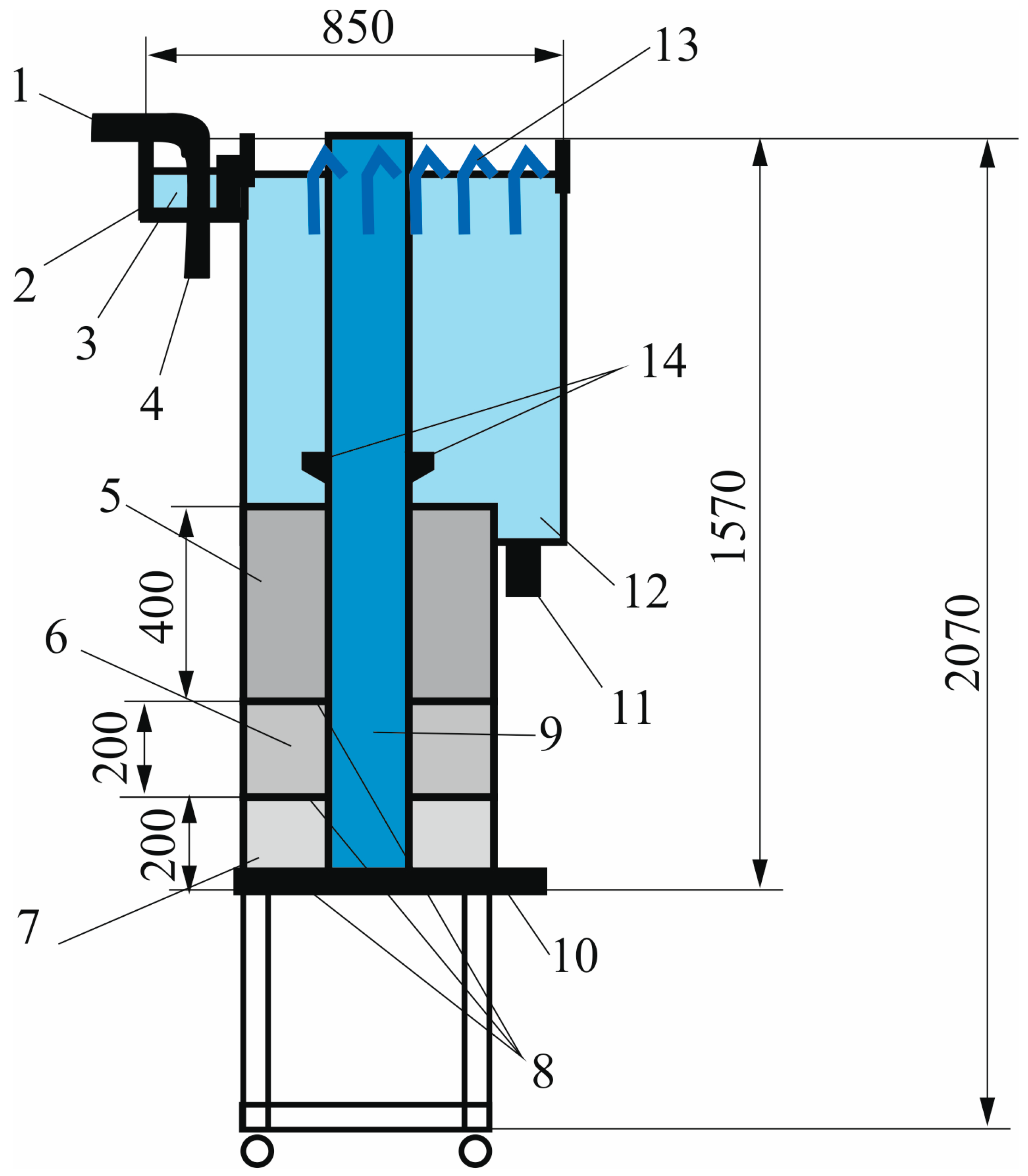
2.1.1. Slow-Rate Pretreatment Filtration
- •
- Design: The filters were columns made of transparent plastic, equipped with a raw-water supply system, a drainage layer, a filter medium, an overflow device and pipes for the extraction of purified water and regeneration.
- •
- Filter materials:
- ○
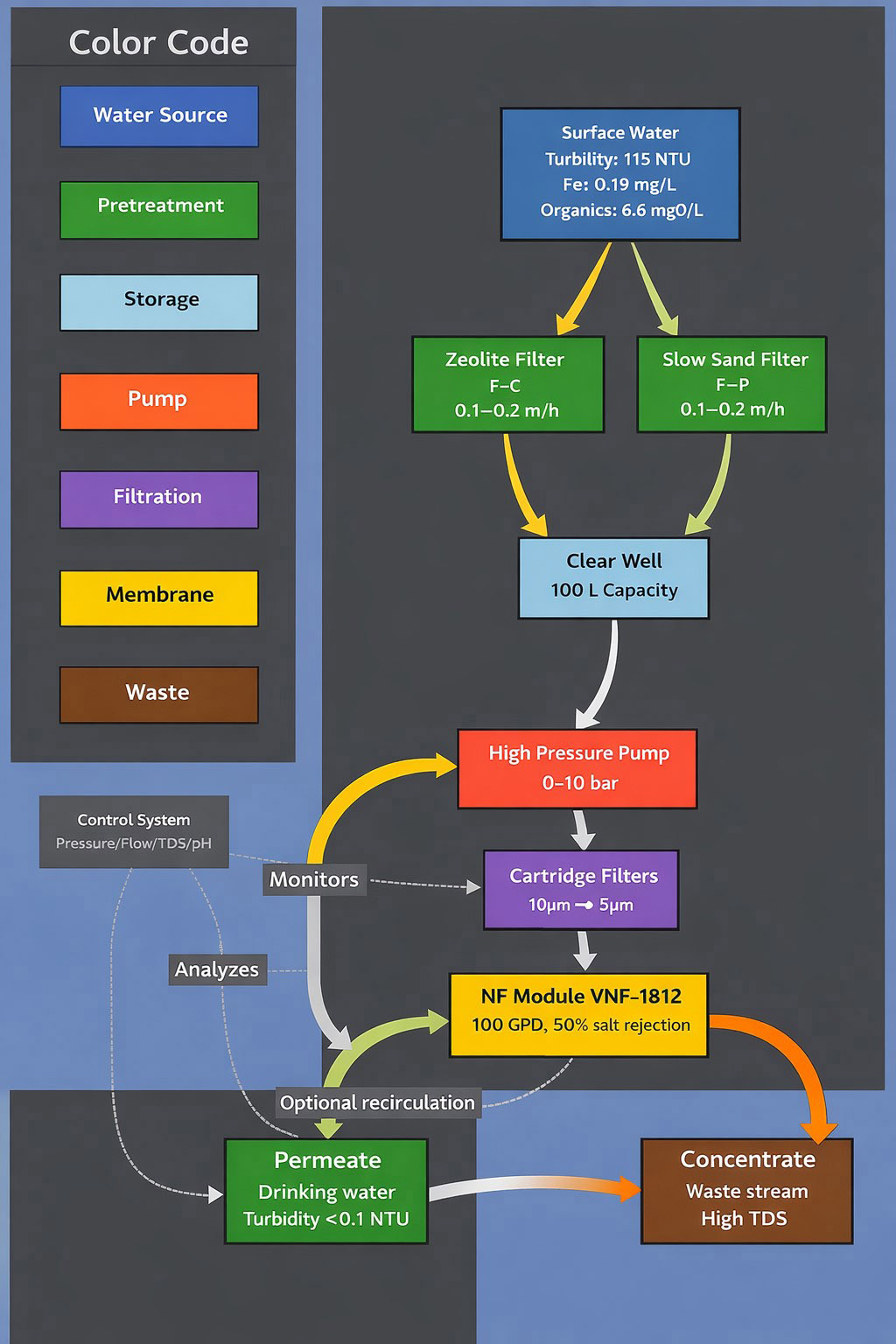
- Sand filter (F–P): The filter bed consisted of three layers of quartz sand with a fraction of 0.8–2 mm (height 50 cm), 2–5 mm (10 cm) and 5–10 mm (10 cm). The lower drainage layer was made of gravel with a fraction of 10–20 mm (5 cm).
- ○
- Zeolite filter (F–C): Natural zeolite with a fraction of 0.3–0.5 mm (50 cm) was used as the main load. Layers of zeolite with a fraction of 3 mm (5 cm), 5 mm (5 cm) and 5–10 mm (10 cm) were located above. The drainage layer consisted of gravel with a particle size of 5–10 mm (10 cm).
- •
- Hydraulic loading regime: In both pretreatment lines, the filtration rate was maintained in the range of 0.1–0.2 m/h. In this manuscript, the term ‘slow filtration’ refers to this low hydraulic loading regime rather than to the type of filtering medium.
2.1.2. Nanofiltration Unit
- •
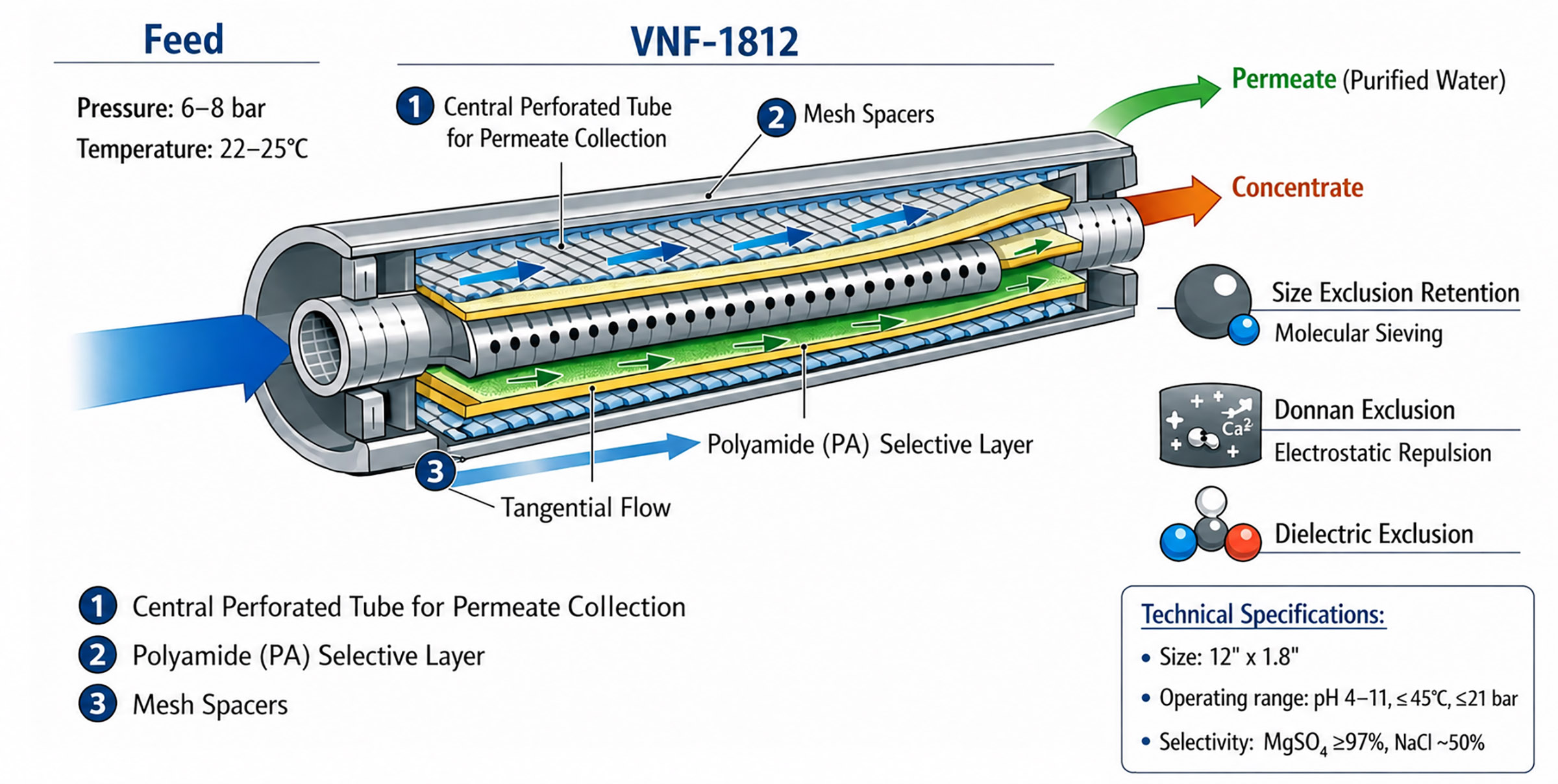
- Main element: 1812 standard size 1812 roll membrane element (length 12 in/298 mm, diameter 1.8 in/46 mm). A polyamide thin-film composite membrane (VNF-1812) was used with the following manufacturer-declared characteristics:
- -
- Nominal permeate capacity: 100 GPD (≈380 L/day).
- -
- Mean salt retention (by NaCl): 50%.
- -
- Mean hardness salt retention (for magnesium sulphate): ≥97%.
- -
- Maximum operating pressure: 21 bar (300 psi).
- -
- pH range for continuous operation: 4–11.
- •
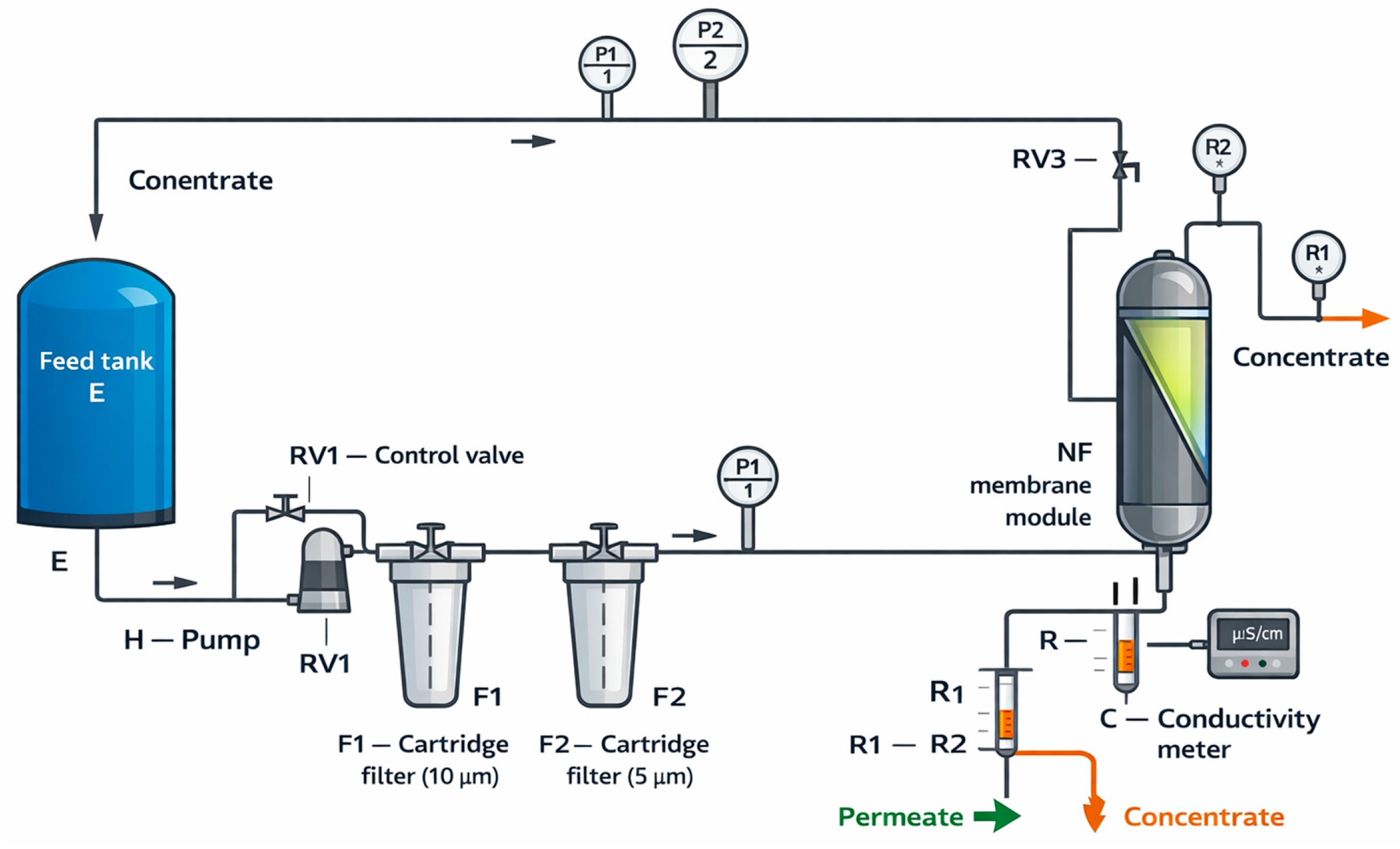
- Pump: A high-pressure centrifugal pump that allows continuous adjustment of the inlet pressure to the membrane module in the range of 0–10 bar.
- •
- Pre-cleaning system: Two sequential 10 μm and 5 μm cartridge filters to remove suspensions and protect the membrane.
- •
- Instrumentation: Pressure gauges at the inlet and outlet of the membrane module; rotameters for measuring permeate and concentrate flow rates; laboratory conductivity meter for online measurement of total salinity (salt content).
- •
- Containers: Plastic tanks for initial solution, permeate and concentrate with a volume of 100 L.
2.2. Methods of Water Quality Analysis
- •
- Spectrophotometry: A laboratory visible spectrophotometer Hach DR3900 (Hach Company, Loveland, CO, USA) (range 320–1100 nm) was used to determine the concentrations of key ions and indicators. The analysis was performed using TNTplus® proprietary reagent kits using pre-defined calibrated methods for the determination of: permanganate oxidizability (PO), iron ions (Fe2+/Fe3+), sulphates (SO42−), nitrates (NO3−), copper (Cu2+) and turbidity (in NTU).
- •
- Electrochemical measurements: The pH value was measured with a laboratory pH meter with a combined electrode. Electrical conductivity (salt content) was measured with a portable conductivity meter.
- •
- Gravimetric analysis: The mass concentration of suspended solids was determined by the standard method of filtering the sample through a pre-weighed membrane filter, followed by drying and weighing.
2.3. Experimental Protocol
2.4. Performance Metrics and Statistical Analysis
2.4.1. Membrane-Process Parameters
2.4.2. Pretreatment Removal Efficiency [31]
2.4.3. Statistical Analysis
3. Results and Discussion
3.1. Pretreatment Performance of Slow Filters
3.2. Nanofiltration Performance and Stability
3.2.1. Initial Membrane Performance and Selectivity
3.2.2. Flux Decline and Effect of Pretreatment
3.2.3. Indirect Assessment of Membrane Fouling
3.2.4. Pretreatment and Membrane Regeneration
4. Conclusions
Author Contributions
Funding
Data Availability Statement
Conflicts of Interest
References
- Jiang, S.; Li, Y.; Ladewig, B.P. A review of reverse osmosis membrane fouling and control strategies. Sci. Total Environ. 2017, 595, 567–583. [Google Scholar] [CrossRef] [PubMed]
- Yang, Z.; Guo, H.; Yao, Z.K.; Mei, Y.; Tang, C.Y. Hydrophilic silver nanoparticles induce selective nanochannels in thin film nanocomposite polyamide membranes. Environ. Sci. Technol. 2019, 53, 5301–5308. [Google Scholar] [CrossRef]
- Lau, W.J.; Ismail, A.F.; Misdan, N.; Kassim, M.A. A recent progress in thin film composite membrane: A review. Desalination 2012, 287, 190–199. [Google Scholar] [CrossRef]
- Prihasto, N.; Liu, Q.F.; Kim, S.H. Pre-treatment strategies for seawater desalination by reverse osmosis system. Desalination 2009, 249, 308–316. [Google Scholar] [CrossRef]
- Henthorne, L.; Boysen, B. State-of-the-art of reverse osmosis desalination pretreatment. Desalination 2015, 356, 129–139. [Google Scholar] [CrossRef]
- Isametova, M.E.; Nussipali, R.; Martyushev, N.V.; Malozyomov, B.V.; Efremenkov, E.A.; Isametov, A. Mathematical Modeling of the Reliability of Polymer Composite Materials. Mathematics 2022, 10, 3978. [Google Scholar] [CrossRef]
- Malozyomov, B.V.; Martyushev, N.V.; Bryukhanova, N.N.; Kondratiev, V.V.; Kononenko, R.V.; Pavlov, P.P.; Romanova, V.V.; Karlina, Y.I. Reliability Study of Metal-Oxide Semiconductors in Integrated Circuits. Micromachines 2024, 15, 561. [Google Scholar] [CrossRef]
- DuPont. FilmTec™ Reverse Osmosis Membranes Technical Manual; Form No. 45-D01504-en, Rev. 18; DuPont: Wilmington, DE, USA, 2025; Available online: https://www.dupont.com/content/dam/water/amer/us/en/water/public/documents/en/RO-NF-FilmTec-Manual-45-D01504-en.pdf (accessed on 11 April 2026).
- Linder, C.; Kedem, O. History of Nanofiltration Membranes from 1960 to 1990. In Nanofiltration: Principles, Applications, and New Materials; Wiley-VCH: Weinheim, Germany, 2021; pp. 3–34. Available online: https://application.wiley-vch.de/books/sample/3527346902_c01.pdf (accessed on 11 April 2026).
- Colloid|Definition of Colloid by Merriam-Webster. Available online: https://www.merriam-webster.com/dictionary/colloid (accessed on 29 January 2020).
- Lafi, R.; Gzara, L.; Lajimi, R.H.; Hafiane, A. Treatment of Textile Wastewater by a Hybrid Ultrafiltration/Electrodialysis Process. Chem. Eng. Process. Process Intensif. 2018, 132, 105–113. [Google Scholar]
- Qasim, M.; Badrelzaman, M.; Darwish, N.N.; Darwish, N.A.; Hilal, N. Reverse osmosis desalination: A state-of-the-art review. Desalination 2019, 459, 59–104. [Google Scholar] [CrossRef]
- Tang, C.Y.; Chong, T.H.; Fane, A.G. Colloidal interactions and fouling of NF and RO membranes: A review. Adv. Colloid Interface Sci. 2011, 164, 126–143. [Google Scholar] [CrossRef] [PubMed]
- Kalafatakis, S.; Zarebska, A.; Lange, L.; Hélix-Nielsen, C.; Skiadas, I.V.; Gavala, H.N. Biofouling mitigation approaches during water recovery from fermented broth via forward osmosis. Membranes 2020, 10, 307. [Google Scholar] [CrossRef]
- Maddah, H.; Chogle, A. Biofouling in reverse osmosis: Phenomena, monitoring, controlling and remediation. Appl. Water Sci. 2017, 7, 2637–2651. [Google Scholar] [CrossRef]
- Filina, O.A.; Sorokova, S.N.; Efremenkov, E.A.; Valuev, D.V.; Qi, M. Stochastic Models and Processing Probabilistic Data for Solving the Problem of Improving the Electric Freight Transport Reliability. Mathematics 2023, 11, 4836. [Google Scholar] [CrossRef]
- Koo, C.H.; Mohammad, A.W.; Suja’, F.; Talib, M.Z.M. Use and Development of Fouling Index in Predicting Membrane Fouling. Sep. Purif. Rev. 2013, 42, 296–339. [Google Scholar] [CrossRef]
- Sim, L.N.; Chong, T.H.; Taheri, A.H.; Sim, S.T.V.; Lai, L.; Krantz, W.B.; Fane, A.G. A review of fouling indices and monitoring techniques for reverse osmosis. Desalination 2018, 434, 169–188. [Google Scholar] [CrossRef]
- Rudolph, G.; Virtanen, T.; Ferrando, M.; Güell, C.; Lipnizki, F.; Kallioinen, M. A review of in situ real-time monitoring techniques for membrane fouling in the biotechnology, biorefinery and food sectors. J. Membr. Sci. 2019, 588, 117221. [Google Scholar] [CrossRef]
- Ruigómez, I.; Vera, L.; González, E.; Rodríguez-Sevilla, J. Pilot plant study of a new rotating hollow fibre membrane module for improved performance of an anaerobic submerged MBR. J. Membr. Sci. 2016, 514, 105–113. [Google Scholar] [CrossRef]
- Demin, A.Y.; Pogrebnoy, A.V.; Efremenkov, E.A.; Valuev, D.V.; Boltrushevich, A.E. Modeling the Reliability of an Electric Car Battery While Changing Its Charging and Discharge Characteristics. Mathematics 2025, 13, 1832. [Google Scholar] [CrossRef]
- Sioutopoulos, D.; Karabelas, A.; Mappas, V. Membrane fouling due to protein—Polysaccharide mixtures in dead-end ultrafiltration; the effect of permeation flux on fouling resistance. Membranes 2019, 9, 21. [Google Scholar] [CrossRef] [PubMed]
- Hernández, M.; Melián-Martel, N.; Ruiz-García, A.; Río-Gamero, B. Del Fouling characterization during initial stage of cross-flow ultrafiltration. J. Water Process Eng. 2020, 38, 101611. [Google Scholar] [CrossRef]
- Neubrand, W.; Vogler, S.; Ernst, M.; Jekel, M. Lab and pilot scale investigations on membrane fouling during the ultrafiltration of surface water. Desalination 2010, 250, 968–972. [Google Scholar] [CrossRef]
- Kim, L.H.; Nava-Ocampo, M.; van Loosdrecht, M.C.M.; Kruithof, J.C.; Vrouwenvelder, J.S. The membrane fouling simulator: Development, application, and early-warning of biofouling in RO treatment. Desalin. Water Treat. 2018, 126, 1–23. [Google Scholar] [CrossRef]
- Vrouwenvelder, J.S.; van Paassen, J.A.M.; Wessels, L.P.; van Dam, A.F.; Bakker, S.M. The Membrane Fouling Simulator: A practical tool for fouling prediction and control. J. Membr. Sci. 2006, 281, 316–324. [Google Scholar] [CrossRef]
- Khalikov, I.H.; Kukartsev, V.A.; Kukartsev, V.V.; Tynchenko, V.S.; Tynchenko, Y.A.; Qi, M. Review of Methods for Improving the Energy Efficiency of Electrified Ground Transport by Optimizing Battery. Energies 2023, 16, 729. [Google Scholar] [CrossRef]
- B.V. Convergence Industry. Membrane Fouling Simulator. Available online: https://www.con-vergence.com/product/membrane-fouling-simulator/ (accessed on 27 April 2021).
- Bagheri, M.; Akbari, A.; Mirbagheri, S.A. Advanced control of membrane fouling in filtration systems using artificial intelligence and machine learning techniques: A critical review. Process Saf. Environ. Prot. 2019, 123, 229–252. [Google Scholar] [CrossRef]
- Aidan, A.; Abdel-Jabbar, N.; Ibrahim, T.H.; Nenov, V.; Mjalli, F. Neural network modeling and optimization of scheduling backwash for membrane bioreactor. Clean. Technol. Environ. Policy 2008, 10, 389–395. [Google Scholar] [CrossRef]
- Curcio, S.; Calabrò, V.; Iorio, G. Reduction and control of flux decline in cross-flow membrane processes modeled by artificial neural networks. J. Membr. Sci. 2006, 286, 125–132. [Google Scholar] [CrossRef]
- Babyr, N.V.; Pogrebnoy, A.V.; Efremenkov, E.A.; Valuev, D.V.; Boltrushevich, A.E. Modelling of Reliability Indicators of a Mining Plant. Mathematics 2024, 12, 2842. [Google Scholar] [CrossRef]
- Hedayati Moghaddam, A.; Hazrati, H.; Sargolzaei, J.; Shayegan, J. Assessing and simulation of membrane technology for modifying starchy wastewater treatment. Appl. Water Sci. 2017, 7, 2753–2765. [Google Scholar] [CrossRef]
- Ruiz-García, A.; Melián-Martel, N.; Nuez, I. Short review on predicting fouling in RO desalination. Membranes 2017, 7, 62. [Google Scholar] [CrossRef] [PubMed]
- ASTM D4189-07; Standard Test Method for Silt Density Index (SDI) of Water. ASTM International: West Conshohocken, PA, USA, 2014. Available online: https://www.astm.org/Standards/D4189.htm (accessed on 21 June 2020).
- Alhadidi, A.; Kemperman, A.J.B.; Schippers, J.C.; Blankert, B.; Wessling, M.; van der Meer, W.G.J. SDI normalization and alternatives. Desalination 2011, 279, 390–403. [Google Scholar] [CrossRef]
- Alhadidi, A.M.M.; Blankert, B.; Kemperman, A.; Schurer, R.; Schippers, J.; Wessling, M. Limitations, improvements and alternatives of the silt density index. Desalin. Water Treat. 2013, 51, 1104–1113. [Google Scholar] [CrossRef]
- Tynchenko, V.S.; Bukhtoyarov, V.V. Overview of Methods for Enhanced Oil Recovery from Conventional and Unconventional Reservoirs. Energies 2023, 16, 4907. [Google Scholar] [CrossRef]
- Boerlage, S.F.E.; Kennedy, M.D.; Bonne, P.A.C.; Galjaard, G.; Schippers, J.C. Prediction of flux decline in membrane systems due to particulate fouling. Desalination 1997, 113, 231–233. [Google Scholar] [CrossRef]
- Boerlage, S.F.E.; Kennedy, M.D.; Dickson, M.R.; El-Hodali, D.E.Y.; Schippers, J.C. The modified fouling index using ultrafiltration membranes (MFI-UF): Characterisation, filtration mechanisms and proposed reference membrane. J. Membr. Sci. 2002, 197, 1–21. [Google Scholar] [CrossRef]
- Cai, B.J.; Baudin, I.; Ng, H.Y. A modified fouling index (MFI40) and fouling predicting approach for ultrafiltration of secondary effluents. J. Water Reuse Desalin. 2019, 9, 67–82. [Google Scholar] [CrossRef]
- Mirzabeygi, M.; Naji, M.; Yousefi, N.; Shams, M.; Biglari, H.; Mahvi, A.H. Evaluation of corrosion and scaling tendency indices in water distribution system: A case study of Torbat Heydariye, Iran. Desalin. Water Treat. 2016, 57, 25918–25926. [Google Scholar] [CrossRef]
- Sorokova, S.N.; Efremenkov, E.A.; Valuev, D.V.; Qi, M. Analysis of a Predictive Mathematical Model of Weather Changes Based on Neural Networks. Mathematics 2024, 12, 480. [Google Scholar] [CrossRef]
- Jepsen, K.L.; Bram, M.V.; Pedersen, S.; Yang, Z. Membrane fouling for produced water treatment: A review study from a process control perspective. Water 2018, 10, 847. [Google Scholar] [CrossRef]
- Chen, K.L.; Song, L.; Ong, S.L.; Ng, W.J. The development of membrane fouling in full-scale RO processes. J. Membr. Sci. 2004, 232, 63–72. [Google Scholar] [CrossRef]



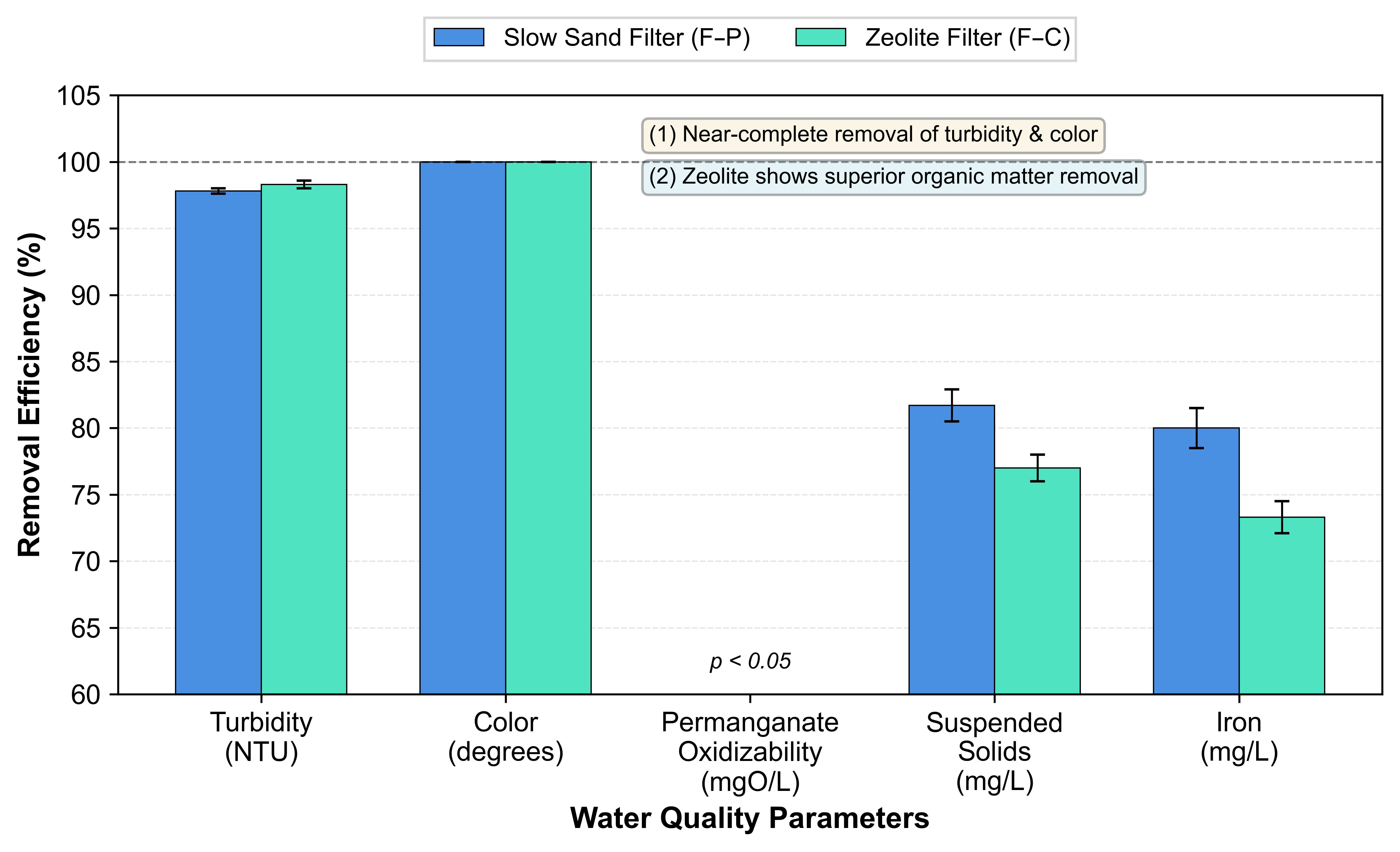
| Parameter | Unit | Raw Water | Sand Filter (F–P) | Removal Efficiency, % | Zeolite Filter (F–C) | Removal Efficiency, % |
|---|---|---|---|---|---|---|
| Turbidity | NTU | 115 ± 12 | 2.5 ± 0.4 | 97.8 | 2.0 ± 0.3 | 98.3 |
| Chromaticity | Hazen | 25 ± 3 | 0 | 100 | 0 | ~100 |
| Permanganate oxidizability | mgO/dm3 | 6.64 ± 0.5 | 3.22 ± 0.3 | 51.5 | 3.08 ± 0.2 | 53.6 |
| Suspended solids | mg/dm3 | 0.213 ± 0.03 | 0.039 ± 0.01 | 81.7 | 0.049 ± 0.01 | 77.0 |
| Iron (Fe, total) | mg/dm3 | 0.15 ± 0.02 | 0.03 ± 0.005 | 80.0 | 0.04 ± 0.006 | 73.3 |
| Sulfates (SO42−) | mg/dm3 | 22 ± 2 | 32 ± 3 | n/a | 23 ± 2 | n/a |
| pH | - | 7.16 ± 0.1 | 7.6 ± 0.1 | n/a | 7.23 ± 0.1 | n/a |
| Parameter | Unit | Feed to NF (Zeolite Filtrate) | Permeate | Rejection/Reduction, % |
|---|---|---|---|---|
| Pressure | bar | 6.0 ± 0.2 | — | — |
| Temperature | °C | 22 ± 1 | — | — |
| Permeate recovery | % | — | 15 | — |
| Permeate flux | L·m−2·h−1 | — | 10.5 ± 0.4 | — |
| Conductivity | µS/cm | ≈430 ± 25 | ≈205 ± 15 | ≈52 |
| Total dissolved solids | % reduction or mg/L | 280 ± 25 mg/L | 115 ± 18 mg/L | 50–60 |
| Hardness ions (Ca2+ + Mg2+) | % rejection | — | — | >93 |
| Turbidity | NTU | 2.0 ± 0.3 | <0.1 | >95 |
| Permanganate oxidizability | mgO/dm3 | 3.08 ± 0.2 | 0.8–1.2 | 61–74 |
| Iron (total) | mg/dm3 | 0.04 ± 0.006 | below detection limit | qualitative near-complete removal |
Disclaimer/Publisher’s Note: The statements, opinions and data contained in all publications are solely those of the individual author(s) and contributor(s) and not of MDPI and/or the editor(s). MDPI and/or the editor(s) disclaim responsibility for any injury to people or property resulting from any ideas, methods, instructions or products referred to in the content. |
© 2026 by the authors. Licensee MDPI, Basel, Switzerland. This article is an open access article distributed under the terms and conditions of the Creative Commons Attribution (CC BY) license.
Share and Cite
Bahig, F.; Kabpasovna, A.K.; Martyushev, N.V.; Malozyomov, B.V.; Kukartsev, V.V.; Panfilova, T.A.; Stupina, A.A.; Tynchenko, Y.A. Nanofiltration for Advanced and Reliable Drinking Water Treatment: Experimental Evaluation of Hybrid Pretreatment Systems and Fouling Control. Membranes 2026, 16, 191. https://doi.org/10.3390/membranes16060191
Bahig F, Kabpasovna AK, Martyushev NV, Malozyomov BV, Kukartsev VV, Panfilova TA, Stupina AA, Tynchenko YA. Nanofiltration for Advanced and Reliable Drinking Water Treatment: Experimental Evaluation of Hybrid Pretreatment Systems and Fouling Control. Membranes. 2026; 16(6):191. https://doi.org/10.3390/membranes16060191
Chicago/Turabian StyleBahig, Fazolrahman, Alimova Kulyash Kabpasovna, Nikita V. Martyushev, Boris V. Malozyomov, Vladislav V. Kukartsev, Tatyana Aleksandrovna Panfilova, Alena A. Stupina, and Yadviga Aleksandrovna Tynchenko. 2026. "Nanofiltration for Advanced and Reliable Drinking Water Treatment: Experimental Evaluation of Hybrid Pretreatment Systems and Fouling Control" Membranes 16, no. 6: 191. https://doi.org/10.3390/membranes16060191
APA StyleBahig, F., Kabpasovna, A. K., Martyushev, N. V., Malozyomov, B. V., Kukartsev, V. V., Panfilova, T. A., Stupina, A. A., & Tynchenko, Y. A. (2026). Nanofiltration for Advanced and Reliable Drinking Water Treatment: Experimental Evaluation of Hybrid Pretreatment Systems and Fouling Control. Membranes, 16(6), 191. https://doi.org/10.3390/membranes16060191