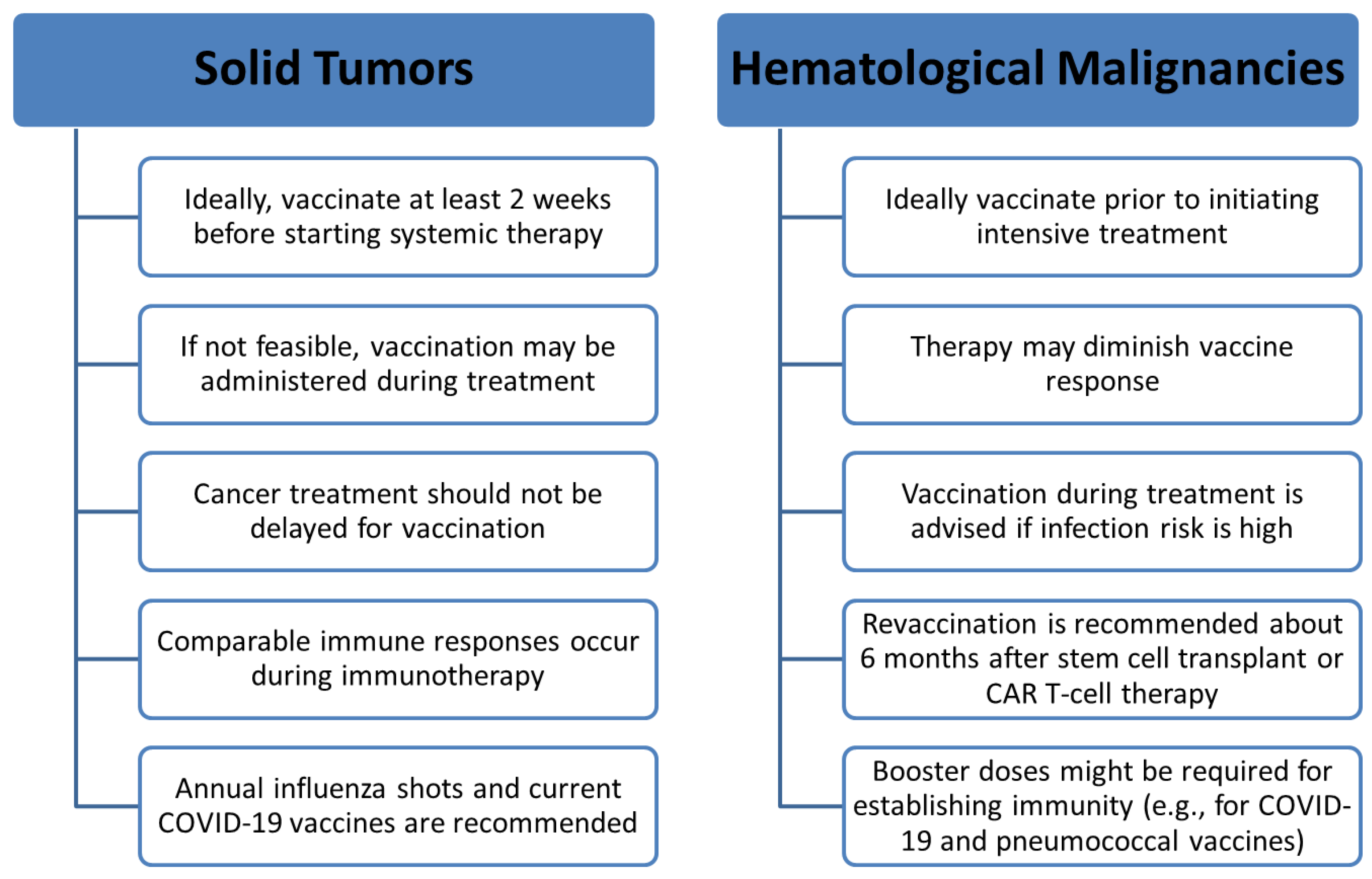
Vaccination Against Respiratory Infections in Adults with Cancer: A Concise Guide for Clinicians


Abstract
1. Introduction
2. Immunological Considerations
3. Burden of Respiratory Infections in Adults with Cancer
4. Benefits of Vaccination Against Respiratory Infections Among Adults with Cancer
5. Safety of Vaccination Against Respiratory Infections Among Adults with Cancer
6. Practical Approach and Improving Vaccination Uptake Among Adults with Cancer
7. Vaccination Limitations and Future Directions
8. Conclusions
Funding
Institutional Review Board Statement
Informed Consent Statement
Data Availability Statement
Conflicts of Interest
References
- Bray, F.; Laversanne, M.; Sung, H.; Ferlay, J.; Siegel, R.L.; Soerjomataram, I.; Jemal, A. Global cancer statistics 2022: GLOBOCAN estimates of incidence and mortality worldwide for 36 cancers in 185 countries. CA Cancer J. Clin. 2024, 74, 229–263. [Google Scholar] [CrossRef]
- Sung, H.; Ferlay, J.; Siegel, R.L.; Laversanne, M.; Soerjomataram, I.; Jemal, A.; Bray, F. Global Cancer Statistics 2020: GLOBOCAN Estimates of Incidence and Mortality Worldwide for 36 Cancers in 185 Countries. CA Cancer J. Clin. 2021, 71, 209–249. [Google Scholar] [CrossRef]
- GBD Cancer Collaborators. The global, regional, and national burden of cancer, 1990–2023, with forecasts to 2050: A systematic analysis for the Global Burden of Disease Study 2023. Lancet 2025, 406, 1565–1586. [Google Scholar] [CrossRef]
- Elhadi, M.; Khaled, A.; Msherghi, A. Infectious diseases as a cause of death among cancer patients: A trend analysis and population-based study of outcome in the United States based on the Surveillance, Epidemiology, and End Results database. Infect. Agents Cancer 2021, 16, 72. [Google Scholar] [CrossRef] [PubMed]
- Kim, Y.J.; Lee, E.S.; Lee, Y.S. High mortality from viral pneumonia in patients with cancer. Infect. Dis. 2019, 51, 502–509. [Google Scholar] [CrossRef]
- Yang, P.; Zheng, Y.; Chen, J.; Ma, H.; Yu, K.; Chen, Y.; Yang, Y.; Wu, B. Immediate risk of non-cancer deaths after a cancer diagnosis. BMC Cancer 2021, 21, 963. [Google Scholar] [CrossRef] [PubMed]
- Zheng, Y.; Chen, Y.; Yu, K.; Yang, Y.; Wang, X.; Yang, X.; Qian, J.; Liu, Z.X.; Wu, B. Fatal Infections Among Cancer Patients: A Population-Based Study in the United States. Infect. Dis. Ther. 2021, 10, 871–895. [Google Scholar] [CrossRef]
- Mato, A.R.; Roeker, L.E.; Lamanna, N.; Allan, J.N.; Leslie, L.; Pagel, J.M.; Patel, K.; Osterborg, A.; Wojenski, D.; Kamdar, M.; et al. Outcomes of COVID-19 in patients with CLL: A multicenter international experience. Blood 2020, 136, 1134–1143. [Google Scholar] [CrossRef] [PubMed]
- Whimbey, E.; Englund, J.A.; Couch, R.B. Community respiratory virus infections in immunocompromised patients with cancer. Am. J. Med. 1997, 102, 10–18; discussion 25–26. [Google Scholar] [CrossRef]
- Mourad, D.F.; Radwan, S.; Hamdy, R.; Elkhashab, D.M.; Kamel, M.M.; Abdel-Moneim, A.S.; Kadry, D.Y. Identification of Lower Respiratory Tract Pathogens in Cancer Patients: Insights into Fatal Outcomes. Microorganisms 2024, 12, 1686. [Google Scholar] [CrossRef]
- Hamdi, W.S.; Fadul, A.; Culurgioni, F.; Gameil, A.; Yaghmour, M.; Coyle, P.V.; Kacem, M.; Al Molawi, N.; Amudhavalli, A.; Bakr, M.; et al. Clinical characteristics and outcomes of viral respiratory infections in allogeneic haematopoietic stem cell transplantation recipients: A single-centre experience. J. Med. Microbiol. 2025, 74, 002071. [Google Scholar] [CrossRef]
- Kamboj, M.; Bohlke, K.; Baptiste, D.M.; Dunleavy, K.; Fueger, A.; Jones, L.; Kelkar, A.H.; Law, L.Y.; LeFebvre, K.B.; Ljungman, P.; et al. Vaccination of Adults with Cancer: ASCO Guideline. J. Clin. Oncol. 2024, 42, 1699–1721. [Google Scholar] [CrossRef]
- Rieger, C.T.; Liss, B.; Mellinghoff, S.; Buchheidt, D.; Cornely, O.A.; Egerer, G.; Heinz, W.J.; Hentrich, M.; Maschmeyer, G.; Mayer, K.; et al. Anti-infective vaccination strategies in patients with hematologic malignancies or solid tumors-Guideline of the Infectious Diseases Working Party (AGIHO) of the German Society for Hematology and Medical Oncology (DGHO). Ann. Oncol. 2018, 29, 1354–1365. [Google Scholar] [CrossRef]
- Rubin, L.G.; Levin, M.J.; Ljungman, P.; Davies, E.G.; Avery, R.; Tomblyn, M.; Bousvaros, A.; Dhanireddy, S.; Sung, L.; Keyserling, H.; et al. 2013 IDSA clinical practice guideline for vaccination of the immunocompromised host. Clin. Infect. Dis. 2014, 58, 309–318. [Google Scholar] [CrossRef]
- Chang, A.; Ellingson, M.K.; Flowers, C.R.; Bednarczyk, R.A. Influenza Vaccination Rates Among Patients with a History of Cancer: Analysis of the National Health Interview Survey. Open Forum Infect. Dis. 2021, 8, ofab198. [Google Scholar] [CrossRef] [PubMed]
- Lo Moro, G.; Golzio, F.; Calabrese, S.C.; Scaioli, G.; Basile, A.; Siliquini, R.; Bert, F. Strategies to Increase Vaccinations in Adult Cancer Patients: A Systematic Review. Vaccines 2025, 13, 964. [Google Scholar] [CrossRef]
- Baum, J.; Lax, H.; Lehmann, N.; Merkel-Jens, A.; Beelen, D.W.; Jockel, K.H.; Duhrsen, U. Preventive health care in blood cancer survivors: Results from the ABC study. J. Cancer Res. Clin. Oncol. 2023, 149, 11531–11540. [Google Scholar] [CrossRef] [PubMed]
- Pedrazzoli, P.; Lasagna, A.; Cassaniti, I.; Piralla, A.; Squeri, A.; Bruno, R.; Sacchi, P.; Baldanti, F.; Di Maio, M.; Beretta, G.D.; et al. Vaccination for seasonal influenza, pneumococcal infection and SARS-CoV-2 in patients with solid tumors: Recommendations of the Associazione Italiana di Oncologia Medica (AIOM). ESMO Open 2023, 8, 101215. [Google Scholar] [CrossRef] [PubMed]
- Mohr, A.; Kloos, M.; Schulz, C.; Pfeifer, M.; Salzberger, B.; Bauernfeind, S.; Hitzenbichler, F.; Plentz, A.; Loew, T.; Koch, M. Low Adherence to Pneumococcal Vaccination in Lung Cancer Patients in a Tertiary Care University Hospital in Southern Germany. Vaccines 2022, 10, 311. [Google Scholar] [CrossRef]
- Andersen, M.A.; Niemann, C.U.; Rostgaard, K.; Dalby, T.; Sorrig, R.; Weinberger, D.M.; Hjalgrim, H.; Harboe, Z.B. Differences and Temporal Changes in Risk of Invasive Pneumococcal Disease in Adults with Hematological Malignancies: Results from a Nationwide 16-Year Cohort Study. Clin. Infect. Dis. 2021, 72, 463–471. [Google Scholar] [CrossRef]
- Figueiredo, J.C.; Levy, J.; Choi, S.Y.; Xu, A.M.; Merin, N.M.; Hamid, O.; Lemos, T.; Nguyen, N.; Nadri, M.; Gonzalez, A.; et al. Low booster uptake in cancer patients despite health benefits. iScience 2024, 27, 110596. [Google Scholar] [CrossRef]
- World Health Organization. Report of the SAGE Working Group on Vaccine Hesitancy. Available online: https://cdn.who.int/media/docs/default-source/immunization/sage/2014/october/sage-working-group-revised-report-vaccine-hesitancy.pdf?sfvrsn=240a7c1c_4 (accessed on 21 October 2023).
- Kontandreopoulou, C.N.; Solomou, E.E.; Kolorizos, E.; Diamantopoulos, P.T. Vaccine challenges in CLL: A comprehensive exploration of efficacy of SARS-CoV-2 immunization for patients with chronic lymphocytic leukemia. Ann. Hematol. 2024, 103, 4971–4980. [Google Scholar] [CrossRef]
- See, K.C. Vaccination for the Prevention of Infection among Immunocompromised Patients: A Concise Review of Recent Systematic Reviews. Vaccines 2022, 10, 800. [Google Scholar] [CrossRef] [PubMed]
- Jamshed, S.; Walsh, E.E.; Dimitroff, L.J.; Santelli, J.S.; Falsey, A.R. Improved immunogenicity of high-dose influenza vaccine compared to standard-dose influenza vaccine in adult oncology patients younger than 65 years receiving chemotherapy: A pilot randomized clinical trial. Vaccine 2016, 34, 630–635. [Google Scholar] [CrossRef]
- Thomas, L.D.; Batarseh, E.; Hamdan, L.; Haddadin, Z.; Dulek, D.; Kalams, S.; Stewart, L.S.; Stahl, A.L.; Rahman, H.; Amarin, J.Z.; et al. Comparison of Two High-Dose Versus Two Standard-Dose Influenza Vaccines in Adult Allogeneic Hematopoietic Cell Transplant Recipients. Clin. Infect. Dis. 2023, 77, 1723–1732. [Google Scholar] [CrossRef] [PubMed]
- Lai, J.J.; Lin, C.; Ho, C.L.; Chen, P.H.; Lee, C.H. Alternative-Dose versus Standard-Dose Trivalent Influenza Vaccines for Immunocompromised Patients: A Meta-Analysis of Randomised Control Trials. J. Clin. Med. 2019, 8, 590. [Google Scholar] [CrossRef]
- Halasa, N.B.; Savani, B.N.; Asokan, I.; Kassim, A.; Simons, R.; Summers, C.; Bourgeois, J.; Clifton, C.; Vaughan, L.A.; Lucid, C.; et al. Randomized Double-Blind Study of the Safety and Immunogenicity of Standard-Dose Trivalent Inactivated Influenza Vaccine versus High-Dose Trivalent Inactivated Influenza Vaccine in Adult Hematopoietic Stem Cell Transplantation Patients. Biol. Blood Marrow Transplant. 2016, 22, 528–535. [Google Scholar] [CrossRef]
- Hsiao, A.; Yee, A.; Fireman, B.; Hansen, J.; Lewis, N.; Klein, N.P. Recombinant or Standard-Dose Influenza Vaccine in Adults under 65 Years of Age. N. Engl. J. Med. 2023, 389, 2245–2255. [Google Scholar] [CrossRef] [PubMed]
- DiazGranados, C.A.; Dunning, A.J.; Kimmel, M.; Kirby, D.; Treanor, J.; Collins, A.; Pollak, R.; Christoff, J.; Earl, J.; Landolfi, V.; et al. Efficacy of high-dose versus standard-dose influenza vaccine in older adults. N. Engl. J. Med. 2014, 371, 635–645. [Google Scholar] [CrossRef]
- Bitterman, R.; Eliakim-Raz, N.; Vinograd, I.; Zalmanovici Trestioreanu, A.; Leibovici, L.; Paul, M. Influenza vaccines in immunosuppressed adults with cancer. Cochrane Database Syst. Rev. 2018, 2, CD008983. [Google Scholar] [CrossRef]
- Ko, E.J.; Kang, S.M. Immunology and efficacy of MF59-adjuvanted vaccines. Hum. Vaccin. Immunother. 2018, 14, 3041–3045. [Google Scholar] [CrossRef]
- Natori, Y.; Humar, A.; Lipton, J.; Kim, D.D.; Ashton, P.; Hoschler, K.; Kumar, D. A pilot randomized trial of adjuvanted influenza vaccine in adult allogeneic hematopoietic stem cell transplant recipients. Bone Marrow Transplant. 2017, 52, 1016–1021. [Google Scholar] [CrossRef] [PubMed]
- Spagnolo, F.; Boutros, A.; Croce, E.; Cecchi, F.; Arecco, L.; Tanda, E.; Pronzato, P.; Lambertini, M. Influenza vaccination in cancer patients receiving immune checkpoint inhibitors: A systematic review. Eur. J. Clin. Invest. 2021, 51, e13604. [Google Scholar] [CrossRef] [PubMed]
- Wang, Y.; Chen, D.; Pan, Y.; Li, H.; Zhao, W.; Lu, T.; Kong, W.; Ding, M.; Wang, X.; Zhang, G. Serological response and immune-related adverse events following COVID-19 vaccination in cancer patients treated with immune checkpoint inhibitors: A systematic review and meta-analysis. Rev. Med. Virol. 2024, 34, e2495. [Google Scholar] [CrossRef] [PubMed]
- Lopez-Olivo, M.A.; Valerio, V.; Karpes Matusevich, A.R.; Brizio, M.; Kwok, M.; Geng, Y.; Suarez-Almazor, M.E.; Colmegna, I. Safety and Efficacy of Influenza Vaccination in Patients Receiving Immune Checkpoint Inhibitors. Systematic Review with Meta-Analysis. Vaccines 2022, 10, 1195. [Google Scholar] [CrossRef]
- Luo, P.; Liu, J.; Wang, Z.; Liao, C.; She, L.; Zou, T.; Chen, J.; Liu, Z. Effects of COVID-19 vaccination on irAEs and prognosis in lung cancer patients receive PD-(L)1 inhibitors. Hum. Vaccin. Immunother. 2025, 21, 2539593. [Google Scholar] [CrossRef]
- Fabbri, A.; Ruggeri, E.M.; Virtuoso, A.; Giannarelli, D.; Raso, A.; Chegai, F.; Remotti, D.; Signorelli, C.; Nelli, F. Periodic Boosters of COVID-19 Vaccines Do Not Affect the Safety and Efficacy of Immune Checkpoint Inhibitors for Advanced Non-Small Cell Lung Cancer: A Longitudinal Analysis of the Vax-On-Third Study. Cancers 2025, 17, 1948. [Google Scholar] [CrossRef]
- Grippin, A.J.; Marconi, C.; Copling, S.; Li, N.; Braun, C.; Woody, C.; Young, E.; Gupta, P.; Wang, M.; Wu, A.; et al. SARS-CoV-2 mRNA vaccines sensitize tumours to immune checkpoint blockade. Nature 2025, 647, 488–497. [Google Scholar] [CrossRef]
- Rabello, L.S.; Silva, J.R.; Azevedo, L.C.; Souza, I.; Torres, V.B.; Rosolem, M.M.; Lisboa, T.; Soares, M.; Salluh, J.I. Clinical outcomes and microbiological characteristics of severe pneumonia in cancer patients: A prospective cohort study. PLoS ONE 2015, 10, e0120544. [Google Scholar] [CrossRef]
- de Montmollin, E.; Tandjaoui-Lambiotte, Y.; Legrand, M.; Lambert, J.; Mokart, D.; Kouatchet, A.; Lemiale, V.; Pene, F.; Bruneel, F.; Vincent, F.; et al. Outcomes in critically ill cancer patients with septic shock of pulmonary origin. Shock 2013, 39, 250–254. [Google Scholar] [CrossRef]
- Li, J.; Zhang, D.; Sun, Z.; Bai, C.; Zhao, L. Influenza in hospitalised patients with malignancy: A propensity score matching analysis. ESMO Open 2020, 5, e000968. [Google Scholar] [CrossRef]
- Rowe, H.M.; Meliopoulos, V.A.; Iverson, A.; Bomme, P.; Schultz-Cherry, S.; Rosch, J.W. Direct interactions with influenza promote bacterial adherence during respiratory infections. Nat. Microbiol. 2019, 4, 1328–1336. [Google Scholar] [CrossRef]
- GBD Lower Respiratory Infections; Antimicrobial Resistance Collaborators. Global burden of lower respiratory infections and aetiologies, 1990–2023: A systematic analysis for the Global Burden of Disease Study 2023. Lancet Infect. Dis. 2025; online first. [Google Scholar]
- Rolston, K.V.I.; Nesher, L. Post-Obstructive Pneumonia in Patients with Cancer: A Review. Infect. Dis. Ther. 2018, 7, 29–38. [Google Scholar] [CrossRef]
- Woods, K.; Beidas, M.; Murugan, V.; Billion, T.; Tauseef, A.; Mirza, M. Trends in influenza- and pneumonia-related mortality in lung cancer patients from 1999 to 2022: A retrospective CDC WONDER analysis. Respir. Res. 2025, 26, 267. [Google Scholar] [CrossRef]
- Lee, J.O.; Kim, D.Y.; Lim, J.H.; Seo, M.D.; Yi, H.G.; Kim, Y.J.; Lee, S.H.; Kim, D.W.; Yang, S.C.; Kim, Y.W.; et al. Risk factors for bacterial pneumonia after cytotoxic chemotherapy in advanced lung cancer patients. Lung Cancer 2008, 62, 381–384. [Google Scholar] [CrossRef]
- See, K.C.; Lau, Y.H. Acute management of pneumonia in adult patients. Singapore Med. J. 2023, 64, 209–216. [Google Scholar] [CrossRef] [PubMed]
- See, K.C. Approach to acute respiratory failure for frontline clinicians. Singapore Med. J. 2022, 63, 740–745. [Google Scholar] [CrossRef] [PubMed]
- Levi, M.; Schultz, M.; van der Poll, T. Sepsis and thrombosis. Semin. Thromb. Hemost. 2013, 39, 559–566. [Google Scholar] [CrossRef] [PubMed]
- Warren-Gash, C.; Blackburn, R.; Whitaker, H.; McMenamin, J.; Hayward, A.C. Laboratory-confirmed respiratory infections as triggers for acute myocardial infarction and stroke: A self-controlled case series analysis of national linked datasets from Scotland. Eur. Respir. J. 2018, 51, 1701794. [Google Scholar] [CrossRef]
- Chawla, L.S.; Amdur, R.L.; Faselis, C.; Li, P.; Kimmel, P.L.; Palant, C.E. Impact of Acute Kidney Injury in Patients Hospitalized with Pneumonia. Crit. Care Med. 2017, 45, 600–606. [Google Scholar] [CrossRef]
- Couch, R.B.; Englund, J.A.; Whimbey, E. Respiratory viral infections in immunocompetent and immunocompromised persons. Am. J. Med. 1997, 102, 2–9; discussion 25–26. [Google Scholar] [CrossRef]
- Cooksley, C.D.; Avritscher, E.B.; Bekele, B.N.; Rolston, K.V.; Geraci, J.M.; Elting, L.S. Epidemiology and outcomes of serious influenza-related infections in the cancer population. Cancer 2005, 104, 618–628. [Google Scholar] [CrossRef] [PubMed]
- Abdel-Rahman, O. Influenza and pneumonia-attributed deaths among cancer patients in the United States; a population-based study. Expert. Rev. Respir. Med. 2021, 15, 393–401. [Google Scholar] [CrossRef]
- Chavez-MacGregor, M.; Lei, X.; Zhao, H.; Scheet, P.; Giordano, S.H. Evaluation of COVID-19 Mortality and Adverse Outcomes in US Patients with or Without Cancer. JAMA Oncol. 2022, 8, 69–78. [Google Scholar] [CrossRef] [PubMed]
- Hedberg, P.; Blixt, L.; Eketorp Sylvan, S.; Killander Moller, I.; Lindahl, H.; Kahn, F.; Nilsdotter-Augustinsson, A.; Fredrikson, M.; Nystrom, S.; Bergman, P.; et al. Outcomes of the COVID-19 pandemic in chronic lymphocytic leukemia: Focus on the very early period and Omicron era. Blood Adv. 2025, 9, 3170–3181. [Google Scholar] [CrossRef]
- Ricco, M.; Parisi, S.; Corrado, S.; Marchesi, F.; Bottazzoli, M.; Gori, D. Respiratory Syncytial Virus Infections in Recipients of Bone Marrow Transplants: A Systematic Review and Meta-Analysis. Infect. Dis. Rep. 2024, 16, 317–355. [Google Scholar] [CrossRef]
- Clausen, C.L.; Egeskov-Cavling, A.M.; Hayder, N.; Sejdic, A.; Roed, C.; Gitz Holler, J.; Nielsen, L.; Eiberg, M.F.; Rezahosseini, O.; Ostergaard, C.; et al. Clinical Manifestations and Outcomes in Adults Hospitalized with Respiratory Syncytial Virus and Influenza a/B: A Multicenter Observational Cohort Study. Open Forum Infect. Dis. 2024, 11, ofae513. [Google Scholar] [CrossRef]
- Shafat, T.; De-la-Rosa-Martinez, D.; Khawaja, F.; Jiang, Y.; Spallone, A.; Batista, M.V.; Ariza-Heredia, E.; Vilar-Compte, D.; Ahmed, S.; Becnel, M.; et al. Outcomes and Risk Factors for Influenza and Respiratory Syncytial Virus Lower Respiratory Tract Infections and Mortality in Patients with Lymphoma or Multiple Myeloma: A 7-Year Retrospective Cohort Study. Open Forum Infect. Dis. 2025, 12, ofaf127. [Google Scholar] [CrossRef]
- Shafat, T.; Spallone, A.; Khawaja, F.; Jiang, Y.; Jackson, J.; Nesher, L.; Chemaly, R.F. Respiratory Syncytial Virus Exceeded SARS-CoV-2 and Influenza in Lower Respiratory Infection and Mortality Rates Among Patients with Hematologic Malignancies During the 2023-2024 Respiratory Virus Season. Transpl. Infect. Dis. 2025, 27, e70113. [Google Scholar] [CrossRef]
- Wee, L.E.; Alcantara, L.S.; Aung, M.K.; Arora, S.; Sim, J.X.Y.; Ren, D.D.; Vincent, Z.A.; Srivathsan, V.; Tuy, T.T.; Ong, S.Y.; et al. Severity of Respiratory Syncytial Virus and Other Respiratory Viruses Versus Seasonal Influenza Among Hospitalized Patients with Cancer. Open Forum Infect. Dis. 2025, 12, ofaf682. [Google Scholar] [CrossRef] [PubMed]
- Ditzel, K.; Giardina, F.; Ten Oever, J.; Cremers, A.J.H. Risk conditions for invasive pneumococcal disease in adults: A systematic review and meta-analysis. EClinicalMedicine 2025, 89, 103522. [Google Scholar] [CrossRef]
- Wong, A.; Marrie, T.J.; Garg, S.; Kellner, J.D.; Tyrrell, G.J.; Group, S. Increased risk of invasive pneumococcal disease in haematological and solid-organ malignancies. Epidemiol. Infect. 2010, 138, 1804–1810. [Google Scholar] [CrossRef]
- Garcia Garrido, H.M.; Knol, M.J.; Heijmans, J.; van Sorge, N.M.; Sanders, E.A.M.; Klumpen, H.J.; Grobusch, M.P.; Goorhuis, A. Invasive pneumococcal disease among adults with hematological and solid organ malignancies: A population-based cohort study. Int. J. Infect. Dis. 2021, 106, 237–245. [Google Scholar] [CrossRef]
- See, K.C. Pertussis Vaccination for Adults: An Updated Guide for Clinicians. Vaccines 2025, 13, 60. [Google Scholar] [CrossRef] [PubMed]
- Florax, A.; Ehlert, K.; Becker, K.; Vormoor, J.; Groll, A.H. Bordetella pertussis respiratory infection following hematopoietic stem cell transplantation: Time for universal vaccination? Bone Marrow Transplant. 2006, 38, 639–640. [Google Scholar] [CrossRef]
- Singh, V.; Nanjappa, S.; Pabbathi, S.; Greene, J.N. Invasive Haemophilus influenzae Infection in Patients with Cancer. Cancer Control 2017, 24, 66–71. [Google Scholar] [CrossRef] [PubMed]
- Chen, C.; Haupert, S.R.; Zimmermann, L.; Shi, X.; Fritsche, L.G.; Mukherjee, B. Global Prevalence of Post-Coronavirus Disease 2019 (COVID-19) Condition or Long COVID: A Meta-Analysis and Systematic Review. J. Infect. Dis. 2022, 226, 1593–1607. [Google Scholar] [CrossRef]
- Hirsch, C.; Zorger, A.M.; Baumann, M.; Park, Y.S.; Brockelmann, P.J.; Mellinghoff, S.; Monsef, I.; Skoetz, N.; Kreuzberger, N. Vaccines for preventing infections in adults with solid tumours. Cochrane Database Syst. Rev. 2025, 4, CD015551. [Google Scholar] [CrossRef] [PubMed]
- Thomas, S.J.; Perez, J.L.; Lockhart, S.P.; Hariharan, S.; Kitchin, N.; Bailey, R.; Liau, K.; Lagkadinou, E.; Tureci, O.; Sahin, U.; et al. Efficacy and safety of the BNT162b2 mRNA COVID-19 vaccine in participants with a history of cancer: Subgroup analysis of a global phase 3 randomized clinical trial. Vaccine 2022, 40, 1483–1492. [Google Scholar] [CrossRef]
- Zorger, A.M.; Hirsch, C.; Baumann, M.; Feldmann, M.; Brockelmann, P.J.; Mellinghoff, S.; Monsef, I.; Skoetz, N.; Kreuzberger, N. Vaccines for preventing infections in adults with haematological malignancies. Cochrane Database Syst. Rev. 2025, 5, CD015530. [Google Scholar] [CrossRef]
- See, K.C. Pneumococcal Vaccination in Adults: A Narrative Review of Considerations for Individualized Decision-Making. Vaccines 2023, 11, 908. [Google Scholar] [CrossRef]
- Bersanelli, M.; Verzoni, E.; Cortellini, A.; Giusti, R.; Calvetti, L.; Ermacora, P.; Di Napoli, M.; Catino, A.; Guadalupi, V.; Guaitoli, G.; et al. Impact of influenza vaccination on survival of patients with advanced cancer receiving immune checkpoint inhibitors (INVIDIa-2): Final results of the multicentre, prospective, observational study. EClinicalMedicine 2023, 61, 102044. [Google Scholar] [CrossRef] [PubMed]
- Gogenur, M.; Fransgard, T.; Krause, T.G.; Thygesen, L.C.; Gogenur, I. Association of postoperative influenza vaccine on overall mortality in patients undergoing curative surgery for solid tumors. Int. J. Cancer 2021, 148, 1821–1827. [Google Scholar] [CrossRef] [PubMed]
- Amdisen, L.; Pedersen, L.; Abildgaard, N.; Benn, C.S.; Cronin-Fenton, D.; Sorup, S. Influenza vaccine effectiveness in immunocompromised patients with cancer: A Danish nationwide register-based cohort study. Cancer 2025, 131, e35574. [Google Scholar] [CrossRef] [PubMed]
- Lee, L.Y.W.; Starkey, T.; Ionescu, M.C.; Little, M.; Tilby, M.; Tripathy, A.R.; McKenzie, H.S.; Al-Hajji, Y.; Barnard, M.; Benny, L.; et al. Vaccine effectiveness against COVID-19 breakthrough infections in patients with cancer (UKCCEP): A population-based test-negative case-control study. Lancet Oncol. 2022, 23, 748–757. [Google Scholar] [CrossRef]
- Di Lorenzo, G.; Ingenito, C.; D’Ambrosio, B.; Ranieri, C.; Iuliucci, M.R.; Iervolino, M.; Primiano, F.; Buonerba, L.; Busto, G.; Ferrara, C.; et al. The Effect of Vaccination against COVID-19 in Cancer Patients: Final Results of the COICA Trial. Oncology 2022, 100, 512–518. [Google Scholar] [CrossRef]
- Lee, L.Y.W.; Ionescu, M.C.; Starkey, T.; Little, M.; Tilby, M.; Tripathy, A.R.; McKenzie, H.S.; Al-Hajji, Y.; Appanna, N.; Barnard, M.; et al. COVID-19: Third dose booster vaccine effectiveness against breakthrough coronavirus infection, hospitalisations and death in patients with cancer: A population-based study. Eur. J. Cancer 2022, 175, 1–10. [Google Scholar] [CrossRef]
- Skarbinski, J.; Elkin, E.P.; Ziemba, Y.C.; Kazemian, E.; Wilson, B.M.; Siddiqui, H.; Schleicher, C.B.; Hsiao, C.A.; Nugent, J.R.; Reckamp, K.L.; et al. COVID-19 Vaccine Booster Uptake and Effectiveness Among US Adults with Cancer. JAMA Oncol. 2025, 11, 999–1010. [Google Scholar] [CrossRef]
- Lazar Neto, F.; Mercade-Besora, N.; Raventos, B.; Perez-Crespo, L.; Castro Junior, G.; Ranzani, O.T.; Duarte-Salles, T. Effectiveness of COVID-19 vaccines against severe COVID-19 among patients with cancer in Catalonia, Spain. Nat. Commun. 2024, 15, 5088. [Google Scholar] [CrossRef]
- Widman, A.J.; Cohen, B.; Park, V.; McClure, T.; Wolchok, J.; Kamboj, M. Immune-Related Adverse Events Among COVID-19-Vaccinated Patients with Cancer Receiving Immune Checkpoint Blockade. J. Natl. Compr. Cancer Netw. 2022, 20, 1134–1138. [Google Scholar] [CrossRef]
- Chiou, W.Y.; Lee, M.S.; Hung, S.K.; Lin, H.Y.; Lo, Y.C.; Hsu, F.C.; Tsai, S.J.; Li, C.Y. Effectiveness of 23-valent pneumococcal polysaccharide vaccine on elderly long-term cancer survivors: A population-based propensity score matched cohort study. BMJ Open 2018, 8, e019364. [Google Scholar] [CrossRef]
- Li, C.Y.; Chen, L.C.; Lin, H.Y.; Lee, M.S.; Hung, S.K.; Lai, C.L.; Huang, L.W.; Yu, B.H.; Hsu, F.C.; Chiou, W.Y. Impact of 23-valent pneumococcal polysaccharide vaccination on the frequency of pneumonia-related hospitalization and survival in elderly patients with prostate cancer: A seven-year nationwide matched cohort study. Cancer 2021, 127, 124–136. [Google Scholar] [CrossRef]
- Svensson, T.; Kattstrom, M.; Hammarlund, Y.; Roth, D.; Andersson, P.O.; Svensson, M.; Nilsson, I.; Rombo, L.; Cherif, H.; Kimby, E. Pneumococcal conjugate vaccine triggers a better immune response than pneumococcal polysaccharide vaccine in patients with chronic lymphocytic leukemia A randomized study by the Swedish CLL group. Vaccine 2018, 36, 3701–3707. [Google Scholar] [CrossRef] [PubMed]
- So, A.C.P.; McGrath, H.; Ting, J.; Srikandarajah, K.; Germanou, S.; Moss, C.; Russell, B.; Monroy-Iglesias, M.; Dolly, S.; Irshad, S.; et al. COVID-19 Vaccine Safety in Cancer Patients: A Single Centre Experience. Cancers 2021, 13, 3573. [Google Scholar] [CrossRef] [PubMed]
- Gilbert, D.; Hu, J.; Medina, T.; Kessler, E.R.; Lam, E.T. Safety of COVID-19 vaccines in subjects with solid tumor cancers receiving immune checkpoint inhibitors. Hum. Vaccin. Immunother. 2023, 19, 2207438. [Google Scholar] [CrossRef] [PubMed]
- Javadinia, S.A.; Alizadeh, K.; Mojadadi, M.S.; Nikbakht, F.; Dashti, F.; Joudi, M.; Harati, H.; Welsh, J.S.; Farahmand, S.A.; Attarian, F. COVID-19 Vaccination in Patients with Malignancy; A Systematic Review and Meta-Analysis of the Efficacy and Safety. Front. Endocrinol. 2022, 13, 860238. [Google Scholar] [CrossRef]
- Hall, V.G.; Alexander, A.A.; Mavandadnejad, F.; Kern-Smith, M.; Dang, X.; Kang, R.; Humar, S.; Winichakoon, P.; Johnstone, R.; Aversa, M.; et al. Safety and immunogenicity of adjuvanted respiratory syncytial virus vaccine in high-risk transplant recipients: An interventional cohort study. Clin. Microbiol. Infect. 2026, 32, 161–168. [Google Scholar] [CrossRef]
- Wumkes, M.L.; van der Velden, A.M.; Los, M.; Leys, M.B.; Beeker, A.; Nijziel, M.R.; van der Velden, A.W.; Westerman, M.; Meerveld-Eggink, A.; Rimmelzwaan, G.F.; et al. Serum antibody response to influenza virus vaccination during chemotherapy treatment in adult patients with solid tumours. Vaccine 2013, 31, 6177–6184. [Google Scholar] [CrossRef]
- Keam, B.; Kim, M.K.; Choi, Y.; Choi, S.J.; Choe, P.G.; Lee, K.H.; Kim, T.M.; Kim, T.Y.; Oh, D.Y.; Kim, D.W.; et al. Optimal timing of influenza vaccination during 3-week cytotoxic chemotherapy cycles. Cancer 2017, 123, 841–848. [Google Scholar] [CrossRef]
- Choi, W.; Kim, J.G.; Beom, S.H.; Hwang, J.E.; Shim, H.J.; Cho, S.H.; Shin, M.H.; Jung, S.H.; Chung, I.J.; Song, J.Y.; et al. Immunogenicity and Optimal Timing of 13-Valent Pneumococcal Conjugate Vaccination during Adjuvant Chemotherapy in Gastric and Colorectal Cancer: A Randomized Controlled Trial. Cancer Res. Treat. 2020, 52, 246–253. [Google Scholar] [CrossRef]
- Ortbals, D.W.; Liebhaber, H.; Presant, C.A.; Van Amburg, A.L., 3rd; Lee, J.Y. Influenza immunization of adult patients with malignant diseases. Ann. Intern. Med. 1977, 87, 552–557. [Google Scholar] [CrossRef] [PubMed]
- Campanella, A.; Capasso, A.; Heltai, S.; Taccetti, C.; Albi, E.; Herishanu, Y.; Haggenburg, S.; Chatzikonstantinou, T.; Doubek, M.; Kattstrom, M.; et al. Additional booster doses in patients with chronic lymphocytic leukemia induce humoral and cellular immune responses to SARS-CoV-2 similar to natural infection regardless ongoing treatments: A study by ERIC, the European Research Initiative on CLL. Am. J. Hematol. 2024, 99, 745–750. [Google Scholar] [CrossRef]
- Acuti Martellucci, C.; Rosso, A.; Zauli, E.; Bianconi, A.; Fiore, M.; Soldato, G.; Marani Toro, P.; De Benedictis, M.; Di Marco, G.; Carota, R.; et al. The Effectiveness of Four Quadrivalent, Inactivated Influenza Vaccines Administered Alone or in Combination with Pneumococcal and/or SARS-CoV-2 Vaccines: A Population-Wide Cohort Study. Vaccines 2025, 13, 309. [Google Scholar] [CrossRef]
- Bai, S.; Zhou, S.; Zhang, J.; Chen, W.; Lv, M.; Wang, J.; Zhang, A.; Wu, J.; Zhao, W. Immunogenicity and safety of different combinations involving a third booster dose of SARS-CoV-2 inactivated vaccine, inactivated quadrivalent influenza vaccine, and 23-valent pneumococcal polysaccharide vaccine in adults aged ≥60 years: A phase 4, randomized, open-label study. Front. Immunol. 2024, 15, 1437267. [Google Scholar] [CrossRef]
- Naficy, A.; Kuxhausen, A.; Seifert, H.; Hastie, A.; Leav, B.; Miller, J.; Anteyi, K.; Mwakingwe-Omari, A. No immunological interference or concerns about safety when seasonal quadrivalent influenza vaccine is co-administered with a COVID-19 mRNA-1273 booster vaccine in adults: A randomized trial. Hum. Vaccin. Immunother. 2024, 20, 2327736. [Google Scholar] [CrossRef]
- Ramsay, J.A.; Jones, M.; Vande More, A.M.; Hunt, S.L.; Williams, P.C.M.; Messer, M.; Wood, N.; Macartney, K.; Lee, F.J.; Britton, W.J.; et al. A single blinded, phase IV, adaptive randomised control trial to evaluate the safety of coadministration of seasonal influenza and COVID-19 vaccines (The FluVID study). Vaccine 2023, 41, 7250–7258. [Google Scholar] [CrossRef]
- Izikson, R.; Brune, D.; Bolduc, J.S.; Bourron, P.; Fournier, M.; Moore, T.M.; Pandey, A.; Perez, L.; Sater, N.; Shrestha, A.; et al. Safety and immunogenicity of a high-dose quadrivalent influenza vaccine administered concomitantly with a third dose of the mRNA-1273 SARS-CoV-2 vaccine in adults aged ≥65 years: A phase 2, randomised, open-label study. Lancet Respir. Med. 2022, 10, 392–402. [Google Scholar] [CrossRef]
- Ofori-Anyinam, O.; Leroux-Roels, G.; Drame, M.; Aerssens, A.; Maes, C.; Amanullah, A.; Schuind, A.; Li, P.; Jain, V.K.; Innis, B.L. Immunogenicity and safety of an inactivated quadrivalent influenza vaccine co-administered with a 23-valent pneumococcal polysaccharide vaccine versus separate administration, in adults ≥50years of age: Results from a phase III, randomized, non-inferiority trial. Vaccine 2017, 35, 6321–6328. [Google Scholar] [CrossRef] [PubMed]
- Niyati, R.; Rezahosseini, O.; Ekenberg, C.; Larsen, C.S.; Harboe, Z.B. Immunogenicity and Safety of Pneumococcal Vaccines Co-Administered with Common Travel Vaccines in Adults: A Systematic Review. Vaccines 2025, 13, 643. [Google Scholar] [CrossRef]
- Rahimi, H.K.; Jasim, A.A.; Rezahosseini, O.; Harboe, Z.B. Immunogenicity and adverse effects of pneumococcal vaccines co-administered with influenza or SARS-CoV-2 vaccines in adults: A systematic review and Meta-analysis. Vaccine 2025, 59, 127293. [Google Scholar] [CrossRef] [PubMed]
- Tashani, M.; Alfelali, M.; Barasheed, O.; Alqahtani, A.S.; Heron, L.; Wong, M.; Rashid, H.; Booy, R. Effect of Tdap when administered before, with or after the 13-valent pneumococcal conjugate vaccine (coadministered with the quadrivalent meningococcal conjugate vaccine) in adults: A randomised controlled trial. Vaccine 2016, 34, 5929–5937. [Google Scholar] [CrossRef]
- Clark, R.; Davies, S.; Labrador, J.; Loubet, P.; Natalini Martinez, S.; Morinigo, H.M.; Nicolas, J.F.; Vera, M.P.; Ramet, M.; Rebollo-Rodrigo, M.H.; et al. Safety and Immunogenicity of Respiratory Syncytial Virus Prefusion F Protein Vaccine when Co-administered with Adjuvanted Seasonal Quadrivalent Influenza Vaccine in Older Adults: A Phase 3 Randomized Trial. Clin. Infect. Dis. 2024, 79, 1088–1098. [Google Scholar] [CrossRef]
- Chime, N.; Anspach, B.; Jain, V.; Laajalahti, O.; Ollinger, T.; Yaplee, D.; Kim, J.H. Phase 3 Study Assessing Lot-to-Lot Consistency of Respiratory Syncytial Virus Prefusion Protein F3 Vaccine and Its Immune Response, Safety, and Reactogenicity When Co-administered With Quadrivalent Influenza Vaccine. J. Infect. Dis. 2025, 231, e144–e153. [Google Scholar] [CrossRef] [PubMed]
- Chandler, R.; Montenegro, N.; Llorach, C.; Aguirre, L.N.; Germain, S.; Kuriyakose, S.O.; Lambert, A.; Descamps, D.; Olivier, A.; Hulstrom, V. Immunogenicity, Reactogenicity, and Safety of AS01E-adjuvanted RSV Prefusion F Protein-based Candidate Vaccine (RSVPreF3 OA) When Co-administered with a Seasonal Quadrivalent Influenza Vaccine in Older Adults: Results of a Phase 3, Open-Label, Randomized Controlled Trial. Clin. Infect. Dis. 2024, ciad786. [Google Scholar] [CrossRef]
- Goswami, J.; Cardona, J.F.; Hsu, D.C.; Simorellis, A.K.; Wilson, L.; Dhar, R.; Tomassini, J.E.; Wang, X.; Kapoor, A.; Collins, A.; et al. Safety and immunogenicity of mRNA-1345 RSV vaccine coadministered with an influenza or COVID-19 vaccine in adults aged 50 years or older: An observer-blinded, placebo-controlled, randomised, phase 3 trial. Lancet Infect. Dis. 2025, 25, 411–423. [Google Scholar] [CrossRef]
- Kattstrom, M.; Uggla, B.; Virta, C.; Melin, M.; Ekstrom, N.; Magnuson, A.; Andersson, P.O.; Hammarlund, Y.; Lockmer, S.; Nilsson, I.; et al. Revaccination with pneumococcal conjugate vaccine five years after primary immunization improves immunity in patients with chronic lymphocytic leukemia. Haematologica 2025, 110, 1774–1785. [Google Scholar] [CrossRef]
- Pool, V.; Tomovici, A.; Johnson, D.R.; Greenberg, D.P.; Decker, M.D. Humoral immunity 10 years after booster immunization with an adolescent and adult formulation combined tetanus, diphtheria, and 5-component acellular pertussis vaccine in the USA. Vaccine 2018, 36, 2282–2287. [Google Scholar] [CrossRef] [PubMed]
- Nordoy, T.; Husebekk, A.; Aaberge, I.S.; Jenum, P.A.; Samdal, H.H.; Flugsrud, L.B.; Kristoffersen, A.C.; Holte, H.; Kvaloy, S.; Kolstad, A. Humoral immunity to viral and bacterial antigens in lymphoma patients 4-10 years after high-dose therapy with ABMT. Serological responses to revaccinations according to EBMT guidelines. Bone Marrow Transplant. 2001, 28, 681–687. [Google Scholar] [CrossRef] [PubMed]
- Reynolds, G.; Hall, V.G.; Teh, B.W. Vaccine schedule recommendations and updates for patients with hematologic malignancy post-hematopoietic cell transplant or CAR T-cell therapy. Transpl. Infect. Dis. 2023, 25, e14109. [Google Scholar] [CrossRef]
- Silva-Pinto, A.; Abreu, I.; Martins, A.; Bastos, J.; Araujo, J.; Pinto, R. Vaccination After Haematopoietic Stem Cell Transplant: A Review of the Literature and Proposed Vaccination Protocol. Vaccines 2024, 12, 1449. [Google Scholar] [CrossRef]
- Ge, C.; Du, K.; Luo, M.; Shen, K.; Zhou, Y.; Guo, K.; Liu, Y.; Yin, C.; Li, Y.; Li, G.; et al. Serologic response and safety of COVID-19 vaccination in HSCT or CAR T-cell recipients: A systematic review and meta-analysis. Exp. Hematol. Oncol. 2022, 11, 46. [Google Scholar] [CrossRef] [PubMed]
- Sharifi Aliabadi, L.; Azari, M.; Taherian, M.R.; Barkhordar, M.; Abbas, S.A.M.; Azari, M.; Ahmadvand, M.; Salehi, Z.; Rouzbahani, S.; Vaezi, M. Immunologic responses to the third and fourth doses of severe acute respiratory syndrome coronavirus 2 (SARS-CoV-2) vaccines in cell therapy recipients: A systematic review and meta-analysis. Virol. J. 2024, 21, 103. [Google Scholar] [CrossRef]
- Hill, J.A.; Martens, M.J.; Young, J.H.; Bhavsar, K.; Kou, J.; Chen, M.; Lee, L.W.; Baluch, A.; Dhodapkar, M.V.; Nakamura, R.; et al. SARS-CoV-2 Vaccination in the First Year After Hematopoietic Cell Transplant or Chimeric Antigen Receptor T-Cell Therapy: A Prospective, Multicenter, Observational Study. Clin. Infect. Dis. 2024, 79, 542–554. [Google Scholar] [CrossRef]
- Walti, C.S.; Krantz, E.M.; Maalouf, J.; Boonyaratanakornkit, J.; Keane-Candib, J.; Joncas-Schronce, L.; Stevens-Ayers, T.; Dasgupta, S.; Taylor, J.J.; Hirayama, A.V.; et al. Antibodies against vaccine-preventable infections after CAR T-cell therapy for B cell malignancies. JCI Insight 2021, 6, e146743. [Google Scholar] [CrossRef]
- See, K.C. Enhancing COVID-19 Vaccination Awareness and Uptake in the Post-PHEIC Era: A Narrative Review of Physician-Level and System-Level Strategies. Vaccines 2024, 12, 1038. [Google Scholar] [CrossRef]
- Shapiro Ben David, S.; Shamai-Lubovitz, O.; Mourad, V.; Goren, I.; Cohen Iunger, E.; Alcalay, T.; Irony, A.; Greenfeld, S.; Adler, L.; Cahan, A. A Nationwide Digital Multidisciplinary Intervention Aimed at Promoting Pneumococcal Vaccination in Immunocompromised Patients. Vaccines 2023, 11, 1355. [Google Scholar] [CrossRef]
- Villa, D.; Gubbay, J.; Sutherland, D.R.; Laister, R.; McGeer, A.; Cooper, C.; Fortuno, E.S., 3rd; Xu, W.; Shi, L.; Kukreti, V.; et al. Evaluation of 2009 pandemic H1N1 influenza vaccination in adults with lymphoid malignancies receiving chemotherapy or following autologous stem cell transplant. Leuk. Lymphoma 2013, 54, 1387–1395. [Google Scholar] [CrossRef]
- Teh, B.W.; Leung, V.K.Y.; Mordant, F.L.; Sullivan, S.G.; Joyce, T.; Harrison, S.J.; Khvorov, A.; Barr, I.G.; Subbarao, K.; Slavin, M.A.; et al. A Randomized Trial of Two 2-Dose Influenza Vaccination Strategies for Patients Following Autologous Hematopoietic Stem Cell Transplantation. Clin. Infect. Dis. 2021, 73, e4269–e4277. [Google Scholar] [CrossRef]
- Karras, N.A.; Weeres, M.; Sessions, W.; Xu, X.; Defor, T.; Young, J.A.; Stefanski, H.; Brunstein, C.; Cooley, S.; Miller, J.S.; et al. A randomized trial of one versus two doses of influenza vaccine after allogeneic transplantation. Biol. Blood Marrow Transplant. 2013, 19, 109–116. [Google Scholar] [CrossRef] [PubMed]
- Jefferson, T.; Dooley, L.; Ferroni, E.; Al-Ansary, L.A.; van Driel, M.L.; Bawazeer, G.A.; Jones, M.A.; Hoffmann, T.C.; Clark, J.; Beller, E.M.; et al. Physical interventions to interrupt or reduce the spread of respiratory viruses. Cochrane Database Syst. Rev. 2023, 1, CD006207. [Google Scholar] [CrossRef] [PubMed]
- Woodfield, M.C.; Pergam, S.A.; Shah, P.D. Cocooning against COVID-19: The argument for vaccinating caregivers of patients with cancer. Cancer 2021, 127, 2861–2863. [Google Scholar] [CrossRef] [PubMed]
- Rensink, M.J.; van Laarhoven, H.W.M.; Holleman, F. Cocoon vaccination for influenza in patients with a solid tumor: A retrospective study. Support. Care Cancer 2021, 29, 3657–3666. [Google Scholar] [CrossRef] [PubMed]


| Pathogen | Vaccine Type | Target Population and Clinical Considerations | Timing Relative to Cancer Therapy |
|---|---|---|---|
| Influenza | Inactivated influenza vaccine. High dose or adjuvanted formulations where available | All adults with cancer. Reduced immunogenicity during intensive chemotherapy. Live attenuated vaccine contraindicated | Ideally before starting chemotherapy. May be given during treatment if needed. Annual administration before or during influenza season |
| COVID-19 | mRNA vaccines. Protein subunit vaccines | All adults with cancer. Blunted responses in hematological malignancies. Serology is not routinely recommended to guide boosters | Preferably before systemic therapy. Can be given during active treatment. Avoid same day administration with intensive chemotherapy if possible |
| RSV | Recombinant protein and mRNA vaccines | Older adults with cancer. Consider younger adults with significant immunosuppression | Preferably before RSV season. Ideally prior to intensive cancer therapy |
| Pneumococcus | Conjugate vaccine followed by polysaccharide vaccine according to schedule. This series may be replaced by a high-valency conjugate vaccine (e.g., PCV20 or PCV21) | All adults with cancer. Polysaccharide vaccine alone has lower immunogenicity | Preferably before chemotherapy. Can be administered during treatment if not previously vaccinated |
| Pertussis | Tdap | Adults with cancer who have not received Tdap in adulthood or with uncertain history. Immunity wanes over time | Preferably before cancer therapy. Can be administered during treatment |
| Hib | Conjugate Hib vaccine | Adults who need stem cell transplantation for hematological malignancies | Preferably before chemotherapy. If not previously vaccinated, administer during or after treatment |
| Pathogen | Initial Schedule | Patients Requiring Multiple Initial Doses | Revaccination Considerations |
|---|---|---|---|
| Influenza | Single dose | None at present | Annual vaccination. More frequent revaccination may be required in immunocompromised patients. Revaccinate about six months after stem cell transplantation regardless of prior history |
| COVID-19 | Two-dose primary series followed by booster doses for immunocompromised patients | Patients receiving B-cell depleting therapy. Post-stem cell transplantation for hematological malignancies | Annual booster vaccination with variant-updated vaccine. More frequent booster may be required in immunocompromised patients. Serology is not routinely recommended to guide dosing. Revaccinate with full primary series about six months after stem cell transplantation regardless of prior history |
| RSV | Single dose. No current recommendation for multi-dose primary series | None at present | Currently single dose. Duration of protection and need for revaccination under evaluation. Revaccinate about six months after stem cell transplantation regardless of prior history |
| Pneumococcus | Conjugate vaccine followed by polysaccharide vaccine after recommended interval. This series may be replaced by a high valency conjugate vaccine (e.g., PCV20 or PCV21) | Post-stem cell transplantation for hematological malignancies | Revaccinate with a four-dose conjugate vaccine series about six months after stem cell transplantation regardless of prior history |
| Pertussis | Three-dose primary series if not previously vaccinated | Patients without prior adult Tdap or unknown vaccination history. Post-stem cell transplantation for hematological malignancies | Revaccinate every 10 years. Revaccinate with a three-dose series about six months after stem cell transplantation regardless of prior history |
| Hib | Three-dose primary series | Post-stem cell transplantation for hematological malignancies | Revaccinate with a three-dose series about six months after stem cell transplantation regardless of prior history |
Disclaimer/Publisher’s Note: The statements, opinions and data contained in all publications are solely those of the individual author(s) and contributor(s) and not of MDPI and/or the editor(s). MDPI and/or the editor(s) disclaim responsibility for any injury to people or property resulting from any ideas, methods, instructions or products referred to in the content. |
© 2026 by the author. Licensee MDPI, Basel, Switzerland. This article is an open access article distributed under the terms and conditions of the Creative Commons Attribution (CC BY) license.
Share and Cite
See, K.C. Vaccination Against Respiratory Infections in Adults with Cancer: A Concise Guide for Clinicians. Vaccines 2026, 14, 105. https://doi.org/10.3390/vaccines14010105
See KC. Vaccination Against Respiratory Infections in Adults with Cancer: A Concise Guide for Clinicians. Vaccines. 2026; 14(1):105. https://doi.org/10.3390/vaccines14010105
Chicago/Turabian StyleSee, Kay Choong. 2026. "Vaccination Against Respiratory Infections in Adults with Cancer: A Concise Guide for Clinicians" Vaccines 14, no. 1: 105. https://doi.org/10.3390/vaccines14010105
APA StyleSee, K. C. (2026). Vaccination Against Respiratory Infections in Adults with Cancer: A Concise Guide for Clinicians. Vaccines, 14(1), 105. https://doi.org/10.3390/vaccines14010105