Clinical Evaluation of Allergen Immunotherapy for Allergic Rhinitis

 , , ,
, , ,  , ,
, ,  ,
,  ,
,  and
and
Abstract
1. Introduction
2. Allergen Immunotherapy Efficacy
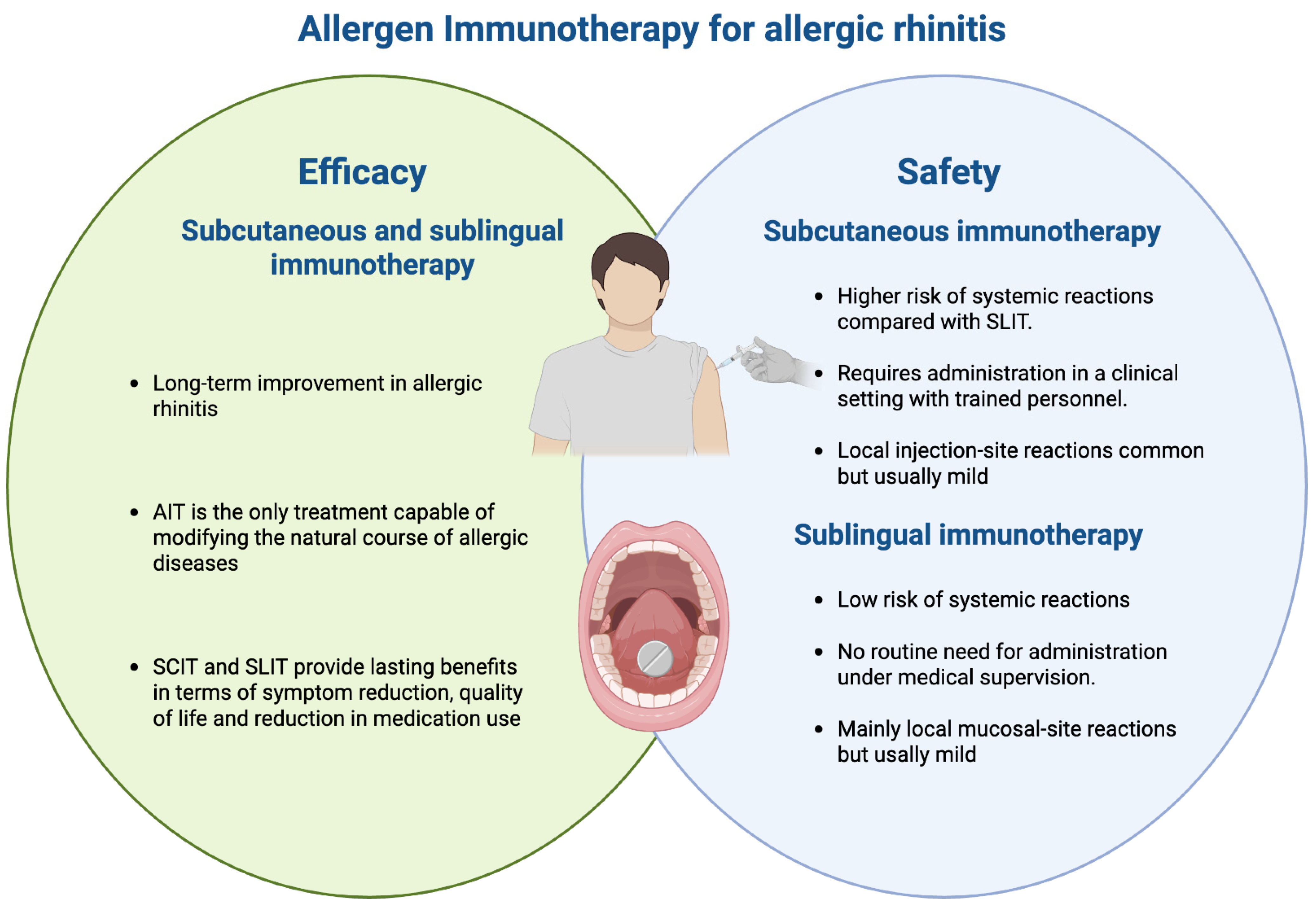
- AIT studies are seldom comparable due to the diversity of allergen extracts, doses, and dosing regimens. In addition, study designs, inclusion criteria, and outcome assessments often differ [43].
2.1. Subcutaneous Immunotherapy Efficacy
2.2. Sublingual Immunotherapy Efficacy

| Authors | Year | Population | Results |
|---|---|---|---|
| Milani et al. EFESO trial [110] | 2008 | 154 patients with allergic rhinitis + 151 controls | SLIT treatment in AR is associated with better quality of life, diminished use of symptomatic drugs, and lower incidence of asthma and new sensitizations. |
| Zielen et al. [85] | 2018 | 2851 patients sensitized for grass pollen + 71,275 control patients | SLIT tablets for grass pollen decreased the use of symptomatic drugs for AR/C and of asthma medication with less frequent asthma exacerbation |
| Wahn et al. [86] | 2019 | 9001 patients sensitized for birch pollen + 45,005 control patients | Reduced AR/C and asthma medications, less frequent asthma exacerbation |
| Devillier et al. [87] | 2019 | 1099 grass pollen SLIT patients + 27,475 control patients | Prescription of grass pollen SLIT tablets reduced the dispensing of AR and asthma medications |
| Jutel et al. [111] | 2020 | 2350 patients sensitized to house dust mite + 64,740 controls | Reduced AR/C and asthma medications, reduced asthma development |
| Vogelberg et al. [84] | 2020 | 11,931 SCIT patients and 10,698 SLIT patients sensitized for grass and tree pollen | SCIT and SLIT have been proven to ameliorate symptom scores, medication scores, and combinations of both in patients with AR/C and asthma. |
| Fritzsching et al. REACT study [80] | 2021 | 46,024 patients with AR/C and with (14,614) or without asthma + 46,024 controls | Reduction in symptomatic drug usage, greater likelihood of stepping down asthma treatment, reduction in asthma exacerbation and pneumonia with antibiotic prescription |
| Pavon-Romero et al. [112]. | 2021 | 786 clinical records with SCIT from 2005 to 2018, comparing the clinical characteristics of patients with ARs versus a group of a similar number of patients who completed SCIT without reactions | Most reactions were mild (grade 1), with fewer grade 2 reactions and no grade 3, grade 4, or 5 (fatality). SCIT demonstrated a favorable safety profile in pediatric patients, with infrequent and predominantly mild ARs. |
| Cardona-Villa et al. [81] | 2025 | 49 children diagnosed with HDM-AR/C, with or without asthma, who were treated with SCIT for 1 year. | Reduction in the CSMS for AR/C. ACT scores also significantly improved, and asthma medication use significantly decreased after 1 year. |
| Demoly et al. (EfficAPSI study) [109] | 2024 | 112,492 AR patients treated with personalized liquid SLIT vs 333,082 matched controls without AIT; patients with and without pre-existing asthma, long-term follow-up (median ~7–8 years) | SLIT-liquid exposure was associated with a significant reduction in asthma onset and progression: ~35–40% lower risk of new asthma events across sensitive, specific and combined definitions; ~one-third reduction in GINA treatment step-up in patients with pre-existing asthma and increased likelihood of step-down. |
| Mosges et al. [113] | 2025 | 101 patients with cat allergy (91 treated with depigmented-polymerized cat allergoid), adolescents and adults, during SCIT up-dosing phase under real-world conditions | SCIT with depigmented-polymerized cat allergoid was safe and well tolerated: ~50% reported ADRs, mainly delayed local reactions; systemic ADRs were rare and non-persistent. ADR incidence did not differ by age group or up-dosing regimen. |
3. Allergen Immunotherapy Safety
3.1. Subcutaneous Immunotherapy Safety
| Grade 1 | Symptom(s)/sign(s) of one organ system present: cutaneous, upper respiratory, conjunctival, nausea |
| Grade 2 | Symptom(s)/sign(s) of more than one organ system present OR lower respiratory symptom OR gastrointestinal symptoms OR uterine cramps |
| Grade 3 | Lower respiratory symptoms more severe than grade 2 (≥40% PEF or FEV1 drop, not responding to inhaled bronchodilator) OR laryngeal, uvula, or tongue edema |
| Grade 4 | Respiratory failure OR Hypotension |
| Grade 5 | Death |
3.2. Sublingual Immunotherapy Safety
4. Conclusions
Author Contributions
Funding
Data Availability Statement
Conflicts of Interest
Abbreviations
| AIT | allergen immunotherapy |
| AR | allergic rhinitis |
| AR/C | allergic rhinitis with or without conjunctivitis |
| SLIT | sublingual immunotherapy |
| SCIT | subcutaneous immunotherapy |
| QoL | quality of life |
| RCTs | randomized controlled trials |
| RWE | real-world evidence |
| RWD | real-world data |
| PROs | patient-reported outcomes |
| CSMS | combined symptom and medication scores |
| RQLQ | Rhinoconjunctivitis Quality-of-Life Questionnaire |
| ACT | Asthma Control Test |
| VAS | visual analogue scales |
| FEV1 | forced expiratory volume in one second |
| HDM | house dust mite |
| ADER | Allergen Immunotherapy Adverse Events Registry |
| FDA | Food and Drug Administration |
| WHO | World Health Organization |
| ICS | intranasal corticosteroid |
| DBPCTs | double-blind placebo-controlled trials |
| ARs | adverse reactions |
| SARs | systemic allergic reactions |
| LRs | local reactions |
References
- Licari, A.; Magri, P.; De Silvestri, A.; Giannetti, A.; Indolfi, C.; Mori, F.; Marseglia, G.L.; Peroni, D. Epidemiology of Allergic Rhinitis in Children: A Systematic Review and Meta-Analysis. J. Allergy Clin. Immunol. Pract. 2023, 11, 2547–2556. [Google Scholar] [CrossRef]
- Savouré, M.; Bousquet, J.; Jaakkola, J.J.K.; Jaakkola, M.S.; Jacquemin, B.; Nadif, R. Worldwide Prevalence of Rhinitis in Adults: A Review of Definitions and Temporal Evolution. Clin. Transl. Allergy 2022, 12, e12130. [Google Scholar] [CrossRef] [PubMed]
- Bauchau, V.; Durham, S.R. Prevalence and Rate of Diagnosis of Allergic Rhinitis in Europe. Eur. Respir. J. 2004, 24, 758–764. [Google Scholar] [CrossRef] [PubMed]
- Platts-Mills, T.A.E. The Allergy Epidemics: 1870–2010. J. Allergy Clin. Immunol. 2015, 136, 3–13. [Google Scholar] [CrossRef]
- Sousa-Pinto, B.; Savouré, M.; Vieira, R.; Amaral, R.; Czarlewski, W.; Bedbrook, A.; Valiulis, A.; Kvedariene, V.; Brussino, L.; Gemicioglu, B.; et al. Allergic Rhinitis and Its Impact on Asthma (ARIA) Classes in MASK-Air Users. J. Investig. Allergy Clin. Immunol. 2025, 35, 373–383. [Google Scholar] [CrossRef]
- Meltzer, E.O. Quality of Life in Adults and Children with Allergic Rhinitis. J. Allergy Clin. Immunol. 2001, 108, S45–S53. [Google Scholar] [CrossRef]
- Bousquet, P.J.; Demoly, P.; Devillier, P.; Mesbah, K.; Bousquet, J. Impact of Allergic Rhinitis Symptoms on Quality of Life in Primary Care. Int. Arch. Allergy Immunol. 2013, 160, 393–400. [Google Scholar] [CrossRef]
- Bernstein, J.A.; Bernstein, J.S.; Makol, R.; Ward, S. Allergic Rhinitis. JAMA 2024, 331, 866. [Google Scholar] [CrossRef]
- Chen, H.; Gould, M.K.; Blanc, P.D.; Miller, D.P.; Kamath, T.V.; Lee, J.H.; Sullivan, S.D. Asthma Control, Severity, and Quality of Life: Quantifying the Effect of Uncontrolled Disease. J. Allergy Clin. Immunol. 2007, 120, 396–402. [Google Scholar] [CrossRef]
- Roberts, G.; Pfaar, O.; Akdis, C.A.; Ansotegui, I.J.; Durham, S.R.; Gerth van Wijk, R.; Halken, S.; Larenas-Linnemann, D.; Pawankar, R.; Pitsios, C.; et al. EAACI Guidelines on Allergen Immunotherapy: Allergic Rhinoconjunctivitis. Allergy 2018, 73, 765–798. [Google Scholar] [CrossRef]
- Catamerò, F.; Giovannini, M.; Barni, S.; Liccioli, G.; Sarti, L.; Tomei, L.; Pessina, B.; Valleriani, C.; Marzi, C.; Baccini, M.; et al. Quality of Life of the SQ House Dust Mite Sublingual Immunotherapy Tablet in Italian Adolescents with House Dust Mite-Induced Allergic Rhinitis. Ital. J. Pediatr. 2025, 51, 154. [Google Scholar] [CrossRef] [PubMed]
- Akdis, C.A.; Akdis, M. Mechanisms of Allergen-Specific Immunotherapy and Immune Tolerance to Allergens. World Allergy Organ. J. 2015, 8, 17. [Google Scholar] [CrossRef] [PubMed]
- Li, J.; Huang, Y.; Lin, X.; Zhao, D.; Tan, G.; Wu, J.; Zhao, C.; Zhao, J.; Spangfort, M.D.; Zhong, N. Influence of Degree of Specific Allergic Sensitivity on Severity of Rhinitis and Asthma in Chinese Allergic Patients. Respir. Res. 2011, 12, 95. [Google Scholar] [CrossRef] [PubMed]
- Kristiansen, M.; Dhami, S.; Netuveli, G.; Halken, S.; Muraro, A.; Roberts, G.; Larenas-Linnemann, D.; Calderón, M.A.; Penagos, M.; Du Toit, G.; et al. Allergen Immunotherapy for the Prevention of Allergy: A Systematic Review and Meta-analysis. Pediatr. Allergy Immunol. 2017, 28, 18–29. [Google Scholar] [CrossRef]
- Gradman, J.; Halken, S. Preventive Effect of Allergen Immunotherapy on Asthma and New Sensitizations. J. Allergy Clin. Immunol. Pract. 2021, 9, 1813–1817. [Google Scholar] [CrossRef]
- Morjaria, J.B.; Caruso, M.; Emma, R.; Russo, C.; Polosa, R. Treatment of Allergic Rhinitis as a Strategy for Preventing Asthma. Curr. Allergy Asthma Rep. 2018, 18, 23. [Google Scholar] [CrossRef]
- Durham, S.R.; Shamji, M.H. Allergen Immunotherapy: Past, Present and Future. Nat. Rev. Immunol. 2023, 23, 317–328. [Google Scholar] [CrossRef]
- Pfaar, O.; Becker, S.; Calabria, C.; Hartenstein, D.; Jung, J.; Zimmer, J.; Ponda, P. Comparison of Allergen Immunotherapy Practice Patterns in Inhalant Allergies in the United States of America and Europe: Similarities and Differences 2023. World Allergy Organ. J. 2023, 16, 100766. [Google Scholar] [CrossRef]
- Paoletti, G.; Nappi, E.; Bragato, M.C.; Valli, P.; Giovannini, M.; Gargano, D.; Pecoraro, L.; Diso, D.; Barbaglia, S.; Canonica, G.W.; et al. Allergen Immunotherapy in Italy: How, When, and Why—A Real-World Study Conducted through a Patient Association. World Allergy Organ. J. 2025, 18, 101015. [Google Scholar] [CrossRef]
- Di Bona, D.; Carlucci, P.; Spataro, F.; Paoletti, G.; Heffler, E.; Pulkanen, J.; Macchia, L.; Del Giacco, S.; Agache, I.; Jutel, M.; et al. Comparison of Evidence of Treatment Effects in Randomized and Nonrandomized Studies on Allergen Immunotherapy. Clin. Exp. Allergy 2023, 53, 610–625. [Google Scholar] [CrossRef]
- Catamerò, F.; Barbaglia, S.; Heffler, E.; Giovannini, M.; Paoletti, G. Patients’ Perspective on Allergen Immunotherapy for Respiratory Allergy. Curr. Opin. Allergy Clin. Immunol. 2025, 25, 500–510. [Google Scholar] [CrossRef]
- Hellings, P.W.; Pugin, B.; Mariën, G.; Bachert, C.; Breynaert, C.; Bullens, D.M.; Ceuppens, J.L.; Clement, G.; Cox, T.; Ebo, D.; et al. Stepwise Approach towards Adoption of Allergen Immunotherapy for Allergic Rhinitis and Asthma Patients in Daily Practice in Belgium: A BelSACI-Abeforcal-EUFOREA Statement. Clin. Transl. Allergy 2019, 9, 1. [Google Scholar] [CrossRef]
- Senna, G.; Ridolo, E.; Calderon, M.; Lombardi, C.; Canonica, G.W.; Passalacqua, G. Evidence of Adherence to Allergen-Specific Immunotherapy. Curr. Opin. Allergy Clin. Immunol. 2009, 9, 544–548. [Google Scholar] [CrossRef]
- Gehrt, F.; Xu, Q.; Baiardini, I.; Canonica, G.W.; Pfaar, O. Adherence in Allergen Immunotherapy: Current Situation and Future Implications. Allergol. Sel. 2022, 6, 276–284. [Google Scholar] [CrossRef]
- Asaria, M.; Dhami, S.; van Ree, R.; Gerth van Wijk, R.; Muraro, A.; Roberts, G.; Sheikh, A. Health Economic Analysis of Allergen Immunotherapy for the Management of Allergic Rhinitis, Asthma, Food Allergy and Venom Allergy: A Systematic Overview. Allergy 2018, 73, 269–283. [Google Scholar] [CrossRef] [PubMed]
- Pfaar, O.; Bousquet, J.; Durham, S.R.; Kleine-Tebbe, J.; Larché, M.; Roberts, G.; Shamji, M.H.; Gerth van Wijk, R. One Hundred and Ten Years of Allergen Immunotherapy: A Journey from Empiric Observation to Evidence. Allergy 2022, 77, 454–468. [Google Scholar] [CrossRef] [PubMed]
- Noon, L. Prophylactic Inoculation Against Hay Fever. Lancet 1911, 177, 1572–1573. [Google Scholar] [CrossRef]
- Freeman, J. Vaccination Against Hay Fever: Report of Results During the Last Three Years. Lancet 1914, 183, 1178–1180. [Google Scholar] [CrossRef][Green Version]
- Frankland, A.W.; Augustin, R. Prophylaxis of Summer Hay-Fever and Asthma. Lancet 1954, 263, 1055–1057. [Google Scholar] [CrossRef]
- Norman, P.; Lichtenstein, L.; Tignall, J. The Clinical and Immunologic Specificity of Immunotherapy. J. Allergy Clin. Immunol. 1978, 61, 370–377. [Google Scholar] [CrossRef]
- Bousquet, J.; Lockey, R.; Malling, H.J.; Alvarez-Cuesta, E.; Canonica, G.W.; Chapman, M.D.; Creticos, P.J.; Dayer, J.M.; Durham, S.R.; Demoly, P.; et al. Allergen Immunotherapy: Therapeutic Vaccines for Allergic Diseases. Ann. Allergy Asthma Immunol. 1998, 81, 401–405. [Google Scholar] [CrossRef] [PubMed]
- Didier, A.; Malling, H.; Worm, M.; Horak, F.; Sussman, G.L. Prolonged Efficacy of the 300IR 5-grass Pollen Tablet up to 2 Years after Treatment Cessation, as Measured by a Recommended Daily Combined Score. Clin. Transl. Allergy 2015, 5, 12. [Google Scholar] [CrossRef] [PubMed]
- Durham, S.R.; Emminger, W.; Kapp, A.; de Monchy, J.G.R.; Rak, S.; Scadding, G.K.; Wurtzen, P.A.; Andersen, J.S.; Tholstrup, B.; Riis, B.; et al. SQ-Standardized Sublingual Grass Immunotherapy: Confirmation of Disease Modification 2 Years after 3 Years of Treatment in a Randomized Trial. J. Allergy Clin. Immunol. 2012, 129, 717–725.e5. [Google Scholar] [CrossRef] [PubMed]
- Jacobsen, L.; Niggemann, B.; Dreborg, S.; Ferdousi, H.A.; Halken, S.; Høst, A.; Koivikko, A.; Norberg, L.A.; Valovirta, E.; Wahn, U.; et al. Specific Immunotherapy Has Long-term Preventive Effect of Seasonal and Perennial Asthma: 10-year Follow-up on the PAT Study. Allergy 2007, 62, 943–948. [Google Scholar] [CrossRef]
- Penagos, M.; Durham, S.R. Allergen Immunotherapy for Long-Term Tolerance and Prevention. J. Allergy Clin. Immunol. 2022, 149, 802–811. [Google Scholar] [CrossRef]
- Bozek, A.; Cudak, A.; Walter Canonica, G. Long-Term Efficacy of Injected Allergen Immunotherapy for Treatment of Grass Pollen Allergy in Elderly Patients with Allergic Rhinitis. Allergy Asthma Proc. 2020, 41, 271–277. [Google Scholar] [CrossRef]
- Gappa, M.; Gagnon, R.; Horak, F.; Cichocka-Jarosz, E.; Dalgaard, T.; Hargreaves, K.; Mikler, J.; Emeryk, A.; Hansen, K.S.; Pfaar, O. The SQ Tree Sublingual Immunotherapy Tablet Is Effective and Well Tolerated in Children—A Pivotal Phase III Trial. Allergy 2025, 80, 795–806. [Google Scholar] [CrossRef]
- Schuster, A.; Caimmi, D.; Nolte, H.; Novakova, S.; Mikler, J.; Foss-Skiftesvik, M.H.; Østerdal, A.S.; Emeryk, A.; Gagnon, R.; Pfaar, O. Efficacy and Safety of SQ House Dust Mite Sublingual Immunotherapy-Tablet (12 SQ-HDM) in Children with Allergic Rhinitis/Rhinoconjunctivitis with or without Asthma (MT-12): A Randomised, Double-Blind, Placebo-Controlled, Phase III Trial. Lancet Reg. Health Eur. 2025, 48, 101136. [Google Scholar] [CrossRef]
- Buta, F.; Paoletti, G.; Bragato, M.C.; Giovannini, M.; Canonica, G.W.; Heffler, E. Real-World Evidence of Allergen Immunotherapy. Curr. Opin. Allergy Clin. Immunol. 2024, 24, 529–535. [Google Scholar] [CrossRef]
- Available online: https://www.fda.gov/science-research/science-and-research-special-topics/real-world-evidence (accessed on 1 March 2026).
- Schünemann, H. All Evidence Is Real World Evidence. Recent Prog. Med. 2019, 110, 165–167. [Google Scholar]
- Giovannini, M.; Catamerò, F.; Agache, I.; Bognanni, A.; Canonica, G.W.; Del Giacco, S.; Heffler, E.; Lenge, M.; Leo, M.C.; Mori, F.; et al. Real-world Evidence in Pediatrics. Pediatr. Allergy Immunol. 2025, 36, e70183. [Google Scholar] [CrossRef] [PubMed]
- Paoletti, G.; Di Bona, D.; Chu, D.K.; Firinu, D.; Heffler, E.; Agache, I.; Jutel, M.; Klimek, L.; Pfaar, O.; Mösges, R.; et al. Allergen Immunotherapy: The Growing Role of Observational and Randomized Trial “Real-World Evidence”. Allergy 2021, 76, 2663–2672. [Google Scholar] [CrossRef] [PubMed]
- Haynes, B. Can It Work? Does It Work? Is It Worth It? BMJ 1999, 319, 652–653. [Google Scholar] [CrossRef] [PubMed]
- de Silva, D.; Geromi, M.; Panesar, S.S.; Muraro, A.; Werfel, T.; Hoffmann-Sommergruber, K.; Roberts, G.; Cardona, V.; Dubois, A.E.J.; Halken, S.; et al. Acute and Long-Term Management of Food Allergy: Systematic Review. Allergy 2014, 69, 159–167. [Google Scholar] [CrossRef]
- Larenas-Linnemann, D.; Cox, L.S. European Allergen Extract Units and Potency: Review of Available Information. Ann. Allergy Asthma Immunol. 2008, 100, 137–145. [Google Scholar] [CrossRef]
- Pfaar, O.; Demoly, P.; Gerth van Wijk, R.; Bonini, S.; Bousquet, J.; Canonica, G.W.; Durham, S.R.; Jacobsen, L.; Malling, H.J.; Mösges, R.; et al. Recommendations for the Standardization of Clinical Outcomes Used in Allergen Immunotherapy Trials for Allergic Rhinoconjunctivitis: An EAACI Position Paper. Allergy 2014, 69, 854–867. [Google Scholar] [CrossRef]
- Pitsios, C. Allergen Immunotherapy: Biomarkers and Clinical Outcome Measures. J. Asthma Allergy 2021, 14, 141–148. [Google Scholar] [CrossRef]
- Suratannon, N.; Limsuwan, T.; Tantilipikorn, P.; Chatchatee, P.; Saengapaswiriya, A.; Boonpiyathad, T.; Thongngarm, T.; Roongpuvapaht, B.; Chantaphakul, H.; Kulalert, P.; et al. A Large Scale Multicentre Randomized, Placebo-Controlled Subcutaneous House Dust Mite Allergen Immunotherapy (HDM SCIT) in Allergic Rhinitis: MITAR Study. Asian Pac. J. Allergy Immunol. 2024, 42, 233–245. [Google Scholar] [CrossRef]
- Makatsori, M.; Pfaar, O.; Calderon, M.A. Allergen Immunotherapy: Clinical Outcomes Assessment. J. Allergy Clin. Immunol. Pract. 2014, 2, 123–129. [Google Scholar] [CrossRef]
- Pfaar, O.; Kleine-Tebbe, J.; Hörmann, K.; Klimek, L. Allergen-Specific Immunotherapy: Which Outcome Measures Are Useful in Monitoring Clinical Trials? Immunol. Allergy Clin. N. Am. 2011, 31, 289–309. [Google Scholar] [CrossRef]
- Buendía-Jiménez, I.; Matas-Ros, M.; Garriga-Baraut, T.; Roger-Reig, A.; Tabar-Purroy, A.; Burchés Baixauli, E.; Cardona Dalh, V.; Castelló Carrascosa, J.V.; Díaz Palacios, M.Á.; Dordal Culla, T.; et al. Efficacy and Safety of a House Dust Mites Allergoid in Patients with Allergic Rhinitis—PROACAROS Study: Protocol for a Randomized Controlled Trial. Trials 2025, 26, 176. [Google Scholar] [CrossRef] [PubMed]
- Bousquet, J.; Schünemann, H.J.; Bousquet, P.J.; Bachert, C.; Canonica, G.W.; Casale, T.B.; Demoly, P.; Durham, S.; Carlsen, K.-H.; Malling, H.-J.; et al. How to Design and Evaluate Randomized Controlled Trials in Immunotherapy for Allergic Rhinitis: An ARIA-GA2LEN Statement. Allergy 2011, 66, 765–774. [Google Scholar] [CrossRef] [PubMed]
- Calderon, M.A.; Eichel, A.; Makatsori, M.; Pfaar, O. Comparability of Subcutaneous and Sublingual Immunotherapy Outcomes in Allergic Rhinitis Clinical Trials. Curr. Opin. Allergy Clin. Immunol. 2012, 12, 249–256. [Google Scholar] [CrossRef] [PubMed]
- Palathumpattu, B.; Pieper-Fürst, U.; Acikel, C.; Sahin, H.; Allekotte, S.; Singh, J.; Hess, M.; Sager, A.; Müller, T.; Mösges, R. Correlation of the Combined Symptom and Medication Score with Quality of Life, Symptom Severity and Symptom Control in Allergic Rhinoconjunctivitis. Clin. Transl. Allergy 2022, 12, e12191. [Google Scholar] [CrossRef]
- Vieira, R.J.; Leemann, L.; Briggs, A.; Pereira, A.M.; Savouré, M.; Kuna, P.; Morais-Almeida, M.; Bewick, M.; Azevedo, L.F.; Louis, R.; et al. Poor Rhinitis and Asthma Control Is Associated with Decreased Health-Related Quality of Life and Utilities: A MASK-Air Study. J. Allergy Clin. Immunol. Pract. 2024, 12, 1530–1538.e6. [Google Scholar] [CrossRef]
- Bousquet, J.; Bullinger, M.; Fayol, C.; Marquis, P.; Valentin, B.; Burtin, B. Assessment of Quality of Life in Patients with Perennial Allergic Rhinitis with the French Version of the SF-36 Health Status Questionnaire. J. Allergy Clin. Immunol. 1994, 94, 182–188. [Google Scholar] [CrossRef]
- Pfaar, O.; Calderon, M.A.; Andrews, C.P.; Angjeli, E.; Bergmann, K.C.; Bønløkke, J.H.; de Blay, F.; Devillier, P.; Ellis, A.K.; Gerth van Wijk, R.; et al. Allergen Exposure Chambers: Harmonizing Current Concepts and Projecting the Needs for the Future—An EAACI Position Paper. Allergy 2017, 72, 1035–1042. [Google Scholar] [CrossRef]
- Lisiecka, M.Z. Efficacy of Subcutaneous, Sublingual and Oral Immunotherapy for Allergens: A Comparative Study. Immunology 2025, 174, 423–433. [Google Scholar] [CrossRef]
- Kouser, L.; Kappen, J.; Walton, R.P.; Shamji, M.H. Update on Biomarkers to Monitor Clinical Efficacy Response During and Post Treatment in Allergen Immunotherapy. Curr. Treat. Options Allergy 2017, 4, 43–53. [Google Scholar] [CrossRef]
- Atkinson, A.J., Jr.; Colburn, W.A.; DeGruttola, V.G.; De Mets, D.L.; Downing, G.J.; Hoth, D.F.; Oates, J.A.; Peck, C.C.; Spilker, B.A.; Woodcock, J.; et al. Biomarkers and Surrogate Endpoints: Preferred Definitions and Conceptual Framework. Clin. Pharmacol. Ther. 2001, 69, 89–95. [Google Scholar] [CrossRef]
- Bousquet, J.; Maasch, H.; Martinot, B.; Hejjaoui, A.; Wahl, R.; Michel, F.B. Double-Blind Placebo-Controlled Immunotherapy with Mixed Grass-Pollen Allergoids. J. Allergy Clin. Immunol. 1988, 82, 439–446. [Google Scholar] [CrossRef]
- Sahiner, U.M.; Giovannini, M.; Escribese, M.M.; Paoletti, G.; Heffler, E.; Alvaro Lozano, M.; Barber, D.; Canonica, G.W.; Pfaar, O. Mechanisms of Allergen Immunotherapy and Potential Biomarkers for Clinical Evaluation. J. Pers. Med. 2023, 13, 845. [Google Scholar] [CrossRef] [PubMed]
- James, L.K.; Durham, S.R. Update on Mechanisms of Allergen Injection Immunotherapy. Clin. Exp. Allergy 2008, 38, 1074–1088. [Google Scholar] [CrossRef] [PubMed]
- Scadding, G.; Durham, S. Mechanisms of Sublingual Immunotherapy. J. Asthma 2009, 46, 322–334. [Google Scholar] [CrossRef] [PubMed]
- Li, X.; Shang, J.; Liu, J.; Zhu, Y. A Meta-Analysis Investigating the Efficacy and Safety of Allergen-Specific Immunotherapy in the Management of Respiratory Allergies. J. Asthma 2024, 61, 1337–1346. [Google Scholar] [CrossRef]
- Dhami, S.; Kakourou, A.; Asamoah, F.; Agache, I.; Lau, S.; Jutel, M.; Muraro, A.; Roberts, G.; Akdis, C.A.; Bonini, M.; et al. Allergen Immunotherapy for Allergic Asthma: A Systematic Review and Meta-analysis. Allergy 2017, 72, 1825–1848. [Google Scholar] [CrossRef]
- Abramson, M.J.; Puy, R.M.; Weiner, J.M. Allergen Immunotherapy for Asthma. In The Cochrane Database of Systematic Reviews; Abramson, M.J., Ed.; John Wiley & Sons, Ltd.: Chichester, UK, 2003. [Google Scholar]
- Bachert, C.; Hoogeveen, H.; Have, R.t.; Yu, D.; Worm, M.; Pfaar, O.; Jutel, M.; Distler, A.; Bozek, A.; Opstelten, D.; et al. Subcutaneous Allergen Immunotherapy in Adults Allergic to House Dust Mites: A Phase 3 Randomized Controlled Trial. Allergy 2025, 80, 3391–3400. [Google Scholar] [CrossRef]
- Jutel, M.; Rudert, M.; Kreimendahl, F.; Kuna, P. Efficacy and Tolerability of a House Dust Mite Allergoid in Allergic Bronchial Asthma: A Randomized Dose-Ranging Trial. Immunotherapy 2018, 10, 1149–1161. [Google Scholar] [CrossRef]
- Castro-Almarales, R.L.; Ronquillo-Díaz, M.; Álvarez-Castelló, M.; Rodríguez-Canosa, J.; González-León, M.; Enríquez-Domínguez, I.; Navarro-Viltre, B.I.; Mateo-Morejón, M.; Oliva-Díaz, Y.; Ramírez-González, W.; et al. Subcutaneous Allergen Immunotherapy for Asthma: A Randomized, Double-Blind, Placebo-Controlled Study with a Standardized Blomia tropicalis Vaccine. World Allergy Organ. J. 2020, 13, 100098. [Google Scholar] [CrossRef]
- Creticos, P.S.; Gunaydin, F.E.; Nolte, H.; Damask, C.; Durham, S.R. Allergen Immunotherapy: The Evidence Supporting the Efficacy and Safety of Subcutaneous Immunotherapy and Sublingual Forms of Immunotherapy for Allergic Rhinitis/Conjunctivitis and Asthma. J. Allergy Clin. Immunol. Pract. 2024, 12, 1415–1427. [Google Scholar] [CrossRef]
- Di Bona, D.; Plaia, A.; Leto-Barone, M.S.; La Piana, S.; Di Lorenzo, G. Efficacy of Subcutaneous and Sublingual Immunotherapy with Grass Allergens for Seasonal Allergic Rhinitis: A Meta-Analysis–Based Comparison. J. Allergy Clin. Immunol. 2012, 130, 1097–1107.e2. [Google Scholar] [CrossRef]
- Feng, S.; Xu, Y.; Ma, R.; Sun, Y.; Luo, X.; Li, H. Cluster Subcutaneous Allergen Specific Immunotherapy for the Treatment of Allergic Rhinitis: A Systematic Review and Meta-Analysis. PLoS ONE 2014, 9, e86529. [Google Scholar] [CrossRef]
- Feng, B.; Wu, J.; Chen, B.; Xiang, H.; Chen, R.; Li, B.; Chen, S. Efficacy and Safety of Sublingual Immunotherapy for Allergic Rhinitis in Pediatric Patients: A Meta-Analysis of Randomized Controlled Trials. Am. J. Rhinol. Allergy 2017, 31, 27–35. [Google Scholar] [CrossRef]
- Dranitsaris, G.; Ellis, A.K. Sublingual or Subcutaneous Immunotherapy for Seasonal Allergic Rhinitis: An Indirect Analysis of Efficacy, Safety and Cost. J. Eval. Clin. Pract. 2014, 20, 225–238. [Google Scholar] [CrossRef] [PubMed]
- Durham, S.R.; Walker, S.M.; Varga, E.-M.; Jacobson, M.R.; O’Brien, F.; Noble, W.; Till, S.J.; Hamid, Q.A.; Nouri-Aria, K.T. Long-Term Clinical Efficacy of Grass-Pollen Immunotherapy. N. Engl. J. Med. 1999, 341, 468–475. [Google Scholar] [CrossRef] [PubMed]
- Scadding, G.W.; Calderon, M.A.; Shamji, M.H.; Eifan, A.O.; Penagos, M.; Dumitru, F.; Sever, M.L.; Bahnson, H.T.; Lawson, K.; Harris, K.M.; et al. Effect of 2 Years of Treatment with Sublingual Grass Pollen Immunotherapy on Nasal Response to Allergen Challenge at 3 Years Among Patients with Moderate to Severe Seasonal Allergic Rhinitis. JAMA 2017, 317, 615. [Google Scholar] [CrossRef] [PubMed]
- Fritzsching, B.; Contoli, M.; Porsbjerg, C.; Buchs, S.; Larsen, J.R.; Freemantle, N. Real-World Evidence: Methods for Assessing Long-Term Health and Effectiveness of Allergy Immunotherapy. J. Allergy Clin. Immunol. 2022, 149, 881–883. [Google Scholar] [CrossRef]
- Fritzsching, B.; Contoli, M.; Porsbjerg, C.; Buchs, S.; Larsen, J.R.; Elliott, L.; Rodriguez, M.R.; Freemantle, N. Long-Term Real-World Effectiveness of Allergy Immunotherapy in Patients with Allergic Rhinitis and Asthma: Results from the REACT Study, a Retrospective Cohort Study. Lancet Reg. Health Eur. 2022, 13, 100275. [Google Scholar] [CrossRef]
- Cardona-Villa, R.; del Pozo, S.; Uribe-García, S.; Calvo-Betancur, V.D.; Fernández-Caldas, E.; Sánchez, J. Clinical Outcomes of Allergen Immunotherapy in Children in Latin America: Treatment with Polymerized Allergen Extracts of Dermatophagoides pteronyssinus and Dermatophagoides farinae. World Allergy Organ. J. 2025, 18, 101094. [Google Scholar] [CrossRef]
- Cardona-Villa, R.; Uribe-Garcia, S.; Calvo-Betancur, V.D.; Cantillo, J.F.; Fernández-Caldas, E. Efficacy and Safety of Subcutaneous Immunotherapy with a Mixture of Glutaraldehyde-Modified Extracts of Dermatophagoides pteronyssinus, Dermatophagoides farinae, and Blomia tropicalis. World Allergy Organ. J. 2022, 15, 100692. [Google Scholar] [CrossRef]
- Vogelberg, C.; Klimek, L.; Brüggenjürgen, B.; Jutel, M. Real-world Evidence for the Long-term Effect of Allergen Immunotherapy: Current Status on Database-derived European Studies. Allergy 2022, 77, 3584–3592. [Google Scholar] [CrossRef] [PubMed]
- Vogelberg, C.; Brüggenjürgen, B.; Richter, H.; Jutel, M. Real-World Adherence and Evidence of Subcutaneous and Sublingual Immunotherapy in Grass and Tree Pollen-Induced Allergic Rhinitis and Asthma. Patient Prefer. Adherence 2020, 14, 817–827. [Google Scholar] [CrossRef] [PubMed]
- Zielen, S.; Devillier, P.; Heinrich, J.; Richter, H.; Wahn, U. Sublingual Immunotherapy Provides Long-term Relief in Allergic Rhinitis and Reduces the Risk of Asthma: A Retrospective, Real-world Database Analysis. Allergy 2018, 73, 165–177. [Google Scholar] [CrossRef]
- Wahn, U.; Bachert, C.; Heinrich, J.; Richter, H.; Zielen, S. Real-world Benefits of Allergen Immunotherapy for Birch Pollen-associated Allergic Rhinitis and Asthma. Allergy 2019, 74, 594–604. [Google Scholar] [CrossRef]
- Devillier, P.; Molimard, M.; Ansolabehere, X.; Bardoulat, I.; Coulombel, N.; Maurel, F.; Le Jeunne, P.; Demoly, P. Immunotherapy with Grass Pollen Tablets Reduces Medication Dispensing for Allergic Rhinitis and Asthma: A Retrospective Database Study in France. Allergy 2019, 74, 1317–1326. [Google Scholar] [CrossRef]
- Nelson, H.S.; Nolte, H.; Creticos, P.; Maloney, J.; Wu, J.; Bernstein, D.I. Efficacy and Safety of Timothy Grass Allergy Immunotherapy Tablet Treatment in North American Adults. J. Allergy Clin. Immunol. 2011, 127, 72–80.e2. [Google Scholar] [CrossRef]
- Blaiss, M.; Maloney, J.; Nolte, H.; Gawchik, S.; Yao, R.; Skoner, D.P. Efficacy and Safety of Timothy Grass Allergy Immunotherapy Tablets in North American Children and Adolescents. J. Allergy Clin. Immunol. 2011, 127, 64–71.e4. [Google Scholar] [CrossRef]
- Maloney, J.; Bernstein, D.I.; Nelson, H.; Creticos, P.; Hébert, J.; Noonan, M.; Skoner, D.; Zhou, Y.; Kaur, A.; Nolte, H. Efficacy and Safety of Grass Sublingual Immunotherapy Tablet, MK-7243: A Large Randomized Controlled Trial. Ann. Allergy Asthma Immunol. 2014, 112, 146–153.e2. [Google Scholar] [CrossRef]
- Creticos, P.S.; Maloney, J.; Bernstein, D.I.; Casale, T.; Kaur, A.; Fisher, R.; Liu, N.; Murphy, K.; Nékám, K.; Nolte, H. Randomized Controlled Trial of a Ragweed Allergy Immunotherapy Tablet in North American and European Adults. J. Allergy Clin. Immunol. 2013, 131, 1342–1349.e6. [Google Scholar] [CrossRef]
- Nolte, H.; Amar, N.; Bernstein, D.I.; Lanier, B.Q.; Creticos, P.; Berman, G.; Kaur, A.; Hébert, J.; Maloney, J. Safety and Tolerability of a Short Ragweed Sublingual Immunotherapy Tablet. Ann. Allergy Asthma Immunol. 2014, 113, 93–100.e3. [Google Scholar] [CrossRef]
- Cox, L.S.; Casale, T.B.; Nayak, A.S.; Bernstein, D.I.; Creticos, P.S.; Ambroisine, L.; Melac, M.; Zeldin, R.K. Clinical Efficacy of 300IR 5-Grass Pollen Sublingual Tablet in a US Study: The Importance of Allergen-Specific Serum IgE. J. Allergy Clin. Immunol. 2012, 130, 1327–1334.e1. [Google Scholar] [CrossRef] [PubMed]
- Nolte, H.; Bernstein, D.I.; Nelson, H.S.; Kleine-Tebbe, J.; Sussman, G.L.; Seitzberg, D.; Rehm, D.; Kaur, A.; Li, Z.; Lu, S. Efficacy of House Dust Mite Sublingual Immunotherapy Tablet in North American Adolescents and Adults in a Randomized, Placebo-Controlled Trial. J. Allergy Clin. Immunol. 2016, 138, 1631–1638. [Google Scholar] [CrossRef] [PubMed]
- Okubo, K.; Masuyama, K.; Imai, T.; Okamiya, K.; Stage, B.S.; Seitzberg, D.; Konno, A. Efficacy and Safety of the SQ House Dust Mite Sublingual Immunotherapy Tablet in Japanese Adults and Adolescents with House Dust Mite–Induced Allergic Rhinitis. J. Allergy Clin. Immunol. 2017, 139, 1840–1848.e10. [Google Scholar] [CrossRef] [PubMed]
- Okamoto, Y.; Fujieda, S.; Okano, M.; Yoshida, Y.; Kakudo, S.; Masuyama, K. House Dust Mite Sublingual Tablet Is Effective and Safe in Patients with Allergic Rhinitis. Allergy 2017, 72, 435–443. [Google Scholar] [CrossRef]
- Gotoh, M.; Yonekura, S.; Imai, T.; Kaneko, S.; Horikawa, E.; Konno, A.; Okamoto, Y.; Okubo, K. Long-Term Efficacy and Dose-Finding Trial of Japanese Cedar Pollen Sublingual Immunotherapy Tablet. J. Allergy Clin. Immunol. Pract. 2019, 7, 1287–1297.e8. [Google Scholar] [CrossRef]
- Nolte, H.; Waserman, S.; Ellis, A.K.; Biedermann, T.; Würtzen, P.A. Treatment Effect of the Tree Pollen SLIT-Tablet on Allergic Rhinoconjunctivitis During Oak Pollen Season. J. Allergy Clin. Immunol. Pract. 2021, 9, 1871–1878. [Google Scholar] [CrossRef]
- Maloney, J.; Berman, G.; Gagnon, R.; Bernstein, D.I.; Nelson, H.S.; Kleine-Tebbe, J.; Kaur, A.; Li, Q.; Nolte, H. Sequential Treatment Initiation with Timothy Grass and Ragweed Sublingual Immunotherapy Tablets Followed by Simultaneous Treatment Is Well Tolerated. J. Allergy Clin. Immunol. Pract. 2016, 4, 301–309.e2. [Google Scholar] [CrossRef]
- Nelson, H.S.; Bernstein, D.I.; Biedermann, T.; Nolte, H. Sublingual Immunotherapy Tablets in Monosensitized and Polysensitized Adults with Allergic Rhinoconjunctivitis. Allergy Asthma Proc. 2024, 45, 33–36. [Google Scholar] [CrossRef]
- Demoly, P.; Emminger, W.; Rehm, D.; Backer, V.; Tommerup, L.; Kleine-Tebbe, J. Effective Treatment of House Dust Mite–Induced Allergic Rhinitis with 2 Doses of the SQ HDM SLIT-Tablet: Results from a Randomized, Double-Blind, Placebo-Controlled Phase III Trial. J. Allergy Clin. Immunol. 2016, 137, 444–451.e8. [Google Scholar] [CrossRef]
- DuBuske, L. Efficacy and Safety of Sublingual Allergen Immunotherapy. Allergy Asthma Proc. 2022, 43, 272–280. [Google Scholar] [CrossRef]
- Virchow, J.C.; Backer, V.; Kuna, P.; Prieto, L.; Nolte, H.; Villesen, H.H.; Ljørring, C.; Riis, B.; de Blay, F. Efficacy of a House Dust Mite Sublingual Allergen Immunotherapy Tablet in Adults with Allergic Asthma. JAMA 2016, 315, 1715. [Google Scholar] [CrossRef]
- Mosbech, H.; Deckelmann, R.; de Blay, F.; Pastorello, E.A.; Trebas-Pietras, E.; Andres, L.P.; Malcus, I.; Ljørring, C.; Canonica, G.W. Standardized Quality (SQ) House Dust Mite Sublingual Immunotherapy Tablet (ALK) Reduces Inhaled Corticosteroid Use While Maintaining Asthma Control: A Randomized, Double-Blind, Placebo-Controlled Trial. J. Allergy Clin. Immunol. 2014, 134, 568–575.e7. [Google Scholar] [CrossRef]
- Available online: https://ginasthma.org/2024-report/ (accessed on 26 March 2026).
- Hamelmann, E.; Hammerby, E.; Scharling, K.S.; Pedersen, M.; Okkels, A.; Schmitt, J. Quantifying the Benefits of Early Sublingual Allergen Immunotherapy Tablet Initiation in Children. Allergy 2024, 79, 1018–1027. [Google Scholar] [CrossRef] [PubMed]
- Valovirta, E.; Petersen, T.H.; Piotrowska, T.; Laursen, M.K.; Andersen, J.S.; Sørensen, H.F.; Klink, R.; Varga, E.-M.; Huttegger, I.; Agertoft, L.; et al. Results from the 5-Year SQ Grass Sublingual Immunotherapy Tablet Asthma Prevention (GAP) Trial in Children with Grass Pollen Allergy. J. Allergy Clin. Immunol. 2018, 141, 529–538.e13. [Google Scholar] [CrossRef] [PubMed]
- Di Bona, D.; Di Biase, A.; Paoletti, G.; Villani, R.; Serviddio, G.; Cognet-Sicé, J.; Scurati, S.; Canonica, G.W. Efficacy of Index of Reactivity-Liquid Sublingual Immunotherapy in Allergic Rhinoconjunctivitis: A Systematic Review and Meta-Analysis of Randomized Studies. Front. Allergy 2025, 6, 1597003. [Google Scholar] [CrossRef]
- Demoly, P.; Molimard, M.; Bergmann, J.-F.; Delaisi, B.; Gouverneur, A.; Vadel, J.; Collin, C.; Girard, L.; Scurati, S.; Devillier, P. Correction to “Impact of Liquid Sublingual Immunotherapy on Asthma Onset and Progression in Patients with Allergic Rhinitis: A Nationwide Population-Based Study (EfficAPSI Study)” [The Lancet Regional Health—Europe 41 (2024) 100915]. Lancet Reg. Health Eur. 2024, 46, 101120. [Google Scholar] [CrossRef]
- Milani, M.; Pecora, S.; Burastero, S. Observational Study of Sublingual Specific Immunotherapy in Persistent and Intermittent Allergic Rhinitis: The EFESO Trial. Curr. Med. Res. Opin. 2008, 24, 2719–2724. [Google Scholar] [CrossRef]
- Jutel, M.; Brüggenjürgen, B.; Richter, H.; Vogelberg, C. Real-world Evidence of Subcutaneous Allergoid Immunotherapy in House Dust Mite-induced Allergic Rhinitis and Asthma. Allergy 2020, 75, 2050–2058. [Google Scholar] [CrossRef]
- Pavon-Romero, G.F.; Larenas-Linnemann, D.E.; Xochipa Ruiz, K.E.; Ramirez-Jimenez, F.; Teran, L.M. Subcutaneous Allergen-Specific Immunotherapy Is Safe in Pediatric Patients with Allergic Rhinitis. Int. Arch. Allergy Immunol. 2021, 6, 553–561. [Google Scholar] [CrossRef]
- Mösges, R.; Rybachuk, A.; Curtius, E.; Acikel, C.; Drevermann, A.; Werkhäuser, N.; Sahin, H.; Katzke, N.; Allekotte, S.; Landmann, I.; et al. Allergen Immunotherapy with Depigmented–Polymerised Cat Allergoid Is Safe and Well-Tolerated in Patients with Allergic Rhinitis/Rhinoconjunctivitis. J. Clin. Med. 2025, 14, 8456. [Google Scholar] [CrossRef]
- Frew, A.J.; Powell, R.J.; Corrigan, C.J.; Durham, S.R. Efficacy and Safety of Specific Immunotherapy with SQ Allergen Extract in Treatment-Resistant Seasonal Allergic Rhinoconjunctivitis. J. Allergy Clin. Immunol. 2006, 117, 319–325. [Google Scholar] [CrossRef] [PubMed]
- Lockey, R.F.; Nicoara-Kasti, G.L.; Theodoropoulos, D.S.; Bukantz, S.C. Systemic Reactions and Fatalities Associated with Allergen Immunotherapy. Ann. Allergy Asthma Immunol. 2001, 87, 47–55. [Google Scholar] [CrossRef] [PubMed]
- Lieberman, P. The Risk and Management of Anaphylaxis in the Setting of Immunotherapy. Am. J. Rhinol. Allergy 2012, 26, 469–474. [Google Scholar] [CrossRef] [PubMed]
- Cox, L.; Nelson, H.; Lockey, R.; Calabria, C.; Chacko, T.; Finegold, I.; Nelson, M.; Weber, R.; Bernstein, D.I.; Blessing-Moore, J.; et al. Allergen Immunotherapy: A Practice Parameter Third Update. J. Allergy Clin. Immunol. 2011, 127, S1–S55. [Google Scholar] [CrossRef]
- Epstein, T.G.; Liss, G.M.; Murphy-Berendts, K.; Bernstein, D.I. AAAAI and ACAAI Surveillance Study of Subcutaneous Immunotherapy, Year 3: What Practices Modify the Risk of Systemic Reactions? Ann. Allergy Asthma Immunol. 2013, 110, 274–278.e1. [Google Scholar] [CrossRef]
- Maloney, J.; Durham, S.; Skoner, D.; Dahl, R.; Bufe, A.; Bernstein, D.; Murphy, K.; Waserman, S.; Berman, G.; White, M.; et al. Safety of Sublingual Immunotherapy Timothy Grass Tablet in Subjects with Allergic Rhinitis with or without Conjunctivitis and History of Asthma. Allergy 2015, 70, 302–309. [Google Scholar] [CrossRef]
- Robertson, K.; Montazeri, N.; Shelke, U.; Jeimy, S.; Kim, H. A Single Centre Retrospective Study of Systemic Reactions to Subcutaneous Immunotherapy. Allergy Asthma Clin. Immunol. 2020, 16, 93. [Google Scholar] [CrossRef]
- Asllani, J.; Mitsias, D.; Konstantinou, G.; Qirko, E.; Hitaj, M.; Musollari, S.; Christoff, G.; Novakova, S.; Makris, M.; Radulovic Pevec, M.; et al. Allergen Immunotherapy Adverse Events in Adults with Respiratory Allergies-data from ADER: An EAACI Task Force Report. Allergy 2025, 80, 775–784. [Google Scholar] [CrossRef]
- Cox, L.; Larenas-Linnemann, D.; Lockey, R.F.; Passalacqua, G. Speaking the Same Language: The World Allergy Organization Subcutaneous Immunotherapy Systemic Reaction Grading System. J. Allergy Clin. Immunol. 2010, 125, 569–574.e7. [Google Scholar] [CrossRef]
- Epstein, T.G.; Liss, G.M.; Murphy-Berendts, K.; Bernstein, D.I. Risk Factors for Fatal and Nonfatal Reactions to Subcutaneous Immunotherapy. Ann. Allergy Asthma Immunol. 2016, 116, 354–359.e2. [Google Scholar] [CrossRef]
- Epstein, T.G.; Murphy-Berendts, K.; Liss, G.M.; Bernstein, D.I. Risk Factors for Fatal and Nonfatal Reactions to Immunotherapy (2008–2018): Postinjection Monitoring and Severe Asthma. Ann. Allergy Asthma Immunol. 2021, 127, 64–69.e1. [Google Scholar] [CrossRef] [PubMed]
- DaVeiga, S.P.; Liu, X.; Caruso, K.; Golubski, S.; Xu, M.; Lang, D.M. Systemic Reactions Associated with Subcutaneous Allergen Immunotherapy: Timing and Risk Assessment. Ann. Allergy Asthma Immunol. 2011, 106, 533–537.e2. [Google Scholar] [CrossRef] [PubMed]
- Pereira, A.M.; Pereira, M.; Araújo, L.M.; Castel-Branco, M.G.; Morete, A.; Almeida Fonseca, J. Self-Reported Adverse Reactions to Subcutaneous Airborne Allergen Immunotherapy: A Real-Life, Single Center Study. Eur. Ann. Allergy Clin. Immunol. 2023, 55, 131. [Google Scholar] [CrossRef] [PubMed]
- Calderón, M.A.; Vidal, C.; Rodríguez del Río, P.; Just, J.; Pfaar, O.; Tabar, A.I.; Sánchez-Machín, I.; Bubel, P.; Borja, J.; Eberle, P.; et al. European Survey on Adverse Systemic Reactions in Allergen Immunotherapy (EASSI): A Real-Life Clinical Assessment. Allergy 2017, 72, 462–472. [Google Scholar] [CrossRef]
- Mösges, R.; Kasche, E.M.; Raskopf, E.; Singh, J.; Sohlich, L.; Astvatsatourov, A.; Shah-Hosseini, K.; Pirotton, S.; Haazen, L.; Durham, S.R.; et al. A Randomized, Double-blind, Placebo-controlled, Dose-finding Trial with Lolium perenne Peptide Immunotherapy. Allergy 2018, 73, 896–904. [Google Scholar] [CrossRef]
- Worm, M.; Rak, S.; Samoliński, B.; Antila, J.; Höiby, A.; Kruse, B.; Lipiec, A.; Rudert, M.; Valovirta, E. Efficacy and Safety of Birch Pollen Allergoid Subcutaneous Immunotherapy: A 2-year Double-blind, Placebo-controlled, Randomized Trial plus 1-year Open-label Extension. Clin. Exp. Allergy 2019, 49, 516–525. [Google Scholar] [CrossRef]
- Bonertz, A.; Roberts, G.; Slater, J.E.; Bridgewater, J.; Rabin, R.L.; Hoefnagel, M.; Timon, M.; Pini, C.; Pfaar, O.; Sheikh, A.; et al. Allergen Manufacturing and Quality Aspects for Allergen Immunotherapy in Europe and the United States: An Analysis from the EAACI AIT Guidelines Project. Allergy 2018, 73, 816–826. [Google Scholar] [CrossRef]
- Mahler, V.; Zielen, S.; Rosewich, M. Year-Round Treatment Initiation for a 6-Grasses Pollen Allergoid in Specific Immunotherapy of Allergic Rhinoconjunctivitis and Asthma. Immunotherapy 2019, 11, 1569–1582. [Google Scholar] [CrossRef]
- Klimek, L.; Schendzielorz, P.; Pinol, R.; Pfaar, O. Specific Subcutaneous Immunotherapy with Recombinant Grass Pollen Allergens: First Randomized Dose-ranging Safety Study. Clin. Exp. Allergy 2012, 42, 936–945. [Google Scholar] [CrossRef]
- Turner, P.J.; Ansotegui, I.J.; Campbell, D.E.; Cardona, V.; Carr, S.; Custovic, A.; Durham, S.; Ebisawa, M.; Geller, M.; Gonzalez-Estrada, A.; et al. Updated Grading System for Systemic Allergic Reactions: Joint Statement of the World Allergy Organization Anaphylaxis Committee and Allergen Immunotherapy Committee. World Allergy Organ. J. 2024, 17, 100876. [Google Scholar] [CrossRef]
- Canonica, G.W.; Cox, L.; Pawankar, R.; Baena-Cagnani, C.E.; Blaiss, M.; Bonini, S.; Bousquet, J.; Calderón, M.; Compalati, E.; Durham, S.R.; et al. Sublingual Immunotherapy: World Allergy Organization Position Paper 2013 Update. World Allergy Organ. J. 2014, 7, 6. [Google Scholar] [CrossRef]
- Calderon, M.A.; Waserman, S.; Bernstein, D.I.; Demoly, P.; Douglass, J.; Gagnon, R.; Katelaris, C.H.; Kim, H.; Nelson, H.S.; Okamoto, Y.; et al. Clinical Practice of Allergen Immunotherapy for Allergic Rhinoconjunctivitis and Asthma: An Expert Panel Report. J. Allergy Clin. Immunol. Pract. 2020, 8, 2920–2936.e1. [Google Scholar] [CrossRef]
- Didier, A.; Bons, B. Safety and Tolerability of 5-Grass Pollen Tablet Sublingual Immunotherapy: Pooled Analysis and Clinical Review. Expert Opin. Drug Saf. 2015, 14, 777–788. [Google Scholar] [CrossRef] [PubMed]
- Blaiss, M.S.; Durham, S.R.; Bernstein, D.; Stranzl, T.; Lindholm, M.; Nolte, H.; Andersen, K.F.; Roberts, G. Sublingual Tablet Immunotherapy Improves Quality of Life in Adults with Allergic Rhinoconjunctivitis. J. Allergy Clin. Immunol. Pract. 2024, 12, 1520–1529.e5. [Google Scholar] [CrossRef] [PubMed]
- Merck. Original BLA for Grastek®, STN: 125473–Statistical Review. 2013. Available online: https://www.fda.gov/media/88507/download (accessed on 26 March 2026).
- Stallergenes, I. Original BLA for Oralair®, STN: 125471. 2014. Available online: https://www.fda.gov/media/88419/download (accessed on 26 March 2026).
- Nelson, H.; Cartier, S.; Allen-Ramey, F.; Lawton, S.; Calderon, M.A. Network Meta-Analysis Shows Commercialized Subcutaneous and Sublingual Grass Products Have Comparable Efficacy. J. Allergy Clin. Immunol. Pract. 2015, 3, 256–266.e3. [Google Scholar] [CrossRef] [PubMed]
- Dhamija, Y.; Epstein, T.E.G.; Bernstein, D.I. Systemic Allergic Reactions and Anaphylaxis Associated with Allergen Immunotherapy. Immunol. Allergy Clin. N. Am. 2022, 42, 105–119. [Google Scholar] [CrossRef]
- Nolte, H.; Calderon, M.A.; Bernstein, D.I.; Roberts, G.; Azuma, R.; Juhl, R.G.; Hulstrøm, V. Anaphylaxis in Clinical Trials of Sublingual Immunotherapy Tablets. J. Allergy Clin. Immunol. Pract. 2024, 12, 85–95.e4. [Google Scholar] [CrossRef]
- Epstein, T.G.; Calabria, C.; Cox, L.S.; Dreborg, S. Current Evidence on Safety and Practical Considerations for Administration of Sublingual Allergen Immunotherapy (SLIT) in the United States. J. Allergy Clin. Immunol. Pract. 2017, 5, 34–40.e2. [Google Scholar] [CrossRef]

Disclaimer/Publisher’s Note: The statements, opinions and data contained in all publications are solely those of the individual author(s) and contributor(s) and not of MDPI and/or the editor(s). MDPI and/or the editor(s) disclaim responsibility for any injury to people or property resulting from any ideas, methods, instructions or products referred to in the content. |
© 2026 by the authors. Licensee MDPI, Basel, Switzerland. This article is an open access article distributed under the terms and conditions of the Creative Commons Attribution (CC BY) license.
Share and Cite
Catamerò, F.; Bragato, M.C.; Lozano, M.A.; Canonica, G.W.; Hernández, D.B.; Escribese, M.M.; Heffler, E.; Pfaar, O.; Sahiner, U.; Paoletti, G.; et al. Clinical Evaluation of Allergen Immunotherapy for Allergic Rhinitis. Vaccines 2026, 14, 326. https://doi.org/10.3390/vaccines14040326
Catamerò F, Bragato MC, Lozano MA, Canonica GW, Hernández DB, Escribese MM, Heffler E, Pfaar O, Sahiner U, Paoletti G, et al. Clinical Evaluation of Allergen Immunotherapy for Allergic Rhinitis. Vaccines. 2026; 14(4):326. https://doi.org/10.3390/vaccines14040326
Chicago/Turabian StyleCatamerò, Francesco, Maria Chiara Bragato, Montserrat Alvaro Lozano, Giorgio Walter Canonica, Domingo Barber Hernández, Maria M. Escribese, Enrico Heffler, Oliver Pfaar, Umit Sahiner, Giovanni Paoletti, and et al. 2026. "Clinical Evaluation of Allergen Immunotherapy for Allergic Rhinitis" Vaccines 14, no. 4: 326. https://doi.org/10.3390/vaccines14040326
APA StyleCatamerò, F., Bragato, M. C., Lozano, M. A., Canonica, G. W., Hernández, D. B., Escribese, M. M., Heffler, E., Pfaar, O., Sahiner, U., Paoletti, G., & Giovannini, M. (2026). Clinical Evaluation of Allergen Immunotherapy for Allergic Rhinitis. Vaccines, 14(4), 326. https://doi.org/10.3390/vaccines14040326