Recent Advances in Chlorogenic Acids for Food Preservation and Shelf-Life Extension



Abstract
1. Introduction
2. Properties of CGAs
2.1. Naturally Occurring Forms in Fruits and Vegetables

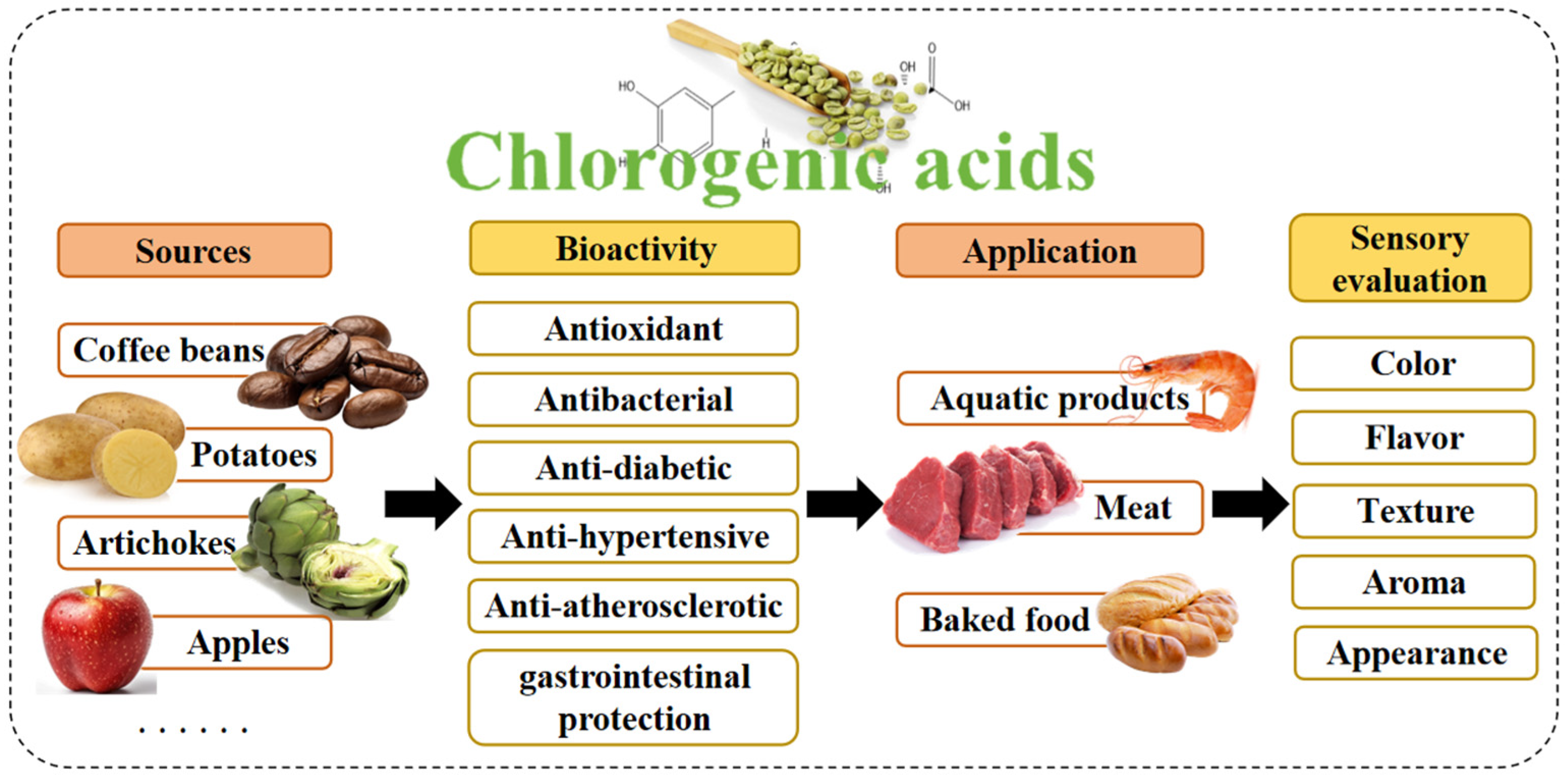
| Food Sources | CGA Content (mg/100 g) | Ref. |
|---|---|---|
| Green coffee beans | 5000–12,000 | [57] |
| Potatoes | 118–13,681 | [58] |
| Tabacco | 348–2031 | [8] |
| Artichoke | 36.3–748 | [52,59] |
| Chicory | 23–644 | [54] |
| Sunflower | 214.3–616 | [56] |
| Sea buckthorn | 1.40–2010 | [47] |
| Mulberry | 259–1338 | [49] |
| Pear | 106.7–247.5 | [60] |
| Apple | 0.70–167.57 | [45] |
2.2. Bioavailability and Stability
2.3. Benefits and Side Effects
3. Application of CGA as a Natural Antioxidant in Various Foods
3.1. Seafood Products
3.1.1. Direct Addition
3.1.2. Feed Additive
3.1.3. Films
| CGA Addition Form | Seafood Product | Concentration of CGA | Results | Refs. |
|---|---|---|---|---|
| Direct addition | Mackerel (Scomberomorus niphonius) | 0.8% CGA | CGA inhibited the effect of lipoxygenase activity on the promotion of fatty acid oxidation and key flavor accumulation in the dry-cured mackerel. | [97] |
| Golden pomfret | 1, 2, and 4 g/L | CGA significantly extended the shelf life of golden pomfret, especially with use at 2 g/L, and the value of the total volatile basic nitrogen (25.90 mg N/100 g) was significantly decreased after 15 d. | [98] | |
| Squid | 2.0 mL of 1 g/L | CGA displayed strong free-radical scavenging capacity, which inhibited the thermal decomposition of trimethylamine oxide in squid extract. | [99] | |
| Ready-to-eat sea cucumber | 1.25, 2.5, 5 and 10 mg/mL | Ready-to-eat sea cucumbers with 10 mg/mL CGA had improved thermal stability, good sensory acceptability and an extended shelf life. | [100] | |
| Ready-to-eat sea cucumber | 5 mg/mL | CGA enhanced sea cucumber collagen stability and extended its shelf life. | [101] | |
| Feed additive | Yellow pond turtles (Mauremys mutica) | 100, 200, 400, 800 mg/kg | The optimal dietary CGA concentration for M. mutica ranges from 197.5 to 359.39 mg/kg to improve immune and antioxidative capacity. | [102] |
| Rainbow trout | 200, 400, 600, and 800 mg/kg diet | 600–800 mg/kg CGA was recommended due to producing the best growth parameters, immune indices, and antioxidant capacity. | [103] | |
| Carp (Cyprinus carpio) | 100, 200, 400, 800 mg/kg | 400 mg/kg was the optimal amount of CGA addition in common carp diets, which enhanced growth performance and antioxidant capacity. | [104] | |
| Blackspotted Croaker Protonibea diacanthus | 100, 200, 400, 800, and 1600 mg/kg | Catalase, glutathione peroxidase, and super oxide dismutase activity increased with the CGA concentration in the diet. A dietary CGA supplementation of 1173.11 mg/kg is suggested based on the muscle texture quality. | [105] | |
| Largemouth Bass (Micropterus salmoides) | 60, 120, 180, and 240 mg/kg | Largemouth bass groups supplemented with 180 and 240 mg/kg CGA displayed improved antioxidant status and weakened inflammatory response. | [106] | |
| Zebrafish | \ | CGA possessed significant antioxidant properties, effectively scavenging free radicals and inhibiting lipid peroxidation. | [107] | |
| Grass carp | 400 mg/kg | A 400 mg/kg CGA supplement promoted digestibility, flesh water-holding capacity and antioxidant capacity. | [108] | |
| Largemouth bass (Micropterus salmoides) | 25, 50, 100 μg/mL | CGA delayed the onset and incidence of the Micropterus salmoides rhabdovirus (MRSV) and reduced mortality, having been used for preventing MRSV in aquaculture farms. | [109] | |
| Spotted sea bass | 100, 200, 300, and 400 mg/kg | Dietary CGA presented antioxidant capacity, immunity, and intestinal health benefits in a high-fat diet, and feed including 400 mg/kg CGA significantly increased total antioxidant activity. | [115] | |
| Juvenile common carp | 550 mg/kg | The addition of both Lactobacillus helveticus and CGA has achieved the best outcomes in increasing catalase and glutathione peroxidase activities and decreasing malondialdehyde activity, which improved immune-antioxidant capacity in common carp. | [116] | |
| Films | ||||
| CGA-CS | Snakehead | 0.2%, 0.5%, and 1.0% (w/w) in 2% chitosan solution | The additional CGA further enhanced the antioxidant and antimicrobial properties but did not influence the hardness of snakehead fish filets after preservation. | [110] |
| CGA-grafted chitosan | Penaeus vannamei | 0.440, 1.318, 2.197 g | The antioxidant and antibacterial activities of CGA-grafted–CS films increased with increasing CGA content. | [111] |
| CGA-grafted CS | Japanese sea bass (Lateolabrax japonicus) | 5.0, 10.0, 20.0 mg/mL | CGA-grafted CS inhibited the growth of Shewanella putrefaciens and spoilage microorganisms, prevented lipid oxidation, and maintained the sensory properties of fish filets. | [112] |
| Gelatin/wheat gliadin electrospun films containing CGA | Grass carp | 25, 50, 75, 100, 125, and 150 mg | The gelatin/wheat gliadin/CGA films delayed the oxidative deterioration of food and maintained its quality. | [113] |
| CGA–gelatin | Sword prawn (Parapenaeopsis hardwickii) | 8.48% (w/w) | CGA–gelatin extended the shelf life of sword prawn from 8 days to 13 days and reduced quality loss, with the sensory evaluation appearing acceptable. | [114] |
3.2. Meat
3.3. Baked Food
3.4. Others
4. Encapsulation Strategies for CGA in Food Matrices
5. Sensory Evaluation of Food Products Containing CGA
6. Conclusions
Author Contributions
Funding
Institutional Review Board Statement
Informed Consent Statement
Data Availability Statement
Acknowledgments
Conflicts of Interest
Abbreviations
| (3′,4′-dimethoxycinnamoyl)quinic aid | DQA |
| 1,4-dicafeoylquinic acid | 1,4-diCQA |
| 1,5-dicafeoylquinic acid | 1,5-diCQA |
| 1-O-caffeoylquinic acid | 1-CQA |
| 1-O-feruloylquinic acid | 1-FQA |
| 2, 2′-Azino-bis, 3-ethylbenzothiazoline-6-sulfonic acid | ABTS |
| 2,2-Diphenyl-1-picrylhydrazyl | DPPH |
| 3,4-dicafeoylquinic acid, isochlorogenic acid B | 3,4-diCQA |
| 3,5-dicafeoylquinic acid, isochlorogenic acid A | 1,3-diCQA |
| 3-O-caffeoylquinic acid, neochlorogenic acid | 3-CQA |
| 3-O-feruloylquinic acid | 3-FQA |
| 4,5-dicafeoylquinic acid, isochlorogenic acid C | 4,5-diCQA |
| 4-O-caffeoylquinic acid, cryptochlorogenic acid | 4-CQA |
| 4-O-feruloylquinic acid | 4-FQA |
| 5-O-caffeoylquinic acid, neochlorogenic acid | 5-CQA |
| 5-O-feruloylquinic acid | 5-FQA |
| AMP-activated protein kinase/peroxisome proliferator-activated receptor γ coactivator 1 | AMPK/PGC-1 |
| Apoferritin | Apo |
| Caffeoylferuloylquinic acids | CFQA |
| Caffeoylquinic acids | CQA |
| Caffeoylquinic-1,5-lactone | CQL |
| Chitosan | CS |
| Chlorogenic acids | CGA |
| Colony-forming units | CFUs |
| Defatted green coffee bean | dGCB |
| Diacylquinic acids | diCQA |
| Ethylenediaminetetraacetic aicd | EDTA |
| Feruloylquinic acids | FQA |
| Feruloylquinic-1,5-lactone | FQL |
| Gallic acid equivalent | GAE |
| Gelatin edible coatings containing Aronia melanocarpa pomace polyphenols | G/AMPPs |
| Green coffee bean | GCB |
| Low-density lipoprotein | LDL |
| Malondialdehyde | MDA |
| m-coumaroylquinic acid | m-CoQA |
| Minimum inhibitory concentration | MIC |
| Mitogen-activated protein kinase | MAPK |
| NF-E2-related factor 2 | Nrf2 |
| Non-alcoholic fatty liver disease | NAFLD |
| Nuclear factor erythroid 2-related factor 2/heme oxygenase-1 | Nrf2/HO-1 |
| Nuclear factor kappa-B | NF-κB |
| Nuclear factor kappa-B/NOD-like receptor protein 3 | NF-κB/NLRP3 |
| p-coumaroylquinic acid | p-CoQA |
| p-coumaroylquinic-1,5-lactone | p-CoQL |
| Reactive oxygen species | ROS |
| Sirtuin 1 | SIRT1 |
| Sodium alginate | SA |
| The European Food Safety Authority | EFSA |
| Thiobarbituric acid reactive substances | TBARSs |
| Total phenolic content | TPC |
| Total volatile base nitrogen | TVB-N |
| Trimethylamine oxide | TMAO |
| Trolox equivalent antioxidant capacity | μMTEAC |
| Ultraviolet-A light | UVA |
References
- Poljsak, B.; Kovač, V.; Milisav, I. Antioxidants, Food Processing and Health. Antioxidants 2021, 10, 433. [Google Scholar] [CrossRef]
- Eze, C.N.; Aduba, C.C.; Ezema, B.O.; Ayoka, T.O.; Nnadi, C.O.; Onyeaka, H. The role of antioxidants in food safety and preservation: Mechanisms, applications, and challenges. Cogent Food Agric. 2025, 11, 2591436. [Google Scholar] [CrossRef]
- Rahaman, M.M.; Hossain, R.; Herrera-Bravo, J.; Islam, M.T.; Atolani, O.; Adeyemi, O.S.; Owolodun, O.A.; Kambizi, L.; Daştan, S.D.; Calina, D.; et al. Natural antioxidants from some fruits, seeds, foods, natural products, and associated health benefits: An update. Food Sci. Nutr. 2023, 11, 1657–1670. [Google Scholar] [CrossRef] [PubMed]
- López-Pedrouso, M.; Lorenzo, J.M.; Franco, D. Advances in Natural Antioxidants for Food Improvement. Antioxidants 2022, 11, 1825. [Google Scholar] [CrossRef] [PubMed]
- Xu, D.P.; Li, Y.; Meng, X.; Zhou, T.; Zhou, Y.; Zheng, J.; Zhang, J.J.; Li, H.B. Natural Antioxidants in Foods and Medicinal Plants: Extraction, Assessment and Resources. Int. J. Mol. Sci. 2017, 18, 96. [Google Scholar] [CrossRef] [PubMed]
- Chibuye, B.; Singh, I.S.; Ramasamy, S.; Maseka, K.K. Natural antioxidants: A comprehensive elucidation of their sources, mechanisms, and applications in health. Next Res. 2024, 1, 100086. [Google Scholar] [CrossRef]
- Sakai, E.; Farhana, F.; Yamaguchi, Y.; Tsukuba, T. Chapter 1—Potentials of natural antioxidants from plants as antiosteoporotic agents. In Studies in Natural Products Chemistry; Atta ur, R., Ed.; Elsevier: Amsterdam, The Netherlands, 2022; Volume 72, pp. 1–28. [Google Scholar]
- Cheng, H.; Chen, J.; Duan, R.; Yang, X.; Yu, J.; Tang, Q.; Wang, H.; Xu, R. Hydrothermal extraction of chlorogenic acid from tobacco waste facilitated by Fe catalyst and optimization of process parameters. Results Eng. 2025, 28, 107707. [Google Scholar] [CrossRef]
- Banožić, M.; Babić, J.; Jokić, S. Recent advances in extraction of bioactive compounds from tobacco industrial waste-a review. Ind. Crops Prod. 2020, 144, 112009. [Google Scholar] [CrossRef]
- Jokić, S.; Gagić, T.; Knez, Ž.; Banožić, M.; Škerget, M. Separation of active compounds from tobacco waste using subcritical water extraction. J. Supercrit. Fluids 2019, 153, 104593. [Google Scholar] [CrossRef]
- Banožić, M.; Jozinović, A.; Grgić, J.; Miličević, B.; Jokić, S. High Voltage Electric Discharge for Recovery of Chlorogenic Acid from Tobacco Waste. Sustainability 2021, 13, 4481. [Google Scholar] [CrossRef]
- Putra, D.P.; Sunarti, T.C.; Syamsu, K.; Fahma, F. Sustainability of coffee solid waste as a source of chlorogenic acid to food’s antimicrobial and antioxidant application. Discov. Food 2025, 5, 177. [Google Scholar] [CrossRef]
- Pyrzynska, K. Spent Coffee Grounds as a Source of Chlorogenic Acid. Molecules 2025, 30, 613. [Google Scholar] [CrossRef] [PubMed]
- Basile, G.; De Luca, L.; Calabrese, M.; Iaccarino, N.; Pizzolongo, F.; Milito, E.M.; Sacchi, R.; Romano, R. Green technologies and chemometric analysis to optimize chlorogenic acid recovery from fennel processing waste. Food Chem. X 2025, 29, 102887. [Google Scholar] [CrossRef]
- Cuffaro, D.; Palladino, P.; Digiacomo, M.; Bertini, S.; Minunni, M.; Macchia, M. Fast, sensitive, and sustainable colorimetric detection of chlorogenic acid in artichoke waste material. Food Chem. 2025, 463, 141505. [Google Scholar] [CrossRef] [PubMed]
- Joly, N.; Souidi, K.; Depraetere, D.; Wils, D.; Martin, P. Potato By-Products as a Source of Natural Chlorogenic Acids and Phenolic Compounds: Extraction, Characterization, and Antioxidant Capacity. Molecules 2021, 26, 177. [Google Scholar] [CrossRef]
- Náthia-Neves, G.; Alonso, E. Valorization of sunflower by-product using microwave-assisted extraction to obtain a rich protein flour: Recovery of chlorogenic acid, phenolic content and antioxidant capacity. Food Bioprod. Process. 2021, 125, 57–67. [Google Scholar] [CrossRef]
- Yeddes, W.; Kalai, F.Z.; Rebey, I.B.; Hammami, M.; Tarchoun, N.; Barros, L.; Petropoulos, S.A.; Falleh, H.; Ksouri, R. Optimization of phenolic compound extraction from Tunisian squash by-products: A sustainable approach for antioxidant and antibacterial applications. Open Life Sci. 2025, 20, 20251096. [Google Scholar] [CrossRef]
- Singh, S.; Singh, R.; Singh, B.; Semwal, B.C. Anti-inflammatory Activity of Chlorogenic Acid and Call for Further Research. Recent Adv. Inflamm. Allergy Drug Discov. 2024, 19, 359–373. [Google Scholar] [CrossRef]
- Kzhyshkowska, J. Stabilizing the immune system by chlorogenic acid. J. Leukoc. Biol. 2022, 112, 7–8. [Google Scholar] [CrossRef]
- He, X.; Zheng, S.; Sheng, Y.; Miao, T.; Xu, J.; Xu, W.; Huang, K.; Zhao, C. Chlorogenic acid ameliorates obesity by preventing energy balance shift in high-fat diet induced obese mice. J. Sci. Food Agric. 2021, 101, 631–637. [Google Scholar] [CrossRef]
- Yan, Y.; Zhou, X.; Guo, K.; Zhou, F.; Yang, H. Use of Chlorogenic Acid against Diabetes Mellitus and Its Complications. J. Immunol. Res. 2020, 2020, 9680508. [Google Scholar] [CrossRef] [PubMed]
- Fernandes, M.Y.D.; Dobrachinski, F.; Silva, H.B.; Lopes, J.P.; Gonçalves, F.Q.; Soares, F.A.A.; Porciúncula, L.O.; Andrade, G.M.; Cunha, R.A.; Tomé, A.R. Neuromodulation and neuroprotective effects of chlorogenic acids in excitatory synapses of mouse hippocampal slices. Sci. Rep. 2021, 11, 10488. [Google Scholar] [CrossRef] [PubMed]
- Jeon, H.J.; Lee, B.-S.; Park, C. Extraction of Chlorogenic Acid Using Single and Mixed Solvents. Molecules 2025, 30, 481. [Google Scholar] [CrossRef] [PubMed]
- Kulathooran, R.; Pushparaju, S.; Venkatachalam, D.; Seshagiri, D.J.; Panday, K.; Rao Lingamallu, J.M. Ionic liquid-based microwave-assisted extraction of chlorogenic acid from green coffee beans. Sustain. Food Technol. 2025, 3, 1580–1588. [Google Scholar] [CrossRef]
- Liu, J.; Duan, H.; Wang, H.; Gao, Q.; Liu, L.; Liang, Y.; He, M.; Xu, L.; Guo, X. Deep eutectic solvent extraction of chlorogenic acid from dandelion with ultrasonic-assisted: Process optimization, purification, and bioactivity. Ultrason. Sonochem. 2025, 122, 107579. [Google Scholar] [CrossRef]
- Gao, L.; Zhang, T.; Zhang, X.; Ding, W.; Yang, J.; Luo, Y.; Wang, J.; Yuan, X.; Zhao, Y. Research progress on the molecular mechanisms of chlorogenic acid’s pharmacological effects and its advanced drug delivery systems. Front. Pharmacol. 2026, 17, 1746172. [Google Scholar] [CrossRef]
- Lu, Y.; Yeap Foo, L. Antioxidant and radical scavenging activities of polyphenols from apple pomace. Food Chem. 2000, 68, 81–85. [Google Scholar] [CrossRef]
- Wang, Q.H.; Dư, T.; Zhang, Z.H.; Ji, M.; Hu, H.Y.; Chen, X.G. Advances in research on the pharmacological effects and mechanism of action of chlorogenic acid. Yaoxue Xuebao 2020, 55, 2273–2280. [Google Scholar] [CrossRef]
- Yin, X.; He, X.; Wu, L.; Yan, D.; Yan, S. Chlorogenic Acid, the Main Antioxidant in Coffee, Reduces Radiation-Induced Apoptosis and DNA Damage via NF-E2-Related Factor 2 (Nrf2) Activation in Hepatocellular Carcinoma. Oxidative Med. Cell. Longev. 2022, 2022, 4566949. [Google Scholar] [CrossRef]
- He, L.; Jing, H.; Wu, Y.; Zhao, Y.; Du, H. Antioxidant and barrier-enhanced lotus seed protein hydrolysate/chlorogenic acid/ propylene glycol alginate edible film for extended freshness of grass carp fillets. Food Chem. 2026, 516, 149351. [Google Scholar] [CrossRef]
- Chen, K.; Peng, C.; Chi, F.; Yu, C.; Yang, Q.; Li, Z. Antibacterial and Antibiofilm Activities of Chlorogenic Acid Against Yersinia enterocolitica. Front. Microbiol. 2022, 13, 885092. [Google Scholar] [CrossRef]
- Han, X.; Chen, J.; Wang, Q.; Zhang, J.; Mi, J.; Feng, J.; Du, T.; Wang, J.; Zhang, W. Photodynamically activated chlorogenic acid-based antimicrobial packaging films for cherry preservation. Food Chem. 2025, 479, 143857. [Google Scholar] [CrossRef]
- Kang, M.-J.; Kim, D.-K. Synergistic antimicrobial action of chlorogenic acid and ultraviolet-A (365 nm) irradiation; mechanisms and effects on DNA integrity. Food Res. Int. 2024, 196, 115132. [Google Scholar] [CrossRef]
- Yuan, Q.; Liu, C.; Zhang, Z.; Chen, F.; Xiao, Q.; Zhang, L.; Pan, X.; He, F.; Xiao, M. Pharmacological advances of the chlorogenic acids family: Current insights and future research directions. Front. Pharmacol. 2025, 16, 1613048. [Google Scholar] [CrossRef]
- Tavassoli, M.; Aslam, R.; Bahramian, B.; Abedi-Firoozjah, R.; Maqsood, S. Chlorogenic acid as a novel bioactive and functional ingredient in the fabrication of biodegradable food packaging films. Trends Food Sci. Technol. 2026, 172, 105672. [Google Scholar] [CrossRef]
- Zalewska, K.; Kulawik, M.; Gierszewska, J.; Gramala, Z.; Kalus, O.; Karpiński, M.; Maćkowiak, J.; Staniewski, A.; Szymańska, Z.; Zalewska, B.; et al. Chlorogenic Acid’s Role in Metabolic Health: Mechanisms and Therapeutic Potential. Nutrients 2025, 17, 3303. [Google Scholar] [CrossRef]
- Gupta, A.; Atanasov, A.G.; Li, Y.; Kumar, N.; Bishayee, A. Chlorogenic acid for cancer prevention and therapy: Current status on efficacy and mechanisms of action. Pharmacol. Res. 2022, 186, 106505. [Google Scholar] [CrossRef]
- Faria, W.C.S.; da Silva, A.A.; Veggi, N.; Kawashita, N.H.; de França Lemes, S.A.; de Barros, W.M.; da Conceição Cardoso, E.; Converti, A.; de Melo Moura, W.; Bragagnolo, N. Acute and subacute oral toxicity assessment of dry encapsulated and non-encapsulated green coffee fruit extracts. J. Food Drug Anal. 2020, 28, 337–355. [Google Scholar] [CrossRef]
- EFSA Panel on Dietetic Products, Nutrition and Allergies (NDA). Scientific Opinion on the substantiation of health claims related to coffee, including chlorogenic acids from coffee, and protection of DNA, proteins and lipids from oxidative damage (ID 1099, 3152, 4301), maintenance of normal blood glucose concentrations (ID 1100, 1962), and contribution to the maintenance or achievement of a normal body weight (ID 2031, 4326) pursuant to Article 13(1) of Regulation (EC) No 1924/2006. EFSA J. 2011, 9, 2057. [Google Scholar] [CrossRef]
- Yu, Y.; Zhang, Z.; Chang, C. Chlorogenic acid intake guidance: Sources, health benefits, and safety. Asia Pac. J. Clin. Nutr. 2022, 31, 602–610. [Google Scholar] [CrossRef]
- Lu, H.; Tian, Z.; Cui, Y.; Liu, Z.; Ma, X. Chlorogenic acid: A comprehensive review of the dietary sources, processing effects, bioavailability, beneficial properties, mechanisms of action, and future directions. Compr. Rev. Food Sci. Food Saf. 2020, 19, 3130–3158. [Google Scholar] [CrossRef]
- Li, Z.; Niu, L.; Chen, Y.; Qiu, X.; Du, T.; Zhu, M.; Wang, M.; Mo, H.; Xiao, S. Recent advance in the biological activity of chlorogenic acid and its application in food industry. Int. J. Food Sci. Technol. 2023, 58, 4931–4947. [Google Scholar] [CrossRef]
- Nguyen, V.; Taine, E.G.; Meng, D.; Cui, T.; Tan, W. Chlorogenic Acid: A Systematic Review on the Biological Functions, Mechanistic Actions, and Therapeutic Potentials. Nutrients 2024, 16, 924. [Google Scholar] [CrossRef]
- Liao, L.; Zhang, W.; Zhang, B.; Cai, Y.; Gao, L.; Ogutu, C.; Sun, J.; Zheng, B.; Wang, L.; Li, L.; et al. Evaluation of chlorogenic acid accumulation in cultivated and wild apples. J. Food Compos. Anal. 2021, 104, 104156. [Google Scholar] [CrossRef]
- Drapeau, C.; Traynard, V.; Yuen, M.W. Seabuckthorn Polyphenols: Characterization, Bioactivities and Associated Health Benefits. In Phenolic Compounds—Chemistry, Synthesis, Diversity, Non-Conventional Industrial, Pharmaceutical and Therapeutic Applications; Badria, F., Ed.; IntechOpen: London, UK, 2021. [Google Scholar] [CrossRef]
- Saddique, I.; Akram, S.; Rubab, S.; Sadiqa, A.; Raza, A.; Mushtaq, M.; Ghauri, M.A. Deep eutectic solvent strategy for green extraction of chlorogenic acid from sea buckthorn: Optimization and sustainability. Future J. Pharm. Sci. 2024, 10, 120. [Google Scholar] [CrossRef]
- Liu, T.; Xie, Q.; Zhang, M.; Gu, J.; Huang, D.; Cao, Q. Reclaiming Agriceuticals from Sweetpotato (Ipomoea batatas [L.] Lam.) By-Products. Foods 2024, 13, 1180. [Google Scholar] [CrossRef]
- Chen, C.; Mokhtar, R.A.M.; Sani, M.S.A.; Noor, N.Q.I.M. The Effect of Maturity and Extraction Solvents on Bioactive Compounds and Antioxidant Activity of Mulberry (Morus alba) Fruits and Leaves. Molecules 2022, 27, 2406. [Google Scholar] [CrossRef]
- Fu, K.; Dai, S.; Zhang, Y.; Gong, J.; Wang, C.; Yao, C.; Zhang, S.; Peng, C.; Li, Y. Natural product chlorogenic acid achieves pharmacological activity and health protection via regulating gut microbiota: A review. Food Sci. Hum. Wellness 2025, 14, 9250153. [Google Scholar] [CrossRef]
- Lin, X.; Lu, X.-K.; Zhu, K.-H.; Jiang, X.-Y.; Chen, J.-C.; Yan, P.-Z.; Zhao, D.-S. Synchronous Extraction, Antioxidant Activity Evaluation, and Composition Analysis of Carbohydrates and Polyphenols Present in Artichoke Bud. Molecules 2022, 27, 8962. [Google Scholar] [CrossRef]
- Chileh-Chelh, T.; Carmona-Fernández, M.; Ezzaitouni, M.; Rincón-Cervera, M.Á.; López-Ruiz, R.; Gómez-Mercado, F.; Guil-Guerrero, J.L. Bioactive compounds and bioactivity of the heads of wild artichokes. Food Biosci. 2024, 59, 104134. [Google Scholar] [CrossRef]
- Corrias, F.; Scano, E.; Milia, M.; Atzei, A.; Casula, M.; Arru, N.; Angioni, A. Extraction and Characterization of Artichoke (Cynara cardunculus L.) Solid Waste from the Industrial Processing of Fresh-Cut Products for Nutraceutical Use. Foods 2025, 14, 13. [Google Scholar] [CrossRef]
- Diemer, E.; Chadni, M.; Grimi, N.; Ioannou, I. Optimization of the Accelerated Solvent Extraction of Caffeoylquinic Acids from Forced Chicory Roots and Antioxidant Activity of the Resulting Extracts. Foods 2022, 11, 3214. [Google Scholar] [CrossRef]
- Chadni, M.; Isidore, E.; Diemer, E.; Ouguir, O.; Brunois, F.; Catteau, R.; Cassan, L.; Ioannou, I. Optimization of Extraction Conditions to Improve Chlorogenic Acid Content and Antioxidant Activity of Extracts from Forced Witloof Chicory Roots. Foods 2022, 11, 1217. [Google Scholar] [CrossRef]
- Wu, J.; Su, M.; Hu, A.; Wang, H. Extraction and recovery of chlorogenic acid from sunflower disks using a high-efficiency system composed of deep eutectic solvents and macroporous resins. J. Food Process. Preserv. 2022, 46, e16856. [Google Scholar] [CrossRef]
- Sanlier, N.; Atik, A.; Atik, I. Consumption of green coffee and the risk of chronic diseases. Crit. Rev. Food Sci. Nutr. 2019, 59, 2573–2585. [Google Scholar] [CrossRef]
- Vescovo, D.; Manetti, C.; Ruggieri, R.; Spizzirri, U.G.; Aiello, F.; Martuscelli, M.; Restuccia, D. The Valorization of Potato Peels as a Functional Ingredient in the Food Industry: A Comprehensive Review. Foods 2025, 14, 1333. [Google Scholar] [CrossRef]
- Alves-Silva, J.M.; Zuzarte, M.; Salgueiro, L.; Cocco, E.; Ghiani, V.; Falconieri, D.; Maccioni, D.; Maxia, A. Agroprospecting of Biowastes: Globe Artichoke (Cynara scolymus L. Cultivar Tema, Asteraceae) as Potential Source of Bioactive Compounds. Molecules 2024, 29, 3960. [Google Scholar] [CrossRef]
- Basit, A.; Shahzad, R.; Mueed, A.; Muhammad, A.; Rong, W.; Ya, L.; Xin, G.; Shahrokh, K.; Arshad, M.; Shutian, T. A critical review on pear Fruit’s polyphenols and its chlorogenic acid: Composition, bioavailability, and pharmacological potential. Food Biosci. 2025, 68, 106407. [Google Scholar] [CrossRef]
- Clifford, M.N.; Jaganath, I.B.; Ludwig, I.A.; Crozier, A. Chlorogenic acids and the acyl-quinic acids: Discovery, biosynthesis, bioavailability and bioactivity. Nat. Prod. Rep. 2017, 34, 1391–1421. [Google Scholar] [CrossRef]
- Clifford, M.N.; Kerimi, A.; Williamson, G. Bioavailability and metabolism of chlorogenic acids (acyl-quinic acids) in humans. Compr. Rev. Food Sci. Food Saf. 2020, 19, 1299–1352. [Google Scholar] [CrossRef]
- Mortelé, O.; Jörissen, J.; Spacova, I.; Lebeer, S.; van Nuijs, A.L.N.; Hermans, N. Demonstrating the involvement of an active efflux mechanism in the intestinal absorption of chlorogenic acid and quinic acid using a Caco-2 bidirectional permeability assay. Food Funct. 2021, 12, 417–425. [Google Scholar] [CrossRef]
- Botti, G.; Pavan, B.; Bianchi, A.; Ferraro, L.; Beggiato, S.; Brugnoli, F.; Bertagnolo, V.; Dalpiaz, A. Chlorogenic acid permeation across intestinal cell monolayers: Influence by circadian rhythms in the presence of other natural polyphenols and by dopaminergic neuronal-like cells. J. Funct. Foods 2024, 119, 106331. [Google Scholar] [CrossRef]
- Kuo, C.-H.; Nargotra, P.; Lin, T.-H.; Shieh, C.-J.; Liu, Y.-C. Ultrasonication-assisted lipase-catalyzed esterification of chlorogenic acid: A comparative study using fatty alcohol and acids in solvent and solvent-free conditions. Ultrason. Sonochem. 2025, 113, 107218. [Google Scholar] [CrossRef]
- Zhang, J.-j.; Luo, Q.-s.; Li, Q.-q.; Xu, Q.; Geng, X.; Xiong, J.-h. Fabrication and characterization of TPGS-modified chlorogenic acid liposomes and its bioavailability in rats. RSC Adv. 2024, 14, 25289–25300. [Google Scholar] [CrossRef] [PubMed]
- Trivedi, H.R.; Puranik, P.K. Chlorogenic acid-optimized nanophytovesicles: A novel approach for enhanced permeability and oral bioavailability. Future J. Pharm. Sci. 2023, 9, 116. [Google Scholar] [CrossRef]
- Wang, Y.; Xu, Y.; Luo, H.; Yang, D.; Ren, F.; Zhang, H. Effect of alkyl-chain unsaturation on the antioxidant potential of chlorogenic acid derivatives in food and biological systems. Int. J. Food Sci. Technol. 2024, 59, 380–389. [Google Scholar] [CrossRef]
- Jasińska, K.; Zieniuk, B.; Bryła, M.; Padewska, D.; Brzezińska, R.; Kruszewski, B.; Nowak, D.; Fabiszewska, A. The Double Life of Plant-Based Food Waste: A Source of Phenolic Acids and a Carrier for Immobilization of Lipases Capable of Their Lipophilization. Int. J. Mol. Sci. 2025, 26, 11400. [Google Scholar] [CrossRef]
- de Oliveira, D.M.; Sampaio, G.R.; Pinto, C.B.; Catharino, R.R.; Bastos, D.H.M. Bioavailability of chlorogenic acids in rats after acute ingestion of maté tea (Ilex paraguariensis) or 5-caffeoylquinic acid. Eur. J. Nutr. 2017, 56, 2541–2556. [Google Scholar] [CrossRef]
- Xu, J.; Zhao, X.; Yang, S.; Tang, M.; Zhao, R.; Hu, S. Chlorogenic acid and intestinal health: Mechanistic insights and therapeutic applications. Food Funct. 2025, 16, 4257–4277. [Google Scholar] [CrossRef]
- Tomas-Barberan, F.; García-Villalba, R.; Quartieri, A.; Raimondi, S.; Amaretti, A.; Leonardi, A.; Rossi, M. In vitro transformation of chlorogenic acid by human gut microbiota. Mol. Nutr. Food Res. 2014, 58, 1122–1131. [Google Scholar] [CrossRef]
- Tunnicliffe, J.M.; Cowan, T.; Shearer, J. Chapter 86—Chlorogenic Acid in Whole Body and Tissue-Specific Glucose Regulation. In Coffee in Health and Disease Prevention; Preedy, V.R., Ed.; Academic Press: San Diego, CA, USA, 2015; pp. 777–785. [Google Scholar]
- Huang, J.; Xie, M.; He, L.; Song, X.; Cao, T. Chlorogenic acid: A review on its mechanisms of anti-inflammation, disease treatment, and related delivery systems. Front. Pharmacol. 2023, 14, 1218015. [Google Scholar] [CrossRef]
- Narita, Y.; Inouye, K. Degradation Kinetics of Chlorogenic Acid at Various pH Values and Effects of Ascorbic Acid and Epigallocatechin Gallate on Its Stability under Alkaline Conditions. J. Agric. Food Chem. 2013, 61, 966–972. [Google Scholar] [CrossRef]
- Yue, Y.; Li, Q.; Fu, Y.; Chang, J. Stability of Chlorogenic Acid from Artemisiae Scopariae Herba Enhanced by Natural Deep Eutectic Solvents as Green and Biodegradable Extraction Media. ACS Omega 2021, 6, 34857–34865. [Google Scholar] [CrossRef] [PubMed]
- Luo, Y.; Li, Y.-C.; Meng, F.-B.; Wang, Z.-W.; Liu, D.-Y.; Chen, W.-J.; Zou, L.-H. Simultaneously enhanced stability and biological activities of chlorogenic acid by covalent grafting with soluble oat β-glucan. Food Chem. X 2023, 17, 100546. [Google Scholar] [CrossRef]
- Xie, M.G.; Fei, Y.Q.; Wang, Y.; Wang, W.Y.; Wang, Z. Chlorogenic Acid Alleviates Colon Mucosal Damage Induced by a High-Fat Diet via Gut Microflora Adjustment to Increase Short-Chain Fatty Acid Accumulation in Rats. Oxidative Med. Cell. Longev. 2021, 2021, 3456542. [Google Scholar] [CrossRef] [PubMed]
- Wan, F.; Cai, X.; Wang, M.; Chen, L.; Zhong, R.; Liu, L.; Yi, B.; Hou, F.; Zhang, H. Chlorogenic acid supplementation alleviates dextran sulfate sodium (DSS)-induced colitis via inhibiting inflammatory responses and oxidative stress, improving gut barrier integrity and Nrf-2/HO-1 pathway. J. Funct. Foods 2021, 87, 104808. [Google Scholar] [CrossRef]
- Yan, Y.; Zhou, X.; Guo, K.; Zhou, F.; Yang, H. Chlorogenic Acid Protects Against Indomethacin-Induced Inflammation and Mucosa Damage by Decreasing Bacteroides-Derived LPS. Front. Immunol. 2020, 11, 1125. [Google Scholar] [CrossRef]
- Wei, R.; Su, Z.; Mackenzie, G.G. Chlorogenic acid combined with epigallocatechin-3-gallate mitigates d-galactose-induced gut aging in mice. Food Funct. 2023, 14, 2684–2697. [Google Scholar] [CrossRef]
- Chen, C.; Xin, X.; Liu, Q.; Tian, H.J.; Peng, J.H.; Zhao, Y.; Hu, Y.Y.; Feng, Q. Geniposide and Chlorogenic Acid Combination Improves Non-Alcoholic Fatty Liver Disease Involving the Potent Suppression of Elevated Hepatic SCD-1. Front. Pharmacol. 2021, 12, 653641. [Google Scholar] [CrossRef]
- Abdollahi, M.; Shirkhani, S.; Marandi, S.M. Chapter 54—Chlorogenic acid utilization in the diabetic and prediabetic states. In Coffee in Health and Disease Prevention, 2nd ed.; Preedy, V.R., Patel, V.B., Eds.; Academic Press: Cambridge, MA, USA, 2025; pp. 599–609. [Google Scholar]
- Pimpley, V.; Patil, S.; Srinivasan, K.; Desai, N.; Murthy, P.S. The chemistry of chlorogenic acid from green coffee and its role in attenuation of obesity and diabetes. Prep. Biochem. Biotechnol. 2020, 50, 969–978. [Google Scholar] [CrossRef] [PubMed]
- Yan, Y.; Li, Q.; Shen, L.; Guo, K.; Zhou, X. Chlorogenic acid improves glucose tolerance, lipid metabolism, inflammation and microbiota composition in diabetic db/db mice. Front. Endocrinol. 2022, 13, 1042044. [Google Scholar] [CrossRef]
- Li, L.; Su, C.; Chen, X.; Wang, Q.; Jiao, W.; Luo, H.; Tang, J.; Wang, W.; Li, S.; Guo, S. Chlorogenic Acids in Cardiovascular Disease: A Review of Dietary Consumption, Pharmacology, and Pharmacokinetics. J. Agric. Food Chem. 2020, 68, 6464–6484. [Google Scholar] [CrossRef]
- Tsai, K.-L.; Hung, C.-H.; Chan, S.-H.; Hsieh, P.-L.; Ou, H.-C.; Cheng, Y.-H.; Chu, P.-M. Chlorogenic Acid Protects Against oxLDL-Induced Oxidative Damage and Mitochondrial Dysfunction by Modulating SIRT1 in Endothelial Cells. Mol. Nutr. Food Res. 2018, 62, 1700928. [Google Scholar] [CrossRef] [PubMed]
- He, H.; Wei, Q.; Chang, J.; Yi, X.; Yu, X.; Luo, G.; Li, X.; Yang, W.; Long, Y. Exploring the hypoglycemic mechanism of chlorogenic acids from Pyrrosia petiolosa (Christ) Ching on type 2 diabetes mellitus based on network pharmacology and transcriptomics strategy. J. Ethnopharmacol. 2024, 322, 117580. [Google Scholar] [CrossRef] [PubMed]
- Yun, N.; Yingrun, F.; Xuefeng, W.; Minghua, Q.; Jiangping, F. Advances in chlorogenic acid derived nanomaterials: Designs and applications. Crit. Rev. Food Sci. Nutr. 2024, 65, 5251–5276. [Google Scholar] [CrossRef] [PubMed]
- Bagdas, D.; Gul, Z.; Meade, J.A.; Cam, B.; Cinkilic, N.; Gurun, M.S. Pharmacologic Overview of Chlorogenic Acid and its Metabolites in Chronic Pain and Inflammation. Curr. Neuropharmacol. 2020, 18, 216–228. [Google Scholar] [CrossRef]
- He, S.; Chen, Y.; Wang, H.; Li, S.; Wei, Y.; Zhang, H.; Gao, Q.; Wang, F.; Zhang, R. Neuroprotective effects of chlorogenic acid: Modulation of Akt/Erk1/2 signaling to prevent neuronal apoptosis in Parkinson’s disease. Free Radic. Biol. Med. 2024, 222, 275–287. [Google Scholar] [CrossRef]
- Xiong, S.; Su, X.; Kang, Y.; Si, J.; Wang, L.; Li, X.; Ma, K. Effect and mechanism of chlorogenic acid on cognitive dysfunction in mice by lipopolysaccharide-induced neuroinflammation. Front. Immunol. 2023, 14, 1178188. [Google Scholar] [CrossRef]
- Elizabeth, H.-E.; Rubén, V.-R.; Julio Cesar, M.-M.; Francisco, M.T.-C.; Elibeth, M.; Gulmaro, G.-P.; Gabriel, G.-O.; Gonzalo, F. Chlorogenic Acid as a Neuroprotective Agent: Enhancing Plasticity and Promoting Brain Health and Functional Reserve. CNS Neurol. Disord. Drug Targets 2025, 24, 139–152. [Google Scholar] [CrossRef]
- Amano, Y.; Honda, H.; Nukada, Y.; Ikeda, N.; Yamane, M.; Nakano, K.; Kameyama, A.; Morita, O. Safety Pharmacological Evaluation of the Coffee Component, Caffeoylquinic Acid, and Its Metabolites, Using Ex Vivo and In Vitro Profiling Assays. Pharmaceuticals 2019, 12, 110. [Google Scholar] [CrossRef]
- Behne, S.; Franke, H.; Schwarz, S.; Lachenmeier, D.W. Risk Assessment of Chlorogenic and Isochlorogenic Acids in Coffee By-Products. Molecules 2023, 28, 5540. [Google Scholar] [CrossRef] [PubMed]
- Pang, Y.; Jiang, M.; Ge, B.; Huang, L.; Rao, X.; Wang, X.; Zhou, H.; Lyu, J.; Wang, Z.; Tan, G. Safe dosage and potential risks of chlorogenic acid: Insights from in vitro and in vivo studies. Front. Pharmacol. 2026, 17, 1740609. [Google Scholar] [CrossRef]
- Liu, Q.; Lei, M.; Lin, J.; Zhao, W.; Zeng, X.; Bai, W. The roles of lipoxygenases and autoxidation during mackerel (Scomberomorus niphonius) dry-cured processing. Food Res. Int. 2023, 173, 113309. [Google Scholar] [CrossRef]
- Yang, N.; Wen, S.; Li, C.; Li, Q.; Zhang, L.; Song, X.; Zhu, L. Effect of chlorogenic acid on the quality of golden pomfret during refrigerated storage: Predictive model using artificial neural network. Food Control 2025, 175, 111324. [Google Scholar] [CrossRef]
- Li, Y.; Du, F.; Song, S.; Li, S.; Yang, X.; Yi, S. Effects of phenolic compounds from blueberry leaves on the thermal decomposition of trimethylamine oxide in squid extract. Int. J. Food Eng. 2021, 17, 285–297. [Google Scholar] [CrossRef]
- Zhu, L.; Sun, X.; Fan, Y.; Wang, Y.; Qi, X.; Hou, H. Effect of gallic acid and chlorogenic acid on physicochemical, microstructural and thermal degradation properties of ready-to-eat sea cucumber. Food Chem. 2022, 380, 132186. [Google Scholar] [CrossRef] [PubMed]
- Zhu, L.; Qi, X.; Bai, J.; Sun, X.; Hou, H. The mechanism of molecular cross-linking against nonenzymatic degradation in the body wall of ready-to-eat sea cucumber. Food Chem. 2022, 373, 131359. [Google Scholar] [CrossRef]
- Zhang, H.; Shi, J.; Yan, Z.; Gao, M.; Lin, K.; Zhan, Y.; Li, Y.; Liang, J.; Han, S. Effects of chlorogenic acid on growth performance, immunity, antioxidant capacity, intestinal microbiota, and liver transcriptome in Mauremys mutica. Aquac. Rep. 2025, 42, 102851. [Google Scholar] [CrossRef]
- Ghafarifarsani, H.; Nedaei, S.; Hoseinifar, S.H.; Van Doan, H. Effect of Different Levels of Chlorogenic Acid on Growth Performance, Immunological Responses, Antioxidant Defense, and Disease Resistance of Rainbow Trout (Oncorhynchus mykiss) Juveniles. Aquac. Nutr. 2023, 2023, 3679002. [Google Scholar] [CrossRef]
- Shang, G.-J.; Liu, S.-y.; Zhu, R.; Li, D.-L.; Meng, S.-T.; Wang, Y.-t.; Wu, L.-F. Chlorogenic acid improves common carp (Cyprinus carpio) liver and intestinal health through Keap-1/Nrf2 and NF-κB signaling pathways: Growth performance, immune response and antioxidant capacity. Fish Shellfish Immunol. 2024, 146, 109378. [Google Scholar] [CrossRef]
- Zhang, H.; Guo, H.; Lin, J.; He, X.; Rong, H.; Lin, F.; Wen, X. Dietary Chlorogenic Acid Improved Muscle Quality, Antioxidant Capacity, and Pro-Inflammatory Responses of Blackspotted Croaker Protonibea diacanthus. Aquac. Nutr. 2024, 2024, 7867796. [Google Scholar] [CrossRef]
- Xia, Z.; Mi, H.; Ren, M.; Huang, D.; Aboseif, A.M.; Liang, H.; Zhang, L. Chlorogenic Acid Plays an Important Role in Improving the Growth and Antioxidant Status and Weakening the Inflammatory Response of Largemouth Bass (Micropterus salmoides). Animals 2024, 14, 2871. [Google Scholar] [CrossRef]
- Tie, F.; Ding, J.; Gao, Y.; Wang, H. Chlorogenic Acid and its Isomers Attenuate NAFLD by Mitigating Lipid Accumulation in Oleic Acid-Induced HepG2 Cells and High-Fat Diet- Fed Zebrafish. Chem. Biodivers. 2024, 21, e202400564. [Google Scholar] [CrossRef]
- Yang, H.; Xu, Z.; Li, X.; Leng, X. Individual and combined effects of dietary chlorogenic acid and quercetin supplementation on the growth, lipid metabolism and flesh quality of grass carp, Ctenopharyngodon idellus. Anim. Feed Sci. Technol. 2024, 318, 116129. [Google Scholar] [CrossRef]
- Niu, Y.; Fu, X.; Lin, Q.; Liang, H.; Luo, X.; Zuo, S.; Liu, L.; Li, N. In vivo and in vitro, antiviral effects of two mixture of Chinese herbal drug active monomers against MSRV and LMBV in largemouth bass (Micropterus salmoides). Aquaculture 2023, 577, 739977. [Google Scholar] [CrossRef]
- Cao, X.; Islam, M.N.; Chitrakar, B.; Duan, Z.; Xu, W.; Zhong, S. Effect of combined chlorogenic acid and chitosan coating on antioxidant, antimicrobial, and sensory properties of snakehead fish in cold storage. Food Sci. Nutr. 2020, 8, 973–981. [Google Scholar] [CrossRef] [PubMed]
- Hu, F.; Sun, T.; Xie, J.; Xue, B.; Li, X.; Gan, J.; Li, L.; Shao, Z. Functional properties and preservative effect on Penaeus vannamei of chitosan films with conjugated or incorporated chlorogenic acid. Int. J. Biol. Macromol. 2020, 159, 333–340. [Google Scholar] [CrossRef]
- Yang, X.; Lan, W.; Lu, M.; Wang, Z.; Xie, J. Characterization of different phenolic acids grafted chitosan and their application for Japanese sea bass (Lateolabrax japonicus) fillets preservation. LWT 2022, 170, 114072. [Google Scholar] [CrossRef]
- Chen, T.; Liu, H.; Deng, C.; Zhang, D.; Li, H.; Zhou, C.; Hong, P. Gelatin/wheat Gliadin Electrospun Film Containing Chlorogenic Acid: Fabrication, Characterization, and Application in the Preservation of Grass Carp (Ctenopharyngodon idella) Fillets. Food Biophys. 2023, 18, 580–595. [Google Scholar] [CrossRef]
- Ge, Y.; Li, Y.; Wu, T.; Bai, Y.; Yuan, C.; Chen, S.; Gakushi, I.; Hu, Y. The preservation effect of CGA-Gel combined with partial freezing on sword prawn (Parapenaeopsis hardwickii). Food Chem. 2020, 313, 126078. [Google Scholar] [CrossRef]
- Ma, J.; Kong, L.; Lin, H.; Zhou, S.; Lin, Y.; Qin, H.; Long, Z.; Liu, L.; Huang, Z.; Li, Z. Effects of chlorogenic acid supplementation in high-fat diet on antioxidant capacity, immunity, and intestinal health of spotted sea bass (Lateolabrax maculatus). Aquac. Int. 2024, 32, 4159–4176. [Google Scholar] [CrossRef]
- Bakhtiari, F.; Ahmadifar, E.; Moghadam, M.S.; Mohammadzadeh, S.; Mahboub, H.H. Dual effects of dietary Lactobacillus helveticus and chlorogenic acid on growth performance, digestibility, immune-antioxidant capacity and resistance against heat stress of juvenile common carp. Aquac. Int. 2024, 32, 7911–7927. [Google Scholar] [CrossRef]
- Yang, X.; Narvaez-Bravo, C.; Zhang, P. Driving forces shaping the microbial ecology in meat packing plants. Front. Microbiol. 2023, 14, 1333696. [Google Scholar] [CrossRef]
- Pérez-Palacios, T.; Estévez, M. Lipid Oxidation in Meat Systems: Updated Means of Detection and Innovative Antioxidant Strategies. In Lipid Oxidation in Food and Biological Systems: A Physical Chemistry Perspective; Bravo-Diaz, C., Ed.; Springer International Publishing: Cham, Switzerland, 2022; pp. 93–111. [Google Scholar]
- Li, M.; Li, X.; Zhou, C.; Wang, L.; Sun, Y.; Cao, J.; Xiao, C.; Pan, D.; Xia, Q. Formation Processes and Control Strategies of Hazardous Substances in Ready-To-Eat and Ready-To-Cook Meat Products. ACS Food Sci. Technol. 2025, 5, 4061–4077. [Google Scholar] [CrossRef]
- Sun, Z.; Zhang, X.; Wu, H.; Wang, H.; Bian, H.; Zhu, Y.; Xu, W.; Liu, F.; Wang, D.; Fu, L. Antibacterial activity and action mode of chlorogenic acid against Salmonella Enteritidis, a foodborne pathogen in chilled fresh chicken. World J. Microbiol. Biotechnol. 2020, 36, 24. [Google Scholar] [CrossRef]
- Tian, L.; Wu, M.; Guo, W.; Li, H.; Gai, Z.; Gong, G. Evaluation of the Membrane Damage Mechanism of Chlorogenic Acid against Yersinia enterocolitica and Enterobacter sakazakii and Its Application in the Preservation of Raw Pork and Skim Milk. Molecules 2021, 26, 6748. [Google Scholar] [CrossRef]
- Ding, X.; Zhang, D.; Liu, H.; Wang, Z.; Hui, T. Chlorogenic acid and Epicatechin: An efficient inhibitor of heterocyclic amines in charcoal roasted lamb meats. Food Chem. 2022, 368, 130865. [Google Scholar] [CrossRef]
- Bergamaschi, M.; Simoncini, N.; Spezzano, V.M.; Ferri, M.; Tassoni, A. Antioxidant and Sensory Properties of Raw and Cooked Pork Meat Burgers Formulated with Extract from Non-Compliant Green Coffee Beans. Foods 2023, 12, 1264. [Google Scholar] [CrossRef]
- Zhang, K.; Meng, H.; Du, M.; Du, Y.; Li, X.; Wang, Y.; Liu, H. Quantitative Phosphoproteomics Analysis Reveals the Protective Mechanism of Chlorogenic Acid on Immunologically Stressed Broiler Meat Quality. J. Agric. Food Chem. 2024, 72, 5062–5072. [Google Scholar] [CrossRef]
- Yang, X.; Yang, X.; Sun, X.; Zhang, D.; Gao, X.; Wang, Z. Effects of combined chlorogenic acid and cold plasma on the colour and flavour of roasted mutton patties. Int. J. Food Sci. Technol. 2023, 58, 6563–6575. [Google Scholar] [CrossRef]
- Yang, L.; Chen, S.; Ma, N.; Chen, W.; Zhang, Z.; Zhang, H. Effect of gelatin edible coating with Aronia melanocarpa pomace polyphenols on the cold storage of chilled pork. Meat Sci. 2025, 219, 109677. [Google Scholar] [CrossRef]
- Zou, J.; Liu, X.; Wang, X.; Yang, H.; Cheng, J.; Lin, Y.; Tang, D. Influence of Gelatin-Chitosan-Glycerol Edible Coating Incorporated with Chlorogenic Acid, Gallic Acid, and Resveratrol on the Preservation of Fresh Beef. Foods 2022, 11, 3813. [Google Scholar] [CrossRef]
- Zain, M.Z.M.; Baba, A.S.; Shori, A.B. Effect of polyphenols enriched from green coffee bean on antioxidant activity and sensory evaluation of bread. J. King Saud Univ. Sci. 2018, 30, 278–282. [Google Scholar] [CrossRef]
- Silva, C.T.; de Souza, M.C.; Machado, A.P.d.F.; do Nascimento, R.d.P.; da Cunha, D.T.; Bezerra, R.M.N.; Rostagno, M.A. Thermal stability and sensory evaluation of a bioactive extract from roasted coffee (Coffea arabica) beans added at increasing concentrations to conventional bread. J. Food Process. Preserv. 2021, 45, e15955. [Google Scholar] [CrossRef]
- Patil, S.S.; Vedashree, M.; Sakhare, S.D.; Murthy, P.S. Coffee leaf valorisation into functional wheat flour rusk: Their nutritional, physicochemical, and sensory properties. J. Food Sci. Technol. 2024, 61, 1117–1125. [Google Scholar] [CrossRef]
- Amotoe-Bondzie, A.; Osei, E.D.; Ivanišová, E.; Dávidová, K.; Harangozo, Ľ.; Čech, M.; Árvay, J.; Kunecová, D.; Kucharski, J.J.; Kowalczewski, P.Ł. Chemical composition, antioxidant properties, and sensory aspects of gingerbread enriched with green coffee and cascara. Acta Sci. Pol. Technol. Aliment. 2025, 24, 163–176. [Google Scholar] [CrossRef]
- Hu, Y.; Sun, H.; Mu, T. Effects of sweet potato leaf powder on sensory, texture, nutrition, and digestive characteristics of steamed bread. J. Food Process. Preserv. 2022, 46, e16697. [Google Scholar] [CrossRef]
- Gulsunoglu-Konuskan, Z.; Yagdi, S.D.; Ersoy, B. The bioaccessibility of phenolic compounds, nutritional quality, and textural properties of gluten-free muffins enriched with artichoke leaves and green lentil protein isolate. J. Food Sci. 2025, 90, e17626. [Google Scholar] [CrossRef]
- Mendes de Souza Mesquita, L.; Aguiar, E.V.; Contieri, L.S.; Togni, V.B.; Forli, B.C.A.; Sanches, V.L.; Santos, F.G.; da Silva, L.G.S.; Fernandes, D.M.; Capriles, V.D.; et al. Repurposing Sunflower Seed Flour for Nutritional and Functional High-Protein Breads within a Circular Economy Framework. ACS Food Sci. Technol. 2025, 5, 1425–1435. [Google Scholar] [CrossRef]
- Gastélum-Estrada, A.; Rabadán-Chávez, G.; Reza-Zaldívar, E.E.; de la Cruz-López, J.L.; Fuentes-Palma, S.A.; Mojica, L.; Díaz de la Garza, R.I.; Jacobo-Velázquez, D.A. Biofortified Beverage with Chlorogenic Acid from Stressed Carrots: Anti-Obesogenic, Antioxidant, and Anti-Inflammatory Properties. Foods 2023, 12, 3959. [Google Scholar] [CrossRef]
- Belcar, J.; Kapusta, I.; Sekutowski, T.R.; Gorzelany, J. Impact of the Addition of Fruits of Kamchatka Berries (L. caerulea var. kamtschatica) and Haskap (L. caerulea var. emphyllocalyx) on the Physicochemical Properties, Polyphenolic Content, Antioxidant Activity and Sensory Evaluation Craft Wheat Beers. Molecules 2023, 28, 4011. [Google Scholar] [CrossRef]
- Wu, F.; Lin, B.; Chen, J.; Zheng, F.; Yang, Y.; Rasheed, U.; Chen, G. Mechanistic Insights into the Antioxidant Potential of Sugarcane Vinegar Polyphenols: A Combined Approach of DPPH-UPLC-MS, Network Pharmacology and Molecular Docking. Foods 2024, 13, 3379. [Google Scholar] [CrossRef]
- Şimşek, A.; Çiçek, B.; Turan, E. The effect of chlorogenic acid from green coffee as a natural antioxidant on the shelf life and composition of hazelnut paste. Eur. Food Res. Technol. 2023, 249, 2077–2086. [Google Scholar] [CrossRef]
- Wang, X.; Liu, L.; Chen, W.; Jia, R.; Zheng, B.; Guo, Z. Insights into impact of chlorogenic acid on multi-scale structure and digestive properties of lotus seed starch under autoclaving treatment. Int. J. Biol. Macromol. 2024, 278, 134863. [Google Scholar] [CrossRef]
- Xu, Y.; Yan, X.; Zheng, H.; Li, J.; Wu, X.; Xu, J.; Zhen, Z.; Du, C. The application of encapsulation technology in the food Industry: Classifications, recent Advances, and perspectives. Food Chem. X 2024, 21, 101240. [Google Scholar] [CrossRef]
- Fu, S.; Yi, X.; Li, Y.; Li, Y.; Qu, X.; Miao, P.; Xu, Y. Berberine and chlorogenic acid-assembled nanoparticles for highly efficient inhibition of multidrug-resistant Staphylococcus aureus. J. Hazard. Mater. 2024, 473, 134680. [Google Scholar] [CrossRef]
- Zhang, S.; Deng, X.; Guo, X.; Zhang, J. Sustained release of chlorogenic acid by co-encapsulation of sodium alginate binding to the Northern pike (Esox Lucius) liver ferritin. Food Chem. 2023, 429, 136924. [Google Scholar] [CrossRef]
- Xing, Z.; Wang, Y.; Wei, Y.; Guo, X.; Liang, X.; Deng, X.; Zhang, L.; Zhang, J. Ultrasound-Assisted Ferritin Extraction from Northern Pike Liver: An Innovative Approach for Chlorogenic Acid Encapsulation with Enhanced Thermal Stability. Molecules 2025, 30, 2080. [Google Scholar] [CrossRef]
- Ibrahim, U.K.; Suzihaque, M.U.H.; Zaki, N.A.M.; Hashib, S.A.; Fatini, W.; Wan Arit, A. Microencapsulation of chlorogenic from green coffee bean using spray drying. AIP Conf. Proc. 2025, 3056, 050005. [Google Scholar] [CrossRef]
- Garcia-Solis, S.E.; Perez-Perez, V.; Tapia-Maruri, D.; Villalobos-Castillejos, F.; Arenas-Ocampo, M.L.; Camacho-Diaz, B.H.; Alamilla-Beltran, L. Microencapsulation of the green coffee waste extract with high antioxidant activity by spray-drying. J. Food Process. Preserv. 2022, 46, e16864. [Google Scholar] [CrossRef]
- Paim, B.T.; Jansen-Alves, C.; Rosas, A.L.G.; de Albuquerque Sousa, T.C.; Massaut, Y.V.B.; Alves, V.; dos Santos, G.H.F.; Deon, V.G.; Pinto, V.Z.; Meinhart, A.D. Does the Encapsulation of Chlorogenic Acids from Ilex paraguariensis Co-Product by Spray-Drying Increase Their Stability? Food Biophys. 2024, 19, 386–399. [Google Scholar] [CrossRef]
- Paredes-Toledo, J.; Herrera, J.; González, E.; Robert, P.; Giménez, B. Spray-Dried Multiple Emulsions as Co-Delivery Systems for Chlorogenic Acid and Curcumin. Antioxidants 2025, 14, 1257. [Google Scholar] [CrossRef]
- Pan, X.; Duan, Y.; Liu, S.; Wang, Y.; Li, Q.; Jiang, F.; Li, Y.; Huang, Z.; Su, L.; Li, X.; et al. All-in-one: Harnessing multifunctional natural polysaccharide spray hydrogel loaded with polyphenol-metal nanoparticles for fruit preservation. Food Chem. 2025, 470, 142638. [Google Scholar] [CrossRef]
- Mihafu, F.; Issa, J.; Kamiyango, M. Implication of Sensory Evaluation and Quality Assessment in Food Product Development: A Review. Curr. Res. Nutr. Food Sci. J. 2020, 8, 690–702. [Google Scholar] [CrossRef]


| Food Product | Concentration of CGA | Results | Refs. |
|---|---|---|---|
| Chilled fresh chicken | 2 mM (the minimum inhibitory concentration, MIC) | A 3 log cfu/g reduction in the viable count of Salmonella enteritidis S1 and extension of the microbiological shelf life by 3–6 days were achieved by treatment with 2 mM CGA. | [120] |
| Raw pork | 2.5 mg/mL (MIC) | As a natural antibacterial preservative, CGA can inhibit the growth of Yersinia enterocolitica in raw pork and Enterobacter sakazakii in skim milk. | [121] |
| Charcoal-roasted lamb meats | 0.025, 0.125, and 0.625 mmol | The generation of heterocyclic amines in charcoal-roasted lamb patties was significantly inhibited by the addition of 0.125–0.625 mmol/100 g CGA and epicatechin. | [122] |
| Raw and cooked pork meat burgers | 183.1 ± 19.3 mg/g | dGCB extract (containing CGA) is an ideal natural antioxidant for the shelf life of vacuum-packed and refrigerated burgers. | [123] |
| Broiler meat | 500, 750 (mg/kg)/day | CGA increased antioxidant enzymatic activity and decreased the malonaldehyde and protein carbonyl level in broiler breast meat. | [124] |
| Roasted mutton patties | 2 mmol/L | A synergistic treatment of CGA and cold plasma results in a long-lasting red color and enhanced tenderness of the roasted meat and significantly improves free-radical scavenging capacity, inhibiting lipid oxidation by 39.19–64.84%. | [125] |
| Chilled pork | 36.91 mg/100 mg | Gelatin edible coatings containing Aronia melanocarpa pomace polyphenols inhibited TVB-N in chilled pork, which demonstrates that the G/AMPPs coating significantly extended the shelf life of chilled pork by up to 15 days. | [126] |
| Fresh beef | 0.5% w/w (gelatin–chitosan–glycerol edible coating) | CGA delayed the increase in the total volatile base nitrogen and inhibited the growth of microorganisms on fresh beef. | [127] |
Disclaimer/Publisher’s Note: The statements, opinions and data contained in all publications are solely those of the individual author(s) and contributor(s) and not of MDPI and/or the editor(s). MDPI and/or the editor(s) disclaim responsibility for any injury to people or property resulting from any ideas, methods, instructions or products referred to in the content. |
© 2026 by the authors. Licensee MDPI, Basel, Switzerland. This article is an open access article distributed under the terms and conditions of the Creative Commons Attribution (CC BY) license.
Share and Cite
Zhang, D.; Yu, F. Recent Advances in Chlorogenic Acids for Food Preservation and Shelf-Life Extension. Antioxidants 2026, 15, 633. https://doi.org/10.3390/antiox15050633
Zhang D, Yu F. Recent Advances in Chlorogenic Acids for Food Preservation and Shelf-Life Extension. Antioxidants. 2026; 15(5):633. https://doi.org/10.3390/antiox15050633
Chicago/Turabian StyleZhang, Dina, and Fanqianhui Yu. 2026. "Recent Advances in Chlorogenic Acids for Food Preservation and Shelf-Life Extension" Antioxidants 15, no. 5: 633. https://doi.org/10.3390/antiox15050633
APA StyleZhang, D., & Yu, F. (2026). Recent Advances in Chlorogenic Acids for Food Preservation and Shelf-Life Extension. Antioxidants, 15(5), 633. https://doi.org/10.3390/antiox15050633