Review

Melatonin in Neurodevelopmental Disorders: A Critical Literature Review

by
Cyrille Feybesse
1,*,
Sylvie Chokron
2 and
Sylvie Tordjman
1,2,3,*
1
Pôle Hospitalo-Universitaire de Psychiatrie de l’Enfant et de l’Adolescent (PHUPEA), Centre Hospitalier Guillaume Regnier, 154 rue de Châtillon, 35000 Rennes, France
2
Integrative Neuroscience and Cognition Center (INCC), CNRS UMR 8002, Université Paris Cité, 45 rue des Saints-Pères, 75006 Paris, France
3
Faculté de Médecine, Université de Rennes, 2 Avenue du Professeur Léon Bernard, 35000 Rennes, France
*
Authors to whom correspondence should be addressed.
Antioxidants 2023, 12(11), 2017; https://doi.org/10.3390/antiox12112017

Submission received: 10 September 2023 / Revised: 29 October 2023 / Accepted: 31 October 2023 / Published: 20 November 2023
(This article belongs to the Special Issue Free-Radical Scavenging and Antioxidant Properties of Melatonin)

Abstract

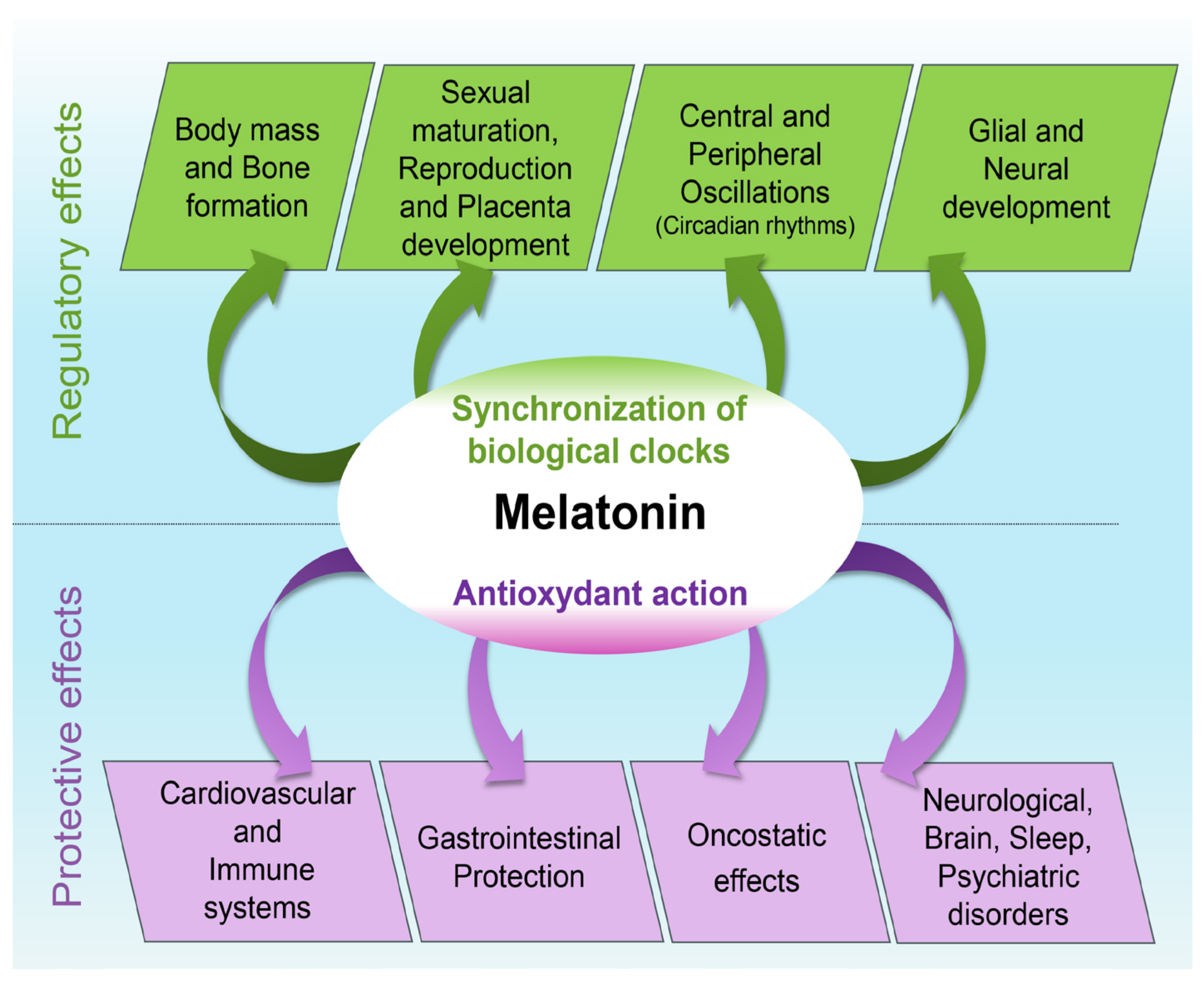
The article presents a review of the relationships between melatonin and neurodevelopmental disorders. First, the antioxidant properties of melatonin and its physiological effects are considered to understand better the role of melatonin in typical and atypical neurodevelopment. Then, several neurodevelopmental disorders occurring during infancy, such as autism spectrum disorder or neurogenetic disorders associated with autism (including Smith–Magenis syndrome, Angelman syndrome, Rett’s syndrome, Tuberous sclerosis, or Williams–Beuren syndrome) and neurodevelopmental disorders occurring later in adulthood like bipolar disorder and schizophrenia, are discussed with regard to impaired melatonin production and circadian rhythms, in particular, sleep–wake rhythms. This article addresses the issue of overlapping symptoms that are commonly observed within these different mental conditions and debates the role of abnormal melatonin production and altered circadian rhythms in the pathophysiology and behavioral expression of these neurodevelopmental disorders.
Keywords: neurodevelopmental disorders; brain development; melatonin; circadian rhythms; sleep–wake rhythms; sleep disturbance; autism; schizophrenia neurodevelopmental disorders; brain development; melatonin; circadian rhythms; sleep–wake rhythms; sleep disturbance; autism; schizophrenia