A Systematic Review of Lifestyle Interventions for Neuropathy and Neuropathic Pain: Alcohol Consumption and Avoidance

 ,
,
Highlights
- Alcohol consumption and dependence were associated with increased incidence, prevalence, and/or severity of neuropathy/neuropathic pain across observational studies, with over half of included studies demonstrating statistically significant positive associations.
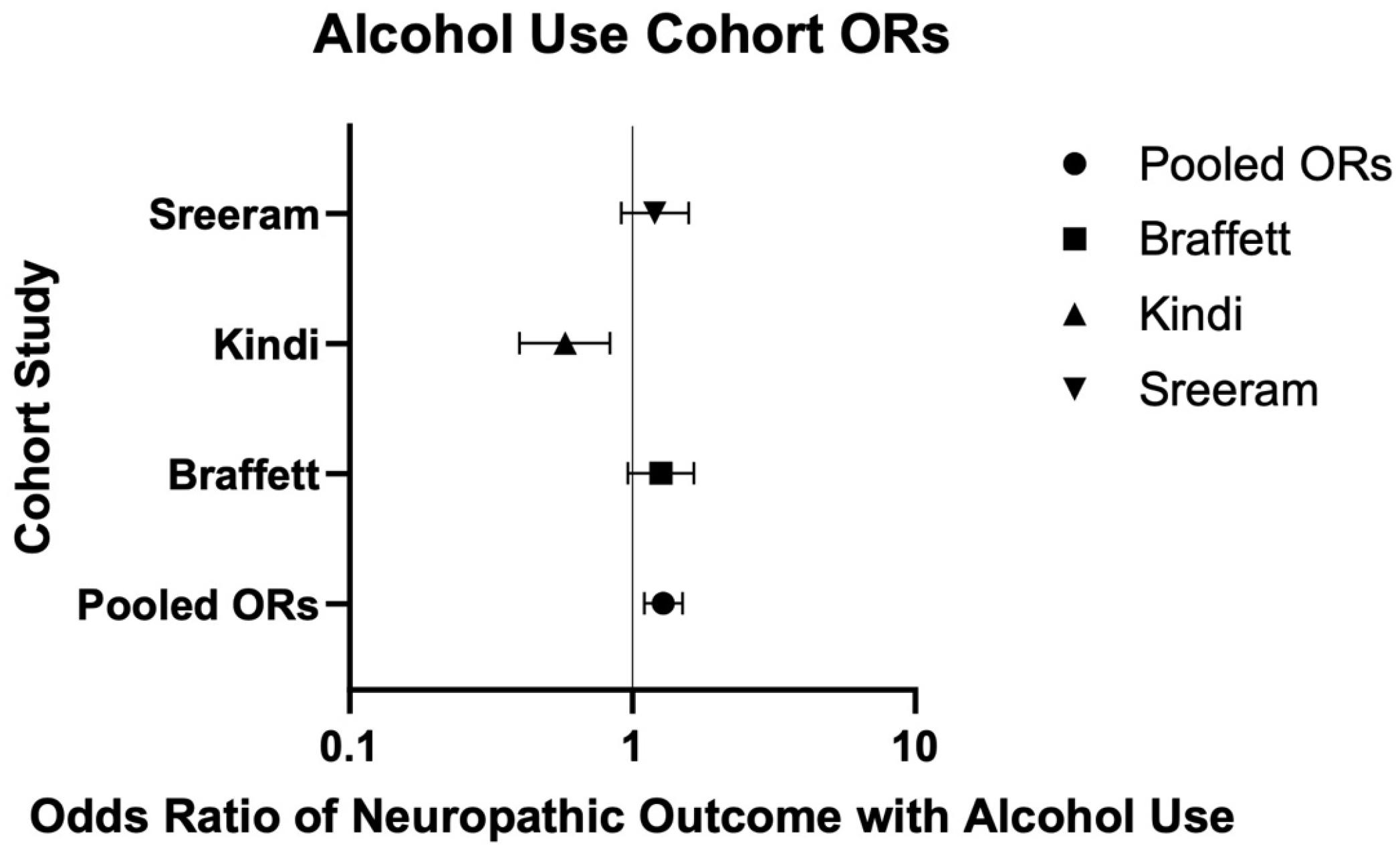
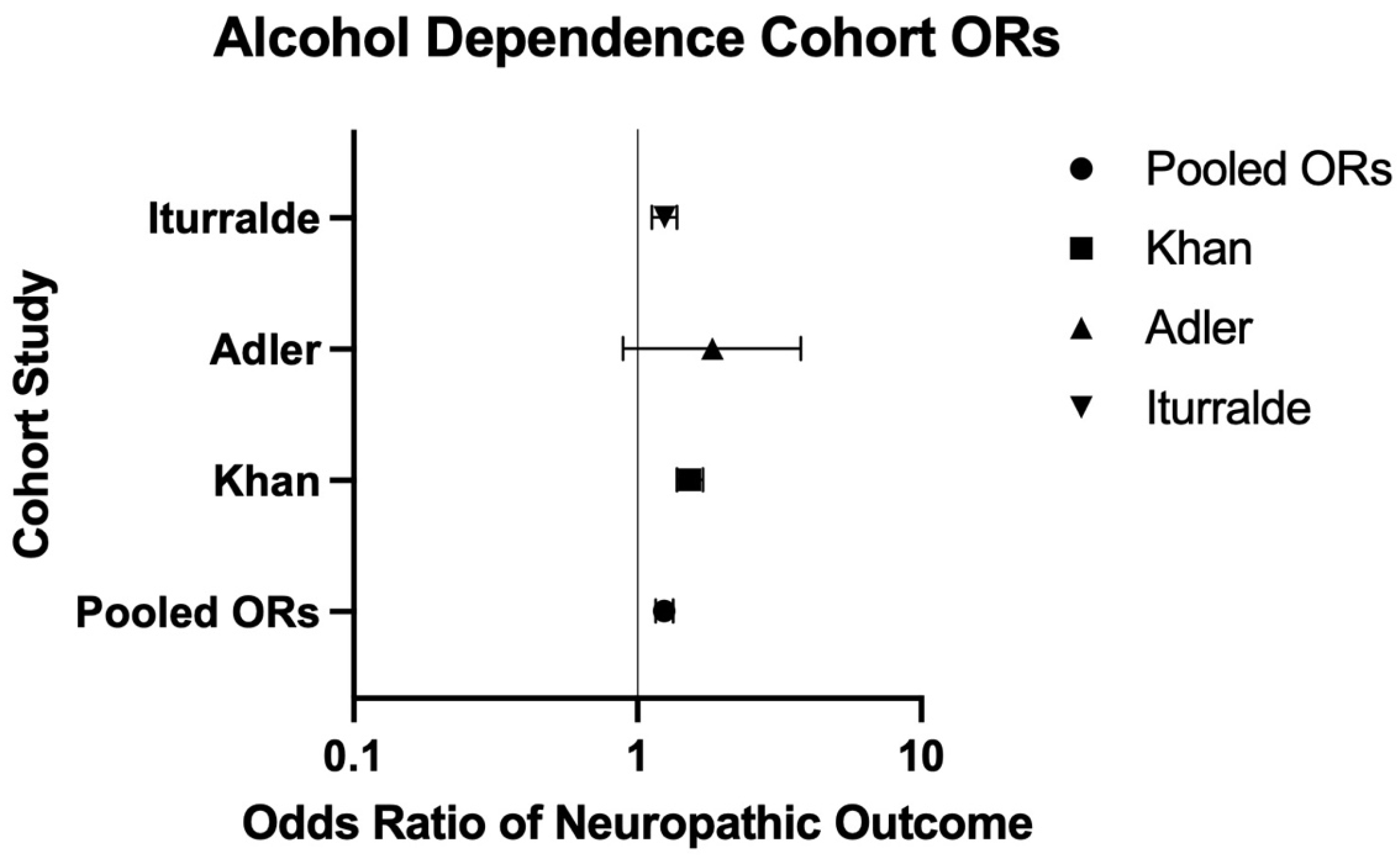
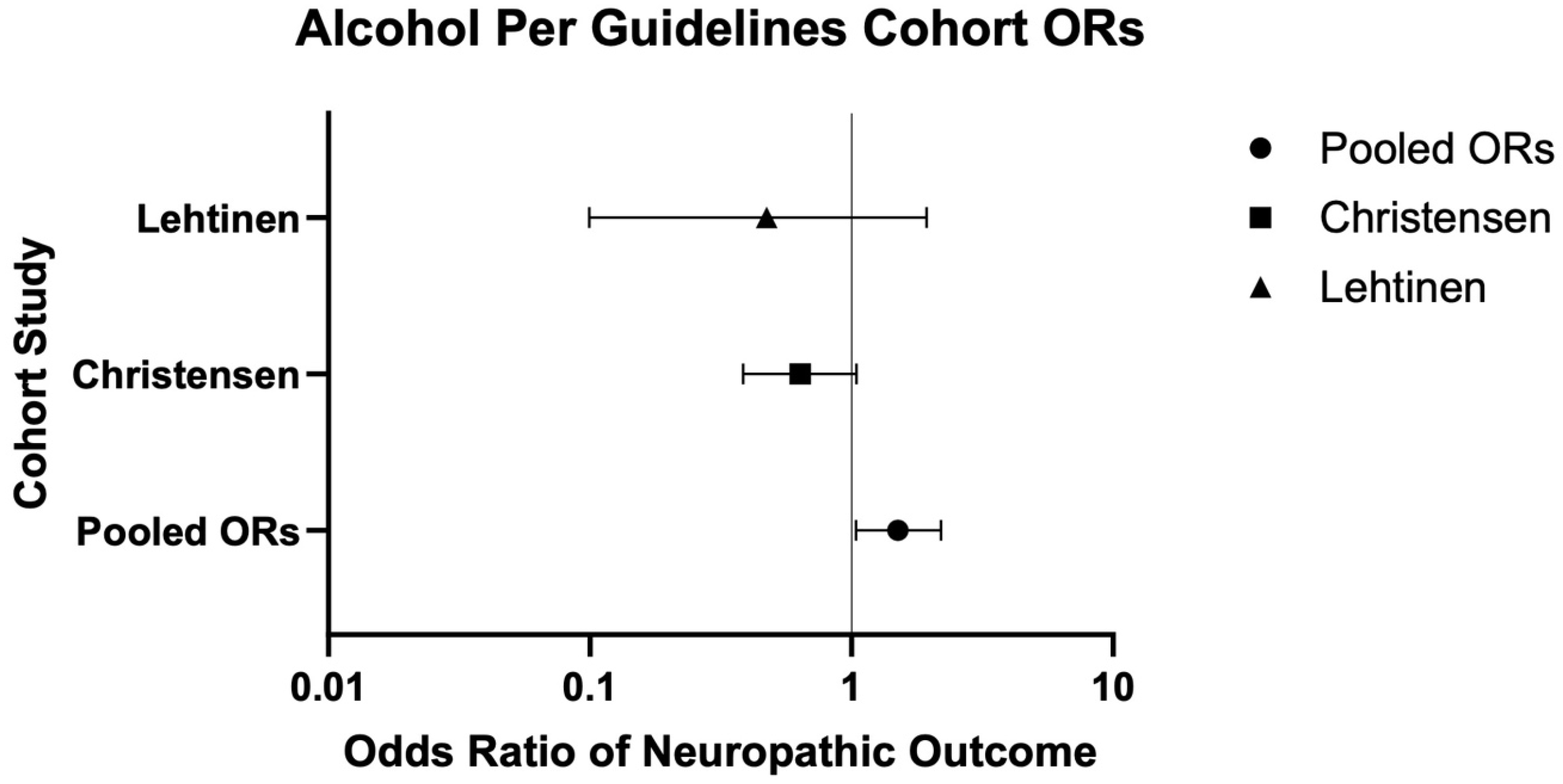
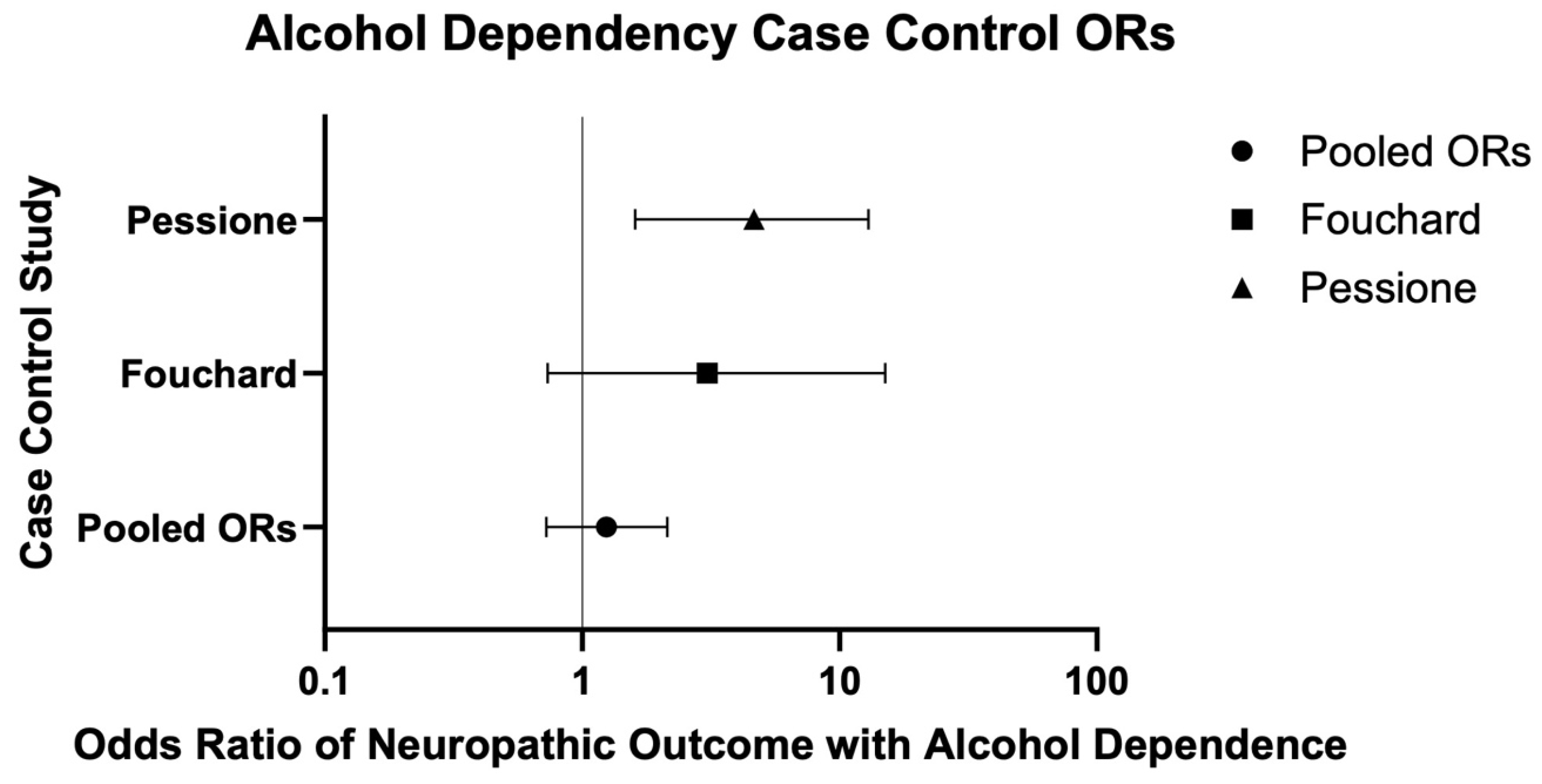
- Pooled analysis showed higher odds of neuropathy with alcohol exposure (consumption: OR 1.29 95% CI [1.10–1.50]; dependence: 1.24 [1.16–1.33]), while longer duration and greater exposure were linked to increased severity and diminished electrophysiological function, and abstinence was associated with clinical improvement.
- Findings support a potential contributory role of alcohol use, particularly dependence and chronic exposure, in the development and progression of neuropathy/neuropathic pain, consistent with known neurotoxic and metabolic mechanisms.
- Alcohol abstinence and reduction may represent a low-risk, low-cost, adjunctive strategy for improving neuropathy/neuropathic pain outcomes, although causal inference is limited by heterogeneity and very low certainty of evidence, highlighting the need for robust interventional studies.
Abstract
1. Introduction
2. Materials and Methods
Statistical and Meta-Analyses
3. Results
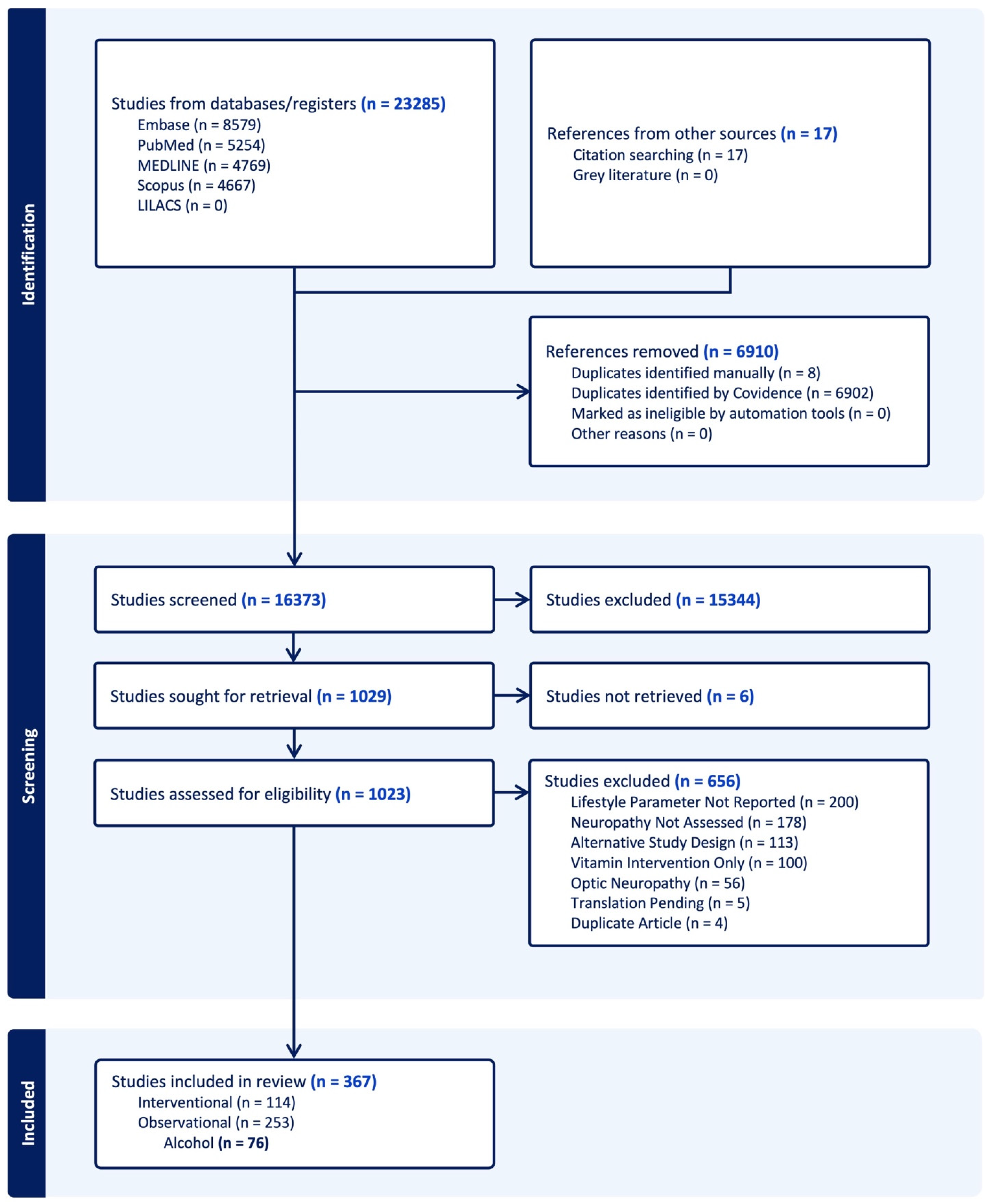
3.1. Literature Search
3.2. Included Studies
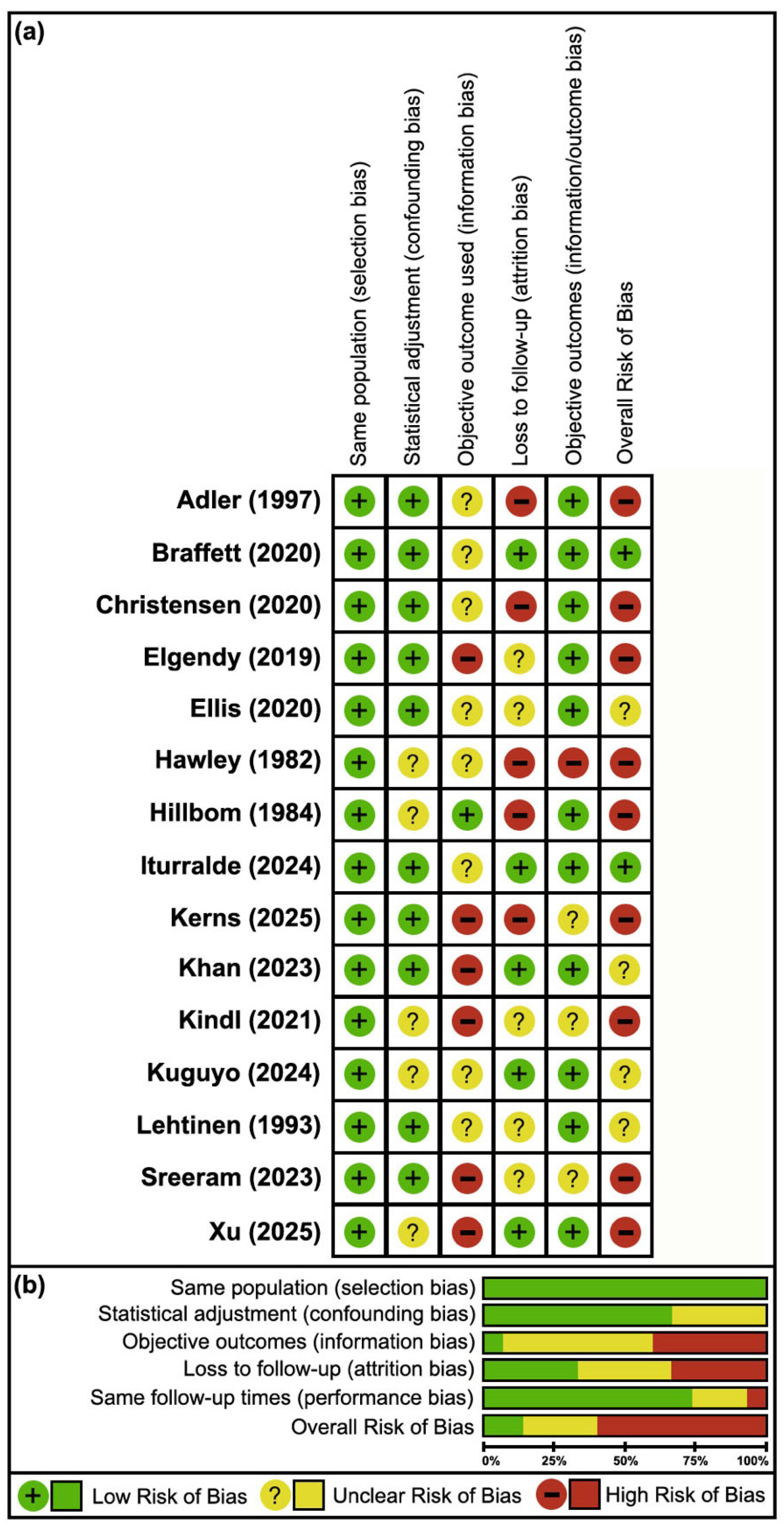
3.3. Risk of Bias
3.4. Summary of Findings
4. Discussion
4.1. Cohort Studies
4.2. Case–Control Studies
4.3. Cross-Sectional Studies
4.4. Limitations
5. Conclusions
Future Directions
Supplementary Materials
Author Contributions
Funding
Institutional Review Board Statement
Informed Consent Statement
Data Availability Statement
Acknowledgments
Conflicts of Interest
Abbreviations
| AUD | Alcohol Use Disorder |
| BMI | Body Mass Index |
| CIDP | Chronic Inflammatory Demyelinating Polyradiculoneuropathy |
| CRPS | Complex Regional Pain Syndrome |
| DSN | Distal Symmetric Neuropathy |
| NP | Neuropathic Pain |
| PN | Peripheral Neuropathy |
| PoN | Polyneuropathy |
| SFN | Small Fiber Neuropathy |
References
- Klowak, M.; Boggild, A.K. A Review of Nutrition in Neuropathic Pain of Leprosy. Ther. Adv. Infect. Dis. 2022, 9, 20499361221102663. [Google Scholar] [CrossRef] [PubMed]
- Julian, T.; Glascow, N.; Syeed, R.; Zis, P. Alcohol-Related Peripheral Neuropathy: A Systematic Review and Meta-Analysis. J. Neurol. 2019, 266, 2907–2919. [Google Scholar] [CrossRef]
- Mellion, M.; Gilchrist, J.M.; De La Monte, S. Alcohol-Related Peripheral Neuropathy: Nutritional, Toxic, or Both? Muscle Nerve 2011, 43, 309–316. [Google Scholar] [CrossRef]
- Sacks, J.J.; Gonzales, K.R.; Bouchery, E.E.; Tomedi, L.E.; Brewer, R.D. 2010 National and State Costs of Excessive Alcohol Consumption. Am. J. Prev. Med. 2015, 49, e73–e79. [Google Scholar] [CrossRef] [PubMed]
- Chopra, K.; Tiwari, V. Alcoholic Neuropathy: Possible Mechanisms and Future Treatment Possibilities. Br. J. Clin. Pharmacol. 2012, 73, 348–362. [Google Scholar] [CrossRef]
- Paul, P.; Campbell, G.; Zekeridou, A.; Mauermann, M.; Naddaf, E. Diagnosing Peripheral Neuropathy in Patients With Alcohol Use Disorder. Mayo Clin. Proc. 2024, 99, 1299–1305. [Google Scholar] [CrossRef]
- Zhang, B.; Xie, T.T.; Ma, Q.; Jiang, Y.P.; Wang, Y.M. Research Progress of Exosome—Derived microRNA in Alcohol Use Disorders: A Critical Review. Addict. Biol. 2026, 31, e70124. [Google Scholar] [CrossRef] [PubMed]
- Gallelli, L.; Cione, E.; Caroleo, M.C.; Carotenuto, M.; Lagana, P.; Siniscalchi, A.; Guidetti, V. microRNAs to Monitor Pain-Migraine and Drug Treatment. MicroRNA 2017, 6, 152–156. [Google Scholar] [CrossRef]
- Klowak, M.; Lau, R.; Mohammed, M.N.; Birago, A.; Samson, B.; Ahmed, L.; Renee, C.; Meconnen, M.; Sam, M.; Boggild, A.K. A Systematic Review of Dietary Lifestyle Interventions for Neuropathic Pain. J. Clin. Med. 2024, 13, 6766. [Google Scholar] [CrossRef]
- Dong, Y.; Buczynski, M.W.; Gregus, A.M. Alcohol Use Disorder-Associated Pain: Clinical and Preclinical Evidence. Alcohol 2025, 129, 14–40. [Google Scholar] [CrossRef]
- Klowak, M.; Lau, R.; Mohammed, M.; Birago, A.; Samson, B.; Ahmed, L.; Renee, C.; Meconnen, M.; Bado, E.; Reid-John, A.; et al. A Systematic Review of Lifestyle Interventions for Neuropathy and Neuropathic Pain: Smoking Cessation. NeuroSci 2025, 6, 74. [Google Scholar] [CrossRef] [PubMed]
- Adler, A.I.; Boyko, E.J.; Ahroni, J.H.; Stensel, V.; Forsberg, R.C.; Smith, D.G. Risk Factors for Diabetic Peripheral Sensory Neuropathy Results of the Seattle Prospective Diabetic Foot Study. Diabetes Care 1997, 20, 1162–1167. [Google Scholar] [CrossRef]
- Braffett, B.H.; Gubitosi-Klug, R.A.; Albers, J.W.; Feldman, E.L.; Martin, C.L.; White, N.H.; Orchard, T.J.; Lopes-Virella, M.; Lachin, J.M.; Pop-Busui, R. Risk Factors for Diabetic Peripheral Neuropathy and Cardiovascular Autonomic Neuropathy in the Diabetes Control and Complications Trial/Epidemiology of Diabetes Interventions and Complications (DCCT/EDIC) Study. Diabetes 2020, 69, 1000–1010. [Google Scholar] [CrossRef]
- Christensen, D.H.; Knudsen, S.T.; Gylfadottir, S.S.; Christensen, L.B.; Nielsen, J.S.; Beck-Nielsen, H.; Sørensen, H.T.; Andersen, H.; Callaghan, B.C.; Feldman, E.L.; et al. Metabolic Factors, Lifestyle Habits, and Possible Polyneuropathy in Early Type 2 Diabetes: A Nationwide Study of 5249 Patients in the Danish Centre for Strategic Research in Type 2 Diabetes (Dd2) Cohort. Diabetes Care 2020, 43, 1266–1275. [Google Scholar] [CrossRef] [PubMed]
- Elgendy, R.; Deschênes, S.S.; Burns, R.J.; Levy, M.; Schmitz, N. Alcohol Consumption, Depressive Symptoms, and the Incidence of Diabetes-Related Complications. J. Diabetes 2019, 11, 14–22. [Google Scholar] [CrossRef] [PubMed]
- Ellis, R.J.; Diaz, M.; Sacktor, N.; Marra, C.; Collier, A.C.; Clifford, D.B.; Calcutt, N.; Fields, J.A.; Heaton, R.K.; Letendre, S.L.; et al. Predictors of Worsening Neuropathy and Neuropathic Pain after 12 Years in People with HIV. Ann. Clin. Transl. Neurol. 2020, 7, 1166–1173. [Google Scholar] [CrossRef]
- Hawley, R.J.; Kurtzke, J.F.; Armbrustmacher, V.W.; Saini, N.; Manz, H. The Course of Alcoholic-Nutritional Peripheral Neuropathy. Acta Neurol. Scand. 1982, 66, 582–589. [Google Scholar]
- Hillbom, M.; Wennbergt, A. Prognosis of Alcoholic Peripheral Neuropathy. J. Neurol. Neurosurg. Psychiatry 1984, 47, 699–703. [Google Scholar] [CrossRef]
- Iturralde, E.; Slama, N.E.; Balapal, N.; Knox, M.J.; Gilliam, L.K.; Satre, D.D.; Sterling, S.A.; Asyyed, A. Type 2 Diabetes Health Care Outcomes for Patients with Alcohol Use Disorder Starting Addiction Treatment. J. Gen. Intern. Med. 2025, 40, 2934–2943. [Google Scholar] [CrossRef]
- Kerns, S.L.; Dinh, P.C.; Monahan, P.O.; Stump, T.; Fung, C.; Sesso, H.D.; Feldman, D.R.; Hamilton, R.J.; Vaughn, D.J.; Huddart, R.; et al. Factors Associated with Longitudinal Progression of the Cumulative Burden of Morbidity and Overall Mortality after Cisplatin-Based Chemotherapy for Testicular Cancer. JNCI J. Natl. Cancer Inst. 2025, 117, 1797–1808. [Google Scholar] [CrossRef]
- Khan, M.T.F.; Lewis, D.; Kaelber, D.C.; Winhusen, T.J. Health Outcomes Associated with Patterns of Substance Use Disorders among Patients with Type 2 Diabetes and Hypertension: Electronic Health Record Findings. Prim. Care Diabetes 2023, 17, 43–47. [Google Scholar] [CrossRef]
- Kindl, G.; Teichmüller, K.; Escolano-Lozano, F.; Birklein, F.; Rittner, H.L. Pain, Disability, and Lifestyle: Patients with Complex Regional Pain Syndrome Compared to Chronic Musculoskeletal Pain—A Retrospective Analysis. Eur. J. Pain UK 2022, 26, 719–728. [Google Scholar] [CrossRef]
- Kuguyo, O.; Matimba, A.; Madziyire, M.G.; Magwali, T.; Dandara, C.; Nhachi, C.F.; Tsikai, N. Prevalence and Predictors for Cisplatin-Induced Toxicities in Zimbabwean Women with Cervical Cancer. Future Oncol. 2024, 20, 1909–1924. [Google Scholar] [CrossRef]
- Lehtinen, J.M.; Niskanen, L.; Hyv6nen, K.; Siitonen, O.; Uusitupa, M. Nerve Function and Its Determinants in Patients with Newly-Diagnosed Type 2 (Non-Insulin-Dependent) Diabetes Mellitus and in Control Subjects—A 5-Year Follow-Up. Diabetologia 1993, 36, 68–72. [Google Scholar] [CrossRef]
- Sreeram, K.; Seaton, R.; Greenwald, M.K.; Kamgar, M.; Assad, H.; Baird, T.; Schwartz, A.G.; Ruterbusch, J.; Simon, M.S. Chemotherapy-Induced Peripheral Neuropathy in the Detroit Research on Cancer Survivors (ROCS) Cohort. Cancer Causes Control 2023, 34, 459–468. [Google Scholar] [CrossRef] [PubMed]
- Xu, H.; Li, H.; Fan, Y.; Zhang, S.; Wang, Y.; Wang, Y.; Zhou, L.; Zhang, J. Trajectory of Chemotherapy-Induced Peripheral Neuropathy and Its Predictive Factors in Breast Cancer Patients: A Prospective Longitudinal Study. Clin. Breast Cancer 2026, 26, 306–314. [Google Scholar] [CrossRef] [PubMed]
- Agelink, M.W.; Malessa, R.; Weisser, U.; Lemmer, W.; Zeit, T.; Majewski, T.; Klieser, E. Alcoholism, Peripheral Neuropathy (PNP) and Cardiovascular Autonomic Neuropathy (CAN). J. Neurol. Sci. 1998, 161, 135–142. [Google Scholar] [CrossRef]
- Doneddu, P.E.; Bianchi, E.; Cocito, D.; Manganelli, F.; Fazio, R.; Filosto, M.; Mazzeo, A.; Cosentino, G.; Cortese, A.; Jann, S.; et al. Risk Factors for Chronic Inflammatory Demyelinating Polyradiculoneuropathy (CIDP): Antecedent Events, Lifestyle and Dietary Habits. Data from the Italian CIDP Database. Eur. J. Neurol. 2020, 27, 136–143. [Google Scholar] [CrossRef]
- Fouchard, M.; Brenaut, E.; Genestet, S.; Ficheux, A.S.; Marcorelles, P.; Misery, L. Observational Case-Control Study of Small-Fiber Neuropathies, with Regards on Smoking and Vitamin D Deficiency and Other Possible Causes. Front. Med. 2023, 9, 1051967. [Google Scholar] [CrossRef]
- Franklin, G.M.; Shetterly, S.M.; Cohen, J.A.; Baxter, J.; Hamman, R.F. Risk Factors for Distal Symmetric Neuropathy in the San Luis Valley Diabetes Study. Diabetes Care 1994, 17, 1172–1177. [Google Scholar] [CrossRef]
- Frost, P.; Johnsen, B.; Fuglsang-Frederiksen, A.; Svendsen, S.W. Lifestyle Risk Factors for Ulnar Neuropathy and Ulnar Neuropathy-like Symptoms. Muscle Nerve 2013, 48, 507–515. [Google Scholar] [CrossRef]
- Gebabo, T.F.; Zewdie, T.H.; Shagaro, S.S.; Haile, F. Determinants of Peripheral Neuropathy among Diabetic Patients under Follow-Up in Chronic Care Clinics of Public Hospitals at Gamo and Gofa Zones, Southern Ethiopia. PLoS ONE 2021, 16, e0246722. [Google Scholar] [CrossRef] [PubMed]
- Koike, H.; Mori, K.; Misu, K.; Hattori, N.; Ito, H.; Hirayama, M.; Sobue, G. Painful Alcoholic Polyneuropathy with Predominant Small-Fiber Loss and Normal Thiamine Status. Neurology 2001, 56, 1727–1732. [Google Scholar] [CrossRef] [PubMed]
- Mitchell, B.D.; Hawthorne, V.M.; Vinik, A.I. Short Reports Cigarette Smoking and Neuropathy in Diabetic Patients. Diabetes Care 1990, 13, 434–437. [Google Scholar] [CrossRef]
- Mondelli, M.; Mattioli, S.; Vinciguerra, C.; Ciaramitaro, P.; Aretini, A.; Greco, G.; Sicurelli, F.; Giorgi, S.; Curti, S. Comorbidities, Anthropometric, Demographic, and Lifestyle Risk Factors for Ulnar Neuropathy at the Elbow: A Case Control Study. J. Peripher. Nerv. Syst. 2020, 25, 401–412. [Google Scholar] [CrossRef]
- Pessione, F.; Louis Gerchstein, J.; Rueff, B. Parental History of Alcoholism: A Risk Factor for Alcohol-Related Peripheral Neuropathies. Alcohol Alcohol. 1995, 30, 749–754. [Google Scholar] [CrossRef]
- Richardson, J.K.; Ho, S.; Wolf, J.; Spiegelberg, T. The Nature of the Relationship between Smoking and Ulnar Neuropathy at the Elbow. Am. J. Phys. Med. Rehabil. 2016, 88, 711–718. [Google Scholar] [CrossRef]
- Walsh, J.C.; Mcleod, J.G. Alcoholic Neuropathy An Electrophysiological and Histological Study. J. Neurol. Sci. 1970, 10, 457–469. [Google Scholar] [CrossRef]
- Alessi, S.M.; Foster, N.C.; Rash, C.J.; Van Name, M.A.; Tamborlane, W.V.; Cengiz, E.; Polsky, S.; Wagner, J. Alcohol Use and Clinical Outcomes in Adults in the Type 1 Diabetes Exchange. Can. J. Diabetes 2020, 44, 501–506. [Google Scholar] [CrossRef]
- Ammendola, A.; Gemini, D.; Iannaccone, S.; Argenzio, F.; Ciccone, G.; Ammendola, E.; Serio, L.; Ugolini, G.; Bravaccio, F. Gender and Peripheral Neuropathy in Chronic Alcoholism: A Clinical–Electroneurographic Study. Alcohol Alcohol. 2000, 35, 368–371. [Google Scholar] [CrossRef] [PubMed]
- Ammendola, A.; Tata, M.R.; Aurilio, C.; Ciccone, G.; Gemini, D.; Ammendola, E.; Ugolini, G.; Argenzio, F. Peripheral Neuropathy in Chronic Alcoholism: A Retrospective Cross-Sectional Study in 76 Subjects. Alcohol Alcohol. 2001, 36, 271–275. [Google Scholar] [CrossRef]
- Asai, A.; Suzuki, F.; Tsujiguchi, H.; Hara, A.; Miyagi, S.; Kannon, T.; Suzuki, K.; Nakamura, M.; Shimizu, Y.; Nguyen, T.T.T.; et al. Relationship between Fatty Acid Intake and Chronic Neck/Shoulder/Upper Limb Pain without Elevated CRP in a Japanese Population: A Cross-Sectional Analysis of the Shika Study. J. Nutr. Sci. 2022, 11, e38. [Google Scholar] [CrossRef]
- Beulens, J.W.J.; Kruidhof, J.S.; Grobbee, D.E.; Chaturvedi, N.; Fuller, J.H.; Soedamah-Muthu, S.S. Alcohol Consumption and Risk of Microvascular Complications in Type 1 Diabetes Patients: The EURODIAB Prospective Complications Study. Diabetologia 2008, 51, 1631–1638. [Google Scholar] [CrossRef]
- Blackstock, E.; Rushworth, G.; Gath, D. Electrophysiological Studies in Alcoholism. J. Neurol. Neurosurg. Psychiatry 1972, 35, 326–334. [Google Scholar] [CrossRef]
- Callaghan, B.C.; Reynolds, E.; Banerjee, M.; Chant, E.; Villegas-Umana, E.; Feldman, E.L. Central Obesity Is Associated with Neuropathy in the Severely Obese. Mayo Clin. Proc. 2020, 95, 1342–1353. [Google Scholar] [CrossRef]
- Chang, W.; Li, X.; Ma, Y.; Bai, T.; Jia, L. Relationship Between Chronic Inflammatory Indicators and Diabetic Peripheral Neuropathy in Hospitalized Elderly Patients with Type 2 Diabetes. Diabetes Metab. Syndr. Obes. 2025, 18, 3075–3088. [Google Scholar] [CrossRef]
- Chaware, N.; Borle, A.; Reddy, A.; Shiddapur, G.S.; Dhadwad, J.S.; Vikhe, V. Study of Clinical Profile of Peripheral Neuropathy in Chronic Alcoholics. Pravara Med. Rev. 2022, 14, 35–39. [Google Scholar] [CrossRef]
- Ching, S.M.; Lee, K.W.; Yusof Khan, A.H.K.; Devaraj, N.K.; Cheong, A.T.; Yap, S.F.; Hoo, F.K.; Wan Sulaiman, W.A.; Loh, W.C.; Chong, S.H.; et al. Prevalence and Factors Associated with Peripheral Neuropathy in a Setting of Retail Pharmacies in Malaysia–A Cross-Sectional Study. PLoS ONE 2024, 19, e0307093. [Google Scholar] [CrossRef]
- Chukwubuzo, O.T.; Chibuike, O.P.; Philip, O.C.; Sunday, E.M.; Ekpunobi, C.P.; Sochima, E.E.; Obumneme, O.A.; Gerald, U.; Diuto Ifeoma, O.; Ugwu, A.R. Prevalence and Associations of Neuropathic Pain Among Subjects with Diabetes Mellitus in the Enugu Diabetic Peripheral Neuropathy (Edipen) Study. J. Pharm. Negat. Results 2022, 13, 10104–10117. [Google Scholar] [CrossRef]
- Claus, D.; Eggers, R.; Engelhardt, A.; Neundörfer, B.; Warecka, K. Ethanol and Polyneuropathy. Acta Neurol. Scand. 2009, 72, 312–316. [Google Scholar] [CrossRef]
- Corrêa, L.A.; Bittencourt, J.V.; Mathieson, S.; Nogueira, L.A.C. Pain-Related Interference and Pain-Related Psychosocial Factors of Three Different Subgroups of Patients with Chronic Low Back Pain. Musculoskelet. Sci. Pract. 2023, 63, 102718. [Google Scholar] [CrossRef]
- D’Amour, M.L.; Bruneau, J.; Butterworth, R.F. Abnormalities of Peripheral Nerve Conduction in Relation to Thiamine Status in Alcoholic Patients. Can. J. Neurol. Sci. J. Can. Sci. Neurol. 1991, 18, 126–128. [Google Scholar] [CrossRef][Green Version]
- Estruch, R.; Nicolas, J.M.; Villegas, E.; Junque, A.; Urbano-Marquez, A. Relationship Between Ethanol-Related Diseases and Nutritional Status in Chronically Alcoholic Men. Alcohol Alcohol. 1993, 28, 543–550. [Google Scholar] [CrossRef]
- Fernandez-Soli, J.; Sacanella, E.; Estruch, R.; Nicolk, J.-M.; Grau, J.-M.; Urbano-Marquez, A. Significance of Type II Fiber Atrophy in Chronic Alcoholic Myopathy. J. Neurol. Sci. 1995, 130, 69–76. [Google Scholar] [CrossRef]
- Gierthmühlen, J.; Attal, N.; Baskozos, G.; Bennedsgaard, K.; Bennett, D.L.; Bouhassira, D.; Crombez, G.; Finnerup, N.B.; Granovsky, Y.; Jensen, T.S.; et al. What Is Associated with Painful Polyneuropathy? A Cross-Sectional Analysis of Symptoms and Signs in Patients with Painful and Painless Polyneuropathy. Pain 2024, 165, 2888–2899. [Google Scholar] [CrossRef] [PubMed]
- Gylfadottir, S.S.; Christensen, D.H.; Nicolaisen, S.K.; Andersen, H.; Callaghan, B.C.; Itani, M.; Khan, K.S.; Kristensen, A.G.; Nielsen, J.S.; Sindrup, S.H.; et al. Diabetic Polyneuropathy and Pain, Prevalence, and Patient Characteristics: A Cross-Sectional Questionnaire Study of 5514 Patients with Recently Diagnosed Type 2 Diabetes. Pain 2020, 161, 574–583. [Google Scholar] [CrossRef] [PubMed]
- Hicks, C.W.; Wang, D.; Lin, F.R.; Reed, N.; Windham, B.G.; Selvin, E. Peripheral Neuropathy and Vision and Hearing Impairment in US Adults With and Without Diabetes. Am. J. Epidemiol. 2023, 192, 237–245. [Google Scholar] [CrossRef]
- Ireri, R.; Kikuvi, G.; Mambo, S.; Cheriro, B.C.R. Prevalence of Microvascular Complications and Associated Risk Factors among Diabetes Mellitus Patients Attending Nyeri County Referral Hospital, Kenya: A Cross-Sectional Study. Open J. Epidemiol. 2024, 14, 444–458. [Google Scholar] [CrossRef]
- Jeyam, A.; McGurnaghan, S.J.; Blackbourn, L.A.K.; McKnight, J.M.; Green, F.; Collier, A.; McKeigue, P.M.; Colhoun, H.M.; Chalmers, J.; Fischbacher, C.; et al. Diabetic Neuropathy Is a Substantial Burden in People with Type 1 Diabetes and Is Strongly Associated with Socioeconomic Disadvantage: A Population-Representative Study from Scotland. Diabetes Care 2020, 43, 734–742. [Google Scholar] [CrossRef]
- Li, C.; Wang, W.; Ji, Q.; Ran, X.; Kuang, H.; Yu, X.; Fang, H.; Yang, J.; Liu, J.; Xue, Y.; et al. Prevalence of Painful Diabetic Peripheral Neuropathy in Type 2 Diabetes Mellitus and Diabetic Peripheral Neuropathy: A Nationwide Cross-Sectional Study in Mainland China. Diabetes Res. Clin. Pract. 2023, 198, 110602. [Google Scholar] [CrossRef]
- Mawdsley, C.; Mayer, R.F. Nerve Conduction in Alcoholic Polyneuropathy. Brain 1965, 88, 335–356. [Google Scholar] [CrossRef]
- Mcculloch, D.K.; Campbell, I.W.; Prescott, R.J.; Clarke, B.F. Effect of Alcohol Intake on Symptomatic Peripheral Neuropathy in Diabetic Men. Diabetes Care 1980, 3, 245–247. [Google Scholar] [CrossRef]
- Melgaard, B.; Saelan, H.; Hedegaard, L. Symptoms and Signs of Polyneuropathy and Their Relation to Alcohol Intake in a Normal Male Population. Acta Neurol. Scand. 1986, 73, 458–460. [Google Scholar] [CrossRef]
- Mellion, M.L.; Silbermann, E.; Gilchrist, J.M.; Machan, J.T.; Leggio, L.; de la Monte, S. Small-Fiber Degeneration in Alcohol-Related Peripheral Neuropathy. Alcohol. Clin. Exp. Res. 2014, 38, 1965–1972. [Google Scholar] [CrossRef]
- Mick, G.; Serpell, M.; Baron, R.; Mayoral, V.; Hans, G.; Mendez, I.; Artime, E.; Qizilbash, N.; Sohns, M. Localised Neuropathic Pain in the Primary Care Setting: A Cross-Sectional Study of Prevalence, Clinical Characteristics, Treatment Patterns, Quality of Life and Sleep Performance. Curr. Med. Res. Opin. 2021, 37, 293–302. [Google Scholar] [CrossRef]
- Mills, K.R.; Ward, K.; Martin, F.; Peters, T.J. Peripheral Neuropathy and Myopathy in Chronic Alcoholism. Alcohol Alcohol. 1986, 21, 357–362. [Google Scholar] [CrossRef]
- Monforte, R.; Estruch, R.; Valls-Sole, J.; Nicolas, J.; Villalta, J.; Urbano-Marquez, A. Autonomic and Peripheral Neuropathies in Patients with Chronic Alcoholism. Arch. Neurol. 1995, 52, 45–51. [Google Scholar] [CrossRef]
- Nagakura, Y.; Hayashi, M.; Kajioka, S. Analysis of Japanese Nationwide Health Datasets: Association between Lifestyle Habits and Prevalence of Neuropathic Pain and Fibromyalgia with Reference to Dementia-Related Diseases and Parkinson’s Disease. Scand. J. Pain 2023, 23, 662–669. [Google Scholar] [CrossRef]
- Nicolosi, C.; Di Leo, R.; Girlanda, P.; Messina, C.; Vita, G. Is There a Relationship between Somatic and Autonomic Neuropathies in Chronic Alcoholics? J. Neurol. Sci. 2005, 228, 15–19. [Google Scholar] [CrossRef]
- Nielsen, S.W.; Eckhoff, L.; Ruhlmann, C.H.B.; Herrstedt, J.; Dalton, S.O. The Prevalence, Distribution and Impact of Peripheral Neuropathy among Danish Patients with Cancer—A Population-Based Cross-Sectional Study. Acta Oncol. 2022, 61, 363–370. [Google Scholar] [CrossRef]
- Papantoniou, M.; Rentzos, M.; Zampelis, T.; Tzavellas, E.; Paparrigopoulos, T.; Kokotis, P. Alcohol-Related Peripheral Neuropathy: Clinico-Neurophysiological Characteristics and Diagnostic Utility of the Neuropathy Symptoms Score and the Neuropathy Impairment Score. Alcohol 2024, 117, 65–71. [Google Scholar] [CrossRef]
- Révész, D.; Bonhof, C.S.; Bours, M.J.L.; Weijenberg, M.P.; Vreugdenhil, G.; Van De Poll-Franse, L.V.; Mols, F. Sociodemographic, Clinical, Lifestyle, and Psychological Correlates of Peripheral Neuropathy among 2- to 12-Year Colorectal Cancer Survivors. Oncol. Res. Treat. 2022, 45, 480–493. [Google Scholar] [CrossRef]
- Sahito, D.A.; Rahu, S.A.; Samad, A.; Hayee, P.A.; Zaman Shaikh, M.; Naseem, S. Assessment of Prevalence and the Risk Factors of Diabetic Peripheral Neuropathy at Primary Health Care Level at Nawab Shah. Pak. J. Med. Health Sci. 2022, 16, 330–332. [Google Scholar] [CrossRef]
- Shetty, A.A.; Shetty, B.A.; Shetty, S.B.; Bhagyalakshmi, K.; Nayanatara, A.; Shetty, A.B. A Longitudinal Study on Association of Alcohol-Induced Liver Dysfunction with Neurological Consequences and Clinical Implications. Clin. Ter. 2025, 176, 567–572. [Google Scholar] [CrossRef]
- Srivastava, S.P.; Sinha, A.P.; Sharma, K.K.; Malik, P.S. Severity, Risk Factors and Quality of Life of Patients Associated with Chemotherapy-Induced Peripheral Neuropathy. Clin. Nurs. Res. 2022, 31, 1080–1090. [Google Scholar] [CrossRef]
- Trendowski, M.R.; Lusk, C.M.; Ruterbusch, J.J.; Seaton, R.; Simon, M.S.; Greenwald, M.K.; Harper, F.W.K.; Beebe-Dimmer, J.L.; Schwartz, A.G. Chemotherapy-Induced Peripheral Neuropathy in African American Cancer Survivors: Risk Factors and Quality of Life Outcomes. Cancer Med. 2021, 10, 8151–8161. [Google Scholar] [CrossRef] [PubMed]
- van der Velde, J.H.P.M.; Koster, A.; Strotmeyer, E.S.; Mess, W.H.; Hilkman, D.; Reulen, J.P.H.; Stehouwer, C.D.A.; Henry, R.M.A.; Schram, M.T.; van der Kallen, C.J.H.; et al. Cardiometabolic Risk Factors as Determinants of Peripheral Nerve Function: The Maastricht Study. Diabetologia 2020, 63, 1648–1658. [Google Scholar] [CrossRef] [PubMed]
- Villalta, J.; Estruch, R.; Antunez, E.; Valls, J.; Urbano-Marquez, A. Vagal Neuropathy in Chronic Alcoholics: Relation to Ethanol Consumption. Alcohol Alcohol. 1989, 24, 421–428. [Google Scholar] [CrossRef]
- Vittadini, G.; Buonocore, M.; Colli, G.; Terzi, M.; Fonte, R.; Biscaldi, G. Alcoholic Polyneuropathy: A Clinical and Epidemiological Study. Alcohol Alcohol. 2001, 36, 393–400. [Google Scholar] [CrossRef]
- Wang, W.; Ji, Q.; Ran, X.; Li, C.; Kuang, H.; Yu, X.; Fang, H.; Yang, J.; Liu, J.; Xue, Y.; et al. Prevalence and Risk Factors of Diabetic Peripheral Neuropathy: A Population-Based Cross-Sectional Study in China. Diabetes Metab. Res. Rev. 2023, 39, e3702. [Google Scholar] [CrossRef] [PubMed]
- Wetterling, T.; Veltrup, C.; Driessen, M.; John, U. Drinking Pattern and Alcohol-Related Medical Disorders. Alcohol Alcohol. 1999, 34, 330–336. [Google Scholar] [CrossRef]
- Wilson, I.; Thompson, T. Association between Medically Assisted Detoxification and Neuropathic Pain. In Nursing Standard; The University of Greenwich: London, UK, 2021. [Google Scholar]
- Wu, Y.H.A.; He, J.H.; McDermott, K.M.; Wang, D.; Fang, M.; Windham, B.G.; Selvin, E.; Hicks, C.W. Prevalence of Peripheral Neuropathy Among Very Old Adults: Evidence from the Michigan Neuropathy Screening Instrument. J. Am. Geriatr. Soc. 2025, 73, 3530–3538. [Google Scholar] [CrossRef]
- Yokoyama, H.; Tsuji, T.; Hayashi, S.; Kabata, D.; Shintani, A. Factors Associated with Diabetic Polyneuropathy-Related Sensory Symptoms and Signs in Patients with Polyneuropathy: A Cross-Sectional Japanese Study (JDDM 52) Using a Non-Linear Model. J. Diabetes Investig. 2020, 11, 450–457. [Google Scholar] [CrossRef]
- Zahr, N.M.; Pohl, K.M.; Pfefferbaum, A.; Sullivan, E.V. Central Nervous System Correlates of “Objective” Neuropathy in Alcohol Use Disorder. Alcohol. Clin. Exp. Res. 2019, 43, 2144–2152. [Google Scholar] [CrossRef]
- Zambelis, T.; Karandreas, N.; Tzavellas, E.; Kokotis, P.; Liappas, J. Large and Small Fiber Neuropathy in Chronic Alcohol-Dependent Subjects. J. Peripher. Nerv. Syst. 2005, 10, 375–381. [Google Scholar]
- Zambelis, T.; Kanelli, S.; Tzavellas, E.; Paparrigopoulos, T.; Karandreas, N. Ulnar Neuropathy at the Elbow in Chronic Alcohol-Dependent Subjects. J. Clin. Neuromusc. Dis. 2016, 18, 28–33. [Google Scholar]
- Page, M.J.; McKenzie, J.E.; Bossuyt, P.M.; Boutron, I.; Hoffmann, T.C.; Mulrow, C.D.; Shamseer, L.; Tetzlaff, J.M.; Akl, E.A.; Brennan, S.E.; et al. The PRISMA 2020 statement: An updated guideline for reporting systematic reviews. BMJ 2021, 372, n71. [Google Scholar] [CrossRef]


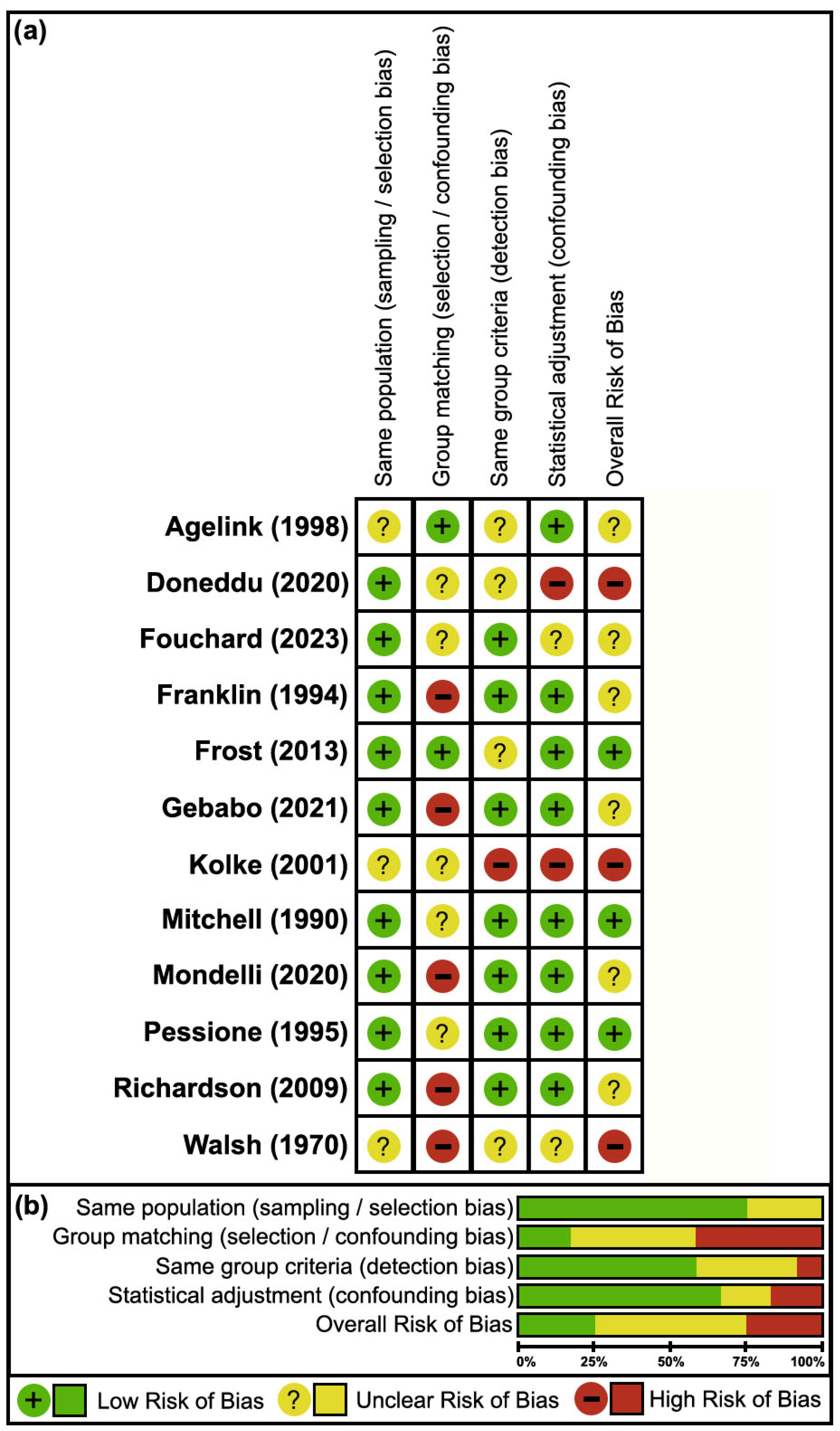
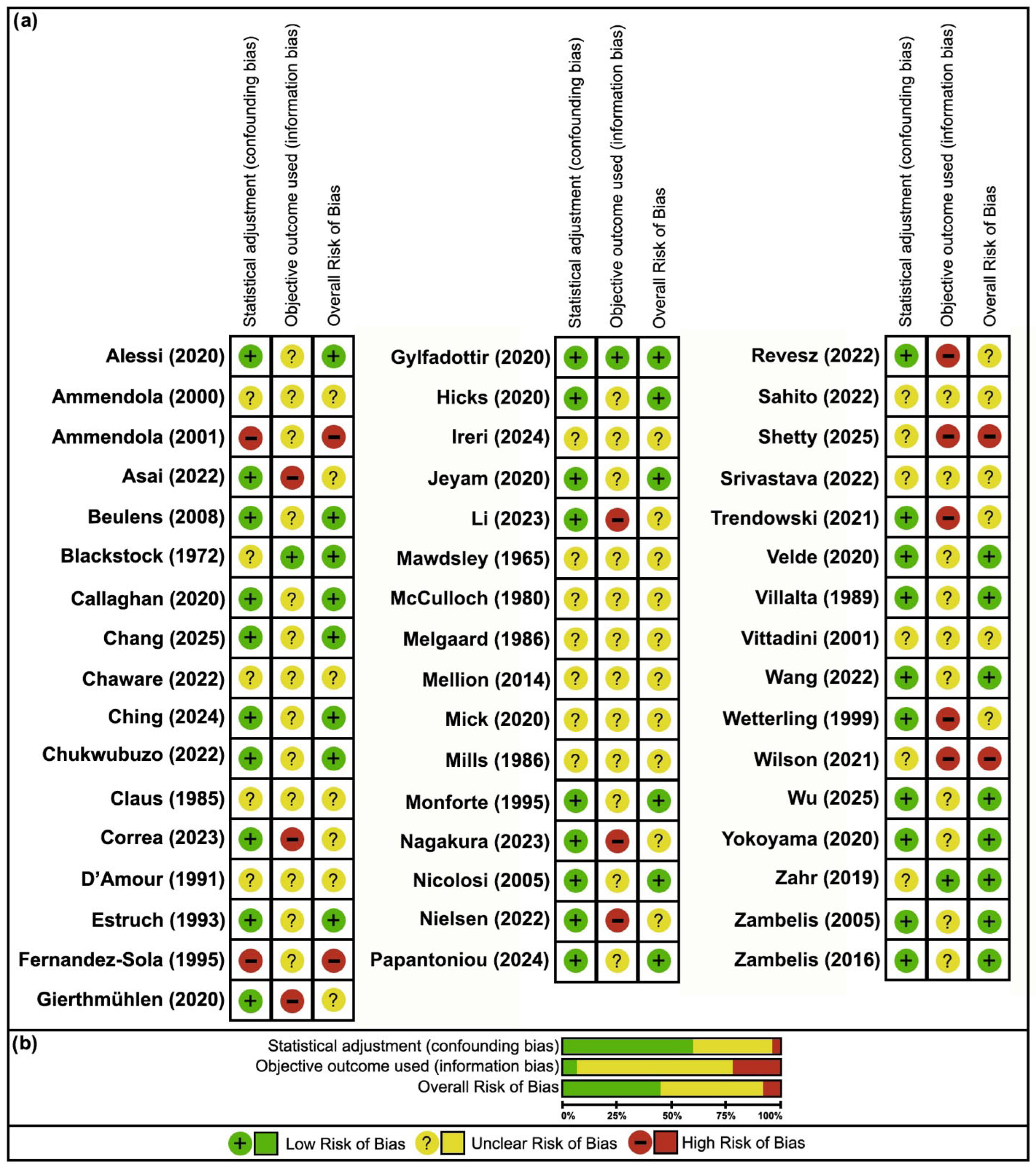


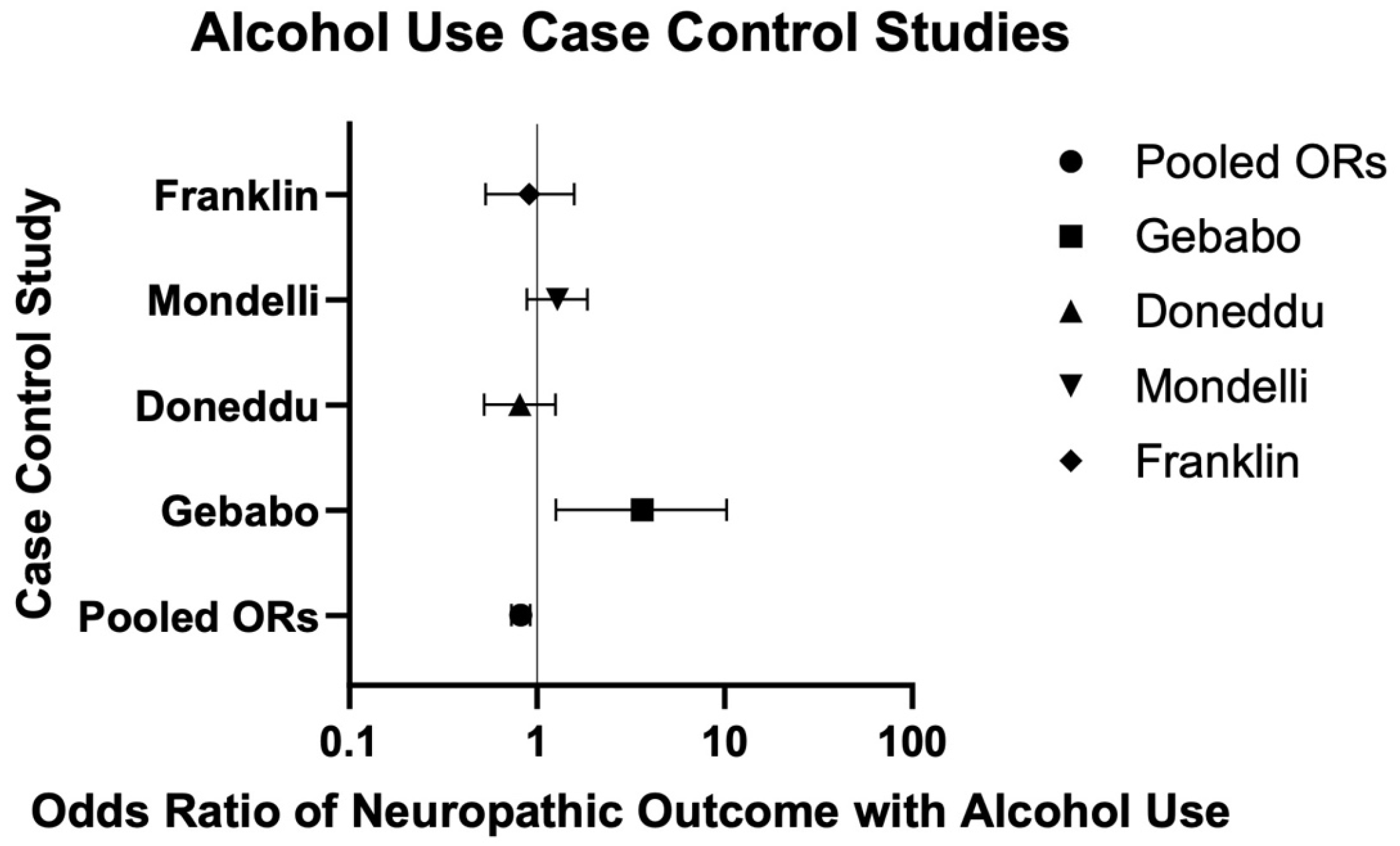


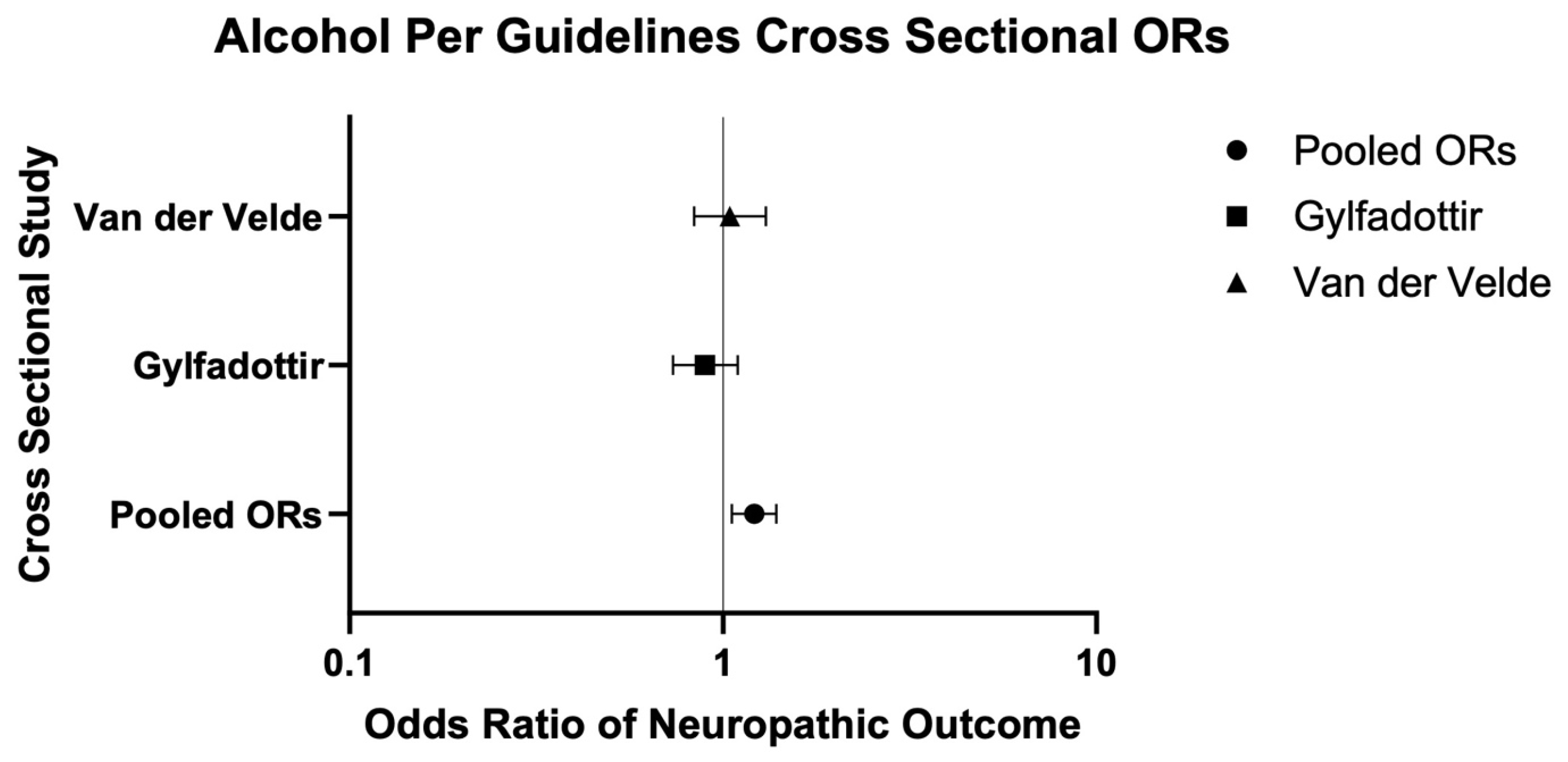

| Author (Year) | Study Design | Setting | N | Sex N (F:M) | Age (Mean ± SD, (Range)) | Population/Etiology | Lifestyle | Outcomes |
|---|---|---|---|---|---|---|---|---|
| Adler (1997) [12] | Cohort Study | US | With Ne: 58; Without Ne: 230 | With Ne: 1:57; Without Ne: 11:219 | With Ne: 64.0; Without Ne: 61.5 | DM ± Incident Ne | Alcohol: CAGE score, history of treatment, current use | High (4) CAGE alcohol score significantly associated with incident Ne (41.7% vs. 58.3%, p = 0.049; β = 1.94, SE = 0.7281, 6.96 [1.67–28.99], p = 0.008). |
| Braffett (2020) [13] | Cohort Study | US | With DPN: 455; Without DPN: 931 | With DPN: 182:273; Without DPN: 475:456 | ^ With DPN: 29 (24, 34); Without DPN 26 (21, 32) | T1DM ± DPN | Occasional or regular alcohol use | Alcohol consumption not significantly associated with DPN (1.14 [0.93–1.41], p > 0.05). |
| Christensen (2020) [14] | Cohort Study | Denmark | Overall: 5249; With DPoN: 938; With DPoN + Pain: 386 | Overall: 2205:3144 | ^ 65 (57, 72) | T2DM ± DPoN ± Pain | Alcohol: ≤14 (F)/21 (M) units, >14 (F)/21 (M) units | Alcohol consumption above recommended limit significantly associated with increased pain prevalence (aPR: 1.31 [1.01–1.69]. |
| Elgendy (2019) [15] | Cohort Study | Canada | 1413 | 705:708 | 60 ± 8.4 | T2DM ± PN | Alcohol frequency: Never, ≤1/mo, 2–4/mo, 2–3/wk, ≥4/wk; Number of drinks/d | High alcohol frequency + depressive symptoms significantly associated with prevalent Ne (1.02 [1.00–1.04], p = 0.04). |
| Ellis (2020) [16] | Cohort Study | US | 254 | 54:200 | 43.5 ± 8.01 | HIV ± DSPoN | Lifetime Alcohol Abuse: Yes, No | Lifetime alcohol abuse not significantly associated with DSPoN (statistics NR). |
| Hawley (1982) [17] | Cohort Study | US | 63 | 0:63 | 53.3 (29–69) | PN due to Alcohol | History of alcoholism | Alcohol abstinence associated with significant electrophysiology improvement in PN (+0.12 m/s/abstinent mo, p < 0.05). |
| Hillbom (1984) [18] | Cohort Study | Sweden | 10 | 0:10 | 53.1 (38–72) | Chronic alcoholism ± PN | History of alcoholism and seeking rehabilitation | Alcohol abstinence associated with improvement in clinical/electrophysiological PN. |
| Iturralde (2024) [19] | Cohort Study | US | Overall: 222,334; AUD+: 1998; AUD−: 220,336 | Overall: 106,353:115,978; AUD+: 477:1521; AUD−: 105,876:114,457 | AUD+: 57 ± 11.3; AUD−: 64.3 ± 12.7 | T2DM ± AUD ± Ne | AUD (yes, no) | AUD significantly associated with a higher risk of Ne in unadjusted (p < 0.001) and adjusted (p < 0.001) models. |
| Kerns (2025) [20] | Cohort Study | US | 1 drink/d: 539; >1 drink/d: 76 | 0:615 | 45 (22–79) | Testicular cancer survivors ± worsening PSN, or NP | History of alcohol consumption (1 drink/d, >1 drink/d) | Alcohol consumption (>1 drink/d) not significantly associated with PSN (0.75 [0.40–1.44], p = 0.392), or NP (0.76 [0.29–1.98], p = 0.570). |
| Khan (2023) [21] | Cohort Study | US | TUD: 8009; TAUD: 1672; PSUD: 642; TUD Co: 8009; TAUD Co: 1672; PSUD Co: 642 | TUD: 4660:3349; TAUD: 582:1090; PSUD: 233:409; TUD Co: 4665:3344; TAUD Co: 584:1088; PSUD Co: 234:408 | TUD: 61.6 ± 12.1; TAUD: 61.52 ± 10.3; PSUD: 57.84 ± 8.3; TUD Co: 61.6 ± 12.1; TAUD Co: 61.42 ± 10; PSUD Co: 57.88 ± 8.1 | T2DM + Hypertension ± Ne | TUD: Yes, No; TAUD: Yes, No; PSUD: Yes, No | PSUD associated with significantly higher risk of DN (1.76 [1.33–2.32], p < 0.05) compared to TUD. |
| Kindl (2021) [22] | Cohort Study | Germany | With MSK: 255; With CRPS: 223 | With MSK: 160:95; With CRPS: 173:50 | With MSK: 54.6 (20–80); With CRPS: 50.9 (18–77) | CRPS or MSK, due to trauma | Alcohol Consumption: Yes, No, Daily, Weekly, Monthly | Prevalence of alcohol consumption significant with MSK (58%, p < 0.001), and CRPS (43%, p < 0.001). |
| Kuguyo (2024) [23] | Cohort Study | Zimbabwe | 252 | 252:0 | (26–90); ^ 50 (43–61) | Breast cancer survivors ± sensory loss (cisplatin) | History of alcohol consumption | Alcohol consumption not significantly associated with diminished electrophysiology (p > 0.05). |
| Lehtinen (1993) [24] | Cohort Study | Finland | With ND: 12; Without ND: 101 | With ND: 9:3; Without ND: 46:55 | With ND: 57.2 ± 4.7; Without ND: 55.4 ± 10.4 | DM ± ND | Alcohol use (>30 g/wk) | Alcohol use not significantly different between ND groups (17% vs. 30%, p > 0.05). |
| Sreeram (2023) [25] | Cohort Study | US | Overall: 1034; With CIPN: 704; Without CIPN: 330 | Overall: 797:237; With CIPN: 570:134; Without CIPN: 227:103 | Overall: 57.1 ± 10.9 (27–79); With CIPN: 55.8 ± 10.8 (27–79); Without CIPN: 59.9 ± 10.4 (27–79) | Cancer survivors ± CIPN | Alcohol use (Past 4 wks): Yes, No | Alcohol use not significantly different between CIPN groups, or associated with CIPN prevalence (51.2% vs. 46.4%, 1.10 [0.81–1.49], p > 0.05). |
| Xu (2025) [26] | Cohort Study | China | Low-Risk Stable CIPN: 148; Mod-Risk Progressive CIPN: 145; High-Risk Progressive CIPN: 57 | 350:0 | 18–44: n = 89; 45–59: n = 179; >60: n = 82 | Breast cancer survivors ± CIPN | History of harmful alcohol consumption (yes, no) | History of harmful alcohol consumption not significantly different between CIPN groups (1.4% vs. 2.1% vs. 1.8%, x2 = 0.225, p = 0.894). |
| Agelink (1998) [27] | Case–Control Study | Germany | Ca: 35; Co: 80 | Ca: 15:20; Co: 33:47 | Ca: 42.9 ± 10 (28–74); Co: 41.8 ± 14.7 (27–77) | Alcoholism ± PN & CAN vs. healthy co | Duration of alcohol dependence (yrs), mean TLDA | Duration of alcohol dependence was significantly longer (6.1 ± 3.8 vs. 16.2 ± 7.1, p < 0.0005) and mean TLDA was significantly larger (438 ± 342 vs. 1930 ± 1173, p < 0.001) with AUD PN vs. without. |
| Doneddu (2020) [28] | Case–Control Study | Italy | Ca: 195; Co: 195 | Ca: 109:86; Co: 109:86 | NR | CIDP due to any etiology and their partners | Alcohol Consumption: Yes, No | Alcohol consumption not significantly associated with CIDP (0.79 [0.50–1.24], p > 0.05). |
| Fouchard (2023) [29] | Case–Control Study | France | Overall: 323; Ca: 162; Co: 161 | Overall: 192:131; Ca: 88:74; Co: 104:57 | Ca: 56 ± 16; Co: 69 ± 13 | Cutaneous paresthesia ± SFN via IENFD due to any etiology | Alcoholism: Yes, No | Alcohol consumption not significantly different between SFN groups (3.7% vs. 1.2%, p > 0.05). |
| Franklin (1994) [30] | Case–Control Study | US | Ca: 77; Co: 200 | Ca: 29:48; Co: 118:82 | Ca: 61.7; Co: 58.6 | NIDDM ± DSN | Alcohol use: never, g/wk (<20, >20) | Alcohol (g/wk: <20, >20) not significantly associated with DSN (0.71 [0.29–1.72] p = 0.69, 1.03 [0.40–2.62]). |
| Frost (2013) [31] | Case–Control Study | Denmark | Ca: 324; Co: 832 | Ca: 121:203; Co 317:515 | Ca Smokers: 49 ± 9.7; Ca Non-Smokers: 44 ± 11.5; Co Smokers: 50 ± 9; Co Non-Smokers: 48 ± 9.9 | Ca: Electroneurographically confirmed UN; Co: Without UN | Alcohol: u/wk | Alcohol consumption not significantly associated with UN (0.81 [0.44–1.48]). |
| Gebabo (2021) [32] | Case–Control Study | Ethiopia | Overall: 528; Ca: 264; Co: 264 | Ca: 101:163; Co: 105:159 | Ca: <40: 43; 40–65: 178; 65+: 43; Co: <40: 64; 40–65: 178; 65+: 17 | T1DM or T2DM ± PN | Alcohol Consumption (Ever): Yes, No | Alcohol consumption significantly higher with PN vs. without (5.3% vs. 1.5%, p = 0.024). |
| Koike (2001) [33] | Case–Control Study | Japan | 18 | 0:18 | 47.7 ± 10.5 (31–70) | Alcoholism PoN vs. healthy co | History of heavy alcohol consumption (100 g eth/d for >10 yrs) | History of heavy alcohol consumption significantly associated with diminished electrophysiology (p < 0.005). |
| Mitchell (1990) [34] | Case–Control Study | US | IDDM: Ca: 54, Co: 56; NIDDM: Ca: 39, Co: 65 | IDDM: Ca: 31:23, Co: 35:21; NIDDM: Ca: 25:14, Co: 44:21 | IDDM: Ca: 36.1, Co: 32.7; NIDDM: 59.4: 39, Co: 57.7 | DM ± Ne | Alcohol: median drink-yrs | Median alcohol consumption not significantly associated with Ne in IDDM (996 vs. 485). or NIDDM (0 vs. 14). |
| Mondelli (2020) [35] | Case–Control Study | Italy | Ca: 220; Co: 460 | Ca: 84:136; Co: 242:218 | Ca: 51.7 ± 11.8; Co: 47.8 ± 12.4 | Ca: UNE; Co: Upper limb complaints | Alcohol: u/wk or d | Alcohol consumption not significantly different between UNE groups (p = 0.463). |
| Pessione (1995) [36] | Case–Control Study | France | Ca: 32; Co: 58 | Ca: 6:26; Co: 22:36 | Ca: 49 ± 10.1; Co: 46.8 ± 9.6 | Alcoholism ± PN | Alcohol: parental history of alcoholism, alcohol dependence, weekly alcohol consumption (drinks) | Alcohol-related risk factors all significantly higher in those with PN vs. without in univariate (p < 0.01); and multivariate p < 0.05) analyses. |
| Richardson (2016) [37] | Case–Control Study | US | Ca: 50; Co: 50 | Ca: 18:32; Co: 34:16 | Ca: 48.4 ± 12.8; Co: 39.2 ± 12 | Ca: UNE+; Co: UNE- | Alcohol: Eth/wk (ounces) | Eth/wk did not significantly differ between UNE groups (1.2 ± 1.9 vs. 1.2 ± 2.2, p = 0.993). |
| Walsh (1970) [38] | Case–Control Study | Australia | Ca: 11; Co: 20 | 1:10 | Ca: 58 (41–73); Co: 54 (38–73) | PN due to alcoholism | History of PN due to alcoholism: Yes, No | History of heavy alcohol consumption associated with diminished electrophysiology (p < 0.01), and fiber densities (3.39 ± 0.86 vs. 5.78 ± 0.90, p < 0.001). |
| Alessi (2020) [39] | Cross-Sectional Study | US | Overall: 934; Never Drinker: 103; Former Drinker: 89; Nonbinge Drinker: 567; Binge Drinker: 174 | Overall: 569:365; Never Drinker: 61:42; Former Drinker: 51:38; Nonbinge Drinker: 373:194; Binge Drinker: 84:90 | Overall: 38.3 ± 15.8; Never Drinker: 31.8 ± 16.8; Former Drinker: 44.1 ± 16.1; Nonbinge Drinker: 39.8 ± 15.8; Binge Drinker: 34 ± 13 | T1DM ± PN | Alcohol Consumption: Never, Former, Current (Nonbinge), Current (Binge) | Ne significantly lower in never vs. former alcohol consumption (11% vs. 35%, p = 0.006). |
| Ammendola (2000) [40] | Cross-Sectional with Nested Case–Control | Italy | 62 | 18:44 | 43.3 (28–69) | Chronic alcoholism (>100 g/d for >2 yrs) ± PN | Mean alcohol-related disease duration; Mean TLDE | Diminished electrophysiology significantly associated with AUD (p < 0.01), longer disease duration (p < 0.01), and higher TLDE (p < 0.05). |
| Ammendola (2001) [41] | Cross-Sectional Study | Italy | Overall: 76; With Ne: 51; Without Ne: 25 | Overall: 21:55; With Ne: 14:37; Without Ne: 7:18 | Overall: 24–69; With Ne: 45.3 ± 9.4; Without Ne: 39.1 ± 7.7 | Chronic alcoholism ± PN | Family history of alcoholism (Yes, No); duration of alcoholism; TLDE | Prolonged alcohol-related disease duration (16.2 ± 9.4 vs. 11.1 ± 8.2, p < 0.05), high TLDE (27.9 vs. 14.8 ± 15.9, p < 0.05), and diminished electrophysiology (p < 0.01) significantly associated with Ne. |
| Asai (2022) [42] | Cross-Sectional Study | Japan | Overall: 817; With CP: 35; Without CP: 782 | Overall: 431:386; With CP: 24:11; Without CP: 407:375 | With CP: 63.91 [60.11–67.72]; Without CP: 63.75 [63.02–67.72] | Chronic neck/shoulder/upper limb pain due to any etiology | Current drinker: Yes, No | Alcohol consumption not significantly different between CP groups (42.86% vs. 47.19%, p > 0.05). |
| Beulens (2008) [43] | Cross-Sectional Study | Europe | 1857 | 893:964 | (15–60) | T1DM ± Ne | Alcohol consumption (g/wk) | Moderate alcohol consumption (30–70 g/wk)/frequency (5–7 d/wk) associated with significantly lower risk of Ne (0.61 [0.41–0.91], p < 0.01; 0.49 [0.34–0.71], p < 0.001). |
| Blackstock (1972) [44] | Cross-Sectional Study | United Kingdom | Chronic Alcoholism: 30; Hospital Personnel: 14 | Chronic Alcoholism: 7:23; Hospital Personnel: NR | Chronic Alcoholism: 44.8 (21–65); Hospital Personnel: 36.6 ± 6.9 | Chronic alcoholism ± PoN vs. hospital personnel | Chronic alcohol consumption/dependency | Greater electrophysiological perturbation in those with AUD vs. hospital personnel (p < 0.001). |
| Callaghan (2020) [45] | Cross-Sectional Study | US | BMI < 35 kg—Ne: 45; BMI > 35 kg—Ne: 110; BMI > 35 kg + Ne: 28 | BMI < 35 kg—Ne: 37:8; BMI > 35 kg—Ne: 87:23; BMI > 35 kg + Ne: 18:10 | BMI < 35 kg—Ne: 43.8 ± 12.1; BMI > 35 kg—Ne: 43.5 ± 11.2; BMI > 35 kg + Ne: 51.4 ± 9.6 | Ca: BMI > 35 kg ± Ne; Co: BMI < 25 kg BMI < 35 kg—Ne; BMI > 35 kg—Ne; BMI > 35 kg + Ne | Alcohol: drinks/wk (past yr) | Alcohol consumption not significantly different between Ne groups (p > 0.05). |
| Chang (2025) [46] | Cross-Sectional Study | China | DPN+: 163; DPN−: 107 | DPN+: 69:94; DPN-: 49:58 | DPN+: 67 (63–70); DPN−: 65 (62–69) | Elderly T2DM ± DPN | History of alcohol consumption (yes, no) | Alcohol consumption not significantly correlated with DPN (p = 0.310). |
| Chaware (2022) [47] | Cross-Sectional Study | India | 100 | 0:100 | 39.91 | Chronic alcoholism ± PN | Chronic alcoholism (>60 g eth/d or >15 drinks/wk): <5 yrs, 5–15 yrs, >15 yrs | Greater severity of DPN significantly associated with longer consumption (<5 yrs: 21.8 ± 3.4; 5–15 yrs: 28.1 ± 3.7; >15 yrs: 33.7 ± 3.9; p = 0.001). |
| Ching (2024) [48] | Cross-Sectional Study | Malaysia | Overall: 1283; PN−: 943; PN+: 340 | Overall: 635:648; PN−: 495:448; PN+: 140:200 | 40.6 ± 12.9 (18–80) | Any etiology ± PN | Alcohol consumption (yes, no) | Alcohol consumption not significantly different between PN groups (18.53% vs. 19.72%, p > 0.05). |
| Chukwubuzo (2022) [49] | Cross-Sectional Study | Nigeria | 422 | 289:133 | 57.6 ± 10.1 | T1DM or T2DM ± PN | Alcohol Consumption: Yes, No | Alcohol consumption not significantly associated with painful DPN (1.48 [0.74–2.98], p < 0.05). |
| Claus (1985) [50] | Cross-Sectional Study | Germany | Chronic Alcoholism: 30; Healthy Volunteers: 30 | Chronic Alcoholism: 0:30; Healthy Volunteers: 2:28 | Chronic Alcoholism: 38.2 ± 6.4 (26–48); Healthy Volunteers: 34.9 ± 6 | Chronic alcohol use ± PoN | History of alcohol consumption (up to >400 mL/d for 5–12 yrs) | Alcohol consumption (>12 yrs) significantly correlated with higher PoN frequency (p = 0.007). Electrophysiology significantly impaired vs. control (p < 0.01 for all). |
| Correa (2023) [51] | Cross-Sectional Study | Brazil | Overall: 444; LLBP: 313; PNBP: 33; WP: 98 | Overall: 289:155; LLBP: 188:125; PNBP: 26:7; WP: 75:23 | Overall: 39.72 ± 14.68; LLBP: 37.02 ± 13.39; PNBP: 8.45 ± 14.30; WP: 48.78 ± 15.59 | Chronic BP due to any etiology | Alcohol Abuse: Yes, No | Reported alcohol consumption: LLBP: 12.1%, PNBP: 9.1%, WP: 12.2% (statistics NR). |
| D’Amour (1991) [52] | Cross-Sectional Study | Canada | Chronic Alcoholism: 20; Hospital Personnel: 20 | NR | Chronic Alcoholism: 46 (31–67); Hospital Personnel: 38 (21–50) | Chronic alcoholism ± PN vs. hospital personnel | History of alcohol consumption (>10 yrs or >100 g/d) | PN in 75% of AUD. Electrophysiology significantly reduced in patients with alcoholism vs. healthy hospital personnel (p < 0.05). |
| Estruch (1993) [53] | Cross-Sectional Study | Spain | Chronic Alcoholism: 250; Healthy Volunteers: 100 | Chronic Alcoholism: 0:250; Healthy Volunteers: 0:100 | Chronic Alcoholism: 41 ± 11 (20–65); Healthy Volunteers: 40 ± 10 (20–65) | Chronic alcoholism ± PN vs. healthy volunteers | Daily ethanol consumption (>100 g) over last 2 yrs | PN present in 16% (41) of AUD. AUD + PN had higher ethanol consumption vs. those without PN (34.7 vs. 22.4, p < 0.001); TLDE was an independent risk factor for PN in multivariate analysis (p < 0.001). |
| Fernandez-Sola (1995) [54] | Cross-Sectional Study | Spain | 100 | 0:100 | 41 ± 9 (25–60) | Chronic alcoholism ± PN | Daily eth intake (g/d); duration of eth consumption; TLDE | PN (39% vs. 15%, p = 0.014) and TLDE (31.7 ± 17 vs. 23.3 ± 14, p = 0.01) significantly higher in those with chronic alcoholism + type II fiber atrophy vs. without. |
| Gierthmühlen (2024) [55] | Cross-Sectional Study | Denmark, France, Germany, Israel, Spain, UK | Overall: 1181; Ne + Pain: 843; Ne − Pain: 338 | Overall: 405:776; Ne + Pain: 285:558; Ne − Pain: 120:218 | Overall: 65.8 ± 12 (19–92); Ne + Pain: 64.9 ± 12.4 (19–92); Ne − Pain: 68.1 ± 10.6 (19–87) | Any etiology Ne ± pain | Current or previous alcohol misuse (yes, no) | Prevalence of current or previous alcohol misuse significantly lower among those with pain vs. without (6.6% vs. 11.5%, p = 0.0022). |
| Gylfadottir (2020) [56] | Cross-Sectional Study | Denmark | 5514 | 2355:3159 | 64.1 ± 10.9 | T2DM ± DPoN | Alcohol: >7 (F)/14 (M) units | Alcohol consumption above recommended limit not significantly associated with DPoN (0.94 [0.74–1.18], p > 0.05), or painful DPoN (1.09 [0.81–1.46], p > 0.05), in multivariable logistic regression. |
| Hicks (2022) [57] | Cross-Sectional Study | US | Overall: 6902; With PN: 1181; Without PN: 5721 | Overall: 3589:3313; With PN: 443:738; Without PN: 3101:2620 | % (!) 40–49: 36 (0.9); 50–59: 27.8 (0.8); 60–69: 18.2 (0.6); 70–79: 12.8 (0.4); ≥80: 5.2 (0.3) | DM ± PN | Alcohol: Never, Former, Current | Alcohol consumption reported between PN groups: Never: 16.4%, Former: 27.2%, Current: 56.5% vs. 11.8%, 20.9%, 67.3% (statistics NR). |
| Ireri (2024) [58] | Cross-Sectional Study | Kenya | 314 | 182:132 | 58.49 ± 17.43 | DM ± Ne | History of alcohol consumption | Alcohol consumption not significantly associated with Ne (p = 0.481). |
| Jeyam (2020) [59] | Cross-Sectional Study | Scotland | Overall: 5558; With DPN 715; Without DPN 4842 | Overall: 2449:3109; With DPN: 320:395; Without DPN 2129:2713 | ^ Overall: 44.7 (33, 55.2); With DPN: 50.6 (41, 59.3); Without DPN: 43.7 (32, 54.4) | T1DM ± DPN | Alcohol (u/wk): 2–6, 6–14, 14–21, 21–32, >32 | Alcohol consumption below 32 u/wk associated with lower odds of DPN (0.47 [0.29–0.75], p < 0.05), while above 32 u/wk was not (0.88 [0.56–1.38], p > 0.05). Authors suggest reverse causation–protopathic bias. |
| Li (2023) [60] | Cross-Sectional Study | China | Overall: 25,710; With PDPN: 14,699; Without PDPN: 11,011 | Overall: 10,785:14,925; With PDPN: 6240:8459; Without PDPN: 4545:6466 | ^ Overall: 63 (55, 71); With PDPN: 65 (56, 73); Without PDPN: 61 (53, 69) | T2DM ± PDPN | Alcohol Abuse: Yes, No | PDPN significantly lower with alcohol abuse vs. without (54.1% vs. 57.1%, p = 0.002). Authors suggest reverse causation–protopathic bias. |
| Mawdsley & Mayer (1965) [61] | Cross-Sectional Study | US | Chronic Alcoholism: 76; Healthy Personnel: 105 | Chronic Alcoholism: 12:64; Healthy Personnel: NR | Chronic Alcoholism: 25–69; Healthy Personnel: 20–70 | Chronic alcohol use ± PN | History of alcohol consumption (1 pint whisky to 1 gallon wine/d) | Electrophysiology significantly diminished vs. control (p < 0.001 for all). |
| McCulloch (1980) [62] | Cross-Sectional | Scotland | 541 | 0:541 | 44 ± 11.6 (20–59) | DM ± PN | Alcohol Intake: Moderate (6 drinks/yr to 10 drinks/wk) vs. Excessive (3–4 drinks/d to diagnosed alcoholism) | PN significantly higher in DM men with excessive alcohol consumption vs. those with moderate (36% vs. 14%, p < 0.001) and most evident with shorter durations of DM (<5 yrs: 32% vs. 8%, p < 0.001). |
| Melgaard (1986) [63] | Cross-Sectional Study | Denmark | 468 | 0:468 | 45 | “Normal” population ± PoN | Alcohol questionnaire including duration and frequency of use | Dependence-related behaviors were significantly correlated with disturbed electrophysiology (p < 0.05). |
| Mellion (2014) [64] | Cross-Sectional Study | US | Overall: 18; Heavy Drinkers: 9; Healthy Co: 9 | 9:9 | Heavy Drinkers: 35.4; Healthy Co: 43.3 | Heavy alcohol drinking (>5 drinks/d (M), >4 drinks/d (F)) + PN vs. healthy co | Eth consumed daily (g); Average duration heavy drinking | Individuals with a history of heavy alcohol consumption exhibited diminished electrophysiology, compared to those without (p < 0.05). |
| Mick (2020) [65] | Cross-Sectional Study | France, Italy, Spain, UK | 1030 | 651:379 | 60.2 ± 15.32; ^ 61 (49–72) | Localized NP due to any etiology | Alcohol Abuse/Dependence: Current, Past, Never | Current or past alcohol dependence/abuse was reported in 6.36% of patients with NP (further statistics NR). |
| Mills (1986) [66] | Cross-Sectional Study | UK | 19 | 4:15 | (30–71) | Chronic alcoholism ± PN | History of alcoholism (120 g eth/d for 4+ yrs) | Chronic alcohol consumption (>100 g/d) significantly associated with electrophysiological PN in 12/19 (statistics NR). |
| Monforte (1995) [67] | Cross-Sectional Study | Spain | Alcohol-Dependent: 107; Healthy Reference: 61 | Alcohol-Dependent: 18:89; Healthy Reference: 10:51 | Alcohol-Dependent: 43 ± 11; Healthy Reference: 41 ± 14 | Chronic alcohol use ± PN | History of alcohol consumption (>100 g/d (M) or >80 g/d (F) for >2 yrs) | Electrophysiological PN identified in 36.8% of alcohol-dependent individuals vs. 1 control (1.64%), p < 0.001). Diminished electrophysiology correlated with greater TLDE (r = −0.43, p < 0.001). |
| Nagakura (2023) [68] | Ecological Cross-Sectional Study | Japan | Pregabalin Reimbursement Claims per 1000 population; up to 126 million | NR | (40–74) | NP due to any etiology treated with pregabalin | Alcohol: Daily, Sometimes, Rarely/Never | Excessive alcohol consumption significantly associated with prevalent NP (β = 0.2683, p < 0.01); low-to-moderate intake reduced prevalence (r = −0.4713, p < 0.01); daily intake increased prevalence (r = 0.6253, p < 0.01). |
| Nicolosi (2005) [69] | Cross-Sectional Study | Italy | 40 | 4:36 | 49.2 ± 10.3 (33–76) | Chronic alcohol use ± SoN | History of alcohol consumption (100–400 g/d for 5–25 yrs) | SoN in 62.5% (25). Electromyography scores were statistically significantly positively correlated with TLDE (r = 0.35, p < 0.03). |
| Nielsen (2022) [70] | Cross-Sectional Study | Denmark | 2839 | High CIPN Score: 274:146; Low CIPN Score: 1193:870 | ^^ High CIPN Score: 69; Low CIPN Score: 67; (18–99) | Cancer diagnosis at any stage of treatment ± CIPN | Alcohol: yes/no + u/wk | Alcohol consumption significantly different between CIPN groups (60.2% vs. 73.5%, p < 0.001); high consumption (>14 u/wk) significantly associated with high CIPN20 scores in males (22% vs. 11%, p = 0.002). |
| Papantoniou (2024) [71] | Cross-Sectional Study | Greece | 90 | 34:56 | 51.98 ± 8.86 (27–74) | AUD ± PN | Duration of Abuse; Total Alcohol Units (kg alcohol/lifetime) | Alcohol abuse significantly longer in those with Ne vs. without (8.08 ± 7.25 vs. 6.92 ± 4.38, p = 0.024), and in those with impaired electrophysiology (p = 0.02). |
| Revesz (2022) [72] | Cross-Sectional Study | The Netherlands | Overall: 1516; With PN: 980; Without PN: 536 | Overall: 634:882; With PN: 445:535; Without PN: 189:347 | Overall: 69.1 ± 9.4; With PN: 70.1 ± 9.4; Without PN: 67.2 ± 9.2 | Colorectal cancer survivors ± PN | Alcohol Consumption: Drinks/wk | Alcohol intake significantly lower in individuals with PN vs. without (median 4 vs. 5 drinks/wk, range 0–100 vs. 0–50, p = 0.006) in univariate analysis only. |
| Sahito (2022) [73] | Cross-Sectional Study | Pakistan | Overall: 1057; With PN: 607; Without PN: 450 | Overall: 414:643; With PN: 230:377; Without PN: 184:266 | 30–40: 119; 41–50: 316; 51–60: 324; 61–70: 165; >70 yrs: 133 | T2DM ± PN | History of alcohol intake: Yes, No | Alcohol intake reported between PN groups: 4.7% vs. 1.4% (statistics NR). |
| Shetty (2025) [74] | Cross-Sectional Study | India | 110 | 9:101 | 41.5 ± 11.9 (22–84) | Chronic liver disease ± PN | History of alcohol consumption (≥5 yrs) | Duration (13.9 ± 6.1 yrs vs. 9.6 ± 4.6 yrs, p < 0.05), and quantity of alcohol consumption significantly higher in those with PN vs. without. |
| Srivastava (2022) [75] | Cross-Sectional Study | India | 98 | 79:19 | 51.63 ± 10.68 | Cancer survivors ± CIPN | History of alcohol consumption: Yes (current, former), No | History of alcohol consumption not significantly associated with CIPN sensory/motor severity (18.37% vs. 81.63%, p > 0.05). |
| Trendowski (2021) [76] | Cross-Sectional Study | US | With CIPN: 550; Without CIPN: 495 | With CIPN: 440:110; Without CIPN: 355:140 | ^^ With CIPN: 56 (23–79); Without CIPN: 58 (21–79) | African American cancer survivors ± CIPN | Alcohol: yes (previous 4 wks)/no; Alcohol Consumed (drinks/wk): 0–4, ≥5 | Alcohol consumption, drinks/d, not significantly associated with CIPN (aPR: 0.88 [0.68–1.14], p = 0.32; aPR: 0.99 [0.91–1.07], p = 0.73). |
| Van der Velde (2020) [77] | Cross-Sectional Study | The Netherlands | Overall: 2401; High Sural SNAPA: 793; Med Sural SNAPA: 796; Low Sural SNAPA: 812 | Overall: 1174:1227; High Sural SNAPA: 464:329; Med Sural SNAPA: 377:419; Low Sural SNAPA: 334:478 | Overall: 59.3 ± 8.2; High Sural SNAPA: 56.4 ± 8.2; Med Sural SNAPA: 59.4 ± 7.9; Low Sural SNAPA: 62 ± 7.5 | T2DM ± PN | Alcohol: >7 (F)/14 (M) units | Alcohol consumption reported between PN groups: High: 26.7%, Medium: 25.8%, Low: 27.6% (statistics NR). |
| Villalta (1989) [78] | Cross-Sectional Study | Spain | Chronic Alcoholism: 70; Hospital Personnel: 70 | Chronic Alcoholism: 0:70; Hospital Personnel: NR | Chronic Alcoholism: 39.7 ± 9.6 (20–60); Hospital Personnel: 39.2 ± 11 (20–59) | Chronic alcoholism + PN vs. hospital personnel | History of alcohol consumption (>100 g/d for >2 yrs) | Prevalence of PN in 37% (21/56). Motor CV significantly negatively correlated with TLDE (r = −0.28, p < 0.05). |
| Vittadini (2001) [79] | Cross-Sectional Study | Italy | 296 | 87:209 | 45.2 ± 11.2 (20–77) | Chronic alcohol use ± PoN | History of alcohol consumption (>100 g/d) | Prevalence of electrophysiological PoN in 48.6% (144/296). PoN severity increased as duration of alcohol misuse lengthened (19.8% at 5 yrs to 40.4% at 10 yrs, p < 0.05). |
| Wang (2023) [80] | Cross-Sectional Study | China | Overall: 14,908; With DPN: 10,084; Without DPN: 4824 | Overall: 6322:8586; With DPN: 4365:5719; Without DPN: 1957:2867 | Overall: 61.3 ± 13, ^ 62 (53, 70); With DPN: 62.6 ± 12.5, ^ 63 (55, 71); Without DPN: 58.5 ± 13.5, ^ 59 (50, 67) | T2DM ± DPN | Alcohol Abuse (Pure Consumption in g/d): >40 (F)/60 (M); Never, Former, Current | Alcohol abuse significantly lower among those with DPN vs. without (8.2% vs. 11%, p < 0.001). |
| Wetterling (1999) [81] | Cross-Sectional Study | Germany | 241 | 64:177 | F: 43.8 ± 8.8; M: 41 ± 9.9 | Chronic alcohol use ± PoN | History of alcohol consumption: episodic (<1 d/wk), frequent (>3 d/wk), continuous (daily) | Prevalence of PoN increased with increasing alcohol consumption (11.3%, 29.6%, 29.9%, p = 0.025), and TLDE (p = 0.0104). |
| Wilson & Thompson (2021) [82] | Cross-Sectional Study | UK | Detoxification+: 17; Detoxification−: 13 | Detoxification+: 6:11; Detoxification−: 6:7 | Detoxification+: 46.8 ± 9 (37–64); Detoxification−: 54.5 ± 10.5 (30–70) | High-risk alcohol use ± history of detoxification ± NP | High-risk alcohol use via FAST score ≥ 3 | Prevalence of NP (IDPQ ≥ 3) significantly greater in those with history of detoxification (8/9) vs. those without (1/12), p = 0.04. |
| Wu (2025) [83] | Cross-Sectional Study | US | Overall: 1068; MNSI+: 666; MNSI−: 402 | 641:427 | 84.1 (78–100) | Very old adults ± PN | Alcohol: Never, Former, Current | Current, former alcohol use not associated with MNSI-defined neuropathy (0.90 [0.59–1.37], 1.02 [0.67–1.54], respectively). Former use not associated with monofilament insensitivity (0.78 [0.52–1.16]), whereas current use was (0.65 [0.43–0.98]). |
| Yokoyama (2020) [84] | Cross-Sectional Study | Japan | Overall: 9914; Without DPoN: 6180; With DPoN: 2745 (with DPoNS: 1689; with UDoPN: 989) | Overall: 3715:6139; Without DPoN: 2273:3904; With DPoN: 1041:1705 (with DPoNS: 664:1025, with UDPoN: 397:530) | ^^ Overall: 66 (69–73); Without DPoN: 65 (57–71); With DPoN: 70 (63–77) (with DPoNS: 69 (63–76), with UDPoN: 67 (59–75)) | T2DM ± DPoN | Alcohol: Current, Former, Never | Former alcohol consumption associated with higher odds of DPN (2.02 [1.25–3.27], p = 0.004), while current was not. Authors suggest reverse causation–protopathic bias. |
| Zahr (2019) [85] | Cross-Sectional Study | US | Ca: 154; Co: 99 | Ca: 43:111; Co: 41:58 | Ca: 49.8 ± 10.5 (21–77); Co: 50.9 ± 13.3 (21–74) | Ca: AUD ± PN; Co: healthy ± PN | History of AUD | Prevalence of PN (Ca: 20 vs. 134; Co: 3 vs. 96; p = 0.007), vibration perception impairment (Ca: 41 vs. 113; Co: 15 vs. 84; p = 0.03), greater with history of AUD. |
| Zambelis (2005) [86] | Cross-Sectional Study | Greece | 98 | 22:17 | 45.2 ± 9.9 (27–70) | Chronic alcohol dependence ± PoN | Daily alcohol consumption (g); duration of alcohol abuse | Duration of alcohol consumption significantly higher in those with PoN vs. without (19.19 vs. 14.14, p = 0.03). |
| Zambelis (2016) [87] | Cross-Sectional Study | Greece | 99 | 23:76 | 47 ± 19.6 | Alcohol dependence ± Ulnar Ne | Duration of alcohol dependence | UNE significantly associated with duration of alcohol dependence (1.09 [1.04–1.15], p < 0.001). |
| Incidence of Neuropathy with/without Alcohol Consumption | |||||||||||
| Population(s): Type 1 diabetes mellitus ± diabetic peripheral neuropathy; type 1 diabetes mellitus ± neuropathy; complex regional pain syndrome and/or musculoskeletal pain via trauma; cancer survivors ± chemotherapy-induced peripheral neuropathy; type 2 diabetes mellitus + hypertension ± neuropathy; diabetes mellitus ± incident neuropathy; type 2 diabetes mellitus ± diabetic polyneuropathy ± pain; diabetes mellitus ± neurophysiologically deteriorated Intervention: Alcohol Comparison: No alcohol Outcome: Neuropathy incidence Setting: Denmark, Finland, Germany, US Study Design: Cohort Studies | |||||||||||
| Stratification | No. of studies | Neuropathy Positive (%) | Neuropathy Negative (%) | Odds ratio (95% CI) | Relative risk (95% CI) | Risk of bias | Inc | Ind | Imp | Certainty of evidence (GRADE) | References |
| Consumed Alcohol | 3 | 483/1369 (35.28%) | 451/1515 (29.77%) | 1.29 (1.10–1.50) | 1.14 (1.05–1.23) | Serious | High risk | Low risk | Low risk | Very Low ⨁◯◯◯ | Braffett (2020) [13], Kindl (2021) [22], Sreeram (2023) [25] |
| Alcohol Dependency | 3 | 1054/49,327 (2.14%) | 3306/191,627 (1.73%) | 1.24 (1.16–1.33) | 1.19 (1.12–1.25) | Serious | Mod risk | Low risk | Low risk | Very Low ⨁◯◯◯ | Adler (1997) [12], Iturralde (2024) [19], Khan (2023) [21] |
| Overconsumption by Guidelines | 2 | 354/398 (88.94%) | 550/653 (84.23%) | 1.51 (1.04–2.2) | 1.31 (1.02–1.71) | Serious | Low risk | Mod risk | Mod risk | Very Low ⨁◯◯◯ | Christensen (2020) [14], Lehtinen (1993) [24] |
| Association between Neuropathy and Alcohol Consumption | |||||||||||
| Population(s): Diabetes mellitus ± peripheral neuropathy; chronic inflammatory demyelinating polyradiculoneuropathy; ulnar neuropathy at the elbow; non-insulin-dependent diabetes mellitus ± distal symmetric neuropathy; paresthesia ± small fiber neuropathy; alcoholism ± peripheral neuropathy; healthy controls Intervention: Alcohol Comparison: No alcohol Outcome: Neuropathy association Setting: Ethiopia, France, Italy, US Study Design: Case–Control Studies | |||||||||||
| Stratification | No. of studies | Neuropathy Positive (%) | Neuropathy Negative (%) | Odds ratio (95% CI) | Relative risk (95% CI) | Risk of bias | Inc | Ind | Imp | Certainty of evidence (GRADE) | References |
| Consumed Alcohol | 4 | 271/756 (35.85%) | 487/1117 (43.60%) | 0.82 (0.73–0.92) | --- | Serious | Mod risk | High risk | Mod risk | Very Low ⨁◯◯◯ | Gebabo (2021) [32], Doneddu (2020) [28], Franklin (1994) [30], Mondelli (2020) [35] |
| Alcohol Dependency | 2 | 32/194 (16.49%) | 30/219 (13.70%) | 1.24 (0.73–2.15) | --- | Not Serious | Low risk | Mod risk | High risk | Very Low ⨁◯◯◯ | Fouchard (2023) [29], Pessione (1995) [36] |
| Prevalence of Neuropathy with/without Alcohol Consumption | |||||||||||
| Population(s): Alcohol use disorder ± peripheral neuropathy; diabetes mellitus ± neuropathy and/or peripheral neuropathy; chronic back pain; type 1 diabetes mellitus ± neuropathy; type 2 diabetes mellitus ± diabetic peripheral neuropathy; diabetes mellitus ± diabetic polyneuropathy; chemotherapy-induced peripheral neuropathy; chronic neck/shoulder/upper limb pain Intervention: Alcohol Comparison: No alcohol Outcome: Neuropathy prevalence Setting: Brazil, China, Denmark, Europe, Japan, Kenya, Malaysia, Netherlands, Pakistan, Scotland, US Study Design: Cross-Sectional Studies | |||||||||||
| Stratification | No. of studies | Neuropathy Positive (%) | Neuropathy Negative (%) | Odds ratio (95% CI) | Relative risk (95% CI) | Risk of bias | Inc | Ind | Imp | Certainty of evidence (GRADE) | References |
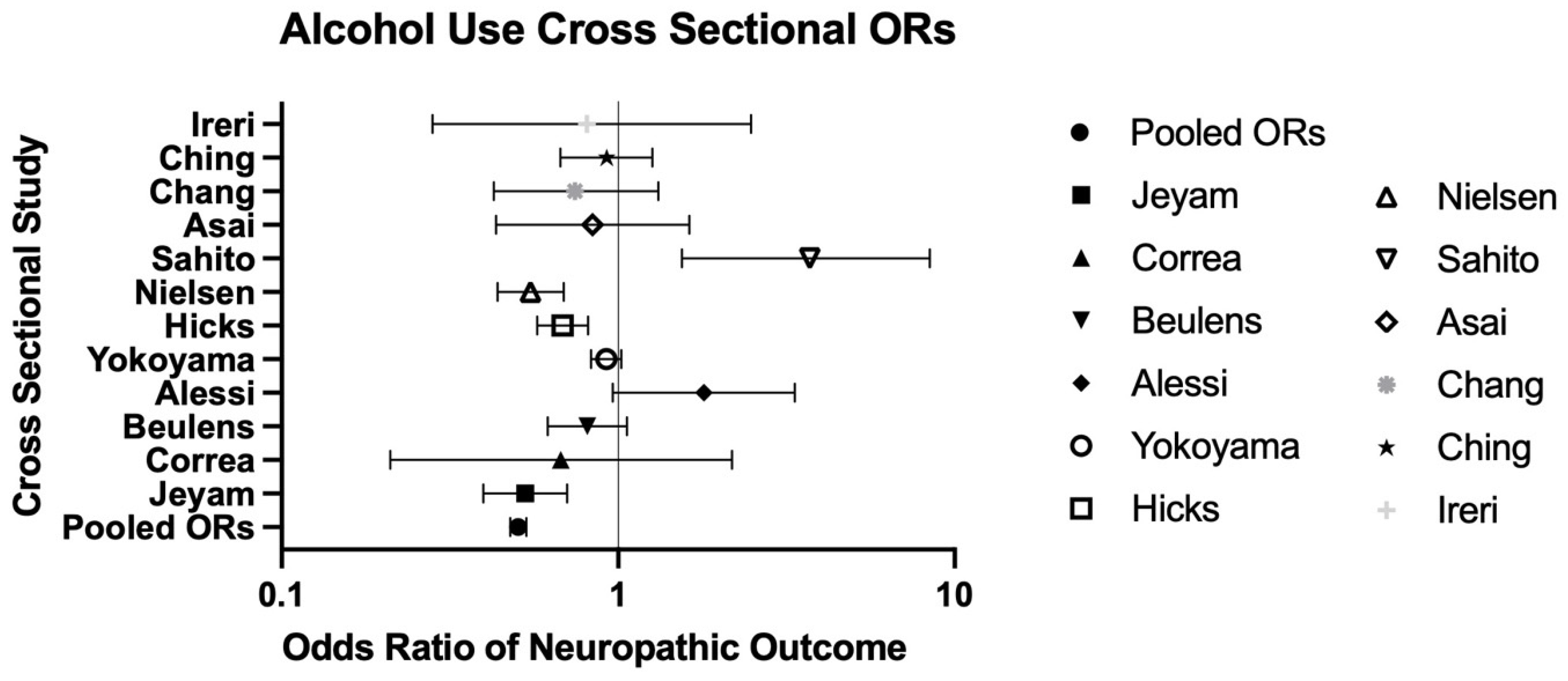
| Consumed Alcohol | 12 | 3548/6789 (52.26%) | 15,261/22,298 (68.44%) | 0.50 (0.48–0.53) | --- | Serious | Mod risk | Mod risk | Low risk | Very Low ⨁◯◯◯ | Alessi (2020) [39], Asai (2022) [42], Beulens (2008) [43], Chang (2025) [46], Ching (2024) [48], Correa (2023) [51], Hicks (2022) [57], Ireri (2024) [58], Jeyam (2020) [59], Nielsen (2022) [70], Sahito (2022) [73], Yokoyama (2020) [84] |
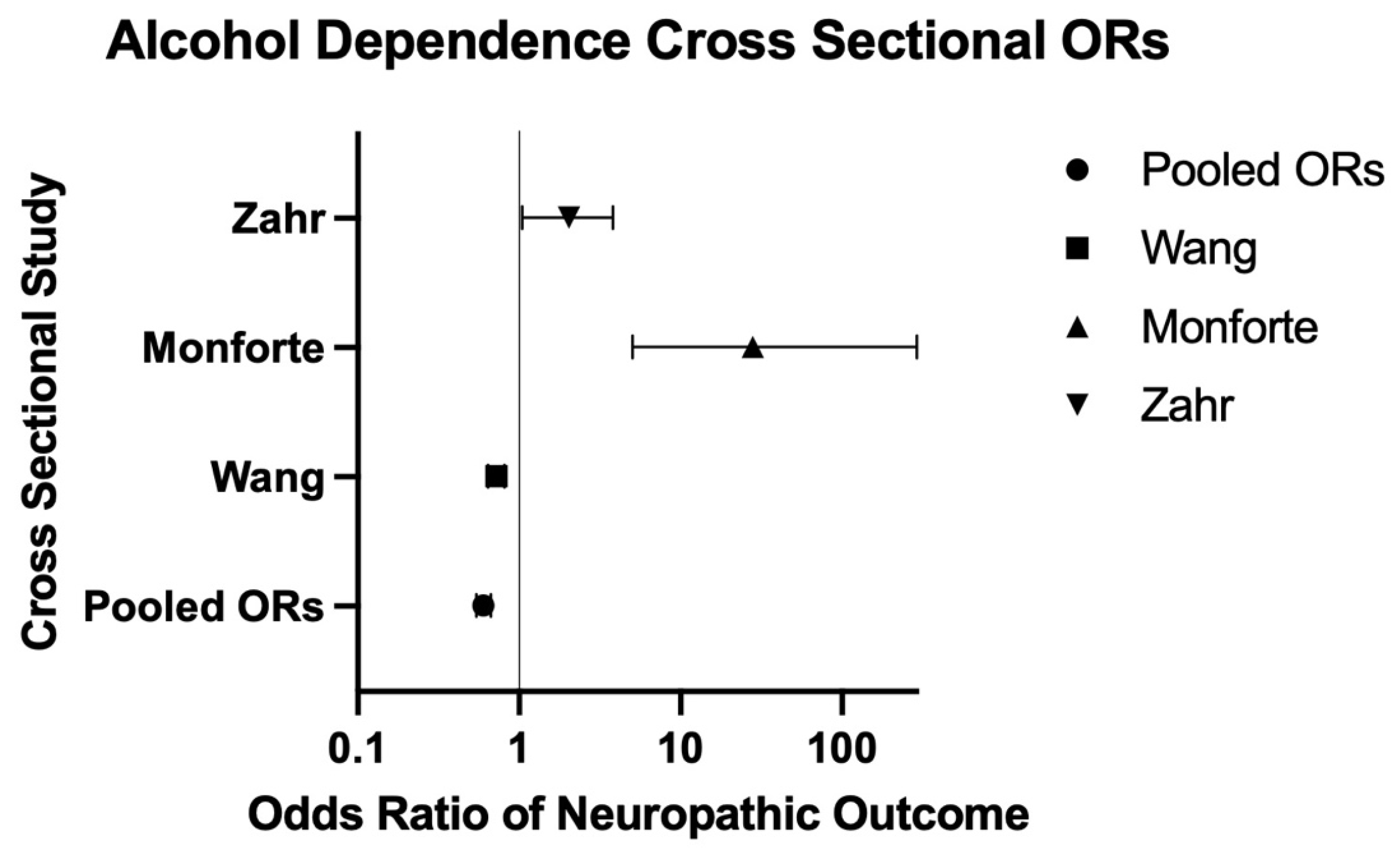
| Alcohol Dependency | 3 | 899/10,175 (8.84%) | 716/5154 (13.89%) | 0.60 (0.54–0.67) | --- | Serious | High risk | Low risk | Low risk | Very Low ⨁◯◯◯ | Monforte (1995) [67], Wang (2023) [80], Zahr (2019) [85] |
| Overconsumption by Guidelines | 2 | 358/1728 (20.72%) | 896/5052 (17.74%) | 1.21 (1.06–1.39) | --- | Serious | Low risk | Mod risk | Low risk | Very Low ⨁◯◯◯ | Gylfadottir (2020) [56], Velde (2020) [77] |
Disclaimer/Publisher’s Note: The statements, opinions and data contained in all publications are solely those of the individual author(s) and contributor(s) and not of MDPI and/or the editor(s). MDPI and/or the editor(s) disclaim responsibility for any injury to people or property resulting from any ideas, methods, instructions or products referred to in the content. |
© 2026 by the authors. Licensee MDPI, Basel, Switzerland. This article is an open access article distributed under the terms and conditions of the Creative Commons Attribution (CC BY) license.
Share and Cite
Klowak, M.; Bado, E.J.; Reid-John, A.; Dawood, R.; Madakadze, C.; Boggild, A.K. A Systematic Review of Lifestyle Interventions for Neuropathy and Neuropathic Pain: Alcohol Consumption and Avoidance. Brain Sci. 2026, 16, 551. https://doi.org/10.3390/brainsci16060551
Klowak M, Bado EJ, Reid-John A, Dawood R, Madakadze C, Boggild AK. A Systematic Review of Lifestyle Interventions for Neuropathy and Neuropathic Pain: Alcohol Consumption and Avoidance. Brain Sciences. 2026; 16(6):551. https://doi.org/10.3390/brainsci16060551
Chicago/Turabian StyleKlowak, Michael, Ezra J. Bado, Aquilla Reid-John, Rumaysa Dawood, Candice Madakadze, and Andrea K. Boggild. 2026. "A Systematic Review of Lifestyle Interventions for Neuropathy and Neuropathic Pain: Alcohol Consumption and Avoidance" Brain Sciences 16, no. 6: 551. https://doi.org/10.3390/brainsci16060551
APA StyleKlowak, M., Bado, E. J., Reid-John, A., Dawood, R., Madakadze, C., & Boggild, A. K. (2026). A Systematic Review of Lifestyle Interventions for Neuropathy and Neuropathic Pain: Alcohol Consumption and Avoidance. Brain Sciences, 16(6), 551. https://doi.org/10.3390/brainsci16060551