Effects of Brain-Computer Interface-Controlled Hand Robot Training on Post-Stroke Recovery of Upper Limb Motor Functions: A Meta-Analysis of Dose-Matched Randomized Controlled Trials


Highlights
- BCI-controlled hand robot training improved overall upper-limb motor function and reduced finger flexor spasticity after stroke. Its effect on upper-limb motor function was more evident in subacute stroke patients.
- BCI-controlled hand robot training showed greater effects on proximal upper-limb motor function than on distal upper-limb motor function.
- This study provides dose-matched evidence supporting the clinical use of BCI-controlled hand robot training in post-stroke upper-limb rehabilitation.
- Future trials should optimize BCI paradigms and robot types, especially to improve distal hand function and long-term efficacy.
Abstract
1. Introduction
2. Methods
2.1. Search Strategy
2.2. Eligibility Criteria
2.2.1. Inclusion Criteria
2.2.2. Exclusion Criteria
2.3. Data Extraction
2.4. Quality Assessment and Certainty of Evidence
2.5. Statistical Analysis
2.5.1. Calculation of Effect Size
2.5.2. Heterogeneity Analysis
2.5.3. Publication Bias
2.5.4. Subgroup Analysis
2.6. Outcome Indicators
2.6.1. Primary Outcome Indicators
2.6.2. Secondary Outcome Indicators
3. Results
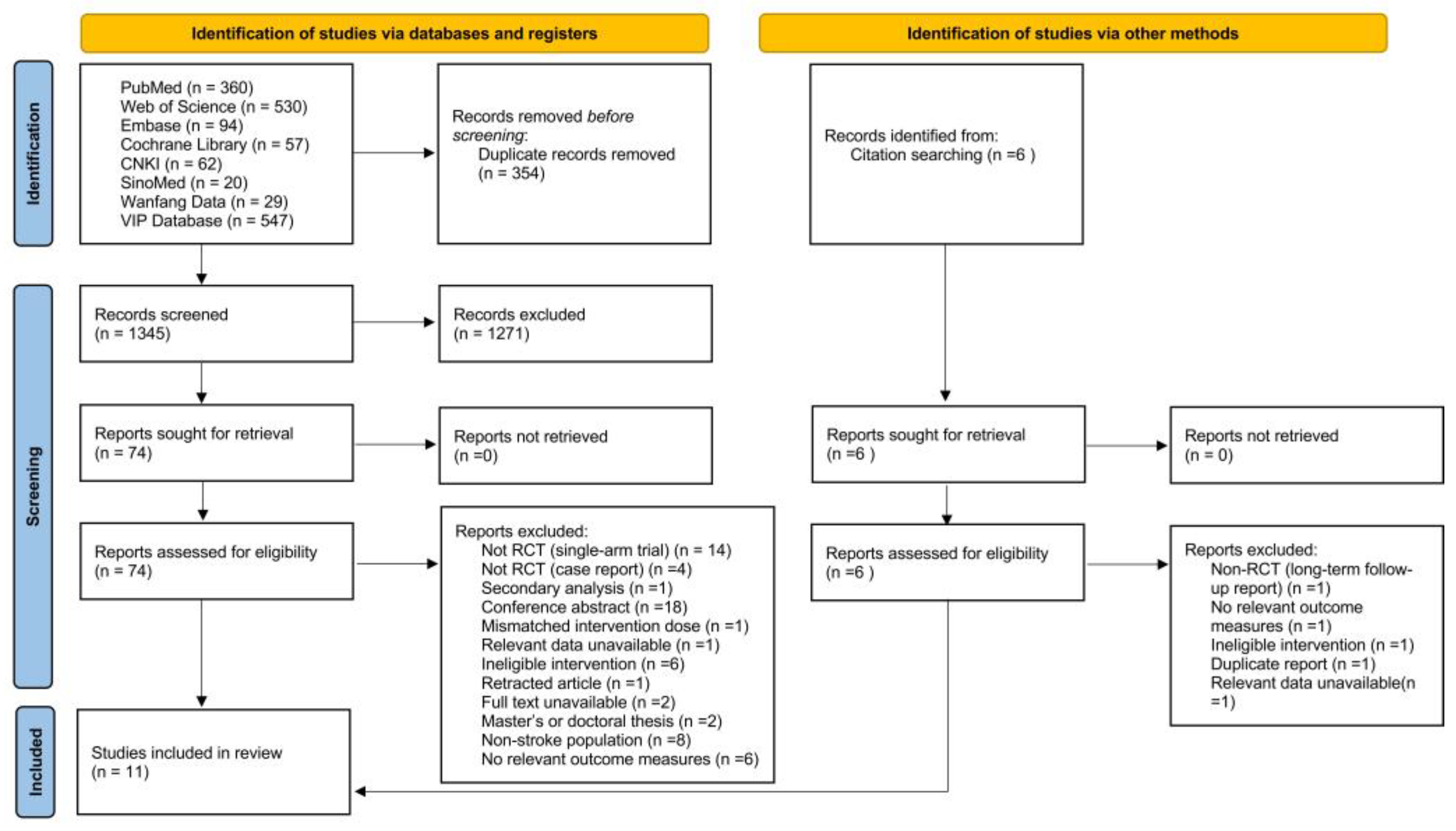
3.1. Research Results
3.2. Characteristics of Included Studies
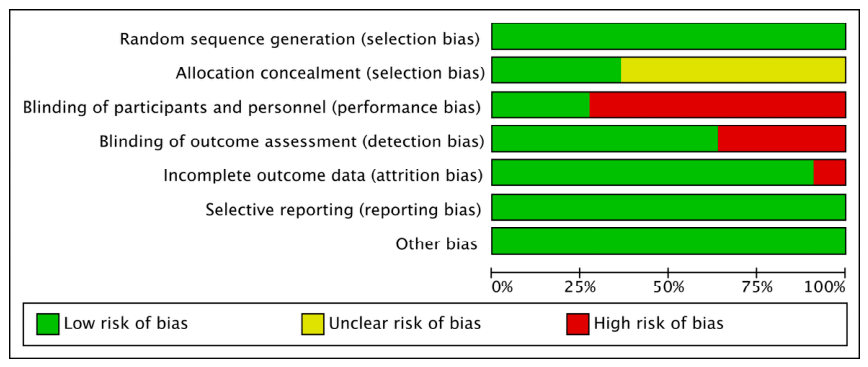
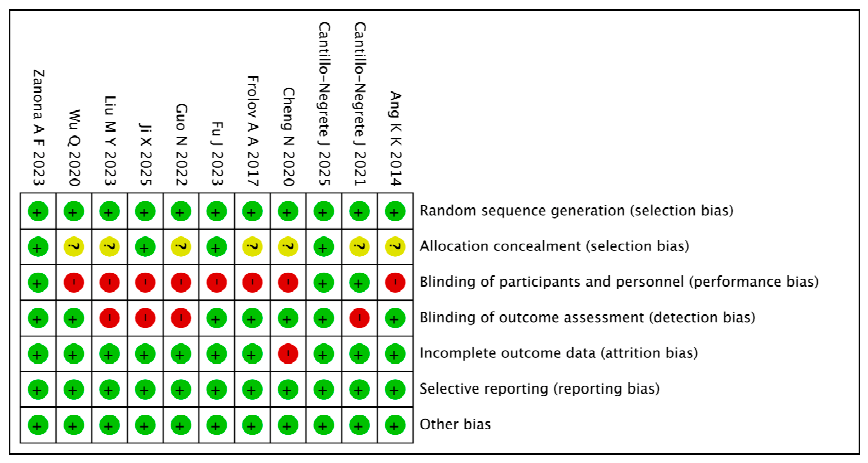
3.3. Risk of Bias Assessment in Included Studies
3.4. Results of Primary Outcome Indicators
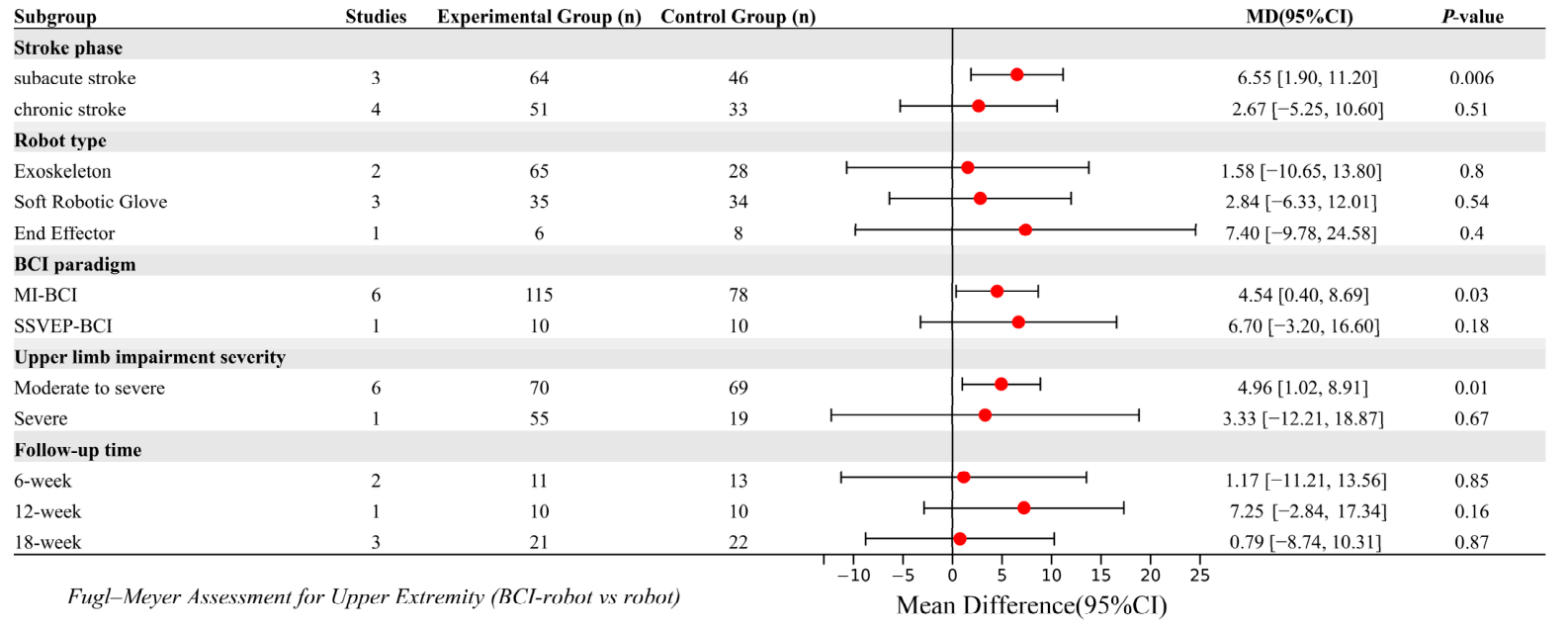
3.4.1. FMA-UE
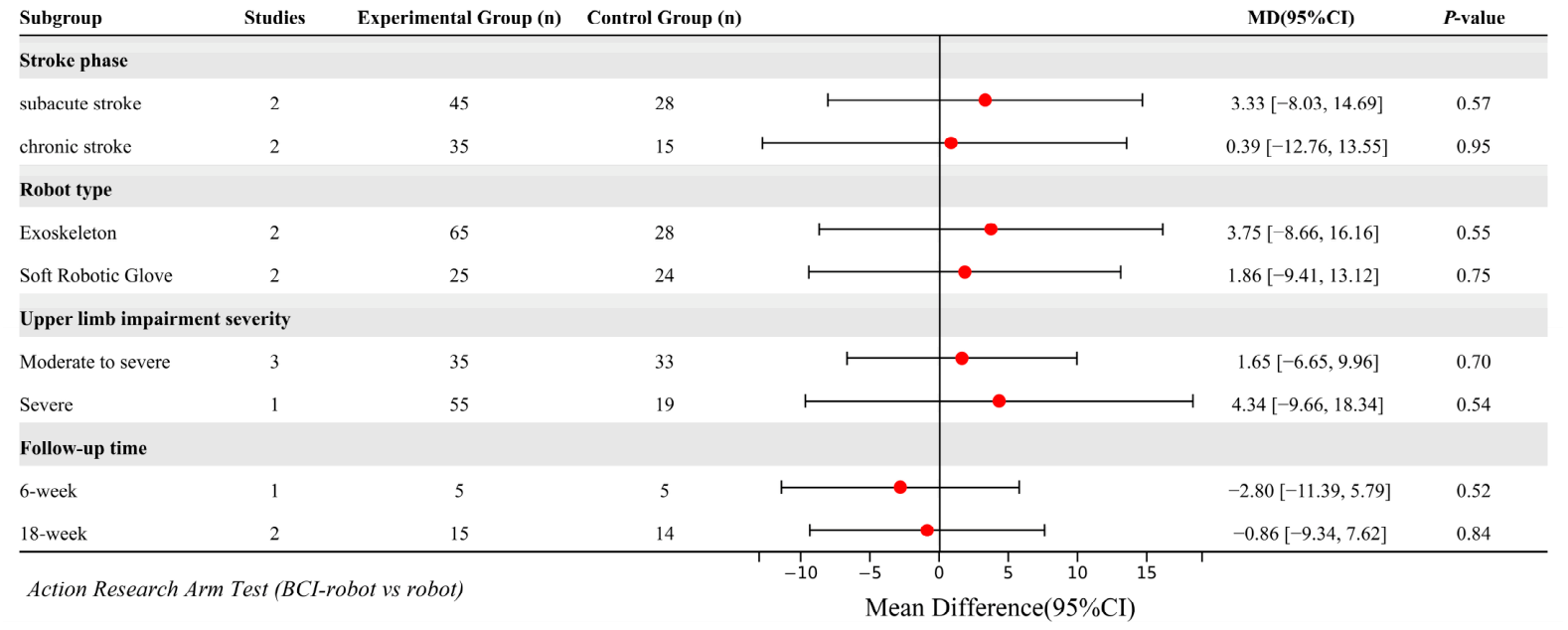
3.4.2. ARAT
3.5. Results of Secondary Outcome Indicators
3.5.1. FMA-UE Proximal Score
3.5.2. FMA-UE Distal Score
3.5.3. MAS (Finger Flexor)
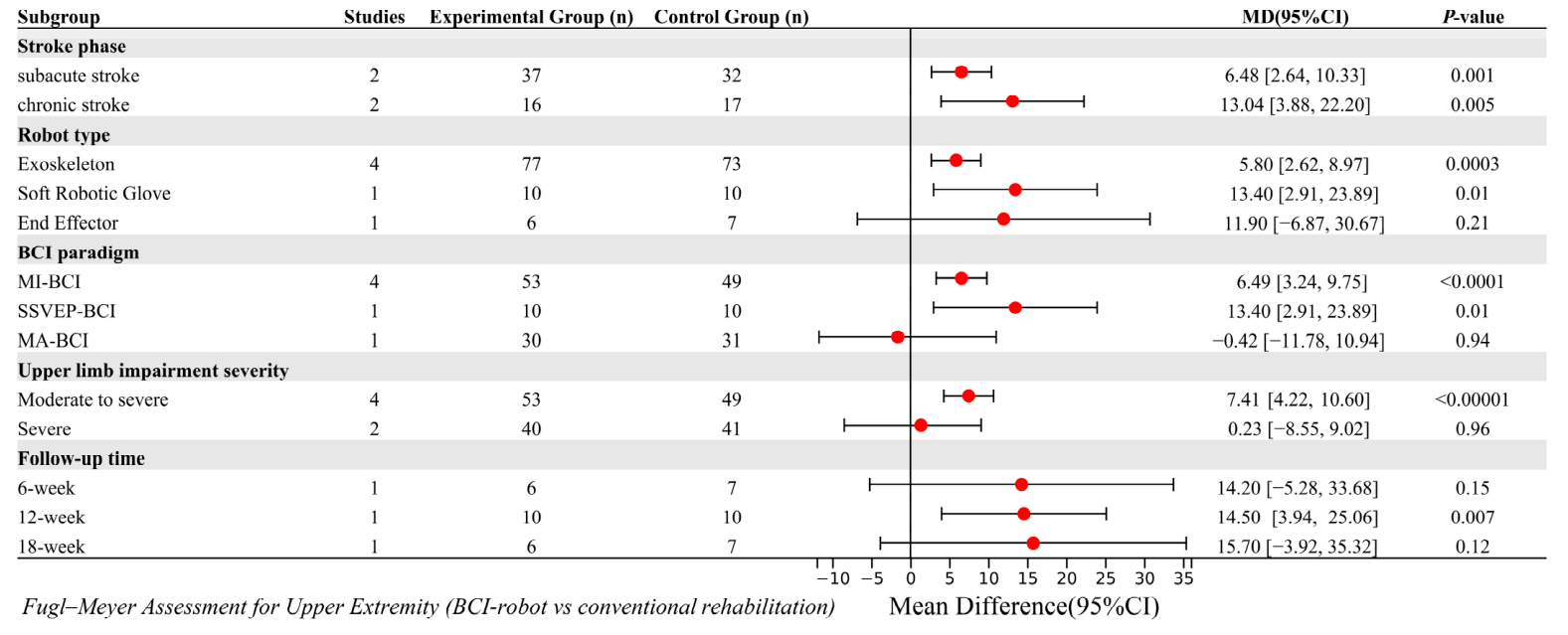
3.6. Subgroup Analysis Results
3.6.1. Stroke Stage
3.6.2. Type of Robot
3.6.3. Types of BCI Paradigms
3.6.4. Degree of Upper Limb Impairment
3.6.5. Follow-Up Time
3.7. GRADE Assessment of Certainty of Evidence
4. Discussion
5. Advantages and Limitations
6. Conclusions
Supplementary Materials
Author Contributions
Funding
Institutional Review Board Statement
Informed Consent Statement
Data Availability Statement
Conflicts of Interest
Abbreviations
| ARAT | Action Research Arm Test |
| BCI | Brain-computer interface |
| CI | Confidence interval |
| CG | Control group |
| EG | Experimental group |
| FMA-UE | Fugl-Meyer Assessment for Upper Extremity |
| MAS | Modified Ashworth Scale |
| MD | Mean difference |
| MI-BCI | Motor imagery-based brain-computer interface |
| RCT | Randomized controlled trial |
| SD | Standard deviation |
| SSVEP | Steady-state visual evoked potential |
References
- Johnson, W.; Onuma, O.; Owolabi, M.; Sachdev, S. Stroke: A global response is needed. Bull. World Health Organ. 2016, 94, 634. [Google Scholar] [CrossRef] [PubMed]
- Tang, Z.; Huang, J.; Zhou, Y.; Ren, J.; Duan, X.; Fu, X.; Pan, R.; Wang, R.; Zhang, P.; Ding, M.; et al. Efficacy and Safety of High-Dose TBS on Poststroke Upper Extremity Motor Impairment: A Randomized Controlled Trial. Stroke 2024, 55, 2212–2220. [Google Scholar] [CrossRef]
- Cirstea, C.M. Integrating Movement Quality in Stroke Neurorehabilitation Could Enhance Arm Recovery. Stroke 2024, 55, 1098–1100. [Google Scholar] [CrossRef]
- Slutzky, M.W.; Vansteensel, M.J.; Herff, C.; Gaunt, R.A. A brain-computer interface working definition. Nat. Biomed. Eng. 2025, 9, 792. [Google Scholar] [CrossRef]
- Chaudhary, U.; Birbaumer, N.; Ramos-Murguialday, A. Brain-computer interfaces for communication and rehabilitation. Nat. Rev. Neurol. 2016, 12, 513–525. [Google Scholar] [CrossRef]
- Liu, J.; Li, Y.; Zhao, D.; Zhong, L.; Wang, Y.; Hao, M.; Ma, J. Efficacy and safety of brain-computer interface for stroke rehabilitation: An overview of systematic review. Front. Hum. Neurosci. 2025, 19, 1525293. [Google Scholar] [CrossRef] [PubMed]
- Tonin, A.; Semprini, M.; Kiper, P.; Mantini, D. Brain-Computer Interfaces for Stroke Motor Rehabilitation. Bioengineering 2025, 12, 820. [Google Scholar] [CrossRef]
- Zhao, C.G.; Ju, F.; Sun, W.; Jiang, S.; Xi, X.; Wang, H.; Sun, X.L.; Li, M.; Xie, J.; Zhang, K.; et al. Effects of Training with a Brain-Computer Interface-Controlled Robot on Rehabilitation Outcome in Patients with Subacute Stroke: A Randomized Controlled Trial. Neurol. Ther. 2022, 11, 679–695. [Google Scholar] [CrossRef] [PubMed]
- Nicolas-Alonso, L.F.; Gomez-Gil, J. Brain computer interfaces, a review. Sensors 2012, 12, 1211–1279. [Google Scholar] [CrossRef] [PubMed]
- Kawala-Sterniuk, A.; Browarska, N.; Al-Bakri, A.; Pelc, M.; Zygarlicki, J.; Sidikova, M.; Martinek, R.; Gorzelanczyk, E.J. Summary of over Fifty Years with Brain-Computer Interfaces-A Review. Brain Sci. 2021, 11, 43. [Google Scholar] [CrossRef]
- Khan, M.A.; Das, R.; Iversen, H.K.; Puthusserypady, S. Review on motor imagery based BCI systems for upper limb post-stroke neurorehabilitation: From designing to application. Comput. Biol. Med. 2020, 123, 103843. [Google Scholar] [CrossRef]
- Cheng, N.; Phua, K.S.; Lai, H.S.; Tam, P.K.; Tang, K.Y.; Cheng, K.K.; Yeow, R.C.; Ang, K.K.; Guan, C.; Lim, J.H. Brain-Computer Interface-Based Soft Robotic Glove Rehabilitation for Stroke. IEEE Trans. Biomed. Eng. 2020, 67, 3339–3351. [Google Scholar] [CrossRef]
- Louie, D.R.; Eng, J.J. Powered robotic exoskeletons in post-stroke rehabilitation of gait: A scoping review. J. Neuroeng. Rehabil. 2016, 13, 53. [Google Scholar] [CrossRef] [PubMed]
- Colucci, A.; Vermehren, M.; Cavallo, A.; Angerhöfer, C.; Peekhaus, N.; Zollo, L.; Kim, W.S.; Paik, N.J.; Soekadar, S.R. Brain-Computer Interface-Controlled Exoskeletons in Clinical Neurorehabilitation: Ready or Not? Neurorehabilit. Neural Repair 2022, 36, 747–756. [Google Scholar] [CrossRef]
- Frolov, A.A.; Mokienko, O.; Lyukmanov, R.; Biryukova, E.; Kotov, S.; Turbina, L.; Nadareyshvily, G.; Bushkova, Y. Post-stroke Rehabilitation Training with a Motor-Imagery-Based Brain-Computer Interface (BCI)-Controlled Hand Exoskeleton: A Randomized Controlled Multicenter Trial. Front. Neurosci. 2017, 11, 400. [Google Scholar] [CrossRef] [PubMed]
- Buch, E.; Weber, C.; Cohen, L.G.; Braun, C.; Dimyan, M.A.; Ard, T.; Mellinger, J.; Caria, A.; Soekadar, S.; Fourkas, A.; et al. Think to move: A neuromagnetic brain-computer interface (BCI) system for chronic stroke. Stroke 2008, 39, 910–917. [Google Scholar] [CrossRef]
- Ramos-Murguialday, A.; Broetz, D.; Rea, M.; Läer, L.; Yilmaz, O.; Brasil, F.L.; Liberati, G.; Curado, M.R.; Garcia-Cossio, E.; Vyziotis, A.; et al. Brain-machine interface in chronic stroke rehabilitation: A controlled study. Ann. Neurol. 2013, 74, 100–108. [Google Scholar] [CrossRef] [PubMed]
- Ji, X.; Lu, X.; Xu, Y.; Zhang, W.; Yang, H.; Yin, C.; Wang, H.; Ren, C.; Ji, Y.; Li, Y.; et al. Effects and neural mechanisms of a brain-computer interface-controlled soft robotic glove on upper limb function in patients with subacute stroke: A randomized controlled fNIRS study. J. Neuroeng. Rehabil. 2025, 22, 171. [Google Scholar] [CrossRef]
- Ang, K.K.; Guan, C.; Phua, K.S.; Wang, C.; Zhou, L.; Tang, K.Y.; Ephraim Joseph, G.J.; Kuah, C.W.; Chua, K.S. Brain-computer interface-based robotic end effector system for wrist and hand rehabilitation: Results of a three-armed randomized controlled trial for chronic stroke. Front. Neuroeng. 2014, 7, 30. [Google Scholar] [CrossRef] [PubMed]
- Baniqued, P.D.E.; Stanyer, E.C.; Awais, M.; Alazmani, A.; Jackson, A.E.; Mon-Williams, M.A.; Mushtaq, F.; Holt, R.J. Brain-computer interface robotics for hand rehabilitation after stroke: A systematic review. J. Neuroeng. Rehabil. 2021, 18, 15. [Google Scholar] [CrossRef]
- Neethu, R.; Ravikiran, M.; Tushar, C.; Cuntai, G. Emerging trends in BCI-robotics for motor control and rehabilitation. Curr. Opin. Biomed. Eng. 2021, 20, 100354. [Google Scholar] [CrossRef]
- Mane, R.; Chouhan, T.; Guan, C. BCI for stroke rehabilitation: Motor and beyond. J. Neural. Eng. 2020, 17, 041001. [Google Scholar] [CrossRef]
- Liu, C.; Lu, J.; Yang, H.; Guo, K. Current State of Robotics in Hand Rehabilitation after Stroke: A Systematic Review. Appl. Sci. 2022, 12, 4540. [Google Scholar] [CrossRef]
- Bai, Z.; Fong, K.N.K.; Zhang, J.J.; Chan, J.; Ting, K.H. Immediate and long-term effects of BCI-based rehabilitation of the upper extremity after stroke: A systematic review and meta-analysis. J. Neuroeng. Rehabil. 2020, 17, 57. [Google Scholar] [CrossRef] [PubMed]
- Qu, H.; Zeng, F.; Tang, Y.; Shi, B.; Wang, Z.; Chen, X.; Wang, J. The clinical effects of brain-computer interface with robot on upper-limb function for post-stroke rehabilitation: A meta-analysis and systematic review. Disabil. Rehabil. Assist. Technol. 2024, 19, 30–41. [Google Scholar] [CrossRef] [PubMed]
- Wan, X.; Wang, W.; Liu, J.; Tong, T. Estimating the sample mean and standard deviation from the sample size, median, range and/or interquartile range. BMC Med. Res. Methodol. 2014, 14, 135. [Google Scholar] [CrossRef]
- Higgins, J.P.; Thompson, S.G.; Deeks, J.J.; Altman, D.G. Measuring inconsistency in meta-analyses. BMJ 2003, 327, 557–560. [Google Scholar] [CrossRef] [PubMed]
- Kim, H.; Shin, J.H. Assessment of Upper Extremity Function in People With Stroke Based on the Framework of the ICF: A Narrative Review. Brain Neurorehabil. 2022, 15, e16. [Google Scholar] [CrossRef]
- Alt Murphy, M.; Al-Shallawi, A.; Sunnerhagen, K.S.; Pandyan, A. Early prediction of upper limb functioning after stroke using clinical bedside assessments: A prospective longitudinal study. Sci. Rep. 2022, 12, 22053. [Google Scholar] [CrossRef]
- Sommerfeld, D.K.; Eek, E.U.; Svensson, A.K.; Holmqvist, L.W.; von Arbin, M.H. Spasticity after stroke: Its occurrence and association with motor impairments and activity limitations. Stroke 2004, 35, 134–139. [Google Scholar] [CrossRef]
- Cantillo-Negrete, J.; Carino-Escobar, R.I.; Carrillo-Mora, P.; Rodriguez-Barragan, M.A.; Hernandez-Arenas, C.; Quinzaños-Fresnedo, J.; Hernandez-Sanchez, I.R.; Galicia-Alvarado, M.A.; Miguel-Puga, A.; Arias-Carrion, O. Brain-Computer Interface Coupled to a Robotic Hand Orthosis for Stroke Patients’ Neurorehabilitation: A Crossover Feasibility Study. Front. Hum. Neurosci. 2021, 15, 656975. [Google Scholar] [CrossRef] [PubMed]
- Cantillo-Negrete, J.; Rodríguez-García, M.E.; Carrillo-Mora, P.; Arias-Carrión, O.; Ortega-Robles, E.; Galicia-Alvarado, M.A.; Valdés-Cristerna, R.; Ramirez-Nava, A.G.; Hernandez-Arenas, C.; Quinzaños-Fresnedo, J.; et al. The ReHand-BCI trial: A randomized controlled trial of a brain-computer interface for upper extremity stroke neurorehabilitation. Front. Neurosci. 2025, 19, 1579988. [Google Scholar] [CrossRef]
- Guo, N.; Wang, X.; Duanmu, D.; Huang, X.; Li, X.; Fan, Y.; Li, H.; Liu, Y.; Yeung, E.H.K.; To, M.K.T.; et al. SSVEP-Based Brain Computer Interface Controlled Soft Robotic Glove for Post-Stroke Hand Function Rehabilitation. IEEE Trans. Neural Syst. Rehabil. Eng. 2022, 30, 1737–1744. [Google Scholar] [CrossRef]
- Wu, Q.; Yue, Z.; Ge, Y.; Ma, D.; Yin, H.; Zhao, H.; Liu, G.; Wang, J.; Dou, W.; Pan, Y. Brain Functional Networks Study of Subacute Stroke Patients With Upper Limb Dysfunction After Comprehensive Rehabilitation Including BCI Training. Front. Neurol. 2020, 10, 1419. [Google Scholar] [CrossRef]
- Zanona, A.F.; Piscitelli, D.; Seixas, V.M.; Scipioni, K.; Bastos, M.S.C.; de Sá, L.C.K.; Monte-Silva, K.; Bolivar, M.; Solnik, S.; De Souza, R.F. Brain-computer interface combined with mental practice and occupational therapy enhances upper limb motor recovery, activities of daily living, and participation in subacute stroke. Front. Neurol. 2023, 13, 1041978. [Google Scholar] [CrossRef]
- Liu, M.; Li, Z.; Cao, Y.; Hao, D.; Song, X. Effect of brain-computer interface training based on motor imagery on hand function for subacute stroke patients. Chin. J. Rehabil. Theory Pract. 2023, 29, 71–76. [Google Scholar]
- Fu, J.; Chen, S.; Shu, X.; Lin, Y.; Jiang, Z.; Wei, D.; Gao, J.; Jia, J. Functional-oriented, portable brain-computer interface training for hand motor recovery after stroke: A randomized controlled study. Front. Neurosci. 2023, 17, 1146146. [Google Scholar] [CrossRef] [PubMed]
- Lundquist, C.B.; Maribo, T. The Fugl-Meyer assessment of the upper extremity: Reliability, responsiveness and validity of the Danish version. Disabil. Rehabil. 2017, 39, 934–939. [Google Scholar] [CrossRef] [PubMed]
- Li, D.; Li, R.; Song, Y.; Qin, W.; Sun, G.; Liu, Y.; Bao, Y.; Liu, L.; Jin, L. Effects of brain-computer interface based training on post-stroke upper-limb rehabilitation: A meta-analysis. J. Neuroeng. Rehabil. 2025, 22, 44. [Google Scholar] [CrossRef] [PubMed]
- Dromerick, A.W.; Geed, S.; Barth, J.; Brady, K.; Giannetti, M.L.; Mitchell, A.; Edwardson, M.A.; Tan, M.T.; Zhou, Y.; Newport, E.L.; et al. Critical Period After Stroke Study (CPASS): A phase II clinical trial testing an optimal time for motor recovery after stroke in humans. Proc. Natl. Acad. Sci. USA 2021, 118, e2026676118. [Google Scholar] [CrossRef]
- Murphy, T.H.; Corbett, D. Plasticity during stroke recovery: From synapse to behaviour. Nat. Rev. Neurosci. 2009, 10, 861–872. [Google Scholar] [CrossRef]
- Takeuchi, N.; Izumi, S. Combinations of stroke neurorehabilitation to facilitate motor recovery: Perspectives on Hebbian plasticity and homeostatic metaplasticity. Front. Hum. Neurosci. 2015, 9, 349. [Google Scholar] [CrossRef]
- Page, S.J.; Fulk, G.D.; Boyne, P. Clinically important differences for the upper-extremity Fugl-Meyer Scale in people with minimal to moderate impairment due to chronic stroke. Phys. Ther. 2012, 92, 791–798. [Google Scholar] [CrossRef]
- Zhou, L.; Zhang, B.; Kang, R.; Wang, Y.; Qin, J.; Xiao, Q.; Hui, V. Efficacy of the Conventional Rehabilitation Robot and bio-Signal Feedback-Based Rehabilitation Robot on Upper-Limb Function in Patients with Stroke: A Systematic Review and Network Meta-Analysis. NeuroRehabilitation 2025, 57, 169–180. [Google Scholar] [CrossRef]
- Wang, A.; Tian, X.; Jiang, D.; Yang, C.; Xu, Q.; Zhang, Y.; Zhao, S.; Zhang, X.; Jing, J.; Wei, N.; et al. Rehabilitation with brain-computer interface and upper limb motor function in ischemic stroke: A randomized controlled trial. Med 2024, 5, 559–569.e4. [Google Scholar] [CrossRef]
- Jose, M.; Munoz-Novoa, M.; Alt Murphy, M. A reliable and valid assessment of upper limb movement quality after stroke: The observational Drinking Task Assessment. J. Rehabil. Med. 2024, 56, 40362. [Google Scholar] [CrossRef] [PubMed]
- Kim, B.; Schweighofer, N.; Haldar, J.P.; Leahy, R.M.; Winstein, C.J. Corticospinal Tract Microstructure Predicts Distal Arm Motor Improvements in Chronic Stroke. J. Neurol. Phys. Ther. 2021, 45, 273–281. [Google Scholar] [CrossRef] [PubMed]
- Schambra, H.M.; Xu, J.; Branscheidt, M.; Lindquist, M.; Uddin, J.; Steiner, L.; Hertler, B.; Kim, N.; Berard, J.; Harran, M.D.; et al. Differential Poststroke Motor Recovery in an Arm Versus Hand Muscle in the Absence of Motor Evoked Potentials. Neurorehabilit. Neural Repair 2019, 33, 568–580. [Google Scholar] [CrossRef] [PubMed]
- Baker, S.N. The primate reticulospinal tract, hand function and functional recovery. J. Physiol. 2011, 589, 5603–5612. [Google Scholar] [CrossRef]
- Wolbrecht, E.T.; Rowe, J.B.; Chan, V.; Ingemanson, M.L.; Cramer, S.C.; Reinkensmeyer, D.J. Finger strength, individuation, and their interaction: Relationship to hand function and corticospinal tract injury after stroke. Clin. Neurophysiol. 2018, 129, 797–808. [Google Scholar] [CrossRef] [PubMed]
- Rondina, J.M.; Park, C.H.; Ward, N.S. Brain regions important for recovery after severe post-stroke upper limb paresis. J. Neurol. Neurosurg. Psychiatry 2017, 88, 737–743. [Google Scholar] [CrossRef] [PubMed]
- Angerhöfer, C.; Colucci, A.; Vermehren, M.; Hömberg, V.; Soekadar, S.R. Post-stroke Rehabilitation of Severe Upper Limb Paresis in Germany—Toward Long-Term Treatment With Brain-Computer Interfaces. Front. Neurol. 2021, 12, 772199. [Google Scholar] [CrossRef]
- Remsik, A.; Young, B.; Vermilyea, R.; Kiekhoefer, L.; Abrams, J.; Evander Elmore, S.; Schultz, P.; Nair, V.; Edwards, D.; Williams, J.; et al. A review of the progression and future implications of brain-computer interface therapies for restoration of distal upper extremity motor function after stroke. Expert Rev. Med. Devices 2016, 13, 445–454. [Google Scholar] [CrossRef] [PubMed]
- Vidaurre, C.; Irastorza-Landa, N.; Sarasola-Sanz, A.; Insausti-Delgado, A.; Ray, A.M.; Bibián, C.; Helmhold, F.; Mahmoud, W.J.; Ortego-Isasa, I.; López-Larraz, E.; et al. Challenges of neural interfaces for stroke motor rehabilitation. Front. Hum. Neurosci. 2023, 17, 1070404. [Google Scholar] [CrossRef] [PubMed]
- Ma, Z.Z.; Wu, J.J.; Cao, Z.; Hua, X.Y.; Zheng, M.X.; Xing, X.X.; Ma, J.; Xu, J.G. Motor imagery-based brain-computer interface rehabilitation programs enhance upper extremity performance and cortical activation in stroke patients. J. Neuroeng. Rehabil. 2024, 21, 91. [Google Scholar] [CrossRef] [PubMed]
- Liu, S.; Zhang, D.; Liu, Z.; Liu, M.; Ming, Z.; Liu, T.; Suo, D.; Shintaro, F.; Yan, T. Review of brain–computer interface based on steady-state visual evoked potential. Brain Sci. Adv. 2022, 8, 258–275. [Google Scholar] [CrossRef]
- Bernard-Espina, J.; Beraneck, M.; Maier, M.A.; Tagliabue, M. Multisensory Integration in Stroke Patients: A Theoretical Approach to Reinterpret Upper-Limb Proprioceptive Deficits and Visual Compensation. Front. Neurosci. 2021, 15, 646698. [Google Scholar] [CrossRef]
- Wasaka, T.; Ando, K.; Nomura, M.; Toshima, K.; Tamaru, T.; Morita, Y. Visuomotor Tracking Task for Enhancing Activity in Motor Areas of Stroke Patients. Brain Sci. 2022, 12, 1063. [Google Scholar] [CrossRef]
- Celnik, P.; Webster, B.; Glasser, D.M.; Cohen, L.G. Effects of action observation on physical training after stroke. Stroke 2008, 39, 1814–1820. [Google Scholar] [CrossRef]
- Chen, C.L.; Chen, C.Y.; Chen, H.C.; Wu, C.Y.; Lin, K.C.; Hsieh, Y.W.; Shen, I.H. Responsiveness and minimal clinically important difference of Modified Ashworth Scale in patients with stroke. Eur. J. Phys. Rehabil. Med. 2019, 55, 754–760. [Google Scholar] [CrossRef]
- Mortezaei, A.; Al-Saidi, N.; Taghlabi, K.M.; Hussein, A.; Hallak, H.; Pouratian, N.; Faraji, A.H. Brain-computer interfaces in poststroke rehabilitation: A meta-analysis of randomized clinical trials. Neurosurg. Focus 2026, 60, E7. [Google Scholar] [CrossRef] [PubMed]
- Lau, C.C.Y.; Yuan, K.; Wong, P.C.M.; Chu, W.C.W.; Leung, T.W.; Wong, W.W.; Tong, R.K.Y. Modulation of Functional Connectivity and Low-Frequency Fluctuations After Brain-Computer Interface-Guided Robot Hand Training in Chronic Stroke: A 6-Month Follow-Up Study. Front. Hum. Neurosci. 2021, 14, 611064. [Google Scholar] [CrossRef] [PubMed]
- Chen, H.; Yun, G. Efficacy of Brain-Computer Interface Therapy for Upper Limb Rehabilitation in Chronic Stroke: Systematic Review and Meta-Analysis of Randomized Controlled Trials. J. Med. Internet Res. 2026, 28, e79132. [Google Scholar] [CrossRef] [PubMed]
- Chen, S.; Xie, N.; Tang, Y.; Ji, Y.; He, Z.; Wang, Y.; Huang, X.; Fu, J.; Ge, M.; Liu, Q.; et al. Long-Term Brain-Computer Interface Functional Electrical Stimulation Enhances Neuroplasticity and Functional Recovery in Elderly Stroke: A 4.5-Year Longitudinal Study Integrating Electroencephalography Biomarkers and Clinical Assessments. Research 2025, 8, 0984. [Google Scholar] [CrossRef]




| Study | n (M/F) | Age (Years) (Mean ± SD) | Disease Duration (Mean ± SD) | Stroke Stage | Upper Limb Impairment Severity |
|---|---|---|---|---|---|
| Ang K K 2014 [19] | EG: 4/2 CG1: 6/2 CG2: 4/3 | EG: 54.0 ± 8.9 CG1: 51.1 ± 6.3 CG2: 58.0 ± 19.3 | EG: 285.7 ± 64.0 (days) CG1: 398.2 ± 150.9 CG2: 455.4 ± 109.6 | Chronic | moderate to severe impairment of upper extremity function (FMMA score 10–50) |
| Cantillo-Negrete J 2021 [31] | EG: 5/5 CG: 5/5 | EG: 59.9 ± 12.8 CG: 59.9 ± 12.8 | EG: 140 ± 83 (days) CG: 140 ± 83 | Subacute: 7 Chronic: 3 | with severe upper limb impairment |
| Cantillo-Negrete J 2025 [32] | EG: 6/4 CG: 8/1 | EG: 47.80 ± 15.74 CG: 55.78 ± 14.96 | EG: 12.68 ± 5.81 CG: 10.33 ± 6.26 | Subacute: 6 Chronic: 13 | hand paresis (Motricity index from 0 to 22) |
| Cheng N 2020 [12] | EG: 3/2 CG: 2/3 | EG: 62.4 ± 4.7 CG: 61.4 ± 4.5 | EG: 476.8 ± 302.0 (days) CG: 890.2 ± 257.23 | Chronic | FMA scores of 10–45 |
| Frolov A A 2017 [15] | EG: 34/21 CG: 14/5 | EG: 57.76 ± 12.66 CG: 59.46 ± 9.92 | EG: 267.20 ± 177.24 (days) CG: 226.80 ± 104.26 | Subacute: 34 Chronic: 40 | with severe upper limb paralysis |
| Guo N 2022 [33] | EG: 9/1 CG1: 8/2 CG2: 8/2 | EG: 60.2 ± 9.3 CG1: 56.9 ± 6.1 CG2: 53.5 ± 8.3 | EG: 12.5 ± 7.1 (months) CG1: 11.7 ± 5.4 CG2: 10.9 ± 7.9 | Chronic | moderate to severe motor impairments of upper limb (FMA-UL between 5 and 50) |
| Ji X 2025 [18] | EG: 12/8 CG: 15/4 | EG: 61.75 ± 10.35 CG: 60.05 ± 14.35 | EG: 49.50 ± 23.36 (days) CG: 42.42 ± 24.50 | Subacute | upper-limb/hand dysfunction (Brunnstrom hand stages II–IV) |
| Wu Q 2020 [34] | EG: 9/5 CG: 9/2 | EG: 62.93 ± 10.56 CG: 64.82 ± 7.22 | EG: 2.11 ± 0.30 (months) CG: 2.27 ± 0.98 | Subacute | moderate to severe UL paralysis |
| Zanona A F 2023 [35] | EG: 12/11 CG: 11/10 | EG: 62.2 ± 9.8 CG: 61 ± 3 | EG: 13.9 ± 6 (months) CG: 12.5 ± 6.7 | Subacute | motor impairment in the upper limb (FMA motor domain 10–60) |
| Liu M Y 2023 [36] | EG: 15/4 CG: 10/8 | EG: 51.26 ± 11.06 CG: 52.89 ± 13.07 | EG: 98.26 ± 48.25 (days) CG: 90.28 ± 52.15 | Subacute | Brunnstrom stage ≥ II |
| Fu J 2023 [37] | EG: 23/7 CG: 25/6 | EG: 55.93 ± 11.05 CG: 59.00 ± 14.49 | EG: 95.50 ± 110.55 (days) CG: 83.67 ± 88.28 | NR | Brunnstrom stages I–V (ranging from severe to moderate impairment); distribution not reported |
| Study | BCI Type | Robot Type | EG Intervention | CG Intervention | Dose-Matched Intervention Amount | Outcome Time Points | Outcomes |
|---|---|---|---|---|---|---|---|
| Ang K K 2014 [19] | MI-BCI | Haptic knob robot | BCI coupled with Haptic Knob robot (60 min) + therapist-assisted arm mobilization (30 min) | CG1: Haptic Knob robot (60 min) + therapist-assisted arm mobilization (30 min) CG2: therapist-assisted arm mobilization (90 min) | 90 min/session, 3 sessions/week, 6 weeks | Baseline Post-intervention (6 weeks) Follow-up (6, 18 weeks) | FMA-UE FMA-UE proximal FMA-UE distal |
| Cantillo-Negrete J 2021 [31] | MI-BCI | Robotic hand orthosis | BCI coupled with robotic hand orthosis | Conventional upper limb therapy (neurofacilitation, stretching, grip, strength, coordination training) | 30–40 min/session, 3 sessions/week, 4 weeks | Baseline Post-intervention (4 weeks) | FMA-UE ARAT |
| Cantillo-Negrete J 2025 [32] | MI-BCI | Robotic hand orthosis | BCI-controlled robotic hand orthosis | Robotic hand orthosis with sham-BCI | 5 sessions/week, 6 weeks, 30 sessions | Baseline Post-intervention (6 weeks) Follow-up (18 weeks) | FMA-UE ARAT |
| Cheng N 2020 [12] | MI-BCI | Soft robotic glove | BCI-controlled soft robotic glove (90 min) + standard arm therapy (30 min) | Soft robotic glove (90 min) + standard arm therapy (30 min) | 120 min/session 3 sessions/week, 6 weeks | Baseline Post-intervention (6 weeks) Follow-up (6, 18 weeks) | FMA-UE ARAT |
| Frolov A A 2017 [15] | MI-BCI | Hand exoskeleton robot | BCI-controlled hand exoskeleton robot | Hand exoskeleton robot | 30 min/session, 10 sessions, total 5 h | Baseline Post-intervention (after 10 sessions) | FMA-UE ARAT FMA-UE proximal FMA-UE distal |
| Guo N 2022 [33] | SSVEP-BCI | Soft robotic glove | SSVEP-BCI-controlled soft robotic glove | CG1: Soft robotic glove CG2: Conventional therapy | 60 min/session 5 sessions/week, 2 weeks | Baseline Post-intervention (2 weeks) Follow-up (12 weeks) | FMA-UE FMA-UE proximal FMA-UE distal MAS-finger |
| Ji X 2025 [18] | MI-BCI | Soft robotic glove | BCI-controlled soft robotic glove (20 min) + conventional rehabilitation (60 min/day) | Soft robotic glove (20 min) + conventional rehabilitation (60 min/day) | 80 min/session 5 sessions/week 4 weeks | Baseline Post-intervention (4 weeks) | FMA-UE ARAT |
| Wu Q 2020 [34] | MI-BCI | Hand exoskeleton robot | BCI-controlled hand exoskeleton robot (1 h/day) + conventional rehabilitation (1 h/day) | Conventional rehabilitation (2 h/day) | 2 h/day 5 days/week 4 weeks | Baseline Post-intervention (4 weeks) | FMA-UE ARAT |
| Zanona A F 2023 [35] | MI-BCI | Hand exoskeleton robot | BCI-controlled exoskeleton hand (30 min/session) + Conventional therapy (50 min/session) | Conventional therapy (80 min/session) | 80 min/session 5 sessions/week, 2 weeks | Baseline Post-intervention (2 weeks) | FMA-UE |
| Liu M Y 2023 [36] | MI-BCI | Hand rehabilitation robot | Motor imagery-based BCI training (30 min/day) + routine comprehensive rehabilitation (60 min/day) | Hand rehabilitation robot training (30 min/day) + routine comprehensive rehabilitation (60 min/day) | 90 min/day, 5 days/week, 4 weeks | Baseline Post-intervention (4 weeks) | FMA-UE FMA-UE distal MAS-finger |
| Fu J 2023 [37] | MA-BCI | Hand exoskeleton robot | BCI-controlled hand exoskeleton training (grasp/open motor training) | Task-oriented guidance training | 30 min/day, 5 days/week, 4 weeks | Baseline Post-intervention (4 weeks) | FMA-UE |
Disclaimer/Publisher’s Note: The statements, opinions and data contained in all publications are solely those of the individual author(s) and contributor(s) and not of MDPI and/or the editor(s). MDPI and/or the editor(s) disclaim responsibility for any injury to people or property resulting from any ideas, methods, instructions or products referred to in the content. |
© 2026 by the authors. Licensee MDPI, Basel, Switzerland. This article is an open access article distributed under the terms and conditions of the Creative Commons Attribution (CC BY) license.
Share and Cite
Hu, S.; Wang, F.; Gao, X.; Zhi, Y.; Kim, D. Effects of Brain-Computer Interface-Controlled Hand Robot Training on Post-Stroke Recovery of Upper Limb Motor Functions: A Meta-Analysis of Dose-Matched Randomized Controlled Trials. Brain Sci. 2026, 16, 552. https://doi.org/10.3390/brainsci16060552
Hu S, Wang F, Gao X, Zhi Y, Kim D. Effects of Brain-Computer Interface-Controlled Hand Robot Training on Post-Stroke Recovery of Upper Limb Motor Functions: A Meta-Analysis of Dose-Matched Randomized Controlled Trials. Brain Sciences. 2026; 16(6):552. https://doi.org/10.3390/brainsci16060552
Chicago/Turabian StyleHu, Song, Fengjiao Wang, Xiaoxue Gao, Yong Zhi, and Daehee Kim. 2026. "Effects of Brain-Computer Interface-Controlled Hand Robot Training on Post-Stroke Recovery of Upper Limb Motor Functions: A Meta-Analysis of Dose-Matched Randomized Controlled Trials" Brain Sciences 16, no. 6: 552. https://doi.org/10.3390/brainsci16060552
APA StyleHu, S., Wang, F., Gao, X., Zhi, Y., & Kim, D. (2026). Effects of Brain-Computer Interface-Controlled Hand Robot Training on Post-Stroke Recovery of Upper Limb Motor Functions: A Meta-Analysis of Dose-Matched Randomized Controlled Trials. Brain Sciences, 16(6), 552. https://doi.org/10.3390/brainsci16060552