Beyond Adversity: Definitions, Retrospective Assessment, and Experimental Manipulation of Positive Early-Life Experiences

Abstract
1. Introduction
1.1. Adverse Early-Life Experiences in Developmental Research
1.2. Integrating Positive Early-Life Experiences into Developmental Research
- (i)
- Current definitions;
- (ii)
- Instruments for their retrospective assessment in humans;
- (iii)
- Experimental approaches aimed at manipulating and promoting such experiences in humans.
2. Definition(s) of Positive Early-Life Experiences
- (i)
- The relationship domain, encompassing secure and nurturing connections with family members, adults, and peers;
- (ii)
- The environmental domain, including safe, equitable, and stable environments to live, learn, and play;
- (iii)
- The social domain, reflecting opportunities for social and civic engagement that foster a sense of belonging and connectedness;
- (iv)
- The emotional growth domain.
3. Retrospective Assessment of Positive Early-Life Experiences
- (i)
- Perceived relational and internal safety and security, such as having at least one safe caregiver and positive core beliefs;
- (ii)
- Positive and predictable quality of life, including enjoyment of school and a stable home routine;
- (iii)
- Interpersonal support, encompassing supportive relationships with teachers, neighbors, extended family, or mentors.
- (i)
- Felt able to discuss their feelings with family members;
- (ii)
- Felt support from their family during difficulties;
- (iii)
- Enjoyed taking part in community traditions;
- (iv)
- Experienced a sense of belonging in school;
- (v)
- Felt friends’ support;
- (vi)
- Had at least two non-parental adults who showed interest in them;
- (vii)
- Felt safe and protected by an adult in their home [25].
- (i)
- Nurturing and supportive relationships;
- (ii)
- Safe and protective environments;
- (iii)
- Constructive social engagement and connectedness.
- (i)
- School climate and peer relationships;
- (ii)
- Neighborhood safety;
- (iii)
- Social support;
- (iv)
- Paternal relationships;
- (v)
- Maternal relationships.

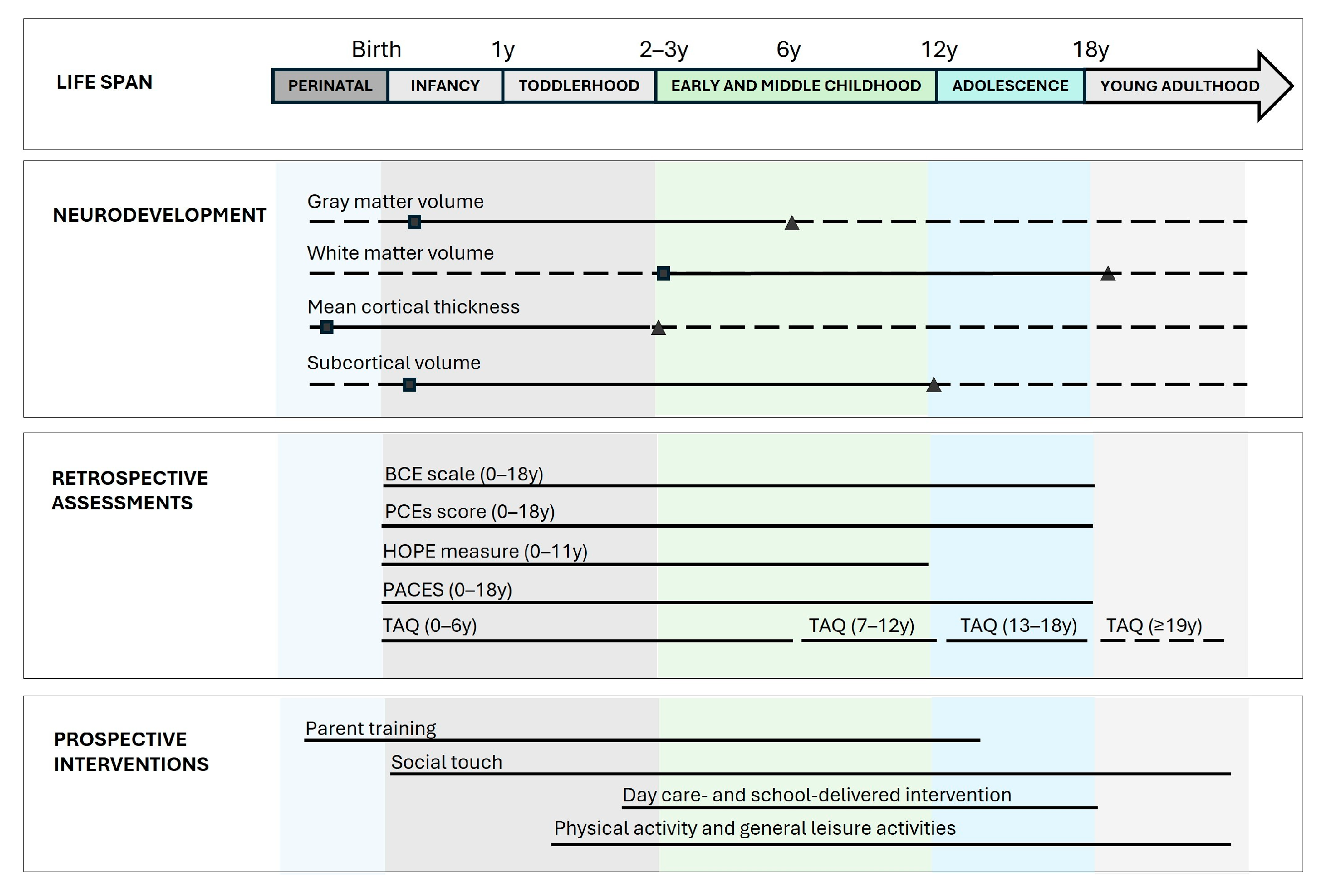
| Retrospective Assessment | Domains | Time of Interest | Sample |
|---|---|---|---|
| Benevolent Childhood Experiences (BCEs) scale [26] | perceived relational and internal safety and security; positive and predictable quality of life; interpersonal support | From birth to 18 years of age | 101 pregnant women (M = 29.10 years, SD = 6.56, range = 18–44; 37% Latina, 22% African-American, 20% White, 21% biracial/multiracial/other; 37% foreign-born, 26% Spanish-speaking) |
| BCE-Revised scale [31] | incorporates physical and health-related factors (such as access to nutritious food, adequate medical care, and good sleep quality), public safety factors, and environmental factors (including regular exposure to the outdoors) | From birth to 18 years of age | 1746 USA young adults (M = 26.6 years, SD = 4.7, range = 19–35 years; 55.3% female, 42.4% male, 2.3% gender non-conforming; 67.0% White, 10.3% Asian, 8.6% Black, 8.4% Latine, 5.7% other) |
| Positive Childhood Experiences (PCEs) score [28] | communication and support within the family; community traditions; belonging in school; interpersonal support (friends and non-parental adults) | From birth to 18 years of age | 6188 non-institutionalized Wisconsin adults (50.7% women and 84.9% White) |
| Health Outcomes from Positive Experiences (HOPE) measure [66] | nurturing and supportive relationships; safe and protective environments; constructive social engagement and connectedness | From birth to 11 years of age | 2 cohorts of Australian children, composed of a birth cohort of 5107 infants and a kindergarten cohort of 4983 4-year-olds |
| Positive and Adverse Childhood Experiences Survey (PACES) [71] | positive childhood events; adverse childhood events | From birth to 18 years of age | 728 clients at rural Colorado clinics for opioid use disorder treatment |
| Trauma and Attachment Questionnaire (TAQ) [72] | positive experiences (i.e., competence and safety); negative experiences (i.e., neglect, separation, secrets, emotional abuse, physical abuse, sexual abuse, witnessing, other traumas, and alcohol and drugs) | During four developmental periods: ages 0–6; 7–12; 13–18; ≥19 | 192 patients with diagnoses of alcohol-related disorders (n = 45), schizophrenic disorders (n = 52), affective disorders (n = 54), and personality disorders (n = 41) |
4. Experimental Approaches to Positive Early-Life Experiences
5. Time-Sensitive and Individual-Centered Approaches to Positive Early-Life Experiences
5.1. Timing of Positive Early-Life Experiences

5.2. Individual-Centered Studies
6. Conclusions
Author Contributions
Funding
Institutional Review Board Statement
Informed Consent Statement
Data Availability Statement
Conflicts of Interest
Abbreviations
| ACEs | Adverse Childhood Experiences |
| ADHD | Attention Deficit/Hyperactivity Disorder |
| ASD | Autism Spectrum Disorder |
| BCEs | Benevolent Childhood Experiences |
| BDNF | Brain-Derived Neurotrophic Factor |
| HOPE | Health Outcomes from Positive Experiences |
| LCHD | Life Course Health Development |
| MRI | Magnetic Resonance Imaging |
| PA | Physical Activity |
| PACEs | Protective and Compensatory Experiences |
| PCEs | Positive Childhood Experiences |
| PICs | Positive Interpersonal Connections |
| SSNRs | Safe, Stable, and Nurturing Relationships |
| TAQ | Trauma and Attachment Questionnaire |
| RCTs | Randomized Controlled Trials |
References
- Ismail, F.Y.; Fatemi, A.; Johnston, M.V. Cerebral plasticity: Windows of opportunity in the developing brain. Eur. J. Paediatr. Neurol. 2017, 21, 23–48. [Google Scholar] [CrossRef]
- Levitt, P. Structural and functional maturation of the developing primate brain. J. Pediatr. 2003, 143, S35–S45. [Google Scholar] [CrossRef]
- Gelfo, F.; Mandolesi, L.; Serra, L.; Sorrentino, G.; Caltagirone, C. The Neuroprotective Effects of Experience on Cognitive Functions: Evidence from Animal Studies on the Neurobiological Bases of Brain Reserve. Neuroscience 2018, 370, 218–235. [Google Scholar] [CrossRef]
- Mandolesi, L.; Gelfo, F.; Serra, L.; Montuori, S.; Polverino, A.; Curcio, G.; Sorrentino, G. Environmental Factors Promoting Neural Plasticity: Insights from Animal and Human Studies. Neural Plast. 2017, 2017, 7219461. [Google Scholar] [CrossRef]
- Black, M.M.; Walker, S.P.; Fernald, L.C.H.; Andersen, C.T.; DiGirolamo, A.M.; Lu, C.; McCoy, D.C.; Fink, G.; Shawar, Y.R.; Shiffman, J.; et al. Early Childhood Development Coming of Age: Science through the Life Course. Lancet 2017, 389, 77–90. [Google Scholar] [CrossRef] [PubMed]
- Chaudhury, S.; Sharma, V.; Kumar, V.; Nag, T.C.; Wadhwa, S. Activity-dependent synaptic plasticity modulates the critical phase of brain development. Brain Dev. 2016, 38, 355–363. [Google Scholar] [CrossRef] [PubMed]
- Berretta, E.; Guida, E.; Forni, D.; Provenzi, L. Glucocorticoid receptor gene (NR3C1) methylation during the first thousand days: Environmental exposures and developmental outcomes. Neurosci. Biobehav. Rev. 2021, 125, 493–502. [Google Scholar] [CrossRef]
- Kolb, B.; Gibb, R. Searching for the principles of brain plasticity and behavior. Cortex 2014, 58, 251–260. [Google Scholar] [CrossRef]
- Nelson, C.A., III; Gabard-Durnam, L.J. Early Adversity and Critical Periods: Neurodevelopmental Consequences of Violating the Expectable Environment. Trends Neurosci. 2020, 43, 133–143. [Google Scholar] [CrossRef] [PubMed]
- Wachs, T.D.; Georgieff, M.; Cusick, S.; McEwen, B.S. Issues in the timing of integrated early interventions: Contributions from nutrition, neuroscience, and psychological research. Ann. N. Y. Acad. Sci. 2014, 1308, 89–106. [Google Scholar] [CrossRef]
- Feldman, R. The Neurobiology of Human Attachments. Trends Cogn. Sci. 2017, 21, 80–99. [Google Scholar] [CrossRef] [PubMed]
- Čater, M.; Majdič, G. How early maternal deprivation changes the brain and behavior? Eur. J. Neurosci. 2022, 55, 2058–2075. [Google Scholar] [CrossRef] [PubMed]
- Baram, T.Z.; Davis, E.P.; Obenaus, A.; Sandman, C.A.; Small, S.L.; Solodkin, A.; Stern, H. Fragmentation and Unpredictability of Early-Life Experience in Mental Disorders. Am. J. Psychiatry 2012, 169, 907–915. [Google Scholar] [CrossRef]
- Felitti, V.J.; Anda, R.F.; Nordenberg, D.; Williamson, D.F.; Spitz, A.M.; Edwards, V.; Koss, M.P.; Marks, J.S. Relationship of Childhood Abuse and Household Dysfunction to Many of the Leading Causes of Death in Adults. Am. J. Prev. Med. 1998, 14, 245–258. [Google Scholar] [CrossRef] [PubMed]
- Merrick, M.T.; Ford, D.C.; Ports, K.A.; Guinn, A.S.; Chen, J.; Klevens, J.; Metzler, M.; Jones, C.M.; Simon, T.R.; Daniel, V.M.; et al. Vital Signs: Estimated Proportion of Adult Health Problems Attributable to Adverse Childhood Experiences and Implications for Prevention—25 States, 2015–2017. MMWR Morb. Mortal. Wkly. Rep. 2019, 68, 999–1005. [Google Scholar] [CrossRef] [PubMed]
- Hughes, K.; Bellis, M.A.; Hardcastle, K.A.; Sethi, D.; Butchart, A.; Mikton, C.; Jones, L.; Dunne, M.P. The effect of multiple adverse childhood experiences on health: A systematic review and meta-analysis. Lancet Public Health 2017, 2, e356–e366. [Google Scholar] [CrossRef] [PubMed]
- Picard, M. Why Do We Care More About Disease than Health? Phenomics 2022, 2, 145–155. [Google Scholar] [CrossRef]
- McEwen, C.A.; Gregerson, S.F. A Critical Assessment of the Adverse Childhood Experiences Study at 20 Years. Am. J. Prev. Med. 2019, 56, 790–794. [Google Scholar] [CrossRef] [PubMed]
- Masten, A.S. Resilience Theory and Research on Children and Families: Past, Present, and Promise. J. Fam. Theory Rev. 2018, 10, 12–31. [Google Scholar] [CrossRef]
- Masten, A.S. Resilience in children threatened by extreme adversity: Frameworks for research, practice, and translational synergy. Dev. Psychopathol. 2011, 23, 493–506. [Google Scholar] [CrossRef]
- Cicchetti, D.; Rogosch, F.A. Equifinality and multifinality in developmental psychopathology. Dev. Psychopathol. 1996, 8, 597–600. [Google Scholar] [CrossRef]
- Sameroff, A.J. Developmental systems and psychopathology. Dev. Psychopathol. 2000, 12, 297–312. [Google Scholar] [CrossRef] [PubMed]
- Rovnaghi, C.R.; Castilla-Liu, D.; Lee, A.M.; Shrivastava, A.; Anand, K.J.S. Promoting Child Wellness: A Narrative Review of Positive Childhood Experiences. Behav. Sci. 2025, 15, 1432. [Google Scholar] [CrossRef] [PubMed]
- Seligman, M.E.; Csikszentmihalyi, M. Positive psychology. An introduction. Am. Psychol. 2000, 55, 5–14. [Google Scholar] [CrossRef]
- Sege, R.D.; Harper Browne, C. Responding to ACEs With HOPE: Health Outcomes from Positive Experiences. Acad. Pediatr. 2017, 17, S79–S85. [Google Scholar] [CrossRef]
- Narayan, A.J.; Rivera, L.M.; Bernstein, R.E.; Harris, W.W.; Lieberman, A.F. Positive childhood experiences predict less psychopathology and stress in pregnant women with childhood adversity: A pilot study of the benevolent childhood experiences (BCEs) scale. Child Abus. Negl. 2018, 78, 19–30. [Google Scholar] [CrossRef]
- Wright, M.O.; Masten, A.S.; Narayan, A.J. Resilience Processes in Development: Four Waves of Research on Positive Adaptation in the Context of Adversity. In Handbook of Resilience in Children; Goldstein, S., Brooks, R., Eds.; Springer: Boston, MA, USA, 2013. [Google Scholar] [CrossRef]
- Bethell, C.; Jones, J.; Gombojav, N.; Linkenbach, J.; Sege, R. Positive Childhood Experiences and Adult Mental and Relational Health in a Statewide Sample. JAMA Pediatr. 2019, 173, e193007. [Google Scholar] [CrossRef] [PubMed]
- Masten, A.S.; Cicchetti, D. Resilience in development: Progress and transformation. In Developmental Psychopathology: Risk, Resilience, and Intervention, 3rd ed.; Cicchetti, D., Ed.; John Wiley & Sons, Inc.: Hoboken, NJ, USA, 2016; pp. 271–333. [Google Scholar] [CrossRef]
- Zimmerman, M.A. Resiliency Theory. Heal. Educ. Behav. 2013, 40, 381–383. [Google Scholar] [CrossRef]
- Narayan, A.J.; Merrick, J.S.; Lane, A.S.; Larson, M.D. A multisystem, dimensional interplay of assets versus adversities: Revised benevolent childhood experiences (BCEs) in the context of childhood maltreatment, threat, and deprivation. Dev. Psychopathol. 2023, 35, 2444–2463. [Google Scholar] [CrossRef]
- La Charite, J.; Khan, M.; Dudovitz, R.; Nuckols, T.; Sastry, N.; Huang, C.; Lei, Y.; Schickedanz, A. Specific domains of positive childhood experiences (PCEs) associated with improved adult health: A nationally representative study. SSM-Popul. Health 2023, 24, 101558. [Google Scholar] [CrossRef]
- Crandall, A.; Miller, J.R.; Cheung, A.; Novilla, L.K.; Glade, R.; Novilla, M.L.B.; Magnusson, B.M.; Leavitt, B.L.; Barnes, M.D.; Hanson, C.L. ACEs and counter-ACEs: How positive and negative childhood experiences influence adult health. Child Abus. Negl. 2019, 96, 104089. [Google Scholar] [CrossRef]
- Crandall, A.; Broadbent, E.; Stanfill, M.; Magnusson, B.M.; Novilla, M.L.B.; Hanson, C.L.; Barnes, M.D. The influence of adverse and advantageous childhood experiences during adolescence on young adult health. Child Abus. Negl. 2020, 108, 104644. [Google Scholar] [CrossRef]
- Chen, Y.; Kubzansky, L.D.; VanderWeele, T.J. Parental warmth and flourishing in mid-life. Soc. Sci. Med. 2019, 220, 65–72. [Google Scholar] [CrossRef]
- Crouch, E.; Radcliff, E.; Strompolis, M.; Srivastav, A. Safe, Stable, and Nurtured: Protective Factors against Poor Physical and Mental Health Outcomes Following Exposure to Adverse Childhood Experiences (ACEs). J. Child Adolesc. Trauma 2018, 12, 165–173. [Google Scholar] [CrossRef]
- Schofield, T.J.; Lee, R.D.; Merrick, M.T. Safe, Stable, Nurturing Relationships as a Moderator of Intergenerational Continuity of Child Maltreatment: A Meta-Analysis. J. Adolesc. Health 2013, 53, S32–S38. [Google Scholar] [CrossRef]
- Lee, B.J.; Yoo, M.S. Family, School, and Community Correlates of Children’s Subjective Well-being: An International Comparative Study. Child Indic. Res. 2015, 8, 151–175. [Google Scholar] [CrossRef]
- Morris, T.P.; Ai, M.; Chaddock-Heyman, L.; McAuley, E.; Hillman, C.H.; Kramer, A.F. Relationships Between Enriching Early-Life Experiences and Cognitive Function Later in Life Are Mediated by Educational Attainment. J. Cogn. Enhanc. 2021, 5, 449–458. [Google Scholar] [CrossRef] [PubMed]
- Berrie, L.; Adair, L.; Williamson, L.; Dibben, C. Youth organizations, social mobility and health in middle age: Evidence from a Scottish 1950s prospective cohort study. Eur. J. Public Health 2022, 33, 6–12. [Google Scholar] [CrossRef]
- Dibben, C.; Playford, C.; Mitchell, R. Be(ing) prepared: Guide and Scout participation, childhood social position and mental health at age 50—A prospective birth cohort study. J. Epidemiol. Community Health 2017, 71, 275–281. [Google Scholar] [CrossRef] [PubMed]
- Rodriguez, K.E.; McDonald, S.E.; Brown, S.M. Relationships among Early Adversity, Positive Human and Animal Interactions, and Mental Health in Young Adults. Behav. Sci. 2021, 11, 178. [Google Scholar] [CrossRef]
- Ravi, K. Growing Green: The Case for Nature Exposure as a Positive Childhood Experience. J. Evid. Based Soc. Work 2025, 1–9. [Google Scholar] [CrossRef]
- Touloumakos, A.K.; Barrable, A. Adverse Childhood Experiences: The Protective and Therapeutic Potential of Nature. Front. Psychol. 2020, 11, 597935. [Google Scholar] [CrossRef]
- Ly, V.; Vella-Brodrick, D.A. Effects of School-led Greenspace Interventions on Mental, Physical and Social Wellbeing in Children and Adolescents: A Systematic Review. Educ. Psychol. Rev. 2024, 36, 133. [Google Scholar] [CrossRef]
- Tillmann, S.; Tobin, D.; Avison, W.; Gilliland, J. Mental health benefits of interactions with nature in children and teenagers: A systematic review. J. Epidemiol. Community Health 2018, 72, 958–966. [Google Scholar] [CrossRef]
- Slopen, N.; Chen, Y.; Guida, J.L.; Albert, M.A.; Williams, D.R. Positive childhood experiences and ideal cardiovascular health in midlife: Associations and mediators. Prev. Med. 2017, 97, 72–79. [Google Scholar] [CrossRef] [PubMed]
- Deer, L.K.; Han, D.; Maher, M.; Scott, S.R.; Rivera, K.M.; Melnick, E.M.; Dieujuste, N.; Doom, J.R. Positive childhood experiences and adult cardiovascular health. Health Psychol. 2025, 44, 489–497. [Google Scholar] [CrossRef] [PubMed]
- Sege, R.D.; Aslam, M.V.; Peterson, C.; Bethell, C.; Burstein, D.; Niolon, P.H.; Jones, J.; de Cuba, S.E.; Hannan, K.; Swedo, E.A. Positive Childhood Experiences and Adult Health and Opportunity Outcomes in 4 US States. JAMA Netw. Open 2025, 8, e2524435. [Google Scholar] [CrossRef]
- Mitani, H.; Kondo, N.; Amemiya, A.; Tabuchi, T. Promotive and protective effects of community-related positive childhood experiences on adult health outcomes in the context of adverse childhood experiences: A nationwide cross-sectional survey in Japan. BMJ Open 2024, 14, e082134. [Google Scholar] [CrossRef]
- Huang, C.X.; Halfon, N.; Sastry, N.; Chung, P.J.; Schickedanz, A. Positive Childhood Experiences and Adult Health Outcomes. Pediatrics 2023, 152, e2022060951. [Google Scholar] [CrossRef]
- Crouch, E.; Radcliff, E.; Merrell, M.A.; Hung, P.; Bennett, K.J. Positive Childhood Experiences Promote School Success. Matern. Child Health J. 2021, 25, 1646–1654. [Google Scholar] [CrossRef]
- Lee, H.; Schafer, M. Are Positive Childhood Experiences Linked to Better Cognitive Functioning in Later Life?: Examining the Role of Life Course Pathways. J. Aging Health 2021, 33, 217–226. [Google Scholar] [CrossRef]
- Owens, J.H.; Windon, C.C.; Mungas, D.; Whitmer, R.A.; Gilsanz, P.; Manly, J.J.; Glymour, M.M. Positive Childhood Experiences, Cognition, and Biomarkers of Alzheimer’s Disease. Int. J. Environ. Res. Public Health 2025, 22, 525. [Google Scholar] [CrossRef] [PubMed]
- Dieujuste, N.; Ejadi, G.; Narayan, A.J.; Doom, J.R. Associations of Adverse and Positive Childhood Experiences with Transdiagnostic Risk Factors for Mental Health Problems in Black American Adults. Advers. Resil. Sci. 2025, 6, 205–220. [Google Scholar] [CrossRef] [PubMed]
- Maia, B.; Cruz, A.R.; Cunha, O. Adverse and Positive Childhood Experiences and Emotional Regulation Difficulties in a Sample of Incarcerated Men. Behav. Sci. 2025, 15, 828. [Google Scholar] [CrossRef]
- Van Doorn, G.; Dye, J.; Teese, R. The influence of Adverse and Positive Childhood Experiences on facets of empathy. Child Abus. Negl. 2024, 155, 106993. [Google Scholar] [CrossRef]
- Cunha, O.; Sousa, M.; Pereira, B.; Pinheiro, M.; Machado, A.B.; Caridade, S.; Almeida, T.C. Positive Childhood Experiences and Adult Outcomes: A Systematic Review. Trauma Violence Abus. 2025, 26, 991–1010. [Google Scholar] [CrossRef]
- Zhang, Y. Positive childhood experiences and adult mental health symptoms: A meta-analysis. Dev. Psychopathol. 2025, 1–16. [Google Scholar] [CrossRef]
- Yen, S.; Sanislow, C.A.; Grilo, C.M.; Daversa, M.T.; Stout, R.L.; Zanarini, M.C.; McGlashan, T.H.; Gunderson, J.G. Positive childhood experiences: Resilience and recovery from personality disorder in early adulthood. J. Clin. Psychiatry 2007, 68, 1102–1108. [Google Scholar] [CrossRef]
- Hero, J.; Gallant, L.; Burstein, D.; Newberry, S.; Qureshi, N.; Feistel, K.; Anderson, K.N.; Hannan, K.; Sege, R. Health Associations of Positive Childhood Experiences: A Scoping Review of the Literature. Int. J. Environ. Res. Public Health 2025, 22, 59. [Google Scholar] [CrossRef] [PubMed]
- Han, D.; Dieujuste, N.; Doom, J.R.; Narayan, A.J. A systematic review of positive childhood experiences and adult outcomes: Promotive and protective processes for resilience in the context of childhood adversity. Child Abus. Negl. 2023, 144, 106346. [Google Scholar] [CrossRef]
- Chung, E.K.; Mathew, L.; Elo, I.T.; Coyne, J.C.; Culhane, J.F. Depressive symptoms in disadvantaged women receiving prenatal care: The influence of adverse and positive childhood experiences. Ambul. Pediatr. 2008, 8, 109–116. [Google Scholar] [CrossRef] [PubMed]
- Morris, A.S.; Hays-Grudo, J.; Treat, A.; Williamson, A.; Roblyer, M.; Staton, J. Protecting parents and children from adverse childhood experiences (ACEs): Preliminary evidence for the validity of the PACEs. In Society for Research in Child Development Special Topic Meeting: New Conceptualizations in the Study of Parenting-At-Risk, San Diego, CA, USA, 13–15 November 2014; Society for Research in Child Development: Washington, DC, USA, 2014. [Google Scholar]
- Hillis, S.D.; Anda, R.F.; Dube, S.R.; Felitti, V.J.; A Marchbanks, P.; Macaluso, M.; Marks, J.S. The Protective Effect of Family Strengths in Childhood against Adolescent Pregnancy and Its Long-Term Psychosocial Consequences. Perm. J. 2010, 14, 18–27. [Google Scholar] [CrossRef] [PubMed]
- Guo, S.; O’Connor, M.; Mensah, F.; Olsson, C.A.; Goldfeld, S.; Lacey, R.E.; Slopen, N.; Thurber, K.A.; Priest, N. Measuring Positive Childhood Experiences: Testing the Structural and Predictive Validity of the Health Outcomes from Positive Experiences (HOPE) Framework. Acad. Pediatr. 2022, 22, 942–951. [Google Scholar] [CrossRef]
- Sousa, M.; Machado, A.B.; Pinheiro, M.; Pereira, B.; Caridade, S.; Almeida, T.C.; Cruz, A.R.; Cunha, O. The Impact of Positive Childhood Experiences: A Systematic Review Focused on Children and Adolescents. Trauma Violence Abus. 2025, 1–15. [Google Scholar] [CrossRef]
- Fuentesal-García, J.; Baena-Extremera, A.; Sáez-Padilla, J. Psychometric Characteristics of the Physical Activity Enjoyment Scale in the Context of Physical Activity in Nature. Int. J. Environ. Res. Public Health 2019, 16, 4880. [Google Scholar] [CrossRef]
- Wood, C.; Barron, D.; Smyth, N. The Current and Retrospective Intentional Nature Exposure Scales: Development and Factorial Validity. Int. J. Environ. Res. Public Health 2019, 16, 4443. [Google Scholar] [CrossRef]
- Narayan, A.J.; Frederick, D.E.; Merrick, J.S.; Sayyah, M.D.; Larson, M.D. Childhood Centeredness is a Broader Predictor of Young Adulthood Mental Health than Childhood Adversity, Attachment, and Other Positive Childhood Experiences. Advers. Resil. Sci. 2023, 4, 191–210. [Google Scholar] [CrossRef]
- Powers, L.D.; Leitch, L.; Amura, C.R.; Peterson, K.; Medina, R.; Cook, P.F. Psychometric properties of the Positive and Adverse Childhood Experiences Survey (PACES) in clients with opioid use disorder. Psychol. Trauma Theory Res. Pract. Policy 2025. [Google Scholar] [CrossRef]
- Saleptsi, E.; Bichescu, D.; Rockstroh, B.; Neuner, F.; Schauer, M.; Studer, K.; Hoffmann, K.; Elbert, T. Negative and positive childhood experiences across developmental periods in psychiatric patients with different diagnoses—An explorative study. BMC Psychiatry 2004, 4, 40. [Google Scholar] [CrossRef]
- Rutter, M. Proceeding from Observed Correlation to Causal Inference: The Use of Natural Experiments. Perspect. Psychol. Sci. 2007, 2, 377–395. [Google Scholar] [CrossRef] [PubMed]
- Benmhammed, H.; El Hayek, S.; Berkik, I.; Elmostafi, H.; Bousalham, R.; Mesfioui, A.; Ouichou, A.; El Hessni, A. Animal Models of Early-Life Adversity. Methods Mol. Biol. 2019, 2011, 143–161. [Google Scholar] [CrossRef] [PubMed]
- Birnie, M.T.; Baram, T.Z. The evolving neurobiology of early-life stress. Neuron 2025, 113, 1474–1490. [Google Scholar] [CrossRef] [PubMed]
- Luby, J.L.; Rogers, C.; McLaughlin, K.A. Environmental Conditions to Promote Healthy Childhood Brain/Behavioral Development: Informing Early Preventive Interventions for Delivery in Routine Care. Biol. Psychiatry Glob. Open Sci. 2022, 2, 233–241. [Google Scholar] [CrossRef]
- Traub, F.; Boynton-Jarrett, R. Modifiable Resilience Factors to Childhood Adversity for Clinical Pediatric Practice. Pediatrics 2017, 139, e20162569. [Google Scholar] [CrossRef]
- Cascio, C.J.; Moore, D.; McGlone, F. Social touch and human development. Dev. Cogn. Neurosci. 2019, 35, 5–11. [Google Scholar] [CrossRef]
- Della Longa, L.; Gliga, T.; Farroni, T. Tune to touch: Affective touch enhances learning of face identity in 4-month-old infants. Dev. Cogn. Neurosci. 2019, 35, 42–46. [Google Scholar] [CrossRef] [PubMed]
- Fairhurst, M.T.; Löken, L.; Grossmann, T. Physiological and Behavioral Responses Reveal 9-Month-Old Infants’ Sensitivity to Pleasant Touch. Psychol. Sci. 2014, 25, 1124–1131. [Google Scholar] [CrossRef]
- Feldman, R.; Singer, M.; Zagoory, O. Touch attenuates infants’ physiological reactivity to stress. Dev. Sci. 2010, 13, 271–278. [Google Scholar] [CrossRef] [PubMed]
- Tuulari, J.J.; Scheinin, N.M.; Lehtola, S.; Merisaari, H.; Saunavaara, J.; Parkkola, R.; Sehlstedt, I.; Karlsson, L.; Karlsson, H.; Björnsdotter, M. Neural correlates of gentle skin stroking in early infancy. Dev. Cogn. Neurosci. 2019, 35, 36–41. [Google Scholar] [CrossRef]
- Packheiser, J.; Hartmann, H.; Fredriksen, K.; Gazzola, V.; Keysers, C.; Michon, F. A systematic review and multivariate meta-analysis of the physical and mental health benefits of touch interventions. Nat. Hum. Behav. 2024, 8, 1088–1107. [Google Scholar] [CrossRef]
- Porter, R.H. The biological significance of skin-to-skin contact and maternal odours. Acta Paediatr. 2004, 93, 1560–1562. [Google Scholar]
- Provenzi, L.; Rosa, E.; Visintin, E.; Mascheroni, E.; Guida, E.; Cavallini, A.; Montirosso, R. Understanding the role and function of maternal touch in children with neurodevelopmental disabilities. Infant Behav. Dev. 2020, 58, 101420. [Google Scholar] [CrossRef] [PubMed]
- Maitre, N.L.; Key, A.P.; Chorna, O.D.; Slaughter, J.C.; Matusz, P.J.; Wallace, M.T.; Murray, M.M. The Dual Nature of Early-Life Experience on Somatosensory Processing in the Human Infant Brain. Curr. Biol. 2017, 27, 1048–1054. [Google Scholar] [CrossRef] [PubMed]
- Figuracion, K.C.F.; Lewis, F.M. Environmental enrichment: A concept analysis. Nurs. Forum 2021, 56, 703–709. [Google Scholar] [CrossRef]
- Sampedro-Piquero, P.; Begega, A. Environmental Enrichment as a Positive Behavioral Intervention Across the Lifespan. Curr. Neuropharmacol. 2017, 15, 459–470. [Google Scholar] [CrossRef]
- Cutuli, D.; Berretta, E.; Laricchiuta, D.; Caporali, P.; Gelfo, F.; Petrosini, L. Pre-reproductive Parental Enriching Experiences Influence Progeny’s Developmental Trajectories. Front. Behav. Neurosci. 2018, 12, 254. [Google Scholar] [CrossRef] [PubMed]
- Gelfo, F. Does Experience Enhance Cognitive Flexibility? An Overview of the Evidence Provided by the Environmental Enrichment Studies. Front. Behav. Neurosci. 2019, 13, 150. [Google Scholar] [CrossRef]
- Stern, Y.; Arenaza-Urquiljo, E.M.; Bartrés-Faz, D.; Belleville, S.; Cantillon, M.; Chetelat, G.; Ewers, M.; Franzmeier, N.; Kempermann, G.; Kremen, W.S.; et al. Whitepaper: Defining and investigating cognitive reserve, brain reserve, and brain maintenance. Alzheimer’s Dement. 2020, 16, 1305–1311. [Google Scholar] [CrossRef] [PubMed]
- Schoentgen, B.; Gagliardi, G.; Défontaines, B. Environmental and Cognitive Enrichment in Childhood as Protective Factors in the Adult and Aging Brain. Front. Psychol. 2020, 11, 1814. [Google Scholar] [CrossRef]
- Woo, C.C.; Leon, M. Environmental enrichment as an effective treatment for autism: A randomized controlled trial. Behav. Neurosci. 2013, 127, 487–497. [Google Scholar] [CrossRef]
- Carson, V.; Lee, E.-Y.; Hewitt, L.; Jennings, C.; Hunter, S.; Kuzik, N.; Stearns, J.A.; Unrau, S.P.; Poitras, V.J.; Gray, C.; et al. Systematic review of the relationships between physical activity and health indicators in the early years (0–4 years). BMC Public Health 2017, 17, 33–63. [Google Scholar] [CrossRef]
- Jing, J.-Q.; Jia, S.-J.; Yang, C.-J. Physical activity promotes brain development through serotonin during early childhood. Neuroscience 2024, 554, 34–42. [Google Scholar] [CrossRef]
- Becker, D.R.; Pedonti, S.F.; Grist, C.; Watson, M. Connections among family socioeconomic status, aerobic fitness, executive function, and the positive experiences of childhood physical activity. J. Exp. Child Psychol. 2025, 252, 106147. [Google Scholar] [CrossRef] [PubMed]
- Basso, J.C.; Suzuki, W.A. The Effects of Acute Exercise on Mood, Cognition, Neurophysiology, and Neurochemical Pathways: A Review. Brain Plast. 2017, 2, 127–152. [Google Scholar] [CrossRef]
- Serra, L.; Petrosini, L.; Mandolesi, L.; Bonarota, S.; Balsamo, F.; Bozzali, M.; Caltagirone, C.; Gelfo, F. Walking, Running, Swimming: An Analysis of the Effects of Land and Water Aerobic Exercises on Cognitive Functions and Neural Substrates. Int. J. Environ. Res. Public Health 2022, 19, 16310. [Google Scholar] [CrossRef]
- da Silva, S.G.; Arida, R.M. Physical activity and brain development. Expert Rev. Neurother. 2015, 15, 1041–1051. [Google Scholar] [CrossRef]
- Abel, J.L.; Rissman, E.F. Running-induced epigenetic and gene expression changes in the adolescent brain. Int. J. Dev. Neurosci. 2013, 31, 382–390. [Google Scholar] [CrossRef]
- Szuhany, K.L.; Bugatti, M.; Otto, M.W. A meta-analytic review of the effects of exercise on brain-derived neurotrophic factor. J. Psychiatr. Res. 2015, 60, 56–64. [Google Scholar] [CrossRef]
- World Health Organization. Guidelines on Physical Activity, Sedentary Behaviour and Sleep for Children Under 5 Years of Age; World Health Organization: Geneva, Switzerland, 2019.
- Goldfield, G.S.; Harvey, A.; Grattan, K.; Adamo, K.B. Physical Activity Promotion in the Preschool Years: A Critical Period to Intervene. Int. J. Environ. Res. Public Health 2012, 9, 1326–1342. [Google Scholar] [CrossRef]
- de Menezes, L.M.; das Neves, B.M.; Motta, B.B.; Azeredo, F.; Quintão, C.C.A. Life cycle phases: Literature review and new classification proposal for application in healthcare. Dent. Press J. Orthod. 2023, 28, e23spe5. [Google Scholar] [CrossRef] [PubMed]
- Gogtay, N.; Giedd, J.N.; Lusk, L.; Hayashi, K.M.; Greenstein, D.; Vaituzis, A.C.; Nugent, T.F.; Herman, D.H.; Clasen, L.S.; Toga, A.W.; et al. Dynamic mapping of human cortical development during childhood through early adulthood. Proc. Natl. Acad. Sci. USA 2004, 101, 8174–8179. [Google Scholar] [CrossRef]
- Bethlehem, R.A.I.; Seidlitz, J.; White, S.R.; Vogel, J.W.; Anderson, K.M.; Adamson, C.; Adler, S.; Alexopoulos, G.S.; Anagnostou, E.; Areces-Gonzalez, A.; et al. Brain charts for the human lifespan. Nature 2022, 604, 525–533. [Google Scholar] [CrossRef]
- Sydnor, V.J.; Ojha, A.; Larsen, B.; Martinez, A.; Calabro, F.J.; Luna, B. Investigating hierarchical critical periods in human neurodevelopment. Neuropsychopharmacology 2026, 51, 67–85. [Google Scholar] [CrossRef]
- Knickmeyer, R.C.; Gouttard, S.; Kang, C.; Evans, D.; Wilber, K.; Smith, J.K.; Hamer, R.M.; Lin, W.; Gerig, G.; Gilmore, J.H. A Structural MRI Study of Human Brain Development from Birth to 2 Years. J. Neurosci. 2008, 28, 12176–12182. [Google Scholar] [CrossRef]
- Tooley, U.A.; Bassett, D.S.; Mackey, A.P. Environmental influences on the pace of brain development. Nat. Rev. Neurosci. 2021, 22, 372–384. [Google Scholar] [CrossRef] [PubMed]
- Miller, G.E.; Chen, E.; Parker, K.J. Psychological stress in childhood and susceptibility to the chronic diseases of aging: Moving toward a model of behavioral and biological mechanisms. Psychol. Bull. 2011, 137, 959–997. [Google Scholar] [CrossRef]
- Guadagno, A.; Verlezza, S.; Long, H.; Wong, T.P.; Walker, C.-D. It Is All in the Right Amygdala: Increased Synaptic Plasticity and Perineuronal Nets in Male, But Not Female, Juvenile Rat Pups after Exposure to Early-Life Stress. J. Neurosci. 2020, 40, 8276–8291. [Google Scholar] [CrossRef] [PubMed]
- Favuzzi, E.; Marques-Smith, A.; Deogracias, R.; Winterflood, C.M.; Sánchez-Aguilera, A.; Mantoan, L.; Maeso, P.; Fernandes, C.; Ewers, H.; Rico, B. Activity-Dependent Gating of Parvalbumin Interneuron Function by the Perineuronal Net Protein Brevican. Neuron 2017, 95, 639–655.e10. [Google Scholar] [CrossRef]
- Bath, K.; Manzano-Nieves, G.; Goodwill, H. Early life stress accelerates behavioral and neural maturation of the hippocampus in male mice. Horm. Behav. 2016, 82, 64–71. [Google Scholar] [CrossRef] [PubMed]
- Miller, J.R.; Cheung, A.; Novilla, L.K.; Crandall, A. Childhood experiences and adult health: The moderating effects of temperament. Heliyon 2020, 6, e03927. [Google Scholar] [CrossRef]
- Brouwer, R.M.; Klein, M.; Grasby, K.L.; Schnack, H.G.; Jahanshad, N.; Teeuw, J.; Thomopoulos, S.I.; Sprooten, E.; Franz, C.E.; Gogtay, N.; et al. Genetic variants associated with longitudinal changes in brain structure across the lifespan. Nat. Neurosci. 2022, 25, 421–432. [Google Scholar] [CrossRef] [PubMed]
- Miguel, P.M.; O Pereira, L.; Silveira, P.P.; Meaney, M.J. Early environmental influences on the development of children’s brain structure and function. Dev. Med. Child Neurol. 2019, 61, 1127–1133. [Google Scholar] [CrossRef] [PubMed]
- Gunnar, M.R.; Wenner, J.A.; Thomas, K.M.; Glatt, C.E.; Mckenna, M.C.; Clark, A.G. The brain-derived neurotrophic factor Val66Met polymorphism moderates early deprivation effects on attention problems. Dev. Psychopathol. 2012, 24, 1215–1223. [Google Scholar] [CrossRef] [PubMed]
- Ellingsen, D.-M.; Leknes, S.; Løseth, G.; Wessberg, J.; Olausson, H. The Neurobiology Shaping Affective Touch: Expectation, Motivation, and Meaning in the Multisensory Context. Front. Psychol. 2016, 6, 1986. [Google Scholar] [CrossRef]
- Casetta, L.; Rizzi, L.; Passarelli, M.; Arcara, G.; Perrella, R. Italian Validation of the Touch Avoidance Measure and the Touch Avoidance Questionnaire. Front. Psychol. 2020, 11, 1673. [Google Scholar] [CrossRef]

Disclaimer/Publisher’s Note: The statements, opinions and data contained in all publications are solely those of the individual author(s) and contributor(s) and not of MDPI and/or the editor(s). MDPI and/or the editor(s) disclaim responsibility for any injury to people or property resulting from any ideas, methods, instructions or products referred to in the content. |
© 2026 by the authors. Licensee MDPI, Basel, Switzerland. This article is an open access article distributed under the terms and conditions of the Creative Commons Attribution (CC BY) license.
Share and Cite
Berretta, E.; Rizzuti, M.; Petrosini, L.; Gelfo, F. Beyond Adversity: Definitions, Retrospective Assessment, and Experimental Manipulation of Positive Early-Life Experiences. Brain Sci. 2026, 16, 221. https://doi.org/10.3390/brainsci16020221
Berretta E, Rizzuti M, Petrosini L, Gelfo F. Beyond Adversity: Definitions, Retrospective Assessment, and Experimental Manipulation of Positive Early-Life Experiences. Brain Sciences. 2026; 16(2):221. https://doi.org/10.3390/brainsci16020221
Chicago/Turabian StyleBerretta, Erica, Martina Rizzuti, Laura Petrosini, and Francesca Gelfo. 2026. "Beyond Adversity: Definitions, Retrospective Assessment, and Experimental Manipulation of Positive Early-Life Experiences" Brain Sciences 16, no. 2: 221. https://doi.org/10.3390/brainsci16020221
APA StyleBerretta, E., Rizzuti, M., Petrosini, L., & Gelfo, F. (2026). Beyond Adversity: Definitions, Retrospective Assessment, and Experimental Manipulation of Positive Early-Life Experiences. Brain Sciences, 16(2), 221. https://doi.org/10.3390/brainsci16020221