


Abstract
Malonyl-CoA decarboxylase (MCD) is an enzyme that controls malonyl-CoA levels and regulates fatty acid synthesis and oxidation. Although its physiological relevance in peripheral tissues is well known, the role of MCD in the central nervous system remains poorly understood. MCD is expressed in mitochondria, cytosol, and peroxisomes and may be regulated by PPAR-α, AMPK, and SIRT4 in tissues such as muscle, liver and kidney. In the brain, MCD expression varies during development and can respond to nutritional states. Inherited MCD deficiency (malonic aciduria) leads to the toxic accumulation of malonic acid and predominantly affects the central nervous system. The underlying mechanisms leading to brain damage in MCD patients remain unclear. Conversely, pharmacological modulation of MCD activity has been studied in obesity, diabetes, and ischemic injury, highlighting its therapeutic potential. There are still major gaps regarding MCD cellular distribution, regulatory pathways, and metabolic interaction with CPT1c (carnitine palmitoyltransferase 1c) in neural metabolism. A deeper understanding of the role of MCD in brain physiology and pathology may indicate novel therapeutic strategies targeting metabolic disorders that involve altered malonyl-CoA dynamics. Here, we discuss the current knowns and unknowns regarding MCD physiology, regulation, and pathophysiology, emphasizing brain aspects.
1. Introduction
Malonyl-CoA decarboxylase (MCD; EC #4.1.1.9) is a key enzyme for the regulation of intermediary metabolism [1,2,3]. MCD is codified by the MLYCD gene (located on the chromosome 16q23.3); it is responsible for the decarboxylation of malonyl-CoA to acetyl-CoA [4]. Enzymatic mechanisms to metabolize malonyl-CoA in mammalian tissues were first suggested in 1950 [5]. MCD is important for the metabolism of different tissues, including liver, skeletal muscle, and heart [6,7]. MCD modulation is implicated in the pathophysiology of different metabolic diseases, including obesity and diabetes [8,9,10].
The present review aims at presenting the main roles of MCD in physiology and pathophysiology of diseases, as well as identifying potential areas that could be further explored. Particularly, MCD actions in the brain represent an important avenue to understand brain metabolism and to target diseases affecting these pathways.
2. Brain Metabolism
The human brain has a high energy demand, relying heavily on glucose metabolism. Approximately 20% of the oxygen and 25% of the glucose consumed by the human body are dedicated to the brain (despite the brain representing only 2% of the total body mass) [11]. However, the brain is composed of several cell types and regions with specific metabolic profiles, which act both individually and in close cooperation. Among brain cells, neurons and astrocytes are classically known for their interactions and for their important metabolic differences. Complete oxidation of glucose occurs primarily in neurons [12]. Neurons are the main energy consumers, being highly active and requiring a constant energy supply for signal transmission and for excitability maintenance. Astrocytes represent 5% to 15% of the total energy needs of the brain [13]. Neurons and astrocytes present differences in susceptibility to the inhibition of oxidative phosphorylation (OXPHOS). Astrocytes, when facing OXPHOS inhibition, can stimulate glycolysis to prevent ATP decrease [14]. Glycolysis in astrocytes can also result in the production of lactate, which may serve as one of the energy substrates used by neurons [15,16]. The metabolic interaction between neurons and astrocytes is essential for maintaining homeostasis and proper brain function [16].
Glucose metabolism is the primary energy source of the brain, meeting nearly all of its energy needs. However, oxidation of fatty acids and ketone bodies can also contribute to brain bioenergetics [17]. Fatty acid oxidation occurs mainly in astrocytes (but also in microglia) and can contribute up to 20% of the total energy demands of the brain [12,18,19]. There are also certain conditions with low glucose availability when lipids are used as energy substrates, including periods of fasting, strenuous exercise, ketogenic diet, and in some neuropathological conditions [20]. During prolonged fasting, the ketone bodies originating from hepatic metabolism or as a result of ketogenesis in the astrocytes are taken up by neurons and converted to acetyl-CoA, which enters the tricarboxylic acid cycle for ATP generation [21]. Ketone bodies and lactate can cross the blood–brain barrier through monocarboxylate transporters [22].
Lipids and ketone bodies are also needed as an energy source in specific stages of brain development, as in the breastfeeding period [23]. Before birth, glucose is the primary energy source [24,25,26]. After birth, there is a significant shift in the utilization of energy substrates, from glucose to fat. The metabolic environment in the newborn reflects the milk-based diet. In humans, the constitution of breast milk is dynamic and shows high levels of amino acids (colostrum) until the 5th day of lactation. However, protein oxidation is less relevant as an energy source [27]. Mature milk (from the 2nd week of lactation on) is rich in saturated and unsaturated fatty acids [28]. The fat present in mammalian milk constitutes the primary source of calories, comprising approximately 55% of the total caloric content [29]. In addition to mitochondrial beta-oxidation, the brain also breaks down fatty acids by omega-oxidation in the endoplasmic reticulum. In contrast to beta-oxidation, omega-oxidation is not a source of ATP, resulting in the formation of dicarboxylic acids [30].
Oligodendrocytes and microglia also play a crucial role in cerebral energy metabolism [31,32]. Oligodendrocytes can also oxidize ketone bodies and lactate as alternative energy sources, providing energy support for processes such as myelination, maintenance of axonal integrity, and neuronal/synaptic function [32,33,34,35,36,37].
Microglia express all the genes necessary for glycolytic and oxidative metabolism, and the expression of oxidative genes can be comparable to those found in neurons and astrocytes [31]. In inflammatory responses, metabolic reprogramming involves a switch from oxidative phosphorylation (OXPHOS) to glycolysis [18,38]. Microglial homeostasis is crucial for brain health and is closely related to the release of inflammatory mediators in pathological conditions such as aging and neurodegenerative diseases [39,40]. Jian and colleagues demonstrated that depletion of microglia leads to the accumulation of malonyl-CoA and increased fatty acid oxidation in astrocytes [41]. In microglia and macrophages, the expression of pro-inflammatory cytokines favors glycolysis and the production of reactive oxygen species [42,43,44], while anti-inflammatory cytokines induce fatty acid oxidation, contributing to the homeostasis of the neural microenvironment [45]. Moreover, MCD inhibitors can attenuate inflammation in macrophages, suggesting a central role of fatty acids in the inflammatory response [46].
Thus, understanding the MCD role in brain metabolism should consider the different neural cell types and intracellular location, as well as the developmental period.
3. MCD in the Physiology of Peripheral and Brain Tissues
3.1. MCD Distribution
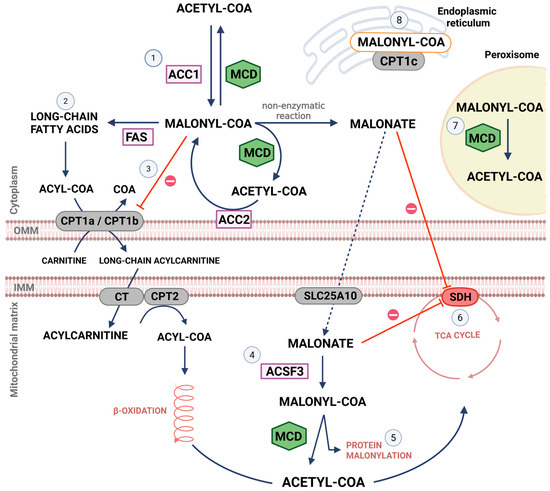
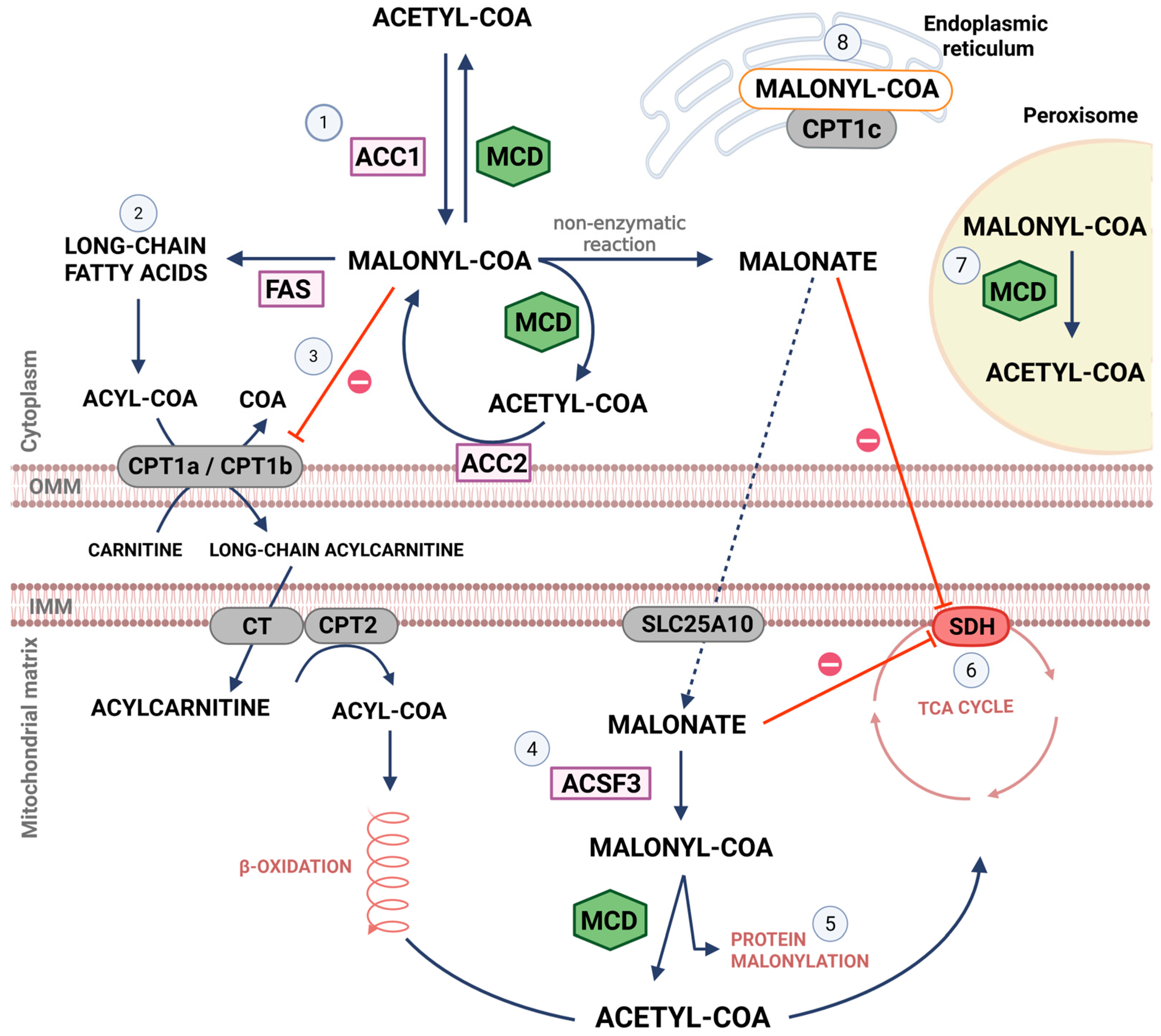
MCD has been reported in peripheral tissues, such as skeletal and cardiac muscles, liver, and kidney, and to a lesser extent in the brain [47,48]. MCD activity appears in mammals, birds, bacteria, plants and yeast [49,50,51,52,53,54,55,56]. MCD is a tetramer, and its subunits are linked by disulfide bonds. Each MCD monomer has an N-terminal domain and a C-terminal catalytic domain [57]. The Mlycd gene has different promoter regions that are responsible for MCD expression in different cellular compartments, producing organelle-specific isoforms of different molecular weights, including those in cytosol (52–54 kDa), mitochondria (50–51 kDa) and peroxisomes (48–49 kDa) [50,58,59,60] (Figure 1). In the N-terminus of MCD there is a sequence that directs the enzyme to the mitochondria, while in the C-terminus there is a motif that directs the enzyme to the peroxisomes [47].
Figure 1.
Metabolic pathways involving malonyl-CoA and malonyl-CoA decarboxylase (MCD) in the cytoplasm, mitochondria and peroxisomes. (1) MCD catalyzes the conversion of malonyl-CoA to acetyl-CoA. In the cytoplasm, malonyl-CoA is synthesized by acetyl-CoA carboxylase (ACC1 and ACC2) from acetyl-CoA. (2,3) Malonyl-CoA plays an important role for fatty acid biosynthesis, acting as well as an allosteric inhibitor of the carnitine palmitoyltransferase 1 (CPT1a and CPT1b). (4) In the mitochondria, malonyl-CoA is synthesized by acyl-CoA synthetase family member 3 (ACSF3) from malonate and then it is converted to acetyl-CoA by MCD. (5) Mitochondrial malonyl-CoA can also be important for malonylation of proteins. (6) Malonate is a classic inhibitor of succinate dehydrogenase (SDH) and it crosses the inner mitochondrial membrane through SLC25A10. (7) MCD may be involved in degrading intraperoxisomal malonyl-CoA, which is generated by the peroxisomal β-oxidation of odd chain-length dicarboxylic fatty acids. (8) In addition, malonyl-CoA can also play a role in the endoplasmic reticulum metabolic signaling by its binding to CPT1c (exclusively in the brain). CT, carnitine-acylcarnitine translocase; FAS, fatty acid synthetase; IMM, inner mitochondrial membrane; OMM, outer mitochondrial membrane; SLC25A10, solute carrier family 25 member 10; TCA, tricarboxylic acid cycle. The red arrows with circled minus (⊖) indicate inhibition. Created with BioRender.
The subcellular distribution of MCD in different tissues is not completely understood. MCD in rat liver is mainly localized in the cytosol, but it is also found in mitochondria and peroxisomes [47,61]. However, in goose liver it is found exclusively in mitochondria [61,62]. The data on MCD localization in the brain suggest a mitochondrial localization [62,63]. It is still in question whether brain MCD is also present in the cytosol or in peroxisomes. Intramitochondrial MCD affinity for malonyl-CoA differs between liver (Km = 0.04 mM) and brain (Km = 0.5 mM) [63,64]. Interestingly, affinity for malonyl-CoA when recombinant MCD is expressed in E. coli also differs when cloned from rats (Km = 0.068 mM) or humans (Km = 0.22 mM) [61,65].
An important area that needs more attention is the localization of MCD in different brain-cell types. In the 90s, the presence of MCD was suggested in some brain cells and regions of adult rats. MCD was reported in neurons and microglia of hippocampus and frontal cortex, and in microglia and Bergman glia in the cerebellum [66].
3.2. MCD Regulation
MCD activity and expression can modulate fatty acid metabolism. Inhibition of MCD results in inhibition of fatty acid oxidation by increasing malonyl-CoA levels [67,68,69,70,71]. In addition, increased MCD activity and expression were observed under conditions of increased fatty acid oxidation [48,72,73]. A few mechanisms have been proposed for the modulation of MCD activity, including post-transcriptional and -translational modifications [2,74,75]. MCD can have transcriptional regulation and have its expression increased by peroxisome proliferator-activated receptor-alpha (PPAR-α) in liver and in skeletal and cardiac muscles [74,76,77]. Post-translational modulation of human MCD expressed in Bombyx mori may include the phosphorylation of Ser-204 and Tyr-405 residues. Mutations of these residues lead to decreased decarboxylase activity [78]. Additionally, MCD activity is increased via AMPK phosphorylation during and after exercise in the muscle (especially in those with fast or moderate contraction), liver and adipose tissue [75,79]. MCD can also be regulated by sirtuin 4 (SIRT4), which deacetylates MCD and decreases its enzymatic activity in muscle and adipocyte cell lines [2]. There is no evidence regarding which specific MCD residues are involved in these latter modulations.
In the brain, different nutritional states may impact MCD expression. The role of MCD in the regulation of food intake has been observed in the hypothalamus through mechanisms that involve changes in malonyl-CoA levels and subsequent signaling via CPT1c [80,81,82]. In this scenario, MCD expression is higher in the hypothalamus of fasting animals [81]. In the pituitary gland, MCD expression is positively regulated by resistin, an adipokine that plays crucial roles including the regulation of lipid metabolism, food intake, and gonadal function [83].
3.3. MCD During Development
In the brain, the role of MCD is poorly explored, particularly during brain development. The brain develops through a sequence of cellular and functional events that define critical windows of development [84]. Neurogenesis occurs predominantly during the embryonic and early fetal periods, followed by neuronal migration and synaptic formation and refinement. Gliogenesis mainly occurs during late fetal stages, whereas myelination begins in the perinatal period and progresses into adulthood [85,86]. These events must be finely tuned and rely on dynamic metabolic support.
There is an increase in MCD expression in the brain and liver of rats throughout development [66]. In the rat brain, mitochondrial MCD activity progressively increases from the neonatal period into adulthood [48,87]. Whereas brain malonyl-CoA concentrations do not show large variations until adulthood, malonate levels increase with age [88]. Acetyl-CoA, another metabolite important for malonyl-CoA metabolism, has a relatively high expression at birth and slightly decreases with age [88]. The impact of brain MCD expression ontogeny on the levels of these compounds is still to be determined. Despite the lack of information on brain MCD expression during aging, it has been shown that there is increased MCD expression in the gastrocnemius of aged mice [7].
Interestingly, MCD deficiency caused by inherited mutations leads to malonic aciduria, an inborn error of metabolism (IEM) affecting brain structure and function in infant patients [4,89,90]. To date, the molecular mechanisms related to MCD dysfunction are poorly understood.
3.4. Malonyl-CoA Metabolism
Malonyl-CoA metabolism is summarized in Figure 1. The synthesis of cytoplasmic malonyl-CoA is undertaken by acetyl-CoA carboxylase. MCD catalyzes the decarboxylation of malonyl-CoA to acetyl-CoA [4]. Malonyl-CoA can be used as 2 carbon units for the biosynthesis of fatty acids by the fatty acid synthase and regulates fatty acid oxidation [91].
The first step in the transport of fatty acyl-CoA across the outer mitochondrial membrane for oxidation is catalyzed by carnitine palmitoyltransferase 1 (CPT1). CPT1 catalyzes the transfer of acyl moieties from acyl-CoA groups (chain length from C12 to C18) to L-carnitine to form fatty acyl-carnitines [92], releasing free CoA. Fatty acylcarnitine is then transported into the mitochondrial matrix in exchange for free carnitine by carnitine-acylcarnitine translocase. Finally, carnitine palmitoyltransferase 2 (CPT2) converts acylcarnitine to fatty acyl-CoA, which is then ready to be oxidized. Mitochondrial beta-oxidation releases acetyl-CoA at the end of every oxidative loop [93]. Acetyl-CoA is a remarkably versatile molecule [94]. Among its actions can be highlighted the fueling of the tricarboxylic acid cycle and therefore ATP production [95].
There are 3 forms of the human CPT1 enzyme: CPT1a, CPT1b, and CPT1c [96,97,98,99]. In the brain, both CPT1a and CPT1b are present especially in the outer mitochondrial membrane [100,101]. CPT1a is more expressed in astrocytes than in neurons, while there is no difference in CPT1b abundance between these cell types [102,103]. CPT1a is also present in microglia and plays a role in neuroinflammation suppression [104]. CPT1a and CPT1b are both inhibited by malonyl-CoA [20]. It has been suggested that only cytosolic malonyl-CoA can inhibit CPT1a and CPT1b, and therefore the oxidation of fatty acids [105].
CPT1c is found in the endoplasmic reticulum, and it is exclusively expressed in neurons [106]. It is found in many brain regions, as well as in the dorsal root ganglia and spinal cord [101,107,108]. Unlike CPT1a and CPT1b, CPT1c has low catalytic activity, using acyl-CoA esters as substrates in the physiological context [101,106,109,110]. Palmitoyltransferase activity of CPT1c is 20 to 300 times lower than that of CPT1a [106] and may contribute to the synthesis of ceramide and sphingolipids [106,111,112]. CPT1c-mediated ceramide synthesis was shown to be associated with appetite-related hormones [80,100,112,113,114,115].
In the brain, CPT1c may be important for dendritic spine maturation during brain development by increasing ceramide levels [111]. CPT1c ablation in mice disturbs synaptic plasticity and may lead to complications of cognitive functions, including learning and memory [116]. In addition, fluctuations of brain malonyl-CoA levels may impact GluA1 trafficking to the plasma membrane in a CPT1c-dependent manner. When CPT1c is devoid of malonyl-CoA, there is a stimulation of phosphoinositide phosphatase suppressor of actin 1 (SAC1) activity. SAC1 has been reported as a protein that regulates vesicular trafficking. Therefore, SAC1 stimulation by CPT1-c disrupts GluA1-containing AMPAr (alpha-amino-3-hydroxy-5-methyl-4-isoxazole propionic acid receptors) trafficking [117]. Hence CPT1c may be considered a strategic target in research related to alterations in the central nervous system.
Malonyl-CoA can also be synthesized in the mitochondria by the acyl-CoA synthetase family member 3 (ACSF3) by binding malonate with CoA [63,87,118]. Malonate is a classic competitive inhibitor of succinate dehydrogenase [119,120] and its main source of production is attributed to the non-enzymatic hydrolysis of cytoplasmic malonyl-CoA. Malonate can enter mitochondria via the dicarboxylate carrier SLC25A10 (solute carrier family 25 member 10), located in the inner mitochondrial membrane [121,122]. Thus, ACSF3 activity lowers intramitochondrial malonate levels, preventing its toxic accumulation [123]. It was hypothesized that mitochondrially synthesized malonyl-CoA can also be important for malonylation of proteins. For instance, malonylation increases the activity of acyl-CoA thioesterase 7 [124], an intracellular enzyme that converts acyl-CoA to free fatty acids and that is highly expressed in neurons [125]. In peroxisomes, malonyl-CoA generated by the peroxisomal beta-oxidation of odd chain-length dicarboxylic fatty acids is catabolized by MCD [61,126]. Additional roles described for malonyl-CoA involve microsomal incorporation into fatty acids used for myelin formation in the brain of young rodents [127].
4. MCD in the Pathophysiology of Diseases
4.1. MCD Deficiency: An Inborn Error of Metabolism (IEM)
Disorders involving inherited metabolic defects have gained attention in recent years since many patients present a good prognosis if diagnosed early and treated appropriately [128,129]. IEMs are a group of genetic metabolic diseases caused by a deficiency of protein, including enzymes and transporters, affecting multiple metabolic pathways. These defects lead to the accumulation of precursors that can become toxic [130]. The symptomatology is variable, but the central nervous system is frequently affected in IEM [131,132].
MCD deficiency (OMIM #248360), also called malonic aciduria, is an IEM caused by mutations in the MLYCD gene. Many pathogenic molecular variations have been associated with the MLYCD gene [133,134,135,136,137]. A loss of 30% of MCD activity is sufficient to impact the health of individuals [4,138], with some patients presenting approximately 15% of residual MCD activity [139]. It is not known whether complete ablation of MCD in humans would be compatible with life [133].
MCD deficiency is a disease that affects infants and can lead to neonatal sudden death. It has been reported that some patients may reach adulthood [133]. Newborns and children with MCD deficiency show a variable phenotype. Patients may present feeding difficulties and alterations in skeletal and cardiac muscles (e.g., hypotonia and cardiomyopathy) [89,140,141]. Many signs and symptoms are also frequently associated with neurological damage. Symptoms include seizures [90,133,135,136,137], neurodevelopmental delay (e.g., language and psychomotor impairment, and intellectual disability) [89,135,136,137] and brain magnetic resonance imaging abnormalities (e.g., generalized brain atrophy, white matter abnormalities, and cortical malformation) [90,135,136,142]. So far, the underlying mechanisms of tissue damage in MCD deficiency remain largely unknown, but malonic acid is a potential culprit. Patients with MCD deficiency may present and excrete much higher levels of malonic acid, a biochemical hallmark of the disease [133,139,142,143]. In healthy humans, malonic acid is found in body fluids, including cerebrospinal fluid, blood, saliva, and urine [133,142,144,145,146]. Table 1 shows the levels of malonic acid and MCD activity reported in patients with MCD deficiency and in healthy individuals. A drastic increase in malonic acid levels is also described in MCD knockout mice (approximately 200 times higher) [147]. Interestingly, MCD knockout mice show high early mortality rate, growth retardation, and early cardiac dysfunction [148].
Treatment options for patients with MCD deficiency involve oral levocarnitine administration and dietary management [133,134]. Levocarnitine enhances the synthesis and excretion of acylcarnitines, reducing the accumulation of potentially toxic metabolites and contributing to the restoration of the free CoA pool [149]. It can also improve fatty acid oxidation and attenuate mitochondrial dysfunction, being associated with clinical improvement in patients with MCD deficiency (especially when combined with specific dietary interventions) [149,150]. The dietary treatment often includes a combination of long-chain triglyceride-restricted diet with medium-chain triglyceride-supplemented diet to meet caloric and essential fatty acid requirements in the first few days of life [133,134]. A patient with presymptomatic diagnosis and early treatment showed only mild language and psychomotor delay, with normal cardiac function [151]. However, disease-specific dietary guidelines for MCD deficiency are still unavailable, so more efforts are needed to establish novel and/or more efficient therapeutical avenues for this disease.
Table 1.
Malonic acid levels and MCD activity in healthy individuals and MCD-deficient patients.
4.2. The Multifaceted Pathophysiological Impact of MCD
MCD impacts different pathophysiological processes. MCD overexpression in the hypothalamus has implications for obesity due to nutritional modulation mediated by the decrease in malonyl-CoA levels, stimulating food intake and progressive weight gain [152,153]. On the other hand, MCD ablation partially prevents the weight gain in rodents subjected to a high-fat diet [154]. MCD manipulation has also been suggested for the treatment of diabetes. Considering the interdependent relationship between the metabolism of glucose and fatty acids, decreased MCD activity and consequent increase of malonyl-CoA levels can favor glucose oxidation (thereby reducing blood glucose levels) [71,154,155]. In addition, MCD pharmacological suppression may be beneficial in the treatment of myocardial ischemia. MCD−/− mice exposed to acute ischemic stress showed a modulation of energy substrate preference (from fatty acids to glucose) in heart, leading to cardioprotection [71,154,155]. Furthermore, MCD inhibition protected cardiomyocytes from insulin resistance induced by lipopolysaccharide, a classic inducer of inflammation [46]. Thus, pharmacological manipulation of MCD activity may be considered a potential therapeutic target for a myriad of metabolic conditions.
5. Future Directions
MCD is an important enzyme that contributes to metabolic homeostasis in different tissues. However, many gaps are yet to be filled, particularly in the brain. Having robust understanding of MCD cellular and subcellular distribution in the brain, as well as the elucidation of brain MCD function and regulation, are exciting areas that warrant further research and development. There is an urgent need for future studies using cell-specific approaches to elucidate the role of MCD in each neural cell population for brain physiology and pathophysiology of various diseases. Potential studies include the use of malonyl-CoA biosensors [156] in different brain cell types following genetic or pharmacological manipulation of MCD. These approaches can contribute to the understanding of how intracellular malonyl-CoA levels impact pathways critical for brain homeostasis (e.g., neuroenergetics, brain fatty acids synthesis, CPT1c-driven signaling, etc.). Thus, the role of MCD in the brain needs to be further explored in the context of both health and disease, contributing to the understanding of (i) the physiological roles of this enzyme; (ii) the pathophysiology of MCD deficiency and diseases with altered MCD activity/malonyl-CoA levels; and (iii) the potential therapeutic value of this metabolic target.
Author Contributions
Conceptualization, M.F.-T. and G.C.F.; writing—original draft preparation, M.F.-T., E.S.B. and C.B.-V.; writing—review and editing, B.K.F., P.F.S. and G.C.F. All authors have read and agreed to the published version of the manuscript.
Funding
This work was supported by the Carlos Chagas Filho Research Support Foundation of the State of Rio de Janeiro (FAPERJ, Brazil) [E-26/200.448/2023; E-26/201.073/2022; E-26/211.289/2021; E-26/211.699/2021; E-26/210.048/2020; E-26/211.095/2019; E-26/010.002215/2019; E-26/202.668/2018; 426342/2018–6; 312157/2016–9] and the National Council for Scientific and Technological Development (CNPq, Brazil) [152312/2024-2; 312991/2021–5; 152071/2020–2; 311369/2020–0; 138008/2017–5].
Institutional Review Board Statement
Not applicable.
Informed Consent Statement
Not applicable.
Data Availability Statement
This study is based on previously published literature, and no new data was generated or analyzed.
Acknowledgments
The authors are grateful to Martha M. Sorenson for proofreading the manuscript.
Conflicts of Interest
The author declares no conflicts of interest.
Abbreviations
| ACC | Acetyl-CoA carboxylase |
| ACSF3 | Acyl-CoA synthetase family member 3 |
| AMPAr | Alpha-amino-3-hydroxy-5-methyl-4-isoxazole propionic acid receptors |
| AMPK | AMP-activated protein kinase |
| ATP | Adenosine triphosphate |
| CT | Carnitine-acylcarnitine translocase |
| CoA | Coenzyme A |
| CPT1a | Carnitine palmitoyltransferase 1a |
| CPT1b | Carnitine palmitoyltransferase 1b |
| CPT1c | Carnitine palmitoyltransferase 1c |
| CPT2 | Carnitine palmitoyltransferase 2 |
| CSF | Cerebrospinal fluid |
| FAS | Fatty acid synthase |
| IEM | Inborn errors of metabolism |
| IMM | Inner mitochondrial membrane |
| MCD | Malonyl-CoA decarboxylase |
| OMM | Outer mitochondrial membrane |
| OXPHOS | Oxidative phosphorylation |
| PPAR- α | Peroxisome proliferator-activated receptor alpha |
| SAC1 | Suppressor of actin 1 |
| SDH | Succinate dehydrogenase |
| SIRT4 | Sirtuin 4 |
| SLC25A10 | Solute carrier family 25 member 10 |
| TCA | Tricarboxylic acid cycle |
References
- Nicastro, R.; Brohée, L.; Alba, J.; Nüchel, J.; Figlia, G.; Kipschull, S.; Gollwitzer, P.; Romero-Pozuelo, J.; Fernandes, S.A.; Lamprakis, A.; et al. Malonyl-CoA Is a Conserved Endogenous ATP-Competitive MTORC1 Inhibitor. Nat. Cell Biol. 2023, 25, 1303–1318. [Google Scholar] [CrossRef] [Scilit]
- Laurent, G.; German, N.J.; Saha, A.K.; de Boer, V.C.J.; Davies, M.; Koves, T.R.; Dephoure, N.; Fischer, F.; Boanca, G.; Vaitheesvaran, B.; et al. SIRT4 Coordinates the Balance between Lipid Synthesis and Catabolism by Repressing Malonyl CoA Decarboxylase. Mol. Cell 2013, 50, 686–698. [Google Scholar] [CrossRef] [Scilit]
- Dyck, J.R.B.; Barr, A.J.; Barr, R.L.; Kolattukudy, P.E.; Lopaschuk, G.D. Characterization of Cardiac Malonyl-CoA Decarboxylase and Its Putative Role in Regulating Fatty Acid Oxidation. Am. J. Physiol. 1998, 275, H2122–H2129. [Google Scholar] [CrossRef] [Scilit]
- Brown, G.K.; Scholem, R.D.; Bankier, A.; Danks, D.M. Malonyl Coenzyme a Decarboxylase Deficiency. J. Inherit. Metab. Dis. 1984, 7, 21–26. [Google Scholar] [CrossRef] [Scilit]
- Lifson, N.; Stolen, J.A. Metabolism of C13-Carboxyl-Labeled Malonate by the Intact Mouse. Exp. Biol. Med. 1950, 74, 451–453. [Google Scholar] [CrossRef] [Scilit]
- Wang, W.; Zhang, L.; Battiprolu, P.K.; Fukushima, A.; Nguyen, K.; Milner, K.; Gupta, A.; Altamimi, T.; Byrne, N.; Mori, J.; et al. Malonyl CoA Decarboxylase Inhibition Improves Cardiac Function Post-Myocardial Infarction. JACC Basic Transl. Sci. 2019, 4, 385–400. [Google Scholar] [CrossRef] [Scilit] [PubMed]
- Ussher, J.R.; Fillmore, N.; Keung, W.; Zhang, L.; Mori, J.; Sidhu, V.K.; Fukushima, A.; Gopal, K.; Lopaschuk, D.G.; Wagg, C.S.; et al. Genetic and Pharmacological Inhibition of Malonyl CoA Decarboxylase Does Not Exacerbate Age-Related Insulin Resistance in Mice. Diabetes 2016, 65, 1883–1891. [Google Scholar] [CrossRef] [Scilit] [PubMed]
- Wolfgang, M.J.; Lane, M.D. Hypothalamic Malonyl-CoA and CPT1c in the Treatment of Obesity. FEBS J. 2011, 278, 552–558. [Google Scholar] [CrossRef] [Scilit] [PubMed]
- Tang, H.; Yan, Y.; Feng, Z.; De Jesus, R.K.; Yang, L.; Levorse, D.A.; Owens, K.A.; Akiyama, T.E.; Bergeron, R.; Castriota, G.A.; et al. Design and Synthesis of a New Class of Malonyl-CoA Decarboxylase Inhibitors with Anti-Obesity and Anti-Diabetic Activities. Bioorg. Med. Chem. Lett. 2010, 20, 6088–6092. [Google Scholar] [CrossRef] [Scilit]
- Ussher, J.R.; Koves, T.R.; Jaswal, J.S.; Zhang, L.; Ilkayeva, O.; Dyck, J.R.B.; Muoio, D.M.; Lopaschuk, G.D. Insulin-Stimulated Cardiac Glucose Oxidation Is Increased in High-Fat Diet-Induced Obese Mice Lacking Malonyl CoA Decarboxylase. Diabetes 2009, 58, 1766–1775. [Google Scholar] [CrossRef] [Scilit]
- Attwell, D.; Laughlin, S.B. An Energy Budget for Signaling in the Grey Matter of the Brain. J. Cereb. Blood Flow Metab. 2001, 21, 1133–1145. [Google Scholar] [CrossRef] [Scilit]
- Ebert, D.; Haller, R.G.; Walton, M.E. Energy Contribution of Octanoate to Intact Rat Brain Metabolism Measured by 13C Nuclear Magnetic Resonance Spectroscopy. J. Neurosci. 2003, 23, 5928–5935. [Google Scholar] [CrossRef] [Scilit]
- Schönfeld, P.; Reiser, G. Why Does Brain Metabolism Not Favor Burning of Fatty Acids to Provide Energy?—Reflections on Disadvantages of the Use of Free Fatty Acids as Fuel for Brain. J. Cereb. Blood Flow Metab. 2013, 33, 1493–1499. [Google Scholar] [CrossRef] [Scilit]
- Almeida, A.; Almeida, J.; Bolaños, J.P.; Moncada, S. Different Responses of Astrocytes and Neurons to Nitric Oxide: The Role of Glycolytically Generated ATP in Astrocyte Protection. Proc. Natl. Acad. Sci. USA 2001, 98, 15294–15299. [Google Scholar] [CrossRef] [Scilit]
- Blazey, T.; Vlassenko, A.G.; Goyal, M.S.; Soliman, H.; Cunningham, C.H.; von Morze, C. Spatial Distribution of Hyperpolarized [1-13C]Pyruvate MRI and Metabolic PET in the Human Brain. Imaging Neurosci. 2025, 3, IMAG.a.903. [Google Scholar] [CrossRef] [Scilit]
- Takahashi, S. Neuroprotective Function of High Glycolytic Activity in Astrocytes: Common Roles in Stroke and Neurodegenerative Diseases. Int. J. Mol. Sci. 2021, 22, 6568. [Google Scholar] [CrossRef] [Scilit]
- Bélanger, M.; Allaman, I.; Magistretti, P.J. Brain Energy Metabolism: Focus on Astrocyte-Neuron Metabolic Cooperation. Cell Metab. 2011, 14, 724–738. [Google Scholar] [CrossRef] [Scilit]
- Allaman, I.; Bélanger, M.; Magistretti, P.J. Astrocyte–Neuron Metabolic Relationships: For Better and for Worse. Trends Neurosci. 2011, 34, 76–87. [Google Scholar] [CrossRef] [Scilit]
- Yang, S.; Qin, C.; Hu, Z.-W.; Zhou, L.-Q.; Yu, H.-H.; Chen, M.; Bosco, D.B.; Wang, W.; Wu, L.-J.; Tian, D.-S. Microglia Reprogram Metabolic Profiles for Phenotype and Function Changes in Central Nervous System. Neurobiol. Dis. 2021, 152, 105290. [Google Scholar] [CrossRef] [Scilit]
- Romano, A.; Koczwara, J.B.; Gallelli, C.A.; Vergara, D.; Micioni Di Bonaventura, M.V.; Gaetani, S.; Giudetti, A.M. Fats for Thoughts: An Update on Brain Fatty Acid Metabolism. Int. J. Biochem. Cell Biol. 2017, 84, 40–45. [Google Scholar] [CrossRef] [Scilit]
- Jensen, N.J.; Wodschow, H.Z.; Nilsson, M.; Rungby, J. Effects of Ketone Bodies on Brain Metabolism and Function in Neurodegenerative Diseases. Int. J. Mol. Sci. 2020, 21, 8767. [Google Scholar] [CrossRef] [Scilit]
- Ueno, M.; Chiba, Y.; Murakami, R.; Miyai, Y.; Matsumoto, K.; Wakamatsu, K.; Takebayashi, G.; Uemura, N.; Yanase, K. Distribution of Monocarboxylate Transporters in Brain and Choroid Plexus Epithelium. Pharmaceutics 2023, 15, 2062. [Google Scholar] [CrossRef] [Scilit]
- Warshaw, J.B.; Terry, M.L. Cellular Energy Metabolism during Fetal Development. Dev. Biol. 1976, 52, 161–166. [Google Scholar] [CrossRef] [Scilit]
- Goyal, M.S.; Hawrylycz, M.; Miller, J.A.; Snyder, A.Z.; Raichle, M.E. Aerobic Glycolysis in the Human Brain Is Associated with Development and Neotenous Gene Expression. Cell Metab. 2014, 19, 49–57. [Google Scholar] [CrossRef] [Scilit]
- Lust, W.D.; Pundik, S.; Zechel, J.; Zhou, Y.; Buczek, M.; Selman, W.R. Changing Metabolic and Energy Profiles in Fetal, Neonatal, and Adult Rat Brain. Metab. Brain Dis. 2003, 18, 195–206. [Google Scholar] [CrossRef] [Scilit]
- Rust, R.S. Energy Metabolism of Developing Brain. Curr. Opin. Neurol. 1994, 7, 160–165. [Google Scholar] [CrossRef] [Scilit]
- Sauer, P.; Carnielli, V.; Sulkers, E.; van Goudoever, J. Substrate Utilization during the First Weeks of Life. Acta Paediatr. 1994, 83, 49–53. [Google Scholar] [CrossRef] [Scilit]
- Wen, L.; Wu, Y.; Yang, Y.; Han, T.L.; Wang, W.; Fu, H.; Zheng, Y.; Shan, T.; Chen, J.; Xu, P.; et al. Gestational Diabetes Mellitus Changes the Metabolomes of Human Colostrum, Transition Milk and Mature Milk. Med. Sci. Monit. 2019, 25, 6128–6152. [Google Scholar] [CrossRef] [Scilit]
- Belfort, M.B.; Stellwagen, L.; North, K.; Unger, S.; O’Connor, D.L.; Perrin, M.T. Deciphering Macronutrient Information about Human Milk. J. Perinatol. 2024, 44, 1377–1381. [Google Scholar] [CrossRef] [Scilit]
- Ranea-Robles, P.; Houten, S.M. The Biochemistry and Physiology of Long-Chain Dicarboxylic Acid Metabolism. Biochem. J. 2023, 480, 607–627. [Google Scholar] [CrossRef] [Scilit]
- Sangineto, M.; Ciarnelli, M.; Cassano, T.; Radesco, A.; Moola, A.; Bukke, V.N.; Romano, A.; Villani, R.; Kanwal, H.; Capitanio, N.; et al. Metabolic Reprogramming in Inflammatory Microglia Indicates a Potential Way of Targeting Inflammation in Alzheimer’s Disease. Redox Biol. 2023, 66, 102846. [Google Scholar] [CrossRef] [Scilit]
- Fünfschilling, U.; Supplie, L.M.; Mahad, D.; Boretius, S.; Saab, A.S.; Edgar, J.; Brinkmann, B.G.; Kassmann, C.M.; Tzvetanova, I.D.; Möbius, W.; et al. Glycolytic Oligodendrocytes Maintain Myelin and Long-Term Axonal Integrity. Nature 2012, 485, 517–521. [Google Scholar] [CrossRef] [Scilit]
- Amaral, A.I.; Meisingset, T.W.; Kotter, M.R.; Sonnewald, U. Metabolic Aspects of Neuron-Oligodendrocyte-Astrocyte Interactions. Front. Endocrinol. 2013, 4, 54. [Google Scholar] [CrossRef] [Scilit]
- Rinholm, J.E.; Hamilton, N.B.; Kessaris, N.; Richardson, W.D.; Bergersen, L.H.; Attwell, D. Regulation of Oligodendrocyte Development and Myelination by Glucose and Lactate. J. Neurosci. 2011, 31, 538–548. [Google Scholar] [CrossRef] [Scilit]
- Tepavčević, V. Oligodendroglial Energy Metabolism and (re)Myelination. Life 2021, 11, 238. [Google Scholar] [CrossRef] [Scilit]
- Simons, M.; Nave, K.-A. Oligodendrocytes: Myelination and Axonal Support. Cold Spring Harb. Perspect. Biol. 2016, 8, a020479. [Google Scholar] [CrossRef] [Scilit]
- Edmond, J.; Robbins, R.A.; Bergstrom, J.D.; Cole, R.A.; de Vellis, J. Capacity for Substrate Utilization in Oxidative Metabolism by Neurons, Astrocytes, and Oligodendrocytes from Developing Brain in Primary Culture. J. Neurosci. Res. 1987, 18, 551–561. [Google Scholar] [CrossRef] [Scilit]
- Sabogal-Guáqueta, A.M.; Marmolejo-Garza, A.; Trombetta-Lima, M.; Oun, A.; Hunneman, J.; Chen, T.; Koistinaho, J.; Lehtonen, S.; Kortholt, A.; Wolters, J.C.; et al. Species-Specific Metabolic Reprogramming in Human and Mouse Microglia during Inflammatory Pathway Induction. Nat. Commun. 2023, 14, 6454. [Google Scholar] [CrossRef] [Scilit]
- Marschallinger, J.; Iram, T.; Zardeneta, M.; Lee, S.E.; Lehallier, B.; Haney, M.S.; Pluvinage, J.V.; Mathur, V.; Hahn, O.; Morgens, D.W.; et al. Lipid-Droplet-Accumulating Microglia Represent a Dysfunctional and Proinflammatory State in the Aging Brain. Nat. Neurosci. 2020, 23, 194–208. [Google Scholar] [CrossRef] [Scilit]
- Bogie, J.F.J.; Timmermans, S.; Huynh-Thu, V.A.; Irrthum, A.; Smeets, H.J.M.; Gustafsson, J.Å.; Steffensen, K.R.; Mulder, M.; Stinissen, P.; Hellings, N.; et al. Myelin-Derived Lipids Modulate Macrophage Activity by Liver X Receptor Activation. PLoS ONE 2012, 7, e44998. [Google Scholar] [CrossRef] [Scilit]
- Jian, H.; Wu, K.; Lv, Y.; Du, J.; Hou, M.; Zhang, C.; Gao, J.; Zhou, H.; Feng, S. A Critical Role for Microglia in Regulating Metabolic Homeostasis and Neural Repair after Spinal Cord Injury. Free Radic. Biol. Med. 2024, 225, 469–481. [Google Scholar] [CrossRef] [Scilit]
- Bordt, E.A.; Polster, B.M. NADPH Oxidase- and Mitochondria-Derived Reactive Oxygen Species in Proinflammatory Microglial Activation: A Bipartisan Affair? Free Radic. Biol. Med. 2014, 76, 34–46. [Google Scholar] [CrossRef] [Scilit]
- Ransohoff, R.M.; Perry, V.H. Microglial Physiology: Unique Stimuli, Specialized Responses. Annu. Rev. Immunol. 2009, 27, 119–145. [Google Scholar] [CrossRef] [Scilit]
- Ransohoff, R.M.; Brown, M.A. Innate Immunity in the Central Nervous System. J. Clin. Investig. 2012, 122, 1164–1171. [Google Scholar] [CrossRef] [Scilit]
- Sica, A.; Mantovani, A. Macrophage Plasticity and Polarization: In Vivo Veritas. J. Clin. Investig. 2012, 122, 787–795. [Google Scholar] [CrossRef] [Scilit]
- Samokhvalov, V.; Ussher, J.R.; Fillmore, N.; Armstrong, I.K.G.; Keung, W.; Moroz, D.; Lopaschuk, D.G.; Seubert, J.; Lopaschuk, G.D. Inhibition of Malonyl-CoA Decarboxylase Reduces the Inflammatory Response Associated with Insulin Resistance Inhibition of Malonyl-CoA Decarboxylase Reduces the Inflamma-Tory Response Associated with Insulin Resistance. Am. J. Physiol. Endocrinol. Metab. 2012, 303, 1459–1468. [Google Scholar] [CrossRef] [Scilit]
- Voilley, N.; Roduit, R.; Vicaretti, R.; Bonny, C.; Waeber, G.; Dyck, J.R.; Lopaschuk, G.D.; Prentki, M. Cloning and Expression of Rat Pancreatic Beta-Cell Malonyl-CoA Decarboxylase. Biochem. J. 1999, 340, 213–217. [Google Scholar] [CrossRef]
- Sam Kim, Y.; Kolattukudy, P.E.; Boos, A. Malonyl-CoA Decarboxylase in Rat Brain Mitochondria. Int. J. Biochem. 1979, 10, 551–555. [Google Scholar] [CrossRef] [Scilit]
- Joly, E.; Bendayan, M.; Roduit, R.; Saha, A.K.; Ruderman, N.B.; Prentki, M. Malonyl-CoA Decarboxylase Is Present in the Cytosolic, Mitochondrial and Peroxisomal Compartments of Rat Hepatocytes. FEBS Lett. 2005, 579, 6581–6586. [Google Scholar] [CrossRef] [Scilit]
- Hunaiti, A.R.; Kolattukudy, P.E. Malonyl-CoA Decarboxylase from Streptomyces Erythreus: Purification, Properties, and Possible Role in the Production of Erythromycin. Arch. Biochem. Biophys. 1984, 229, 426–439. [Google Scholar] [CrossRef] [Scilit]
- Kresze, G.; Steber, L.; Oesterhelt, D.; Lynen, F. Reaction of Yeast Fatty Acid Synthetase with Iodoacetamide. Eur. J. Biochem. 1977, 79, 191–199. [Google Scholar] [CrossRef] [Scilit]
- Buckner, J.S.; Kolattukudy, P.E.; Poulose, A.J. Purification and Properties of Malonyl-Coenzyme A Decarboxylase, a Regulatory Enzyme from the Uropygial Gland of Goose. Arch. Biochem. Biophys. 1976, 177, 539–551. [Google Scholar] [CrossRef] [Scilit] [PubMed]
- Hatch, M.D.; Stumpf, P.K. Fat Metabolism in Higher Plants. XVII. Metabolism of Malonic Acid & Its α-Substituted Derivatives in Plants. Plant Physiol. 1962, 37, 121–126. [Google Scholar] [CrossRef] [Scilit]
- Nakada, H.I.; WOLFE, J.B.; WICK, A.N. Degradation of Malonic Acid by Rat Tissues. J. Biol. Chem. 1957, 226, 145–152. [Google Scholar] [CrossRef] [Scilit]
- Wolfe, J.B.; Ivler, D.; Rittenberg, S.C. Malonate Oxidation by Dry Cells and Cell-Free Extracts of Pseudomonas Fluorescens. J. Bacteriol. 1955, 69, 240–243. [Google Scholar] [CrossRef] [Scilit]
- Hayaishi, O. Enzymatic Decarboxylation of Malonic Acid. J. Biol. Chem. 1955, 215, 125–136. [Google Scholar] [CrossRef] [Scilit]
- Aparicio, D.; Perez-Luque, R.; Carpena, X.; Díaz, M.; Ferrer, J.C.; Loewen, P.C.; Fita, I. Structural Asymmetry and Disulfide Bridges among Subunits Modulate the Activity of Human Malonyl-CoA Decarboxylase. J. Biol. Chem. 2013, 288, 11907–11919. [Google Scholar] [CrossRef] [Scilit]
- Dyck, J.R.B.; Berthiaume, L.G.; Thomas, P.D.; Kantor, P.F.; Barr, A.J.; Barr, R.; Singh, D.; Hopkins, T.A.; Voilley, N.; Prentki, M.; et al. Characterization of Rat Liver Malonyl-CoA Decarboxylase and the Study of Its Role in Regulating Fatty Acid Metabolism. Biochem. J. 2000, 350, 599. [Google Scholar] [CrossRef]
- Jang, S.H.; Cheesbrough, T.M.; Kolattukudy, P.E. Molecular Cloning, Nucleotide Sequence, and Tissue Distribution of Malonyl-CoA Decarboxylase. J. Biol. Chem. 1989, 264, 3500–3505. [Google Scholar] [CrossRef] [Scilit]
- Kerner, J.; Hoppel, C.L. Radiochemical Malonyl-CoA Decarboxylase Assay: Activity and Subcellular Distribution in Heart and Skeletal Muscle. Anal. Biochem. 2002, 306, 283–289. [Google Scholar] [CrossRef] [Scilit]
- Sacksteder, K.A.; Morrell, J.C.; Wanders, R.J.A.; Matalon, R.; Gould, S.J. MCD Encodes Peroxisomal and Cytoplasmic Forms of Malonyl-CoA Decarboxylase and Is Mutated in Malonyl-CoA Decarboxylase Deficiency. J. Biol. Chem. 1999, 274, 24461–24468. [Google Scholar] [CrossRef] [Scilit] [PubMed]
- Kim, Y.S.; Kollttukudy, P.E.; Boos, A. Dual Sites of Occurrence of Malonyl-CoA Decarboxylase and Their Possible Functional Significance in Avian Tissues. Comp. Biochem. Physiol. Part B Comp. Biochem. 1979, 62, 443–447. [Google Scholar] [CrossRef] [Scilit] [PubMed]
- Koeppen, A.H.; Mitzen, E.J.; Ammoumi, A.A. Malonate Metabolism in Rat Brain Mitochondria. Biochemistry 1974, 13, 3589–3595. [Google Scholar] [CrossRef] [Scilit]
- Scholte, H.R. The Intracellular and Intramitochondrial Distribution of Malonyl-CoA Decarboxylase and Propionyl-CoA Carboxylase in Rat Liver. Biochim. Biophys. Acta 1969, 178, 137–144. [Google Scholar] [CrossRef] [Scilit]
- Lee, G.-Y.; Bahk, Y.-Y.; Kim, Y.-S. Rat Malonyl-CoA Decarboxylase; Cloning, Expression in E. Coli and Its Biochemical Characterization. J. Biochem. Biol. 2002, 35, 213–219. [Google Scholar] [CrossRef] [Scilit] [PubMed]
- Dickson, A.C.; McEvoy, J.A.; Koeppen, A.H. The Cellular Localization of Malonyl-Coenzyme A Decarboxylase in Rat Brain. Neurochem. Res. 1994, 19, 1271–1276. [Google Scholar] [CrossRef] [Scilit]
- Cheng, M.L.; Yang, C.H.; Wu, P.T.; Li, Y.C.; Sun, H.W.; Lin, G.; Ho, H.Y. Malonyl-CoA Accumulation as a Compensatory Cytoprotective Mechanism in Cardiac Cells in Response to 7-Ketocholesterol-Induced Growth Retardation. Int. J. Mol. Sci. 2023, 24, 4418. [Google Scholar] [CrossRef] [Scilit]
- Folmes, C.; Lopaschuk, G. Role of Malonyl-CoA in Heart Disease and the Hypothalamic Control of Obesity. Cardiovasc. Res. 2007, 73, 278–287. [Google Scholar] [CrossRef] [Scilit]
- Gao, L.; Chiou, W.; Tang, H.; Cheng, X.; Camp, H.S.; Burns, D.J. Simultaneous Quantification of Malonyl-CoA and Several Other Short-Chain Acyl-CoAs in Animal Tissues by Ion-Pairing Reversed-Phase HPLC/MS. J. Chromatogr. B Anal. Technol. Biomed. Life Sci. 2007, 853, 303–313. [Google Scholar] [CrossRef] [Scilit]
- Stanley, W.C.; Morgan, E.E.; Huang, H.; Mcelfresh, T.A.; Sterk, J.P.; Okere, I.C.; Chandler, M.P.; Cheng, J.; Dyck, J.R.B.; Lopaschuk, G.D.; et al. Malonyl-CoA Decarboxylase Inhibition Suppresses Fatty Acid Oxidation and Reduces Lactate Production during Demand-Induced Ischemia Malonyl-CoA Decarboxylase Inhibition Suppresses Fatty Acid Oxida-Tion and Reduces Lactate Production during Demand-Induced Ischemia. Am. J. Physiol. Heart Circ. Physiol. 2005, 289, 2304–2309. [Google Scholar] [CrossRef] [Scilit]
- Dyck, J.R.B.; Cheng, J.F.; Stanley, W.C.; Barr, R.; Chandler, M.P.; Brown, S.; Wallace, D.; Arrhenius, T.; Harmon, C.; Yang, G.; et al. Malonyl Coenzyme a Decarboxylase Inhibition Protects the Ischemic Heart by Inhibiting Fatty Acid Oxidation and Stimulating Glucose Oxidation. Circ. Res. 2004, 94, e78–e84. [Google Scholar] [CrossRef] [Scilit]
- Sutendra, G.; Bonnet, S.; Rochefort, G.; Haromy, A.; Folmes, K.D.; Lopaschuk, G.D.; Dyck, J.R.B.; Michelakis, E.D. Fatty Acid Oxidation and Malonyl-CoA Decarboxylase in the Vascular Remodeling of Pulmonary Hypertension. Sci. Transl. Med. 2010, 2, 44ra58. [Google Scholar] [CrossRef] [Scilit] [PubMed]
- Young, M.E.; Goodwin, G.W.; Ying, J.; Guthrie, P.; Wilson, C.R.; Laws, F.A.; Taegtmeyer, H. Regulation of Cardiac and Skeletal Muscle Malonyl-CoA Decarboxylase by Fatty Acids. Am. J. Physiol. Endocrinol. Metabol. 2001, 280, E471–E479. [Google Scholar] [CrossRef] [Scilit]
- Muoio, D.M.; Way, J.M.; Tanner, C.J.; Winegar, D.A.; Kliewer, S.A.; Houmard, J.A.; Kraus, W.E.; Dohm, G.L. Peroxisome Proliferator-Activated Receptor-α Regulates Fatty Acid Utilization in Primary Human Skeletal Muscle Cells. Diabetes 2002, 51, 901–909. [Google Scholar] [CrossRef] [Scilit]
- Park, H.; Kaushik, V.K.; Constant, S.; Prentki, M.; Przybytkowski, E.; Ruderman, N.; Saha, A.K. Coordinate Regulation of Malonyl-CoA Decarboxylase, Sn-Glycerol-3-Phosphate Acyltransferase, and Acetyl-CoA Carboxylase by AMP-Activated Protein Kinase in Rat Tissues in Response to Exercise. J. Biol. Chem. 2002, 277, 32571–32577. [Google Scholar] [CrossRef] [Scilit]
- Lee, G.Y.; Kim, N.H.; Zhao, Z.-S.; Cha, B.S.; Kim, Y.S. Peroxisomal-Proliferator-Activated Receptor Alpha Activates Transcription of the Rat Hepatic Malonyl-CoA Decarboxylase Gene: A Key Regulation of Malonyl-CoA Level. Biochem. J. 2004, 378, 983–990. [Google Scholar] [CrossRef] [Scilit]
- Campbell, F.M.; Kozak, R.; Wagner, A.; Altarejos, J.Y.; Dyck, J.R.B.; Belke, D.D.; Severson, D.L.; Kelly, D.P.; Lopaschuk, G.D. A Role for Peroxisome Proliferator-Activated Receptor α (PPARα) in the Control of Cardiac Malonyl-CoA Levels: Reduced Fatty Acid Oxidation Rates and Increased Glucose Oxidation Rates in the Hearts of Mice Lacking PPARα Are Associated with Higher Concentrations of Malonyl-CoA and Reduced Expression of Malonyl-CoA Decarboxylase. J. Biol. Chem. 2002, 277, 4098–4103. [Google Scholar] [CrossRef] [Scilit]
- Hwang, I.W.; Makishima, Y.; Suzuki, T.; Kato, T.; Park, S.; Terzic, A.; Chung, S.K.; Park, E.Y. Phosphorylation of Ser-204 and Tyr-405 in Human Malonyl-CoA Decarboxylase Expressed in Silkworm Bombyx Mori Regulates Catalytic Decarboxylase Activity. Appl. Microbiol. Biotechnol. 2015, 99, 8977–8986. [Google Scholar] [CrossRef] [Scilit] [PubMed]
- Saha, A.K.; Schwarsin, A.J.; Roduit, R.; Masse, F.; Kaushik, V.; Tornheim, K.; Prentki, M.; Ruderman, N.B. Activation of Malonyl-CoA Decarboxylase in Rat Skeletal Muscle by Contraction and the AMP-Activated Protein Kinase Activator 5-Aminoimidazole-4-Carboxamide-1-β-d-Ribofuranoside. J. Biol. Chem. 2000, 275, 24279–24283. [Google Scholar] [CrossRef] [Scilit]
- Gao, S.; Zhu, G.; Gao, X.; Wu, D.; Carrasco, P.; Casals, N.; Hegardt, F.G.; Moran, T.H.; Lopaschuk, G.D. Important Roles of Brain-Specific Carnitine Palmitoyltransferase and Ceramide Metabolism in Leptin Hypothalamic Control of Feeding. Proc. Natl. Acad. Sci. USA 2011, 108, 9691–9696. [Google Scholar] [CrossRef] [Scilit]
- Lopaschuk, G.D.; Ussher, J.R.; Jaswal, J.S. Targeting Intermediary Metabolism in the Hypothalamus as a Mechanism to Regulate Appetite. Pharmacol. Rev. 2010, 62, 237–264. [Google Scholar] [CrossRef] [Scilit]
- Obici, S.; Feng, Z.; Arduini, A.; Conti, R.; Rossetti, L. Inhibition of Hypothalamic Carnitine Palmitoyltransferase-1 Decreases Food Intake and Glucose Production. Nat. Med. 2003, 9, 756–761. [Google Scholar] [CrossRef] [Scilit] [PubMed]
- Rodriguez-Pacheco, F.; Novelle, M.G.; Vazquez, M.J.; Garcia-Escobar, E.; Soriguer, F.; Rojo-Martinez, G.; García-Fuentes, E.; Malagon, M.M.; Dieguez, C. Resistin Regulates Pituitary Lipid Metabolism and Inflammation in Vivo and in Vitro. Mediat. Inflamm. 2013, 2013, 479739. [Google Scholar] [CrossRef] [Scilit]
- Chakraborty, R.; Vijay Kumar, M.J.; Clement, J.P. Critical Aspects of Neurodevelopment. Neurobiol. Learn. Mem. 2021, 180, 107415. [Google Scholar] [CrossRef] [Scilit]
- Graham, A.M.; Marr, M.; Buss, C.; Sullivan, E.L.; Fair, D.A. Understanding Vulnerability and Adaptation in Early Brain Development Using Network Neuroscience. Trends Neurosci. 2021, 44, 276–288. [Google Scholar] [CrossRef] [Scilit]
- Menassa, D.A.; Gomez-Nicola, D. Microglial Dynamics During Human Brain Development. Front. Immunol. 2018, 9, 1014. [Google Scholar] [CrossRef] [Scilit]
- Mitzen, E.J.; Ammoumi, A.A.; Koeppen, A.H. Developmental Changes in Malonate-Related Enzymes of Rat Brain. Arch. Biochem. Biophys. 1976, 175, 436–442. [Google Scholar] [CrossRef] [Scilit]
- Mitzen, E.J.; Koeppen, A.H. Malonate, Malonyl-Coenzyme A, and Acetyl-Coenzyme A in Developing Rat Brain. J. Neurochem. 1984, 43, 499–506. [Google Scholar] [CrossRef] [Scilit] [PubMed]
- Snanoudj, S.; Torre, S.; Sudrié-Arnaud, B.; Abily-Donval, L.; Goldenberg, A.; Salomons, G.S.; Marret, S.; Bekri, S.; Tebani, A. Heterogenous Clinical Landscape in a Consanguineous Malonic Aciduria Family. Int. J. Mol. Sci. 2021, 22, 12633. [Google Scholar] [CrossRef] [Scilit]
- De Wit, M.C.Y.; De Coo, I.F.M.; Verbeek, E.; Schot, R.; Schoonderwoerd, G.C.; Duran, M.; De Klerk, J.B.C.; Huijmans, J.G.M.; Lequin, M.H.; Verheijen, F.W.; et al. Brain Abnormalities in a Case of Malonyl-CoA Decarboxylase Deficiency. Mol. Genet. Metab. 2006, 87, 102–106. [Google Scholar] [CrossRef] [Scilit]
- Foster, D.W. Malonyl-CoA: The Regulator of Fatty Acid Synthesis and Oxidation. J. Clin. Investig. 2012, 122, 1958–1959. [Google Scholar] [CrossRef] [Scilit]
- Lopes, V.G.; Filho, A.d.B.C.; Yoshinaga, M.Y.; Hirata, M.H.; Ferreira, G.M. Carnitine Palmitoyl Transferase I: Conformational Changes Induced by Long-Chain Fatty Acyl CoA Ligands. J. Mol. Graph. Model. 2022, 112, 108125. [Google Scholar] [CrossRef] [Scilit]
- Adeva-Andany, M.M.; Carneiro-Freire, N.; Seco-Filgueira, M.; Fernández-Fernández, C.; Mouriño-Bayolo, D. Mitochondrial β-Oxidation of Saturated Fatty Acids in Humans. Mitochondrion 2019, 46, 73–90. [Google Scholar] [CrossRef] [Scilit]
- Shi, L.; Tu, B.P. Acetyl-CoA and the Regulation of Metabolism: Mechanisms and Consequences. Curr. Opin. Cell Biol. 2015, 33, 125–131. [Google Scholar] [CrossRef] [Scilit]
- Arnold, P.K.; Finley, L.W.S. Regulation and Function of the Mammalian Tricarboxylic Acid Cycle. J. Biol. Chem. 2023, 299, 102838. [Google Scholar] [CrossRef] [Scilit]
- Bonnefont, J.P.; Djouadi, F.; Prip-Buus, C.; Gobin, S.; Munnich, A.; Bastin, J. Carnitine Palmitoyltransferases 1 and 2: Biochemical, Molecular and Medical Aspects. Mol. Asp. Med. 2004, 25, 495–520. [Google Scholar] [CrossRef] [Scilit]
- Yamazaki, N.; Shinohara, Y.; Shima, A.; Terada, H. High Expression of a Novel Carnitine Palmitoyltransferase I like Protein in Rat Brown Adipose Tissue and Heart: Isolation and Characterization of Its CDNA Clone. FEBS Lett. 1995, 363, 41–45. [Google Scholar] [CrossRef] [Scilit] [PubMed]
- Esser, V.; Britton, C.H.; Weis, B.C.; Foster, D.W.; McGarry, J.D. Cloning, Sequencing, and Expression of a CDNA Encoding Rat Liver Carnitine Palmitoyltransferase I: Direct Evidence That a Single Polypeptide Is Involved in Inhibitor Interaction and Catalytic Function. J. Biol. Chem. 1993, 268, 5817–5822. [Google Scholar] [CrossRef] [Scilit] [PubMed]
- Fritz, I.B.; Yue, K.T.N. Long-Chain Carnitine Acyltransferase and the Role of Acylcarnitine Derivatives in the Catalytic Increase of Fatty Acid Oxidation Induced by Carnitine. J. Lipid Res. 1963, 4, 279–288. [Google Scholar] [CrossRef] [Scilit] [PubMed]
- Fadó, R.; Rodríguez-Rodríguez, R.; Casals, N. The Return of Malonyl-CoA to the Brain: Cognition and Other Stories. Prog. Lipid Res. 2021, 81, 101071. [Google Scholar] [CrossRef] [Scilit]
- Price, N.T.; Van Der Leij, F.R.; Jackson, V.N.; Corstorphine, C.G.; Thomson, R.; Sorensen, A.; Zammit, V.A. A Novel Brain-Expressed Protein Related to Carnitine Palmitoyltransferase I. Genomics 2002, 80, 433–442. [Google Scholar] [CrossRef] [Scilit]
- Morant-Ferrando, B.; Jimenez-Blasco, D.; Alonso-Batan, P.; Agulla, J.; Lapresa, R.; Garcia-Rodriguez, D.; Yunta-Sanchez, S.; Lopez-Fabuel, I.; Fernandez, E.; Carmeliet, P.; et al. Fatty Acid Oxidation Organizes Mitochondrial Supercomplexes to Sustain Astrocytic ROS and Cognition. Nat. Metab. 2023, 5, 1290–1302. [Google Scholar] [CrossRef] [Scilit]
- Jernberg, J.N.; Bowman, C.E.; Wolfgang, M.J.; Scafidi, S. Developmental Regulation and Localization of Carnitine Palmitoyltransferases (CPTs) in Rat Brain. J. Neurochem. 2017, 142, 407–419. [Google Scholar] [CrossRef] [Scilit] [PubMed]
- Li, W.; Li, Y.; Chen, Y.; Wang, Y.; Qian, L. CPT1A Ameliorates Microglia-Induced Neuroinflammation via Facilitating VDR Succinylation. Sci. Rep. 2025, 15, 5181. [Google Scholar] [CrossRef] [Scilit]
- Cuthbert, K.D.; Dyck, J.R. Malonyl-CoA decarboxylase is a major regulator of myocardial fatty acid oxidation. Curr. Hypertens. Rep. 2005, 7, 407–411. [Google Scholar] [CrossRef] [Scilit] [PubMed]
- Sierra, A.Y.; Gratacós, E.; Carrasco, P.; Clotet, J.; Ureña, J.; Serra, D.; Asins, G.; Hegardt, F.G.; Casals, N. CPT1c Is Localized in Endoplasmic Reticulum of Neurons and Has Carnitine Palmitoyltransferase Activity. J. Biol. Chem. 2008, 283, 6878–6885. [Google Scholar] [CrossRef] [Scilit] [PubMed]
- Casals, N.; Zammit, V.; Herrero, L.; Fadó, R.; Rodríguez-Rodríguez, R.; Serra, D. Carnitine Palmitoyltransferase 1C: From Cognition to Cancer. Prog. Lipid Res. 2016, 61, 134–148. [Google Scholar] [CrossRef] [Scilit]
- Rinaldi, C.; Schmidt, T.; Situ, A.J.; Johnson, J.O.; Lee, P.R.; Chen, K.L.; Bott, L.C.; Fadó, R.; Harmison, G.H.; Parodi, S.; et al. Mutation in CPT1C Associated with Pure Autosomal Dominant Spastic Paraplegia. JAMA Neurol. 2015, 72, 561–570. [Google Scholar] [CrossRef] [Scilit]
- Wang, C.Y.; Wang, C.H.; Mai, R.T.; Chen, T.W.; Li, C.W.; Chao, C.H. Mutant P53-MicroRNA-200c-ZEB2-Axis-Induced CPT1C Elevation Contributes to Metabolic Reprogramming and Tumor Progression in Basal-Like Breast Cancers. Front. Oncol. 2022, 12, 940402. [Google Scholar] [CrossRef] [Scilit]
- Wolfgang, M.J.; Cha, S.H.; Millington, D.S.; Cline, G.; Shulman, G.I.; Suwa, A.; Asaumi, M.; Kurama, T.; Shimokawa, T.; Lane, M.D. Brain-Specific Carnitine Palmitoyl-Transferase-1c: Role in CNS Fatty Acid Metabolism, Food Intake, and Body Weight. J. Neurochem. 2008, 105, 1550–1559. [Google Scholar] [CrossRef] [Scilit]
- Carrasco, P.; Sahún, I.; McDonald, J.; Ramírez, S.; Jacas, J.; Gratacós, E.; Sierra, A.Y.; Serra, D.; Herrero, L.; Acker-Palmer, A.; et al. Ceramide Levels Regulated by Carnitine Palmitoyltransferase 1C Control Dendritic Spine Maturation and Cognition. J. Biol. Chem. 2012, 287, 21224–21232. [Google Scholar] [CrossRef] [Scilit]
- Rodríguez-Rodríguez, R.; Fosch, A.; Garcia-Chica, J.; Zagmutt, S.; Casals, N. Targeting Carnitine Palmitoyltransferase 1 Isoforms in the Hypothalamus: A Promising Strategy to Regulate Energy Balance. J. Neuroendocrinol. 2023, 35, e13234. [Google Scholar] [CrossRef] [Scilit]
- Rodríguez-Rodríguez, R.; Miralpeix, C.; Fosch, A.; Pozo, M.; Calderón-Domínguez, M.; Perpinyà, X.; Vellvehí, M.; López, M.; Herrero, L.; Serra, D.; et al. CPT1C in the Ventromedial Nucleus of the Hypothalamus Is Necessary for Brown Fat Thermogenesis Activation in Obesity. Mol. Metab. 2019, 19, 75–85. [Google Scholar] [CrossRef] [Scilit]
- Wolfgang, M.J.; Kurama, T.; Dai, Y.; Suwa, A.; Asaumi, M.; Matsumoto, S.; Cha, S.H.; Shimokawa, T.; Lane, M.D. The Brain-Specific Carnitine Palmitoyltransferase-1c Regulates Energy Homeostasis. Proc. Natl. Acad. Sci. USA 2006, 103, 7282–7287. [Google Scholar] [CrossRef] [Scilit] [PubMed]
- Ramírez, S.; Martins, L.; Jacas, J.; Carrasco, P.; Pozo, M.; Clotet, J.; Serra, D.; Hegardt, F.G.; Diéguez, C.; López, M.; et al. Hypothalamic Ceramide Levels Regulated by Cpt1c Mediate the Orexigenic Effect of Ghrelin. Diabetes 2013, 62, 2329–2337. [Google Scholar] [CrossRef] [Scilit]
- Iborra-Lázaro, G.; Djebari, S.; Sánchez-Rodríguez, I.; Gratacòs-Batlle, E.; Sánchez-Fernández, N.; Radošević, M.; Casals, N.; Navarro-López, J.d.D.; Soto del Cerro, D.; Jiménez-Díaz, L. CPT1C Is Required for Synaptic Plasticity and Oscillatory Activity That Supports Motor, Associative and Non-associative Learning. J. Physiol. 2023, 601, 3533–3556. [Google Scholar] [CrossRef] [Scilit] [PubMed]
- Casas, M.; Fadó, R.; Domínguez, J.L.; Roig, A.; Kaku, M.; Chohnan, S.; Solé, M.; Unzeta, M.; Miñano-Molina, A.J.; Rodríguez-Álvarez, J.; et al. Sensing of Nutrients by CPT1C Controls SAC1 Activity to Regulate AMPA Receptor Trafficking. J. Cell Biol. 2020, 219, e201912045. [Google Scholar] [CrossRef] [Scilit]
- Witkowski, A.; Thweatt, J.; Smith, S. Mammalian ACSF3 Protein Is a Malonyl-CoA Synthetase That Supplies the Chain Extender Units for Mitochondrial Fatty Acid Synthesis. J. Biol. Chem. 2011, 286, 33729–33736. [Google Scholar] [CrossRef] [Scilit]
- Thorn, M.B. Inhibition by Malonate of Succinic Dehydrogenase in Heart-Muscle Preparations. Biochem. J. 1953, 54, 540–547. [Google Scholar] [CrossRef] [Scilit]
- Krebs, H.A.; Salvin, E.; Johnson, W.A. The Formation of Citric and α-Ketoglutaric Acids in the Mammalian Body. Biochem. J. 1938, 32, 113–117. [Google Scholar] [CrossRef] [Scilit] [PubMed]
- Saint-Macary, M.; Foucher, B. Binding of Malonate to the Inner Membrane of Rat Liver Mitochondria. Biochem. Biophys. Res. Commun. 1980, 96, 457–462. [Google Scholar] [CrossRef] [Scilit]
- Mirandola, S.R.; Melo, D.R.; Schuck, P.F.; Ferreira, G.C.; Wajner, M.; Castilho, R.F. Methylmalonate Inhibits Succinate-Supported Oxygen Consumption by Interfering with Mitochondrial Succinate Uptake. J. Inherit. Metab. Dis. 2008, 31, 44–54. [Google Scholar] [CrossRef] [Scilit]
- Bowman, C.E.; Wolfgang, M.J. Role of the Malonyl-CoA Synthetase ACSF3 in Mitochondrial Metabolism. Adv. Biol. Regul. 2019, 71, 34–40. [Google Scholar] [CrossRef] [Scilit]
- Wang, W.; Ma, C.; Zhang, Q.; Jiang, Y. TMT-Labeled Quantitative Malonylome Analysis on the Longissimus Dorsi Muscle of Laiwu Pigs Reveals the Role of ACOT7 in Fat Deposition. J. Proteom. 2024, 298, 105129. [Google Scholar] [CrossRef] [Scilit]
- Kuramochi, Y.; Takagi-Sakuma, M.; Kitahara, M.; Emori, R.; Asaba, Y.; Sakaguchi, R.; Watanabe, T.; Kuroda, J.; Hiratsuka, K.; Nagae, Y.; et al. Characterization of Mouse Homolog of Brain Acyl-CoA Hydrolase: Molecular Cloning and Neuronal Localization. Mol. Brain Res. 2002, 98, 81–92. [Google Scholar] [CrossRef] [Scilit] [PubMed]
- Suzuki, H.; Yamada, J.; Watanabe, T.; Suga, T. Compartmentation of Dicarboxylic Acid β-Oxidation in Rat Liver: Importance of Peroxisomes in the Metabolism of Dicarboxylic Acids. Biochim. Biophys. Acta Gen. Subj. 1989, 990, 25–30. [Google Scholar] [CrossRef] [Scilit]
- Morita, M.; Kawamichi, M.; Shimura, Y.; Kawaguchi, K.; Watanabe, S.; Imanaka, T. Brain Microsomal Fatty Acid Elongation Is Increased in Abcd1-Deficient Mouse during Active Myelination Phase. Metab. Brain Dis. 2015, 30, 1359–1367. [Google Scholar] [CrossRef] [Scilit]
- Schuck, P.F.; Ferreira, G.C.; McKenna, M.C. Recent Advances in the Pathophysiology of Inherited Metabolic Diseases. Int. J. Dev. Neurosci. 2020, 80, 50–51. [Google Scholar] [CrossRef] [Scilit]
- Fukao, T.; Nakamura, K. Advances in Inborn Errors of Metabolism. J. Hum. Genet. 2019, 64, 65. [Google Scholar] [CrossRef] [Scilit] [PubMed]
- Ferreira, C.R.; van Karnebeek, C.D.M. Inborn Errors of Metabolism. In Handbook of Clinical Neurology; Elsevier: Amsterdam, The Netherlands, 2019; Volume 162, pp. 449–481. [Google Scholar] [CrossRef] [Scilit]
- Saudubray, J.-M.; Garcia-Cazorla, A. An Overview of Inborn Errors of Metabolism Affecting the Brain: From Neurodevelopment to Neurodegenerative Disorders. Dial. Clin. Neurosci. 2018, 20, 301–325. [Google Scholar] [CrossRef] [Scilit]
- Duarte, J. Metabolic Disturbances in Diseases with Neurological Involvement. Aging Dis. 2014, 5, 238–255. [Google Scholar] [CrossRef] [Scilit] [PubMed]
- Zhang, J.M.; Hao, L.L.; Qiu, W.J.; Zhang, H.W.; Chen, T.; Ji, W.J.; Zhang, Y.; Liu, F.; Gu, X.F.; Yang, S.H.; et al. Clinical, Biochemical and Genetic Characteristics and Long-Term Follow-up of Five Patients with Malonyl-CoA Decarboxylase Deficiency. Brain Dev. 2024, 46, 286–293. [Google Scholar] [CrossRef] [Scilit]
- Zhao, C.; Peng, H.; Jiang, N.; Liu, Y.; Chen, Y.; Liu, J.; Guo, Q.; Wu, Z.; Wang, L. A Case of Malonyl Coenzyme A Decarboxylase Deficiency with Novel Mutations and Literature Review. Front. Pediatr. 2023, 11, 1133134. [Google Scholar] [CrossRef] [Scilit] [PubMed]
- Chapel-Crespo, C.; Gavrilov, D.; Sowa, M.; Myers, J.; Day-Salvatore, D.L.; Lynn, H.; Regier, D.; Starin, D.; Steenari, M.; Schoonderwoerd, K.; et al. Clinical, Biochemical and Molecular Characteristics of Malonyl-CoA Decarboxylase Deficiency and Long-Term Follow-up of Nine Patients. Mol. Genet. Metab. 2019, 128, 113–121. [Google Scholar] [CrossRef] [Scilit]
- Salomons, G.S.; Jakobs, C.; Pope, L.; Errami, A.; Potter, M.; Nowaczyk, M.; Olpin, S.; Manning, N.; Raiman, J.A.J.; Slade, T.; et al. Clinical, Enzymatic and Molecular Characterization of Nine New Patients with Malonyl-Coenzyme A Decarboxylase Deficiency. J. Inherit. Metab. Dis. 2007, 30, 23–28. [Google Scholar] [CrossRef] [Scilit]
- Xue, J.; Peng, J.; Zhou, M.; Zhong, L.; Yin, F.; Liang, D.; Wu, L. Novel Compound Heterozygous Mutation of MLYCD in a Chinese Patient with Malonic Aciduria. Mol. Genet. Metab. 2012, 105, 79–83. [Google Scholar] [CrossRef] [Scilit]
- Matalon, R.; Michaels, K.; Kaul, R.; Whitman, V.; Rodriguez-Novo, J.; Goodman, S.; Thorburn, D. Malonic Aciduria and Cardiomyopathy. J. Inherit. Metab. Dis. 1993, 16, 571–573. [Google Scholar] [CrossRef] [Scilit]
- Haan, E.A.; Scholem, R.D.; Croll, H.B.; Brown, G.K. Malonyl Coenzyme A Decarboxylase Deficiency. Clinical and Biochemical Findings in a Second Child with a More Severe Enzyme Defect. Eur. J. Pediatr. 1986, 144, 567–570. [Google Scholar] [CrossRef] [Scilit]
- Lee, S.H.; Ko, J.M.; Song, M.K.; Song, J.; Park, K.S. A Korean Child Diagnosed with Malonic Aciduria Harboring a Novel Start Codon Mutation Following Presentation with Dilated Cardiomyopathy. Mol. Genet. Genom. Med. 2020, 8, e1379. [Google Scholar] [CrossRef] [Scilit] [PubMed]
- Ficicioglu, C.; Chrisant, M.R.K.; Payan, I.; Chace, D.H. Cardiomyopathy and Hypotonia in a 5-Month-Old Infant with Malonyl-CoA Decarboxylase Deficiency: Potential for Preclinical Diagnosis with Expanded Newborn Screening. Pediatr. Cardiol. 2005, 26, 881–883. [Google Scholar] [CrossRef] [Scilit]
- Polinati, P.P.; Valanne, L.; Tyni, T. Malonyl-CoA Decarboxylase Deficiency: Long-Term Follow-up of a Patient New Clinical Features and Novel Mutations. Brain Dev. 2015, 37, 107–113. [Google Scholar] [CrossRef] [Scilit]
- Wishart, D.S.; Guo, A.C.; Oler, E.; Wang, F.; Anjum, A.; Peters, H.; Dizon, R.; Sayeeda, Z.; Tian, S.; Lee, B.L.; et al. HMDB 5.0: The Human Metabolome Database for 2022. Nucleic Acids Res. 2022, 50, D622–D631. [Google Scholar] [CrossRef] [Scilit] [PubMed]
- Hušek, P.; Švagera, Z.; Hanzlíková, D.; Řimnáčová, L.; Zahradníčková, H.; Opekarová, I.; Šimek, P. Profiling of Urinary Amino-Carboxylic Metabolites by in-Situ Heptafluorobutyl Chloroformate Mediated Sample Preparation and Gas Chromatography-Mass Spectrometry. J. Chromatogr. A 2016, 1443, 211–232. [Google Scholar] [CrossRef] [Scilit]
- Bouatra, S.; Aziat, F.; Mandal, R.; Guo, A.C.; Wilson, M.R.; Knox, C.; Bjorndahl, T.C.; Krishnamurthy, R.; Saleem, F.; Liu, P.; et al. The Human Urine Metabolome. PLoS ONE 2013, 8, e73076. [Google Scholar] [CrossRef] [Scilit]
- Sugimoto, M.; Saruta, J.; Matsuki, C.; To, M.; Onuma, H.; Kaneko, M.; Soga, T.; Tomita, M.; Tsukinoki, K. Physiological and Environmental Parameters Associated with Mass Spectrometry-Based Salivary Metabolomic Profiles. Metabolomics 2013, 9, 454–463. [Google Scholar] [CrossRef] [Scilit]
- Ambati, C.S.R.; Yuan, F.; Abu-Elheiga, L.A.; Zhang, Y.; Shetty, V. Identification and Quantitation of Malonic Acid Biomarkers of In-Born Error Metabolism by Targeted Metabolomics. J. Am. Soc. Mass Spectrom. 2017, 28, 929–938. [Google Scholar] [CrossRef] [Scilit]
- Aksentijević, D.; McAndrew, D.J.; Karlstädt, A.; Zervou, S.; Sebag-Montefiore, L.; Cross, R.; Douglas, G.; Regitz-Zagrosek, V.; Lopaschuk, G.D.; Neubauer, S.; et al. Cardiac Dysfunction and Peri-Weaning Mortality in Malonyl-Coenzyme A Decarboxylase (MCD) Knockout Mice as a Consequence of Restricting Substrate Plasticity. J. Mol. Cell. Cardiol. 2014, 75, 76–87. [Google Scholar] [CrossRef] [Scilit] [PubMed]
- Guerreiro, G.; Deon, M.; Becker, G.S.; dos Reis, B.G.; Wajner, M.; Vargas, C.R. Neuroprotective Effects of L-Carnitine towards Oxidative Stress and Inflammatory Processes: A Review of Its Importance as a Therapeutic Drug in Some Disorders. Metab. Brain Dis. 2025, 40, 127. [Google Scholar] [CrossRef] [Scilit]
- Kasapkara, C.S.; Civelek Ürey, B.; Ceylan, A.C.; Ünal Uzun, Ö.; Çetin, I. Malonyl Coenzyme A Decarboxylase Deficiency with a Novel Mutation. Cardiol. Young 2021, 31, 1535–1537. [Google Scholar] [CrossRef] [Scilit]
- Celato, A.; Mitola, C.; Tolve, M.; Giannini, M.T.; De Leo, S.; Carducci, C.; Carducci, C.; Leuzzi, V. A New Case of Malonic Aciduria with a Presymptomatic Diagnosis and an Early Treatment. Brain Dev. 2013, 35, 675–680. [Google Scholar] [CrossRef] [Scilit]
- Hu, Z.; Dai, Y.; Prentki, M.; Chohnan, S.; Lane, M.D. A Role for Hypothalamic Malonyl-CoA in the Control of Food Intake. J. Biol. Chem. 2005, 280, 39681–39683. [Google Scholar] [CrossRef] [Scilit] [PubMed]
- He, W.; Lam, T.K.T.; Obici, S.; Rossetti, L. Molecular Disruption of Hypothalamic Nutrient Sensing Induces Obesity. Nat. Neurosci. 2006, 9, 227–233. [Google Scholar] [CrossRef] [Scilit]
- Dyck, J.R.B.; Hopkins, T.A.; Bonnet, S.; Michelakis, E.D.; Young, M.E.; Watanabe, M.; Kawase, Y.; Jishage, K.I.; Lopaschuk, G.D. Absence of Malonyl Coenzyme A Decarboxylase in Mice Increases Cardiac Glucose Oxidation and Protects the Heart from Ischemic Injury. Circulation 2006, 114, 1721–1728. [Google Scholar] [CrossRef] [Scilit]
- Lopaschuk, G.D.; Stanley, W.C. Malonyl-CoA Decarboxylase Inhibition as a Novel Approach to Treat Ischemic Heart Disease. Cardiovasc. Drugs Ther. 2006, 20, 433–439. [Google Scholar] [CrossRef] [Scilit] [PubMed]
- Ranzau, B.L.; Robinson, T.D.; Scully, J.M.; Kapelczack, E.D.; Dean, T.S.; TeSlaa, T.; Schmitt, D.L. A Genetically Encoded Fluorescent Biosensor for Intracellular Measurement of Malonyl-CoA. ASC Bio Med Chem Au 2025, 5, 184–193. [Google Scholar] [CrossRef] [Scilit] [PubMed]
Disclaimer/Publisher’s Note: The statements, opinions and data contained in all publications are solely those of the individual author(s) and contributor(s) and not of MDPI and/or the editor(s). MDPI and/or the editor(s) disclaim responsibility for any injury to people or property resulting from any ideas, methods, instructions or products referred to in the content. |
© 2026 by the authors. Licensee MDPI, Basel, Switzerland. This article is an open access article distributed under the terms and conditions of the Creative Commons Attribution (CC BY) license.