Association Between Caffeine Levels and Symptom Profile in Schizophrenia: Results from a Cohort Study in Central Greece

 ,
,  , , , and
Highlights
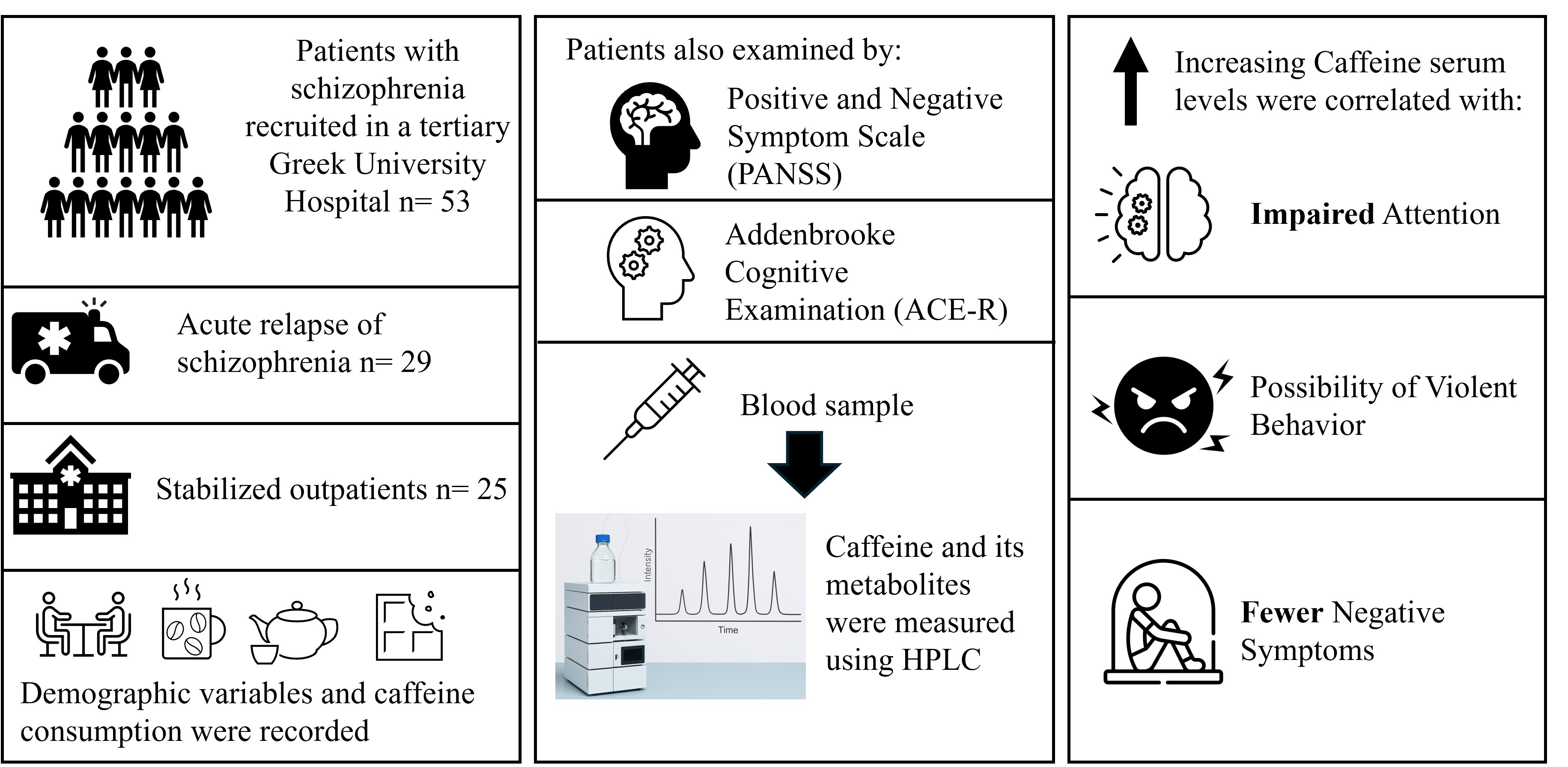
- Elevated caffeine serum levels are correlated with impaired attention.
- Violent behavior is seen more commonly as caffeine serum levels increase.
- Caffeine may have a paradoxical effect on attention in patients with schizophrenia.
- The introduction of routine caffeine monitoring may help manage patients prone to aggressive behavior.
Abstract
1. Introduction
Background/Rationale
2. Methods
2.1. Study Design
2.2. Setting
2.3. Participants
2.4. Data Sources/Measurements
2.5. Variables
2.6. Study Size
2.7. Statistics
2.8. Ethical Considerations
3. Results
3.1. PANSS Arm
3.2. ACE-R Arm
3.3. GAD-7 Arm
4. Discussion
Limitations of the Study
5. Conclusions
Supplementary Materials
Author Contributions
Funding
Institutional Review Board Statement
Informed Consent Statement
Data Availability Statement
Acknowledgments
Conflicts of Interest
References
- Cappelletti, S.; Daria, P.; Sani, G.; Aromatario, M. Caffeine: Cognitive and physical performance enhancer or psychoactive drug? Curr. Neuropharmacol. 2015, 13, 71–88. [Google Scholar] [CrossRef] [Scilit]
- Temple, J.L.; Bernard, C.; Lipshultz, S.E.; Czachor, J.D.; Westphal, J.A.; Mestre, M.A. The Safety of Ingested Caffeine: A Comprehensive Review. Front. Psychiatry 2017, 8, 80. [Google Scholar] [CrossRef] [Scilit]
- Dews, P.B. Caffeine. Ann. Rev. Nutr. 1982, 2, 323–341. [Google Scholar] [CrossRef] [Scilit]
- Verster, J.C.; Koenig, J. Caffeine intake and its sources: A review of national representative studies. Crit. Rev. Food Sci. Nutr. 2018, 58, 1250–1259. [Google Scholar] [CrossRef] [Scilit]
- Fulgoni, V.L.; Keast, D.R.; Lieberman, H.R. Trends in intake and sources of caffeine in the diets of US adults: 2001–2010. Am. J. Clin. Nutr. 2015, 101, 1081–1087. [Google Scholar] [CrossRef] [Scilit]
- Statista. Global Coffee Consumption from 2012/13 to 2023/24 (in Million 60-Kilogram Bags). 2025. Available online: https://www.statista.com/statistics/292595/global-coffee-consumption/ (accessed on 15 September 2025).
- Bonati, M.; Latini, R.; Galletti, F.; Young, J.F.; Tognoni, G.; Garattini, S. Caffeine disposition after oral doses. Clin. Pharmacol. Ther. 1982, 32, 98–106. [Google Scholar] [CrossRef] [Scilit]
- Yesair, D.W.; Branfman, A.R.; Callahan, M.M. Human disposition and some biochemical aspects of methylxanthines. Prog. Clin. Biol. Res. 1984, 158, 215–233. [Google Scholar]
- Arnaud, M.J. Identification, kinetic and quantitative study of [2-14C] and [1-Me-14C]caffeine metabolites in rat’s urine by chromatographic separations. Biochem. Med. 1976, 16, 67–76. [Google Scholar] [CrossRef] [Scilit]
- Mumford, G.K.; Benowitz, N.L.; Evans, S.M.; Kaminski, B.J.; Preston, K.L.; Sannerud, C.A.; Silverman, K.; Griffiths, R.R. Absorption rate of methylxanthines following capsules, cola and chocolate. Eur. J. Clin. Pharmacol. 1996, 51, 319–325. [Google Scholar] [CrossRef] [Scilit]
- Fredholm, B.B.; Bättig, K.; Holmén, J.; Nehlig, A.; Zvartau, E.E. Actions of caffeine in the brain with special reference to factors that contribute to its widespread use. Pharmacol. Rev. 1999, 51, 83–133. [Google Scholar] [CrossRef] [Scilit]
- Fredholm, B.B. Methylxanthines; Springer: Berlin/Heidelberg, Germany, 2011; Volume 200. [Google Scholar]
- Vickroy, T.W.; Chang, S.-K.; Chou, C.-C. Caffeine-induced hyperactivity in the horse: Comparisons of drug and metabolite concentrations in blood and cerebrospinal fluid. J. Vet. Pharmacol. Ther. 2008, 31, 156–166. [Google Scholar] [CrossRef] [Scilit]
- European Food Safety Authority (EFSA). Scientific Opinion on the safety of caffeine. EFSA J. 2015, 13, 4102. [Google Scholar] [CrossRef] [Scilit]
- Nehlig, A. Interindividual Differences in Caffeine Metabolism and Factors Driving Caffeine Consumption. Pharmacol. Rev. 2018, 70, 384–411. [Google Scholar] [CrossRef] [Scilit]
- Miners, J.O.; Birkett, D.J. The use of caffeine as a metabolic probe for human drug metabolizing enzymes. Gen. Pharmacol. Vasc. Syst. 1996, 27, 245–249. [Google Scholar] [CrossRef] [Scilit]
- Berthou, F.; Flinois, J.P.; Ratanasavanh, D.; Beaune, P.; Riche, C.; Guillouzo, A. Evidence for the involvement of several cytochromes P-450 in the first steps of caffeine metabolism by human liver microsomes. Drug Metab. Dispos. 1991, 19, 561–567. [Google Scholar] [CrossRef] [Scilit]
- Rasmussen, B.B.; Brix, T.H.; Kyvik, K.O.; Brøsen, K. The interindividual differences in the 3-demthylation of caffeine alias CYP1A2 is determined by both genetic and environmental factors. Pharmacogenetics 2002, 12, 473–478. [Google Scholar] [CrossRef] [Scilit]
- Tang-Liu, D.D.; Williams, R.L.; Riegelman, S. Disposition of caffeine and its metabolites in man. J. Pharmacol. Exp. Ther. 1983, 224, 180–185. [Google Scholar] [CrossRef] [Scilit]
- Institute for Health Metrics and Evaluation (IHME). Global Burden of Disease Study 2023 (GBD 2023) Results; IHME: Seattle, WA, USA, 2023; Available online: https://vizhub.healthdata.org/gbd-results/?params=gbd-api-2019-permalink/27a7644e8ad28e739382d31e77589dd7 (accessed on 15 September 2025).
- Jongsma, H.E.; Turner, C.; Kirkbride, J.B.; Jones, P.B. International incidence of psychotic disorders, 2002–2017: A systematic review and meta-analysis. Lancet Public Health 2019, 4, e229–e244. [Google Scholar] [CrossRef] [Scilit]
- Shafer, A.; Dazzi, F. Meta-analysis of the positive and Negative Syndrome Scale (PANSS) factor structure. J. Psychiatr. Res. 2019, 115, 113–120. [Google Scholar] [CrossRef] [Scilit]
- Grube, B.S.; Bilder, R.M.; Goldman, R.S. Meta-analysis of symptom factors in schizophrenia. Schizophr. Res. 1998, 31, 113–120. [Google Scholar] [CrossRef] [Scilit]
- Jauhar, S.; Johnstone, M.; McKenna, P.J. Schizophrenia. Lancet 2022, 399, 473–486. [Google Scholar] [CrossRef] [Scilit]
- Weickert, T.W.; Goldberg, T.E.; Gold, J.M.; Bigelow, L.B.; Egan, M.F.; Weinberger, D.R. Cognitive Impairments in Patients with Schizophrenia Displaying Preserved and Compromised Intellect. Arch. Gen. Psychiatry 2000, 57, 907. [Google Scholar] [CrossRef] [Scilit]
- Kremen, W.S.; Seidman, L.J.; Faraone, S.V.; Toomey, R.; Tsuang, M.T. The paradox of normal neuropsychological function in schizophrenia. J. Abnorm. Psychol. 2000, 109, 743–752. [Google Scholar] [CrossRef]
- Owens, D.G.C.; Johnstone, E.C. The Disabilities of Chronic Schizophrenia—Their Nature and the Factors Contributing to their Development. Br. J. Psychiatry 1980, 136, 384–395. [Google Scholar] [CrossRef] [Scilit]
- Reichenberg, A. The assessment of neuropsychological functioning in schizophrenia. Dialogues Clin. Neurosci. 2010, 12, 383–392. [Google Scholar] [CrossRef] [Scilit]
- Palmer, B.W.; Dawes, S.E.; Heaton, R.K. What do we know about neuropsychological aspects of schizophrenia? Neuropsychol. Rev. 2009, 19, 365–384. [Google Scholar] [CrossRef] [Scilit]
- Relationship of neuroleptic drug effects at brain dopamine, serotonin, alpha-adrenergic, and histamine receptors to clinical potency. Am. J. Psychiatry 1980, 137, 1518–1522. [CrossRef] [Scilit]
- Creese, I.; Burt, D.R.; Snyder, S.H. Dopamine Receptor Binding Predicts Clinical and Pharmacological Potencies of Antischizophrenic Drugs. Science 1976, 192, 481–483. [Google Scholar] [CrossRef] [Scilit]
- Javitt, D.C.; Zukin, S.R.; Heresco-Levy, U.; Umbricht, D. Has an Angel Shown the Way? Etiological and Therapeutic Implications of the PCP/NMDA Model of Schizophrenia. Schizophr. Bull. 2012, 38, 958–966. [Google Scholar] [CrossRef] [Scilit]
- Javitt, D.C.; Zukin, S.R. Recent advances in the phencyclidine model of schizophrenia. Am. J. Psychiatry 1991, 48, 1301–1308. [Google Scholar] [CrossRef] [Scilit]
- Lara, D.R.; Souza, D.O. Schizophrenia: A purinergic hypothesis. Med. Hypotheses 2000, 54, 157–166. [Google Scholar] [CrossRef] [Scilit] [PubMed]
- Holtzman, S.G.; Mante, S.; Minneman, K.P. Role of adenosine receptors in caffeine tolerance. J. Pharmacol. Exp. Ther. 1991, 256, 62–68. [Google Scholar] [CrossRef] [Scilit]
- Fredholm, B.B. Are methylxanthine effects due to antagonism of endogenous adenosine? Trends Pharmacol. Sci. 1979, 1, 129–132. [Google Scholar] [CrossRef] [Scilit]
- Fredholm, B.B. Adenosine, Adenosine Receptors and the Actions of Caffeine. Pharmacol. Toxicol. 1995, 76, 93–101. [Google Scholar] [CrossRef] [Scilit]
- Rogers, P.J.; Hohoff, C.; Heatherley, S.V.; Mullings, E.L.; Maxfield, P.J.; Evershed, R.P.; Deckert, J.; Nutt, D.J. Association of the Anxiogenic and Alerting Effects of Caffeine with ADORA2A and ADORA1 Polymorphisms and Habitual Level of Caffeine Consumption. Neuropsychopharmacology 2010, 35, 1973–1983. [Google Scholar] [CrossRef] [Scilit]
- Leathwood, P.D.; Pollet, P. Diet-induced mood changes in normal populations. J. Psychiatr. Res. 1982, 17, 147–154. [Google Scholar] [CrossRef] [Scilit] [PubMed]
- Kaplan, G.B.; Greenblatt, D.J.; Ehrenberg, B.L.; Goddard, J.E.; Cotreau, M.M.; Harmatz, J.S.; Shader, R.I. Dose-dependent pharmacokinetics and psychomotor effects of caffeine in humans. J. Clin. Pharmacol. 1997, 37, 693–703. [Google Scholar] [CrossRef] [Scilit]
- Sawyer, D.A.; Julia, H.L.; Turin, A.C. Caffeine and human behavior: Arousal, anxiety, and performance effects. J. Behav. Med. 1982, 5, 415–439. [Google Scholar] [CrossRef] [Scilit]
- Jarvis, M.J. Does caffeine intake enhance absolute levels of cognitive performance? Psychopharmacology 1993, 110, 45–52. [Google Scholar] [CrossRef] [Scilit]
- Hameleers, P.A.H.M.; Van Boxtel, M.P.J.; Hogervorst, E.; Riedel, W.J.; Houx, P.J.; Buntinx, F.; Jolles, J. Habitual caffeine consumption and its relation to memory, attention, planning capacity and psychomotor performance across multiple age groups. Hum. Psychopharmacol. Clin. Exp. 2000, 15, 573–581. [Google Scholar] [CrossRef] [Scilit] [PubMed]
- Araújo, L.F.; Mirza, S.S.; Bos, D.; Niessen, W.J.; Barreto, S.M.; van der Lugt, A.; Vernooij, M.W.; Hofman, A.; Tiemeier, H.; Ikram, M.A. Association of Coffee Consumption with MRI Markers and Cognitive Function: A Population-Based Study. J. Alzheimer’s Dis. 2016, 53, 451–461. [Google Scholar] [CrossRef] [Scilit]
- Childs, E.; de Wit, H. Subjective, behavioral, and physiological effects of acute caffeine in light, nondependent caffeine users. Psychopharmacology 2006, 185, 514. [Google Scholar] [CrossRef] [Scilit]
- Kelemen, W.L.; Creeley, C.E. Caffeine (4 mg/kg) influences sustained attention and delayed free recall but not memory predictions. Hum. Psychopharmacol. Clin. Exp. 2001, 16, 309–319. [Google Scholar] [CrossRef] [Scilit]
- Borea, P.A.; Gessi, S.; Merighi, S.; Vincenzi, F.; Varani, K. Pharmacology of Adenosine Receptors: The State of the Art. Physiol. Rev. 2018, 98, 1591–1625. [Google Scholar] [CrossRef] [Scilit]
- Ferré, S. Adenosine-dopamine interactions in the ventral striatum. Psychopharmacology 1997, 133, 107–120. [Google Scholar] [CrossRef] [Scilit]
- Ginés, S.; Hillion, J.; Torvinen, M.; Le Crom, S.; Casadó, V.; Canela, E.I.; Rondin, S.; Lew, J.Y.; Watson, S.; Zoli, M.; et al. Dopamine D1 and adenosine A 1 receptors form functionally interacting heteromeric complexes. Proc. Natl. Acad. Sci. USA 2000, 97, 8606–8611. [Google Scholar] [CrossRef] [Scilit] [PubMed]
- Rivera-Oliver, M.; Moreno, E.; Álvarez-Bagnarol, Y.; Ayala-Santiago, C.; Cruz-Reyes, N.; Molina-Castro, G.C.; Clemens, S.; Canela, E.I.; Ferré, S.; Casadó, V.; et al. Adenosine A1-Dopamine D1 Receptor Heteromers Control the Excitability of the Spinal Motoneuron. Mol. Neurobiol. 2019, 56, 797–811. [Google Scholar] [CrossRef] [Scilit] [PubMed]
- Ferre, S.; von Euler, G.; Johansson, B.; Fredholm, B.B.; Fuxe, K. Stimulation of high-affinity adenosine A2 receptors decreases the affinity of dopamine D2 receptors in rat striatal membranes. Proc. Natl. Acad. Sci. USA 1991, 88, 7238–7241. [Google Scholar] [CrossRef] [Scilit] [PubMed]
- Ciruela, F.; Casadó, V.; Rodrigues, R.J.; Luján, R.; Burgueño, J.; Canals, M.; Borycz, J.; Rebola, N.; Goldberg, S.R.; Mallol, J.; et al. Presynaptic Control of Striatal Glutamatergic Neurotransmission by Adenosine A1 –A2A Receptor Heteromers. J. Neurosci. 2006, 26, 2080–2087. [Google Scholar] [CrossRef] [Scilit]
- Cristóvão-Ferreira, S.; Navarro, G.; Brugarolas, M.; Pérez-Capote, K.; Vaz, S.H.; Fattorini, G.; Conti, F.; Lluis, C.; Riberio, J.A.; McCormick, P.J.; et al. A1R–A2AR heteromers coupled to Gs and Gi/0 proteins modulate GABA transport into astrocytes. Purinergic Signal. 2013, 9, 433–449. [Google Scholar] [CrossRef] [Scilit]
- Ferré, S. An update on the mechanisms of the psychostimulant effects of caffeine. J. Neurochem. 2008, 105, 1067–1079. [Google Scholar] [CrossRef] [Scilit] [PubMed]
- George, S.R.; O’Dowd, B.F.; Lee, S.P. G-Protein-coupled receptor oligomerization and its potential for drug discovery. Nat. Rev. Drug Discov. 2002, 1, 808–820. [Google Scholar] [CrossRef] [Scilit] [PubMed]
- Singer, P.; Yee, B.K. The adenosine hypothesis of schizophrenia into its third decade: From neurochemical imbalance to early life etiological risks. Front. Cell. Neurosci. 2023, 17, 1120532. [Google Scholar] [CrossRef] [Scilit]
- Mayo, K.M.; Falkowski, W.; Jones, C.A.H. Caffeine: Use and Effects in Long-Stay Psychiatric Patients. Br. J. Psychiatry 1993, 162, 543–545. [Google Scholar] [CrossRef] [Scilit] [PubMed]
- Strassnig, M.; Brar, J.S.; Ganguli, R. Increased caffeine and nicotine consumption in community-dwelling patients with schizophrenia. Schizophr. Res. 2006, 86, 269–275. [Google Scholar] [CrossRef] [Scilit]
- Goiney, C.C.; Gillaspie, D.B.; Alvarez Villalba, C.L. Addressing Caffeine-induced Psychosis. Addict. Disord. Their Treat. 2012, 11, 146–149. [Google Scholar] [CrossRef] [Scilit]
- Hedges, D.W.; Woon, F.L.; Hoopes, S.P. Caffeine-Induced Psychosis. CNS Spectr. 2009, 14, 127–131. [Google Scholar] [CrossRef] [Scilit]
- Kim, A.; O’Hanlon, M. Caffeine and clinical change in a patient with schizophrenia on a long-stay ward. Ir. J. Psychol. Med. 2011, 28, 42–44. [Google Scholar] [CrossRef] [Scilit]
- Wang, H.R.; Woo, Y.S.; Bahk, W.M. Caffeine-induced psychiatric manifestations. Int. Clin. Psychopharmacol. 2015, 30, 179–182. [Google Scholar] [CrossRef] [Scilit]
- Topyurek, M.; Tibbo, P.; Núñez, C.; Stephan-Otto, C.; Good, K. Caffeine effects and schizophrenia: Is there a need for more research? Schizophr. Res. 2019, 211, 34–35. [Google Scholar] [CrossRef] [Scilit]
- Núñez, C.; Stephan-Otto, C.; Cuevas-Esteban, J.; Maria Haro, J.; Huerta-Ramos, E.; Ochoa, S.; Usall, J.; Brébion, G. Effects of caffeine intake and smoking on neurocognition in schizophrenia. Psychiatry Res. 2015, 230, 924–931. [Google Scholar] [CrossRef] [Scilit]
- Jabbar, S.B.; Hanly, M.G. Fatal Caffeine Overdose. Am. J. Forensic Med. Pathol. 2013, 34, 321–324. [Google Scholar] [CrossRef] [Scilit] [PubMed]
- Rudolph, T.; Knudsen, K. A case of fatal caffeine poisoning. Acta Anaesthesiol. Scand. 2010, 54, 521–523. [Google Scholar] [CrossRef] [Scilit]
- Bioh, G.; Gallagher, M.M.; Prasad, U. Survival of a highly toxic dose of caffeine. BMJ Case Rep. 2013, 2013, bcr2012007454. [Google Scholar] [CrossRef] [Scilit]
- Kerrigan, S.; Lindsey, T. Fatal caffeine overdose: Two case reports. Forensic Sci. Int. 2005, 153, 67–69. [Google Scholar] [CrossRef] [Scilit]
- Lucas, P.B.; Pickar, D.; Kelsoe, J.; Rapaport, M.; Pato, C.; Hommer, D. Effects of the acute administration of caffeine in patients with schizophrenia. Biol. Psychiatry 1990, 28, 35–40. [Google Scholar] [CrossRef] [Scilit] [PubMed]
- Gandhi, K.K.; Williams, J.M.; Menza, M.; Galazyn, M.; Benowitz, N.L. Higher serum caffeine in smokers with schizophrenia compared to smoking controls. Drug Alcohol. Depend. 2010, 110, 151–155. [Google Scholar] [CrossRef] [Scilit] [PubMed]
- Rosen, R.L.; Ramasubramani, R.S.; Benowitz, N.L.; Gandhi, K.K.; Williams, J.M. Caffeine levels and dietary intake in smokers with schizophrenia and bipolar disorder. Psychiatry Res. 2023, 319, 114989. [Google Scholar] [CrossRef] [Scilit]
- Han Almis, B.; Tekin, A.; Hakyemez Geylani, G.; Baltaci, E.; Egeli, A. Is there a relationship between caffeine intake and smoking and positive and negative symptom severity in schizophrenia? Psychiatr. Danub. 2023, 35, 56–61. [Google Scholar] [CrossRef] [Scilit]
- Szoke, A.; Richard, J.R.; Fond, G.; Misdrahi, D.; Lajnef, M.; Aouizerate, B.; Boyer, L.; Berna, F.; Capdevielle, D.; André, M.; et al. Clinical and pharmacological correlates of caffeine consumption in subjects with schizophrenia—Data from the FACE-SZ cohort. J. Psychiatr. Res. 2023, 161, 206–212. [Google Scholar] [CrossRef] [Scilit]
- Lykouras, E.; Botsis, A.; Oulis, P. The Positive and Negative Syndrome Scale (PANSS); Tsiveriotis Ed: Athens, Greece, 1994. (In Greek) [Google Scholar]
- Kay, S.R.; Fiszbein, A.; Opler, L.A. The positive and negative syndrome scale (PANSS) for schizophrenia. Schizophr. Bull. 1987, 13, 261–276. [Google Scholar] [CrossRef] [Scilit] [PubMed]
- Spitzer, R.L.; Kroenke, K.; Williams, J.B.W.; Löwe, B. A Brief Measure for Assessing Generalized Anxiety Disorder. Arch. Intern. Med. 2006, 166, 1092. [Google Scholar] [CrossRef] [Scilit]
- Hodges, J.R.; Larner, A.J. Addenbrooke’s Cognitive Examinations: ACE, ACE-R, ACE-III, ACEapp, and M-ACE. In Cognitive Screening Instruments: A Practical Approach [Internet]; Larner, A.J., Ed.; Springer International Publishing: Cham, Switzerland, 2017; pp. 109–137. [Google Scholar] [CrossRef] [Scilit]
- Mathuranath, P.S.; Nestor, P.J.; Berrios, G.E.; Rakowicz, W.; Hodges, J.R. A brief cognitive test battery to differentiate Alzheimer’s disease and frontotemporal dementia. Neurology 2000, 55, 1613–1620. [Google Scholar] [CrossRef] [PubMed]
- Kourtesis, P.; Margioti, E.; Demenega, C.; Christidi, F.; Abrahams, S. A Comparison of the Greek ACE-III, M-ACE, ACE-R, MMSE, and ECAS in the Assessment and Identification of Alzheimer’s Disease. J. Int. Neuropsychol. Soc. 2020, 26, 825–834. [Google Scholar] [CrossRef] [Scilit]
- Begas, E.; Kouvaras, E.; Tsakalof, A.K.; Bounitsi, M.; Asprodini, E.K. Development and validation of a reversed-phase HPLC method for CYP1A2 phenotyping by use of a caffeine metabolite ratio in saliva. Biomed. Chromatogr. 2015, 29, 1657–1663. [Google Scholar] [PubMed]
- Leucht, S.; Samara, M.; Heres, S.; Davis, J.M. Dose Equivalents for Antipsychotic Drugs: The DDD Method. Schizophr. Bull. 2016, 42, S90–S94. [Google Scholar] [CrossRef] [Scilit]
- Woods, S.W. Chlorpromazine Equivalent Doses for the Newer Atypical Antipsychotics. J. Clin. Psychiatry 2003, 64, 663–667. [Google Scholar] [CrossRef] [Scilit]
- Hany, M.; Rizvi, A. Schizophrenia; StatPearls Publishing: Treasure Island, FL, USA, 2025. [Google Scholar]
- Marder, S.R.; Cannon, T.D. Schizophrenia. N. Engl. J. Med. 2019, 381, 1753–1761. [Google Scholar] [CrossRef] [Scilit]
- Hellenic Statistical Authority, Greek National Survey. 2025. Available online: https://www.statistics.gr/greece-in-figures (accessed on 26 June 2025).
- Harvanko, A.M.; Derbyshire, K.L.; Schreiber, L.R.N.; Grant, J.E. The effect of self-regulated caffeine use on cognition in young adults. Hum. Psychopharmacol. Clin. Exp. 2015, 30, 123–130. [Google Scholar] [CrossRef] [Scilit]
- Strassnig, M.T.; Nascimento, V.; Deckler, E.; Harvey, P.D. Pharmacological treatment of violence in schizophrenia. CNS Spectr. 2020, 25, 207–215. [Google Scholar] [CrossRef] [Scilit]
- Zaslove, M.O.; Beal, M.; McKinney, R.E. Changes in Behaviors of Inpatients After a Ban on the Sale of Caffeinated Drinks. Hosp. Community Psychiatry 1991, 42, 84–85. [Google Scholar] [CrossRef] [Scilit] [PubMed]
- Carmel, H. Caffeine and Aggression. Hosp. Community Psychiatry 1991, 42, 637–638. [Google Scholar] [CrossRef] [Scilit] [PubMed]
- Witt, K.; van Dorn, R.; Fazel, S. Risk Factors for Violence in Psychosis: Systematic Review and Meta-Regression Analysis of 110 Studies. PLoS ONE 2013, 8, e55942. [Google Scholar] [CrossRef] [Scilit]
- Gurpegui, M.; Aguilar, M.C.; Martinez-Ortega, J.M.; Diaz, F.J.; de Leon, J. Caffeine Intake in Outpatients with Schizophrenia. Schizophr. Bull. 2004, 30, 935–945. [Google Scholar] [CrossRef] [Scilit]
- Thompson, L.; Pennay, A.; Zimmermann, A.; Cox, M.; Lubman, D.I. “Clozapine makes me quite drowsy, so when I wake up in the morning those first cups of coffee are really handy”: An exploratory qualitative study of excessive caffeine consumption among individuals with schizophrenia. BMC Psychiatry 2014, 14, 116. [Google Scholar] [CrossRef] [Scilit]
- Arrojo-Romero, M.; Armas Barbazán, C.; López-Moriñigo, J.D.; Ramos-Ríos, R.; Gurpegui, M.; Martínez-Ortega, J.M.; Jurado, D.; Diaz, F.J.; de Leon, J. Caffeine consumption in a long-term psychiatric hospital: Tobacco smoking may explain in large part the apparent association between schizophrenia and caffeine use. Schizophr. Res. 2015, 164, 234–241. [Google Scholar] [CrossRef] [Scilit]
- Walsh, E.; Buchanan, A.; Fahy, T. Violence and schizophrenia: Examining the evidence. Br. J. Psychiatry 2002, 180, 490–495. [Google Scholar] [CrossRef] [Scilit]



| Variables | PANSS Arm n = 53 | ACE-R Arm n = 50 | |
|---|---|---|---|
| Sex | Female | 13 | 13 |
| Male | 40 | 37 | |
| Smoking status | Non-smoker | 28 | 26 |
| Smoker | 25 | 24 | |
| Age (years) | 45 ± 11 | 45 ± 11 | |
| Duration of disease (years) | 21.58 ± 10.78 | 21.88 ± 10.80 | |
| Body Mass Index (kg/m2) | 28.98 ± 6.34 | 29.16 ± 6.37 | |
| CPZ equivalent (mg) | 691.83 ± 425.37 | 704.82 ± 426.08 | |
| Caffeine levels at baseline (μg/mL) | 0.543 ± 2.451 | 0.617 ± 2.503 | |
| Variable | Measurement |
|---|---|
| Positive PANSS subscore | 15 ± 8 |
| Negative PANSS subscore | 21 ± 7 |
| Perilous behavior PANSS subscore | 7 ± 4 |
| General Psychopathology PANSS subscore | 30 ± 9 |
| Total PANSS score | 72 ± 21 |
| Caffeine levels at baseline (μg/mL) | 1.589 ± 2.451 |
| Variable | Caffeine Non-Consumers (n = 25) | Caffeine Consumers (n = 28) | p |
|---|---|---|---|
| Positive PANSS subscore | 25.1 | 28.7 | 0.394 |
| Delusions | 27.14 | 26.88 | 0.948 |
| Conceptual disorganization | 25.56 | 28.29 | 0.489 |
| Hallucinatory behavior | 24.6 | 29.14 | 0.225 |
| Excitement | 23.22 | 30.38 | 0.055 |
| Grandiosity | 26.02 | 27.88 | 0.483 |
| Suspiciousness/persecution | 27.9 | 26.2 | 0.665 |
| Hostility | 24.42 | 29.3 | 0.128 |
| Negative PANSS subscore | 29.74 | 24.55 | 0.221 |
| Blunted affect | 29.52 | 24.75 | 0.248 |
| Emotional withdrawal | 27.9 | 26.2 | 0.68 |
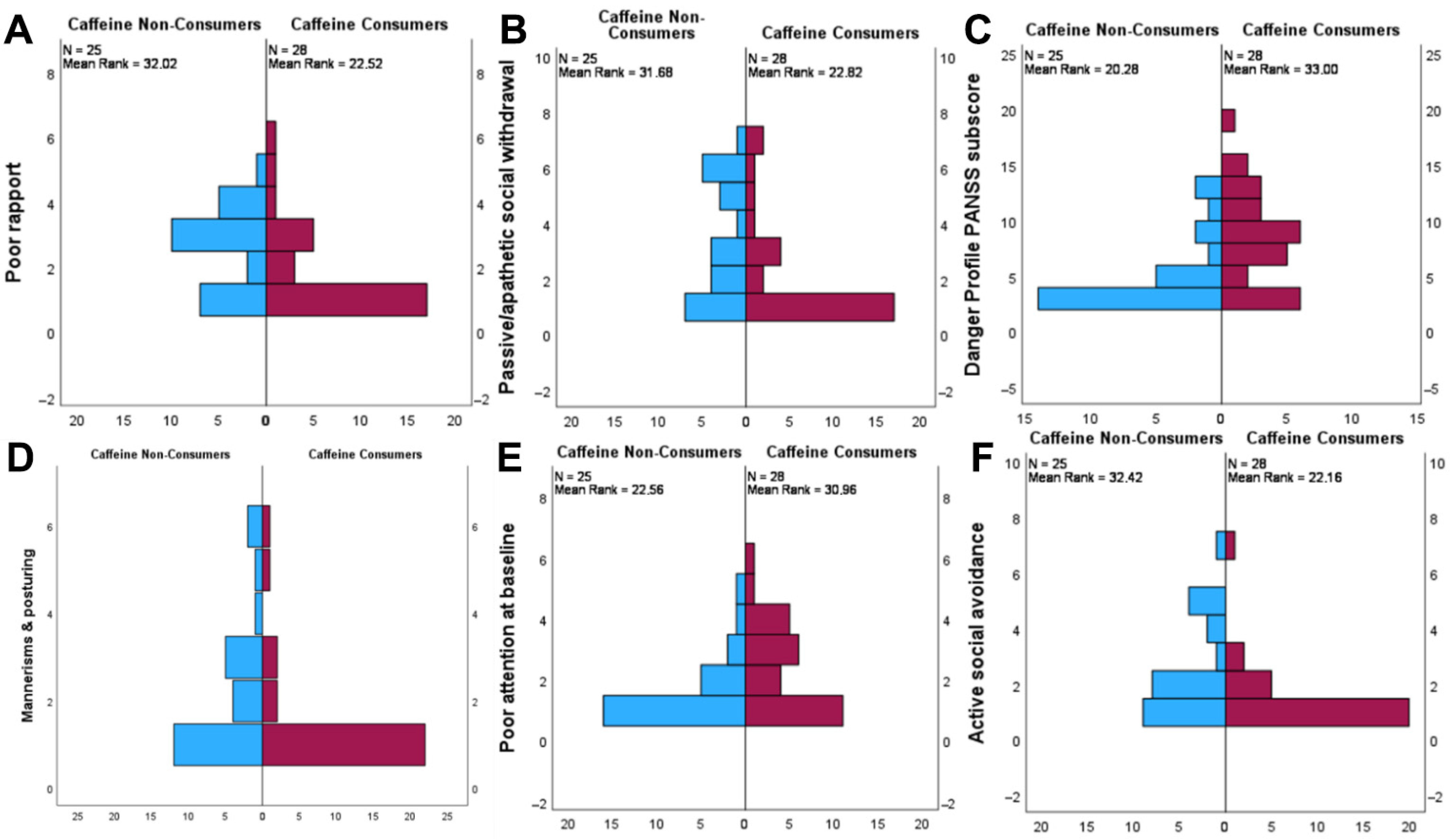
| Poor rapport | 32.02 | 22.52 | 0.017 * |
| Passive/apathetic social withdrawal | 31.68 | 22.82 | 0.028 * |
| Difficulty in abstract thinking | 24.3 | 29.41 | 0.22 |
| Lack of spontaneity and flow of conversation | 28.48 | 25.68 | 0.492 |
| Stereotyped thinking | 26.68 | 27.29 | 0.875 |
| Danger Profile PANSS subscore | 20.28 | 33 | 0.002 * |
| Anger | 22 | 31.46 | 0.013 * |
| Intolerance to deferred gratification | 22.26 | 31.23 | 0.026 * |
| Emotional volatility | 20.12 | 33.14 | 0.001 * |
| General Psychopathology PANSS subscore | 28.66 | 25.52 | 0.459 |
| Somatic concern | 27.7 | 26.38 | 0.66 |
| Anxiety | 28.28 | 25.86 | 0.543 |
| Guilt feelings | 27.98 | 26.13 | 0.538 |
| Tension | 29.92 | 24.39 | 0.139 |
| Mannerisms and posturing | 31.26 | 23.2 | 0.027 * |
| Depression | 29.6 | 24.68 | 0.169 |
| Motor retardation | 29.82 | 24.48 | 0.129 |
| Uncooperativeness | 25.46 | 28.38 | 0.349 |
| Unusual thought content | 27.18 | 26.84 | 0.928 |
| Disorientation | 25.24 | 28.57 | 0.284 |
| Poor attention | 22.56 | 30.96 | 0.033 * |
| Lack of judgement and insight | 25.18 | 28.63 | 0.409 |
| Disturbance of volition | 28 | 26.11 | 0.495 |
| Poor impulse control | 26.42 | 27.52 | 0.738 |
| Preoccupation | 24.44 | 29.29 | 0.194 |
| Active social avoidance | 32.42 | 22.16 | 0.008 * |
| Total PANSS Score | 26.56 | 27.39 | 0.845 |
| Spearman’s Rho | p | Spearman’s Rho | p | ||
|---|---|---|---|---|---|
| Positive PANSS subscore | 0.209 | 0.133 | Emotional volatility * | 0.464 | <0.001 |
| Delusions | 0.053 | 0.706 | General Psychopathology PANSS subscore | 0.017 | 0.902 |
| Conceptual disorganization | 0.194 | 0.164 | Somatic concern | 0.034 | 0.808 |
| Hallucinatory behavior | 0.189 | 0.176 | Anxiety | −0.042 | 0.766 |
| Excitement * | 0.341 | 0.012 | Guilt feelings | −0.1 | 0.477 |
| Grandiosity | 0.161 | 0.251 | Tension | −0.14 | 0.318 |
| Suspiciousness/persecution | −0.018 | 0.899 | Mannerisms and posturing | −0.227 | 0.103 |
| Hostility * | 0.276 | 0.045 | Depression | −0.145 | 0.301 |
| Negative PANSS subscore | −0.202 | 0.147 | Motor retardation | −0.207 | 0.137 |
| Blunted affect | −0.173 | 0.216 | Uncooperativeness | 0.178 | 0.201 |
| Emotional withdrawal | −0.03 | 0.832 | Unusual thought content | 0.04 | 0.777 |
| Poor rapport * | −0.349 | 0.01 | Disorientation | 0.178 | 0.202 |
| Passive/apathetic social withdrawal * | −0.387 | 0.004 | Poor attention * | 0.337 | 0.013 |
| Difficulty in abstract thinking | 0.171 | 0.22 | Lack of judgement and insight | 0.144 | 0.302 |
| Lack of spontaneity and flow of conversation | −0.142 | 0.309 | Disturbance of volition | −0.045 | 0.748 |
| Stereotyped thinking | −0.02 | 0.887 | Poor impulse control | 0.147 | 0.294 |
| Perilous behavior PANSS subscore * | 0.435 | 0.001 | Preoccupation | 0.238 | 0.086 |
| Anger * | 0.335 | 0.014 | Active social avoidance * | −0.347 | 0.011 |
| Intolerance to deferred gratification * | 0.357 | 0.009 | Total PANSS Score | 0.115 | 0.41 |
| Variables | Measurements |
|---|---|
| ACE-R attention and memory score | 16 ± 2 |
| ACE-R memory score | 16 ± 6 |
| ACE-R fluency score | 7 ± 3 |
| ACE-R language score | 22 ± 3 |
| ACE-R visuo-spatial score | 13 ± 2 |
| Total ACE-R score | 75 ± 13 |
| MW-U Test 23 vs. 27 | Spearman’s Correlation Test | ||
|---|---|---|---|
| p | Spearman’s Rho | p | |
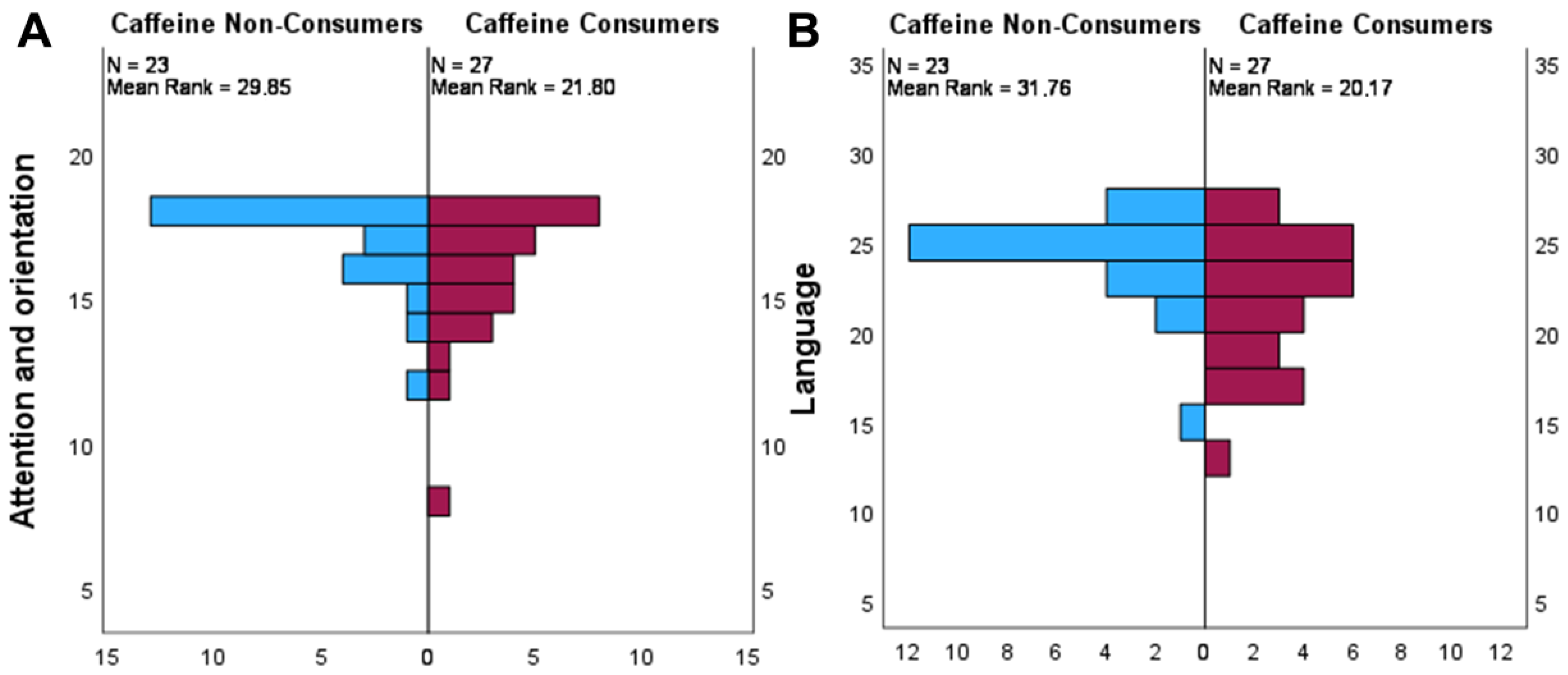
| Attention and orientation * | 0.042 | −0.335 | 0.017 * |
| Memory | 0.977 | −0.002 | 0.987 |
| Fluency | 0.524 | 0.116 | 0.423 |
| Language * | 0.005 | −0.418 | 0.003 |
| Visuo-spatial perception | 0.189 | −0.177 | 0.218 |
| Total ACE-R score | 0.501 | −0.108 | 0.455 |
Disclaimer/Publisher’s Note: The statements, opinions and data contained in all publications are solely those of the individual author(s) and contributor(s) and not of MDPI and/or the editor(s). MDPI and/or the editor(s) disclaim responsibility for any injury to people or property resulting from any ideas, methods, instructions or products referred to in the content. |
© 2026 by the authors. Licensee MDPI, Basel, Switzerland. This article is an open access article distributed under the terms and conditions of the Creative Commons Attribution (CC BY) license.
Share and Cite
Janho, M.B.; Papaliaga, M.N.; Samara, A.A.; Papoutsopoulou, S.; Speletas, M.; Christodoulou, N.; Asprodini, E. Association Between Caffeine Levels and Symptom Profile in Schizophrenia: Results from a Cohort Study in Central Greece. Brain Sci. 2026, 16, 209. https://doi.org/10.3390/brainsci16020209
Janho MB, Papaliaga MN, Samara AA, Papoutsopoulou S, Speletas M, Christodoulou N, Asprodini E. Association Between Caffeine Levels and Symptom Profile in Schizophrenia: Results from a Cohort Study in Central Greece. Brain Sciences. 2026; 16(2):209. https://doi.org/10.3390/brainsci16020209
Chicago/Turabian StyleJanho, Michel B., Maria N. Papaliaga, Athina A. Samara, Stamatia Papoutsopoulou, Matthaios Speletas, Nikolaos Christodoulou, and Eftihia Asprodini. 2026. "Association Between Caffeine Levels and Symptom Profile in Schizophrenia: Results from a Cohort Study in Central Greece" Brain Sciences 16, no. 2: 209. https://doi.org/10.3390/brainsci16020209
APA StyleJanho, M. B., Papaliaga, M. N., Samara, A. A., Papoutsopoulou, S., Speletas, M., Christodoulou, N., & Asprodini, E. (2026). Association Between Caffeine Levels and Symptom Profile in Schizophrenia: Results from a Cohort Study in Central Greece. Brain Sciences, 16(2), 209. https://doi.org/10.3390/brainsci16020209