Article

Potential Biological Processes Related to Brain SLC13A5 Across the Lifespan: Weighted Gene Co-Expression Network Analysis from Large Human Transcriptomic Data


by
Bruna Klippel Ferreira
1,
Patricia Fernanda Schuck
1,
Gustavo Costa Ferreira
1,* and
Hércules Rezende Freitas
2,*
1
Laboratório de Erros Inatos do Metabolismo, Programa de Bioquímica e Biofísica Celular, Instituto de Bioquímica Médica Leopoldo de Meis, Universidade Federal do Rio de Janeiro, Rio de Janeiro 21941-599, Brazil
2
Laboratório de Informática em Saúde (LabInfoS), Departamento de Ciências Médicas Integradas, Faculdade de Ciências Médicas, Universidade do Estado do Rio de Janeiro, Cabo Frio 28905-320, Brazil
*
Authors to whom correspondence should be addressed.
Brain Sci. 2026, 16(2), 163; https://doi.org/10.3390/brainsci16020163
Submission received: 31 December 2025 / Revised: 23 January 2026 / Accepted: 27 January 2026 / Published: 30 January 2026

Abstract

Background/Objectives: SLC13A5 encodes a sodium–citrate cotransporter implicated in early-onset epileptic encephalopathy and metabolic brain dysfunction, yet its developmental regulation and molecular context in the human brain remain incompletely defined. Methods: Leveraging human developmental transcriptomes from the Evo-Devo resource, we delineated tissue trajectories and network context for SLC13A5 across the fetal–postnatal life. Results: In the cerebrum, SLC13A5 expression rises from late fetal stages to peak in the first postnatal year and then declines into adulthood, while cerebellar levels increase across the lifespan; liver shows a fetal decrease followed by sustained postnatal upregulation. A transcriptome-wide scan identified extensive positive and negative associations with SLC13A5, and a signed weighted gene co-expression network analysis (WGCNA) built on biweight midcorrelation placed SLC13A5 in a large module. The module eigengene tracked brain maturation (Spearman rho = 0.802, p = 8.62 × 10⁻⁶) and closely matched SLC13A5 abundance (rho = 0.884, p = 2.73 × 10⁻⁶), with a significant partial association after adjusting for developmental rank (rho = 0.672, p = 6.17 × 10⁻⁴). Functional enrichment converged on oxidative phosphorylation and mitochondria. A force-directed subnetwork of the top intramodular members (|bicor| > 0.6) positioned SLC13A5 adjacent to a densely connected nucleus including CYP46A1, ITM2B, NRGN, GABRD, FBXO2, CHCHD10, CYSTM1, and MFSD4A. Conclusions: Together, these results define a developmentally tuned, mitochondria-centered program that co-varies with SLC13A5 in the human brain across the lifespan. It may provide insights to interrogate age-dependent phenotypes and therapeutic avenues for disorders involving citrate metabolism.

1. Introduction

SLC13A5 epilepsy, also known as developmental epileptic encephalopathy 25 (OMIM # 615905), is an autosomal recessive disease caused by deficiency in SLC13A5 citrate transporter. The disease is characterized by neonatal seizures, febrile seizures, status epilepticus, developmental delay, a severe movement disorder, and lack of tooth enamel. Severe seizures start in the first days of life, with better seizure control in late childhood and adolescence but lifelong increased seizure risk [1]. Patients have global developmental delay and impaired motor function [2]. Tooth hypoplasia due to amelogenesis imperfecta remains a distinctive feature [3].
To date, more than 50 loss-of-function mutations in human SLC13A5 have been found to cause SLC13A5 epilepsy [4,5]. Interestingly, there has been no genotype–phenotype correlation identified, though all tested mutations had a severe loss of citrate transporter function [6,7]. Slc13a5-knockout mice showed pro-epileptogenic neuronal excitability changes in the hippocampus, and approximately 50% of the mice had spontaneous seizures [8].
There are no curative treatments for SLC13A5 epilepsy, and all patients are treated with standard antiseizure medications, with mixed results. Previously reported antiseizure medications include benzodiazepines, phenobarbital, phenytoin, and carbamazepine, with good seizure control in some patients. However, some patients needed to use up to 10 drugs in polytherapy [1,2]. Although current antiseizure medications may reduce seizure frequency, more targeted treatments are needed to address the epileptic and non-epileptic features of SLC13A5 epilepsy, such as communication and movement disorders [9]. Additionally, SLC13A5 has been proposed as a molecular target for several diseases, such as metabolic syndrome, kidney disease, and cancer [10].
Studies have demonstrated that SLC13A5 epilepsy symptoms change with age [1,9]. However, it is unknown whether physiological SLC13A5 expression changes over time. The present work is therefore an effort to use large transcriptomic data to investigate SLC13A5 expression in humans.

2. Materials and Methods

2.1. Data Sources

The Evo-Devo application, created by Cardoso-Moreira et al. (2019) [11], is a vast database including expression results for genes in different species, organs, and development stages. Human RNA-seq expression (RPKM) across developmental stages was obtained from the Evo-Devo resource [11]. SLC13A5 and genome-wide expression for brain and peripheral tissues reported by Evo-Devo were analyzed. Analyses focused on Homo sapiens only. Descriptive trajectories were assembled for brain, cerebellum, kidney, liver, testis, and ovary.

2.2. Preprocessing and Sample Ordering

Expression tables were reshaped into sample-by-gene matrices keyed by Ensembl gene identifiers. To stabilize variance, values were transformed as log2(RPKM + 1). Genes with zero variance or entirely missing values were removed, and Ensembl version suffixes were stripped to harmonize identifiers. Cerebrum samples were arranged according to a biologically consistent developmental sequence spanning from 4 to 20 weeks post-conception (wpc) through newborn, infant (6 to 9 months old), toddler (2 to 4 years old), school age (7 to 9 years old), teenager (13 to 19 years old), young adult (25 to 32 years old), young mid-age (39 to 41 years old), older mid-age (46 to 54 years old), and senior (58 to 63 years old). Since the Evo–Devo developmental labels are ordinal rather than metrically spaced, an ordinal trait (age rank) was constructed by assigning ranks from 1 to N along this sequence. Data quality was assessed using the WGCNA goodSamplesGenes criterion, with a minimum non-missing fraction of 0.30 [12]; only samples and genes passing quality control were retained.

2.3. Transcriptome-Wide Association with SLC13A5

Within the brain data set, transcriptome-wide association was performed across cerebrum samples, correlating SLC13A5 (Stable ID: ENSG00000141485) with each expressed gene by using Spearman rank correlation and pairwise handling of missingness. Genes present in at least 80% of samples were included in the correlation analysis. Transcriptome-wide developmental correlation screening used 22 developmental samples and 37,743 genes, yielding 830,346 sample × gene measurements in the analyzed expression matrix. Downstream enrichment analyses used this same set of 37,743 tested genes as the background universe, with a significant input set of 13,915 genes at FDR < 0.05. Two-sided P-values were adjusted for multiple testing using Benjamini–Hochberg false discovery rate (FDR). The full correlation landscape was summarized with a volcano-type display and a compact temporal heatmap of the top positively and negatively associated genes to visualize developmental coherence.

2.4. Weighted Gene Co-Expression Network Analysis (WGCNA)

A signed co-expression network was constructed from the brain matrix using biweight midcorrelation (bicor). The soft-thresholding power was chosen from the range of 1–20 as the first value, achieving a scale-free topology fit of R2 ≥ 0.80; when no value reached this criterion, a conservative default of 6 was used [13]. Modules were identified with blockwise hierarchical clustering using signed topology overlap, a minimum module size of 30 genes, a merge cut height of 0.25, zero reassignment threshold, and partitioning around medoids respecting the dendrogram [14]. For each module, the first principal component (module eigengene) was computed to summarize expression.

2.5. Module–Trait and Gene–Module Relationships

Associations between the SLC13A5 module eigengene (SME) and developmental progression were tested using Spearman correlation with the ordinal age group rank. The relationship between SME and SLC13A5 expression was assessed analogously. A partial Spearman association between SME and SLC13A5 controlling for age rank was obtained by correlating rank-based residuals from linear models. Intramodular connectivity (kME) was quantified as the signed correlation between each gene and its own module eigengene, providing a continuous measure of hubness.

2.6. Functional Enrichment

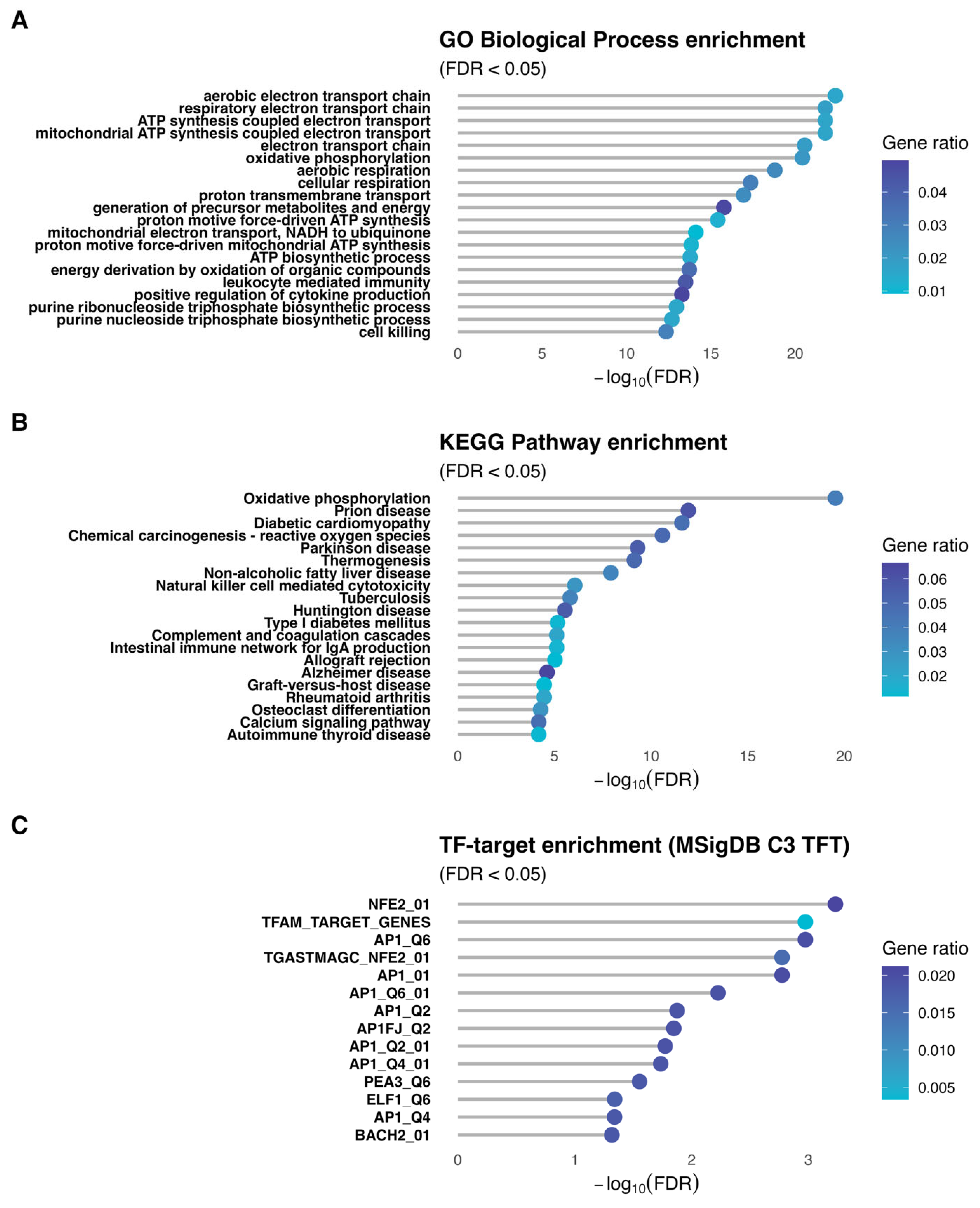
Functional enrichment for the SLC13A5 module was performed while keeping gene-identifier universes consistent with each analysis. Gene Ontology Biological Process testing used Ensembl IDs for both input and background (all genes passing network quality control), with FDR control by Benjamini–Hochberg [15]. KEGG analysis required mapping Ensembl to Entrez Gene identifiers; both the module and the background were mapped symmetrically with deduplication at the Entrez level prior to testing, and FDR was controlled analogously. Transcription factor target enrichment used MSigDB C3 TFT signatures retrieved via msigdbr [16], tested as over-representation on HUGO Gene Nomenclature Committee (HGNC) symbols with a matching symbol-level background. Enrichment results were summarized by −log10(FDR) and gene-ratio for the most significant terms.

2.7. Co-Expression Subnetwork Visualization

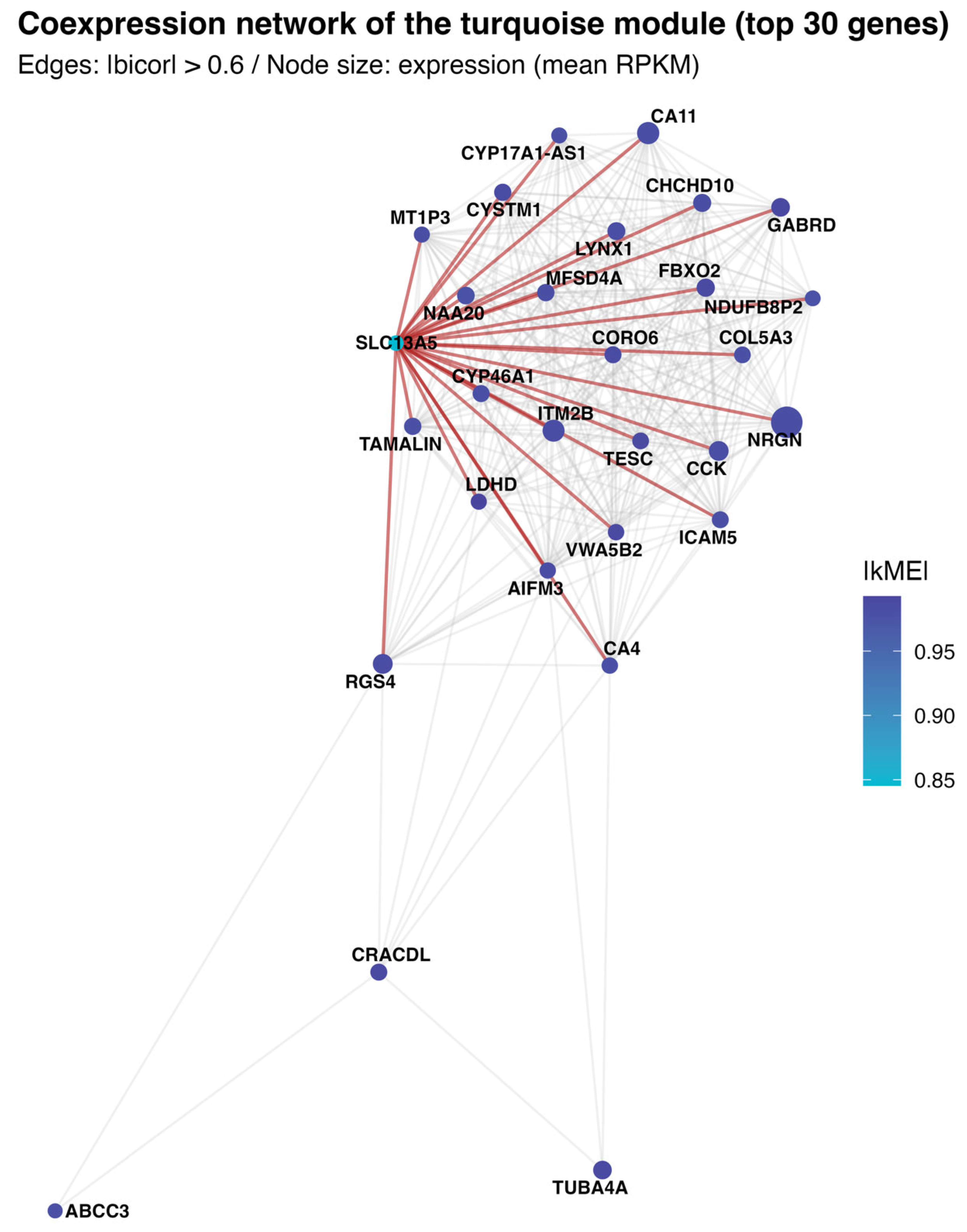
To illustrate intramodular organization, the 30 genes with the highest absolute kME within the SLC13A5 module were selected, with SLC13A5 forcibly included (if not originally among the top 30). Pairwise bicor values were computed within this set, and an undirected edge was drawn when the absolute correlation exceeded 0.60 [17]. The graph was laid out with a Fruchterman–Reingold force-directed algorithm using a fixed random seed for reproducibility. Node size and color encode |kME|, labels are shown for SLC13A5 and the highest-connectivity genes, and edges incident to SLC13A5 are highlighted to delineate its immediate neighborhood.

2.8. Statistical Considerations

Since expression distributions deviated substantially from normality, nonparametric measures, such as Spearman’s rho (ρ), were used throughout for association. All tests were two-sided, and multiplicity was controlled by Benjamini–Hochberg FDR unless otherwise stated. Random seeds were fixed where stochastic procedures were involved to ensure reproducibility of visual layouts and summaries. All analyses were performed using the R language (version 4.5.1) with IDE RStudio (version 2025.9.1.401). A reproducible script is provided as Supplementary Material.

3. Results

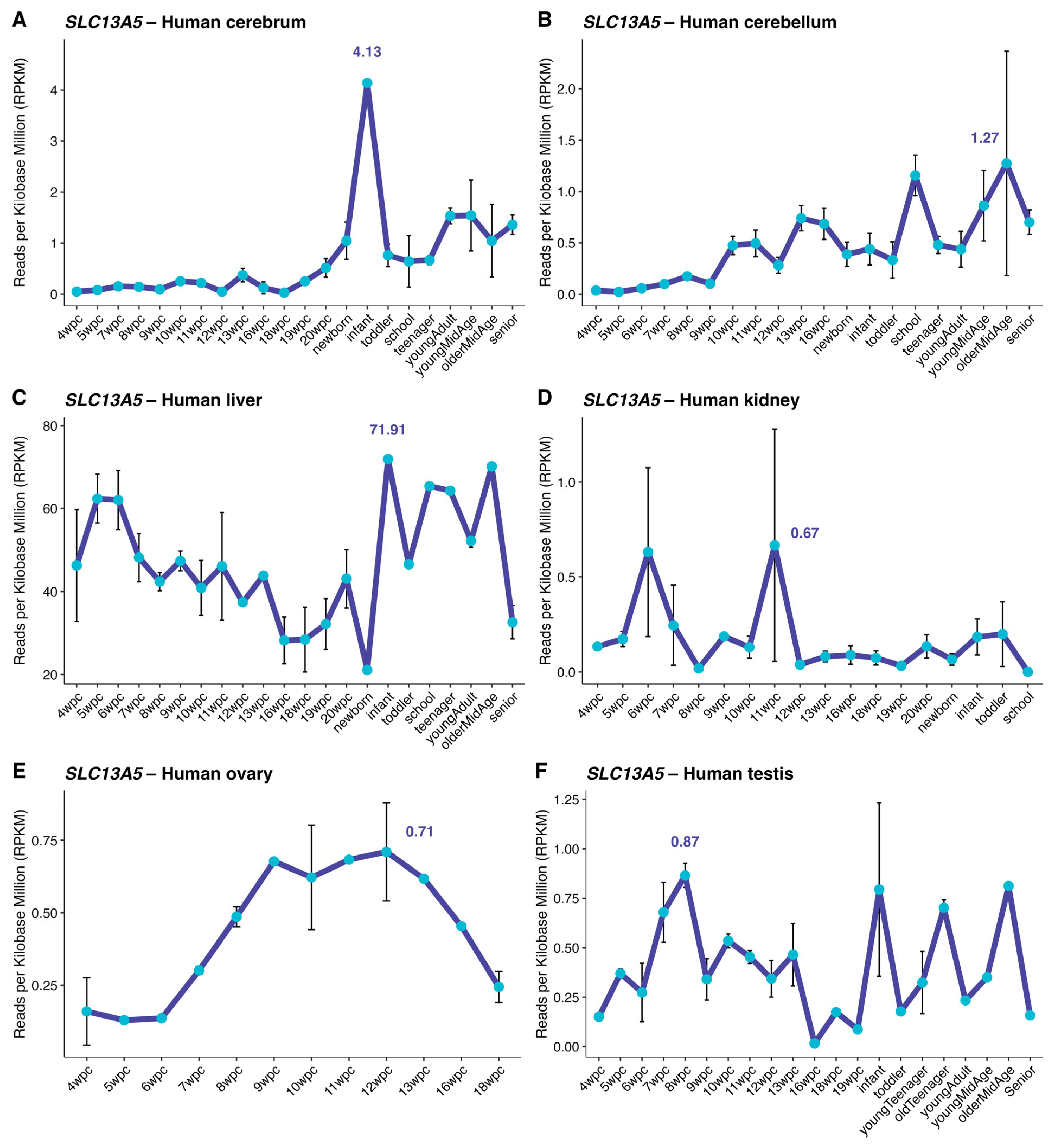
To determine SLC13A5 expression across tissues and how expression changes throughout development, we analyzed SLC13A5 expression using the human data from Cardoso-Moreira et al. (2019) [11]. Figure 1 shows the longitudinal view of SLC13A5 expression in different human tissues, namely cerebrum (Figure 1A), cerebellum (Figure 1B), liver (Figure 1C), kidney (Figure 1D), testis (Figure 1E), and ovaries (Figure 1F). Mean values for pre- and post-conception SLC13A5 expression (RPKM) by tissue are shown in Table 1 (raw data available in Supplementary Data S1).
In the cerebrum, SLC13A5 expression increases from ~0.5 RPKM at 19 wpc to ~4 RPKM in the first year of life. This is followed by a decrease in cerebrum SLC13A5 expression until adult life, when levels are kept above 1 RPKM for the following decades. In early stages of development, cerebellar SLC13A5 expression is less than 1 RPKM (0.3 ± 0.3 RPKM) but increases slowly and continuously throughout life (0.7 ± 0.3 RPKM). Liver is the tissue with the highest SLC13A5 expression. Following an initial drop during the fetal period until birth (from ~50 RPKM to ~20 RPKM), SLC13A5 expression increases and is kept high (~60 RPKM) until the end of adulthood. Other peripheral tissues (including kidney, ovaries, and testis) are also low throughout life.
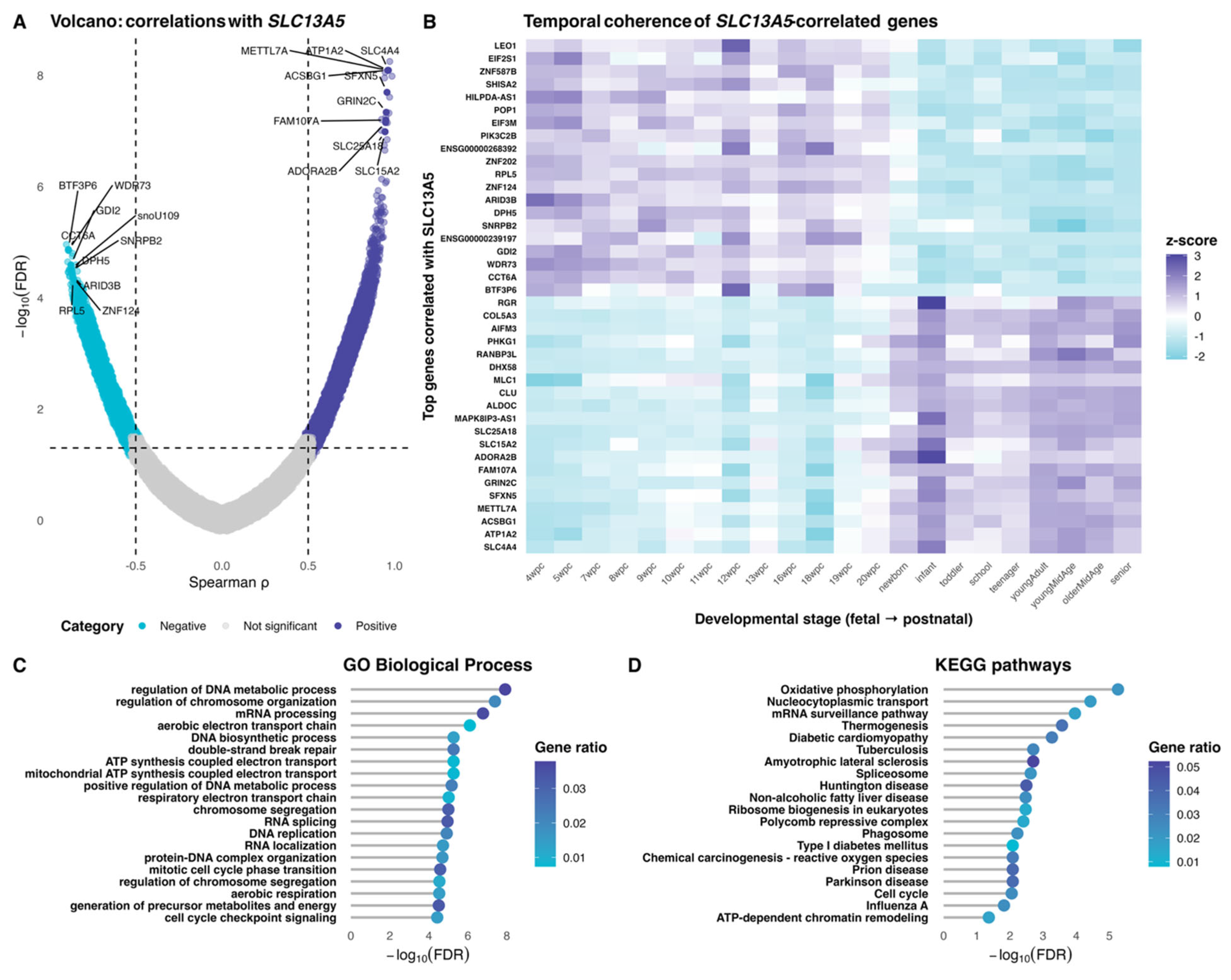
We then assessed the genes whose expression co-varies with SLC13A5 across development in the human cerebrum transcriptome. A transcriptome-wide correlation scan across Evo-Devo cerebrum samples revealed extensive bidirectional associations with SLC13A5 expression (Figure 2A, Supplementary Data S2). It includes both positively and negatively correlated genes after multiple-testing correction. To examine whether these relationships are developmentally organized, we evaluated z-scored expression for the top SLC13A5-correlated genes across fetal-to-postnatal stages. The heat map shows temporal coherence, with many transcripts mirroring the fetal-to-postnatal shift observed for SLC13A5 (Figure 2B). Over-representation analyses of this set of genes flagged processes/pathways linked to mitochondrial energy metabolism (notably oxidative phosphorylation), RNA processing and surveillance (including spliceosome-related terms), and cell-cycle/chromatin regulation (Figure 2C,D).
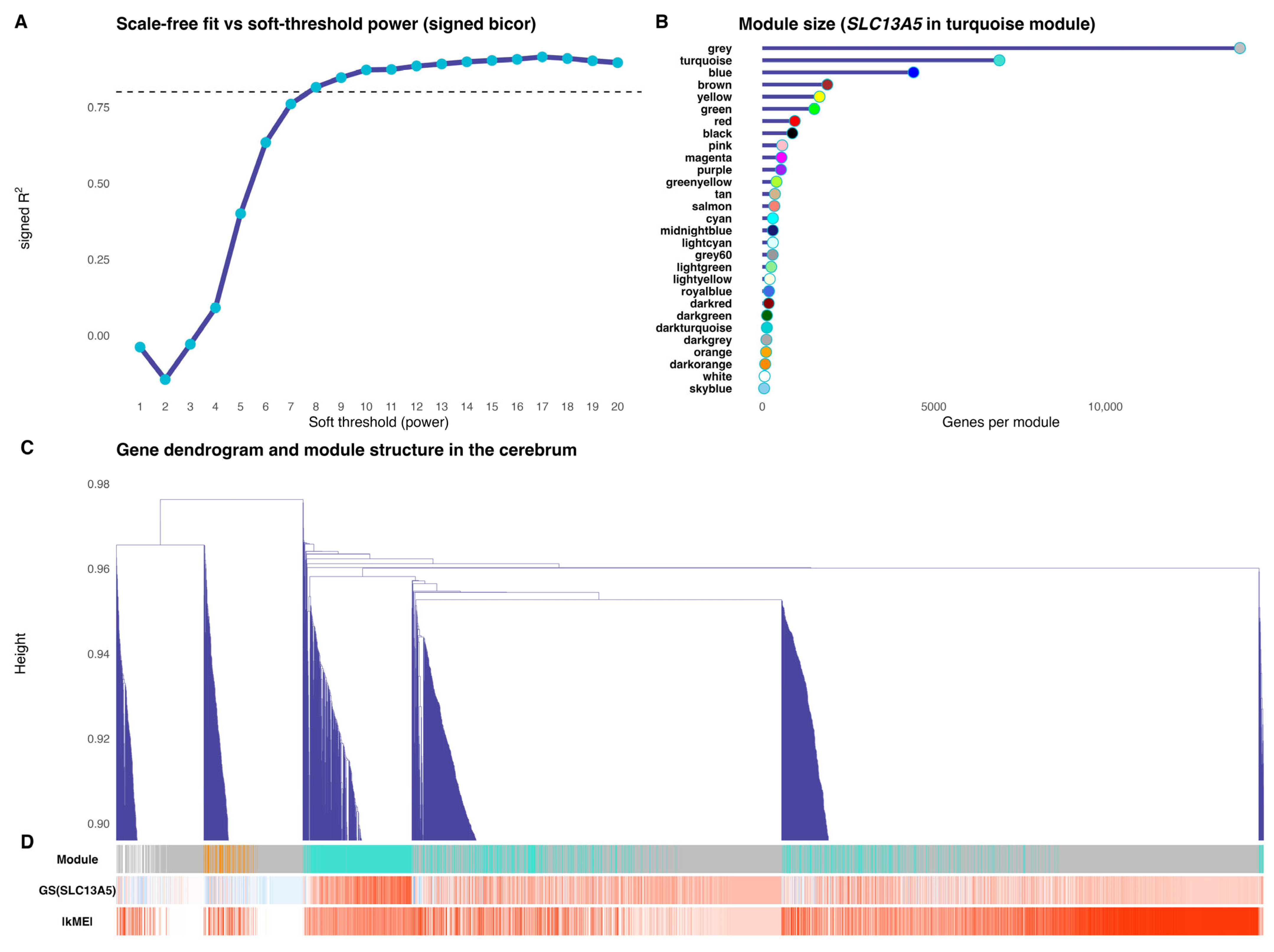
Network construction of the human cerebrum yielded a scale-free-like topology at low double-digit soft thresholds, with the signed bicor fit approaching the conventional R2 = 0.8 plateau and remaining stable thereafter (Figure 3A). Using this parameter, WGCNA identified a heterogeneous module landscape with a few very large groups and many smaller ones (Figure 3B); the “grey” set aggregated unassigned genes, while the turquoise and blue modules comprised the largest structured clusters. The hierarchical dendrogram revealed block structure (Figure 3C). The aligned annotation tracks (Figure 3D) showed that SLC13A5 is found in the turquoise module, where genes with the strongest gene significance to SLC13A5 (red in GS track) spatially co-localize with high intramodular connectivity (deep red in |kME| track).
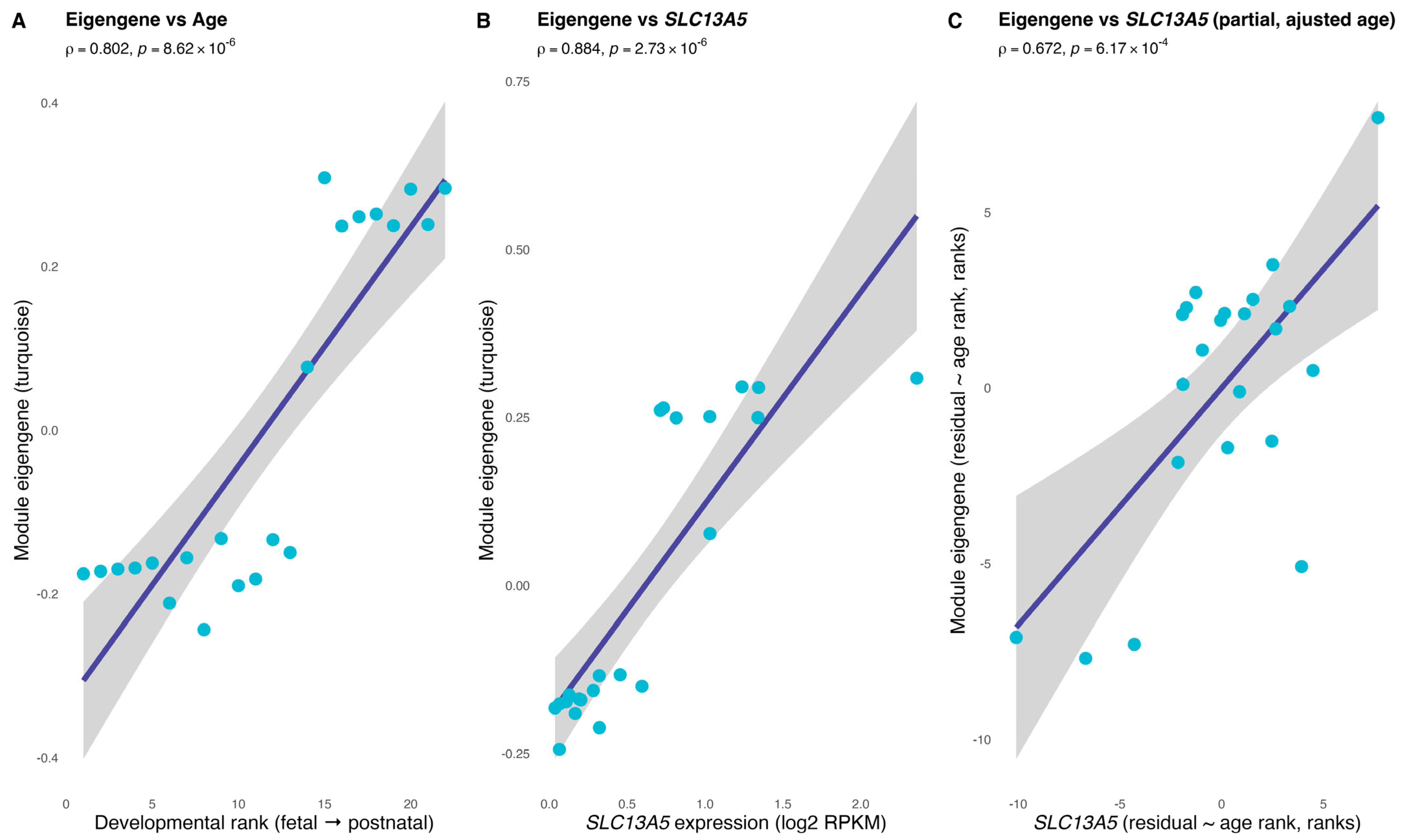
The SLC13A5 module’s eigengene tracked cerebrum maturation and the gene’s own expression (Figure 4). Across fetal-to-postnatal stages, the eigengene rose in accordance with developmental rank (Spearman rho = 0.802, p = 8.62 × 10⁻⁶; Figure 4A), indicating that the turquoise module is progressively activated during human cerebrum development. The eigengene was also tightly correlated with SLC13A5 expression itself (rho = 0.884, p = 2.73 × 10⁻⁶; Figure 4B), consistent with SLC13A5 being embedded within, and representative of, the module. Importantly, this association persisted after regressing out age effects: A partial correlation between the eigengene and SLC13A5 (controlling for developmental rank) remained significant (rho = 0.672, p = 6.17 × 10⁻⁴; Figure 4C).
To visualize the local wiring of the SLC13A5 module, a force-directed subnetwork composed of the top 30 module members was plotted (ranked by |kME|); edges represent robust pairwise co-expression (|bicor| > 0.6) (Figure 5). The layout reveals a compact nucleus of highly interconnected genes with high module cohesion, flanked by a few peripheral nodes with weaker within-module connectivity. SLC13A5 sits adjacent to the core and forms numerous strong links to neuronal and mitochondrial/transport genes (including CYP46A1, ITM2B, NRGN, GABRD, FBXO2, CHCHD10, CYSTM1, MFSD4A, CORO6, and LYNX1), consistent with the functional enrichments for oxidative metabolism, RNA/protein homeostasis, and synaptic programs. In contrast, nodes such as ABCC3, CRACDL, and TUBA4A occupy a more peripheral position with fewer edges, indicating lower intramodular connectivity.
Gene set enrichment of the SLC13A5-containing module revealed a coherent, mitochondria-centered program (Figure 6). In GO Biological Process (Figure 6A), top terms were related to mitochondrial metabolism, including ‘aerobic electron transport chain’, ‘respiratory electron transport chain’, ‘ATP synthesis coupled electron transport’, and ‘mitochondrial ATP synthesis coupled electron transport’. Other terms also revealed involvement with inflammation and purine metabolism. KEGG analysis (Figure 6B) showed a significant enrichment for ‘oxidative phosphorylation’ and pathways involved in neurodegenerative and inflammatory diseases. Transcription factor target enrichment (MSigDB C3 TFT; Figure 6C) highlighted regulators consistent with these themes, including NFE2/NRF-like motifs, TFAM-associated genes, and AP-1 family targets (multiple AP1 motif sets), as well as ELF1/BACH2 target sets.

4. Discussion

SLC13A5 plays a key role in citrate metabolism, impacting hepatic lipogenesis, cell proliferation, bone development, and epilepsy in mammals [18]. Loss-of-function mutations in the SLC13A5 gene have been associated with SLC13A5 epilepsy [19]. On the other hand, overexpression of Slc13a5 in neurons from mouse forebrain has been linked to disrupted white matter integrity and autistic-like behaviors [20]. Slc13a5 overexpression also causes progeria-like phenotype, systemic inflammation, and alterations in protein acetylation [21]. Thus, SLC13A5 may present different roles/importance across the lifespan.
The physiological pattern of SLC13A5 expression across life in human tissues has not been described yet. We therefore used a dataset of human tissues from Moreira and colleagues (2019) [11] to start addressing this issue. Liver was the tissue with the highest SLC13A5 mRNA expression at all timepoints investigated. Previous reports showed SLC13A5 expression to be much higher in liver than in brain (for both humans and rats) [22,23]. In cerebrum, SLC13A5 mRNA expression increased from conception until infancy, when it reached its peak. An increase in Slc13a5 mRNA expression during early postnatal life was also shown in rat cerebral cortex [24]. Cerebellar expression of SLC13A5 steadily increased throughout life. Slc13a5-knockout mice show distinct metabolic pathways disrupted depending on the tissue investigated [25]. Thus, the distinct patterns of SLC13A5 mRNA expression reported here may cooperate with the different roles played by SLC13A5 in the metabolism of these tissues.
We then assessed expression data of all cerebrum genes in the Evo-Devo database and ran multiple Spearman correlation analyses against the longitudinal expression of SLC13A5. We found sets of genes with strong correlation (positive or negative) and time coherence appropriateness with SLC13A5 expression. Analysis of gene ontology and KEGG pathways indicates that SLC13A5 sits in a developmentally coherent gene neighborhood enriched for mitochondrial bioenergetics and gene regulatory pathways in the human cerebrum. Genes related to transcription, translation, and synthesis of proteins are critical during neurodevelopment, and dysfunction of these genes may cause reduced brain volume, developmental delay, cognitive deficits, alterations in neural cristae, and neuronal alteration [26,27,28,29]. Additionally, the tuning of bioenergetic metabolism is crucial during neurodevelopment. Shifts in bioenergetics control cell fate, as well as neural progenitor proliferation and differentiation [30].
In order to evaluate the network hierarchy, we performed a weighted gene co-expression network analysis and evaluated the intramodular connectivity. The results of WGCNA validated the chosen network parameters, delineated the global co-expression architecture of the developing brain, and defined a densely connected SLC13A5-centered module for downstream analyses. The analyses of association between SLC13A5, the eigengene, and the developmental rank indicated that the module captures a coordinated expression program that matches developmental progression and specifically co-varies with SLC13A5 (regardless of the global age trajectory).
The analysis of |kME| within the SLC13A5 module suggested that SLC13A5 is embedded in a densely connected module. It is directly connected to genes involved in neuronal homeostasis (synaptic signaling and structural proteins), mitochondrial organization, and lipid/cholesterol turnover. It is feasible that SLC13A5 plays a role in the cooperation between brain and liver for citrate homeostasis, maintaining lipid balance throughout the body (including basic and complex lipids) [25]. We also observed the presence of genes important for calcium handling (e.g., NRGN and TESC) [31,32,33] for cell signaling, metabolism, and fate (e.g., CYP46A1, LDHD, CA4, CA11, RGS4, CHCHD10, AIFM3, and TAMALIN) [34,35,36,37,38,39,40], as well as cell structure and extracellular matrix (e.g., COL5A3, ICAM5, TUBA4A, and CORO6) [41,42,43,44]. Interestingly, GABRD was found to be directly connected to SLC13A5 in the module. GABRD is a gene that encodes GABAA subunit, an important receptor during neurodevelopment and for epilepsy [45]. SLC13A5 was also directly connected to LYNX1, a gene encoding a protein that modulates nAChR. Alterations in nAChR are associated with some epilepsies [46]. LYNX1 dysregulation was reported in Fragile X Syndrome, a condition characterized by epilepsy [47], and in neurodevelopmental disorders [48]. Additionally, knockout of Lynx1 in animal models enhances synaptic efficacy and performance in memory tests. However, it induces neurodegeneration by the hyperactivation of nAChR [49].
The functional programs enriched in the SLC13A5 module were then analyzed. GO Biological Process enrichment analysis indicated that the SLC13A5 module is embedded in a developmental program with genes involved in mitochondrial energy metabolism, reflecting a transcriptional coordination between mitochondrial homeostasis and SLC13A5. KEGG analysis showed an enrichment in pathways associated with neurodegenerative disease (Parkinson’s, Alzheimer’s, Huntington’s disease) and metabolic and inflammatory diseases (type I diabetes, non-alcoholic fatty liver disease, rheumatoid arthritis). Interestingly, SLC13A5 inhibition has also been suggested as a potential therapeutic target for kidney disease [50], hyperlipidemia [51], non-alcoholic fatty liver disease, insulin resistance, and a myriad of metabolic diseases [10,52,53,54]. The underlying mechanisms may involve decreasing citrate uptake from blood and reducing intracellular levels of citrate in the liver [55]. The enriched transcription-factor targets include factors such as NFE2, TFAM, and members of the AP-1 family (API, AP1F), implicated in the regulation of mitochondrial biogenesis, stress response, and cell differentiation [42,56,57,58]. The presence of TFAM, a key regulator of mitochondrial transcription, is particularly relevant. Altogether, the data suggest that this module may represent a regulatory axis relevant to physiological and pathophysiological conditions involving mitochondria.
It is important to emphasize that our analyses rely on transcriptomic data quantified as RPKM, which does not always correlate directly with protein abundance or functional activity. In fact, mRNA levels explain only about 40% of the variability in protein abundance across human tissues, highlighting the inherent constraints of using transcriptomic data alone to infer protein expression or biological function [59,60]. Therefore, protein abundance and localization must be addressed with orthogonal data. Moreover, potential confounders such as age-dependent changes in cell type composition, inter-donor variability, sex, and technical artifacts were not systematically addressed in this study. These factors may influence both transcript and protein measurements and should be considered when interpreting the data. While our analyses focus on within-series co-variation and use rank-based associations with matched testing universes to mitigate some sources of bias, we cannot exclude the possibility that part of the reported pathway enrichment and co-expression structure is influenced by these factors.

5. Conclusions

SLC13A5 is highly expressed in the brain in the first years of life, suggesting an important role in this period of life and coinciding with the onset of seizures in SLC13A5 epilepsy patients. Potential targets of metabolic interplay with SLC13A5 include mitochondria, neurotransmission-related genes, and lipid metabolism. These findings deepen our understanding of the SLC13A5 expression patterns and highlight its potential significance in cellular metabolism and disease pathogenesis. Continued investigation into the molecular mechanisms underlying SLC13A5 regulation and its functional implications in health and disease will be essential for unraveling its full biological significance and therapeutic potential. For instance, a better understanding of the mechanisms behind age- and tissue-specific SLC13A5 transcription would help identify targeted therapeutics for SLC13A5 epilepsy and other metabolic disorders with altered citrate homeostasis. Future studies should also investigate neurotransmitter changes after loss of SLC13A5 to elucidate the functional role of SLC13A5 in neurotransmission.

Supplementary Materials

The following supporting information can be downloaded at: https://www.mdpi.com/article/10.3390/brainsci16020163/s1, a reproducible script (Script1) is provided as supplementary material, Data S1: Mean developmental SLC13A5 expression in human tissues, Data S2: Genes correlated to SLC13A5 throughout development.

Author Contributions

Conceptualization, B.K.F., P.F.S., G.C.F. and H.R.F.; methodology, H.R.F.; software, H.R.F.; formal analysis, B.K.F., P.F.S., G.C.F. and H.R.F.; data curation, H.R.F.; writing—original draft preparation, B.K.F. and H.R.F.; writing—review and editing, B.K.F., P.F.S., G.C.F. and H.R.F.; supervision, P.F.S., G.C.F. and H.R.F.; project administration, P.F.S. and G.C.F.; funding acquisition, B.K.F., P.F.S., G.C.F. and H.R.F. All authors have read and agreed to the published version of the manuscript.

Funding

This work was supported by the Carlos Chagas Filho Research Support Foundation of the State of Rio de Janeiro (FAPERJ, Brazil) [E-26/200.448/2023; E-26/201.073/2022; E-26/211.289/2021; E-26/211.699/2021; E-26/210.048/2020; E-26/211.095/2019; E-26/010.002215/2019; E-26/202.668/2018; 426342/2018–6; 312157/2016–9], the National Council for Scientific and Technological Development (CNPq, Brazil) [152312/2024-2; 312991/2021–5; 152071/2020–2; 311369/2020–0; 138008/2017–5], and Tess Research Foundation (TRF, USA) [Early-Career Investigator Research Grant, 2022/2023].

Institutional Review Board Statement

Not applicable.

Informed Consent Statement

Not applicable.

Data Availability Statement

The raw data supporting the conclusions of this article will be made available by the authors upon reasonable request. Evo-Devo resource website: https://apps.kaessmannlab.org/evodevoapp/ (accessed on 6 July 2023).

Acknowledgments

We thank Brenda Porter and Tanya Brown, as well as TRF, for their support and for reviewing the first draft of this manuscript.

Conflicts of Interest

The authors declare that the research was conducted in the absence of any commercial or financial relationships that could be construed as a potential conflict of interest.

References

  1. Matricardi, S.; De Liso, P.; Freri, E.; Costa, P.; Castellotti, B.; Magri, S.; Gellera, C.; Granata, T.; Musante, L.; Lesca, G.; et al. Neonatal Developmental and Epileptic Encephalopathy Due to Autosomal Recessive Variants in SLC13A5 Gene. Epilepsia 2020, 61, 2474–2485. [Google Scholar] [CrossRef]
  2. Spelbrink, E.M.; Brown, T.L.; Brimble, E.; Blanco, K.A.; Nye, K.L.; Porter, B.E. Characterizing a Rare Neurogenetic Disease, SLC13A5 Citrate Transporter Disorder, Utilizing Clinical Data in a Cloud-Based Medical Record Collection System. Front. Genet. 2023, 14, 1109547. [Google Scholar] [CrossRef]
  3. Hardies, K.; de Kovel, C.G.F.; Weckhuysen, S.; Asselbergh, B.; Geuens, T.; Deconinck, T.; Azmi, A.; May, P.; Brilstra, E.; Becker, F.; et al. Recessive Mutations in SLC13A5 Result in a Loss of Citrate Transport and Cause Neonatal Epilepsy, Developmental Delay and Teeth Hypoplasia. Brain 2015, 138, 3238–3250. [Google Scholar] [CrossRef]
  4. Brown, T.L.; Bainbridge, M.N.; Zahn, G.; Nye, K.L.; Porter, B.E. The Growing Research Toolbox for SLC13A5 Citrate Transporter Disorder: A Rare Disease with Animal Models, Cell Lines, an Ongoing Natural History Study and an Engaged Patient Advocacy Organization. Ther. Adv. Rare Dis. 2024, 5, 1–15. [Google Scholar] [CrossRef] [PubMed]
  5. Goodspeed, K.; Liu, J.S.; Nye, K.L.; Prasad, S.; Sadhu, C.; Tavakkoli, F.; Bilder, D.A.; Minassian, B.A.; Bailey, R.M. SLC13A5 Deficiency Disorder: From Genetics to Gene Therapy. Genes 2022, 13, 1655. [Google Scholar] [CrossRef]
  6. Klotz, J.; Porter, B.E.; Colas, C.; Schlessinger, A.; Pajor, A.M. Mutations in the Na+/Citrate Cotransporter NaCT (SLC13A5) in Pediatric Patients with Epilepsy and Developmental Delay. Mol. Med. 2016, 22, 310–321. [Google Scholar] [CrossRef]
  7. Wang, W.-A.; Ferrada, E.; Klimek, C.; Osthushenrich, T.; MacNamara, A.; Wiedmer, T.; Superti-Furga, G. Large-Scale Experimental Assessment of Variant Effects on the Structure and Function of the Citrate Transporter SLC13A5. Sci. Adv. 2025, 11, eadx3011. [Google Scholar] [CrossRef]
  8. Henke, C.; Töllner, K.; van Dijk, R.M.; Miljanovic, N.; Cordes, T.; Twele, F.; Bröer, S.; Ziesak, V.; Rohde, M.; Hauck, S.M.; et al. Disruption of the Sodium-Dependent Citrate Transporter SLC13A5 in Mice Causes Alterations in Brain Citrate Levels and Neuronal Network Excitability in the Hippocampus. Neurobiol. Dis. 2020, 143, 105018. [Google Scholar] [CrossRef]
  9. Ozlu, C.; Adams, R.M.; Solidum, R.M.; Cooper, S.; Best, C.R.; Elacio, J.; Kavanaugh, B.C.; Spelbrink, E.M.; Brown, T.L.; Nye, K.; et al. Developmental Phenotype and Quality of Life in SLC13A5 Citrate Transporter Disorder. Dev. Med. Child Neurol. 2025, 67, 930–940. [Google Scholar] [CrossRef]
  10. Akhtar, M.J.; Khan, S.A.; Kumar, B.; Chawla, P.; Bhatia, R.; Singh, K. Role of Sodium Dependent SLC13 Transporter Inhibitors in Various Metabolic Disorders. Mol. Cell Biochem. 2023, 478, 1669–1687. [Google Scholar] [CrossRef]
  11. Cardoso-Moreira, M.; Halbert, J.; Valloton, D.; Velten, B.; Chen, C.; Shao, Y.; Liechti, A.; Ascenção, K.; Rummel, C.; Ovchinnikova, S.; et al. Gene Expression across Mammalian Organ Development. Nature 2019, 571, 505–509. [Google Scholar] [CrossRef]
  12. Langfelder, P.; Horvath, S. WGCNA: An R Package for Weighted Correlation Network Analysis. BMC Bioinform. 2008, 9, 559. [Google Scholar] [CrossRef] [PubMed]
  13. Bakhtiarizadeh, M.R.; Hosseinpour, B.; Shahhoseini, M.; Korte, A.; Gifani, P. Weighted Gene Co-Expression Network Analysis of Endometriosis and Identification of Functional Modules Associated with Its Main Hallmarks. Front. Genet. 2018, 9, 453. [Google Scholar] [CrossRef] [PubMed]
  14. Li, J.; Zhou, D.; Qiu, W.; Shi, Y.; Yang, J.-J.; Chen, S.; Wang, Q.; Pan, H. Application of Weighted Gene Co-Expression Network Analysis for Data from Paired Design. Sci. Rep. 2018, 8, 622. [Google Scholar] [CrossRef]
  15. Benjamini, Y.; Hochberg, Y. Controlling the False Discovery Rate: A Practical and Powerful Approach to Multiple Testing. J. R. Stat. Soc. Ser. B Methodol. 1995, 57, 289–300. [Google Scholar] [CrossRef]
  16. Dolgalev, I. msigdbr: MSigDB Gene Sets for Multiple Organisms in a Tidy Data Format; Version 25.1.1; R Foundation for Statistical Computing: Vienna, Austria, 2025. [Google Scholar]
  17. Langfelder, P.; Horvath, S. Fast R Functions for Robust Correlations and Hierarchical Clustering. J. Stat. Softw. 2012, 46, 1–17. [Google Scholar] [CrossRef]
  18. Hu, T.; Huang, W.; Li, Z.; Kane, M.A.; Zhang, L.; Huang, S.-M.; Wang, H. Comparative Proteomic Analysis of SLC13A5 Knockdown Reveals Elevated Ketogenesis and Enhanced Cellular Toxic Response to Chemotherapeutic Agents in HepG2 Cells. Toxicol. Appl. Pharmacol. 2020, 402, 115117. [Google Scholar] [CrossRef]
  19. Kopel, J.J.; Bhutia, Y.D.; Sivaprakasam, S.; Ganapathy, V. Consequences of NaCT/SLC13A5 /mINDY Deficiency: Good versus Evil, Separated Only by the Blood–Brain Barrier. Biochem. J. 2021, 478, 463–486. [Google Scholar] [CrossRef]
  20. Rigby, M.J.; Orefice, N.S.; Lawton, A.J.; Ma, M.; Shapiro, S.L.; Yi, S.Y.; Dieterich, I.A.; Frelka, A.; Miles, H.N.; Pearce, R.A.; et al. SLC13A5/Sodium-Citrate Co-Transporter Overexpression Causes Disrupted White Matter Integrity and an Autistic-like Phenotype. Brain Commun. 2022, 4, fcac002. [Google Scholar] [CrossRef]
  21. Fernandez-Fuente, G.; Overmyer, K.A.; Lawton, A.J.; Kasza, I.; Shapiro, S.L.; Gallego-Muñoz, P.; Coon, J.J.; Denu, J.M.; Alexander, C.M.; Puglielli, L. The Citrate Transporters SLC13A5 and SLC25A1 Elicit Different Metabolic Responses and Phenotypes in the Mouse. Commun. Biol. 2023, 6, 926. [Google Scholar] [CrossRef]
  22. Inoue, K.; Zhuang, L.; Ganapathy, V. Human Na+-Coupled Citrate Transporter: Primary Structure, Genomic Organization, and Transport Function. Biochem. Biophys. Res. Commun. 2002, 299, 465–471. [Google Scholar] [CrossRef]
  23. Inoue, K.; Zhuang, L.; Maddox, D.M.; Smith, S.B.; Ganapathy, V. Structure, Function, and Expression Pattern of a Novel Sodium-Coupled Citrate Transporter (NaCT) Cloned from Mammalian Brain. J. Biol. Chem. 2002, 277, 39469–39476. [Google Scholar] [CrossRef]
  24. Yodoya, E.; Wada, M.; Shimada, A.; Katsukawa, H.; Okada, N.; Yamamoto, A.; Ganapathy, V.; Fujita, T. Functional and Molecular Identification of Sodium-Coupled Dicarboxylate Transporters in Rat Primary Cultured Cerebrocortical Astrocytes and Neurons. J. Neurochem. 2006, 97, 162–173. [Google Scholar] [CrossRef]
  25. Milosavljevic, S.; Glinton, K.E.; Li, X.; Medeiros, C.; Gillespie, P.; Seavitt, J.R.; Graham, B.H.; Elsea, S.H. Untargeted Metabolomics of SLC13A5 Deficiency Reveal Critical Liver-Brain Axis for Lipid Homeostasis. Metabolites 2022, 12, 351. [Google Scholar] [CrossRef] [PubMed]
  26. Capossela, S.; Muzio, L.; Bertolo, A.; Bianchi, V.; Dati, G.; Chaabane, L.; Godi, C.; Politi, L.S.; Biffo, S.; D’Adamo, P.; et al. Growth Defects and Impaired Cognitive-Behavioral Abilities in Mice with Knockout for Eif4h, a Gene Located in the Mouse Homolog of the Williams-Beuren Syndrome Critical Region. Am. J. Pathol. 2012, 180, 1121–1135. [Google Scholar] [CrossRef] [PubMed]
  27. Parenti, I.; Rabaneda, L.G.; Schoen, H.; Novarino, G. Neurodevelopmental Disorders: From Genetics to Functional Pathways. Trends Neurosci. 2020, 43, 608–621. [Google Scholar] [CrossRef] [PubMed]
  28. Russ, J.B.; Stone, A.C.; Maney, K.; Morris, L.C.; Wright, C.F.; Hurst, J.H.; Cohen, J.L. Cell-Specific Expression Biases in Human Cortex of Genes Associated with Neurodevelopmental Disorders. Sci. Rep. 2025, 15, 23172. [Google Scholar] [CrossRef]
  29. Zheng, Z.; Guo, S.; Tam, H.Y.; Wang, J.; Rao, Y.; Hui, M.-N.; Cheung, M.P.L.; Leung, A.W.L.; Wong, K.K.W.; Sharma, R.; et al. Determination of Trunk Neural Crest Cell Fate and Susceptibility to Splicing Perturbation by the DLC1-SF3B1-PHF5A Splicing Complex. Nat. Commun. 2025, 16, 6718. [Google Scholar] [CrossRef]
  30. Rajan, A.; Fame, R.M. Brain Development and Bioenergetic Changes. Neurobiol. Dis. 2024, 199, 106550. [Google Scholar] [CrossRef]
  31. Bao, Y.; Hudson, Q.J.; Perera, E.M.; Akan, L.; Tobet, S.A.; Smith, C.A.; Sinclair, A.H.; Berkovitz, G.D. Expression and Evolutionary Conservation of the Tescalcin Gene during Development. Gene Expr. Patterns 2009, 9, 273–281. [Google Scholar] [CrossRef]
  32. De Arrieta, C.M.; Jurado, L.P.; Bernal, J.; Coloma, A. Structure, Organization, and Chromosomal Mapping of the Human Neurogranin Gene (NRGN). Genomics 1997, 41, 243–249. [Google Scholar] [CrossRef] [PubMed]
  33. Perera, E.M.; Bao, Y.; Kos, L.; Berkovitz, G. Structural and Functional Characterization of the Mouse Tescalcin Promoter. Gene 2010, 464, 50–62. [Google Scholar] [CrossRef] [PubMed]
  34. De Blasi, A.; Conn, P.J.; Pin, J.; Nicoletti, F. Molecular Determinants of Metabotropic Glutamate Receptor Signaling. Trends Pharmacol. Sci. 2001, 22, 114–120. [Google Scholar] [CrossRef]
  35. Jin, S.; Chen, X.; Yang, J.; Ding, J. Lactate Dehydrogenase D Is a General Dehydrogenase for D-2-Hydroxyacids and Is Associated with D-Lactic Acidosis. Nat. Commun. 2023, 14, 6638. [Google Scholar] [CrossRef] [PubMed]
  36. Kitano, J.; Yamazaki, Y.; Kimura, K.; Masukado, T.; Nakajima, Y.; Nakanishi, S. Tamalin Is a Scaffold Protein That Interacts with Multiple Neuronal Proteins in Distinct Modes of Protein-Protein Association. J. Biol. Chem. 2003, 278, 14762–14768. [Google Scholar] [CrossRef]
  37. Lv, G.; Sayles, N.M.; Huang, Y.; Mancinelli, C.; McAvoy, K.; Shneider, N.A.; Manfredi, G.; Kawamata, H.; Eliezer, D. Amyloid Fibril Structures Link CHCHD10 and CHCHD2 to Neurodegeneration. Nat. Commun. 2025, 16, 7121. [Google Scholar] [CrossRef]
  38. Svichar, N.; Waheed, A.; Sly, W.S.; Hennings, J.C.; Hübner, C.A.; Chesler, M. Carbonic Anhydrases CA4 and CA14 Both Enhance AE3-Mediated Cl-HCO3 Exchange in Hippocampal Neurons. J. Neurosci. 2009, 29, 3252–3258. [Google Scholar] [CrossRef]
  39. Xie, Q.; Lin, T.; Zhang, Y.; Zheng, J.; Bonanno, J.A. Molecular Cloning and Characterization of a Human AIF-like Gene with Ability to Induce Apoptosis. J. Biol. Chem. 2005, 280, 19673–19681. [Google Scholar] [CrossRef]
  40. Zhao, Q.; Li, J.; Feng, J.; Wang, X.; Liu, Y.; Wang, F.; Liu, L.; Jin, B.; Lin, M.; Wang, Y.; et al. Cholesterol Metabolic Reprogramming Mediates Microglia-Induced Chronic Neuroinflammation and Hinders Neurorestoration Following Stroke. Nat. Metab. 2025, 7, 2099–2116. [Google Scholar] [CrossRef]
  41. Ning, L.; Tian, L.; Smirnov, S.; Vihinen, H.; Llano, O.; Vick, K.; Davis, R.L.; Rivera, C.; Gahmberg, C.G. Interactions between ICAM-5 and β1 Integrins Regulate Neuronal Synapse Formation. J. Cell Sci. 2013, 126, 77–89. [Google Scholar] [CrossRef]
  42. Alaiz-Noya, M.; Miozzo, F.; Fuentes-Ramos, M.; Machnicka, M.A.; Kurowska, M.; Herrera, M.L.; Del Blanco, B.; Ninerola, S.; Bustos-Martínez, I.; Wilczynski, B.; et al. Neuronal Type-Specific Modulation of Cognition and AP-1 Signaling by Early-Life Rearing Conditions. Nat. Commun. 2025, 16, 9710. [Google Scholar] [CrossRef]
  43. Chan, K.T.; Creed, S.J.; Bear, J.E. Unraveling the Enigma: Progress towards Understanding the Coronin Family of Actin Regulators. Trends Cell Biol. 2011, 21, 481–488. [Google Scholar] [CrossRef] [PubMed]
  44. Zhu, J.-L.; Liang, X. TUBA4A: The Tale of an Unconventional Tubulin. Cytoskeleton 2025, early view. [Google Scholar] [CrossRef]
  45. Feng, Y.; Wei, Z.-H.; Liu, C.; Li, G.-Y.; Qiao, X.-Z.; Gan, Y.-J.; Zhang, C.-C.; Deng, Y.-C. Genetic Variations in GABA Metabolism and Epilepsy. Seizure 2022, 101, 22–29. [Google Scholar] [CrossRef]
  46. Becchetti, A.; Grandi, L.C.; Cerina, M.; Amadeo, A. Nicotinic Acetylcholine Receptors and Epilepsy. Pharmacol. Res. 2023, 189, 106698. [Google Scholar] [CrossRef]
  47. Talvio, K.; Minkeviciene, R.; Townsley, K.G.; Achuta, V.S.; Huckins, L.M.; Corcoran, P.; Brennand, K.J.; Castrén, M.L. Reduced LYNX1 Expression in Transcriptome of Human iPSC-Derived Neural Progenitors Modeling Fragile X Syndrome. Front. Cell Dev. Biol. 2022, 10, 1034679. [Google Scholar] [CrossRef]
  48. Smith, M.R.; Glicksberg, B.S.; Li, L.; Chen, R.; Morishita, H.; Dudley, J.T. Loss-of-Function of Neuroplasticity-Related Genes Confers Risk for Human Neurodevelopmental Disorders. Pac. Symp. Biocomput. 2018, 23, 68–79. [Google Scholar]
  49. Miwa, J.M.; Stevens, T.R.; King, S.L.; Caldarone, B.J.; Ibanez-Tallon, I.; Xiao, C.; Fitzsimonds, R.M.; Pavlides, C.; Lester, H.A.; Picciotto, M.R.; et al. The Prototoxin Lynx1 Acts on Nicotinic Acetylcholine Receptors to Balance Neuronal Activity and Survival in Vivo. Neuron 2006, 51, 587–600. [Google Scholar] [CrossRef]
  50. Gill, D.; Zagkos, L.; Gill, R.; Benzing, T.; Jordan, J.; Birkenfeld, A.L.; Burgess, S.; Zahn, G. The Citrate Transporter SLC13A5 as a Therapeutic Target for Kidney Disease: Evidence from Mendelian Randomization to Inform Drug Development. BMC Med. 2023, 21, 504. [Google Scholar] [CrossRef]
  51. Zhang, L.; Hu, W.; Guo, H.; Sun, Q.; Xu, X.; Li, Z.; Qiu, Z.; Bian, J. Discovery of Highly Potent Solute Carrier 13 Member 5 (SLC13A5) Inhibitors for the Treatment of Hyperlipidemia. J. Med. Chem. 2024, 67, 6687–6704. [Google Scholar] [CrossRef] [PubMed]
  52. Brachs, S.; Winkel, A.F.; Tang, H.; Birkenfeld, A.L.; Brunner, B.; Jahn-Hofmann, K.; Margerie, D.; Ruetten, H.; Schmoll, D.; Spranger, J. Inhibition of Citrate Cotransporter SLC13A5/mINDY by RNAi Improves Hepatic Insulin Sensitivity and Prevents Diet-Induced Non-Alcoholic Fatty Liver Disease in Mice. Mol. Metab. 2016, 5, 1072–1082. [Google Scholar] [CrossRef]
  53. Schumann, T.; König, J.; Henke, C.; Willmes, D.M.; Bornstein, S.R.; Jordan, J.; Fromm, M.F.; Birkenfeld, A.L. Solute Carrier Transporters as Potential Targets for the Treatment of Metabolic Disease. Pharmacol. Rev. 2020, 72, 343–379. [Google Scholar] [CrossRef] [PubMed]
  54. Willmes, D.M.; Kurzbach, A.; Henke, C.; Schumann, T.; Zahn, G.; Heifetz, A.; Jordan, J.; Helfand, S.L.; Birkenfeld, A.L. The Longevity Gene INDY (I'm Not Dead Yet) in Metabolic Control: Potential as Pharmacological Target. Pharmacol. Ther. 2018, 185, 1–11. [Google Scholar] [CrossRef]
  55. Kopel, J.; Higuchi, K.; Ristic, B.; Sato, T.; Ramachandran, S.; Ganapathy, V. The Hepatic Plasma Membrane Citrate Transporter NaCT (SLC13A5) as a Molecular Target for Metformin. Sci. Rep. 2020, 10, 8536. [Google Scholar] [CrossRef]
  56. Pajares, M.; Cuadrado, A.; Rojo, A.I. Modulation of Proteostasis by Transcription Factor NRF2 and Impact in Neurodegenerative Diseases. Redox Biol. 2017, 11, 543–553. [Google Scholar] [CrossRef]
  57. Song, Y.; Wang, W.; Wang, B.; Shi, Q. The Protective Mechanism of TFAM on Mitochondrial DNA and Its Role in Neurodegenerative Diseases. Mol. Neurobiol. 2024, 61, 4381–4390. [Google Scholar] [CrossRef]
  58. Williams, L.M.; Lago, B.A.; McArthur, A.G.; Raphenya, A.R.; Pray, N.; Saleem, N.; Salas, S.; Paulson, K.; Mangar, R.S.; Liu, Y.; et al. The Transcription Factor, Nuclear Factor, Erythroid 2 (Nfe2), Is a Regulator of the Oxidative Stress Response during Danio Rerio Development. Aquat. Toxicol. 2016, 180, 141–154. [Google Scholar] [CrossRef] [PubMed]
  59. Schwanhäusser, B.; Busse, D.; Li, N.; Dittmar, G.; Schuchhardt, J.; Wolf, J.; Chen, W.; Selbach, M. Global Quantification of Mammalian Gene Expression Control. Nature 2011, 473, 337–342. [Google Scholar] [CrossRef] [PubMed]
  60. Liu, Y.; Beyer, A.; Aebersold, R. On the Dependency of Cellular Protein Levels on mRNA Abundance. Cell 2016, 165, 535–550. [Google Scholar] [CrossRef]
Figure 1. SLC13A5 expression in human central and peripheral tissues. RPKM for SLC13A5 expression is shown at different age categories for (A) cerebrum, (B) cerebellum, (C) liver, (D) kidney, (E) ovary, and (F) testis. Each panel depicts the biological ordering from fetal weeks post-conception (wpc) through postnatal stages, with the within-tissue median ± IQR annotated. The horizontal axis represents developmental progression through age ranks, including 4–20 wpc, newborn, infant (6 to 9 months old), toddler (2 to 4 years old), school age (7 to 9 years old), teenager (13 to 19 years old), young adult (25 to 32 years old), young mid-age (39 to 41 years old), older mid-age (46 to 54 years old), and senior (58 to 63 years old). Data are expressed as mean RPKM ± SEM.
Brainsci 16 00163 g001
Figure 2. Transcriptome-wide association landscape for SLC13A5 in the human cerebrum. Panel (A) shows a volcano-type display of Spearman correlations between SLC13A5 and all expressed genes across cerebrum samples (dashed guides at ρ = ±0.5 and at the Benjamini–Hochberg FDR = 0.05 threshold). Labeled points indicate the most significant positive and negative associates after FDR correction. Panel (B) presents a compact heat map of the top positively and negatively associated genes (at all developmental stages from 4 wpc to senior), showing z-scored expression to emphasize temporal gradient. Panels (C,D) summarize functional enrichment among FDR-significant correlates: (C) Gene Ontology Biological Process using Ensembl identifiers for SLC13A5-correlated genes; (D) KEGG pathways using a symmetric Ensembl → Entrez mapping. The color of the dots indicates the gene ratio. The y-axis reflects −log10(FDR), with terms ranked by significance.
Brainsci 16 00163 g002
Figure 3. Network architecture of the cerebrum co-expression map. Panel (A) displays the scale-free topology fit versus soft-thresholding power for a signed, bicor network, with a chosen beta of 8, corresponding to the first value achieving R2 ≥ 0.80 (fallback applied when no value reaches the criterion). Panel (B) shows module size distribution (genes per module), with the circle color fill matching the WGCNA module color key used throughout. Panels (C,D) show the gene dendrogram with aligned color tracks: (C) dendrogram zoomed at the top to emphasize branch topology; (D) annotation tracks reporting, in order, module assignment (one block showing genes represented by their module color, according to panel B), gene significance to SLC13A5 (bicor with SLC13A5; blue[high]-white-red[low] gradient), and intramodular connectivity (|kME|; blue[high]-white-red[low] gradient).
Brainsci 16 00163 g003
Figure 4. The SLC13A5 module tracks neurodevelopment and the gene itself. Panel (A) shows the association between the SLC13A5 module eigengene (SME) and the ordinal developmental rank (age rank) across cerebrum samples. Panel (B) depicts the association between SME and SLC13A5 expression (log2-transformed). A partial Spearman correlation controlling for age rank (computed on rank-based residuals) is provided in the panel (C). Spearman ρ and two-sided p are indicated in all panels.
Brainsci 16 00163 g004
Figure 5. Intramodular co-expression network linked to SLC13A5. A force-directed graph depicts the top 30 genes by absolute intramodular connectivity (|kME|) within the SLC13A5 module, with SLC13A5 forcibly included when necessary. Undirected edges connect pairs with |bicor| > 0.60, emphasizing robust associations. Node color encodes |kME|, and size represents cerebrum gene expression (mean RPKM); labels are shown for SLC13A5 and the highest-connectivity nodes. Edges incident to SLC13A5 are highlighted (in red) to delineate its immediate neighborhood within the module.
Brainsci 16 00163 g005
Figure 6. Functional programs enriched in the SLC13A5 module. Gene set over-representation for the SLC13A5 module is shown for Gene Ontology Biological Process (Panel (A)), KEGG pathways (Panel (B)), and MSigDB C3 transcription factor targets (Panel (C)). Universes are matched to each test (all network-tested genes in Ensembl for GO; symmetric Ensembl → Entrez mapping for KEGG; symbol-level background for TF targets). Points encode the gene ratio by color, and the y-axis indicates −log10(FDR). Displayed terms are the top results by FDR, highlighting processes and pathways linked to the module’s coordinated variation.
Brainsci 16 00163 g006
Table 1. Pre- and post-conception SLC13A5 expression (RPKM) by tissue.
Conception Stage
Tissue nDS Overall 1 Pre 1 Post 1 Diff. 2 95% CI 2 p-Value 2
Cerebrum 22 0.7 ± 0.9 0.2 ± 0.1 1.4 ± 1.1 −1.2 −2.1, −0.40 0.009
Cerebellum 20 0.5 ± 0.4 0.3 ± 0.3 0.7 ± 0.3 −0.39 −0.69, −0.09 0.015
Heart 19 0.1 ± 0.1 0.0 ± 0.1 0.1 ± 0.1 −0.01 −0.12, 0.09 0.8
Kidney 18 0.2 ± 0.2 0.2 ± 0.2 0.1 ± 0.1 0.08 −0.08, 0.24 0.3
Liver 22 46.9 ± 14.2 43.5 ± 10.3 53.0 ± 18.6 −9.5 −26, 6.4 0.2
Ovary 12 0.4 ± 0.2 0.4 ± 0.2 - - - -
Testis 21 0.4 ± 0.3 0.4 ± 0.2 0.4 ± 0.3 −0.08 −0.33, 0.18 0.5
1 Mean ± SD; 2 Welch two-sample t-test; abbreviation: CI = confidence interval, nDS = number of developmental stages available in the dataset, Diff. = diference between pre and post conception stage.
Disclaimer/Publisher’s Note: The statements, opinions and data contained in all publications are solely those of the individual author(s) and contributor(s) and not of MDPI and/or the editor(s). MDPI and/or the editor(s) disclaim responsibility for any injury to people or property resulting from any ideas, methods, instructions or products referred to in the content.