Article

Development of Practical Design Approaches for Water Distribution Systems


1
Department of Civil and Architectural Engineering and Mechanics, University of Arizona, Tucson, AZ 85721, USA
2
Water Works Research Center, K-water Research Institute Research Institute, Deajeon 34045, Korea
3
Hajon Engineering and Construction Co., LTD., Dongbu-ro, Jinju 52818, Korea
4
Department of Civil Engineering, The University of Suwon, Hwasung 18323, Korea
5
School of Civil, Environmental and Architectural Engineering, Korea University, Anamdong, Seongbukgu, Seoul 136-713, Korea
*
Author to whom correspondence should be addressed.
Appl. Sci. 2019, 9(23), 5117; https://doi.org/10.3390/app9235117
Submission received: 11 October 2019 / Revised: 12 November 2019 / Accepted: 22 November 2019 / Published: 26 November 2019
(This article belongs to the Special Issue Emerging Issues of Urban Water Systems Modeling and Analysis)

Abstract

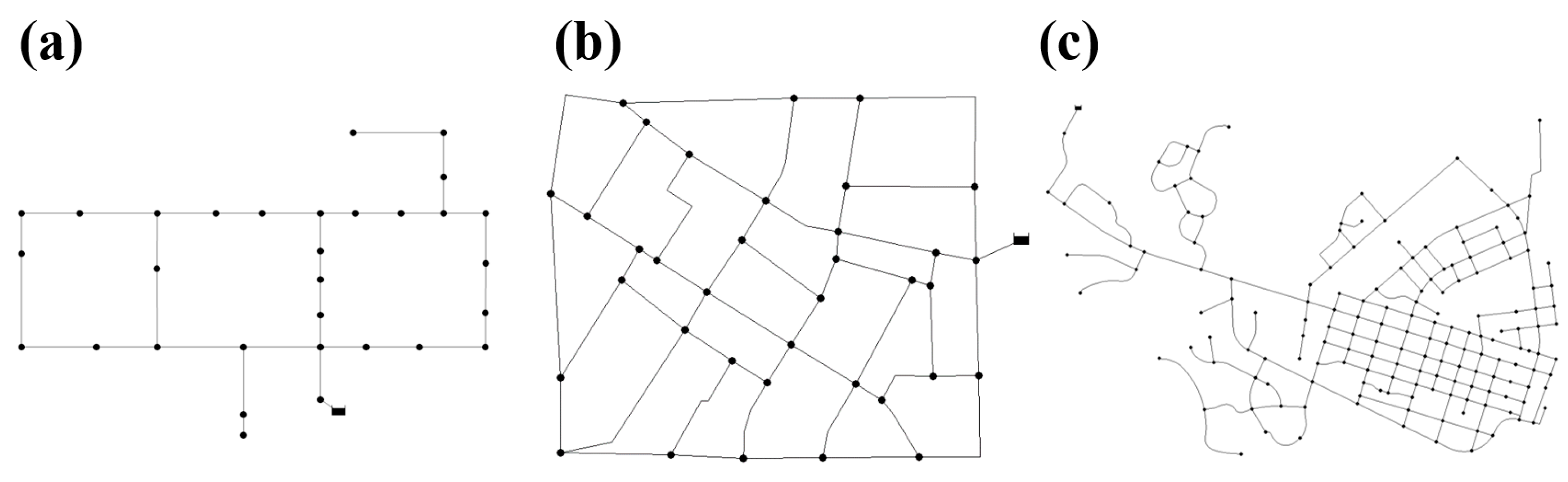
The optimal design of water distribution systems (WDSs) should be economical, consider practical field applicability, and satisfy hydraulic constraints such as nodal pressure and flow velocity. However, the general optimal design of a WDSs approach using a metaheuristic algorithm was difficult to apply for achieving pipe size continuity at the confluence point. Although some studies developed the design approaches considering the pipe continuity, these approaches took many simulation times. For these reasons, this study improves the existing pipe continuity search method by reducing the computation time and enhancing the ability to handle pipe size continuity at complex joints that have more than three nodes. In addition to more practical WDSs designs, the approach considers various system design factors simultaneously in a multi-objective framework. To verify the proposed approach, the three well-known WDSs to apply WDS design problems are applied, and the results are compared with the previous design method, which used a pipe continuity research algorithm. This study can reduce the computation time by 87% and shows an ability to handle complex joints. Finally, the application of this practical design technique, which considers pipe continuity and multiple design factors, can reduce the gap between the theoretical design and the real world because it considers construction conditions and abnormal situations.
Keywords: practical design approach; water distribution systems; multi-objective optimization; improved efficiency and effect practical design approach; water distribution systems; multi-objective optimization; improved efficiency and effect