Energy Management Strategy for a Hybrid Electric Vehicle Based on Deep Reinforcement Learning

Abstract
1. Introduction
2. Problem Formulation
3. Deep Reinforcement Learning-Based EMS
3.1. Value Function Approximation
3.2. DRL Algorithm Design
| Algorithm 1: Deep Q-Learning with Experience Replay |
| Initialize replay memory D to capacity N |
| Initialize action-value function with random weights |
| Initialize target action-value function with weights |
| 1: For episode = 1, M do |
| 2: Reset environment: |
| 3: For t = 1, T, do |
| 4: With probability select a random action |
| otherwise select |
| 5: Choose action and observe the reward |
| 6: Set |
| 7: Store in memory D |
| 8: Sample random mini-batch of from D |
| 9: if terminal : Set |
| else set |
| 10: Perform a gradient descent step on |
| 11: Every C steps reset |
| 12: end for |
| 13: end for |
3.3. DRL-Based Algorithm Online Learning Application
4. Experimental Results and Discussion
4.1. Offline Application
4.1.1. Experiment Setup
4.1.2. Experimental Results
4.2. Online Application
4.2.1. Experiment Setup
4.2.2. Experimental Results
5. Conclusions
Acknowledgments
Author Contributions
Conflicts of Interest
References
- Un-Noor, F.; Padmanaban, S.; Mihet-Popa, L.; Mollah, M.N.; Hossain, E. A Comprehensive Study of Key Electric Vehicle (EV) Components, Technologies, Challenges, Impacts, and Future Direction of Development. Energies 2017, 10, 1217. [Google Scholar] [CrossRef] [Scilit]
- Wirasingha, S.G.; Emadi, A. Classification and review of control strategies for plug-in hybrid electric vehicles. IEEE Trans. Veh. Technol. 2011, 60, 111–122. [Google Scholar] [CrossRef] [Scilit]
- Gokce, K.; Ozdemir, A. An instantaneous optimization strategy based on efficiency maps for internal combustion engine/battery hybrid vehicles. Energy Convers. Manag. 2014, 81, 255–269. [Google Scholar] [CrossRef] [Scilit]
- Odeim, F.; Roes, J.; Wulbeck, L.; Heinzel, A. Power management optimization of fuel cell/battery hybrid vehicles with experimental validation. J. Power Sources 2014, 252, 333–343. [Google Scholar] [CrossRef] [Scilit]
- Li, C.; Liu, G. Optimal fuzzy power control and management of fuel cell/battery hybrid vehicles. J. Power Sources 2009, 192, 525–533. [Google Scholar] [CrossRef] [Scilit]
- Denis, N.; Dubois, M.R.; Desrochers, A. Fuzzy-based blended control for the energy management of a parallel plug-in hybrid electric vehicle. IET Intell. Transp. Syst. 2015, 9, 30–37. [Google Scholar] [CrossRef] [Scilit]
- Ansarey, M.; Panahi, M.S.; Ziarati, H.; Mahjoob, M. Optimal energy management in a dual-storage fuel-cell hybrid vehicle using multi-dimensional dynamic programming. J. Power Sources 2014, 250, 359–371. [Google Scholar] [CrossRef] [Scilit]
- Vagg, C.; Akehurst, S.; Brace, C.J.; Ash, L. Stochastic dynamic programming in the real-world control of hybrid electric vehicle. IEEE Trans. Contr. Syst. Techol. 2016, 24, 853–866. [Google Scholar] [CrossRef] [Scilit]
- Qin, F.; Xu, G.; Hu, Y.; Xu, K.; Li, W. Stochastic optimal control of parallel hybrid electric vehicles. Energies 2017, 10, 214. [Google Scholar] [CrossRef] [Scilit]
- Chen, Z.; Mi, C.C.; Xiong, R.; Xu, J.; You, C. Energy management of a power-split plug-in hybrid electric vehicle based on genetic algorithm and quadratic programming. J. Power Sources 2014, 248, 416–426. [Google Scholar] [CrossRef] [Scilit]
- Xie, S.; Li, H.; Xin, Z.; Liu, T.; Wei, L. A pontryagin minimum principle-based adaptive equivalent consumption minimum strategy for a plug-in hybrid electric bus on a fixed route. Energies 2017, 10, 1379. [Google Scholar] [CrossRef] [Scilit]
- Guo, L.; Guo, B.; Guo, Y.; Chen, H. Optimal energy management for HEVs in Eco-driving applications using bi-level MPC. IEEE Trans. Intell. Transp. Syst. 2017, 18, 2153–2162. [Google Scholar] [CrossRef] [Scilit]
- Tian, H.; Li, S.E.; Wang, X.; Huang, Y.; Tian, G. Data-driven hierarchical control for online energy management of plug-in hybrid electric city bus. Energy 2018, 142, 55–67. [Google Scholar] [CrossRef] [Scilit]
- Daming, Z.; AI-Durra, A.; Fei, G.; Simoes, M.G. Online energy management strategy of fuel cell hybrid electric vehicles based on data fusion approach. J. Power Sources 2017, 366, 278–291. [Google Scholar]
- Martinez, C.M.; Hu, X.; Cao, D.; Velenis, E.; Gao, B.; Wellers, M. Energy Management in Plug-in Hybrid Electric Vehicles: Recent Progress and a Connected Vehicles Perspective. IEEE Trans. Veh. Technol. 2017, 66, 4534–4549. [Google Scholar] [CrossRef] [Scilit]
- Zheng, C.; Xu, G.; Xu, K.; Pan, Z.; Liang, Q. An energy management approach of hybrid vehicles using traffic preview information for energy saving. Energy Convers. Manag. 2015, 105, 462–470. [Google Scholar] [CrossRef] [Scilit]
- Liu, T.; Zou, Y.; Liu, D.; Sun, F. Reinforcement learning-based energy management strategy for a hybrid electric tracked vehicle. Energies 2015, 8, 7243–7260. [Google Scholar] [CrossRef] [Scilit]
- Qi, X.; Wu, G.; Boriboonsomsin, K.; Barth, M.J.; Gonder, J. Data-driven reinforcement learning-based real-time energy management system for plug-in hybrid electric vehicles. Transp. Res. Rec. 2016, 2572, 1–8. [Google Scholar] [CrossRef] [Scilit]
- Li, W.; Xu, G.; Xu, Y. Online learning control for hybrid electric vehicle. Chin. J. Mech. Eng. 2012, 25, 98–106. [Google Scholar] [CrossRef] [Scilit]
- Hu, Y.; Li, W.; Xu, H.; Xu, G. An online learning control strategy for hybrid electric vehicle based on fuzzy Q-learning. Energies 2015, 8, 11167–11186. [Google Scholar] [CrossRef] [Scilit]
- Volodymyr, M.; Kavukcuoglu, K.; Silver, D.; Rusu, A.; Veness, J.; Bellemare, M.G.; Graves, A.; Riedmiller, M.; Fidjeland, A.; Ostrovski, G.; et al. Human-level control through deep reinforcement learning. Nature 2015, 518, 529–533. [Google Scholar]
- Silver, D.; Aja, H.; Maddison, J.C.; Guez, A.; Sifre, L.; van den Driessche, G.; Schrittwieser, J.; Antonoglou, L.; Panneershelvam, V.; Lanctot, M.; et al. Mastering the game of go with deep neural networks and tree search. Nature 2016, 529, 484–489. [Google Scholar] [CrossRef] [Scilit] [PubMed]
- Springenberg, T.; Boedecker, J.; Riedmiller, M.; Obermayer, K. Autonomous learning of state representations for control. Künstliche Intell. 2015, 29, 1–10. [Google Scholar]
- Wei, T.; Wang, Y.; Zhu, Q. Deep reinforcement learning for building HVAC control. In Proceedings of the 54th Annual Design Automation Conference, Austin, TX, USA, 18–22 June 2017. [Google Scholar]
- Belletti, F.; Haziza, D.; Gomes, G.; Bayen, A.M. Expert level control of ramp metering based on multi-task deep reinforcement learning. IEEE Trans. Intell. Transp. Syst. 2017, 99, 1–10. [Google Scholar] [CrossRef] [Scilit]
- Sallab, A.E.; Abdou, M.; Perot, E.; Yogamani, S. End-to-End deep reinforcement learning for lane keeping assist. arXiv 2016, arXiv:1612.04340. [Google Scholar]
- Chae, H.; Kang, C.M.; Kim, B.D.; Kim, J.; Chung, C.C.; Choi, J.W. Autonomous Braking System via Deep Reinforcement Learning. arXiv 2017, arXiv:1702.02302. [Google Scholar]
- Tianho, Z.; Kanh, G.; Levine, S.; Abbeel, P. Learning deep control policies for autonomous aerial vehicles with MPC-guided policy search. In Proceedings of the 2016 IEEE International Conference on Robotics and Automation (ICRA), Stockholm, Sweden, 16–21 May 2016; pp. 528–535. [Google Scholar]
- Qi, X.; Luo, Y.; Wu, G.; Boriboonsomsin, K.; Brath, M.J. Deep reinforcement learning-based vehicle energy efficiency autonomous learning system. In Proceedings of the 2017 IEEE Intelligent Vehicles Symposium (IV), Redondo, Beach, CA, USA, 11–14 June 2017. [Google Scholar]




| Part or Vehicle | Parameters Value |
|---|---|
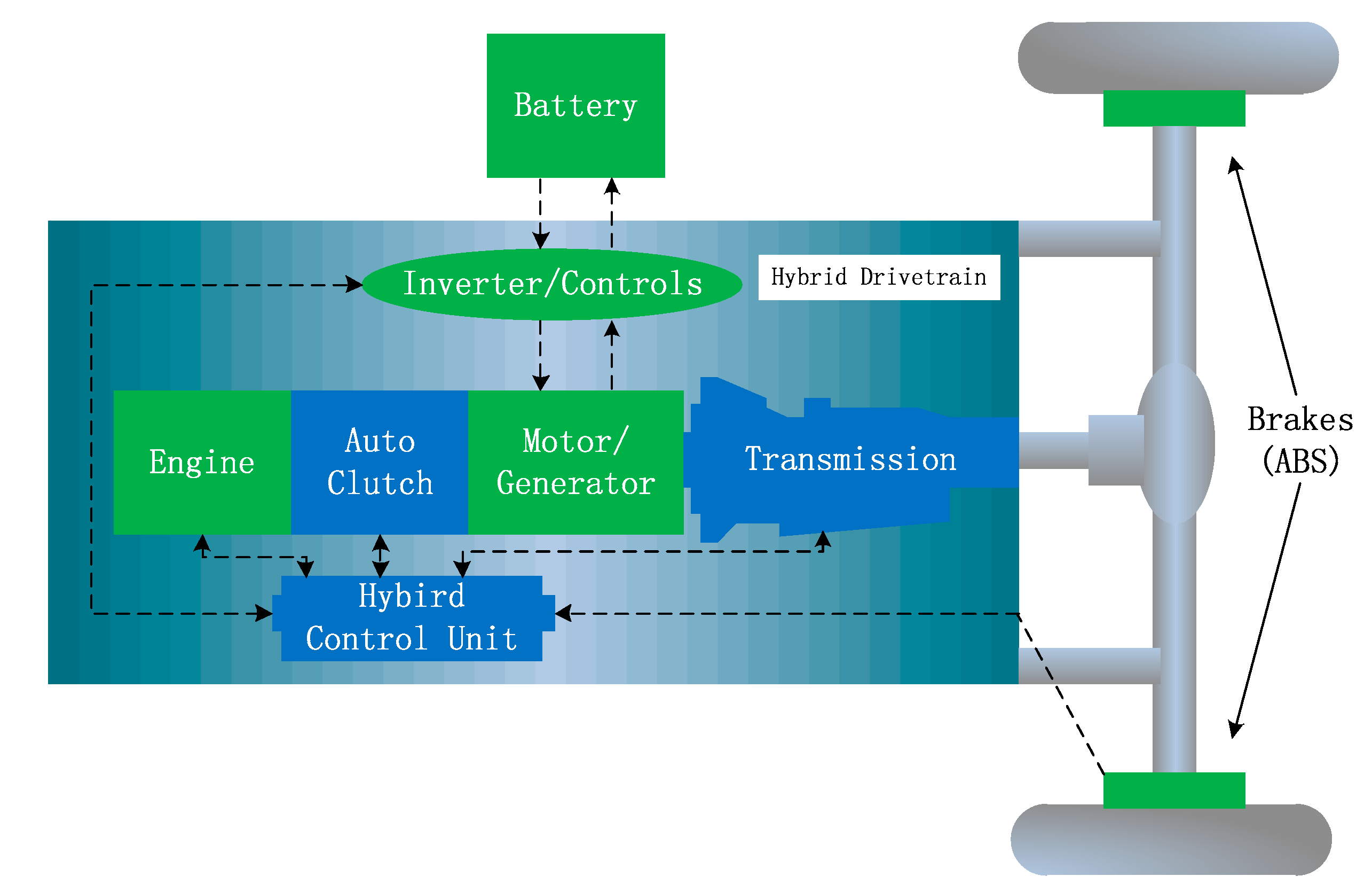
| Spark Ignition (SI) engine | Displacement: 1.0 L Maximum power: 50 kW/5700 r/min Maximum torque: 89.5 Nm/5600 r/min |
| Permanent magnet motor | Maximum power: 10 kW Maximum torque: 46.5 Nm |
| Advanced Ni-Hi battery | Capacity: 6.5 Ah Nominal cell voltage: 1.2 V Total cells: 120 |
| Automated manual transmission | 5-speed GR: 2.2791/2.7606/3.5310/5.6175/11.1066 |
| Vehicle | Curb weight: 1000 kg |
| Hyper Parameters | Value |
|---|---|
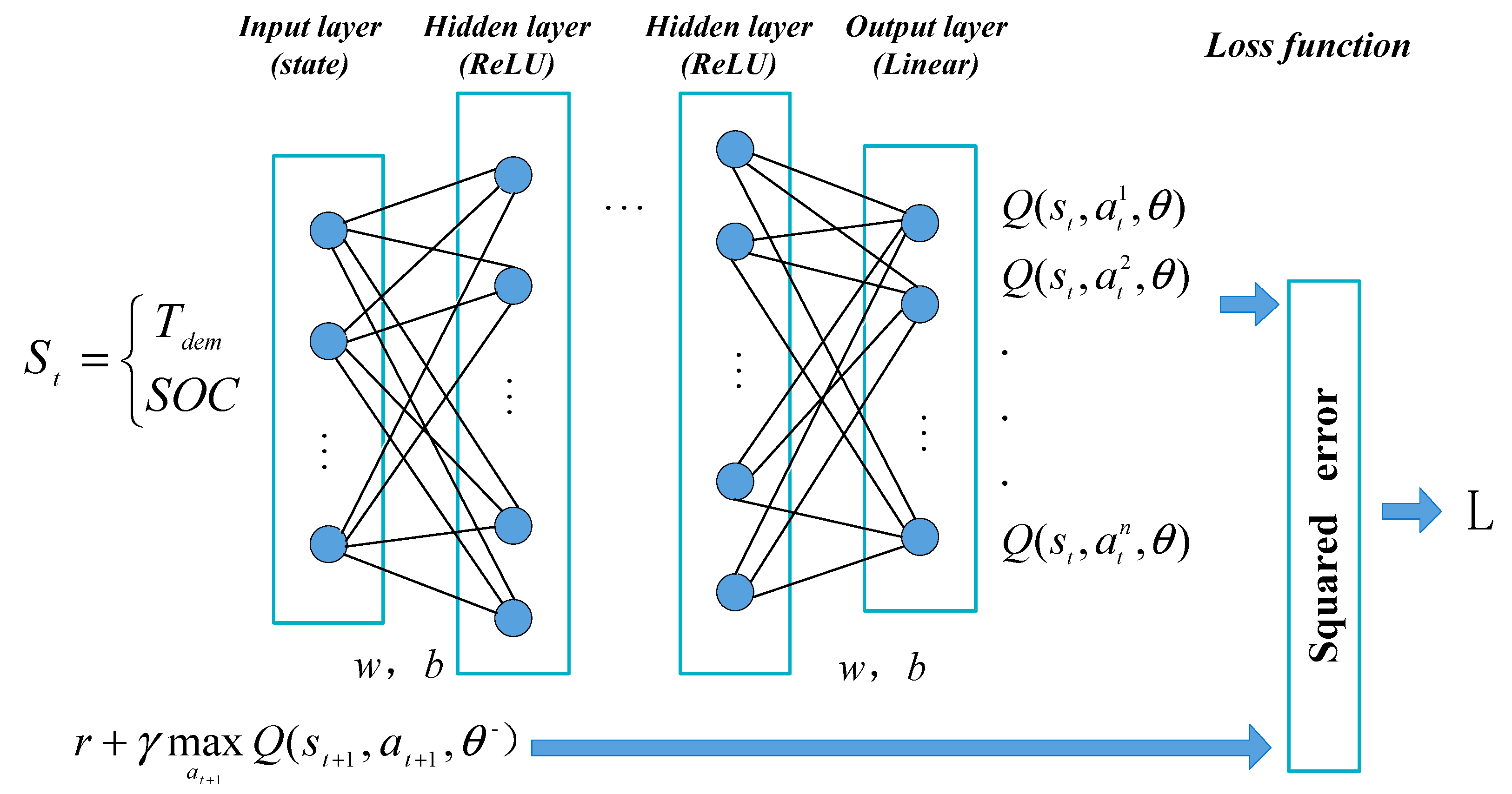
| mini-batch size | 32 |
| replay memory size | 1000 |
| discount factor | 0.99 |
| learning rate | 0.00025 |
| initial exploration | 1 |
| final exploration | 0.2 |
| replay start size | 200 |
| Control Strategy | Fuel Consumption (L/100 km) | Equivalent Fuel Consumption (L/100 km) |
|---|---|---|
| Rule-Based | 3.857 | 3.861 |
| DRL-based | 3.468 | 3.550 |
| Control Strategy | Fuel Consumption (L/100 km) | Equivalent Fuel Consumption (L/100 km) |
|---|---|---|
| Rule-Based | 3.877 | 3.892 |
| DRL-based | 3.478 | 3.792 |
| Control Strategy | Fuel Consumption (L/100 km) | Equivalent Fuel Consumption (L/100 km) |
|---|---|---|
| Rule-Based | 3.877 | 3.892 |
| DRL-based EMS trained under NEDC online | 3.478 | 3.792 |
| DRL-based EMS only pre-trained under UDDS offline | 3.690 | 3.872 |
| Control Strategy | Fuel Consumption (L/100 km) | Equivalent Fuel Consumption (L/100 km) |
|---|---|---|
| DRL-based EMS trained under NEDC online | 3.478 | 3.792 |
| DRL-based EMS only pre-trained under UDDS offline | 3.690 | 3.872 |
| DRL-based EMS which pre-trained offline and trained under NEDC online | 3.440 | 3.795 |
© 2018 by the authors. Licensee MDPI, Basel, Switzerland. This article is an open access article distributed under the terms and conditions of the Creative Commons Attribution (CC BY) license (http://creativecommons.org/licenses/by/4.0/).
Share and Cite
Hu, Y.; Li, W.; Xu, K.; Zahid, T.; Qin, F.; Li, C. Energy Management Strategy for a Hybrid Electric Vehicle Based on Deep Reinforcement Learning. Appl. Sci. 2018, 8, 187. https://doi.org/10.3390/app8020187
Hu Y, Li W, Xu K, Zahid T, Qin F, Li C. Energy Management Strategy for a Hybrid Electric Vehicle Based on Deep Reinforcement Learning. Applied Sciences. 2018; 8(2):187. https://doi.org/10.3390/app8020187
Chicago/Turabian StyleHu, Yue, Weimin Li, Kun Xu, Taimoor Zahid, Feiyan Qin, and Chenming Li. 2018. "Energy Management Strategy for a Hybrid Electric Vehicle Based on Deep Reinforcement Learning" Applied Sciences 8, no. 2: 187. https://doi.org/10.3390/app8020187
APA StyleHu, Y., Li, W., Xu, K., Zahid, T., Qin, F., & Li, C. (2018). Energy Management Strategy for a Hybrid Electric Vehicle Based on Deep Reinforcement Learning. Applied Sciences, 8(2), 187. https://doi.org/10.3390/app8020187