Comparative Effects of Breathing-Integrated Scapular Stabilization Versus Thoracic–Scapular Stabilization Exercises on Muscle Strength and Postural Alignment in Individuals with Shoulder Dysfunction: A Randomized Controlled Trial

Abstract
1. Introduction
2. Methods
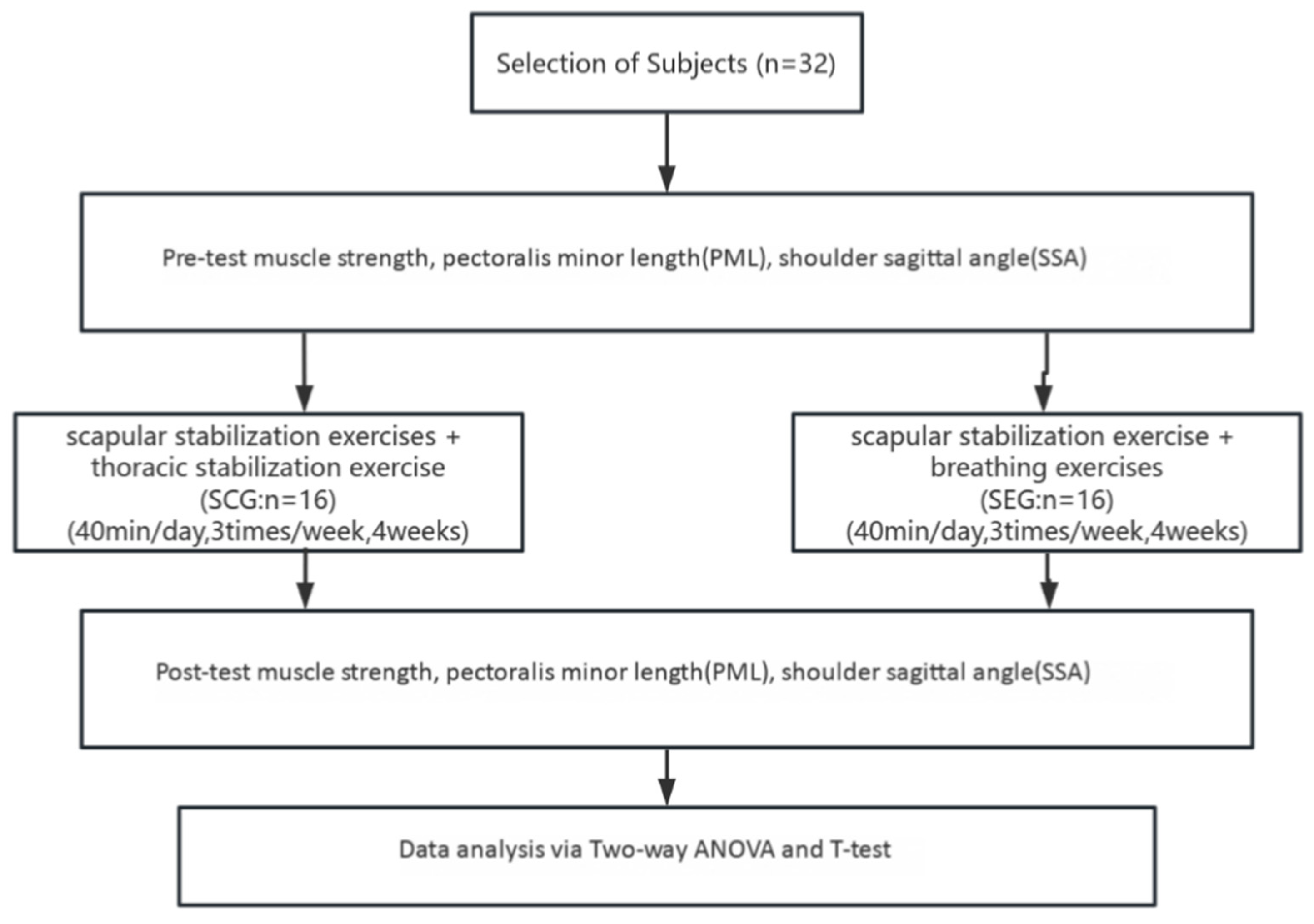
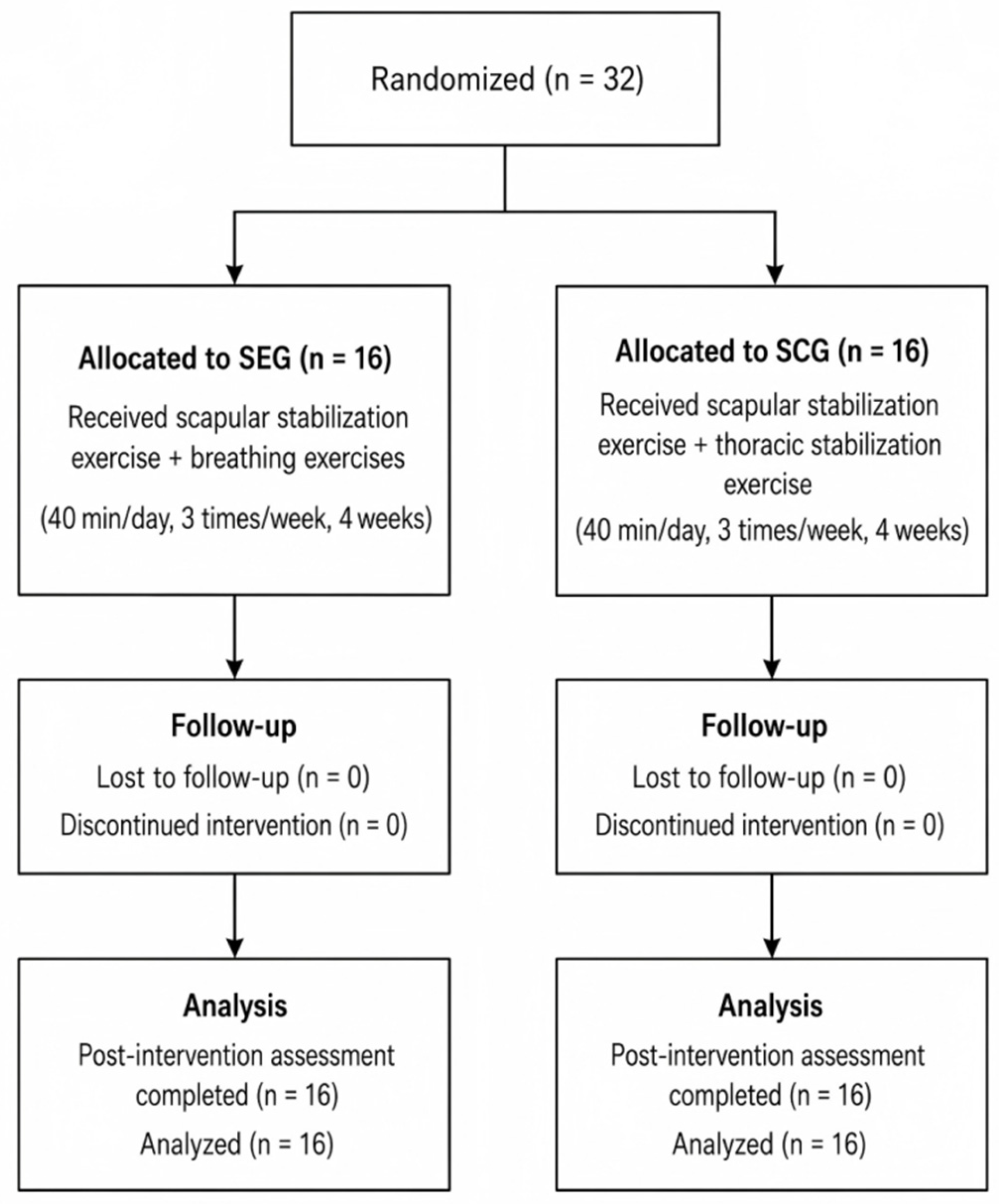
2.1. Study Design
2.2. Study Sample Size
2.3. Outcome Measurements
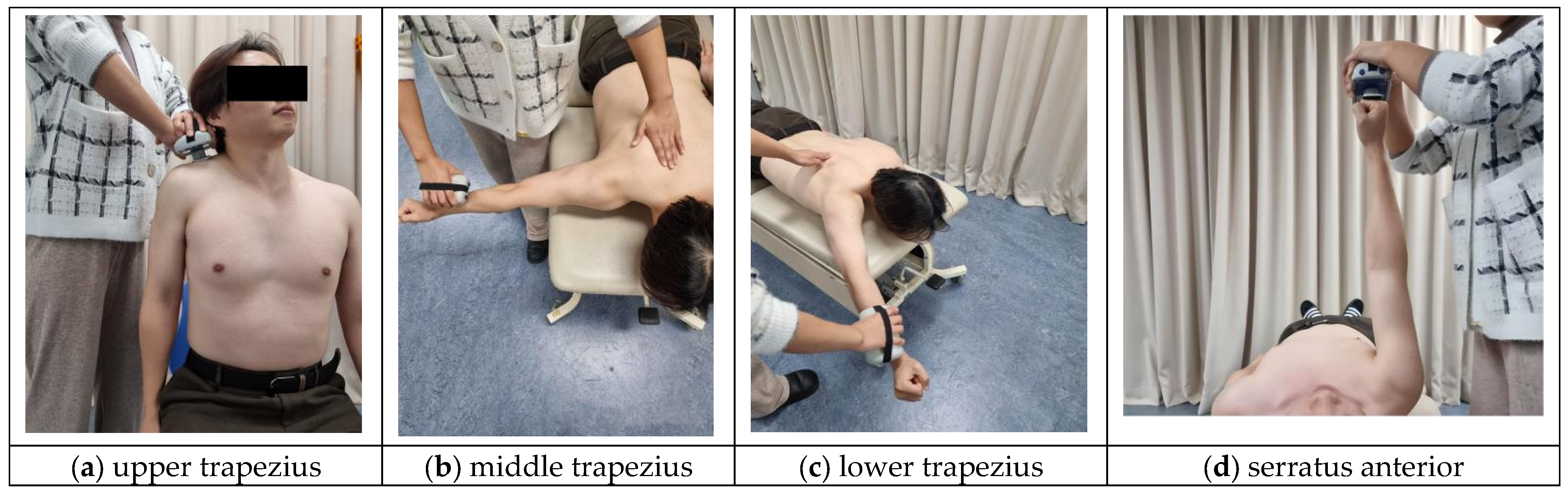
2.3.1. Muscle Strength
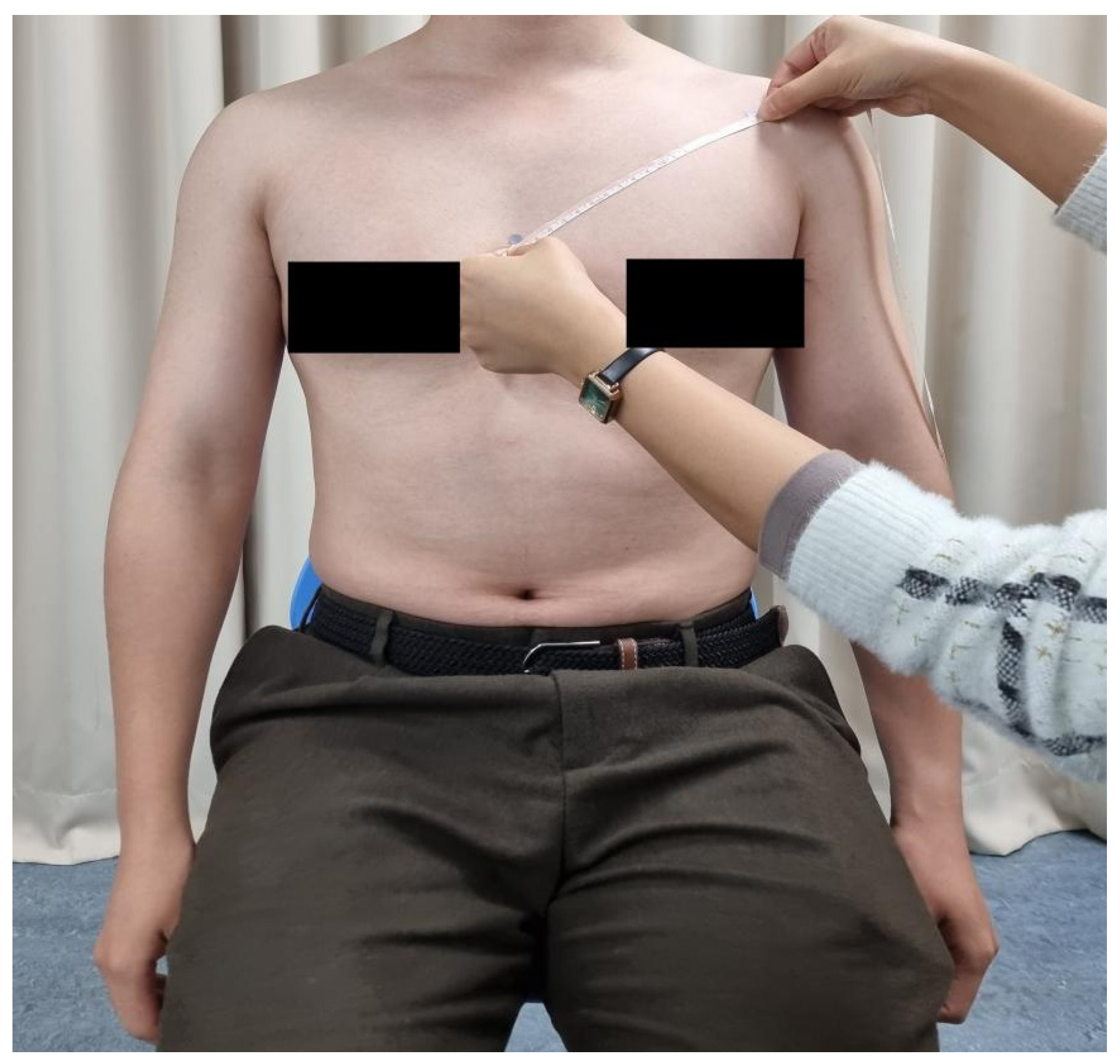
2.3.2. Pectoralis Minor Length (PML)
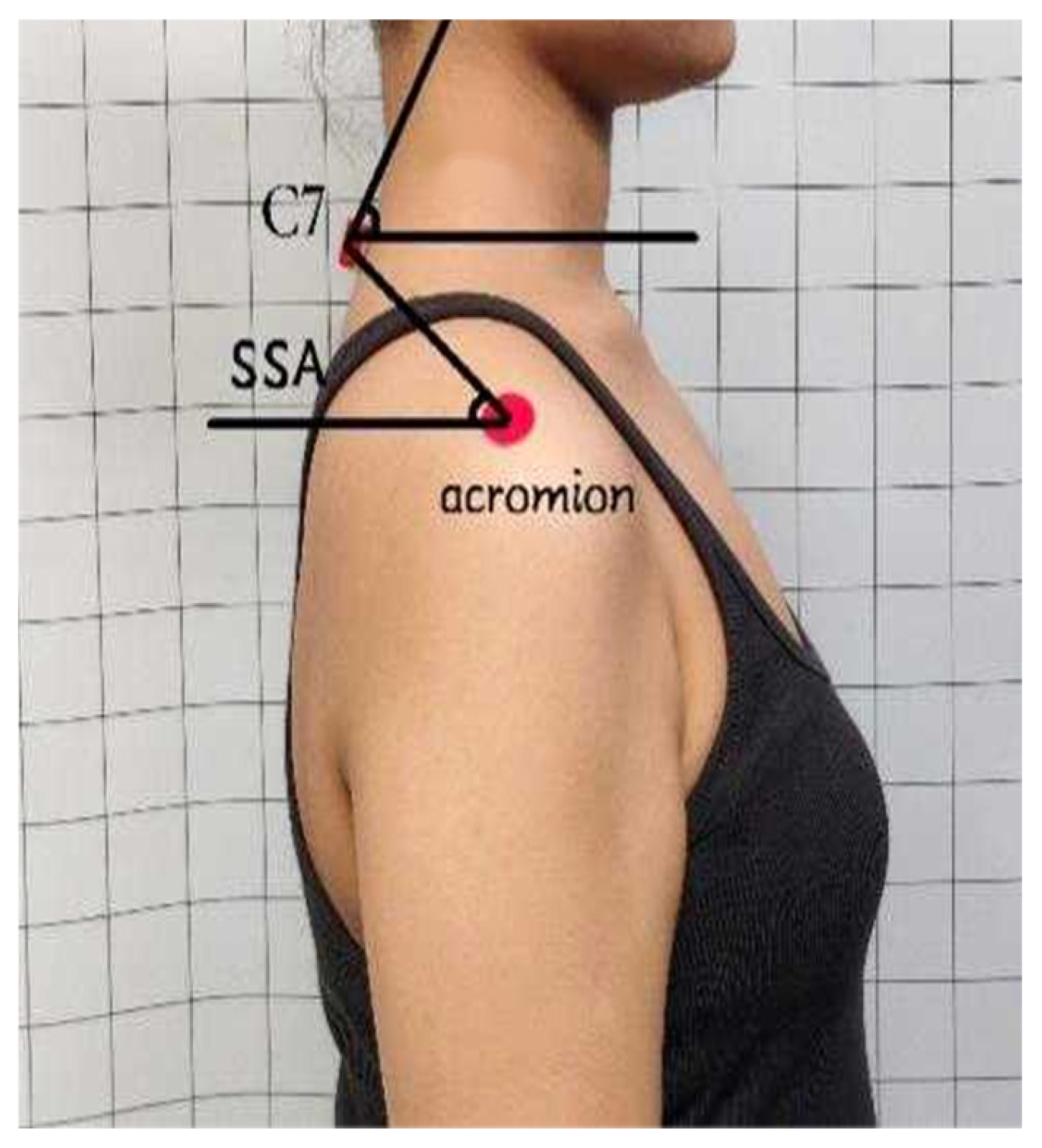
2.3.3. Shoulder Sagittal Angle (SSA)
2.4. Intervention
2.4.1. Scapular Sstabilization Exercises
2.4.2. Breathing Exercises
2.4.3. Thoracic Stabilization Exercises
2.5. Data Analysis
3. Results
4. Discussion
5. Conclusions
Author Contributions
Funding
Institutional Review Board Statement
Informed Consent Statement
Data Availability Statement
Acknowledgments
Conflicts of Interest
References
- Lee, H.J.; Kim, J.H. Classification of shoulder diseases in older adult patients: A narrative review. Ewha Med. J. 2025, 48, e5. [Google Scholar] [CrossRef]
- Lin, J.J.; Hanten, W.P.; Olson, S.L.; Roddey, T.S.; Soto-Quijano, D.A.; Lim, H.K.; Sherwood, A.M. Functional activity characteristics of individuals with shoulder dysfunctions. J. Electromyogr. Kinesiol. 2005, 15, 576–586. [Google Scholar] [CrossRef]
- Khawar, A.; Khawar, S.; Tauqeer, S.; Amjad, F.; Rubab, H.I.; Wafa, H.S. Association of upper cross syndrome with prolonged sitting among young adults. Pak. Biomed. J. 2022, 5, 370–374. [Google Scholar] [CrossRef]
- Gu, Q.; Pan, L.; Yu, L.; Jiang, Q. Effect of scapular posterior tilting exercise on scapular muscle activities in men and women with a rounded shoulder posture. J. Orthop. Surg. Res. 2024, 19, 383. [Google Scholar] [CrossRef] [PubMed]
- Feng, D.; Zhang, Y. College Students’ Knowledge, attitudes, and practices regarding body posture: A cross-sectional survey—Taking a university in Wuhu City as an example. Prev. Med. Rep. 2023, 36, 102422. [Google Scholar] [CrossRef]
- Chaudhuri, S.; Chawla, J.K.; Phadke, V. Physiotherapeutic interventions for upper cross syndrome: A systematic review and meta-analysis. Cureus 2023, 15, e45471. [Google Scholar] [CrossRef] [PubMed]
- Hasan, S.; Iqbal, A.; Alghadir, A.H.; Alonazi, A.; Alyahya, D. The combined effect of the trapezius muscle strengthening and pectoralis minor muscle stretching on correcting the rounded shoulder posture and shoulder flexion range of motion among young Saudi females: A randomized comparative study. Healthcare 2023, 11, 500. [Google Scholar] [CrossRef] [PubMed]
- Spanhove, V.; Van Daele, M.; Van den Abeele, A.; Rombaut, L.; Castelein, B.; Calders, P.; Malfait, F.; Cools, A.; De Wandele, I. Muscle activity and scapular kinematics in individuals with multidirectional shoulder instability: A systematic review. Ann. Phys. Rehabil. Med. 2021, 64, 101457. [Google Scholar] [CrossRef]
- Kwon, O.Y.; Kang, M.H.; Kim, M.H.; Kim, S.J.; Kim, T.H.; Park, K.N.; Oh, J.S.; Lee, W.H.; Im, I.Y.; Jang, J.H. KEMA Approach for Analysis and Management of Motor Impairment 1; Hakjisa Medical: Seoul, Republic of Korea, 2022. [Google Scholar]
- Sahrmann, S. Diagnosis and Treatment of Movement Impairment Syndromes; Mosby: St. Louis, MO, USA, 2002. [Google Scholar]
- Bauer, S.; Blakeney, W.G.; Wang, A.W.; Ernstbrunner, L.; Corbaz, J.; Werthel, J.D. Challenges for optimization of reverse shoulder arthroplasty Part II: Subacromial space, scapular posture, moment arms and muscle tensioning. J. Clin. Med. 2023, 12, 1616. [Google Scholar] [CrossRef]
- Nitayarak, H.; Charntaraviroj, P. Effects of scapular stabilization exercises on posture and muscle imbalances in women with upper crossed syndrome: A randomized controlled trial. J. Back Musculoskelet. Rehabil. 2021, 34, 1031–1040. [Google Scholar] [CrossRef]
- Kibler, W.B.; Sciascia, A. Current concepts: Scapular dyskinesis. Br. J. Sports Med. 2010, 44, 300–305. [Google Scholar] [CrossRef]
- Giuseppe, L.U.; Laura, R.A.; Berton, A.; Candela, V.; Massaroni, C.; Carnevale, A.; Stelitano, G.; Schena, E.; Nazarian, A.; DeAngelis, J.; et al. Scapular dyskinesis: From basic science to ultimate treatment. Int. J. Environ. Res. Public Health 2020, 17, 2974. [Google Scholar] [CrossRef]
- Lucado, A.M. Scapular muscle imbalance: Implications for shoulder pain and pathology. Phys. Ther. Rev. 2011, 16, 356–364. [Google Scholar] [CrossRef]
- Romero-Morales, C.; López-López, D.; Almazán-Polo, J.; Mogedano-Cruz, S.; Sosa-Reina, M.D.; García-Pérez-de-Sevilla, G.; Martín-Pérez, S.; González-de-la-Flor, Á. Prevalence, diagnosis and management of musculoskeletal disorders in elite athletes: A mini-review. Dis. Mon. 2024, 70, 101629. [Google Scholar] [CrossRef] [PubMed]
- Nodehi Moghadam, A.; Rahnama, L.; Noorizadeh Dehkordi, S.; Abdollahi, S. Exercise therapy may affect scapular position and motion in individuals with scapular dyskinesis: A systematic review of clinical trials. J. Shoulder Elb. Surg. 2020, 29, e29–e36. [Google Scholar] [CrossRef] [PubMed]
- Wang, C.H.; McClure, P.; Pratt, N.E.; Nobilini, R. Stretching and strengthening exercises: Their effect on three-dimensional scapular kinematics. Arch. Phys. Med. Rehabil. 1999, 80, 923–929. [Google Scholar] [CrossRef]
- Yuksel, E.; Yesilyaprak, S.S. Scapular stabilization exercise training improves treatment effectiveness on shoulder pain, scapular dyskinesis, muscle strength, and function in patients with subacromial pain syndrome: A randomized controlled trial. J. Bodyw. Mov. Ther. 2024, 37, 101–108. [Google Scholar] [CrossRef]
- Moezy, A.; Sepehrifar, S.; Dodaran, M.S. The effects of scapular stabilization-based exercise therapy on pain, posture, flexibility and shoulder mobility in patients with shoulder impingement syndrome: A controlled randomized clinical trial. Med. J. Islam. Repub. Iran 2014, 28, 87. [Google Scholar]
- Pieters, L.; Lewis, J.; Kuppens, K.; Jochems, J.; Bruijstens, T.; Joossens, L.; Struyf, F. An update of systematic reviews examining the effectiveness of conservative physical therapy interventions for subacromial shoulder pain. J. Orthop. Sports Phys. Ther. 2020, 50, 131–141. [Google Scholar] [CrossRef]
- Csepregi, É.; Gyurcsik, Z.; Veres-Balajti, I.; Nagy, A.C.; Szekanecz, Z.; Szántó, S. Effects of classical breathing exercises on posture, spinal and chest mobility among female university students compared to currently popular training programs. Int. J. Environ. Res. Public Health 2022, 19, 3728. [Google Scholar] [CrossRef]
- Kim, M.K.; Jeong, B.C.; Yoo, K.T. The effect of shoulder stabilization exercise and core stabilization exercise on the shoulder height and respiratory function in young adults with round shoulder posture. Korean Soc. Phys. Med. 2023, 18, 1–17. [Google Scholar] [CrossRef]
- Park, K.N.; Jung, D.Y.; Kim, S.H. Trapezius and serratus anterior muscle strength in violinists with unilateral neck pain. J. Back Musculoskelet. Rehabil. 2020, 33, 631–636. [Google Scholar] [CrossRef]
- Ekstrom, R.A.; Soderberg, G.L.; Donatelli, R.A. Normalization procedures using maximum voluntary isometric contractions for the serratus anterior and trapezius muscles during surface EMG analysis. J. Electromyogr. Kinesiol. 2005, 15, 418–428. [Google Scholar] [CrossRef] [PubMed]
- Chamorro, C.; Arancibia, M.; Trigo, B.; Arias-Poblete, L.; Jerez-Mayorga, D. Absolute reliability and concurrent validity of hand-held dynamometry in shoulder rotator strength assessment: Systematic review and meta-analysis. Int. J. Environ. Res. Public Health 2021, 18, 9293. [Google Scholar] [CrossRef]
- Lee, J.H.; Cynn, H.S.; Yoon, T.L.; Choi, S.A.; Choi, W.J.; Choi, B.S.; Ko, C.H. Comparison of scapular posterior tilting exercise alone and scapular posterior tilting exercise after pectoralis minor stretching on scapular alignment and scapular upward rotators activity in subjects with short pectoralis minor. Phys. Ther. Sport 2015, 16, 255–261. [Google Scholar] [CrossRef] [PubMed]
- Komati, M.A.; Korkie, F.E.; Becker, P. Pectoralis minor length measurements in three different scapula positions. S. Afr. J. Physiother. 2020, 76, 1487. [Google Scholar] [CrossRef]
- Aneis, Y.M.; El-Badrawy, N.M.; El-Ganainy, A.A.; Atta, H.K. The effectiveness of a multimodal approach in the treatment of patients with upper crossed syndrome: A randomized controlled trial. J. Bodyw. Mov. Ther. 2022, 32, 130–136. [Google Scholar] [CrossRef] [PubMed]
- Singla, D.; Veqar, Z.; Hussain, M.E. Photogrammetric assessment of upper body posture using postural angles: A literature review. J. Chiropr. Med. 2017, 16, 131–138. [Google Scholar] [CrossRef]
- Arshadi, R.; Ghasemi, G.A.; Samadi, H. Effects of an 8-week selective corrective exercises program on electromyography activity of scapular and neck muscles in persons with upper crossed syndrome: Randomized controlled trial. Phys. Ther. Sport 2019, 37, 113–119. [Google Scholar] [CrossRef]
- Shetty, N.; Samuel, S.R.; Alaparthi, G.K.; Amaravadi, S.K.; Joshua, A.M.; Pai, S. Comparison of diaphragmatic breathing exercises, volume, and flow-oriented incentive spirometry on respiratory function in stroke subjects: A non-randomized study. Ann. Neurosci. 2020, 27, 232–241. [Google Scholar] [CrossRef]
- Tomas-Carus, P.; Branco, J.C.; Raimundo, A.; Parraca, J.A.; Batalha, N.; Biehl-Printes, C. Breathing exercises must be a real and effective intervention to consider in women with fibromyalgia: A pilot randomized controlled trial. J. Altern. Complement. Med. 2018, 24, 825–832. [Google Scholar] [CrossRef]
- Kang, N.Y.; Im, S.C.; Kim, K. Effects of a combination of scapular stabilization and thoracic extension exercises for office workers with forward head posture on the craniovertebral angle, respiration, pain, and disability: A randomized controlled trial. Turk. J. Phys. Med. Rehabil. 2021, 67, 291. [Google Scholar] [CrossRef]
- Saju, N. Strength profile of scapular muscles in collegiate students. RGUHS J. Physiother. 2023, 3, 12–16. [Google Scholar] [CrossRef]
- Sahrmann, S.; Azevedo, D.C.; Van Dillen, L. Diagnosis and treatment of movement system impairment syndromes. Braz. J. Phys. Ther. 2017, 21, 391–399. [Google Scholar] [CrossRef]
- Cho, I.K.; Park, H.K.; Lee, W.H. The effectiveness of selective lower trapezius strengthening exercises on pain, muscle function, and scapular position in patients with rounded shoulder and chronic neck pain. Phys. Ther. Rehabil. Sci. 2021, 10, 503–511. [Google Scholar] [CrossRef]
- Kim, T.G.; Kim, J.S.; Zhang, H.; Kim, S.Y. Reliability of scapular position and periscapular muscle strength tests in healthy subjects with forward neck and rounded shoulder posture. Isokinet. Exerc. Sci. 2024, 32, 265–272. [Google Scholar] [CrossRef]
- Sharma, S.; Ghrouz, A.K.; Hussain, M.E.; Sharma, S.; Aldabbas, M.; Ansari, S. Progressive resistance exercises plus manual therapy is effective in improving isometric strength in overhead athletes with shoulder impingement syndrome: A randomized controlled trial. BioMed Res. Int. 2021, 2021, 9945775. [Google Scholar] [CrossRef] [PubMed]
- Lee, J.H.; Cynn, H.S.; Yoon, T.L.; Ko, C.H.; Choi, W.J.; Choi, S.A.; Choi, B.S. The effect of scapular posterior tilt exercise, pectoralis minor stretching, and shoulder brace on scapular alignment and muscles activity in subjects with round-shoulder posture. J. Electromyogr. Kinesiol. 2015, 25, 107–114. [Google Scholar] [CrossRef]
- Gross, E.A. The Effect of Muscle Energy Technique on Forward Shoulder Posture, Pectoralis Minor Length, and Upper Extremity Blood Flow in Collegiate Female Swimmers. Masters’s Thesis, Illinois State University, Normal, IL, USA, 2015. [Google Scholar]
- Thongchote, K.; Threetepchanchai, K.; Chuwijit, A.; Lapmanee, S. Pilot study on the improvement effects of scapulothoracic exercises on the respiratory functions in sedentary young female adult with forward shoulder posture: A randomized control trial. Adv. Rehabil. 2023, 37, 23–32. [Google Scholar] [CrossRef]


| Levator scapular stretching | In the seated position, the shoulder on the side to be stretched was secured with a bandage and the arm gently lifted. The subject bent the head 45 degrees diagonally down to the opposite side, allowing the chin to touch the opposite clavicle, and placing the hand on the top of the head for stretching. |
| Upper trapezius stretching | In the seated position, the hand on the side to be stretched was seated under the buttocks, and the head was tilted 45 degrees to the same side, the hand placed on the top of the head to provide resistance. |
| Pectoralis minor stretching | The subject lay in a flat position, with the chest placed on the opposite hand, and the therapist stood at the head of the subject’s stretching side, with one hand placed beside the subject and the other hand grasping the subject’s wrist, raising the arm and turning it into external rotation, and then slowly stretching it downward. |
| Teres major stretching | The subject lay flat, and the therapist stood on the stretching side, so that the shoulder joint on was completely in external rotation; the therapist took the subject’s elbow joint in hand, while their other hand fixed the shoulder blade before beginning to stretch. |
| Push-up exercises | While standing, the subject pushed elevation while abducting the arms at an angle, careful not to shrug the shoulders during the process (SA strengthening). |
| Bilateral external rotation | While standing, the subject held an elastic band with both hands, stretching it with 90 degrees of elbow flexion, pressing the upper arms against both sides of the chest. |
| L-exercises | In a prone position, the subject kept their arms in an L shape to strengthen the middle trapezius muscle. |
| Y-exercises | In a prone position, the subject kept their arms in a Y shape to strengthen the lower trapezius muscle. |
| Wall-slide exercises | While standing, the subject bent the shoulder joint and elbow joint 90 degrees, so that the lower arm was close to a wall or smooth plane; without shrugging the shoulder, they slowly pushed up to strengthen the serratus anterior muscle. |
| Inspiratory spirometry exercises | The participant was seated comfortably in an upright posture and instructed to inhale deeply and slowly over at least five seconds, followed by a relaxed, unforced exhalation, explicitly avoiding any active or forceful expiration. Next, the participant held the flow-based respiratory training device (Romson’s Respirometer Respiratory Exerciser) vertically and performed a controlled inhalation to elevate the internal indicator ball to a predetermined target level. Prior to practice, the physical therapist provided live, step-by-step demonstrations of all breathing techniques to ensure accurate comprehension and proper execution by each participant [29]. |
| Costal expansion exercise | The participant was seated upright and completed three sets of ten repetitions. Prior to initiating resistance training with the elastic band, the therapist manually applied graded resistance, using both hands to guide the participant through the correct breathing pattern: coordinated diaphragmatic engagement during inhalation, and controlled, active exhalation against resistance. The hands-on demonstration served to reinforce proper respiratory mechanics and progressive resistance application before transitioning to the elastic band. |
| Diaphragmatic breathing exercises | (1) Seated posture (2) Supine posture (3) Prone posture (4) In the supine position, a 4 kg weight was placed over the abdominal region, specifically centered on the diaphragmatic dome to provide gentle, targeted resistance during breathing exercises and enhance diaphragmatic engagement. |
| Rectus abdominis stretching | In the prone position, the subject supports upper body with the lower arm, careful not to overuse the waist to compensate. |
| Thoracic mobility exercises | A foam roller was used to increase the range of motion. The subject’s hands supported their head, with the roller placed on the lower back to roll the head, waist, and buttocks in a straight line. During the rolling process, attention was paid to tightening the core strength, so as not to collapse the buttocks or raise the head too much. |
| Thoracic extensor muscle strengthening | In a seated position, the subject folded their arms over their chest, knees, and hips in a 90-degree flexion state. The initial condition was flexion of the thoracic vertebrae, followed by slow extension, which minimized compensatory movement of the waist. |
| Backward rocking exercises | In a four-legged kneeling position, the subject kept their waist and head in a straight line and moved slowly backward. |
| Postural exercise 1 | In a four-legged kneeling position, the subject kept their waist and head in a straight line and moving slowly backward. |
| Postural exercise 2 | The object used a stick, holding it behind their back with both hands. Keeping the spine close to the stick, the subject sat down in a squat, used the buttocks to find the feeling of sitting on a bench during the squat, and paid attention to the knee not exceeding the tip of the foot. |
| Thoracic stabilization exercise | In a four-legged kneeling position, the subject slowly raised one arm, with the back in a straight line, minimizing the movement of the spine and shoulder blades during the process. |
| Characteristic | SEG (n = 16) | SCG (n = 16) | p | Cohen’s d |
|---|---|---|---|---|
| Age (year) | 23.56 ± 2.42 a | 24.5 ± 3.06 | 0.344 | 0.341 |
| Sex (female/male) | 9/7 | 9/7 | 1.000 | - |
| Height (cm) | 170.13 ± 8.35 | 167.63 ± 7.31 | 0.375 | 0.319 |
| Weight (kg) | 65.44 ± 13.14 | 62.00 ± 12.43 | 0.453 | 0.269 |
| BMI (kg/m2) | 22.46 ± 3.31 | 21.96 ± 3.36 | 0.671 | 0.150 |
| UT (Newton) | 49.35 ± 11.41 | 46.97 ± 9.97 | 0.536 | 0.222 |
| MT (Newton) | 25.50 ± 9.89 | 25.30 ± 6.84 | 0.948 | 0.024 |
| LT (Newton) | 23.50 ± 8.24 | 22.60 ± 8.65 | 0.767 | 0.107 |
| SA (Newton) | 37.77 ± 6.90 | 37.89 ± 6.95 | 0.959 | 0.017 |
| PML (cm) | 17.84 ± 1.35 | 17.45 ± 1.10 | 0.373 | 0.317 |
| SSA (°) | 46.05 ± 3.48 | 45.59 ± 3.66 | 0.718 | 0.129 |
| SEG (n = 16) | SCG (n = 16) | Time×Group F(p,ηp2) | Time F(p,ηp2) | Group F(p,ηp2) | Cohen’s d | ||
|---|---|---|---|---|---|---|---|
| UT | pre | 49.35 ± 11.41 a | 46.97 ± 9.97 | 0.949 (0.338, 0.031) | 4.113 (0.052, 0.121) | 0.186 (0.670, 0.006) | |
| post | 50.12 ± 12.04 | 49.18 ± 10.77 | 0.082 | ||||
| MT | pre | 25.50 ± 9.89 | 25.30 ± 6.84 | 0.666 (0.421, 0.022) | 43.404 (0.000 *, 0.591) | 0.019 (0.892, 0.001) | |
| post | 29.77 ± 9.85 | 30.78 ± 7.51 | 0.115 | ||||
| LT | pre | 23.50 ± 8.24 | 22.60 ± 8.65 | 1.996 (0.168, 0.062) | 46.883 (0.000 *, 0.610) | 0.007 (0.932, 0.000) | |
| post | 25.99 ± 8.00 | 26.40 ± 7.90 | 0.052 | ||||
| SA | pre | 37.77 ± 6.90 | 37.89 ± 6.95 | 0.263 (0.612, 0.009) | 72.193 (0.000 *, 0.706) | 0.033 (0.856, 0.001) | |
| post | 42.40 ± 6.55 | 43.12 ± 6.75 | 0.108 | ||||
| SEG (n = 16) | SCG (n = 16) | Time×Group F(p,ηp2) | Time F(p,ηp2) | Group F(p,ηp2) | Cohen’s d | ||
|---|---|---|---|---|---|---|---|
| PML (cm) | pre | 17.84 ± 1.35 | 17.45 ± 1.10 | 0.062 (0.805, 0.002) | 99.941 (0.000 *, 0.769) | 1.131 (0.296, 0.036) | |
| post | 19.13 ± 1.21 | 18.67 ± 1.05 | 0.406 | ||||
| SSA (°) | pre | 46.05 ± 3.48 | 45.59 ± 3.66 | 0.124 (0.727, 0.004) | 174.087 (0.000 *, 0.853) | 0.087 (0.770, 0.003) | |
| post | 53.25 ± 2.32 | 53.19 ± 2.17 | 0.027 | ||||
Disclaimer/Publisher’s Note: The statements, opinions and data contained in all publications are solely those of the individual author(s) and contributor(s) and not of MDPI and/or the editor(s). MDPI and/or the editor(s) disclaim responsibility for any injury to people or property resulting from any ideas, methods, instructions or products referred to in the content. |
© 2026 by the authors. Licensee MDPI, Basel, Switzerland. This article is an open access article distributed under the terms and conditions of the Creative Commons Attribution (CC BY) license.
Share and Cite
Yan, X.; Tian, Q.-S.; Kim, T.-H. Comparative Effects of Breathing-Integrated Scapular Stabilization Versus Thoracic–Scapular Stabilization Exercises on Muscle Strength and Postural Alignment in Individuals with Shoulder Dysfunction: A Randomized Controlled Trial. Appl. Sci. 2026, 16, 4553. https://doi.org/10.3390/app16094553
Yan X, Tian Q-S, Kim T-H. Comparative Effects of Breathing-Integrated Scapular Stabilization Versus Thoracic–Scapular Stabilization Exercises on Muscle Strength and Postural Alignment in Individuals with Shoulder Dysfunction: A Randomized Controlled Trial. Applied Sciences. 2026; 16(9):4553. https://doi.org/10.3390/app16094553
Chicago/Turabian StyleYan, Xin, Qiu-Shuo Tian, and Tae-Ho Kim. 2026. "Comparative Effects of Breathing-Integrated Scapular Stabilization Versus Thoracic–Scapular Stabilization Exercises on Muscle Strength and Postural Alignment in Individuals with Shoulder Dysfunction: A Randomized Controlled Trial" Applied Sciences 16, no. 9: 4553. https://doi.org/10.3390/app16094553
APA StyleYan, X., Tian, Q.-S., & Kim, T.-H. (2026). Comparative Effects of Breathing-Integrated Scapular Stabilization Versus Thoracic–Scapular Stabilization Exercises on Muscle Strength and Postural Alignment in Individuals with Shoulder Dysfunction: A Randomized Controlled Trial. Applied Sciences, 16(9), 4553. https://doi.org/10.3390/app16094553