Article

Promotional Corrugated-Type Catalyst of Nb-Modified V-Based Catalyst for NH3-SCR over a Wide Temperature Range with Low SO2/SO3 Conversion


1
Low-Carbon Energy Group, Korea Institute of Industrial Technology, Ulsan 44413, Republic of Korea
2
Department of Material Science and Engineering, Pusan National University, Busan 46241, Republic of Korea
3
Department of Materials Science and Engineering, Ulsan National Institute of Science and Technology, Ulsan 44919, Republic of Korea
*
Authors to whom correspondence should be addressed.
These authors contributed equally to this work.
Appl. Sci. 2026, 16(9), 4552; https://doi.org/10.3390/app16094552
Submission received: 27 March 2026 / Revised: 24 April 2026 / Accepted: 27 April 2026 / Published: 5 May 2026

Abstract

This study investigates the catalytic activity and surface behaviors of V2O5 catalysts modified with promoter components to improve low-temperature activity and suppress SO2-to-SO3 oxidation. Moreover, we fabricated corrugated-type catalysts using glass fiber sheets as substrates, because powdered catalysts revealed limitations for practical applications. The modified catalysts were prepared via a slurry mixing method using vanadium precursor with different promoters such as W, Nb, Zr, Mo, Ce, Fe supported on TiO2. The catalysts were fabricated into slurry coating type catalysts using glass fiber sheets and the catalytic activity, specific surface area, and acid sites were investigated. The performance of corrugated-type catalyst and oxidation of SO2 to SO3 over a wide temperature range were evaluated using a Micro-Reactor. Our results showed that adding a promoter improves the catalytic performance of VW/Ti catalysts by enhancing surface acidity. The results varied depending on the catalyst loading and promoter components over a wide temperature range. Among them, VWNb/Ti catalysts exhibited the highest NOx conversion of 80.9% at 350 °C despite the high gaseous velocity (AV of 51 m·h−1) and the large flow rate of 20 L·min−1, with the lowest Ea of 13.7 kJ·mol−1. Among the evaluated promoters, Nb exhibited the most favorable balance of activity and SO2-to-SO3 oxidation. These results suggest that the Nb modification strategy can be extended to commercial SCR catalysts, providing a practical approach for improving catalytic performance.

1. Introduction

Nitrogen oxides (NOx), one of major air pollutants, are generated as by-products of combustion processes like those in thermoelectric power plants and diesel engines [1], and are a major source of particulate matter (PM) [2,3,4,5,6,7]. They cause various environmental and health problems [8,9], such as greenhouse effect, photochemical smog, acid rain, and respiratory disease. Selective catalytic reduction (SCR) is recognized as the most effective method to control NOx emissions. Industrial V2O5–WO3/TiO2 catalysts exhibit high NOx conversion and exceptional resistance to sulfur (SO2) and H2O. However, these catalysts also exhibit several disadvantages, including a high and narrow effective temperature range (300–400 °C) and a propensity to oxidize SO2 to SO3 [10,11,12,13].
SO3 reacts with NH3 to form ammonium sulfate (NH4)2SO4 or bisulfate (NH4HSO4), which shortens the lifetime of the catalyst [5,14]. The formation of (NH4)2SO4 or NH4HSO4 occurs within the operating range (250–350 °C) of the catalyst. The reaction of SO3 with water vapor results in the formation of H2SO4, a corrosive mist that has the potential to damage the catalyst system and lead to equipment failure. Consequently, the utilization of SCR catalysts with high NOx conversion efficiencies at reduced operating temperatures is required to ensure economic viability and to minimize energy expenditure. This catalyst must exhibit the capacity to function at conventional low temperatures (200–250 °C), demonstrate enhanced catalyst properties, such as elevated NOx conversion coupled with diminished SO2-SO3 oxidation, and possess a prolonged lifespan.
In recent studies, various metal oxides as promoter species have been utilized to enhance the activity of vanadium-based catalysts in NH3-SCR [15,16,17,18,19,20]. A substantial body of research has been dedicated to investigating the impact of promoters on the dispersion of catalyst components, with the objective of enhancing catalyst activity [21,22]. For instance, molybdenum (Mo) has been shown to enhance the durability of SO2 and increase the surface acid site density, thereby promoting the activity of SCR catalysts [23]. Iron (Fe) has been reported to exhibit excellent SCR properties by enhancing the adsorption and activation of NH3 [24,25]. Cerium (Ce) is renowned for its high oxygen storage and transport capacity and is extensively utilized to enhance catalytic activity [26,27]. Zirconium (Zr) has been reported to enhance thermal stability and augment the efficiency of catalysts by increasing the specific surface area [28,29]. The presence of niobium (Nb) has a positive effect on the performance of the catalyst, enhancing its effectiveness in the conversion process [17,30,31]. However, most previous studies have focused on powdered catalysts, and studies evaluating structured catalysts under practical conditions remain limited. In addition to their elevated specific surface areas, glass fiber sheets possess a low density, are readily formable, and exhibit optimal supporting ratios for the catalyst materials. In this context, the effect of metal oxides as promoter species (Nb, Mo, Ce, Fe, and Zr) on V2O5/TiO2 catalysts was systematically investigated, and their catalytic performance was evaluated in comparison with commercial V2O5–WO3/TiO2 SCR catalysts. Unlike previous studies that focused on powdered catalysts or individual promoter effects, this study demonstrates the synergistic role of Nb addition in a fabricated corrugated-type catalyst under practical operating conditions, simultaneously achieving enhanced low-temperature activity and suppressed SO2-to-SO3 conversion.

2. Experimental

2.1. Catalyst Preparation

Catalysts with different promoter components were prepared in the following five steps. The catalyst slurry was prepared by simple mixing of TiO2, binders, main catalyst (ammonium metavanadate, NH4VO3, AMV, 99%, DAEJUNG, Siheung-si, Republic of Korea and ammonium metatungstate, (NH4)6H2W12O40, AMT, 99.9%, Sigma-Aldrich, St. Louis, MI, USA), and precursor of promoter species (Nb; niobium oxide (V) oxalate hydrate, C10H5NbO20·xH2O, 99.9%, Thermo Fisher Scientific, Waltham, MA, USA, Ce; cerium (IV) diammonium nitrate, (NH4)2Ce(NO3)6; CeH8N8O18, 97%, DAEJUNG, Zr; zirconium (IV) oxynitrate hydrate, ZrO(NO3)2 · xH2O, 99%, Sigma-Aldrich, Fe; ferric nitrate nonahydrate, Fe(NO3)3 · 9H2O, 99%, DAEJUNG, Mo; hexaammonium heptamolybdate tetrahydrate, (NH4)6Mo7O24 · 4H2O; H24Mo7N6O24 · 4H2O, 98%, DAEJUNG) in silica sol. The catalyst slurry was coated onto a glass fiber support sheet and fabricated. (1) AMV was mixed with the silica sol for 30 min using a magnetic stirrer. (2) TiO2 and silica sol were mixed with precursor of promoter species (Nb, Ce, Zr, Mo, and Fe) for 1 h. (3) Vanadate/silica sol prepared in step (1) was added to the previously synthesized slurry with precursor of promoter species, obtained in step (2), and mixed for 30 min. (4) Clay (an inorganic binder) and polyvinyl alcohol (PVA an organic binder) were added to the catalyst slurry obtained in step (3). The slurry was mixed using a homogenizing stirrer (HS-30E, DAIHAN Scientific, Wonju, Republic of Korea), followed by ball milling for 2 h. (5) The resultant slurry was coated on a glass fiber sheet to form a corrugated catalyst. The obtained SCR catalyst was dried at 80 °C for 12 h, and then calcined in air at 500 °C for 3 h. For comparison, V2O5–WO3/TiO2 (V-W/Ti) catalysts containing 1 wt% V2O5 and 4 wt% WO3 were prepared. V2O5–WO3–MOx/TiO2 (V-W-M/Ti) catalysts were prepared using the same procedure described above, except that a metal oxides as promoter species (i.e., Nb, Mo, Ce, Zr, Fe) was added.

2.2. Characterization

X-ray diffraction (XRD, PANalytical, X’Pert PRO High Resolution X-Ray Diffractometer, Almelo, The Netherlands) was conducted using Cu Kα (40 kV, 40 mA) radiation in a continuous scan mode at 20° ≤ 2θ ≤ 80°. The specific surface areas and average particle size of the composites were determined (ASAP 2020, Micromeritics, Norcross, GA, USA) using liquid N2 at 77 K. The specific surface area (SBET) was calculated using the Brunauer–Emmett–Teller (BET) method. Temperature programmed desorption of NH3 was performed using a chemisorption analyzer (NH3-TPD, Autochem II 2920 chemisorption analyzer, Micromeritics, Norcross, GA, USA). Samples were preheated at 300 °C with He for 1 h followed by NH3 adsorption to saturation and He purging at 100 °C. Further, temperature programmed desorption of O2 was performed using the chemisorption analyzer (O2-TPD, Autochem II 2920, Micromeritics, Norcross, GA, USA), and the samples were preheated to 300 °C using 10% O2/Ar for 1 h and cooled down to 50 °C. Then, the samples were saturated with 1% O2/Ar for 1 h, and physically adsorbed O2 was removed through Ar purging. The gas temperature increased from 100 to 800 °C. Desorption was performed from 100 to 800 °C at a heating rate of 10 °C/min. H2-temperature-programmed reduction (H2-TPR) was carried out using a chemisorption analyzer (Autochem II 2920, Micromeritics, Norcross, GA, USA). H2-TPR was investigated during the temperature increase from 100 to 800 °C under a flow of 10% H2/Ar gas. In situ diffuse reflectance infrared Fourier-transform spectroscopy (DRIFT) spectra was conducted using Vertex 70v (Bruker, Billerica, MA, USA). The gas flow, which was constantly controlled through a mass flow controller (MFC), consisted of 1000 ppm of NO, NH3, 5 vol% of O2 and balance with N2 to maintain the overall flow at 300 mL∙min−1. The in situ DRIFTS sequence was conducted in two steps; one was the gas flow of [NO + O2] after [NH3], and the other was that [NH3] after [NO + O2]. Prior to each step, the catalyst samples were pretreated with N2 flow at 200 °C for 2 h.

2.3. Catalytic Performance Test

The SCR activity was measured in a Micro-Reactor (MR, NANO Co., Sangju-si, Republic of Korea) as shown in Figure S1. A slurry coated catalyst was prepared with dimensions of 3.5 cm × 5.5 cm and a thickness of about 1 mm. The corrugated catalyst sample inserted into the MR had a diameter of approximately 50 mm and length of 1 m. The test conditions were as follows: 300 ppm NO, 300 ppm NH3, 300 ppm SO2, 5 vol% O2, 10 vol% H2O, and N2 as the balance gas. Total flow through the reactor was 20 L·min−1, area velocity (AV) was 51 m·h−1, and the operating temperatures were 200 to 450 °C. The SO2-to-SO3 conversion was measured after 48 h of aging. The aging conditions were as follows; 300 ppm NO, 300 ppm SO2, 5 vol% O2, 10 vol% H2O, and the balance gas was N2. The total flow through the reactor was 20 L·min−1, the AV was 51 m·h−1 (i.e., GHSV of ~20,000 h−1) and operating temperatures were between 200 and 450 °C. SO2-to-SO3 conversion analysis was performed using an Ion chromatography (IC, Dionex ICS-5000, ThermoFisher, Sunnyvale, CA, USA) to measure the SO42− formed when SO3 in the outlet gas was dissolved in water. The performance of NH3-SCR catalyst was assessed by NOx conversion, NH3 conversion, N2 selectivity, turnover frequency (TOF), and SO2-to-SO3 conversion, which were determined using the following equations:
N O X   c o n v e r s i o n % = ( N O X ) i n ( N O X ) o u t ( N O X ) i n × 100
N H 3 c o n v e r s i o n % = ( N H 3 ) i n ( N H 3 ) o u t ( N H 3 ) i n × 100
N 2   s e l e c t i v i t y % = ( N O ) i n + ( N H 3 ) i n ( N O ) o u t ( N H 3 ) o u t ( N 2 O ) o u t ( N O ) i n + ( N H 3 ) i n ( N O ) o u t ( N H 3 ) o u t × 100
T O F ( h 1 ) = F N O × N O   c o n v e r s i o n × ( N 2   s e l e c t i v i t y ) ( R ) × ( T ) × ( m o l V W ) × 100
S O 2 t o S O 3   c o n v e r s i o n % = ( S O 3 ) o u t ( S O 3 ) i n ( S O 2 ) i n × 100

3. Results and Discussion

3.1. Catalytic Performances

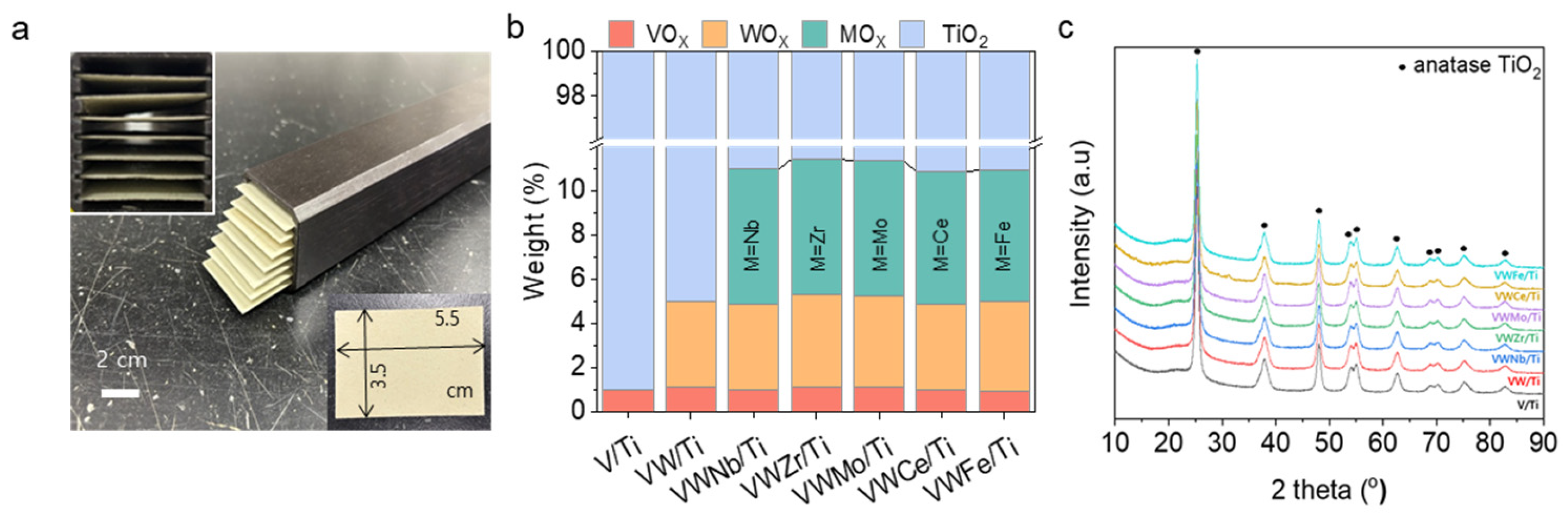
The catalyst was fabricated as a coated sheet type with dimensions of 3.5 cm × 5.5 cm, as illustrated in Figure 1a. The composition of the manufactured catalyst was confirmed via XRF analysis (Figure 1b and Table S1). The weight percentage of VOX was approximately 1 wt%, while WOX was ~4 wt%. The weight percentage of MOX (M = Nb, Zr, Mo, Ce, and Fe) was ~6 wt%. The presence of catalytic active materials (i.e., V, W, M = Nb, Ce, Zr, Mo, and Fe) was confirmed. The structural properties of the catalysts were deduced from the X-ray diffraction patterns (Figure 1c), and the observed peaks correspond to the anatase phase of TiO2 (ICSD No. 98-017-2914). However, other peaks for catalytic active materials were not detected. The absence of diffraction patterns indicates that the metal oxides were either non-crystalline or well dispersed on the support surface with a crystal particle size of diameter of <4 nm. They were too small to be detected by XRD [32]. Prepared catalysts exhibited comparable textural properties, with a specific surface area (SBET) of 104.6–118.8 m2·g−1, as indicated in Table S2. The higher SBET and pore volume will improve reaction activity by facilitating interaction with the flue gas [33]. However, given the presence of other contributing factors, the observed effects were not found to be absolute. This indicates that differences in catalytic performance are not solely governed by surface area, but also influenced by other properties such as surface acidity and redox behavior.
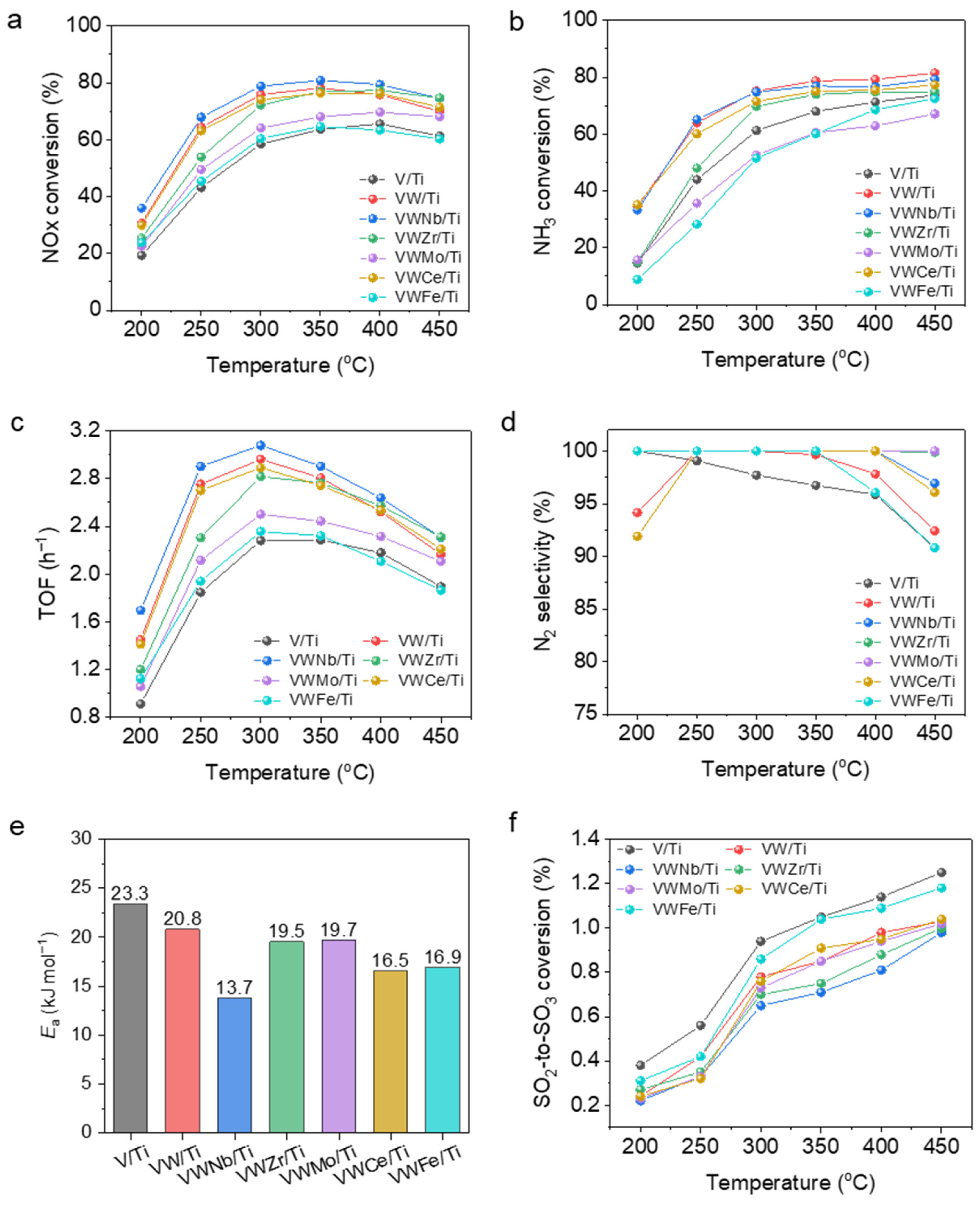
As illustrated in Figure 2a–c, the enhancement of catalytic activity was not solely dependent on high specific surface areas [33,34]. In the examined temperature range (200–450 °C), the V/Ti catalyst with the highest SBET of 118.8 m2·g−1 exhibited the lowest NOx conversion. Conversely, the VWNb/Ti catalyst with the SBET of 115.4 m2·g−1 exhibited the highest NOx conversion. The performance of the NH3-SCR was evaluated in terms of NOx conversion (Figure 2a), NH3 conversion (Figure 2b), and N2 selectivity (Figure 2c), thereby providing a comprehensive assessment of the system’s functionality. The catalysts were tested to determine NOx conversion and NH3 slip within a temperature range of 200 ≤ TOP ≤ 450 °C. The majority of the catalysts exhibited elevated activity across a substantial temperature range following the incorporation of metal oxides as promoter species. The NOx efficiencies of the majority of catalysts exhibited an increase until the temperature reached 350 °C, followed by a decrease from 400 °C. Furthermore, the NH3 slip of the catalysts decreased with increasing NOx conversion. Given the theoretical equivalence of NOx and NH3 at a ratio of 1:1, instances of NH3 slip can occur in practical applications due to NH3 overspray. NH3 slip is a poisoning factor in the catalyst because the slipped NH3 can form ammonium sulfate by reacting with SO2 in the flue gas. NH3 was observed to form ammonium salts at relatively low temperatures. At elevated temperatures, ammonium salts undergo decomposition and oxidation to N2O and NO2, thereby accelerating NOx generation.
Among all catalysts, V/Ti and VWFe/Ti exhibited the lowest NOx conversion over the temperature range of 200–450 °C. Generally, vanadium-based catalysts demonstrate high NOx conversion efficiencies at elevated temperatures (>300 °C); however, efficiencies of 40–50% are observed at relatively low temperatures. The incorporation of the metal oxides as promoter species enhanced NOx conversion at low temperatures. The process of NOx conversion is contingent upon the characteristics of the catalyst, including acidity, specific surface area, the bond between the catalyst and the support material, and its dispersion. Furthermore, the impact of flue gas must be considered. The presence or absence of SO2 and H2O in the flue gas has been reported to directly affect catalytic activity [11,35,36,37]. This is due to the competition between NH3 and the aforementioned gases for catalytic acid sites. SO2 and H2O have been observed to react with acid sites, thereby prohibiting them through a process of inhibition and salt formation. This, in turn, results in the deactivation of the catalyst [38,39,40]. The catalysts were examined in the presence of H2O to consider the aforementioned factors. The NOx conversion efficiencies of the majority of the catalysts exhibited an increase in the high-temperature range (i.e., ≥300 °C). The NOx conversion efficiencies at temperatures below 200 °C were ranked in the following sequence: VWNb/Ti ≥ VW/Ti ≥ VWCe/Ti > VWZr/Ti > VWMo/Ti > VWFe ≥ V/Ti. The incorporation of metal oxides as promoter species into V/Ti led to an enhancement in its catalytic activity across a broad temperature range. This behavior indicates that Nb incorporation contributes to enhanced catalytic activity and stability over a broad temperature range. The results indicate that the composition of metal oxides as promoter species influences the operating temperature range. VWM/Ti at 200–450 °C demonstrated enhanced catalytic activity and resistance to H2O and SO2 in comparison to V/Ti [41]. The incorporation of metal oxides, such as Nb or Ce, into a VW/Ti composition led to enhanced NOx conversion efficiencies across a substantial temperature range. The VWFe/Ti exhibited low activity, which sharply decreased at temperatures above 400 °C. The VWCe/Ti also demonstrated elevated activity across a broad temperature spectrum. Among the catalysts, the VWNb/Ti exhibited the highest performance, exhibiting an almost ~80% NOx conversion across a broad temperature range. The incorporation of Nb into the catalyst composition resulted in the enhancement of vanadium dispersion over the TiO2 surface, thereby generating optimal acid sites and facilitating reaction with flue gases. This behavior was considered beneficial for NOx conversion across a broad temperature range.
It is important to consider both the NO conversion rate and the catalyst’s N2 selectivity, given the necessity to convert both NO and NH3 to N2 and H2O. This phenomenon can be attributed to the toxicity of N2O and NH3, which are produced as a consequence of the NH3-SCR reaction. Depending on the added co-catalyst, the N2 selectivity according to the N2O concentration also varied. The catalyst turnover frequency (TOF) is calculated using these factors and the amount of catalyst (Figure 2d). Among these, the catalyst demonstrating superior TOF compared to VW/Ti was the Nb-added catalyst, which was the only one across the entire temperature range. Furthermore, the activation energy was calculated using the Arrhenius equation, and the Nb catalyst exhibited the lowest value at 13.7 kJ mol−1 (Figure 2e), consistent with the TOF results. These results further confirm that Nb addition enhances catalytic activity.
The SO2 in the flue gas is oxidized to SO3 via side reaction of the V-based catalyst. SO3 reacts with water present in flue gas and ammonia, forming sulfuric acid (H2SO4), ammonium sulfate ((NH4)2SO4), and ammonium bisulfate (NH4HSO4). These by-products are formed within the catalyst pores, resulting in catalyst deactivation. The presence of SO2 and NH3 in flue gas has been reported to induce catalyst deactivation, even at low ppm levels. Ammonium sulfate deposits have been observed to accumulate on the surface of the air preheater (APH) and downstream of the reactor. This accumulation has been shown to affect the gas flow rate, thereby causing serious problems for the selective catalytic reduction (SCR) system. The SO2-to-SO3 conversion has been observed to be associated with the concentrations of SO2, NH3, and O2. This conversion was generally increased at temperatures above 300 °C. The SO3 produced reacts with unreacted NH3, resulting in equipment corrosion and catalyst deactivation. Therefore, controlling SO3 formation is important. The impact of the promoter and the broad temperature range on the oxidation of SO2 to SO3 was investigated. The outcomes are presented in Figure 2f. The catalysts showed the following trend in SO2-to-SO3 conversion: VWNb/Ti < VWZr/Ti < VWMo/Ti < VWCe/Ti < VW/Ti < VWFe/Ti < V/Ti. The catalysts that have been augmented with promoters demonstrated a reduced propensity for SO2-to-SO3 oxidation in comparison to those that have not been supplemented with promoters. Niobium (Nb) and zirconium (Zr) have been shown to exhibit high durability in the presence of sulfur (SO2), exhibiting a comparable performance to tungsten (W). The presence of Nb and Zr-oxides as promoter species has been observed to result in a non-exponential increase in SO2-to-SO3 conversion with temperature, demonstrating stable suppression even at temperatures above 400 °C. Consequently, the Nb and Zr-oxides demonstrated thermal stability and significant resistance to SO2 and H2O. A comparison of the data from VWCe/Ti and VWMo/Ti reveals a high degree of similarity. In general, Ce-oxides exhibits a high degree of resistance to SO2 [39,42,43,44]. The reaction of VWFe/Ti with SO2 was attributed to the oxidation of Fe at elevated temperatures, particularly above 350 °C [41]. This reaction led to a rapid conversion of SO2 to SO3 upon the addition of Fe to the catalyst. Previous studies have reported that SO2-to-SO3 oxidation is associated with the oxidation of SO2 by V = O, which results in the sulfation and/or oxidation of vanadia sites [37]. It is suggested that the incorporation of promoter elements modifies the surface vanadium species and alters the oxygen environment, which may reduce the active sites responsible for SO2-to-SO3 oxidation. In consideration of the aforementioned hypothesis and the findings of our investigation, the following conclusions can be drawn. Initially, the oxidation of SO2-to-SO3 was influenced by an elevation in the catalyst operating temperature. Secondly, a high SO2 adsorption capacity is equivalent to a low rate of oxidation of SO2-to-SO3 [45]. These results indicate that the promoter is the primary factor influencing SO2-to-SO3 conversion. Moreover, while the corrugated structure enables practical operation under realistic flow conditions, the observed performance differences among catalysts are primarily governed by the promoter composition, particularly Nb incorporation. Thus, the promoter composition is a key factor in determining SO2-to-SO3 conversion behavior.

3.2. Catalytic Characterization

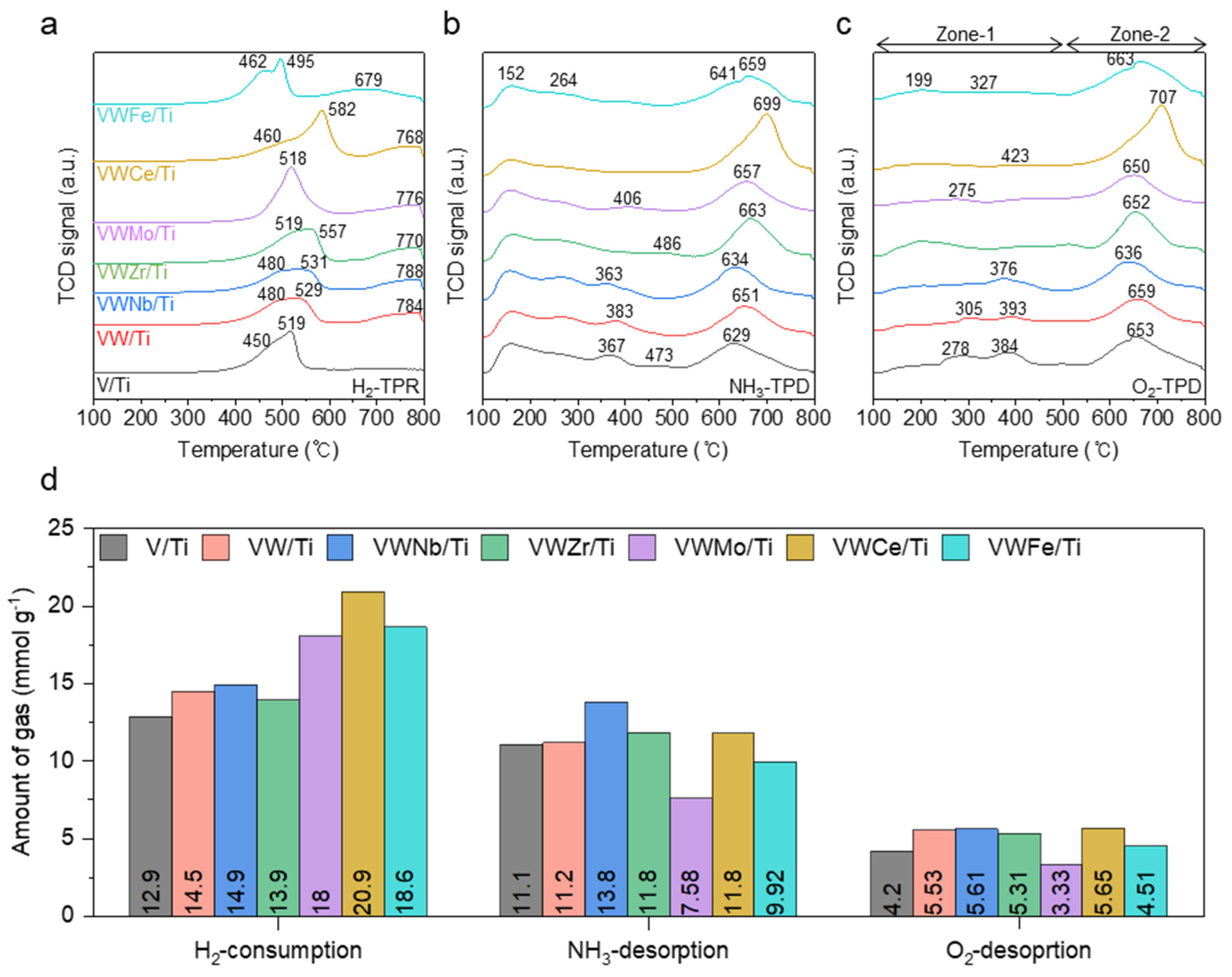
H2-temperature-programmed-reduction (H2-TPR) profiles were investigated to assess the reducibility of the catalysts, and the outcomes are delineated in Figure 3a and Table S3. The results indicated a correlation between NOx conversion and the aforementioned parameters. Redox properties are of paramount importance in the context of SCR catalysts. To this end, H2-TPR analysis was conducted to ascertain the mobility and transfer capacity of oxygen. The participation of oxygen in the SCR reaction is understood to occur in the form of oxygen supplied to the gas phase, lattice oxygen species present in the catalyst, and changes in the oxidation form of the catalyst [46]. Therefore, these results indicate that the enhanced participation of the surface lattice oxygen led to an improvement in the catalytic redox properties. In the SCR mechanism, adsorbed NH3 is activated by V5+ = O, which results in the generation of V-ONH3-V4+-OH surface species. The V-ONH3-V4+-OH surface species reacted with NO, yielding N2 and H2O. In this process, the generation of V4+-OH is observed, which subsequently decomposes into V5+ = O and V3+ during the reaction. Reduced V3+ is re-oxidized to V5+ = O by gaseous oxygen, the catalytic redox cycle is facilitated. The re-oxidation rate of this V5+ = O species increases, resulting in enhanced catalytic activity. The two primary reduction peaks were commonly observed in all catalyst samples, with the exception of those containing Fe and Ce components. A broad peak was detected between 450 and 600 °C. These results were associated with a reduction in active lattice oxygen, oxygen species, Ti4+, and Ti3+ on the catalyst sample surface. In essence, the vanadium and vanadium-tungsten-based catalyst is associated with monomeric surface vanadia species V5+ to V3+ at temperatures ranging from 400 to 500 °C. The temperature range of 500 to 600 °C was indicated by the W6+ to W4+ of WO3 on the surface, as well as the polymeric vanadia species V5+ to V3+. These results were confirmed by co-reduction. The temperature region around 580 °C was identified as crystalline VOX and W6+ to W4+, and the temperature range of 700–800 °C was identified as W4+ to W0. The catalysts can be broadly categorized into two groups based on their TPR profiles. Typical reduction patterns of V and/or W appeared; those showing distinctly modified profiles due to Ce or Fe addition. The reduction peaks of V/Ti appear at approximately 519 °C, while the reduction peak of VW/Ti is observed at 529 °C. The reduction peaks exhibit variations in accordance with the incorporation of each promoter. Furthermore, analogous peak areas were observed, with the exception of Ce and Fe components. In the contrast, the VWCe/Ti exhibited three reduction peaks at 460, 582, and 768 °C. The 460 to 590 °C peak was identified as the Ce4+ to Ce3+ transition. It is hypothesized that the presence of high temperatures, reaching a maximum of 768 °C, may be attributable to the reduction in W species in interaction with the TiO2 support. In addition, as indicated in other literature on the subject, the reduction peak at 450–600 °C in the catalyst is found to be coincident with the vanadium-ceria reduction peak. Furthermore, the reduction peak near 770 °C is found to be coincident with the tungsten-ceria reduction peak. The 460 °C is attributed to the surface-capping oxygen of the Ce4+-O-Ce4+ type stoichiometric ceria. Overall, Ce exhibited a propensity to attain a higher reduction peak temperature in comparison to the other catalysts, a finding that is consistent with its elevated NOx conversion capacity. Similarly, in the case of the VWFe/Ti, the reduction peaks exhibit a shift towards a low-temperature range, with peaks observed at 462, 495, and 679 °C. This outcome suggests that the reduction reaction becomes more favorable when a greater quantity of reactive oxygen species is present. The broad peaks at 350–800 °C can be seen as overlapping reductions from Fe3+ to Fe2+, V5+ to V4+ and/or V3+. In addition, the 628 and 679 °C peak has been observed to exhibit a possible reduction of Fe2+ to Fe0. In other words, Fe-loaded catalysts exhibited higher levels of reactive oxygen species compared to other catalysts. The H2-TPR profile of VWMo/Ti exhibits a peak at the 440–520 °C range, indicative of a reduction in Mo6+ to Mo4+ and a concomitant increase in temperature, suggesting the formation of metallic Mo [47,48,49]. Furthermore, the V and Mo reduction peaks exhibit partial overlap. The VWZr/Ti catalyst demonstrated a reduction peak at 557 °C. Pure ZrO2 exhibits no redox properties; therefore, this peak may be attributable to the reduction of surface V5+ to V3+. In summary, Zr-oxides as promoter species has been reported to expand the reduction area, thereby facilitating alterations in surface properties and oxygen mobility [50,51]. The addition of Nb to the VWNb/Ti catalyst has been shown to enhance surface reactive oxygen species and H2-consumption, thereby improving the catalytic oxidation characteristics [30,31,52]. The incorporation of Nb resulted in the extension of the reduction peak to its maximum extent (531 °C) and the broadening of the low-temperature range [17]. Consequently, the Nb-loaded catalyst exhibited enhanced reducibility, which was attributed to the interaction between the V-Nb species. This interaction was found to correlate with improved SCR performance [17,30], with enhanced reducibility and oxygen mobility contributing to this behavior.
Catalyst adsorption of NH3 and surface acidity have been identified as critical factors in SCR reactions [41,53]. A quantitative analysis of the number of surface acid sites and the adsorption strength was conducted using a NH3-temperature-programmed-desorption (NH3-TPD) profiles. The high adsorption capacities indicate that NH3 reacts with more surface acid sites on the catalyst, which in turn helps improve the NOx conversion [54]. Therefore, the present section is concerned with an analysis of the influence of the promoter component on the strength of the catalytic acid sites. The NH3-TPD profiles were investigated within a temperature range of 100–800 °C, and the profiles were categorized based on the presence of three primary peaks (Figure 3b). The initial peak, which occurred at 107–250 °C, was attributed to the presence of weakly adsorbed NH3 on acid sites. The second peak, situated at 300–480 °C, was attributed to medium-strong acid sites. In general, the NH3 desorption at the relatively low temperature region of 100–240 °C is attributed to partially adsorbed ionic NH4+. Peaks at the elevated temperature range of 250–450 °C are attributed to the desorption of NH4+ on Brønsted acid sites, while coordinated NH3 on Lewis acid sites is also a contributing factor [22,30,54,55,56]. Lastly, the ammonia pyrolysis peak, which occurs above 600 °C, is difficult to analyze in terms of its properties. Consequently, a greater number of ammonia species were desorbed from Brønsted acid sites than Lewis at low temperature. Brønsted acid sites contributed to the catalytic activity in the low-temperature range, whereas the Lewis sites contributed to the catalytic activity in the high-temperature range. The observed outcomes suggest that the variations in the distribution of acid sites, attributable to alterations in the chemical and physical adsorption characteristics with respect to the catalyst temperature, effectively imply that the activation energy for NH3 desorption is contingent on temperature.
Among the evaluated promoters, Nb and Ce most effectively modified the distribution of Brønsted and Lewis acid sites, contributing to their NOx conversion. The amount of NH3 desorption followed the trend: V/Ti > VWNb/Ti = VW/Ti = VWCe/Ti = VWZr/Ti > VWFe/Ti > VWMo/Ti. These results confirmed that the addition of promoters influences surface acidity; however, the NOx conversion did not directly correlate with the NH3-TPD results. The majority of the catalyst samples exhibited analogous trends; a significant amount of acid sites was observed in the range of 150–400 °C, and the peaks were substantial, suggesting elevated adsorption. It was confirmed that V/Ti and VW/Ti possessed sufficient surface acid sites and other promoters, with the exception of Mo and Fe. In general, the number of catalytic acid sites increases when Mo is added, thereby exhibiting great catalytic efficiency at low temperatures [14,47,49]. However, the results of this study indicated contradictory findings. Furthermore, while Fe exhibited lower amounts of acid sites, its peak point exhibited an expansion in comparison to other catalysts. The incorporation of Ce into the vanadium-based catalyst has been demonstrated to enhance both acid sites (i.e., Brønsted and Lewis acid sites) and NOx conversion. The findings provided a quantitative assessment of the observed effects. The results of the NH3-TPD experiment demonstrate that the addition of promoters to vanadium-based systems has the effect of altering the NH3 desorption peak over a considerable temperature range. Among these promoters, it was confirmed that the addition of Ce and Nb expanded and altered the area of Brønsted and Lewis acid sites [12,30,57]. Consequently, Nb enhanced surface acidity, thereby augmenting catalytic activity in comparison to alternative catalysts across a broad temperature range. We confirmed that ammonia adsorption varied with the promoter and temperature ranges. Thus, the desorption temperature underwent a shift in response to the incorporation of the promoter. However, a direct connection between the NH3-TPD results and the NOx conversion results was not observed. Therefore, catalytic performance is not determined solely by surface acidity.
The O2-temperature-programmed-desorption (O2-TPD) experiment was conducted to ascertain the oxidation characteristics, oxygen species, and oxygen mobility (Figure 3c). Therefore, the objective of the O2-TPD measurement was to ascertain the NOx conversion effect on the surface oxygen species of the catalyst. Improved oxygen mobility has been reported to promote adsorption and activation [49,58]. The presence and behavior of oxygen have been identified as significant factors in the performance of catalysts. This investigation focused on the effect of each promoter. The catalysts exhibited broad desorption peaks within the temperature range of 200 to 500 °C and 700 °C. These peaks were attributed to the desorption of multiple oxygen species. As demonstrated in the result, the vanadium-based catalyst has been shown to be indicative of a relationship between desorption and release of O2 on the surface of catalysts. The third to fifth desorption peaks were identified for each promoter. Specifically, for all catalysts corresponding to adsorbed oxygen (Oads) and lattice oxygen (Olatt), a weak desorption peak below 400 °C and a strong desorption peak above 400 °C was observed [47,58,59].
As is the case with V-based catalysts in general, the trend is analogous. The flow of the total desorption amount is displayed in Figure 3d and Table S3. A comparative analysis of the V-based catalysts revealed that they exhibited analogous trends; however, when a promoter was introduced, the reaction occurred at a reduced temperature. The results of the study are as follows: VWNb/Ti = VWCe/Ti > VW/Ti > VWZr/Ti > VWFe/Ti > V/Ti > VWMo/Ti. With the exception of V/Ti and VWMo/Ti, the peak of the other promoters added sample commenced at low temperatures of approximately 200 °C. These catalysts have been shown to broaden the oxygen mobility range. The aforementioned trends are associated with the NOx conversion results. The conversion process involves the oxidation of NO to NO2, a process that occurs in conjunction with adsorbed surface oxygen species and vacancies. The NO can be oxidized to NO2, which further forms nitrate species (NO3), which subsequently adsorb on the surface of the catalyst. Conversely, NO2 and NO3 have been observed to react with adsorbed NH3 and/or NH4+, yielding NH4NO2 and NH4NO3 intermediates. These intermediates are further decomposed to produce N2 and H2O [60]. In summary, the expansion to a low-temperature range was associated with an increase in catalytic activity at low temperatures. The incorporation of the promoter resulted in the augmentation of surface adsorbed oxygen species and the enhancement of NO adsorption capacity. The addition of the promoter enhanced the reducibility of the V/Ti and VW/Ti catalysts. This indicates that improved oxygen mobility and adsorption capacity contribute significantly to enhanced NOx conversion.

3.3. Reaction Between Pre-Adsorbed NO + O2 and NH3

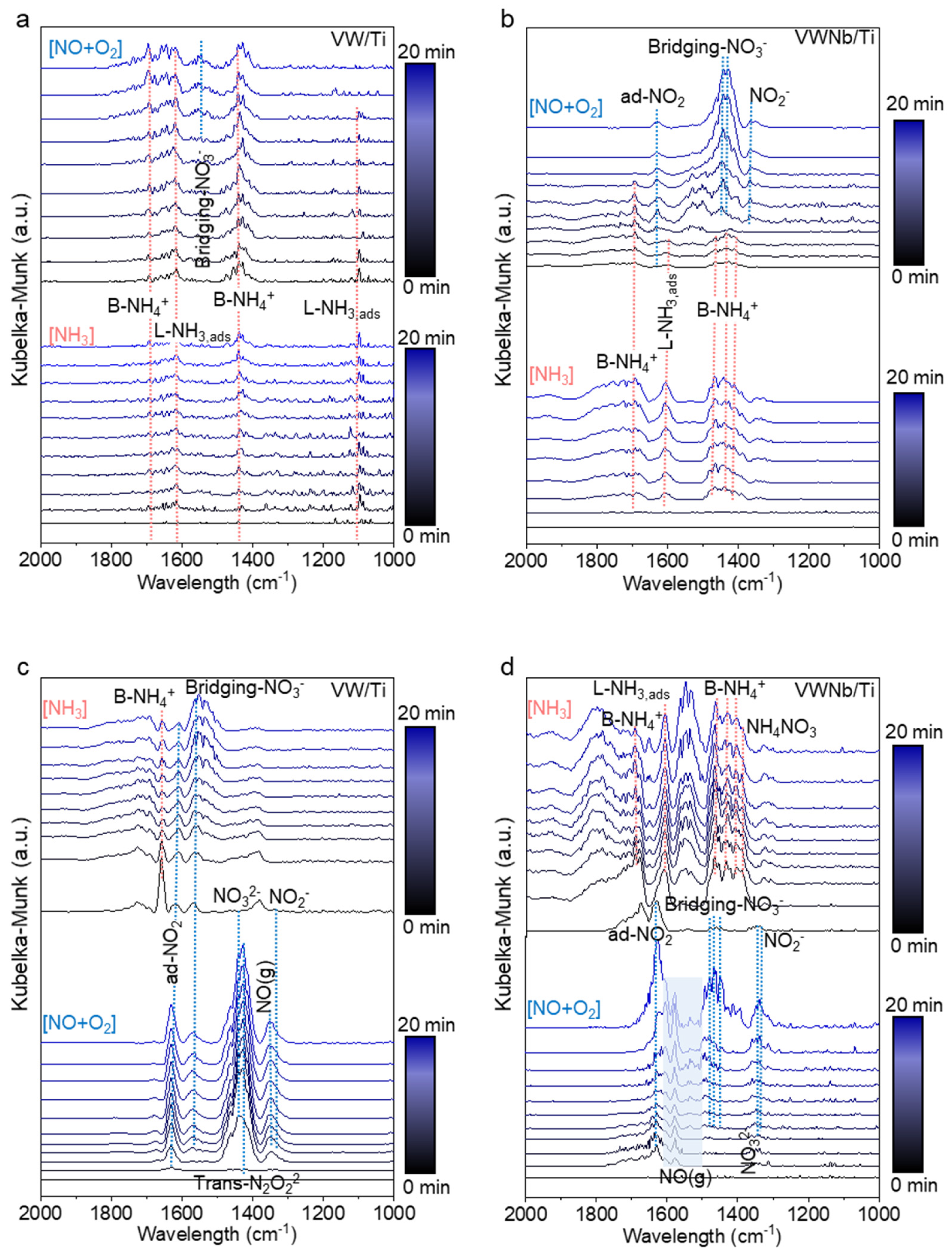
An investigation was conducted into the adsorption–desorption behaviors of gases on catalysts. Gaseous adsorption–desorption behaviors on catalysts during SCR reaction were investigated by collecting in situ diffuse reflection infrared Fourier transform (DRIFT) spectra. First, all catalysts were adsorbed by flowing NH3 of 1000 ppm with balanced N2 for 20 min. Thereafter, gases with concentrations of 1000 ppm NO and 5 vol% O2 were simultaneously flowed for 20 min after 3 min of N2 purge (Figure 4). In situ DRIFTS was utilized to conduct this investigation. Initially, NH3 was flowed over the catalysts. This was followed by NO and O2. In general, the disappearance of peaks assigned to NH3 species by the introduction of NO and O2 indicates that the adsorbed NH3 species reacted with gases of NO and O2 through the SCR reaction. The adsorbed ammonia species on Lewis acid sites were denoted as L-NH3,ads, while the adsorbed ammonia species on Brønsted acid sites were denoted as B-NH4+. Upon the injection of NH3, the peaks for adsorbed-NH3 on V/Ti immediately appeared (Figure S2). A peak assigned to L-NH3,ads appeared at 1607 cm−1, and the peak for NH2 species at 1583 cm−1 corresponded to the active form of L-NH3,ads [61,62]. In particular, broad peaks over a wavelength range of 2000–1600 cm−1 were identified as gaseous NH3 (denoted as NH3(g)) on the catalyst [63]. These peaks disappeared during the 3 min N2 purge. The injection of NO and O2 resulted in the disappearance of the peak for L-NH3,ads after 18 min, concurrent with the emergence of new peaks for adsorbed NO species.

3.4. Reaction Between Pre-Adsorbed NH3 and NO + O2

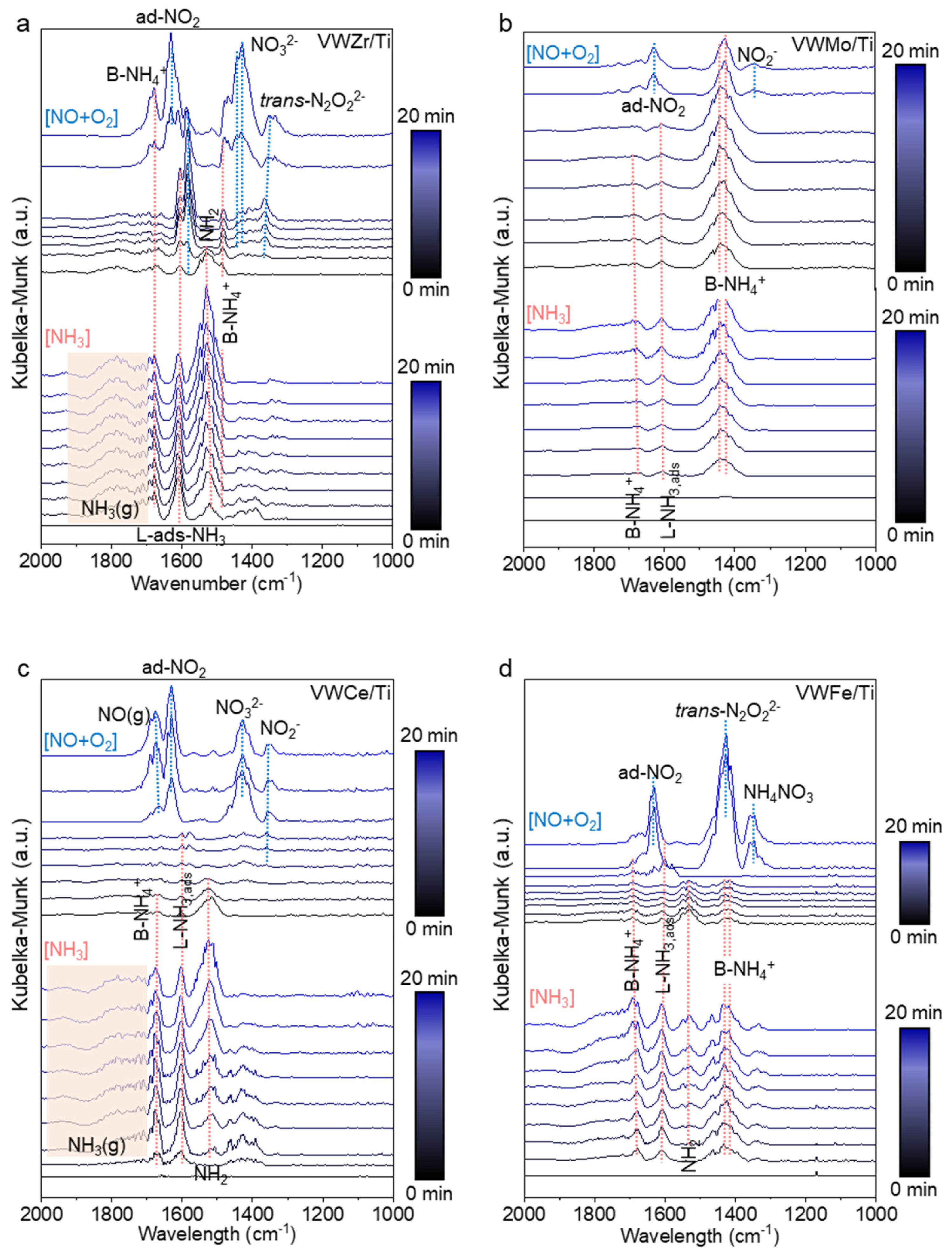
Additional in situ DRIFTS spectra were collected to confirm the influences of the other promoter added into VW/Ti (Figure 5). Gaseous behaviors over Zr added catalyst were investigated (Figure 5a), and physically adsorbed NH3 species appeared over a range from 1900 to 1700 cm−1. In a case of NH3 species adsorbed on acid sites, appeared B-NH4+ at 1675 cm−1 remained even after flowing gases of NO and O2 for 20 min, and L-NH3,ads at 1607 cm−1 disappeared after 16 min [51]. In a DRIFT result of VWMo/Ti (Figure 5b), peaks which appeared at 1676 cm−1 and on 1607 cm−1, were respectively corresponded to B-NH4+ and L-NH3,ads [23,49]. By the introduction of NO and O2, former disappeared after 10 min, whereas the latter disappeared after 14 min. However, a peak at 1434 cm−1 (assigned to B-NH4+) remained even after 20 min. For VWCe/Ti (Figure 5c), B-NH4+ species appeared at 1680, 1450, and 1434 cm−1, and L-NH3,ads appeared at 1600 cm−1 [64,65,66]. After flow of NO and O2, B-NH4+ disappeared after 2 min, and L-NH3,ads did after 10 min. In a case of VWFe/Ti (Figure 5d), peaks at 1675 and 1440 cm−1 were attributed to B-NH4+, and a peak for L-NH3,ads appeared at 1607 cm−1 [67]. After flowing the gases of NO and O2, the appeared adsorbed NH3 peaks disappeared after 12 min, completely. Although Ce could make the reaction rate fast, NH3 was still physically adsorbed over VWCe/Ti. In summary, the addition of Nb as promoter could help to increase the SCR reaction rate by advantageously changing the adsorption form of NH3 for SCR reaction

4. Conclusions

The corrugated type SCR catalysts were fabricated using glass fiber sheets and modified by the addition of a promoter. The corrugated type V-W-M/Ti catalyst was prepared via a simple mixing process. The NOx conversion was found to be the highest in the VWNb/Ti catalyst at 200–450 °C, and the SO2-to-SO3 oxidation was less than 1% at 350 °C. The incorporation of the promoter resulted in alterations to the acid sites (Brønsted and Lewis acid sites) present on the catalyst surface, thereby significantly affecting its catalytic activity. The primary factors contributing to the enhanced NOx conversion and reduced oxidation of SO2-to-SO3 are attributed to promoter-support interaction and modified surface properties induced by the incorporated promoter. Consequently, the addition of Nb enhanced the activity and properties of the VW/Ti catalyst, comparable to commercial catalysts. Furthermore, it demonstrated improved catalytic activity over a broad temperature range. These results demonstrate the applicability of corrugated Nb-modified catalysts for practical SCR applications. Therefore, the developed structured catalyst has strong potential for practical NH3-SCR applications in industrial flue gas treatment systems. However, these results do not reflect the optimization of the catalyst content. Further optimization of catalyst composition and loading is expected to improve catalytic performance.

Supplementary Materials

The following supporting information can be downloaded at: https://www.mdpi.com/article/10.3390/app16094552/s1, Figure S1: Schematic diagram of experimental apparatus for catalytic performance test in semi-bench reactor, and trap and measure setup for SO2-to-SO3 conversion; Figure S2: In situ DRIFTS for the investigation of SCR mechanisms of (a) V/Ti after exposure to [NH3] = 1000 ppm for 20 min followed by N2 purging for 3 min and subsequent exposure to [NO] = 1000 ppm with [O2] = 5 vol.% for 20 min at 200 °C; Table S1: Elemental composition measured via X-ray fluorescence (XRF) of the catalysts; Table S2: Textural properties measured via Brunauer-Emmett-Teller (BET) analysis for catalysts; Table S3: Calculated amounts of H2-consumption, NH3-desorption, and O2-desorption from the TPR and TPD profiles for the catalysts.

Author Contributions

B.J.: Conceptualization, Investigation, Interpretation and Writing—Original Draft, M.-J.L.: Investigation, Interpretation and Writing (in situ DRIFTS), N.K. and D.K.: Formal analysis, Investigation (NH3, O2-TPD analysis, BET, H2-TPR measurements and interpretation), S.-J.K.: Formal analysis, Investigation (in situ DRIFTS, catalytic performance measurements), H.L.: Supervision, H.-D.K.: Supervision, Conceptualization, Funding acquisition, Writing—review and editing. All authors have read and agreed to the published version of the manuscript.

Funding

This research was financially supported by the Ministry of Trade, Industry and Energy (MOTIE) [code number 20005721, RS-2022-00155604 and RS-2025-08262968], Ministry of Oceans and Fisheries (MOF) [code number RS-2023-00256331]. We would like to express our sincere thanks to them for the support.

Data Availability Statement

The data that support the findings of this study are available from the corresponding author upon reasonable request.

Conflicts of Interest

The authors declare no conflicts of interest.

References

  1. Heck, R.M. Catalytic abatement of nitrogen oxides–stationary applications. Catal. Today 1999, 53, 519–523. [Google Scholar] [CrossRef]
  2. Penn, S.L.; Boone, S.T.; Harvey, B.C.; Heiger-Bernays, W.; Tripodis, Y.; Arunachalam, S.; Levy, J.I. Modeling variability in air pollution-related health damages from individual airport emissions. Environ. Res. 2017, 156, 791–800. [Google Scholar] [CrossRef] [PubMed]
  3. Geng, G.; Zhang, Q.; Tong, D.; Li, M.; Zheng, Y.; Wang, S.; He, K. Chemical composition of ambient PM2.5 over China and relationship to precursor emissions during 2005–2012. Atmos. Chem. Phys. 2017, 17, 9187–9203. [Google Scholar] [CrossRef]
  4. Shafer, M.M.; Toner, B.M.; Overdier, J.T.; Schauer, J.J.; Fakra, S.C.; Hu, S.; Herner, J.D.; Ayala, A. Chemical speciation of vanadium in particulate matter emitted from diesel vehicles and urban atmospheric aerosols. Environ. Sci. Technol. 2012, 46, 189–195. [Google Scholar] [CrossRef]
  5. Ye, B.; Jeong, B.; Lee, M.-J.; Kim, T.H.; Park, S.-S.; Jung, J.; Lee, S.; Kim, H.-D. Recent trends in vanadium-based SCR catalysts for NOx reduction in industrial applications: Stationary sources. Nano Converg. 2022, 9, 51. [Google Scholar] [CrossRef]
  6. Boningari, T.; Smirniotis, P.G. Impact of nitrogen oxides on the environment and human health: Mn-based materials for the NOx abatement. Curr. Opin. Chem. Eng. 2016, 13, 133–141. [Google Scholar] [CrossRef]
  7. Ye, B.; Jeong, B.; Lee, M.; Kim, H.-D.; Baik, J.M. Low-Temperature NOx conversion Extruded Monolithic Catalysts Based on Highly Dispersive Mn–Ce Oxide Nanoparticles of Low Ce Content. Adv. Mater. Technol. 2019, 4, 1800462. [Google Scholar] [CrossRef]
  8. Pietikäinen, M.; Väliheikki, A.; Oravisjärvi, K.; Kolli, T.; Huuhtanen, M.; Niemi, S.; Virtanen, S.; Karhu, T.; Keiski, R.L. Particle and NOx emissions of a non-road diesel engine with an SCR unit: The effect of fuel. Renew. Energy 2015, 77, 377–385. [Google Scholar] [CrossRef]
  9. Cederlöf, R.; Doll, R.; Fowler, B.; Friberg, L.; Nelson, N.; Vouk, V. Air pollution and cancer: Risk assessment methodology and epidemiological evidence. Environ. Health Perspect. 1978, 22, 43. [CrossRef][Green Version]
  10. Liu, B.; Du, J.; Lv, X.; Qiu, Y.; Tao, C. Washcoating of cordierite honeycomb with vanadia–tungsta–titania mixed oxides for selective catalytic reduction of NO with NH3. Catal. Sci. Technol. 2015, 5, 1241–1250. [Google Scholar] [CrossRef]
  11. Kwon, D.W.; Park, K.H.; Hong, S.C. Enhancement of SCR activity and SO2 resistance on VOx/TiO2 catalyst by addition of molybdenum. Chem. Eng. J. 2016, 284, 315–324. [Google Scholar] [CrossRef]
  12. Jiang, B.; Deng, B.; Zhang, Z.; Wu, Z.; Tang, X.; Yao, S.; Lu, H. Effect of Zr addition on the low-temperature SCR activity and SO2 tolerance of Fe–Mn/Ti catalysts. J. Phys. Chem. C 2014, 118, 14866–14875. [Google Scholar] [CrossRef]
  13. Zhang, H.; Han, J.; Niu, X.; Han, X.; Wei, G.; Han, W. Study of synthesis and catalytic property of WO3/TiO2 catalysts for NO reduction at high temperatures. J. Mol. Catal. A Chem. 2011, 350, 35–39. [Google Scholar] [CrossRef]
  14. Kwon, D.W.; Park, K.H.; Ha, H.P.; Hong, S.C. The role of molybdenum on the enhanced performance and SO2 resistance of V/Mo-Ti catalysts for NH3-SCR. Appl. Surf. Sci. 2019, 481, 1167–1177. [Google Scholar] [CrossRef]
  15. Chen, C.; Cao, Y.; Liu, S.; Chen, J.; Jia, W. Review on the latest developments in modified vanadium-titanium-based SCR catalysts. Chin. J. Catal. 2018, 39, 1347–1365. [Google Scholar] [CrossRef]
  16. Ding, S.; Liu, F.; Shi, X.; He, H. Promotional effect of Nb additive on the activity and hydrothermal stability for the selective catalytic reduction of NOx with NH3 over CeZrOx catalyst. Appl. Catal. B Environ. 2016, 180, 766–774. [Google Scholar] [CrossRef]
  17. Zhu, L.; Zhong, Z.; Xue, J.; Xu, Y.; Wang, C.; Wang, L. NH3-SCR performance and the resistance to SO2 for Nb doped vanadium based catalyst at low temperatures. J. Environ. Sci. 2018, 65, 306–316. [Google Scholar] [CrossRef]
  18. Xu, C.; Liu, J.; Zhao, Z.; Yu, F.; Cheng, K.; Wei, Y.; Duan, A.; Jiang, G. NH3-SCR denitration catalyst performance over vanadium–titanium with the addition of Ce and Sb. J. Environ. Sci. 2015, 31, 74–80. [Google Scholar] [CrossRef]
  19. Boyano, A.; Lombardo, N.; Gálvez, M.E.; Lázaro, M.J.; Moliner, R. Vanadium-loaded carbon-based monoliths for the on-board NO reduction: Experimental study of operating conditions. Chem. Eng. J. 2008, 144, 343–351. [Google Scholar] [CrossRef]
  20. Due-Hansen, J.; Boghosian, S.; Kustov, A.; Fristrup, P.; Tsilomelekis, G.; Ståhl, K.; Christensen, C.H.; Fehrmann, R. Vanadia-based SCR catalysts supported on tungstated and sulfated zirconia: Influence of doping with potassium. J. Catal. 2007, 251, 459–473. [Google Scholar] [CrossRef]
  21. Ye, B.; Lee, M.; Jeong, B.; Kim, J.; Lee, D.H.; Baik, J.M.; Kim, H.-D. Partially reduced graphene oxide as a support of Mn-Ce/TiO2 catalyst for selective catalytic reduction of NOx with NH3. Catal. Today 2019, 328, 300–306. [Google Scholar] [CrossRef]
  22. Zhao, K.; Han, W.; Lu, G.; Lu, J.; Tang, Z.; Zhen, X. Promotion of redox and stability features of doped Ce–W–Ti for NH3-SCR reaction over a wide temperature range. Appl. Surf. Sci. 2016, 379, 316–322. [Google Scholar] [CrossRef]
  23. Liu, Z.; Zhang, S.; Li, J.; Ma, L. Promoting effect of MoO3 on the NOx reduction by NH3 over CeO2/TiO2 catalyst studied with in situ DRIFTS. Appl. Catal. B Environ. 2014, 144, 90–95. [Google Scholar] [CrossRef]
  24. Li, X.; Li, K.; Peng, Y.; Li, X.; Zhang, Y.; Wang, D.; Chen, J.; Li, J. Interaction of phosphorus with a FeTiOx catalyst for selective catalytic reduction of NOx with NH3: Influence on surface acidity and SCR mechanism. Chem. Eng. J. 2018, 347, 173–183. [Google Scholar] [CrossRef]
  25. Foo, R.; Vazhnova, T.; Lukyanov, D.B.; Millington, P.; Collier, J.; Rajaram, R.; Golunski, S. Formation of reactive Lewis acid sites on Fe/WO3–ZrO2 catalysts for higher temperature SCR applications. Appl. Catal. B Environ. 2015, 162, 174–179. [Google Scholar] [CrossRef]
  26. Lee, K.J.; Kumar, P.A.; Maqbool, M.S.; Rao, K.N.; Song, K.H.; Ha, H.P. Ceria added Sb-V2O5/TiO2 catalysts for low temperature NH3 SCR: Physico-chemical properties and catalytic activity. Appl. Catal. B Environ. 2013, 142, 705–717. [Google Scholar] [CrossRef]
  27. Shan, W.; Liu, F.; He, H.; Shi, X.; Zhang, C. An environmentally-benign CeO2-TiO2 catalyst for the selective catalytic reduction of NOx with NH3 in simulated diesel exhaust. Catal. Today 2012, 184, 160–165. [Google Scholar] [CrossRef]
  28. Zhao, X.; Huang, L.; Li, H.; Hu, H.; Hu, X.; Shi, L.; Zhang, D. Promotional effects of zirconium doped CeVO4 for the low-temperature selective catalytic reduction of NOx with NH3. Appl. Catal. B Environ. 2016, 183, 269–281. [Google Scholar] [CrossRef]
  29. Zhang, Q.; Xu, L.; Ning, P.; Gu, J.; Guan, Q. Surface characterization studies of CuO-CeO2-ZrO2 catalysts for selective catalytic reduction of NO with NH3. Appl. Surf. Sci. 2014, 317, 955–961. [Google Scholar] [CrossRef]
  30. Liu, J.; Yan, Y.; Lian, M.; Song, J.; Yang, Y.; Huang, G.; Wang, M.; Feng, X.; Ji, W. High-efficiency and durable V–Ti–Nb ternary catalyst prepared by a wet-solid mechanochemical method for sustainably producing acrylic acid via acetic acid–formaldehyde condensation. RSC Adv. 2023, 13, 1530–1538. [Google Scholar] [CrossRef]
  31. Ma, Z.; Weng, D.; Wu, X.; Si, Z.; Wang, B. A novel Nb–Ce/WOx–TiO2 catalyst with high NH3-SCR activity and stability. Catal. Commun. 2012, 27, 97–100. [Google Scholar] [CrossRef]
  32. Ma, Z.; Wu, X.; Feng, Y.; Si, Z.; Weng, D.; Shi, L. Low-temperature SCR activity and SO2 deactivation mechanism of Ce-modified V2O5–WO3/TiO2 catalyst. Prog. Nat. Sci. Mater. Int. 2015, 25, 342–352. [Google Scholar] [CrossRef]
  33. Gong, P.; Xie, J.; Fang, D.; Liu, X.; He, F.; Li, F. Novel heterogeneous denitrification catalyst over a wide temperature range: Synergy between CeO2, ZrO2 and TiO2. Chem. Eng. J. 2019, 356, 598–608. [Google Scholar] [CrossRef]
  34. Zhao, X.; Huang, L.; Namuangruk, S.; Hu, H.; Hu, X.; Shi, L.; Zhang, D. Morphology-dependent performance of Zr–CeVO4/TiO2 for selective catalytic reduction of NO with NH3. Catal. Sci. Technol. 2016, 6, 5543–5553. [Google Scholar] [CrossRef]
  35. Qing, M.; Su, S.; Wang, L.; Liu, L.; Xu, K.; He, L.; Jun, X.; Hu, S.; Wang, Y.; Xiang, J. Getting insight into the oxidation of SO2-to-SO3 over V2O5-WO3/TiO2 catalysts: Reaction mechanism and effects of NO and NH3. Chem. Eng. J. 2019, 361, 1215–1224. [Google Scholar] [CrossRef]
  36. Lin, C.-H.; Bai, H. Adsorption behavior of moisture over a vanadia/titania catalyst: A study for the selective catalytic reduction process. Ind. Eng. Chem. Res. 2004, 43, 5983–5988. [Google Scholar] [CrossRef]
  37. Dunn, J.P.; Stenger, H.G., Jr.; Wachs, I.E. Oxidation of SO2 over Supported Metal Oxide Catalysts. J. Catal. 1999, 181, 233–243. [Google Scholar] [CrossRef]
  38. Yu, S.; Lu, Y.; Cao, Y.; Wang, J.; Sun, B.; Gao, F.; Tang, C.; Dong, L. Composite catalytic systems: A strategy for developing the low temperature NH3-SCR catalysts with satisfactory SO2 and H2O tolerance. Catal. Today 2019, 327, 235–245. [Google Scholar] [CrossRef]
  39. Liu, Y.-M.; Hang, S.H.U.; Xu, Q.-S.; Zhang, Y.-H.; Yang, L.-J. FT-IR study of the SO2 oxidation behavior in the selective catalytic reduction of NO with NH3 over commercial catalysts. J. Fuel Chem. Technol. 2015, 43, 1018–1024. [Google Scholar] [CrossRef]
  40. Huang, Z.; Zhu, Z.; Liu, Z. Combined effect of H2O and SO2 on V2O5/AC catalysts for NO reduction with ammonia at lower temperatures. Appl. Catal. B Environ. 2002, 39, 361–368. [Google Scholar] [CrossRef]
  41. Zhao, X.; Huang, L.; Li, H.; Hu, H.; Han, J.; Shi, L.; Zhang, D. Highly dispersed V2O5/TiO2 modified with transition metals (Cu, Fe, Mn, Co) as efficient catalysts for the selective reduction of NO with NH3. Chin. J. Catal. 2015, 36, 1886–1899. [Google Scholar] [CrossRef]
  42. Yang, S.; Guo, Y.; Chang, H.; Ma, L.; Peng, Y.; Qu, Z.; Yan, N.; Wang, C.; Li, J. Novel effect of SO2 on the SCR reaction over CeO2: Mechanism and significance. Appl. Catal. B Environ. 2013, 136, 19–28. [Google Scholar] [CrossRef]
  43. Li, C.; Li, Q.; Lu, P.; Cui, H.; Zeng, G. Characterization and performance of V2O5/CeO2 for NH3-SCR of NO at low temperatures. Front. Environ. Sci. Eng. 2012, 6, 156–161. [Google Scholar] [CrossRef]
  44. Wu, Z.; Jin, R.; Wang, H.; Liu, Y. Effect of ceria doping on SO2 resistance of Mn/TiO2 for selective catalytic reduction of NO with NH3 at low temperature. Catal. Commun. 2009, 10, 935–939. [Google Scholar] [CrossRef]
  45. Choo, S.T.; Yim, S.D.; Nam, I.-S.; Ham, S.-W.; Lee, J.-B. Effect of promoters including WO3 and BaO on the activity and durability of V2O5/sulfated TiO2 catalyst for NO reduction by NH3. Appl. Catal. B Environ. 2003, 44, 237–252. [Google Scholar] [CrossRef]
  46. Song, L.; Zhang, R.; Zang, S.; He, H.; Su, Y.; Qiu, W.; Sun, X. Activity of Selective Catalytic Reduction of NO over V2O5/TiO2 Catalysts Preferentially Exposed Anatase {001} and {101} Facets. Catal. Lett. 2017, 147, 934–945. [Google Scholar] [CrossRef]
  47. Kwon, D.W.; Choi, J.; Nam, K.B.; Ha, H.P. New insight into the role of Mo–Sb addition towards VMoSbTi catalysts with enhanced activity for selective catalytic reduction with NH3. Chem. Eng. J. 2022, 428, 132078. [Google Scholar] [CrossRef]
  48. Wu, R.; Zhang, N.; Liu, X.; Li, L.; Song, L.; Qiu, W.; He, H. The Keggin Structure: An Important Factor in Governing NH3–SCR Activity Over the V2O5–MoO3/TiO2 Catalyst. Catal. Lett. 2018, 148, 1228–1235. [Google Scholar] [CrossRef]
  49. Zhu, L.; Zhong, Z.; Yang, H.; Wang, C. Effect of MoO3 on vanadium based catalysts for the selective catalytic reduction of NOx with NH3 at low temperature. J. Environ. Sci. 2017, 56, 169–179. [Google Scholar] [CrossRef]
  50. Xu, H.; Sun, M.; Liu, S.; Li, Y.; Wang, J.; Chen, Y. Effect of the calcination temperature of cerium–zirconium mixed oxides on the structure and catalytic performance of WO3/CeZrO2 monolithic catalyst for selective catalytic reduction of NOx with NH3. RSC Adv. 2017, 7, 24177–24187. [Google Scholar] [CrossRef]
  51. Jia, B.; Guo, J.; Shu, S.; Fang, N.; Li, J.; Chu, Y. Effects of different Zr/Ti ratios on NH3–SCR over MnOx/ZryTi1-yO2: Characterization and reaction mechanism. Mol. Catal. 2017, 443, 25–37. [Google Scholar]
  52. Jiang, Y.; Han, D.; Yang, L.; Yang, Z.; Ge, H.; Lin, R.; Wang, X. Improving the K resistance effectively of CeO2-TiO2 catalyst by Nb doping for NH3-SCR reaction. Process Saf. Environ. Prot. 2022, 160, 876–886. [Google Scholar] [CrossRef]
  53. Dong, G.-J.; Zhang, Y.-F.; Yuan, Z.; Yang, B.A.I. Effect of the pH value of precursor solution on the catalytic performance of V2O5-WO3/TiO2 in the low temperature NH3-SCR of Nox. J. Fuel Chem. Technol. 2014, 42, 1455–1463. [Google Scholar] [CrossRef]
  54. Li, F.; Shen, B.; Tian, L.; Li, G.; He, C. Enhancement of SCR activity and mechanical stability on cordierite supported V2O5-WO3/TiO2 catalyst by substrate acid pretreatment and addition of silica. Powder Technol. 2016, 297, 384–391. [Google Scholar] [CrossRef]
  55. Yan, Z.; Yu, J.; Liu, H.; Ke, X.; Wang, C.; Liu, L.; Wei, L.; Yang, T. A novel regeneration method for deactivated commercial NH3-SCR catalysts with promoted low-temperature activities. Environ. Sci. Pollut. Res. 2020, 27, 41970–41986. [Google Scholar] [CrossRef] [PubMed]
  56. Sun, X.; Guo, R.-T.; Liu, J.; Fu, Z.-G.; Liu, S.-W.; Pan, W.-G.; Shi, X.; Qin, H.; Wang, Z.-Y.; Liu, X.-Y. The enhanced SCR performance of Mn/TiO2 catalyst by Mo modification: Identification of the promotion mechanism. Int. J. Hydrogen Energy 2018, 43, 16038–16048. [Google Scholar] [CrossRef]
  57. Jiang, D.; Zhang, S.; Zeng, Y.; Wang, P.; Zhong, Q. Active Site of O2 and Its Improvement Mechanism over Ce-Ti Catalyst for NH3-SCR Reaction. Catalysts 2018, 8, 336. [Google Scholar] [CrossRef]
  58. Shi, J.; Zhang, Z.; Chen, M.; Zhang, Z.; Shangguan, W.; Gu, S.; Shin-ichi, H. Effect of alumina and zirconia as binders on the activity of Fe-BEA for NH3-SCR of NO. Front. Environ. Sci. Eng. 2018, 12, 15. [Google Scholar] [CrossRef]
  59. Ma, Z.; Wu, X.; Si, Z.; Weng, D.; Ma, J.; Xu, T. Impacts of niobia loading on active sites and surface acidity in NbOx/CeO2–ZrO2 NH3–SCR catalysts. Appl. Catal. B Environ. 2015, 179, 380–394. [Google Scholar] [CrossRef]
  60. Andana, T.; Rappé, K.G.; Nelson, N.C.; Gao, F.; Wang, Y. Selective catalytic reduction of NOx with NH3 over Ce-Mn oxide and Cu-SSZ-13 composite catalysts–Low temperature enhancement. Appl. Catal. B Environ. 2022, 316, 121522. [Google Scholar] [CrossRef]
  61. Cheng, K.; Liu, J.; Zhao, Z.; Wei, Y.; Jiang, G.; Duan, A. Direct synthesis of V–W–Ti nanoparticle catalysts for selective catalytic reduction of NO with NH3. RSC Adv. 2015, 5, 45172–45183. [Google Scholar] [CrossRef]
  62. Sun, L.; Liu, P.; Xu, J.; Liu, K.; Zhang, Z.; Zhang, Y.; Yang, X. Active Vanadium (IV) Species Synthesized at Low-Temperature Facilitate Excellent Performance in Low-Temperature NOx-Catalytic Removal. Catal. Sci. Technol. 2023, 13, 5197–5204. [Google Scholar] [CrossRef]
  63. Husnain, N.; Wang, E.; Fareed, S.; Anwar, M.T. Comparision on the low-temperature NH3-SCR performance of γ-Fe2O3 catalysts prepared by two different methods. Catalysts 2019, 9, 1018. [Google Scholar] [CrossRef]
  64. Pan, Y.; Shen, B.; Liu, L.; Yao, Y.; Gao, H.; Liang, C.; Xu, H. Develop high efficient of NH3-SCR catalysts with wide temperature range by ball-milled method. Fuel 2020, 282, 118834. [Google Scholar] [CrossRef]
  65. Ning, R.; Chen, L.; Li, E.; Liu, X.; Zhu, T. Applicability of V2O5-WO3/TiO2 catalysts for the SCR denitrification of alumina calcining flue gas. Catalysts 2019, 9, 220. [Google Scholar] [CrossRef]
  66. Liu, J.; Shi, X.; Shan, Y.; Yan, Z.; Shan, W.; Yu, Y.; He, H. Hydrothermal Stability of CeO2–WO3–ZrO2 Mixed Oxides for Selective Catalytic Reduction of NOx by NH3. Environ. Sci. Technol. 2018, 52, 11769–11777. [Google Scholar] [CrossRef] [PubMed]
  67. Yu, J.; Qiu, L.; Yin, Y.; Li, X.; Chen, H.; Wang, C.; Chang, H. Poisoning Effects of Chlorine on V2O5-WO3/TiO2 Catalysts for Selective Catalytic Reduction of NOx by NH3. Catal. Surv. Asia 2023, 27, 147–154. [Google Scholar] [CrossRef]
Figure 1. (a) Photograph of coated-sheet-type catalysts in a jig for catalytic testing. (b) Elemental composition measured via X-ray fluorescence (XRF) and (c) X-ray diffraction patterns of the catalysts.
Applsci 16 04552 g001
Figure 2. (a) NO conversion efficiencies, (b) NH3 conversion efficiencies, and (c) N2 selectivity for the catalysts under reaction conditions of [NO] = [NH3] = [SO2] =300 ppm, [O2] = 5 vol%, [H2O] = 10 vol% with N2 as balance for a total flow rate of 20 Lˑmin−1, and AV = 51 mˑh−1 (i.e., GHSV of ~20,000 h−1) in the temperature range of 200–450 °C with an interval of 50 °C. (d) Turnover frequency (TOF) values for the reduction of NO to N2 during NH3-SCR reaction, and (e) calculated activation energies (Ea). (f) SO2-to-SO3 conversion values measured on ion-chromatography under the same gaseous reaction conditions.
Applsci 16 04552 g002
Figure 3. (a) Hydrogen-temperature-programmed-reduction (H2-TPR) profiles, (b) ammonia-temperature-programmed-desorption (NH3-TPD) profiles, and (c) oxygen-temperature-programmed-desorption (O2-TPD) profiles investigated over temperature range of 100–800 °C. (d) Integral area of peaks form the profiles, comparing V/Ti, VW/Ti, and VWM/Ti (M = Nb, Zr, Mo, Ce, and Fe).
Applsci 16 04552 g003
Figure 4. In situ DRIFTS spectra for the investigation of SCR mechanisms of (a,c) VW/Ti and (b,d) VWNb/Ti resulting from (a,b) the following gas-flow sequence: [NH3] = 1000 ppm for 20 min, N2 purging for 3 min, and [NO] = 1000 ppm and [O2] = 5 vol% for 20 min at 200 °C. Spectra of (c) VW/Ti and (d) VWNb/Ti under the reverse sequence mentioned in (a,b). The red lines related to NH3-species and blue lines for NOx-species.
Applsci 16 04552 g004
Figure 5. In situ DRIFTS spectra for the investigation of SCR mechanisms of (a) VWZr/Ti, (b) VWMo/Ti, (c) VWCe/Ti, and (d) VWFe/Ti after exposure to [NH3] = 1000 ppm for 20 min followed by N2 purging for 3 min and subsequent exposure to [NO] = 1000 ppm with [O2] = 5 vol.% for 20 min at 200 °C. The red lines related to NH3-species and blue lines for NOx-species.
Applsci 16 04552 g005
Disclaimer/Publisher’s Note: The statements, opinions and data contained in all publications are solely those of the individual author(s) and contributor(s) and not of MDPI and/or the editor(s). MDPI and/or the editor(s) disclaim responsibility for any injury to people or property resulting from any ideas, methods, instructions or products referred to in the content.