Article

Comparative Effects of Breathing-Integrated Scapular Stabilization Versus Thoracic–Scapular Stabilization Exercises on Muscle Strength and Postural Alignment in Individuals with Shoulder Dysfunction: A Randomized Controlled Trial

1
Department of Physical Therapy, The Graduate School, Daegu University, Gyeongsan-si 38453, Republic of Korea
2
Department of Physical Therapy, College of Rehabilitation Science, Daegu University, Gyeongsan-si 38453, Republic of Korea
*
Author to whom correspondence should be addressed.
Appl. Sci. 2026, 16(9), 4553; https://doi.org/10.3390/app16094553
Submission received: 25 March 2026 / Revised: 21 April 2026 / Accepted: 29 April 2026 / Published: 5 May 2026
(This article belongs to the Special Issue Biomechanical Analysis for Sport Performance)

Abstract

Shoulder dysfunction characterized by scapular internal rotation is associated with muscle weakness, pectoralis minor shortening, and altered postural alignment. Although breathing-integrated scapular stabilization or thoracic–scapular stabilization exercises may improve these impairments, no prior study has directly compared their effects in this population. Methods: Thirty-two adults with shoulder dysfunction characterized by scapular internal rotation were randomly assigned to an experimental group (n = 16), which performed breathing-integrated scapular stabilization exercises, or a control group (n = 16), which performed thoracic–scapular stabilization exercises. Both groups participated in a 4-week intervention program conducted three times per week, with each session lasting 40 min. Muscle strength, pectoralis minor length (PML), and shoulder sagittal angle (SSA) were assessed at baseline and after the intervention. Data were analyzed using two-way repeated-measures ANOVA to examine group × time interactions, followed by Bonferroni-adjusted post hoc tests (α = 0.025). Results: No significant group × time interaction effects were observed for any outcome (p > 0.025), indicating that neither intervention demonstrated clear superiority over the other during the study period; however, both groups showed significant improvements over time in muscle strength, PML, and SSA following intervention (p < 0.025), except for upper trapezius strength, which did not change significantly. Conclusions: Both breathing-integrated scapular stabilization and thoracic–scapular stabilization exercises were associated with improvements in muscle strength, pectoralis minor length, and shoulder sagittal angle over time in individuals with shoulder dysfunction characterized by scapular internal rotation. However, no clear superiority of one intervention over the other was demonstrated during the 4-week study period.

1. Introduction

The shoulder joint plays a crucial role in daily activities, and shoulder dysfunction is a common health problem across diverse patient populations, characterized by symptoms such as shoulder pain and reduced range of motion, which can substantially impair daily living activities [1,2]; additionally, pain and limited mobility may lead to compensatory, maladaptive postural pattern changes, which can further exacerbate muscular imbalances around the scapular region and trunk, thereby perpetuating the cycle of dysfunction [3,4,5]. Excessive forward extension of the neck, curvature of the thoracic spine, and downward, anterior tilt of the shoulder blades often result in excessive inward rotation of the shoulders; problems associated with muscle imbalance can also occur, including serratus anterior muscles, deep flexion of the neck muscles, lower trapezius weakness, overuse of the upper trapezius, and over tension of the pectoralis major muscle [4,6,7].
Scapular dyskinesis, including patterns such as excessive internal rotation, anterior tilt, and winging, is frequently observed in shoulder dysfunction. According to Sahrmann and Kwon et al., scapular movement impairments can be categorized into several types, among which internal rotation is particularly common; this condition is often accompanied by forward shoulder posture, thoracic kyphosis, tightness in the pectoralis minor, and weakness in the middle trapezius, lower trapezius, and serratus anterior [8,9,10].
The scapula fulfills four biomechanical roles: It is the pivotal point of the humerus, as well as the attachment of the humerus onto the thoracic wall. The scapula prevents the acromion from impeding the movement of the humerus during both abduction and flexion, thereby eliminating any potential for impingement. The positions of the scapula and glenoid determine the degree of freedom in each plane of shoulder motion, and the scapula plays an important role in the chain of upper arm motion [7]. Optimal shoulder mobility is closely linked to efficient scapulothoracic mechanics, as scapular orientation and resting position are dynamically influenced by thoracic spine alignment and habitual posture. As synthesized by Kibler from multiple empirical investigations, adequate scapulothoracic motion is fundamental to preserving physiological shoulder kinematics and functional capacity. In the presence of increased thoracic kyphosis, the scapula commonly adopts a forward-tilted, internally rotated, and protracted resting posture, altering the glenohumeral joint’s biomechanical environment and potentially compromising overhead movement efficiency [11].
We are aware that normal scapular movement necessitates the specific contribution of every muscle attached to the scapula; for instance, the serratus anterior can stabilize the medial edge and lower angle of the scapula, facilitate upward rotation, and effectively prevent excessive swinging and forward tilting of its medial aspect [12,13,14]. Weakness and stiffness in these muscles can alter scapular function and position. Excessive internal rotation of the scapula will result in forward abduction. Furthermore, weakness in the middle trapezius, inferior trapezius, and serratus anterior, along with tension in muscles such as pectoralis major, may also contribute [15,16]. The results indicate that strength training for the shoulder girdle muscles, stability training for the shoulder girdle muscles, and stretching exercises for the shoulder girdle muscles can significantly improve shoulder movement disorders by altering the position and motion of the scapula [17].
The research of Wang and colleagues shows that stretching exercises for the pectoral muscles and resisted strengthening exercises improve muscle strength, promote a more erect upper trunk posture, and enhance scapular stability [18]. Yuksel and colleagues suggest that scapular stabilization exercises showed better improvement in muscle strength [19]. Moezy and colleagues suggested that the scapular stabilization-based exercise intervention was successful in increasing shoulder range, correcting shoulder postures [20]. Numerous studies have demonstrated the effectiveness of scapular stability training in promoting proper scapular positioning and movement, as well as improving overall function [21]. Breathing exercises, or shoulder exercises with thoracic stabilization, improve posture [22,23]. However, although these exercise approaches have shown benefits in individuals with scapular dyskinesis, few studies have directly compared their effects in individuals specifically classified as having scapular internal rotation, a common subtype of shoulder dysfunction, characterized by abnormal scapular alignment and associated muscle imbalances. From a clinical perspective, it is important to investigate which combined exercise approach is more effective for improving muscle strength and postural alignment in individuals with shoulder dysfunction characterized by scapular internal rotation. We hypothesized that the breathing-integrated scapular stabilization program would produce greater improvements than thoracic–scapular stabilization exercises alone.

2. Methods

2.1. Study Design

Allocation was concealed until the point of assignment by using an opaque container filled with an equal number of white and black balls. After baseline assessment, each participant selected one ball, which determined group allocation. Participants who selected a white ball were assigned to the breathing-integrated scapular stabilization exercise group (SEG), whereas those who selected a black ball were assigned to the thoracic–scapular stabilization exercise group (SCG). Due to the nature of the intervention, participants and treating physical therapists were not blinded; however, the outcome assessor remained blinded to group assignment during data collection. All exercises were supervised by experienced physical therapists.
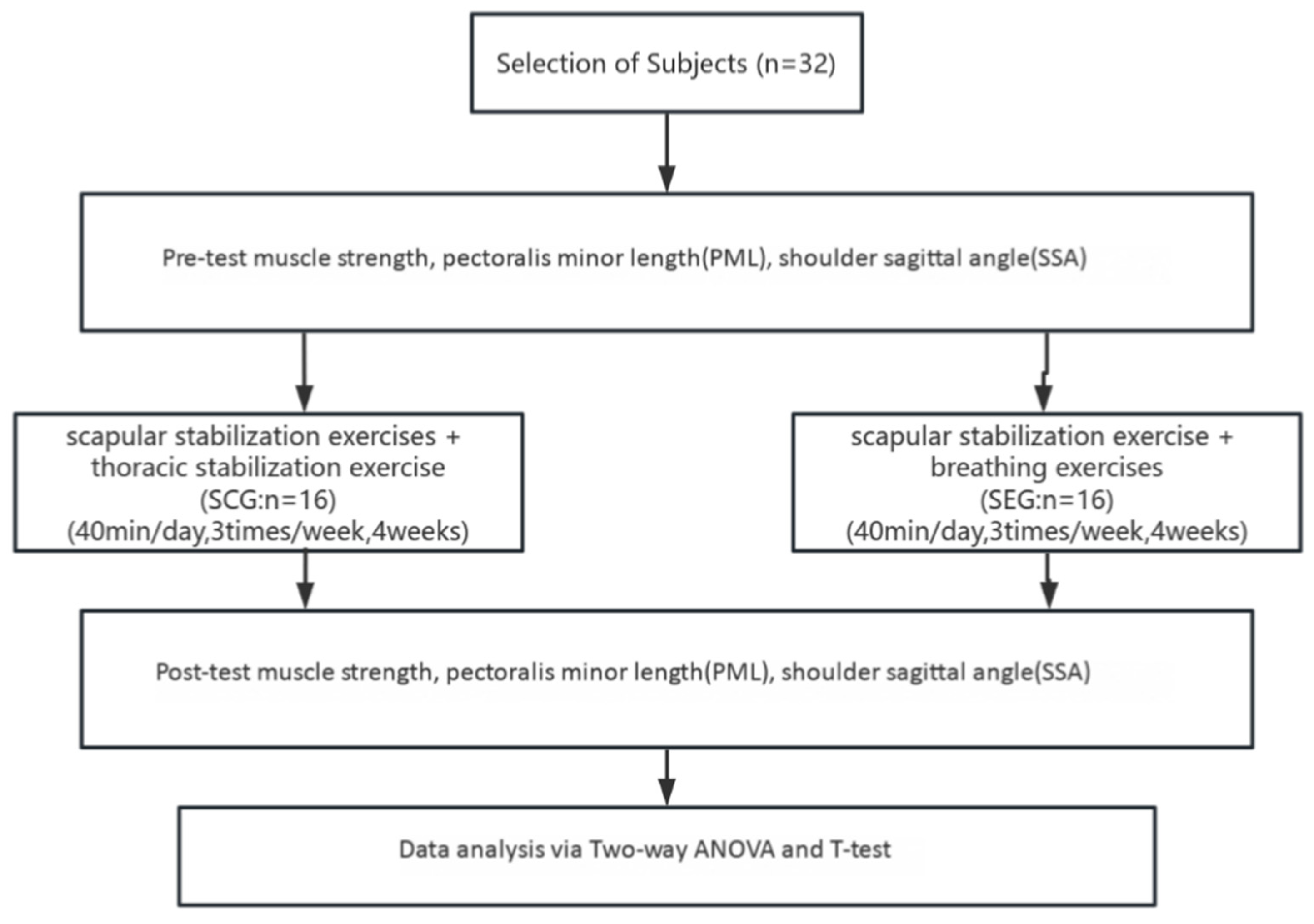
A total of 32 subjects were included, with experimental data collection including muscle strength, pectoralis minor length (PML), and shoulder sagittal angle (SSA) (Figure 1).
The research protocol received formal ethical clearance from Daegu University’s Institutional Review Board in the Republic of Korea (IRB No.: 1040621-202401-HR-008); it was also registered with the Clinical Research Information Service (CRIS), Korea’s national clinical trial registry (Registration No.: KCT0010657, dated 20 June 2025). All participants and, where applicable, their legally authorized representatives provided written informed consent prior to enrollment, adhering strictly to the ethical standards outlined in the Declaration of Helsinki. The study was conducted over a 101-day period, commencing on 21 February 2024, and concluding on 31 May 2024. Participants in both groups underwent a 4-week intervention program, with sessions conducted three times per week, and each session lasting 40 min.
Participants were eligible for inclusion if they met all of the following criteria: (1) a shoulder sagittal angle (SSA) of 52° or less; (2) a positive bilateral shoulder flexion test; and (3) middle trapezius and serratus anterior muscle strength rated below ‘good’ on manual muscle testing. Participants were excluded if they had a history of scapular injury restricting functional activities, previous scapular or thoracic fracture, or any musculoskeletal or neurological condition that could interfere with exercise participation or outcome assessment.

2.2. Study Sample Size

Before launching the main investigation, a pilot study was carried out to inform the design and statistical planning of the trial. Sample size estimation was conducted using G*Power software (Heinrich Heine University, Düsseldorf, Germany, v3.1.9.7) for an independent samples, two-sided t-test. The assumed effect size (Cohen’s d = 1.05) was derived from the preliminary between-group difference observed in the primary outcome during the pilot study. Although the primary statistical analysis in the present study was conducted using two-way repeated-measures ANOVA, the initial sample size estimation was based on between-group mean comparisons at the study planning stage and was retained as a conservative approach, as it did not account for within-subject correlations across repeated measurements and therefore was less likely to underestimate the required sample size. Assuming a conventional significance threshold of α = 0.05 and desired statistical power of 1−β = 0.80, the analysis indicated that at least 32 participants, randomly assigned equally across two groups (n = 16 each group), were necessary to detect meaningful between-group differences. Accordingly, the final sample comprised 32 adults diagnosed with shoulder dysfunction, recruited from clinical settings in South Korea. All aspects of the study, from participant recruitment and data collection to analysis, were implemented in full alignment with established ethical standards and regulatory requirements.

2.3. Outcome Measurements

To minimize measurement error, all assessments were conducted by the same trained assessor using a standardized protocol. Participant positioning, anatomical landmark identification, instrument placement, and testing procedures were kept consistent across all measurements. Repeated measurements were obtained and averaged for analysis where applicable.

2.3.1. Muscle Strength

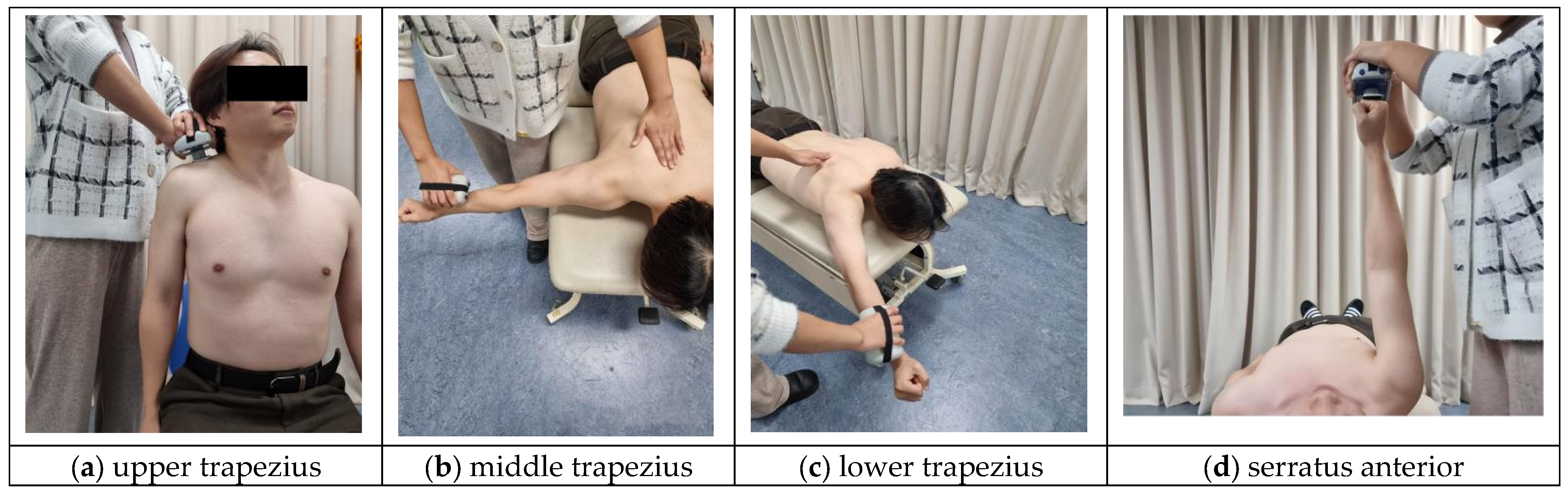
Prior to muscle strength assessment, participants received standardized instructions regarding the testing procedures and completed a familiarization trial to ensure maximal voluntary contraction. Muscle strengths of the trapezius and serratus anterior were assessed using a hand-held dynamometer (HHD) (MMT, Lafayette Instrument Company, Lafayette, IN, USA), with testing positions illustrated in Figure 2 (Figure 2). Hand-held dynamometry has been widely used in clinical and research settings and has demonstrated acceptable to excellent reliability for the assessment of shoulder muscle strength [24,25,26].
During testing, participants were asked to maintain the designated arm position while resistance was progressively applied by the examiner until peak contraction was achieved within 5 s. Each muscle was measured three times, with a 2 min rest interval between trials, and the mean value was used for analysis. The testing order of the muscles was randomized across participants.

2.3.2. Pectoralis Minor Length (PML)

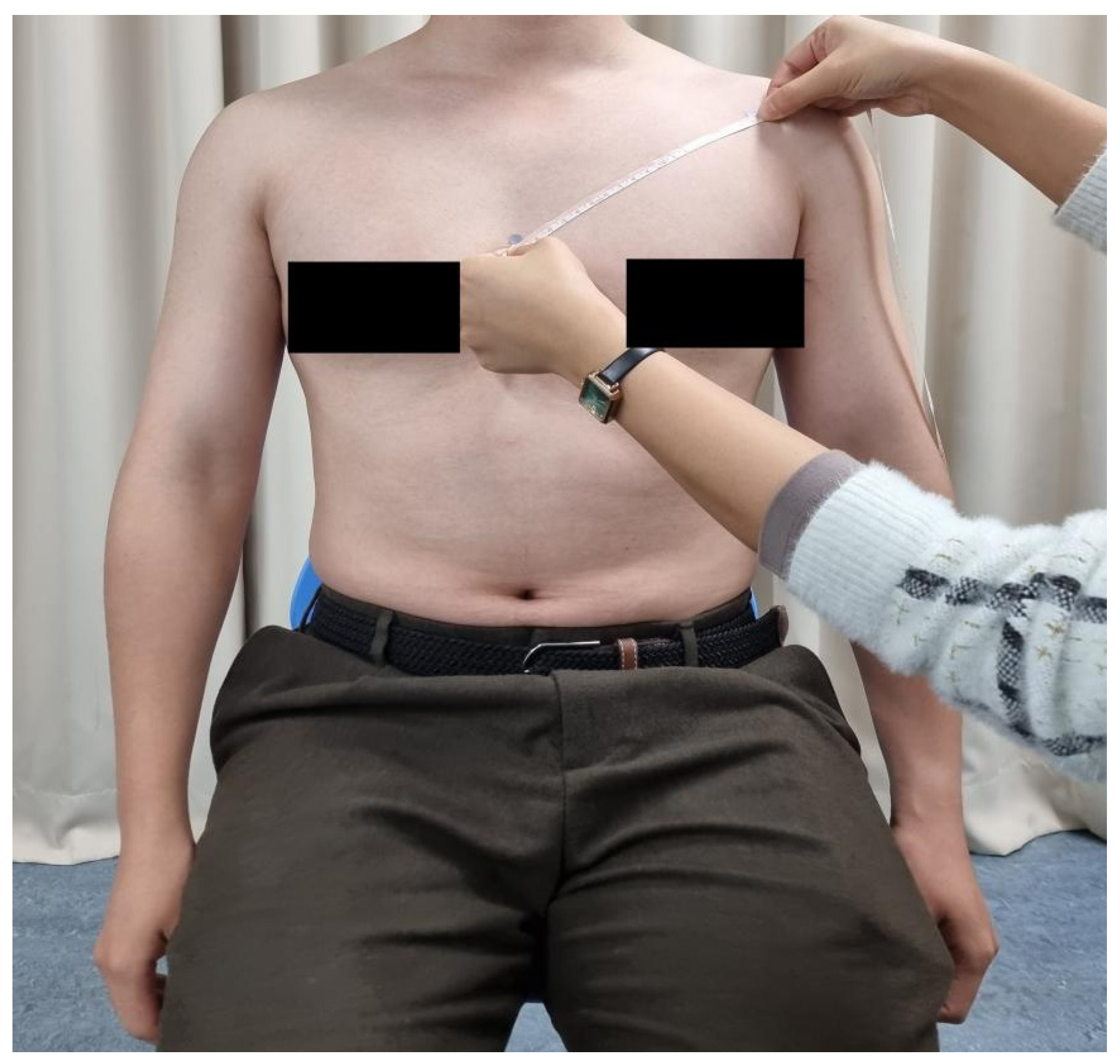
The subject maintained an upright posture, with the forearm positioned neutrally and the hand in a relaxed state. The tested arm was positioned at the side of the body. The resting muscle length was assessed by placing a centimeter tape between the medial–inferior aspect of the coracoid process and a lateral point adjacent to the sternocostal junction of the fourth rib’s inferior border. The pectoralis minor length measurement method used in this study has shown acceptable reliability in previous research [27,28] (Figure 3).

2.3.3. Shoulder Sagittal Angle (SSA)

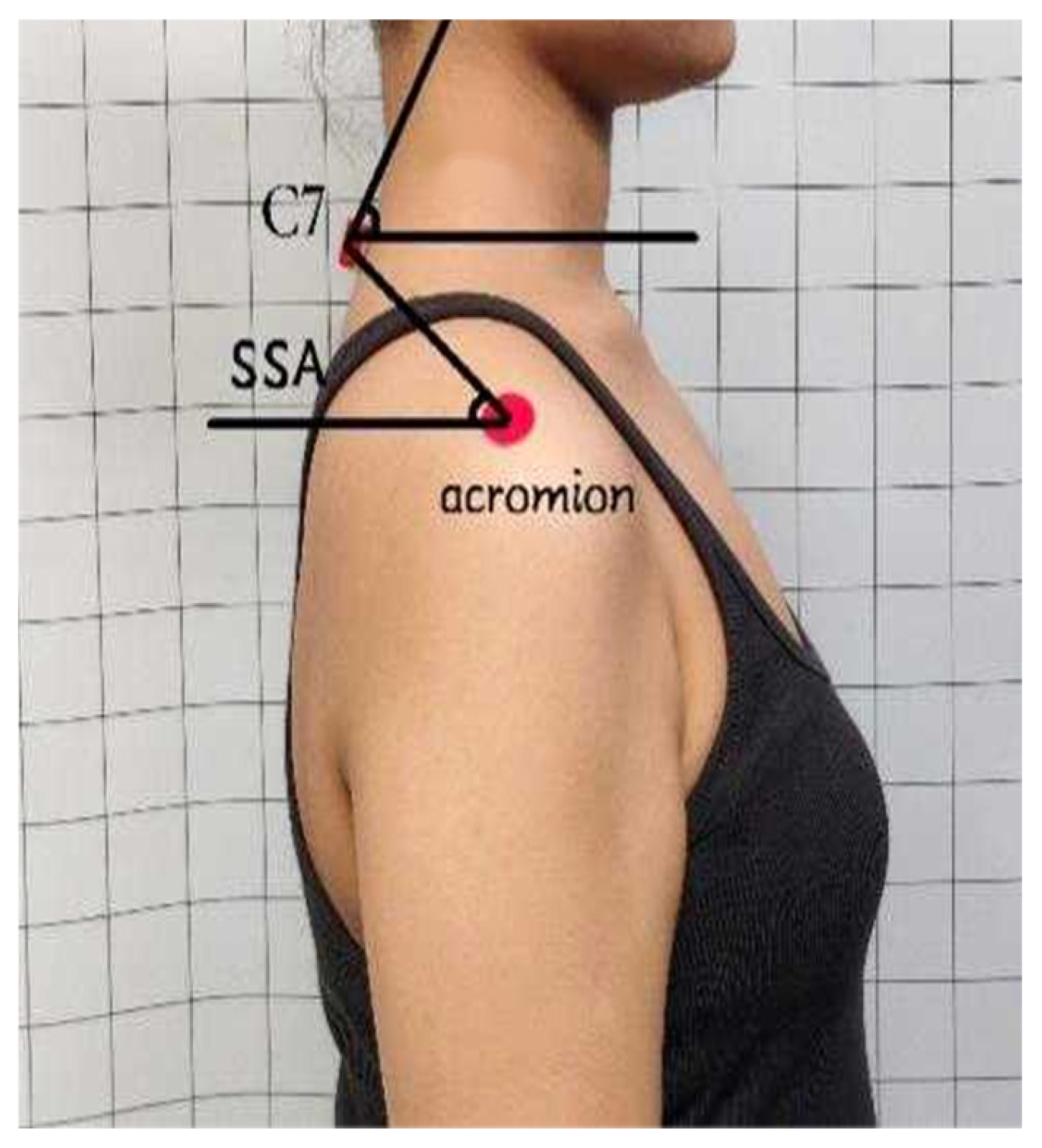
The SSA was quantified as the angle formed between two lines: (1) a line connecting the C7 spinous process to the midpoint of the lateral shoulder, defined anatomically as the halfway point between the greater tubercle of the humerus and the posterior edge of the acromion, and (2) a horizontal reference line passing through that same lateral shoulder midpoint. The photographic assessment method used to determine shoulder sagittal angle has been previously applied in posture-related research and provides a standardized approach for evaluating sagittal shoulder angle [29,30].
To facilitate reliable and standardized SSA measurement, anatomical landmarks, specifically the C7 spinous process and the lateral border of the acromion, were clearly marked on each participant’s skin. Participants stood upright in a relaxed, natural posture, with their feet shoulder-width apart, arms resting passively at their sides, and weight symmetrically distributed over both lower limbs (see Figure 4). A Huawei HONOR 20 smartphone camera (Shenzhen, China) was mounted on a tripod positioned 50 cm laterally from the participant’s right foot; the tripod height was adjusted so that the center of the camera lens was horizontally aligned with the midpoint of the participant’s tragus, which served only as a standardized reference for camera positioning [29].
After the photographs were obtained under these standardized conditions, the images were uploaded to the Angle Meter application for angle analysis. SSA was measured using the predefined anatomical landmarks described above. To reduce measurement error, three repeated measurements were obtained for each participant, and the mean value was used for the final analysis.

2.4. Intervention

All exercise sessions were performed under the supervision of experienced physical therapists. The intervention protocol was standardized across the 4-week study period, and no planned progression of exercise intensity or difficulty was implemented. All participants performed the same training program as specified in Table 1, Table 2 and Table 3. Attendance was monitored throughout the intervention period, and all participants completed the full intervention schedule.
Due to the nature of the exercise intervention, neither the participants nor the treating physical therapists were blinded to group allocation. However, the outcome assessor remained blinded throughout the measurement process.

2.4.1. Scapular Sstabilization Exercises

Participants performed a 45 s static stretching routine, followed by three sets of eight targeted strengthening and neuromuscular control exercises (detailed in Table 1). Exercise selection and movement execution were based on evidence-based protocols described in prior work by Kwon et al., Arshadi et al., and Aneis et al. [9,29,31].

2.4.2. Breathing Exercises

The therapist guided participants through three sets of 10 controlled diaphragmatic breathing repetitions per session. Each set was performed with emphasis on slow, deep inhalation engaging the diaphragm, followed by relaxed, complete exhalation ensuring consistent rhythm and proper neuromuscular coordination throughout [32,33] (Table 2).

2.4.3. Thoracic Stabilization Exercises

A 45 s static stretching protocol was implemented, followed by three sets of eight task-specific exercises designed to enhance muscular strength, neuromuscular control, and functional scapulothoracic movement patterns. Three sets of eight movement exercises were performed, each held for 15 s (Table 3). The correction of the movement by Kwon et al. and Kang [9,34] was utilized.

2.5. Data Analysis

SPSS Statistics (version 27.0; IBM Corp., Armonk, NY, USA) was used for all analyses. Baseline comparability between groups was assessed using independent samples t-tests. The Shapiro–Wilk test was applied to verify the assumption of normality for all continuous outcome variables. To evaluate both time–group interactions and within-group changes across measurement points, a two-way repeated-measures ANOVA was employed, with “group” (intervention versus control) as the between-subjects factor and “time” (pre-intervention, post-intervention) as the within-subjects factor. Statistical significance was set at p < 0.05 for the primary analyses. For Bonferroni-adjusted post hoc comparisons of within-group pre- to post-intervention differences, the significance threshold was set at p < 0.025. Because all randomized participants completed the intervention and post-intervention assessment, the final analysis included the full randomized sample. To ensure analytical objectivity, all statistical procedures were performed by a researcher blinded to participant group allocation and uninvolved in any aspect of intervention delivery or data collection. Effect size estimates were additionally calculated to facilitate interpretation of the magnitude of baseline between-group differences and intervention effects.
To further assess baseline comparability between groups, Cohen’s d was calculated for continuous baseline variables in addition to conventional significance testing. The magnitude of effect sizes was interpreted according to conventional criteria, whereby values of 0.2, 0.5, and 0.8 were considered small, medium, and large, respectively. Baseline effect sizes close to zero were interpreted as indicating minimal between-group differences prior to the intervention.

3. Results

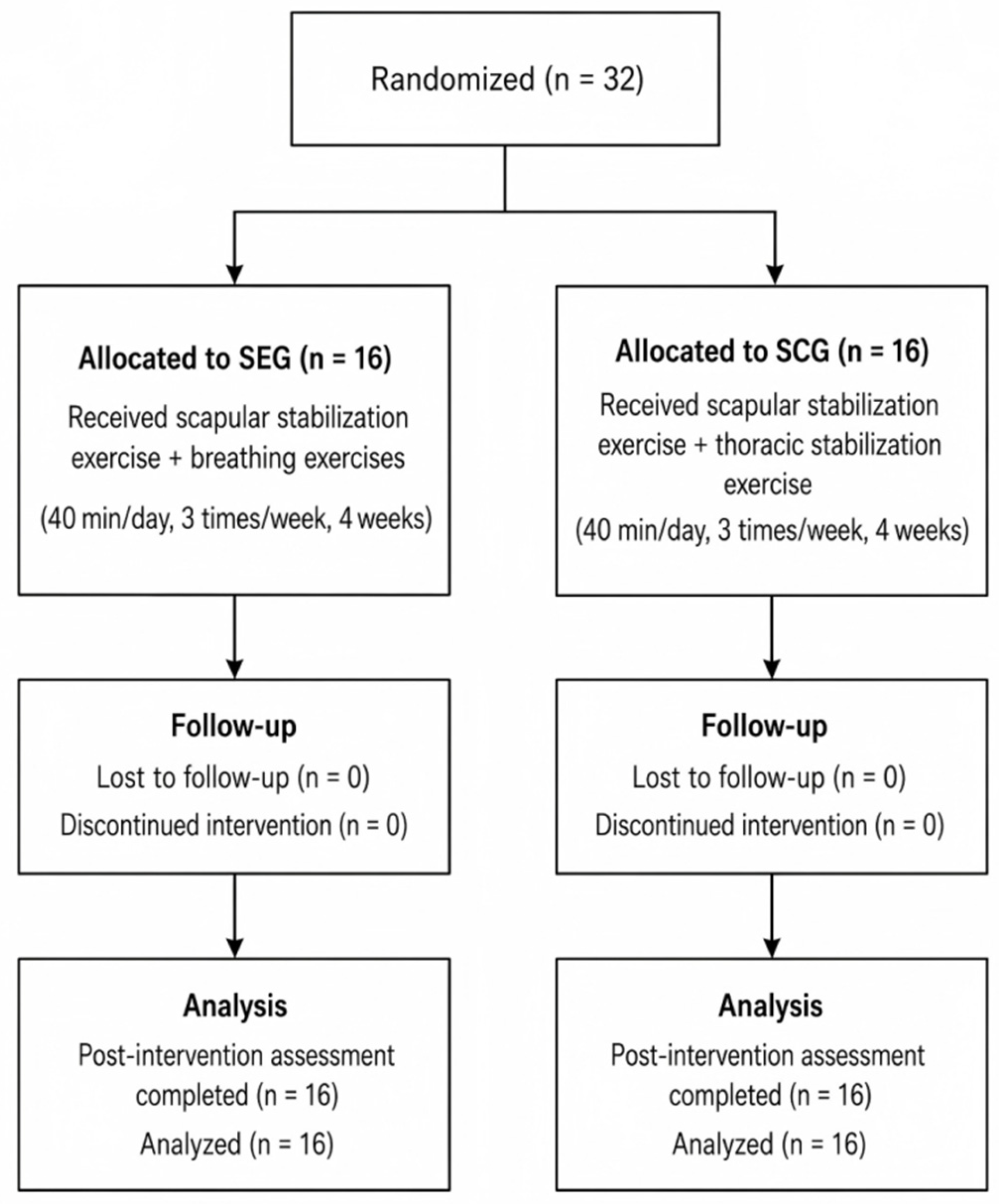
A CONSORT flow diagram illustrating participant randomization, allocation, follow-up, and analysis is presented in Figure 5. All randomized participants completed the full 4-week intervention program and post-intervention assessment, with no dropouts during the study period. The mean age; body mass index; and baseline muscle strength, pectoralis minor muscle length, and shoulder sagittal angle scores were similar for each group (Table 4). The baseline effect sizes were generally small, indicating that the two groups were comparable before the intervention.
No significant group × time interaction effects were observed for upper trapezius, middle trapezius, lower trapezius, or serratus anterior strength (all p > 0.025), indicating that the magnitude of change over time did not differ significantly between the SEG and SCG groups. A significant main effect of time was observed for the middle trapezius, lower trapezius, and serratus anterior (all p < 0.001), suggesting that muscle strength increased over time in both groups, regardless of intervention type. In contrast, upper trapezius strength did not show a significant time effect (p = 0.052). No significant main effect of group was found for any muscle strength variable (all p > 0.025) (Table 5).
No significant group × time interaction effects were observed for pectoralis minor length or shoulder sagittal angle (both p > 0.025), indicating that the magnitude of change over time did not differ significantly between the SEG and SCG groups. However, significant main effects of time were found for both pectoralis minor length and shoulder sagittal angle (both p < 0.001), suggesting improvements over time in both groups regardless of intervention type. No significant main effect of group was observed for either outcome (both p > 0.025) (Table 6).

4. Discussion

Muscle strength in the middle trapezius, lower trapezius, and serratus anterior increased after exercise intervention compared with baseline. Scapular stability and adequate scapular muscle strength are important for normal shoulder function and maintenance of proper scapular alignment [35]. According to Sahrmann et al., the scapular stabilizing muscles play a crucial role in scapular control. For individuals with scapular internal rotation, strengthening of the middle trapezius, lower trapezius, and serratus anterior has been recommended [9,36]. In addition, previous studies have suggested that intensive training may be effective for improving muscle strength [12,37]. It has also been reported that, when the upper trapezius becomes overactive and the middle and lower trapezius weaken, muscular imbalance around the scapulothoracic region may develop. Therefore, strengthening of the middle and lower trapezius has been recommended to reduce this imbalance [38,39].
In the present study, both groups performed similar compound scapular exercises, including L-exercises, Y-exercises, and push-ups, which may explain the observed increases in middle trapezius, lower trapezius, and serratus anterior strength over time. However, no significant group × time interaction effects were observed, indicating that the magnitude of improvement did not differ significantly between the two intervention groups. Upper trapezius strength did not change significantly following the intervention, which may be attributable to the deliberate omission of targeted strengthening for this muscle, as well as the consistent verbal and tactile cueing used to minimize compensatory upper trapezius overactivation during scapular and breathing-related tasks. Taken together, these findings suggest that the shared scapular stabilization components of both exercise programs were associated with improvements in the muscles most directly involved in scapular control, particularly the middle trapezius, lower trapezius, and serratus anterior.
Pectoralis minor length increased significantly over time in both groups. Anatomically, the pectoralis minor originates from the third, fourth, and fifth ribs and inserts onto the coracoid process of the scapula; shortening of this muscle has been associated with increased anterior tilting of the scapula [27]. In individuals with scapular internal rotation, the pectoralis minor and teres major are often shortened and tightened, and scapular internal rotation is commonly accompanied by anterior scapular tilt [9]. As scapular internal rotation and anterior tilt increase, pectoralis minor length may decrease; therefore, pectoralis minor length is closely related to scapular alignment, particularly anterior tilting. Previous studies, including that of Lee et al., have shown that stretching exercises can effectively increase the lengths of muscles associated with scapular internal rotation and improve range of motion [9,27]. In the present study, both groups performed scapular stabilization exercises that included stretching of the pectoralis minor and teres major. The shared intervention components may explain the observed improvement in pectoralis minor length over time in both groups. However, no significant group × time interaction effect was observed, suggesting that the magnitude of change did not differ significantly between the two intervention approaches.
The pectoralis minor originates from the third, fourth, and fifth ribs, and shortening of this muscle may influence rib cage mechanics and breathing-related movement. Previous studies have reported that chest expansion resistance training can improve rib positioning, which may, in turn, affect pectoralis minor length [40]. In the present study, the SEG performed costal expansion exercises, which may have contributed to the observed improvement in pectoralis minor length. In addition, previous studies have demonstrated that scapulothoracic extension exercises can increase pectoralis minor length [41,42]. In the present study, the SCG performed thoracic extension exercises, which may, likewise, have contributed to the improvement in pectoralis minor length. According to the findings of this study, no significant difference in pectoralis minor length was observed between the two groups, suggesting that the magnitude of improvement was comparable between the interventions, and that the shared stretching components of the exercise programs may have had a greater influence on pectoralis minor length in individuals with scapular internal rotation.
Muscle lengthening is commonly achieved through structured stretching interventions, especially in muscles prone to adaptive shortening as a result of postural stress or repetitive use. In clinical practice, targeted stretching of the levator scapulae and upper trapezius is often included in rehabilitation programs because these muscles are frequently associated with impaired cervical scapular alignment and postural discomfort. In the present study, both groups performed scapular stabilization exercises that included stretching of the levator scapulae and upper trapezius, along with posture correction exercises such as wall sliding. The shared intervention components may explain the improvements observed in pectoralis minor length and shoulder sagittal angle in both groups, an interpretation supported by previous studies suggesting that scapular stabilization exercises can improve postural alignment and increase shoulder sagittal angle [7,22,27,29].
The observed between-group effect sizes at post-intervention were generally trivial to small in magnitude, ranging from 0.027 to 0.406 across the primary outcomes. These values were substantially smaller than the effect size assumed in the a priori sample size calculation (Cohen’s d = 1.050). Therefore, although the planned sample size was achieved, the possibility of a Type II error cannot be excluded, particularly for outcomes showing very small between-group differences.
This study has several limitations. First, the intervention period was limited to 4 weeks, which may not have been sufficient to detect potential differences between the two exercise approaches over a longer treatment duration. Second, no follow-up assessment was conducted; therefore, the sustainability of the observed changes could not be determined. Third, although breathing-integrated exercises were included in the experimental intervention, respiratory function was not assessed in this study. Fourth, formal intra-rater reliability coefficients (e.g., ICCs) were not established within the present study or through a separate calibration session. Therefore, although the selected measurement methods have demonstrated acceptable reliability in previous studies and standardized procedures were applied to minimize measurement error, measurement consistency within the present study could not be fully quantified. Future research should include respiratory outcomes and formal reliability testing to better clarify the broader clinical effects and methodological robustness of breathing-integrated scapular stabilization programs.

5. Conclusions

Both breathing-integrated scapular stabilization and thoracic–scapular stabilization exercises were associated with improvements over time in muscle strength, pectoralis minor length, and shoulder sagittal angle in individuals with shoulder dysfunction characterized by scapular internal rotation. However, no significant group × time interaction effects were observed, and no clear superiority of one intervention over the other was demonstrated during the 4-week study period.

Author Contributions

X.Y. conducted study design, investigation, and data curation, and wrote the manuscript draft. Q.-S.T. analyzed the data. T.-H.K. supervised the study, acquired funding, performed project administration, and revised the manuscript. All authors have read and agreed to the published version of the manuscript.

Funding

This research was supported by the Daegu University Future Scholars Research Grant, 2025.

Institutional Review Board Statement

The research protocol received formal ethical clearance from Daegu University’s Institutional Review Board in the Republic of Korea (IRB No.: 1040621-202401-HR-008); it was also registered with the Clinical Research Information Service (CRIS), Korea’s national clinical trial registry (Registration No.: KCT0010657, dated 20 June 2025).

Informed Consent Statement

Informed consent was obtained from all subjects involved in the study.

Data Availability Statement

All data related to this study are included in the article.

Acknowledgments

We thank our colleagues for their helpful comments on earlier drafts of this manuscript.

Conflicts of Interest

The authors declare no conflicts of interest.

References

  1. Lee, H.J.; Kim, J.H. Classification of shoulder diseases in older adult patients: A narrative review. Ewha Med. J. 2025, 48, e5. [Google Scholar] [CrossRef]
  2. Lin, J.J.; Hanten, W.P.; Olson, S.L.; Roddey, T.S.; Soto-Quijano, D.A.; Lim, H.K.; Sherwood, A.M. Functional activity characteristics of individuals with shoulder dysfunctions. J. Electromyogr. Kinesiol. 2005, 15, 576–586. [Google Scholar] [CrossRef]
  3. Khawar, A.; Khawar, S.; Tauqeer, S.; Amjad, F.; Rubab, H.I.; Wafa, H.S. Association of upper cross syndrome with prolonged sitting among young adults. Pak. Biomed. J. 2022, 5, 370–374. [Google Scholar] [CrossRef]
  4. Gu, Q.; Pan, L.; Yu, L.; Jiang, Q. Effect of scapular posterior tilting exercise on scapular muscle activities in men and women with a rounded shoulder posture. J. Orthop. Surg. Res. 2024, 19, 383. [Google Scholar] [CrossRef] [PubMed]
  5. Feng, D.; Zhang, Y. College Students’ Knowledge, attitudes, and practices regarding body posture: A cross-sectional survey—Taking a university in Wuhu City as an example. Prev. Med. Rep. 2023, 36, 102422. [Google Scholar] [CrossRef]
  6. Chaudhuri, S.; Chawla, J.K.; Phadke, V. Physiotherapeutic interventions for upper cross syndrome: A systematic review and meta-analysis. Cureus 2023, 15, e45471. [Google Scholar] [CrossRef] [PubMed]
  7. Hasan, S.; Iqbal, A.; Alghadir, A.H.; Alonazi, A.; Alyahya, D. The combined effect of the trapezius muscle strengthening and pectoralis minor muscle stretching on correcting the rounded shoulder posture and shoulder flexion range of motion among young Saudi females: A randomized comparative study. Healthcare 2023, 11, 500. [Google Scholar] [CrossRef] [PubMed]
  8. Spanhove, V.; Van Daele, M.; Van den Abeele, A.; Rombaut, L.; Castelein, B.; Calders, P.; Malfait, F.; Cools, A.; De Wandele, I. Muscle activity and scapular kinematics in individuals with multidirectional shoulder instability: A systematic review. Ann. Phys. Rehabil. Med. 2021, 64, 101457. [Google Scholar] [CrossRef]
  9. Kwon, O.Y.; Kang, M.H.; Kim, M.H.; Kim, S.J.; Kim, T.H.; Park, K.N.; Oh, J.S.; Lee, W.H.; Im, I.Y.; Jang, J.H. KEMA Approach for Analysis and Management of Motor Impairment 1; Hakjisa Medical: Seoul, Republic of Korea, 2022. [Google Scholar]
  10. Sahrmann, S. Diagnosis and Treatment of Movement Impairment Syndromes; Mosby: St. Louis, MO, USA, 2002. [Google Scholar]
  11. Bauer, S.; Blakeney, W.G.; Wang, A.W.; Ernstbrunner, L.; Corbaz, J.; Werthel, J.D. Challenges for optimization of reverse shoulder arthroplasty Part II: Subacromial space, scapular posture, moment arms and muscle tensioning. J. Clin. Med. 2023, 12, 1616. [Google Scholar] [CrossRef]
  12. Nitayarak, H.; Charntaraviroj, P. Effects of scapular stabilization exercises on posture and muscle imbalances in women with upper crossed syndrome: A randomized controlled trial. J. Back Musculoskelet. Rehabil. 2021, 34, 1031–1040. [Google Scholar] [CrossRef]
  13. Kibler, W.B.; Sciascia, A. Current concepts: Scapular dyskinesis. Br. J. Sports Med. 2010, 44, 300–305. [Google Scholar] [CrossRef]
  14. Giuseppe, L.U.; Laura, R.A.; Berton, A.; Candela, V.; Massaroni, C.; Carnevale, A.; Stelitano, G.; Schena, E.; Nazarian, A.; DeAngelis, J.; et al. Scapular dyskinesis: From basic science to ultimate treatment. Int. J. Environ. Res. Public Health 2020, 17, 2974. [Google Scholar] [CrossRef]
  15. Lucado, A.M. Scapular muscle imbalance: Implications for shoulder pain and pathology. Phys. Ther. Rev. 2011, 16, 356–364. [Google Scholar] [CrossRef]
  16. Romero-Morales, C.; López-López, D.; Almazán-Polo, J.; Mogedano-Cruz, S.; Sosa-Reina, M.D.; García-Pérez-de-Sevilla, G.; Martín-Pérez, S.; González-de-la-Flor, Á. Prevalence, diagnosis and management of musculoskeletal disorders in elite athletes: A mini-review. Dis. Mon. 2024, 70, 101629. [Google Scholar] [CrossRef] [PubMed]
  17. Nodehi Moghadam, A.; Rahnama, L.; Noorizadeh Dehkordi, S.; Abdollahi, S. Exercise therapy may affect scapular position and motion in individuals with scapular dyskinesis: A systematic review of clinical trials. J. Shoulder Elb. Surg. 2020, 29, e29–e36. [Google Scholar] [CrossRef] [PubMed]
  18. Wang, C.H.; McClure, P.; Pratt, N.E.; Nobilini, R. Stretching and strengthening exercises: Their effect on three-dimensional scapular kinematics. Arch. Phys. Med. Rehabil. 1999, 80, 923–929. [Google Scholar] [CrossRef]
  19. Yuksel, E.; Yesilyaprak, S.S. Scapular stabilization exercise training improves treatment effectiveness on shoulder pain, scapular dyskinesis, muscle strength, and function in patients with subacromial pain syndrome: A randomized controlled trial. J. Bodyw. Mov. Ther. 2024, 37, 101–108. [Google Scholar] [CrossRef]
  20. Moezy, A.; Sepehrifar, S.; Dodaran, M.S. The effects of scapular stabilization-based exercise therapy on pain, posture, flexibility and shoulder mobility in patients with shoulder impingement syndrome: A controlled randomized clinical trial. Med. J. Islam. Repub. Iran 2014, 28, 87. [Google Scholar]
  21. Pieters, L.; Lewis, J.; Kuppens, K.; Jochems, J.; Bruijstens, T.; Joossens, L.; Struyf, F. An update of systematic reviews examining the effectiveness of conservative physical therapy interventions for subacromial shoulder pain. J. Orthop. Sports Phys. Ther. 2020, 50, 131–141. [Google Scholar] [CrossRef]
  22. Csepregi, É.; Gyurcsik, Z.; Veres-Balajti, I.; Nagy, A.C.; Szekanecz, Z.; Szántó, S. Effects of classical breathing exercises on posture, spinal and chest mobility among female university students compared to currently popular training programs. Int. J. Environ. Res. Public Health 2022, 19, 3728. [Google Scholar] [CrossRef]
  23. Kim, M.K.; Jeong, B.C.; Yoo, K.T. The effect of shoulder stabilization exercise and core stabilization exercise on the shoulder height and respiratory function in young adults with round shoulder posture. Korean Soc. Phys. Med. 2023, 18, 1–17. [Google Scholar] [CrossRef]
  24. Park, K.N.; Jung, D.Y.; Kim, S.H. Trapezius and serratus anterior muscle strength in violinists with unilateral neck pain. J. Back Musculoskelet. Rehabil. 2020, 33, 631–636. [Google Scholar] [CrossRef]
  25. Ekstrom, R.A.; Soderberg, G.L.; Donatelli, R.A. Normalization procedures using maximum voluntary isometric contractions for the serratus anterior and trapezius muscles during surface EMG analysis. J. Electromyogr. Kinesiol. 2005, 15, 418–428. [Google Scholar] [CrossRef] [PubMed]
  26. Chamorro, C.; Arancibia, M.; Trigo, B.; Arias-Poblete, L.; Jerez-Mayorga, D. Absolute reliability and concurrent validity of hand-held dynamometry in shoulder rotator strength assessment: Systematic review and meta-analysis. Int. J. Environ. Res. Public Health 2021, 18, 9293. [Google Scholar] [CrossRef]
  27. Lee, J.H.; Cynn, H.S.; Yoon, T.L.; Choi, S.A.; Choi, W.J.; Choi, B.S.; Ko, C.H. Comparison of scapular posterior tilting exercise alone and scapular posterior tilting exercise after pectoralis minor stretching on scapular alignment and scapular upward rotators activity in subjects with short pectoralis minor. Phys. Ther. Sport 2015, 16, 255–261. [Google Scholar] [CrossRef] [PubMed]
  28. Komati, M.A.; Korkie, F.E.; Becker, P. Pectoralis minor length measurements in three different scapula positions. S. Afr. J. Physiother. 2020, 76, 1487. [Google Scholar] [CrossRef]
  29. Aneis, Y.M.; El-Badrawy, N.M.; El-Ganainy, A.A.; Atta, H.K. The effectiveness of a multimodal approach in the treatment of patients with upper crossed syndrome: A randomized controlled trial. J. Bodyw. Mov. Ther. 2022, 32, 130–136. [Google Scholar] [CrossRef] [PubMed]
  30. Singla, D.; Veqar, Z.; Hussain, M.E. Photogrammetric assessment of upper body posture using postural angles: A literature review. J. Chiropr. Med. 2017, 16, 131–138. [Google Scholar] [CrossRef]
  31. Arshadi, R.; Ghasemi, G.A.; Samadi, H. Effects of an 8-week selective corrective exercises program on electromyography activity of scapular and neck muscles in persons with upper crossed syndrome: Randomized controlled trial. Phys. Ther. Sport 2019, 37, 113–119. [Google Scholar] [CrossRef]
  32. Shetty, N.; Samuel, S.R.; Alaparthi, G.K.; Amaravadi, S.K.; Joshua, A.M.; Pai, S. Comparison of diaphragmatic breathing exercises, volume, and flow-oriented incentive spirometry on respiratory function in stroke subjects: A non-randomized study. Ann. Neurosci. 2020, 27, 232–241. [Google Scholar] [CrossRef]
  33. Tomas-Carus, P.; Branco, J.C.; Raimundo, A.; Parraca, J.A.; Batalha, N.; Biehl-Printes, C. Breathing exercises must be a real and effective intervention to consider in women with fibromyalgia: A pilot randomized controlled trial. J. Altern. Complement. Med. 2018, 24, 825–832. [Google Scholar] [CrossRef]
  34. Kang, N.Y.; Im, S.C.; Kim, K. Effects of a combination of scapular stabilization and thoracic extension exercises for office workers with forward head posture on the craniovertebral angle, respiration, pain, and disability: A randomized controlled trial. Turk. J. Phys. Med. Rehabil. 2021, 67, 291. [Google Scholar] [CrossRef]
  35. Saju, N. Strength profile of scapular muscles in collegiate students. RGUHS J. Physiother. 2023, 3, 12–16. [Google Scholar] [CrossRef]
  36. Sahrmann, S.; Azevedo, D.C.; Van Dillen, L. Diagnosis and treatment of movement system impairment syndromes. Braz. J. Phys. Ther. 2017, 21, 391–399. [Google Scholar] [CrossRef]
  37. Cho, I.K.; Park, H.K.; Lee, W.H. The effectiveness of selective lower trapezius strengthening exercises on pain, muscle function, and scapular position in patients with rounded shoulder and chronic neck pain. Phys. Ther. Rehabil. Sci. 2021, 10, 503–511. [Google Scholar] [CrossRef]
  38. Kim, T.G.; Kim, J.S.; Zhang, H.; Kim, S.Y. Reliability of scapular position and periscapular muscle strength tests in healthy subjects with forward neck and rounded shoulder posture. Isokinet. Exerc. Sci. 2024, 32, 265–272. [Google Scholar] [CrossRef]
  39. Sharma, S.; Ghrouz, A.K.; Hussain, M.E.; Sharma, S.; Aldabbas, M.; Ansari, S. Progressive resistance exercises plus manual therapy is effective in improving isometric strength in overhead athletes with shoulder impingement syndrome: A randomized controlled trial. BioMed Res. Int. 2021, 2021, 9945775. [Google Scholar] [CrossRef] [PubMed]
  40. Lee, J.H.; Cynn, H.S.; Yoon, T.L.; Ko, C.H.; Choi, W.J.; Choi, S.A.; Choi, B.S. The effect of scapular posterior tilt exercise, pectoralis minor stretching, and shoulder brace on scapular alignment and muscles activity in subjects with round-shoulder posture. J. Electromyogr. Kinesiol. 2015, 25, 107–114. [Google Scholar] [CrossRef]
  41. Gross, E.A. The Effect of Muscle Energy Technique on Forward Shoulder Posture, Pectoralis Minor Length, and Upper Extremity Blood Flow in Collegiate Female Swimmers. Masters’s Thesis, Illinois State University, Normal, IL, USA, 2015. [Google Scholar]
  42. Thongchote, K.; Threetepchanchai, K.; Chuwijit, A.; Lapmanee, S. Pilot study on the improvement effects of scapulothoracic exercises on the respiratory functions in sedentary young female adult with forward shoulder posture: A randomized control trial. Adv. Rehabil. 2023, 37, 23–32. [Google Scholar] [CrossRef]
Figure 1. Diagram of the experimental design.
Applsci 16 04553 g001
Figure 2. Measurement of muscle strength.
Applsci 16 04553 g002
Figure 3. Measurement of pectoralis minor length.
Applsci 16 04553 g003
Figure 4. Measurement of shoulder sagittal angle.
Applsci 16 04553 g004
Figure 5. CONSORT flow diagram of participant randomization, allocation, follow-up, and analysis.
Applsci 16 04553 g005
Table 1. Scapular stabilization exercises.
Levator scapular stretchingIn the seated position, the shoulder on the side to be stretched was secured with a bandage and the arm gently lifted. The subject bent the head 45 degrees diagonally down to the opposite side, allowing the chin to touch the opposite clavicle, and placing the hand on the top of the head for stretching.
Upper trapezius stretchingIn the seated position, the hand on the side to be stretched was seated under the buttocks, and the head was tilted 45 degrees to the same side, the hand placed on the top of the head to provide resistance.
Pectoralis minor stretchingThe subject lay in a flat position, with the chest placed on the opposite hand, and the therapist stood at the head of the subject’s stretching side, with one hand placed beside the subject and the other hand grasping the subject’s wrist, raising the arm and turning it into external rotation, and then slowly stretching it downward.
Teres major stretchingThe subject lay flat, and the therapist stood on the stretching side, so that the shoulder joint on was completely in external rotation; the therapist took the subject’s elbow joint in hand, while their other hand fixed the shoulder blade before beginning to stretch.
Push-up exercisesWhile standing, the subject pushed elevation while abducting the arms at an angle, careful not to shrug the shoulders during the process (SA strengthening).
Bilateral external rotationWhile standing, the subject held an elastic band with both hands, stretching it with 90 degrees of elbow flexion, pressing the upper arms against both sides of the chest.
L-exercisesIn a prone position, the subject kept their arms in an L shape to strengthen the middle trapezius muscle.
Y-exercisesIn a prone position, the subject kept their arms in a Y shape to strengthen the lower trapezius muscle.
Wall-slide exercisesWhile standing, the subject bent the shoulder joint and elbow joint 90 degrees, so that the lower arm was close to a wall or smooth plane; without shrugging the shoulder, they slowly pushed up to strengthen the serratus anterior muscle.
Table 2. Breathing exercises.
Inspiratory spirometry exercisesThe participant was seated comfortably in an upright posture and instructed to inhale deeply and slowly over at least five seconds, followed by a relaxed, unforced exhalation, explicitly avoiding any active or forceful expiration. Next, the participant held the flow-based respiratory training device (Romson’s Respirometer Respiratory Exerciser) vertically and performed a controlled inhalation to elevate the internal indicator ball to a predetermined target level. Prior to practice, the physical therapist provided live, step-by-step demonstrations of all breathing techniques to ensure accurate comprehension and proper execution by each participant [29].
Costal expansion exerciseThe participant was seated upright and completed three sets of ten repetitions. Prior to initiating resistance training with the elastic band, the therapist manually applied graded resistance, using both hands to guide the participant through the correct breathing pattern: coordinated diaphragmatic engagement during inhalation, and controlled, active exhalation against resistance. The hands-on demonstration served to reinforce proper respiratory mechanics and progressive resistance application before transitioning to the elastic band.
Diaphragmatic breathing exercises(1) Seated posture
(2) Supine posture
(3) Prone posture
(4) In the supine position, a 4 kg weight was placed over the abdominal region, specifically centered on the diaphragmatic dome to provide gentle, targeted resistance during breathing exercises and enhance diaphragmatic engagement.
Table 3. Thoracic stabilization exercises.
Rectus abdominis stretchingIn the prone position, the subject supports upper body with the lower arm, careful not to overuse the waist to compensate.
Thoracic mobility exercisesA foam roller was used to increase the range of motion. The subject’s hands supported their head, with the roller placed on the lower back to roll the head, waist, and buttocks in a straight line. During the rolling process, attention was paid to tightening the core strength, so as not to collapse the buttocks or raise the head too much.
Thoracic extensor muscle strengtheningIn a seated position, the subject folded their arms over their chest, knees, and hips in a 90-degree flexion state. The initial condition was flexion of the thoracic vertebrae, followed by slow extension, which minimized compensatory movement of the waist.
Backward rocking exercisesIn a four-legged kneeling position, the subject kept their waist and head in a straight line and moved slowly backward.
Postural exercise 1In a four-legged kneeling position, the subject kept their waist and head in a straight line and moving slowly backward.
Postural exercise 2The object used a stick, holding it behind their back with both hands. Keeping the spine close to the stick, the subject sat down in a squat, used the buttocks to find the feeling of sitting on a bench during the squat, and paid attention to the knee not exceeding the tip of the foot.
Thoracic stabilization exerciseIn a four-legged kneeling position, the subject slowly raised one arm, with the back in a straight line, minimizing the movement of the spine and shoulder blades during the process.
Table 4. Baseline characteristics of participants for each group.
CharacteristicSEG (n = 16)SCG (n = 16)pCohen’s d
Age (year)23.56 ± 2.42 a24.5 ± 3.060.3440.341
Sex (female/male)9/79/71.000-
Height (cm)170.13 ± 8.35167.63 ± 7.310.3750.319
Weight (kg)65.44 ± 13.1462.00 ± 12.430.4530.269
BMI (kg/m2)22.46 ± 3.3121.96 ± 3.360.6710.150
UT (Newton)49.35 ± 11.4146.97 ± 9.970.5360.222
MT (Newton)25.50 ± 9.8925.30 ± 6.840.9480.024
LT (Newton)23.50 ± 8.2422.60 ± 8.650.7670.107
SA (Newton)37.77 ± 6.9037.89 ± 6.950.9590.017
PML (cm)17.84 ± 1.3517.45 ± 1.100.3730.317
SSA (°)46.05 ± 3.4845.59 ± 3.660.7180.129
PML: pectoralis minor length. SSA: shoulder sagittal angle. a Mean ± standard deviation. SEG: breathing-integrated scapular stabilization exercises. SCG: thoracic–scapular stabilization exercises. UT: upper trapezius. MT: middle trapezius. LT: lower trapezius. SA: serratus anterior. Cohen’s d: effect size.
Table 5. Changes in muscle strength outcomes in the two groups, with emphasis on group × time interaction effects. (unit: Newton).
SEG (n = 16)SCG (n = 16)Time×Group
F(p,ηp2)
Time
F(p,ηp2)
Group
F(p,ηp2)
Cohen’s d
UTpre49.35 ± 11.41 a46.97 ± 9.970.949
(0.338, 0.031)
4.113
(0.052, 0.121)
0.186
(0.670, 0.006)
post50.12 ± 12.0449.18 ± 10.770.082
MTpre25.50 ± 9.8925.30 ± 6.840.666
(0.421, 0.022)
43.404
(0.000 *, 0.591)
0.019
(0.892, 0.001)
post29.77 ± 9.8530.78 ± 7.510.115
LTpre23.50 ± 8.2422.60 ± 8.651.996
(0.168, 0.062)
46.883
(0.000 *, 0.610)
0.007
(0.932, 0.000)
post25.99 ± 8.0026.40 ± 7.900.052
SApre37.77 ± 6.9037.89 ± 6.950.263
(0.612, 0.009)
72.193
(0.000 *, 0.706)
0.033
(0.856, 0.001)
post42.40 ± 6.5543.12 ± 6.750.108
* p < 0.05. a Mean ± standard deviation. ηp2, partial eta squared. SEG: breathing-integrated scapular stabilization exercises. SCG: thoracic–scapular stabilization exercises. UT: upper trapezius. MT: middle trapezius. LT: lower trapezius. SA: serratus anterior.
Table 6. Changes in PML and SSA outcomes in the two groups, with emphasis on group × time interaction effects.
SEG (n = 16)SCG (n = 16)Time×Group
F(p,ηp2)
Time
F(p,ηp2)
Group
F(p,ηp2)
Cohen’s d
PML (cm)pre17.84 ± 1.3517.45 ± 1.100.062
(0.805, 0.002)
99.941
(0.000 *, 0.769)
1.131
(0.296, 0.036)
post19.13 ± 1.2118.67 ± 1.050.406
SSA (°)pre46.05 ± 3.4845.59 ± 3.660.124
(0.727, 0.004)
174.087
(0.000 *, 0.853)
0.087
(0.770, 0.003)
post53.25 ± 2.3253.19 ± 2.170.027
* p < 0.05. ηp2, partial eta squared. SEG: breathing-integrated scapular stabilization exercises. SCG: thoracic–scapular stabilization exercises. PML: pectoralis minor length. SSA: shoulder sagittal angle.
Disclaimer/Publisher’s Note: The statements, opinions and data contained in all publications are solely those of the individual author(s) and contributor(s) and not of MDPI and/or the editor(s). MDPI and/or the editor(s) disclaim responsibility for any injury to people or property resulting from any ideas, methods, instructions or products referred to in the content.