Article

Decadal Hydrochemical Monitoring Reveals Characteristics, Genetic Mechanisms and Health Risks of High-Nitrate Groundwater

1
College of Water Sciences, Beijing Normal University, Beijing 100875, China
2
Beijing Institute of Geo-Environmental Monitoring, Beijing 100195, China
3
Beijing Municipal Institute and Mineral Exploration, Beijing 100195, China
*
Author to whom correspondence should be addressed.
Appl. Sci. 2026, 16(9), 4524; https://doi.org/10.3390/app16094524
Submission received: 19 February 2026 / Revised: 28 April 2026 / Accepted: 29 April 2026 / Published: 4 May 2026
(This article belongs to the Special Issue Hydrogeology and Regional Groundwater Flow)

Abstract

Groundwater nitrate contamination, coupled with long-term overexploitation and intensive anthropogenic perturbations, has become a critical environmental challenge in the northwestern North China Plain, underscoring the urgent need to elucidate groundwater hydrochemical characteristics and their genetic mechanisms. Taking the upper section of the Yongding River alluvial–proluvial fan as the study area, this research aims to quantitatively decipher the hydrochemical characteristic and genetic mechanism of high-nitrate groundwater, identify the sources of nitrate contamination, and assess the associated human health risks. By leveraging over a decade of continuous hydrochemical monitoring data, an integrated analytical approach is adopted, including hydrochemical ionic ratio analysis, Positive Matrix Factorization, and Human Health Risk Assessment. The results indicate that the groundwater is characterized by HCO3-Ca. The pH values range from 7.2 to 8.2 while the total dissolved solids concentrations vary between 695 mg/L and 949 mg/L. Ionic ratio analysis demonstrates that water–rock interaction is the dominant controlling process, involving silicate hydrolysis, dissolution of carbonates, gypsum dissolution, and cation exchange. The Positive Matrix Factorization model quantitatively identifies four key factors controlling the hydrochemical characteristics of groundwater. Factor 1 is dominated by NO3 (76.67%) and associated with exogenous nitrate inputs from nitrogen fertilizer application. Factor 2 is dominated by Na+ (72.26%) and Mg2+ (81.67%), deriving from silicate weathering and dolomite dissolution. Factor 3 is governed by pH (59.62%) and K+ (71.65%), with its driving mechanism being the weathering and dissolution of potassium-bearing silicate minerals. Factor 4 is dominated by SO42− (50.12%) and constitutes a mixed source associated with sulfur-containing fertilizer application and livestock breeding. Groundwater NO3 concentrations range from 4.2 mg/L to 23.3 mg/L, with 69% of dry-season and 77% of wet-season samples exceeding the 10 mg/L threshold, primarily originating from manure and domestic wastewater. HHRA results show that nitrate poses significant non-carcinogenic health risks, with the highest risk observed in children (100% of samples at high risk), followed by adult females (92% at high risk) and adult males (77~92% at high risk). This study provides quantitative insights into the genetic mechanisms of groundwater nitrate contamination and offers a scientific basis for groundwater quality management and health risk mitigation in the NCP and other similar agricultural regions worldwide.

1. Introduction

Groundwater constitutes a critical component of global water resources, underpinning socioeconomic development and ecological stability. In the North China Plain, a densely populated and economically vital region, this dependency is pronounced due to perennial surface water scarcity [1,2]. Prolonged over-extraction has triggered severe environmental problems, including sustained water-table declines, expanding cones of depression, and widespread land subsidence [3,4,5]. Recent large-scale water-transfer projects and regulatory interventions have begun reshaping the regional hydrological regime [6]. Against this evolving backdrop, a systematic analysis of groundwater hydrochemistry and its spatiotemporal evolution is essential. Such work not only elucidates key processes controlling water quality and flow but also provides a scientific foundation for the sustainable management of groundwater resources in the northwestern NCP.
The Yongding River is a vital surface water system in the NCP, playing a key role in regional hydrology and water security. Since the mid-20th century, ecological degradation in its basin has intensified, driven by upstream reservoir construction and extensive groundwater extraction [7,8]. In response, the Beijing Municipal Government launched an ecological water replenishment (EWR) project in 2019 to restore hydrological connectivity and aquifer levels. While EWR has effectively raised groundwater tables, nitrate contamination remains widespread in the plain area, with excessive nitrate-nitrogen affecting approximately 135.94 km2, posing risks to groundwater quality and ecological health [9,10,11,12]. Critically, the effects of ecological water replenishment on nitrate transport and transformation processes within the vadose zone and aquifer, mediated through enhanced surface water–groundwater exchange, remain poorly understood [13,14,15,16]. This knowledge gap underscores the need to systematically evaluate how managed water replenishment affects nitrate dynamics in groundwater.
Conventional hydrogeochemical investigations have largely depended on qualitative interpretations based on ion concentrations, ionic ratios, and graphical classification diagrams. Although these methods provide a useful preliminary assessment, they often fall short in quantitatively discriminating the contributions of multiple natural and anthropogenic sources or in disentangling overlapping hydrochemical processes [17,18,19]. Such limitations hinder a process-based understanding of complex groundwater systems. In contrast, the PMF model provides a quantitative approach that objectively extracts latent source factors including carbonate weathering and agricultural inputs from the covariance structure of hydrochemical datasets while quantifying their relative contributions to each sample [20,21,22,23]. Leveraging its source apportionment capacity, the model enables the establishment of a robust analytical framework to identify the dominant controls on groundwater constituents such as nitrate and to clarify the intrinsic genetic mechanisms governing groundwater hydrochemical characteristics.
Extensive research on groundwater in the North China Plain (NCP) has been conducted, and most studies have focused on qualitative analyses of hydrochemical characteristics and genetic mechanisms in piedmont alluvial–proluvial fans, while quantitative partitioning of the contribution ratios of key hydrochemical processes remains understudied. Additionally, previous investigations have predominantly relied on short-term datasets, which cannot capture the long-term evolutionary trajectories of groundwater systems. This study systematically analyzes groundwater in the northwestern NCP using 13 years of continuous hydrochemical monitoring data, integrated with ionic ratio analysis, Positive Matrix Factorization (PMF) and human health risk modeling. The study tests three core hypotheses derived from the regional hydrogeological context and literature limitations: (1) Long-term spatiotemporal variations in groundwater hydrochemical composition are jointly controlled by natural hydrogeological processes and anthropogenic disturbances, with distinct evolutionary patterns observed in shallow and deep aquifers over the monitoring period. (2) Water–rock interactions, agricultural activities and domestic wastewater discharge contribute unequally to groundwater hydrochemical evolution, and nitrate enrichment in shallow groundwater is primarily driven by non-point-source agricultural inputs rather than point-source pollution. (3) Non-carcinogenic health risks from groundwater nitrate exposure exhibit significant disparities across different age groups and exposure pathways, with children facing higher vulnerability than adult populations in the study area. The verification of these hypotheses will provide quantitative evidence for regional groundwater quality management and targeted health risk mitigation strategies.

2. Geological Setting

The study area is situated in the northern part of the NCP and features a typical warm-temperate continental monsoon climate. The multi-year average temperature is approximately 12 °C, while the multi-year average potential evaporation reaches around 1800 mm with evaporation from March to June representing over 50% of the annual total. The multi-year average precipitation is about 555 mm, and rainfall from June to September accounts for more than 85% of the annual precipitation.
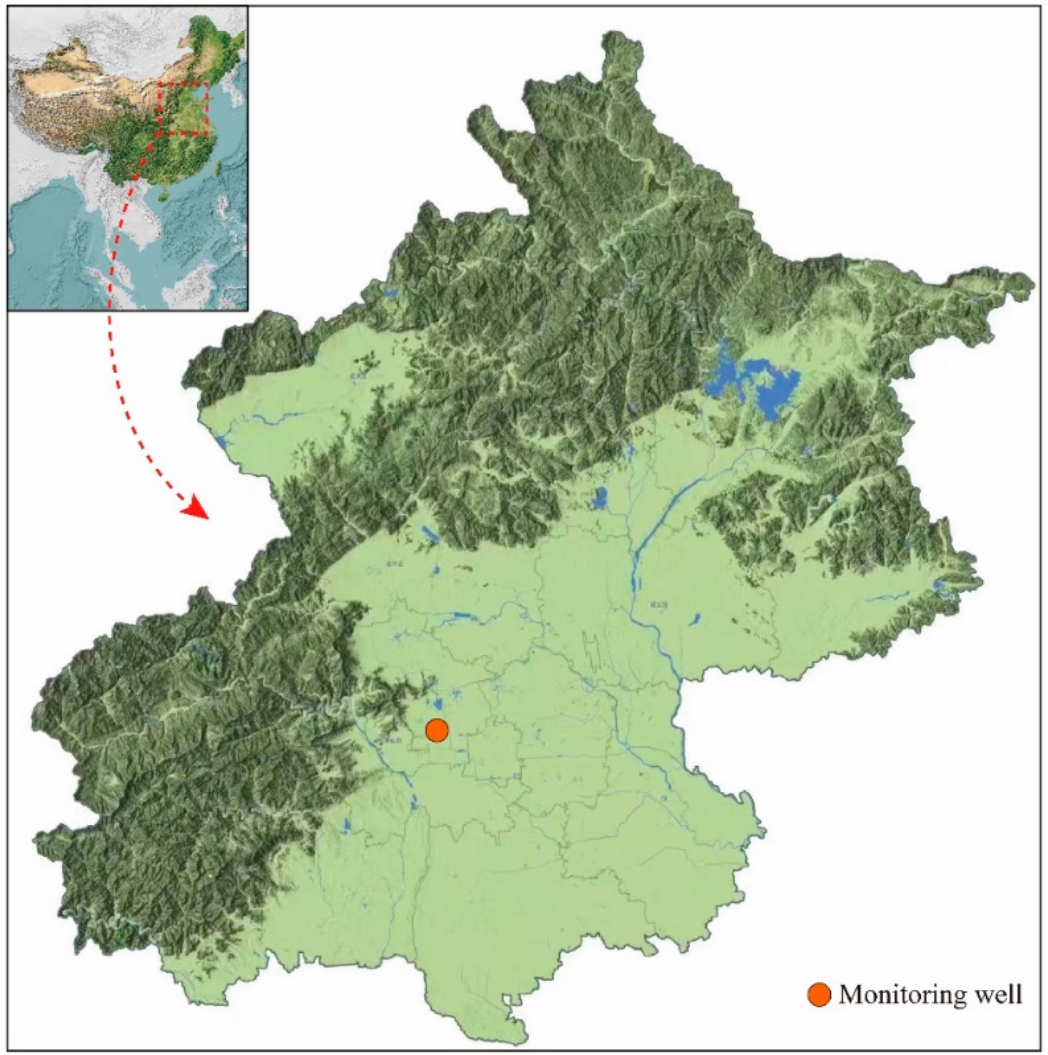
The study area is located in the upper portion of the Yongding River alluvial–proluvial fan (Figure 1). As a result of frequent channel migration, a multi-level alluvial–proluvial fan landform has developed, exhibiting a topographic gradient of high elevation in the northwest and low elevation in the southeast. Quaternary unconsolidated layers are extensively distributed in the mountain valleys and plain regions within the study area. At the front edge of the mountain foothills, the strata are characterized by eluvial and diluvial facies with lithologies comprising brown and yellowish-brown loess-like silty clay and silty soil containing calcareous concretions and locally interbedded with gravel [24]. In the plain area, the strata are dominated by alluvial–proluvial facies with lithologies primarily including yellow light yellow and light gray gravel pebbles and sandy gravel. Under the influence of the paleogeographic sedimentary environment, the thickness of the Quaternary unconsolidated layers gradually increases from the mountain front to the plain area, ranging from 15~20 m to 100 m.
The dominant aquifer in the study area is the Quaternary porous aquifer, where groundwater is of phreatic type. Such groundwater is predominantly distributed within sand and sandy gravel deposits formed by alluvial and proluvial depositional processes. Aquifer thickness in the plain region ranges from 30 m to 70 m. Groundwater recharge is dominated by atmospheric precipitation infiltration with supplementary contributions from mountain lateral runoff river valley underflow and farmland irrigation. Notably, atmospheric precipitation and river water exhibit favorable infiltration conditions. The general groundwater flow direction is from the northwestern piedmont area toward the southeastern plain area and runoff dynamics are governed by topography and aquifer lithology. The depth of the groundwater table ranges approximately from 10 m to 30 m.

3. Samples and Method

3.1. Samples

To investigate groundwater hydrochemical characteristics and elucidate the genetic mechanisms of high nitrate concentrations, a 13-year (2012–2024) monitoring program was implemented. Groundwater samples were collected annually from a consistent set of fixed monitoring wells, with biannual sampling campaigns conducted during the dry (April–May) and wet (August–September) seasons to capture seasonal variations. This long-term sampling yielded a total of 26 groundwater samples, with 13 samples collected during the dry season and another 13 samples collected during the wet season.
Prior to collection, each well was purged for at least 15 min until stable readings of pH and temperature were achieved. All water samples were filtered in situ through 0.45 μm cellulose acetate membrane filters, which had been pre-rinsed with deionized water followed by sample water to prevent contamination. Immediately after filtration, aliquots for cation analysis were acidified to pH < 2 using ultrapure nitric acid, while those for anion analysis remained unacidified. Filtered samples were stored in pre-cleaned high-density polyethylene bottles, sealed with Parafilm, and transported to the laboratory at 4 °C in insulated coolers, protected from direct sunlight, with all analyses completed within seven days of collection. Strict QA/QC protocols are implemented throughout the sampling and analytical workflow to ensure data accuracy and precision. Field and laboratory duplicates are prepared for every ten samples, yielding relative standard deviations consistently below 5% for all measured parameters.
For laboratory analyses, all groundwater samples, which were stored in 500 mL polyethylene bottles, underwent cation and anion detection. Major cations (Na+, K+, Ca2+, Mg2+) were analyzed using an inductively coupled plasma optical emission spectrometer (ICP-OES; Perkin-Elmer Optima 5300 DV, Waltham, MA, USA), whereas major anions (Cl, SO42−, and NO3) were determined by ion chromatography (ICS-2500, Dionex, Sunnyvale, CA, USA). The concentration of HCO3 was measured via acid–base titration with 0.02 mol/L H2SO4 following standard analytical protocols. Additionally, instruments (ICP-OES for cations and IC for anions) were calibrated daily using multi-point standard solutions, with a calibration verification standard analyzed every 20 samples to maintain instrument stability.
The reliability of the laboratory-measured hydrochemical data was verified using the charge balance error (CBE), as defined in Equation (1). A CBE value greater than 10% denotes unacceptable measurement results, while a value below 10% confirms that the hydrochemical data are reliable, valid, and appropriate for subsequent hydrochemical analyses. All analyzed samples exhibited CBE values below 10%, thereby confirming the credibility of the experimental data employed in this study.
C B E ( % ) = c a t i o n s a n i o n s c a t i o n s + a n i o n s × 100 %

3.2. Positive Matrix Factorization

To quantitatively apportion the hydrochemical constituents and elucidate their respective provenance, this study employs the PMF model, a receptor-oriented technique extensively utilized in environmental geochemistry for source discrimination. Distinct from conventional methods mandating a priori knowledge of source profiles, PMF offers robust capabilities in accommodating measurement uncertainties and managing missing observations without compromising solution stability. The theoretical foundation of PMF rests upon the bilinear decomposition of the original data matrix into two non-negative constituent matrices: the factor contribution matrix (representing source strength at individual sampling sites) and the factor profile matrix (representing chemical fingerprints of identified sources). This decomposition facilitates the interpretation of latent geochemical processes underlying the observed hydrochemical patterns. The fundamental mathematical formulation of the PMF model is expressed as follows [24,25]:
x i j = k = 1 p g i k f k j + e i g
where Xij denotes the concentration of component j in sample i, with p representing the total number of components. gik stands for the contribution of the k-th source to sample i. fkj denotes the concentration of component j in the k-th source, and eij represents the residual term corresponding to both sample i and component j. In matrix notation, this relationship can be simplified to X = GF + E, where G is the source contribution matrix, F is the source composition matrix (i.e., factor matrix), and E is the residual matrix.
A fundamental constraint governing the PMF model requires that both the source contribution matrix G and the factor profile matrix F strictly adhere to non-negativity constraints. This requirement aligns with the physical reality that hydrochemical source contributions and constituent concentrations cannot assume negative values, thereby ensuring geochemically meaningful solutions. The model optimization proceeds through minimization of an objective function Q that incorporates measurement uncertainties, thereby enhancing the robustness of derived solutions against data noise and analytical errors. This objective function is mathematically formulated as follows:
Q = i = 1 n j = 1 m [ x i j k = 1 p g i k f k j u i j ] 2
where uij denotes the uncertainty associated with component j in sample i. The factorization process of the model achieves an optimal result when the value of Q is minimized. This uncertainty can be calculated by Equations (4) and (5) as follows:
u n c = 5 6 × M D L C M D L
u n c = ( E F × C ) 2 + ( 0.5 × M D L ) 2 C M D L
where C represents the measured concentration, MDL denotes the method detection limit, and EF stands for the relative error fraction.

3.3. Human Health Risk Assessment

Quantitative evaluation of potential health risks constitutes a prerequisite for sustainable groundwater resource development and management. The Human Health Risk Assessment (HHRA) provides a systematic toxicological methodology for elucidating the non-linear relationships between contaminant exposure via groundwater ingestion and dermal contact pathways and subsequent adverse health outcomes. This approach enables the probabilistic quantification of carcinogenic and non-carcinogenic hazards arising from multiple exposure routes, thereby supporting evidence-based decision-making in groundwater quality management. To assess route-specific risks, the hazard quotient (HQ) via oral ingestion (HQOral) and dermal absorption (HQDermal) is calculated for different demographic groups, categorized by age and gender, using the following equations [26]:
HQ Oral = I Oral RfD Oral ,   I Oral = c i × IR × EF × ED BW × AT
HQ Dermal = I Dermal RfD Oral × ABS gi ,   I Dermal = c i × K × S a × T × EV × CF × EF × ED BW × AT
The empirical parameters utilized in the HHRA, as referenced in Equations (6) and (7), are summarized in Table 1 [24]. Elevated concentrations of NO3 in groundwater may pose significant risks to human health, which can be quantitatively evaluated using the following equation:
HI Total = i = 1 n HI i ,   HI i = HQ Oral + HQ Dermal
The aforementioned equation facilitates the quantitative evaluation of nitrate-related health risks across three demographic subgroups including children, adult females, and adult males. HITotal represents the cumulative non-carcinogenic risk index. Risk levels are interpreted based on the hazard quotient, referred to as HQ. These levels are generally classified into three categories, whereby an HQ value less than 1 indicates negligible risk, a value ranging from 1 to 4 reflects moderate risk, and a value greater than 4 signifies high health risk.

4. Hydrochemical Results

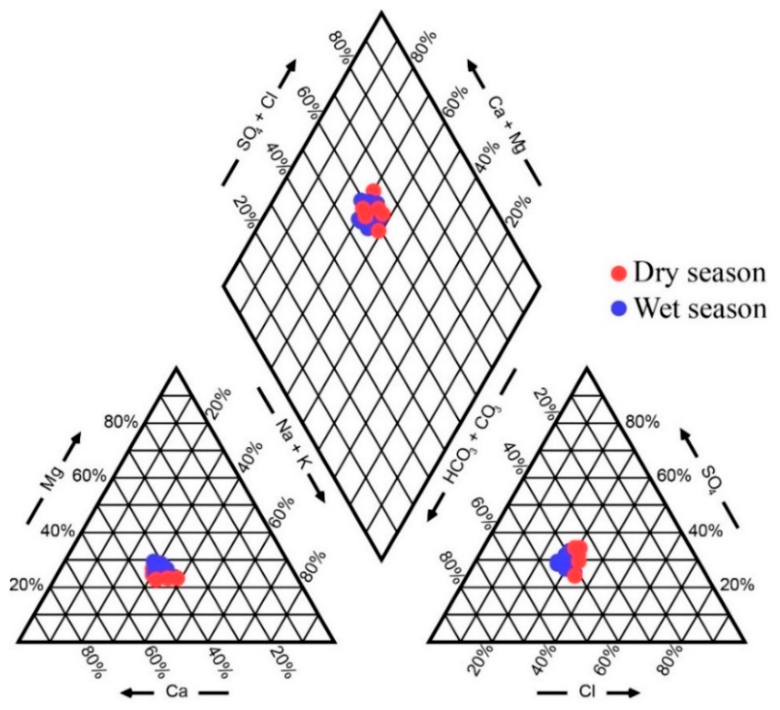
This study systematically characterizes the hydrochemical properties of groundwater across wet and dry seasons to elucidate the dominant geochemical processes governing groundwater quality evolution. Physicochemical parameters, encompassing pH, TDS, and major ion concentrations (Na+, K+, Ca2+, Mg2+, Cl, SO42−, HCO3, and NO3), serve as diagnostic indicators for interpreting the overall geochemical behavior and evolutionary trajectories of the regional groundwater system. Detailed hydrochemical data for samples collected during both hydrological seasons are summarized in Table 2. To facilitate a comprehensive understanding of temporal variability in groundwater chemistry, this study employs an integrated analytical framework combining quantitative datasets (Table 2) with graphical visualization techniques (Figure 2 and Figure 3). This multi-dimensional approach enables intuitive interpretation of parameter distribution patterns, hydrochemical facies variations, and potential geochemical interaction mechanisms operative within the study domain.
During the dry season, groundwater samples exhibited pH values ranging from 7.2 to 8.2, averaging 7.6, indicating moderately alkaline conditions. Total dissolved solids concentrations varied from 695 mg/L to 932 mg/L, with a mean of 841 mg/L. Among major cations, calcium concentrations ranged from 95.7 mg/L to 152.0 mg/L, averaging 128.1 mg/L; magnesium ranged from 36.1 mg/L to 59.5 mg/L, averaging 49.4 mg/L; sodium ranged from 97.2 mg/L to 131.0 mg/L, averaging 111.7 mg/L; and potassium ranged from 3.1 mg/L to 5.6 mg/L, averaging 4.5 mg/L. For major anions, bicarbonate exhibited concentrations from 278.0 mg/L to 409.0 mg/L, averaging 346.9 mg/L; sulfate ranged from 175.0 mg/L to 251.0 mg/L, averaging 207.8 mg/L; chloride ranged from 132.0 mg/L to 173.0 mg/L, averaging 151.5 mg/L; and nitrate ranged from 4.4 mg/L to 21.0 mg/L, averaging 14.0 mg/L. The relative abundance of cations followed the order calcium greater than sodium greater than magnesium greater than potassium, whereas anions followed bicarbonate greater than sulfate greater than chloride greater than nitrate. The predominant hydrochemical facies were classified as bicarbonate calcium type.
During the wet season, groundwater pH values ranged from 7.3 to 8.2, averaging 7.6, thus maintaining moderately alkaline conditions comparable to the dry season. Total dissolved solids concentrations varied from 723 mg/L to 949 mg/L, with a mean of 853 mg/L. Among major cations, calcium ranged from 96.6 mg/L to 152.0 mg/L and averaged 129.0 mg/L; sodium ranged from 98.4 mg/L to 131.0 mg/L and averaged 113.8 mg/L; magnesium ranged from 35.7 mg/L to 58.7 mg/L and averaged 48.6 mg/L; and potassium ranged from 3.2 mg/L to 6.3 mg/L and averaged 4.6 mg/L. For major anions, bicarbonate concentrations ranged from 282.0 mg/L to 405.0 mg/L, averaging 345.1 mg/L; sulfate ranged from 159.0 mg/L to 271.0 mg/L, averaging 213.6 mg/L; chloride ranged from 129.0 mg/L to 178.0 mg/L, averaging 156.0 mg/L; and nitrate ranged from 4.2 mg/L to 23.3 mg/L, averaging 14.7 mg/L. The relative abundance of cations followed the order calcium greater than sodium greater than magnesium greater than potassium, while anions followed bicarbonate greater than sulfate greater than chloride greater than nitrate, thus mirroring the hydrochemical patterns observed during the dry season. The predominant hydrochemical facies remained bicarbonate calcium type, indicating substantial seasonal stability in the geochemical processes governing groundwater composition.
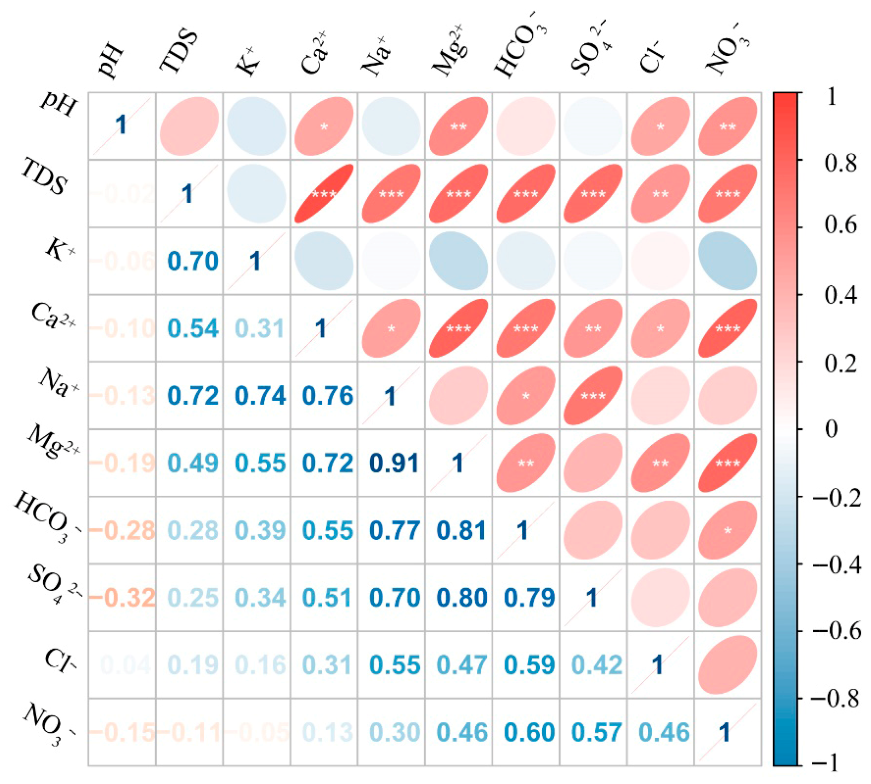
To further elucidate the provenance of dissolved constituents and their governing geochemical processes, Pearson correlation analysis was applied to the comprehensive hydrochemical dataset. Quantifying the linear relationships among major ions facilitates the identification of solute origins, hydrogeochemical evolution pathways, and migration mechanisms operative within the groundwater system. Strong positive correlations between ion pairs typically signify common geological sources or concurrent transport processes, whereas statistically significant negative correlations may reflect competitive sorption dynamics or divergent geochemical trajectories. Furthermore, the resulting correlation structure enables discrimination between ions predominantly derived from natural water–rock interactions, such as carbonate and silicate mineral weathering, versus those exhibiting chemical signatures consistent with anthropogenic perturbation.

5. Discussion

5.1. Dominant Controlling Factors of Hydrochemical Characteristics

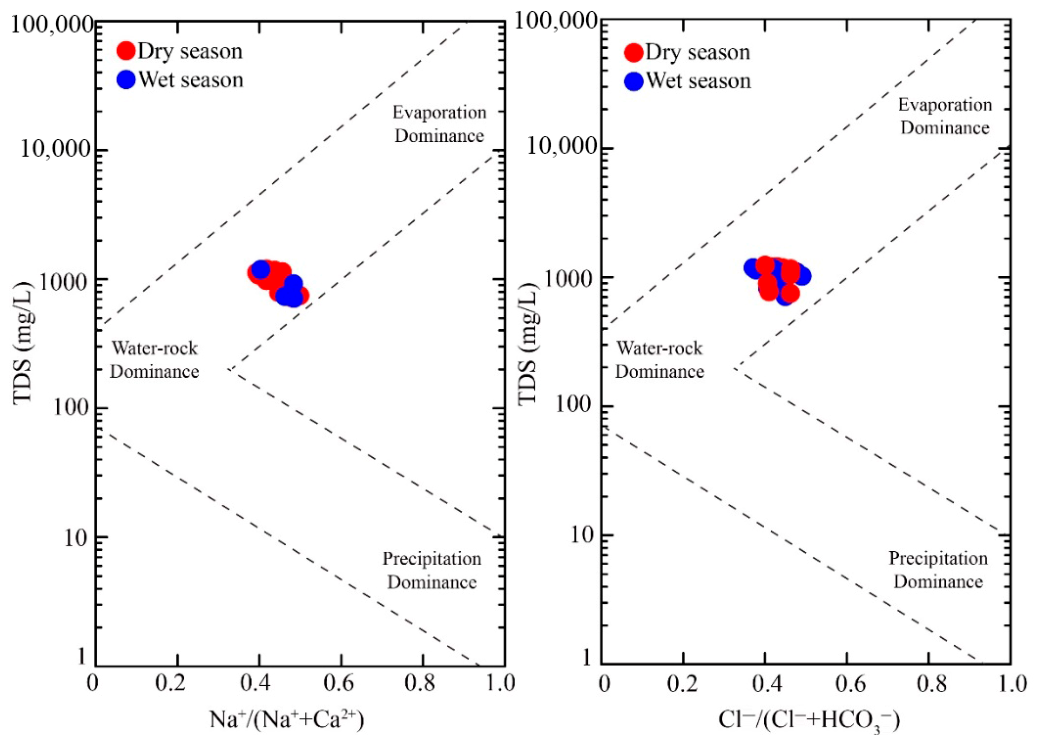
Ionic ratios serve as a fundamental tool for identifying and interpreting dominant hydrochemical processes. To better elucidate the genetic mechanisms controlling groundwater hydrochemistry, the Gibbs diagram is employed, which effectively distinguishes the relative contributions of atmospheric precipitation, rock–water interactions, and evaporation processes [27]. For the dry season, the Na+/(Na+ + Ca2+) ratios of groundwater samples range from 0.39 to 0.48, and Cl/(Cl + HCO3) ratios vary between 0.37 and 0.49 (Figure 4). For the wet season, these values are 0.39~0.50 and 0.40~0.47 (Figure 4), respectively. The general stability of these ratios across seasons suggests consistent hydrochemical controls. Most sample points are clustered within the central region of the Gibbs diagram, which signifies that water–rock interaction is the predominant process influencing ionic composition.
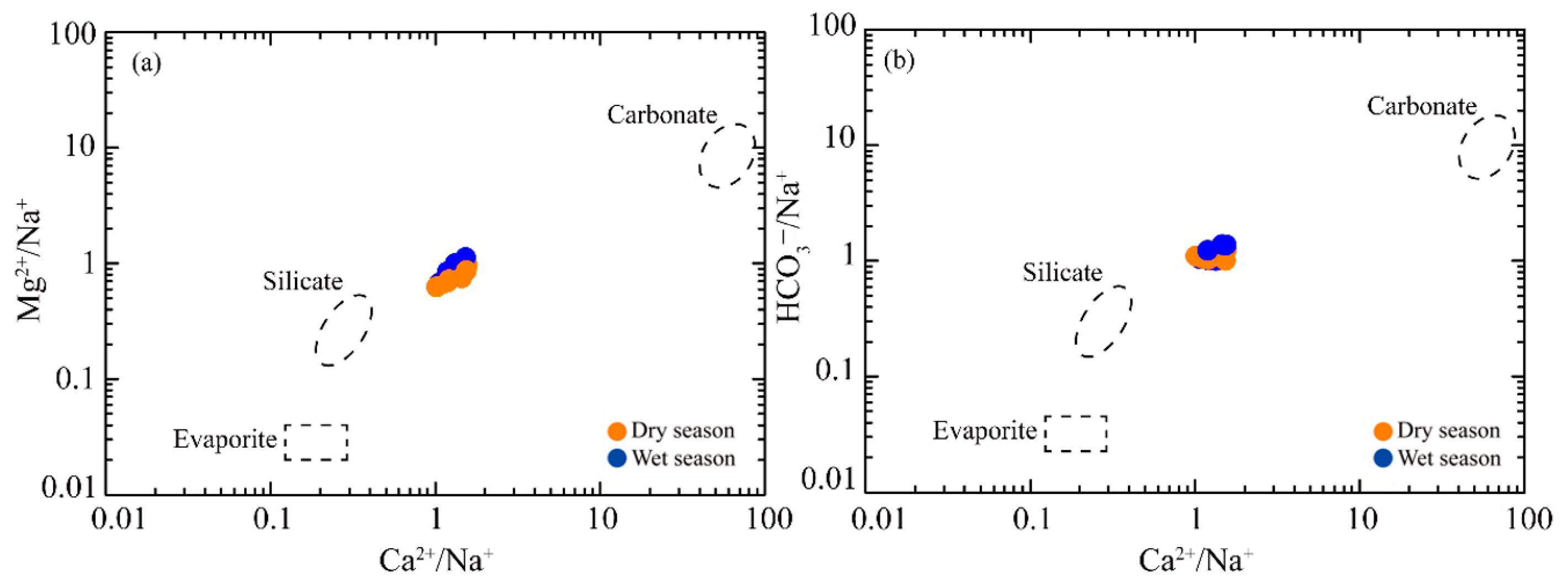
To further elucidate the mechanisms underlying water–rock interactions, this study employed end-member diagrams to identify the specific mineral phases that govern groundwater hydrochemistry with emphasis on those derived from evaporites, silicate rocks and carbonate rocks. Binary plots of Mg2+/Na+ versus Ca2+/Na+ and HCO3/Na+ versus Ca2+/Na+ were constructed to delineate the dominant rock sources regulating ionic composition [28]. Results presented in Figure 5 demonstrate that groundwater samples are distributed between the silicate and carbonate end members, exhibiting a stronger affinity for the silicate-weathering domain. Such a distribution indicates that both silicate hydrolysis and carbonate dissolution play significant roles in solute acquisition.
The identification of genetic mechanisms controlling the hydrochemical characteristics of HCO3-Ca-type groundwater is centered on elucidating the sources of Ca2+ and HCO3. To this end, ionic proportional relationships were analyzed using equivalent concentrations in milliequivalents per liter with particular focus on the following key ratios and their associated implications. Together, these analytical approaches provide critical insights into the dominant geochemical processes governing ion provenance.
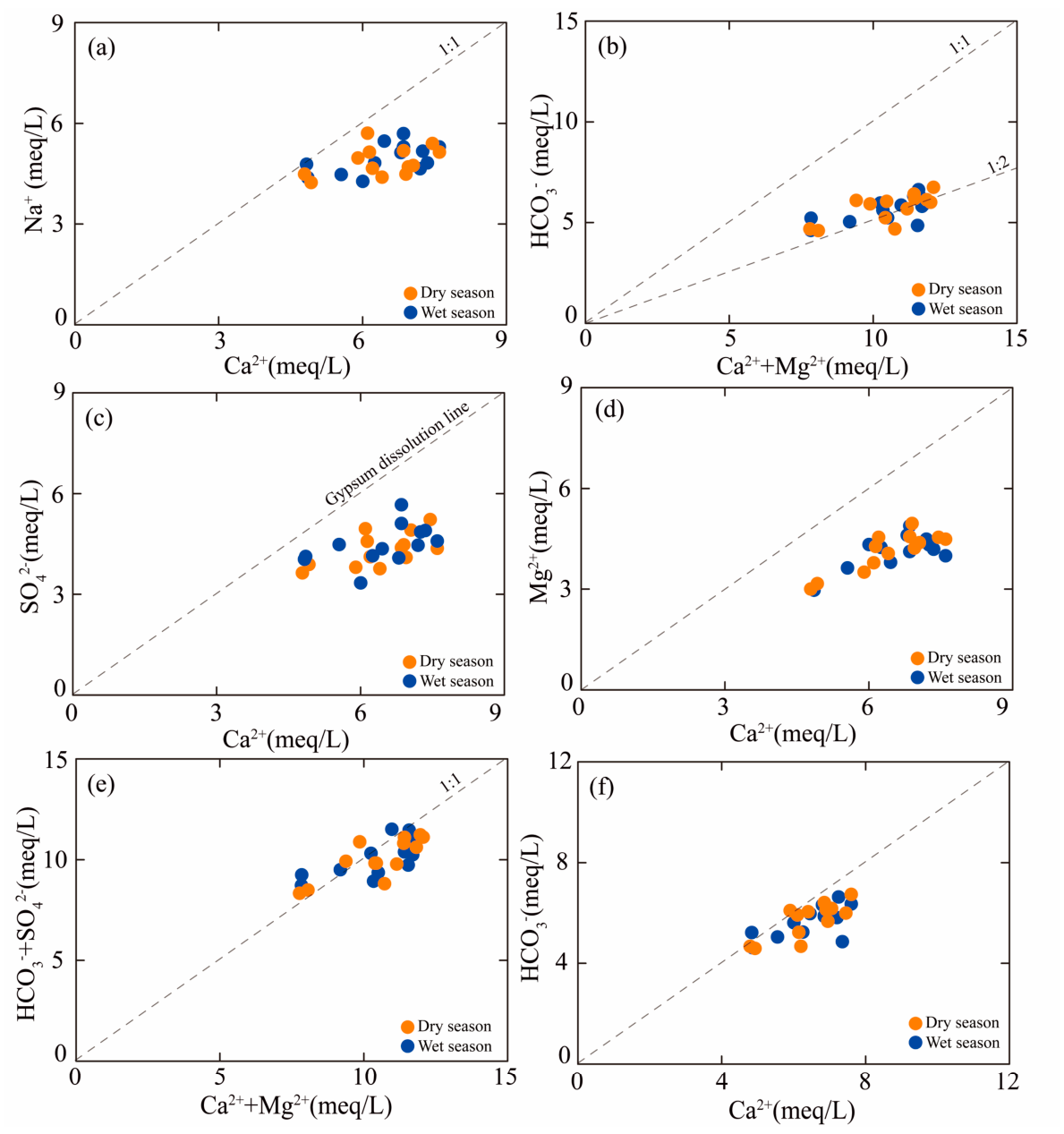
Silicate rocks (e.g., NaAlSi3O8) represent a significant natural source of Na+ in groundwater, primarily attributable to their chemical weathering processes in groundwater environments. In striking contrast, the weathering of carbonate rocks (e.g., calcite and dolomite) is dominated by the release of Ca2+, Mg2+, and HCO3, with negligible Na+ release that can be omitted from consideration. Based on this pronounced difference, the Na+/Ca2+ ratio is widely employed as a characteristic indicator to quantify the contribution of silicate mineral weathering to the hydrochemical characteristics of groundwater. Within a hydrogeochemical context dominated by carbonate rock weathering, the dissolution of calcite (CaCO3) and dolomite (CaMg(CO3)2) does not constitute a significant source of Na+. This results in extremely low Na+ concentrations in groundwater, with the corresponding Na+/Ca2+ ratio approaching 0. Conversely, when silicate rock weathering occurs (Equation (9)), hydrolysis processes simultaneously release Na+ and HCO3, leading to non-negligible Na+ levels in groundwater; the corresponding Na+/Ca2+ ratio typically stabilizes within the range of 0.1~1.0 [29,30]. As illustrated in Figure 6a, all groundwater samples collected in this study exhibit a Na+/Ca2+ ratio greater than 0.1. It is indicated that silicate rock weathering is one of the important sources of Ca2+ and HCO3 in the groundwater of the study area. It also confirms that silicate rock weathering is not a negligible geochemical process in the hydrochemical evolution of groundwater in this region.
2 NaAlSi 3 O 8 + 2 CO 2 + 3 H 2 O 2 Na + + 2 HCO 3 + Al 2 Si 2 O 5 ( OH ) 4 + 4 SiO 2
The molar ratio of HCO3 to Ca2+ plus Mg2+ was further evaluated as presented in Figure 6b. Most groundwater samples are distributed along the 1:2 line while a subset plots below this reference line. This distribution indicates the concurrent release of HCO3, Ca2+, and Mg2+ through dissolution reactions. The deviation of some samples from the 1:2 line is attributed to excess Ca2+ derived from gypsum dissolution as shown in Equation (10). Furthermore, the Ca2+/SO42− molar ratio illustrated in Figure 6c is substantially higher than 1, which is the expected value if gypsum were the sole source of Ca2+. This finding confirms supplementary Ca2+ input from the dissolution of carbonate minerals including calcite and dolomite. These geochemical lines of evidence are mutually consistent and collectively demonstrate that the formation of HCO3-Ca type groundwater is primarily controlled by carbonate mineral dissolution.
CaSO 4 2 H 2 O Ca 2 + + SO 4 2 + 2 H 2 O
CaMg ( C O 3 ) 2 + 2 C O 2 + 2 H 2 O C a 2 + + M g 2 + + 4 H C O 3
To quantify the respective contributions of calcite and dolomite dissolution to hydrochemical composition, the molar ratio of Ca2+ to Mg2+ was analyzed. Calcite dissolution primarily releases Ca2+ with negligible Mg2+ input whereas dolomite dissolution releases approximately equimolar amounts of Ca2+ and Mg2+ as described in Equation (11). Consequently, a molar ratio of Ca2+ to Mg2+ greater than 2 indicates that calcite dissolution is the dominant process. A ratio ranging from 1 to 2 denotes concurrent dissolution of both minerals while a ratio close to 1 signifies a process dominated by dolomite dissolution. As shown in Figure 6d, the molar ratios of Ca2+ to Mg2+ for all collected samples range from 1 to 2, confirming the coexistence of both dolomite and calcite dissolution processes. Calcite dolomite and gypsum dissolution primarily release Ca2+, Mg2+, HCO3, and SO42− ions into the aqueous phase, respectively. As shown in Figure 6e, the vast majority of groundwater samples plot closely along the 1:1 equiline of Ca2+ + Mg2+ versus HCO3 + SO42−. This distinct distribution indicates that the concentrations of Ca2+ and Mg2+ in groundwater are predominantly controlled by the dissolution of calcite dolomite and gypsum, thereby corroborating the significant influence of these mineral dissolution processes on the hydrochemical signature of the study system.
The HCO3/Ca2+ ratio provides evidence for identifying the influence of calcite on hydrochemical characteristics. When the ratio is close to 2, it indicates that Ca2+ and HCO3 are mainly derived from calcite. When the ratio is greater than 2, it suggests the presence of additional sources of HCO3. When the ratio is less than 2, it implies an extra consumption of Ca2+, for instance, the adsorption of Ca2+ by clay minerals during the cation exchange process. As shown in Figure 6f, the HCO3/Ca2+ ratios of the collected samples are less than 2, which demonstrates that extra Ca2+ consumption occurred in these samples, and this phenomenon may be associated with cation exchange.
CAI   1 = Cl ( Na + + K + ) Cl
CAI   2 = Cl ( Na + + K + ) HCO 3 + SO 4 2 + CO 3 2 + NO 3
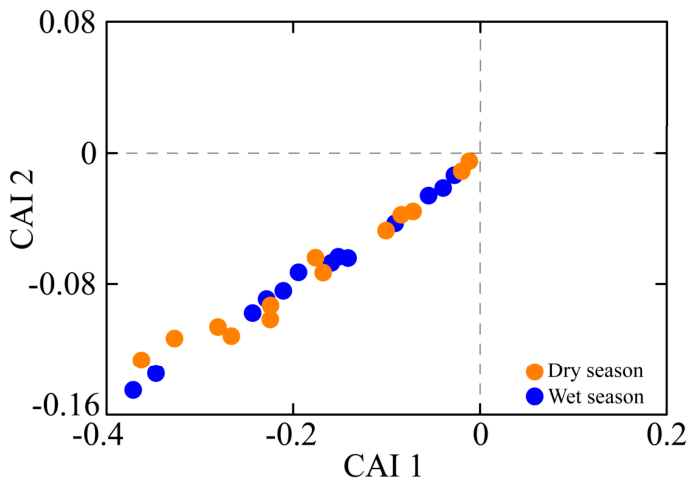
The chloro-alkaline indices CAI-1 and CAI-2 (Equations (12) and (13)) are employed to further assess cation exchange in the groundwater system. As shown in Figure 7, all groundwater samples exhibit negative values for both CAI-1 and CAI-2, which is consistent with a cation exchange process wherein clay minerals adsorb Ca2+ while releasing Na+ into the aqueous phase. It is indicated that in the earlier inference, based on the HCO3/Ca2+ ratio, additional Ca2+ depletion occurs in the system.
In summary, this section identifies the dominant controlling factors of the hydrochemical characteristics of groundwater in the study area through ionic ratio analysis. The results indicate that water–rock interaction is the predominant process regulating groundwater ionic composition. Hydrogeochemical processes including silicate hydrolysis, carbonate dissolution (calcite and dolomite), gypsum dissolution, and cation exchange collectively influence the groundwater hydrochemical characteristics in the study area, ultimately shaping the dominant hydrochemical facies of the HCO3-Ca type.

5.2. Source Apportionment by PMF

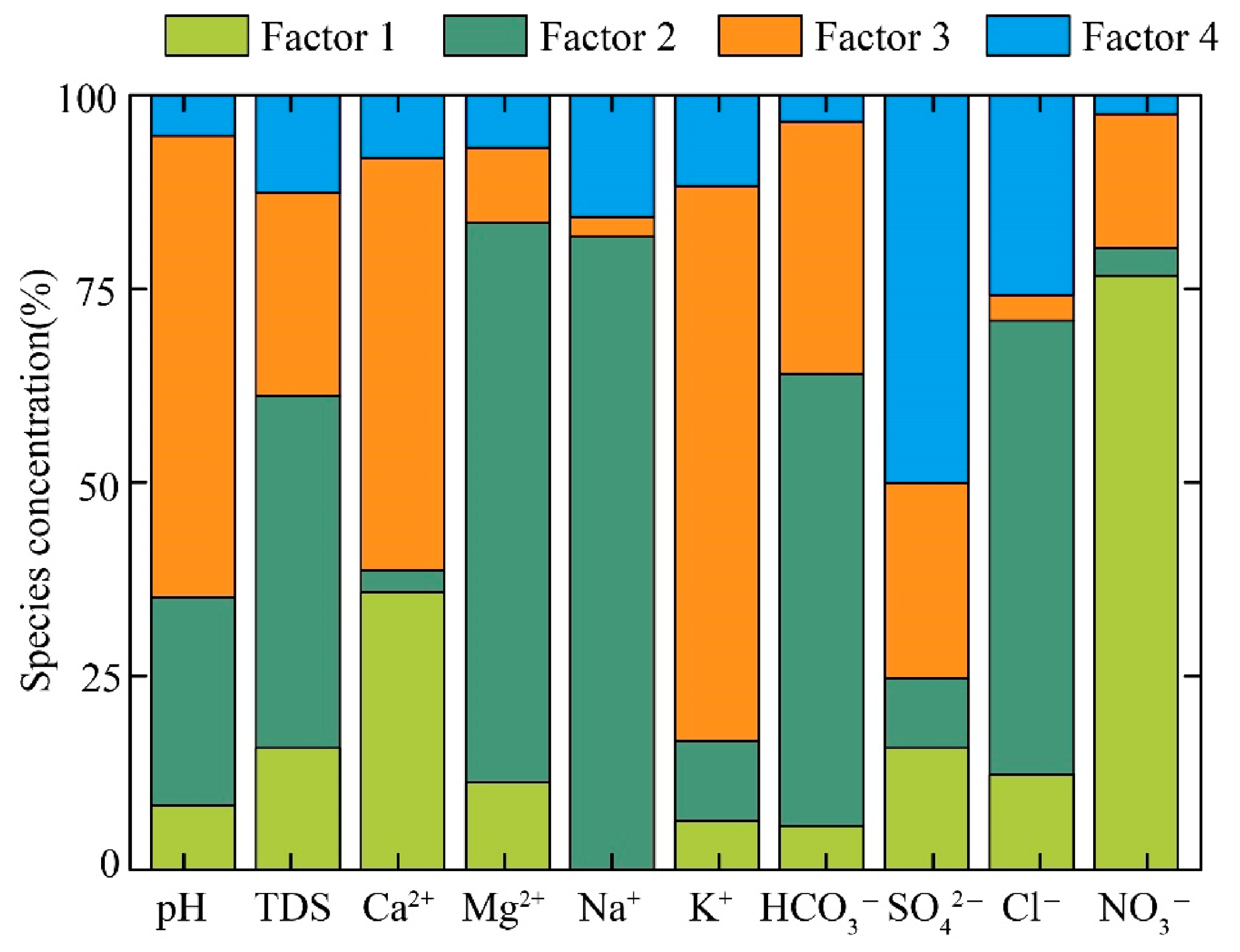
To identify the main controlling factors of groundwater hydrochemical characteristics and the genetic mechanism of high nitrate concentration in the study area, this study conducts quantitative source apportionment using the Positive Matrix Factorization (PMF) model based on ten indicators of 26 groundwater samples. Four factors (Factor 1~4) with distinct hydrogeochemical significance are identified, and their contribution rates to each indicator are presented in Figure 8. In addition, the reliability of the factor analysis results is further verified via Pearson correlation analysis among different groundwater ions.
Factor 1 is characterized by a predominant nitrate loading of 76.67%, the highest among all hydrochemical indicators, signifying its primary role in representing nitrate enrichment within the regional groundwater system. Nitrate constitutes the most prevalent inorganic nitrogen contaminant in groundwater environments, with its concentration demonstrating strong positive correlations with the intensity of agricultural land use. The study area is typified by high population density and intensive agricultural production, where substantial nitrogen fertilizer inputs create significant anthropogenic pressure on groundwater quality. Unassimilated nitrogen undergoes microbially mediated ammonification and subsequent nitrification, transforming into mobile nitrate that leaches through the vadose zone and generates diffuse non-point-source pollution. This anthropogenic nitrate subsequently migrates into the saturated zone, where it undergoes further modification through hydrogeochemical processes including adsorption–desorption equilibria and redox transformations, thereby influencing its spatial distribution and environmental persistence. Integrating the predominant land use patterns with the established geochemical behavior of nitrogen species in aquifer systems, Factor 1 is definitively attributed to exogenous nitrate inputs derived predominantly from agricultural fertilizer application.
The core characteristic of Factor 2 is the high loadings of Na+ and Mg2+, with values of 72.26% and 81.67% respectively. The correlation analysis reveals an extremely significant positive correlation between the two ions (R2 = 0.91), indicating that their material sources and migration processes are both governed by the same hydrogeochemical process. Combined with the lithological composition of the study area, this factor mainly corresponds to the weathering and hydrolysis of silicate minerals, with typical minerals including albite and magnesium-bearing silicate minerals. Under similar hydrochemical conditions, such as pH and partial pressure of carbon dioxide, the aforementioned minerals undergo synergistic weathering, releasing Na+ and Mg2+ into the water body at a fixed ratio and simultaneously generating HCO3, which constitutes the fundamental geochemical basis for their strong correlation. In addition, the genesis of this factor is also related to the dissolution of dolomite (CaMg(CO3)2). After Ca2+, Mg2+ and HCO3 released by dolomite dissolution enter the water body, Ca2+ combines with HCO3 to form calcite precipitation in a neutral to weakly alkaline environment, while Mg2+ is more likely to remain in the water. If superimposed with exogenous Na+ supplementation (such as the input of sodium salts or the continuous release of Na+ from silicate weathering), the synchronous enrichment of Na+ and Mg2+ in the water body will occur. Based on the above analysis, the material source of Factor 2 can be apportioned as silicate weathering and dolomite dissolution.
Factor 3 exhibits pronounced loadings for pH at 59.62% and K+ at 71.65%, indicating a robust association with the hydrolysis of potassic silicate minerals. Within groundwater systems, dissolved carbon dioxide hydrates to form carbonic acid, which subsequently dissociates to liberate hydrogen ions, thereby accelerating the incongruent dissolution of framework silicates such as potassium feldspar with the structural formula KAlSi3O8. This proton-promoted weathering reaction progressively depletes aqueous hydrogen ion concentrations, resulting in systematic pH elevation as described by the reaction stoichiometry. The observed pH loading pattern in Factor 3 aligns mechanistically with this geochemical process. Potassium exhibits relatively conservative behavior in subsurface hydrologic environments, showing limited propensity for precipitation or surface complexation with aquifer matrix materials, which renders dissolved K+ concentrations particularly diagnostic of silicate-weathering intensity. Synthesizing these hydrochemical signatures with the established geochemical behavior of potassium in groundwater systems, Factor 3 is definitively attributed to the weathering and dissolution of potassium-bearing silicate minerals, with potassium feldspar identified as the predominant reactive phase.
2 KAlSi 3 O 8 + 2 H 2 CO 3 + 9 H 2 O 2 K + + 2 HCO 3 + Al 2 Si 2 O 5 ( OH ) 4 + 4 H 4 SiO 4
Factor 4 exhibits a predominant loading of 50.12% for SO42−, signifying strong anthropogenic control on its hydrochemical evolution. Agricultural intensification and livestock production constitute the primary human activities influencing sulfate distribution in the study area. Following application of sulfur-bearing fertilizers such as ammonium sulfate and potassium sulfate to agricultural lands, sulfur moieties undergo vertical migration through the vadose zone via infiltration and leaching processes, ultimately recharging the saturated zone and elevating groundwater sulfate concentrations. This anthropogenic sulfur input represents the dominant source of sulfate in the aquifer system relative to geogenic contributions. Integrating the spatial distribution of agricultural practices with documented sulfate leaching mechanisms, Factor 4 is definitively apportioned as a composite anthropogenic source encompassing sulfur fertilizer application in agricultural production and waste discharge from livestock breeding operations.

5.3. Identifying Nitrate Sources

In natural groundwater systems, nitrate-nitrogen concentrations typically remain below the widely recognized threshold of 10 mg/L, a benchmark established as indicative of anthropogenic contamination. The present investigation reveals nitrate concentrations ranging from 4.2 mg/L to 23.3 mg/L during the wet season, with an arithmetic mean of 14.7 mg/L, and from 4.2 mg/L to 21.0 mg/L during the dry season, averaging 14.0 mg/L. Remarkably, the proportion of samples exceeding the 10 mg/L criterion reaches 77% under wet-season hydrological conditions and 69% under dry-season conditions, thereby demonstrating pervasive anthropogenic alteration of groundwater hydrochemistry across the study area.
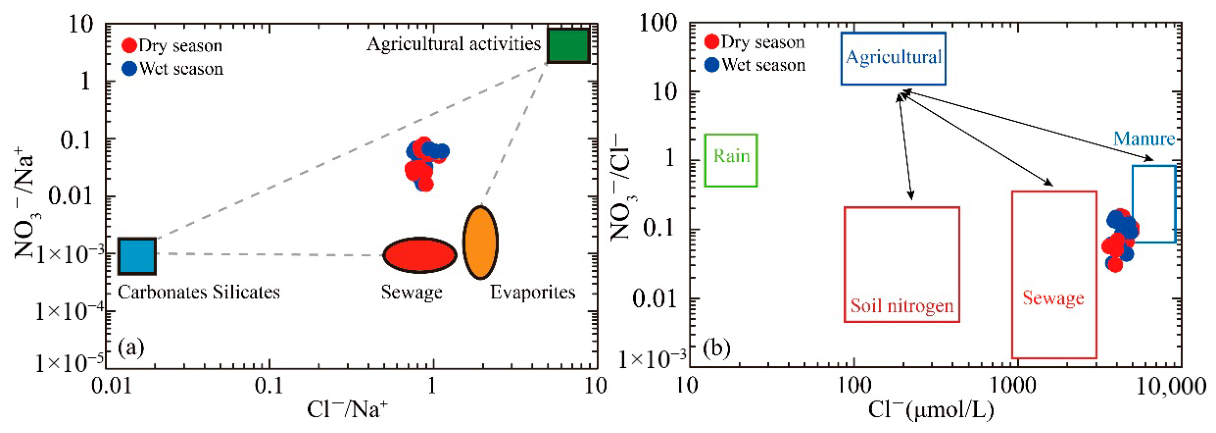
Molar ratio analysis provides a robust geochemical framework for discriminating nitrate provenance, encompassing agricultural runoff, industrial discharge, and domestic wastewater. Binary mixing diagrams have been extensively employed in hydrochemical investigations, specifically Cl/Na+ versus NO3/Na+ and Cl versus NO3/Cl, to identify dominant contaminant inputs through comparison of measured ionic ratios with established end-member compositional ranges. As illustrated in Figure 9a, the majority of samples plot within the mixing zone bounded by sewage and agricultural end-members, indicating that nitrate contamination derives primarily from wastewater infiltration and farming activities. Furthermore, the NO3/Cl ratio serves as a reliable hydrochemical tracer for elucidating mixing processes and quantifying relative contributions from chemical fertilizers, manure, sewage, and natural soil nitrogen. Elevated NO3/Cl ratios concomitant with low Cl concentrations are diagnostic of chemical fertilizer sources, whereas reduced NO3/Cl ratios accompanied by elevated Cl characterize manure and sewage inputs. To further resolve nitrate origins from rainfall, soil nitrogen, agricultural sources, sewage, and manure, Figure 9b presents NO3/Cl plotted against Cl concentration. Samples from both hydrological seasons, distinguished by red for the dry season and blue for the wet season, exhibit predominant clustering within the sewage or manure domain. This distribution pattern indicates that groundwater nitrate is predominantly attributable to manure application and domestic wastewater discharge, with negligible contribution from agricultural fertilizers or atmospheric deposition. The absence of pronounced seasonal differentiation in sample distribution further suggests persistent contamination sources and transport pathways operating throughout the annual hydrological cycle.

5.4. The Results of Human Health Risk Assessment

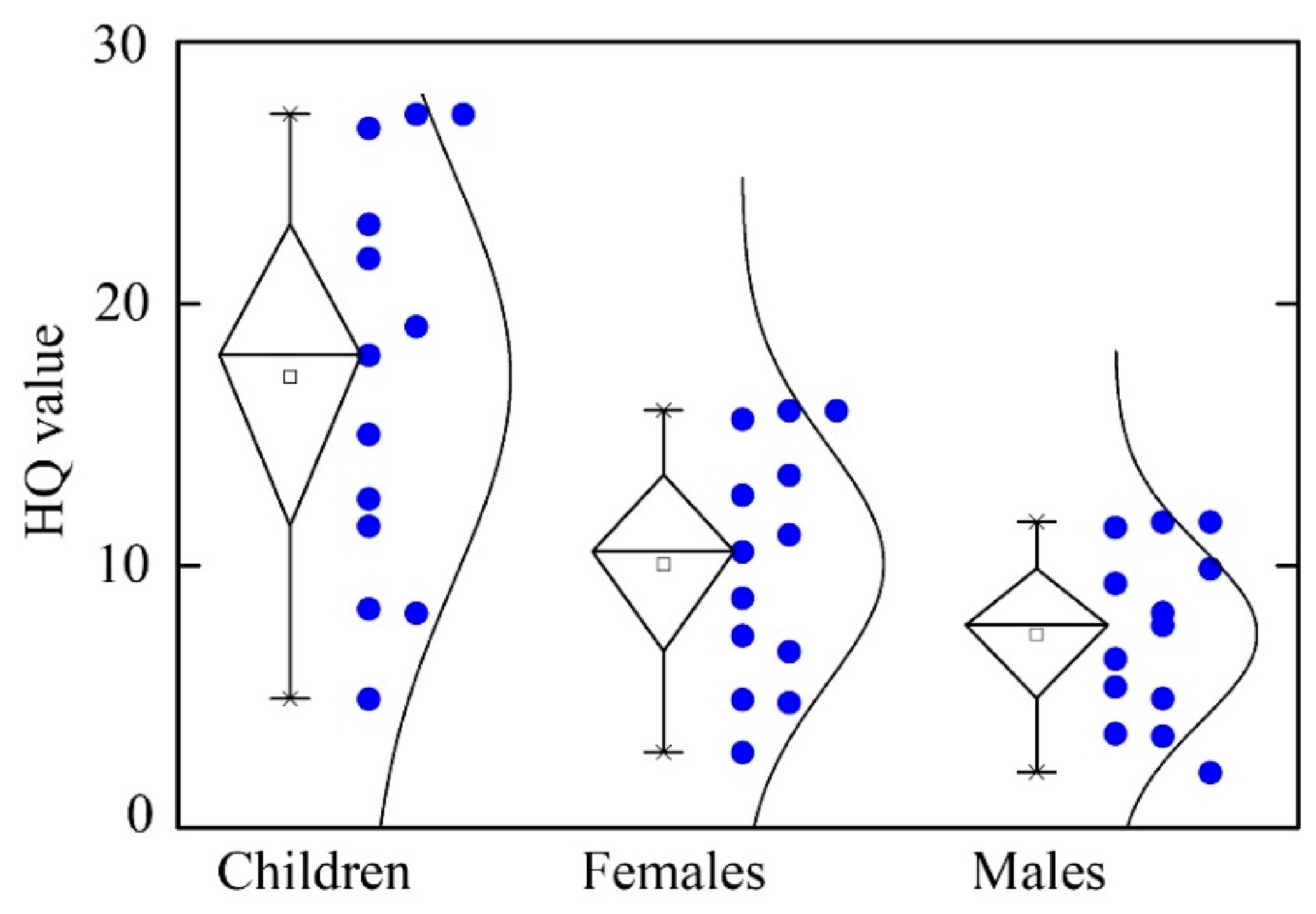
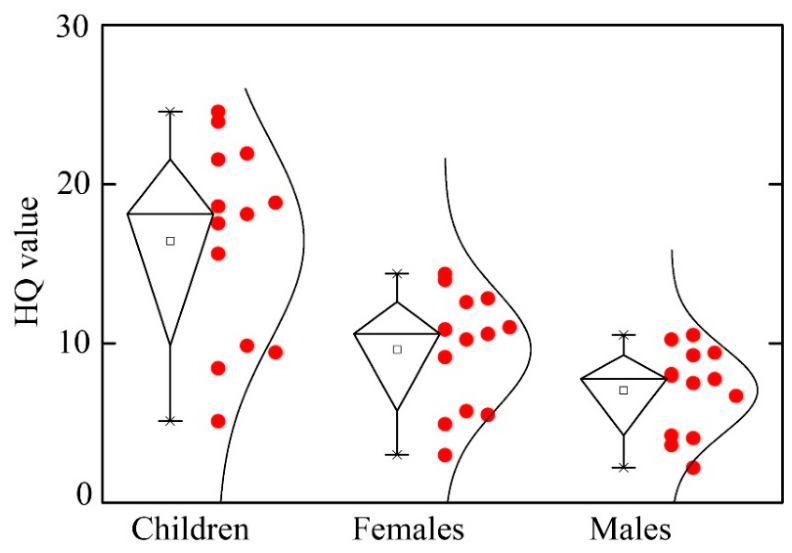
The Total Health Risk Index (HITotal) for children, adult females, and adult males is presented in Figure 10 and Figure 11, corresponding to the wet and dry seasons, respectively. To comprehensively evaluate health risks associated with high-nitrate groundwater, a detailed analysis accounting for seasonal variations is conducted as follows:
For children, HITotal values span 4.93 to 27.24 with an average of 17.21 in the wet season, while in the dry season they vary between 5.13 and 24.57, averaging 16.44. Per health risk classification criteria, where HITotal values exceeding 4 indicate high risk, all groundwater samples surpass this threshold. This finding confirms that 100% of samples in both seasons pose a high level of non-carcinogenic health risk to children.
For adult females, HITotal values range from 2.88 to 15.92 with a mean of 10.06 during the wet season. Among these samples, 92% fall into the high-risk category and 8% into the moderate-risk category. In the dry season, HITotal values span 3.00 to 14.36 with an average of 9.61, with the same proportion of high-risk and moderate-risk samples (92% and 8% respectively). This consistency indicates no significant seasonal difference in health risk levels for adult females.
For adult males, HITotal values vary between 2.12 and 11.69, averaging 7.38 in the wet season, with 77% of samples classified as high risk and 23% as moderate risk. In the dry season, HITotal values range from 2.20 to 10.54 with a mean of 7.06, and the proportion of high-risk samples increases significantly to 92% while moderate-risk samples decrease to 8%.
HHRA results reveal that the overall non-carcinogenic health risks posed by high-nitrate groundwater follow the order of children > adult females > adult males. Children exhibit higher susceptibility compared to adults, a finding consistent with existing literature. Such heightened susceptibility may stem from children’s lower body weight and immature metabolic systems.
These findings highlight severe nitrate-related public health threats in the upper Yongding River alluvial–proluvial fan, where groundwater remains the primary drinking water source. The 100% high non-carcinogenic risk to children demands immediate targeted interventions, including safe drinking water provision for local schools and childcare centers. Priority management measures include promoting soil-test-based fertilization, regulating livestock manure disposal, upgrading rural domestic sewage systems, and strengthening water quality monitoring during ongoing ecological water replenishment.

6. Conclusions

To inform sustainable groundwater management in the northwestern North China Plain, this study employs over 13 years of hydrochemical monitoring data from 26 samples across dry and wet seasons in the upper Yongding River alluvial–proluvial fan. The results reveal seasonally stable, moderately alkaline groundwater with bicarbonate-calcium facies. Total dissolved solids show minimal seasonal variation, averaging 841 mg/L in the dry season and 853 mg/L in the wet season. Major ions display consistent abundances: Ca2+ > Na+ > Mg2+ > K+ for cations and HCO3 > SO42− > Cl > NO3 for anions. Integrated analysis of Pearson correlations, ionic ratios, and Gibbs diagrams demonstrates that groundwater chemistry is primarily governed by water–rock interactions, including silicate weathering, dissolution of calcite, dolomite, and gypsum, as well as cation exchange.
Positive Matrix Factorization identified four geochemical sources: agricultural nitrate inputs, silicate weathering and dolomite dissolution, weathering of K-bearing silicates, and sulfate from agricultural practices. Nitrate concentrations remain elevated across seasons, averaging 14.7 mg/L in the wet season and 14.0 mg/L in the dry season, with 77% and 69% of samples exceeding the anthropogenic pollution threshold of 10 mg/L, respectively. Molar ratios confirm persistent contributions from manure, sewage, and synthetic fertilizers.
Health risk assessment indicates that nitrate ingestion poses significant non-carcinogenic risks, particularly to children due to their lower body weight and developing metabolic systems. All sampled groundwater presents a high risk to children, while elevated hazard quotients are also observed for most adult females and males across seasons. These findings underscore the need for targeted mitigation of anthropogenic nitrogen inputs to protect groundwater quality and public health.

Author Contributions

Conceptualization, F.L. and A.D.; Methodology, Q.Y.; Software, Q.Y. and K.C.; Validation, Q.Y. and X.Z.; Formal analysis, Q.Y. and X.Z.; Investigation, Q.Y., F.L., X.Z. and K.C.; Resources, F.L.; Writing—original draft, Q.Y.; Writing—review & editing, A.D.; Visualization, X.Z. and K.C.; Supervision, A.D.; Funding acquisition, Q.Y. and A.D. All authors have read and agreed to the published version of the manuscript.

Funding

This research is supported by the Jing-Jin-Ji Regional Integrated Environmental Improvement National Science and Technology Major Project (No. 2025ZD1205600), the Open Foundation of the Key Laboratory of Coupling Process and Effect of Natural Resources Elements (No. 2024KFKT001), the Qinghai Provincial Key Laboratory of Geology and Environment of Salt Lakes (No. 2024-KFKT-B10), and the Open Research Fund Project of Hebei Key Laboratory of Geological Resources and Environment Monitoring and Protection (No. JCYKT202404).

Institutional Review Board Statement

Not applicable.

Informed Consent Statement

Not applicable.

Data Availability Statement

The raw data supporting the conclusions of this article will be made available by the authors on request.

Acknowledgments

We are grateful to the editorial team for their guidance throughout the review process. We deeply appreciate the anonymous reviewers for their insightful comments and valuable feedback, which significantly improved the quality of this work.

Conflicts of Interest

The authors declare no conflicts of interest.

References

  1. Cakir, R.; Sauvage, S.; Gerino, M.; Volk, M.; Sánchez-Pérez, J.M. Assessment of ecological function indicators related to nitrate under multiple human stressors in a large watershed. Ecol. Indic. 2020, 111, 106016. [Google Scholar] [CrossRef]
  2. Wells, M.J.; Gilmore, T.E.; Nelson, N.; Mittelstet, A.; Böhlke, J.K. Determination of vadose zone and saturated zone nitrate lag times using long-term groundwater monitoring data and statistical machine learning. Hydrol. Earth Syst. Sci. 2021, 25, 811–829. [Google Scholar] [CrossRef]
  3. He, S.; Li, P.; Su, F.; Wang, D.; Ren, X. Identification and apportionment of shallow groundwater nitrate pollution in Weining Plain, northwest China, using hydrochemical indices, nitrate stable isotopes, and the new Bayesian stable isotope mixing model (MixSIAR). Environ. Pollut. 2022, 298, 118852. [Google Scholar] [CrossRef]
  4. Su, F.; He, S.; Zhou, X.; Yu, F.; Qiang, S.; Ma, H.; Guan, Z.; Zhang, T. Assessing impacts of land use/land cover patterns to shallow groundwater nitrate pollution in an agricultural-dominant area in northwest China using random forest. Environ. Earth Sci. 2024, 83, 584. [Google Scholar] [CrossRef]
  5. Di Lorenzo, T.; Fiasca, B.; Di Camillo Tabilio, A.; Murolo, A.; Di Cicco, M.; Galassi, D.M.P. The weighted Groundwater Health Index (wGHI) by Korbel and Hose (2017) in European groundwater bodies in nitrate vulnerable zones. Ecol. Indic. 2020, 116, 106525. [Google Scholar] [CrossRef]
  6. K’Oreje, K.; Okoth, M.; Van Langenhove, H.; Demeestere, K. Occurrence and point-of-use treatment of contaminants of emerging concern in groundwater of the Nzoia River basin, Kenya. Environ. Pollut. 2022, 297, 118725. [Google Scholar] [CrossRef] [PubMed]
  7. Hermawan, O.R.; Hosono, T.; Yasumoto, J.; Yasumoto, K.; Song, K.-H.; Maruyama, R.; Iijima, M.; Yasumoto-Hirose, M.; Takada, R.; Hijikawa, K.; et al. Effective use of farmland soil samples for N and O isotopic source fingerprinting of groundwater nitrate contamination in the subsurface dammed limestone aquifer, Southern Okinawa Island, Japan. J. Hydrol. 2023, 619, 129364. [Google Scholar] [CrossRef]
  8. Ding, H.; Gao, H.; Zhu, M.; Yu, M.; Sun, Y.; Zheng, M.; Su, J.; Xi, B. Spectral and molecular insights into the characteristics of dissolved organic matter in nitrate-contaminated groundwater. Environ. Pollut. 2024, 355, 124202. [Google Scholar] [CrossRef]
  9. Mao, H.; Wang, G.; Liao, F.; Shi, Z.; Rao, Z.; Zhang, H.; Qiao, Z.; Bai, Y.; Chen, X.; Yan, X.; et al. Spatiotemporal Variation of Groundwater Nitrate Concentration Controlled by Groundwater Flow in a Large Basin: Evidence From Multi-Isotopes (15N, 11B, 18O, and 2H). Water Resour. Res. 2024, 60, e2023WR035299. [Google Scholar] [CrossRef]
  10. Dong, Y.; Zhu, S.; Li, J.; Liu, W.; Li, Z.; Sun, Z.; Liu, C. Hydrochemical characteristics and source identification of nitrate in surface water and shallow groundwater in the Poyang Lake Basin, China. Environ. Earth Sci. 2025, 84, 271. [Google Scholar] [CrossRef]
  11. Wali, S.U.; Alias, N.B.; Usman, A.A.; Umar, A.; Muhammad, N.; Kaoje, I.U.; Samaila, B.; Aliyu, B.; Ladan, H.M.; Atiku, M.; et al. Hydrochemical characterization and seasonal variability of shallow groundwater in the Sokoto basin northern Nigeria rock weathering as a dominant control factor. Discov. Geosci. 2025, 3, 122. [Google Scholar] [CrossRef]
  12. Jin, L.; Ye, H.; Shi, Y.; Li, L.; Liu, R.; Cai, Y.; Li, J.; Li, F.; Jin, Z. Using PCA-APCS-MLR model and SIAR model combined with multiple isotopes to quantify the nitrate sources in groundwater of Zhuji, East China. Appl. Geochem. 2022, 143, 105354. [Google Scholar] [CrossRef]
  13. Zhang, Q.; Wei, A.; Ren, J.; Qian, H.; Hou, K. Multi-isotope tracer for identifying nitrate sources in shallow groundwater in a large irrigation area, China. J. Environ. Manag. 2025, 376, 124424. [Google Scholar] [CrossRef]
  14. Xia, C.; Cheng, W.; Ren, M.; Zhu, Y. Chromium(VI) and nitrate removal from groundwater using biochar-assisted zero valent iron autotrophic bioreduction: Enhancing electron transfer efficiency and reducing EPS accumulation. Environ. Pollut. 2025, 364, 125313. [Google Scholar] [CrossRef] [PubMed]
  15. Taloor, A.K.; Sharma, S.; Pir, R.A.; Kumar, K. Appraisal of health risks associated with exposure of fluoride and nitrate contaminated springs in the Doda Kishtwar Ramban (DKR) region of Jammu and Kashmir, India. J. Geochem. Explor. 2024, 257, 107380. [Google Scholar] [CrossRef]
  16. Li, S.; Chow, R.; Su, H.; Han, F.; Li, Z. Multiple isotopes and GIS analyses reveal sources and drivers of nitrate in the Loess Plateau’s groundwater. Environ. Pollut. 2025, 384, 127022. [Google Scholar] [CrossRef]
  17. Deng, Y.; Ye, X.; Du, X. Predictive modeling and analysis of key drivers of groundwater nitrate pollution based on machine learning. J. Hydrol. 2023, 624, 129934. [Google Scholar] [CrossRef]
  18. Shi, J.; Yang, Y.; Shi, M.; Lu, Y.; Chen, W. Hydrogeochemical and machine learning evidences for release and attenuation mechanisms of chromium contamination in a partially PRB remediation of shallow groundwater. Environ. Pollut. 2025, 385, 127109. [Google Scholar] [CrossRef]
  19. Fan, G.; Zhang, D.; Zhang, J.; Li, Z.; Sang, W.; Zhao, L.; Xu, M. Ecological environmental effects of Yellow River irrigation revealed by isotope and ion hydrochemistry in the Yinchuan Plain, Northwest China. Ecol. Indic. 2022, 135, 108574. [Google Scholar] [CrossRef]
  20. Hossain, M. A simple and effective approach to investigate the dominant contaminant sources and accuracy in water quality estimation through Monte Carlo simulation, Gaussian Mixture Models (GMMs), and GIS machine learning methods. Ecol. Indic. 2025, 171, 113188. [Google Scholar] [CrossRef]
  21. Rotiroti, M.; Sacchi, E.; Caschetto, M.; Zanotti, C.; Fumagalli, L.; Biasibetti, M.; Bonomi, T.; Leoni, B. Groundwater and surface water nitrate pollution in an intensively irrigated system: Sources, dynamics and adaptation to climate change. J. Hydrol. 2023, 623, 129868. [Google Scholar] [CrossRef]
  22. Martinelli, G.; Ciolini, R.; Facca, G.; Fazio, F.; Pierotti, L. Tectonic-Related Geochemical and Hydrological Anomalies in Italy during the Last Fifty Years. Minerals 2021, 11, 107. [Google Scholar] [CrossRef]
  23. Riedel, T.; Kübeck, C.; Quirin, M. Legacy nitrate and trace metal (Mn, Ni, As, Cd, U) pollution in anaerobic groundwater: Quantifying potential health risk from “the other nitrate problem”. Appl. Geochem. 2022, 139, 105254. [Google Scholar] [CrossRef]
  24. Zhang, S.C.; Liu, K.; Ma, Y.; Wang, L.Y.; Sun, J.L. Identifying the Hydrochemical Characteristics, Genetic Mechanisms and Potential Human Health Risks of Fluoride and Nitrate Enriched Groundwater in the Tongzhou District, Beijing, North China. Acta Geol. Sin. (Engl. Ed.) 2024, 98, 468–476. [Google Scholar] [CrossRef]
  25. Ge, D.; Gao, X.; Jiang, P.; Li, B.; He, N.; Wu, Y.; He, Q.; Cai, Y.; Li, C.; Zhao, X. Deep soil desiccation hinders nitrate leaching to groundwater in the global largest apple cultivation area. J. Hydrol. 2024, 637, 131334. [Google Scholar] [CrossRef]
  26. Turkeltaub, T.; Jia, X.; Zhu, Y.; Shao, M.-A.; Binley, A. A Comparative Study of Conceptual Model Complexity to Describe Water Flow and Nitrate Transport in Deep Unsaturated Loess. Water Resour. Res. 2021, 57, e2020WR029250. [Google Scholar] [CrossRef]
  27. Yoshihara, N.; Matsumoto, S.; Machida, I.; Uchida, Y. Deciphering natural and anthropogenic effects on the groundwater chemistry of Nago City, Okinawa Island, Japan. Environ. Pollut. 2023, 318, 120917. [Google Scholar] [CrossRef]
  28. Aleku, D.L.; Dähnke, K.; Pichler, T. Source, transport, and fate of nitrate in shallow groundwater in the eastern Niger Delta. Environ. Sci. Pollut. Res. 2024, 31, 65034–65050. [Google Scholar] [CrossRef]
  29. Hansen, B.; Thorling, L.; Kim, H.; Blicher-Mathiesen, G. Long-term nitrate response in shallow groundwater to agricultural N regulations in Denmark. J. Environ. Manag. 2019, 240, 66–74. [Google Scholar] [CrossRef] [PubMed]
  30. Kaandorp, V.P.; Broers, H.P.; van der Velde, Y.; Rozemeijer, J.; de Louw, P.G.B. Time lags of nitrate, chloride, and tritium in streams assessed by dynamic groundwater flow tracking in a lowland landscape. Hydrol. Earth Syst. Sci. 2021, 25, 3691–3711. [Google Scholar] [CrossRef]
Figure 1. The location of the study area.
Applsci 16 04524 g001
Figure 2. The Piper diagram.
Applsci 16 04524 g002
Figure 3. Pearson correlation coefficient diagram. *: p<0.05; **: p<0.01; ***: p<0.001.
Applsci 16 04524 g003
Figure 4. The Gibbs diagram of collected groundwater samples.
Applsci 16 04524 g004
Figure 5. The molar ratios between (a) Ca2+/Na+ and Mg2+/Na+ and (b) Ca2+/Na+ and HCO3/Na+.
Applsci 16 04524 g005
Figure 6. The ionic ratios of (a) Ca2+ vs. Na+, (b) Ca2+ + Mg2+ vs. HCO3, (c) Ca2+ vs. SO42−, (d) Ca2+ vs. Mg2+, (e) Ca2+ + Mg2+ vs. HCO3 + SO42−, and (f) Ca2+ vs. HCO3.
Applsci 16 04524 g006
Figure 7. The relationship between CAI 1 and CAI 2.
Applsci 16 04524 g007
Figure 8. PMF-based source apportionment of hydrochemical constituents.
Applsci 16 04524 g008
Figure 9. Nitrate source identification by (a) Cl/Na+ vs. NO3/Na+ and (b) Cl vs. NO3/Cl.
Applsci 16 04524 g009
Figure 10. Box plot of HQ value of high NO3 concentration groundwater in the wet season.
Applsci 16 04524 g010
Figure 11. Box plot of HQ value of high NO3 concentration groundwater in the dry season.
Applsci 16 04524 g011
Table 1. The empirical parameters of HHRA.
ParameterUnitChildrenFemaleMale
Oral reference dose for NO3 (RfDoral)mg/(kg × day)0.040.040.04
Gastrointestinal absorption factor (ABSgi)-111
Drinking rate (IR)L/day0.71.51.5
Exposure frequency (EF)days/year365365365
Exposure duration (ED)years63030
Average body weight (BW)kg155575
Average time (AT)days219010,95010,950
Skin permeability (K)cm/h0.0010.0010.001
Contact duration (T)h/d0.40.40.4
Exposure frequency of daily dermal contact (EV)-111
Unit conversion factor (CF) L/cm30.0010.0010.001
Skin surface area (Sa)-6597.0115,475.8518,742.36
Average body height (H)cm99.4153.4165.3
Table 2. The physicochemical parameters of the collected samples.
pHTDSK+Ca2+Na+Mg2+HCO3SO42−ClNO3
Unit mg/Lmg/Lmg/Lmg/Lmg/Lmg/Lmg/Lmg/Lmg/L
Wet seasonMax8.29496.3152.0131.058.7405.0271.0178.023.3
Min7.37233.296.698.435.7282.0159.0129.04.2
Ave7.68534.6129.0113.848.6345.1213.6156.014.7
SD0.3740.817.59.76.636.126.813.86.4
CV0.040.090.170.140.090.140.100.130.090.43
Dry seasonMax8.29325.6152.0131.059.5409.0251.0173.021.0
Min7.26953.195.797.236.1278.0175.0132.04.4
Ave7.68414.5128.1111.749.4346.9207.8151.514.0
SD0.3700.716.69.56.841.322.912.85.2
CV0.040.080.160.130.090.140.120.110.080.37
Disclaimer/Publisher’s Note: The statements, opinions and data contained in all publications are solely those of the individual author(s) and contributor(s) and not of MDPI and/or the editor(s). MDPI and/or the editor(s) disclaim responsibility for any injury to people or property resulting from any ideas, methods, instructions or products referred to in the content.