Article

The Evolution of Groundwater Hydrochemical Characteristics Under Coal Mining Conditions—A Case Study in Western China

1
Transportation Engineering College, Nanjing Tech University, Nanjing 211816, China
2
Nanjing Institute of Environmental Science, Ministry of Ecology and Environment, Nanjing 210042, China
3
Key Laboratory of Soil Environmental Management and Pollution Control, Ministry of Ecology and Environment, Nanjing 210042, China
*
Author to whom correspondence should be addressed.
Appl. Sci. 2026, 16(5), 2200; https://doi.org/10.3390/app16052200
Submission received: 9 February 2026 / Revised: 19 February 2026 / Accepted: 22 February 2026 / Published: 25 February 2026
(This article belongs to the Special Issue Hydrogeology and Regional Groundwater Flow)

Abstract

To evaluate the dynamic evolution of the groundwater chemical characteristics in multi-layer aquifers under coal mining conditions, this study takes Qinglong Coal Mine as a typical case for systematic analysis. A comprehensive research method combining hydrochemical analysis and numerical simulation is adopted, coupling MODFLOW, MT3D, and PHREEQC modules to simulate the synergistic changes in the groundwater flow field and hydrogeochemical reaction during coal mining. The results show that among the studied aquifers, the coal seam aquifer (P3l) has the worst water quality and is most obviously disturbed by mining activities, with its hydrochemical genesis mainly controlled by water–rock interaction. After mining, groundwater depression cones are formed near pumping wells. Fissure development-induced leakage recharge enhances hydraulic connectivity between aquifers. The P3l aquifer undergoes slight acidification with a significant increase in SO42− concentration, while the overlying roof aquifers (P3c and T1y) show gentle hydrochemical changes, with ion concentration anomalies mainly occurring at fissure penetration zones. Overall, coal mining not only alters the groundwater flow field but also transforms the underground environment from a reducing to an oxidizing state. Thereby, it significantly affects the groundwater chemical composition in the mining area. This study provides a scientific basis for groundwater environment protection and rational development of groundwater resources in coal mining areas.

1. Introduction

Global coal demand has hit a record high at present. Coal mining activities have moved from Western countries, such as Australia and the United States, to emerging economies in the East, including China, India, and Southeast Asia [1]. As the world’s largest coal producer and consumer, China faces severe challenges in the coal industry. It needs to balance resource development and environmental protection while guaranteeing energy security, especially in the western regions. Underground pumping and drainage due to coal mining have damaged aquifer structures and significantly altered the groundwater flow field in mining areas [2,3]. These changes may trigger problems such as river dry-up and spring depletion [4]. In addition, altered groundwater flow paths and mining-induced fractures accelerate the oxidative dissolution of sulfides in coal seams [5], leading to long-term groundwater pollution. Thus, studying the evolution of the groundwater flow field under mining impact and analyzing hydrochemical change trends can lay a foundation for the prevention and control of mine water disasters [6].
Groundwater in western China is primarily of the karst fissure type [7,8,9]. Besides variously sized karst caves and underground rivers, there is an extensive network of fissures. These structures accelerate contaminant migration in groundwater and enhance water–rock interactions [10,11,12]. Research data from southwestern China show that during coal mining periods, the concentrations of sulfate and ammonia nitrogen in surface water increase [13,14]. Acid mine drainage (AMD) is a prominent environmental issue [15,16]. When evaluating groundwater quality during coal mining, it is often classified as Class IV water, which is unsuitable for direct drinking [17,18]. The complex groundwater system, coupled with intensive coal extraction, makes the mining impact particularly pronounced [19]. Li et al. [20] analyzed water sources near a coal mine area in western Guizhou and found that their hydrochemical environment was affected by mining wastewater. Based on the similarity in chemical composition between surface water and groundwater, they inferred that most soluble sulfate in groundwater originates from the oxidation of pyrite in coal. The coal seams in Guizhou Province contain relatively high levels of pyrite, which is easily oxidized to form sulfate ions in mining groundwater. This process lowers the pH of groundwater. In sulfur-containing coal mines, groundwater is typically characterized by low pH, high sulfate, and high total dissolved solids [21,22].
Early research on coal mine groundwater primarily focused on analyzing water hydrochemical composition and assessing water quality [23,24]. By combining field sampling with laboratory testing, studies analyzed the spatial distribution of hydrochemical characteristics in mining areas [25,26]. As early as the 1980s, Oteri [27] conducted field investigations and sampling on Kent aquifer pollution. Hydrochemical analysis was used to quantitatively map the formation water salinity in the aquifer. This preliminary clarified the internal relationship between coal mining and groundwater chemical characteristics, laying a foundation for subsequent studies on the mine groundwater environment. As research deepened, scholars began integrating statistical methods into the analysis of water chemical characteristics. Feng et al. [28] used multivariate statistical analysis, principal component analysis, and inverse distance weighting to analyze groundwater chemical data from the Yellow River Basin between 2011 and 2022. They found that changes in groundwater composition in this area are mainly influenced by rock weathering and human activities. Zhang et al. [29] used the analytic hierarchy process and principal component analysis to study groundwater in the Linhuan mining area. They found that mining activities destroyed the reducing environment of the aquifer, leading to an increase in groundwater sulfate concentration. Since the 21st century, artificial intelligence methods have developed rapidly. Yan et al. [30] used machine learning to quantify pollution sources and groundwater drinking suitability in a coal mining area in western China. They identified mineral pollution discharge and agricultural activities as primary sources, with nitrate being the main influencing factor. However, relying solely on static data and models is insufficient for analyzing the chemical characteristics of groundwater in coal mining areas [31,32]. This approach neglects the real-time impact of dynamic groundwater flow field changes on the hydrochemical environment during mine drainage. It also fails to reliably predict the development trend of groundwater chemical characteristics. Thus, a key challenge lies in accurately describing groundwater chemical characteristics in dynamic flow fields and establishing predictive models capable of simultaneously simulating flow, transport, and chemical reactions.
To solve the above problems, numerical simulation technology has been introduced into coal mine groundwater systems. This approach quantitatively depicts changes in both the groundwater flow field and chemical field. Surinaidu et al. [33] used the finite difference method to construct a complex groundwater flow model containing 20 aquifers in the Godawali Valley mining area of Andhra Pradesh, India. The model predicted groundwater inflows during the six mining periods to be 5877 m3/d, 12,818 m3/d, 12,910 m3/d, 20,428 m3/d, 22,617 m3/d, and 14,504 m3/d, respectively. It provided a basis for rationally planning extraction methods and determining pumping well locations. Numerical models can also predict the impact of coal mining on the groundwater environment [34]. Khan et al. [35] established a groundwater model using the MODFLOW module to simulate groundwater flow flux in the Dinajpur district of Northwest Bangladesh and evaluate groundwater level trends. The results showed that coal mining has caused the groundwater level in the study area to decline at a rate of 0.142 m per year. This work further indicated that the groundwater shortage in the Dinajpur district would reach 246,375 t per year by 2050. Based on groundwater flow field models, solute transport simulation can be conducted to evaluate changes in the groundwater chemical field [36]. Guo et al. [37] constructed a numerical groundwater model for the Shendong Coal Mine during its mining period. Using hydrogeochemical numerical simulation and ion ratio analysis, they studied factors influencing mine water quality and identified target aquifers suitable for groundwater storage. Numerical simulation technology compensates for the limitations of static water quality assessments based solely on statistical analysis. The simulation results can predict the evolution of the groundwater flow field and chemical field in the mining area [38], providing a decision-making basis for mining work. However, traditional solute transport simulation still faces some challenges. It typically considers only simple adsorption–desorption effects and fails to account for the hydrogeochemical processes of groundwater [39]. Most studies have also failed to achieve real-time coupling simulation of the dynamic changes in the groundwater flow field and the evolution of hydrogeochemical processes.
In groundwater numerical simulation, the PHREEQC module can be used to establish hydrogeochemical models [40]. This module effectively describes changes in groundwater chemical composition under the influence of various reactions [41]. It can explain the formation and evolution mechanism of groundwater chemical characteristics under mining disturbance and serve as a tool to solve the problem of effectively integrating multi-component chemical reaction processes into three-dimensional flow models. Zhou et al. [42] considered the sources of groundwater acidification in abandoned sulfur-containing coal mines, including natural pyrite oxidation and corrosion of abandoned underground structures. Using PHREEQC, they simulated long-term hydrogeochemical reactions involving water–solid–gas interactions and found that the dominant acidification reaction is the corrosion of underground structures by iron ions from two sources. In the arid areas of northwest China, underground reservoirs are often constructed to protect water sources and mitigate disasters such as land subsidence caused by mining. Jiang et al. [43] used PHREEQC to simulate water–rock interactions along the reaction path defined by the inlet and outlet of an underground reservoir within a target aquifer. They found that the underground reservoir has water purification capacity.
PHREEQC can simulate the inversion of complex hydrogeochemical processes, providing an effective measure for monitoring and protecting groundwater quality in mining areas. However, its application in three-dimensional space, especially under the complex hydrogeological conditions of coal mining, is relatively limited, and application costs are significantly higher [44]. The PHREEQC module alone is inadequate for capturing the complex dynamic variability of groundwater systems. Although Cui et al. [45] used PHREEQC to simulate water–rock interactions in a multi-layer aquifer in the Yuheng mining area. They generalized each aquifer layer into a one-dimensional model. They comprehensively analyzed water quality changes using ion ratios and isotopes of each aquifer, but ignored the response of hydrogeochemicals to dynamic changes in the groundwater flow field.
To address these research gaps, this study establishes a coupled MODFLOW-PHREEQC numerical model. This framework simultaneously simulates transient three-dimensional groundwater flow fields and complex hydrogeochemical reactions in coal mining contexts, focusing on acid mine drainage (AMD) generation and evolution. Qinglong Coal Mine is located in a southwestern China karst development area. Extensively developed fault and fold systems provide typical geological conditions for karst fissure water occurrence and migration. The mine has various aquifer types, with structurally controlled hydrogeochemical characteristics, and weakly acidic groundwater in some areas, making it a suitable research object. The core objective is to quantitatively assess mining-induced groundwater hydrogeochemical environment alterations, focusing on perturbations to the main coal seam and its overlying aquifers. Analyzing coal mining impacts on the groundwater chemical field requires considering both flow and chemical fields, as well as hydrogeochemical effects during groundwater flow. Thus, this study takes the Guizhou Qinglong Coal Mine as a case study. Based on groundwater samples, Piper trilinear diagrams, ion ratio analysis, and Gibbs diagrams are used to analyze coal mine groundwater chemical composition and genetic types. A conceptual groundwater model including P3l and roof aquifers is established based on mining area water quality hydrogeochemical analysis results. The model couples Qinglong Coal Mine groundwater chemical characteristics with aquifer convection and dispersion physical processes. MODFLOW and MT3D modules simulate groundwater flow and chemical field evolution during coal mining, while the coupled PHREEQC module considers complex hydrogeochemical processes (e.g., cation exchange and pyrite oxidation) during groundwater convection and dispersion to evaluate groundwater chemical environment impacts under dynamic coal mining conditions. Based on Qinglong Coal Mine’s specific structural and hydrogeological conditions, the conclusions apply mainly to coalfields with similar karst-fissure aquifer systems and multi-stage structural superposition. Significant differences exist in stratigraphic structure, tectonic evolution, and hydrogeochemical background among coalfields. Therefore, extending these findings to geologically distinct coalfields requires verification and adaptation to their specific contexts.

2. Study Area

2.1. Geology and Stratigraphic Lithology

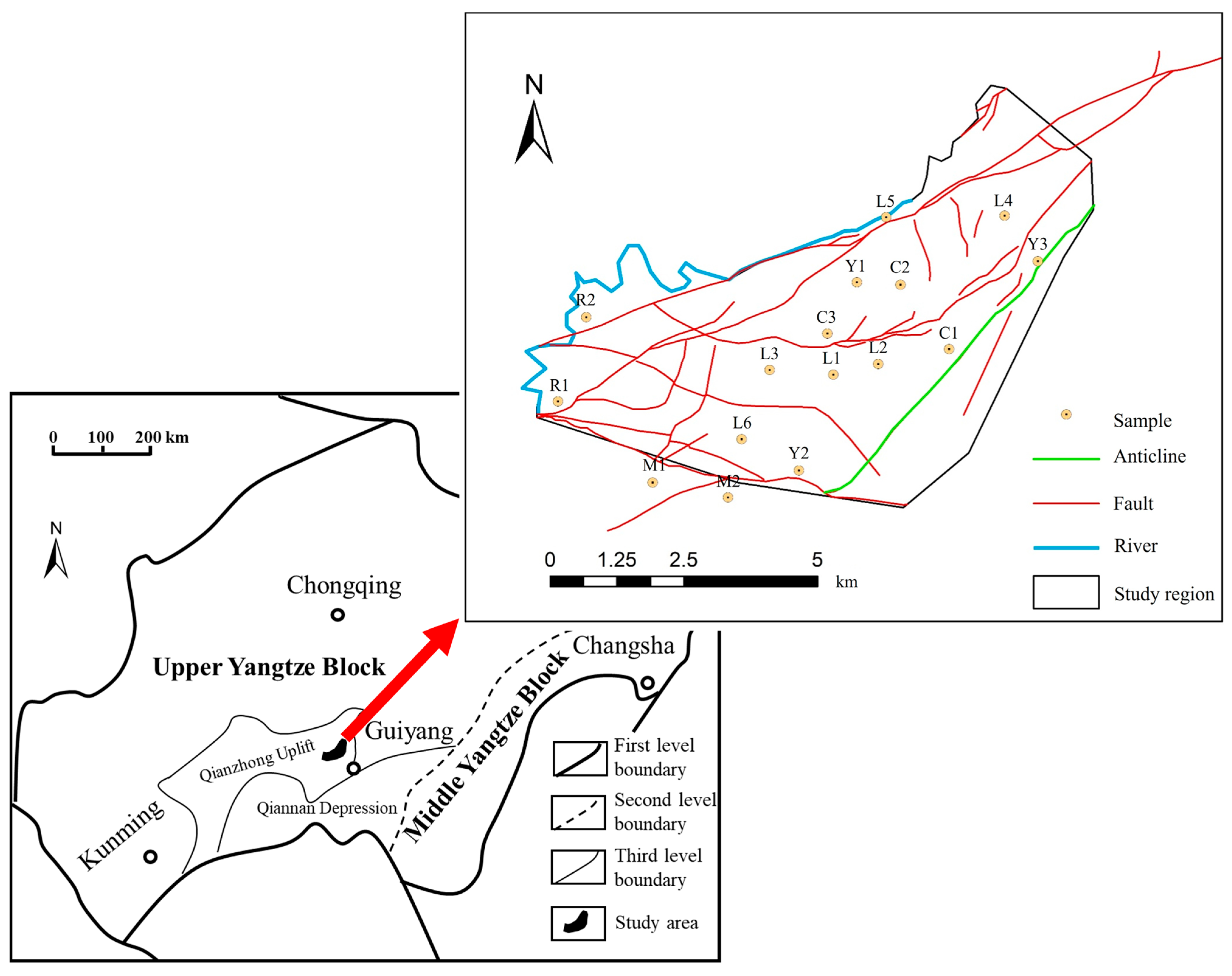
The Qinglong Coal Mine is located in the eastern part of Qianxi County, Guizhou Province, China, belonging to the Qianbei Coalfield in the hinterland of the “Qianzhong Uplift”. The Qianbei Coalfield lies on the southern margin of the Yangtze Block, at the junction of the Tethys tectonic domain and the coastal Pacific tectonic domain, adjacent to the Qiannan Depression on both its east and west sides [46,47]. Controlled by regional geological structures and lithology, the mine features a plateau low-mountain landform and has a subtropical warm and humid climate, with an average annual rainfall of 973.3 mm and an average annual temperature of 14.0 °C. The mine area’s topography is generally higher in the north and south and lower in the northwest. Exposed strata in the mine include carbonate rocks, Maocaopu Formation limestone, Yulongshan Formation limestone, and partial Changxing Formation limestone. Due to well-developed karst features (e.g., sinkholes, underground karst conduits, slopes, and gullies), surface water and groundwater in the mine have close hydraulic connectivity. The overall geological structure of the Qinglong Coal Mine is shown in Figure 1.
The strata exposed in the coal mine from old to new are: Middle Permian Maokou Formation (P2m), Upper Emeishan Basalt Formation (P3β), Longtan Formation (P3l), Changxing Formation (P3c), Triassic Inferior Yelang Formation (T1y), and Maocaopu Formation (T1m). The main coal-bearing stratum is P3l, whose thickness is 158.50~188.30 m.

2.2. Hydrogeological Profile

The largest water system in the coal mine is the Tuomei River on the northwest side, a tributary of the Wujiang River in the Yangtze River system, flowing from southwest to northeast. The average upstream flow rate is 3.35 m3/s, and the average downstream flow rate is 5.05 m3/s. The lowest erosion base level is in the Zhongzhai area, with an elevation of 1155 m [46].
As shown in Table 1, there are six aquifers in the Qinglong Coal Mine. From top to bottom, they are the T1m karst fissure aquifer, T1y karst fissure aquifer, P3c karst fissure aquifer, P3l fissure aquifer, P3β fissure aquifer, and P2m karst fissure aquifer.
The main coal mining layer is located within P3l, which serves as the direct water-filled source of the deposit. Subsequent research focuses on P3l, investigating the influence of its overlying aquifer. In addition, P3c and T1y are the direct aquifers of the coal mine roof and the direct water inrush source of the roof. For safety, groundwater in P3l has been drained during mining. This paper first describes the groundwater hydrogeochemical characteristics of the entire Qinglong Coal Mine aquifer system.

2.3. Data Collection

Based on the water filling situation of coal seam mining, three samples in T1y, three samples in P3c, six samples in P3l, two samples in P2m, and two Tuomei River samples were collected in the early stage of mine mining in 2014. A total of 16 hydrochemical samples were taken from hydrogeological boreholes, with sampling points shown in Figure 1. The sampling, preservation methods, and procedures of water chemical samples follow the national standard “Standard examination methods for drinking water—Collection and preservation of water samples” (GB/T5750.2-2006) [48]. For long-unused boreholes, groundwater was pumped first, and pH and electrical conductivity (EC) were monitored on-site until values stabilized before sampling to eliminate the influence of stagnant water. Samples were collected in 1000 mL polyethylene bottles as undisturbed groundwater for routine chemical analysis. All containers were rinsed with ultrapure water before use, and then rinsed three times with the target water samples. After collection, samples were immediately refrigerated at 4 °C and delivered to the laboratory for analysis on the same day. HCO3 was determined by titration, and Na+, Ca2+, and Mg2+ were determined by an inductively coupled plasma emission spectrometer. The anions Cl and SO42− were determined by ion chromatograph [49].
Sixteen groundwater samples are collected from five aquifers. As shown in Figure 1, Y1~Y3 were sampled from the T1y aquifer, C1~C3 from the P3c aquifer, L1~L6 from the P3l aquifer, M1~M2 from the P2m aquifer, and R1~R2 were sampled from the Tuomei river. Table 2 shows little difference in the ion content of different aquifer water samples. The dominant cations are Ca2+, Na+, Mg2+, while the dominant anions are HCO3, SO42−, Cl. For all samples, the average concentration of Ca2+ is 104.68 mg/L, while the maximum concentration was collected from the P3l aquifer. The concentration of Na+ ranges from 2.22 mg/L to 252.27 mg/L, with relatively high content in the fissure water of coal clastic rocks. The HCO3 concentration ranges from 100.05 mg/L to 388.01 mg/L, with an average of 187.82 mg/L. The average concentration of SO42− is 269.52 mg/L, with a steep increase near the main mine entrance in P3l. According to the Groundwater Quality Standard (GB/T14848-93) [50], SO42− concentrations exceeding 350 mg/L are classified as Class V that is unfit for drinking. So, groundwater in P3l is very likely to threaten the health of surrounding residents. The coal mine strata of Qinglong Coal Mine contain pyrite. It is inferred that the excessive SO42− concentration may be related to the oxidative dissolution of pyrite under the open conditions after mining.
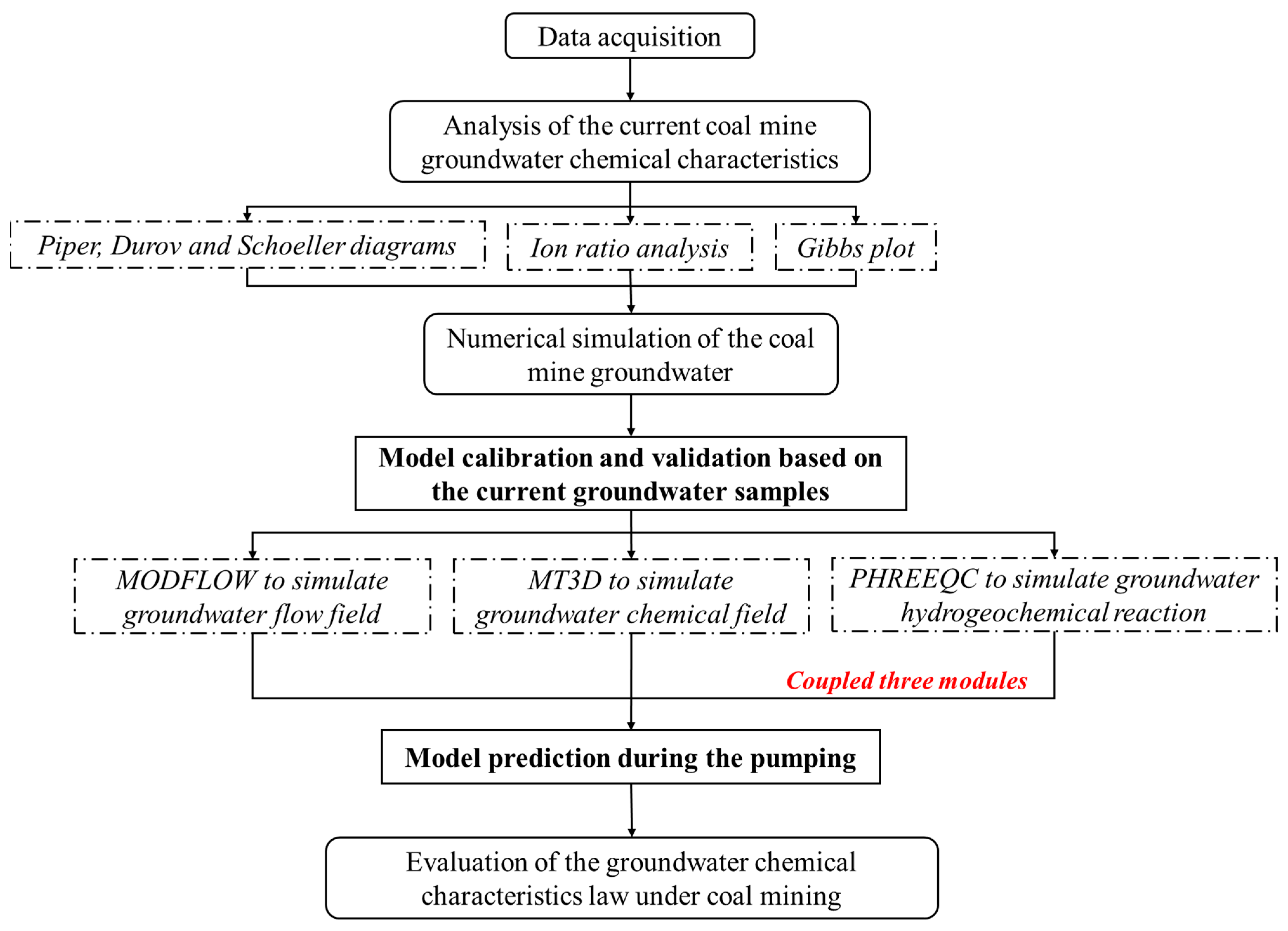
However, the above sampling points are sparse, and the data are limited. Only six samples were collected from the main aquifer P3l, and three samples each from T1y and P3c. This may lead to deviations in the simulated pollution migration scope when characterizing the spatial heterogeneity of aquifer hydrogeochemical parameters. Moreover, the lack of time-series monitoring data may introduce deviations in the initial simulation time, affecting the reliability of long-term hydrogeochemical effect predictions. Therefore, the current numerical model is more suitable as a preliminary tool for mechanistic discussion. For quantitative prediction and engineering decision-making, it is necessary to supplement monitoring data and quantify uncertainties. The technical route of this study is shown in Figure 2.

3. Groundwater Chemical Characteristics of Aquifer in Qinglong Coal Mine

3.1. Hydrochemical Types Analysis

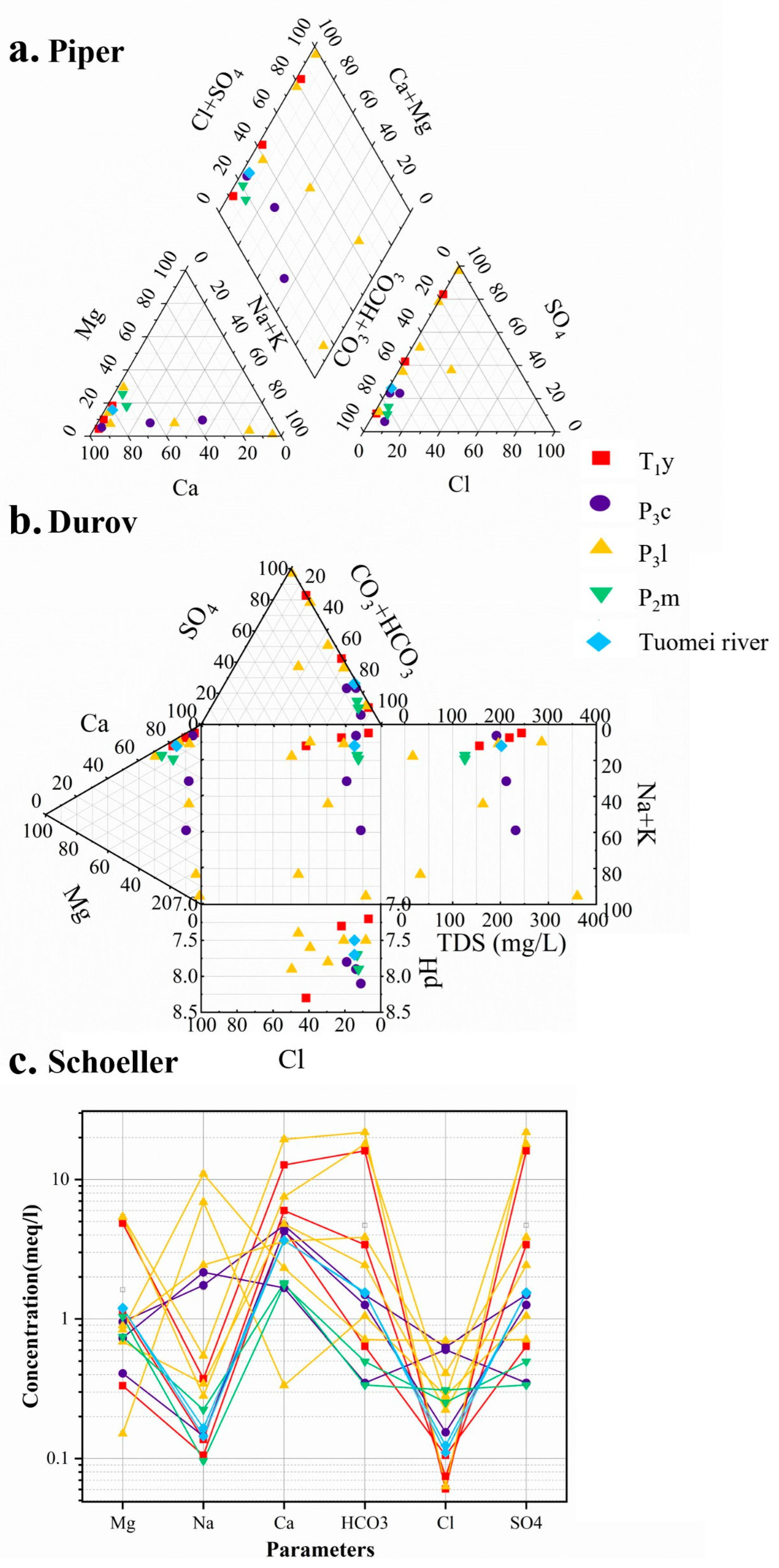
The characterization of groundwater chemical composition primarily relies on three hydrochemical diagrams. They are the piper trilinear diagram [51] for classification, the Durov diagram [52] for analyzing anion–cation relationship, and the Schoeller diagram [53] for examining ion trend and anomaly analysis. As shown in Figure 3, Ca2+ is the dominant cation in the T1y aquifer, P2m aquifer, and Tuomei River, while Na+ and Ca2+ dominate the P3c and P3l aquifers. HCO3 is the primary anion in the P3c, P2m aquifers and Tuomei River, with similar concentrations of the three major anions in other aquifers. Piper trilinear diagram (Figure 3a) shows P3l aquifer samples distributed across all partitions, indicating high variability in its chemical composition and vulnerability to external influences. Overall, Qinglong Coal Mine groundwater is characterized by alkaline earth metals and weak acids [54]. Durov diagram (Figure 3b) reveals decreasing Ca2+ and increasing Na+ concentrations in P3c and P3l aquifers, suggesting a potential hydraulic connection. The high SO42− concentrations in some T1y and P3l samples are likely from coal mining. Schoeller diagram (Figure 3c) confirms these characteristics, particularly the increase in Na+, SO42−, and decrease in Ca2+ in the P3l aquifer.

3.2. The Ion Ratio Analysis

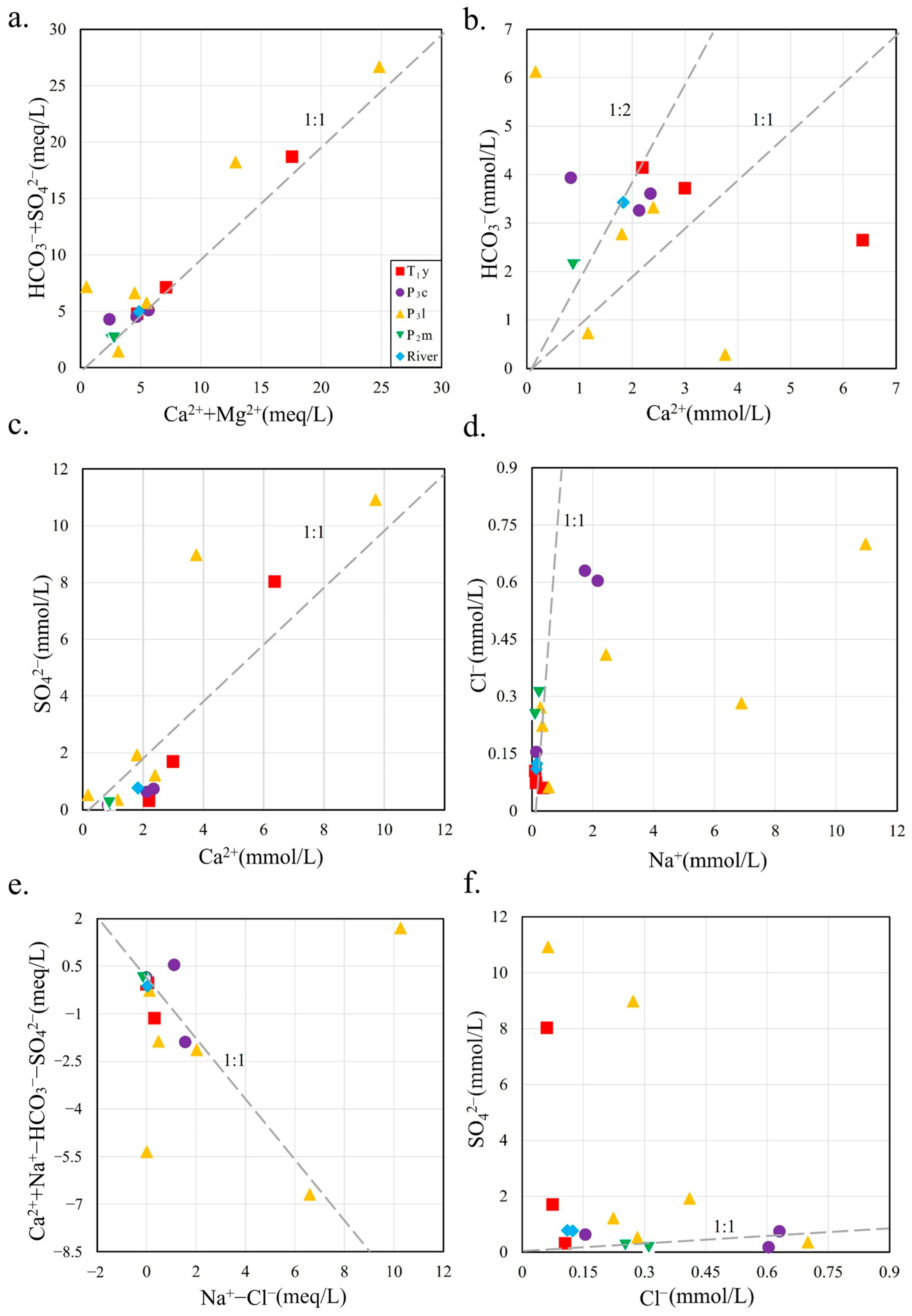
Ion ratio analysis assesses hydrochemical processes during groundwater formation and evolution to identify ion sources [55]. In Figure 4a, the milligram equivalents of Ca2++Mg2+ and (HCO3+SO42−) in all aquifers except P3l fits line 1:1 line, indicating their origin from carbonate and sulfate mineral dissolution [56]. The P3l aquifer likely has an additional SO42− source, e.g., the pyrite oxidative dissolution. For the relationship of Ca2+ and HCO3 in Figure 4b, most samples lie between the 1:1 and 2:1 lines, indicating the calcite dissolution [56]. The low HCO3 in P3l and T1y aquifers are possibly from carbonate precipitation or CO2 overflow. In Figure 4c, a 1:1 line means the source of SO42− and Ca2+ is gypsum dissolution [57]. But most of the samples are below the 1:1 line, suggesting cation exchange or desulfurization. Cation exchange is confirmed by Figure 4e. If the ratio of Ca2++Na+−HCO3−SO42− to Na+−Cl is close to −1, Na+ released from the rock can remove Ca2+ and Mg2+ dissolved in groundwater [58]. In Qinglong Coal Mine, the cation exchange occurs in groundwater with high Na+. Figure 4f indicates weak desulfurization because most samples are above the 1:1 line [59].

3.3. Gibbs Plot

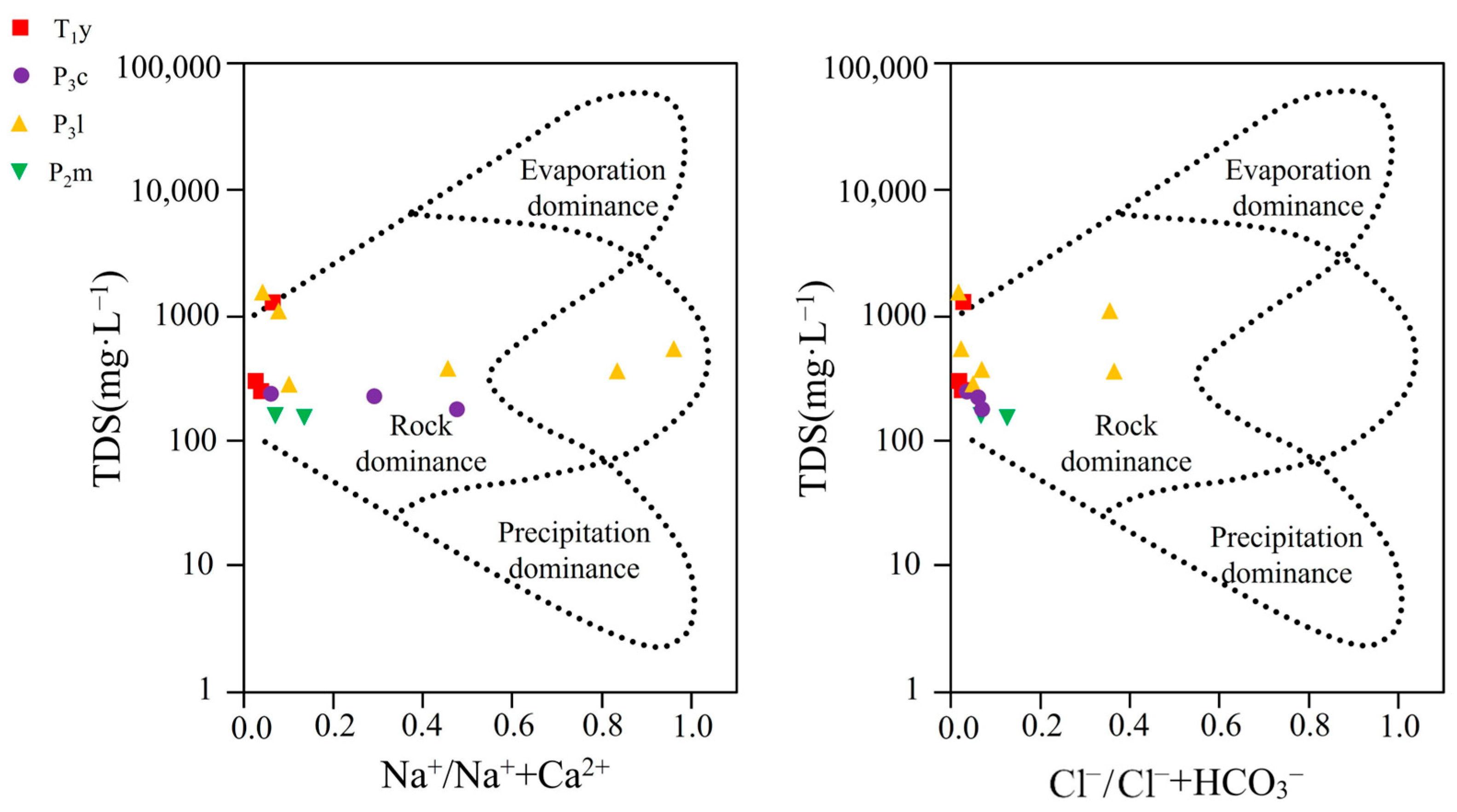
The Gibbs graphical method visually distinguishes dominant controlling processes of groundwater chemistry [60], with main factors including evaporation, atmospheric precipitation, and water–rock reactions. Figure 5 shows that T1y, P3c, and P2m are all controlled by water–rock reactions, where Cl/(Cl+HCO3) values are all below 0.5. In the T1y aquifer, the average value of Na+/(Na++Ca2+) is 0.028. The TDS of individual sample points exceeds 1000 mg/L. Average value from the P3c aquifer of Na+/(Na++Ca2+) is 0.312, and TDS ranges from 100 to 500 mg/L. In the P2m aquifer, the average value of Na+/(Na++Ca2+) is 0.092, and TDS ranges from 100 to 300 mg/L. P3l aquifer samples are mainly in the water–rock reaction, with scattered samples migrating to the evaporation zone. The TDS near the pumping well exceeds 1000 mg/L, with scattered samples migrating to the evaporation zone.

4. Groundwater Numerical Model of Qinglong Coal Mine

Groundwater chemical analysis reveals anomalous compositional changes in P3l. Mining activities have degraded the groundwater environment in the mine area. Considering the distribution of strata and aquifers in the study area, P3l is the direct host layer of the main coal seam and the core research target for the numerical model. P3c acts as the direct aquifer above the coal seam roof. The water-conducting fissure zone here is breached, serving as the primary channel for roof water inrush, with its hydrochemical response closely tied to mining operations. Although locally confined by aquicludes, sufficient fault displacement allows P3c and T1y to form hydraulic connections with P3l via faults. T1m is distant from the main coal seam, separated by two major aquicludes within T1y, leading to weak hydraulic connectivity with the underlying aquifers. Beneath P3l, both P3β and P2m are deeply buried. Mine pumping data show weak hydraulic connectivity with P3l, and mining has little impact on their hydrochemical fields. Therefore, to investigate groundwater chemistry evolution under mining conditions, numerical simulations of groundwater flow and hydrochemical fields were performed for the main mining layer P3l and its overlying aquifers P3c and T1y. The simulations focus on mining-induced flow field changes and analyze the evolution patterns and hydrogeochemical effects of six major ions. This study employs the MODFLOW [61], MT3D [62], and PHREEQC [63] modules to solve the model.

4.1. Numerical Method

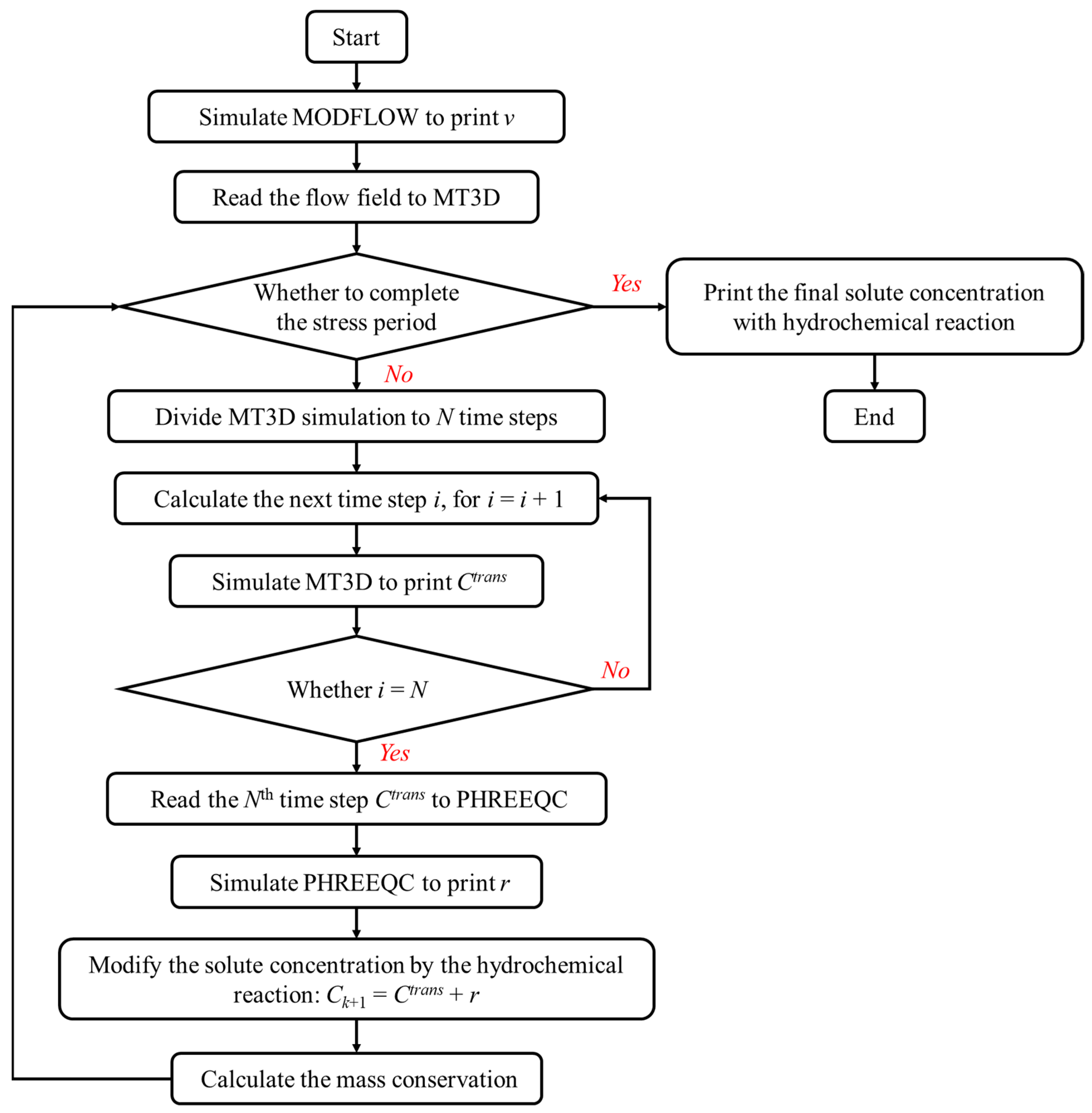
To couple the three modules, MODFLOW is used to solve the groundwater flow equation. The outputs are the groundwater velocity and groundwater head distributions. The physical dynamic field of groundwater transport is constructed. Based on the flow field, MT3D is applied to solve the physical transport process of solutes through the convection–dispersion equation. It obtains the solute concentration only considering the physical transport effect. PHREEQC takes the transport concentration as the initial condition to calculate the concentration change caused by equilibrium reaction (e.g., mineral dissolution, ion exchange) and kinetic reaction (e.g., biodegradation). Finally, the concentration after reaction is fed back to MT3D as the initial concentration of the next time step.
The groundwater flow obeys Darcy’s law. In MODFLOW, the formula is [61]
K h = S * M h t q s
Here, ∇ is the gradient. K (m/d) is the permeability coefficient. h (m) is groundwater head. S* is the storativity coefficient. M (m) is the thickness of the aquifer. t (d) is the time. qs (d−1) is the volumetric flow rate per unit volume of aquifer representing fluid sources (positive) and sinks (negative).
The solute transport refers to Ficken’s law. In the MT3D module, it is as follows [62]:
θ C t = θ D C θ v C + θ q s C s C + θ r
Here, θ is the porosity. C (mg/L) is the total concentration of solute in the aquifer. D (m2/d) is dispersion. v (m/d) is the flow velocity that v = Kh. Cs (mg/L) is the concentration of solute in the source and sink. r (mg/(L·d)) is the source and sink term of hydrochemical reaction, which is the key to the PHREEQC module. The r can be expressed as [63]
r = 0 t k r f C , T , p H d t
Here, kr is the reaction rate constant whose unit depends on the specific reaction types. f(C, T, pH) is the rate influence function, which reflects the regulation of concentration, temperature, and pH on the reaction rate.
In order to couple MODFLOW, MT3D, and PHREEQC modules, it should calculate the physical transport concentration of the solute Ctrans [62]:
C t r a n s = C k + L C k + 1 2 Δ t
Here, Ck (mg/L) is the initial concentration of solute at the kth time step. L (mg/L) is the spatial differential operator of solute at the time step k + 1/2. Δt (d) is the time step length. Then, the solute concentration would be modified by the hydrochemical reaction [63]:
C k + 1 = C t r a n s + r
The solute concentration coupled with PHREEQC is finally presented as Ck+1, which means that the concentration at the k + 1th time step is based on the physical transport concentration at the kth time step and the concentration change caused by the hydrochemical reaction. Finally, it should obey the mass conservation [63]:
t q s C s d t = t q s C d t + g r i d θ V C t r a n s + g r i d θ V r
Here, V (L) is the grid volume. ∑grid is the sum of all grid internal terms.
The Newton-Raphson iteration method is used to solve Formula (6). All three modules have the same stress period. Traditionally, the time step length of PHREEQC is set to be consistent with that of MT3D. It means that PHREEQC calculations are performed immediately after each MT3D step. While it reduces the operator splitting error, it results in excessive computational load. Hence, the time step length of PHREEQC is set to the product of the number of time steps and the time step length of MT3D. For example, MT3D completes N time steps to calculate Ctrans at the Nth time step. PHREEQC then performs one reaction modification to improve the computational efficiency. The coupling steps are shown in Figure 6.

4.2. Groundwater Flow Field Simulation

4.2.1. Conceptual Model

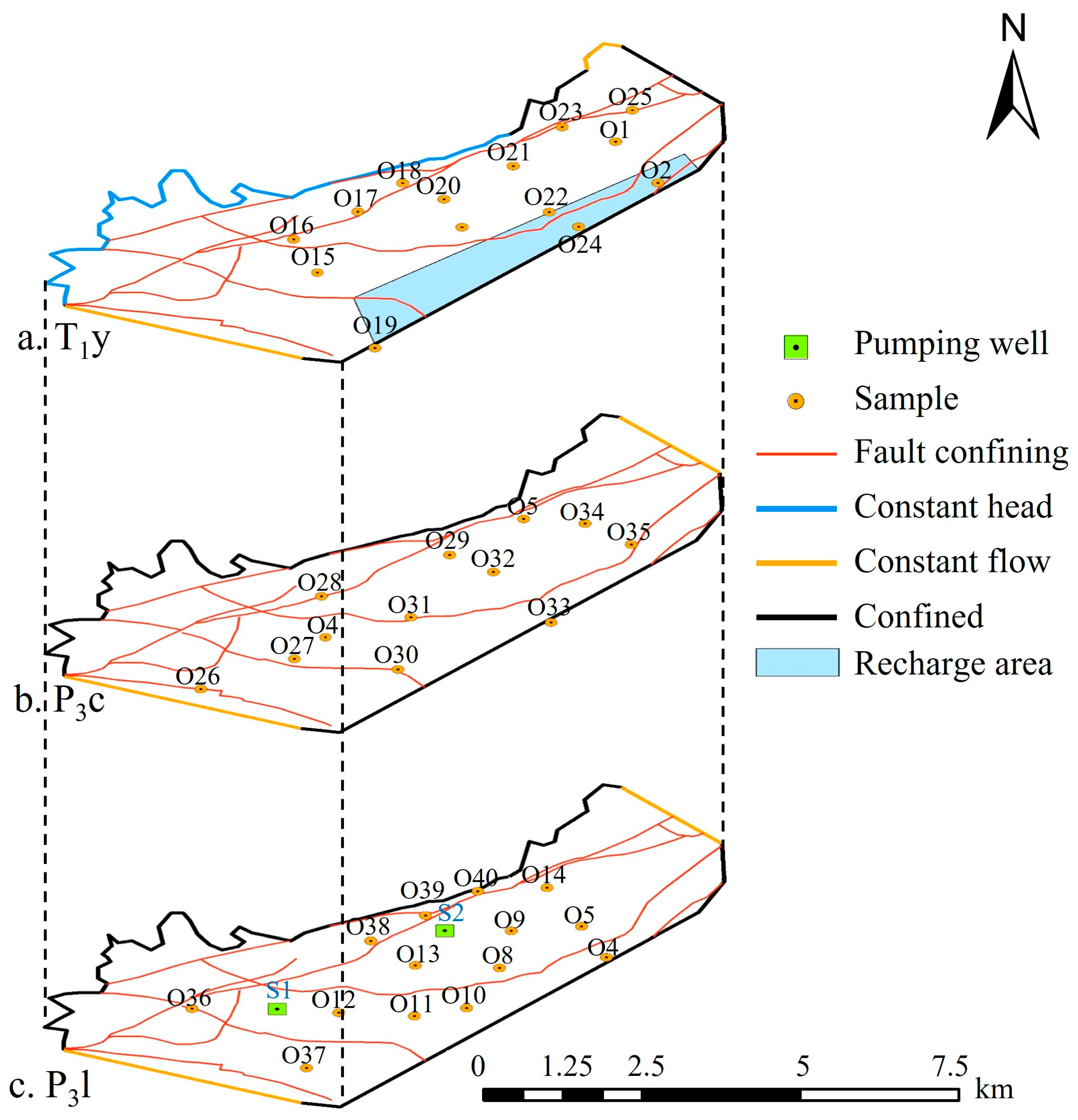
The hydrogeological conditions of Qinglong Coal Mine are complex, with numerous faults and folds and well-developed karst fissures. Combined with the mining area conditions, a conceptual model is established as shown in Figure 7. The southeast of the coal mine is the core of the Gelaozhai anticline, which is defined as an impervious boundary. The F1 fault in the northeast penetrates the three layers and is treated as a constant flow boundary. The northern section of T1y is influenced by multiple faults and the lowest erosion surface of the Tuomei River. The portion within the Tuomei River basin is defined as a constant head boundary with an elevation range of 1158 m to 1220 m. The northwest side is set as a constant flow boundary. Additionally, the F3 fault on the western side of the mine penetrates P3c and P3l, so the western boundaries of these two aquifers are defined as constant flow boundaries. Based on drilling data, the boundary outflow is set to 0.1 m3/d per cell. The T1y aquifer is partially exposed and receives recharge from atmospheric precipitation. Pumping wells are arranged in P3c Mining Area 2 and Mining Area 4, respectively. Since the aquifer is of karst fissure type, the numerical model adopts an equivalent porous medium approach, which may not fully resolve individual karst conduits. The model, therefore, generalizes eight fissures through the aquifer. The permeability coefficient K is set to 100 m/d to simulate the main fissures and water-conducting channels.
The hydrogeological parameters of the coal mine refer to [19] as shown in Table 3. Here, T (m2/d) is transmissivity. R is the recharge rate. Other parameters are the same in Formulas (1) and (2).

4.2.2. The Original Groundwater Flow Field

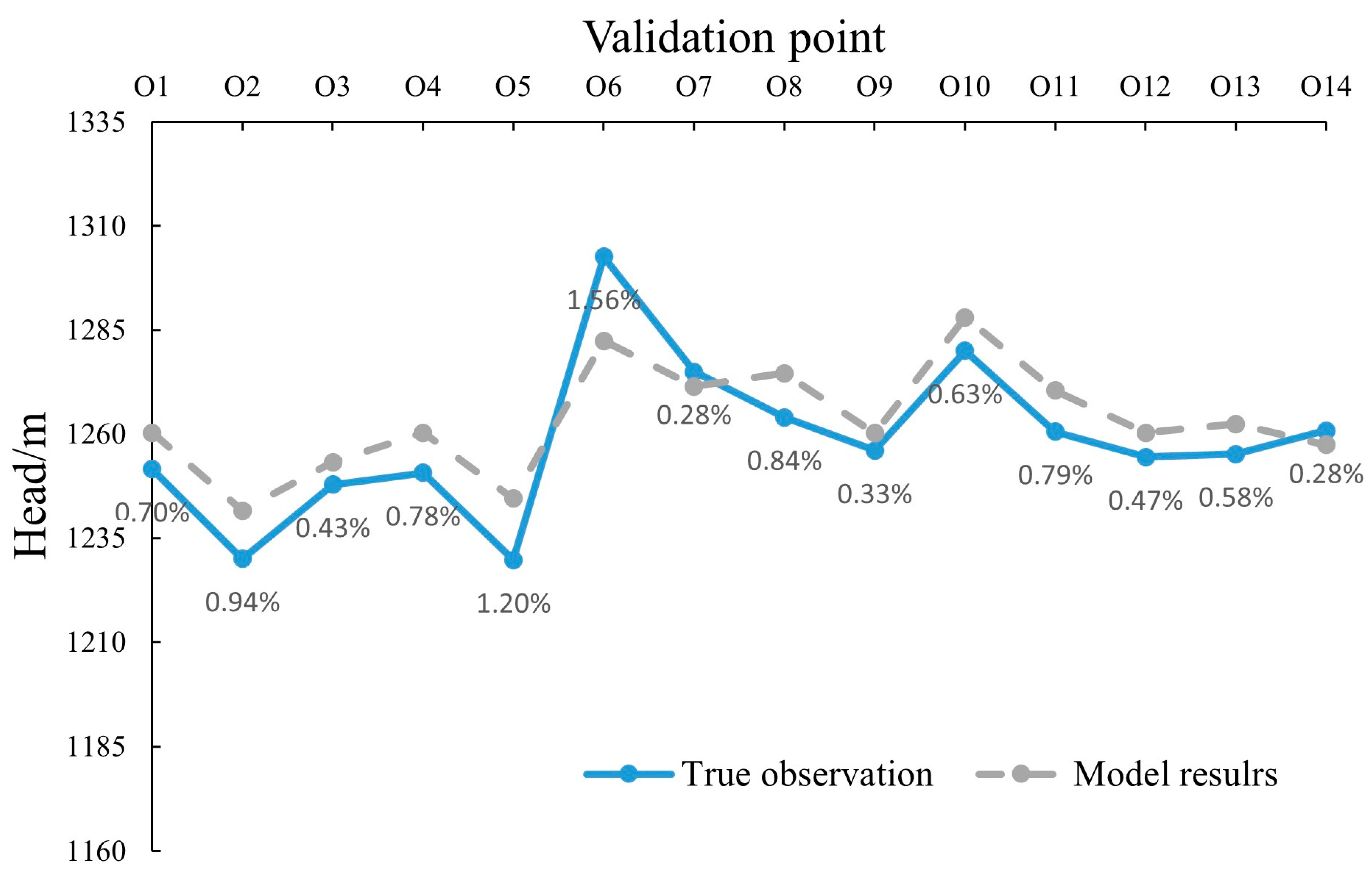
The aquifer system is defined as a three-dimensional, isotropic, steady-flow confined aquifer system with local water-conducting fissures. The model is divided into 173 rows and 208 columns. A groundwater flow field model is established using 40 groundwater head observation points. Fourteen of these points are used for model validation, and 26 for model calibration. The MODFLOW module is used to solve the mathematical model and obtain the original groundwater flow field in the mining area before mining. Three indicators, Root Mean Squared Error (RMSE), Mean Relative Error (MRE), and Coefficient of Determination (R2), are employed to evaluate the prediction performance of the model. The RMSE and R2 of the model are 9.88 and 0.807, respectively. The MREs of all validation observation points are less than 1.5%, as shown in Figure 8. Therefore, the model has good prediction performance.
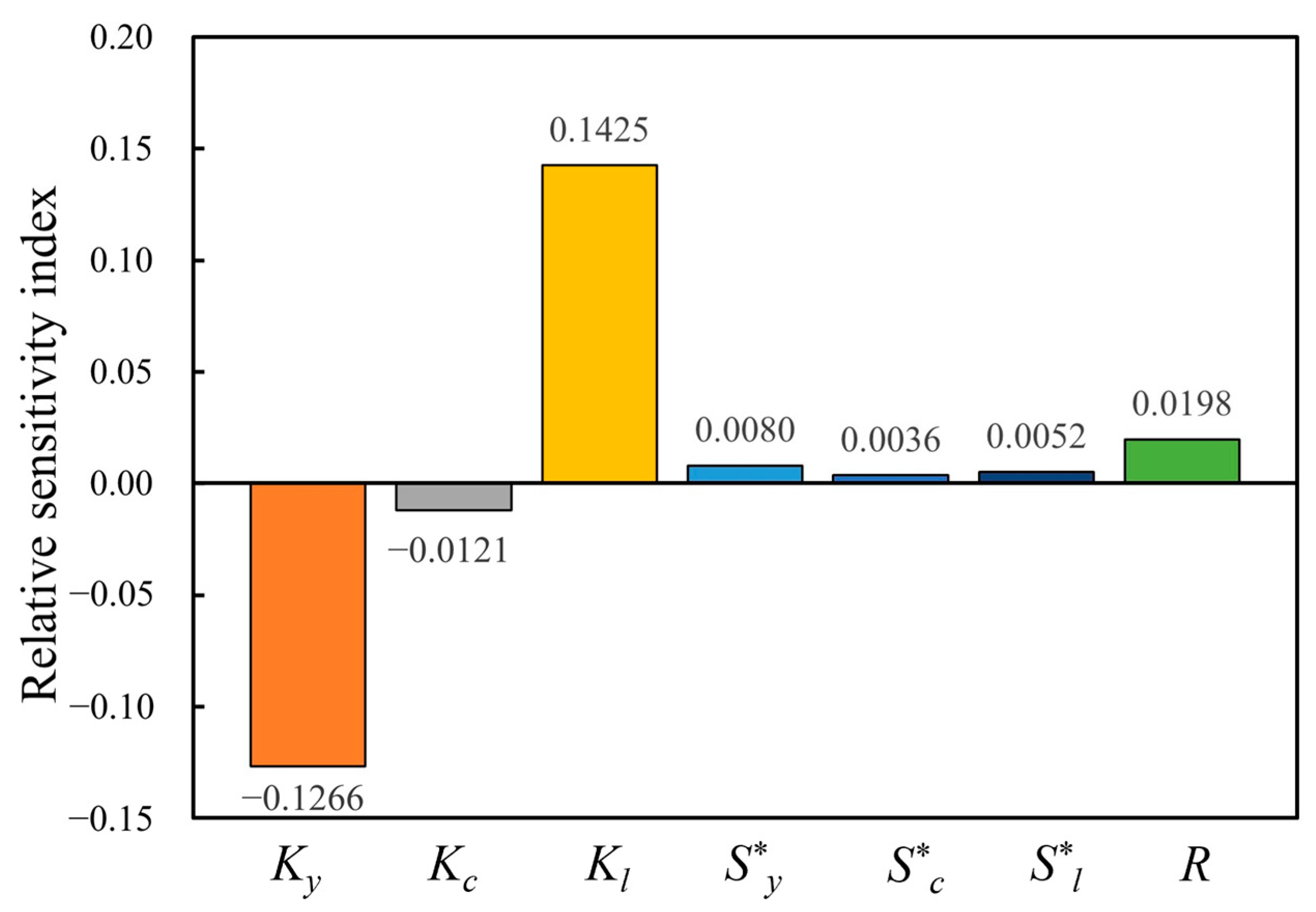
Perturbation analysis was used to evaluate the sensitivity of key hydrogeological parameters in the model, as shown in Figure 9. Model parameters were taken as baseline values with a variation range of ±80% [64,65]. The permeability coefficient and storativity coefficient of three aquifers, as well as the recharge rate in the T1y aquifer, a total of seven parameters were adjusted by ±20%, ±40%, ±60% and ±80% from the baseline values. The subscripts y, c, and l represent T1y, P3c, and P3l, respectively. The MODFLOW numerical simulation program was used to calculate the groundwater flow, and the cumulative number of runs of the model was 7 × 8 = 56. The simulation was on a personal computer with a 12th Gen Intel(R) Core(TM) i7-12700H, 2.30 GHz processor. MODFLOW executed one flow model, approximately requiring 68 s. The results indicate that the permeability coefficient K of the P3l aquifer has the highest sensitivity. The storativity coefficient obtains the lowest sensitivity. Moreover, the recharge rate in the T1y aquifer has a slightly higher sensitivity than the storativity coefficient.
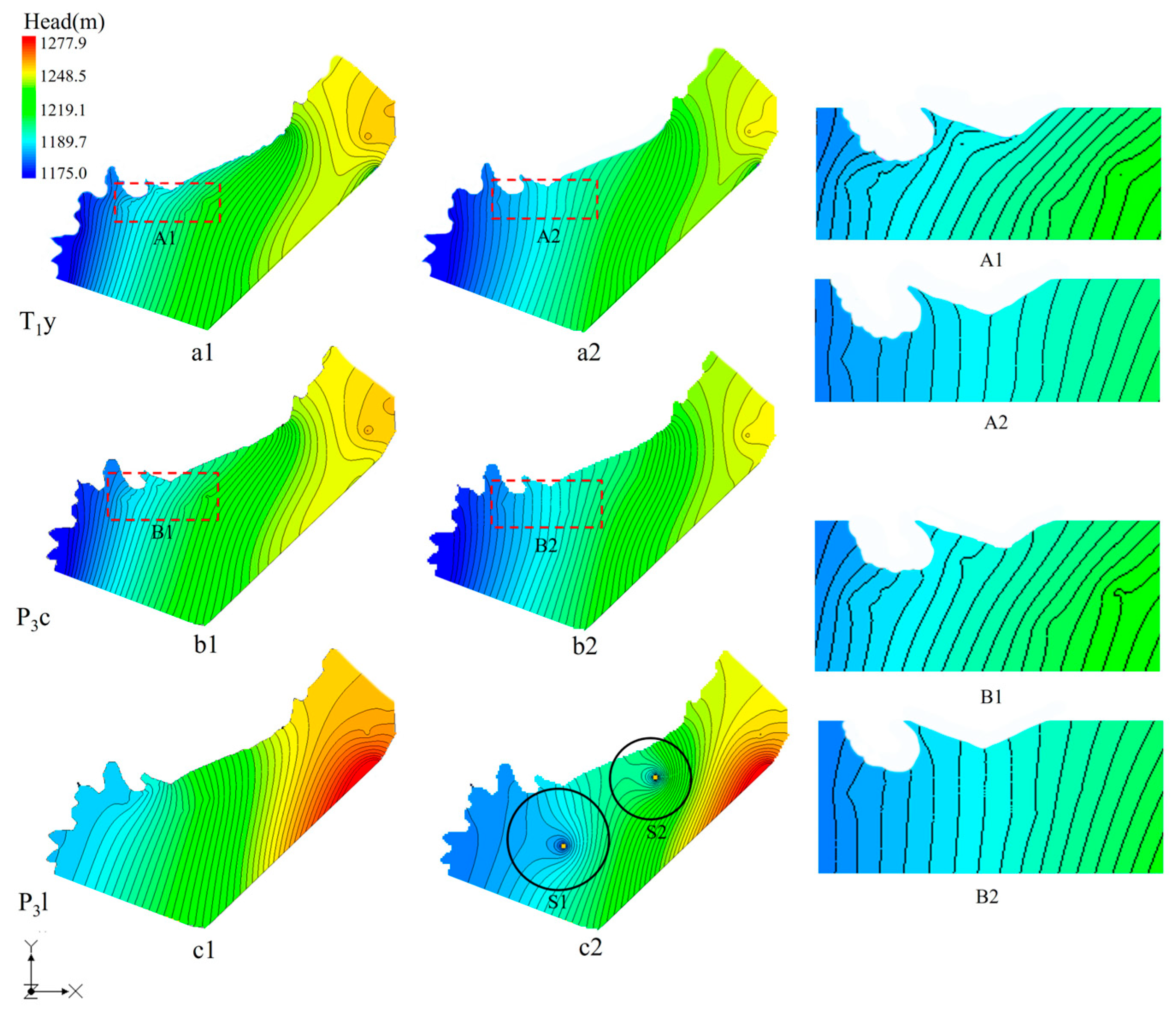
The initial groundwater flow field of the coal mine is shown in the first column of Figure 10. Before mining, groundwater flows from east to northwest, consistent with the coal mine’s topographic and tectonic controls. The highest groundwater head occurs near the anticline, while the lowest head is observed near the Tuomei River. A small watershed exists in the middle of the coal mine, directing groundwater flow to the northwest and north, respectively. Local groundwater head mutation points appear due to the connection of some fissures, as shown in Figure 10(A1). The flow fields of T1y and P3c are similar. The head mutation in the eastern part of P3l is more obvious than that in the overlying aquifers, as shown in Figure 10(B1).

4.2.3. The Analysis of Groundwater Flow Field Evolution

The calibrated and validated results confirm that the groundwater flow model can be used to simulate the groundwater flow field changes during the mining process with pumping. Based on the initial flow field, two pumping wells are operated at 800 m3/d to simulate the mining conditions.
The groundwater flow field after pumping is shown in the second column of Figure 10. The groundwater heads of the three aquifers decrease significantly, with the P3l aquifer showing the most obvious decline. The hydraulic gradient along the southwestern boundary of P3l decreases from 0.024 to 0.020. The highest groundwater head on the southeastern boundary drops to 1278.1 m. It enhanced river recharge from pumping limits head decline along the northwestern boundary, where the average hydraulic gradient change is only 0.00024. Potential leakage recharge may occur through numerous fissures in this zone. Pumping also creates a local groundwater divide in central P3l. The eastern boundary experiences reduced flow velocity with an increased hydraulic gradient of 0.0015, and head drops exceeding 30 m. The O14 well in the study area has the largest drawdown at 19.24 m, while the O16 well has the smallest at 7.11 m. Drawdown of the remaining observation wells ranges from 8.89 m to 17.2 m, with an average of 13.62 m. Additionally, depression cones form around both pumping wells as shown in Figure 10(c2). The average groundwater head decrease within these cones is 60.31 m, and the maximum influence radius of P3l is about 1100 m, as shown in the black circle of Figure 10(c2). The central head within the depression cone drops more than 75 m. The overlying P3c and T1y aquifers are less affected by pumping, though drawdown occurs at fissure-connected locations, particularly near the eastern anticline. Influenced by river recharge and atmospheric precipitation, T1y is less affected by pumping and maintains a relatively stable groundwater flow field. Local head anomalies in T1y and P3c between the pumping wells also diminish or disappear, as shown in Figure 10(A2,B2).
The results show that the mining-induced pumping alters groundwater flow directions. Combined with Fick’s law, it will also affect the distribution of ions in groundwater. It is easy to cause groundwater pollution and affect the groundwater environment of coal mines.

4.3. Groundwater Chemical Field Simulation

4.3.1. The Initial Groundwater Chemical Field

Based on the groundwater flow model and Table 2 data, Kriging interpolation is conducted on the main ion concentrations of the three aquifers. Concentration values for each region and boundary are defined using the interpolation results. The boundaries are free boundaries, allowing ions to enter and exit per the convection–dispersion equation. A groundwater solute transport model for Qinglong Coal Mine is established with 12 hydrochemical samples. Eight samples are used for model calibration and four for validation, with the simulation period consistent with that of the flow model.
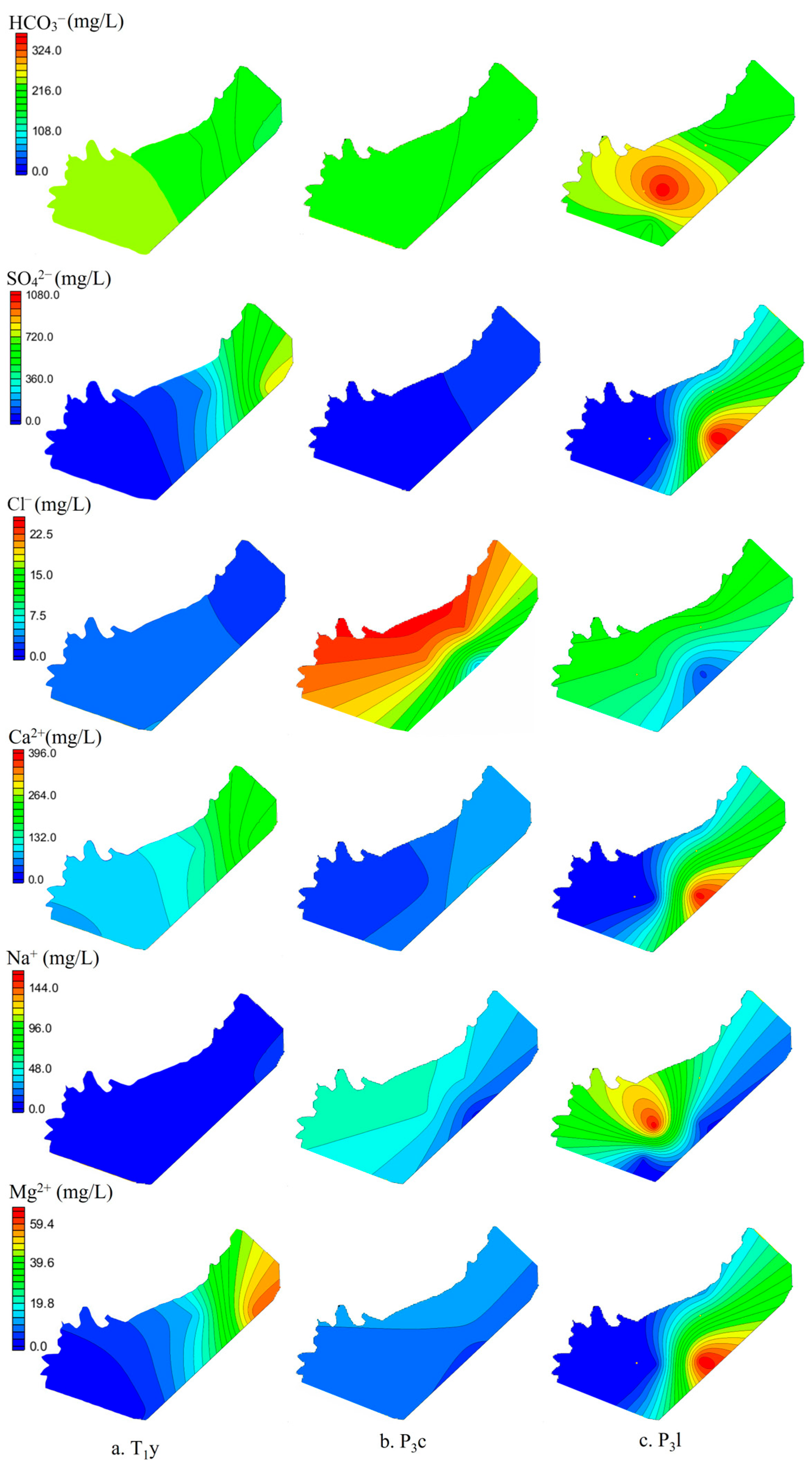
Figure 11 depicts the migration of main anions (HCO3, SO42−, and Cl) and cations (Ca2+, Na+, and Mg2+) in groundwater. The ion distribution of the T1y aquifer (first column of Figure 11) is strongly correlated. All ions except Cl increase in concentration from southwest to northeast, while Cl shows the opposite distribution. Among the six ions, Na+ concentration is extremely low. The concentration of SO42− in the P3c is lower than that in the roof and floor aquifers. All ions except Ca2+ exhibit high concentrations in the northwest and low concentrations in the southeast, with Ca2+ showing the reverse trend. Ion concentrations in P3l are significantly higher than in the other two aquifers, with SO42− increasing most prominently. This may be associated with coal mining disturbance of pyrite-containing strata.

4.3.2. The Analysis of Groundwater Chemical Field Evolution

Ion concentration distribution is closely related to the groundwater flow field [64]. Slow groundwater circulation leads to ion enrichment in low-velocity areas. Rapid flow dilutes ion concentrations. The groundwater solute transport model for Qinglong Coal Mine is established based on the groundwater flow model. The spatial distribution of six major ions (HCO3, SO42−, Cl, Ca2+, Na+, and Mg2+) is used as the initial concentration.
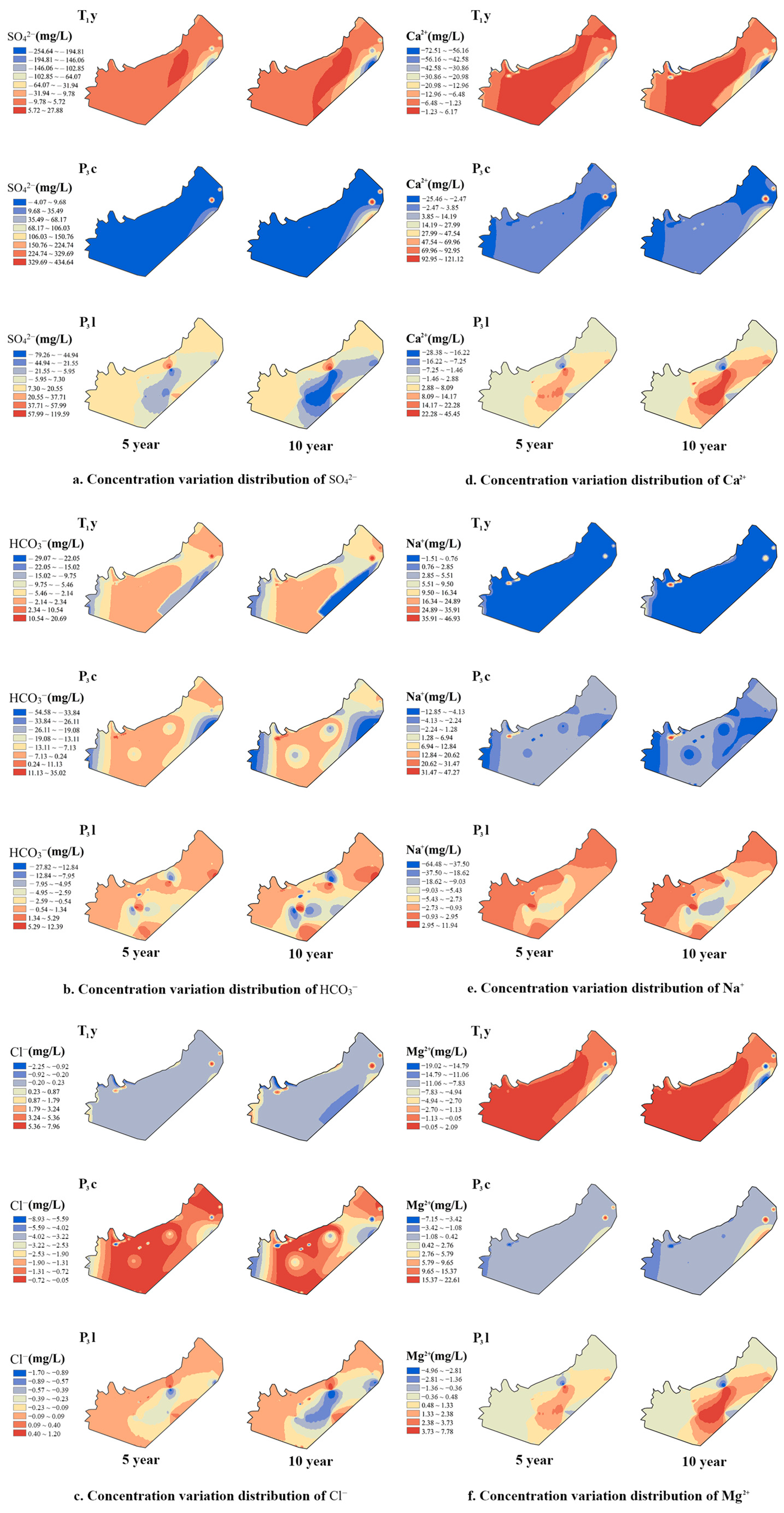
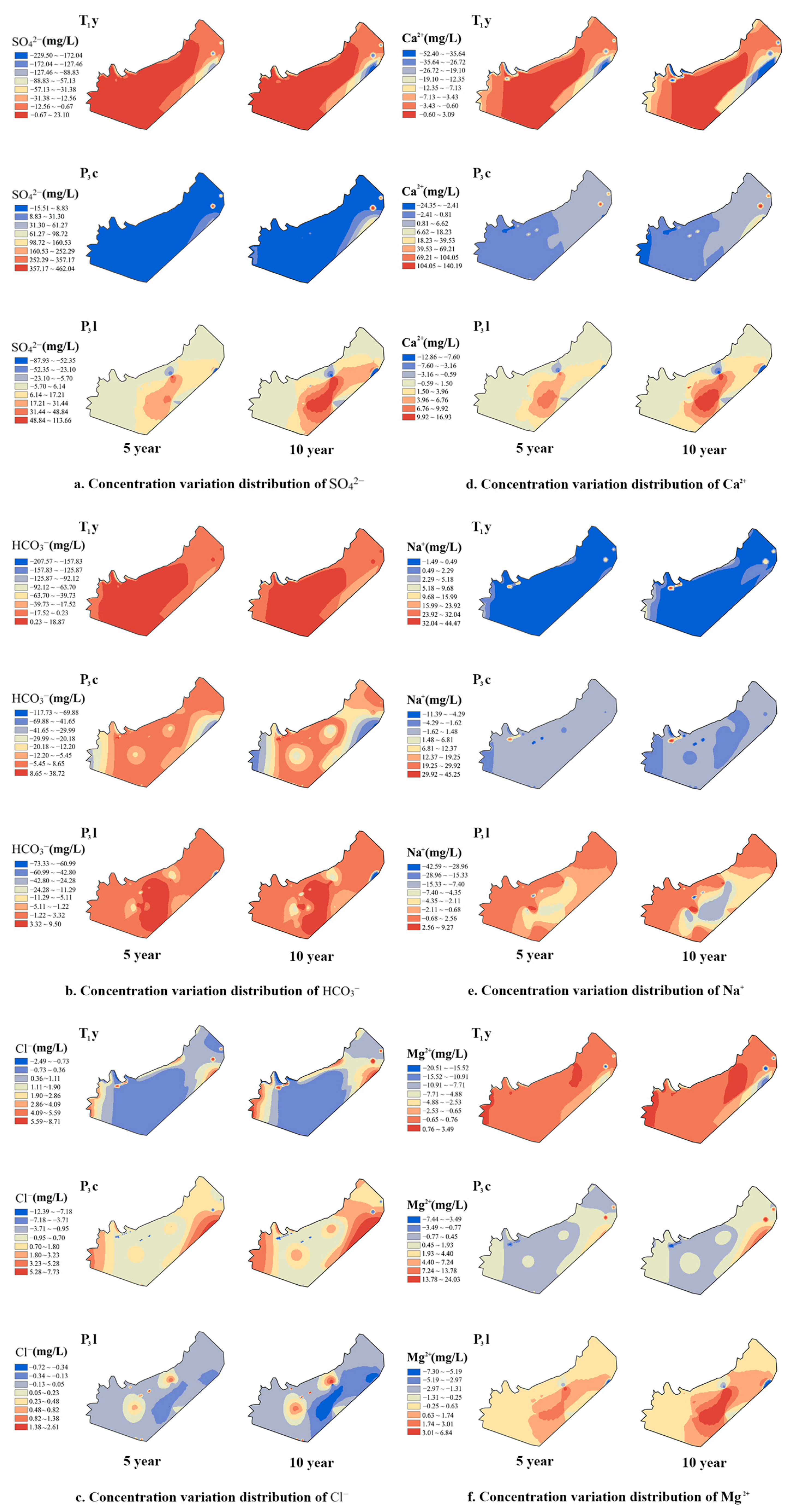
Figure 12 shows the concentration differences in three anions (HCO3, SO42−, and Cl) and three cations (Ca2+, Na+, and Mg2+) under pumping. During pumping, all six ions migrate toward the pumping wells. Groundwater flow increases the hydraulic gradient near the wells. This also raises the concentration gradient of these ions. Thus, ion distribution across the aquifers shows consistent spatial evolution patterns.
In the P3l aquifer, Cl, Na+, and HCO3 concentrations decrease near the pumping wells. In contrast, Ca2+, Mg2+, and SO42− concentrations increase. SO42− increases by more than 69 mg/L. In the P3c aquifer, HCO3 concentration decreases significantly. Initial Cl concentration (15~22.5 mg/L) is higher than in other aquifers and decreases over time. Na+ and Mg2+ concentrations change gently. Other ions remain relatively stable. The F1 fault penetrates both P3c and P3l aquifers, creating local hydraulic connectivity between them and causing abnormal changes in HCO3 concentration. All ions in the T1y aquifer show a decreasing trend, with SO42− decreasing most notably. Mg2+ has an initial local high-concentration region (50~59.4 mg/L) that expands slightly over time. Cl and Na+ show limited changes.
Overall, ion distribution in the three aquifers is influenced by the constant head boundary on the southwest side. Pumping increases hydraulic gradient and flow velocity, accelerating the groundwater renewal cycle and reducing most ion concentrations. The southeast boundary of the three aquifers is impervious. During pumping, ion concentrations here decrease with falling groundwater heads. A key exception is SO42−. Its concentration increases due to mining activities, which change the underground environment from reductive to oxidative and release SO42− from sulfur-containing coal strata.

4.4. Groundwater Hydrogeochemical Reaction Simulation

4.4.1. The Settings of the PHREEQC Model

The PHREEQC module is coupled with the MT3D model to simulate hydrogeochemical reactions under pumping. In the simulation, the southeast anticline is set as an inflow boundary, following the groundwater flow direction. The western and northeastern sides are treated as outflow boundaries. Possible mineral phases and hydrogeochemical reactions include calcite, cation exchange, and pyrite oxidation. Parameters of water samples involved in the hydrochemical simulation are input into the model. Simulation results of coupled reaction transport are combined with those of pure solute transport (MT3D).

4.4.2. The Analysis of Groundwater Hydrogeochemical Characteristics Evolution

Comparison of simulation results shows ion concentrations in the three aquifers are higher than those from MT3D simulations. All ions in P3l accumulate near the pumping wells. In P3c, HCO3 concentrations decrease near the pumping wells. Both T1y and P3c aquifers show local concentration anomalies due to fissure influence. The results indicate ion impacts around pumping wells are more pronounced when hydrogeochemical reactions are considered. Coal mining changes the underground environment from reducing to oxidizing [22]. This causes pyrite oxidation [15], leading to increased SO42− concentration as shown in Figure 13a. This difference confirms that hydrogeochemical reactions significantly affect ion distribution, which MT3D fails to capture.
Our findings align with those of Zhan et al. [4]. Focusing on deep coal mining in western China, Zhan et al. [4] integrated 218 water sample data points and long-term hydrodynamic monitoring records. Hierarchical clustering, ion ratio analysis, and wavelet analysis were employed. The hydrochemical evolution mechanisms of multilayer aquifer systems under mining influence were systematically investigated. Zhan et al. [4] revealed that mining activities promote the development of water-conducting fissure zones and changes in the redox environment. These are the main reasons for the significant increase in SO42− concentration, which is consistent with our coupled simulation results. Therefore, we hypothesize that pumping enhances groundwater circulation, which promotes oxygen transport. This further aggravates pyrite oxidation in the P3l aquifer. The specific chemical reaction formula is as follows:
F e S 2 ( s ) + H 2 O + O 2 F e 2 + + 2 S O 4 2 + 2 H +
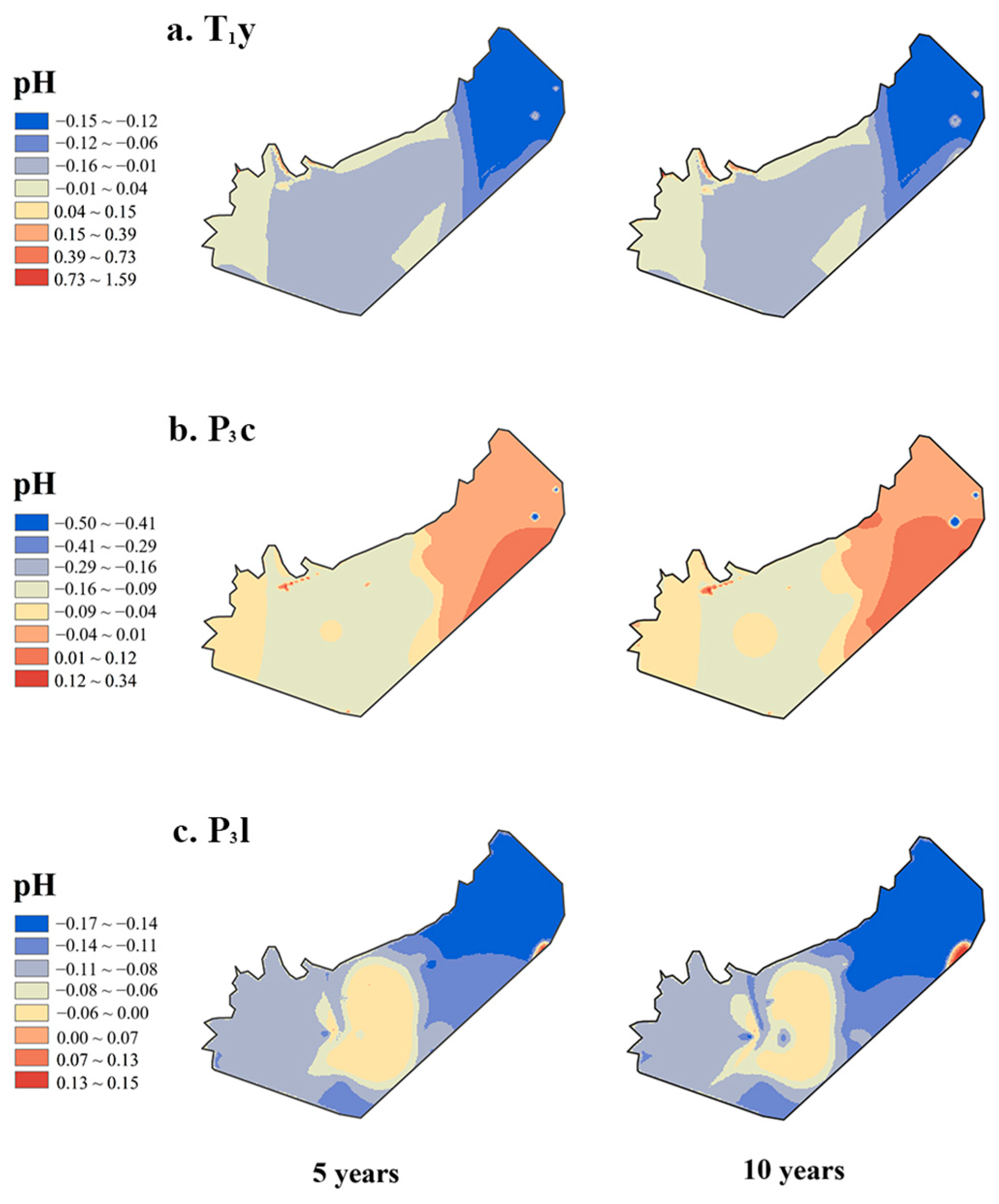
Zhan et al. [4] revealed the spatiotemporal variations in hydrodynamic information using wavelet analysis. It further quantifies the hydrochemical response process triggered by hydrodynamic changes through a coupled model. It is found that altered hydrodynamic conditions serve as the premise for hydrochemical evolution. The shift in redox conditions is responsible for the water quality deterioration. Pyrite undergoes continuous oxidation, driving the reaction forward. This increases SO42− concentration in groundwater. It also raises H+ content in the water, which is another key reaction captured by PHREEQC. Zhou et al. [42] supplemented this finding by studying SO42− increases from artificial iron sources, such as mine steel components (e.g., anchor bolts). They noted that a dual source system of pyrite and steel equipment promotes mutual enhancement. This further aggravates acid and sulfate release. It also indicates the actual SO42− concentration in P3l may be higher than our coupled simulation predicts, which only considers pyrite oxidation. Subsequently, groundwater acidity increases and pH decreases as shown in Figure 14, leading to groundwater acidification.
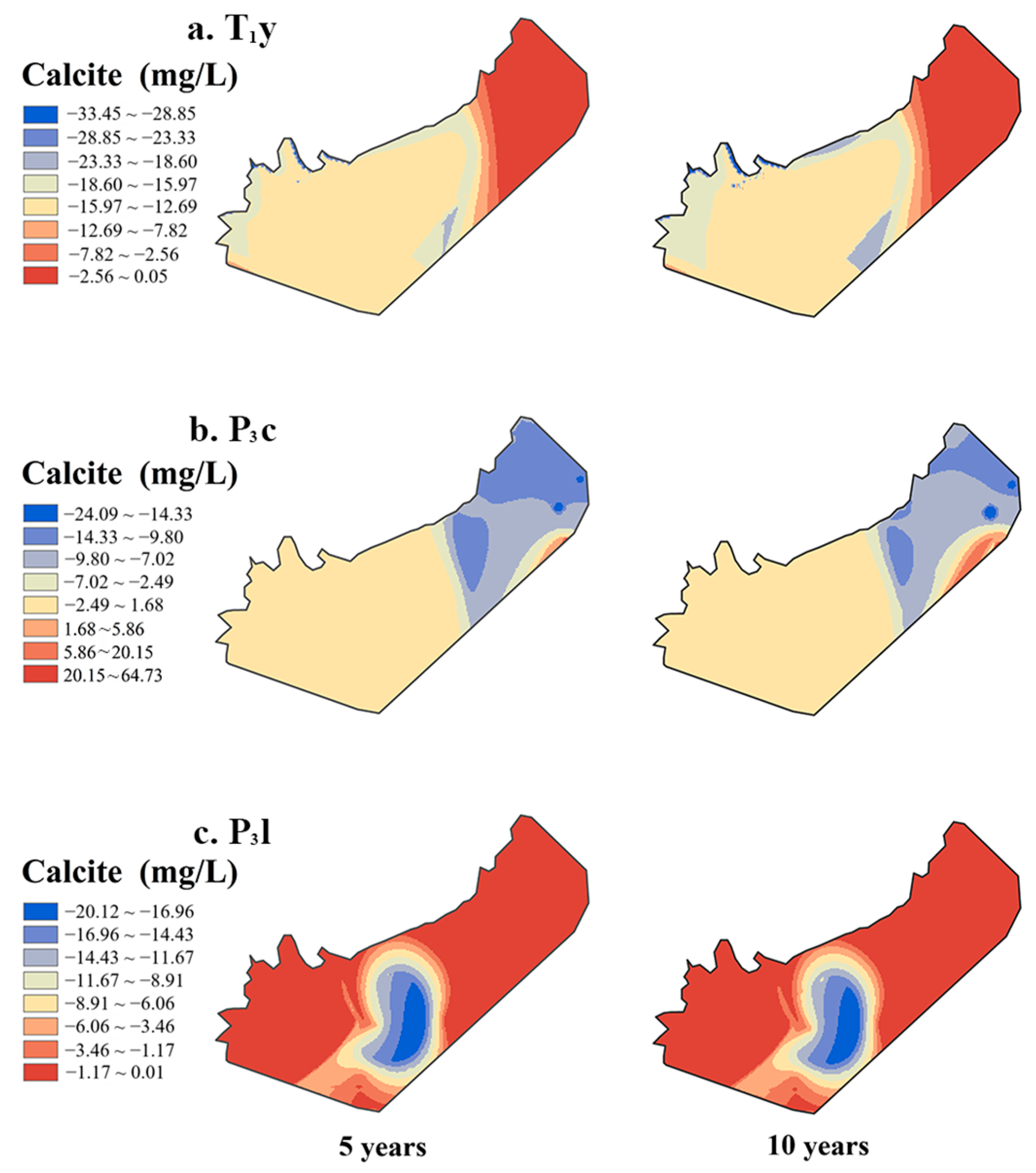
The aquifer lithology in Qinglong Coal Mine is dominated by calcite and dolomite, which dissolve naturally. Ca2+ and Mg2+ are mainly derived from these carbonate rocks. Minor disturbances (e.g., roadway excavation) rarely alter this balance. Lv et al. [10] confirmed that shallow underground engineering excavation only causes slight groundwater disturbance, concentrated in local fissures. It does not change mineral dissolution-precipitation equilibrium or trigger large-scale water flow alternation. However, the H+ released from pyrite oxidation strengthens lixiviation. Pumping accelerates groundwater flow, increasing the hydraulic gradient. This promotes limestone dissolution in the aquifer, triggering karst reactions, as shown in Figure 15.
Tian et al. [7] corroborated this mechanism in the Tengxian Coalfield. Through multi-hole aquifer tests, it was found that groundwater runoff in the Ordovician aquifer is sluggish under normal conditions. However, hydrodynamic changes were triggered under mining conditions. Their research indicated that hydrochemical evolution under mining disturbance is mainly controlled by cation exchange. This finding aligns with the results of the coupled simulation in this study. It illustrates that mining disrupts hydrogeological structures, enlarges aquifer fissures, and accelerates groundwater runoff. Combined with pyrite oxidation, this enhances short-term carbonate rock dissolution. It explains why reactions (8) and (9) proceed forward in Qinglong Coal Mine.
C a C O 3 + H + C a 2 + + H C O 3
C a M g ( C O 3 ) 2 + 2 H + C a 2 + + M g 2 + + 2 H C O 3
As a result, H+ in groundwater is consumed and a large amount of Ca2+, Mg2+, and HCO3 is generated.
Local HCO3 changes correspond to pH changes, especially in P3c. Near pumping wells, HCO3 first increases then decreases as shown in Figure 13b. This likely stems from neutralization between H+ (from pyrite oxidation) and HCO3 (from carbonate equilibrium), as shown in reaction (10):
H + + H C O 3 H 2 C O 3 C O 2 ( g ) + H 2 O
Increased HCO3 and H+ drive the reaction rightward. Generated HCO3 is continuously consumed, and CO2 escapes via the wellhead, sustaining the reaction. Thus, HCO3 is simultaneously generated and consumed. Under the influence of no mining activities, HCO3 is influenced by atmospheric precipitation and natural karstification [41]. Without mining, HCO3 is influenced by atmospheric precipitation and natural karstification [41]. After mining, it is mainly controlled by groundwater carbonate balance, especially near pumping wells, where oxidation and pumping strongly affect carbonic acid balance. It significantly reduces HCO3 [19]. In other regions, lixiviation outweighs carbonate balance, increasing HCO3.
Additionally, the total change in Ca2+ and Mg2+ exceeds that of HCO3. As lixiviation progresses, the Ca2+ and Mg2+ concentrations rise, as shown in Figure 13d,f, respectively. Coal mining induces water-level decline and enhances water–rock interaction, which promotes strong Ca2+-Na+ cation exchange [7,19]. During long-term pumping, groundwater undergoes cation exchange adsorption with argillaceous bands in the formation. The specific reaction is as follows:
C a ( 2 + ) ( l ) + 2 N a + ( s ) 2 N a + ( l ) + C a ( 2 + ) ( s )
Ca2+ in groundwater replaces Na+ adsorbed by rock and soil, theoretically increasing Na+ content and decreasing Ca2+ in groundwater, as shown in Figure 13d,e. However, the increased hydraulic gradient from pumping reduces water–rock contact time, potentially preventing full ion exchange equilibrium [66]. Additionally, limited exchangeable Na+ in aqueous media also constrains Na+ changes. These factors explain why PHREEQC simulations show insignificant Na+ concentration changes, with variations only in individual areas.
Cl is a conservative ion, rarely participating in hydrogeochemical reactions [41]. Its concentration is mainly controlled by hydraulic convection–dispersion. Zhan et al. [4] confirmed Cl concentrations remain stable, as mining barely affects its sources and dissolution. The enhanced water–rock interaction primarily alters SO42− rather than Cl. Thus, Cl shows little change when hydrogeochemical reactions are considered in Figure 13c. Solute transport results are similar in P3c and P3l aquifers. T1y, however, is noticeably influenced by river recharge, leading to increased Cl concentrations.

5. Conclusions

5.1. Main Research Conclusions

This study analyzes the evolution of the groundwater chemical field under coal mining conditions, considering the distribution characteristics and driving mechanisms of groundwater chemical components. Combined with the actual conditions of Qinglong Coal Mine, by coupling hydrogeochemical reaction simulations (PHREEQC module) with solute transport simulations (MT3D module), the study quantitatively analyzes the evolution trend of groundwater chemical characteristics affected by mining in the main coal seam aquifer (P3l) and its roof aquifers (P3c and T1y). The main conclusions are summarized as follows:
  • The three aquifers in Qinglong Coal Mine exhibit distinct hydrochemical characteristics, with coal mining disturbance serving as the primary driver of local anomalies. The coupled model effectively captures the dynamic flow chemistry response.
  • Mining induces pronounced local hydrodynamic changes in the groundwater flow field, establishing hydraulic connectivity between the coal seam aquifer and roof aquifer at fissure-connected locations. These hydrodynamic alterations are the key drivers of hydrochemical evolution in the mining area.
  • Groundwater chemistry in fissure aquifers within coalfields is primarily controlled by lixiviation. Mining disturbs the coal seam aquifer, shifting it from reducing to oxidizing conditions. This triggers pyrite oxidation, leading to slight acidification. Local ion enrichment in roof aquifers mainly results from pumping effects at fracture zones.
The above conclusions provide valuable references for similar fissure aquifers and coalfields with multiple superimposed structures.

5.2. Research Limitations and Future Prospects

The karst-fissure groundwater is simulated based on an equivalent porous medium model. It focuses on the influence of major fissures but neglects aquifer heterogeneity. For areas with well-defined, easily characterizable, and large-scale fissures, the aforementioned methods can effectively capture the overall evolutionary trends. However, for localized changes within the mining area, such as variations in the hydrochemical composition around a specific mine shaft, the model’s predictive accuracy is insufficient. Due to limited available data, the existing data are used for exploration. Some abnormal data are adjusted during interpolation. Insufficient data may lead to inaccurate concentration characterization. If regional data are sufficient, the aforementioned methods can be employed for more accurate characterization. In this study, only the pumping under mining conditions was simulated. Two pumping wells were set up in the model. If other pollutant ions are discharged, they can be drained through wells, and additional contaminants can be incorporated.
In the future, the heterogeneity of the karst fissure aquifer will be described by combining relevant geological data. Uncertainty will also be introduced into the model to improve the accuracy of model characterization. This will further explore the groundwater chemical environment under the influence of coal mining.

Author Contributions

Conceptualization, methodology, writing—original draft preparation, Y.P. and H.L.; software, validation, formal analysis, investigation, Y.P., H.L. and C.X.; writing—review and editing, supervision, Y.P. and W.X.; funding acquisition, Y.P. All authors have read and agreed to the published version of the manuscript.

Funding

This research was funded by the National Key Research and Development Program of China, grant number 2023YFC3012102, and the National Natural Science Foundation of China, grant number 42402236.

Institutional Review Board Statement

All authors have read, understood, and complied as applicable with the statement on “Ethical responsibilities of Authors,” as found in the Instructions for Authors, and are aware that, with minor exceptions, no changes can be made to authorship once the paper is submitted.

Informed Consent Statement

Not applicable.

Data Availability Statement

The data presented in this study are available on request from the corresponding author.

Acknowledgments

We gratefully acknowledge the support of all staff involved in this study. We are particularly grateful to Shicun Li for his meticulous language polishing and editorial suggestions.

Conflicts of Interest

The authors declare no conflicts of interest.

References

  1. IEA. World Energy Investment 2025; IEA: Paris, France, 2025; Available online: https://www.iea.org/reports/world-energy-investment-2025 (accessed on 9 February 2026).
  2. Liu, Z.J.; Wang, X.H.; Wan, X.; Jia, S.Q.; Mao, B.Y. Evolution origin analysis and health risk assessment of groundwater environment in a typical mining area: Insights from water-rock interaction and anthropogenic activities. Environ. Res. 2024, 252, 118792. [Google Scholar] [CrossRef]
  3. Mu, W.P.; Wu, X.; Deng, R.C.; Hao, Q.; Qian, C. Mechanism of Water Inrush Through Fault Zones Using a Coupled Fluid–solid Numerical Model: A Case Study in the Beiyangzhuang Coal Mine, Northern China. Mine Water Environ. 2020, 39, 380–396. [Google Scholar] [CrossRef]
  4. Zhan, H.; Liu, S.Q.; Wu, Q.; Liu, W.T.; Shi, L.H.; Liu, D. Effects of deep coal mining on groundwater hydrodynamic and hydrochemical processes in a multi-aquifer system: Insights from a long-term study of mining areas in ecologically fragile western China. J. Contam. Hydrol. 2024, 265, 104386. [Google Scholar] [CrossRef] [PubMed]
  5. Zhu, M.T.; Chen, J.J.; He, C.H.; Ren, S.; Guo, L.C. Multi-method characterization of groundwater nitrate and sulfate contamination by karst mines in southwest China. Sci. Total Environ. 2024, 946, 174375. [Google Scholar] [CrossRef]
  6. Wang, C.Y.; Liao, F.; Wang, G.C.; Qu, S.; Mao, H.R.; Bai, Y.F. Hydrogeochemical evolution induced by long-term mining activities in a multi-aquifer system in the mining area. Sci. Total Environ. 2023, 854, 158806. [Google Scholar] [CrossRef] [PubMed]
  7. Tian, B.; Chang, L.C.; Zhao, D.Q.; Li, J.Y.; Zhu, H.F.; Dong, F.Y. Hydrochemical Evolution of Karst Groundwater and Mining-Induced Activation Effects in a Coal Mining Area: A Case Study from the Tengxian Coalfield, China. ACS Omega 2025, 10, 42548–42560. [Google Scholar] [CrossRef] [PubMed]
  8. Chen, W.X.; Pu, L.C.; Luo, Y.; Li, B.; Peng, J.C.; Jin, X.J. Behavior of Sb and as in the hydrogeochemistry of adjacent karst underground river systems and the responses of such systems to mining activities. Sci. Total Environ. 2023, 857, 159411. [Google Scholar] [CrossRef]
  9. Scanlon, B.R.; Mace, R.E.; Barrett, M.E.; Smith, B. Can we simulate regional groundwater flow in a karst system using equivalent porous media models? Case study, Barton Springs Edwards aquifer, USA. J. Hydrol. 2003, 276, 137–158. [Google Scholar] [CrossRef]
  10. Lv, Y.X.; Hu, W.; Jiang, Y.J.; He, B.H. Hydrogeochemical evaluation of the impact of tunnel excavation on groundwater circulation in a karst trough valley, Chongqing, China. Hydrogeol. J. 2025, 33, 279–291. [Google Scholar] [CrossRef]
  11. Zhang, J.; Zhang, L.; Kang, F.X.; Yuan, Z.W.; Jiang, J.D.; Jin, M.G. Hydrochemical Evolution Characteristics, Water Quality and Potential Nitrate Health Hazards of Groundwater Systems from Karst Mountainous to Alluvial Plain in Jinan, North China. Soc. Sci. Res. Net. 2025, 5243249. [Google Scholar] [CrossRef]
  12. Andreychouk, V.; Rozkowski, J.; Niedoba, T.; Teleshman, I. Hydrogeochemical and karstological effects of the activation of water circulation within a gyp sum quarry (based on the example of Criva Quarry, Moldova Republic). Geol. Q. 2025, 69, 1778. [Google Scholar]
  13. Hou, J.Y.; Xiang, Z.; Hu, Y. Classification of groundwater systems and system characteristics in the Datang synclinal area of north Guizhou. Carsologica Sin. 2025, 44, 48–56. [Google Scholar]
  14. An, R.; Li, B.; Li, J.; Li, S.P.; Zhu, Q.Y.; Liu, X.Y.; Guo, H.M.; Li, W.P.; Liu, K. Quantifying the vulnerability of karst groundwater to emerging organic compounds in southwest China. Environ. Pollut. 2025, 388, 127374. [Google Scholar] [CrossRef]
  15. Joshua, O.I.; Setyo, B.K.; Kingsley, O.I.; Chukwunonso, O.A.; Chinenye, A.I. A review of treatment technologies for the mitigation of the toxic environmental effects of acid mine drainage (AMD). Process Saf. Environ. Prot. 2022, 157, 37–58. [Google Scholar]
  16. Amidu, A.M.; Frances, C.; George, J.M.; Ryosuke, K.; Walubita, M.; Akizumi, I.; Tsubasa, O. Geochemical characterization and potential impact of coal mine drainage on river water quality at selected coal mines in the Livingstonia Coalfield, Malawi. Appl. Geochem. 2026, 196, 106636. [Google Scholar]
  17. Hao, C.M.; Sun, X.M.; Xie, B.; Hou, S.L. Increase in fluoride concentration in mine water in Shendong mining area, Northwest China: Insights from isotopic and geochemical signatures. Ecotox. Environ. Saf. 2022, 236, 113496. [Google Scholar] [CrossRef]
  18. Qiu, H.L.; Gui, H.R.; Xu, H.F.; Cui, L.; Li, Z.C.; Yu, H. Quantifying nitrate pollution sources of shallow groundwater and related health risks based on deterministic and Monte Carlo models: A study in Huaibei mining area, Huaibei coalfield, China. Ecotox. Environ. Saf. 2023, 249, 114434. [Google Scholar] [CrossRef] [PubMed]
  19. Yan, F.Y.; Wang, E.Z.; Guo, Y.Y.; Liu, X.L.; Qi, C.Z.; Chen, Y. Spatiotemporal evolution mechanisms of groundwater seepage-chemical coupling fields in Pingshuo mining area Available to Purchase. Phys. Fluids 2025, 37, 066607. [Google Scholar] [CrossRef]
  20. Li, X.X.; Wu, P.; Han, Z.W.; Zha, X.F.; Ye, H.J.; Qin, Y.J. Effects of mining activities on evolution of water quality of karst waters in Midwestern Guizhou, China: Evidences from hydrochemistry and isotopic composition. Environ. Sci. Pollut. Res. 2018, 25, 1220–1230. [Google Scholar] [CrossRef]
  21. Tu, Z.H.; Wu, Q.; He, H.P.; Zhou, S.; Liu, J.; He, H.J.; Liu, C.M.; Dang, Z.; Reinfelder, J.R. Reduction of acid mine drainage by passivation of pyrite surfaces: A review. Sci. Total Environ. 2022, 832, 155116. [Google Scholar] [CrossRef] [PubMed]
  22. Akcil, A.; Koldas, S. Acid Mine Drainage (AMD): Causes, treatment and case studies. J. Clean. Prod. 2006, 14, 1139–1145. [Google Scholar] [CrossRef]
  23. Liu, J.T.; Hao, Y.J.; Gao, Z.J.; Wang, M.; Liu, M.X.; Wang, Z.Y.; Wang, S. Determining the factors controlling the chemical composition of groundwater using multivariate statistics and geochemical methods in the Xiqu coal mine, North China. Environ. Earth Sci. 2019, 78, 364. [Google Scholar] [CrossRef]
  24. Kim, J.Y.; Chon, H.T. Pollution of a water course impacted by acid mine drainage in the Imgok creek of the Gangreung coal field, Korea. Appl. Geochem. 2001, 16, 1387–1396. [Google Scholar] [CrossRef]
  25. Lin, Y.; Ren, H.X.; Wu, Y.Z.; Cao, F.L.; Jia, F.J.; Qu, P.C. The evolution of hydrogeochemical characteristics of a typical piedmont karst groundwater system in a coal-mining area, Northern China. Environ. Earth Sci. 2019, 78, 557. [Google Scholar] [CrossRef]
  26. An, S.K.; Jiang, C.L.; Zhang, W.X.; Chen, X.; Zheng, L.G. Influencing factors of the hydrochemical characteristics of surface water and shallow groundwater in the subsidence area of the Huainan Coalfield. Arab. J. Geosci. 2020, 13, 191. [Google Scholar] [CrossRef]
  27. Oteri, A.U. Geoelectric investigation of saline contamination of a chalk aquifer by mine drainage water at Tilmanstone, England. Geoexploration 1981, 19, 179–192. [Google Scholar] [CrossRef]
  28. Feng, F.S.; Chen, G.Y.; Yao, T.T.; Wei, Y.; Shan, Y.P.; Su, W.L. Increasing anthropogenic contributions on hydrochemical evolution of groundwater in the Yellow River basin over the past decade. Appl. Geochem. 2025, 183, 106331. [Google Scholar] [CrossRef]
  29. Zhang, M.; Chen, L.W.; Hou, X.W.; Hu, Y.S.; Zhang, J.; Li, J.; Yin, X.X.; Shi, X.P.; Cai, X.Y. Patterns of spatiotemporal variations in the hydrochemistry and controlling factors of bedrock aquifers in the northern region of the Linhuan mining area. J. Contam. Hydrol. 2024, 26, 104450. [Google Scholar] [CrossRef]
  30. Yan, Y.T.; Zhang, Y.H.; Sun, Z.X.; Xie, Z.; Yao, R.W.; Chen, S.; Uddin, M.G.; Pu, Y.J.; Yang, C.; Wang, Y.; et al. Using unsupervised machine learning and positive matrix factorization models to drive groundwater chemistry and associated health risks in a coal? mining rural region. J. Hydrol. 2025, 661, 133691. [Google Scholar] [CrossRef]
  31. Zhang, H.T.; Xu, G.Q.; Chen, X.Q.; Mabaire, A.; Zhou, J.S.; Zhang, Y.X.; Zhang, G.; Zhu, L. Groundwater Hydrogeochemical Processes and the Connectivity of Multilayer Aquifers in a Coal Mine with Karst Collapse Columns. Mine Water Environ. 2020, 39, 356–368. [Google Scholar] [CrossRef]
  32. Chen, X.Q.; Zhang, H.T.; Cai, Y.J. Hydrochemical characteristics and processes of groundwater in the Cenozoic pore aquifer under coal mining. Environ. Sci. Pollut. Res. 2023, 30, 33334–33348. [Google Scholar] [CrossRef]
  33. Surinaidu, L.; Gurunadha-Rao, V.V.S.; Srinivasa-Rao, N.; Srinu, S. Hydrogeological and groundwater modeling studies to estimate the groundwater inflows into the coal Mines at different mine development stages using MODFLOW, Andhra Pradesh, India. Water Resour. Ind. 2014, 7–8, 49–65. [Google Scholar] [CrossRef]
  34. Qiao, X.J.; Li, G.M.; Li, M.; Zhou, J.L.; Du, J.; Du, C.Y.; Sun, Z.H. Influence of coal mining on regional karst groundwater system: A case study in West Mountain area of Taiyuan City, northern China. Environ. Earth Sci. 2011, 64, 1525–1535. [Google Scholar] [CrossRef]
  35. Khan, M.S.H.; Haque, E.; Ahmed, M.; Mallick, J.; Islam, A.R.T.; Fattah, A. Quantitative analysis and modeling of groundwater flow using visual MODFLOW: A case from subtropical coal mine, northwest Bangladesh. Environ. Dev. Sustain. 2024, 26, 12971–12993. [Google Scholar] [CrossRef]
  36. Lee, K.Y. Modeling Long-Term Transport of Contaminants Resulting from Dissolution of a Coal Tar Pool in Saturated Porous Media. J. Environ. Eng. 2005, 130, 1507–1513. [Google Scholar] [CrossRef]
  37. Guo, H.M.; Wang, Y.X. Hydrogeochemical processes in shallow Quaternary aquifers from the northern part of the Datong Basin, China. Appl. Geochem. 2004, 19, 19–27. [Google Scholar] [CrossRef]
  38. Guo, Y.N.; Li, G.Q.; Wang, L.; Zhang, Z. Hydrochemical Characteristics of Mine Water and Their Significance for the Site Selection of an Underground Reservoir in the Shendong Coal Mining Area. Water 2023, 15, 1038. [Google Scholar] [CrossRef]
  39. Huang, H.; Chen, Z.; Wang, T.; Zhang, L.; Zhou, G.; Sun, B.; Wang, Y. Characteristics and processes of hydrogeochemical evolution induced by long-term mining activities in karst aquifers, southwestern China. Environ. Sci. Pollut. Res. 2019, 26, 30055–30068. [Google Scholar] [CrossRef] [PubMed]
  40. Gomo, M.; Vermeulen, D. Hydrogeochemical characteristics of a flooded underground coal mine groundwater system. J. Afr. Earth Sci. 2014, 92, 68–75. [Google Scholar] [CrossRef]
  41. Tang, C.L.; Zheng, X.Q.; Liang, Y.P. Hydrochemical Characteristics and Formation Causes of Ground Karst Water Systems in the Longzici Spring Catchment. Environ. Sci. 2020, 41, 2087–2095. [Google Scholar]
  42. Zhou, L.; Ye, T.; Zheng, S.S.; Zhu, X.Q.; Chen, Z.W.; Wu, Y. Experimental and modeling investigation of dual-source iron release in water-solid-gas interaction of abandoned coal mine drainage. Environ. Geochem. Health 2023, 45, 8433–8449. [Google Scholar] [CrossRef]
  43. Jiang, B.B.; Gao, J.; Du, K.; Deng, X.; Zhang, K. Insight into the water–rock interaction process and purification mechanism of mine water in underground reservoir of Daliuta coal mine in China. Environ. Sci. Pollut. Res. 2022, 29, 28538–28551. [Google Scholar] [CrossRef]
  44. Mohamed, J.E.H.; Abdelkabir, M.; Tikou, B.; Marie-Elise, V. Three-Dimensional Groundwater and Geochemical Reactive Transport Modeling to Assess Reclamation Techniques at the Quémont 2 Mine, Rouyn-Noranda, Canada. Water 2025, 17, 1191. [Google Scholar]
  45. Cui, H.; Duan, L.M.; Pan, H.; Liu, T.X. Geochemical pattern, quality and driving forces of multi-layer groundwater in a high-capacity mining area basin: A comprehensive analysis based on the interweaving of multiple factors. J. Hydrol. 2025, 660, 133376. [Google Scholar] [CrossRef]
  46. Jiang, J. Structural Characteristics of Qinglong Mine and Its Control Mechanism on Mine Water. Ph.D. Thesis, China University of Mining and Technology, Xuzhou, China, 2017. (In Chinese) [Google Scholar]
  47. Xu, B.; He, M. Guizhou Coalfield Geology Bureau, Coalfield Geology in Guizhou; China University of Mining and Technology Press: Xuzhou, China, 2003. (In Chinese) [Google Scholar]
  48. GB/T 5750.2-2006; Standard Examination Methods for Drinking Water—Collection and Preservation of Water Samples. National Health Commission of the People’s Republic of China: Beijing, China; National Standardization Administration: Beijing, China, 2006.
  49. Yan, Z.X.; Li, Z.B.; Li, P.; Zhao, C.X.; Xu, Y.T.; Cui, Z.W.; Sun, H. Hydrochemical assessments and driving forces of water resources in coal mining areas: A case study of the Changhe River Basin, Shanxi. Environ Earth Sci. 2023, 82, 447. [Google Scholar] [CrossRef]
  50. GB/T 14848-2017; Groundwater Quality Standards. Ministry of Ecology and Environment of the People’s Republic of China: Beijing, China, 2017.
  51. Hou, Z.M.; Huang, L.; Zhang, S.W.; Han, X.; Xu, J.; Li, Y.N. Identification of groundwater hydrogeochemistry and the hydraulic connections of aquifers in a complex coal mine. J. Hydrol. 2024, 628, 130496. [Google Scholar] [CrossRef]
  52. Zhao, C.Q.; Li, X.Q.; Wang, Z.X.; Hou, X.W.; Ma, J.F. Integration of self-organizing maps and entropy-weighted quality index methods to study hydrochemical processes and quality assessment in Qilian coal base of China. Environ. Earth Sci. 2024, 83, 92. [Google Scholar] [CrossRef]
  53. Abu-Bakar, H.; Zarrouk, S.J. Geochemical multiaquifer assessment of the Huntly coalfield, New Zealand, using a novel chloride-bicarbonate-boron ternary diagram. Int. J. Coal Geol. 2016, 167, 136–147. [Google Scholar] [CrossRef]
  54. Raza, I.; Kgalid, P.; Ehsan, I.M. Geospatial interpolation and hydro-geochemical characterization of alluvial aquifers in the Thal Desert, Punjab, Pakistan. PLoS ONE 2024, 19, e0307025. [Google Scholar] [CrossRef]
  55. Lu, C.; Cheng, W.J.; Yin, H.Y.; Li, S.; Zhang, Y.; Dong, F.Y.; Cheng, Y.X.; Zhang, X.R. Study on inverse geochemical modeling of hydrochemical characteristics and genesis of groundwater system in coal mine area—A case study of Longwanggou Coal Mine in Ordos Basin. Environ. Sci. Pollut. Res. 2024, 31, 16583–16600. [Google Scholar] [CrossRef]
  56. Gastmans, D.; Chang, H.K.; Hutcheo, I. Groundwater geochemical evolution in the northern portion of the Guarani aquifer system (Brazil) and its relationship to diagenetic features. Appl. Geochem. 2010, 25, 16–33. [Google Scholar] [CrossRef]
  57. Zhang, H.T.; Xu, G.Q.; Chen, X.Q. Hydrogeochemical evolution of multilayer aquifers in a massive coalfield. Environ. Earth Sci. 2019, 78, 675. [Google Scholar] [CrossRef]
  58. Wu, J.H.; Li, P.Y.; Qian, H.; Duan, Z. Using correlation and multivariate statistical analysis to identify hydrogeochemical processes affecting the major ion chemistry of waters: A case study in Laoheba phosphorite mine in Sichuan, China. Arab. J. Geosci. 2014, 7, 3973–3982. [Google Scholar] [CrossRef]
  59. Liu, P.; Yang, M.; Sun, Y.J. Hydrogeochemical processes of the deep Ordovician groundwater in a coal mining area. Hydrogeol. J. 2019, 27, 2231–2244. [Google Scholar] [CrossRef]
  60. He, S.F.; Cheng, Y.C.; Xie, H. Water chemistry characteristics and their causes of limestone groundwater in Panxie Mining Area. Energy Environ. Prot. 2020, 34, 37–43. [Google Scholar]
  61. Langevin, C.D.; Provost, A.M.; Panday, S.; Hughes, J.D. Documentation for the MODFLOW 6 Groundwater Transport Model. In Techniques and Methods; Book 6, Chapter A61; U.S. Geological Survey: Reston, VA, USA, 2022; p. 56. [Google Scholar]
  62. Bedekar, V.; Morway, E.D.; Langevin, C.D.; Tonkin, M. MT3D-USGS version 1: A U.S. Geological Survey release of MT3DMS updated with new and expanded transport capabilities for use with MODFLOW. In Techniques and Methods; U.S. Geological Survey: Reston, VA, USA, 2016. [Google Scholar]
  63. Parkhurst, D.L.; Appelo, C.A.J. Description of input and examples for PHREEQC version 3—A computer program for speciation, batch-reaction, one-dimensional transport, and inverse geochemical calculations. In Techniques and Methods; Book 6, Chapter A43; U.S. Geological Survey: Reston, VA, USA, 2013; p. 497. [Google Scholar]
  64. Scardi, M.; Harding, L.W. Developing an empirical model of phytoplankton primary production: A neural network case study. Ecol. Model. 1999, 120, 213–223. [Google Scholar] [CrossRef]
  65. Christ, J.A.; Lemke, L.D.; Abriola, L.M. Comparison of two-dimensional and three-dimensional simulations of dense nonaqueous phase liquids (DNAPLs): Migration and entrapment in a nonuniform permeability field. Water Resour. Res. 2005, 41, 733–745. [Google Scholar] [CrossRef]
  66. Zhang, J.; Chen, L.W.; Hou, X.W.; Li, J.; Ren, X.X.; Lin, M.L.; Zhang, M.; Wang, Y.X.; Tian, Y. Effects of multi-factors on the spatiotemporal variations of deep confined groundwater in coal mining regions, North China. Sci. Total Environ. 2022, 823, 153741. [Google Scholar] [CrossRef]
Figure 1. Schematic diagram of Qinglong Coal Mine.
Applsci 16 02200 g001
Figure 2. Technical roadmap of groundwater chemical characteristics research in Qinglong Coal Mine.
Applsci 16 02200 g002
Figure 3. (a) Piper, (b) Durov, and (c) Schoeller diagrams of Qinglong Coal Mine groundwater.
Applsci 16 02200 g003
Figure 4. The ion ratio diagram of Qinglong Coal Mine groundwater: (a) p(HCO3−SO42−)/p(Ca2++Mg2+); (b) p(HCO3)/p(Ca2+); (c) p(SO42−)/p(Ca+); (d) p(Cl)/p(Na+); (e) p(Ca2++Na+−HCO3−SO42−)/p(Na+−Cl); and (f) p(SO42−)/p(Cl). (p is the ion milligram equivalent).
Applsci 16 02200 g004
Figure 5. Gibbs plot of Qinglong Coal Mine.
Applsci 16 02200 g005
Figure 6. The flow chart of coupled MODFLOW, MT3D, and PHREEQC.
Applsci 16 02200 g006
Figure 7. Conceptual hydrogeological model of Qinglong Coal Mine: (a) T1y aquifer; (b) P3c aquifer; and (c) P3l aquifer.
Applsci 16 02200 g007
Figure 8. Validation of groundwater flow field model.
Applsci 16 02200 g008
Figure 9. Sensitivity analysis of groundwater flow model parameters.
Applsci 16 02200 g009
Figure 10. Comparison of groundwater flow field before and after mining in Qinglong Coal Mine: (a1) the original flow field of T1y; (a2) the flow field of T1y after pumping; (A1) the original mutation flow of T1y; (A2) the mutation flow of T1y after pumping; (b1) the original flow field of P3c; (b2) the flow field of P3c after pumping; (B1) the original mutation flow of P3c; (B2) the mutation flow of P3c after pumping; (c1) the original flow field of P3l; (c2) the flow field of P3l after pumping and S1, S2 are two pumping wells.
Applsci 16 02200 g010
Figure 11. The ion distribution of Qinglong Coal Mine: (a) T1y aquifer; (b) P3c aquifer; and (c) P3l aquifer.
Applsci 16 02200 g011
Figure 12. The ion concentration difference distribution of the groundwater MT3D model under the influence of pumping in Qinglong Coal Mine: (a) SO42−; (b) HCO3; (c) Cl; (d) Ca2+; (e) Na+; and (f) Mg2+.
Applsci 16 02200 g012
Figure 13. The ion concentration difference distribution of the PHREEQC model under the influence of pumping in Qinglong Coal Mine: (a) SO42−; (b) HCO3; (c) Cl; (d) Ca2+; (e) Na+; and (f) Mg2+.
Applsci 16 02200 g013
Figure 14. The pH difference distribution of the groundwater PHREEQC model in Qinglong Coal Mine: (a) T1y aquifer; (b) P3c aquifer; and (c) P3l aquifer.
Applsci 16 02200 g014
Figure 15. The calcite difference distribution of the groundwater PHREEQC model in Qinglong Coal Mine: (a) T1y aquifer; (b) P3c aquifer; and (c) P3l aquifer.
Applsci 16 02200 g015
Table 1. Part of the strata column of Qinglong Coal Mine [46].
StratigraphyFigure
1:25,000
Depth
Min
Max
Lithology
SystemFormation
TriassicMaocaopu Formation (T1m)Applsci 16 02200 i001189


757
Dolomite
and
limestone
PermianYelang Formation (T1y)247


420
Limestone
intercalated
mustone
Changxing Formation (P3c)25–43Limestone with chert lump
Longtan Formation (P3l)136

276
Silstone, mudstone with coal line
Emeishan Basalt Formation (P3β)56–60Basalt contains limestone
Table 2. Test results of groundwater samples from Qinglong Coal Mine. (mg/L).
SampleSO42−ClHCO3Ca2+Mg2+Na+
Y1162.302.66218.78119.7413.693.15
Y230.403.76243.8687.714.062.43
Y3765.002.16156.02254.6459.148.59
C160.005.52191.7885.104.983.33
C270.8322.51212.2263.8111.6140.09
C316.6421.56231.6833.378.9249.66
L1855.009.7016.72150.4365.496.47
L21040.002.25286.12388.5865.9212.57
L350.0010.08360.416.701.84158.35
L433.9925.0132.5746.2710.21252.27
L5183.5714.64163.2872.0410.9356.00
L6115.667.98195.5695.898.417.91
M116.0511.07125.7936.199.085.15
M223.679.01126.0334.9112.632.22
R172.754.42201.6973.2614.403.80
R273.893.94201.7073.0314.663.32
Table 3. The parameters in the groundwater numerical model.
AquiferT [m2/d]S*θRD [m2/d]
T1y11.44.21 × 10−30.31.2 × 10−43.5
P3c2.180.95 × 10−30.22/1.5
P3l0.950.62 × 10−30.2/0.8
Disclaimer/Publisher’s Note: The statements, opinions and data contained in all publications are solely those of the individual author(s) and contributor(s) and not of MDPI and/or the editor(s). MDPI and/or the editor(s) disclaim responsibility for any injury to people or property resulting from any ideas, methods, instructions or products referred to in the content.